Blog Archives
Watchmen (2009)
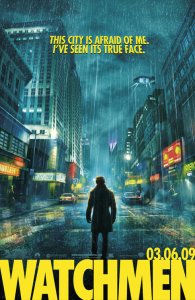 In the realm of comics, Watchmen is tantamount to the Bible. It consisted of 12 issues released between 1986-1987 but it arguable changed the medium forever afterward. TIME magazine listed the book, by author Alan Moore and artist Dave Gibbons, as one of the 100 greatest 20th century novels. Therefore, there has always been heavy trepidation within the geek community when Hollywood came courting the Watchmen property. Different directors have tried tackling the material, going back to the late 1980s when Terry Gilliam was hired to direct and producer Joel Silver was adamant about getting Arnold Schwarzenegger to portray Dr. Manhattan (back then, they totally just would have painted him blue — like they did when he was Mr. Freeze). The movie would seem like a tantalizing possibility and then the production would collapse, most recently in 2004 with director Paul Greengrass attached. Director Zack Snyder (300) understood all of the concerns from the notoriously vocal geek community and attempted to make the most faithful Watchmen film possible. He accomplished that goal. But was it the right goal?
In this alternative account of history, masked crime fighters exist and were even bankrolled by the U.S. government. President Nixon is re-elected to a third term, thanks in part to superheroes winning the Vietnam War, and then he outlaws all masked vigilantes. Flash forward to 1985, and Nixon is on his fifth term and staring down Soviet aggression into Afghanistan. It appears that the world on is on the brink of nuclear annihilation by the dueling super powers engaged in a staring contest. Edward Blake, a.k.a. the Comedian (Jeffrey Dean Morgan), is thrown from his apartment window and killed. Blake used to belong to a second-generation superhero team in the 1970s called the Watchmen. The other members consisted of Dan Dreiberg, a.k.a. Night Owl (Patrick Wilson), Rorschach (Jackie Earle Haley), Adrian Veidt (Matthew Goode), a.k.a. Ozymandias, the glowing blue man Dr. Manhattan (Billy Crudup), who was transformed into a god-like figure of power after a laboratory accident, and then there’s Laurie Jupiter, a.k.a. The Silk Spectre (Malin Akerman), who was following in her mother’s (Carla Gugino) footsteps, the first Silk Spectre. The death of the Comedian brings the old team back together and rekindles some interest in putting on the super suits and fighting crime one more time. It seems someone out there is trying to knock off the retired superheroes, and Rorschach is convinced that a bigger conspiracy is unwinding.
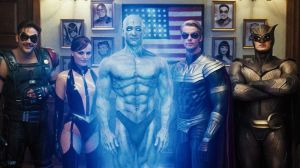 It’s difficult for me to formally express my feelings and reactions to the Watchmen film adaptation. Count me among the throng of fans that feels that Moore’s source material is a remarkably dense and witty deconstruction of the superhero mythos. Imagine a Superman that can’t be bothered to help out humanity because he feels life is overrated, or a group of super heroes that don’t necessarily do anything heroic; when they beat up the bad guys it’s because they get a sexual thrill from the rush of violence. My voice was among the cacophonous crowd screaming, “Don’t you dare butcher this great work! Keep it as close to the comic as possible!” And that’s pretty much what Snyder delivers. But now I’m left to wonder if a literal-minded interpretation is truly what I wanted all along. Watchmen is not like Sin City, a comic that was already a movie in panels. Frank Miller’s ode to film noir was ready and waiting to be a splashy action movie with style to spare. Watchmen is not a ready-made action vehicle, as it really only has about two extended pieces of action. Moore’s story examined what kind of people would become vigilante crime fighters if the government approved the practice. Surprise, it’s a bunch of sociopaths that are now getting checks from Uncle Sam! Watchmen is a nihilistic account of human behavior and far more cerebral than any superhero film that has ever graced the screen. Seriously, what other superhero movie opens with a fictitious episode of PBS’ political yak fest, The McLaughlin Group? So I suppose this paragraph is a sheepish way of admitting that perhaps Watchmen should have stayed place on the page unless, gulp, it was advantageously adapted for the medium of film.
It’s not that Snyder does a bad job or that the film itself is poor. While Snyder isn’t the best man to handle actors, he is certainly a skilled visual tactician and knows how to make some immensely pleasing imagery. He breathes great life into the images of the comic book and filled in the blanks nicely, and his one big artistic addition is one of the film’s best moments. In the opening credits we get a series of shots that perfectly establish this alternative universe, where JFK shakes Dr. Manhattan’s hand on the White House lawn only to be later gunned down by none other than the Comedian in Dallas. The segment is cleverly set to Bob Dylan’s “The Times They Are A Changin'” and is a terrific intro into a re-imagined America. I wanted to spend more time exploring the differences, like watching a giant Dr. Manhattan win the Vietnam War in one week’s time. In many ways, Watchmen is Snyder’s epic pop commentary on the history of the United States. Dr. Manhattan takes the first pictures of the astronauts on the moon. It is a female crime fighter that swoops a woman off her feet for that iconic celebratory kiss marking the end of World War II. The flick even has a period appropriate, synth-aided score, which is fine, though the use of period pop songs can be distracting. Watching Laurie and Dan make love to the raspy tunes of Leonard Cohen’s already overused tune “Hallelujah” is a deeply uncomfortable moment. Also, the aging makeup is horrendously bad. Gugino looks like she has a turkey waddle and the older Nixon looks like a freaking Halloween mask.
 At what cost did Watchmen make it to the screen? Wacthmen plays as an adaptation like the first two Harry Potter movies, like there was an assigned checklist rather than a fully developed script. I achieved a brief understanding with the characters and each central figure provides a glimpse of the trouble beneath the surface. Laurie is a girl with daddy issues who’s been pressured to follow her mother, a rape victim who still loves her rapist. Dan is a self-pitying putz who has never felt more alive than when he puts on a costume. Rorschach has the same pessimistic view of mankind that Travis Bickle did, viewing many people as vermin clogging the gutter. Yet Rorschach also is the most single-minded of all the characters and abides by an innate moral code and sense of duty, never mind the fact that he may have lost his mind. Dr. Manhattan has been turned into a supreme being and has lost his connection to humanity. The Comedian is a man of wanton desire who declares himself to be the epitome of the American dream: giving in completely to the id. Watchmen has been deemed as an unfilmable book, and perhaps they were right. It feels like Watchmen and looks like Watchmen, but the movie never seems to become anything grander than the sum of its parts. The Dr. Manhattan back-story, where we see him live life in the past, present, and future simultaneously may be one of the best moments in the movie, but it doesn’t add up to much more than an interesting aside. The trips to Mars and Antarctica provide nice visual landscapes but do little else. The other quandary is that everything Snyder cut from the comic (the side characters, the pirate comic, the alien squid) is something that ultimately was unimportant. All of the important and memorable moments from the comic are here, though abbreviated and truncated. Even a 2-hour and 40-minute movie feels like too much of a sprint through such rich material probably better suited to the more accommodating narrative confines of a glossy HBO miniseries. The movie ends up becoming a handsomely mounted and reverent homage to the source material, but I question if the movie serves any other purpose than as an advertisement to go read the book. Will people unfamiliar with the book enjoy a movie practically tailor-made to appeal to fans of the book? Who will watch the Watchmen?
Make no mistake, Watchmen is a hard R-rated movie and if any parent takes their child to this flick because it has men in capes, then that parent should have their child removed. Snyder has ramped up the book’s adult elements, which were originally a commentary on how comics flirt with sex and violence but never get their hands too dirty. Snyder has gotten his hands dirty all right. Instead of zapping others into poofs of smoke, Dr. Manhattan turns them into explosions of human goo that stick to the ceiling. Instead of the Comedian being thrown from the window, we see an extended fight sequence that seems to indicate that the Comedian’s apartment is full of nothing but breakable glass tables. When Dan and Laurie get into a street brawl where bones pop through skin. The sex scenes now involve an almost-agonizing level of thrusting. This is an adult tale in a very simple sense: there are boobs and blood. But the movie is also adult in the fact that it trades in complex political, psychological, and philosophic ideologies, asking hard questions that do not come with easy answers. Do the ends ever justify the means or is mankind destined to always destroy itself? Is humanity worth saving and at what cost? This is probably the most subversive studio-backed movie to come out of Hollywood since 1997’s pro-fascism melodrama, Starship Troopers.
 The three best performances in the movie all come from the three weirdest and most messed up characters. Haley (Little Children) fully inhabits the grisly character of Rorschach and growls his way through the movie. You can tell just by the man’s face how much he has weathered. Crudup (Big Fish) and his gentle voice make Dr. Manhattan an intriguing yet beleaguered super being. Morgan (TV’s Grey’s Anatomy) makes the Comedian one consummate bastard but a bastard that you cannot stop watching, nonetheless. The rest of the cast does suitable jobs and I don’t feel that Goode (The Lookout) or Akerman (27 Dresses) deserve the drubbings they’re getting through the critical community. I actually liked Goode’s portrayal of Ozmanydias, though he fails to express the heavy crown the smartest man in the world must bear. Gugino (Sin City) is terrific when she’s the young, spunky Silk Specter and the opposite of terrific when she’s the troubled, alcoholic older version on screen.
Snyder has served up the Watchmen that fans have been demanding for years, but is this really what everyone truly wanted? Snyder made an adaptation for the fans but what do the fans know except for lavish loyalty? The book utilized the medium of comic books to accentuated its story while commenting on the history of comics and superheroes, and when translated to the big screen as is Watchmen can feel like an artistic stillborn. I’m now more curious than ever to read the previous drafts out there, the ones that directors like Darren Aronofsky and Greengrass were going to film until the financing got pulled. One of the drafts transplants the world of Watchmen to modern day and replaces the nuclear brinksmanship with the Russians to the ongoing War on Terror. It may not be faithful to the fabulous source material, and it quite possibly would have made a terrible movie, but it would have been more interesting as a film project because it would have been an adaptation. Snyder’s Watchmen is reverent to a fault but I cannot complain too much. This is likely the most faithful recreation of a complex book that fans could hope for. I feel satisfied and yet unsatisfied with the finished product. It was everything I was looking for in a Watchmen movie and maybe, in the end, that was the problem. I think instead of buying the DVD I may just read the book again.
Editor’s Note: I have warmed up to this film much, much more on Blu-Ray, especially the 3-hour director’s cut. It’s Snyder’s best work to date.
Nate’s Grade: B
Share this:

Australia (2008)
 Baz Luhrmann is a filmmaker that doesn’t know the meaning of the word “small.” He paints in giant strokes with lavish creative flourishes that separate him from the pack of visionary auteurs. I’ve enjoyed every one of his films thus far and I fee that Moulin Rouge is a romantic touchstone that I can go back again and again to be dazzled and moved. I anticipated that Australia would be suitably grandiose in scope and style. While it suitably grandiose it definitely could have used some fine-tuning when it came to scope and style.
Australia follows the adventures of Lady Sarah Ashley (Nicole Kidman) entering the land Down Under in 1939. Her husband owns a cattle ranch in the north called Faraway Downs. She suspects that her husband travels to Australia to get a bit more business down under, if you know what I mean. He’s been killed and the only witness is a half-white, half-aboriginal boy named Nullah (newcomer Brandon Walters). It was customary for the Australian government to abduct mixed race children and ship them off to a church mission, where the tykes got to learn how to be servants for rich white people (this government policy only officially ended in the 1970s). Little Nullah hides on the Faraway downs ranch with his aboriginal mother. Lady Ashley must decide what to do with her strip of land. The local meat baron, King Carney (Bryan Brown), owns all the land surrounding Faraway downs and is close to maintaining a monopoly. Carney’s right hand man, Fletcher (David Wenham), has been keeping watch over Faraway Downs. Lady Ashley decides to hold onto the ranch and to drive the 1,000 head of cattle to sell at the town of Darwin. Carney orders Fletcher to stop the competition in its tracks. With little resources, Lady Ashley needs a rugged man to lead the cattle drive. The Drover (High Jackman) is a man of adventure and promises to deliver the cattle to their destination in Darwin. Through the course of 165 minutes Lady Ashley and the Drover will fall in love, Nullah’s freedom will be in jeopardy, and the Japanese will bomb Darwin in 1941.
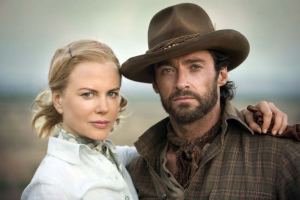 The flick is ambitious, I’ll give it that. Just the title itself sets off an aim to summarize an entire country’s history, culture, and people in a declarative and definitive narrative. Somehow I doubt many will leave the theater and say, “Well, now that’s Australia.” Indeed, I find the film’s narrative to be a limp representation for a country. I suppose most big nationalistic history films start with the birth of nations, but when your country began as a repository for English criminals then I suppose you may want to find a different tale to tell. Australia is really three movies in one colossal package: a Western dust-up, a World War II disaster, and a dark history lesson over the country’s treatment of the aborigines. There is too much movie there, especially at a mammoth running time of 2 hours and 45 minutes. I almost think that Luhrmann believes that if he throws out enough storylines and emotions that somehow it will form a cohesive whole, but the pieces never truly mesh satisfactory. The kitchen sink method rarely works without a grander scheme. The war elements could have been dropped entirely considering that the Japanese bombing sneaks in at the very end of the film and serves little other purpose then decimating the town of Darwin. The movie just all of a sudden transitions into Australia at wartime, and various characters have new positions, like Lady Ashley serving as a phone operator. Where did any of this come from? It just sort of happens without any solid setup or transition despite a near three-hour length. You don’t need to nudge in World War II disasters just to introduce sustainable conflict. Australia is filled with moments where the plot or the characters make big leaps without justifying the transition. Lady Ashley goes from a lily-white upper-class fop to a tanned Outback rootin’-tootin’ adventurer over the course of mere minutes.
Director Luhrmann’s over-the-top visual style is absent and the movie feels strangely square, like Luhrmann is keeping his more manic abilities in check so he can tell an old school epic. But [i]Australia[/i] is not an epic despite a running time that would argue otherwise. It has gorgeous cinematography, gorgeous natural exteriors, and a pair of fairly good-looking leads (Jackman was named People Magazine’s sexiest man alive for 2008), but these are all components and not a finished product. I kept wanting Luhrmann to break free from his creative straitjacket and add some pizzazz and inspired sidesteps. It never happened. Lurhmann has been instrumental in the birth of Australia from beginning to end (he is credited with the screen story), but having such an idiosyncratic and surreal talent make a movie that is so backwards in approach and appeal is lunacy. This is not the best use of Lurhmann’s many talents. Australia has some gauzy and gaudy visuals but it feels altogether devoid of style, though it attempts to make up for that loss in sweep.
 The true history of what happened to mixed race aboriginal children is appalling and certainly worth examination. So why then is Australia another case where the story of a minority’s oppression and tragedy must be told through the eyes of valiant white characters? Nullah’s story is far more interesting then Lady Ashley learning to be a country gal or the Drover learning to settle down. There is much more inherent drama in following a child who feels displaced and forever hunted because of his own genetics. That’s far more powerful than watching the tyke play “Somewhere Over the Rainbow” for the 80th time on his harmonica. Whenever Australia dips into serious statements on the plight of the unfortunate aboriginals, the movie feels very awkward. This is because “serious” is not what the movie does best at all. Australia is a large-scale attempt to revitalize that old-fashioned, sweepingly romantic Hollywood filmmaking of the 1950s. You could just as easily imagine John Wayne and Maureen O’Hara in the starring roles, though the movie’s sensuality and outward comments on racial equality would have been tampered down. My point is that Australia is engineered to be this romantic spectacle that nearly overdoses on sentiment, so whenever it cuts to the aboriginals plight (something serious not in a silly movie sense) then it just seems tonally disjointed.
Let’s also talk about the depiction of the aboriginal people in Australia. Clearly Luhrmann has sympathy for these people and their persecution, and rightfully so. However, the movie turns the aborigines into magical otherworldly spiritual creatures. The depiction is similar to how Native Americans are seen in movies that take place in North America. The Native American is always seen as a being more in tune with nature and spirituality; they’re a “magic Indian” and always seem to possess supernatural powers and great wisdom. These portrayals are intended to be flattering but they really come across as hollow and condescending, transforming disadvantaged people into mystical and mysterious figures. Australia is packed with aborigines walking around, singing their songs to the wind, and having a near-psychic connection to the Earth and its inhabitants. There are several moments where King George, an old aboriginal man, will hum to himself and appear out of nowhere across thousands of miles to pose in a flamingo-like stance. It’s this sort of silly attempt at mystical reverence that stops the movie full-force when it touches upon the terrible realities of how the government treated the aborigines.
 The actors do as best they can with such underwritten characters. Kidman found a perfect collaborator with Luhrmann on Moulin Rouge, a performance that deserved the Best Actress Oscar of that year. She has complete trust in Luhrmann. Her character is the typical role where someone from the outside adapts and finds a new home, which means Kidman is mostly comic and overacts in the beginning. She overdoes the comedy, expressing lines with a bit too much energy that almost seems against her will, like someone is pulling an invisible string to stretch her face into extreme expressions. I’ve always believed that Kidman could be a fine actress but honestly I don’t think I’ve loved a Kidman performance since 2001 with, yep, Moulin Rouge (she was quite fine in Dogville and The Interpreter). I’m starting to dread the thought that I may never see another Kidman performance that sets me afire. Jackman’s background in theater comes in handy when it comes to selling such melodrama and cheesy sentiment. He’s a handsome man and the movie takes great pains to showcase him shirtless. His character is another in a long line of solitary men who have to learn to reach out and love again despite the danger of being hurt. It’ all pretty standard for a Drover, naturally. Walters’ performance can at times be too cloying that it becomes grating. Eventually you do build a tolerance and he becomes more endearing than annoying. I had more fun with the supporting cast who can be relied on to offer glimpses of humor and menace.
I will say that I was rarely bored with the movie, though there are occasions that sag in the overly extended middle. Lurhmann still knows how to make an entertaining movie even if it’s one that generally plays by the book. The first third of the film, the cattle driving section, is the most successful and the most compelling, which is somewhat a backhanded compliment when the movie also deals with racial injustice. The stampede sequence is quite exciting and adds some needed action into the proceedings. From a technical standpoint, everything is staged well and looks refined, and my goodness does Walters have big dark soulful eyes that look pristine on the big screen. Kidman and Jackman’s big screen coupling will likely sate fans of romances between proper ladies and men with musk. Theirs is a romance thinly sketched but told with vigor. Australia is far too accomplished to be dismissed as a bad movie or a grandiose failure, but it never really settles into anything alluring or momentous.
 You know what I’ll take away most from Australia? The term “drover.” Jackman’s character never has a real name, he is simply referred to as “Drover” or occasionally, “Mr. Drover,” as manners require after you sleep with a drover. He is not a “driver” of cattle but a “drover,” which sounds like a present use of a past tense. At one point little Nullah says in voice over, “The Drover drove them cheeky bulls.” Can you “druv”? When you are completed is called “droven”? I wonder if Australian school children ever had to diagram this sentence: “The Drover drove the cows until he had droven them far enough to druv.” This grammatical curiosity lodged in my brain and I amused myself elaborating on the “drover” vocabulary.
Now, Australia itself, as many locals will tell you, isn’t bad. It packs a lot of movie in 165 minutes but I just wish it had been a stronger movie. While the visuals are pleasing and the story is mildly engaging, Australia never justifies itself as the epic it so eagerly wants to become. The story is too disjointed and silly to be taken seriously and too square and stifled to be fun and energetic. Lurhmann is a filmmaker who has such limitless potential; he didn’t just resurrect the movie musical in 2001 but gave it a new language. Watching his talents get henpecked and hampered to tell a nostalgic old-fashioned romance that doesn’t resonate is like watching Gene Kelly paint. Sure it might work but the man just wasn’t meant for it. Which then makes it even more bizarre that Australia has been a passion project that Luhrmann has been working on for years. I don’t feel his passion or even his pride for his native land, though cattle drive tours might increase as a result. This is a movie that could have used more of Luhrmann’s brash and buzzy style. The only thing declarative about Australia is that Luhrmann should have been attached to a different movie.
Nate’s Grade: C+
Share this:

Tropic Thunder (2008)
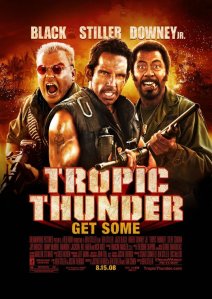 Ben Stiller has been kicking around the idea for Tropic Thunder for nearly 20 years. It took a lot of time to get the script in fighting shape, but the time was well worth it. Tropic Thunder is tasteless and occasionally appalling but it is also wickedly, deliriously funny.
Set inside modern-day Vietnam, Hollywood is filming another epic war movie but this one’s in trouble. It’s over budget, behind schedule, and the first-time director (Steve Coogan) can’t control his actors. Tugg Speedman (Stiller) is a fading action star looking for another hit. Jeff Portnoy (Jack Black) is a crass comedian who’s after some real acting credibility. He’s also addicted to heroin and worries that people will only ever see him as a funny man who farts. Kirk Lazarus (Robert Downey Jr.) is a five-time Oscar-winning actor who, thanks to makeup and a lot of hubris, is playing the film’s African-American sergeant. Alpa Chino (Brandon T. Jackson) is a rapper breaking into acting and is steamed that the Hollywood producers gave the sizeable black role to a white guy.
The director is at his wit’s end and being bullied by producers back in America. He is advised by “Four Leaf” Tayback (Nick Nolte), the Vietnam vet whose story the film is based upon. Tayback says to get real emotion and real fear that the actors should be stranded in the jungle without their precious handlers and demands. So the director takes Speedman, Portnoy, Lazarus, Alpa, and newcomer Kevin Sandusky (Jay Baruchel) in a helicopter and out into the wild. Trouble is, the actors have been left in the middle of an actual drug war, except they think it’s all apart of the script.
 Tropic Thunder is all things to all comedies. It could be tagged as being a bit incoherent but that’s because the movie has so much going on. It’s a sharp satire of Hollywood moviemaking and the raging egos of actors, it’s a send-up of Vietnam war movies and their bloody clichés, it’s a fairly worthwhile action film, and it’s a stupendously politically incorrect comedy with plenty of crude humor mixed side-by-side with genuine wit. It’s a comedy that has the potential to leave you aching from slapstick humor one second and biting satire the next. This feels like a complete comedy and not merely a series of sketches. Every character has an arc, some great moments, and each actor brings something different and something wonderful to the fray. This is clearly Stiller’s greatest achievement as a director.
The focus of Tropic Thunder is all over the place, and no one is safe from Stiller and his co-writers Etan Cohen and actor Justin Theroux. This is a brutal insider satire that plays it broad and loud. There are great jokes that ridicule the pomposity of the entire movie industry and the pitfalls of celebrity as a whole. I loved the jabs at celebrities going overseas and adopting children like they’re souvenirs. The movie has caught flak from disability groups that are mad about the movie’s liberal use of the term “retard.” I don’t want to say these people are missing the point of satire, or the fact that an R-rated comedy should offend on some level, but the joke is clearly on Hollywood and how movies exploit those with mental handicaps under the guise of telling their harrowing and inspiring stories. Movies have long been chronicling the adventurous lives of those with disabilities, which also has the side effect of making these people seem less like, well, just people. In the film, Speedman stared in a movie called “Simple Jack” about a mentally challenged boy who thinks he can talk with animals. Then the character has to pop up later in the film, complete with hysterical dialogue that blows apart just how exploitative these movies are (“I’ll see you in my head movies, but this is one head movie that makes my eyes rain”). It’s performed in just the right tone to make you laugh at the industry and the individual and not because of any disability.
The way the film establishes character back-story is genius. Tropic Thunder introduces all four major characters through fake commercials and trailers, like Grindhouse. The trailers are hilarious and a great way to kick off the movie. Stiller stars in a sinking action franchise where the world keeps being overtaken by fire (“Now, the one man who saved the world five straight times — will have to do it again”). The action franchise’s idea is to just reverse the scenario and, as sequels do, make everything bigger. Black’s trailer revolves around an obese family of super flatulent idiots all played by Black. The sequence is constant farting but it’s so over-the-top and pumped with contempt for lame-brained Hollywood comedies. The best trailer is the one that gives us Downey Jr.’s character, the esteemed Kirk Lazarus. Set in an Augustine monastery around the Middle Ages, Downey plays a monk who finds that he must conceal his inflamed passions for another man of the cloth (a figure I won’t spoil). Think of it as a 12th century Brokeback Mountain, and Stiller and company know exactly where to hammer Hollywood: the go-go eye stares, the hesitant naughtiness, and the ridiculous marketing angles – the title is inexplicably Satan’s Alley. The opening collection of fake trailers serves as perfect comedy bon mots for the feast that is to follow. They whet your appetite and may be the greatest opening 10 minutes of any comedy in memory.
 Downey Jr. gives an unforgettable performance comprised of sheer brilliant comedic bliss. I loved every second he was onscreen and I fully expect the man to get an Oscar nomination for his work here. Now, the role of a Method actor playing a black actor naturally presents a tightrope that needs to be walked just the right manner to maintain a satiric tone that doesn’t turn ugly. Let me state clearly that blackface is never funny. It is repugnant and Hollywood has a rather depressing history with the unsavory practice (Gene Kelly and even Bing Crosby sadly did it). Tropic Thunder is not a Stepin Fetchit-style minstrel show where Downey makes eye-rolling racist stereotypes. The joke is not that Downey is playing a black man, the joke is that he is such an arrogant and egotistical actor that he thinks he can play anyone. Besides, Jackson chides him throughout the film for his unorthodox portrayal, which tells you where the filmmakers stand. Downey elevates every scene he steps into and gives a performance, like the film, that is densely layered with comedy. He never breaks character even when the cameras aren’t filming and even when he’s alone. He’s two steps removed; channeling a performance as a heralded Australian actor playing his idea of a 1970s black male. When Alpa derogatorily drops the N-word, Lazarus slaps him and then begins a speech with, “For over 400 years they have been using that word to keep us down,” and ends it reciting the lyrics to the theme song from The Jefferson’s. In that span of time, Downey takes you along on every stop in the dense, hilarious mind of Lazarus.
While the rest of the actors don’t ascend to Downey’s heights (years ago this would have doubled as a drug reference), the ensemble of Tropic Thunder works together smoothly and they help make the film so much more enjoyable. Black is great when he’s trying to be seen as a “serious” actor when they are filming. I love his rushed and hushed line deliveries. But he’s even funnier after going through the wringer of heroin withdrawal. A sight gag involving Black digging through his speedo had me in stitches. Stiller is playing his usual dimwitted blowhard but propels the plot forward. He knows exactly how to oversell for laughs, like when he’s being riddled with bullets in dramatic slow-mo or when he’s playing Simple Jack. Baruchel is a nice counter foil to the uncheck bravado and craziness of the other actors. Jackson has fun voicing his mounting vexation with Lazarus. Coogan and Nolte provide good small moments, and Danny McBride steals his scenes as a pyrotechnic special effects expert that wants to “make Mother Nature piss her pants.”
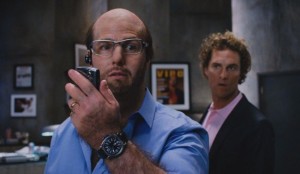 By now you’ve likely heard all about Tom Cruise’s small role in the movie as an irate, bald, fat, extremely hairy studio executive. It’s nice and amusing but I could have done with something different. Downey is unrecognizable in both physical appearance and through his speech; he fully inhabits a character that fully inhabits characters. Cruise, on the other hand, is instantly recognizable even with glasses, a paunch, and a shiny dome. It’s Tom Cruise playing a profane asshole but the joke wears thin. Cruise either needed to do something different or just be seen less, including his hip hop dance moves. And yet, Tropic Thunder has a running joke about Hollywood taking its beautiful A-listers and thinking that, through the power of makeup and superficial physicality, they can play any role. We’ve had a streak of Best Actress Oscar winners that have won accolades by stripping away their beauty and packing on the pounds (check out Charlize Theron in Monster). It seems like even the pretty girls are getting the ugly girl roles now; what’s a homely actress to do nowadays? So, in a way, Tropic Thunder is making fun of this line of thinking, that fat suits and some makeup are the great equalizer, but then it has Tom Cruise more or less falling into the same trap. He puts on a fat suit, a bald cap, but it’s still him and you hear Tom Cruise in every utterance. Maybe it would have been funnier if Cruise were playing a parody of himself since he is a studio executive at United Artists.
Tropic Thunder is a wildly funny movie that takes no prisoners when it comes to its sprawling satire. Stiller and company cut down the self-absorbed lifestyle and mentality inside the film industry and insecure actors. The film really shares the spotlight and each actor provides something different and welcome, and there isn’t a weak link in the bunch. Downey Jr. gives a brilliant comedic performance that will be long remembered. The movie is rude, crude, stupid, smart, and all over the place thanks to such a broad comic canvass. It took many years for Stiller to finally get Tropic Thunder off the ground but the wait was worth it. This is a rare comedy that eels loose, hits hard, and may warrant multiple viewings just to catch all the jokes-within-jokes. This is a movie with plenty on its mind, perhaps too much, but I wish more comedies were as well executed and skillful in their gags about gas passing.
Nate’s Grade: A
Share this:

Mongol (2008)
 Genghis Khan can’t be all bad. The Oscar-nominated foreign film Mongol dares to show the little known softer side to the man that conquered most of the known world in the early 13th century. The film follows the rise of Temudjin (Tadanobu Asano). Mongol has the look and feel of epic adventures of old, the type of stuff Hollywood was churning out at four-hour lengths in the 1960s. The cinematography is excellent and sweeping, the real-life filming locations add great authenticity to the tale, and the acting is universally strong, especially Asano and his stalwart and attractive wife, Börte (Khulan Chuluun). Even though Asano is Japanese he makes a much more convincing Genghis Khan than John Wayne (I advise everyone to skip 1956’s The Conqueror). Most of the film concerns Temudjin’s relationship with his wife and his blood brother, Jamukha (Honglei Sun). Eventually he must defeat his powerful blood brother and consolidate the Mongolian people. The interpersonal relationships between the three principles are surprisingly deft and full of insight. For a two-hour film detailing the life of Genghis Khan, the movie doesn’t resort to many battle sequences. The combat is exhilarating and stylish without ever becoming self-conscious. I read that Mongol is intended to be part one of a trilogy following Genghis Khan, so perhaps there will be more military strategy and battles once he steps off his home turf.
The movie lost me somewhere in its languid middle and never fully regained my attention. The movie starts off well, ends decently enough, but man the time in between gets terribly repetitious. Temudjin is captured. He escapes. He’s captured. He escapes. His wife is captured. He rescues her. I have no idea if all the events the film portrays are necessarily historically accurate as depicted. Even if they are, the filmmakers could have provided a stronger through-line to connect the events and provide a better sense of overall direction. Mongol is certainly a good film but it’s not great. It even feels a tad pre-programmed, like it was constructed for a U.S. audience that has grown accustomed to the likes of Braveheart and other bloody history epics. I’ll keep a passing notice on whether Mongol Part Two (the rise) and Mongol Part Three (the fall) improve upon Part One.
Nate’s Grade: B
Share this:

Iron Man (2008)
 Robert Downey Jr. and Jon Favreau seem like decidedly odd choices for a studio to hand over a multi-million dollar potential comic franchise. Iron Man certainly isn’t one of the better-known super hero properties but Marvel Studios felt confident that having Favreau behind the lens and Downey Jr. in a heavy suit of armor was the right direction. They couldn’t have been more right. Iron Man is a rock solid action vehicle that flies by in a blast. My biggest complaint: the film never utilizes the ready-made theme song by Black Sabbath.
Tony Stark (Downey Jr.) is the billionaire CEO of Stark Industries, a high-grade weapons manufacturer creating bigger and better ways for people to kill each other. His life is a never-ending party, going from gambling to girls to gizmos. His assistant, Pepper Potts (Gwyneth Paltrow), keeps Stark as grounded as he can be. Stark is traveling to Afghanistan to demonstrate the awesome might of some of his new missiles when his convoy is ambushed. One of Stark’s own weapons sends shrapnel into his chest. He is kidnapped by terrorists (read: Arabs with guns) and held captive inside a cave. Stark is kept alive by a glowing electromagnet do-dad in his chest that manages to keep the shrapnel from entering his heart. Raza (Faran Tahir) orders Stark to build him a missile or else. So Stark does what any mechanical boy genius would do: he builds a giant suit of armor and busts his way out.
 Stark’s friend Jim Rhodes (Terrence Howard), an Air Force officer, rescues him in the desert. Once back at home in his Malibu mansion, Stark has a personal epiphany. After seeing the human damage his weapons cause he no longer wants to manufacture weapons. His business partner Obadiah Stane (Jeff Bridges) and the board of directors are not interested in Stark’s revision. They want to keep doing what they do, making weapons for the highest bidder. Stark begins building a more advanced mechanical suit based upon the prototype from Afghanistan. He will use his technical expertise and great fortune to destroy his own weapons, even if he has to become an ironclad superhero to do so.
Downey Jr. is Iron Man, yes, but he IS Iron Man. He makes this character, this movie, and serves as the film’s ambassador to an audience that has grown tired of mopey teenagers imbued with super powers. His character is a man going through a mid-life crisis of sorts, reevaluating his life and trying to find meaning in his work. There’s something satisfying about watching an older adult wreck of a man taking on a genre that feels like it’ stuck in a high school atmosphere. Downey Jr. is a fantastically engaging, talented actor and when he turns on his narcissistic quick-witted charm it is impossible not to be won over. He provides the film with a tremendous spark and manages to make a womanizing, alcohol-swilling, super wealthy arms peddler/playboy into a figure of sympathy and a hero for the masses. Downey Jr. has expert comic timing and makes Tony Stark a cool swinging superhero. Just listen to his line deliveries and the energy and pacing he puts into the dialogue; it’s terrific. He also gives Stark the necessary drama to pull off the weight of guilt.
Iron Man is also a victory for Favreau as a director. The Swingers star has become a stealthily competent director. He helmed 2003’s Elf and 2005’s underappreciated Zathura and I suppose Marvel Studios saw what I saw in those films. The direction is focused and he makes smart decisions, never overwhelming an audience and always centered closely to the story. Favreau is more concerned with storytelling than noisy, empty special effects. Hell, Iron Man doesn’t even enter the film until an hour into it. There is a confidence and patience to his direction; it manages to convince an audience that they will be rewarded for their time.
 Favreau doesn’t pander and knows well enough that practical special effects will inspire the greatest sense of awe in a summer flick. Iron Man‘s special effects are almost seamless from the practical to CGI. I enjoy popcorn action movies so much more when I’m not nit-picking the special effects. This isn’t a slam on CGI itself, but computer effects have the tendency to declare their fakeness. Sure the special effects were amazing in last summer’s Transformers (how it lost the visual effects Oscar to the subpar Golden Compass I’ll never know), but the CGI-ness of it could be overpowering. When I cannot decipher a special effect automatically, then I know I have been fully immersed in the action. Favreau smartly lays out a bevy of nifty practical effects for the first half. By the time he transitions to broader CGI then he’s already laid the foundation for realism.
Favreau isn’t the best action director but this only presents an issue in the film’s last act. The action sequences in Iron Man take a back seat to watching Tony Stark piece together his new life. I was more interested in seeing Stark test and reconfigure his designs. The construction of Iron Man, to me, is more intriguing than seeing a man in an iron suit battle some guy in a bigger iron suit. The fun is watching him become Iron Man. The action sequences are serviceably kick-ass but too short. I loved watching Iron Man punch people and seeing their bodies fly backwards. Even at over two hours there just isn’t a whole lot of traditional action to Iron Man but this suited my tastes. I’d rather watch an actor with Downey’s talent interact with an A-list cast than watch robots fight and smash personal property.
Iron Man is aided by a strong script credited to two of the writers of Children of Men. It’s structured as an origin tale but it takes its time to set up events and characters that will have lasting meaning. Stark confronts being a weapons manufacturer in a post-9/11 world. He finally stops and asks, “What is the cost?” His own company is double dipping, selling weapons to both sides in a conflict, weapons that will kill U.S. men and women pledged to protect America. Stark has a true change of heart, both figuratively and, later, literally with the assistance of Pepper. There’s a political undercurrent to the film’s drama that manages to be timely and provide at least some thought to go along with the popcorn thrills. Iron Man finds a way to force its characters to combat real moral questions that result from their actions.
 The supporting cast has a combined seven Oscar nominations for acting, so this is a step above the acting level of a Fantastic Four. Howard is mostly underwritten but he provides a nice sense of camaraderie with his friendship with Stark. Bridges is an obvious villain just from the first sight of his bald dome and big, bushy beard. He’s got a mean scowl but Bridges provides a warm and fatherly guide for Stark. But man, when he gets menacing he is rather scary. But my highest praise in the supporting work goes to Paltrow, who coolly delivers arch snappy one-liners in a retro do-everything secretary role. And yet the role also offers some reflection, like after dancing in public with her boss she worries over gossip and what perception will construe the moment into. She, his employee, wearing a plunging backline dress that looks gorgeous on the actress, dances with her boss, an infamous womanizer. And then in this moment of doubt there’s a nice, unexpected moment for both a comic book movie and a would-be romance, and the “would-be” is the correct term. She has great chemistry with Downey Jr. and watching the two of them playfully bicker is another reason Iron Man soars above the confines of genre and formula. Plus she looks great with red hair.
Iron Man is a great start to the summer movie season and will be hard to beat. It doesn’t have the psychological depth of Batman Begins or the high-flying fun of Spider-Man 2, but this film certainly deserves to be mentioned in that same group. Favreau has crafted a respectful comic book movie that manages to place special effects in service of an interesting story played by extremely engaging actors. Downey Jr. is the movie’s secret weapon and he delivers a smart, witty, charming, sardonic and enormously entertaining performance that anchors a fine example of what big budget popcorn filmmaking done right looks like. Batman and Spider-Man might want to be on the look out because the new kid on the block is generating some serious heat.
Nate’s Grade: A-
Share this:

The Counterfeiters (2007)
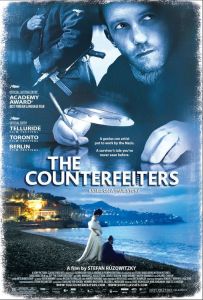 The Oscar-winner for 2007 foreign film is certainly a fine film and a respectable winner, but let’s be honest, the foreign film category was watered down a tad. France nominated Persepolis over The Diving Bell and the Butterfly because a country is only allowed to nominate a single film (sucks to be you, countries with good movies). This rule has resulted in past incidents like Spain nominating Tuesdays in the Sun over Pedro Almodovar’s Talk to Her, which ended up winning the 2002 Best Original Screenplay Oscar despite Spain’s snub. The hard decision by France was moot because Persepolis didn’t make the Academy 2007 shortlist of nine nominees. The biggest snub from that shortlist was Romania’s 4 Months, 3 Weeks, and 2 Days, a harrowing film about two college-aged women seeking an illegal abortion in 1980s communist Romania. It won the Palme d’Or at the Cannes Film Festival and also won the Best Picture award by the European Film Awards (Austria’s The Counterfeiters wasn’t even nominated). Then there was Israel’s amusing and touching film, The Band’s Visit, about an Egyptian band that takes a wrong bus and finds itself in an Israeli town. But the Academy’s foreign films ruled that The Band’s Visit had too much spoken English and therefore could not be ruled as a foreign film. Also left out were Germany’s Edge of Heaven and Spain’s The Orphanage. Nothing against The Counterfeiters but the foreign language field had already snubbed most of the main contenders.
The Counterfeiters is a deeply fascinating true-story about the world’s largest counterfeiting ring. Sal Sorowitsch (Karl Markovics, with a face as hard as flint) is a master forger leading a life of luxury in Berlin until the police capture him and send him to a concentration camp with his fellow Jews. As World War II carries on, the Nazis recruit Sal to lead a team to forge the British pound and the American dollar. The Nazis hope to destabilize their enemies’ economies. Sal is given greater freedoms in the camp and the S.S. officers try to become his chums. But he has to ask himself what his cost his actions will have. He could be prolonging the conflict and actually helping Germany win, but if he doesn’t assist the Nazis then he will surely be murdered as will his team.
Write/director Stefan Ruzowitzky creates great tension from scene to scene but it is the moral dilemmas that stick. What are principles worth? Are they worth dying for? Are they worth endangering others’ lives? The movie takes a docu-drama approach with bobbing handheld camerawork; even the film stock looks like it was soaked in grime for authenticity. And yet I wish The Counterfeiters had chosen to be less enigmatic. The main character is a criminal that keeps his emotions close to the vest, but Ruzowitzky cheats the audience by keeping Sal mostly in his head. The story is filled with factual intrigue and the natural tension given the situation, but after it’s over there isn’t much that’s memorable for a genre that expects more of itself. The Holocaust genre (and let’s not kid ourselves, it is a genre at this point) has some pretty high dramatic expectations and produces films that sear into our brains. The Counterfeiters is a very well told tale with great acting and some interesting character relationships but it can’t fully measure up to other Holocaust parables.
Nate’s Grade: B+
Share this:

Atonement (2007)
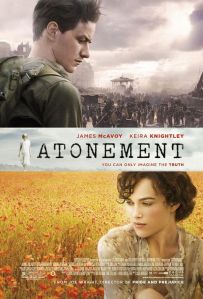 No film this awards season seems to have been kicked and beaten more than the sweeping period romance, Atonement. This poor movie has a strong stable of well-respected British thespians, a red-hot young director in Joe Wright (2005’s Pride and Prejudice), plenty of lofty, top-notch production values, and the whole enterprise is based off a highly acclaimed novel by author Ian McEwan. Where did all the hate come from? I think it has something to do with the fact that somewhere along the line Atonement became, on paper, the presumptive favorite to win Best Picture. Then reality hit and it hit hard. Atonement wasn’t even nominated by the Writer’s Guild, the Producer’s Guild, or the Director’s Guild and yet the film still managed to eek out a Best Picture nomination for 2007. I became suspicious that Atonement would turn out to be this year’s Dreamgirls, namely a presumptive front-runner that was too calculating and self-conscious and ultimately free of substance to make its mark. While Atonement is perfunctory and nothing altogether special, the film still succeeds as a worthy piece of entertainment that doesn’t deserve to be dragged through the mud.
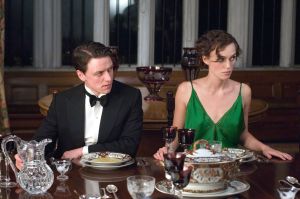 In the mid 1930s, Robbie (James McAvoy) works as a housekeeper’s son on a lovely English estate. He has his eye on Celia (Keira Knightley) and puts his burning passion to paper, typing two very different notes. The first one is blunt (and features a naughty word that rhymes with “blunt”) and the second one is more of a poetic declaration of his affections. Robbie has instructed Celia’s younger sister, Briony (Saoirse Ronan), to pass his love letter to the rightful party. He realizes too late that he sent her off with the wrong letter and Briony reads it herself, dumbfounded at the message and terminology. Briony is a bright child that fancies herself a playwright, but she’s still a child that cannot fully grasp the meaning of Robbie’s advancements. When she intrudes on Robbie and Celia having spontaneous sex against a library wall, she can only assume that Robbie is attacking her older sister (stupidly, neither says anything to clear up the awkwardness and just leaves the scene wordless). That same night Briony discovers her cousin being attacked and she’s certain that Robbie is the culprit, or is she? Her false confession sends Robbie to jail and alters lives forever.
Flash ahead to World War II, and Robbie has joined the Army to be released from jail, Celia reunites with him for the first time in years, and a now 18-year-old Briony (Romola Garai) realizes her foolishness as a child and tries expunging her overwhelming feelings of guilt by working as a nurse and tending to the ghastly numbers of wounded soldiers.
Atonement is visually ravishing to watch. The cinematography by Seamus McGarvey is lushly colorful and blends light and shadow to an extraordinarily effective degree, draping the performers in contrasting colors that pop. Wright’s camera always seems to be perfectly located to discover beautiful compositions indoors and out; the movie is just visually pleasing on all fronts, like seeing Knightley in her dark green dress bathed in the glow of police lights at night. At several points, however, the film’s look does get overly soft and glossy, like the cameraman smeared gobs of Vaseline over the lens. The period costumes and production design are agreeably period-y. The musical score has moments of great lyrical poignancy and then it shatters when the score resorts to integrating the sound of a clacking typewriter as a percussive instrument. I wanted to beat my head against a typewriter to make it stop.
 There’s a vague mechanical air over the entire two hours, like the filmmakers felt that merely assembling all the right pieces and having the right, awards-friendly pedigree would be enough. The five-minute uninterrupted tracking shot along the Dunkirk beach epitomizes this flawed belief. This superfluous shot wanders around soldiers stationed on a beach, winds around the outskirts of the bombed out city, and finally rests in a pub crawling with Brits, but nothing is added by the shot continuing uninterrupted and the staging fails to illuminate anything remarkable about the expensive set. The shot exists simply to call attention to its self and to serve as another bragging point for the filmmakers. The Dunkirk shot adds little to the atmosphere of the film because the scene barely flirts with giving a bigger picture of what is happening. Instead, that shot, like the movie, while well composed and entertaining, is an exercise in self-congratulation.
The film loses serious momentum as it transitions into war and its period of titular atoning. The movie just isn’t as compelling watching Robbie shuffle around at war. Rarely is he in any danger and he just seems to be biding time. Atonement is a tad too prim, a tad too demure to really go deep enough. The romance is intended to be of the unrequited variety but it feels malnourished even at an unrequited level, which is truly saying something. There is so much more beneath the surface but the film never wants to push too far for whatever reason. Knightley and McAvoy have a nice workable chemistry and that’s part of what makes the first half of Atonement the better half. So much of the story involves internal struggle but the movie doesn’t wish to invest the time needed to explore serious psychological wounds. Atonement never capitalizes on the intriguing if melodramatic opening of the film. This is by no means a love story, no matter what the marketers wish to convince otherwise. The romance between Celia and Robbie has little setup to seem believable or worthwhile. This is a movie about the power of words, which naturally is a topic that functions better in books.
After Kinsey and now Atonement, Vanessa Redgrave seems to have found a contemporary niche or her talents: she shows up in the final minutes to give a monologue that demands that the audience reflect from a fresh perspective. Redgrave plays an older adult Briony who has written several best selling books and is being interviewed for television. The ending is designed to be more devastating in print form, and it wants to call into question the nature of fiction and whether or not one lie and be absolved by another. But in the medium of film, the shockwaves are minimal because the language of film is visual. The stutter-step plot structure, which occasionally bends backwards to replay an event from an alternative perspective, is an extraneous annoyance that’s finally justified by Redgrave’s late appearance. What is the true cost for a “happy” ending?
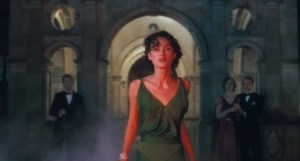 While Knightley and McAvoy get all the attention and cause teen girls to swoon uncontrollably, the real star of Atonement is 13-year-old Ronan. The young actress is a revelation as a sophisticated girl entering the earliest stages of womanhood. She’s nursing some serious puppy love on Robbie and his disinterest fuels her false confession; she means to punish him. Ronan is eloquently precocious at the start, acting wise beyond her years, but when she steels a glimpse at Robbie’s unfortunate letter, she drops her older pretensions and presents the spirited and unrestrained eagerness of a girl that’s madly curious and madly in love. Ronan effortlessly switches between the two sides of Briony, playing the astute, proper young lady or the nervy, confused girl trying to make sense of her budding sexuality. Kudos to the casting director as well for casting an older actress to play the 18-year-old Briony that genuinely looks like a grown-up Ronan.
Naysayers dismissing Atonement as outdated rubbish are diluted; it’s a well-crafted movie from considerably all angles. Then again, those that champion the film as a testament to bravura filmmaking are also diluted; the film is good, yes, but entirely unexceptional. Atonement is a fine film that takes a reportedly unfilmable novel and gives it a good attempt.
Nate’s Grade: B
Share this:

Across the Universe (2007)
 Julie Taymor is a one-of-a-kind artist. She made her name developing Disney’s The Lion King for the theater with highly elaborate and inventive costuming and staging. She then turned her vision to film and directed two strange yet visually splendid entires, 1999’s Titus and 2002’s Frida. Her latest is Across the Universe, a film constructed around actors singing Beatles songs. Hey, everyone likes the Beatles, so what could go wrong?
It’s the late 1960s and Jude (Jim Sturgess) has traveled from Liverpool (where else?) to Princeton to find his father. He makes friends with troublemaker Max (Joe Anderson) and they elect to travel to New York City and find their voice in these tumultuous times. They get a rather spacious apartment and their landlady, Sadie (Dana Fuchs), is a redheaded rock singer. Joe’s little sister, Lucy (Evan Rachel Wood) who just lost her boyfriend in the Vietnam War. JoJo (Martin Luther) and Prudence (T.V. Carpio) find their way to this apartment and into the increasing group of young, music-minded kids in the midst of a social revolution. Lucy fall hard for one another but their relationship is strained because Max has been shipped off to fight in Vietnam and Lucy is joining an increasingly violent radical resistance group.
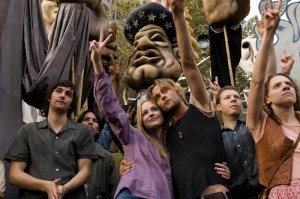 I can’t decide whether it is clever of simply lazy to structure a whole screenplay around 30-some songs by one band. Many of the tunes are used for pointless reasons like “Dear Prudence” is reduced to coaxing a character out of a closet literally, though she is gay so perhaps there’s a double-meaning there, but it’s still lame. In fact, the entire character of Prudence is pointless and grafted onto the story with no real care or precision. She disappears and then miraculously pops up again, with happy girlfriend in tow, and then that’s it. But what really chafes is that when Taymor uses the Beatles’ songs to tell the bulk of her story that means that little feels authentic. Lucy and Jude spout their love songs so quickly after their first encounter. Their romance doesn’t feel believable and, more importantly, it doesn’t feel worthy of our time and interest.
Across the Universe is dripping with Baby Boomer nostalgia and the film leaves no cliché left unturned in its account of history. This jumbled melting pot of every late 1960s cultural event feels as shallow as a junior high report on the subject. Everything from the Watts riots, to the assassination of Martin Luther King Jr., to the Columbia protests and LSD activist Ken Kesey and his colorful bus are elbowed into a story that feels empty and crowded at the same time. Across the Universe is a tad overextended and even goes to the trouble of climaxing with a rooftop jam similar to the Beatles’ last public performance together.
Taymor is a talented visionary but sometimes she lets her creative impulses take over her better judgment. The movie ultimately feels like 30-some music videos strung together by a flimsy boy-meets-girl story that will sink or swim depending upon the song-by-song visual follies. Sometimes Taymor excels with the sublimely surreal like some underwater canoodling to “Something,” Uncle Sam reaching out from a recruitment poster to the tune of “I Want You (She’s So Heavy),” and a spectacular rendition of “Happiness is a Warm Gun” where Max and other war vets cope with their trauma while multiple Salma Hayeks tempt them in sexy nurse outfits. But then Taymor gets a little too carried away with her runaway train of an imagination and her visuals can become simplistic (splattering strawberries = blood shed) or just way too funky, like a truly awful animated excursion where the wonderful Eddie Izzard speak-sings “For the Benefit of Mr. Kite” as a creepy circus ringleader. What does “Come Together” have to do with pimps and prostitutes and Joe Cocker as a bum? The worst moment may be when Taymor decides to visualize the parenthetical of “I Want You (She’s So Heavy)” by having underwear-clad soldiers hauling the Statue of Liberty over the jungles of Vietnam while they sing, “She’s so heavy.” I’m also uncertain about the flagrant jumps into theatricality like the synchronized acrobatic dancing; it’s a bit jarring at times.
 The cast is rather strong from a vocal standpoint and they recorded their performances live instead of within the confines of a recording studio. Wood has a particularly pure voice. Sturgess and his throaty pipes remind me of Ewan McGreggor in Moulin Rouge. Fuchs gives a favorable impression of Janis Joplin. Bono is great in his limited time on screen and hums one dandy version of “I Am the Walrus.” There isn’t a weak singer in the bunch and simply listening to them is one of the highlights of the film, but then I could accomplish this by plugging in the soundtrack. The new arrangements of the Beatles songs are a bit lackluster; they seem too bare and stripped down into vanilla ballads. “Something” sounds exactly note-for-note like how the Elliott Smith version sounded that hauntingly played over the closing credits of American Beauty. I seriously thought that Across the Universe just lifted Smith’s version.
Inherently goofy and occasionally garish, Across the Universe is a misguided trip through the back catalogue of the Beatles. There is a moderate level of fun with the concept and the quirky visuals, but the film plods on and on and eventually the appeal of the gimmick is long exhausted. The singing is strong and the visuals have a sense of whimsy when they work, but in the end the Beatles already had one failed movie constructed entirely from their songs (1978’s Sgt. Pepper’s Lonely Hearts Club Band starring Peter Frampton and the Bee Gees) and now they have one more for a new generation of fans.
Nate’s Grade: C
Share this:

The Good German (2006)
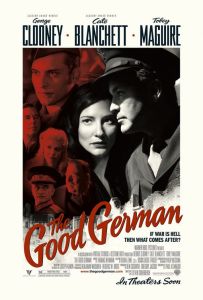 Steven Soderbergh has always seemed uncomfortable with his success and thus tried to stretch his creative wings with experimental gambles. They’re certainly ambitious but many times Soderbergh seems to be giving himself busy work. Did anyone see Bubble? I didn’t think so. The Good German is a film that wants to be seen as a forgotten relic from the 1940s, and Soderbergh went so far for period accuracy that he filmed with equipment from the same bygone era. That kind of artistic integrity is great, but what does it do to make the movie any better? The Good German aspires to be a cinematic cousin to Casablanca, even aping the iconic ending to that famous film. You’ll also get Chinatown déjà vu, especially when characters say, “Hey Jake, it’s Berlin.” The plot hinges on a murder around the Berlin conference with the Allied powers that will decide the fate of Europe and reshape the map. The story is too muddled and confusing and seems to amount to little to nothing after flirting with intrigue. The actors give hammy performances that may be true to the stagy, well-articulated acting styles of old Hollywood, but it does little in the realm of being enjoyable. Cate Blanchett is intended to be Marlena Dietrich, and George Clooney is intended to be Cary Grant, but neither manages to escape being a second-rate impression of their film noir forbears. There’s an interesting post-war story buried under all this period homage and Method-style artifice, but Soderbergh only seems interested in pleasing himself with these experimental errands, and this is coming from someone that loved Schitzopolis.
Nate’s Grade: C+
Share this:

Black Book (2006)
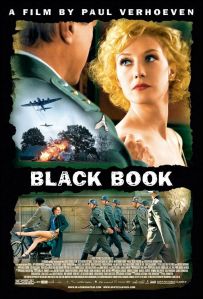 If there’s one thing you can say about Dutch filmmaker Paul Verhoeven, it’s that his films are never boring. He’s shameless when it comes to the amounts of sex and violence he squeezes into his films, and this isn’t typical bouncy violence but cold, serious violence that manage to have whiffs of dark comedy to it. The sex is sleazy and ridiculous, often outpacing the late-night flesh peddlers on Cinemax. I don’t think Verhoeven knows how to do anything subtle, and frankly I wouldn’t want him to. The man is responsible for brawny sci-fi (Total Recall, Robocop), killer lesbians (Basic Instinct), the most subversive mainstream Hollywood movie of the modern era (Starship Troopers is pro-fascism, people), and the most surreal visual effect I have seen in my life – a breast groping itself (Hollow Man). Verhoeven even shows up in person to accept his Razzie award for Worst Director for 1995’s camp classic, Showgirls. This man doesn’t have an off switch. The man makes enjoyable movies, both intentionally and unintentionally.
It’s been a long six years since Verhoeven’s last film and in that time off he’s settled back into his homeland. Black Book (Zwartboek) is a tale loosely based around true stories involving the Dutch resistance in the Nazi-occupied occupied Netherlands. And if there is anyone that can throw in some sex with our good old-fashioned WWII violence, it is Paul Verhoeven.
Rachel (Carice van Houten) is a Jew hiding out in the Netherlands. She and her family is trying to pass out of the country by river when they are ambushed by the guns of a Nazi boat. Rachel is the lone survivor and watches all of her family members get mowed down. She joins the underground resistance movement to find out who betrayed her family. She dyes her hair blonde, both above and below the waist to be thorough, and cuddles up to a stamp-collecting S.S. leader, Ludwig Muntz (Sebastian Koch). She works her way into his trust and along the way uncovers a twisty conspiracy to trick rich Jews into ambushed escapes.
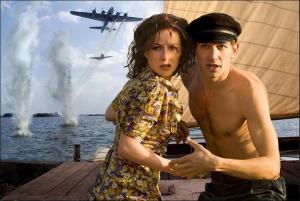 Black Book is skillfully made and pulpy enough to keep the viewer’s enjoyment level in a good place. From start to finish the movie presents enough trials and setbacks to keep an audience satisfied, and enough sex and violence to meet out the standard Verhoeven quota. Nazi occupation hasn’t been deeply explored from the Dutch point of view, and Verhoeven decides not to make everything so black and white. Muntz is a compassionate S.S. officer that wants to work negotiations with resistance fighters to stop further bloodshed. Rachel deeply falls for him, at the disgust of some of her fellow men at arms. On the other side of the coin, once the Nazis have been toppled there are several Dutch civilians and bureaucrats that can behave just as cruel. Those now with power strike out against those deemed to have sympathized and collaborated with German rule. Verhoeven is making a point that there was good and bad on both sides, which is admirable, though this point has been made better elsewhere. Black Book is filled with various twists and double-crosses, so the audience is involved until the very end. Plus, the sex and violence help too.
There’s terribly little below the surface when it comes to Black Book. It’s a thrilling, unabashedly entertaining movie but nothing beyond a sexed-up, suped-up version of a 1940s behind-enemy-lines potboiler. The characters have little to them beyond basic motivations like greed and lust and revenge, so it all can seem like an empty but high-spirited, fun-filled time at the movies. Verhoeven has never imbued his female roles with much characterization, more often showcasing them as ass-kicking vaginas on legs (whoa, now there’s a mental image for you). Another flaw is how Black Book is structured. We open on a tourist trip to Israel in 1954 and see Rachel teaching a class of schoolchildren. This colossal misstep drains the tension from whenever Rachel is in danger; we already know she has to survive to teach our little ones. [I]Black Book[/I] is a largely fictional take, a collection of various historical pieces and figures, so that means that the outcome for our heroine is not preordained. Rachel very well could die amidst her undercover infiltration, but alas the movie opening in flashback erases this threat.
Van Houten is an enticing screen beauty that brings to mind Hollywood stars of old. She has a very simple, prim, elegant look to her, and a presence that is coy and sensual but far from trashy or vulgar. This helps add traces of believability to a figure that does some incredible acts in the name of God and country. Hollywood would have cast Rachel as a tall, buxom bombshell, but it would all be wrong. If this girl turned heads she would be dead. Van Houten gets thrown through the wringer, and at one point literally shit upon, and she handles it with steely grit. The best moments are when we see how Rachel rebounds from setbacks, when she is forced to break from her resolve and think. Her first encounter with Muntz in a train car is a good example, but even better is how she reacts when Muntz accuses her of dying her hair and being a Jew. She grabs his hands and places them on her hips and finally rests them on her exposed breasts. “Are these Jewish?” she asks. She defuses the situation and lives another day, and it’s perfectly played by a nervous but nervy Van Houten. She makes two plus enjoyable hours even more enjoyable.
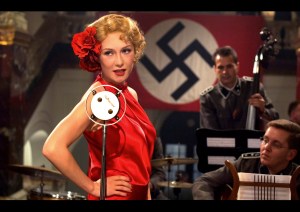 Black Book is clearly and fairly rated R, but part of its rating piqued my curiosity. One of the items that help push the film into the restricted rating is “graphic nudity.” Now, what exactly is graphic nudity? I recall last year’s Babel also getting an R-rating for what was deemed “graphic nudity.” One thing the two films have in common is that they both show quick glimpses of exposed female genitalia. I suppose that the MPAA feels that nudity becomes graphic when we see pubic hair. This confounds me. What about pubic hair turns nudity into an extra, more offensive category of nudity? At the end of the day, it’s just hair, people. I did some quick research and [I]Basic Instinct[/I], infamous for Sharon Stone’s career-making leg crossing, is rated R for mere “strong sexuality.” For the record, when Stone flashes her naughty bits they were bare. So let the record show that hair seems to be the qualifier between what is nudity and what is graphic nudity. Maybe I’ll write a dissertation on this some day.
As for another aside, how freaking cool is the name Zwartboek? It sounds like some fun term I’d come across in the pages of Douglas Adams’ The Hitchhiker’s Guide to the Galaxy. The Dutch language is a tad bizarre for my American ears; it’s sounds like a mixture of English and German, and sometimes it seems like a subtitled sentence is actually direct English. I know I can’t stop saying “zwatboek” around my home in place of gasps and curses.
Black Book is Verhoeven’s first Dutch language film in over 25 years, and it also feels like he’s enjoying movies again after his bad experiences across the Atlantic. I welcome more entertaining Dutch films from their favorite filmmaking son. He may not be he most subtle man behind a camera, but we already have plenty Terrence Mallicks and Gus van Sants to bring confounding contemplation to movies. We need more people like Vanhoeven who know how to please the sense, kick you in the balls, and make you grateful for the experience.
Nate’s Grade: B


 nathanzoebl
You must be logged in to post a comment.