Blog Archives
Until Dawn (2025)

I’m going to do something I don’t know if I’ve ever really done before in my twenty-five-plus years of toil as a film critic. I’m going to devote almost the entirety of this review to try and make sense of the ending and its cascading choices that confound and astound me. I’ll present some spoiler-free analysis beforehand but, dear reader, this is going to be a spoiler-heavy review because, quite simply, it’s all I want to talk about as it concerns Until Dawn. The horror movie is an adaptation of a 2014 PlayStation video game that itself was fashioned like a ten-hour horror movie. It was a love letter to the horror genre and your goal was to keep as many of the characters alive as you could through quick-time events and choices that could have lingering and unexpected consequences later in the game. It was, above all else, fun, and news that Hollywood was going to turn it into a movie made a degree of sense. After all, it was practically an interactive movie to begin with. Then news matriculated that they weren’t really adapting the game and instead were making something new and different, so why call it Until Dawn? Beyond the cash-grab from the use of a familiar name, if you’re going to be Until Dawn in name only, why not just be that original horror idea and let someone else actually adapt Until Dawn as it was? You’re not going to get another crack at this title, so why is the first attempt one that could be done without the game existing? Regardless, the movie is a bad adaptation of the game and a bad use of dwindling brain cells.
Five teenagers make a trip to search of Clover’s (Ella Rubin) missing older sister. They trace her last recording to a gas station just outside the mining town of Gore County. The gas station attendant (Peter Stormare) lets these curious kids know that weird things happen in town, and sure enough the weird stranger is right. The teens take refuge in a visitor center with a guestbook and a peculiar hourglass time piece on the wall. Soon enough they’re beset with masked killers and monsters and each of the five friends is slaughtered. Then they wake up back in the visitor center with the hourglass starting over. They have to learn about this mysterious location to try and stay alive all the way… until dawn!

Before the heavy spoilers begin, I’ll provide a few accolades to what the movie does well. Director David F. Sandberg (Shazam!, Lights Out) has a clear affinity for the horror genre and can summon some pretty effective and skin-crawling imagery. I actually like the premise of a horror time loop, though this was also covered with the tongue-in-cheek genre tweak that was 2017’s Happy Death Day. However, that movie primarily dealt with a slasher scenario whereas Until Dawn can mix and match different genres, which makes each new iteration feel like a blank slate to explore. I loved the shortest loop, where the characters hold up in a bathroom and gruesomely discover what happens if you drink the local water. It’s the best development in the movie and one I’m glad the script revisits from time to time. With most time loop movies, once the characters adjust to the reality that death is not final, they get a little more loose with their physical well-being. I enjoyed some of the turns the characters make with the understanding that they’ll come back again. The visual nods and connections to the game are there without feeling too gimmicky. Plus, having Stormare come back to play a variation on his nattering psychiatric weirdo from the game is exactly what the movie adaptation needs. Stormare is on his own unique wavelength.
Now, the madness. Abandon all hope ye who enter the spoiler section of this review.
I don’t understand this movie. At all. I read over its Wikipedia summary and watched a few of those YouTube explanation videos to see if it was just me and I missed important pieces of information that would connect the various elements together. It’s not me, folks. These story elements don’t connect. They don’t form a coherent whole. I don’t need a reason why time loop scenarios happen; they never explained it with the genre grandaddy Groundhog Day, and if it’s good enough for Groundhog Day, it’s good enough for your movie. The problem is when they try to explain and it actively makes things worse, because now you begin to question everything. I liken it to 2019’s Us, a movie with plenty of outlandish story elements including the existence of a same-age evil twin for every person but living in a subterranean mimicry of surface life. I would have happily accepted that as-is, but then the movie tries to find a real explanation for where these people came from and why, and now the illusion of ignorance is shattered. Now all those pesky questions start flooding the mind that could have before been kept at bay.

Let’s examine the explanations for the two primary mysteries: 1) why there are monsters, and 2) why there is a time loop trap. Again, both of which didn’t even need explanations but here we go.
The mythology of the game gets ported over in starts and stops, but the movie keeps the setting of a mining town that had a tragic collapse that devastated the town. In this version, the majority of the town fell into a sinkhole below the earth. Do we get to explore these exciting and creepy locations? Nope. One of the town’s psychiatrists (Stormare) is still alive and continuing his mad experiments for… reasons. Like the game, there is a curse wherein if you resort to cannibalism you will become a spooky wendigo monster, so the creatures are a result of the former townspeople and other past residents from the previous time loops. Fine. I can accept that. However, late in the movie, our creepy psych doc clarifies for Clover that things aren’t just all in her head, a nod to the original game. Except that ending would have made more sense. The new ending says that Clover’s fears are responsible for manifesting the different antagonistic monsters and killers. Okay, so we’re externalizing the internal, fine, but why her? Why not any of the other friends? Does this mean every previous group was also responsible for manifesting their own tormentors based upon personal psychological fears? Why are we including this roulette wheel of terrors on top of the constant of the wendigo creatures? How is this even happening because the movie gives no scant indication? Do the deadly rules get reset with each new group? In our story, the characters can’t drink the water, but what about other groups? If every group is manifesting the same avatars of fear then why not just adopt them as stable rules? Why is this one man staying behind to catalogue the results? He’s mortal so he just lives in the sinkhole or works at the gas station, waiting for wayward teens to stumble into his next experimental group? Who is keeping the lights on in this visitor center? What does this guy do during the “off season” when there are no looky-loos? Does he have to feed the existing wendigos like some kind of demented zoo? What is to be gained from all these experiments? Is he planning on publishing his research later? What is this guy’s regular life like?

Then there’s the time loop explanation which is -wait for it- nothing. Absolutely nothing. Why are characters getting second and third and thirteenth chances to survive until dawn? Why is it thirteen? The movie doesn’t even have the time to demonstrate thirteen loops, instead jumping from like the fourth straight to the last one through the annoying use of, “Oh, let’s watch these film clips we took that we don’t remember.” If you didn’t have the interest or time for thirteen loops, why even make it thirteen? Why does the number matter if they inevitably turn into wendigos from desperate cannibalism? You would think the loops should be infinite to guarantee this result. Why would the other victims bother writing their name in the guestbook every loop? It establishes a timeline of sorts, but if writing can last in this guestbook, why doesn’t anyone write anything other than their name over and over? Detailing your experiences and lessons learned as a living record might be helpful to future loopers. Also, what obligations do these people feel about signing their names in the guestbook? Who accepts getting murdered over ten times but is still being a stickler for signing their name, and for what? Are they getting some little feeling of superiority that they were able to scribble their name thirteen times? Where did the hourglass come from? It definitely looks like it was installed with purpose, so did these just materialize? Why do the timeloops even consider having a mechanism for letting participants win and escape? What about the other quirks like how the weather is affected by the bad vibes of this place? Even the rain knows better.
So, in summation, the time loops and manifesting monsters are unrelated to one another and there is no added context provided for like some ancient curse or witchy magic or anything to cause this mess. There is one nefarious wacko doctor who just hangs around for kicks, though why he is immune from the loops or the larger effects of the manifested monsters is beyond me. Is he recruiting the monsters like some sort of work foreman, telling this gnarly creature, “Need ya to pull a double today, Fangy.” It just all feels like scary elements working in parallel and occasionally drifting into one another’s orbit, but there’s no fitting or acceptable explanation, so why does the movie even try to present one in the first place? I’m stunned at how Until Dawn just completely unravels into incoherent madness by the conclusion, which sets up that there might be a larger universe of these doctors overseeing experiments. At that point, you might as well be watching The Cabin in the Woods. If you have no allegiance or familiarity with the video game, you might find enough to amuse you, at least for fleeting moments. I was open-minded to what an Until Dawn-in-name-only adaptation could do with a time loop gimmick, but the final results feel like an uneven grab-bag of imagery and ideas and directions that go nowhere.
Nate’s Grade: C-
Share this:

Five Nights at Freddy’s (2023)
 I’ve learned so much more about pre-teen horror video games in the years since I’ve become a parent. There is no shortage of horror-themed games, many of them available through Roblox, that act as gradual entry points for burgeoning new horror fans that might not be emotionally ready for more intense horror (for my money, the creepy smiley creatures with dozens of teeth are more frightening than Michael Myers on any day). This brings me to the Five Nights at Freddy’s movie based on the insanely popular video game series that essentially said, “What if Chuck E. Cheese was, like, evil?” The game involved shifting between security cameras to keep watch on some frisky animatronics that have a hard time staying put, and of course jump scares and bloodless deaths. It’s a game about alternating camera feeds and waiting, and so the big screen version is also a movie very much about waiting for the creatures to stir. That’s probably why a quarter of the feature is watching Josh Hutcherson (The Hunger Games) travel into a dream-space to try and communicate with mysterious children to figure out what must be some of the more obvious plot revelations that he just can’t seem to grasp about this sleepy town and its history of missing kids. Why are we spending this much time on the human character’s back-story when we have killer robots to maim dumb teenagers? There are more scenes with the ghost kids than the animatronics of fame. The protagonist’s motivation seems wishy-washy since he’s putting his life on the line to keep his little sister and then makes an ill-advised bargain with the robots to get rid of her because… we need a moment for him to realize what really matters most? Huh? The scenes of horror rely much more on impressions, favoring shadows and implied violence than featuring anything too overt. I found the revelation of the ultimate villain to be laughable, no matter if it matches up with whatever the convoluted lore is for a game that, again, is flipping through TV channels and trying not to get eaten. There just isn’t a whole lot going on here, and the human drama of Hutcherson trying to win custody of his little sister feels a bit too dramatic and real for something this silly. He can’t get any other job than guarding an abandoned pizza parlor? Why does anyone just not enter the restaurant? He keeps returning to the job even after he realizes the danger. Unless you’re a diehard fan thrilled to just see live-action versions of your favorite furry friends, Five Nights at Freddy’s fees like four nights too many.
Nate’s Grade: C
Share this:

Final Fantasy: The Spirits Within (2001) [Review Re-View]
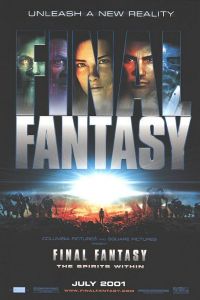 Originally released July 11, 2001:
Final Fantasy is an exciting venture in the history of animation. It’s the second video game to be turned into a feature film this summer, though exponentially better than Tomb Raider. It took the makers of Final Fantasy four years and the creation of new technology to capture what will be a benchmark in animation for years to come.
The story concerns a future Earth where aliens have crashed and invaded long ago. These “phantoms” are slightly invisible energy creatures of different size and roam around various areas with the ability to suck the life force or soul from a human being. General Hein (James Woods) is trying to convince the Earth council to allow him to fire a satellite called the Zeus Cannon to obliterate the alien menace. In opposition to Hein is Dr. Sid (Donald Sutherland) who believes with his adventurous pupil Aki Ross (Ming-Na) that the Zeus Cannon will obliterate the “spirit” of Earth. Their solution it to collect eight spirits in whatever forms they might be including plants and small animals to gather together and… do something that will send the alien life force repelling.
 Now I know Hein is supposed to be the bad guy as he’s a military man complete with the evil looking black leather cloak, but I couldn’t help but find myself agreeing with his logic. He wants to use something that has already been proven to kill the aliens whereas these two new age scientists want to collect a bunch of plants and animals and have their collective spirits ward off the interplanetary menace. I’d stand in my chair and say thank you to Hein when he dismisses the doctor’s plot. I know that Aki and Sid are the heroes and of course whatever theories they have will be proven true, but hell, I found myself agreeing more with General Hein than these two.
Complicating matters Aki is infected with a piece of the alien phantom that is slowly taking control over her body. Along in her quest to discover the final spirits is aided by a military commander Grey (Alec Baldwin) and his company of men. Turns out Grey and Aki are former sweethearts, so of course expect them to reconcile before the end credits.
The plot consists of something that could be an average episode on Star Trek: Voyager but does meander along at times. The dialogue is typical sci-fi buzzwords like “Fire in the hole” “The perimeter’s been breached” and the sort. Final Fantasy does have great excitement to it and some terrific action sequences better than most anything this summer. The ending is a disappointment as all the action hinges on two globs of energy propelled against one another. Globs or energy are not exciting. I thought we would have learned this by now.
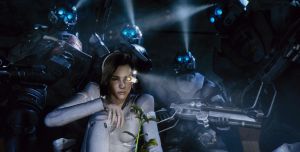 Final Fantasy is a landmark in animation. Never has so much detail been put into a movie and pulled off so amazingly well. To the nit-pickers out there the animation isn’t exactly the Holy Grail of photo-realism, but it’s closer than anything ever before. At times the characters come off as too plasticy (like Jude Law in A.I.) and tend to move too much, notwithstanding that their mouths don’t always follow the words coming out of them. Put aside these small grievances and what you have is stunning animation that makes one constantly forget it is animation. There are numerous moments of eerie precision like when a character’s nostril flares and their nose scrunches up in response, and the movement of every one of Aki’s 60,000 strands of gorgeous hair, to even a kiss between two characters. Even inanimate objects like a crumbled wall, a glass of alcohol, or a gun and its rounds are given startling accuracy. Backgrounds and scenic vistas are beautifully rendered with great care. There has been nothing ever like Final Fantasy before and it is the first movements toward an exciting area in animation.
The discussion must be raised can actors be phased out by computers now and will they ever? No, never. Actors can portray nuances that computers will never be able to master. Despite some actors best attempts to prove otherwise, we will always need actors. Now that you have the near photo realism one might be led to question what is the greatness of creating a fully realistic looking CGI tree when one can just be shot on film for millions of dollars cheaper. The all CGI world will not replace the real world of film making.
The mediocre story can be excused by the awe-inspiring animation. Despite the clunker of a plot Final Fantasy is entirely enjoyable because it always gives the viewer something to sit in wonder and take in. There’s always something to mesmerize the eyes on screen.
Nate’s Grade: B
——————————————————
WRITER REFLECTIONS 20 YEARS LATER
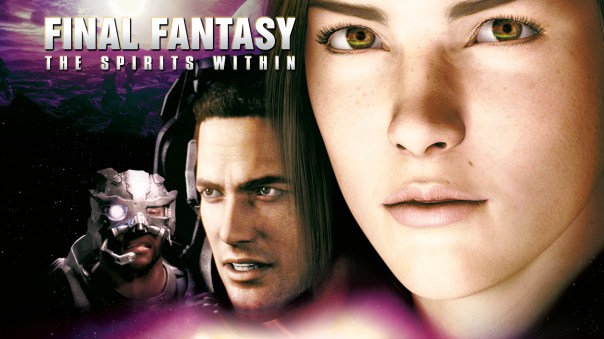
There was a time where the world wondered whether 2001’s Final Fantasy: The Spirits Within was going to put actors out of business. The Columbia/Sony animated feature, the first the studio released theatrically since the second Care Bears Movie, was a big technological leap. Square Studios, the makers behind the extremely popular video game RPG series, opened a new studio stationed in Hawaii to enter the realm of Hollywood, and they devoted four years and countless hours of processing to create photo-realistic visuals. This was still at the dawn of CGI animated features taking over the landscape and the leap was impressive. None other than Roger Ebert wrote in his review that he considered the movie a milestone along the lines of the first talkies. Before its release, there was scuttlebutt whether or not this was the wave of the future and actors would be replaced with computer versions, never mind that vocal actors were still being employed. The lead “actor,” Aki, was depicted in a swimsuit on a Maxim cover as an icky promotion. The 2002 movie S1mone satirizes this concept further, with Al Pacino fed up with temperamental industry actors so he secretly uses a photo-realistic computer program instead.
 I don’t really know why people got so worried. There are nuances that humans can convey that machines cannot, but even beyond that distinction, it’s simply a lot cheaper to hire an actor, put a costume on them, and record them than to build a model from scratch in a computer and toil for hours just to get the right look of the character raising an eyebrow. The listed budget for Spirits Within is $137 million, though has been rumored to be as high as $170 million (even more than Waterworld). For reference, the budgets of other 2001 movies include $125 million for the first Harry Potter, $93 million for Jurassic Park 3, $100 million for the Tim Burton Planet of the Apes, and $93 million for The Fellowship of the Ring. Even if you view Spirits Within as paving the way for motion-capture animated movies, the kind Robert Zemeckis spent a decade of his career slaving over, even those were eventually deemed too expensive for their returns. I think we can, at least for the time being, put this question to rest. Beyond the complexity that real actors can bring to performances, there’s the ease and cost that cannot be beat by a computer. Maybe in time this will change but for now rest easy Tom Hanks. You’re not going anywhere.
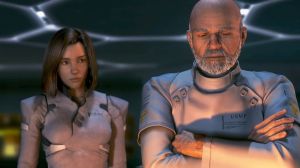
Twenty years later, the animation that once inspired awe now feels dated and surpassed. That’s the nature of the speed of technological advancement; even the company had to redesign scenes from the movie as they finished because the tech improved dramatically over the four-year development process. The visuals of the movie have become the norm for modern-day video games. There are aspects of the animation that are missing or just unable to be fully formed at the time. The faces look too slick and plastic, absent grooves and pores and imperfections that provide texture to people’s faces. The human appendages move like rubber. The hair seems to flow like it’s captured from a bouncy shampoo ad (apparently a fifth of the processing power went to animate the lead heroine’s 60,000 follicles). The character’s mouths look to be wired shut and unable to articulate their words. From a 2021 standpoint, the animation looks more like an extended video game cut scene from late 2000s. Its innovation has become commonplace.
 It should be no surprise that the script went through numerous rewrites. All the attention for Sony and Square was on the technical achievements and much less so on the story, which I guess they assumed would come together at some point. The project began with the Final Fantasy writers coming up with the initial plot, which would make sense until you realize the RPG fantasy series isn’t known for its sense of realism or cohesion. The plot of Spirits Within is not very in keeping with the more fantastical Final Fantasy series world. Screenwriter Jeff Vintar (I, Robot) was asked to read the script because the studio reportedly did not understand the project at all. His analysis was that they should completely start from scratch. The studio asked if he wanted to rewrite the script and gave him three weeks. His words were translated from English to Japanese and then back into English, which left something lost in translation a couple times over.
It’s surprising that the movie is even slightly coherent with everything it’s been through. It’s still a mess of a plot, with aliens having crashed onto Earth and made parts of the planet uninhabitable by their presence. They’re also revealed to be ghosts. So… alien ghosts. And there are eight horcruxes, I mean, um, spirits that need to be found to… something. The screenplay, under all of its laborious mutations, is really about a military team and a pair of scientists collecting MacGuffins and trying to use dreams to thwart a fascist from using a doomsday laser. It is simultaneously overly simplistic and overly complicated and quite silly. The villain, voiced by James Woods, even gets the full Nazi wardrobe but his viewpoint seems logical considering he’s pitted against scientists saying they need to break through to the “spirit of the Earth.” It’s hard to take their claims and wild speculation seriously in this more realistic world. Apparently, there was a plot development where Aki was revealed to be pregnant and her unborn child was the eighth and final spirit needed. You can still see its place in the plot. Reportedly, this storyline was cut because it was deemed “too Japanese” and I have no idea what that means.
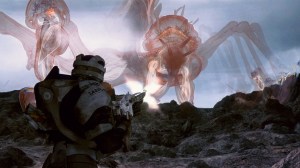 The real reason to ever watch The Spirits Within has come and gone. It’s now a footnote in animation history and a mild curiosity at best. I suppose you can still try and think how cool everything must have been to experience in 2001, and then your mind will wander because the nonsensical story will do little to hold your attention. It was such a financial disaster that Square Studios closed down and the company went back to focusing on video games full time with the occasional CGI direct-to-DVD movie (2004’s Advent Children and 2016’s Kingsglaive). Square Studio did make one of the CGI animated segments for 2003’s Animatrix, a concept paving the way for other ambitious animated anthologies like Netflix’s Love, Death, and Robots. The entire emphasis of this expensive production was slated onto its visual decadence, but the story was muddled, confusing, trite, and alien to the source material and the fanbase it was appealing to. I want to give my 2001 self a high-five because I’m happy that even at 19 years old in my original review I could see the evident faults of the mediocre storytelling as well as the arguments for replacing real actors with virtual facsimiles. Back in 2001, I said Final Fantasy: The Spirits Within had the benefit of always giving the viewer “something to sit in wonder and take in.” Twenty years later, that lone benefit has all but disappeared. Conversely, video games have become so much more ambitious, artistic, and emotionally engaging since 2001. So skip the movie and just play a game instead.
Re-View Grade: C
Share this:

Mortal Kombat (2021)
 Mortal Kombat is video game royalty, and if you were a Millennial that grew up in the 90s, then you likely have your own personal connection to this bone-crunching franchise. Released in 1992, the halcyon decade of fighting games, the arcade game gained notoriety and parental infamy for its photo-realistic fighters and for the over-the-top violence. Players could finish off their opponents in brutal and bloody fashion, drawing the condemnation of parents and politicians and only making teenagers want to play the games even more. I can recall my disappointment over the Super Nintendo port of the first game lacking the blood and gore of the arcade, something my Sega Genesis friends could lord over me with their faithful port (there was a code where you could turn the copious amount of sweat red, but it wasn’t the same). This was corrected with the release of Mortal Kombat II, and I think I devoted two whole years of my teenage life to playing that game, memorizing every player’s special moves and deadly finishes. I never really kept up with the franchise after the third game, and from what I’ve seen with the newest versions, I can safely say they just aren’t for me anymore. The gore of the 90s games was campy and ridiculous and the gore of the current games is too medically graphic for me (I’m not alone; apparently the game developers also needed therapy as they suffered trauma from their research and detailed recreation of the intensely destructive violence upon human bodies).
 I can recall seeing the 1995 Mortal Kombat movie at the local drive-in with my friend and fellow fan of the franchise, and we lapped it up eager to see any live-action version of our video game obsession. We were so excited and ignored the faults of the film, and we weren’t alone. It gained the reputation as one of the “better video game movies,” which is a criminally low bar to clear. I never watched the 1997 sequel, Annihilation, but it’s widely regarded as a so-bad-it’s-good farce and definitely an insult to fans of the games. From there, fans have been savoring the day another Kombat film could find its way to the big screen, something to wash away the taste of the cheesy 90s movies that were both PG-13 and lacking the signature gore of the series. The new 2021 Mortal Kombat movie is firmly rated R and is chiefly made for the diehard fans. It’s a fun and bloody movie with some flaws, but I don’t know what more I should have expected from a franchise that, from its very beginning, has literally spelled “combat” with a K.
The plot is straightforward for a game centered around a super-powered inter-dimensional fighting tournament. The Outworld has won nine tournaments in a row and with one more victory they will gain control over Earthrealm. Sorcerer Shang Tsung (Chin Sun) is the ruler of the Outworld and has the bright idea that if he kills all of Earth’s chosen fighters ahead of time, it will make his next tournament victory that much easier. He sends powerful assassins to Earth to locate the Chosen One, an MMA fighter named Cole Young (Lewis Tan) who doesn’t know he’s the descendant of a destined family line of warriors. Cole is taken under protection by Sonya Blade (Jessica McNamee) and Lord Raiden (Tadanobu Asano), where he is trained to reach his true potential. He needs to unleash a hidden superpower to compete with the best of Outworld.
First off, if you’re looking for a Kombat movie that is faithful to the atmosphere of the games, then you should walk away happy. Nobody is going into this movie and expecting Oscar-level material. We’re here for the fights, the crazy characters, and the gasp-inducing gore effects, and to that end the third film incarnation of Mortal Kombat mostly delivers the goods. Compared to the 1995 movie, populated with majority white actors with varying degrees of martial arts skills, and “varying” might be charitable, this is a clear winner. These are actors here from The Raid, Wu Assassins, Into the Badlands, The Twilight Samurai, Mongol, and plenty other worthy martial arts spectacles, so the filmmakers clearly valued having actors who could credibly perform the complex fight choreography. It’s also worth noting that we have Asian actors playing Asian characters, so that’s a bonus for authenticity and reverence as well.
 The opening six minutes of the movie really sets up how serious and potentially great it can be. It’s the early 1600s, and we’re introduced to the quiet family man, Hanzo Hasashi (Hiroyuki Sanada), a member of a Japanese ninja clan that is being hunted by Bi-Han (Joe Taslim), a dangerous warrior from a rival Chinese ninja clan. The opening is patient, thoughtful, and eerie, and when the fighting breaks out it’s done in longer takes where we can watch the actors strut their physical stuff. The fighting makes specific use of each character’s skills and is a satisfying start. The movie never quite lives up to these artistic heights again, at least for a sustained duration, but this taste of a legitimately good Mortal Kombat movie is enough to make you believe we can return here again.
The rest of the movie is decidedly fun and clearly doesn’t take itself too seriously (they even make fun of the “combat” with a K spelling). It’s got characters that can shoot lasers from their eyes, invisible monsters, four-armed strongmen, metal arms, and just about every character introduction is another opportunity for the movie to shrug and just accept its inherent weirdness of its rogue’s gallery. There’s a lady with dinosaur wings and another guy with a really sharp hat. What you want is for the filmmakers to present a world where these characters work, something that didn’t succeed with the goofy 1990s movies. I think the script by Greg Russo and Dave Callahan (Wonder Woman 1984) accomplish this feat and presents a world that finds a credible middle ground between campy indulgence and self-serious blather. It’s serious enough to not break out into derisive laughter but it’s still not too serious that the filmmakers have forgotten what the audience has paid to see. The gore effects are sticky and impressive and gross without being offensively so. The creative process for this movie was likely crafting a list of all the red-strewn finishing moves from the games and figuring out how best to squeeze them into the royal rumble. Every character gets a signature move, along with plenty of clunky catchphrases also crammed in for fan approval. If you’re a fan of the games, they’ve designed this movie with your demands primarily in mind.
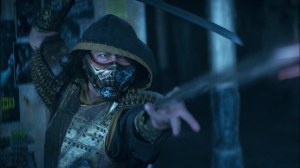 Where the movie falters are with decisions of pacing, structure, and some editing. Centering the story on a newcomer seems odd when any other established character could have sufficed, until you realize they’re setting up Cole Young to inherit the legacy of his ancestor and likely become the Scorpion we know so well from the games. Except that’s not quite what happens, which makes the decision to center him as an entry point perspective more confusing. It’s not like Cole is that interesting on his own. He’s a boring MMA fighter who wants to protect his family and that’s about it. He needs to summon his special power, and when he does, prepare to be underwhelmed. Another issue is that the second act is far too long and protracted. It’s mainly comprised of training exercises and people being told, “You’re not ready,” and vague force fields and teleportation powers that invite questions over whether they could have been used earlier. It’s too much training without the bloody reward of the gnarlier fights. This leaves the final act to be rushed and many of the climactic one-on-one fights are pushed into a measly montage. Finally, the editing of the fighting can become too choppy and jumbled to fully appreciate the onscreen action. The opening sequence is an example of where careful edits can highlight the choreography.
The new Mortal Kombat movie is fun, cool, bloody, and probably exactly what diehard fans would hope for from a big-screen rendition. It’s ridiculous but not tongue-in-cheek in tone. The visuals and special effects can often be weirdly beautiful especially with the crystalizing powers of Sub-Zero, the game’s popular ninja with the power to freeze and create deadly daggers of ice. There are some standout “wow” visual moments, like when Sub-Zero freezes a bullet firing from the blast of a rifle, or when he freezes his opponent’s spurting blood to form a knife. There were as many moments that brought a smile to my face as made me check the time. The dialogue is flat and the only actor who seems to really be enjoying himself is the proudly profane Josh Lawson as Kano. But when it comes to the fighting, the fatalities, and the franchise’s glorious selling point, it might not be a flawless victory but it’s still a victory nonetheless for fans.
Nate’s Grade: B-


 nathanzoebl
You must be logged in to post a comment.