Blog Archives
The Fantastic Four: First Steps (2025)

Apparently there must have been an ancient curse that brings forth a new attempt at a Fantastic Four franchise every ten years, even further if you want to include the 1994 Roger Corman movie that was purposely made and never released just to hold onto the film rights (I’ve seen it, and once you forgive the chintzy special effects and shoestring budget, it’s actually a pretty reverent adaptation). The 2000s Fantastic Four films were too unserious, then the 2015 Fantastic Four gritty reboot (forever saddled with the painful title Fant4stic) was too serious and scattershot. Couldn’t there be a healthy middle? There has been an excellent Fantastic Four film already except it was called The Incredibles. That 2004 Pixar movie followed a family of superheroes that mostly aligned with the powers of the foursome that originally made their debut for Marvel comics in 1961. It makes sense then for Marvel to borrow liberally from the style and approach of The Incredibles because, after all, it worked. There’s even a minor villain that is essentially a mole man living below the surface. Set on an alternate Earth, this new F4 relaunch eschews the thirty-something previous films of the Marvel Cinematic Universe (MCU). You don’t need any prior understanding to follow the action, which is kept to under 105 minutes. The 1960s retro futurist visual aesthetic is a constant delight and adds enjoyment in every moment and every scene. The story is a modern parable: a planet-eating Goliath known as Galactus will consume all of Earth unless Reed Richards (Pedro Pascal) and Sue Storm (Vanessa Kirby), a.k.a. Mr. and Ms. Fantastic, give over their unborn son. The added context is that they have struggled with fertility issues, and now that at last they have a healthy baby on the cusp of being theirs, a cosmic giant wants to call dibs. It makes the struggle and stakes much more personal. It makes the foursome genuinely feel like a family trying to resolve this unthinkable ultimatum. I cared, and I even got teary-eyed at parts relating to the baby and his well-being, reflecting on my own parenting journey.

From a dramatic standpoint, this movie has it. From an action standpoint, it leaves a little to be desired. It incorporates the different powers well enough, but there are really only two large action set pieces with some wonky sci-fi mumbo jumbo. There’s a whimsical throwback that makes the movie feel like an extension of a Saturday morning cartoon show except for the whole give-me-your-baby-or-everybody-dies moral quandary. While I also appreciated its running time being lean, you can feel the absence of connective tissue. Take for instance The Thing (The Bear‘s Ebon Moss-Bachrach) having a possible romance with a teacher played by Natasha Lyonne (Poker Face). The first scene he introduces himself… and then he appears much later at her synagogue seeking her out specifically during mankind’s possible final hours. We’re missing out on the material that would make this personal connection make sense. The same with the world turning on the F4 once they learn they’ve put everyone in danger. It’s resolved pretty quickly by Sue giving one heartfelt speech. The movie already feels like it has plenty of downtime but I wanted a little more room to breathe. I was mostly underwhelmed by Pascal, who seems to be dialing down his natural charm, though his character has some inherently dark obsessions that intrigued me. He recognizes there is something wrong with him and the way his mind operates, and yet he hopes that his child will be a better version of himself, a relatable parental wish. There are glimmers of him being a more in-depth character but it’s only glimmers. The family downtime scenes were my favorite, and the camaraderie between all four actors is, well, fantastic (plus an adorable robot). Kirby (Napoleon) is the standout and the heart of the movie as a figure trying to square the impossible and desperate to hold onto the baby she’s dreamed of for so long.
The Fantastic Four: First Steps is an early step in a better direction. It’s certainly better than the prior attempts to launch Marvel’s first family of heroes, though this might not be saying much. It does more right than wrong, so perhaps the fourth time might actually be the charm.
Nate’s Grade: B-
Share this:

Napoleon (2023)

I may be completely in the wrong, but I feel the only way to view Ridley Scott’s latest historical epic, a 158-minute account of the life of Napoleon Bonaparte, is as a comedy with the full intention of not retelling history but of de-mythologizing the grandiosity of its star. Otherwise, these 158 minutes feel like an accelerated Wikipedia summary of the man’s many famous deeds as he rose from general to Emperor and swept his armies across the continent conquering much of Europe. Rather, I choose to think of the movie as a strange comedy that shows how this fearsome military genius might also have been just a strange little guy with a temper.
The Revolution in France is burning out of bodies and the people are growing restless at the lack of meaningful democratic progress. Enter Napoleon Bonaparte (Joaquin Phoenix) as a successful general who will eventually crown himself as Emperor of France. He will wage war across the continent, lead to the deaths of three million by his final defeat 1815, and reshape and revolutionize the military of its days. He will also die alone, exiled, and without the love of his life, his wife, Josephine (Vanessa Kirby).

This all has to be a comedy, right? Ridley Scott (Gladiator, The Last Duel) went to elaborate lengths to make fun of the little general, right? How else to read scenes where Napoleon and Josephine argue at the dinner table where he accuses her of being infertile, she accuses him of being fat, and he agrees that he heartily likes his food and says, “Fate has brought this lamb chop to me.” How else to read a scene where he throws a hilarious hissy fit before the English ambassador, who Napoleon feels has been rude and less than deferential, and he screams, “You think you’re so great because you have boats!” How else do you read a montage of Napoleon seizing power with the military pushing out the old figures of power and one of them, aghast, shouting, “This cannot be. I am enjoying a succulent breakfast!” How else to interpret the scene where Napoleon is going to achieve his coup from the French parliament and he’s run out of the chamber, falling and scampering out like a child caught playing tyrant. It’s moments like these, as well as the acting choices, that push me in the direction of interpreting this movie less as another handsomely mounted biopic of The Great Men of History and more tearing down the lockstep reverence for this figure glorified through centuries of back-patting. I’m reminded of Josh Trank’s relatively unloved Capone movie from 2020, and while imperfect, I appreciated that Trank spent the entire movie tearing down the legend and myth of this bad man and showed him for what he was late in life, a pathetic, decrepit loser riddled with syphilis losing his mind and crapping his pants. I think we need more biopics that have a less reverent approach to their subject because then it provides a public service of inviting viewers to be more critical of history rather than blindly accepting.
I think this is also showcased by the fact that Scott and screenwriter David Scarpa (All the Money in the World) are choosing to tackle the legends rather than the history. Take for instance the acclaimed Battle of Austerlitz, one of the film’s high-points. Napoleon surprises the combined Russian and Austrian troops by firing cannons at the frozen lake, causing it to shatter and entomb thousands of men to their watery graves. It’s a stunning visual sequence that blends the beauty and terror of the events and of course little of it happened in real life. In reality, the lake was really more a series of small ponds and reportedly very few enemy soldiers drowned. In reality, Napoleon never rode into battle as part of his cavalry. The generals stayed behind with orders. Or take for instance Napoleon’s ill-fated march into Russia, and when he arrives he’s so bored and thoroughly depressed as he sits on the empty throne in Moscow, acting like a little kid who is eager to go home already. That’s the difference between history as it happens and history as it is remembered, and that’s the myth-making that Scott is attempting to work through and re-contextualize for the many people who aren’t fanatical acolytes of the historical record. This is Scott saying he’s going to take all the myths and legends and make you critically reconsider.

Then there’s the relationship with Josephine which defines much of the movie, so much so that it provides explanations for why Napoleon left his first exile, because, apparently, he was upset his wife was seeing other people. The relationship plays out like one more of political maneuvering than romance, with some eyebrow-raising bedroom kinks to modernize the tale. Much of their conflict is on Napoleon’s inability to sire a male heir, which is put through the steps of the scientific method by his concerned and opportunistic mother as he attempts to father bastards with other women. This is the storyline that suffers the most from the accelerated pacing and editing, so consumed with moving from place to place and fitting in all the historical checkpoints. The larger nuance of this relationship, and Josephine as a character, is taken out by simplifying it as a tale of two people who realize that gender-specific baby-making is their top priority. In reality, Napoleon absolutely adored his wife and wrote lengthy love letters that you can read today, with lines such as, “I hope before long to crush you in my arms and cover you with a million kisses burning as though beneath the equator,” and, “Without his Josephine, without the assurance of her love, what is left him upon earth? What can he do?” It’s a shame so much of this is reduced to heir-production anxiety.
Phoenix (Beau is Afraid) plays the titular role like he’s sleepwalking, slumped and grumpy and rarely providing much energy except around plates of food. It’s a curious performance and one that helps me to further see the depiction as one through the lens of a critical offbeat comedy. He’s certainly not playing the man like he’s one of the great inspirational figures, and he’s certainly not playing the man like he’s tearing through a multitude of doubts and inner demons. He’s playing Napoleon like a grumpy weird little guy who would rather be dining than conquering. Kirby’s (Mission: Impossible Dead Reckoning) more an accessory in her character’s limited scope but she does have a few moments that reflect Josephine’s moxy.
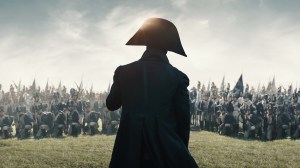
I would be remiss to pass up this chance to sing the praises of my former high school AP history teacher, Mr. Jerry Anglim, who had been teaching history and government for over 26 years before I stepped foot in his classroom. The man brought history alive for me and really crystalized my love for the subject, seeing how it’s all just one big canvas of storytelling. And this man loved teaching the Napoleonic Wars in great detail, and I loved scribbling down those notes every day. I even thought about getting a Napoleon poster to hang in my room, which would have been quite the odd teenage decorating choice. We watched the 1970s Waterloo movie starring Rod Steiger as Napoleon in class on a tiny TV attached to the corner, and yet I was spellbound because of what this teacher had done for me with the subject. So, wherever you are Mr. Anglim, thank you, and I’m sure you have your complaints with this new movie and I would love to hear them.
As a long movie still barely chronicling the major events of its subject, Napoleon feels lacking unless viewed through the lens as a critical comedy tackling his legends and myths. Then the abrupt nature of the plotting becomes more an addition than a subtraction. However, Scott has gone on record that he has a four-hour director’s cut that Apple plans to make available on its streaming platform in the near future, so perhaps my entire interpretation could be blown up. To be fair, the real Napoleon was a military genius and did revolutionize and modernize the French military, and while he didn’t “conquer everything,” especially Great Britain and Russia, the man and his ambitions and good fortune dominated the first fifteen years of the nineteenth century. Human beings will always be drawn to the stories of conquerors, but it’s important to also see them as people, quite often terrible people, but human beings with failings and complexities that are often left behind from decades if not centuries of propaganda and historical whitewashing. As a biopic, Napoleon the movie feels too short and shrift. As a comedy, it’s a lamb chop served up by fate.
Nate’s Grade: C+
Share this:

Mission: Impossible – Dead Reckoning Part One (2023)
 I was a nominal fan of the Mission: Impossible series after three movies, and it seemed like the American public was feeling the same. After 15 years, it felt like the franchise was considering a soft reboot/shift with 2011’s Ghost Protocol, setting up Jeremy Renner as the heir apparent to Tom Cruise’s super spy, Ethan Hunt (weirdly, Renner was also set up to be another franchise replacement for Matt Damon’s Jason Bourne in 2012). Except what may have been initially planned as a franchise hand-off became a franchise renewal, with a delightfully twisty plot, fun teamwork as they scramble to adapt, and a show-stopping action set-piece that remains the franchise’s high-point, the scaling of the towering Burj Khalifa skyscraper. It also reminded us that not only does Cruise love to run but the man has a death wish when it comes to performing his own amazing stunts. With Cruise firmly back in place as lead, and Renner jettisoned (which also happened after 2012’s The Bourne Legacy), the franchise was further boosted by two of its best additions: actress Rebecca Ferguson and writer/director Christopher McQuarrie. The Oscar-winning Hollywood screenwriting staple was not known as much for his directing efforts, but he became a Cruise confidant after 2008’s Valkyrie, and he’s worked almost exclusively on Cruise projects ever since. He earned the man’s trust and proved a fantastic action director. 2018’s Mission: Impossible Fallout is just blockbuster filmmaking at its high-stakes finest. I was bouncing in my chair with excitement and simply luxuriating in action thriller nirvana.
This time Ethan Hunt (Cruise) and his select team of trusted friends and colleagues are battling a villain terrifyingly relevant to our modern times, especially in light of the screenwriters’ strike – artificial intelligence. The big bad is an A.I. that can control the world’s security apparatus, and it’s become self-aware and resentful of its human overlords. It exists inside a computer console inside a Russian submarine at the bottom of the Arctic ocean under a wall of ice, and the A.I., known as “The Entity,” doesn’t want to ever be found (must be an introvert). If only it was that easy. The world is racing to be the first to claim this unparalleled prize, and the Impossible Missions team has to ensure they can find the location, which of course involves a MacGuffin, this time two interlocking keys to access the A.I. sub station. Can Ethan get there first and can he even trust his own government to do what’s best with access to this kind of power?
 Mission: Impossible – Dead Reckoning Part One is a mouthful of a title. We got a colon, a dash, and a “part one,” a presumptuous gamble that after 160 minutes the audience is going to be ravenously hungry for a continuation in a series that has never had a two-parter before. In short, the movie is a lot, a lot of the same action and renowned stunt work we expect, and a lot of setup and extension that might have been better trimmed by focusing on one movie rather than setting up two. McQuarrie has done this before and been successful without the need of a direct two-parter. For all intents and purposes, Fallout is a direct sequel to 2015’s Rogue Nation, carrying over the same villain for the first time in the series and the ongoing relationship between Ethan and Ilsa Faust (Ferguson). Both of those movies feel complete and satisfying and well-designed in structure and development without needing one part to complete the other. With Dead Reckoning Part One, henceforth known as M:I 7 to spare me from writing this title every time, it feels like an overlong setup. By the end of the movie, our characters know where the A.I. is located but they still don’t know where the sub is or how to get there, which means the entire movie could have been collapsed into a more streamlined venture. Part of this may be the production troubles where they had to shut down and rejigger the plot multiple times from COVID outbreaks, as M:I 7 is the last of the big Hollywood movies to release that was shutdown in 2020 by the devastating pandemic. It all feels a bit overstretched and absent a satisfying conclusion.
The draw of the franchise, and chiefly its 2010s renewal back into the zeitgeist, is still the eye-popping stunts and set-pieces and Dead Reckoning still delivers. Most viewers will likely find the final action sequence aboard a speeding train to be the high-point, and it’s got some wow moments, my favorite is when the train is hanging over a blown bridge and Ethan has to leap from train car to train car before it plummets, oh and it’s all at an incline. It turns each car into a new obstacle to overcome utilizing its specific dynamics, like a dining car with a falling piano to a kitchen with vats of hot grease to avoid. The standout stunt involves Cruise driving a motorcycle off a mountain in a desperate effort to parachute onto this speeding train. However, this whole train sequence didn’t excite me too much, outside of its beginning stunt and the end. Watching men chase one another atop the speeding train, let alone wrestle and fight with knives, only serves to limit what can be done and it reminds me how fake the moment is for a franchise that has made its mark on its daredevil realism. That extended middle feels a bit too much like other Hollywood thrillers and action movies, and that’s what made it disappointing for a series I consider the current gold standard of franchise action.
 A much less heralded sequence around the forty-five minute mark was my favorite, where Ethan is running around the Abu Dhabi airport while the following takes place: 1) Ethan trying to evade federal agents (the dependable Shea Whigham) looking to arrest him, 2) Ethan is trying to find the owner of one half of the MacGuffin keys who happens to be a pickpocket that keeps giving him the slip, 3) Ethan’s team, Luther (Ving Rhames, the only other actor who has appeared in every M:I film) and Benji (Simon Pegg) trying to find a nuclear bomb in a suitcase through the maze of baggage claim and disarm it, 4) the introduction of our villain Gabriel, well, our primary lackey to The Entity, who also happens to be a former IMF turncoat who killed Ethan’s girlfriend and essentially “made Ethan Hunt who he is” following Batman logic. This entire sequence is pure McQuarrie splendor, where it introduces the different characters, several at cross-purposes, lets them loose and then finds organic complications and specific turns that take advantage of the geography as well as the character’s emotional states. I loved it, and it made me hopeful that after a bit of a slow start that M:I 7 was now cooking and would be the prolonged deluge of near-perfect set-pieces that was Fallout. Not so much, but this sequence was indeed good fun.
Another issue I had was that our villain, again more like chief lackey, is so bland. I like Esai Morales (Ozark) as an actor, but the character of Gabriel is such a non-starter. Even giving him the personal history with Ethan feels like an admission that this bad guy has little to offer on his own. I think it’s part of how the character is written but I think it’s also a reflection that he’s the number two behind the all-powerful, scheming A.I., and then he too has a number two (number three?) played by Pom Klementieff (Guardians of the Galaxy vol. 3), and she is so much more engaging as an antagonistic presence. She’s the one driving through cars and stonework throughout Rome to chase down Ethan. She’s the one who fights him in a narrow alleyway, a nicely claustrophobic change-of-pace action moment for a series that gorges on scale. If the true villain is going to be an A.I., why can’t Pom simply be its number two hench-person? Gabriel is redundant and boring and his fight sequences don’t feel believable against this crew.
 There are a couple other storytelling choices that I wasn’t happy with, but I’ll save delving into those for the sake of spoilers. Suffice to say, I hope Dead Reckoning Part Two in 2024 course corrects and we have some welcomed returns. It’s kind of fun to see Kittridge (Henry Czerny, Ready or Not) make his first reappearance since the 1996 M:I and also get so much screen time. He’s essentially the face of the U.S. government infrastructure for the duration of the movie. His clenched-jaw consternation is a nice foil to the always rogue super spy.
Dead Reckoning – Part One is a good but not great Mission: Impossible movie, conceived as two parts and suffering some of the consequences of its over-extension. The thrills are still there, the sturdy production values, the emphasis on the spectacular stunts and fun action set pieces, so any fan of the franchise will find enough to enjoy over 160 minutes. The addition of Hayley Atwell (Avengers: Endgame) as the wily pickpocket who has stumbled into international espionage is great, though she cannot escape feeling like an Ilsa replacement while Ferguson is off-screen for too long. Cruise is still the movie star who delivers the most from film to film, and his high-wire efforts are appreciated. By the end of the movie, the sub is still at the bottom of the ocean, our characters are still in a race to find it, and I wondered why we couldn’t have ditched “Part One.” The answer, as much in Hollywood, is of course money, but I wish this Part One made me more psyched for Part Two.
Nate’s Grade: B
Share this:

Pieces of a Woman (2020)
 More an acting exercise than a fully developed movie, Pieces of a Woman is a punishing experience for the audience as much as the actors onscreen. The entire first 30 minutes is comprised of watching a home birth in an extended long take, which doesn’t so much immerse you in the situation as beg the question of, “How’d they do that?” The sequence concludes with a rushed delivery and an asphyxiated child, and then we cut to the title screen. From there, it’s 90 minutes of what agonizing grief does to this family. Vanessa Kirby (The Crown) plays the mother and she doesn’t want to let go but also feels uncomfortable that their flustered midwife is being charged with negligent homicide. Her boyfriend (Shia LaBeouf) is struggling to maintain their relationship and move past their shared tragedy. Her mother (Ellen Burstyn) is a domineering presence and wants the boyfriend gone and the midwife in jail. It’s all very well acted and Kirby does a fine job dredging up pure emotional devastation. The problem is that Pieces of a Woman has seemed to confuse drama with plot. There are many dramatic moments that occur but they don’t really provide greater insight into the main characters who are, at their core from that half-hour mark onward, broken people coming to terms with their response to the unimaginable. It seems paradoxical because the concept of a grieving family, angry and looking to blame someone, a relationship splintered where each party is potentially having an affair to feel something diverting, mother-daughter head-butting, it all seems like foundational elements of compelling drama. The problem is that we don’t ever get progression with the characters and their emotional states from these very dramatic events. They’re suffering, they’re unhappy, they’re numb to the pain yet carrying on, but are they interesting? Are we getting more of a sense over who they are or how they’ve changed? I would argue no. The movie feels locked into stagnation. I think a major stumbling block was spending so much time establishing a realistic birthing sequence opening, aided by a roving and unblinking camera, when the same information could have been covered in the first ten minutes and not first 30. It’s excessive and repetitive, but then so are the 90 minutes that follow that wallow in unchecked misery. It’s an approach that can take some of the devastation out of the horrific. Pieces of a Woman will be available on Netflix streaming starting tomorrow and despite its artistic merits and good acting I can’t exactly argue that it’s worth enduring the pain over.
Nate’s Grade: C+
Share this:

Fast and Furious Presents: Hobbs & Shaw (2019)
 It took nine movies but we can now put the Fast and Furious franchise to rest, and that’s because we now have Hobbs & Shaw, the spinoff that took the best parts of the franchise and ran away. What started as a film about underground street racing in 2001 has morphed into an over-the-top superhero spectacle where their superhuman power is being really good with cars, as well as not adhering to any laws of physics. Now they’ve cordoned off The Rock and Jason Statham, attached the director of Atomic Blonde and give me Idris Elba as the villain, who openly proclaims himself to be “black Superman.” Why do we ever need to go back to Vin Diesel and his pit crew ever again? Hobbs & Shaw is a big blast of action overkill fun. It’s not without its flaws and limitations but it’s exactly what it set out to be.
Agent Hobbs (Dwayne Johnson) is trying to enjoy some rest and relaxation with his daughter but the world isn’t going to be save itself. He’s recruited to team up with the wily Deckard Shaw (Statham) to recover a missing sample of a super virus that can be programmed to kill anyone on the planet. The key is finding MIA MI6 agent Hattie (Vanessa Kirby), accused of killing her team and absconding with the virus. She also happens to be Shaw’s estranged sister. The real villain is a super mercenary Brixton (Elba) who is engineered to be a superior killing machine. His mysterious employer wants to recruit Hobbs and Shaw to the cause, but in the event of their refusal, death is always an option. The Shaw family reunion makes the majority of the movie a three-person chase film that ultimately pushes Hobbs to go back home to the Samoan family he left behind decades ago and they haven’t forgotten their prodigal son.
 Once again, the main draw of a Fast and Furious movie are the eye-popping action set pieces, and Hobbs & Shaw has its fair share of excitement and satisfaction. There are a couple standouts, notably a climactic helicopter face-off involving a chain of racing vehicles and the concept of lift, but really none of the action will displace the top moments from this increasingly insane franchise. Director David Leitch (Deadpool 2) doesn’t have any signature moments that stun like that extended, fatigued fight sequence in Atomic Blonde, but he definitely taps into the moment-to-moment fun and absurdity. A chase down the side of a building is not remotely realistic, but with Leitch there’s an added sense of comedy by making it another contest between Hobbs and Shaw. That macho posturing can liven up an already enjoyable scene and give it a personal edge that ties into the charisma of the stars. So even when the action is cooking at a lower level, focusing on that charisma elevates the sequence. The action pumps at a constant pace with plenty of explosions, tumbles, and powerful fists. The movie follows the latter Fast and Furious mold by not even trying to resemble reality. When Brixton’s super hands-free motorcycle acts more like a living Transformer, it doesn’t matter because the movie isn’t building a reality where something like that would seem like an exaggeration. I laughed more at moments like that and smiled rather than scoffing at its disconnect from crafting some kind of baseline sense of reality.
I will say the action beats could be shaved down, especially as the movie teeters to 135 minutes long. It’s not exactly the kind of action cinema like Mission: Impossible where the set pieces are so brilliantly constructed with organic complications. These aren’t quite at the level of spectacle or immersion of a Fury Road or even the Justin Lin-era of Furious land. There are few sequences that couldn’t be pared down because often the beats are the same beats just with more of them. I wished there had been a greater variety of action sequences or at least an interesting series of complications, the lifeblood of great action movies. There are a few standout moments with larger-than-life imagery but mostly the action has a very same-y quality that can feel repetitive. That’s where the comedic perspectives can help. A hallway fight is enjoyable but lacks impressive fight choreography, but what saves the scene is the comedic exasperation at the end for Shaw and again tying it to the ongoing competition with Hobbs.
 Beyond the explosive action, the real draw is the cast and they are overloaded with charisma. There’s a reason somebody at Universal decided to slice off these two characters because they are clearly the only characters many people ever cared about, because both actors have an innate charm that pops off the screen. Watching the two of them butt heads and trade insults and glares is an ongoing pleasure. It reminds one how big personalities can effortlessly carry big Hollywood action movies when you have the right stars together. They do form their own sort of combative bond and understanding by the end, but one wonders if their banter will get old if it doesn’t evolve over the inevitably commissioned assembly of sequels. The Rock and Statham get some big laughs and hearty entertainment squaring off and working together for even bigger destructive power.
Kirby (Mission: Impossible – Fallout) is a terrific addition as a strong-willed, kickass heroine first and a potential love interest for Hobbs second, which amusingly upsets Shaw. Kirby has an above-it-all air to her that makes her seem like a natural match as a sister to Statham. Elba (Molly’s Game) is settling into a groove as a go-to heavy (Star Trek Beyond, The Jungle Book) and even while threatening a global pandemic he can’t help but be smooth and charming. This is the best cast ever assembled for a Fast and Furious movie, and you throw in unexpected comedy cameos, Helen Mirren, and an extended Samoan family, and the movie begins to stake out its own claims on a world separate from Diesel’s boring “family.”
 Hobbs & Shaw is a combination of 80s action movie attitude, 90s bombast, and 2010s outrageous set pieces, lead by two of the more charming men Hollywood has at its punching-kicking disposal. That’s actually a pretty good word, “disposal,” because the movie is designed as nothing more than a breezy two hours at the movies with your biggest tub of popcorn. Of course the studio has larger plans and envisions it as a way to keep the Fast and Furious franchise alive and diversified. Hobbs & Shaw has little more on its mind than giving its audience a good time, and it easily achieves that aim. I may not feel the need to watch Fast and Furious movies again like I do other action franchises that provide more emotional investment, practical stuntwork, and structural brilliance, but that doesn’t mean I won’t happily consume the next entry. As long as The Rock and Statham are in place and feeling good, so too will the eventual audience.
Nate’s Grade: B
Share this:

Mission: Impossible – Fallout (2018)
 Coming down from the surging adrenaline rush, I was trying to determine when was the last time an action movie made me feel the immersive, delirious highs that Mission: Impossible – Fallout offers in spades, and what I came up with 2015’s Mad Max: Fury Road. Simply put, this is the best straightforward action movie in three years. It’s the best Mission: Impossible movie in the series, which, if it hadn’t already, has assumed the peak position of the most consistent, most entertaining, and best action franchise in Hollywood. Allow me to explain how returning writer/director Christopher McQuarrie (Jack Reacher) makes an action movie that demolishes the competition.
Ethan Hunt (Tom Cruise) has been pulled back into spy action thanks to the lingering fallout (eh, eh?) of the capture of Solomon Lane (Sean Harris), whose followers, nicknamed The Apostles, have stolen three plutonium cores. It’s Ethan Hunt’s fault the nuclear cores got loose, and so he and his team, Luther (Ving Rhames) and Benji (Simon Pegg), must clean up after their mess. The CIA sends its own asset, the burly August Walker (Henry Cavill), to help oversee the mission and specifically Ethan Hunt, who must pose as a shadowy terrorist broker to maintain appearances with important figures in the criminal underworld. In order to get the nuclear parts, Ethan Hunt has to retrieve Solomon Lane and release him back into the open. Complicating matters further is Ilsa Faust (Rebecca Ferguson) who needs Solomon dead to clear her own spy debts.
 Every action movie lives or dies depending upon its unique set pieces, often the first thing constructed by a studio and then the plot mechanics are ladled on merely as the barest of connecting tissue. They need to have stakes, they need to have purpose, they need to be memorable, and they need to be understood and develop organically. Mission: Impossible – Fallout could be taught in filmmaking schools about how to properly build action set pieces. They are brilliant. McQuarrie finds interesting ways to set them up, complicate them, and just keep the escalation going in a manner that still maintains the believability of the moment. Take for instance a foot chase where Ethan Hunt is trying to nab a bad guy through downtown London. Where McQuarrie pushes into the extraordinary is by having that foot chase on a multi-level terrain. Ethan Hunt has to chase after his target but multiple stories above the ground, and so he’s leaping out windows, jumping over rooftops simply to keep up. It’s a simple twist that takes what we’re familiar with and, literally, elevates it to new heights. Or take for instance the mission in Paris to capture Solomon Lane. At first it’s capture, then it’s flee police, then it’s flee another assassin. There are multiple stages to this sequence, each with a new goal, each with new complications, and each with new eye-popping stunts and escapes. The action finds natural points to progress, making smart use of the geography, and keeping different elements at play to come in and out to add more problems. This is how you do action right. As soon as the half-hour mark settles in with the arrival of Walker, the movie is practically nonstop in its set pieces until the very end. At a steep 147 minutes, this is the longest Mission: Impossible movie yet but it’s breathless in its execution.
Amazing set pieces that are cleverly designed is one aspect of a great action movie, but if you can’t tell what’s going on, what’s the point of all that cleverness? Fortunately, McQuarrie understands this and adheres to a visceral depiction of the action that creates gloriously immersive and pulse-pounding sequences. The set pieces are terrific, so it stands to reason the stuntwork should be terrific, and to make sure you appreciate the stuntwork, McQuarrie makes sure the photography highlights the verisimilitude. It’s a symbiotic (or as the Venom trailer tells me, “sym-BI-oat-ic”) relationship but when done correctly, as evidenced in this film, it’s the key to truly kinetic action sequences. Take for instance a parachute jump that marks the start of the second act. McQuarrie films it as a sustained long take, and as the camera plummets to the ground chasing after the two men, our brains can tell us that there is some special effects trickery to mitigate the dangers, but our senses are overwhelmed with the sustained illusion of tension. The fight choreography is equally up to the challenge. A bathroom brawl with Ethan Hunt and Walker and another man becomes a lesson in how many things can be smashed and what can be used as a weapon. A high-speed motorcycle chase through Parisian streets gets even more frantic when Ethan Hunt drives against traffic, and the scene becomes even more exciting when McQuarrie’s lens allows us to see the danger in all its glory.
 The Mission: Impossible franchise has been notable for its insane stuntwork but also, chiefly after the second installment, its edict to practical effects and maintaining the believability of its reality. It’s still movie spy shenanigans and globetrotting adventures, yes, but the moment-to-moment thrills feel like they’re really happening. The Fast and Furious franchise has gained great acclaim for the bombast of its physics-defying spectacle, and the Mission: Impossible franchise seems to have gone purposely in the opposite direction. It’s real Tom Cruise jumping off that building, it’s real Tom Cruise riding through traffic on a motorcycle, and it’s real Tom Cruise falling and climbing up a speeding helicopter during the thrilling finale. Cruise has had a death wish when it comes to throwing himself into the high-wire stunts of his franchise, but even at 56 years old he’s still at it, essentially trying to commit suicide on film for all of our amusement. Cruise is one of the few remaining movie stars and his commitment is without question.
This is also the first Mission: Impossible film that feels like the characters matter. It’s a direct continuation from the previous film, 2015’s Rogue Nation, bringing back the (somewhat lackluster) villain, the newest spy counterpart/potential love interest, the CIA and IMF brass, and the essential supporting team members from prior engagements. Because of this it feels more like what happened previously was establishment for a new story building upon that foundation. Rather than starting all over, the characters find ways to deepen their relationships, and the film opens up Ethan Hunt as a character and the toll his duty takes on those closest to him. There are some nice quiet moments that examine these characters as actual people. Several complications are as a direct result of personal character decisions, some good and some bad. I was joking with my pal Ben Bailey beforehand about wondering whether they’d find a way for Ving Rhames to matter, since he hasn’t been much more than “a guy in the van” for four movies, and by God they make him matter. They make each team member matter, finding moments to give them, mini-goals they’re entrusted with. During the dizzying helicopter chase in the finale, supporting players are left with their own task. Luther has to defuse a bomb but doesn’t have enough hands. Benji has to find something valuable in a very needle-haystack situation designed to torment and waste precious time. Ilsa is at cross-purposes for most of the film, not wanting to harm her fellow allies but also being given her own orders to prove her loyalty and protect her future. All of this comes to a head and it makes the parts feel as important as the whole. That’s great storytelling.
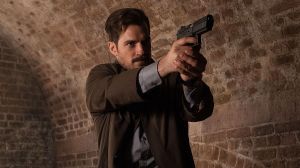 Let’s talk about that million-dollar mustache of Cavill’s. It was a year ago that Justice League re-shoots required Cavill and the Mission: Impossible team refused to allow their actor to shave his mustache, thus leading to that unsettling fake baby lip Superman was sporting in a majority of his scenes in the haphazard Justice League film. I just read an AV Club interview with McQuarrie where he for the first time discusses the whole mustache brouhaha and apparently Paramount estimated that it would have cost them three million for the effects to uphold Cavill’s upper lip continuity. Warner Brothers refused to pay up and so went down that ill-fated CGI mustache-removing route. It was shortly afterwards that Cruise shattered his ankle in a roof-leaping stunt (that is in the finished film and advertisements) and the production had to shut down for a month. If only Warner Brothers had waited, perhaps we all could have avoided this mustache mess.
Mission: Impossible – Fallout is a new highpoint for the best action franchise going in movies today (I’m still waiting for a third Raid film, Gareth Evans). The set pieces are memorable and unique, leading from one into the next with exquisite precision and thought. The action sequences are stunning and shot with stunning photography, highlighting the stunning stuntwork by the best death-defying professionals. It’s the first Mission: Impossible movie that doesn’t climax at its middle; in fact there’s a pretty obvious reveal that feels like it was going to be a late Act Three twist, but McQuarrie recognizes the audience thinking ahead, and there’s like a whole other exciting 45 minutes after. The stakes are better felt because the characters matter and are integrated in meaningful ways. This is the most I’ve enjoyed Henry Cavill in a movie (with possible exception of another spy movie, Man From U.N.C.L.E.), and you know what, his mustache works too. While the vertigo-inducing Burj Khalifa sequence is the best set piece in the franchise, Fallout has everything else beat at every level. Mission: Impossible – Fallout is a reminder that there are few things in the world of cinema better than a properly orchestrated, properly filmed, and properly developed action movie operating at full throttle. This is one of the reasons why we go to the movies, folks. See it in IMAX if possible. Soak it up.
Nate’s Grade: A


 nathanzoebl
You must be logged in to post a comment.