Blog Archives
Nosferatu (2024)
 Director Robert Eggers’ remake of a famous rip-off of the most famous blood-sucker in literature is a finely crafted and highly atmospheric drop into the past, as should be expected from Eggers (The Witch, The Northman). It doesn’t redefine cinematic vampires but rather puts the story through the contemporary lens of a toxic ex-boyfriend who refuses to relinquish what he feels belongs to him. The story should be familiar to most, even if they never watched the original 1922 silent film, nor its 1970s remake by Werner Herzog. Bill Skarsgaard plays the mysterious and threatening Count Orlock, a wealthy Transylvanian outsider looking to relocate to the big city in Germany, primarily to prey upon poor Ellen Hunter (Lily-Rose Depp), the “one who got away,” so to speak. He haunts her dreams and drives her mad, with Depp mesmerized and convulsing most convincingly. From there it’s a battle between Ellen’s husband (Nicholas Hoult) and an expert in the occult (Willem Defoe) over whose will will win out. Skarsgaard is fascinating and chilling and you too may want to imitate the thick-as-stew Count Orlock accent afterwards. The technical elements of this movie are masterful, from production design, to costuming, to the gas-lit and moody photography. Eggers is a deeply sincere filmmaker who translates his passions and madness onto the big screen with loving care. Nosferatu is gorgeous and unnerving, though I’m hesitant to say it rivals Francis Ford Coppola’s Dracula movie for modern vampire artistic triumph and pure horniness. It’s a gussied-up B-movie with a deeply committed filmmaker to deeply realized genre filmmaking, and so Nosferatu is an entertaining remake that most vampire fans will be happy to sink their teeth into this holiday season.
Nate’s Grade: B
Share this:

Van Helsing (2004) [Review Re-View]
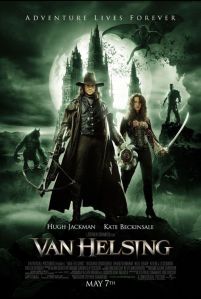
Originally released May 7, 2004:
Crossover movies have a distasteful history in the world of cinema. Some movie exec gets the notion, “Hey, why can’t two great tastes taste great together?” But what we’re left with is usually uninspired (The Flintstones Meet the Jetsons notwithstanding). Crossovers for horror movies are the worst of the lot. For every Freddy vs. Jason there’s a dud, like 1966’s Jesse James meets Frankenstein’s Daughter. That year went down in the annals of cinematic history, however, as it also gave us Billy the Kid versus Dracula, marking two entries in the expanding genre of cowboys battling famous monsters (as far as I know, this genre still stands at two movies). So what can one expect from Van Helsing, a big-budget creature feature that includes Dracula, Frankenstein, and the Wolfman?
Van Helsing (Hugh Jackman and a really big hat) is a secret soldier for a covert order of the Vatican. This covert order dispatches monsters and creepy-crawlies the world over. He’s been ordered to assist Anna Valerious (Kate Beckinsale), the last in a Romanian family line that has sought to kill the infamous Dracula (Richard Roxburgh). It seems that their family line is dwindling. And Anna’s brother being turned into a werewolf doesn’t help the situation. If her family line dies before Dracula then they cannot enter heaven. Van Helsing comes to town to help out the locals who are terrorized by Dracula’s flying brides. Van Helsing effectively kills one of the vamp ladies and is celebrated as a hero by the village. As he gets closer to Anna he also learns more about his own mysterious past and his connection to a certain figure with big teeth.

The Big D has a dastardly plan. He wants to find Frankenstein’s monster (Shuler Hensley) to channel enough power through him to awaken zillions of goo-sacks harboring the vamp’s undead brood. Of course, Frankenstein’s monster isn’t too keen on this. Together, he and Van Helsing, with the help of Anna as well as a comic relief monk, battle to stop Dracula from unleashing his children of the night.
Van Helsing is stupid, stupid, stupid. Director Stephen Sommers exists in his own indulgent world where bigger is better and some CGI spackle will fix any plot holes. He makes check-your-brain-at-the-door popcorn movies, but a “popcorn movie” is no excuse to forgive a rambling, incoherent, loud, stupid mess. I liked the first Mummy flick and even found some good with the second, but Van Helsing is Sommers at his rock-bottom worst, gorging on a trough of special effects and vomiting the results onto the big screen. Sommers’ idea of character development is knocking people through walls like they were in a Looney Tunes cartoon.
Van Helsing raises some interesting questions, like why do Dracula’s brides morph into flying demons that are conveniently genitalia-free? Why does a werewolf rolling over the top of a carriage somehow cause it to catch on fire? Why does Dracula keep his magic lycanthropy cure in the open? It doesn’t matter. Van Helsing is so straight-laced about its absurdities that questioning them will just get tiresome.
Not that you would expect much, but the acting in Van Helsing is bad. Beckinsale’s accent couldn’t be less convincing if her role were played by Charo. The trio of Dracula’s brides are played by swimsuit models and let me just say their performance is on par with what you would expect from swimsuit models. Roxburgh is quite possibly the worst vampire in the modern history of vampires, and that includes Blacula, Count Chocula and Tom Cruise. He couldn’t look any less sinister if he was in a diaper and bonnet. What’s up with those strands of hair that dangle in his face? Why do the Van Helsing creators want their Prince of Evil and son of Satan to look like he was the keyboardist for some 80s pop synth band?
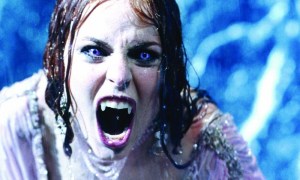
This overly long film feels like a seven-year-old’s book report that he hasn’t read: it’s like a child is making this up as they go. “And then … a werewolf pops up … and then Dracula’s flying brides … and then they all need Frankenstein’s monster ….” Seriously, were the penning this script on the fly? It’s a $150 million improv film. The reels of the film could be switched around and no one would be able to tell the difference. Van Helsing is one long, exasperated action sequence that drags its heels instead of wowing. It beats the audience into submission with its stupidity and redundancy.
The entertainment level of Van Helsing is exceedingly weak. It runs an eternity, which wouldn’t be a problem if one were intrigued by the story, the characters, or the action sequences. The action could have been suitable but Sommers has gotten less reliant on the physical and more superfluous with his CGI. Watching a CGI monstrosity smash into a CGI monstrosity before a CGI background where no semblance of reality is present grows tiresome after 130 minutes. The effects are passable, but they overload the viewer and numb whatever slight interest may have existed for the classic monsters.
What should have been a clever homage turns instead into a hollow marketing ploy that’s so frenetic and tireless with its manic pacing and bad special effects. Even the many attempts at humor are flat. It has to be some kind of apocalyptic sign that Hellboy and now Van Helsing have been unleashed unto the innocents of this world. Some will find Van Helsing decent popcorn entertainment, but most will grow weary of its sloppy design and wafer-thin substance. For me, this is one to avoid, period. There isn’t an ounce of fun to be had while sitting through the painful pair of hours that is Van Helsing. This is one monster mash that’s a real monster mess.
Nate’s Grade: D
——————————————————
WRITER REFLECTIONS 20 YEARS LATER
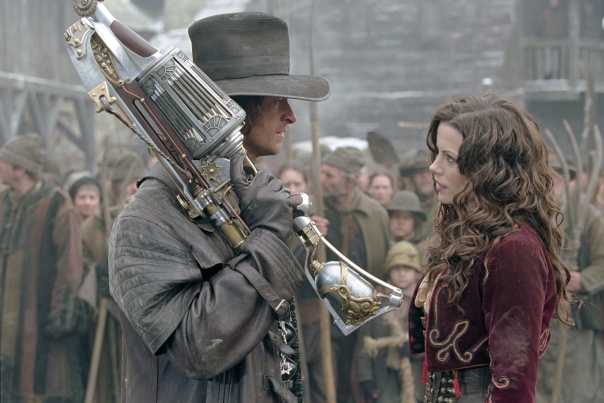
In 2004, Van Helsing was being primed to be not just a blockbuster but the forerunner for a new interconnected franchise revitalizing the classic Universal horror icons. Director Stephen Sommers was hot off the success of the first two Mummy movies, Hugh Jackman had become a household name playing everyone’s favorite growling superhero, and Kate Beckinsale had proven her own box-office mettle fighting vampires and werewolves in the Underworld series. The studio was expecting so much that it planned a sequel, a TV series on NBC called Transylvania, an animated prequel, a clothing line, a video game, maybe even theme park additions, and to maintain the Eastern European sets so that they could be utilized for the eventual show and sequels. Obviously, this never came to pass, and Sommers’ last big Hollywood action movie was the 2009 G.I. Joe movie, and he hasn’t directed a movie since 2013’s Odd Thomas adaptation. He chose not to direct the third Mummy movie in 2008, but it seems like this man’s career has never been the same since Van Helsing cratered in the summer of 2004. It began as the studio asking Sommers for even more monster movies, Sommers pitching them all together as an Avengers-style super movie, the studio getting carried away with larger plans of franchise dominance, and then when it didn’t materialize, a promising popcorn filmmaker in the highest blockbuster sphere just vanished in a poof of overzealous CGI.
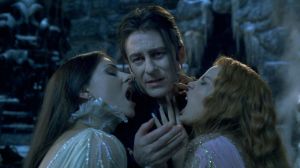
Me wife’s crush circa 2004
In 2004, I did not like Van Helsing. That might be too charitable a description. I wrote in my original review, “Van Helsing is stupid, stupid, stupid. [Sommers] exists in his own indulgent world where bigger is better and some CGI spackle will fix any plot holes. He makes check-your-brain-at-the-door popcorn movies, but a ‘popcorn movie’ is no excuse to forgive a rambling, incoherent, loud, stupid mess.” It was one of my worst movies of 2004, and twenty years later, I’ve mostly come around on the movie. I won’t tell you that it’s a great movie, or even achieves that same magic alchemy of action-adventure swash buckle that The Mummy brought back to major studio filmmaking in 1999, but Van Helsing is enjoyably ridiculous schlock nonsense. It was also one of my wife’s favorite movies growing up, and she reminded me that her teenage self had a big crush on Richard Roxburgh’s version of Dracula, not Hugh.
I now view Van Helsing less as a horror monster action vehicle and more of a spy vehicle in a strange world. The titular Van Helsing is our secret agent complete with spy gadgets with his comedic relief sidekick, and he’s got his important missions and the sexy Bond Girl, and the villains and betrayals and added back-story that doesn’t seem even necessary. It’s Sommers taking the structure of a spy thriller and supplanting it onto a Victorian-era monster steampunk universe of demons and centuries-old church conspiracies. Jackman is enjoyably suave as the Vatican’s favorite killing machine learning his own life lessons about the nature of legacy. I even enjoyed the villain’s motivation for Dracula; he’s trying to learn the secrets of Dr. Frankenstein’s reanimation to ensure that his vampy babies survive. Here is a Dracula who is bereft because he cannot father living children. I suppose there could be further discussion over the different forms of life as converting humans into vampires is itself a rebirth. Perhaps the distinction is like the difference between having biological children and adopted children. Maybe dear old Drac just wants to have a bundle of joy he can call his own. That’s more interesting than versions that make him out to be some stalker ex-boyfriend. Likewise, the role of Anna (Beckinsale) is given more pathos than simply being the Strong Romani Badass. While her wardrobe consists of corsets and teased hair to appeal to a young male demo, her character’s mission is powerful and personal. Anna needs to kill Dracula not to save herself but to ensure the rest of her deceased family members can enter heaven. Talk about cumulative family guilt. That’s heavy. When her face appears in the clouds at the end like Mufasa, it’s a confirmation of generational rest. That’s an arc that’s more fulfilling than being any love interest that would be discarded later.
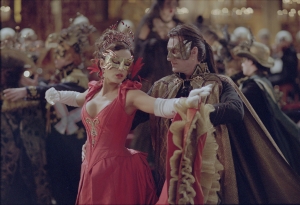
As soon as it got rolling, I said to my wife that this was going to go one of two ways: Van Helsing will learn that his organization is not as righteous as he believed them to be, manipulating him to eliminate threats to the organization’s standing rather than threats to humanity; or Dracula and Van Helsing have a personal connection that hasn’t been fully examined. Dear reader, it went in both directions because Sommers is slapping so many plot elements to make this movie feel full to bursting like a bloated tick. There’s ideas stacked upon ideas here, references and unexplored plot points for an untapped universe (vampires started werewolves?). An hour in, all of Dracula’s bats, a.k.a. his children have been slain, and you may erroneously think the movie is over. Well, there’s a whole other castle to explore with even more baby bats to kill. The last hour operates on pure video game mechanics of, go here, grab this item, battle this mini-boss. There’s definitely a level of redundancy and a “more is more” kitchen sink excess philosophy, but the bombast is part of his general appeal. There’s a touch of Sam Raimi here, a touch of Michael Bay; schlock with sheen. Maybe it was my nostalgia goggles, or maybe I was just attuning to Sommers’ wavelength, but the movie worked for me much better in 2024 as I was now charmed by its goofball sensibilities and less irritated by its over-plotted script.
You feel the admirable passion that Sommers has for this universe, adopting stylish pastiches to celebrate the older movies and lore, but definitely bringing his more modern sensibilities to the forefront. There’s a certain chaotic energy that animates Sommers big movies, bringing these classic characters together to run amok and crash into each other. That little kid’s imagination given the whole sandbox to play in can be enviable and lively, and it can also lead into unexpected directions that unexpectedly go nowhere. The incorporation of Frankenstein’s monster (Shuler Hensely) is more a plot device than a thoughtful character to bring to the team. He’s the magical MacGuffin both sides are fighting to claim for their own. Van Helsing’s major crime is trying too much and being too straight-laced about its silly. It’s not winking to the audience, it’s not self-commenting on its absurdities, it’s just living them lavishly. In 2004, I couldn’t appreciate that and this movie, and now I can find a place in my heart for such fun.
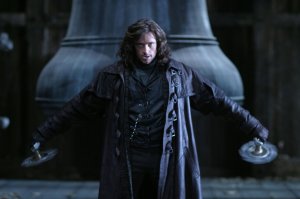
My original review in 2004 is scathing, with ready-to-blurb snark trying to communicate the intensity of my distaste. The line that Sommers is “gorging on a trough of special effects and vomiting the results onto the big screen” sticks with me. I’m surprised I restrained myself from making a “Van Helsing sucks” comment. Several of my criticisms about the acting, the confusing rules, the convoluted storytelling are entirely valid, but they just don’t bother me enough twenty years later. I can relax and enjoy the movie because it is a mess. That doesn’t mean every flawed movie deserves kindly dismissing its faults if it doesn’t aspire to anything other than mass entertainment. Big movies for big audiences can still be big bad. I think Van Helsing’s appeal is how sloppy it is and how excessive every element plays. In another universe, a… “dark universe” to borrow a phrase that came to me for no reason, this could have kicked off the interconnected Universal monster movies (any reference to Egyptian mummies is absent, implying perhaps that Sommers earlier movies exist in a shared world). It was not to be, and Sommers’ career has never been the same since, which is a real shame. The blockbuster space needs a filmmaker like Sommers, a man nimble enough to juggle tones and childlike glee with darker humor. Come back, Stephen Sommers, and maybe try your hand at the Creature From the Black Lagoon while you’re at it.
Nate’s Grade: C+
Share this:

Abigail (2024)
 Abigail feels very much like a spiritual sister for 2019’s Ready or Not, as it is a follow-up from the same writers and directors. It’s a bloody, funny movie about a hunt in a big mansion with a heroine who is battling against supernatural forces over the course of one long hellish night. We have a team of thieves kidnapping the young daughter of a man with money and having to hold her overnight. They don’t know one another and there’s an initial bristle to their discovery, like when an ex-police detective (Dan Stevens) and a recovering addict (Melissa Berrera) have equal measure not to trust one another. Things get worse when it’s revealed that their hostage, the titular Abigail (Alisha Weir), is not what she seems, a fact spoiled in the trailer. What follows is a topsy-turvy game of cat and mouse with some effective creepy moments and some lively humor without losing sight of the escalating stakes as well as the acclimation of new rules. The acting ensemble is highly enjoyable, particularly Stevens as a scuzzy authority figure, Kevin Durand as a himbo with an emotional core, and Weir, who has tremendous range to pull off the changes her character goes through. It’s not as fulfilling and finely developed as Ready or Not, one of 2019’s best films and one of the best endings to a movie ever, but Abigail is a first-rate bloody B-movie that might not hit as high but still satisfies.
Nate’s Grade: B
Share this:

Morbius (2022)
 Not the train wreck the advertising made it seem, Morbius is merely a bland superhero retread that reminded me of the early 2000s superhero output like Daredevil and the Tim Story Fantastic Four. Having been delayed almost two years thanks to COVID-19, the film was released on April 1 for full unintended irony, and it’s a silly mess but also nothing worth getting too worked up over. Method actor extraordinaire Jared Leto (Suicide Squad) plays Dr. Michael Morbius who is suffering from a rare disease and finds a solution via a serum mixing vampire bat DNA but it has some consequences. He has super powers but needs to feast on blood every six hours and is dreading the point where he may not be able to resist the allure of feeding on humans. It’s a very Jekyll/Hyde concept, man trying to control his inner demons made literal, and once again we have a villain that essentially has the same powers as the hero. Matt Smith (Doctor Who) play’s Morbius’ childhood friend who also suffers from the same rare blood disease, but Dr. Morbius refused to share the cure because he explains it’s a “curse,” although maybe let the man suffering make that personal health choice. Bless you, Matt Smith, because you’re the only one having any fun with this movie, and that includes in the audience. Leto is actually fine though not much about the Morbius character is really imparted. The action sequences are erratic and the stylistic flourishes, like the “look at me” slow-mo ramps and the inexplicable wispy colorful smoke clouds trailing Morbius in action, hamper the ability to even discern what is happening onscreen. Maybe that’s on purpose after two years delay. The movie establishes a basic structure, series of goals, antagonist, and problems efficiently enough to make it to the end credits after 90 minutes. It’s just that we’ve come to expect better from our super hero cinema by now. As a disposable monster B-movie, Morbius is okay. It’s not recognizably campy, it’s not so-bad-it’s-good, it’s just a generic origin story/Dr. Jekyll and Mr. Hyde territory with a lot of dropped subplots and subpar CGI. I have my serious doubts about Sony’s plan to hatch solo movies for all these different Spider-Man villains, and the creakiness of this plan is even more evident with their contrived post-credit scenes trying to awkwardly establish their retinue of villains to confront Spider-Man. Does Morbius know who Spider-Man even is? Morbius the movie and character just feels too half-hearted for anyone to care.
Nate’s Grade: C
Share this:

Vampires vs. The Bronx (2020)
 Take Attack the Block and mix with The Lost Boys and you get a perfectly enjoyable B- kind of fun B-movie about a group of Bronx tweens combating blood-suckers gentrifying their neighborhood, and vampires too. It’s a pleasant experience that hankers back to enjoyable 80s ensembles and it maintains a sweetness without being sappy and an edge that feels appropriate for its age-range without getting too heavy or too simplistic. We follow our core characters as they investigate the would-be vampires, uncover their real estate schemes for the neighborhood, and then plan how best to thwart them. It’s a reliable formula but it works. I enjoyed Shea Whigham (Kong: Skull Island) as the vampire middleman, and I enjoyed how his own character arc as a subservient villain is tied into another teen’s arc about not following in the steps of his criminal older brother and rejecting people who only want to use you. That’s smart writing, finding room to draw parallels and connect the personal to the thematic. The lead kids all have their own personalities and problems and I enjoyed spending time with them as they bonded, bickered, and bandied together as a team. Their chemistry made them feel like real friends. The horror doesn’t really ever approach being scary or intense; when the vampires are in full teeth-baring mode, they seem more like the goofy, cheesy, cloaked figures from the TV soap Dark Shadows. It also feels like the movie runs a bit out of steam as it carries on into its final attack/assault on the vampire’s nest. Still, Vampires vs. The Bronx is a funny and light-hearted 90 minutes with likeable characters and an enjoyably relaxed supernatural caper. It’s not going to be too deep but you can tell the filmmakers care about these characters, the film’s genre influences, and telling an accessible adventure to kids.
Nate’s Grade: B-
Share this:

Breaking Dawn: Part Two (2012)
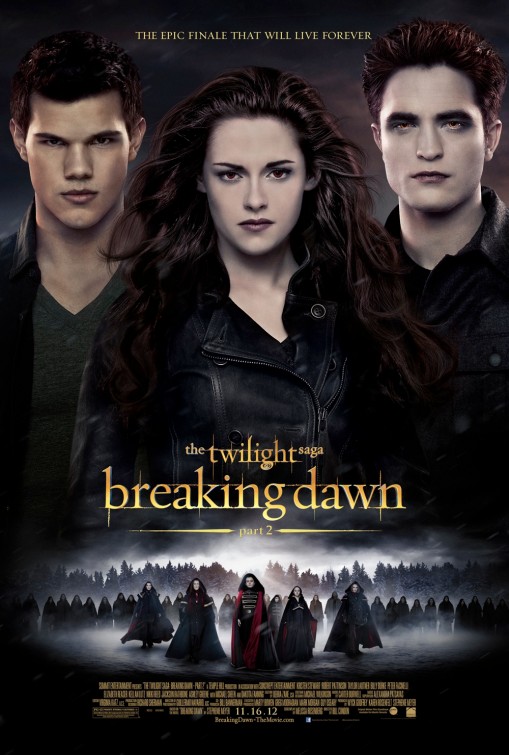 Ignoring the ironic nature of the Breaking Dawn Part 2 poster taglines declaring love to be “forever,” the box-office juggernaut that is the Twilight franchise is coming to an end. Based upon Stephenie Meyer’s outrageously popular series of books, we’ve followed the love life of Bella Swan as she’s experimented with human, vampire, and werewolf. The studio heads decided to take Meyer’s final book and split it into two books. Breaking Dawn Part 1 had a wedding, honeymoon, pregnancy, supernatural birth, and Bella’s death/resurrection. And yet, that movie was still crushingly boring. My hopes were substantially low for Part 2, despite director Bill Condon’s (Dreamgirls) best efforts to jazz up all the awful plotting, characters, and romance. Then a funny thing happened. I started enjoying myself, and then the movie took some chances that I felt were daring considering its rabid fanbase. And then watching Breaking Dawn Part 2 became more than watching the film, it was also the experience of watching the audience. To that end, the movie delivers and I may rue these words but I kinda sorta almost liked enough of it.
Bella Cullen nee Swan (Kristen Stewart) and her husband, immortal vampire Edward (Robert Pattinson), have gone through the wringer. In her waning days as a human, Bella got knocked up during her honeymoon, and her half-human half-vampire baby killed its mama on the way out. Now Bella’s a vampire and a mom (note to self: start writing new script – “Single Mom Vampire”). Her daughter, Renesmee (Mackenzie Foy’s face on a whole lot of other people’s bodies), is rapidly growing. She’s mistaken for a vampire baby, which is a punishment worthy of death. This news gets Aro (Michael Sheen) to rustle up his Volturi forces, a group of vampires with super powers. They’re coming for the Cullens and little Renesmee. The friendly vampires scour the world, gathering “witnesses” to the tyke’s half-vampire status, but really they’re gathering an army to defend themselves. It’s super vamp against super vamp and heads will roll.
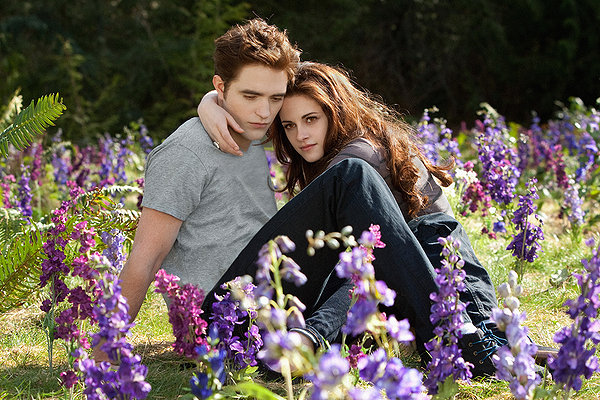 I clearly understand that I am in no way the target audience for this franchise and that my reams of pithy words will find little traction in the hearts of the Twi-hard faithful, but I’d like to state that I’ve never been a hater of the movies. Well, let me rephrase that. My thoughts ping-pong from liked okay (Twilight) to hated (New Moon) back to liked okay (Eclipse) back to hated (Breaking Dawn Part 1), and now here we back are to liked okay. Consider it a double-dip recession in quality. I still view the whole franchise as an exercise in pre-teen wish fulfillment, but I’ve already written extensively upon that theory so I won’t bother re-litigating that battle. With all that said, I found myself oddly enjoying myself for sustained durations. It’s just as silly as the other movies but finally we can move on from mopey Bella and her dubious romantic triangle. Finally we don’t have to suffer through two hours of kids making (new) mooneyes at each other (did I just out myself as “old”?). By this I mean finally something ELSE happens rather than the incremental coupling of Bella and Edward. Granted their kid is really more a prop than a character, but at least the story has taken one gigantic leap forward. Finally Stewart can actually smile and, you know, do things of actual consequence!
It’s no secret that the Twilight saga, as its monetary benefactors would like to dub the franchise, has noticeably been better the less time it spends with its female protagonist, Bella. Breaking Dawn Part 2 might just be the least Bella-filled episode yet, a cause of celebration for my brethren who view Ms. Cullen as an infuriating, insufferable, insulting protagonist. At least in this movie she develops a sense of self-identity, though too often that identity falls into the camps of Wife and Mother. With this movie, she’s adjusting to life as a vampire, so we get cutesy scenes of her hunting prey, learning how to fake looking like a puny human, and arm-wrestling the strong cocky vampire guy to, you know, for the strides in girl power. Too little too late, Bella. I find it more than a little funny that Bella’s super power is passive in nature, fitting a passive protagonist that waist for people to give her meaning and tell her what to do. I should stop before another rant unspools as I’ve done on previous Twilight writing occasions. In short: Bella sucks.
We’re introduced to a lot of new characters in this movie and each brings some sliver of backstory to develop. I’m not saying they’re all deserving of attention or interest, but at least these new clans of vampires brought some much-needed life to what has often been a claustrophobic, monotonous love triangle. Opening up Meyer’s world and seeing other vamps with special powers are a fun detour that I wish had taken place sooner. I liked seeing Lee Pace (TV’s Pushing Daisies) as a soldier from back to America’s colonial days. I’m left scratching my head why certain vampire members were added to the ranks when they didn’t even show up for the final showdown. What was the point of having Joe Anderson (Across the Universe) show up and be all skeptical about the group’s chances of winning… and then not have him join? So he was skeptical from the start and then remained so, choosing to sit the finale out. Well I’m sure glad we spent time on him then. Also, the movie falls into the trap of establishing super-powered beings that are too powerful. We get one guy who can control the elements. Not just one or two but freaking all of the elements. He’s like Captain Planet minus that dumb kid with the lame heart power. During the climactic battle, this kid uses his power ONCE. How do you give him a wealth of super powers and then sideline him? There’s also an Amazon vampire who can control people’s vision, namely making them see whatever she wants. How are these two assets not utilized for tactical supremacy?
 I had the suspicion that Breaking Dawn Part 2 might be the best film in the series simply by the fact that it’s the one with the most Michael Sheen. God I love this man. His last-minute turn in the appalling New Moon banished the suicidal thoughts swirling in my head. Even when he’s in bad movies, Sheen is usually the best thing about them (see: TRON: Legacy or the Underworld films). Here’s an actor who knows exactly how ridiculous everything about this universe is, and by God he sinks his teeth in. The benefit of added Sheen cannot be overstated. The movie greatly benefits by having a strong outside threat early. Only the third movie, Eclipse, had an external threat from the start, and that gave the film a much-needed sense of urgency. I was with Sheen and the Volturi on this one. They were merely following the laws of vampires meant to protect their own kind. Vampire babies are a no-no since they cannot control their otherworldly urges, so they and their makes must be destroyed. You know you’re in for a darker Twilight when early on we witness a baby getting tossed into a roaring fire. I admit that I have a susceptibility to falling under the sway of magnetic villains. Perhaps this speaks to some character defect of my own. It probably just speaks to the fact that movies often have boring heroes and charismatic villains. Sheen is so hammy and delightful and I just wanted more of him amidst the melee that punctuates the end. The man even looks like he’s about to lead a marching band during the battle and he’s still badass. Such is the awesomeness of Michael Sheen. Of this there can be no question.
But then the Condon and series scribe Melissa Rosenberg do something almost extraordinary given the slavish devotion to the series fans have. They divert from the source material in broad strokes during the climactic vampire brawl. I won’t go into exact details but the preview audience I was with was absolutely losing their collective minds. Women were screaming, cries of “Nooo” rang through the room; all around me was the echo of consternation and shock, women trying to absorb the reality of what they were viewing. Sitting with them, taking in their shrieks and lamentations, the general horror of what might happen next… it was a thing of beauty. I can almost recommend seeing Breaking Dawn Part 2 simply to be part of this experience. However, you’ll have to act quickly and be selective. You’ll need a packed theater filled with vocal Twi-hards, likely an opening weekend evening crowd, the kind that openly cheer shirtless revelries from the male co-stars. And then just sit and wait, knowing that soon all that revelry will turn to shock. I sound so mean-spirited explaining this and that’s not my intention. I didn’t necessarily enjoy the discomfort of the Twi-hards. I enjoyed the bewilderment. It felt like the theater was alive, coursing with the energy of alert uncertainty. Anything could happen, including some very not nice things. To be one tiny drop in an ocean of furious estrogen, well it’s an experience that deserves mentioning. Its strange experiences like this that make me love going to the movies, and that, ladies and gentlemen, is a combination of words I’d never thought I would write about any Twilight film.
Also, though my expectations were never that high to begin with, I have to credit Condon with fashioning a fairly exciting action brawl, one that’s surprisingly graphic at spots for a PG-13 movie primarily aimed at young girls. The series has been building up to a massive showdown, and the movie itself has been putting the feuding factions into place, so it’s satisfying that the finale truly feels climactic and delivers some thrills. For the record, Meyer’s book was free of any climactic battle. This movie is chock full of decapitations. I cannot recall another PG-13 film that had this many beheadings. I think you could watch a drama set during the French Revolution and you wouldn’t witness this many people lose their heads. Is there no other ay to kill a vampire? What ever happened to the good old fashioned staking of the heart? These kids these days; all they want to do is decapitate. To dull the grisly spectacle, the beheadings are weirdly bloodless. Condon does a bangup job of setting up plenty of mini-payoffs and duels throughout his busy action centerpiece. Then when it looks like the carnage is at an end, the movie takes a page from the Final Destination playbook, which Twi-hards will probably find relieving. I thought it was a major cop-out but whatever. Let the kids have their happy ending.
 Before you get your hopes up too extravagantly, this movie still offers plenty of stupid. I don’t care how you explain it, the imprinting thing is stupid incarnate. I still find it eternally creepy that Jacob couldn’t have the mother so he settles for the daughter. The fact that everyone treats this development so seriously makes me laugh. And oh boy, let’s talk about those Amazon vampires. First off, I find it hilarious that Meyer’s vision of vampire clans from around the world really just boils down to Europe and the Amazon. When they stepped onto screen wearing, and I kid you not, loin clothes and tribal markings, I was flabbergasted. Doesn’t anyone find this depiction to be at least deeply ignorant and culturally insensitive? I’ll stop short of calling it quasi-racist; though attaching “quasi” to anything lets you get away with most declarations (“This movie is quasi-watchable”). But when our big battle over a frozen lake takes place, why are these Amazon characters STILL wearing loincloths in the frozen landscape? Then there’s the annoying fact that Renesmee rapidly grows, meaning that Bella and Edward get to skip out on actually raising a baby. If Meyer intended to punish these kids for having sex in Part 1, then she needs to follow through on her antiquated sexual hang-ups.
As the franchise draws to a close, I’m trying to take stock of the five films and their overall impact (sadly, we all know with the potential riches, a reboot is likely only five years out). The end credits play out like a gauzy yearbook for the franchise, visually highlighting every significant speaking role, including the two different actresses who played villainous Rachel. The Twilight series has been very good to me as a writer; I’ve produced long-winded reviews with each new entry, and the opening-day people watching has become part of the spectacle I enjoy. That’s really what we’re dealing with here – spectacle. It’s all gooey romantic fantasy nonsense with some pretty bland characters, questionable messages for young girls, and such deadly seriousness. If we were grading on a curve, I’d say Breaking Dawn Part 2 is actually tolerable thanks to nominal character development, less whiny Bella, an influx of new characters, extra Sheen time, a better sense of humor, and a climax that truly feels climactic.
I can’t say the Twilight movies have gotten better as they’ve gone, though Condon has proven to be an apt choice to steer this franchise to a close. He’s given the franchise a bit more life, a bit more blood. I’ll never admit that the love story of Bella and Edward deserved five full-fledged movies, but I recognize the significance Twilight stands in many young girls lives. Fans will eat this stuff up. They’ll certainly enjoy the Bella/Edward sex where she doesn’t end up bruised. For them, it ends in a fitting sendoff, even after the jolts of text deviation morphs into giggled recounts on car rides home. For them, Breaking Dawn Part 2 will be the perfect ending to their beloved series. I can’t imagine anyone indifferent to the series working up that much interest, but I can say with sincerity that Breaking Dawn Part 2 is the best film in the Twilight series and potentially worth seeing for the rollercoaster ride of bewildered fan reactions. Now that the last blood has been drained from this franchise, let’s move on to more important items… like the next Hunger Games movie.
Nate’s Grade: B-
Share this:

Abraham Lincoln: Vampire Hunter (2012)
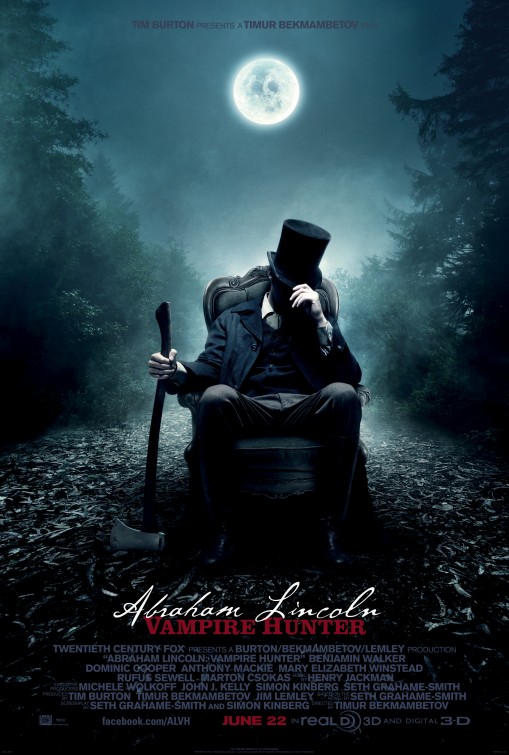 Did you know that our sixteenth president had a rather unorthodox hobby, and it was really the purpose that drove him into politics and later the White House? That’s what the gonzo best-selling book Abraham Lincoln: Vampire Hunter purports. When he was talking about a house divided not being able to stand, he was secretly talking about vampires, you see. The film version, under the tutelage of producer Tim Burton, looks like it’d be an axe-swinging good time. I realize the absurdity of wishing the filmmakers had hewn closer to the source material, a radical reinterpretation of American history, but there it is. I cannot tell a lie.
Abraham Lincoln (Benjamin Walker) is a man determined to rid this new country of the scourge of vampires. His mother was murdered by a vampire landlord, Jack Barts (Marton Csokas), when Lincoln was only a little boy. As an adult, Lincoln tries to avenge his mother’s death but Barts is too strong. Henry (Dominic Cooper) saves Lincoln and teaches him all about vampires and, more importantly, how to hunt and kill them. They strike up a partnership: Henry will provide names of vampire targets and Lincoln will dispatch them with extreme prejudice. Lincoln tries to live a solitary life but keeps building attachments; to his co-worker Joshua Speed (Jimmi Simpson), to his childhood friend Will (Anthony Mackie), who needs Lincoln’s help to forge some slave papers, and the enchanting Mary Todd (Mary Elizabeth Winstead). Abe realizes the limitations of killing vampires one by one. The vampires are exploiting Southern slavery as an all-you-can-eat buffet. Lincoln realizes the only way to foil the vampires is to eliminate slavery, and to do so he must be in a high government position, and so Lincoln retires his axe to turn to abolitionist politics.
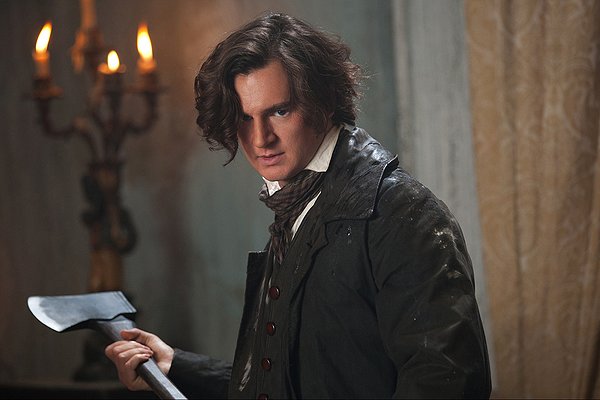 It feels that rather than embrace the courage of its convictions, the movie is trying to please as many mass markets as possible. So many characters and storylines are inserted wholesale without any connection to the book. The film is almost unrecognizable from the book. Now, I’ll quit my bemoaning for the time being because a movie has to exist on its own merits, but Abraham Lincoln: Vampire Hunter is just a mess. As far as new characters included only to appeal to broad audiences, there’s the Black Best Friend, long a staple in movies meant to say, “Hey, our lead character is hip and has no problems with race,” but really it’s always been a depressing act of pander and I always feel sympathy for the thousands of black actors who have to compete over the limited best friend parts. Giving Lincoln a black best friend seems to remind the audience that Lincoln was against slavery, you know, in case anyone didn’t know anything about the man nicknamed the Great Emancipator. Then there’s the ascension of Mary Todd Lincoln into a feisty, strong-willed, formidable ally rather than the insular, clinically depressed woman she was in real life and in the book. Mary even gets some grand hero moments taking out a vampire in slow-mo coolness. The transformation of Mary feels just as big a pander as the character of Will. Then there’s the idea that Lincoln and his small inner circle of pals are placed in the center of action, like they alone and their heroic escapades single-handedly turn the tide of war. It’s handled so ham-handedly that it all plays out like they’re the Scooby Doo gang solving the Case of the Vampire Insurrection.
Lincoln’s history is given such shrift attention, just enough to fill out the standard tortured hero’s backstory for the aims of the story. We see Lincoln as a child but just enough to establish his tragedy and hunger for revenge. Then we cut to him as an adult and going to kill Barts. That’s quite a big leap in time with little careful setup. The time before Lincoln’s presidency is just enough to supply him with a stock character posse and a plucky love interest, and then it’s right to the Civil War. So much time in between the main events just gets squeezed out, and so Abraham Lincoln: Vampire Hunter feels like it’s always one scene away from a clumsy montage.
The vampire threat, as presented, also feels too insurmountable. Not only can these vampires walk in the daylight, they’re super strong, super fast, and can make themselves invisible, a neat new trick. When they ally with the South they seem nigh unbeatable. The movie makes the mistake of making the adversary seem too powerful, so the eventual thwarting of the vampire Confederacy feels too easy and far-fetched given the magnitude of the threat. Adam (Rufus Sewell) is hinted at being like the first vampire, but then this idea is never picked up again. Why even hint at something significant if you have no intention of pursuing it? There’s another new wrinkle where vampires are incapable of killing their own kind. If this is the case then why aren’t the vampires turning every single person they can find into vampires? It shores up their side and guarantees less potential people that could kill them. I’m curious how certain swaths of southerners are going to react to seeing their beloved Confederacy teeming with devilish creatures. Then again, I think the romanticism of the Confederacy is hogwash. When insurrections win we call them revolutions of independence, and when they lose we call them treason. Guess what? The South lost.
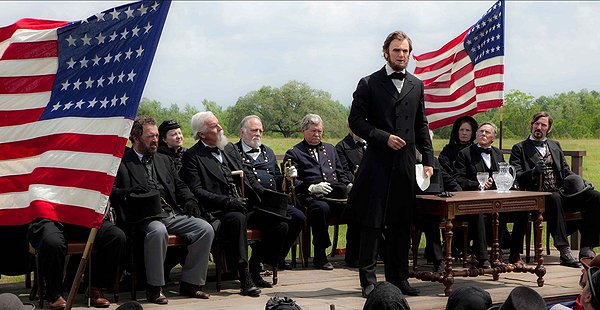 As much as I enjoyed his book, I have to lay the blame at the hands of Seth Grahame-Smith, who adapted his book into the screenplay (he’s 0-2 this summer after his disastrous screenplay for the other vampire movie this summer, Burton’s Dark Shadows). Granted, I’m sure he got intensive notes on how to alter his story for the big screen; the whole projects reeks like it had too many cooks in the kitchen. The interconnection from the book, finding clever ways to marry history and alternative history together, have been ground down to stream line Lincoln into an American super hero. Not only is he handy with an axe, this Honest Abe can leap from racing horse back to racing horse back, and even get clobbered by a horse and keep on going. The coda at the end feels like a missed opportunity to carry on the Lincoln tradition into our modern age. With the clever reworking replaced by blockbuster superficiality, the film merely takes history and has it perform the outrageous rather than finding smart ways to connect all the outrageousness to the established facts.
What the movie has to the credit of director Timur Bekmambetov is a strong visual pulse. Bekmambetov directed 2008’s testosterone-soaked Wanted, so you know you’re going to get some crazy and eye-catching images on display. The action sequences do pack a punch and I’ll admit that seeing an axe utilized as an inventive martial arts weapon is considerably cool. There are two standout set pieces. The first is a fistfight between Abe and Barts in the middle of stampeding horses. You feel right in the thick of the action, horses stampeding all around, the sun setting to offer an eerie yet beautiful glow to the ordeal. It’s one of the more reality-stretching moments, as I noted above, but man if it isn’t thrilling and lovely to watch. The other standout sequence is a climax aboard a speeding locomotive itself atop a large wooden bridge engulfed in flames. Abe and Will stand back to back, swapping the axe to kill vampires, and then hey have to outrun the collapsing train. In these moments, the movie is joltingly alive, bursting with excitement and that rare yet glorious feeling of watching something beautifully different. I just wish this sensation wasn’t so fleeting in the movie.
Abraham Lincoln: Vampire Hunter is a violent historical reworking that isn’t good enough to be properly entertaining and it isn’t bad enough to be considered camp. The film is mostly disappointing because it should feel far more engaging given its whacked-out premise the very cheeky promise of its title, and strong source material, a pulpy, ripsnorter of a read. The movie has some stellar standout moments but I think what ultimately hinders the entertainment value is how dumb everything comes across. This is not dumb in the winking, self-aware, satiric sense, but dumb in more of the blockheaded, Michael Bay, formulaic blockbuster sense. I wouldn’t even classify this movie as an enjoyably dumb, a silly summer slice of escapism like Battleship, which is looking better every week after new, disappointing summer releases (and it’s not even July yet!). The spirit of this movie is missing, the cleverness of the conceit drained, and the fun is bottled up. What this movie reminds me of is the stupid 2003 film The League of Extraordinary Gentlemen, which took classic literary characters and threw them into a genre movie. Both movies figure the exercise alone, seeing classic literary or historical figures in absurd contexts, was enough to justify entertainment. I say that you have to work harder.
Nate’s Grade: C+
Share this:

Dark Shadows (2012)
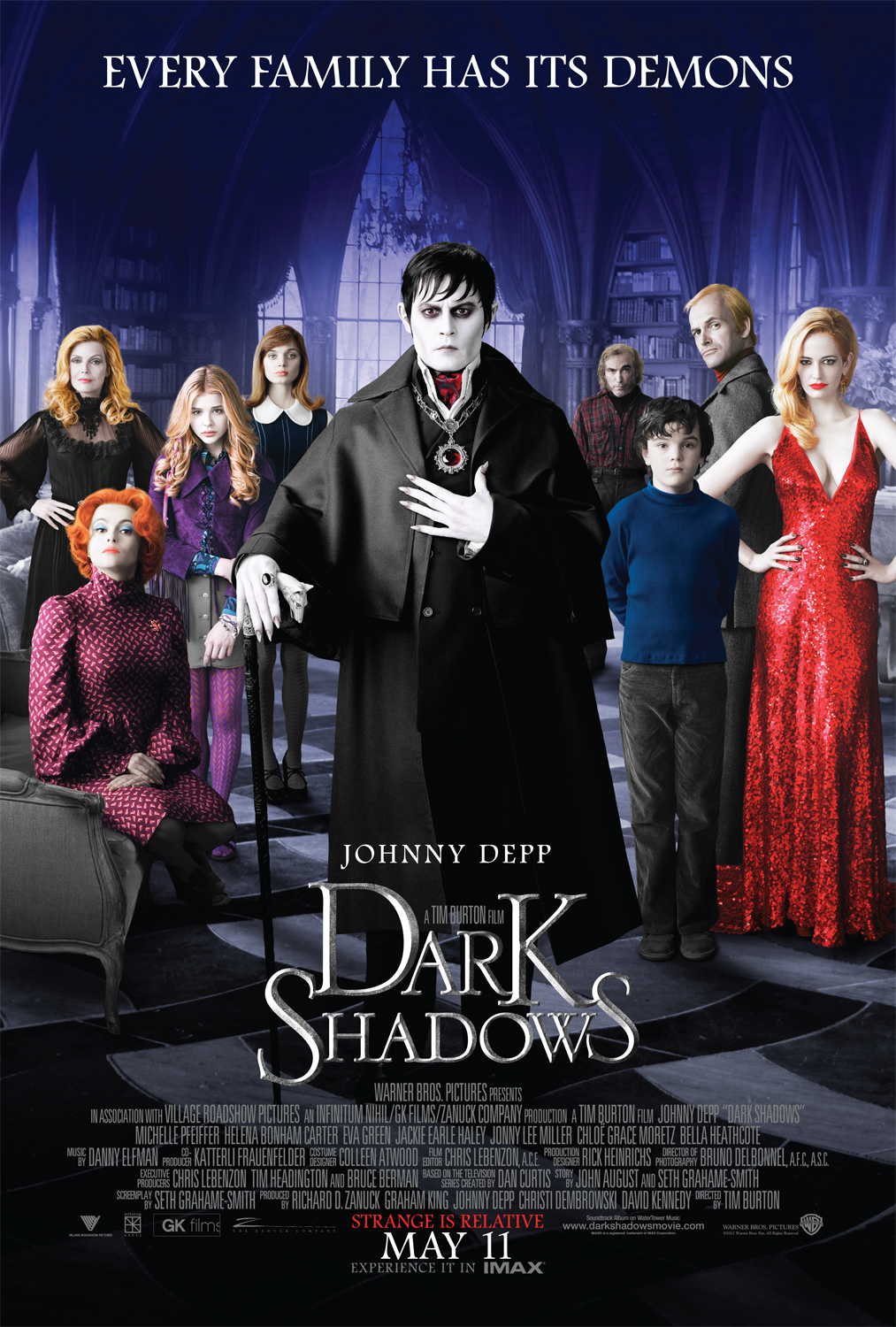 Dark Shadows was a daytime soap that aired for only a brief period of time as far as soaps are concerned, 1966-1971, but it was enough to make a lasting impression. The supernatural soap featured vampires, werewolves, and other creatures of the night, entangled in high-stakes drama and romantic excursions – it was the Twilight of its day. Director Tim Burton and his attached-at-the-hip collaborator, actor Johnny Depp, were fans as children and have kicked around a big-budget big screen version for years. Now that Dark Shadows hits theaters, you’ll be left wondering whether they really ever liked the original show or secretly despised it.
In the 1770s, Barnabus Collins (Depp) is the son of fishing and canning magnate in colonial Maine. He has a fling with Angelique (Eva Green), one of his family’s servant girls, and unfortunately for him, the gal is also a witch in her spare time. She curses the Collins family, killing Barnabus’ mother, father, and the woman he loves. She then turns him into a vampire, riles the villagers into mob mode, and Barnabus gets trapped in a coffin and buried for good.
Two hundred years later, a construction crew unearths an old coffin and out pops Barnabus from his prison. The world is a very different place. Elizabeth Collins Stoddard (Michelle Pfeiffer) is running the Collins family manor and canning company, which has fallen on hard times. A rival canning company is snapping up fisherman contracts, and this company is led by none other than the same ageless Angelique. Elizabeth tries to conceal her distant relative’s unique “condition” from the rest of her family, her brother Roger (Johnny Lee Miller), and his son David (Gulliver McGrath), grieving the loss of his mother, moody 15-year-old daughter Carolyn (Chloe Grace Moretz), and caretaker, Willie Loomis (Jackie Earle Haley). The Collins family also has a new hire, Victoria Winters (Bella Heathcote), who looks strikingly like Barnabus’ lost love from 200 years ago. He becomes smitten with the new lass, who may be the reincarnation of his lost love. That’s enough to rev up Angelique’s wild sense of jealousy, as she tries to get her long-desired man and destroy anyone that stands in her way.
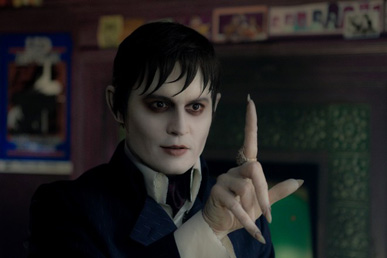 Is this ever one ghoulish mess of a movie. It never settles on a tone; is it supposed to be a larky tongue-in-cheek send-up, a Gothic melodrama, a dysfunctional oddball family comedy? What is this supposed to be, because whatever it is, it isn’t entertaining. Oh sure, it’s entertaining in a, “Where the hell is this going?” kind of way, but so is being kidnapped by a drifter. The movie feels like it has a box filled with ideas, and every so often it just shakes up that box, reaches inside, grabs one and says, “Let’s give this a try.” The screenplay, credited to author Seth Grahame-Smith (Abe Lincoln: Vampire Hunter), is awash with half-baked ideas and poorly developed characters. The live-in doctor, played by the second stalwart of the Burton Repertory Players, Helena Bonham Carter, is a hoot. Carter (The King’s Speech) has got an edge to her and an interesting dynamic with Barnabus, but sadly her storyline is tied up far too quickly. The character of Victoria is a rather interesting one, a girl who could communicate with her ghostly former relatives, who happen to look just like her. The gal was sent to a mental asylum by her parents and escaped, compelled to come to the Collins mansion. Why in the world wasn’t she the movie’s protagonist? That is a far more compelling perspective than a goofy vampire who speaks all old timey. Seriously, the Barnabus stuff is your basic fish-out-of-water comedy, lazily commenting on the times. There is no joke that is too obvious for this movie (Barnabus inquires why Carolyn has no husband; Barnabus is fascinated by a lava lamp; Barnabus thinks Alice Cooper is an ugly woman – sigh). A lot of the shapeless narrative would be forgivable if the movie was just funnier. Barnabus is just not that fun of a character. His anachronistic verbiage gets dull when you discover that seems to be the movie’s one joke. You may start tuning him out like I did.
The movie feels like a collection of subplots and no main storyline to gather traction. We’re told that the youngest Collins, little David, is enamored with Barnabus, though considering we’ve only seen the two together in like one previous scene, this seems like quite a leap. Unless David has gotten particularly skilled at hiding behind rocks, we haven’t seen any of this. The entire character of David and his sleazy father could be eliminated and they would only minimally affect the story. And then there’s the late revelation that one of our characters has a hidden secret identity, a revelation that fostered no setup. When the character looks into the camera to explain and ends with a curt, “Deal with it,” it’s like Grahame-Smith himself is speaking directly to the audience, mocking it for hoping that the movie would actually do a good job of setting up and paying off character development and relationships. Stupid audience. Why can’t you just be happy with all that neat Tim Burton set design?
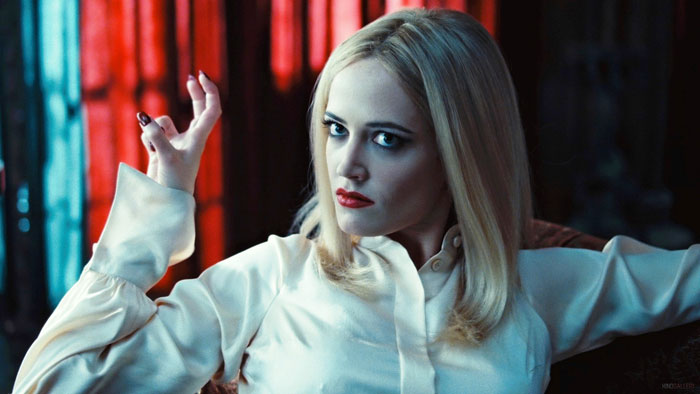 The final melee between the Collins family and Angelique keeps reminding you of the dashed promise of the flick. Angelique, in her witchy withiness, summons dark forces to make statues come alive. Well, sort of. They flail their arms a tad. And then she makes the walls bleed. Well, sort of. The dripping blood stops after just a few inches from where it began. If you’re going to make the house bleed, I want Shining-level torrents of the red stuff. The tonal inconsistency, matched with the muddled plot and scant character work, makes for a pretty frustrating bore of a movie.
You could usually count on Depp (Alice in Wonderland) for at least committing himself to another bravura weird performance, but the material fails him. He’s caked with alabaster makeup, given claw-like hands thanks to additional knuckles (why…?), and he’s trying his best to transform a list of peculiarities into a character, but like most things concerning the movie, it does not coalesce properly. I actually think the most entertaining actor in the movie is Green (Casino Royale). There’s not much to her role but at least she has fun with it, bringing an admirable level of energy while her peers remain laconic, content to submerge into the 70s scenery. She shows a nice flair for comedy heretofore unseen. Strangely, Green adopts a slightly raspy voice that sounded like an imitation of, none other than, Helena Bonham Carter. If Burton’s note to his film’s young, frisky, sexy antagonist was, “Sound more like my wife doing an American accent,” then I think we’ve butted into something personal best left between husband and wife.
Ultimately, I have no idea who this movie is going to appeal to. The fans of the original soap will surely not be pleased with the jokey, tongue-in-cheek manner that Dark Shadows treats its source material. Fans of Burton’s stylized, dreamy, Gothic fairy tale visuals will find the film tedious and a poor waste of the man’s talents. Even the casual Depp fan will probably find the movie mostly unfunny, weird, and boring. The tonal whiplash never settles down, and the plot is replete with half-developed characters, ideas, and plot points. It just seems to throw everything at the wall to see what sticks, but that’s not the best way to tell a story. Not even Burton’s visuals or Depp’s performance can save this movie. Dark Shadows is unquestionably amongst Burton’s worst films (2001’s Planet of the Apes debacle takes the crown), made all the more inexplicable by the fact that Burton and Depp are self-described fans of the TV show. Maybe we all have different definitions of “fan” that I am not privy to. This movie deserves a quick death.
Nate’s Grade: C
Share this:

Fright Night (2011)
 Horror is a genre that’s been notoriously cannibalistic, especially as of late. I don’t mean flesh-eating, I mean the glut of remakes that has polluted the horror market in recent years. After remakes of Halloween, A Nightmare on Elm Street, Friday the Thirteenth, The Hills Have Eyes, House of Wax, Prom Night, My Bloody Valentine, The Amityville Horror, The Fog, The Texas Chainsaw Massacre, Black Christmas, Sorority Row, Dawn of the Dead, The Crazies, Don’t Be Afraid of the Dark, I Spit on Your Grave, Last House on the Left, The Thing, and scads more, you’d be forgiven for believing that the remake of 1985’s Fright Night would be another soulless cash grab. It turns out that it’s way better than even the original and quite an entertaining movie that got lost in the shuffle.
In a quiet little suburb outside Las Vegas, students are going missing. Ed (Christopher Mintz-Plasse) suspects that there is a vampire in town. Ed’s former friend, Charley Brewster (Anton Yelchin), dismisses this idea, especially since the would-be vampire in question is his new neighbor, Jerry (Colin Farrell), a home construction worker who seems to work at night mostly. But lo and behold, after Ed goes missing, Charley concludes that his old friend was right all along. Jerry has his eyes set on Charley’s single realtor mom, Jane (Toni Colette), and maybe even Charlie’s sprightly girlfriend, Amy (Imogen Poots). The only ally Charley can muster is a drunken Vegas magician in the Criss Angel tradition. Peter Vincent (David Tennant) has been studying vampires for years due to his tragic personal connection to vampires, notably Jerry.
 Fright Night finds that horror sweet spot, equal parts scary and funny. Credit screenwriter Marti Noxon who cut her teeth on TV’s seminal show (yeah, I said it) Buffy the Vampire Slayer; there’s even a reference to a “Scooby gang” for we Buffy fans. Noxon does a terrific job of establishing a suspenseful situation and then developing it nicely, teasing it out. There’s a sequence where Charley is trying to rescue a neighbor lady that just involves a series of hiding places but uses a simple setup of ducking around corners so well. When our plucky protagonist checks in with Vincent for some assistance, we’re introduced to an array of exotic vampire-hunting weapons and artifacts that the Vegas magician has under glass. With a setup like that, you better believe we’re going to be using those weapons later, and how. The character development is richer than most teens-battle-monster genre films. The relationship between Charley and Ed, and the awkwardness and resentment of two friends growing apart, feels rather believable even dropped into the middle of a vampire adventure. The standard girlfriend role is given a bit more weight, as she’s the one who feels confidant and aggressive. She knows what she wants, and as played by the adorably named Imogen Poots (Solitary Man), you want to be what she wants. Seriously, this actress is striking in her Grecian features and I like a woman who knows how to handle a mace. There are also small touches that I really enjoyed that helped round out the movie. At one moment, a woman is being fed on by Jerry and she spots Charley hiding behind a door. Rather than cry out for help, she carefully draws a shaking finger to her mouth, wishing him to keep quiet and not to save her. The resolution of this rescue attempt is shocking in all the right ways. It’s a surprise that feels completely within reason, and organic twists and turns are always the most satisfying.
Noxon’s script continually surprises even when it starts to follow a by-the-numbers plot. Instead of an axe lopping off a vampire’s head, it just goes about halfway through thanks to the rigidity of bone. That’s a nice touch, but then when that same vampire tries to bite our hero and can’t move his fairly severed neck closer, then that’s when Noxon has capitalized on her cleverness. And she capitalizes often enough for Fright Night to be a real step above most vampire action flicks. Noxon also finds clever spins on vampire mythos; to get around the whole can’t-enter-without-an-invitation rule, Jerry just attempts to blow up the Brewster’s home to drive them out (“Don’t need an invitation if there’s no house”). There’s a particularly ingenious method to light a vampire on fire. And the entire character of Peter Vincent, played brilliantly by Dr. Who actor David Tennant, is a hoot and a great addition. He’s a riot as a cynical, profane, and selfish stage performer. His character is such an enjoyably comic foil, and Tennant plays him with aplomb, that you almost wish for a Peter Vincent spinoff movie.
Director Craig Gillespie shows that he is shocking adept when it comes to staging a horror film. I would not have expected this level of competency from the director of Lars and the Real Girl. It embraces its R-rating and the bloodshed is plentiful though the gore is restrained. Gillespie draws out scenes with judicious editing, letting the dread build steadily. The tension of something simple like Jerry standing in a doorway, waiting for any verbal slipup to come inside, can be terrific. Gillespie also has some nifty visual tricks up his sleeve to complement Noxon’s crafty screenplay. There’s one scene where Jerry walks into a hotel lobby and is confronted by a security guard. The camera pans over a series of security monitors that do not pick up Jerry. Then in the background we see Jerry hurl the guard to the ground to bite him and in the foreground we see the security footage minus Jerry. There’s an ongoing tracking shot inside a fleeing minivan that’s not exactly Children of Men but still a good way to feel the fever of panic. The final showdown between Charley and Vincent versus Jerry is suitably climactic and rewarding, nicely tying back elements that were introduced earlier and giving Poots an opportunity to vamp out, literally and figuratively.
 Farrell (Horrible Bosses) is a charming, sexy, alluring menace as Jerry, which is exactly what you’d want in a vampire (sorry Twilight fans). Vampires are supposed to be seductive; they’re inherently sexual, what with all that biting and sucking and sharing of body fluids. If Jerry is going to be dangerous, he also has to be seductive, and Farrell is exactly that. With his swaggering walk, with his pose-worthy stances, with his grins, he’s a great ambassador for vampire kind. But this guy does more than preen; he’s also a credible threat. He’s the bad boy that is actually quite bad. Farrell’s enjoyment of his villainous role is noticeable. Jerry taunts Vincent: “You have your mother’s eyes.” He shoots and misses the big bad vamp. “And your father’s aim,” he add, chillingly. Having a strong villain can do wonders for an action movie, and Jerry is a formidable foe played with great relish by Farrell.
Not everything goes off without a hitch. The special effects can be dodgy at times, especially when Jerry goes into full CGI vampire face. The vampires tend to look like shark people, with long exaggerated jaws and rows of gnarly teeth. It’s not a particularly good look. While Noxon’s script excels in most areas, there is still enough dangling plot threads. Charley’s mother is really never a figure of significance. Her potential romance of her neighbor/vampire is a storyline that is never capitalized upon, oddly enough. That seems like the kind of storyline you’d build a whole movie around. She’s written out of the movie in hasty fashion, immediately going from a sequence of driving to being unconscious in a hospital bed. How did that happen exactly? After the Brewster house explodes, nobody seems to make a big deal out of this, like it’s just some regular neighborhood occurrence. What kind of neighborhood watch is this?
Fright Night is just a fun night out at the movies. It’s got plenty of laughs thanks to Noxon’s clever script, plenty of scares thanks to Gillespie, and plenty of sex appeal oozing from Farrell (though “sex appeal” and “oozing” don’t sound like an advisable linguistic match). It’s not much more than a vampire action flick but it’s a really good vampire action flick, clearly a cut above the dreck that usually just relies on its audience’s understanding of genre convention to cover up for its shortcomings. There’s no reason you cannot be a good movie with this genre, and Fright Night is proof of that. Convincingly acted, cleverly staged, and surprisingly well-executed, this is one genre movie that hits the right vein.
Nate’s Grade: A-
Share this:

Blubberella (2011)
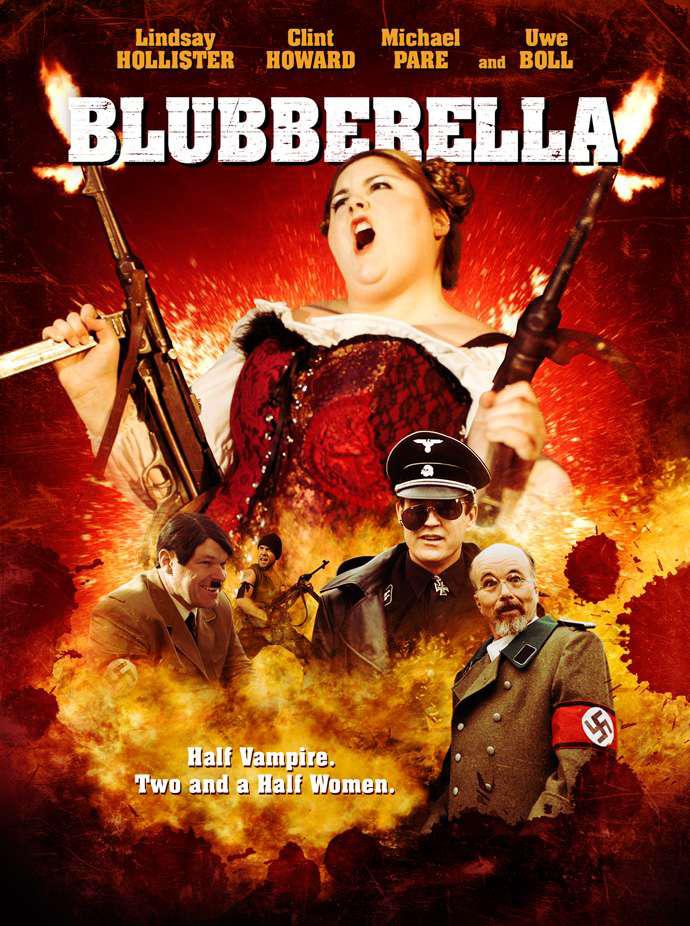 The action/horror spoof Blubberella is Uwe Boll’s second attempt at (intentional) comedy. He did re-release a “funny” version of his 2003 disaster, House of the Dead. That seems like the same opportunistic rebranding and dubious retconning that Tommy Wiseau pulled when he tried to claim that his magnus opus of suck, The Room, was always intended as a “quirky black comedy.” Sure, Tommy. Boll’s first attempt at comedy, 2007’s Postal, almost worked despite itself; the taboo-smashing genre of wacky comedy seems like a better fit for Boll’s cinematic tendencies. Blubberella is proof that Boll should stick to schlock and leave comedy to the professionals.
Blubberella (Lindsay Hollister) is a dhamphir, half-vampire/half-human, but really she’s just looking for a good man and a good meal. It’s 1944 Germany, and Blubby has joined forces with a resistance group lead by Nathaniel Gregor (Brendan Fletcher). Together, the group, along with the sassy gay soldier Vadge (William Belli), must battle a mad scientist (Clint Howard), a vampire Nazi general (Michael Pare), and the prospect of an immortal Adolf Hitler (Uwe Boll himself!).
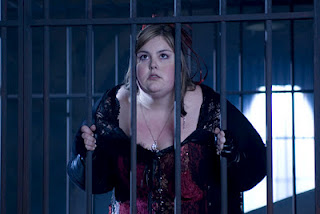 Leaden puns, obvious jokes, clueless pacing and comedic construction, tiresome one-liners, incessant yet flaccid sex jokes, a desperation to be shocking, Blubberella is a bizarre and staggering failure even by Boll standards. Rarely does the movie actually land a funny line (you want to know the best line? Here it is: “My friend says I replace sex with food… but then he raped me, so that kinda shot that theory.” Yes, that is the best one). The jokes aren’t textured in the slightest and can’t be bothered with basic constructive issues like setup, context, and payoffs. Instead, the movie is rife with random sexual and scatological references. It’s like the film is the living embodiment of a Tourette’s child. Belli (TV’s Nip/Tuck) is a braying gay stereotype that wears out his abrasive welcome in no time flat. At one point Pare just goes into a garbled Marlon Brando impersonation for no clear reason, and then it’s done. This would-be comedy, in name only, confuses randomness for clever. Here’s an example: a group of characters are crouched waiting for an all clear signal, and Vadge blurt out, “If you’re going through the drive-thru get me a Frosty.” Just because it’s a random line and anachronistic does not cover up the fact that it’s simply not funny in any context. There is no joke there. Everything in the movie just seems like a meaningless throwaway gag, never accumulating or having any connection to situation. Randomness does not excuse sheer ineptness. Given the understated title, I’d expect there to be a plethora of fat jokes that the movie would routinely fall back on for easy punchlines. I actually counted: there are approximately 35 fat-related jokes; at barely 75 minutes, that comes to about one fate joke every 45 seconds. I’m shocked they had that much restraint considering the opening minute of the movie featured Blubby walking into a giant walk-in freezer filled with enough blunt Flintstones-style sight gags.
Even worse, Blubberella relies on pitiful attempts to be “shocking” to rouse the audience into laughter. And so we endure scenes like the resistance fighters relocking a boxcar full of concentration camp victims (“No wonder they took you. That hat does nothing.”), Blubby killing a man by farting on his face, playing RISK with Hitler and then there’s the blackface. In the movie’s most obscene, whiplash-inducing moment, Blubby suddenly morphs into a Caucasian version of Precious being berated by her abusive and spiteful mother. Belli portrays the monstrous mother in drag and blackface. Amazingly, this is not the only character Belli plays in blackface. There’s another regrettable moment during that Hitler RISK sequence where Belli plays Hitler’s black assistant (“One of our new allies from Africa,” Hitler explains), and the guy can’t go a single sentence without referring to people as MF-ers. Whoo boy. Here’s the thing about the attempted Precious parody: just taking a situation and copying and pasting it to a new location doesn’t make it a parody. The blackface moments, in particular the Precious aside, feel completely out of place and tacky at best. Just because something is supposedly shocking or in bad taste does not mean it is funny without due context and setup. Blubberella does not understand this comedy truism, and so we get more of the same wearisome crass crap.
Blubberella was shot simultaneously with Bloodrayne: The Third Reich, utilizing the same sets, costumes, actors (literally everybody does double duty), recycled action footage, and more or less the same script. It’s not like the script for Bloodrayne 3 was that strong to begin with to warrant a copycat. It’s like Boll’s version of Rosencrantz and Guildenstern are Dead, though with more Nazis. Actually, just that very description is giving the movie far more credit than it could possibly ever hope for. There’s nothing clever about Boll’s alternative spin on his third Bloodrayne vehicle; just replacing Rayne with a 300-pound actress and making her go through the same motions doesn’t mean it’s a comedy. The laziness on display is powerfully lulling. I don’t think anyone on the entire planet was praying for a wackier retread of Bloodrayne 3. The funny thing is I don’t think the change of tone makes that much difference to Clint Howard.
 Blubberella plays out like a tired improv game that has gone on for an eternity. The film is stuffed with scenes that just seem to spin on and on, lacking momentum and any discernable direction. Scenes will just wander aimlessly like Boll is just waiting for his actors to somehow produce quality jokes spontaneously. Newsflash: this isn’t a Judd Apatow movie. Hollister and company will just spout random lines and riff off one another, acting like a troupe of lobotomized circus acts that have stumbled into a war zone. The results are pitiful, though occasionally they will hit a somewhat amusing idea that will be aborted in the next breath/stab at improv. It’s merely a numbers game and if they fire 100 jokes maybe 2 find some footing. Such shrug-worthy moments include Blubby holding a soldier’s hand to her stomach and saying, “If there wasn’t a baby in there, would that be okay?” Huh? At one point, Boll’s narration pops up to declare the following scene “boring,” and yet the entire scene from Bloodrayne 3 plays out uninterrupted or unedited. What was the point of that? If you’ve already made an attempt to side with your audience by declaring your scene boring, then why leave it unabridged? Why is keeping this scene vital from a plot standpoint for what is intended to be a silly spoof? Why does plot continuity even matter?
I noted with Bloodrayne: The Third Reich a theory that Boll, a notorious cinematic pick-pocket, was trying his hand at recreating Quentin Tarantino’s Oscar-winning WWII drama, Inglourious Basterds. Well after sitting through this movie, I can confirm without a doubt that Boll has a raging hard-on when it comes to Tarantino homage. The movie is broken up into chapters, including such delightful titles as “Titty Titty Fang Bang,” the score will resort to periods of long whistling, Hitler screams “nein nein nein,” and for older references, one character says, “Wakey wakey, eggs and bakey,” and another, “I’ll kill every last mother fuckin’ last one of you.” Are you going to tell me that is all a coincidence?
The lingering problem with Blubberella, besides its overwhelming incompetence and inexplicable existence, is that it feels more like a gag reel accrued for the cast and crew of Bloodrayne 3. This doesn’t feel at all like a movie or even an attempt at a movie. I’m of a mixed mind when it comes to Hollister. The central Ohio native (represent, girlfriend!) is probably not going to get many starring roles, though she has shined in guest roles on numerous TV shows like My Name is Earl, Big Love, Law and Order: SVU, and Scrubs, so I can’t blame her for jumping at the chance to be the lead star, the headliner (she and Belli are also listed as co-writers). Hollister is actually a pretty nice actress and has strong comedic instincts; however, that doesn’t mean she will rise to the occasion if left to her own devices by Boll’s paucity for scripted jokes. Boll isn’t exactly the most creatively nurturing collaborator. It’s all one big fat mess. You want the most telling moment? It occurs during the dull outtakes peppered throughout the end credits. One of the actresses, little seen in the flick, remarks astutely, “It’s not working. It’s not funny.” In six short words, she has summarized Blubberella better than I could ever hope to.
Nate’s Grade: D


 nathanzoebl
You must be logged in to post a comment.