Blog Archives
Fruitvale Station (2013)
 In the early hours of New Year’s Day in 2009, 22-year-old Oscar Grant was forcefully escorted off the Oakland transit system by armed officers. He was believed to be involved in some sort of gang-related scuffle on the train. Over the din of confusion, shouting, and anger, Oscar was shot and killed by a transit cop. His death sparked waves of outrage in his hometown and grabbed national headlines. Ryan Coogler was so passionate about Oscar’s death that he decided to write and direct a movie detailing the last hours of Grant’s life. He snagged Michael B. Jordan and Octavia Spencer (The Help) to star, attached Forrest Whitaker (Lee Daniels’ The Butler) as a producer, and the ensuing film, Fruitvale Station, debuted at the 2013 Sundance Film Festival and won the top honors. Thanks to Coogler, many more people will have a chance to get to know Oscar Grant as a person rather than an unfortunate statistic.
Coogler creates a remarkable debut film for himself, one where the details of life feel richly realized and observed. Sure there are obvious symbolic metaphors introduced like boiling lobsters and a lost dog that dies in Oscar’s arms (yes, foreshadowing), but as a whole Fruitvale Station feels like real life transposed onto celluloid. Coogler also works hard to humanize all the participants in his film, save for the transit cops at the end. There is a refreshing lack of judgment throughout the film as people are allowed to be the ambiguous creatures we are. No more so than Oscar. He has moments that make you wince, but mostly we watch a man struggling to get his life in order. He’s terrific with his daughter, loving and naturally attentive; he puts his family’s needs ahead of his own when it comes to money; he even helps a stranger learn how flash fry a fish, though there’s a hint of flirtation guiding his actions. But he also can’t hold onto a job, has trouble being more actionable in his life’s decisions, and temptation is always banging on his door to lead him back to prison. He’s a complicated man and Jordan (Chronicle) masterfully brings the man and his complexities to life. This is a star-making performance by Jordan (as was his turn on The Wire) and I was stunned at how easily Jordan dissolves completely into his role. There isn’t a physical nuance or line delivery that feels false. It’s a sympathetic humanization and Jordan’s performance is a gift. Combined with Coogler’s deft handling, Fruitvale Station is engrossing.
 For much of the film I felt like I was attending a funeral. It’s hard to watch at times, especially watching Oscar’s family wait at the hospital for the news we already know is coming. It reminded me of 2006’s United 93, where the overwhelming sense of dread held over every scene, every innocuous moment held the extra weight that it would be the last time this person was doing this or talking to this person; the dread of waiting for the end we all know is coming. Coogler opens his film with real phone video recordings of the death of Oscar Grant, so from the first moment on we’re awaiting the horrible inevitability. I suppose it gives every moment an extra dimension of pathos, and to some this may be cheap and easy, but it all comes down to perspective. Surely if you knew the final day of your life, you’d likely find extra meaning in the simplest things, bidding goodbye in a thousand different subtle ways. This message isn’t exactly new; it was already old when Thornton Wilder hammered it home in his 1937 play Our Town. Carpe Diem, seize the day, live every moment like it’s your last, stop and smell the roses; you get the idea. And so, the entire running time of Fruitvale Station is a mournful examination on the contradictions, complexities, and connections of a single human life.
Oscar Grant is not lionized as a saint nor is he vilified as some mindless thug without redemption. Carefully, Coogler constructs a complicated man struggling to right his life. Through flashbacks we see he’s spent time in prison, and he’s got a quick flash of a temper that can lead him into impulsive and violent confrontations. It’s significant that we see this prison flashback to summarize completely the life Oscar is trying not to return to. The temptation is always present to fall back on old patterns of comfort, namely cheating on his girlfriend (he has a lot of girls’ numbers in his phone) and going back to selling drugs to make ends meet. Oscar’s ongoing struggle with personal responsibility has cost him his supermarket job (he was late far too often), and he’s kept this news to himself, choosing not to worry those close to him. But his options are limited as an ex-con, let alone a guy fighting his own demons, but he keeps fighting because the Oscar we see, the glimpses of what he could become, are one who wants to be better. He dumps his supply of drugs rather than go through with a sale. The gesture is noble but also partially self-destructive from a pragmatically financial way of thinking. He’s in a deeper hole, money-wise, but he seems committed to making the change. A late encounter with a kind stranger also provides the possibility of a new job, a new chance, one that seems all the more tragic because we know it is a promise that will never be captured. Oscar Grant was likely never going to be a man who changed the world. He was an ordinary man. But we still mourn the death of ordinary men, even those who have made mistakes and are fallible.
 It’s impossible to view Fruitvale Station without its relevant connections to the Trayvon Martin case of 2012. Both of these men were black youths deemed to be “up to no good” with quick judgment skewed by prevailing racial bias. Both men were killed for being viewed as threats due to their race and gender. However, unlike Trayvon, we have a litany of witnesses and video evidence documenting the senseless execution of Oscar Grant. That transit officer argued he mistook his tazer for his gun because, surely, a suspect who is already handcuffed, face down on the ground, and having his head pressed down with the boot of an officer, surely that man needs to be tazed just for good measure. That officer, by the way, served 11 months of a two-year prison sentence for involuntary manslaughter (justice served?). It’s senseless tragedy built upon miscalculated racial alarm, and the reason we have a movie, the reason there were riots in Oakland, is because this specific case had witnesses. How many other innocent young men die every year because someone wrongly and hastily deemed them to be “up to no good”?
Coogler isn’t trying to stir the pot of racial animus or deify Oscar Grant into some martyr for the cause. Fruitvale Station only follows the last day of Oscar Grant’s life but in doing so it becomes an illumination of a human life. Oscar was an ordinary man before he met so unfortunate an end, but Coogler wants us to remember him not simply as a newspaper headline, but as a person. It’s a worthy endeavor that succeeds heartily but may prove to be dull to many, including several of my own friends and critical colleagues. I can’t argue that the life of Oscar Grant is notable to follow beyond the sad final twenty minutes. But that doesn’t bother me, because with the talents of Coogler and Jordan and their indomitable sense of purpose, the film becomes a fitting portrait of Oscar Grant as a human being and a life lived, not just a life prematurely extinguished. It’s powerful, upsetting, brimming with emotion and fury, and it’s also eerily relevant to today and will, I fear, only continue to be more relevant as the next Oscar Grant or Trayvon Martin captures the national spotlight. Coogler’s excellently realized film is a eulogy to an ordinary man, flaws and all, but also a call to do better.
Nate’s Grade: A-
Share this:

Lone Survivor (2013)
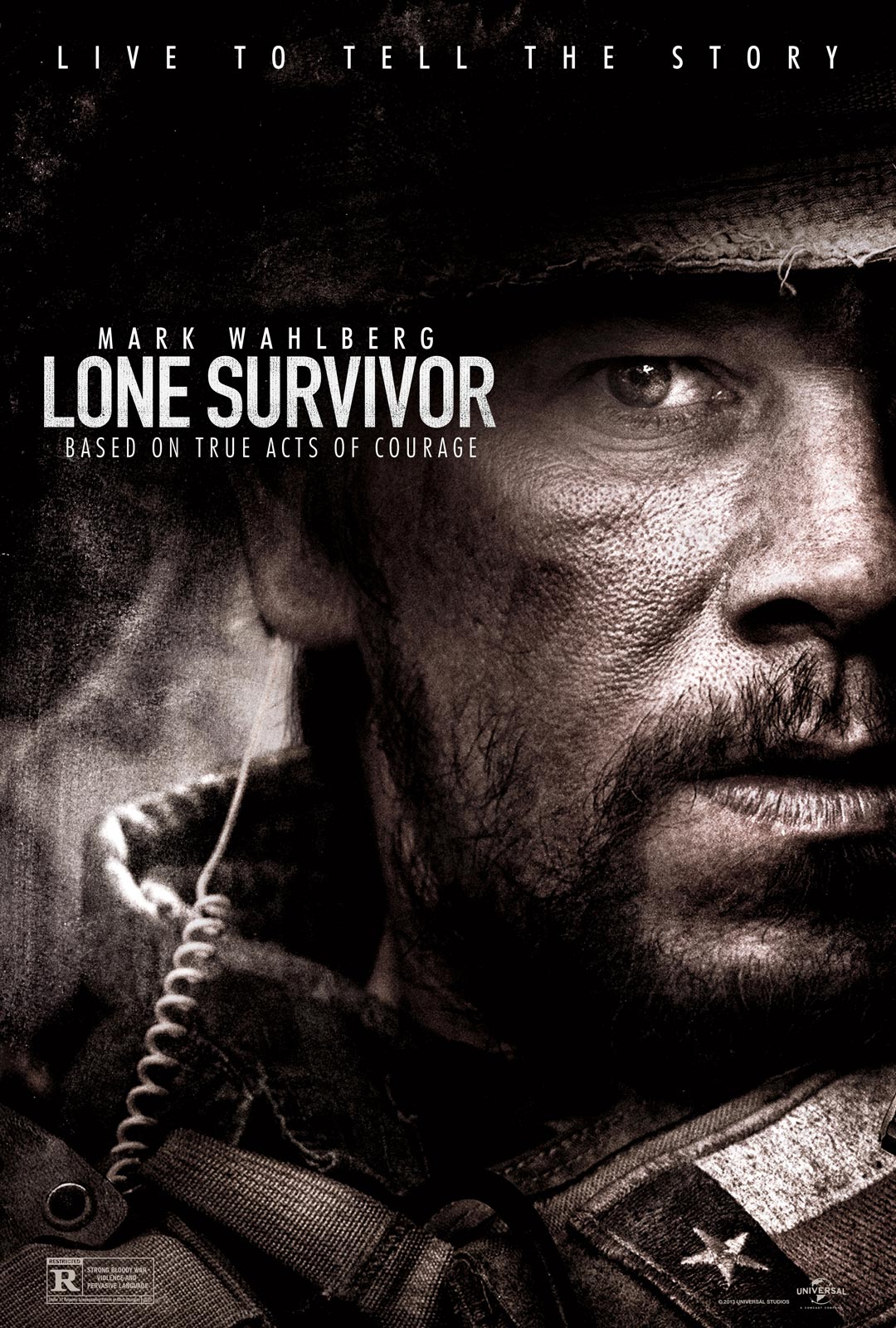 What do you do when the title of a movie is a spoiler? That’s the question with director Peter Berg’s reverential military action film, Lone Survivor. It’s the true story of a team of Navy Seals who had their mission compromised by a pair of unlucky Afghan goat herders. After deciding to set them free, rather than snuff them out, the Seals retreat to an extraction point, with a hundred Taliban fighters hot on their heels. When the action is firing, Berg is right at home, placing the audience in the middle of a visceral firefight that’s bloody and hardcore and pulse pounding. The rocky terrain of the country is just as deadly as the Taliban, as the Seals bounce around like ragdolls. The performances are all grizzled and finely attuned to keeping the terror of the moment at bay. Ben Foster (The Messenger) is the standout, which is a statement that’s been said with most Foster performances. At the end, I’m left wondering what is the film’s greater message. It’s retelling a military episode few people know about, illuminating the courage and bond between soldiers under fire. But in the end, all of these lives were lost because of one moral though arguably bad decision. Couldn’t they have just tied up the goatherds and gotten a better head’s start? Will the movie convince an audience that those innocent Afghan goatherds should have just been collateral damage? Does the movie critique the futility of America’s ongoing presence in Afghanistan? The futility of war itself? I doubt it, especially with Berg’s fervent appreciation of the armed forces putting their lives on the line (the opening credits themselves glorify the toughness of the Seals while also setting up an explanation why they could survive so many gunshots, injuries, etc.). Lone Survivor isn’t the heedless jingoistic propaganda piece that others critics have feared, but in the end it’s simply a sober and respectful tribute to the fallen, and that’s it. For many, this will be enough. For me, I was thrilled by the heroics but looking for more.
Nate’s Grade: B
Share this:

Mandela: Long Walk to Freedom (2013)
 One of the most important figures in the twentieth century, you’d expect Hollywood to give Nelson Mandela his well-deserved close-up, and in 2013 we got a biopic on his wife and the man himself, with Mandela: Long Walk to Freedom. It is a respectful, reverent, and relatively inspirational biopic boasted by a pair of great performances. Idris Elba (Pacific Rim/everything cool ever) nails the voice but also inhabits the courage of the man, the toll of his decisions, and the doubt that crept in at his darkest moments. Harris (Skyfall) gives a fiery performance as Winnie Mandela. You may be surprised, as I was, how active she was in South Africa’s rebellion against the government. The problem is that the film plays like a greatest hits collection without much more insight than we could glean from a cursory new report. Cramming the man’s life into 140 minutes is obviously going to be insufficient, but the speedy narrative does little justice to the man’s hardships and the complexities of South Africa’s civil rights movement. The cradle-to-grave approach in biopics is somewhat passé now. Rather movies like Lincoln and Invictus, also about Mandela, focus on pivotal moments that encapsulate the person. I think I have the perfect rewrite of this movie: adjust the focus squarely on the series of meetings in the late 1980s Mandela had with the South African government about political reform. Let’s dig deep into the political conflicts, the government’s fear to equal rights and possible recriminations, the smoothing of tensions, the building of trust, the fragility of a country in the balance. It may seem like more of a stage bound approach, but I think it has more immediacy, nuance, and works to summarize his lifetime of struggle and the change of his country. Oh well. Mandela is a respectful biopic but the man and his legacy deserved something better than a speedy run-through of his life’s checkpoints.
Nate’s Grade: C+
Share this:

The Wolf of Wall Street (2013)
 Martin Scorsese. The greatest living filmmaker on the planet. Enough said. When his latest, The Wolf of Wall Street, was pushed back due to an editing crunch, the rumor mill started as it normally does. Are there problems? Is it any good? Will it be forgotten this late into the awards season? While I can’t speak for the Academy, but for me The Wolf of Wall Street just about blows every competing movie out of the water this season. It’s brash, exhilarating, uproarious, mesmerizing, and just about every other adjective you can fetch from a dictionary. This is first-class filmmaking from a master, and consider Wolf of Wall Street the white-collar companion piece to Scorsese’s gangster masterpiece, Goodfellas. It’s that good, folks.
Based on his memoirs, Jordan Belfort (Leonardo DiCaprio) rises on Wall Street from a rookie stock trader to the king of his own empire. From the late 80s to the 90s, Jordan assembles a cutthroat team that knowingly sells lousy stocks to gullible investors and stuffing their pockets with hefty commissions. “Better there money was with me. I knew how to spend it better,” he admits. His closest friend and business partner, Donnie Azoff (Jonah Hill), literally quits his job to work for Jordan after spying one of his pay stubs. The guys start their own firm, specializing in high-pressure sales and on penny stock commissions. From there, they expand and expand until they’re making their own noise on Wall Street. The trading floor more closely resembles a frathouse party, complete with chimp, strippers, marching bands in their underwear, midget tossing, and other objectionable behavior. Jordan easily succumbs to the sex and drugs of the high-finance world of money, leaving his plain wife for Naomi (Margot Robbie), a gorgeous underwear model. He’s got a giant estate, a huge yacht, his own helicopter, and more money than he can spend. He’s also got the attention of the FBI and Agent Patrick Denham (Kyle Chandler). With the feds circling in, Jordan has to take extra steps to keep the good times rolling.
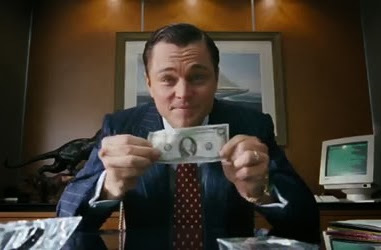 With a running time exactly one minute shy of three hours, it’s easy to call The Wolf of Wall Street self-indulgent and excessive, except that’s exactly the point. The movie is an orgy of unchecked male ego, a perverse bacchanal of Earthly pleasures that Caligula might blushingly admire. They are literally two orgies depicted in the movie and plenty of thrust-heavy sexual congress (I counted eight walkouts in my theater, most of them the little old lady variety). Here is a tilt-o-wheel of madness. These people were living like there was no tomorrow, had more money than they knew what to possibly do with, and would figuratively dance while Rome burns (in this instance, the stability of the U.S. economy). What’s important is to communicate that these individuals were having the time of their lives. It wasn’t just the hedonistic pleasures and the mountains of drugs; it was the power, the uninhibited embrace of a life available via poorly regulated capitalism. Many of those brokers in Jordan’s company were people from ordinary backgrounds. Their self-made success (that wasn’t so much earned as swindled) is a point of pride that fills them with purpose. They are seizing their full potential. There is no doubt in my mind that every broker in this movie would do it all again in a heartbeat. There is no remorse on display anywhere. The only remorse is having the ride unceremoniously end. “Was it obscene? Yeah it was obscene. In the normal world,” Jordan narrates. “And who wants to live there?”
I won’t say that there aren’t scenes and moments that could have been trimmed, but I was enjoying myself way too much to care about the bloat. This is the fastest three hours you’ll ever experience in your life. There’s some fat, yes, but man does this picture just move along like a freight train. The screenplay by Terence Winter (creator of HBO’s Boardwalk Empire) is impeccably drawn. The movie just courses with energy and watching it is often an exhilarating rush, communicating the highs the characters are undergoing. The supporting players are used to great effect to punctuate the comedy moment to moment. I loved Rob Reiner’s exasperated and profane performance as Jordan’s father. Naturally the bad behavior is entertaining in how absurd and over-the-top it can get, but one key sequence ranks up there with the finest sequences Scorsese has ever put to film. It’s the “Lemon” sequence, named after a legendarily potent batch of Quaaludes. It is a sequence of pure movie bliss, brilliantly edited and staged, as Jordan is placed in a precarious position when the drugs kick in, and his comic floundering is riotous. Winter and Scorsese have taken what, in other hands, could have been a modern American tragedy and decided to portray it as a darkly comic fantasia. I laughed long and hard throughout the movie. There are numerous scenes I can think back on and start laughing again. The ridiculous nature of moments, like discussing the logistics of tossing midgets at a dart board (“This is their gift”) is to be expected, but it’s the overall degenerate lifestyle these clowns chase after with impunity that kept me laughing.
I’ve read cantankerous critiques of the film, chastising Scorsese for celebrating the lavish lifestyle and excessive hedonism of his characters. I could not disagree with this appraisal more. The error is assuming that witnessing Jordan behaving badly is akin to celebrating it, as if adopting the perspective of our lead is the same as excusing his actions. Scorsese makes it clear early, and often, that Jordan Belfort is not a good person. Hopefully you don’t need him hitting his wife for this point to stick. This guy is fleecing people out of their life savings, living high off the fat of the land, and openly admitting to the camera how deeply illegal his activities are. But you’re under his spell, much like his brokers that worship him with unflinching zeal. Jordan, especially as portrayed by DiCaprio, is a volcano of energy and single-minded determination. He whips his troops up like a religious revival, manipulating you with every tactic in his employ. Early on, he’s defrauding ordinary middle-class and low-income clients, but because we’re all addicted to the adrenaline rush of the sale, of the con, we push this troubling reality from our minds. When he moves onto wealthier clients, we adopt a similar attitude of Teresa, Jordan’s first wife, mainly that these people can afford the losses and therefore get what they deserve from a silver-tongued shyster. It’s the audience that proves to have a selective memory because we’re drawn to Jordan’s charisma, expertise, and talent, so we ignore the pesky details of who gets stuck with the bill. Don’t pin that on Scorsese. He makes it abundantly clear that Jordan is a bad man, and the depths of his greed is but the tip of the iceberg when it comes to Wall Street. Jordan’s firm was a tiny player. Think of what horror stories Goldman Sachs or Lehman Brothers would offer if ever exposed.
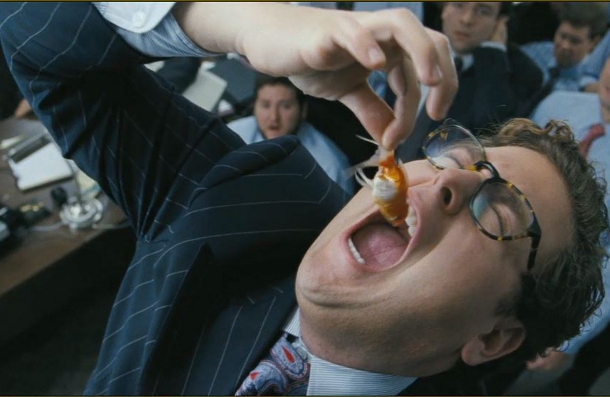 This is my favorite Scorsese film since Goodfellas, and they have plenty of similarities. It makes sense because these men of finance take their cues from movie gangsters, styling themselves as tough guys. At one point, brokers hold a guy over a building to intimidate him. There’s also certainly as much cocaine as there may have been in Scarface. But like that classic of the gangster cinema, Scorsese propels us into the hidden world of the financial institution run amok, allowing us a backstage pass to the people profiting from wrecking the economy. It’s a fascinating perspective that confirms some of our worst fears about stockbrokers. It’s a misogynistic boys club and the few women that do participate have to play by their hyper masculine, juvenile rules. These are people that find any number of ways to skirt the law, rip off their clients, and live in luxury until they can find another sucker. It’s a system built for the entertainment of the few on the backs of the many, and it’s just as relevant today as it was in the 90s. With Jordan’s inside knowledge, we’re educated on the many corrupt ways of Wall Street.
Marking the fifth collaboration with Scorsese, this may be the finest DiCaprio (The Great Gatsby) performance yet. The man sheds his vanity, easily fitting into the shark that is Jordan Belfort. He’s ruthless in one moment and completely inept in another, at the whim of his vices. DiCaprio taps into Jordan’s leadership qualities with the dynamite sales speeches, but he also shows what an insecure man he is at heart. He’s got a taste for the good life and is reinventing himself, including trading up in wives to attain that proverbial American Dream. He’s living empty pleasure to empty pleasure and he doesn’t care. DiCaprio acts as our ringmaster through his own circus, and you’ll be delighted and horrified by his actions (and also his peculiar, bird-like dance moves). There’s not a bad performance in the whole cast, and this is one huge cast. Hill (This is the End) is a becoming more and more credible as a dramatic actor, though he excels at the blustery outrageousness as Jordan’s number two. He’s a treat. Robbie (About Time) nails her New Yawk accent but more importantly nails the portrayal of a trophy wife who recognizes and eventually resents her lifestyle. And oh does she just exude sexual heat.
I want to focus on the very end of the film, so there will be some mild spoilers in this paragraph but nothing I feel that would ruin the viewing experience. You have been warned, spoiler phobes. As expected, Jordan eventually winds up in jail for his felonious misdeeds. Ordinarily this would be the end of our traditional law-and-order morality tales; the bad guys are locked away to pay for their crimes. Jordan tells us how nervous he was on his first day of prison, that is, until he remembered one very important fact: he’s rich. White-collar prison is not the same as other penitentiaries, and we see Jordan loftily playing tennis. His sentence is only three years as well, which seems like an insult given the thousands of lives he may have instrumentally ruined. But that’s the ultimate condemnation in the end: the system is rigged for people like Jordan, people with money. In the end, he wins. He goes to prison, his family life is torn asunder, and his personal relationships are strained, but the guy wins. He continues his speaking engagements motivating everyday saps how, with his cherished expertise, they too can rake in wealth. The final shot of the movie tells me everything I need to know. It’s a slight pan out to the crowd in attendance of Jordan’s speaking session. We see the collection of faces, each person hanging onto Jordan’s every word, each filled with idolatry. They want to be him. Despite everything, the bad behavior, the crimes, the waste, they all want to be him, and that’s why people like Jordan will always succeed, will always prevail, will always have the last laugh. There will always be a healthy supply of suckers that want to believe whatever nonsense he’s peddling. That’s the point. He won.
 Recently I watched the very good crime caper American Hustle and noted that its director looked to be fashioning a loving Martin Scorsese homage. Well, after watching The Wolf of Wall Street twice (not back to back, mind you; I’m not nuts) I can say that there is no Scorsese like the source. This is vintage Scorsese. This is brilliant filmmaking, a bold movie that practically sings, it flies by with exhilarating force and acumen, daring you to keep watching. The fact that 71-year-old Scorsese could make a movie this highly energetic, this debased, this brash, this borderline indecent, and this awesomely entertaining is encouraging. It’s even more hilarious to me that older Academy members at a recent screening of the film accosted Scorsese, essentially being termed a “debauched scoundrel.” That’s got to count as some badge of honor. Yes, at three hours the movie can get long but it’s never dull or taxing. The propulsive narrative, the hilarious humor, the shrewd characterization, the wanton excess, the filmmaking bravado that hums, it all coalesces into a disturbing and disturbingly enjoyable condemnation of greed and our inherent celebration of this lifestyle. There is not one aspect of this movie that falls flat. The Wolf of Wall Street is an invigorating piece of cinema. The choice of music, the swinging cinematography, the wide ensemble of actors, the feverish editing, it all comes beautifully together to form a whole that surpasses everything else in cinema this year. Dig in.
Nate’s Grade: A
Share this:

American Hustle (2013)
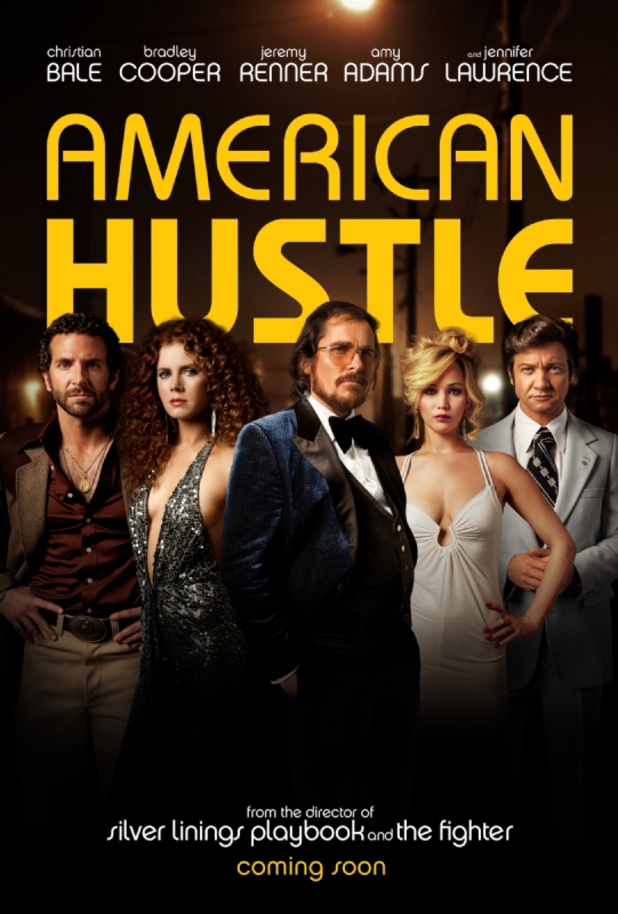 With two movies, writer/director David O. Russell has vaulted to the top of Hollywood. Previously known for his own difficult behavior, Russell’s last two films, The Fighter and Silver Linings Playbook, were both critical and commercial hits (Silver Linings made over $230 million worldwide). Both brought a bushel of Oscar nominations as well, making Russell one of the hottest directors for actors and producers. But a new side seems to have emerged over these last two movies, one less of Russell the domineering director and one of Russell the open collaborator. It feels like he’s just hitting his stride too. American Hustle is Russell’s latest and it’s sharply written, engrossing, lively, surprisingly comic, and readily entertaining.
In the late 1970s, the FBI set up an undercover sting to nail political corruption, ultimately nabbing several U.S. congressmen and one standing U.S. Senator. Richie DiMaso (Bradley Cooper) is an FBI agent who snags the perfect assistance. To catch a crook you have to think like a crook, and so Richie has strong-armed a pair of lucrative con artists into helping him. Irving Rosenfeld (Christian Bale) is a professional down to his elaborate hairpiece. He’s used to fleecing desperate people and selling phony artwork to the gullible, but he’s been too shy about making too much noise. If you stay small, you go unnoticed. Irving’s partner in crime is Sydney Prosser (Amy Adams), a kindred spirit who has reinvented her self. She and Irving are in love, and now they’re trapped by Richie to set up New Jersey mayor Carmine Polito (Jeremy Renner). The one unpredictable element is Irving’s young wife, Rosalyn (Jennifer Lawrence), who could blow up the whole operation with her careless and self-involved tantrums.
 Russell has once again given audiences one of the most entertaining films of the year, this time allowing them to participate vicariously in a con game, trying to anticipate the twists and turns and assessing everyone’s personal angle. This is a fictionalized rendition of the Abscam case (the opening text drolly says, “Some of this actually happened”) and it gives us a slew of meaty characters that have something going on. The central point elaborated in this pop crime caper is that we’re all cons, we’re all pretending, on some level, to be different people; Russell’s film just takes this notion to the extreme. Irving and Sydney are trying to escape lives of ordinary malaise, of being victims, of the more powerful dictating their options for them. With Sydney, she’s pretending to fall for Richie, but we don’t fully know which side she may choose to end up on. Richie is trying to also escape his dull life of desk jobs and lower middle-class dinners. His ambitions get hold of him, and with Irving’s aid, he catapults himself toward achieving those oversized dreams of his, never mind the ethical lapses in nabbing the bad guys. For Carmine, he’s so fiercely devoted to his community that you don’t doubt his loyalty for a second. He’s a man who sincerely wants to help others and is knowledgeable enough about how the world works, knowing he may have to grease some wheels to get the progress started. He is the most moral figure of the five main players and you may find yourself rooting for him to escape the snare closing in on him. Then there’s Rosalyn who has her hooks in Irving, looking for a sense of stability for her and her child. She’s a volatile cocktail of emotion but she knows what she needs to do to keep Irving anchored to her needs, though she’s also cognizant enough to latch onto a better provider if one materializes. Mixing and matching those characters, you have an eclectic mix of personalities clashing, many at odds with one another as far as goals, and the conflict stirred up is delicious.
Russell also attaches on his Martin Scorsese filter, delivering a freewheeling film about criminals from their wizened point of view, explaining the ins and outs of their hustle with flamboyance, style, and vigor. While the opening is a tad slow, including an opening minute watching Irving work his almost breathtaking comb over hairstyle, we plow right along into this world of hustlers and con men, learning tricks of their trade (hint: desperate people are desperate) and the tools to stay ahead of detection. We’re awash in multiple perspectives, each with voice over, a frenetic camera, and emboldened editing. It’s the Scorsese approach given studious application to the Abscam affair. It’s a great thing that Scorsese is the finest living filmmaker and devoting a two-hour-plus homage to the man’s most stylized crime pictures is a plus. Russell’s movie feels alive but also hungry, like many of his characters, restlessly searching for something. The scenes land but they don’t feel like they’re standing still; everything is propulsive in this movie. The small operation of Irving and Sydney is taken to the big leagues thanks to Richie’s ego, and the FBI’s desire for splashy headline busts, but wider exposure also exponentially multiplies the danger. Once the gambling scheme attracts the investment of the Mob, that’s when everyone has gone too far. I was clenching my fists in suspense toward the end, worried that our fictional cons may be too far in to survive.
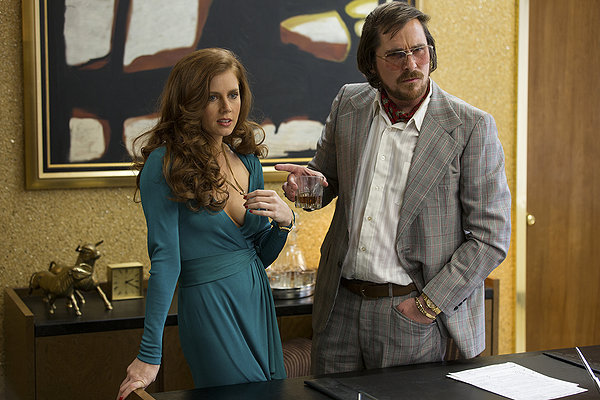 Russell hasn’t lost his magic touch with actors. His last two films have netted seven acting Oscar nominations and three wins, and the cast of American Hustle meets that same level of excellence. Perhaps even more so than The Fighter, the characters are given a very broadly comic brush, easily and routinely stepping into a carnival row of over-the-top behavior. It provides plenty of entertainment of the mishap and absurd variety, but there are also lone piercing moments of great empathy with these messy people. Mostly, the various actors all seem to be in a great syncopation, each one contributing where the other left off, building a great and compelling picture. When this ensemble is firing, it’s hard to beat. Special mention to comedian Louis C.K. (TV’s Louie) making the most of every scene he’s in as an FBI party pooper. His running gag involving a personal ice-fishing story is one of the film’s best jokes.
Bale (Out of the Furnace) is our guiding voice in this world, a flimflam man of the first order who fools maybe even himself. He’s got his own code of ethics and a heart behind that pot belly (another physical transformative performance by Bale the chameleon). He’s briskly entertaining but my only complaint is that, by being so suave and slick, he seems a tad too low-key at points given the risk involved. I know it’s part of the act, but from an audience standpoint, it makes him seem a tad too modulated. His equal is Renner (The Bourne Legacy) who is so earnest that it practically breaks your heart when he oversteps into morally murky territory.
However, Bale’s performance is compensated by the sheer craziness of the Silver Linings co-stars, Cooper and Lawrence. Cooper (The Place Beyond the Pines) is a lawman but also the film’s biggest antagonist. He gets drunk with power and the credit he’s receiving at the FBI. He’s also a deeply insecure man who is trying to style himself like Irving and Sydney as a posh reinvention. Cooper gives him a manic energy and taps back into his reservoir of eager-to-please egotism. Lawrence (Catching Fire) is the most unpredictable character. She acts on impulse, flirts with sabotage, and soaks up the spotlight she’s so rarely afforded. Lawrence is having the time of her life playing a loud, shrewish, vampy housewife who has a noticeable habit of starting house fires.
Beforehand, I would have thought that Lawrence and Adams should have swapped roles (still an interesting experiment), but having now seen the film, each suits them well. Adams (Man of Steel) is the saddest character of them all to me because she’s the bruised dreamer anxious to be anyone but who she really was. She relishes the con, more so than Irving, and ties much of her self-identity to her shyster skills.
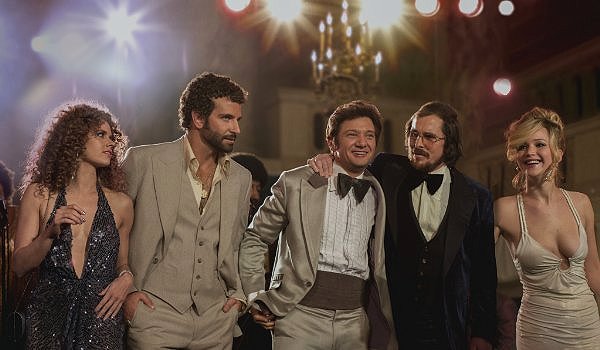 I’ve been dragging my feet writing my review and I’ve been trying to determine why, beyond, obviously, holiday-related sloth. American Hustle is readily a good movie that provides plenty of entertainment, meaty characters, and fun, but why do I keep feeling like it’s missing one undetermined ingredient? I can’t even articulate what at the moment but after having seen the film two times now, I feel like perhaps my emotional involvement was stunted. It’s a finely tuned script that delivers big performances for big-time actors, with a dandy ending that manages to dish out satisfying conclusions to its bevy of wheeler-dealers. But why didn’t I care more, why didn’t I feel more resonance by the time the end credits landed? The best theory I can surmise at this time is that we’re caught up in the con game, where everyone is pretending to be somebody else out of necessity or desire, that when it’s all over, we reflect on what a fun ride it’s been with fun characters but do we feel like we’ve gotten anywhere? I feel like I was more interested in the characters than attached to them. Again, American Hustle is still a sensationally entertaining movie and this paragraph is but a quibble, but it’s enough to thwart me from fully embracing and celebrating Russell’s film (confession: having already seen Scorsese’s brilliant Wolf of Wall Street, this could be coloring things for me with Russell’s Scorsese homage).
American Hustle is a fun ride with arresting performances, oodles of style, energy, and comedy. It’s a crime caper of the first order, easing you into this world and watching people play all sides. Even better, we’re given a volatile mix of personalities that clash, forming new and lasting conflicts, some of which could endanger the entire operation. These are interesting people to spend time with and so we can excuse the indulgences of a 140-minute movie that offers even more with this fantastic cast. Russell with a Scorsese filter is an even more improbably entertaining filmmaker. This is a crowd-pleasing sort of movie, much like Silver Linings, that doles out punchlines and payoffs with aplomb. It’s easy to go along for the ride, laugh uproariously, and then by the end sort of wonder whether it was all worth it. The emotional detachment to the characters may be a minor complaint for a film this largely satisfying, but since we’re spending so much time on our characters, I think I would have preferred something a tad more substantive by the end. It’s a great ride, with great characters and great humor, but there is a nagging concern that it may have been a better ride than a story. Regardless, American Hustle is an enjoyably alluring con that mines the absurdist fashions, personalities, and political overreach of the 1970s, painting a tale of criminals who may be the real heroes of the American dream.
Nate’s Grade: A-
Share this:

42 (2013)
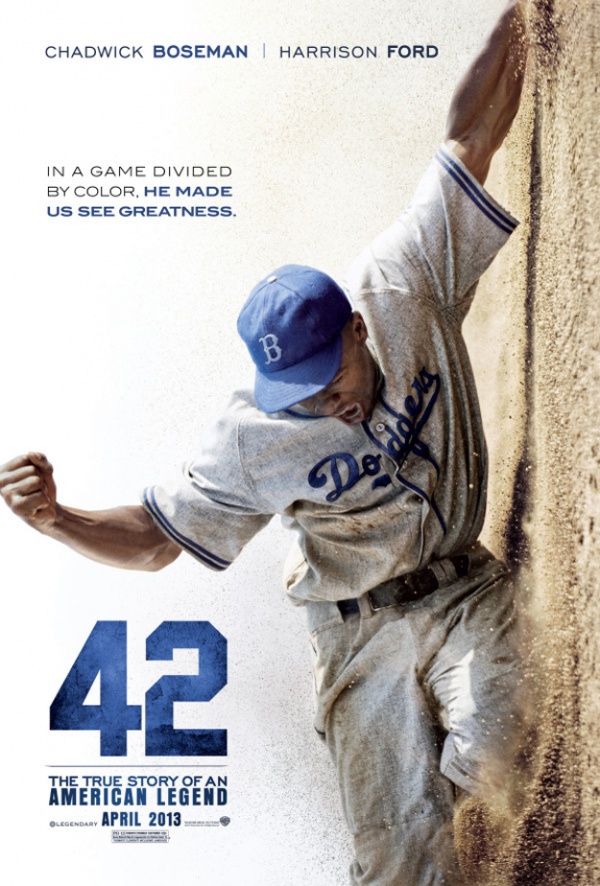 Staid and square, a bit like its lead, 42 is a biopic on Jackie Robinson breaking the color barrier in baseball, and while it’s reverential to a fault, it could have used more life. As a character, Robinson is simply not terribly interesting because he’s being trapped within a limited prism of inaction. Robinson the man could be fascinating, but Robinson the character of this movie is a bit of a bore. That’s why the film is just as much about Brooklyn Dodgers owner Branch Rickey (Harrison Ford), a far more colorful character that gets to chomp cigars and lecture people with countless speeches accompanied by heroic piano cues. 42 is crammed to the gills with messages but they’re so transparent and overdone, occasionally ham-fisted, where every important thought is spelled out and underlined and repeated for the audience. The corny sentimentality clashes with the danger and hostility Robinson bravely faced. We got stuff like a little kid praying to God that Robinson hits a homer to “show what we can do,” a white guy trots up to Robinson and he seems dangerous… only to want to wish him well, and then there’s all the white players learning lessons of tolerance, treating Robinson as if he’s some prop for their own self-actualization. The greatest acting in the movie, a bit that may take your breath away, is from Alan Tudyk who plays a competing team manager. He is like a racist Foghorn Leghorn and he just… keeps… going. This sequence is the film’s best because it feels earned, complete, and lastly emotionally resonant. 42 is an acceptable biopic, effectively triumphant where it counts, but it feels too dated, too safe, and overburdened with doling out a slew of messages rather than telling an engaging and difficult story.
Nate’s Grade: B-
Share this:

Dallas Buyers Club (2013)
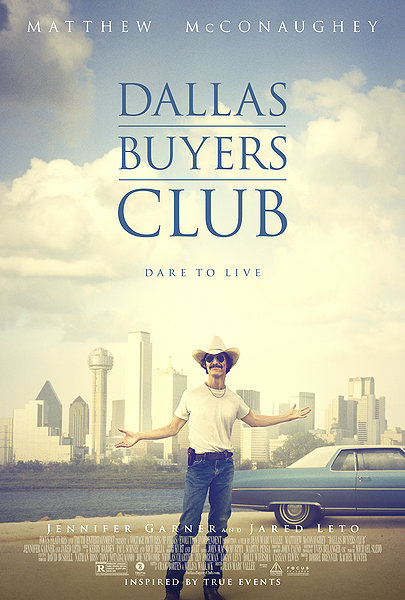 It’s been a while since Hollywood really tackled the AIDS crisis and the prejudices associated with it. Thanks to better understanding and tolerance, and a rise in life-extending drug treatments, AIDS is rarely stigmatized today as it once was, as a death sentence, as a gay disease. It’s faded into the back of most people’s minds. It’s been twenty years since Philadelphia and Tom Hanks’ Oscar-winning performance. Has it been too long? The drama Dallas Buyers Club returns to the early years of the AIDS crisis and the ignorance of the age, illuminating a lesser known true story about one of the most unlikely activists to emerge.
In 1985, Ron Woodruff (Matthew McConaughey) is a Texas electrician and part-time rodeo bull rider. He’s drinking, snorting cocaine, and sleeping with every woman he lays eyes on. Then one day he collapses and wakes up in the hospital. He’s told he has contracted HIV/AIDS and likely only has 30 days left to live. Ron is aghast, instantly defensive, declaring, “I ain’t no faggot.” Rather than wallow, he fights to live as long as he can, refusing to be part of a hospital drug treatment for AZT unless they can tell him, definitively, he’s getting the actual drug and not the placebo. Ron travels to Mexico and finds a sympathetic doctor with alternative treatments involving vitamins and other natural drugs, none of them illegal, just unapproved by the FDA. Ron returns to the States and runs into trouble trying to sell his wares to the afflicted gay community. Raylon (Jared Leto), a kindly transvestite suffering from AIDS, agrees to help Ron make inroads, for a percentage of the sales. Ron and his unlikely business partner skirt legal loopholes to sell “memberships” into the titular Dallas Buyers Club. With monthly dues, every member gets a dose of attentive medicine, and it’s having remarkable results.
 The bulk of the attention Dallas Buyers Club has received is from the transformative performances of its two lead male actors, and they are exceptional. McConaughey (Mud) begins as the sort of character we’ve seen before, the swaggering cowboy who’s a natural ladies’ man, but as his life quickly falls apart and his circle of friends turn on him in gay panic and ignorance, Ron is pushed to the brink. McConaughey’s weight loss, which garnered plenty of ink in tabloids last year, is startling and instantly echoes his character’s dire state. Likewise, when you see a late scene of Leto (Lord of War), his frame is so gaunt, so frail, and so evocative of the few remaining moments these men have left to them. It’s no stunt or gimmick because their performances, even without the weight loss, are enormously affecting and powerful. Both men project a blustery confidence they themselves occasionally buy into, but both men are, naturally, scared witless, fumbling, scrambling against the clock. McConaughey is the strong face, the wheeler-dealer who has to use his live-wire charm and bag of tricks to get the meds. As roadblock after roadblock is thrown his way, we readily watch the toll is takes on Ron, the heaviness of his burden that becomes more about people than money. Leto is the conscience of the film and as he shrinks away, you can’t help but feel the inescapable tragedy. Leto will break your heart. I fully expect both men not only to be nominated for Oscars but likely to be favorites to win.
Despite the strength of those two outstanding performances, the film itself doesn’t measure up in a disappointing number of ways. The script by Craig Borten and Melissa Walleck misses far too many opportunities to round out the characters and the central conflict. The second half of Dallas Buyers Club feels a tad rudderless, and this is mostly because of a general sense of sameness in Ron’s conflicts. He butts heads with the FDA, finds a loophole, keeps going. This pattern repeats but it never escalates until the very end. As a result, the film feels like it’s treading water when it shouldn’t be. The portrayal of the FDA and other antagonists is decidedly one-note, almost to a ghoulishly degree. The movie sets up the piñata of Big Business/Pharma to take easy whacks at a faceless, money-driven entity that put profits before human lives. I get it, but it’s too easy and a movie that gropes for emotional depth should not have to stoop to caricatures of bureaucratic evil. The truth of the matter is that there was plenty of legal intransigence and feet dragging when it came to the response to AIDS, and that’s why it feels almost callously wrong for Dallas Buyers Club to reduce this dramatic point in history, where 95% of people who contracted HIV/AIDS had a month left to live, to an us vs. them/slobs vs. snobs underdog tale. That reductive condensing is a disservice to the real people but also a greater dramatic story at heart here.
I’d also like to note that the characters themselves are lacking. They held my interest, certainly, but what can I say about them? What moments revealed nuance or progression? The character arcs are dramatic with a capital D: homophobic Texas good ole’ boy becomes unlikely AIDS activist and friend to gays. The parameters are clearly mapped out, the start and the finish, but what’s lacking is substantive growth that I can acknowledge onscreen. Beyond the ongoing presence of Raylon, the movie doesn’t provide enough evidence for me to move Ron from homophobe to activist. I think this is due to the script meeting the basic requirements of what it thinks are the big signposts along Ron’s personal journey. So we get a scenario such as Ron refusing to enter a gay bar, then cautiously entering, then feeling comfortable around gay people. I don’t need people to trip over soapboxes to blurt out their inner feelings, their changing perspectives, but there has to be more than what’s presented in the interest of time and narrative cohesion. Likewise, Raylon is portrayed as saintly, your prototypical movie gay man with flamboyance and attitude, and he is certainly charming, but much like the main character in 12 Years a Slave, Raylon is more tragic martyr than fully-realized character. His service to the script is to push Ron forward on his own humanizing arc, and I’ve already stated my problems with that. The remaining characters are underwritten, with the unfeeling Dr. Sevard (Dennis O’Hare) served up as a stooge. Except he’s trying to get a sample size to test a drug’s viability, the same process with all medicine. Yet because he’s looking at the big picture, and lacks bedside manner, he’s the enemy to harrumph. Jennifer Garner’s character is more an exposition spout than person.
 Weirdly, the movie drifts into an extended subplot, almost a secondary antagonist after the FDA, against the preliminary AZT drug treatment. This was the first major drug produced to combat HIV/AIDS. It had major backing with huge pharmaceutical industries. Opposition to the conventional norm of the time (AZT is our only medical hope) provides a snug storyline to garner our rooting interest in Ron, but this fight seems too impersonal and one-sided. We’re given reams of stats on the effects of AZT on AIDS patients, presenting a picture that AZT breaks down the patient’s immune system. Dallas Buyer’s Club becomes a sermon against AZT. The movie doesn’t have to be apolitical but it needs to mask its sermonizing or at least be more passionate about its case. Then in the end credits we’re served a short post-script saying that a low-dose AZT, in combination with other drugs, saved millions of lives. After hearing two hours of how terrible and stupid AZT is for treatment, it’s a surprising endnote. Does that justify the doctors that the film so easily vilified?
Ultimately a good film worth watching, I can’t help but continue finding problems as I reflect upon my Dallas Buyers Club experience. If it wasn’t for the excellent acting onscreen, I would have noticed the flaws of Dallas Buyers Club even earlier, but strong acting has a way of being a soothing balm with the deficiencies in a film. The narrative, with easy one-note villains and a runaround of repetitive conflicts, needs more development to match the caliber of performances of McConaughey and Leto. Both men give it their all, breaking your heart in the process, and their performances are even more commendable and impressive when you realize that the film’s characterization is wanting. I feel like the complexity of this volatile time, and Ron Woodroof as a human being and unlikely activist, have been simplified into a rah-rah mass appeal underdog vehicle. I think this does a disservice to the characters and their personal drama, and I wish the filmmakers presented them better as well-rounded individuals rather than tools for the re-education of Ron Woodroof. There’s enough good here to balance out the could-have-been-better, chiefly the power of the central male performances. However, if you want a passionate account of early AIDS activism, I suggest checking out last year’s Oscar-nominated documentary How to Survive a Plague.
Nate’s Grade: B
Share this:

12 Years a Slave (2013)
 In 1841, free black man Solomon Northup (Chiwetel Ejiofor) lives in Saratoga Spring, New York, performing as a trained violinist. Some traveling performers offer him serious money if he’ll play with their circus act in Washington, D.C. Solomon bids goodbye to his family, never knowing he will not see them again for a dozen years. He’s kidnapped, imprisoned, and sold down South to a series of plantation owners. He insists he is a free man, but who will believe him? He’s a black man in chains, and frankly many people just do not care. He learns to adjust to the rules of his new life, finding some companionship with the fiery Patsey (Lupita Nyong’o), and looking for a trusted source to mail a letter to Solomon’s family. It’s a life of daily terror and Solomon could be killed at any moment if word got out that he knew how to read and write.
12 Years a Slave is, as expected, a hard movie to watch at times but it is an essential movie to be seen. A friend of mine literally had this conversation with a movie patron (I wish I was only making this up):
Customer: “Yeah, I don’t think I’ll end up seeing 12 Years.”
Friend: “Oh. Well it is a hard movie to watch.”
Customer: “It’s not that. I’m just waiting for a movie that finally shows all the good slave owners doing nice things. It wasn’t all bad.”
 This brief conversation exemplifies for me why a searing drama like 12 Years of a Slave is still vital in 21st century America. This is a slice of history that cannot be forgotten, but just as sinister is the amelioration of its cruelty. As time passes, and those with direct personal experience are long gone, then the mitigation begins, and you have ignorance consuming people who want to whitewash America’s original sin, like the above movie patron. I’ve even read, simply on message boards for this very film, a dubious prospect I admit, people arguing, “Can’t we just move on already?” and posing false equivalences like, “Well the poor Southerners who worked as indentured servants had it just as bad.” I swear I am not deliberately setting up a straw man argument, these are actual gripes people have. It’s as if acknowledging the totality of the horror of slavery is, in itself, some kind of insult to people today. It’s history and vital history that need not ever be forgotten or mitigated, and we need more films dealing with this subject.
There is zero equivalency to treating people as subhuman property, stripping them of all human rights and dignity, separating them from their families, beating them, raping them, murdering them without consequence, being punished for defending yourself, and kept in a constant state of terror where anything horrible can happen to you at any time without reason. Sorry slavery apologists, but even the notion of a “kindly slaver,” which the movie actually showcases, is erroneous. Whether they don’t beat their slaves as often or addressed them as people, slave owners are still profiting from the institution of slavery, and as such the notion of a “good slave owner” is antithetical to the very insidious nature of plainly owning another human being.
With all that said, 12 Years a Slave is an unflinching look at the cruel reality of slavery but one that demands to be seen. Director Steve McQueen (Shame, Hunger) doesn’t pull his punches when it comes examining the unrelenting misery of slavery. There’s a whipping scene where he are in the safe position of focusing on the faces of those involved, studying their horror, but then McQueen has the camera turn around and you see, in graphic detail, the ravaged back of an innocent woman, the bloody result of every one of those whippings that we watched at a comfortable distance at first. This is a gory example, and the film is rather restrained when it comes to this aspect. This is not simply wallowing in sadism. Hollywood has yet to have a definitive film showcase the traumatic reality of slavery. 1997’s Amistad gave you glimpses, but most of Steven Spielberg’s movie was set in courtrooms arguing the philosophical nature of inherent rights. I wish they would remake the classic miniseries Roots; today’s TV landscape would be more permissible at showing the graphic terror of slavery than 1970s network television. With 12 Years a Slave, there are several uncomfortable moments that will make you gasp, but overall, while retrained on the gore, you feel the overall devastation of a slave’s predicament. Every moment of life was at the whims of another, and a victim could be trapped at every turn. Solomon is beaten soundly, and after he defends himself, he is rounded up to be lynched for his audacity. The aftermath is portrayed with stark tension, as Solomon is left hanging by a noose, his feet barely touching the muddied ground, trying to maintain his stance or else choke to death. And like the long takes in shame, McQueen’s camera just holds us there, trapping the audience in the same strenuous dilemma. The worst goes to Patsey, who is raped by her master and tormented by the master’s jealous wife. Both Solomon and Patsey are damned with every decision. By the end, Solomon is rescued and reunited with his family, but you can’t help but think about all those other unfortunate souls left to mire in slavery. For millions of them, there was no set limit to their desolation.
 From a script standpoint, the movie flows more as a series of scenes rather than a traditional three-act arc. Writer John Ridley (Red Tails, Three Kings) works from Solomon’s own autobiography and does an incisive job of recreating the dimensions of mid-19th century America and the diseased mentality that accepted slavery. No more is this evident than in the frightening character of Edwin Epps, played with chilling absorption by Michael Fassbender, McQueen’s favorite collaborator. Epps is the kind of man who uses selective Scripture to justify his heinous actions. “A man can treat his property how he likes,” he quips with authority. Epps’ plantation is the worst along Solomon’s hellish odyssey. Fassbender (X-Men: First Class, Prometheus) spookily possesses Epps with great ardor, bringing out the snarling dangers of a man and his unsavory convictions. You’ll cringe over all the unwanted lascivious attention he gives to Patsey. He is a weak man through and through, but one who rages against others with his weaknesses. Fassbender is electric and keeps an audience extra alert when onscreen.
The acting is exceptional and infuriating. Ejiofor (Serenity, Salt) is commanding in a performance that stays with you. There is so much the man has to communicate with his eyes, those great orbs of his. Because of his circumstances he must hold back his ire, do what he can to make it another day, and his adjustment to the horrors of slavery are heartbreaking in itself. He must always be cautious, and when he dares to risk trusting a white man, we feel the same tremors of trepidation. There’s a great scene where Solomon, having been betrayed, has to come up with a credible alternative in the moment, with so much riding on his improvisation skills. It’s as suspenseful a moment as most Hollywood thrillers. The most heartbreaking performance, though, belong to Nyong’o, who is making her film debut in a major way. As Patsey, she symbolizes the mounting torment of unremitting victimization, a woman begging for death but too proud to make it happen. She has some intense monologues where not one word feels false. She is a broken woman struggling to find her footing, and watching her get abused in so many different ways is gut wrenching. She’s more than a martyr and Nyong’o shows you that.
Undeniably a good movie, there are still enough filmmaking choices that hold it back for me, and it all comes down to Solomon as the protagonist. The movie’s center was not as strong as it needed to be, and that is chiefly because our focal point, Solomon, is not well developed as a character. I feel pings of something approaching shame just bringing up the subject, but I must profess that Solomon is just not given much to do beyond suffer. As a free man, his adjustment to the absurd cruelty of the institution of slavery is meant to serve as an entry point for a modern audience, to have the safety of our lives suddenly stripped away. But if I had to describe Solomon as a character, I could say that he mostly vacillates between two modes: shock and solemn dignity (“I don’t want to survive. I want to live.”). Strange that Patsey and Epps and even Epps’ wife are shown more dimension than the lead character. I’m not asking for Solomon to suddenly become a more active character and to rise up, Django Unchained-style; the context of slavery limits his opportunities to express himself. I just wanted more to this guy to separate him from the others suffering onscreen. And maybe, ultimately, that’s the point, that Solomon is, at heart, no different than any other slave. I can agree with that in philosophy, however, this approach also nullifies my ultimate investment in the protagonist. I feel for him because he suffers, I feel for him because I want him to find some semblance of justice (an impossible scenario given the circumstances, I know), and I feel for him because he is a good, honorable man. But I do not feel for him because I have an insight into the character of Solomon Northup. Fortunately, Ejiofor does a superb job of communicating as much as he can non-verbally. It just wasn’t enough for me.
 To criticize 12 Years a Slave makes me feel awkward due to the seriousness of its subject matter, but hey, plenty of people make mediocre movies exploring Holocaust atrocities too (does anyone ever dare say, “Get over it,” to Holocaust survivors?). A horrifying historical subject does not give filmmakers cart blanche to slack when it comes to the important elements of storytelling, like story and characterization. 12 Years a Slave, by extension, is an exceptionally made movie with moments to make you wince and cry, gifted with powerful acting and sensitive direction. It is a searing recreation of the many facets of slavery, not just the sheer brutality of the beatings. You will understand on multiple levels the terrorism that was the institution of slavery, a vicious reality that should never be forgotten by a complacent citizenry. I can applaud 12 Years a Slave for its technical excellence, depth of performance, and historical accuracy; however, my personal investment in the protagonist was somewhat limited because Solomon Northup was not developed sufficiently enough. I certainly empathized with the man, but too often I felt like I was watching Solomon as a suffering symbol rather than a character. He’s obviously an interesting figure and I wanted more dimension. While not exactly rising to the level of a Schindler’s List for the institution of slavery (as some have dubbed), 12 Years a Slave is an enthralling movie in so many ways. It’s just a shame that an underdeveloped protagonist would hobble a film so otherwise worthy.
Nate’s Grade: B+
Share this:

Lee Daniels’ The Butler (2013)
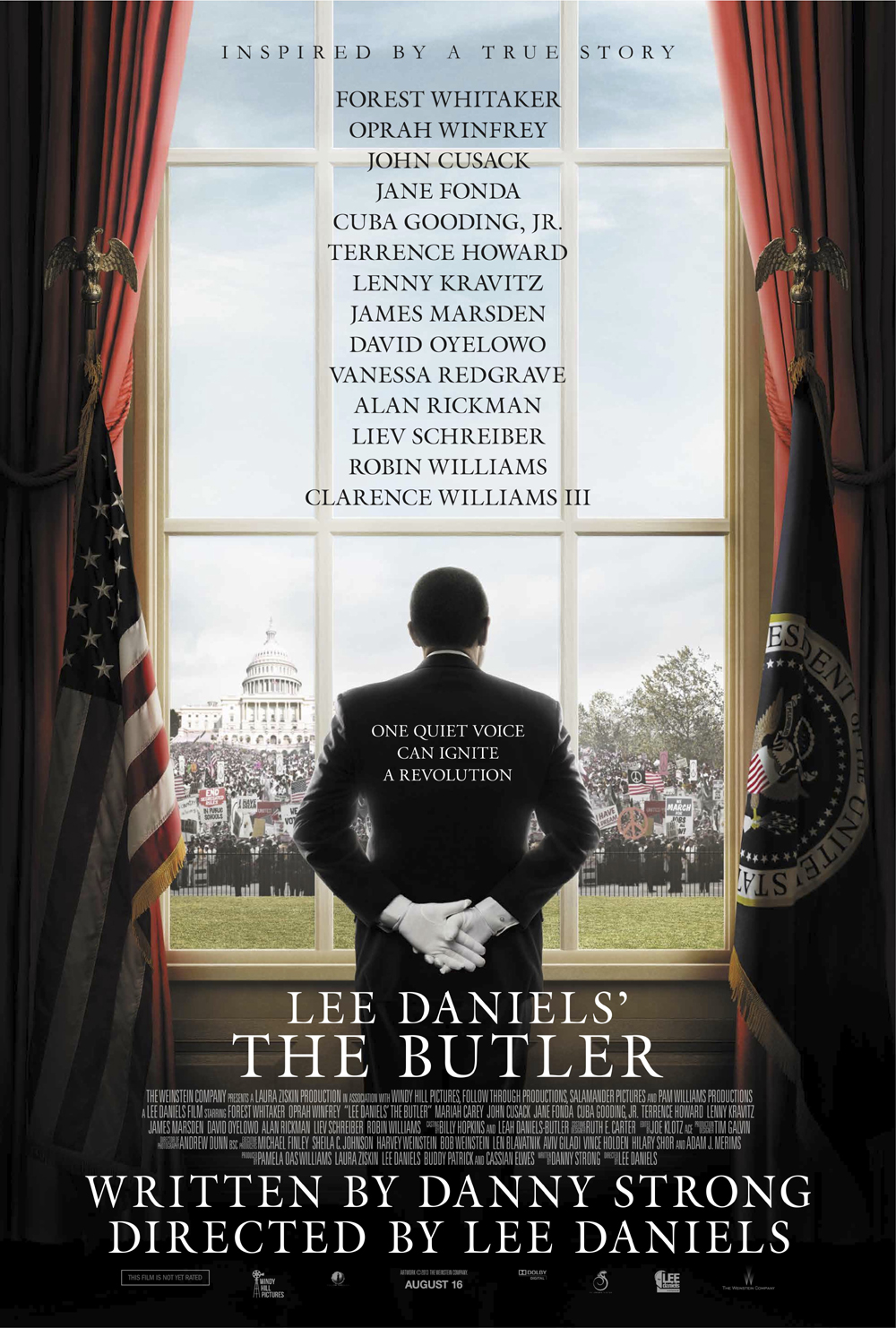 Before I begin my review, I feel the need to come to the defense of Oscar-nominated director Lee Daniels (Precious). Despite what Internet message boards and detractors may have you believe, it was never the man’s intention to insert his name into the title of his latest film, Lee Daniels’ The Butler. Warner Brothers claimed copyright ownership over the title of The Butler. The MPAA mediates title discrepancies in cases where one movie could clearly be confused for another. However, Warner Brothers’ claims a 1915 silent short film in their vault by the same name. Is anyone in the year 2013 really going to pay a ticket for the Butler and reasonably expect a silent short that’s almost 100 years old? Rather than pay a financial settlement, The Weinstein Company decided to alter the original title, adding the director’s name. This isn’t The Butler. Now it’s Lee Daniels’ The Butler. So before I get into the thick of my review, I’d like to absolve Daniels of Tyler Perry-levels of hubris. You’ll excuse me for just referring to it as The Butler throughout the duration of this review, not to be confused with a 1915 short film.
From Harry Truman to Ronald Reagan, one man served them all and his name is Cecil Gaines (Forrest Whitaker). He was a White House butler for over 30 years, even attending a state dinner at the behest of Nancy Reagan. Cecil grew up on a Georgia cotton plantation and moved up the ranks in high-class service. His wife, Gloria (Oprah Winfrey), wishes her husband would worry more about his own home than the White House. Cecil’s two sons, Louis (David Oyelowo) and Charlie (Elijah Kelley), have very different views of their father. Louis feels like dear old dad is too close to the men of power, and Louis is going to do what he can on the frontlines of change.
 I’m sure everyone had good intentions with this movie, but I walked away with the overwhelming impression that The Butler was too heavy-handed, too corny, and too mishandled with its plot construction for it to be the effective drama all desired. I also know that my opinion is of a minority, but that has never bothered me as a critic. Let’s start with the biggest handicap the film has going, and that’s the fact that its central character, the titular butler, is too opaque for a biopic. Early on, Cecil rises through the ranks of black service workers because of his skill, and that skill is none other than “having a room feel empty with [him] inside it.” I’m not downplaying the man’s dedication, or the culture he grew up in that preferred their black workers to be silent, but here is a movie where the man’s claim to fame is that he served eight presidents but he was in the background for all that history. I wasn’t expecting Cecil to lean over and go, “Mr. President, that Voting Rights Act might be a good idea, and I’ll help ya with it.” He is just sort of there. I was expecting him to have some larger significance, especially in his own life, but here’s the kicker: by the end of the movie, you’re left with the impression that all of his years of service were for naught. Cecil comes to the realization that his son, who he has sparred with for decades, was right and he was wrong. Is this the intended point? My colleague Ben Bailey will argue this is Daniels’ subversive intent, to undermine the tenets of typical biopics, to fashion an anti-biopic. I am not as convinced.
The problem is that Cecil is a passive character, which makes him the least interesting character in his own story. He served eight presidents, yes, but what else can you say about him as presented? What greater insights into life, himself, or politics does he have during those years with seven different presidential administrations? I cannot tell. I was thoroughly astounded that Cecil, as a character, was boring. I suspect this is why screenwriter Danny Strong (Recount, Game Change) chose to split Cecil’s story with his son, Louis. Here is a character on the front lines of the Civil Rights movement, getting chased by mobs, beaten, sprayed with firehouses. Here is an active character that wants to make a difference. He also happens to be mostly fictional.
While the film opens with the phrase “inspired by a true story” you should be wary. Upon further inspection, very little is as it happened. I think all true stories, when adapted to the confines of a two-hour film narrative, are going to have to be modified, and pure fidelity to the truth should not get in the way of telling a good story, within reason. I don’t have an issue with Louis being fictional, but it points to the larger problem with the biopic of such an opaque man. The real-life Cecil, Eugene Allen, had one son who went to Vietnam and married a former Black Panther. Strong splits the difference, supplying two sons with different paths. Because of his invention, this means Louis has the benefit of being present at a plethora of famous Civil Rights events, like the Woolworth counter sit-in, the Freedom Rider bus burning, and the assassination of both Malcolm X and Martin Luther King Jr. Seriously, he’s in the same motel room with MLK in Memphis. With the exception of the Woolworth sit-in, the Civil Rights events feel like minor pit stops, barely spending any time to develop. It ends up feeling like a facile Forrest Gump-like trip through the greatest hits of the Civil Rights movement.
This narrative expediency also translates to the supporting characters in The Butler. Beyond Cecil, Louis, and Gloria, there aren’t any characters that last more than one or two scenes. Cecil’s White House co-workers, played by Cuba Gooding Jr. (Red Tails) and Lenny Kravitz (The Hunger Games), provide amiable comic relief but little else to the narrative. Terrence Howard (Dead Man Down) has an affair with Gloria and then is never seen again. That affair, by the way, is also never referenced again nor does it have any further ramifications with the relationship between Cecil and Gloria. So then what was the point? There is a litany of famous faces playing real people, but they’re all in and out before you know it. The actors portraying the presidents are more an entertaining diversion than anything of real substance. Alan Rickman (Harry Potter) as Reagan gets the closest in the physical resemblance game, though I strongly doubt Reagan, as presented in the film, sat down and openly admitted he was wrong to his African-American service workers. John Cusack (The Raven) as Nixon is a hoot. The movie speeds right through the Ford and Carter administrations, so I’ll play my own game of casting (Ford: Dan Akroyd; Carter: Billy Bob Thornton). The presidents, like the clear majority of supporting players, don’t stick around long enough to leave an impression. It’s as if our prior knowledge of these famous faces is meant to serve as characterization. Beyond the immediate Gaines family, you don’t feel like you’re getting to know anyone.
 Then you bring in Daniels as director and the man has not shown much of a penchant for, let’s call, subtlety. This is, after all, the same man who directed Nicole Kidman in the ways of urinating upon Zac Efron. A coherent tone has often been elusive in Daniels’ films, which veer into wild, loud, sometimes clashing melodrama. The most clashing thing in The Butler are the matching 1970s and 80s fashion that will burn your eyes. He tones down his wilder sensibilities but The Butler is an especially earnest movie; but overly earnest without earned drama usually begets a corny movie, and that’s what much of The Butler unfortunately feels like. The significance of the Civil Rights movement and the bravery of the ordinary men and women, and children, fighting for equality cannot be overstated. These were serious heroes combating serious hate. I expect a serious movie, yes, but one that isn’t so transparent about its Staid Seriousness. The Butler is very respectful to history (fictional additions aside) but too often relies on the historical context to do the heavy lifting. It also hurts when the film is so predictable. At one point, I thought to myself, “I bet Cecil’s other son gets shipped to Vietnam and probably dies.” Mere seconds after this thought, young Charlie Gaines says he’s going to Vietnam. I’ll leave it to you to discover his eventual fate.
Daniels’ true power as a director is his skill with actors. The man nurtured Mo’Nique into an Academy Award-winning actress. From top to bottom, no actor in this film delivers a bad performance, which is a real accomplishment considering its stable of speaking roles. Whitaker (Repo Men) is the anchor of the movie and he puts his all into a character that gives him little to work with. He brings a quiet strength and dignity to Cecil, able to draw you in even as he’s presented so passively and ultimately perhaps in the wrong. Winfrey hasn’t been acting onscreen since 1998’s Beloved. Gloria is an underwritten part but she does the most with it and I’d like to see more of Oprah the actress more often. Another highlight is Oyelowo (Jack Reacher) as the defiant son fighting for what he believes is right. I want to also single out former America’s Next Top Model contestant Yaya Alafia as Louis’ girlfriend and eventual Black Power participant, Carol. She’s got real potential as an actress and if she gets the right role she could breakout and surprise people.
Lee Daniels’ The Butler (just one last time for feeling) is an earnest, emotional, but ultimately unsatisfying picture and it’s mostly because of its title figure. The figure of Cecil Gaines is not the kind of man that the entire perspective of the Civil Rights movement can be hung onto as an allegory. He’s treated as background of his own story. If the filmmakers wanted to highlight the life of a man who grew up on a cotton plantation, worked in the White House, and who lived long enough to see an African-American be president, well then tell me that story. But they don’t. I think Daniels and Strong knew the limitations of their central figure, which is why the son’s role was invented to provide a more active perspective outside the hallowed walls of 1600 Pennsylvania Avenue. In the end, I really don’t know what the message is, because the one I’m left with is that Cecil Gaines realizes late in life how wrong he was, not just with his son, but his faith in the office of the presidency. I doubt the majority of filmgoers are going to walk away with this message. While well acted and with a sharp eye for period details, The Butler is earnest without having earned your emotions.
Nate’s Grade: C
Share this:

The Conjuring (2013)
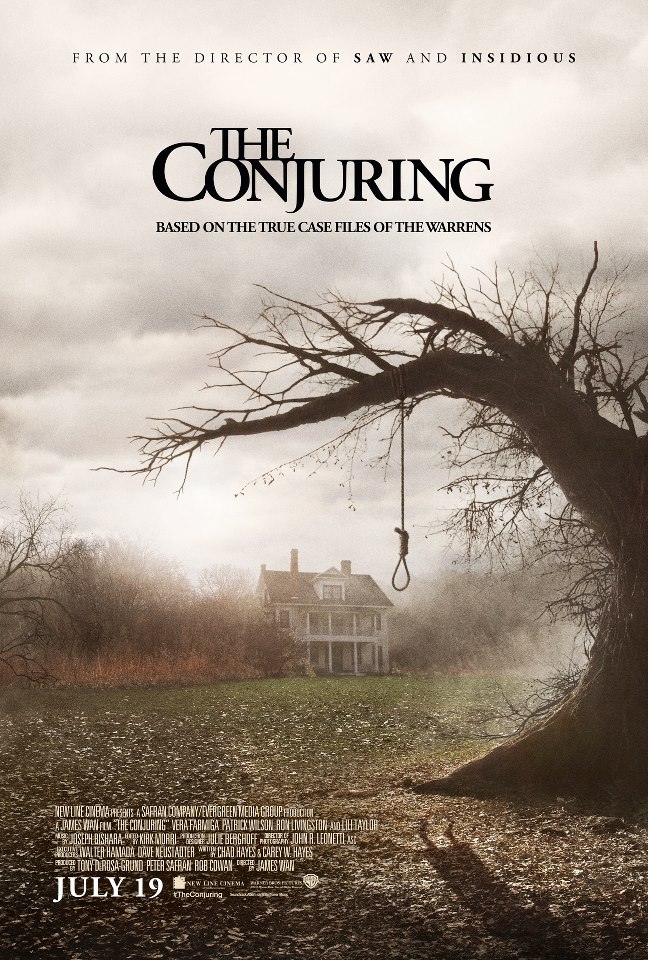 Does it seem like it’s getting harder and harder to scare people? Perhaps audiences have grown jaded by a real world kept at a fever pitch of post-9/11 anxiety and economic uncertainty. It seems that one solution is to just up the gore/gross factor, or overdose on grisly nihilism, but there has to be a law of diminishing returns to pointless shock value. The core elements of a good scary movie will usually be the same: make us care about the people onscreen and make us dread what happens next. What The Conjuring does so well, almost effortlessly, is what all provocative horror movies should accomplish, and that’s the formation of a truly effective spooky atmosphere. There may not even be any gore whatsoever in this film and very minimal jump scares, two overused tools in modern horror filmmaking. This is old school horror played to spine-tingling satisfaction.
Ed and Lorraine Warren (Patrick Wilson and Vera Farmiga) are the top paranormal investigators in the nation. In 1971, they’re asked to determine what is tormenting the Perron family in rural Rhode Island. Carolyn (Lily Taylor) and Roger Perron (Ron Livingston) and their five daughters cannot rest as a vengeful spirit is wrecking havoc with their lives. The spirit wants a body count and won’t go away before it has blood.
 Director James Wan (Saw) and his team take their time to build a direct sense of unease, a chilling mood that leaves you dreading what may happen next. The success of a horror film isn’t necessarily the fear of what you see but more so what you fail to see. The buildup, in essence, is more pivotal than the boo part. Credit also needs to go to twin screenwriters Chad and Carey Hayes (Whiteout, House of Wax) who show off their skill at setting up scares and delivering (I credit their work on Baywatch Nights because, well, someone has to remember that spin-off). The child game of Hide and Clap, where one person wanders blindfolded trying to find their compatriots, requesting three claps to locate them, is just a flat-out terrific idea to parlay into a horror movie. There’s the staple of dramatic irony, realizing what the onscreen character does not, and the increasingly suspenseful dredge into unknown danger. Another example is a wind-up toy that, when its jingle is complete, should reveal something ghostly in its mirror. This is a great device that delivers tension in budding anticipation. Then there’s one daughter’s habit of sleepwalking, which again leads to some effective unease. The Hayes find smart ways to introduce elements to their ghost story and then integrate them again and again in satisfying and spooky ways. Plus there’s all those groping in the dark moments and a super effective sound design. The film does an excellent job of developing old school scares, taking its time to get under your skin.
It also helps when you actually care about the character being tormented. The Conjuring does a good job of making its characters relatable given the outlandish circumstances. At no point does any character really violate the Law of Stupidity, where our allegiance reverses. They even present plausible reasons why the family can’t simply move out of its haunted abode (financially under water, no one to buy the estate, the ghost will just follow them). The Perron clan is a loving family that feels real. The Warrens themselves are given their own vulnerability, which is important since they are the experts. Having a know-it-all character without a weakness doesn’t make for an interesting battle against the paranormal. Lorraine can sense things, yes, but she also loses part of herself every time, thus endangering herself with every new case, making herself more susceptible to the forces she feels she’s been chosen to defend others from. When Lorraine accidentally leaves behind a family locket, with a picture of her daughter, it brings an escalated threat level that hits home for the Warrens. The acting form top to bottom is also exceptional. They don’t oversell the scares. You feel their fear in a palpable way.
Another aspect of a haunting story is the mystery surrounding the angry spirit. If it’s a compelling investigation, you’re intrigued by every new clue or revelation and enjoy how the pieces come together. While there isn’t a complex backstory to the haunting of the Perron home, The Conjuring has enough creepy historical details to add to the overall atmosphere. I enjoyed that the evil spirit cursed anyone who lived on her property, eventually divided up into different owners. I liked that the spirit had a mother-child fixation, turning mothers against their children. And I liked that these peripheral ghosts, many of whom killed themselves in ghastly fashions, also pop up to terrorize the Perrons. It adds further depth to the world of the film while upping the spooky factor.
 I need to single out one section of the plot that was eerie but also a bit confounding. The opening case doesn’t have anything to do with the Perron family but it does set a nice mood. It’s about a cracked, fraying, and altogether creepy porcelain doll that appears to be possessed and leaving notes for its roommates (“Miss me?”). We later see this creepy doll again because the Warrens have an entire garage filled with creepy artifacts from previous investigations. They argue destroying the possessed items because it would unleash all those demonic forces, so instead the garage serves as a sort of prison (a priest comes by every so often to re-bless the premises, which sounds like a nice side gig for the Vatican). I’ll accept the Warrens reasoning that locking away these dangerous items, each with its own troubling story, is safer for mankind. It’s also just a great set that begs for further analysis to pick apart every artifact. What I do not understand at all is that it looks like the Warrens have no protective lock with this door. Their young daughter stumbles in at one point. I don’t want to give anybody parenting tips, but if you have a room stocked with demonically possessed items that can escape, perhaps, I don’t know, you get a padlock for that door to safeguard against unwanted intrusions.
While entertaining to the end, the third act doesn’t have the same effect because it transitions wholly from a haunted house story into an overt exorcism film. For my tastes, it’s less interesting and exorcism films have always come across as fairly lazy for me. Once you bring a demonic possession and a set of familiar rules, it sort of goes on autopilot and rarely strays from the same template as the most famous of exorcism movies (Naturally I’m talking about Repossessed). For fans of that horror subgenre, they’ll be tickled, but I found it a lesser way to steer the movie to its conclusion. I realize that we’re dealing with the parameters of a personal account (I’m hesitant to say “true story” when it comes to paranormal events, but that’s my own bias), so I understand that this is the direction the story must conclude. I just thought it was a slight downgrade.
If you’re looking for a scary movie this summer, then The Conjuring will do the trick. It’s an old school horror movie that’s more concerned with properly established atmosphere, a mood of dread, and paying off well-developed plot elements that pack a punch. The best compliment I can give Wan, the Hayes, and everyone else involved is that I was squirming throughout much of the movie, uneasily shifting and dreading what was next. There’s a maturity to the film and Wan’s direction, as if he’s patterned his style after the films of the 1970s themselves. After Insidious, Wan definitely knows a thing or two about keeping an audience afraid. There are several moments of unsettling imagery that should find a way to creep out just about everyone. Just remember: don’t invite dolls to live with you, do investigate those strange bruises, and always lock up your demonic possessions, people. In short, The Conjuring doesn’t reinvent the wheel when it comes to ghost stories but it doesn’t have to, because this movie is scary good.
Nate’s Grade: B+


 nathanzoebl
You must be logged in to post a comment.