Blog Archives
Cats (2019)
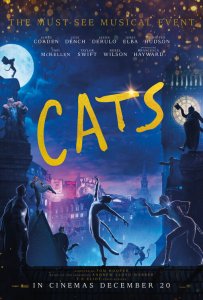 Cats, beyond all reason, is a musical sensation. Andrew Lloyd Webber based the show on the poems of T.S. Eliot. The original production played on Broadway for eighteen years from 1982 to 2000 and I don’t know a single person that likes it. It was only a matter of time before these jellicle cats were headed for the big screen in a big-budget folly. The first look the public got of a Cats movie musical trailer was met with revulsion and horror. I was anticipating the worst and yet I still wasn’t fully prepared for the jellicle disaster strutting around with undue confidence.
Director Tom Hooper (Les Miserables, The Danish Girl) made the colossal misfire to film his action in motion capture bodysuits and provide CGI hair and cat features to them later. This choice dooms whatever meager chance a big screen Cats might have had. There’s a reason the Internet erupted in collective horror when the first trailer was released, and Hooper and his producers tried assuring the public that those were early renditions of the technology and it would be improved upon its holiday release. Dear reader, I am here to tell you that the horror of that first trailer is alive and well in every unnatural moment of this nightmare. The uncanny valley has been a busy transit stop this year with the unsettling live-action (?) Lion King and now Cats serves as a dire warning about the perils of modern technology. Just because you can try and give human beings CGI fur and ears and tails doesn’t mean you should. The look is never fully transporting and often it appears like human features have been slapped onto a furry background composite, like a snowman’s facial features while it might be melting. Then there’s the additional levels of scary anthropomorphism, with mice and marching cockroaches. Why not just use prosthetics and makeup like every stage production? I think the Cats producers wanted to do something to distinguish it and in doing so they unleashed one of apocalyptic seals.
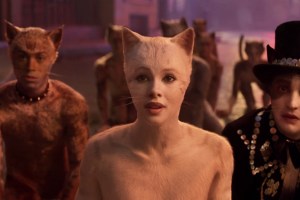 Whatever film version of Cats was destined to be disappointing because the source material is so lackluster. The Broadway musical was so popular for so long, I assume, primarily from its creative use of costumes, makeup, and staging to bring to life a fanciful world of felines. The CGI decision takes away whatever admirable craftsmanship and charm the stage show might have conveyed and replaced with nightmare fuel for the eyes. Absent the initial appeal, we’re left with a truly underwhelming story populated with underwritten characters that only really exist when they’re singing and otherwise just operate in background space. It’s a show that feels powerfully redundant with a plot structure that amounts to cats being tapped to deliver an explanatory song about themselves and then to move onto the next. It’s very much, “I’m a cat. Here’s my cat song,” followed by, “I’m a different cat. Here’s my different cat song.” Without further plot advancement, it feels like the silliest job interview with the worst candidates seeking the position of Cat Who Gets the Honor of Being Reborn in the Sky. By the end of the movie, I was convinced that I was watching an even scarier version of Midsommar and that this cat gang was really a religious cult that was selecting a ritual sacrifice to their blood-thirsty Egyptian Gods.
It’s a storytelling experience that never connects because this is designed entirely for children. Much of the show feels like a children’s television series that was hijacked by a sexual deviant. The film is replete with simplistic moral messages that you would find in children’s television, things like “Believe in yourself,” and, “Invite others into your play,” and, “Wait your turn,” and, “Treat others with respect,” and other easily digestible platitudes. This isn’t a complicated show and children would not be tasked with remembering the many characters and their stupid names because most of them are meaningless to the larger story. There is nothing complex about this story, which was compensated by the production values of the original stage show. The large stages the actors frolic around are fun to watch because they’re built to scale, meaning the tables are gigantic to present the world from a cat’s perspective. However, the proportions vary wildly and at whim. The cats will seem much larger than their world and much smaller; dining cutlery will appear far larger than a cat’s whole body, or they’ll strut on a railway and look like they’re three inches tall. Couple that with inconsistent world building and ill-defined magic powers (teleportation works except when it doesn’t) and it becomes very hard to hold onto anything as a baseline. The attempts at whimsy through the exaggerated scale become another point of confusion and unease as this world continually feels like a simulation that doesn’t quite add up.
 I really want to examine just how ridiculous so many of these character names are. Apparently, a cat chooses their name (sorry, pet owners, but you’ve been giving them slave names?) and they’re selecting some pretty insane identities. Without further ado, we have Bombalurina, Bustopher Jones, Grizabela, Macavity, Jennyanydots, Rum Tum Tugger, Rumpleteazer, Mungojerrie, Mr. Mistoffelees, Munustrap, Griddlebone, Tantomile, Jellylorum, Growltiger, and without a doubt, my favorite, Skimbleshanks. You could play a game guessing whether the names were cat names, pirate names, or something an elderly human said during a stroke.
The songs are also another source of disappointment. There’s the lone exception of “Memory” and Jennifer Hudson kills it with the kind of emotion the rest of the movie was missing, but everything else feels like it’s droning on and absent a strong sense of melody. The synth score also feels very dated and hard on the ears. The only saving grace for a movie that puts this concerted emphasis on the performances would be the song and dance numbers, and the dance choreography is bland and undercut by the editing, and the songs are forgettable. The Skimbleshanks number is a slight variation because of the force of personality from the character, being introduced like a fancy feline member of the Village People, suspenders and literal handlebar mustache and all. He also has an impressive tap number that leads into the exciting world of… sleeping cars on a train. It’s hard for me to impart any emotional impact from the songs because they’re so plainly expository, explaining a different cat’s life from being mischievous to being fat and lazy. These are not interesting characters in the slightest (sorry, Skimbleshanks) and their songs are like boring third grade essays about their home lives.
 Nobody walks away completely clean from this movie but the actors with singing experience come closest. James Corden (Into the Woods) is a real highlight from his comic asides that feel like he’s puncturing the bizarre self-serious nature of this silly movie. Jason Derulo has a slick amount of charm to be a commitment-challenged alley cat. Hudson (All Rise) is a strong singer and made me think of her character from Dreamgirls being a cat and singing her big number. The lead heroine, Francesca Hayward, has a genuine grace to her presence and a nice face to stand out amid a world of scary human-looking cat deformities. I wish she had more moments to showcase her balletic talents. The older actors fare the worst, unfortunately. Judi Dench (Murder on the Orient Express) looks pained and sounds it too. Her fourth-wall breaking song that concludes the film, instructing the audience on how to address and treat their kitties, is inherently awkward. Elba (Hobbes & Shaw) provides a palpable sense of menace to his devil figure, until he appears without clothes and I audible gasped and groaned. In one instant, any sense of menace vanished as I watched a naked black cat version of Idris Elba dance a jolly jig. I know these actors signed up for this but that didn’t stop me from feeling a resigned sense of embarrassment for them.
And now is the time to talk about the unspoken audience for a live-action Cats, and that’s the contingent of furries or soon-to-be discovered furries. I was wondering before if the filmmakers would be cognizant of the unorthodox appeal of their film production to a certain select group of audience members, and I am here to say they are completely aware and play into this. There’s a musical number where Taylor Swift sprays catnip (a.k.a. magic horny dust) that drives the cats crazy and they writhe and purr with wild abandon, striking evocative poses with legs raised. There may not be any visible genitals but that doesn’t stop Rebel Wilson’s character from a joke about neutering. In news reports, Derula has been upset by his phantom phallus in the movie, which is slightly hilarious considering he signed up for this, but it’s also indicative of the weirdly sexual vibes the movie is playing around with but at an infantile level of wonder. There is going to be a generation of moviegoers who watch Cats and discover that they are turned on by sexy human versions of animals slinking around, lifting their legs, and rubbing their fuzzy little butts.
 I was waiting for Cats to end long before it did because so much felt so pointless. The false whimsy was covering ineffective and repetitive storytelling, malnourished and unimportant characters, confusing world building and powers, middling songs (with one sterling exception), and direction that seems to make the whole enterprise feel like a children’s cartoon. It’s too simple to be intellectually stimulating, too weird and confounding to be whimsical, too sporadic and repetitive to be emotionally involving, and vacillating between complete seriousness and wanton silliness. I’m not even a hater of Hooper when it comes to his idiosyncratic direction of big Broadway musicals. I enjoyed his rendition of Les Miserables and thought several of the artistic choices made the movie better, especially the live singing. With Cats, I don’t think there was a possibility of this ever being a good movie as long as it was a faithful adaptation of a not great stage show. However, there were decisions that made this movie much much worse, namely the scary marriage of technology and flesh. If somehow you were a fan of Cats, or somehow consider yourself one as an adult, or a furry, you might find some degree of enchantment. For everyone else, Cats is a cat-astrophe. Sorry.
Nate’s Grade: D
Here are some pun-laden blurbs offered by a colleague, Steven Gammeter, in preparation for writing this review:
1) “You’ll need to change the litter box after this movie.”
2) “Follow Bob Barker’s lead and spay and neuter these Cats.”
3) “It feels like you’re living all nine of your lives while sitting through this movie.”
4) “There’s more than one way to skin a cat.”
Share this:

The Danish Girl (2015)
 While you watch The Danish Girl, you can feel the full weight of everybody’s good intentions. The filmmakers and cast all seem to realize that they are telling a story that will humanize and help others better understand trans issues. It’s the first sexual reassignment surgery and a community that is still fighting for wider acceptance. Nobody wants to screw up this story and do a disservice to representing the stories of the trans community. You feel the earnest good intentions with every frame, and yet I would argue those same good intentions end up paralyzing the movie and its impact.
Lili Erbe (Eddie Redmayne) is living her life as Einar Wegener, a Danish landscape painter of some renown in the 1920s. His wife, Gerda (Alicia Vikander), is a portrait artist trying to be more than the wife of a famous painter. One day, Gerda’s model is absent and she asks Einar to step in. He puts on stockings, holds a gown to his body, and it’s a revelation. Soon after Einar is wearing women’s garments under his clothes and Gerda dresses him up with makeup and a wig. It’s a fun diversion and something of a turn-on for Gerda, and then her husband informs her that Lili isn’t the costume, Einar is. Lili tries to find a sense of explanation with disdainful psychiatrists and doctors but is deemed aberrant. Lili is struggling with this crisis of identity and self-acceptance, and then a new beginning emerges with a helpful doctor who can physically transform Lili from a man into a woman. The surgery is not without risk but Lili is willing to do whatever it takes to feel whole (note: since Lili is the chosen gender identity for the film’s subject, I shall be referring to her as Lili and using feminine pronouns).
 Redmayne (The Theory of Everything) gives a suitably affecting performance that is full of empathy and a halting sense of fragility. He seems like he’s about to crumble at any moment, his nervous smile and pleading and confused eyes communicating Lili’s trepidation and flights of exciting discovery. Redmayne’s delicate androgynous features and long-limbed dancer’s body play to his strengths, as he adjusts his physicality to reflect his mind’s experimentation of what it would be like to be a woman. There’s a rather lovely visual where Lili visits a peep show in Paris. After a few minutes of bashful eye contact, she begins to mimic the peep show model’s physical poses, and the camera’s focus melts between the two. It feels like a dance between the two and in this simple visual much is communicated. Unfortunately, the majority of the movie lacks the impact of this poignant visual. Redmayne too often retreats into his stable of nervous gesticulations and halted speech. It’s a performance that feels too detached and too opaque to make you feel the full turmoil of Lili. There’s an interesting moment when, dressed as Lili, a smitten man kisses her without permission. Lili is upset at the lack of consideration, to which the man replies, “I couldn’t chance you saying no.” That little moment highlights the challenges of women in a society that doesn’t respect their agency. It’s too bad the movie doesn’t present more scenes that explore this new dynamic that Lili will have to adjust to. Instead the move repeatedly falls back on her as Brave and Strong. As presented, Lili is more catalyst than a fleshed-out character, which is remarkable considering the movie is reportedly about her struggles. Rather, the real focus of the story seems to be Gerda, who, incidentally, is the only person on screen referred to as “the Danish girl.”
Gerda is given equal attention in the screen adaptation by Lucinda Coxon (The Crimson Petal and the White), which is generous and will likely leave several viewers confused. First, Gerda is given the most complete character arc and a surprising amount of consideration for her perspective. I suppose she could be the audience’s entry point into this story, the relatable position for many audience members trying to better understand a loved one saying they were born in the wrong body. The movie presents greater empathy for Gerda’s plight than it does Lili, which is definitely unexpected and perhaps misplaced. Surely finding the courage to embrace a controversial identity that precious few will even acknowledge, let alone the bastions of contemporary medical science declaring such thinking to be signs of a degenerative brain, is a bit more of a risk than being a supportive spouse. I don’t want to mitigate Gerda’s own personal struggles dealing with the outward transformation of Einar into Lili. It’s a position that deserves deep empathy and the movie has it in spades, as we watch Gerda try to be supportive while the person she fell in love with erases himself. Vikander (Ex Machina) also kills it. Her performance is full of the breadth of emotions that I found wanting in her screen partner. Vikander’s face registers all the complicated emotions; she’s in a sense saying goodbye to her husband and a specific life they shared, and while for her it can feel like mourning, for Lili it is a rebirth. Viankder’s compassionate and nuanced performance as Gerda is the exclamation on one hell of a year for the Swedish actress.
Director Tom Hooper (Les Miserables, The King’s Speech) gives everything the proper stately appearance with his signature visual indulgences (the man loves his asymmetrical one-shots and generous head room in the camera frame). There are several landscapes or venues that look gorgeous or given a dream-like sense just from Hooper’s framing. His handling of his actors is first-rate, and there’s a comfortable sensuality to scenes between Einar and Gerda, further communicating just how enraptured each is with the other. The musical score by Alexandre Desplat (The Grand Budapest Hotel) is a bit over excited to explain all the many emotions you should be feeling, but other than that the technical aspects of The Danish Girl are pleasing to the senses and enhance the story. I just wish the screenplay gave us so much more to think about when it comes to Lili.
 As a strange aside, I’d like to question what the MPAA is referring to with its disclaimer that The Danish Girl is R-rated for such content as “full nudity.” I understand the concept of partial nudity since you’re only seeing a fraction of the form, but what exactly makes one’s nudity full? Do they mean “complete” as in you see everything, front to back? If so, I thought that content was already covered in the oft-used term of “graphic nudity.” For you ratings aficionados out there, or people who are intrigued with arcane movie trivia like myself, I’ve discovered that “graphic” often means two things: the sight of a penis or pubic hair. If its breasts, bottoms, or female genitals absent the appearance of hair, it’s commonly categorized plainly as “nudity.” There’s likely a larger essay on why male genitals are thought of as “graphic,” and especially why seeing pubic hair on women is somehow a sight in need of more forewarning than simply “nudity,” but I’ll set that bit of cultural soul-searching aside for a later day. If you must know, there’s a brief shot of Redmayne tucking his genitals behind his legs and creating the image of a woman. I double-checked and the MPAA hasn’t revised the rating rationale for 1991’s Silence of the Lambs (also a prominent film tuck display), but I’ll let you know, dear reader, if any more information comes across my news desk on this very weird subject.
Tasteful to a fault, The Danish Girl is a reserved biopic that goes about its story with a sincere and earnest sense of responsibility. It wants to tell its story correctly instead of telling its story in the best-developed and executed fashion, and there is a difference. The performances are strong, though Viankder is the standout as the film’s surprising focus. Redmayne feels too timid and fragile to make Lili’s story resonate beyond common human compassion. The screenplay doesn’t place us insider her mind. Instead, we’re treated more to how Lili’s choices are impacting her supportive but anguished wife. In 1930, a mere four months after the fourth and final surgery, Lili died from complications related to the operation, lending a greater sense of tragedy (this fact is left out of the concluding text). It’s a movie that feels too distant even from itself. Everything is so reserved, so tasteful, so artfully opaque, so afraid of making the wrong step that The Danish Girl ends up being an Oscar-bait biopic that feels too hesitant and bloodless.
Nate’s Grade: B-
Share this:

Les Miserables (2012)/ Rock of Ages (2012)
 I have no qualms with my heterosexual nature to make the following statement: I love a good musical. Why shouldn’t I? None other than Martin Scorsese said any true film lover is a fan of horror movies and musicals, two genres uniquely suited to the visual flourishes of cinema. My tastes tend to run toward the more offbeat, like Avenue Q and Hedwig and the Angry Inch and Sweeney Todd and Dancer in the Dark. My favorite movie musical of all time is 1952’s Singin’ in the Rain, but that’s probably because I’m a movie lover first and foremost. A well-done movie musical can sweep you off your feet. The polarizing Moulin Rouge! is still my favorite film of 2001; I love every messy, ambitious, transporting second of it. And that’s what the best musicals and, in general, best films achieve: they transport us to another realm. Since the success of 2002’s Chicago, there’s been a run of hit-or-miss movie musicals proliferating the big screen. It’s hard to think of any longstanding Broadway hits that have yet to make the leap (you’ll get your turn, Book of Mormon). Of course it also works the other way, with plenty of movies being adapted into Broadway musicals, like Shrek, Elf, Ghost, Catch Me if You Can, Newsies, A Christmas Story, Sister Act, Legally Blonde, Bring it On, and Tony-winner for Best Musical, Once. Then you get movies turned into musicals and back into movie musicals, like The Producers and Hairspray. It seems like Broadway and Hollywood are stuck in a loop, feeding off one another’s spoils.
In 2012, two high-profile musicals got the big screen treatment: Rock of Ages and Les Miserables. The former is from 2009 whereas the latter is one of the most successful Broadway shows of all time, beginning in 1980 and spanning continents. Rock of Ages was savaged by critics and bombed at the box-office, whereas Les Miz is soaring this holiday season and is seen as a major Oscar contender. Of course one of these films is about the outrage of the lower classes being exploited by an unfair system that benefits the rich, and the other has Tom Cruise and a monkey named “Hey Man.” Having seen both films recently, and Les Miserables more than once, I think they present an interesting discussion on the pitfalls of adapting a popular theatrical show to film. You won’t have to wait long to figure out which movie succeeds and which falters badly.
 Les Miserables, based on Victor Hugo’s novel, is set in early 19th century France. Prisoner Jean Valjean (Hugh Jackman) is nearing the end of his twenty-year sentence for stealing a loaf of bread. Inspector Javert (Russell Crowe) is convinced Valjean will never reform and go back to a life of crime. After help from a kindly bishop, Valjean flees his parole and sets up a new life as a businessman. Fantine (Anne Hathaway), one of Valjean’s workers, gets thrown out and tumbles down a chain of regrettable circumstances. She becomes a prostitute to support her young daughter, Cosette. Valjean recognizes poor Fantine on the street and, horrified at his own neglect leading her to this path, takes it upon himself to care for her and her daughter. Years later, the teenaged Cosette (Amanda Seyfried) has fallen for the young revolutionary Marius (Eddie Redmayne). Marius enlists his good friend Eponine (Samantha Barks) to help find out who Cosette is, all the while ignorant that Eponine is clearly in love with him. The young people of France are riled up about class abuses and exploitation, and the spirit of revolution is in the air. Javert is also becoming suspicious of Valjean’s true identity, so Valjean feels the need to flee once again. However, Cosette’s love and the bravery of the young revolutionaries makes Valjean decide to stop running from his past.
Oscar-winning director Tom Hooper (The King’s Speech) made the ballsy but ultimately brilliant decision to have his performers sing live. Every line, every note, every performance is captured in the moment; there is nary a second of lip-synching. I cannot overstate how blessed this decision was. It places the emphasis on the performances, and that’s exactly what something as big and deeply felt as Les Miserables required for the big screen. Look, Hollywood actors are never going to be able to outdo trained and professional theatrical singers. What I expect from movie stars is movie-star level performances, and Hooper understands this. These actors aren’t playing to the cheap seats, belting the tunes with power and over exaggerated dramatics (note: there is absolutely nothing wrong with this style given the theatrical setting). In many ways, this is a more intimate Les Miserables, and it still maintains its charms and magic. There is no choreography, short of perhaps the more jovial “Master of the House” number, and Hooper puts us right in the muck of life in a 19th century impoverished slum. This is one dirty movie with lots of grimy period details, creating a reality that can only be implied on stage. The more visceral version of Les Miserables demands performances that are more naturalistic and less bombastic, to a degree. I am a cinephile first but I genuinely prefer my musicals with trained actors to trained singers. A great actor can add so much inflection and personality through the prism of song, whereas a great singer is concentrating on the notes first and foremost. I value performance over nailing the mechanics, and more movie musicals should follow Hooper’s path. This, ladies and gentlemen, is how to do the movie musical experience right.
 I don’t know if Hooper was exactly the right man for the job but he certainly does the beloved stage show justice. Hooper’s visual tics are still present. The man loves to film in close-ups and at all sorts of tilted Dutch angles; he also loves filming a conversation between two people where neither one will be in the same shot. It’s a peculiarity that I never really warmed up to. However, Hooper generally has the best interests of his movie at stake, capitalizing on the large outpouring of feeling. This is a Big Musical with big emotions, and it’s easy to be swept up in its exuberant earnestness and humanism. It even has a famous concluding line, “To love another person is to see the face of God.” It’s the kind of stuff you roll your eyes at under lesser circumstances. Now, thinking back, you’ll realize that many of these people were simply painfully naïve and that there was a slew of death for no good reason. Purists may chafe at some altered lyrics and truncated songs, but really this is pretty much the closest version of the famous stage show you’ll ever see adapted. Not one of the songs has been cut (in fact a new one was written for the film by the original composers), and at a lengthy 157 minutes, it’s practically as long as the stage show, and just about sung through every moment. There are probably ten total lines that are merely spoken. I predict hardcore Les Miz fans will lap up every second.
Les Miserables also boasts some fortuitous casting (Taylor Swift at one point was rumored to be up for a role… shudder), none more than Anne Hathaway (The Dark Knight Rises). She is nothing less than perfect as Fantine. There isn’t a false note during any of her acting. Her performance of “I Dreamed a Dream” is so powerful, so breathtaking, so intensely felt, that it ranks up there with some of the best moments in all of 2012 movies. And oh can this woman sing her ass off too. You feel every flicker of anger and devastation, the grain in her voice, on the verge of tears and fury. This woman deserves every accolade they can come up with this year. This woman is a total lock for Best Supporting Actress. She’s wonderful during every moment of her screen time and the lengths and emotional ferocity of her performance, and subsequent pitfalls the character endures, left me reaching for the tissues at several points.
The other standout amidst a pretty stellar cast is Barks. This is her first film work though she has plenty of experience with her character, portraying Eponine in the 25th anniversary run of Les Miserables. Her singing is terrific, as you’d imagine, but her acting is just as strong. Her rendition of “On My Own” is a showstopper of a number. Barks naturally transitions to the demands of film. I was completely on Team Eponine and found her to be an infinitely better catch than Cosette. After people get a glimpse of this woman, she is going to get plenty more acting offers, and a few concerned inquiries into the size of her waist, which at times looks like it might be the size of The Rock’s neck. Hooper also has the good sense to film both “I Dreamed a Dream” and “On My Own” in unbroken takes; focus tightly pinned on our outstanding actresses, letting the skill of their performances sell the big emotions.
 Of course the crux of the tale rests on two men, Valjean and Javert, and the rest of the cast does kind of get saddled in underdeveloped roles made more apparent as a movie. It seems blasphemous to say I was a little disappointed with both lead actors. Crowe (Robin Hood) is easily the weakest singer of the cast but that doesn’t mean he’s bad. He has a lower register and sings his parts like a rock musician rather than a Broadway player. Fans of the stage show will have to adjust their expectations for a more subdued Javert. Still, having an actor of Crowe’s talents is definitely a plus even if his singing is adequate. Jackman (Real Steel) is a Tony-winning thespian, so I held him to a higher standard. He’s got a lot of heavy lifting to do as Jean Valjean, and Jackman does an admittedly fine job with the bigger emotional parts. I just expected more from his vocal abilities but it’s not a major detraction. As my mother noted, it’s not too difficult to spot the classically trained singers in the cast. Also, for eagle-eyed Les Miz fans, look for the original Jean Valjean, Colm Wilkinson, as the Bishop in this movie.
There is the tricky nature of translating a Broadway production into some variance of period reality. There’s plenty of relevance with the class struggle illustrated in the second half of the movie (Bane would approve). It’s an obvious statement but film is a different medium than the theater and affords different opportunities. The depressing reality of lower class life and the vultures that preyed on others is striking, yes, but sort of conflicts with the comic relief characters represented by the scheming Thenadiers (Sacha Baron Cohen, Helena Bonham Carter). When the seriousness of the period is inflated, they feel like they sort of belong in a different movie. Then there’s just the conflict between stage reality and film reality. On the stage we’ll accept Marius falling madly in love with Cosette at first sight. When it’s on film, the guy comes across as a callous chump, oblivious to Eponine’s pining. He ignores the friend he’s had for years for some blonde in a bonnet. And the final number, reuniting all the dead cast members, works better as a curtain call than a finale to a film. These are just the quirks of theater one must just accept. I wouldn’t say the songs and music is in the same category as Sondheim or Webber, but there are definitely some hummable tunes here made all the more swooning. You’ll have a fine pick of songs to get stuck in your head for days (mine: “Look Down”).
 Earlier this year, Rock of Ages came and quickly left the box-office, failing to make a splash with the American public despite a healthy enough run on Broadway and touring the country. The stage show is a jukebox musical set to the head-banging tunes of 1980s hair metal. Adam Shankman, the director behind the bouncy and thoroughly entertaining 2007 Hairspray movie musical, was tasked with bringing Rock of Ages to the screen with the same finesse. Cherie (Julianne Hough) a hopeful singer just off the bus from Oklahoma, meets up with Drew (Diego Boneta), a nice kid who gets her a job at The Bourbon Room, a rock club running afoul with the mayor (Bryan Cranston) and his moral crusading wife (Catherine Zeta-Jones). The club owners (Alec Baldwin, Russell Brand) are relying on fickle, burned-out, taciturn, and overall mysterious rock legend Stacy Jaxx (Tom Cruise) to save their club from financial ruin. Along the way, Cherie and Drew look for their big breaks, fall in love, get pulled apart, and reunite in time for one final sendoff to leave the audience tapping their toes.
 Allow me to elucidate on my main problem with the rise in jukebox musicals: I find them to be, with rare exception, exceedingly lazy. The musical number is meant to advance the narrative and give insights into character and situation, just like any other aspect of plot. You’ll find great original tunes that do this. When you’re dealing with pop songs that the public is well familiar with, then your job becomes even harder, and I find many are just not up to the task. Too often jukebox musicals are designed to merely string together a pre-packaged and time-tested number of hit songs, utilizing the faintest of narrative threads to get from one song to the next. The appeal of jukebox musicals lies not with the story or characters but waiting for the next recognizable song and wondering how it will, poorly, fit into this new context. You’ll notice that these jukebox musicals seem to have twice as many song numbers. They know their selling point, and more singing means less time spent developing characters and story. And so my impression of the jukebox musical is one of a cynical cash grab following the bare minimum of narratives to achieve the status of musical so it can be resold with low risk. I’m simplifying things in my ire, yes, but there’s a definite reason that jukebox musicals have sprouted like mad in the past few years. They don’t require as much work and the audience seems to hold them to a lesser standard. Much like the worst of Friedberg and Seltzer (Disaster Movie, Meet the Spartans), it seems just recognizing the familiar has become the core draw of entertainment.
And this is one of the main problems with Rock of Ages. I’ve never seen the stage show, but my God for something that purports to live the rock and roll lifestyle, it’s certainly so tame and scrubbed clean of anything dangerous. This feels like your grandparents’ idea of what “modern” rock music is. After a cursory search online, I’ve found that the movie makes some significant changes to convert a story about rock and roll hedonism into sanitized family friendly fare (spoilers to follow, theatergoers): apparently in the stage version, Cherie and Jaxx had sex, Jaxx remains a creep and flees the country on statutory rape charges, though before that he and Cherie share a lap dance/duet to “Rock Me Like a Hurricane,” the family values crusader characters were new inventions, the Rolling Stone reporter (Malin Akerman, the best singer in the film) is considerably beefed up to provide Jaxx his happy ending, and they don’t even use the song “Oh Cherie.” I’m not a stickler for adaptation changes, but clearly it feels like Rock of Ages had every edge carefully sanded down to reach out to the widest array of mainstream filmgoers (Shankman says he cut Cherie’s lap dance number because it tested poorly with mothers). The funny part is that the movie lambastes a slimy manager (Paul Giamatti) for playing to demo numbers, shooting for pandering mass appeal rather than the art, man. Feel the hypocrisy.
 The first hour of Rock of Ages is mildly passable mostly because of the goofy supporting cast, but then the movie just keeps going, getting more and more tedious with every protracted minute. The second half involves Cherie and Drew apart and finding new lows; for him it’s selling his soul to join in a boy band, and for her it’s selling herself, working as a stripper. Let’s look back at that sentence. One of those life choices is not nearly as upsetting as the other. Nothing against the hard-working strippers in this country, but Cherie taking to the pole is definitely more of a moral compromise for the character than whatever the hell Drew endures. It’s this leaden second hour that made me lose faith that Rock of Ages would even provide a morsel of cheesy entertainment. It has the misfortune of two of the blandest leads I’ve ever seen in a musical. Hogue (Footloose) and Boneta (Mean Girls 2) are both physically blessed specimens of human genetics, but oh are these kids boring boring boring. Their love story is completely malnourished and you couldn’t scrape together one interesting thing about them combined. The fact that Rock of Ages further strips away any interesting personality from Cherie (see above) makes them even more disastrously boring. To be stuck with these two for another hour of vapid griping, only to magically get back together, is interminable. Thank God they pumped up the side characters because that is the only time when Rock of Ages even challenges for your attention. Cruise isn’t the best singer but he’s pretty good belting out 80s rock hits, and the man has his natural charisma and stage presence to spare.
So I guess where Rock of Ages goes wrong, and where Les Miserables succeeds, is thinking of how best to translate the experience of the stage to the medium of film. Shankman does a pitiful job staging his musical numbers, with lackluster choreography that rarely takes advantage of the sets and characters. Worse, Shankman feels like he strays from the tone and angle of the stage show, sanitizing the rock and roll lifestyle and looking for ways to squeeze in bland happy endings. In other words, he doesn’t capture enough of the essence of the original stage show to please neophytes and fans of the Broadway show. With Les Miserables, I think most fans of the stage show, and they are legion, will walk away feeling satisfied with the results, content that real artists treated the long-running musical with justice. Hooper opens up the world of the stage show, utilizing the parameters of film, and the emphasis on performance over singing mechanics maximizes the unique power of film. Les Miserables is a grand movie musical smartly adapted to the opportunities of film. Rock of Ages is a sloppy, neutered, criminally boring mess poorly developed and poorly translated to the silver screen. Let this be an educational resource for future generations. Take note, producers, and learn from the mistakes of Rock of Ages and the accomplishments of Les Miserables. Oh, and guys, if you see Les Miserables, it will get you super laid with your girlfriend (I have anecdotal evidence).
Nate’s Grades:
Les Miserables: B+
Rock of Ages: C-
Share this:

The King’s Speech (2010)
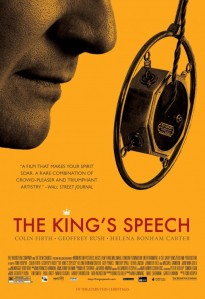 Public speaking is a nerve-racking position. Nobody wants to seem like a fool but it can be hard to do anything else when all eyes fall upon you with expectation. There was a poll a few years ago that asked Americans what their top fears were, and death came in second to public speaking. The Grim Reaper should feel relieved. Now imagine that you’re the leader of a country during a time of duress and you have a speech impediment. That’s the grueling circumstances for King George VI (affectionately known as “Bertie” to family), leader of Britain on the eve of World War II. The King’s Speech tells the inspirational true story of one of the most powerful men in the world finding his own voice.
Before becoming king of his country, Bertie (Colin Firth) was the Duke of York and a man suffering from a debilitating stutter. When stressed, it was difficult for Bertie to even read a statement. This speech impediment is made all the more troublesome now that the world has entered into the radio age; kings and presidents are now expected to speak to their peoples, no longer content to just be a striking figurehead. Elizabeth (Helena Bonham Carter), future Queen Mother, seeks out different speech therapists but the traditional methods are getting her husband nowhere. Then she comes across Lionel Logue (Geoffrey Rush), a self-taught speech therapist who worked with shell-shocked WWI soldiers in his native Australia. His methods are unorthodox but he’s the first to begin to get results with Bertie. The demands of his position get even greater when Bertie’s father, George V (Michael Gambon), dies in 1936 and Bertie’s older brother, Edward VIII (Guy Pearce) abdicates the throne. Now Bertie is expected to lead his nation, that is, if he can string two sentences together in public.
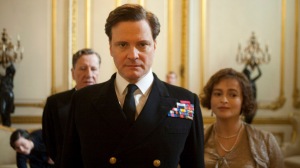 The King’s Speech is really the heartwarming story of the unlikely friendship between a king and a quirky Australian commoner. Their warm, humane friendship allows for several scenes of great humor and great drama. Watching the irreverent Lionel bounce off the proper and isolated Bertie supplies plenty of comedy. It’s essentially an odd couple comedy mixed with a true-life historical drama. There’s great pleasure in watching the chilly relationship between classes thaw, the men grow closer together, and Lionel’s unconventional tactics make progress. Each time Bertie discovers a new practice that removes his stutter, whether it is speaking while listening to music or speaking in the cadence of a song. This is a film that follows the English tradition of understatement even given the dramatic setting, principle characters, and a speech impediment. The characters don’t go around blurting their feelings, leaving the actors room to explore oodles of subtext. There’s a signature scene where Lionel coaxes Bertie into opening up by promising to allow him to paint a child’s model airplane (a treat for a man of title never allowed such toys). As he paints away, Bertie reveals a damaging truth about a neglectful childhood nanny. The truth is so painful that Bertie is forced to reveal it through the cadence of song, which somehow makes the revelation more sad and tragic. Their ongoing relationship is deeply satisfying and emotionally rewarding.
You won’t see a better-acted movie all year, thanks to Firth and Rush. More than following a checklist of gimmicks, Firth inhabits his character from the inside out. He feels like a living, breathing, somewhat broken person instead of a collection of ailments. Firth doesn’t overdo his stutter and treats the character, and the ailment, with a deep sense of compassion. Firth gives what is likely the greatest acting performance by any male in 2010. He is magnificent, commanding, and empathetic in every scene. Likewise, Rush doesn’t overpower as a personality foil. His character manages to be irreverent but without being flippant; he finds a reverent irreverence, if you will. Lionel is treating the future King of England, and the gravity of this stately relationship is not lost on him. Both men hide an inner melancholy, perhaps one of the things that ultimately bonds them together. Rush is flush with vigor and merriment, truly delightful to watch. This is his finest onscreen performance since he won his Oscar in 1996 for Shine.
The enormity of the king’s duties is given due care. You feel the weight of the crown that awaits Bertie and empathize with his quaking hesitation. Ever since childhood, his family looked down on Bertie. His father felt a stern tone would best aid the young stammerer, and his older brother would often belittle Bertie with cruel taunts. You see flashes of this unhealthy dynamic when Edward cuts down his little brother after their father passes.
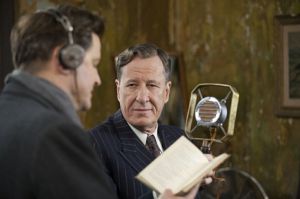 Bertie was seen as unimportant. Edward was the one set up for the throne. And yet Edward is the one who shirks his responsibilities in the name of love (a twice-divorced American woman). Edward refuses to become the leader of his people if the ancient rules forbid him from marrying a divorced woman. Bertie cannot buckle under the tremendous pressure and expectations that wait. Even when the rather passive Bertie lashes out, you feel like his anger is a moment of achievement. King George VI also had to deal with the fact that his brother is still alive and well and an alternative to the throne if Bertie is deemed incapable. Firth makes it easy to feel the remarkable pressure of being a leader not born or elected, merely expected. And even if an audience is clueless about British monarchy history and the rules of royal succession, The King’s Speech is easy to follow and comprehend for a daft American like myself.
Truth be told, The King’s Speech is a little stagy, a little square, and a little too fastidious for its own good. Hooper and crew are too content with making a pleasant moviegoing experience that the film lacks any slight form of edge. It’s all just a little too safe, a little too staid. While rated R, this movie could easily be a PG-13 family film, maybe even a PG one, sans the two sequences where Bertie unleashes a torrent of profanities in frustration (he discovers that he does not stutter while swearing). I feel like a curmudgeon for dinging a movie for being, essentially, too nice and gentle, but it clips the ambition of the movie when crowd-pleaser is the zenith of accomplishment. The fateful speech to the nation, on the eve of war with Germany, is even given an extra oomph thanks to the background music of Beethoven. A larger story of triumph seems reduced to the Oscar favorite storyline of Man Overcoming Physical Adversity. The direction by Hooper has some curious tics to it, like sequences of two people talking where they will never share the frame despite sitting side by side. I assume Hooper is trying to communicate some form of emotional distance or wariness, or perhaps it’s just a nod that different actors had unworkable schedules and could not be filmed together. Hooper is a talented director, as anyone who saw the massive undertaking of the masterful HBO miniseries John Adams can attest. However, like John Adams, Hooper is prone to TV-movie staging. His direction limits the cinematic power of the film. It looks like any ordinary episode of Masterpiece Theater.
The King’s Speech is pretty much everything you’d wish for in a movie groomed for awards consideration. This is prime Oscar bait. You may tear up at points, you’ll probably smile in many places, and your spirit will definitely rise. Plus it features some of the finest acting you’ll witness all year. And yet it’s that conscious need to please, to uplift, that can occasionally distract you from the many charms that The King’s Speech offers. The fact that the story is predictable is not a detriment, but the fact that the film doesn’t push harder, dig deeper, or expect more from its audience is a missed opportunity. The material is so rich, but a terrifically acted, smartly written film isn’t a bad consolation. Especially when that film happens to be one of the most rousing and rewarding theatrical experiences of the year.
Nate’s Grade: A-


 nathanzoebl
You must be logged in to post a comment.