Blog Archives
Lawless (2012)
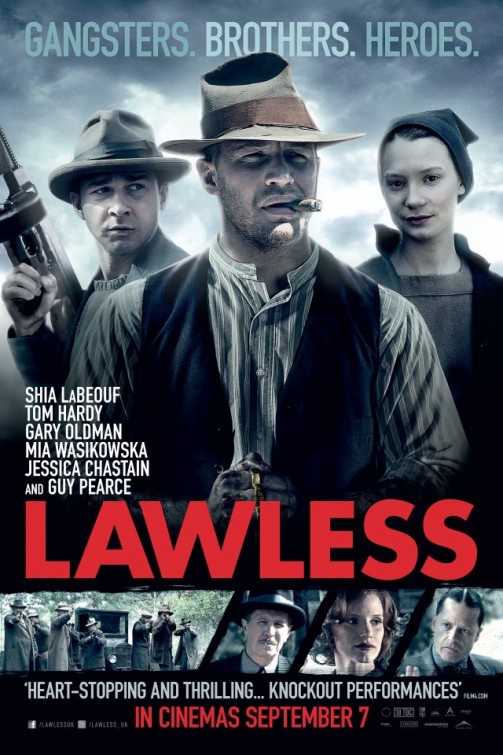 The bootlegging drama Lawless certainly has all the right elements to be an enjoyable movie. It’s by the men who gave us the great noir-Western The Proposition (director John Hillcoat, writer Nick Cave), it’s got a star-studded cast, plenty of bloody action, and a handsomely recreated production of the Prohibition era. But as I watched the Bondurant boys struggle against those who would like to put them in jail and/or murder them, I kept noticing something odd. I wasn’t that engaged. There was plenty of life-and-death drama, but why wasn’t I involved in the story more? Lawless feels like a series of scenes rather than a movie. Even when the plot changes it doesn’t feel like the movie is advancing. Even when things are more desperate it doesn’t feel like the momentum is building. The characters are somewhat sluggish as well, Shia LaBeouf as the scared youngest brother, Tom Hardy as the grumbly big brother who talks like his mouth is full of molasses. Jessica Chastain as the abused Good Woman who opens herself up to our Strong Hurting Man. Then you got a plot with a mobster (Gary Oldman) that weirdly climaxes with an hour left in the movie. He’s ignored for the remainder. Then there’s Guy Pearce as a colorfully fiendish and foppish special deputy that terrorizes the town. I am a Pearce fan but this guy is acting like he’s in his own weirder personal movie; it’s the kind of stuff Marlon Brando did. I appreciated that Lawless kept things gritty and bloody for realism, but I kept finding moments that ripped me out, namely the indestructible nature of Tom Hardy. Seriously, this guy has to be the Terminator. When he miraculously survives yet another seemingly fatal injury, all you can do is laugh. Lawless is passable entertainment but with its pedigree this should have been better.
Nate’s Grade: B-
Share this:

The Dark Knight Rises (2012)
 Let’s be honest, The Dark Knight Rises movie was never going to meet fan expectations after the high-water mark between superhero movie and crafty crime thriller that was the pop-art masterpiece, The Dark Knight. Whatever director/co-writer Christopher Nolan put together was fated not to match the pulpy big blockbuster alchemy that he worked so well in 2008. Minus Heath Ledger’s instantly iconic performance, a role that set the film on fire whenever he was onscreen, there is going to be a certain void to this capper to the trilogy. Now having seen the movie twice, including once in sphincter-rattling IMAX, I feel that I can truthfully state the most obvious: The Dark Knight Rises is not as good as the previous movies. While a fine finale for an ambitious series, this is definitely the weakest movie of the trilogy.
It’s been eight years since Gotham City last saw the likes of Batman. Bruce Wayne (Christian Bale) is an older man, hobbled by age, and living as a recluse in his mansion. His trusted friend and butler Alfred (Michael Caine) keeps encouraging Bruce to seek a life outside that of Batman. In those eight years, Gotham’s police have cracked down on organized crime thanks to the Dent Act, a law named after the late district attorney Harvey Dent (a fallen idol that only a handful know the real truth about). Commissioner Gordon (Gary Oldman) is growing sick with the secret of Harvey Dent and looks to retire from the force. Miranda Tate (Marion Cotillard) is a businesswoman eager to restart Wayne’s clean energy project, and a woman interesting in getting Bruce back on his feet. There’s also Selina Kyle (Anne Hathaway), a.k.a. Catwoman, a master thief who gives Bruce a new challenge. But then along comes Bane (Tom Hardy), a master terrorist and figure of brute strength. His goal is to fulfill the League of Shadows’ plan and destroy Gotham City and expose its rampant corruption. He sidelines Batman and takes over the city, unleashing criminals and hordes of the downtrodden upon the wealthy. There is no escape from Bane’s plan, his wrath, but Bruce Wayne must rise to the occasion and be ready to sacrifice the last of himself for the people of Gotham.
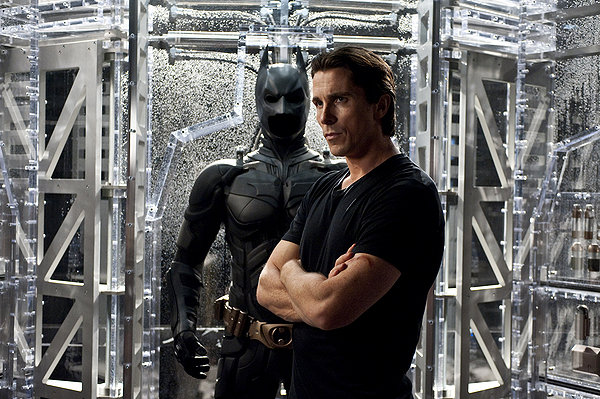 Firstly, Bane is no Joker. The bad guy lacks the fiendish charisma of Ledger’s Joker and he’s not as well integrated thematically into the movie. The Joker was an anarchist that wanted to tear down the pretensions of society and watch people “eat each other.” And we watched a city come unglued. We explore the notion of escalation and what the blowback would be for a man fighting crime in a costume. With Dark Knight Rises, Bane wants to take up the mantle of Ra’s Al Ghul (Liam Neeson) and wipe Gotham off the map. He’s got moments of being a master planner but really he’s just a big heavy. He’s the big tough guy that beats up old man Bruce Wayne, and Bane is continuously diminished in the film as it goes. A late revelation with the character completely diminishes his role and turns him into the equivalent of a mean junkyard dog. His big plan is simply to rile up the masses and wait for the inevitable. Hardy (Bronson) is a great actor prone to mesmerizing performances. This isn’t one of them. He’s super beefy but the facial mask, looking like some sea urchin, obscures half his face. It’s all physicality and eyes for his performance, along with very amped-up dialogue that you can tell was rerecorded after filming. Every time Bane speaks it’s like he has a speaker system installed in his face. And then there’s the matter of his sticky accent, which to me sounds like German mad scientist but to my friends sounded like drunken Sean Connery.
Bane keeps espousing about the corruption of Gotham but you really never get a strong sense of what that corruption has lead to. Catwoman talks about the Gotham elites living large while the rest of the city struggles; but rarely do you get a sense of this. So when Bane flips the tables, and the elite and wealthy are stripped of their decadence and put on trial by mobs, it feels improperly set up. Just because you have characters talk about wealth disparity and the city’s corrupting influence doesn’t mean it’s been established. Nolan’s Batman movies are a reflection of our modern-day anxieties in a post-9/11 world, so I wasn’t surprised to see a society rotting away from the sociopathic greed and wanton excess of the 1%. But rather than serve up a wealth disparity parable of class conflict, the movie simply turns to mob rule, a far less nuanced and interesting dissection of current events and fears. It’s like the French revolution took a trip to Gotham City (Gordon even quotes from A Tale of Two Cities). It’s a society built upon a central lie, the idol of Harvey Dent, but the movie fails to make the corruption felt. In the end, this is all pretty weak social allegory. And would it have killed Bane to be a little more brutal to stock exchange short-sellers?
 Then there’s the typical Nolan origami plot with the myriad of subplots intersecting. This is the first time in the series where the plots felt poorly developed. Rewatch Batman Begins or The Dark Knight, as I recently did, and you’ll see there is not an ounce of fat in those movies, not one wasted scene or one wasted line. Sure they got secret super ninjas and Katie Holmes, but those movies were well built blockbusters. I could have done without Bane entirely and certainly would have loved more of Catwoman. Hathaway (Alice in Wonderland) is terrific in the antihero role and brings a very interesting dynamic relationship with Batman. She may be the only person who understands him. I wanted more Catwoman, the movie needed more Catwoman, but alas she is just a plot device to connect Wayne to Bane. She has a larger role in the concluding melee but essentially becomes Batman’s reluctant wingman. The whole theme of the 99% vs. the 1% could have been generously explored with this character, and her spark and charisma would certainly be enough to get Bruce Wayne out of bed again. Then there’s the regular cop (Joseph Gordon-Levitt) doing the unheralded good deeds that so easily get overlooked. Here is an interesting character that, due to some leaps in logic, connects with Bruce Wayne on a unique level. He presents a counterbalance to all the souped-up superheroes, a recognizably regular human trying to do good. It’s then a shame that he gets entirely relegated during the third act so that the superheroes and their super toys can make some noise.
For a Batman movie there’s hardly any Batman in it. The caped crusader has been in retirement for eight years, so it takes some time before Bruce puts the suit back on. But then he’s also sidelined for a good third of the movie, stowed away in a far-off prison. The entire Indian prison sequence really could have been exorcised. It essentially becomes a Rocky training moment for Bruce Wayne to recover and a plot device to explain why there needs to be a time gap in the story. But this part of the movie just feels like it goes on forever, and we all know where it will go so we just keep waiting for the movie to get there. No one wants a Batman movie where Batman sits the middle out. The end feels relatively fitting but any fan of The Iron Giant will recognize some similar key elements.
And while I’m on the subject, let me do some estimates here. The timeline between Batman Begins and The Dark Knight is about a year, as the Joker notes to a congregation of mobsters. I’ll be generous and say that the events of The Dark Knight last two months. We learn that Batman never appeared again after the death of Harvey Dent, and now we flash to eight years later with The Dark Knight Rises. So you’re telling me that we only really got a solid year of Batman being Batman? That over the course of nine years he was Batman for only one of them? That’s very little Batman-ing for a Batman franchise.
But even with these flaws in tow, The Dark Knight Rises is still an exciting, stimulating, and mostly satisfying close to a trilogy of unprecedented ambition and scope for a modern blockbuster. The action sequences in this movie are huge and exhilarating. I loved Bane turning Batman’s armada of weapons against him. The Bat fighter plane is a nice addition that gets plenty of solid screen time. The sheer scope of what Nolan produces is epic; from a plane being hijacked in mid-flight and torn apart, to a city being leveled by explosives, to a face-off between a bevy of armored Batmobiles and the Bat plane through the streets of Gotham, the movie does not disappoint when it comes to explosive, large-scale action set pieces. This is also the first Batman movie where the climax is the best part of the film. The last half hour is solid action but also a fitting sendoff for a beloved character. Some will grumble with certain hat-tipping moments at the end, but I found it entirely satisfying. It all comes back to the central thesis of Nolan’s Batman films about becoming something more than just a man, becoming a symbol, and that symbol is meant to inspire others. By the end, you feel that the inspiration has been earned as so has our conclusion.
 I want to single out Caine (Harry Brown) who has very few scenes but absolutely kills them. He’s the emotional core of the movie, perhaps even the series, and has always been hoping that his charge, Bruce Wayne, would never return to Gotham. He’s the voice of reason in the movie, the man that reminds Bruce about the costs of a life spent seeking vengeance and sacrificing his body. I wish Caine was in the movie longer but his scenes are pivotal to the plot, as is his absence.
The Dark Knight Rises doesn’t rise to the level of artistic excellence of its predecessors, but it’s certainly a strong summer blockbuster that works as an agreeable finale to the premier franchise of the era. It’s not quite the knockout we were expecting from Nolan but it still delivers where it counts. I wish it had give a fuller, richer portrait of a city corrupt from the inside out, a society rotting away and ready for revolution, and plus I also wish we had plenty more Catwoman and plenty more shots of Anne Hathaway in her Catwoman cat suit (Michelle Pfeiffer still has nothing to fear), but these are the things of dreams. Nolan’s aim has always been to place Batman in a world that is recognizably our own, and with that comes the responsibility of bringing a stolid sense of realism with all the blockbuster pyrotechnics. This artistic ethos has given us some extraordinary movies, though some Batman purists would object that Nolan’s hyper-realism is not the Batman they grew up with. It’s hard to really get a sense of the accomplishments that Nolan and his team has been able to pull off over the course of three bladder-unfriendly movies and seven years. He’s taken the superhero movie and redefined it, brought it unparalleled psychological depth and philosophical analysis, and given a human quality to what normally gets dismissed as escapism. The Dark Knight Rises isn’t as revelatory as its previous entry but it sticks the landing and puts to rest what is indisputably the greatest superhero trilogy of all time.
Now get ready for the reboot in three years.
Nate’s Grade: B
Share this:

Tinker, Tailor, Soldier, Spy (2011)
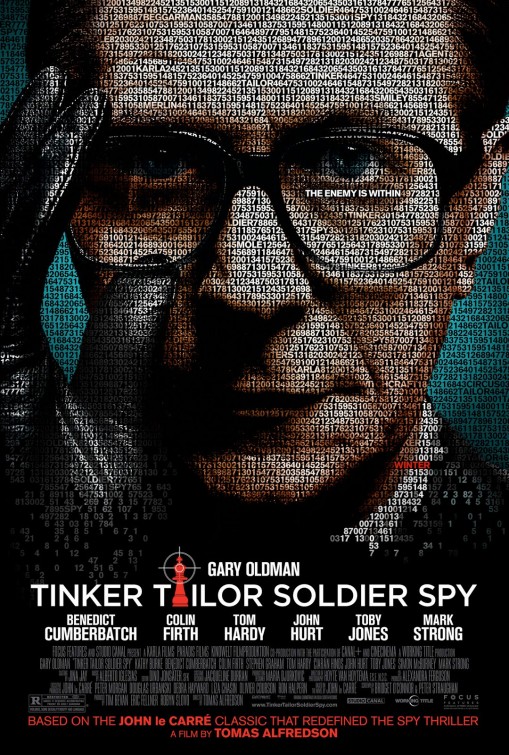 Billed as one of the most dense films of the holiday season, I was startled to discover that Tinker, Tailor, Soldier, Spy is not nearly as puzzling as people have protested. The adaptation of John le Carre’s famous novel follows retired British spy George Smiley (Gary Oldman) performing a clandestine investigation to flesh out a mole in the highest level of the agency. Directed by Tomas Alfredson (Let the Right One In), condensed form a 7-hour BBC miniseries, and stuffed with a wealth of terrific Brits, the movie is tricky, clever, and rather brainy, ultimately coming to the conclusion that these little communities of intelligence knew little. The movie has a rich array of characters and teases out back-story in flashbacks, meaning the film hops around time wise and will also take turns with different perspectives. It demands your attention but, honestly, I found it easy enough to follow. But in the end, what does all that narrative trickery and obfuscation get you? It’s a fairly dispassionate film about dispassionate people played out in a dispassionate manner. For some this will be hailed as a virtue, communicating the duty-first sacrifices and compartmentalization of these secret spies. For me, that just sounds like a cop out. Beyond the mystery, it’s hard to get involved in the movie. The reveal of the mole is anti-climactic, though the resolution, set to the tones of Julio Iglesias, is aces. The meticulous production design is stellar, including an agency meeting room that looks like it was wallpapered with checkerboards. The details of the ins and outs of the agency are absorbing. I’m debating whether I should watch the movie again, looking for nuance I must have missed. Tinker, Tailor, Soldier, Spy is an espionage thriller with a bit too many stiff upper lips.
Nate’s Grade: B
Share this:

Warrior (2011)
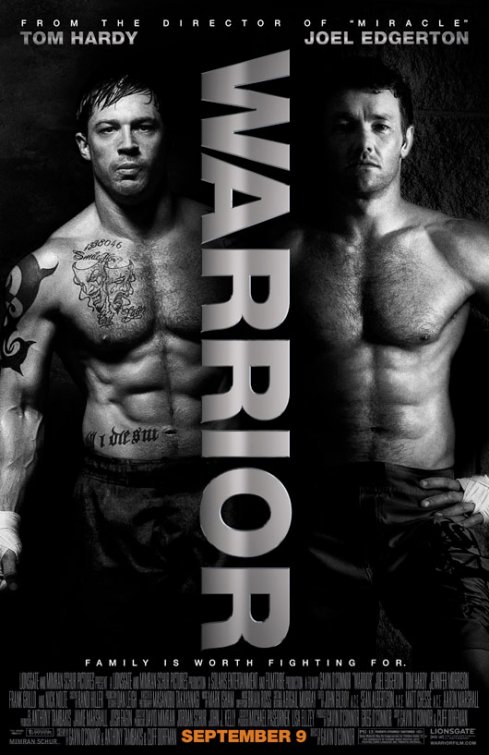 This may be a mixed martial arts (MMA) movie in appearance, but really Warrior is put together like a traditional boxing movie. Director/co-writer Gavin O’Connor (Miracle) takes a kitchen-sink approach to storytelling; just about every damn dramatic thing you can think of, short of emergency baby deliveries, is stuffed into this movie. You’ve got two brothers, one a hard luck school teacher (Joel Edgerton) trying to save the bank from taking his home (his family is broke due to his sick daughter’s medical condition), and the other (Tom Hardy) an Iraq War vet who saved lives and wants no glory, for he’s haunted by the men in his platoon who did not survive. Add a drunken father (Nick Nolte) trying to live life on the straight-and-narrow who wants to get back in his sons’ good graces, the teacher’s community rallying around him, the Marine’s comrades in service rallying around him, and some major personal issues between brothers (Hardy feels that his bro abandoned him and their sick mother), and two competing underdog tales, and my God, it’s hard not to feel beaten into submission. But damn if it isn’t effective stuff. I was tearing up at multiple points, completely sucked into the drama, riveted by the brutal, adrenaline-pumping MMA fight scenes, and pining for family reconciliation. Hardy and Edgerton flex more than their muscles on screen; each gives terse, heartbreaking, completely convincing performances as broken-down men struggling for redemption. You don’t have to no a lick about MMA to get hooked by the heavy emotional beats of the movie. Warrior is by no means a subtle movie, but it pushes all the sports genre buttons expertly, presenting a gratifying, affecting meat-and-potatoes drama that grown men are given permission to get weepy over.
Nate’s Grade: A-
Share this:

Inception (2010)
 Without a doubt, no movie has piqued curiosity like Christopher Nolan’s Inception. After breaking all sorts of box-office records with The Dark Knight, Nolan earned some capital. He wanted to make an expensive, intellectually demanding, high-concept movie that takes place mostly in the realm of dreams. The studio said yes, anything to keep their golden goose happy before a third Batman can roll out. Nolan has been tinkering with the script for Inception for almost ten years, trying to scale it down but never being content. This is a story that called for the biggest stage, which required a heavy price tag, and could only be fulfilled once Nolan was an established hit-maker. Early images of shifting gravity and folding cityscapes got people buzzing but then the concern was whether Inception would be too smart for audiences to embrace. You know, the same public that made two Alvin and the Chipmunks films blockbusters. Two weeks running, Inception has made a sizeable portion of money and become the “must-see” movie of the summer. Score one for the public.
Dom Cobb (Leonardo DiCaprio) is an expert extractor. He can sneak into your dreams and discover whatever secret you’re hiding from your self, your wife, even your shrink. All for a tidy sum, of course. He’s on the run from U.S. authorities because they believe he killed his wife Mal (Marion Cotillard). A rich businessman, Seito (Ken Watanabe), promises to clear away the pending charges if Cobb can perform one important job. Instead of stealing an idea, Cobb will have to plant an idea, known as inception. A young upstart (Cillian Murphy) will inherit his dying father?s empire, and Seito wants the guy to break up that empire and sell it off. Cobb enlists the help of a skilled team to pull off what is believed to be impossible; Arthur (Joseph Gordon-Levitt) as the point man, Ariadne (Ellen Page), as the architect of the dream world, Eames (Tom Hardy), a forger who can convince the mark he?s other identities, and Yusuf (Dileep Rao), a chemist that creates a compound to put the team under a deep sleep. They’ll need it because Cobb plans to go three levels deep, a dream within a dream within a dream in order for inception to take root. The only way out is a “kick,” the sensation of falling that will awaken the dreamer. The team is under great risk not just from the dream world, but also from Cobb. He?s been secretly keeping memories of his dead wife alive and she keeps intruding into shared dreaming, causing havoc, relying on the same info that Cobb knows. The deeper they go into the dream the deeper they also go into Cobb’s memories.
 Inception can be many things to many people, as is the nature of dreams. I found the movie to be a master class mousetrap. Watching Nolan and his origami-like script fold and bend and connect is a true pleasure. However, the movie is not a great character piece. Cobb is the only person on the entire team allowed any sort of back-story or inner lives or even personality traits. What do we know about Arthur, Ariadne, Eames? Nothing. They are all members of the team, but it is Cobb who is the only one allowed to have supporting details. Despite Cobb’s tragic past with his wife, emotionally the movie can best be described as a bit distant (not cold, distant). Nor does Inception deal with the psychology of dreams or the interpretation of the subconscious and its links to our own reality; this movie does not have Freudian psychoanalysis in mind. What Inception does deliver is a brilliantly staged heist that takes place in the realm of dreams, and if that doesn’t sound like a fun concept then I don?t know what does. To get to that heist, the audience must slosh through about 90 minutes of solid set-up and exposition (Pages character is essentially an exposition device). There are a lot of rules to digest in order for the final hour to have the impact that it does. If you nod off for a portion of that time, like my father, you will be lost as to why anything is exactly happening. Having seen the film a second time, I can say that once the hyperactive “Oh my gosh, this is awesome!” haze of newness wears off you do realize that the pre-heist portion of the movie can be a bit slow. I think that for future DVD-viewings I will skip to the start of the heist and sit back and relax (much like skipping the first hour of King Kong).
After talking about what Inception is not, let’s focus on what Inception is. It is a massively entertaining, brain-tickling thriller with eye-popping visuals that verge toward the iconic. Nolan isn’t the greatest orchestrator of action (a foot chase in Mombassa is pretty lackluster short of a narrow alleyway) but the man knows how to put together tremendously memorable set pieces. From Paris folding upon itself to a fistfight in a revolving hallway, Inception is packed with stimuli to ignite the senses. It’s the first movie in years that I walked out and thought, “How did they do that?” It renewed my sense of mystery and wonder with the movies. And the last hour is ridiculously fraught with tension as the movie descends level after level of subconscious, juggling four separate action set pieces with mounting climaxes. The revolving hallway fight is perhaps my favorite action scene in years. I still got goose bumps the second time. Gordon-Levitt hops from ceiling to floor like he’s Spiderman, or Gene Kelly, all while the camera remains fixed. Gordon-Levitt gets a lot of zero gravity experience in this movie. He might have qualified for a free ride on the space shuttle.
Like the alternate reality of The Matrix, people can manipulate the world of dreams, which allows for some imaginative visuals. Aside from the dreams-within-dreams impacting one another, there aren’t really playful distortions of reality. There?s a few M. C. Escher-inspired staircases but nothing too out of bounds. Nolan devises a reason for this since the dreamers do not want to call attention to altering the dream. They want to hide among the subconscious projections; get in and get out without being noticed. You do wish that Nolan played to the potential of his flexible reality, but on the other hand, it’s still fairly mind-bending to reach inside a magician?s hat into another magician?s hat and so on. I wonder if there was another story that could have succeeded in this setting, namely competing thieves that have to race against time within the world of dreams. Think about it next time, Nolan. That one?s on me.
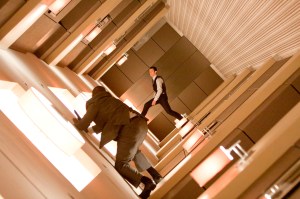 But the most exciting aspect of the movie is how intellectually stimulating it is. The movie is jam-packed with ideas like Nolan’s other works, so much that it’s hard to fully process everything the film offers in one sitting. The pieces do fit together and the movie follows its own internal logic, so if you didn’t skip out on any bathroom breaks, you should be able to follow along reasonably. On first viewing, Inception is bristling with intelligence and narrative complexity, and it rarely stops to pander to an audience. It expects you to keep up for the rewards that will follow, and they are indeed rewarding. The movie isn’t as complicated to follow but it can definitely get complicated when you try and explain action beyond a literal level. Nolan laces all sorts of narrative stops and peculiarities that can be targeted for an alternative thesis statement on the ending. The very ending shot is ambiguous perfection. It keeps the mystery of what constitutes reality while providing an out for people that want to formulate a happy ending. There’s plenty of room for interpretation and analysis but it doesn’t get in the way of telling a good story. Hollywood is pretty risk averse when it comes to anything that makes people think, let along anything expensive that requires active synapses. Nolan has long been a filmmaker of intellectual heft and non-linear narratives. His narratives are complex puzzles that snap together with airtight precision. The joy of a Nolan film is surrendering yourself to his narrative origami and waiting to see the Big Picture. There are new insights to discover with every viewing. Nolan may not be the second-coming of God, as those frothing at the mouth on Internet message boards proclaim, but I can think of no other director working today who harnesses Big Ideas on such a big stage.
Inception is a $160-million dollar studio film with substance, but it also looks like money well spent. The film looks amazing. The cinematography by Wall Pfister (Dark Knight) is gorgeous without being self-consciously arty, pleasing the senses without drawing too much attention away from the story. But with a screenplay that makes all kinds of leaps, you need the help of a good editor to guide the proceedings. Lee Smith (Truman Show, Master and Commander) is that man. While the repeated cutbacks to the van falling in slow motion can be giggle-inducing, Smith gamely holds everything together thanks to his skill in juggling all the parallel storylines/dreamscapes. Finally, the score by Hans Zimmer (The Lion King, Gladiator) is full of ominous, blaring horns that send shivers and get your blood pumping. Johnny Marr (The Smiths, Modest Mouse) even added an assist by strumming the guitar licks on the score. Apparently Zimmer’s key score themes are actually the tune “Non, Je Ne Regrette Rien,” the Edith Piaf signature song used to signal “kicks,” played at a slowed speed. At the risk of sounding like one of those frothing from the mouth on the Internet, that’s insanely cool.
 The acting is uniformly good with a few bumps. DiCaprio (Shutter Island) might need to do something light after continuous roles where he inhabits mean weighed down by guilt and dead wives (three in a row for those counting). He’s a good emotional anchor. Watching the star of 500 Days of Summer and Brick as a suave, cool-as-can-be action star is improbably awesome. Hardy (Bronson) is a scene-stealer mostly because he?s the only member of the team that has a sense of humor. Cotillard (Nine, Public Enemies) who won an Oscar playing Edith Piaf in 2007’s La vie en Rose, gets her best part since then. She gets to do many things as Mal, a projection of a character. This means that she must be limited in how she fills out the character because she is defined by Cobb’s fading memory. Yet she can be malicious, playful, spiteful, loving, vulnerable, and more. Cotillard and her big, glassy eyes do a great service in selling a romance we only see after the fact. Page (Juno) just feels out of place. She seems like the kid among a group of adults. And while the elfin actress will always look youthful until she applies for an AARP card, Page just seems in over her head. Her performance is fine if a bit mealy-mouthed but she still feels miscast.
Inception. Expect it to become a fanboy religion in a matter of weeks. It wears its influences on its sleeve, from The Matrix to Abre Los Ojos (or the American remake, Vanilla Sky). Thrilling, stimulating on different levels, and supremely engrossing, Inception is just about everything you could wish for in a summer blockbuster, except when it can also feel mechanical, distant, and free of emotion and character development save DiCaprio (perhaps this is further evidence that it was all a dream?). Regardless, Inception is easily the brainiest movie of the year, and usually those don?t get packaged as big-budget Hollywood spectacle. Just make sure to bring your totem the second time you watch the movie.
Nate’s Grade: A
Share this:

RocknRolla (2008)
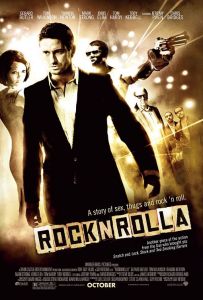 I’m a fan of Guy Ritchie’s convoluted cockney comedic crime capers (wow, check out that alliteration), but this movie is just plodding and dull. The trouble is that Ritchie works best when he has one foot in the fantastic, with comically over-the-top and menacing underworld personalities. A Ritchie movie usually involves a lot of crisscrossing characters, but this is his first film where I couldn’t keep the folks straight, I couldn’t understand much of the personal connections, I couldn’t understand the purpose of the various characters and their various interplay, and frankly, I never bothered to care. RocknRolla has maybe two colorful characters (all hail Tom Wilkinson as a sleazy real estate gangster), but the rest of the movie is overstuffed with bland and forgettable toughs. What the hell are Ludacris and Jeremy Piven doing here? You could eliminate half of the cast and the movie would barely be affected. This movie is just way too straight and square for its own good. Ritchie is still a top-notch visual stylist, and the movie has a terrific deep focus digital video cinematography, but there are very few moments or visual flourishes in this flick that prove to be remotely memorable. I hope Ritchie does not make good on his promise to continue telling more stories with these characters and in this style because this many needs to get back to what he does so well, and that is telling the darkly comic escapades of larger than life Dick Tracy-esque villains and scoundrels.
Nate’s Grade: C
Share this:

Black Hawk Down (2001)
 In the fall of 1993 Somalia was a nation being torn by civil war with feuding warlords and slowly being crippled by rampant hunger. The UN intervened to try feeding the starving nation but warlords like Mohamed Farrah Aidid cut off many of its shipments of food. The United States had plans to capture two top lieutenants of Aidid’s in the capital of Mogadishu. Over 100 Delta units and Army Rangers were sent into the heart of the Mogadishu market to execute the operation.
Things didn’t go well from the start as casualties began to pile up and first one, then two Black Hawk helicopters were shot down from ground fire. Medical vans and Humvees were continually blocked access to help the stranded soldiers by civilian roadblocks consisting of smoldering debris. It wasn’t supposed to take longer than 45 minutes. It ended up lasting over 15 hours. In the end 18 American lives were lost, over 70 were wounded, and over a 1000 Somalian lives were lost. What’s truly amazing is the courage the men displayed, and the fact that being surrounded by a sea of armed Somalians that more lives weren’t lost.
 Black Hawk Down is essentially a two-hour action sequence. The emphasis of the film is on the stark recreation of the Somalia skirmish and it is indeed an achievement in grueling realism. You truly feel like you have been thrown into the middle of this firefight. With all the gunfire and chaos it leaves little time for getting to know characters. This is probably why they have names written on their helmets so the audience can attempt some semblance of who’s who.
The film is by no means for the faint of heart. Saving Private Ryan had some intense violence, but it was mainly condensed for the opening and closing 20 minutes. Black Hawk Down, on the other hand, is two straight hours of non-stop blood and gore. The violence and the intense realism are not gratuitous but indicative of the horror these men faced. If you can’t stomach a soldier plunging his entire forearm into the chest cavity of another to cut off a bullet wound – stay at home and read a good book.
 Ridley Scott is on an ultra-violent hot streak after directing big name Hollywood tokens like Hannibal and Gladiator. His handling of Black Hawk Down is masterful, just for the simple fact of keeping the audience free from confusion. Throughout the duration we know who is where, where they want to go, and the general geography of the hot spot. The staging of the entire battle is beautifully filmed and the recreation of the Mogadishu market place is amazing in its fine detail. Some criticism has been projected at the film for portraying the Somalians as basically black people with guns. This is entirely true, but one must remember that the film is told from the American point of view.
The acting, as expected in a war film, takes a back seat to the heroic histrionics and the fireworks. Josh Hartnett is sullen in his duty as Staff Sergeant Matt Eversmann but always a comfortable figure to see on screen amidst the chaos. Ewan McGregor plays a soldier promoted to action instead of desk work and adds some touches of humor to the fray. Tom Sizemore is the most recognizable person as the often-frustrated Lt. Colonel Danny McKnight who fearlessly strolls across the battlefield while bullets whiz by.
Black Hawk Down for some will be the right movie at the right time, though it was never intended to be. The riveting action is more than entertaining and worth admission price, but you might leave pondering on the sacrifice few know the full details. Just make sure to go to the bathroom before the film starts.
Nate’s Grade: A-


 nathanzoebl
You must be logged in to post a comment.