Blog Archives
The Hateful Eight (2015)
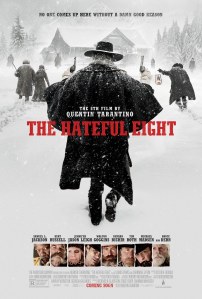 The Hateful Eight almost didn’t happen thanks to our modern-day views on copyright and privacy. Writer/director Quentin Tarantino sent the first draft of his newest script to three trusted actors, and within days it had spread to the outer reaches of the Internet. Tarantino was so incensed that he swore to shelve Hateful Eight and never film it. After a staged reading in L.A. with many of the eventual actors for the film, he changed his mind, to the relief of his sizable fanbase and actors everywhere. The Hateful Eight is a drawing room mystery with plenty of Tarantino’s signature propulsive language and bloody violence, but it’s also the director’s least substantial film to date.
In post-Civil War Wyoming, famous bounty hunter John “The Hangman” Ruth (Kurt Russell) is taking the outlaw Daisy Domergue (Jennifer Jason Leigh) to hang for her crimes. Along the way, he meets up with Major Marquis Warren (Samuel L. Jackson), a bounty hunter who served in the North and carries a letter written to him from none other than Abraham Lincoln. They’re both heading to Red Rock to extract their bounty earnings. Due to an oncoming blizzard, they’re forced to make a stay at Minnie’s haberdashery, except Minnie isn’t anywhere to be found. There’s Bob the Mexican (Demian Bichir) who says Minnie left him in charge, a foppish hangman Oswaldo Moblay (Tim Roth), a quiet cattle driver Joe Gage (Michael Madsen), a Confederate general, Sandy Smithers (Bruce Dern), and Chris Mannix (Walton Goggins), the son of a Confederate rebel who claims to be the newly designated sheriff of Red Rock. Over the course of one long night, everyone’s true identity will be learned, because someone is not who they seem to be and is secretly waiting to free Daisy and kill the rest.
 Even as lesser Tarantino, The Hateful Eight is still an entertaining and talky stage play put to film. The setup is strong and invites the audience to play along, to scrutinize the assorted characters and determine who is telling the truth. There are plenty of twists and turns and some violent surprises to keep things interesting. The conversations of the characters are such a pleasure to listen to; I want to luxuriate in Tarantino’s language. His wordsmith abilities are unparalleled in Hollywood. There’s a reason every star is dying to snag a part in a Tarantino movie, especially now that they’ve caught Oscar fire as of late. That’s somewhat crazy to think about. Cinema’s ultimate indie voice with his encyclopedic knowledge of the medium, high and low art, has become an institution within the system and his violent period films are now looked at as year-end prestige pictures. Tarantino’s M.O. has been to take B-movies and to transform them into A-movie level talent and intelligence. Never has a Tarantino flick felt more B-movie than The Hateful Eight. It was inspired from episodes of TV and it’s easy to see that genesis in its execution. It’s a self-contained mystery that comes to a head. It’s a limited story that’s likely taken as far as it could possible go, pushing three hours. I’m a tad befuddled why this was the movie Tarantino insisted on filming in “glorious Panavision 70 millimeter.” It’s almost entirely set in that one-room interior location. The extra depth that 70 millimeter affords would appear to be wasted, unless you enjoy looking at general store items on shelves in the background. Still, The Hateful Eight is a movie that doesn’t feel like three hours and harbors enough intrigue and payoffs to hook.
I tried to diagnose why this felt like lesser Tarantino, and it’s because over the course of almost three hours we don’t have much at stake because the people inhabiting the movie aren’t really characters but tough-talking facades. Tarantino is often cited for his uniquely florid dialogue, and nobody writes dialogue like Tarantino and his naturally stylized cadences, but another of the man’s skills is how great he can write a coterie of colorful characters that pop from the big screen. You might not be able to remember many lines from Hans Landa or Vincent Vega or Django, but you remember the vivid characters. Tarantino is preternaturally skilled at building characters that feel fully realized with their own viewpoints and flaws and prior experiences. He can make characters stand out but he also has the great ability to make the larger-than-life characters feel real, which is truly genius screenwriting for characters so flamboyant. The older romance in Jackie Brown is perfectly captured and felt. It’s downright mature. This is the first time I would say Tarantino has disappointed when it comes to his characters.
There are broadly drawn folk aplenty onscreen and they still talk in that wonderfully florid language of Tarantino’s that actors must savor like a fine steak, something they can sink themselves in for and enjoy every morsel. However, the characters onscreen have never felt this empty before. They are what they are and the only real change that occurs is that many will be dead before the end credits. They don’t have arcs per se but end points. It’s all about unmasking and identifying the rogues in a room full of rogues. Beyond Warren and Mannix, we’re left with precious little for characterization beyond bravado and nihilism. The effect of how empty they are would be felt less if we weren’t stranded with them for near three hours. Trapped in a room with a group of suspicious characters can only go so far, and ultimately it’s a parlor game that cannot sustain longer staying power. I doubt I’ll ever watch this with the frequency of other Tarantino flicks.
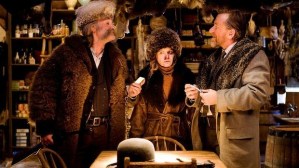 “You keep talkin’. You’re gonna talk yourself to death,” says one of those hateful numbers to another member. I’d pay to listen to Tarantino rewrite the phone book, that’s how excellent the man is with his dialogue. The man likes to hear his words and I like listening to them too. The problem is that The Hateful Eight has no reason for its gargantuan running time. As stated above, the characters we’re getting are nowhere near as complex or interesting as previous Tarantino escapades, so the talking can grow weary. Tarantino has patented a new formula from 2009’s Inglorious Basterds that involves characters playing a game of I-know-you-know-I-know while they suss out the truth, all the while the tension finely simmers until it blows. It’s a long fuse of suspense that can pay off rich rewards, like the near-perfect tavern scene in Basterds. The dinner table scene with Candie and the skull of his favorite house slave is another good example. Once our titular eight have gathered at Minnie’s, the entire movie is this sort of scene. It may be broken up into chapters and flashbacks but it feels like one long scene.
There’s also far less at stake than there was with Basterds or Django Unchained, even Reservoir Dogs, and that’s because the protagonists had goals and we had built up far more allegiance and time with them. When they were in danger, it mattered. The danger doesn’t feel as immediate because so little else is happening. There are plenty of comparisons to Dogs, which also utilized a hidden identity and a confined location. I think the difference was that, besides it being Tarantino’s first foray as a director, the tension was felt more because the danger was immediate from the start and we cared about character relationships. I cared about Mr. Orange and Mr. White and their bond. I can’t say I cared about any of the characters in Hateful Eight. I found them interesting at points, sure, but they were all a bunch of rotten bastards with little variation short of a burgeoning understanding between Mannix and Warren. The wait at Minnie’s feels like the Basterds tavern scene on steroids, pushed to the breaking point, and yet absent the urgency.
The acting is yet another tasty dish served up by Tarantino, and it feels like the actors are having the time of their lives playing their lively scoundrels. Jackson (Kingsmen: the Secret Service) settles in nicely and always seems to elevate his game when he’s reciting Tarantino’s words. He’s icy cool in scenes where the other characters are trying to do whatever they can to fire him up. He’s less bombastic than we’ve come to expect from Jackson. For bombast, there’s Russell (Furious 7) who cranks his performance to the broad heights of his bellicose lawman. Goggins gives a sly and extra caffeinated performance that answered the question of what it would sound like if you dropped his character from TV’s Justified into a Tarantino movie. Roth (Selma) feels like he’s doing his best manic Christoph Waltz impression. Dern (Nebraska) is a racist codger with a soft spot for his kin. Madsen (Kill Bill vol. 2) seems somewhat wasted as a taciturn “cow puncher.” Bichir (The Heat) gets some laughs as a seemingly aloof caretaker. It’s Leigh (Anomalisa) who steals the show, especially in the film’s second half. Daisy is a character that relishes being bad, and Leigh takes every opportunity to enjoy the fun. Her character plays a bit of possum during the first half but it’s the second half where she lets loose and becomes unhinged, and her exasperated and grotesque responses are often played for great sputtering comic effect. It’s a boys movie but it’s the lone woman who will prove most memorable. Tarantino’s last two movies have won acting awards and Leigh just might make it three-in-a-row.
 There are also some uncomfortable elements that can deter your viewing enjoyment, which isn’t exactly a foreign charge against Tarantino’s career. At this point you can probably repeat the oft-cited accusations: flagrant use of the N-word and exploitative violence. At least the historical background provides a context for the other characters unleashing the N-word, and I’d argue it tells us something about the characters as well. The characters that use the N-word when referring to Warren are the ones with allegiances to the Confederacy and those viewpoints don’t vanish even after you lost a war. They’re dismissive and intolerant and view Warren as sub-human. It also doesn’t approach Django Unchained-levels of excess, so I let it slide (I know my perspective as a white male makes my opinion on this effectively meaningless). It was the violence that got to me, specifically the violence directed at Daisy. Tarantino’s penchant for violence goes all the way back to his ear-slicing debut, so it’s nothing unexpected. He often tells stories about violent men and women fighting their way in a world governed by violence. I accept that these characters are bad to their core. That doesn’t excuse behavior. Violence on screen can be tempered with authorial commentary, but it’s the association that bothered me with Hateful Eight. For the entire movie, Daisy is put through the physical wringer. Our very first image of her is with a black eye. She’s a nasty woman and Ruth often expresses his distaste of her by punching her in the face, which is played as dark comedy. This happens repeatedly. We’re meant to recoil from much of the bloody violence on screen but repeatedly we’re meant to laugh at the violent suffering of Daisy. Tarantino has often used over-the-top violence as dark humor, and I’ve laughed along with it. This was one instance though where I stopped laughing and starting shifting uncomfortably in my seat.
Even lesser Tarantino can still be plenty entertaining and superior to most of what Hollywood usually cranks out as product. The Hateful Eight can be exciting, funny, surprising, and plenty of things, but what it can’t be is more than a lark. Tarantino has taken stories that would seem like larks, particularly the Kill Bill series, and infused them with pathos and meditation and soul to go along with all that snazzy genre stuff. It’s disappointing that Hateful Eight isn’t more than what’s on screen, but what’s on screen is still worth watching, though I don’t know whether it’s worth watching a second time.
Nate’s Grade: B
Share this:

Selma (2014)/ Black or White (2014)
 There’s a reason that race is regarded as the “third rail” when it comes to American politics. A half-century after the marches and protests, chief among them the influence of Martin Luther King Jr., the world feels just as fractious as ever when it comes to race relations. The inauguration of America’s first black president was seen as a significant touchstone, but optimism has faded and recent headline-grabbing criminal cases, and the absence of indictments, have prompted thousands to voice their protest from assembly to street corner. Race relations are one of the thorniest issues today and will be for some time. Two recent films take two very different approaches to discussing race relations, and they’re clearly made for two very different audiences. Selma is an invigorating, moving, and exceptional film showcasing bravery and dignity. Where Selma is complex, Black or White is a simplified and misguided sitcom writ large.
In 1965, Alabama was the epicenter for the Civil Rights movement. Martin Luther King Jr. (David Oyelowo) has his sights set on organizing a march from Selma to the sate capital in Montgomery. His wife, Coretta (Carmen Ejogo), is worried about the safety of their children, as death threats are sadly common for MLK. He needs to turn the tide of public perception to light a fire under President Lyndon Johnson (Tom Wilkinson) to get him to prioritize legislation that would protect every citizen’s right to vote.
 Without question, Selma is one of the finest films of 2014. It is powerful, resonant, nuanced, political, immediate, and generally excellent on all fronts. It’s a rarity in Hollywood, namely a movie about the Civil Rights movement without a prominent white savior. This is a film about the ordinary and famous black faces on the ground fighting in the trenches for their freedoms. There are compassionate white people who heed the call, don’t get me wrong, but this is a movie told from the black perspective. I suspect the portrayal of President Johnson had something to do with Selma’s poor showing with the Oscars, though I can’t fully comprehend why. Yes, Johnson is portrayed as a man who has to be won over, but he’s on MLK’s side from the beginning. He is not opposed to legislation to protect voting rights; he’s just hesitant about the timing. Johnson says, “You got one issue, I got 100,” and the pragmatic reality of pushing forward legislation through a divided Congress was real. Johnson was not opposed to MLK’s wishes; he just wanted him to wait until the political process would be easier. In fact, in my eyes, Johnson comes across as compassionate, politically savvy, and he clearly makes his stakes on which side of history he’s going to be associated when he has a sit-down with the obstinate Alabama governor, George Wallace (Tim Roth). Like the rest of the varied characters in Selma, it’s a nuanced portrayal of a man in the moment.
The march in Selma is a moment that seems like an afterthought in the narrative of the Civil Rights movement, dwarfed by the Montgomery bus boycott and the March on Washington. The movie does a great job of re-examining why this moment in history is as significant, an eye-opening moment for the nation to the brutal reality of oppression. The opposition is entrenched, thanks to a stagnant system that wants to hold onto its “way of life.” It just so happens that way of life meant very different things for black people. The movie is politically sharp, with dissenting perspectives arguing over the next course of action in Selma and the national stage. Selma is another in the current crop of biopics eschewing the standard cradle-to-grave approach to highlight a significant moment that highlights exactly who their central figure is (Lincoln, Invictus). With Selma, we get a battleground that allows us to explore in both micro and macro MLK, the man. The courage of ordinary citizens in the face of violent beatdowns and police bullying is effortlessly moving and often heartbreaking. There is a moment when an elderly man, reflecting upon a recent family tragedy, cannot find words to express his grief, and my heart just ached right then and there. I teared up at several points, I don’t mind saying.
 There isn’t a moment where I didn’t feel that director Anna DuVernay (Middle of Nowhere) was taking the easy road or pulling her punches. The screenplay respects the intelligence of the audience to sift through the politics and the arguments, to recognize when MLK is igniting a spark, and just how complicated and fragile the Selma situation was back then. Here’s a movie ostensibly about MLK but spends much of its time on the lesser known individuals like James Bevel and Congressman John Lewis, who walked alongside the man, taking time to flesh them out as people rather than plot points. MLK’s wife is also given an important part to play and she’s much more than just being the Wife of Great Man. DuVernay’s direction is impeccable; you feel like she has command over every frame. The sun-dappled cinematography by Bradford Young (A Most Violent Year) makes great use of shadows, often bathing its subjects in low-light settings. The score is rousing without being overpowering, just like every other technical aspect. This is a prime example of Hollywood filmmaking with vision and drive.
With respect to the Academy, it’s hard for me to imagine there being five better performances than the one Oyelowo (Lee Daniels’ The Butler) delivers as the indomitable Martin Luther King Jr. It is rare to see an actor inhabit his or her character so completely, and Oyelowo just sinks into the skin of this man. You never feel like you’re watching an actor but the living embodiment of history made flesh. This is a complex performance that shows refreshing degrees of humanity for a figure sanctified. He was a man first and foremost, and one prone to doubts and weaknesses as well. An excellent scene with top-notch tension and peak emotion involves MLK and Coretta listening to a supposed tape of Martin’s infidelity. In the ensuing tense conversation, both parties acknowledge the reality of his affairs. It’s a scene that’s underplayed, letting the audience know she knows, and he knows she knows, but not having to rely upon large histrionics and confrontations. It’s the behind-the-scenes moments with King that brought him to life for me, watching him coordinate and plan where to go with the movement. Oyelowo perfectly captures his fiery inspirational side, knocking out every single speech with ease. It’s a performance of great nuance and grace, where you see the fear in the man’s eyes as he steps forward, hoping he’s making the best decision possible for those in desperation.
There isn’t one bad performance in the entire film, and this is a deep supporting cast including Wendell Pierce (HBO’s The Wire), Tessa Thompson (Dear White People), Common, Giovanni Ribisi, Dylan Baker, Lorraine Toussaint (Netflix’s Orange is the New Black), Stephen Root, Cuba Gooding Jr, Jeremy Strong, and Oprah Winfrey.
It’s been weeks now since I watched Selma but there are still many moments that I can recall that still have a tremendous power on me even in mere recollection. The opening sequence of the Birmingham bombing, a moment of horror frozen in chaos and debris, is a gut punch of a way to begin a movie about human beings fighting for equality. The sheer brutality of the response from the Selma police force and associates is horrifying, and a true pivot point for the movement in the eyes of the public. More so than anything else, Selma brilliantly and beautifully recreates the suffocating reality of injustice that was so prevalent for many African-American citizens, especially in the South. This is an era where people are being lynched with impunity just for being “uppity.” There was a supreme danger in simply standing up for equal rights, and many suffered as a result. The movie recreates this mood, this permeating feeling of dread and outrage and sorrow, so expertly and so artfully. From an early scene with a middle-aged black woman jumping through hoop after arbitrary hoop just to register to vote, you quickly realize that this vehemently hostile environment was never going to settle things on their “own time,” as apologists are prone to citing in lieu of federal intervention. Selma makes it abundantly clear why MLK felt the movement just could not wait, as Johnson requested. People are senselessly dying and being beaten all for the right to fairly vote. You feel the same sense of urgency with every scene, whether it’s cold-blooded murder, noxious intimidation, or reciprocation that goes above and beyond any sense of responsibility, you understand exactly the terror it was to be black in the South during this time period.
 Another potent point of acclaim for Selma is how relevant it is to our own world today. While 12 Years a Slave was an often stirring and very professionally made biopic that exposed the ugly reality of slavery, it was not a film that screamed “immediacy.” Slavery ended in this country over 150 years ago, and while we’re still dealing with the repercussions of treating other human beings as property, it’s an easy film to dismiss in a backhanded, “Well, that was so long ago, and we’ve come so far” manner. The actions of Selma and MLK are still being felt to this day. We live in a world where many feel the justice system has its own separate-but-equal division, and the recent controversial grand jury decisions in the cases of Michael Brown and Eric Garner cannot be ignored. The reality for many black men in this country is statistically far more dangerous than others, fueled by a culture of entrenched racial bias that assumes the worst at first. The transit officer who executed Oscar Grant (detailed in the harrowing 2013 film Fruitvale Station) served eleven months in prison for a crime that had scads of witnesses. Garner’s death is captured on video, and yet even the Staten Island coroner’s report of “homicide” wasn’t enough to convince a grand jury that there was sufficient cause to at least go to trial. It’s been noted that prosecutors could get a grand jury to “indict a ham sandwich.” According to the U.S. Bureau of Justice Statistics, of the 30,000 cases that were not prosecuted in this country, only 11 were because a grand jury did not return an indictment (.0004%). However, grand juries rarely indict when a police officer is accused (In Dallas between 2008 and 2012, there were 81 grand jury investigations of officer shootings and only one actual indictment). It’s hard not to feel like these things don’t add up.
Then there’s the all-important struggle of voting, central to Selma and the plight of African-Americans in the South. You would think with Johnson’s passage of the Voting Rights Act that we wouldn’t be litigating the same issues of the past, but the Supreme Court determined that this country is far different then it was in the 1960s and there was no need for the Voting Rights Act today. Within hours of striking it down, scads of new legislation appeared in the (primarily Southern) states that had been limited beforehand because of their past history of discrimination. The right to vote is just as relevant as it was during MLK’s time and there are forces trying to stifle that right, to throw up new obstacles, new hoops, new challenges, all in the name of “polling security,” never mind that the cases of in-person voter fraud are so rare as to be one in every 15 million voters. It’s a solution without a cause, and it’s why many see it as a disingenuous political ploy. It’s the twentieth-century, and yet the struggle for equality frustratingly repeats too many of the same battles. It’s this historical and contemporary context that gives Selma its extra surge of relevancy, reminding how far we still have to go, reminding the world that MLK’s work is by no means complete and that it is up to the rest of the populace to fight for the kind of country that he spoke of in his “I Have a Dream” speech.
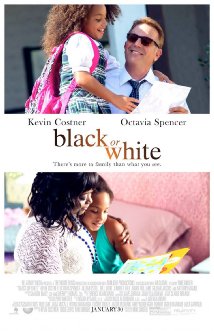 It is this complex, complicated, and dire reality that hobbles another movie that tackles modern-day race relations, Mike Binder’s imprudent Black or White. The plot of the film, inspired by a true story reportedly, centers on Kevin Costner as Elliot Anderson, a rich lawyer who has custody over his biracial granddaughter Eloise (the angelically adorable Jillian Estell). Now that Elliot has lost his wife, Eloise’s other grandmother, Rowena Jeffers (Octavia Spencer), wants joint custody so Eloise can spend time around “her own people.” The two of them push and pull and lock horns over what’s best for their grandchild, which gets more complicated when her biological father (Andre Holland, who is actually in Selma as well) comes back into the picture.
Right away you can tell very early on that there will not be anything approaching subtlety in the world of Black or White, its own title serving as the first clue. The characters are sketched broad and the premise feels like a weird mishmash of Archie Bunker appearing in a court drama. It’s a preachy movie that doesn’t have a deft hand when it comes to crafting a message that rises above easy observations disguised as something deeper. Eloise’s father, Reggie, is so poorly underwritten that he feels like he stepped off the set of some after school special. He’s addicted to crack, a lifelong screw-up, and a general disappointment that has never been present for his daughter’s life. He even smokes crack out in the open on the front porch across the street from where his mother lives. At one point, Anthony Mackie’s character berates Reggie for being a walking stereotype. Just because Binder calls attention to it doesn’t excuse it. But he’s not alone, because Spencer’s sassy black matriarch character and Costner’s gruff and frequently soused character are right there with him. The frequent arguments feel like they should be punctuated by studio audience hoots and applause, that is, if you could hear them over Terrence Blanchard’s relentlessly overpowering musical score instructing the audience exactly how to feel with every clunky moment.
 In a way, the overbearing musical score gets at the major problem of Black or White, which is that a complicated case is being told from the safest point of view. Elliot is more akin to Clint Eastwood’s character from Gran Torino then, say, Archie Bunker. He’s irritable and prejudiced and old-fashioned and wary but balks if you call him a bigot. I mean he’s polite to his Hispanic housekeeper. The more you examine the character the more you realize this is a movie designed to coddle an older generation (my tiny theater was packed with patrons over 60). The movie doesn’t challenge anybody and actually rewards Costner’s character and his outdated viewpoints. The opening conflict over his refusal to share custody with Rowena makes no sense. She’s an excellent grandmother, caring, nurturing, a fine role model as well for her perseverance and starting several small businesses out of her home. Not only that but Rowena is surrounded by a large family of relatives that adore Eloise. It’s contrived that these two could not agree on shared custody when they both have much to offer the girl. The only way any of this works is if Reggie is somehow responsible for the death of Eloise’s mom. Perhaps he introduced her to crack and she overdosed. Unfortunately, it’s never explained in the slightest, and so Elliot’s hostility for the entire Jeffers clan seems petulant, especially with the happiness of his granddaughter in the balance. Without better context, his rampant anger seems to be guilt-by-association overkill. To his credit, Rowena has a major and annoying blind spot when it comes to Reggie’s stability as a parent. In fact he’s so obviously still on drugs that her ongoing refusal to accept reality harms her character irreparably.
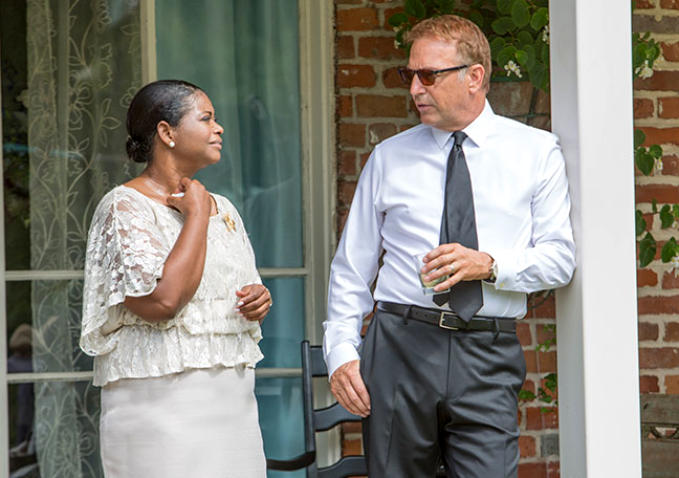 In the end, Black or White isn’t so much a film that about race relations as it is about privilege. Costner’s would-be bigot doesn’t have a problem with black people, just as long as those black people abide by his rules of conduct and expectation. It’s the same kind of qualification he’s never had to consider for himself, and one the intended audience will likewise miss. He comes from a wealthy position and Rowena and her family are likely lower middle class at best. He has a world of class privilege at his disposal that the loving Jeffers family does not, and because of that he feels they are less suited to raising little Eloise. Perhaps he’s worried about Reggie re-entering her life, but what animates Elliot Anderson is spite. He’s consumed with the overriding assumption that he must be right in all things. While the film draws many heavy-handed parallels between Reggie’s drug abuse and Elliot’s alcoholism, it clearly presents the both of them on completely different planes of judgment. One of them is ultimately redeemable and the other less so. Elliot’s perspective is essentially he can provide more and therefore more has to be better, but his definition of more is a private school, a housekeeper, a tutor who is treated as a caricature of initiative. Rowena provides a large and loving support system, but apparently they are less valued in the eyes of Elliot. And if you needed any more of a clue that Elliot and his sense of privilege are the unbeknownst star of the movie, he gets to deliver the big speech at the end that Says Something Meaningful. It feels a bit odd that the one character that uses the N-word in the film (albeit there is context) is the one telling lower-class black families how to live.
I don’t doubt the sincerity of writer/director Mike Binder (The Upside of Anger); I don’t think he purposely made a film to make older, primarily white Americans feel better about thinking what they do about these troublesome times. It’s not a nefarious movie but it is misguided and will provide cover for a certain selection of audience members who wonder why nobody is asking the old white guys their opinions on modern race relations. Even overlooking this charge, Black or White is just overblown melodrama that has to constantly explain everything to you at all times and guide you through every strained point. Selma and Black or White are both aiming at hearts and minds, looking to add to the conversation on contemporary race relations, but only one of them works as both an eye-opening message of empathy and as an exceptionally made film itself.
Nate’s Grades:
Selma: A
Black or White: C
Share this:

The Incredible Hulk (2008)
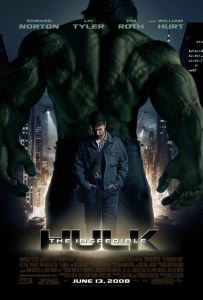 Maybe the American public just doesn’t care for the jolly green giant. The second incarnation of a big screen Hulk flick is better paced, with more action sequences and better special effects, but I just kept shrugging my shoulders the whole time. I was never truly engaged by the movie at any point. Edward Norton fills the role of Bruce Banner for the second go-round and does an admirable job. The climax involving one giant CGI monster battling another giant CGI monster gets tiresome. This is a fairly middle of the road movie that might pass the time but does little else with style.
Nate’s Grade: C+
Share this:

Planet of the Apes (2001)
 Taking a storied, and for the most part successful, franchise like Planet of the Apes and trying to rework it is frightfully difficult. You don’t want it to turn off the original’s fans but not be different enough to have its own voice. When I heard that Tim Burton was going to helm this reworking I became optimistic about the prospects of a Burton Planet of the Apes and began to eagerly anticipate its release. What I got, despite some stellar visuals, is a disappointing low point for many people involved, and that does include the man that gave us “Good Vibrations.”
Capt. Leo Davidson (Mark Wahlberg) is a trained pilot inhabiting a space station orbiting the rings of Saturn. The members inside are performing tests on the intelligence of apes (foreshadowing poking you in the eye) and seem to be coming back with optimistic results. A cosmic energy storm erupts near the station and Leo’s chimp is sent out into a pod to investigate. When the ape disappears (oh the foreshadowing is starting to hurt) Leo decides to venture out himself to save his monkey despite the instructions of his superiors. He gets pulled into the energy field and crashes on a distant planet where he discovers that apes are on top of the food chain and humans are the sport. Captured by the ape commander Attar (Michael Clark Duncan), he is taken to Ape City. He is sold into slavery but wins the attention of a human rights activist Ari (Helena Bonham Carter) who agrees to help him escape and get to his crashed vessel. General Thade (Tim Roth) still carries a torch for Ari but has an entirely different viewpoint when it comes to humans. At one moment he grabs Wahlberg and pulls apart his mouth to murkily inquire “Is there a soul in there?” When Thade begins to learn about Ari’s assistance to the human escape he mounts a full army to travel to the Forbidden Zone and annihilate the humans once and for all.
 Burton’s Apes remake, excuse me… “re-imagining,” lacks the social commentary, originality, and heck, even entertainment level that its predecessor possessed. Burton adds his usual great touches of style and the sets are vast and a wonder to see, but what movie is all set watching? This isn’t the simian Home and Garden channel. Burton dresses his players up nice thanks in part to Rick Baker’s fantastic makeup but the components in Apes redux are all dressed up with nowhere to go.
The script is credited to four writers but I wonder why anyone would want to take any credit for it. The story is not only half-baked it seems to never have come out of the oven. The tale is full of numerous incongruities that make this new Apes feel stagnant, especially during its middle portion. The story never gives us any real characters or an exciting line to follow. It’s more like a story pitch than a full story. There are many moments where dialogue is paraphrased from the original in an attempt at a humorous wink, but it’s worthy of more groans than applause.
Unlike the first Apes series, the humans of Burton’s ape world can speak… they just don’t have anything interesting to say. Estella Warren fills in as the good looking and useless heroine that spends her days frolicking about in ripped rags. She’s supposed to be the love interest for Mark but she fails at that (even though she’s the planet’s only attractive female) with Carter getting more googly eyes cast her way. There’s something weirdly natural seeing Kris Kristofferson as a scrubby post-apocalyptic dweller. It seems like he was made to lurk through caves and grunt. Wahlberg himself seems to sleepwalk through the entire film and speaks in only one monotonous tone.
Roth gets to huff and puff a lot and does quite a good menacing job. Every expression of his has a dominating glare of power and every piece of dialogue spoken in a gruff snarl. He has total capture of a great villain and serves his end well enough as the story provides. Carter gives a light touch as the sympathetic human defender but the long awkward moments where her and Mark gaze at each other gave way to great howls from my audience. Giamatti hams up his role with verve and provides some of the best moments of levity for this overwrought film.[
The original Planet of the Apes ending was one of the greatest twists of cinema. It was entirely logistical and packed a great punch. The ending of Burton’s “re-imagining” packs as much punch as a wet noodle. The ending is TOTALLY IMPOSSIBLE given the set-up of the events in the film. Not only is it a disappointing head-scratcher but ]it also manages to rip off the first film’s ending with no shame. It truly may be the worst ending possibly ever. I bet a room full of monkeys could have written a better ending, and I’m willing to put money on it.
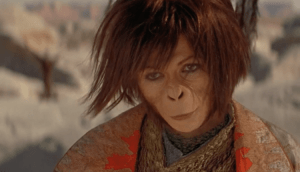 Let me explain why it’s impossible through the use of spoilers. So Mark is in the future. He follows his little monkey friend and crash lands on a separate planet IN THE FUTURE. On this planet, Mark’s space station has been looking for him and crash landed. Their monkey experiments get loose and bing, bang, zoom, we got fully evolved monkeys ruling the place (don’t even bother asking where the horses came from). Now, after learning all this, Mark takes a space pod and zooms his way back to present day Earth. He crash lands against the Lincoln Memorial steps only to discover that Lincoln has been replaced with General Thade and Earth is populated with highly evolved apes that still speak English. What? How? What? This cannot be because the film establishes a frame where Earth already has a long history of non-evolved monkey rule. Wahlberg crash landed on a DIFFERENT planet in THE FUTURE that should, therefore, have no bearing whatsoever on what happens to Earth or its past. The Apes remake rips off the most famous twist ending ever by serving up an incongruous version that makes no sense and cannot happen.
Planet of the Apes had all the right components for an exciting and sleek sci-fi ride but falls far short. Burton adds enough of his Gothic vision but this will likely go down as the weakest film on his resume. The usually reliable Danny Elfman’s score is nothing more than hyped up symphonic white noise. Burton may go home with a large check but I pray they don’t do a “re-imagining” of the next Apes picture. Marky Mark and the Furry Bunch are stuck in a hollow, head-scratching bore. Fans of the original series may find interest in comparing and contrasting, but if that’s cause enough to make a film then give me 100 bucks and I’ll make my own versions in my backyard. And they’ll at least make more sense than this monkey mess.
Nate’s Grade: C


 nathanzoebl
You must be logged in to post a comment.