Blog Archives
Hail, Caesar! (2016)
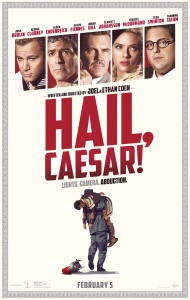 The biggest enemy of the celebrated Coen brothers always seems to be expectations. I count only two misfires during their storied filmmaking careers, but sometimes their larks are pilloried for not quite measuring up to their masterpieces. Hail, Caesar! is on par with Burn After Reading and O Brother, Where Art Thou? It’s still a fun, fizzy, and entertaining film and a celebration of Old Hollywood and its movie magic. Loosely centered on an embittered studio head (Josh Brolin), the film is a series of vignettes highlighting different 1940/50s pastiches, including the realms of Esther Williams, Carmen Miranda, Gene Kelly, and John Wayne. If you’re a fan of the old Hollywood pictures and their stars, the indulgences will play better; you can certainly feel the warmth the Coens have for the films of yesteryear. The plot kicks off with a major star (George Clooney) kidnapped, but it’s really the small side stories and moments that are most memorable, and the Coens are still unbeatable when it comes to being silly and clever. I loved a scene where Brolin asks religious advisors for approval over the script of his biblical epic and they offer legitimate notes over flawed story logic. There’s also a delightful song and dance numbers with a group of sailors lamenting the lack of ladies (“But mermaids ain’t got no gams”). The real star of the movie is Alden Ehrenreich (soon to be young Han Solo) as singing cowboy-turned-actor-turned-studio-sleuth. The sequence where his character tries to rapidly adapt into a “serious actor” on the set of some British melodrama makes for great fish-out-of-water comedy, gamely matched by an increasingly exasperated Ralph Fiennes as the director. The ending doesn’t exactly tie everything together but Hail, Caesar! is more a movie of distractions, of spinning plates, or bumbling bosses trying to hide bad behavior from the press and keep hold of their sanity. If you’re a fan of old Hollywood, there should be just enough to make you smile. If you’re not a fan, then you’ll shrug off the Coens and their latest film lark.
Nate’s Grade: B
Share this:

Snowpiercer (2014)
 I have seen Snowpiercer twice and it’s still a hard movie to describe. It’s the English-language debut of Korean filmmaker Joon-hoo Bong, notable for The Host (the good one) and Mother. It’s based upon a French graphic novel only printed in France and South Korea. It’s an international production, filmed in the Czech Republic, and populated with recognizable actors like Octavia Spencer, Tilda Swinton, John Hurt, Ed Harris, and Captain America himself, Chris Evans. It’s a dark dystopian allegory about class warfare, it’s a stunning sci-fi action movie, it’s a parable about humanity, it’s a stylish thriller that puts most of Hollywood to shame; it’s many things, chief among them, an incredible movie that demands to be seen on the big screen when able.
To combat global warming, world leaders disperse a chemical to lower temperatures, and oh boy does it work, inadvertently causing a new Ice Age that kills almost all life on the planet. Almost, because a few hundred got aboard the train owned and operated by Wilford (Harris), a rich and secretive industrialist. He built a train that can circle the globe, running on a perpetual motion motor. The last of humanity is housed on Wilfrod’s train. After seventeen years aboard, the class system has become rather rigid. The important and wealthy are at the front of the train, and the poor are crammed in the back, given gelatinous protein blocks to eat, and kept in line by armed guards. Curtis (Evans) is plotting a revolt, biding his time, consulting with the wise Gilliam (Hurt), an aging leader missing several limbs. Together, they storm ahead, capturing effete Wilford spokesman Mason (Swinton) as a hostage, rescuing an engineer (Kang-ho Song) with a drug addiction who will help them open the train cars, fighting car by car to take control of the train. Naturally, those in power fight back in force to maintain the uneven status quo.
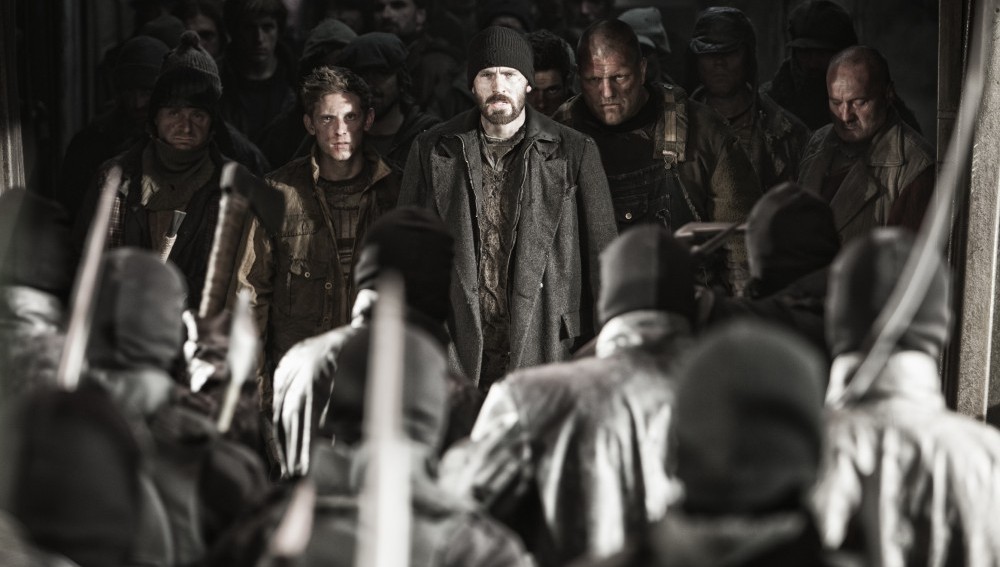 Short of the adrenaline-soaked Raid 2, there hasn’t been a better action movie this year than Snowpiercer. It starts slow, drawing the audience in, setting up its initial burst as a prison break of sorts where the tail section passengers have to figure out a way past the guards and several security doors open for only a few seconds. When the break does happen, in a clever fashion, you feel the full rush of the new opportunity thanks to the movie properly setting up the stakes and obstacles. Each new car presents a new world and a new obstacle. There’s one car where Curtis and his revolutionaries are met with fifty ski-mask wearing grunts with axes. This is the standout action sequence because of how it keeps changing. At first its brawn versus brawn, complete with swinging axes. Then the fighting stops briefly and all the grunts put on night vision goggles. The train enters a long tunnel, condemning Curtis and company to the dark. The grunts then go to town, spearing and slashing the hapless passengers blindly swinging in the dark. I won’t spoil the solution to this scenario but it too is properly set up and leads to some extremely satisfying action imagery, the kind of stuff that pops in a trailer. There’s an entirely different sequence later that also stands out. As the train goes into a long curve in the track, certain train cars are visible from others. Our chief heavy, listed as Franco the Elder (Vlad Ivanov), sees Curtis in the car ahead and starts firing. Eventually Curtis and Franco blast small holes in the protective glass and wait, wait for their moment, for their shot. It’s a tense neo-Western standoff moment, and another delightful addition. The accumulative action has a surprising degree of variety and development.
Snowpiercer is a stirring action movie that keeps your eyes glued to the screen, but it does an equally impressive job of building its world and adding dimension to its storytelling. Reportedly, Harvey Weinstein wanted to cut twenty minutes out of the 126-minute film, but I’m puzzled as to where those edits would come. Every scene in this movie drives the film forward or imparts crucial pieces of information or metaphor that will play out later. Even something as comical as stopping for sushi in the aquarium car (balancing the ecosystem) has greater meaning and subtext when you look back at the film as a whole. Joon-hoo Bong and his co-screenwriter Kelly Masterson (Before the Devil Knows You’re Dead) have given serious consideration to how this world operates and what life would be like when all of humanity is confined to one long train. The past is revealed incrementally, gingerly allowing the audience to become consumed with this odd dystopian landscape, our fascination brewing with each new puzzle piece being added. I was enthralled with the rich details, the cruel methods of keeping those in the tail section in line, the regular head counts, the protein block bars and what they truly are made of, the annual celebration of passing a certain bridge marking their own New Year, and especially the deification of Wilford. The characters worship the engine, and why not since it is the source of life for them, or as the chirpy schoolteacher (Alison Pill) sings: “What happens if the engine fails? We all freeze and die!” The later reveals are the best, giving full explanation why tail section children are important and, particularly, why Curtis is so ashamed at having two good arms. That monologue by Evans, looking back on the earliest and most cruelly chaotic days on the train, is a whopper. I truly hope that aspiring actors will use it during future auditions. It will make an impression.
 Its dark sense of humor and political and philosophical subtext provide an even richer texture to this strange, bleak world. The political commentary isn’t exactly subtle, I’ll admit, but it’s exceedingly better executed and integrated into its plot than, say, last year’s Elysium. The class-consciousness provides a greater depth to the proceedings, providing a new spin on the have/have nots that’s just as relevant today. It’s not just tacked on, either. The political commentary is intertwined with the mechanics of the plot, as we’re witnessing class warfare against inequality, how barbarous acts can be co-opted for personal gain. When Curtis and his small company finally reach Wilford and the engine, it’s a moment akin to visiting the Wizard in Oz, the man behind the curtain they’ve heard so much about. There’s a great degree of incredulous humor from Wilford’s vaulted perspective, but the longer you listen, the more you start to follow his twisted logic and why exactly the status quo must be upheld despite the bloody consequences. Then there’s the macabre humor, which can be bracing at points, none more so than the school car sequence with Alison Pill (TV’s The Newsroom). Also doing plenty of comedic heavy lifting is Swinton (Only Lovers Left Alive, We Need to Talk About Kevin) with such an odd authority figure character. With a mouthful of fake teeth, some owlish glasses, and a peculiar speech pattern, it feels like she stepped out of a Terry Gilliam movie, and we’re all the better for it. Often she’s the only source of humor in what is otherwise a dreary story about the strong preying upon the weak.
Stylish, intelligent, rewarding in surprising ways while still being thoroughly entertaining, with tremendous technical attributes such as production design, Snowpiercer is a sci-fi flick that borrows from many but creates its own unique and enthralling landscape. Rare is the movie going experience where you sit at the edge of your seat, completely taken in by the creativity of the artists at work, transported to somewhere new and exciting, and you dread the approaching end credits. Snowpiercer is an experience that’s hard to describe beyond an unrelenting checklist of positive, glowing adjectives. Simply put, it’s movies like this that make going to the movies special.
Nate’s Grade: A
Share this:

The Grand Budapest Hotel (2014)
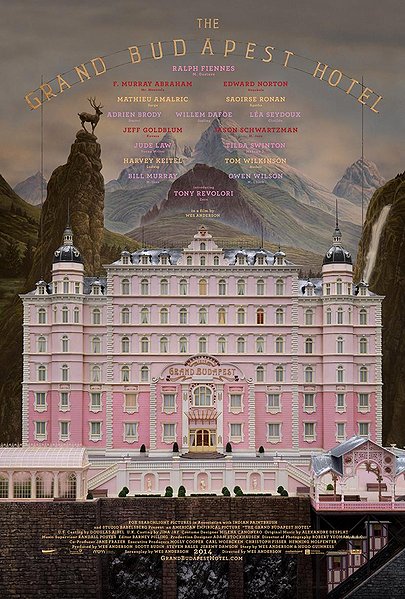 Wes Anderson is a filmmaker whose very name is a brand itself. There are a small number of filmmakers who have an audience that will pay to see their next film regardless of whatever the hell it may be about. Steven Spielberg is the world’s most successful director but just having his name attached to a movie, is that enough to make you seek it out and assume quality? If so, I imagine there were more than a few disappointed with War Horse and Kingdom of the Crystal Skull. But Wes Anderson has gotten to that height of audience loyalty after only seven movies, mostly because there are expectations of what an Anderson film will deliver. And deliver is what the quirky, fast-paced, darkly comic, and overall delightful Grand Budapest Hotel does.
In the far-off country of Zubrowka, there lays the famous hotel known the world over, the Grand Budapest. The head of the hotel, the concierge, is Gustave (Ralph Fiennes), a highly mannered Renaissance man who caters to the every whim of his cliental. Zero (Tony Revolori), an orphaned refugee, is Mr. Gustave’s apprentice, a lobby boy in training learning from the master in the ways of hospitality. Gustave likes to leave people satisfied, including the wealthy dowagers that come from far just for him (Gustave: “She was dynamite in the sack,” Zero: “She was… 84,” Gustave: “I’ve had older.”). One of these very old, very rich ladies is found murdered and in her rewritten will, the old bitty had left a priceless portrait to Gustave. Her scheming family, lead by a combustible Adrien Brody, plots to regain the painting, which Gustave and Zero have absconded with.
 For Wes Anderson fans, they’ll be in heaven. I recently climbed back aboard the bandwagon after the charming and accessible Moonrise Kingdom, and Grand Budapest is an excellent use of the man’s many idiosyncratic skills. The dollhouse meticulous art design is present, as well as the supercharged sense of cock-eyed whimsy, but it’s a rush for Anderson to pair a story that fits snuggly with his sensibilities. The movie is a series of elaborate chases, all coordinated with the flair of a great caper, and the result is a movie over pouring with entertainment. Just when you think you have the film nailed down, Anderson introduces another conflict, another element, another spinning plate to his narrative trickery, and the whimsy and the stakes get taken up another notch. The point of contention I have with the Anderson films I dislike (Life Aquatic, Darjeeling Limited) is the superficial nature of the films. As I said in my review for Darjeeling, Anderson was coming across like a man “more interested in showing off his highly elaborate production design than crafting interesting things for his characters to do inside those complex sets.” With this film, he hones his central character relationships down to Gustave and Zero, and he can’t stop giving them things to do. Thankfully, those things have merit, they impact the story rather than serving as curlicue diversions. We get an art heist, a prison break, a ski chase, a murderous Willem Dafoe leaving behind a trail of bodies, not to mention several other perilous escapes. This is a film packed with fast-paced plot, with interesting actions for his actors, maybe even too packed, opening with three relatively unnecessary frame stories, jumping from modern-day, to the 1980s, back to the 1960s, and finally settling into the 1930s in our fictional Eastern European country.
The other issue with Anderson’s past films, when they have underachieved, is that the flights of whimsy come into conflict with the reality of the characters. That is not to say you cannot have a mix of pathos and the fantastical, but it needs to be a healthy combination, one where the reality of the creation goes undisturbed. With Grand Budapest, Anderson has concocted his best character since Rushmore’s Max Fisher. Gustave is another overachieving, highly literate, forward-driving charmer that casually collects admirers into his orbit, but he’s also a man putting on a performance for others. As the head of the Grand Budapest, he must keep the illusion of refinement, the erudite and all-knowing face of the luxurious respite for the many moneyed guests. He has to conceal all the sweat and labor to fulfill this image, and so he is a character with two faces. His officiously courtly manner of speaking can be quite comical, but it’s also an insightful indication that he is a man of the Old World, a nostalgic European realm of class and civilization on the way out with looming war and brutality. And as played by the effortlessly charming Fiennes (Skyfall), Gustave is a scoundrel that the audience roots for, sympathizes with, scolds, but secretly desire his approval, much like Zero. It is a magnificent performance that stands as one of the best in any Anderson film.
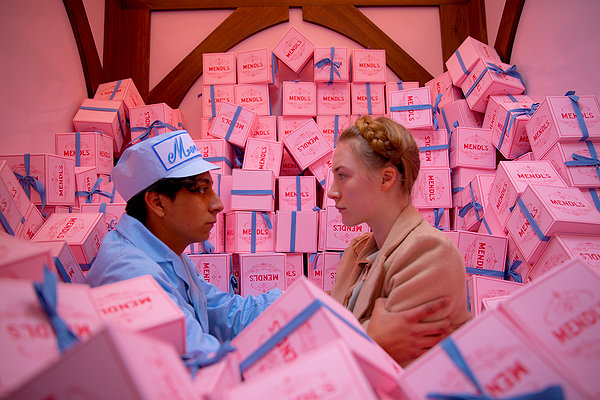 The fun of a Wes Anderson movie is the zany surprises played with deadpan sincerity, and there is plenty in Grand Budapest to produce smiles and laughter. It’s hard to describe exactly which jokes land the best in a Wes Anderson film because they form a patchwork that elevates the entire movie, building an odd world where oddballs can fit right in. It was under a minute before I laughed, and I smiled through just about every remaining minute of the film. I enjoyed a joke involving a dead cat that just kept being carried from scene to scene. I enjoyed a sexually graphic painting that just happened to be lying around. I enjoyed the fact that Zero draws on a mustache every morning to better fit in with the men of his day. But mostly I just enjoyed the characters interacting with one another, especially Gustave and Zero, which forms into the emotional core of the film. It begins as a zany chase film and matures as it continues, tugging at your feelings with the father/son relationship (there’s also a subtly sweet romance for Zero and a pastry girl played by Saoirse Ronan). One of the big surprises is the splash of dark violence that grounds the whimsy, reminding you of the reality of death as war and fascism creep on the periphery. In fact, the movie is rather matter-of-fact about human capacity for cruelty, so much so that significant characters will be bumped off (mostly off screen) in a style that might seem disarming and unsatisfying. It’s the mixture of the melancholy and the whimsy that transforms Grand Budapest into a macabre fairy tale of grand proportions.
The only warning I have is that many of the star-studded cast members have very brief time on screen. It’s certainly Fiennes and Revolori’s show, but familiar names like Bill Murray, Tilda Swinton, Tom Wilkinson, Jeff Goldblum, Lea Seydoux, Jude Law, Harvey Keitel, Jason Schwartzman, Owen Wilson, F. Murray Abraham, and Bob Balaban are in the film for perhaps two scenes apiece, no more than three minutes of screen time apiece. Norton, Brody, and Dafoe have the most screen time of the supporting cast. Though how does Revolori age into the very non-ethnic Abraham? It reminded me of Street Fighter: The Legend of Chun-Li (here me out) where, as she ages, Chun-Li becomes less and less Chinese in her facial appearance. Anyway, the brevity of cast screen time is not detrimental to the enjoyment of the film, considering all the plot elements being juggled, but I would have liked even more with the dispirit array of fun characters.
The Grand Budapest Hotel is Wes Anderson at his best, pared down into a quirky crime caper anchored by a hilariously verbose scoundrel and his protégé. Naturally, the technical merits of the film are outstanding, from the intricate art direction and set dressing, to the period appropriate costumes, to the camerawork by longtime cinematographer Robert Yeoman. The movie is a visually lavish and handcrafted biosphere, a living dollhouse whose central setting ends up becoming a character itself. The trademark fanciful artifice is alive and well but this time populated with interesting characters, a sense of agency, and an accessible emotional core. The faults in Anderson’s lesser films have been fine-tuned and fixed here, and the high-speed plotting and crazy characters that continually collide left me amused and excited. If you’re looking for a pair of films to introduce neophytes into the magical world of Wes Anderson, you may want to consider Grand Budapest with Moonrise Kingdom (Royal Tenenbaums if they need bigger names). In the end, I think Anderson more than identifies with his main character, Gustave, a man enchanted in a world of his own creation, a world better than the real one. Who needs the real world when you’ve got The Grand Budapest Hotel?
Nate’s Grade: A
Share this:

Moonrise Kingdom (2012)
 It feels good to be a Wes Anderson fan once again. The indie auteur has a very distinctive style that he seems to have little regard in altering. I’ve been critical of Anderson’s idiosyncratic style, comparing it to crafting wonderfully composed, intricate dollhouses minus compelling or relatable characters to inhabit these artfully constructed mini-worlds. Without that necessary element, it’s all just fancy window dressing. Finally, Anderson, with Moonrise Kingdom, has concocted another movie where the characters grab more of your attention than the backgrounds.
Set in 1965 on a small island just off the New England coast, the movie follows the adventures of Sam (Jared Gilman) and Suzy (Kara Hayward), both twelve years old. Sam has run away from his summer camp, the Khaki Scouts, led by Scout Master Ward (Ed Norton). Suzy has run away from her parents (Bill Murray, Frances McDormand). The small island’s one police officer, Captain Sharp (Bruce Willis), enlists the help of several Khaki Scouts he deputizes to find the missing duo. It’s revealed through a serried of letters, and flashbacks, that Sam and Suzy have been plotting their escape for over a year. They’re in love, and they’re going to make sure nobody interferes.
 What more relatable than young love? Sam and Suzy just want to be together and the rest of the adult world seems intent on keeping them apart. Right away you’re pulling for these kids, rooting for their triumph, and the movie does a fantastic job of replicating the innocence of young love without overly romanticizing a very nervous, awkward time in life. When Sam and Suzy practice kissing, for what is obviously the first time, I defy anyone sitting in the audience not to feel a recognizable pang of insecurity. The experimentation is a tad more realistic than you might expect with the PG-13 rating but still nothing to shatter the youthful innocence of the picture. There is not a tawdry moment in Moonrise Kingdom. It’s a time in life when the knowledge of sex existed without a keen understanding of sensuality, like in Miranda July’s Me, and You, and Everyone We Know. It’s more like fumbling around with what you think is appropriate activity. Still, the fact that the movie features twelve-year-olds in their underwear dancing and mildly experimenting means Moonrise Kingdom might draw a swath of ticket-buyers for the wrong reasons (beware the patron in a raincoat).
The scrupulous attention to detail is the same obsessive quality you come to expect from a Wes Anderson movie. He builds living worlds and his color schemes and shot arrangements add much texture to this idiosyncratic landscape. Unlike Life Aquatic and Darjeeling Limited, these artistic elements work in harmony rather than conflict; Anderson actually seems to care about the people here. Chances are if you’re not a Wes Anderson fan, Moonrise Kingdom will probably not be the movie to win you over. The whimsical, storybook nature of the film actually accentuates the broader themes; bright-eyed exploration, the magic of possibility with love, and an unyielding hope. The movie feels like one of Suzy’s storied adventures come to life but without compromising the relatable character conflicts. The movie does build a nice head of steam thanks to the pursuit of our runaway romantics. There’s also a palpable sense of danger lurking, as the kids risk life and limb and even experience death, albeit a dog (Suzy: “Was he a good dog?” Sam: “Who’s to say?”). It’s a poignant tale of childhood but it doesn’t feel childish, a family film meant for people probably too young for families.
Moonrise Kingdom walks a fine line between whimsical and overly precious. Less skilled filmmakers haven fallen suit to making insufferably twee film productions consumed by their own indulgent sense of preciousness. Moonrise Kingdom is full of the typical Anderson quirk but it doesn’t overpower the narrative or define the characters in such limited personal scopes. There’s plenty of laughs to be had with the film, most in the wry chuckle variety; I was laughing throughout, finding those staple peculiar touches to be the most amusing, from the Scout Master reading a magazine titled “Indian Corn,” to Bob Balaban’s questionably omniscient narrator, to some improvised natural earrings.
The movie is consistently funny but also far sweeter than I would have imagined given the detached, arch nature of Life Aquatic and The Darjeeling Limited. Again, the kids are precocious and the adults act more like children, but everyone is really hurting and lonely and looking for a means of coping or persevering, with the biggest source of pain being love; the longing, the ache, the uncertainty of when and if it will return. Usually Anderson’s films involve dysfunctional families mending some degree of their brokenness by film’s end and formulating a connection. With Moonrise Kingdom, the plot is on two kids falling in love and their will to endure. I appreciate that Anderson and co-writer Roman Coppola (Darjeeling Limited) do not trivialize or look down upon the relationship between Sam and Suzy (“Oh, it’s just puppy love you silly, naïve, waifs.”). To them it feels like everything. The tender approach to young love opens the film up to a broader audience without compromising the director’s unique vision. I’d hardly say the film approaches overt sentimentality. What’s there feels earned and more reserved than what we might expect from burgeoning romance. When the expressions of affection occur, they have greater weight and make a greater impact charming the audience.
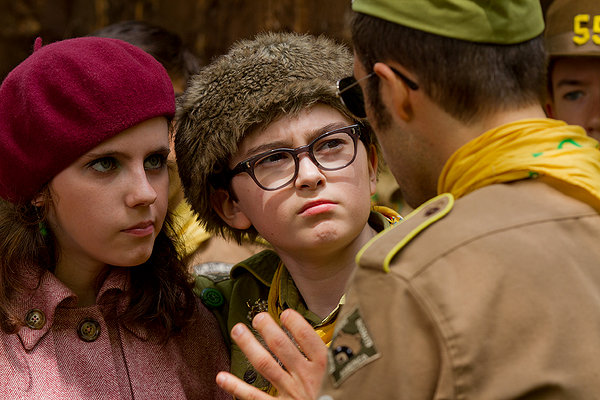 The first-time child actors do a credible job with carrying the film. Hayward and Gilman are charming and easy to like, though I wish Anderson had pushed his young actors a tad harder. They seem stiff at times and a little above-it-all in attitude. I applaud the kids for acting somewhat reserved rather than going crazy with their budding hormones. Both characters are also characterized as “emotionally disturbed,” though this seems like another of the film’s damning details about the out-of-touch adults dictating their lives. I just wished we sensed a greater degree of urgency from them about this whole adventure and the possibility of losing one another. They feel a tad blasé, all things considered.
The bigger celebrity names in the cast assume smaller roles, and many of the supporting characters are thinly sketched with personal conflicts mostly kept at a simmer. These are grownups that, at their heart, don’t know what to do with their feelings. Sam and Suzy feel liberated by their feelings. I found Murray’s blustery sense of anger amusing, and Willis does some subtle work to give you a sense how truly lonely his character is to the core, but it’s Jason Schwartzman (Scott Pilgrim vs. the World) who steals the show in my book as the fast-talking, mercurial, scheming Cousin Ben who seems to have whatever somebody needs. When he agrees to marry Sam and Suzy and acknowledges that their marriage will not be deemed official under any court whatsoever, you get a sense that Moonrise Kingdom has been missing a propulsive and delightful character like Cousin Ben. I wish he had been inserted earlier, but this is Sam and Suzy’s movie, after all.
It’s not on the same level as Rushmore of The Royal Tenenbaums (my favorite Anderson films), but it’s a film that feels a lot more alive and emotionally resonant. It feels like a return to form for Anderson, remembering that the characters and their drama need to be as engaging as the set design. The turbulent young love of Sam and Suzy is sweet and leads to some tender yet poignant moments that warm the heart without making you overdose on cheap sentiment. The idiosyncratic touches are all there, the ironic humor, and the stellar soundtrack selection (Benjamin Britten’s deconstructive orchestral marches stand out as a thematic core), everything you’d expect from a Wes Anderson movie, except this time you’ll find the characters recognizable, their struggle compelling, and the end rewarding. Moonrise Kingdom isn’t the most substantive film playing in theaters but damned if it isn’t the most alluring, amusing, and affectionate, yet all on its own terms. Who would have guessed that a pair of twelve-year-olds would help us show what real love is in 2012?
Nate’s Grade: A-
Share this:

We Need to Talk About Kevin (2011)
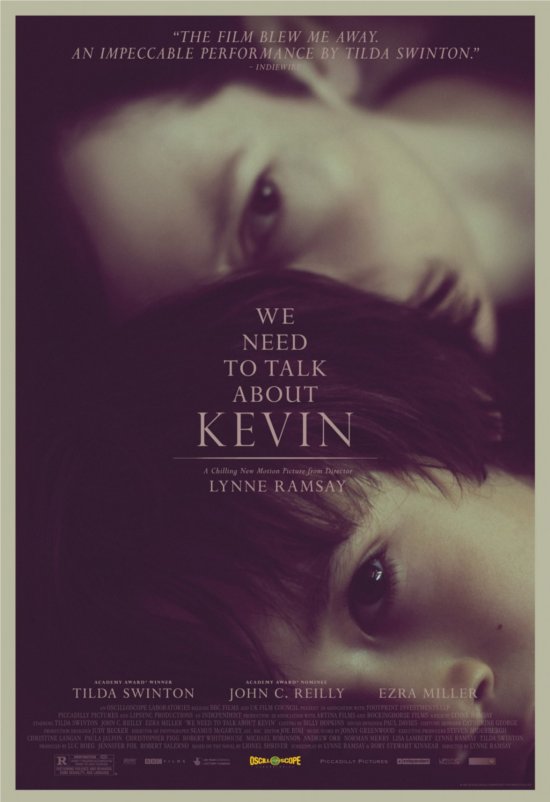 If you’re contemplating having children, then We Need to Talk About Kevin may not be the movie for you at this moment. It takes a stab at the nature/nurture debate and proposes that some children are just born broken and beyond the reach of even the most dedicated parent. It’s not exactly the cuddly message we get from most stories about the joys of parenting, but We Need to Talk About Kevin is a startling, provocative, and powerful portrait of grief, aggravation, and slowly dawning horror. Can even a mother love her monster?
Motherhood has not been the rewarding venture as promised for Eva (Tilda Swinton). Kevin (Jasper Newell at a child; Ezra Miller as a teen) wails so incessantly as a baby that she seeks out the sweet sounds of a jackhammer to drown out her shrieking babe. Even as a toddler, she knows there’s something just not right about her sullen, uncommunicative son. He seems to deprive her of any affection or attention she might find gratifying. Truly it seems much of Kevin’s motivation in life is to humiliate and torment his mother. It starts with being deliberately unresponsive as a child, and turning on a dime when in the presence of his father, then to delayed toilet training because he seems to enjoy making his mother clean up his mess (metaphor?), to the unexplainable massacre at her son’s hands. We Need to Talk About Kevin is an immersive experience, occasionally piling on how irredeemable Kevin is as a character. It also speaks to the unreliable nature of our shell-shocked point of view. It’s a disquieting film to say the least but I found it riveting and compelling at every second, artfully exploring a form of grief and social isolation that few will ever be able to fully understand.
 There’s tremendous psychological detail to this nightmarish parenting tale, and it’s those details that make the film feel eerily authentic and not exploitative. I found it fascinating to be drawn into this world, like I was watching an intimate, illustrated case study come alive. I found it very telling that after Eva accidentally injures her son in a fit of frustration, she apologizes but can only bring herself to do so under the shield of third person, saying, “Mommy shouldn’t have done that,” rather than, “I shouldn’t have done that.” And then when they get home, little Kevin unspools a perfectly believable story to cover-up what really happened. Even at six this kid is a shockingly adept liar, possibly because he’s a budding sociopath. Horror movies have been bringing us little pint-sized terrors for decades, from Bad Seed to the Village of the Damned, but those wicked kids seem like child’s play compared to Kevin, a startling, vacant child who is the scariest of the bunch exactly because he feels completely real. No Satanic imagery, glowing red eyes, or over-the-top associations needed; this is one messed up kid.
Watching this tumultuous and combative struggle for domination is equal turns compelling and terrifying. In many ways Eva adopts the role of Cassandra, the Greek figure cursed with visions of the future that nobody believed; Eva warns the people in her life that Kevin isn’t right, that he’s entirely capable of great evil, yet everyone ignores her dire warnings, and even Eva is culpable to some degree of enabling. Rather than discipline Kevin or stick to her principles, she passively accepts the situation and carries on with full knowledge that Kevin is going unchallenged. To everyone else he seems like a bright, helpful, normal teenage boy, which is why dear old dad (John C. Reilly) is so condescending and dismissive when Eva voices concern. Parenting is supposed to be instinctive, right? Eva feels like a failure, that this young soul has been steered to the dark side under her watch, and I think her hesitation to continue ringing alarm can be summed up by the fact that she’s just exhausted, tired of fighting a fight that everyone else ignores. I think she may also be desperately hopeful that she can ride this out, that it’s only a phase for her son, that somehow he’ll grow up to be a normal, loving child through some miracle, like a switch will be flipped. The only time Kevin ever shows his mother compassion is when she reads him a bedtime story involving archery, a hobby that would prove deadly.
The film is told non-linearly as we observe the fragmented memory of Eva. We have to pick up the pieces of life much like Eva recovering from her son’s destruction. It’s interesting to discover the symbolic connections between scenes, the connective tissue binding the memories together, and director/co-writer Lynne Ramsay (Ratcatcher) does an exceptional job of filling in key details to enrich this woman’s horrid life. The scenes don’t seem to last long, but Ramsay and her team provide all the meaning and weight we need so that the scenes matter. There’s a heavy amount of dread suffused into every scene in this movie, as the totality of events starts to become clear. The metaphors aren’t subtle but they are effective. Prepare for a lot of red in the color palate: squashed tomatoes, strawberry jam, splattered paint across Eva’s front porch as an act of vandalism. She spends the rest of the movie trying to clean away the red stains on her home (see what I mean about subtlety?). The splintered narrative also serves as a statement on Eva’s frame of mind, trying to move forward but haunted by a tragedy that goes down to the marrow.
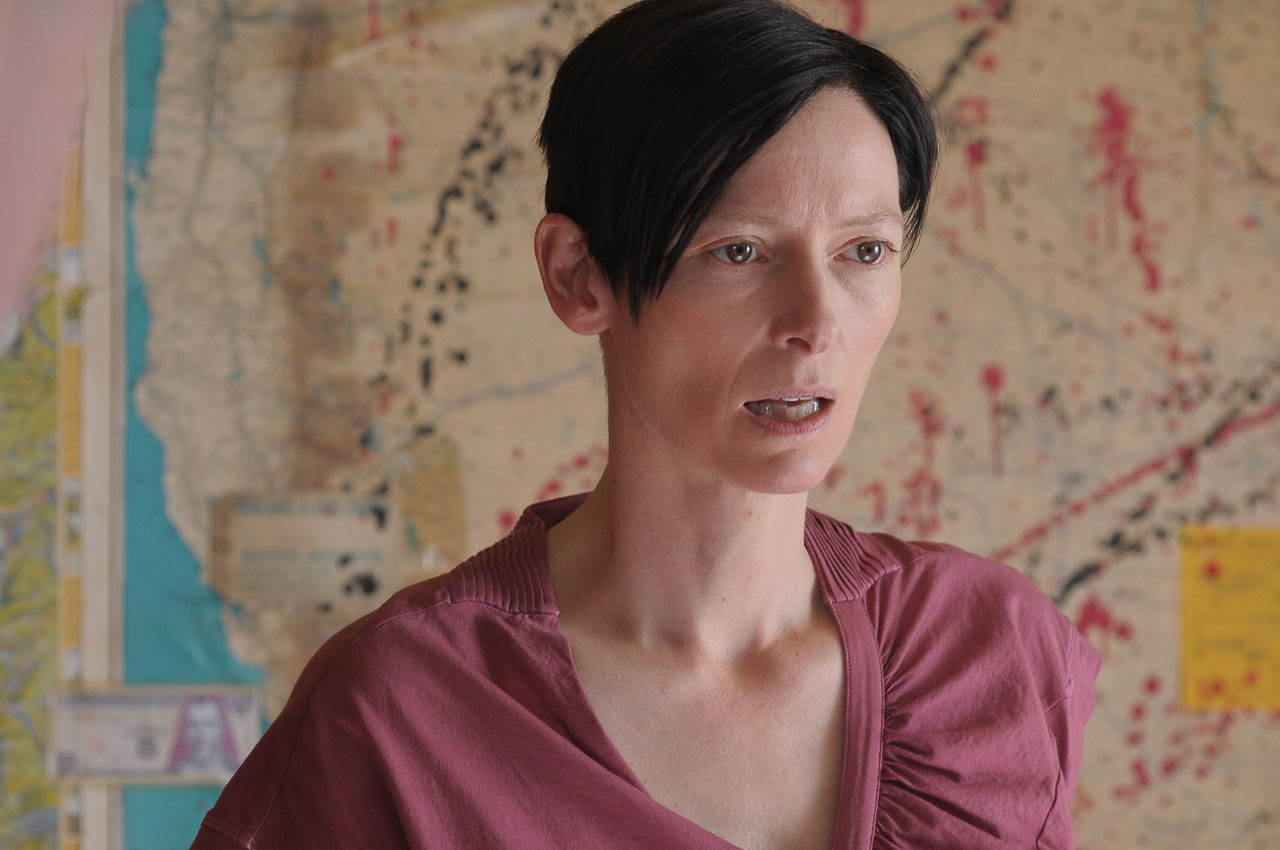 And of course all praise of the film needs to also be placed at he feet of versatile actress Tilda Swinton (Michael Clayton). She’s not given many lines of dialogue but what she is able to do to make her character feel fully lived-in is astonishing. There are so many different points of her life to play, from young exuberance to growing disdain to zombie-like pariah, and Swinton doesn’t strike one false note. Even during her grief and guilt she doesn’t go into hysterics. This is a woman that simply wants to waste away and be forgotten. Even when it looks like she might find some small measure of satisfaction or affection from another person, the movie sucker punches you. You realize that her son may be in jail but she’s serving a sentence all her own. Swinton is heartbreaking and subtle and nuanced even when it appears she’s simply staring off into space. You don’t really want to be in this woman’s head, and yet Swinton’s performance puts us there, hence all of my analytical assessment above. She’s a mixture of self-loathing, denial, bitterness, and penitence, and Swinton gives us telling glimpses of the storm below the surface. Her guilt is eating her away from the inside out. I’ll go on record and say it’s a crime that Swinton wasn’t nominated for a Best Actress Oscar (I personally apologize for not nominating her for the PSP Silver Cines).
I feel the need to talk and talk about We Need to Talk About Kevin, to sing its despairing praises, to encourage lovers of challenging, complex, and emotionally devastating film to experience this exceptional movie. It’s psychologically rich, bold, and revealing with even the smallest details to round out this hellish family scenario. It’s not an easy two hours to sit through, not by a long shot, but there are certain rewards for those who choose to wade through the darkness, Swinton’s haunting performance among them. This is a difficult subject and it’s produced a difficult film, but sometimes we need to be put in uncomfortable circumstances to get at a greater truth. What is the greater truth of the film? Maybe that parenting is really, when it’s all said and done, a leap of faith, maybe that avoidance of hard decisions is no solution, and maybe that some people are just beyond redemption. A movie that makes you think? Somebody ought to talk about this one.
Nate’s Grade: A
Share this:

The Curious Case of Benjamin Button (2008)
 This lavish and long-winded spectacle is curious, all right. Director David Fincher (Se7en, Zodiac) has all the technical wizards at his disposal to produce a near three-hour fantasy about life, love, and death. The Curious Case of Benjamin Button works around the bizarre gimmick of a man going through the process of aging backwards. It’s loosely based on F. Scott Fitzgerald’s short story, adapted by Eric Roth (Forrest Gump), and the results are befuddling. Benjamin is a handsomely mounted and incredibly expensive work engineered for one purpose: to win Oscars. Benjamin Button is a film that strives for making grand statements and wringing a maximum amount of tears, but it’s also a film that lives more in a series of moments than as a cohesive whole. It’s a fine piece of work but feels overburdened by its urgent desire to be profound.
Benjamin Button (Brad Pitt) is born on the day the first World War ended in 1918. He is born as a small infant that better resembles an 80-year-old man (in Fitzgerald’s short story he is born as a full grown old man, which means it must have been fun for his mother). Benjamin is aging backwards but his mind is still as it should be, so while he is all wrinkly, arthritic, and covered in liver spots, Benjamin is like other small kids who want to make friends. Benjamin’s father (Jason Flemyng) is horrified by his son’s condition and abandons him at the steps of a nursing center. Queenie (Taraji P. Henson) raises Benjamin as her own child and he grows up (down?) surrounded by a colorful cast of elderly residents (one woman remarks that a young-old Benjamin looks just like her ex husband). It is here that Benjamin meets the love of his life, Daisy (played by Cate Blanchett in her older years). She’s enchanted by Benjamin’s condition but she has her youth to live and Benjamin is left behind. Daisy becomes a trained ballerina and tours the world. Benjamin goes on a series of escapades, like working on a tugboat, traveling to Russia and having an affair with a diplomat’s wife (Tilda Swinton), and discovering his biological father and the family business of buttons. But he’s always been waiting for Daisy, and eventually they “meet in the middle.”
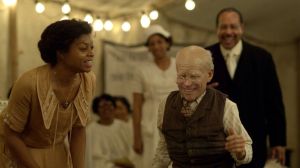 The very nature of the premise means that the movie isn’t going to have many pure, joyful moments. The idea of a romance that needs to take 40 years to connect, and even then has a limited shelf life before they go in their separate aging directions, is beautiful and heartbreaking. Waiting decades for a glimmer of your happiness with your mate, that’s a hard pill to swallow. Benjamin Button explores a similar situation covered by vampire-immortal romances, where you must endure watching your precious loved ones grow old and die. The entire movie radiates with an overwhelming sense of melancholy. The movie manages to find humor and grace amidst its melancholic dirge. The reflections on mortality are ever-present though rarely profound. It may not say anything new or original but it has many things to say about life, death, and the fleeting moments in between. By that notion, the film is structured so that the beginning, where Benjamin is a young old man, it’s more comic and beguiling, then as he and Daisy match up we finally get the pairing we’ve been pining for from the start. The pent-up passion provides great conflict, and then we barely get to enjoy the coupling before reality strikes. The final twenty minutes of the film, where old Daisy cares for old young Benjamin, are incredibly moving and have an indelible symmetry to them, watching an old lady lead a child by the hand.
 So then why do I feel so hesitant about fully accepting this movie? The story follows a similar Gump like pattern of incidents but the movie refrains from being mawkish. The main character is mostly passive with little personality; he’s nice but take away his unusual condition and not many folks would remember their time with Mr. Button. Before he gets with Daisy the film feels a bit episodic with the chapters of Benjamin’s life, and they are entertaining asides but they fail to amount to much more. Benjamin Button feels like something important is absent; it’s not cold as others have claimed but it feels, perhaps, remote, stopping just shy from being a full emotional investment by keeping the audience at a somewhat objective distance. This may be Fincher’s own design because Fincher ensures that a film about living life to the fullest doesn’t degenerate into sentimental claptrap. The end hits hard but not as hard as it could if I was more invested in Benjamin as a character. The Hurricane Katrina framing device seems tacked on, but then again the story mostly takes place in New Orleans and Katrina is rather noteworthy, you could say. The “elderly lady recalls her life story” is reminiscent of Titanic, and might not even be necessary though it offers Daisy the ability to look back over her years with added insight. The layers of realistic makeup piled onto Blanchett are impressive, though I worry what would happen if the actress had to go to the bathroom.
Technically, the movie is nearly flawless. The visual effects are astounding, seamlessly allowing Pitt to play the role even as a young child. The Curious Case of Benjamin Button is a glorious experience to watch but a mildly curious experience to register. The film is so meticulously crafted and it has all the right components of a tragic romance for the ages, but it somehow misses the mark. It’s an entertaining and moving film but it leaves something to be desired. The most resonant moments are also the ones that are the simplest, the ones that lack the window dressing of expensive special effects. I appreciated the film’s expressions of symmetry, but I have the nagging feeling that Benjamin Button both tries too hard and perplexingly doesn’t try hard enough. It keeps audience involvement at a distance, wishing to comment on humanity without embracing humanity. It is difficult for me to articulate what is lacking, because it is an enjoyable if overly long movie, but it falls into the “almost” category of poignant filmmaking. It’s almost a challenging movie, it’s almost an affecting movie, it’s almost a movie worth falling in love with. The film’s story and sensitivity and scope cannot match the technical audaciousness.
Nate’s Grade: B
Share this:

Burn After Reading (2008)
 The Coen brothers tend to follow serious works with silly, and now that they have a heap of Oscars from 2007’s No Country for Old Men audiences can expect extreme silliness. Burn After Reading is a farce in the best sense of the word; it’s a send-up of the spy thriller where morons inhabit every role. The incompetent characters repeatedly act impulsive and the whole movie’s tone is cranked to outlandish heights. The score by Carter Burwell is like a continuous thundercloud that underscores the ridiculous and faux ominous atmosphere. The Coens have been accused of ridiculing their characters and being too detached and clinical as screenwriters. I do not believe this for a moment. Anyone who watches Burn After Reading can tell that the Coens love their characters, especially Brad Pitt’s ebullient personal trainer. Pitt is a comic joy and brings fresh life to his fun character, a highly cheerful doofus who can’t stay still. Even the funky way Pitt walks is worth a giggle. Burn After Reading takes some surprising twists and turns and could have been much longer than 96 total minutes. The Coens go to such terrific lengths establishing great oddball characters and great comedic scenarios, and then the whole movie just comes to a close when it feels like it’s hitting another gear. Still, Burn After Reading may be no masterpiece but its yet another unconventional and mostly entertaining comedy from the reliably quirky Coen brothers.
Nate’s Grade: B+
Share this:

Michael Clayton (2007)
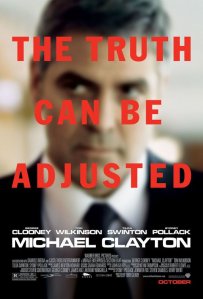 A smart, suspenseful, terrifically acted corporate thriller, this movie hums along with great precision thanks to a deeply articulate screenplay by writer/director Tony Gilroy. The acting trio (George Clooney, Tom Wilkinson, Tilda Swinton) delivers sensational performances muddled with doubt and weary, nervy complexity; each comes across a full human being in what could have come across as a dull Law and Order episode. I don’t understand why Gilroy plays around with the film’s timeframe, because he spends nearly ten minutes at the end in a suspenseful car chase where we already know the outcome. There is a murder that is played against Hollywood convention; it’s quick, grimly efficient, and scary in how soon it’s all over. Michael Clayton is a first-class movie that respects the intelligence of an audience.
Nate’s Grade: A
Share this:

The Chronicles of Narnia: The Lion, the Witch, and the Wardrobe (2005)
 I have never read one single word from C.S. Lewis’ classic children?s tales, The Chronicles of Narnia. I have never read one word from J.R.R. Tolkien’s Lord of the Rings tomes either. I read five pages in Dune and returned it to the library (50-page glossary of vernacular my ass!). I have also never read one word of any Harry Potter book, and I’m quite all right with that. I have several friends that were consumed by Lewis’ series in their childhoods and now are consumed by J.K. Rowling’s series. I don’t confess to be geek-free; I read the Shanara series by Terry Brooks when I was in junior high. I collected comic books, I watched cartoons, I still do both to an extent, but I suppose I left the fantasy genre with my appreciation for flannel all the way back in junior high (I also discovered women). Whenever I enter a fantasy film I bring with me no baggage. And so I strolled into The Chronicles of Narnia: The Lion, the Witch, and the Wardrobe ready to be entertained by a good story, whether Lewis, a big Christian theologian and author, was advancing some kind of Christian allegory or not. After seeing all 125 minutes, it’s safe to say I’ll be in line for any potential sequels.
In the heat of WWII, the Pevensie children are being transported out of London to live with a kindly professor (Jim Broadbent) on a safe rural farm. Peter (William Moseley) is the oldest and assumes the leader position vacated by their departed father. Susan (Anna Popplewell) is the brainiest, Edmund (Skandar Keynes) is the moodiest, and little Lucy (Georgie Henley) is the precocious true believer.
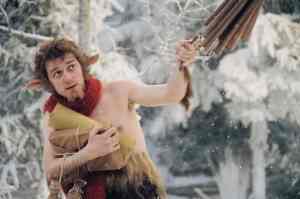
 One day during a game of hide and seek Lucy hides in an upstairs wardrobe. To her delight and amazement, she is transported to a magical, snow-covered realm known as Narnia. She encounters a faun, half man-half hoofed animal, named Mr. Tumnus (James McAvoy). He’s shocked to see a live human girl before his eyes and invites her for tea. There’s an old prophecy that says when two Sons of Adam and two Daughters of Eve arrive then the 100-year winter will end. The evil White Witch (Tilda Swinton), the one ruling Narnia with an icy fist, wants the humans captured and dead so she can rule forever. Lucy tells her siblings about her amazing adventures but they don?t believer her, that is, until they all tumble forth into the land of Narnia. The older kids mostly want to return home, but Edmund has sold them out by aligning with the White Witch. Now they’re on the run from her pack of wolves and the Pevensie children must seek out the powerful Aslan (voiced by Liam Neeson), a heroic lion who is all that stands in the way of the White Witch.
I declare my undying love for Tilda Swinton, truly the best character actress we have working today. Swinton already gave one bizarre yet outstanding performance this year as the androgynous angel Gabriel in Constantine (Swinton does androgyny better than anyone else; hell, she was convincing as a man and a woman in Orlando). In Narnia, Swinton exhumes a chilly command that could make you stand at attention. She’s such a hostile, icy, stone-faced villain, and Swinton has such calm confidence the whole time. She preens like a rock star and has the oversized ego to boot. She’s the kind of bad girl you could really fall in love with, especially if you have monstrous maternal issues.
The rest of the actors are mostly good. Henley steals every scene she’s in, and I’m not talking about the added attention of her suitable British choppers (my apologies to U.K. readership). Neeson seems a little bored with yet another wise teacher role just this year. I would be more interested in hearing the original voice of Aslan, the stupendous Brian Cox (Troy). McAvoy has a gentle sweetness to him.
Director Andrew Adamson integrates the flashy computer effects with surgical-like precision. Adamson?s experience as co-director for the Shrek films has given him the know-how to coordinate massive effects sight unseen and still coherently direct his live-action actors (ahem, George Lucas, ahem). The special effects in Narnia are outstanding. The characters move and behave with staggering authenticity (I know most of these creatures are mythical and have no comparison). The vistas and landscapes are beautiful, particularly the winter wonderland of Narnia. Adamson has a keen eye for visuals and lavishly recreates his visions; the climactic battle is bloodless but no less exciting.
 Most of the story flaws come from the source material. Narnia lacks the epic scope of the Lord of the Rings movies as well as the seriousness. As a result, no one feels very much in danger even during the more harrowing moments of battle. Lucy’s gift of “resurrection juice” kind of let’s the air out of the tension balloon. What suspense is there if a character has a magical healing elixir they can just whip out? The two girls are removed from the final battle and have little impact on its outcome. The White Witch’s tactic of freezing her enemies instead of killing them seems to be foolish, especially when they can be thawed at inopportune times. A major character’s sacrifice seems a tad superfluous if he can just reappear, lickity split like he had an extra life. Lots of secondary characters get the shrift when it comes to characterization, so you feel less than you should when something happens to them; this is even further hampered by Lucy’s Jesus Juice.
There’s a real genial sense of magic to Narnia. When little Lucy first transports to this magic realm, her face lights up in that adorable cherubic way, she wafts through the falling snow, catching it with her hands. Her moments with Mr. Tumnus are note-perfect from the dialogue, to the vocal inflections, to where the scene leads. Their relationship is very tender and provides some of the film’s best moments. Looking back, I can pick apart the movie, but while I was sitting in my theater I was deeply surprised how affected I was. I felt their fear, I felt their sorrow, and most of all I felt some sense of magic. The logic part of my brain was telling me how silly it was to see Santa Claus, let alone witness jolly ole Saint Nick handing out weapons for all the little good girls and boys (“Ho ho ho, kill ’em good for Santa.”). Yet while I watched I never questioned these things. The power of Narnia had taken full hold of me and I was swallowed whole by its tale.
Narnia is a good entry point for children in the world of fantasy. It’s suspenseful without being scary, and familiar without being too simplistic. Unlike Tolkien’s complicated worlds and heavy tales, Narnia is more a children’s story, what with the inclusion of unicorns, centaurs, fauns, and a menagerie of talking animals. There’s the suitable kid fantasy, like becoming king and fighting monsters, but there’s also a focus on family reconciliation and being accountable for your own actions. This isn’t a story that will overwhelm its audience but will leave them hungry for more adventures. The characters are mostly sketches (the leader who doesn’t want to be a leader, the overly logical one, the disaffected youth constrained by too much discipline, the little believer in the unknown), so it’s a testament to the filmmakers that the story and the characters have as much resonance as they do. The Lion, the Witch, and the Wardrobe sets up the parameters of the Narnia universe and its inhabitants and now future sequels can add meat to this bare skeleton. Narnia is a fantasy film the whole family can enjoy.
 The Christian allegories and metaphors mostly fly under the radar, with the exception of one extremely obvious scene that might make Mel Gibson wince. I even think Narnia is better enjoyed as a straight-up story than as an elaborate series of codes and messages harkening toward Christianity. If you view Narnia with the intent to break down its meaning and supplant connection to the Bible, then you’re really missing out on some great storytelling. And Narnia isn’t outwardly religious; it’s mostly a film preaching good values rather than simply good Christian values. Most of the lessons and values taught within Narnia are universally applicable to all people.
The Chronicles of Narnia: The Lion, the Witch, and the Wardrobe is a superbly entertaining retelling of C.S. Lewis’ classic children’s series. Adamson connects all the expected fantasy dots while seamlessly incorporating awe-inspiring special effects. The bountiful imagination up onscreen is the film’s biggest charm, rendering a divine touch of magic to the finished proceedings. Despite any better judgment pointing out the simplicity of the tale and characters, the production is first class and compelling. I was completely surprised how affecting I found the film and how immersed I became. This is great storytelling aided by gifted storytellers. Narnia is bigger than a family film, more accessible than a “Christian movie,” and more entertaining and endearing than most films released this year by Hollywood.
Nate’s Grade: B
Share this:

Broken Flowers (2005)
 Just as VH1 has been described as “TV to do other stuff to,” so is Broken Flowers a movie to do other stuff to. There’s so little that goes on, and at such a lackadaisical pace, that you could really iron your pants in another room and keep up with the film. You really feel Don’s (Bill Murray) apathy. Not good. There are plenty of moments of just watching someone stare. I was a big fan of Murray’s understated work in Lost in Translation, but here he’s understated to the point where he’s fading into the background. Admittedly, I am not a Jim Jarmusch fan, but the whole movie is underplayed to its detriment. The premise of Broken Flowers is really good, but it lacks any follow-through. I would rather see a Winston movie, Don’s eccentric neighbor who imagines himself as an amateur detective. It felt like a Robert Altman in the sense that a giant talented cast was assembled for two-line parts. The musical score is annoying because it repeats the same jangly 30 seconds over and over. It fits with the tone of the film. Broken Flowers is underplayed to the point of irrelevance.
Nate’s Grade: C


 nathanzoebl
You must be logged in to post a comment.