Blog Archives
Another Simple Favor (2025)
 The sly 2018 original was a tart breath of fresh air, chronicling a friendship between two moms, one of means and one of lesser means, that unraveled a conspiracy of death, lies, secret twins, ransom, and murder. It was an enjoyable diversion that was elevated by snappy banter, a combustible chemistry between Anna Kendrick and Blake Lively, and some dishy twists. I wasn’t expecting a sequel, but with the same director and principal cast returning, I was at least a little intrigued as to what they would cook up. Instead Another Simple Favor is a warmed-over retread of the original. This time we travel to scenic Italy where Emily (Lively) has been released from prison and is now marrying a wealthy Mafia scion and wants Stephanie (Kendrick), her old frenemy, to be her maid of honor. At its best, the sequel has glimmers of the spiky fun of its predecessor thanks to the serviceably witty banter and ongoing fun between its lead actresses. Mostly, it’s a tangled mess chasing after what made the original entertaining and adult. I can pretend I fully understood the plot with its assault of soapy revelations, character intersections, and convoluted machinations, but that would be a lie. There are times where the movie feels like an overburdened runaway “yes and…” improv game, where anything and anything is accepted and absorbed into the script. I wonder if every additional movie is just going to add more versions of a certain character. If you’re a fan of the 2018 original there might be enough here to prove fleetingly engaging, like the fabulous villas and extravagant costumes, but mostly Another Simple Favor doesn’t feel like it’s doing anyone a real favor.
Nate’s Grade: C+
Share this:

Companion (2025)

Confession: several years ago, my good friend and I co-wrote a movie for the Chinese film market that had several similarities with Companion. It was about a robot designed to be everything her owner desires turning on her owner. I’ll freely admit: Companion is better. While the movie doesn’t reveal that its robotic companion, Iris (Sophie Thatcher), is indeed made of circuits and screws until twenty minutes in, there are so many better twists and turns that come later. It begins with something relatively standard, a girlfriend nervous to meet the friends of her boyfriend Josh (Jack Quaid) during a lake house retreat. The film takes a dark turn that forces the characters to question how far they would be willing to go to cover up a crime as well as their own culpability. The second half of the movie becomes a very engaging and twisty cat-and-mouse game with Iris trying to escape from pursuers. Writer/director Drew Hancock (My Dead Ex) had put plenty of thought into the story mechanics of his thriller set pieces, connecting them to character decisions and the desperation of trying to outwit one another. The entire movie is elevated and then some by the terrific lead performance from Thatcher (Heretic, Yellowjackets) who becomes our emotional anchor and Final Girl worthy of rooting for. Thatcher can be heartbreaking one minute, hilariously deadpan the next, like when she’s stuck speaking German, and a tremendous source of empathy as she fights for her survival. Upon my first watch, I felt there might be too many twists and turns right up to the very end, but having re-watched Companion, I appreciate how much Hancock really thinks about move-countermove plotting, making sure that we experience many avenues from this premise. It’s a vicious take-down of viciously exploitative control freaks, with some strong satirical dark humor elbowing you in the ribs. It very much reminded me of 2019’s Ready or Not and would pair well as a double-feature of feminine empowerment amidst horror manhunts. While it might not have much on its mind as far as larger social commentary, there’s enough cooking here to keep me entertained, laughing, wincing, with my eyes glued to the screen to see where exactly it could go next. That’s a rarity. Companion is built different.
Nate’s Grade: A-
Share this:

G20 (2025)
 G20 is a curious movie. There are plenty of these kinds of movies to be found dotting the landscape of straight-to-DVD action vehicles starring the likes of, say, Casper Van Dien or Dolph Lungren. Junky action movies can be their own pleasure, guilty or otherwise. What I wouldn’t expect was watching one of these kinds of movies with an actress the caliber of Viola Davis, four-time Academy Award nominee. The movie portrays Davis as America’s president (if only …sigh…) attending the annual G20 global convention of world leaders when it’s taken over by terrorists. The lead terrorist (Antony Starr, The Boys) has a master plan to appeal to the citizens of the world to divest their money from banks and invest entirely in crypto currency. That’s right, dear reader, the bad guy has a crypto scheme. I suppose the movie is meant to emulate a Die Hard-in-a formula, or more accurately an Air Force One-in-a formula since that movie also followed a cornered president acting as an avenging lone wolf. The setup is fine, it’s the execution that is shoddy and poorly developed, with the limitations of the budget that was still obviously so much bigger than almost any other direct-to-DVD action thriller. The hide-and-seek setup where we watch a character outfox and pick off the bad guys is a winning scenario, but G20 doesn’t bother to derive engaging and surprising set pieces. Each scene of characters running, fighting, or exchanging gunfire is much like the last. The president even has a pair of tech-savvy kids, and a useless husband (sorry Anthony Anderson), who are lackluster additions, serving as tools to be threatened. If you had cut out Davis and replaced her with, say, Antony Starr, this movie wouldn’t be much different from the tide of mediocre action-thrillers meant to pass the time. Davis is a credited producer on this movie, which means she is the star because she wanted to be an action hero. That’s an admirable goal but an actress of her ability shouldn’t have settled for interchangeable genre dreck.
Nate’s Grade: C
Share this:

Saturday Night (2024)/ September 5 (2024)
Recently two ensemble dramas were thought to have awards potential that never materialized, and I think I might know at least one reason why: they are both undone by decisions of scope to focus on either a single day or a 90-minute period to encapsulate their drama.
 With Saturday Night, we follow show creator Loren Michaels (Gabriel LaBelle) the night before the premiere episode of the iconic sketch TV series, Saturday Night Live. The story is told in relative real time covering the last 90 minutes before its initial 11:30 PM EST debut in 1975. We watch Michaels try and deal with squabbling cast members, striking union members, failing technology, his ex-wife (Rachel Sennot) who also happens to be a primary producer of the show, muppets, and studio bosses that are doubtful whether this project will ever make it to air. I understand in essence why the real-time setting is here to provide more pressure and urgency as Michaels is literally running out of time. The problem is that we know the show will be a success, so inventing doubtful older TV execs to add extra antagonists feels like maybe the framing by itself was lacking. Think about Air but you added a fictional exec whose only purpose was to say, “I don’t think this Michael Jordan guy will ever succeed.” There are interesting conflicts and subplots, especially with the different groups that Michaels has to manage, but when it’s all stuffed in such a tight time frame, rather than making the movie feel more chaotic and anxious, it makes those problems and subplots feel underdeveloped or arbitrary. I would relish a behind-the-scenes movie about SNL history but the best version of that would be season 11, the “lost season,” when Michaels came back to save the show and there were legitimate discussions over whether to cancel the show. Admittedly, we would already know the show survives, but does the public know what happened to people like Terry Sweeney and Danitra Vance? Does the public know what kind of sacrifices Michaels had to make? That’s the SNL movie we deserve. Alas, Saturday Night is an amiable movie with fun actors playing famous faces, but even the cast conflicts have to be consolidated to the confined time frame. This is a clear-cut example where the setting sabotages much of what this SNL movie could have offered for its fans.
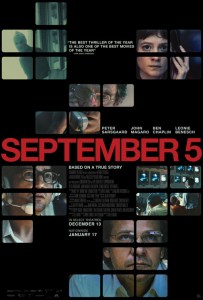 With September 5, we remain almost entirely in the control room of ABC Sports as they cover the fateful 1972 Munich Olympics after the Israeli athletes are taken hostage by terrorists. It’s a subject covered in plenty of other movies, including Steven Spielberg’s Munich and the 1999 Oscar-winning documentary One Day in September, but now we’re watching it from the perspective of the journalists thrust into the spotlight to try and cover an important and tragic incident as it plays out by the hour. It’s an interesting perspective and gives voice to several thorny ethical issues, like when the news team is live broadcasting an oncoming police assault, which the terrorists can watch and prepare for as well. The movie is filmed in a suitable docu-drama style and the pacing is as swift as the editing, and that’s ultimately what holds me back from celebrating the movie more. It’s an interesting anecdote about media history, but September 5 fails to feel like a truly insightful addition to the history and understanding of this tragedy. It’s so focused on the people in the studio and restrained to this one day that it doesn’t allow for us to really dwell or develop in the consequences of this day as well as the consequences of their choices on this fateful day. The movie feels like a dramatization of a select batch of interviews from a larger, more informative documentary on the same subject. It’s well-acted and generally well-written, though I challenge people to recall any significant detail of characters besides things like “German translator” and “Jewish guy.” It’s a worthy story but one that made me wish I could get a fuller picture of its impact and meaning. Instead, we get a procedural about a ragtag group of sports journalists thrust into a global political spotlight. There’s just larger things at stake, including the inherent drama of the lives at risk, than if they’ll get the shot.
Nate’s Grades:
Saturday Night: C+
September 5: B
Share this:

Blink Twice (2024)
 Zoe Kravitz’s directorial debut Blink Twice has stayed with me for weeks after I watched it, and with further harrowing revelations coming from the fallout of P. Diddy’s empire of exploitation, it has even more relevance. Think of it as a feminist revenge thriller set on Jeffrey Epstein’s island or a Diddy party. Channing Tatum plays a successful tech bro who hosts lavish getaways for the Wall Street and Silicon Valley elite, where the week is an orgy of food, drink, drugs, and of course sex. We follow Frida (Naomi Ackie), a waitress yearning for the finer things in life, so when Tatum’s rich and famous CEO invites her and her friend to his private island, she’s ecstatic. But everything is not what it seems, and Frida and the other women begin to notice weird clues, that is, when they can remember as time frequently seems to be lost for them. Blink Twice is a twisty, eerie mystery and Kravitz shows real skill at developing tension and suspense, with sequences that had me girding great waves of anxiety. There’s also an eye for style and mood here that makes me feel Kravitz has a real career as a genre director. I don’t think it’s spoilers to say that eventually the surviving women team up together to fight back against their oppressors, and it’s gloriously entertaining, bloody, and table-turning satisfying. The ending is designed to spark debate and controversy, and I enjoy that Kravitz and co-writer E.T. Feigenbaum do not want to make things too tidy, even with their protagonists. The themes here are broad but the execution is exact. There are several moments that stand out to me, from unexpected moments of levity to bold artistic choices that are mesmerizing, like an “I’m sorry” apology that goes through every level. If you’re looking for slickly executed genre thrills with great comeuppance, don’t blink when it comes to with Blink Twice.
Nate’s Grade: B+
Share this:

Heretic (2024)/ Conclave (2024)
Recently, two religious-based, single-location thrillers have emerged from the confines of indie cinema, and this combination is so rare that I felt a unique opportunity to review them both.
 Heretic is a chamber movie about two teen Mormons (Sophie Thatcher, Chloe East) proselytizing to a middle-aged man (Hugh Grant) one dark and stormy night. He invites them in and seems kind and welcoming, but looks can be very deceiving. He has some very strong opinions when it comes to the nature of belief, and he will test both of these young Mormons on the faith of their convictions as he puts them through a series of trials and lectures. That last part might stun people, but Heretic is actually at its best during its lengthy lecture sequences. It might remind people of a nattering Reddit atheist being unleashed, but the movie really comes alive when Grant is challenging the roots of their belief systems as well as the historical contexts of religions. The Mormon ladies push back as well, countering some of the arguments so it’s not so one-sided. There’s a clear point of view to the movie but I wouldn’t say it’s didactic. The thrills ratchet as the two women start to fret about what this man has in store for them, how they might escape from his labyrinthine house, and how to signal for help. Unfortunately, the revelations can never quite match the fun of the mystery of motivations, and once it gets into a really convoluted place of switcheroos, then I think it loses momentum. The performances are all outstanding, led by Grant’s magnetic about-face turn as a snide villain. The same self-effacing charms he worked so well in the realm of rom-coms have a new eerie manipulative quality, luring his prey into his fiendish trap. The end attempts to go a bloodier and more ambiguous route that I don’t know it earns, but by that time, even after stalling out for the last act, Heretic won me over by virtue of its creepy convictions.
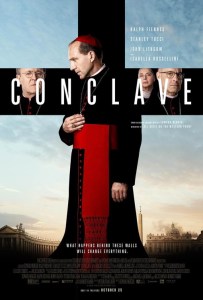 Conclave is an electioneering movie that places the viewer in the middle of the fraught voting process to determine the next pope of the Catholic Church. Ralph Fiennes plays a cardinal tasked with leading the conclave, the gathering of Catholic cardinals who will stay until a nominee has won a majority of their secret votes. Except it’s all not so secret as multiple candidates are openly campaigning for votes, trying to persuade different factions to support their candidacy. Each round of voting without a winner resets the field of play and leaves sides scrambling to reclaim footing. The movie is surprisingly very easy to get into, a crackling political thriller about the behind-the-scenes machinations and politicking for the highest office in the Catholic Church. There is a bevy of twists and turns and plenty of juicy revelations and betrayals, as these holy men start acting a little less holy to eliminate their competition or sully their chances. The constant churning is enough to keep things unsettled and intriguing, but there’s also a larger question for our protagonist, a man of faith who told the prior pope that he wished to leave his faith only to be denied by the pontiff for reasons we aren’t quite sure. Why did this pope specifically pick him for this position? The movie also asks deeper questions about the nature of power and leadership, namely are the people actively seeking it the right candidates for the right reasons? The very end of the movie knocked me out with a twist that I dare say nobody will rightly see coming, but it made me want to applaud. Conclave is an intelligently crafted thriller with weighty ideas and engaging performances.
Nate’s Grades:
Heretic: B
Conclave: B+
Share this:

Trap (2024)
 At this point, there is a certain expectation with any M. Night Shyamalan movie that reality will be heightened, that people will never talk like actual human beings, and that his brand of unreality can become part of the unique selling point, nestling into a campy charm when it all coalesces. Such is the case with Trap, the ludicrous thriller that plays much more pleasingly as a wacky comedy of errors and incompetence as an entire city’s police force is looking for a notorious serial killer, The Butcher a.k.a. Cooper (Josh Hartnett), at a concert for a pop star (Syamalan’s own daughter, Saleka). It’s a silly premise that essentially endangers thousands of innocent concert-goers where the plan is to, I guess, grab any middle-aged white guy in attendance and question them? It’s absurd, but it becomes a fun game of watching our trapped killer try and work out different escape options and adapt on the fly, while also being that supportive girl dad for his starstruck little tween. There’s an appealing “how is he gonna get outta this jam?” conflict resolution, though our deadly dad also acts so supremely weird, from buddying up with the merch guy, pushing ladies down stairs completely unbeknownst to observers, and trying to convince his daughter they should ditch this fancy concert to go explore what’s beneath a trap door. The hilarity is that Cooper is not really good at hiding his tracks, or his peculiarities, but everyone else in this universe is just that dim. It’s grand entertainment but definitely loses something once it leaves the central location for its final act, shifting the protagonist onto a new face that can’t quite carry the movie(reminded me of 2013’s The Call once it abandoned its premise for the final act). Given the heightened atmosphere, this is also the kind of movie that would have benefited from another twist or two, perhaps with Cooper’s family. Hartnett is playing a very specific tone and manages to make his character creepy, daffy, intense, and thoroughly watchable. If you’re in doubt what Shyamalan was going for, look no further than casting Parent Trap(!)-actress Hayley Mills as the older criminal psychologist trying to ensnare our killer with this outlandish ruse. Imagine Hitchcock by way of Peter Sellers, and you have Trap.
Nate’s Grade: B-
Share this:

Woman of the Hour (2024)
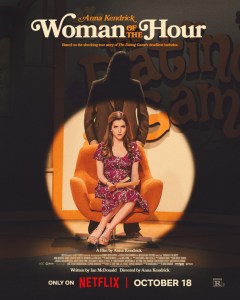 I never knew there was an actual serial killer that appeared on a 1978 episode of The Dating Game, and that he actually won. That’s a killer hook. The problem with Woman of the Hour, Anna Kendrick’s debut as a director, is that there isn’t really a movie here as presented. Because the game show segment can only last so long, we get the creepy first date, that never happened in real life, and watch Kendrick playing our lucky lady with mounting dread. A moment where the killer requests that she re-read the phone number she hastily gave him by memory, because she should know her number, is terrifically tense, as is the scene of him following her to her car. The problem is that this first date can only last so long, just as the cheesy TV game show segment can only last so long, so the movie has to provide extra back-story to fill the time. We get several past encounters with the killer’s unfortunate victims, all played quite unnervingly and seriously. The woman of the hour is less Kendrick getting her fleeting spotlight on TV, and an anecdote to impress people at parties for the rest of her life, than the survivor who eventually leads to the killer’s arrest. Amazingly, at the time of his TV appearance, he was on the FBI’s Most Wanted List but there wasn’t a searchable database, so he clumsily got to keep committing murders, including while out on bail. It’s a harrowing story, but is it one best told through the gimmick structure of the game show appearance? If you were going this route, perhaps best to treat the material like a slow-burn stage play, starting with the first date, and watch in real time as it gets awkward and our heroine begins to have her suspicions that this man does not mean her well. Instead, the game show segments are goofy and broad and the least important moments in the stretched-thin film. There might be a movie with this subject, but I’m not sure that Woman of the Hour is it.
Nate’s Grade: C+
Share this:

Tarot (2024)
 In the long line of horror movies about dumb teenagers stumbling onto curses, Tarot might be one of the most ineffective and ridiculous. First off, tarot readings are so detailed and specific, while also being vague to most of us unfamiliar with what you can find on the playing cards. This means the movie must constantly remind the viewer what the fateful readings were as well as the spooky imagery. Also, being a PG-13 movie, means that the terror is kept more on a psychological bullying level, where the teens have to “face their fears” but they’re not terribly personalized. One girl finds herself in a magician’s performance for ghouls and literally hides in a box only to be sawed in half. What was the personal fear there? Stage magicians? One guy is in a subway station and comes across a newspaper with his face on it and the headline, “You Die Today” (who says print media is dead…. wait a second). This is one of those movies that suffers because the rules of the curse are sketchy at best. We don’t know the escalation or how the teens might beat it. However, I wanted to almost applaud in amazement when the script practically plays an Uno Reverse card on its angry spirit (“If she’s killing everyone because they got their horoscope read, what if WE read HER horoscope to HER, huh?!”). The entire enterprise feels transparently like some studio exec optioned the concept of a tarot deck and said, “You know, make it haunted or whatever.” Unless you’re desperate for some derisive entertainment chuckles, skip Tarot.
Nate’s Grade: D+
Share this:

It’s What’s Inside (2024)
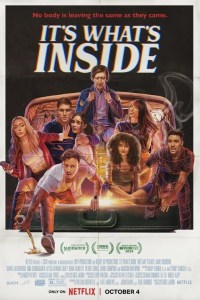 This sneaky little movie is exactly what I’ve been asking for from low-budget genre cinema, where creative ingenuity and imagination are the dominant forces to offset budget limitations. It’s What’s Inside is ostensibly a body swap movie between a group of friends stuck in a mansion overnight. A device allows eight people to swap into other hosts, and it plays as a silly party game early, before writer/director Greg Jardin increases the stakes. People pretend to be someone else and then explore that freedom, which usually means having affairs and getting a little too comfortable in other people’s bodies. Then there are… complications, and watching the characters frantically debate their new challenges and limitations with growing mistrust, exasperation, and betrayal makes for a delicious 90 minutes of surprises. Because there are multiple rounds of body-swapping, and eight starting characters, Jardin takes particular points to better clarify identities, from characters wearing Polaroids to a red-tinted sort of x-ray showing the real characters underneath the confusing physical surface. All of it helps, though I still had to ask who was really who quite often. I think watching it a second time would make it more coherent but also give me even more appreciation for Jardin’s slippery, shifting screenwriting. Here is a movie with rampant intrigue and imagination to spare, that maximizes its creativity to tap the body swap as an illuminating and destructive device to explore secret insecurities, desires, jealousies, and dissatisfaction in a friends group. It’s a wild trip, elevated by energetic and helpful editing, where the ideas are the main feature. It might not be much more than a bad overnight stay with bad people but It’s What’s Inside is top-notch genre filmmaking. It’s what’s inside the movie that matters most, its big imagination and fulfilling execution. Greg Jardin, you have my full attention with whatever movies you want to make from here on out.
Nate’s Grade: A-


 nathanzoebl
You must be logged in to post a comment.