Blog Archives
Birdman or (The Unexpected Virtue of Ignorance) (2014)
 Expecting a comedy from Mexican director Alejandro Gonzalez Inarritu would have preposterous. The man was known for his cinema verite of suffering, notably Babel, 21 Grams, Biutiful, and his best film, Amores Perros, roughly translated to Love’s a Bitch. Perhaps there isn’t much of a shift going from tragedy to comedy. Inarritu’s newest film, Birdman or (The Unexpected Virtue of Ignorance), has been wowing critics and audiences alike, building deafening awards buzz for its cast, Iarritu, and the superb cinematography, but will it fly with mainstream audiences? This may be one of the weirdest Oscar front-runners in some time.
Riggan (Michael Keaton) is an actor best known for playing the superhero Birdman in the early 1990s and walking away from the franchise. He’s still haunted by that role (sometimes literally) and struggling to prove himself as an artist. He’s brokered all his money into directing, adapting, and starring in a theatrical version of Raymond Carver’s short story, “What We Talk About When We Talk About Love.” The show is in previews and about to open its run on Broadway but it’s already got a rash of problems. The leading man needs to be replaced immediately. The supposed savior is famous actor Mike (Edward Norton), an undeniably talented but temperamental actor who pushes buttons to find some fleeting semblance of “truth.” Mike’s girlfriend, Lesley (Naomi Watts), is growing tired of his antics and desperate for her own long-delayed big break. Laura (Andrea Riseborough) is Riggan’s “girlfriend” and co-star and may be pregnant. Sam (Emma Stone), Riggan’s personal assistant and also his detached daughter, is fresh from rehab, and spiteful against her neglectful dad. Toss in Riggan’s best friend/manager/play producer (Zach Galifianakis), Riggan’s ex-wife (Amy Ryan), and a feared theater critic (Lindsay Duncan) who is determined to kill Riggan’s show to send a message to the rest of Hollywood polluting the integrity of the theat-tah. Oh, and throughout all this, Riggan hears an ominous voice that alternating encourages him and humiliates him.
 It’s an industry satire, a bizarre comedy, a father/daughter drama, an examination on identity and the complicated pulls of affection and admiration, and a stunning virtuoso technical achievement. As a movie, Birdman is hard to pin down or categorize. It’s a movie that you definitely need to experience on your own rather than have described (don’t stop reading, come back…), and that is a reason enough to see the film, a rare aspect among modern movies. It’s an artistically offbeat movie and yet it ultimately is about one has been actor looking back on his career and coming to terms with his own impact with pop-culture, art, and his family. It’s about a man struggling to find his place in his own life, beset at all odds by doubters and traitors and obstructionists. The refreshing aspect about Riggan is that he’s a has-been but not a sad sack; he’s fighting from the beginning, sometimes pathetically and sometimes in vain, but the man is always fighting to regain his dignity, to reclaim his life’s narrative, and to fight for his legacy. Riggan, after all, set the stage for the modern superhero industry that currently dominates Hollywood bean counters. He was too just soon, and the parallels with Keaton (Batman) are superficially interesting but there’s more of an original character here than a reflection of the actor playing him. He’s neurotic, egotistical, hungry, and fighting for respect, like many actors, and the film flirts with the façades people inhabit. Many of the characters are emotionally needy, desperate for validation wherever they can find it.
Another strength of the film is that it finds a moment for each of its talented ensemble players to shine, chief among them Keaton. The actor hasn’t had a showcase like this in some time and he is a terrific guiding force to hold the entire story together. Whether it’s marching in his tighty whities or working through his complicated degrees of neuroses, Keaton is alive in a way that is electrifying. We see several highs and lows over the course of two hours, some moments making us cheer on Riggan and others making us wince, but he comes across more like a person than just the butt of a joke. It’s also just fun to watch him adopt different acting styles when he steps on stage, including one early on where he’s purposely too stilted. It’s so comforting to watch Norton (The Grand Budapest Hotel) get to be great again, not just good but great. Early on, you see the appeal of Mike, his allure, and Norton keeps pushing the audience, as well as the characters, back and forth with his wealth of talent. Stone (Amazing Spider-Man 2) spends most of the film as the sulky daughter but she gets to uncork one awesomely angry monologue against her loser dad. The thawing father/daughter relationship ends up supplying the film with its only degree of heart. Watts (The Impossible) is comically frazzled for the majority of her time but gets a memorable character beat where she breaks down in tears, realizing her dream of “making it” might never materialize. Riseborough (Oblivion) also has moments where he sadness and vulnerability cut deep. The supporting characters aren’t terribly deep but they all have a moment to standout.
It’s a decidedly offbeat film that dips into the surreal though never dives completely inside. The movie is rather ambiguous about whether or not the fantastical flourishes are a result of Riggan being mentally ill, or at the least overtaxed with stress. Is there really a Birdman or is it a voice in his head, a manifestation of his ego or a ghost to remind him of the past when he was a star? Does Riggan really have the powers he seems to believe he does, including the ability to make objects move with his mind? Innaritu playfully keeps the audience guessing, treating the bizarre in an offhand manner reminiscent of magic realism. The bizarre embellishments blend smoothly with the film’s darkly comic tone. It’s a funny movie but one that you laugh at between clenched teeth.
 Is it all the unblinking camerawork a gimmick? I don’t think so. While the story can engage with its weirdness and surreal unpredictability, the long tracking shots bring a heightened reality to the unreal, they bring a larger sense of awe to the proceedings, watching to see the magic trick pulled off to the end. If anything, it’s an extra thrill to the script and greatly compounds the artistic audaciousness of the film, but I think it also channels the live-wire energy of theater, of watching actors have to walk that tightrope of performance and blocking, weaving together to pull off the ensemble. It makes the film medium feel more like live theater. Thematically I think the style also connects to the anxious mentality of Riggan. In the end, I don’t truly care that much whether it’s a gimmick or not (though I vote it is not) because the camerawork is rapturous. Made to resemble an entire two-hour tracking shot, it is a joyous thrill to watch these technical wizards do their thing, to watch the best in the business perform a visual magic trick over the duration of two hours. Even if you don’t care for the overall movie you can at least be entertained by the imaginative and thoroughly accomplished cinematography by Emmanuel Lubezki, fresh from his Oscar for Gravity and who should be clearing shelf space for the next bushel of awards he’s destined to win with this film. It’s an intoxicating experience to behold, though the film is structured into 10-minute or so chunks for feasibility. If you want to watch a real cinematic magic trick, check out the film Russian Ark, which is an entire movie, performed in one uncut single tracking shot.
I’m still wrestling with the debate over whether Birdman is an artistically ambitious romp or a truly great movie. Much like the characters in the film, I’m wrestling with whether I have confused my admiration with adoration. It’s a movie that I feel compelled to see a second time, and maybe a third, just to get a handle on my overall thoughts and feelings. That may be a sign that Birdman is a film for the ages, or maybe it’s just a sign that it’s not as approachable and denied a higher level of greatness by its obtuseness. Inarritu’s surreal showbiz satire is plenty entertaining, darkly comic, and a technical marvel thanks to the brilliant camerawork. The percussion-heavy musical score is another clever choice, naturally adding more urgency and anxiety to the proceedings. Birdman is a strange and beguiling movie, one that deserves to be seen, needs to be experienced, and stays with you rolling around in your brain. That sounds like a winner to me.
Nate’s Grade: A
Share this:

August: Osage County (2013)
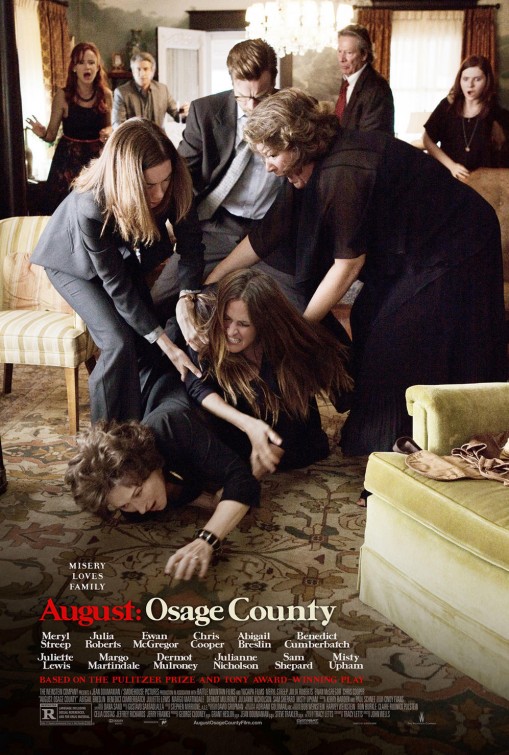 This holiday season, the movie with the most acting, by far, is likely to be August: Osage County, the adaptation of Tracy Letts’ Tony award-winning play. It’s a large dysfunctional family getting back together and opening old wounds, so, you know, the most relatable Christmas movie for some. It’s easy to see what attracted such A-list talent to this project because these characters are actor catnip; each is overflowing with drama, secrets, revelations, anger, and it’s all channeled through Letts’ barbed sense of humor and wickedly skillful dialogue. With Meryl Streep as the pill-popping matriarch, Julia Roberts as her resentful daughter, and a host of other inter-generational conflicts and secrets, you may feel exhausted by the end of its 130-minute running time (the stage play was 3.5 hours, respectively). The emotional confrontations feel like grueling pugilist matches, the melodrama kept at a fever pitch, but the film is never boring. Streep is her usual astonishing self and the deep ensemble gives each actor something to chew over. This is the best Roberts has been in years, and she’s not afraid to get nasty (“Eat your fish!”). Just when you think the story might soften, Letts unleashes another body blow, allowing no uncertainty that this is a family doomed. The story also provides insights into tracking the path of cruelty through the family tree, limb by limb. August: Osage County is stridently funny but also punishing in its no-holds-barred approach to family drama. If you’re looking for a movie that makes your family seem normal and even-tempered, this may be it.
Nate’s Grade: B
Share this:

Les Miserables (2012)/ Rock of Ages (2012)
 I have no qualms with my heterosexual nature to make the following statement: I love a good musical. Why shouldn’t I? None other than Martin Scorsese said any true film lover is a fan of horror movies and musicals, two genres uniquely suited to the visual flourishes of cinema. My tastes tend to run toward the more offbeat, like Avenue Q and Hedwig and the Angry Inch and Sweeney Todd and Dancer in the Dark. My favorite movie musical of all time is 1952’s Singin’ in the Rain, but that’s probably because I’m a movie lover first and foremost. A well-done movie musical can sweep you off your feet. The polarizing Moulin Rouge! is still my favorite film of 2001; I love every messy, ambitious, transporting second of it. And that’s what the best musicals and, in general, best films achieve: they transport us to another realm. Since the success of 2002’s Chicago, there’s been a run of hit-or-miss movie musicals proliferating the big screen. It’s hard to think of any longstanding Broadway hits that have yet to make the leap (you’ll get your turn, Book of Mormon). Of course it also works the other way, with plenty of movies being adapted into Broadway musicals, like Shrek, Elf, Ghost, Catch Me if You Can, Newsies, A Christmas Story, Sister Act, Legally Blonde, Bring it On, and Tony-winner for Best Musical, Once. Then you get movies turned into musicals and back into movie musicals, like The Producers and Hairspray. It seems like Broadway and Hollywood are stuck in a loop, feeding off one another’s spoils.
In 2012, two high-profile musicals got the big screen treatment: Rock of Ages and Les Miserables. The former is from 2009 whereas the latter is one of the most successful Broadway shows of all time, beginning in 1980 and spanning continents. Rock of Ages was savaged by critics and bombed at the box-office, whereas Les Miz is soaring this holiday season and is seen as a major Oscar contender. Of course one of these films is about the outrage of the lower classes being exploited by an unfair system that benefits the rich, and the other has Tom Cruise and a monkey named “Hey Man.” Having seen both films recently, and Les Miserables more than once, I think they present an interesting discussion on the pitfalls of adapting a popular theatrical show to film. You won’t have to wait long to figure out which movie succeeds and which falters badly.
 Les Miserables, based on Victor Hugo’s novel, is set in early 19th century France. Prisoner Jean Valjean (Hugh Jackman) is nearing the end of his twenty-year sentence for stealing a loaf of bread. Inspector Javert (Russell Crowe) is convinced Valjean will never reform and go back to a life of crime. After help from a kindly bishop, Valjean flees his parole and sets up a new life as a businessman. Fantine (Anne Hathaway), one of Valjean’s workers, gets thrown out and tumbles down a chain of regrettable circumstances. She becomes a prostitute to support her young daughter, Cosette. Valjean recognizes poor Fantine on the street and, horrified at his own neglect leading her to this path, takes it upon himself to care for her and her daughter. Years later, the teenaged Cosette (Amanda Seyfried) has fallen for the young revolutionary Marius (Eddie Redmayne). Marius enlists his good friend Eponine (Samantha Barks) to help find out who Cosette is, all the while ignorant that Eponine is clearly in love with him. The young people of France are riled up about class abuses and exploitation, and the spirit of revolution is in the air. Javert is also becoming suspicious of Valjean’s true identity, so Valjean feels the need to flee once again. However, Cosette’s love and the bravery of the young revolutionaries makes Valjean decide to stop running from his past.
Oscar-winning director Tom Hooper (The King’s Speech) made the ballsy but ultimately brilliant decision to have his performers sing live. Every line, every note, every performance is captured in the moment; there is nary a second of lip-synching. I cannot overstate how blessed this decision was. It places the emphasis on the performances, and that’s exactly what something as big and deeply felt as Les Miserables required for the big screen. Look, Hollywood actors are never going to be able to outdo trained and professional theatrical singers. What I expect from movie stars is movie-star level performances, and Hooper understands this. These actors aren’t playing to the cheap seats, belting the tunes with power and over exaggerated dramatics (note: there is absolutely nothing wrong with this style given the theatrical setting). In many ways, this is a more intimate Les Miserables, and it still maintains its charms and magic. There is no choreography, short of perhaps the more jovial “Master of the House” number, and Hooper puts us right in the muck of life in a 19th century impoverished slum. This is one dirty movie with lots of grimy period details, creating a reality that can only be implied on stage. The more visceral version of Les Miserables demands performances that are more naturalistic and less bombastic, to a degree. I am a cinephile first but I genuinely prefer my musicals with trained actors to trained singers. A great actor can add so much inflection and personality through the prism of song, whereas a great singer is concentrating on the notes first and foremost. I value performance over nailing the mechanics, and more movie musicals should follow Hooper’s path. This, ladies and gentlemen, is how to do the movie musical experience right.
 I don’t know if Hooper was exactly the right man for the job but he certainly does the beloved stage show justice. Hooper’s visual tics are still present. The man loves to film in close-ups and at all sorts of tilted Dutch angles; he also loves filming a conversation between two people where neither one will be in the same shot. It’s a peculiarity that I never really warmed up to. However, Hooper generally has the best interests of his movie at stake, capitalizing on the large outpouring of feeling. This is a Big Musical with big emotions, and it’s easy to be swept up in its exuberant earnestness and humanism. It even has a famous concluding line, “To love another person is to see the face of God.” It’s the kind of stuff you roll your eyes at under lesser circumstances. Now, thinking back, you’ll realize that many of these people were simply painfully naïve and that there was a slew of death for no good reason. Purists may chafe at some altered lyrics and truncated songs, but really this is pretty much the closest version of the famous stage show you’ll ever see adapted. Not one of the songs has been cut (in fact a new one was written for the film by the original composers), and at a lengthy 157 minutes, it’s practically as long as the stage show, and just about sung through every moment. There are probably ten total lines that are merely spoken. I predict hardcore Les Miz fans will lap up every second.
Les Miserables also boasts some fortuitous casting (Taylor Swift at one point was rumored to be up for a role… shudder), none more than Anne Hathaway (The Dark Knight Rises). She is nothing less than perfect as Fantine. There isn’t a false note during any of her acting. Her performance of “I Dreamed a Dream” is so powerful, so breathtaking, so intensely felt, that it ranks up there with some of the best moments in all of 2012 movies. And oh can this woman sing her ass off too. You feel every flicker of anger and devastation, the grain in her voice, on the verge of tears and fury. This woman deserves every accolade they can come up with this year. This woman is a total lock for Best Supporting Actress. She’s wonderful during every moment of her screen time and the lengths and emotional ferocity of her performance, and subsequent pitfalls the character endures, left me reaching for the tissues at several points.
The other standout amidst a pretty stellar cast is Barks. This is her first film work though she has plenty of experience with her character, portraying Eponine in the 25th anniversary run of Les Miserables. Her singing is terrific, as you’d imagine, but her acting is just as strong. Her rendition of “On My Own” is a showstopper of a number. Barks naturally transitions to the demands of film. I was completely on Team Eponine and found her to be an infinitely better catch than Cosette. After people get a glimpse of this woman, she is going to get plenty more acting offers, and a few concerned inquiries into the size of her waist, which at times looks like it might be the size of The Rock’s neck. Hooper also has the good sense to film both “I Dreamed a Dream” and “On My Own” in unbroken takes; focus tightly pinned on our outstanding actresses, letting the skill of their performances sell the big emotions.
 Of course the crux of the tale rests on two men, Valjean and Javert, and the rest of the cast does kind of get saddled in underdeveloped roles made more apparent as a movie. It seems blasphemous to say I was a little disappointed with both lead actors. Crowe (Robin Hood) is easily the weakest singer of the cast but that doesn’t mean he’s bad. He has a lower register and sings his parts like a rock musician rather than a Broadway player. Fans of the stage show will have to adjust their expectations for a more subdued Javert. Still, having an actor of Crowe’s talents is definitely a plus even if his singing is adequate. Jackman (Real Steel) is a Tony-winning thespian, so I held him to a higher standard. He’s got a lot of heavy lifting to do as Jean Valjean, and Jackman does an admittedly fine job with the bigger emotional parts. I just expected more from his vocal abilities but it’s not a major detraction. As my mother noted, it’s not too difficult to spot the classically trained singers in the cast. Also, for eagle-eyed Les Miz fans, look for the original Jean Valjean, Colm Wilkinson, as the Bishop in this movie.
There is the tricky nature of translating a Broadway production into some variance of period reality. There’s plenty of relevance with the class struggle illustrated in the second half of the movie (Bane would approve). It’s an obvious statement but film is a different medium than the theater and affords different opportunities. The depressing reality of lower class life and the vultures that preyed on others is striking, yes, but sort of conflicts with the comic relief characters represented by the scheming Thenadiers (Sacha Baron Cohen, Helena Bonham Carter). When the seriousness of the period is inflated, they feel like they sort of belong in a different movie. Then there’s just the conflict between stage reality and film reality. On the stage we’ll accept Marius falling madly in love with Cosette at first sight. When it’s on film, the guy comes across as a callous chump, oblivious to Eponine’s pining. He ignores the friend he’s had for years for some blonde in a bonnet. And the final number, reuniting all the dead cast members, works better as a curtain call than a finale to a film. These are just the quirks of theater one must just accept. I wouldn’t say the songs and music is in the same category as Sondheim or Webber, but there are definitely some hummable tunes here made all the more swooning. You’ll have a fine pick of songs to get stuck in your head for days (mine: “Look Down”).
 Earlier this year, Rock of Ages came and quickly left the box-office, failing to make a splash with the American public despite a healthy enough run on Broadway and touring the country. The stage show is a jukebox musical set to the head-banging tunes of 1980s hair metal. Adam Shankman, the director behind the bouncy and thoroughly entertaining 2007 Hairspray movie musical, was tasked with bringing Rock of Ages to the screen with the same finesse. Cherie (Julianne Hough) a hopeful singer just off the bus from Oklahoma, meets up with Drew (Diego Boneta), a nice kid who gets her a job at The Bourbon Room, a rock club running afoul with the mayor (Bryan Cranston) and his moral crusading wife (Catherine Zeta-Jones). The club owners (Alec Baldwin, Russell Brand) are relying on fickle, burned-out, taciturn, and overall mysterious rock legend Stacy Jaxx (Tom Cruise) to save their club from financial ruin. Along the way, Cherie and Drew look for their big breaks, fall in love, get pulled apart, and reunite in time for one final sendoff to leave the audience tapping their toes.
 Allow me to elucidate on my main problem with the rise in jukebox musicals: I find them to be, with rare exception, exceedingly lazy. The musical number is meant to advance the narrative and give insights into character and situation, just like any other aspect of plot. You’ll find great original tunes that do this. When you’re dealing with pop songs that the public is well familiar with, then your job becomes even harder, and I find many are just not up to the task. Too often jukebox musicals are designed to merely string together a pre-packaged and time-tested number of hit songs, utilizing the faintest of narrative threads to get from one song to the next. The appeal of jukebox musicals lies not with the story or characters but waiting for the next recognizable song and wondering how it will, poorly, fit into this new context. You’ll notice that these jukebox musicals seem to have twice as many song numbers. They know their selling point, and more singing means less time spent developing characters and story. And so my impression of the jukebox musical is one of a cynical cash grab following the bare minimum of narratives to achieve the status of musical so it can be resold with low risk. I’m simplifying things in my ire, yes, but there’s a definite reason that jukebox musicals have sprouted like mad in the past few years. They don’t require as much work and the audience seems to hold them to a lesser standard. Much like the worst of Friedberg and Seltzer (Disaster Movie, Meet the Spartans), it seems just recognizing the familiar has become the core draw of entertainment.
And this is one of the main problems with Rock of Ages. I’ve never seen the stage show, but my God for something that purports to live the rock and roll lifestyle, it’s certainly so tame and scrubbed clean of anything dangerous. This feels like your grandparents’ idea of what “modern” rock music is. After a cursory search online, I’ve found that the movie makes some significant changes to convert a story about rock and roll hedonism into sanitized family friendly fare (spoilers to follow, theatergoers): apparently in the stage version, Cherie and Jaxx had sex, Jaxx remains a creep and flees the country on statutory rape charges, though before that he and Cherie share a lap dance/duet to “Rock Me Like a Hurricane,” the family values crusader characters were new inventions, the Rolling Stone reporter (Malin Akerman, the best singer in the film) is considerably beefed up to provide Jaxx his happy ending, and they don’t even use the song “Oh Cherie.” I’m not a stickler for adaptation changes, but clearly it feels like Rock of Ages had every edge carefully sanded down to reach out to the widest array of mainstream filmgoers (Shankman says he cut Cherie’s lap dance number because it tested poorly with mothers). The funny part is that the movie lambastes a slimy manager (Paul Giamatti) for playing to demo numbers, shooting for pandering mass appeal rather than the art, man. Feel the hypocrisy.
 The first hour of Rock of Ages is mildly passable mostly because of the goofy supporting cast, but then the movie just keeps going, getting more and more tedious with every protracted minute. The second half involves Cherie and Drew apart and finding new lows; for him it’s selling his soul to join in a boy band, and for her it’s selling herself, working as a stripper. Let’s look back at that sentence. One of those life choices is not nearly as upsetting as the other. Nothing against the hard-working strippers in this country, but Cherie taking to the pole is definitely more of a moral compromise for the character than whatever the hell Drew endures. It’s this leaden second hour that made me lose faith that Rock of Ages would even provide a morsel of cheesy entertainment. It has the misfortune of two of the blandest leads I’ve ever seen in a musical. Hogue (Footloose) and Boneta (Mean Girls 2) are both physically blessed specimens of human genetics, but oh are these kids boring boring boring. Their love story is completely malnourished and you couldn’t scrape together one interesting thing about them combined. The fact that Rock of Ages further strips away any interesting personality from Cherie (see above) makes them even more disastrously boring. To be stuck with these two for another hour of vapid griping, only to magically get back together, is interminable. Thank God they pumped up the side characters because that is the only time when Rock of Ages even challenges for your attention. Cruise isn’t the best singer but he’s pretty good belting out 80s rock hits, and the man has his natural charisma and stage presence to spare.
So I guess where Rock of Ages goes wrong, and where Les Miserables succeeds, is thinking of how best to translate the experience of the stage to the medium of film. Shankman does a pitiful job staging his musical numbers, with lackluster choreography that rarely takes advantage of the sets and characters. Worse, Shankman feels like he strays from the tone and angle of the stage show, sanitizing the rock and roll lifestyle and looking for ways to squeeze in bland happy endings. In other words, he doesn’t capture enough of the essence of the original stage show to please neophytes and fans of the Broadway show. With Les Miserables, I think most fans of the stage show, and they are legion, will walk away feeling satisfied with the results, content that real artists treated the long-running musical with justice. Hooper opens up the world of the stage show, utilizing the parameters of film, and the emphasis on performance over singing mechanics maximizes the unique power of film. Les Miserables is a grand movie musical smartly adapted to the opportunities of film. Rock of Ages is a sloppy, neutered, criminally boring mess poorly developed and poorly translated to the silver screen. Let this be an educational resource for future generations. Take note, producers, and learn from the mistakes of Rock of Ages and the accomplishments of Les Miserables. Oh, and guys, if you see Les Miserables, it will get you super laid with your girlfriend (I have anecdotal evidence).
Nate’s Grades:
Les Miserables: B+
Rock of Ages: C-
Share this:

Killer Joe (2012)
 This is one nasty, alarming, but very involving movie that wallows in darkness and plays it up for laughs. Killer Joe is a dysfunctional family drama, a crime thriller, and a mesmerizing character study when it comes to the lessons of amorality. Based on the play by Tracy Letts (August: Osage County), Joe (Matthew McConaughey) is a crooked cop who works as an assassin on the side. A weasely loser (Emile Hirsch) and his family hire Joe to kill their mother for the insurance money. Things get out of hand in frequent measure, with splashes of brutal violence, healthy amounts of sex and full-frontal nudity, and a disturbing sexual act with chicken that more than earn this film its adults-only NC-17 rating. What makes the movie rise above base exploitation is its depraved, deep-fried sense of humor. There is plenty of uncomfortable laughter and guffaws. The end of the film, during a fever-pitch of violence, is so sudden, so kooky, so debauched, that my friend and I burst out laughing. Without its wicked sense of humor, and its sharp ear for working-class dialogue, the movie could be accused of wallowing in the muck. There’s also the terrific acting, chiefly from McConaughey. He gives a hypnotic performance, chilling, unpredictable, and deeply committed to retribution. When he zeroes his cold eyes on you, boy does the flesh crawl. It’s an intense performance and arguably the best of the man’s career. Directed by William Friedkin (who also directed the 2006 adaptation of Letts’ play, Bug) with brutish élan, Killer Joe is one nasty piece of work, but given the right audience, it could prove to be a perverse entertainment.
Nate’s Grade: B
Share this:

Black Swan (2010)
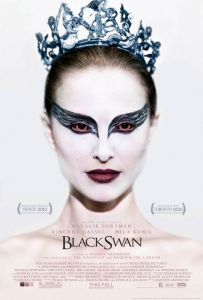 The prissy world of prima ballerinas and tutus doesn’t seem like a natural fit for sex, murder, lunacy, and mayhem. Director Darren Aronofsky (Requiem for a Dream, The Wrestler) is used to exploring the punishments of the human body and the strain of the mind, so you know that Black Swan isn’t going to be your traditional dance movie.
Nina (Natalie Portman) has been a company ballerina in New York City for years. She spends her hours at home practicing the grueling routines in hopes to break out for a lead role. Her mother (Barbara Hershey) is a former ballerina herself who gave up her shot at the big time when she had Nina. Then the head of the dance company, Thomas Leroy (Vincent Cassel), has decided that Tchaikovsky’s Swan Lake will be the first show of the season. It’s a bit tired, he admits, but he has a plan to juice it up: the same dancer will portray both the swan queen (tragic protagonist) and the black swan (villainous temptress). All of the dancers are committed to doing what they can to earn that coveted lead role. Nina’s primary worry is Lily (Mila Kunis), a dancer who is imperfect in technique but honest and free in her movements, garnering the attention of Thomas. In the process, Nina is losing her grip on reality. She’s hearing weird things, seeing weird things, and something dark wants to take center stage.
 Black Swan is a grade-A mind freak of the first order, a tonal fusion of sight and sound that echoes earlier masterworks of the eerie psychological horror like Rosemary’s Baby and The Shining. This is a movie that gets under your skin; I literally had a nightmare the night after watching it, though I don’t want to give people the wrong impression. Black Swan is not a horror film by the traditional standard we’re accustomed to today. The entire film has a downright Kubrickian vibe, from its devoted tracking shots, to the overdose on classical music underscoring the dramatic tension, and the unraveling of the human mind toward eventual psychosis. Aronofsky keeps the audience tethered to Nina, at times literally. The camerawork will rarely stray away from Portman, like we’re caught within her orbit and forced to see the world through her fractured perspective. She is our eyes to the world but, as becomes increasingly apparent, we cannot trust what we see. The unreliable POV leads to some fantastic freak-out moments that will consistently leave you scrambling. The diligent pacing marvelously matches the dissolution of Nina’s psyche. As her paranoia and delusion take control, Nina comes undone one thread at a time, with Aronofsky on the other end providing the tugs. The spiraling mental determination culminates with a glorious 20-minute finale that manages to be tense, beautiful, haunting, and powerfully moving. There are moments in this film that gave me goose bumps (a blood red-eyed Portman growling, “It’s my turn” is a chilling highpoint). I became determined to see Black Swan again even before the closing credits arrived.
Aronofsky makes use of every tool at his disposal to heighten the intense atmosphere. The attentive editing and camerawork create a shifty mood, communicating Nina’s desperate groping for direction. But beyond that, Aronofsky employs subtle sound effects to rattle you, keep you off guard. Routinely there will be the fluttery sound of wings flapping or hushed whispers. It’s enough to make you shudder time and again. It’s a small touch that elevates the mood and instantly snaps you to attention whenever you hear the eerie echoes. The disquieting sound effects are coupled with equally subtle visual effects. As Nina absorbs herself in her ballet role we occasionally will witness the pores of her skin raise, as if invisible hair, or fathers, are protruding. Sometimes these raised bumps will wash over her body in waves. As Nina becomes more consumed with her darker impulses, the special effects take a surreal role in conveying her madness.
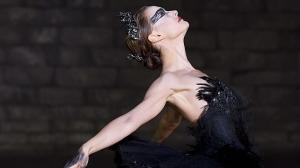 The film is also rather sensual without becoming trashy, late-night Cinemax fodder. Portman’s descent is linked with loosening up her own sexuality. She can portray the innocent and delicate white swan, but she’s having significant problems portraying the ominous and seductive black swan. She’s told to let go, lose herself to her physical impulses, and explore the confines of her nubile body. Black Swan is probably the artiest high profile film to feature prominent female masturbation since 2001’s trippy Mulholland Drive (the two movies have plenty of similarities in ambition). Nina’s suspicions about her rival transform into confusing erotic fantasies that will delight the teenage males in the crowd. Black Swan treads the erotic terrain with a European sense of maturity and candidness. The sex and masturbation and bisexual smooches don’t feel like gross, gratuitous shots at cheap titillation.
Portman ably takes the frazzled lead and gives an enthralling performance that will be hard to beat come Oscar time. The role is a lot more than screaming and crying. Although to be fair, Portman cries a whole lot. You may lose count the amount of times Portman is seen crying on screen. Her character is fragile but not fighting for sympathy. She can be distant and a little cold, obsessed with reaching the unattainable state of perfection. This pushes her to the extreme, goaded by her somewhat loopy mother. Portman has always been an attractive presence on screen, but she is also fairly transparent when she’s bored with her material (watch those Star Wars prequels and argue differently, I dare you). With Black Swan, she throws herself into a role like I’ve never seen before from Portman. I did not think the kewpie-dolled actress was capable of such heights. The immersion is entrancing. She physically trained for over a year before production to be able to do most of those pirouettes and fouettés. I’m not being overly generous with the dancing accolades; Portman comes across as smooth as a professional. The fact that Portman is capable of expressing so much devastating emotion through dance is astounding. My eyes were glued to her every movement. This is the performance that officially lifts Portman to the acting big leagues. She dances circles around the acting competition for 2010.
While it’s certainly Portman’s show, the supporting cast all shine in their small roles. Kunis (Forgetting Sarah Marshall, Book of Eli) is made to exemplify the edgy opposing force in Nina’s life. Kunis’s natural charm and alluring presence might make her the most likeable character in the film, even though her wild ways will keep you guessing about her true motives. Hershey (Hannah and Her Sisters) seems like a doting and supportive mother at first glance, but the actress reveals shades of desperation and mania. Winona Ryder (Star Trek, Girl, Interrupted) makes a welcomed near-cameo as the ballerina pushed out of the spotlight. And then Cassel (Ocean’s Twelve, Eastern Promises) plays lecherous creep like few others.
 The film manages to make ballet feel like a contact sport. These people punish their bodies, their artistic vessels. The rigorous routines require dancers to be in sleek form, which often leads to abuse via bulimia. The excruciating balance and coordination required places unusually high demands on the human body, particularly on the feet that must support the body in extreme positions. Broken toes and split nails are the least of the worries. Black Swan succeeds in showcasing the fierce brutality of dance; however, the movie also showcases the intrinsic beauty. I am a self-described novice when it comes to dance, especially ballet at that, but even I was spellbound by watching the dancing, notably the exhilarating Swan Lake opening night performance. The camera is positioned to be like another dancer, so we’re swooping and spinning around the stage with the featured performers. This gives the audience an intimate glimpse into the fluid movements and, just as importantly, the nuanced and sensual expressions of the performers. I would have scoffed at the idea of a ballet performance being anything more than frou-frou-ness, but Black Swan made me a believer. Witnessing the beauty and gracefulness of the dancing is proof that all that hard, punishing preparation is worth it.
Probing the stress of the body and fraying endurance of the mind, Black Swan richly explores the sacrifices we make for art and ambition. The world of ballet is highlighted as a hotbed for scandal and intrigue and female sensual desire. Not bad for all that hoofing around in frilly tights. Black Swan is anchored by Portman’s captivating descent into madness, a performance that will surely be awarded in the ensuing months to come. Aronofsky has fashioned a riveting psychological thriller with enough artfully crafted chills and spooks to make for one visceral experience at the art house. Beyond bringing the tingles of spine and bumps of goose, Black Swan digs into the psychological underpinnings of competition, devotion to art, and personal glory. There’s much more going on here than ballet. It’s a grade-A mind-freak but under Aronofsky’s skilled direction and Portman’s transfixing acting, Black Swan is also a grade-A piece of art and one of the most stunning works of cinema this year.
Nate’s Grade: A
Share this:

Nine (2009)
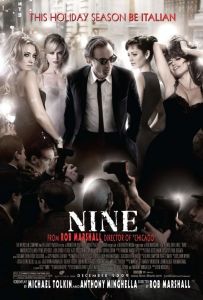 Filled with beautiful stars, beautiful Italian scenery, and beautiful cinematography, Nine has some significant sure-fire flash, but it’s missing the dazzle (or is it razzle?). The movie based on the 1980s Broadway musical based upon the Fellini movie, 8 1/2, is a pretty hollow enterprise. It’s all about writer’s block, and unless you’re the Coen brothers this is not a very interesting conflict to watch on screen. Daniel Day-Lewis plays Guido, a famous Italian director feeling overwhelmed by the impending start of his ninth movie, a movie he hasn’t written a script for yet. He tries to find inspiration from his wife (Marion Cotillard), his mistress (Penelope Cruz), his muse/lead actress (Nicole Kidman), his dead mother (Sophia Loren), a magazine journalist (Kate Hudson), and just about anybody else. The film is structured much like director Rob Marshall’s Oscar-winning musical Chicago, where the song-and-dance numbers are little mental asides inside the characters’ minds. So most actresses get one big number and then it’s arevaderche. Day-Lewis is good but his character is hard to emphasize with, especially as he bounces from woman to woman, whining about the duress of creativity while anybody minus a Y chromosome (and who isn’t Judi Dench) throw themselves at the guy. Despite the lackluster story and characters, Nine still could have succeeded from its musical numbers. Too bad then that the songs are instantly forgettable. Seriously, if you put a gun to my head mere minutes after I heard these tunes I wouldn’t be able to hum a bar. The dancing is lively, and Cruz and Cotillard prove to be infinitely and tantalizingly flexible, but the songs are truly unimpressive. I never would have guessed that in a movie filled with so many Oscar-winners that Fergie would be the highpoint. She plays a lustful figure of Day-Lewis’ youth, and her number exudes a vivacious sensuality. The playful choreography incorporates sand on the stage, which makes for several great images and dance moves. The song is also by far the catchiest, “Be Italian,” and the only thing worth remembering. The trouble for Nine is that there’s another hour left after this peak. I’m astounded that people thought, at one time, that Nine was going to be a serious awards contender. This has the “parts” of an awards movie but no vision or verve to assemble them.
Nate’s Grade: C
Share this:

Every Little Step (2009)
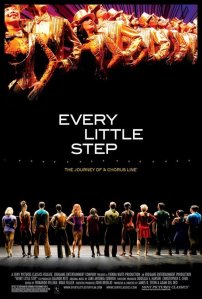 Being that A Chorus Line is a famous Broadway musical all about auditioning for a Broadway musical, Every Little Step, an agile documentary following every heel-toe-kick, takes place almost entirely in the world of high-stress auditions. The documentary traces the origins of the meta-theatrical show all the way to a taped conversation director Michael Bennet had with a handful of New York City dancers in 1974. That night they opened up about their lives and then it became character backstories. I would have liked more of an exploration about the nature of art transposing someone’s life story, but this is not that movie. Every Little Step examines the elation, disappointment, and sheer exhaustion of getting a part in a show. We watch scores of actors try out for the 2006 revival and we also listen to interviews from key participants in the original 1975 production. The movie does have some issues and one of them is that it doesn’t become personally involving to a Broadway naïf until after an hour in. I understand that the casting crew was weeding out hundreds of talent, but the movie doesn’t give enough time to specific hopefuls to follow, build a connection with, and eventually root for. Every Little Step only begins to flesh out its finalists at the final round of callbacks, which makes the stakes less emotionally involving. Still, it’s hard not to feel the rush of joy when some dancers achieve their dreams.
Nate’s Grade: B
Share this:

Synecdoche, New York (2008)
 Nothing comes easy when dealing with acclaimed screenwriter Charlie Kaufman. The most exciting scribe in Hollywood does not tend to water down his stories. Kaufman’s latest head-trip, Synecdoche, New York, is a polarizing work that follows a nontraditional narrative and works on a secondary existential level. That’s enough for several critics to hurtle words like “incomprehensible” and “confusing” as weapons intended to marginalize Synecdoche, New York as self-indulgent prattle. I guess no one wants to go to the movies and think any more. Thinking causes headaches, after all.
Caden (Phillip Seymour Hoffman) is a struggling 40-year-old theater director trying to find meaning in his beleaguered life. His wife (Catherine Keener) has run off to Germany with his little daughter, Olive. He also manages to botch a potential romance with Hazel (Samantha Morton), a woman who works in the theater box-office who has an unusual crush on Caden. He’s also plagued by numerous mysterious health ailments that only seem to multiply. While his life seems to be in the pits, Caden is offered a theater grant of limitless money. He has big ambitions: he will restage every moment of his whole life to try and discover the hard truths about life and death. Caden must then cast actors to portray the various people in his life. Sammy (Tom Noonan) argues that no other actor could get closer to the truth of Caden; Sammy has been following and studying Caden for over 20 years (don’t bother asking why in a movie like this). Caden also casts his new wife, Claire (Michelle Williams), as herself. The theater production gets more and more complex, eventually requiring the “Caden” character to hire his own Caden actor. Caden hires Hazel to be his assistant and Sammy falls in love with her. Caden admonishes his actor, “That Hazel isn’t for you.” Caden then tries sleeping with “Hazel” (Emily Watson) to get even with the real Hazel. By producing a theatrical mechanism that almost seems self-sustaining, Caden wants to leave his mark on the world and potentially live forever.
 I heard plenty of blather about how mind-numbing Synecdoche, New York was and how Kaufman had really done it this time when he composed a script that involves characters playing characters playing characters. People told me that it was all too much to keep track of and that it made their brains hurt. The movie is complex, yes, and demands a viewer to be actively engaged, but the movie is far from confusing and any person or critic that just throws up their hands and says, “Nope, too much to think about,” is doing their brain a disservice. The movie is relatively easy to follow in a simple linear cause-effect manner; Kaufman only really goes as deep as two iterations from reality, meaning that Caden has his initial doppelganger and then eventually that doppelganger must get his own Caden doppelganger (it’s not nearly as confusing as it sounds if you see it). Now, where the movie might be tricky to understand is how deeply contemplative and metaphorical it can manage to be, especially at its somber close. That doesn’t mean that Synecdoche, New York is impossible to understand only that it requires some extra effort to appreciate. But this movie pays off in huge ways on repeat viewings, adding texture to Kaufman’s intricately plotted big picture, unfolding into a richer statement about the nature of life and death and love.
Theater has often been an easy metaphor for life. William Shakespeare said, “All the world’s a stage, and all the men and women merely players; they have their exits and their entrances; and one man in his time plays many parts.” Kaufman movies always dwell substantially with the nature of identity, and Synecdoche, New York views identity through the artifice of theater. Caden searches for something brutal and true via the stage, but of course eventually his search for truth becomes compromised with personal interests. Characters in Caden’s life are altered and in the end when Caden steps down, as himself, reality starts getting revised. The truth is often blurred through the process of interpretation. Caden ends up swapping identities with a bit player in the story of his life, potentially finding a greater sense of personal comfort as someone else. Don’t we all play characters in our lives? Don’t we all assume different identities for different purposes? Do we act differently at a job than at home, at church than at a bar? Caden remarks that there are no extras in life and that everyone is a lead in his or her own story.
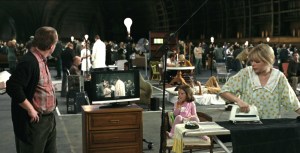 Kaufman’s movie is also funny, like really darkly funny and borderline absurdist to the point of being some strange lost work by Franz Kafka (Hazel even mentions she’s reading Kafka’s The Trial). You may be so caught up trying to render the complexities of the story to catch all of the humor. The movie exists in a surreal landscape, where the characters treat the fantastic practically as mundane. Hazel’s house is constantly on fire and yet none of the characters regard this as dangerous or out of the ordinary. It is just another factor of life. The entire subplot with Hope Davis as a hilariously incompetent therapist is deeply weird. Caden suffers some especially cruel Job-like exploits, particularly what befalls his estranged daughter, Olive. He’s obsessed with her hidden whereabouts and European upbringing, to the point that Caden cannot even remember the name of his other daughter he has with Claire. There is a deathbed scene between the two that is equally sad and twisted given the astounding behavior that Caden is forced to apologize for. There are running gags that eventually transform into metaphors, like Caden’s many different medical ailments and the unhelpful bureaucratic doctors who know nothing and refuse to divulge any info. Kaufman even has Emily Watson, an actress mistaken for Morton, play the character of “Hazel.”
This is Kaufman’s debut as a director and I think the movie ultimately benefits by giving its writer more control over the finished product. The movie is such a singular work of creativity that it helps by not having another director; there is no other artistic vision but Kaufman’s. While the film can feel slightly hermetic at times visually, Kaufman and cinematographer Frederick Elmes (The Ice Storm) pack the film with detail. Stylistically, the film is mannered but this is to make maximum impact for the vast amount of visual metaphors. Synecdoche, New York never feels as mannered as the recent Wes Anderson films, henpecked by a style that serves decoration rather than storytelling. The production design for the world-within-a-world is also alluring and imaginative, like a living, breathing dollhouse.
 The assorted actors do well with their quirky, flawed characters, but clearly Hoffman is the linchpin to the film. He plays a character from middle age to old age, and at every step Hoffman manages to infuse some level of empathy for a man routinely disappointed by his own life. The failed yet lingering and hopeful romance between Caden and Hazel provides an almost sweet undercurrent for a character obsessed with death. Hoffman is convincing at every moment, even as a hobbled 80-year-old man, and gives a performance steeped in sadness but with the occasional glimmer of hope, whether it be the ambition of his theater project or the dream of holding Hazel once more. Morton is also wonderfully kindhearted and endearing as the woman that just seems to keep slipping away from Caden.
There’s no other way to say it but Synecdoche, New York is a movie that you need to see multiple times to appreciate. The plot is so grandiose in scope and ambition that one sitting does not do it justice. Kaufman has forged a strikingly peculiar movie that manages to be surreal and bleakly comic while also being poignant and humane. This is a big movie with big statements that can be easily missed, but for those willing to dig into the wealth of metaphor and reflection, Synecdoche, New York is a rewarding film experience that sticks with you. By the end of this movie, Kaufman has earned the merging of metaphor and narrative. I have already seen the movie twice and still cannot get it out of my thoughts. This isn’t the kind of movie that you feel warm affection for, like Kaufman’s blissfully profound Eternal Sunshine of the Spotless Mind. This movie is less a confounding puzzle than an intellectually stimulating examination on art, the human experience, and, ultimately death. If people would rather kill brain cells watching whatever dreck Hollywood secretes every week (cough, Street Fighter: The Legend of Chun-Li, cough) then that’s their prerogative. Give me a Charlie Kaufman movie and a bottle of aspirin any day.
Nate’s Grade: A
Share this:

Doubt (2008)
 You know you’re in for some intellectual and moral ambiguity when the opening sermon covers the nature of doubt. Doubt follows a New York head nun (Meryl Streep) in 1964 that suspects one of the new parish priests (Philip Seymour Hoffman) of having an inappropriate relationship with a young male student. The acting by the four principal actors is phenomenal. This is a showcase of stellar acting. Streep is ferocious and unwavering, a one-woman wrecking ball, and yet she still manages to make an antagonistic character empathetic: she’s doing what she feels is right to protect her students. Are unethical deeds acceptable in a righteous pursuit? Does she truly believe her convictions, or is Streep striking back against an entrenched hierarchy that diminishes her value? There is a clear resentment between some of the nuns and the array of priests with all the power and all the say. Naturally, in a he-said she-said molestation case, the audience is more likely to side with the funny, caring, progressive priest than the scary nun who detests ballpoint pens and Frosty the Snowman. In the end, the accusations aren’t cleared up and the film lets the audience debate the results. Director/writer John Patrick Shanley adapts from his acclaimed stage play and does a mostly fine job bringing it alive on screen, though he has a penchant for relying on really simplistic visual metaphors. The supporting cast rises up to Streep’s level, notably Viola Davis as the mother of the boy accused of being mishandled. Note to future students of acting: study Davis’ 10 minutes of screen time to see how a truly talented thespian displays a range of conflicted emotions, none of them feeling inauthentic or cheap. Doubt isn’t just one of the best-acted films of the year but also one of the best, period, and I have little doubt to that.
Nate’s Grade: A
Share this:

Hamlet 2 (2008)
 Believe it or not, there actually is a sequel out there about William Shakespeare’s most famous play concerning family dysfunction. Author David Bergantino surely doesn’t feel that he can improve upon the Bard’s classic Hamlet, but Bergantino is a writer who doesn’t cower from a challenge, like where to go next when all the main characters are dead. That’s why Bergantino took it upon himself to write Hamlet II: Ophelia’s Revenge (no joke). Apparently modern students at Globe University are playing out a family squabble very similar to anyone that has taken a high school literature class. The synopsis over at Amazon.com says it better than I could ever hope:
“When he unexpectedly inherits a creepy old castle in Denmark, Cameron tries to put his worries behind him, inviting his girlfriend and college buddies along on an overseas trip to check out the gloomy fortress. The plan is to get some serious partying done. Too bad nobody counted on the ghost of a drowned girl rising from her watery grave with vengeance on her mind! Now the only question is: to die or not to die?”
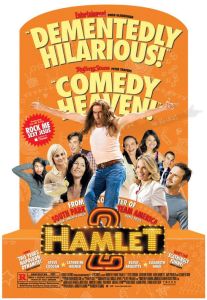
In the wake of Hamlet 2, a popular comedy at the Sundance Film Festival, I pity Bergantino. The man is going to be the Leif Ericson of pointless Shakespeare sequels: forgotten by history at the original pioneer. The film Hamlet 2 follows the miserable life of Dana Marschz (Steve Coogan). He teaches drama at a Tucson, Arizona public school and barely gets paid. His wife (Catherine Keener) is anxious to get pregnant and convinced Dana is shooting blanks. The couple is so poor that they have to rent out their home to a boarder (David Arquette). His drama class has two very WASP-y pupils (Phoebe Strole and Skyler Astin), but the rest are disinterested Hispanic students bused in from another school district. The school’s theater critic chides Dana’s laughable productions of Hollywood movies, like Mississippi Burning and Erin Brocovich. Then comes the news that drama has been slashed from the school budget. The pint-sized theater critic tells Dana to try something original to save the drama department. The answer? Hamlet 2. Thanks to a time machine, and Hamlet’s new best buddy Jesus Christ, the pair can go back and save everyone who previously perished.
 Hamlet 2 is Coogan’s show and the British comic makes his character endearing sad-sack. His character is pathetic and subject to all sorts of personal humiliations, and yet Dana is so earnest that it makes it hard not to empathize with his exploits. Coogan has a wild leer to him that gives the character a manic edge of desperation. He’s a gifted comic but he’s used to playing smug, droll characters, and Dana Marschz is the exact opposite of that mold. Coogan’s many breakdowns and bouncy spirit give the material an extra lift. He works hard for every laugh. It’s a shame, though, that he sort of disappears into the background during the staging of his infamous play.
So what is the comedic point of view with Hamlet 2? Are we to laugh at Dana and find him a buffoon? Well if that’s the case, then why serve up a musical finale that’s actually worthwhile and completely hilarious? The production values are pretty extravagant given the money limitations on the characters. Not only that, it’s so bonkers that I wanted to just watch Hamlet 2 on stage and not cut back to life outside. I wanted to luxuriate in the inspired craziness of a musical that involves time travel, Shakespeare, Albert Einstein, the song “Raped in the Face,” the devil, the Gay Men’s Chorus, lots of father issues, and Jesus moonwalking over water. That’s way more interesting than the ho-hum characters interacting backstage. In truth, the play’s the thing and it’s way too short for my liking. The performance serves as the film’s payoff, so I wanted to get every crazy kernel of shameless joy. The “Rock Me Sexy Jesus” song is irresistible and I haven’t been able to get it out of my head for days. It’s so bouncy and fun and melodic. I’ll be walking along and then I’ll start humming the damn thing. I doubt that I will come across a catchier original song in movie this year. Hopefully those bigwigs in the Academy will realize the tune’s musical merits and give it a nomination it rightfully deserves.
Then is Hamlet 2 a parody of all those treacly teacher inspiration movies, the kind that seem to always be populated by tough minority kids who just need someone to take the time and break through to them? Well Dana constantly refers to Hollywood movies like they’re documentaries, and even a whole class lecture concerns Dangerous Minds. When he accidentally injures a student, Dana jumps at his students being alert and offers in summation, “Yes it was stupid but it was theater.” The movie takes some shots against the likes of Dead Poet’s Society and Mr. Holland’s Opus, but ultimately Hamlet 2 becomes yet another inspirational teacher movie. Dana is able to rally his students to the cause of theater, prejudices are broken down, and certain students take charge of their young lives. It’s all so predictable, and predictability blunts edginess and can destroy comedy. The only true genre tweak seems to come when standoffish Octavio’s background comes to light. He’s not the underprivileged wannabe gangster but a bright kid whose been admitted to an Ivy League school early. And his parents don’t object to the play because of “ethnic narrow-mindness” but because they think it’s poorly written.
 Like Dana’s students, the film never seems to match its potential. The concept is great and so is having a main character who is inspired by theater but profoundly inept at teaching it. Dana lacks talent but can it be made up for with such big-hearted enthusiasm? There is plenty of ripe material there, but Hamlet 2 doesn’t seem to fully realize the comedic possibilities. Watching Dana fight administration officials in the name of the arts is worthwhile conflict but it’s rarely funny. Keener seems wasted as Dana’s passive-aggressive wife. An ACLU lawyer (Amy Poehler) is a great political target, especially as she fights in the name of bad art, but she appears too late in the film to be really capitalized. The climactic staging of Dana’s masterwork is another example of not fully thinking out the comic potential of a situation.
Here’s a perfect example: Elisabeth Shue appears in the film as herself, actress Elisabeth Shue. She’s quit the acting business and taken residence as a nurse in Tucson. What exactly is the joke here? Is it that Hollywood has the habit of spitting out aging actresses? Dana’s students have no idea who Shue is. Is it self-parody? If it was self-parody then the filmmakers needed to give Shue more of a personality. She’s appears infrequently and beams a nice smile but that seems like the only demand, though I must admit always in her nurse outfit, a nice visual gag. If Hamlet 2 had spent more time in revision it would utilize the comic possibilities of integrating a real-life actress playing herself in such a remote city.
Ultimately, I don’t know what to make out of Hamlet 2. It’s a marginally funny and entertaining venture that celebrates the power of the arts, which is a noble cause. Coogan straps the production on his back and carries it as far as he can go. There are some decent laughs and the closing 15 minutes is a giddy blast. However, the movie often feels flat and simply odd, missing potential punchlines and settling for second-rate comedic situations. The crafty premise afforded better material then what eventually comes across onscreen. The whole thing also feels like a mild retread of Waiting for Guffman. But take heart, because Bergantino is not about to lose the spotlight just yet. He also has written A Midsummer Night’s Scream: Hamlet II (I have no idea where the two stories connect but that’s the genius of it). It’s only a penny at Amazon.com. Get it while you can. Or don’t. Preferably, don’t.
Nate’s Grade: B-


 nathanzoebl
You must be logged in to post a comment.