Blog Archives
Saturday Night (2024)/ September 5 (2024)
Recently two ensemble dramas were thought to have awards potential that never materialized, and I think I might know at least one reason why: they are both undone by decisions of scope to focus on either a single day or a 90-minute period to encapsulate their drama.
 With Saturday Night, we follow show creator Loren Michaels (Gabriel LaBelle) the night before the premiere episode of the iconic sketch TV series, Saturday Night Live. The story is told in relative real time covering the last 90 minutes before its initial 11:30 PM EST debut in 1975. We watch Michaels try and deal with squabbling cast members, striking union members, failing technology, his ex-wife (Rachel Sennot) who also happens to be a primary producer of the show, muppets, and studio bosses that are doubtful whether this project will ever make it to air. I understand in essence why the real-time setting is here to provide more pressure and urgency as Michaels is literally running out of time. The problem is that we know the show will be a success, so inventing doubtful older TV execs to add extra antagonists feels like maybe the framing by itself was lacking. Think about Air but you added a fictional exec whose only purpose was to say, “I don’t think this Michael Jordan guy will ever succeed.” There are interesting conflicts and subplots, especially with the different groups that Michaels has to manage, but when it’s all stuffed in such a tight time frame, rather than making the movie feel more chaotic and anxious, it makes those problems and subplots feel underdeveloped or arbitrary. I would relish a behind-the-scenes movie about SNL history but the best version of that would be season 11, the “lost season,” when Michaels came back to save the show and there were legitimate discussions over whether to cancel the show. Admittedly, we would already know the show survives, but does the public know what happened to people like Terry Sweeney and Danitra Vance? Does the public know what kind of sacrifices Michaels had to make? That’s the SNL movie we deserve. Alas, Saturday Night is an amiable movie with fun actors playing famous faces, but even the cast conflicts have to be consolidated to the confined time frame. This is a clear-cut example where the setting sabotages much of what this SNL movie could have offered for its fans.
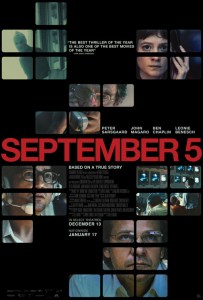 With September 5, we remain almost entirely in the control room of ABC Sports as they cover the fateful 1972 Munich Olympics after the Israeli athletes are taken hostage by terrorists. It’s a subject covered in plenty of other movies, including Steven Spielberg’s Munich and the 1999 Oscar-winning documentary One Day in September, but now we’re watching it from the perspective of the journalists thrust into the spotlight to try and cover an important and tragic incident as it plays out by the hour. It’s an interesting perspective and gives voice to several thorny ethical issues, like when the news team is live broadcasting an oncoming police assault, which the terrorists can watch and prepare for as well. The movie is filmed in a suitable docu-drama style and the pacing is as swift as the editing, and that’s ultimately what holds me back from celebrating the movie more. It’s an interesting anecdote about media history, but September 5 fails to feel like a truly insightful addition to the history and understanding of this tragedy. It’s so focused on the people in the studio and restrained to this one day that it doesn’t allow for us to really dwell or develop in the consequences of this day as well as the consequences of their choices on this fateful day. The movie feels like a dramatization of a select batch of interviews from a larger, more informative documentary on the same subject. It’s well-acted and generally well-written, though I challenge people to recall any significant detail of characters besides things like “German translator” and “Jewish guy.” It’s a worthy story but one that made me wish I could get a fuller picture of its impact and meaning. Instead, we get a procedural about a ragtag group of sports journalists thrust into a global political spotlight. There’s just larger things at stake, including the inherent drama of the lives at risk, than if they’ll get the shot.
Nate’s Grades:
Saturday Night: C+
September 5: B
Share this:

Stronger (2017)
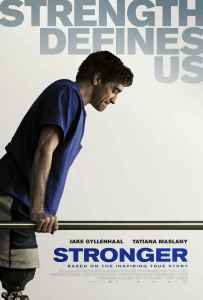 An inspiring true-life story that still manages to stay grounded on its own terms, Stronger is an emotionally affecting movie buoyed by two sensational performances. Jake Gyllenhaal plays Jeff Bauman, an ordinary guy who is present at the 2013 Boston Marathon bombing and loses his legs in the attack. He was there to support his on-again off-again girlfriend, Erin (Tatiana Maslany). Needless to say, his whole world changes and he has to adjust to a new life, a new identity, and the hardships placed upon others within his family sphere, especially Erin. This is a very solid meat and potatoes kind of drama. It’s not flashy or inventive but it has serious human drama and it treats it as such. I was on the verge of tears for a solid thirty minutes. Gyllenhaal delivers yet another Oscar-worthy performance, burrowing into an average screw-up thrust into the national limelight. Everyone tells him he’s a hero, but he doesn’t feel it. Everyone wants a piece of him and his doting mother (Miranda Richardson) often blurs the line between pride in her son and exploitation. The colorful, coarse, dysfunctional family dynamic will remind many of 2010’s The Fighter. I greatly appreciated that even after the terrorist attack Jake is not canonized. He’s no saint just because something terrible happened to him. Director David Gordon Green (Pineapple Express) takes great care to keep the movie grounded even as it hits the standard inspirational notes, finding moments of grace in unexpected places and people. The backbone of Stronger is the thoroughly moving relationship between Jake and Erin. They have exchanges of both ferocious anger and deep tenderness. A post-amputation sex scene between them is so intimately filmed by Green that you almost feel like you’re intruding. Maslany (Orphan Black) can break your heart or make it melt just with an expression. The non-verbal acting in this movie is truly exceptional. Stronger is a strongly developed drama with characters that earn every one of your hard-fought tears.
Nate’s Grade: B+
Share this:

Postal (2008)
 I feel very strange at this moment. I may need to consult a physician. I’m undergoing an altogether new and confusing sensation. You see, I’m hesitant, almost embarrassed to admit this, but I finally found a Uwe Boll movie that I, well, don’t hate. In fact, I was laughing with Postal and not derisively at it. I would never have guessed that a social satire co-written and directed by Boll, which begins with hijackers flying a plane into a large skyscraper, is actually intentionally funny. That’s not to say that the outrageous, violent, and messy film is verifiably good, but for the first time I feel like Boll is genuinely progressing as a filmmaker and may prove that he can craft a competently entertaining movie in the future. And if you know anything about Boll, that statement is akin to going from crawling to flying an F-14 fighter jet blindfolded while constructing a birdhouse out of Popsicle sticks.
The slapdash plot takes place in the small town of Paradise, Arizona. Postal Dude (Zack Ward, TV’s Titus, Bloodrayne II) is a guy who gets pushed around by life. His fat wife is cheating on him constantly, he’s bullied by rednecks that live in the neighborhood trailer park, and he can’t find a job to escape. He’s looking for any way out. His uncle Dave (Dave Foley) has started a doomsday religious cult of disenfranchised hippies. The IRS is currently targeting him and needs a quick money fix. Uncle Dave and Postal Dude scheme to steal the lone shipment of “Krotchy” dolls, a doll that resembles male testicles that is highly in demand (the Chinese shipment capsized and the crew all died, but luckily the dolls were saved). Also looking to snatch the dolls is a terrorist cell that includes Osama bin Laden (played by Jewish actor Larry Thomas, best known as the Soup Nazi on Seinfeld). The plot isn’t important per se, but you will find yourself openly questioning why respected actors like J.K. Simmons and Seymour Cassel are doing in this mess.
 I think Boll has finally found a genre best suited for his cinematic interests. Setting Postal in the wacky comedy world has a freeing effect for Boll: he doesn’t have to adhere to any form of logic. His other movies usually suffered through continual lapses in thought and deed. With Postal, Boll can be as silly as he wants and not have to worry about disrupting his narrative. It should be no surprise then that Postal contains the best acting ever seen in a Boll movie. The good German has always had a seemingly inability to control his actors or provide any helpful direction, but finally he has found a genre that will work with actors giving unrestrained performances that are figuratively all over the thespian map. Shockingly, Ward and Foley both give quite good straight-laced comedic performances (nothing can prepare you for Foley’s generous dose of full-frontal nudity).
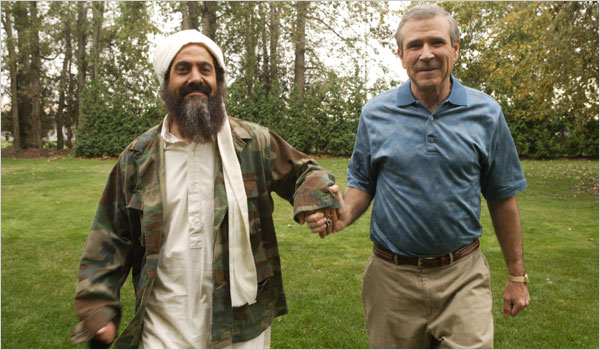
Boll stuffs a lot of extreme elements into his movie, including Islamic terrorists, Osama bin Laden frolicking hand-in-hand with President Bush, inbred rednecks with garish teeth, sex scenes with the morbidly obese, crass racial stereotypes, sexual abuse gags, the media’s opportunism in response to tragedy, an ending that takes a page from Dr. Strangelove, a mentally handicapped martyr, and much more. The movie’s aim is to offend and it has many targets. Boll is no insightful political satirist but even he finds humor in the absurd. The movie is blunt and belittles everyone. Postal skewers religious fundamentalism/apocalyptic yearnings on all sides. There is one sequence where Ward is pinned down by rednecks, Islamic terrorists, and crazy cult followers. He tries appealing to their hearts and establishing common ground. “Well,” one of the terrorists says, “We all hate the Jews,” and then everyone nods solemnly. That’s funny. It’s not deep or biting but it is funny in setup and delivery. I give credit where it’s due. Postal takes some seriously demented detours that take advantage of the wacky, anything-goes atmosphere.
The movie’s jokes hit high and low but some of them definitely stick. The concept of our main character caught in a shootout at the welfare office is given a wicked twist when he crawls along the incapacitated victims looking to trade up a better waiting number. There are comedic riffs hat actually work. Postal isn’t clever or scathing, and is hardly subtle or nuanced, but I could honestly see Postal developing a small cult following, one removed from the cult following already built around bashing Boll.
 Here is a list of moments that made me actually laugh: using a man in a vegetative state bound in wheelchair as a stepping stone to help climb a chain-link fence, Foley and Ward arguing decimal placements, watching Mini-Me actor Verne Troyer pushing a suitcase bigger than himself across a long shot, the fact that Osama bin Laden casually walks around in broad daylight to underscore the nagging fact that the man is still at large, the concept of using a cat as a silencer for a gun (fear not animal lovers, the cat lives), a “God shelter” in case of rapture, Osama attending a workshop on leadership styles and having his credit card declined, a character’s dying attempt to discover if he’s gay or merely bisexual, and the insane religious prophecy involving Troyer and 1000 horny monkeys. That last one is almost inspired in its sheer lunacy. The best part for many will be when Uwe Boll appears onscreen as himself. He admits he finances his crummy movies via Nazi gold and then, no kidding, the actual creator of the Postal video game appears and shoots Boll in the groin. For many, this is a vicarious moment to be savored.
Postal could have worked even better had Boll had a more consistent tone. Simply put, being offensive and shocking and wallowing in bad taste does not guarantee being funny. Watching a truck run over a baby carriage isn’t funny because it’s shocking. Without greater context or setup, it’s the equivalent of a tired and morose “dead baby” joke: tasteless but lacking any humor. And yet here are more missed comedic opportunities that Boll fails to capitalize upon. The missed comedic opportunities mount (Islamic terrorists eventually descend upon a redneck trailer park and … nothing?). Some jokes teeter but then hit a wrong note and become uncomfortable. Watching a black police officer (Chris Spencer, Bloodrayne II) brutally murder an Asian driver is not funny. Seeing a montage of children being massacred by stray gunfire is not funny and has no hope of being funny. When the movie utilizes realistic violence, it must walk a very delicate tone to spring laughs from darker territory. Realistic violence by itself is not funny because brutality is hard to milk for laughs.
Boll will drift and lose his comedy momentum. The highly publicized opening sequence is actually kind of funny. Two terrorists have hijacked a plane but then have second thoughts after they realize there are discrepancies about the number of post-martyrdom virgins. They begin to then analyze the gaps in theology and decide to turn the plane around and head to the Bahamas instead. With this segment Boll has taken a politically sensitive subject and given it a twist. Where the segment goes wrong is not when the passengers storm the cockpit and cause the plane to crash, this serves as irony. Where the segment goes wrong is when it cuts to a window washer atop a skyscraper and we watch the plane come closer and crash into a fiery blaze. The view doesn’t serve as any comedic punchline and places the viewer in an uncomfortable position of not only reliving 9/11 but also reliving it from a hapless victim’s perspective. It’s one example of a misstep that ruins the joke. By the film’s end it has turned into an incoherent bloodbath.
 Not to kill Uwe Boll with praise, but Postal is also his best looking movie to date. The shot compositions are framed well, there is actual camerawork that gives off a slight Coen brothers’ vibe, and the cinematography by Boll staple Mathias Nuemann is crisp and clean. This is a good-looking movie that works within its limited budget and locations.
Postal wasn’t given much of a chance out of the gate. It has been sitting on a shelf for over a year, it was dumped into a small number of theaters opening the same weekend opposite the slightly higher profile Indiana Jones sequel. Boll arranged a free screening of the film and a majority walked out after the opening segment involving the hijackers. Postal is a bizarre and distasteful movie that relies too heavily on shock tactics and the idea that offensive equates humor. There are holes, inconsistencies, shallow satire, and many missed comedic opportunities, and yet, in spite of everything, I laughed at several points. This is Boll’s most intentionally entertaining movie to date. While it may sound like heresy, I would rather watch Postal again than the much more commercial and critically lauded Pineapple Express.
It feels like Boll is actually progressing as a filmmaker, however, I make this statement under the caveat that the confines of the wacky comedy genre forgive lapses in content. But I may not be alone. Boll submitted his flick to the Hoboken International Film Festival and actually won. Boll was named Best Director and the film was awarded Best of the Festival, which is a category based upon audience votes. Perhaps it’s just my lowered expectations with any Boll production, but Postal almost works; not quite but almost. And that’s a tremendous leap forward for a man whose movies have made me retire synonyms for “stupid.”
Nate’s Grade: C
Share this:

Vantage Point (2008)
 Vantage Point presents a terrorist strike and a presidential assassination from six different perspectives (though the advertising credits 8 perspectives). The Rashoman-style idea presents enough intrigue to sustain viewer involvement, but then it seems like the movie gets tired of its own gimmick, throws its hands in the air after the fifth trip down memory lane, and says, “Ah, forget this. Here’s what really happened,” and spells it out. The perspectives are too short and there are frankly too many; the idea is good but the execution is flawed. I think having possibly three perspectives play out for around 40 minutes each would have beefed up the plot and allowed for more intriguing criss-crossing. Not all of the perspectives are equally compelling (Forest Whitaker as a tourist with a camera seems like a lame way to bridge plot points) but they do link together and each submits a bevy of new questions and surprises. The swift, 90-minute running time means there’s precious little screen time to be doled out to the many characters, so don’t get used to seeing most after their main appearance. Vantage Point careens toward a finish that ties everything and every perspective together with a fairly nifty car chase. The movie could use some extra time spent on the flaccid characters (I’m at a total loss as for the motivation of several of them), and the film strains credibility, and yet it works as a passable thriller with enough of an edge to pass the time agreeably.
Nate’s Grade: B-
Share this:

The Kingdom (2007)
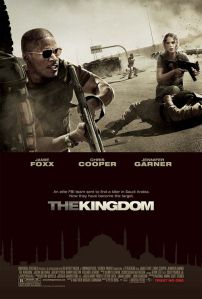 Now that summer is but a hazy memory, get ready for a roll out of serious minded movies Hollywood hopes vie for serious award attention. It may be five years into the current war, but the movies are now cranking out Iraq-themed dramas that will dominate the release schedule for the approaching months. Things are about to get heavy and somber. First out of the gate, though, is The Kingdom, a film about the nebulously termed War on Terror set within the confines of an action movie. Actor-turned-director Peter Berg (Friday Night Lights, The Rundown) knows how to create a stylized movie that feels organic to its genre, and The Kingdom is another example of his growing cinematic pedigree.
In Saudi Arabia, a housing enclosure of American contractors and their families is brutally attacked by terrorists that have infiltrated the Saudi security. Two hundred American lives are lost and FBI agent Ronald Fluery (Jamie Foxx) is intent on leading a team of experts (Chris Cooper, Jennifer Garner, Jason Bateman) to the soil of the Saudis, otherwise known as The Kingdom. The State Department refuses to authorize an investigation citing the jurisdiction of the Saudis as well as the danger of violent reprisals if agents are within reach of the perpetrators. Colonel Faris Al Ghazi (Ashraf Barhom) is assigned to baby-sit the American agents and keep them stuck in red tape during their five days allotted to them. Fluery refuses to take a subservient role and works with Al Ghaazi to get some answers.
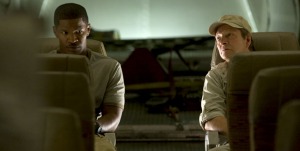 The animated opening credit crash course in Saudi history is fun and informative, however, it really doesn’t relate to The Kingdom even though the damn movie is set in that country. Curiously, the movie only makes cursory statements on the wary relationship between the Saudis and the United States, but otherwise this movie could have been dropped in any nondescript Muslim country in the Middle East. If The Kingdom was relocated to, say, Yemen, I doubt the script would need that much fine-tuning; snip some references to royalty here and there. This is a story about the balance between a moderate Middle East regime and radical elements within the country willing to buck Western influence by any destructive means necessary. I’m measurably disappointed that the movie didn’t tackle more about the unique and tenuous Saudi-U.S. relationship, but then I accepted the fact that The Kingdom wasn’t so much about a country but an ideology that knows no borders.
To that end, The Kingdom is one part CSI: Saudi Arabia, one part political thriller, and one part gung-ho Hollywood action extravaganza, and none of the parts seems to work well together as a whole. The film doesn’t work as a cohesive unit and perhaps tries to do too much. Now, this does not mean that any of those parts are not entertaining. The criminal investigating is rather interesting because of all the cultural barriers between the U.S. agents and the Saudi governing system (a miscast Jeremy Piven, as an ambassador, admonishes Janet, in a very Ari Gold way, to “dial down the boobies”). The central mystery of who is responsible is pretty thin and easy to solve, which may be why the film spends so much time finding obstacles to delay our FBI team from getting their hands on the evidence. The political thriller elements are expressed with the subtlety of a sledgehammer, and yet they feel like thoughtful counterpoints to any rah-rah jingoism that The Kingdom may instill in an American audience. The climax provides plenty of fist-pumping violence but it also ends on a note about the futility of violence as well as the durability of hate. I even appreciated devoting time to interdepartmental jockeying and watching agency heads seeing who will blink first in a public relations-dominated world. The Kingdom doesn’t have a desire to become Syriana 2: No Blood for Oil, but it does possess a greater deal of intelligence and relevance than most of what big budget Hollywood is spewing out (I refuse to believe the FBI would send an agent, with a personal family tie to Israel, into a Muslim country).
Strict action fans, however, are going to have a lot of downtime on their hands. The Kingdom opens with an action sequence and closes with an action sequence, and there’s a wide gap in between those bookends. The final 20 minutes are devoted to a nail-biting ambush and rescue that transforms our FBI agents into improbable action movie warriors. Berg’s restless camera isn’t as well honed as Paul Greengraas (The Bourne Ultimatum), and sometimes you just wish the jittery cameraman would allow you to see what’s going on. I don’t know if the docu-drama emphasis is fully needed, especially when the movie jumps between shots of just two people having a conversation. Berg is a terrific director and the action sequences hit hard; I just hope he doesn’t become trapped trying to fit himself into one style.
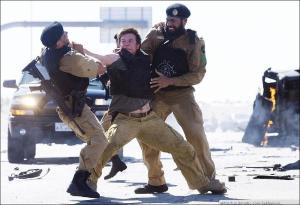
In truth, the most intriguing part of The Kingdom is the relationship between Fleury and Al Ghazi. They begin frustrated and fighting for control, but soon, in true buddy cop genre fashion, a mutual respect forms as they search for the bad guys. The script offers helpful examples of good Movie Arabs and bad Movie Arabs, and the audience is able to easily identify the two sides. The interplay between Fleury and Al Ghazi leads to some humorous exchnages as well as some reflective opportunities, like where the men recount their families and declare they do not care why such dastardly acts were done, they just want to inflict some punishment on the rightful parties.
The acting, like the film, is a bit all over the place. Foxx seems to be on autopilot. Foxx has bunkered into his acting troupes; intense, penetrating stare, whispery dialogue recitations, and a cocksure attitude. Cooper is cranky and incredulous older timer along for the ride. Garner does her best with a character that was written for the sole purpose of concocting culture squabbles over the role of the opposite sex. She does unleash a torrent of anger and power in one very hard-core and frighteningly extreme fight scene. Bateman is playing comic relief and does sarcastic quips with great ease, but his character also gets unexpectedly thrown into a very harrowing experience and Bateman makes you feel every drop of his fear. Barhom (Paradise Now) gives a convincing performance of a man torn apart by his moral compass and the path of his country. He feels a sense of duty to protect the innocent but at the same time he is scoffed at by colleagues for helping “them.”
The Kingdom is an action movie with more on its mind than blowing up the enemy real nice like, though that also plays a key component. The pieces don’t fully add up to a whole and the film’s politics are a little tricky to get a bearing on; is this a red state movie, a blue state movie, or something for both audiences? Berg’s ambition is admirable and his film never drags out a soapbox to preach. The Kingdom is a topical movie aimed at planting seeds of debate among a mainstream audience in between their handfuls of popcorn and gulps of soda.
Nate’s Grade: B-
Share this:

United 93 (2006)
 I’ve heard a lot of talk about whether America was ready for United 93. Almost every magazine or newspaper article you’d read about director Paul Greengrass’ real time account of 9/11 began with the question, “Is it too soon?” That’s mostly a personal decision. My response: of course not. They were making World War II movies while Europe was still burning and while Pearl Harbor was still recovering. Speaking of which, doesn’t anyone feel that a 9/11 movie would be much more powerful and respectful now, five years removed from one of the worst days in American history? We can still remember that awful day, and most importantly, we can use art as a means of catharsis when the subject remains relevant. Does anyone seriously want to wait 20 years down the pipe for a 9/11 movie to be produced by Jerry Bruckheimer? Was 2001’s Pearl Harbor the kind of movie we’ll get when it’s “not too soon?” While I’d never insist people see United 93 if they weren’t ready, I will say it’s definitely a movie that demands to be seen sooner rather than later.
On September 11, 2001, four planes were hijacked in the sky by members of the terrorist group Al-Quaeda. Two crashed into New York’s World Trade Center building. Another crashed into the Pentagon in Washington, D.C. A fourth plane, United 93, was delayed on its initial takeoff, meaning the four hijackers on board were already behind schedule. After the hijackers had taken control of the plane and turned it back around, presumably headed toward the White House, the passengers started making phone calls from the flight and piecing together the scenario. They weren’t going to land at any airport; they were a bomb on wings. The passengers came together with a heroic plan to take back the plane and use a fellow passenger, with flying experience, to help them land. Their valiant effort ended in United 93 crashing in Shanksville, Pennsylvania.
 United 93 is one of the most nerve-racking movie going experiences I have ever seen. Because of our prior knowledge of the events, every little thing carries so much dread, from a man who just makes the plane to simple phone calls, unknowingly their last, that end so regularly in “I love you.” Hitchcock said tension was watching a happy couple unaware of a ticking bomb below their picnic table, and he was right. United 93 is grueling to sit through, but that doesn’t mean the film isn’t rewarding. We’re going through the same situation and harrowing steps of realization as the passengers. The final phone calls on board may be the most emotionally wrenching thing I’ve seen in a movie since 2000’s Requiem for a Dream. The final 30-minutes of the film, concentrating on the passengers retaking the plane, is some of the most intense cinema I’ve seen in years. My heart was beating outside of my chest and I was shaking, even after I got out of the theater. I spent the next hour at my house walking around trying to shake it off but I couldn’t. This is an incredibly powerful and sobering film that will stay with you like a bad dream.
Witnessing the unfolding events of United 93, a spellbinding example of you-are-there cinema verite, you really feel like you’re watching a living documentary. There’s nothing sensational or overly political that happens within United 93. Greengrass even has the temerity to present the hijackers as human beings, granted human beings capable of ferocious acts of horror. The first moments of the movie are the hijackers preparing, praying, reciting the Koran, and going about their plot. You see them sweat, get antsy, and the lead hijacker evens seems a bit hesitant about following through, especially since this coordinated attack was botched by United 93’s delay on the tarmac. Some would call such a portrayal ludicrous, citing a scene where a hijacker calls his girlfriend to say his last “I love you” as apologetic claptrap. Some would take offense that the hijackers are not demonized, have horns sprouting from their heads, or laugh maniacally at spilled blood. But just like Spielberg’s portrayal of Palestinians in Munich, human evil is much more nuanced than simply painting a mustache on. United 93 shows every side to 9/11 like what a good documentary should do. This isn’t propaganda, this isn’t exploitation, this is respectful filmmaking. Yes, we?ll never know what happened on flight 93, and much of the film is speculation, but it’s speculation built around research and reverence.
 Greengrass is in fine form, recreating the same sense of building desperation and terror that he so elegantly assembled in 2002’s Bloody Sunday. The antic handheld camerawork may give people some headaches, but no filmmaker does a better job of putting you in the moment than Greengrass. His decision to use real people portraying themselves, like FAA head Ben Sliney, creates a greater feel for authenticity, even having the film’s stewardesses played by real United stewardesses. None of it feels gimmicky, nor is Greengrass interested in telling a jingoistic, hyperbolic action adventure. The famous “Let’s roll” line is just another line said amongst many in the planning process for taking back the flight. The violence is sudden and shocking but never sensationalized. United 93 ends exactly as it should too. You?ll probably hear sobbing in your theater at that point; I did.
There have been complaints that the character development in United 93 is lacking. But really this is a story about 2 hours on one morning, told in real time, and how much talking do strangers do on a flight? Some, sure, but not a lot. To answer critics, if we’d gotten to know these characters extensively it would either break the fabric of reality and turn these people into eagerly sharing, easily emotive figures, not people, or would require extensive flashbacks which would remove us from the visceral feeling of the story. That’s why Greengrass cuts back to NORAD and the FAA, because there’s stuff happening there; the slow realization of fright, the disbelief, the staggering amount of confusion and miscommunication. They can’t even get anyone from the White House on the phone to even establish a chain of command. If we had staid onboard we would be watching people read magazines or eat peanuts for 30 minutes. I never once felt less for these people because of the characterization concerns.
 The “ordinariness” of the passengers is what works best, because it just as easily could have been you or me, but would we have reacted the same? Had it been “Tom Cruise starring in United 93″ then it never would have worked. This excels on how realistic everything comes across, and any Hollywood moment that would shatter that realism is absent (thank God there’s no product placement). One of the more amazing aspects of United 93‘s conclusion is just how fast everything came about. These people had little time to act, much less take stock of the waking nightmare the day was turning into and formulate a plan. The movie is a touching tribute to a group of ordinary people that became something more on one of our darkest days.
Naturally, United 93 is not going to be a film for everyone. It’s unflinching, grueling, and altogether hard to sit through. It does a stupendous job of recreating that tragic day and allowing our own knowledge of the events to build an overwhelming sense of dread. Greengrass excels in this arena of storytelling and he’s worked his docu-drama magic once more, painstakingly allowing the viewer feel like they are a participant, to the point where we even get a rush of hope that maybe the passengers could take back their plane and save themselves. The question of whether it’s too soon for a major 9/11 movie has to be decided on an individual level. I don’t recall anyone griping about the thousands of documentaries and the A&E Flight 93 TV movie, all of which, yes, made money off 9/11 too. I think for us as a society, we need this movie to remind ourselves of the heroism and sacrifice of a few. It’s very easy to get lulled back to complacency, but the masterful United 93 will not allow that. This is a powerful story told without a hint of melodrama and it will be guaranteed to be near my Best of the Year list when 2006 rolls to a close.
Nate’s Grade: A
Share this:

Arlington Road (1999)
 Psychological thrillers are always much harder to pull off than the standard Hollywood action flicks. Bullets and explosions are replaced with taut mental games and psychological grips played with reluctant victims. Though harder to pull off, the spoils can be fruitful. Arlington Road tries to bridge the gap since the last great psychological movie (a little something called Silence of the Lambs) and has lofty intentions. But its efforts fall short.
The movie moves at a snail’s pace and has the feel of a novel instead of a screenplay. Mark Pellington, the director most known for the Pearl Jam video “Jeremy,” is completely wrong for this picture. His blurs, camera swirls, exaggerated close-ups and poor lighting makes you wonder if they forgot to take off the lens cap and seem entirely out of place. Scenes go on forever with no real connection to one other.
Sure, the movie has a boatload of stars. Tim Robbins wondrously pulls off the menacing feel that his creepy neighbor character needs to seem dangerous. Joan Cusack is the standout with her devilish take on suburban motherhood and her never-ending evil grin. But while the acting is good, the movie is devoid of suspense and tension for the most part.
The movie does pack suspense into the last ten minutes. The ending is haunting and will linger with you for some time after you exit the theater. But even a terrific ending doesn’t make up for what the audience has been made to suffer through to get to that point.
Arlington Road tries to reach for the sky with its idea that terror doesn’t come from overseas, but from our own backyards. The idea is ripe with potential, but Arlington Road never lives up to it. I guess the public will have to wait for the next great psychological thriller. But Arlington Road gives me hope for what the future may bring.
Nate’s Grade: C+


 nathanzoebl
You must be logged in to post a comment.