Blog Archives
The Wackness (2008)
 Every Sundance Film Festival seems to coronate new talent and new films that never seem to materialize once they step outside of the happy bubble of festival life. It happened with Happy, Texas, with Tadpole, with Hav Plenty, with Primer and numerous others that never managed to get started with the public. At the 2008 Sundance film festival, the biggest buzz followed the documentary American Teen and The Wackness. Writer/director Jonathan Levine’s coming-of-age tale won the Audience Award for Drama and boasts shimmering visuals, formidable actors, and a hip soundtrack. Too bad the drama gets the least attention in that package. I suspect The Wackness will be yet another Sundance buzz flick that, while well made, fails to leave a mark on mainstream crowds (here’s hoping more for American Teen).
Luke (Josh Peck) has just graduated from a New York City high school and is winding down the summer before he moves on to college. He has a unique summer job: Luke sells marijuana out of an ice cream vendor’s box. One of his clients, Dr. Squires (Ben Kingsley), is a therapist. He trades therapy time to Luke for pot. The two of them form an unanticipated bond and Dr. Squires makes it a point to see that Luke is making the most of his youth. Luke is smitten with the doc’s stepdaughter, Steph (Juno‘s Olivia Thirby, gratifyingly authentic), and determined to lose his virginity and find love before the summer fades away.
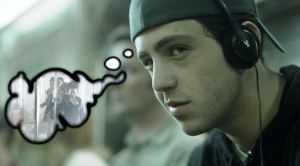 The strength of The Wackness is in the unexpected father/son relationship that forms between Luke and Dr. Squires. Kingsley is sensational in his role and provides all the pathos and unexpected discoveries that the coming-of-age genre is associated with. I think that’s what’s most interesting about Levine’s film, is that Kingsley is going through all the coming-of-age moments reserved for teenage protagonists. Dr. Squires and Luke form a surprising and deep relationship where they learn from each other. Luke learns to talk about his life’s sadness and make it a part of his life, instead of sweeping it under a proverbial rug. Dr. Squires learns to re-embrace life and to kick his heavy supply of pharmaceutical prescriptions. He is coming of age at middle age. He even gets to second base with an Olsen twin (Mary-Kate is only in the film for two scenes and an estimated five minutes). Most of all, Dr. Squires needs a friend and Luke fulfills this desperate void. Kingsley is funny, pathetic, and the real star of The Wackness.
My main problem with The Wackness is how familiar it all comes across. It follows the coming-of-age model down to the end, so a savvy audience is going to realize that Luke will fall in love, get his heart broken, stand up for himself, and gather a bit more wisdom by the time the end credits roll. You’ve seen this movie played in a thousand different ways before, and now The Wackness makes it 1001; you will essentially know every beat of this story before it happens. The film doesn’t break any new ground and doesn’t manage to provide much commentary or lasting insight while it comes of age. The screenwriting fails to hide what disinterests Levine. So we get quick glimpses of Luke’s home life and I swear in every one of them his parents are just yelling. That’s all Levine is interested in, setting up one ten second shot of Luke overhearing his parents shouting again and again. Dr. Squires’ wife (Famke Jannsen) gets the same kind of treatment. She gets a cursory amount of screen time to glower and that’s about it. I can tell Levine is only interested in his three main characters (Luke, Dr. Squires, Steph) but then why does he not concentrate on them further and scuttle what he feels is wasted time?
The Wackness is awash in pointless nostalgia. The movie is set during the summer of 1994 for no real reason. The time setting doesn’t impact the film in any manner except for some digs at Mayor Giuliani’s policies (he was only in office for sixth months or so when the film opens). Levine dishes out pop-culture references like the 8-bit Nintendo game system, old chunky GameBoys, Kurt Cobain’s suicide, mix tapes, and lots of rap music. The Wackness is an ode to mid 90s rap music and Luke is a lover of acts like A Tribe Called Quest, De La Soul, and some up-and-coming guy named The Notorious B.I.G. The soundtrack is also meant to convey good nostalgic vibes of a simpler time only — 14 years ago. Setting the film in 1994 is a lazy attempt to cover the lapses in screenwriting with cozy audience nostalgia. And is there anything really culturally transcendent about the summer of 1994?
 Peck may have lost like 100 pounds since he was fat comic relief on a Nickelodeon kids show, and he’s marginally handsome, but this kid needs some more practice before he’s a dramatic actor. I understand that his character gets stoned often and, as a typical teenager, is trying to pull off a too-cool-for-the-world-“whatever” attitude, but he seems freaking catatonic. He’s too aloof for his own good. His acting is dry and monotone and he feels like he’s constantly zoning out. Again, I understand that this works with his stoned persona but Peck is hardly ever convincing in the part and his acting shortcomings rob the role of a greater level of sympathy. A great actor can make you like a character that eats babies and kicks puppies, or the other way around, but Peck is not that actor. I believe that part of The Wackness‘ failure to connect and elevate beyond its genre trappings is due to Peck’s poor performance. He’s just kind of boring character and, to borrow a term from our pals on the other side of the pond, a bit of a wanker.
As a director, Levine has a playful and visually appealing look for the film, bathing it in arid tones to echo the hot summer days. The cinematography is a character all its own, giving the film a colorful and lively flair that makes every scene worth watching even if the script fails to do likewise. Levine has a handful of clever visual tricks up his sleeve, like a middle finger that moves through a crowd of New Yorkers at rapid speed before finding and dialing a pay phone. Levine has definite talent as a director and it shouldn’t be long before Hollywood comes knocking and plucks him away to make The Fast and the Furious 8: The Search for Curly’s Gold.
The Wackness feels like a coming-of-age film that goes through the motions. The main character is stoned to the point of comatose and he’s a rather boring protagonist, made even duller by Peck’s lackluster acting ability. Writer/director Levine flexes enough visual artistry to make him a talent to watch, however, his screenplay is too familiar with little personality or flavor to stand out against the pack. The movie looks good, it sounds good, and Kingsley is certainly good, it’s just a shame that it isn’t his movie. Steph tells the mopey Luke that all she sees is the goodness life has to offer and all he sees is “the wackness” (you can go home happy to understand the title). I guess I similarly be accused of focusing on the “wackness” of The Wackness because it’s certainly not a bad movie. It just happens to be ordinary. Though it does have some torrid Kingsley-on-Olsen Twin action. I suppose that isn’t too wack.
Nate’s Grade: C+
Share this:

No End in Sight (2007)
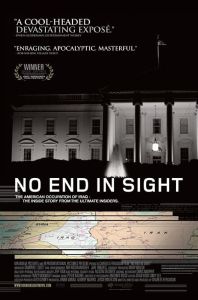 Director Charles Ferguson lived his life as a PhD political scientist, and then he felt compelled to make a movie. No End in Sight doesn’t focus much on the origins of the current Iraq War, which have been well documented and discussed in many other realms, instead the movie takes an exacting look into where the U.S. government fouled up the occupation after toppling Saddam Hussein. Because of this approach, Ferguson’s expose cannot be dismissed under false propaganda claims, and because his interviews mostly consist of the people on the ground who were responsible to stabilize the country, No End in Sight is blessed with plenty of hard-hitting first-hand accounts by the people given the hurried, thankless job of rebuilding a conquered nation.
General Jay Garner and his team, including Colonel Paul Hughes and Ambassador Barbara Bodine, were given 60 days to plan for a post-war Iraq. In contrast, FDR spent years planning ahead for an occupation of Germany. Planning was difficult because when they arrived in Baghdad the post-war looting made setting up a government a formidable task. They not only had to find means to contact people but they had to figure out ways simply to operate in an environment where looting had destroyed buildings and proper tools for communication. They were in charge of ORHA, the Office of Reconstruction and Humanitarian Assistance, which was not run through the State department, as would be normal, but run by the Defense department.
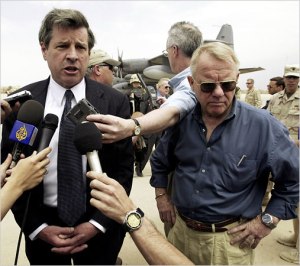 The film holds its harshest criticism for L. Paul Bremer, the man appointed to run the Coalition Provisional Authority, formerly ORHA. Bremer, like many who planned the post-war occupation and were placed in key positions within the occupation, had no military experience, no foreign policy experience with the Middle East, a notoriously tricky region, and he didn’t speak a lick of Arabic. In any other scenario, he would be judged unqualified for his heavy duty ahead. No End in Sight lays out three grievous errors that Bremer made in the summer of 2003 that gave birth to the ongoing insurgency and sent Iraq spinning out of control. The first was absolving any previous work to reach out and include Iraqis in helping to form a working provisional government. Bremer was more a my-way-or-the-highway kind of guy, which may be why he was esteemed in a presidential administration filled with these types. This alienated the Iraqi people and began Bremer’s calamitous habit of bridge burning. His second error was his decision to eliminate the Ba’ath party, Saddam Hussein’s ruling party, and bar members from any future government service. This stripped teachers, engineers, intellectuals, the very people integral to build the infrastructure of a nation, and made them permanently unemployed in Iraq. Many members had merely joined the Ba’ath party because it was the only way to secure a steady job.
But by far the most baffling and incompetent decision Bremer made was to disband Iraq’s army. This boneheaded move went against the recommendations of U.S. military figures, and in the blink of an eye, the 500,000-strong Iraqi army were without a job and an income. There were overtures from military leaders to ORHA; Paul Hughes recounts that one officer promised him 12,000 men in a week if asked. So, in a situation where the U.S. military did not have enough soldiers on the ground to even halt looting, Bremer disbanded Iraq’s best solution for restoring law and order. Half a million angry, disenfranchised, combat-trained, well-armed men were now left to fend for themselves, and if the U.S. didn’t care for their expertise then death militias would. It should come as no surprise that shortly after this colossal miscue is when Improvised Explosive Device (IED) attacks on the U.S. troops surged along with U.S. casualties. It seems like at that point the verdict had come against the U.S. occupation.
 Bremer’s decisions alienated, humiliated, and inflamed the people of Iraq, and they went against the recommendations by people that knew what they were talking about. The greatest tragedy that comes to mind is that, despite morally questionable, downright repugnant reasons for entering this conflict, the U.S. could have done this right. Saddam was indeed a bad man and the people of Iraq were initially receptive to see what the U.S. occupation would bring about. They weren’t expecting rampant unemployment, no tangible security force, being excluded from decision-making, having American private contractors bleed them dry, and an utter lack of basic human services like power and clean water. Add a long-standing religious feud into the mix and it’s no wonder the country has descended into a quagmire. No End in Sight makes the dots easy to follow and connect the cause-effect relationships into where we are today.
It’s hard to watch the film and not feel your blood boil. While No End in Sight is presented soberly and with clear-headed precision, watching the absurd miscalculations and naiveté prevail over the opinions of experts is infuriating. General Shinseki recommended to Congress that several hundred thousand troops would be required after toppling Saddam. Paul Wolfowitz, deputy Secretary of Defense, swiftly countered this assertion by claiming that it was unimaginable that it would require more troops to secure the peace rather than engage in war. “Unimaginable” is the key word here; Wolfowitz just couldn’t potentially fathom a reality that was known by most high-ranking military officials. Stabilizing a country is far more taxing than simply taking out an opposing force. Shinseki, who guided occupation forces in Bosnia and Kosovo, was ignored and pushed into “early retirement,” and Wolfowitz’s plan was followed (Wolfowitz also famously stated that the war would pay for itself thanks to Iraq’s oil revenues).
 No End in Sight does have a figure of amusement and it just so happens to be Secretary of Defense Donald Rumsfeld. The film opens with his farewell address after the 2006 midterm elections where Republicans lost control of Congress and Rumsfeld was shortly ousted from his job days later. He calls the Iraq War little understood and declares that Bush and his team’s accomplishments will one day get the full historical notation they deserve. Of course, the irony is that the designers of the Iraq War had little understanding of what they were getting into and ignored the warnings and advice of those whose opinions conflicted with the Administration line. Many clips of Rumsfeld news conferences are shown and the man comes across as flippant and disingenuous. He dismisses the looting as “stuff happens” and argues TV news is re-running the same image of a man absconding with a vase (“And you have to wonder, are there that many vases in the whole country?” he adds). The Iraq looting destroyed a museum that had artifacts dating back 7,000 years to the dawn of civilization and a library with hundreds of ancient manuscripts was burned to the ground; an entire country’s deep culture and history went up in smoke and Rumsfeld was using it as a setup to a vase joke. The clips further remind the audience that Rumsfeld, one of the chief architects of the war along with Vice President Dick Cheney and Wolfowitz, simply disregards information he doesn’t agree with, whether it may actually be right. The leaders of the Bush Administration demonstrate time and again a supreme disconnect from reality.
No End in Sight is one of the best documentaries yet on the Iraq War and a definitive indictment on the lack of substantial care given to post-war planning. No one can accuse this film of slander or pushing an agenda; this is an exacting autopsy on the current chaos in Iraq, and it has cold facts and hard truths to back up its convictions. Even if you feel that you know all the blunders tied to Iraq, this sensational film is not merely a repackaging of dogma. It’s eye-opening and intensely fascinating and one of the better films of the year; it’s an argument made on the merits of evidence and testimony, and it is damning. One soldier reflects upon the current conditions and flatly asks, “This is the best America can do? Don’t tell me that.” Then after a small pause he adds, “That makes me angry.” You are not alone, brother.
Nate’s Grade: A
Share this:

Waitress (2007)
 Kerri Russell is irresistibly charming in this winning romantic comedy from the late write/director Adrienne Shelly. I fell totally in love, head over heels, with Waitress and I’m not ashamed to say it. In a perfect world, Russell would earn an Oscar-nomination for her sure-handed, witty, and incandescent performance as a pregnant woman who has an affair with her new gyno doc (Serenity‘s Nathan Fillion). This is a star-making performance and it is sealed when the movie relies solely on her emerging smile for an entire minute to communicate a blossoming figure. The supporting cast is great in their eccentric roles well and the movie concludes in a happy if unconventional manner. Waitress is the kind of movie that makes you feel great. The sheer exuberance on display is infectious and it makes it an even bigger tragedy that Shelly will never grant the world another wonderful slice of entertainment.
Nate’s Grade: A
Share this:

Primer (2004)
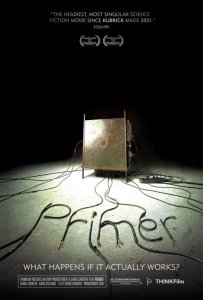 I was intrigued about Primer because I had been told it was classy, smart sci-fi that’s so often missing in today’s entertainment line-up (see: Sci-Fi channel’s Mansquito). It won the Grand Jury Prize at the 2004 Sundance Film Festival and the critical reviews had been generally very positive. So my expectations were high for a well wrought, high brow film analyzing time travel. What I got was one long, pretentious, incomprehensible, poorly paced and shot techno lecture. Oh it got bad. Oh did it get bad.
Aaron (Shane Carruth) and Abe (David Sullivan) run a team of inventors out of their garage. Their newest invention seems promising but they’re still confused about what it does. Aaron and Abe’s more commercially minded partners want to patent it and sell it. Aaron and Abe inspect their invention further and discover it has the ability to distort time. They invent larger versions and time travel themselves and thus create all kinds of paradoxes and loops and confusion for themselves and a viewing audience.
Watching Primer is like reading an instruction manual. The movie is practically crushed to death by techno terminology and all kinds of geek speak. The only people that will be able to follow along are those well-versed in quantum physics and engineering. Indeed, Primer has been called an attempt to make a “realistic time-travel movie,” which means no cars that can go 88 miles per hour. That’s fine and dandy but it makes for one awfully boring movie.
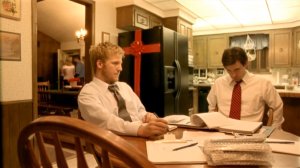 Primer would rather confound an audience than entertain them. There is a distinct difference between being complicated and being hard to follow. You’d need a couple volumes of Cliff Notes just to follow along Primer‘s talky and convoluted plot. I was so monumentally bored by Primer that I had to eject the DVD after 30 minutes. I have never in my life started a film at home and then turned it off, especially one I paid good money to rent, but after so many minutes of watching people talk above my head in a different language (techno jargon) I had reached my breaking point. Primer will frustrate most viewers because most will not be able to follow what is going on, and a normal human being can reasonably only sit for so long in the dark.
I did restart Primer and watched it to its completion, a scant 75 minutes long. The last 20 minutes is easier to grasp because it does finally deal with time travel and re-staging events. It’s a very long time to get to anything comprehensible. I probably should watch Primer again in all fairness but I have the suspicion that if I did my body would completely shut down on me in defense. Some people will love this and call it visionary, but those will be a very select group. It’s not just that Primer is incomprehensible but the film is also horrifically paced. When you don’t know what’s being said and what’s going on then scenes tend to drag because there is no connection. This movie is soooooo slow and it’s made all the worse by characters that are merely figureheads, dialogue that’s confusing and wooden, and a story that would rather spew ideas than a plot.
Writer/director/star Shane Carruth seems to have high ambitions but he has no empathy for an audience. Films can be dense and thought-provoking but they need to be accessible. Richard Kelly’s Donnie Darko is a sci-fi mind bender but it’s also an accessible, relatable, enjoyable movie that’s become a cult favorite. Carruth also seems to think that shooting half the movie out of focus is a good idea.
I’m not against a smart movie, nor am I against science fiction that attempts to explore profound concepts and ideals. What I am against, however, is wasting my time with a tech lecture disguised as quality entertainment. Primer is obtuse, slow, convoluted, frustrating and pretentiously impenetrable. After finally finishing Primer I scanned the DVD spine and noticed it said, “Thriller.” I laughed so hard I almost fell over. The only way Primer could be a thriller is because you’ll be racing the clock for it to finish.
Nate’s Grade: C-
Share this:

Saw (2004)
 Saw was pieced together by two first-time filmmakers, director James Wan and writer Leigh Whannell. They envisioned that old movie favorite, the imaginative serial killer. Their killer would put people in horrific life-or-death situations, testing our will to live even if it meant rummaging around the intestines of a live human being for our key to freedom. With a budget of a mere million dollars, Wan and Whannell have executed a dark, slick, sometimes thrilling, sometimes laughable fright flick. The only question is if audiences are hungry enough for the splashes of blood Saw can deliver, or if they’d rather watch Sara Michelle Gellar turning Japanese.
Adam (Whannell), a private photographer, and Dr. Gordon (Cary Elwes), a workaholic surgeon, are in a very strange circumstance. They’ve both just awoken and find themselves chained by their feet at opposite ends of a bathroom with a dead body between them. Neither has any idea how they got there. Dr. Gordon theorizes that they’re the culprits of the Jigsaw Killer, a psycho that places his victims in elaborate death traps they must fight to get out of. In the pants pockets of Adam and Dr. Gordon are audio tapes from Jigsaw establishing the rules of this “game.” In eight hours, if Dr. Gordon does not kill Adam, his wife and daughter will be killed. Jigsaw has even left them clues to their escape, most notably a pair of rusty saws not strong enough to cut through their chains, but still plenty strong to slice through their feet if they so choose. Outside this game, Detective Tapp (Danny Glover) is closing in on the identity of the Jigsaw Killer and may be the only hope Adam and Dr. Gordon have.
 Saw is a grisly horror movie that hits the right macabre marks. Horror is such a tricky genre, and you can either build tension in an effective what’s-around-the-corner kind of way (The Ring, 28 Days Later), or, if that fails, and it often does (The Grudge anyone?), you can cut your losses by showing the gory goods (Texas Chainsaw Massacre, any slasher film). This isn’t to say one version is inferior to the other; sometimes we just want to be grossed out. Saw is a horror film committed to horror, sometimes to a rather unpleasant and sadistic point. In a way, the fact that Saw goes for broke in its depiction of the grotesque makes it more enjoyable than recent horror fair that tried to hedge their bets on jump scares and nosy cats.
In some manner, Saw is like a dumber, trashier Seven. They both involve serial killers with agendas and they both give the killer the upper hand. While Seven is a masterpiece of the thriller genre, Saw is a mostly entertaining horror entry. Its premise is razor-sharp and really hooks an audience. We know only as much as the characters do, so their discoveries work two-fold. The pacing is tight, the cinematography is exceptional for its budget, and the end had me jump out of my seat. I will say this; Saw reluctantly seems to think that it needs to reveal the identity of the Jigsaw killer, as well as his motives, to satisfy an audience. I think no answer could ever be satisfying; however, the actual reveal of Saw‘s true killer had me wanting to give the filmmakers a standing ovation. There are fleeting moments of greatness here among the misery. Whannell knows when to show which cards, and it makes the story more enticing.
There are glaring issues with Saw. The acting is one of them. Elwes is usually a stable character actor, but chain him to a wall and say,”Go!” and the man will overact as if his real wife and child depended on it. Whannell, a first time actor and the co-writer, goes deliriously over the top in some battle of scenery chewers. Don’t feel too bad if you feel like laughing during certain moments of “emotional turmoil.”
Saw seems to exist in that magical place known as It Could Only Happen in Movies World. For example, a serial killer designing highly elaborate, and personally clever, death traps could only happen in a movie. I love the fact that the film even shows evidence that the Jigsaw Killer builds dioramas of his future death traps. If he entered them in the Third Grade Sadistic Science Fair, I’m fairly certain he?d at least earn a blue ribbon or a gift certificate.
Yes, only in a movie are we expected to believe one man can kidnap people, lug them around, set up his elaborate Rube Goldberg puzzles, and then kick back and elude police capture. The entire premise of Saw is whole-heartedly ludicrous, and the plot turns are heavily contrived, but, as an audience, you must yield such ordinary eye-rolling to enjoy the pleasures of Saw. If you can swallow plot holes and just go with the film’s skewed logic, there is some enjoyment to be had.
 Wan can also be his worst enemy. Too often he punctuates chase scenes with pounding heavy metal, which does little more than numb an audience. Wan’s film loses some of its focus in the middle as the audience endures flashback after flashback. To goose up the viewing, Wan shoves in extraneous flashes of gore. Just like The Exorcist prequel, flashes of something horrific do little more than to cause an audience to yelp. They’re immediate. If you want true gut-churning reactions, you have to build, and in the end Saw remembers what it came to do and sprints to the finish line.
Saw also exists in the grimiest possible world. Whether it be parking garage, office, or even personal apartment, the characters of Saw exist in some netherworld of filth crying out for an army of scrubbing bubbles. I’m sure this was intentional, but can’t any place in horror movies afford a coat of paint nowadays?
Saw is a gruesome, twisted, sometimes sadistic horror movie with a knock-out premise, a moderately good ending twist (not the final end, though), and some lag time in between. Wan and Whannel really stretch their budget to impressive ends and imply more blood and guts than are shown. Fans of hardcore gore horror should be pleased with Saw, though they may find themselves giggling at it from time to time. I was hooked by its premise and found myself getting more intrigued as the revelations began to sift. Many will find Saw too ugly, gory, or stupid, but for fans of the genre, it should satisfy the itch recent PG-13 horror couldn’t efficiently scratch. Saw is violent, contrived, ridiculous, but also, in the end, gruesomely entertaining in parts.
Nate’s Grade: B-
Share this:

Open Water (2004)
 What a summer it has been for independent films. This summers most talked about movie wasn’t Spider-Man 2; no, it was Michael Moore’s Fahrenheit 9/11. This summer’s greatest triumphant underdog wasn’t Shrek; no, it was Napoleon Dynamite. And this summers scariest movie wasn’t The Village or the Exorcist prequel; no, it was Catwoman. A fine runner-up, though, is the 2004 Sundance smash, Open Water.
Susan and Daniel (Blanchard Ryan and Daniel Travis) are a couple vacationing in the islands. They sign up for a scuba diving voyage, but due to a counting error by the boats crew, are left stranded in the middle of the ocean. Susan and Daniel at first seem nonplussed, but as the hours wear down they begin to question how they’ll ever be rescued. Panic really starts to set in as they realize they have no control over where the current decides to take them. They turn to each other for support but that also doesn’t pan out. Sharks pop up here and there and Daniel tries to use what he learned on Shark Week to asses their danger. As the hours pass, and dehydration sets in, the sharks become more numerous, and Susan and Daniels’ fears become overpowering.
Writer/director/editor Chris Kentis creates a solid, tightly wound mood. His film was shot on a shoestring budget and sometimes it shows in the picture quality. He knows how to effectively draw out a scene and cut it to build tension. The plot could have been written on a napkin, and the characters are somewhat bland, but that doesn’t stop Kentis from masterfully drawing us in and making us care. Open Water is only 79 minutes long, and about 10 of that is the opening vacation footage, but Kentis makes the most of his time.
 The acting by the two relative unknowns is passably good. Ryan and Travis never trip up and become actors wading in water; they feel like real people. This is a testament to the writing and proximity to actual sharks, but Ryan and Travis should also be credited for keeping the illusion together. Early in the film, Ryan also bares all in a surprising full-frontal nude scene that I doubt few going to see Open Water ever heard a whiff about. I guess when you go on talk shows and all they ask you is, ”What was it like being around real sharks?”
One of the reasons that Open Water is so effective is how realistic it is. The film is based on a true incident at the Great Barrier Reef in the 90s. A scuba-diving couple was left behind by their tour boat and eventually died of thirst days later. Their bodies washed ashore. Now, slowly dying of thirst wont exactly ratchet up the terror, so one must forgive the inclusion of dangerous sea life this film brings to the table.
Open Water succeeds in creating a taut atmosphere. The greatest trick to establish tension in thrillers or horror films is to make the audience afraid of what they dont see. To a lesser extent, The Blair Witch Project tried this with rocks, stick figures, and an anticlimactic sit-in-the-corner ending. Open Water will succeed where Blair Witch failed for some (like me) because the fear of the unknown involves ferocious animals that can rip you apart, that are always just below the surface. Once a character starts openly bleeding, we dread the gruesome inevitability. That’s a whole lot scarier than rocks.
 I do not get scared by movies easily. When a jump scare occurs onscreen, and I can see the audience leap in waves, it registers nothing with me. Perhaps my body has just grown to predict them and register them as nothing special. I mean, can you remember one jump scare from a scary movie (the bus in Final Destination notwithstanding)? Jump scares are lame. Open Water, however, builds tension effortlessly. Your fear simmers the longer the couple bobs in the water. As time passes by, and they drift further and their chances of rescue diminish, the more helpless things become. When sharks begin to circle the couple, our fear is starting to strangle us. There’s a fantastic moment late in the film set at night. The screen is pitch black except for the occasional glimpse afforded by strikes of lightening. This is a film that really makes you uneasy and stays with you long after you shuffle out of the theater to your land-locked home.
Open Water‘s two leads have a certain blandness to them, but instead of being a detriment, this allows the audience to easily place themselves inside the characters. We become involved because we see ourselves and our own harried reactions. The dialogue in Open Water also feels 100% authentic to the situation. The characters stick to tired optimism, trade in gallows humor, discuss what they know about sharks and sea life, and eventually bat blame around for being in this incredible situation. Nothing about the way these characters speak feels ironic, or snappy, or fake. The characters feel real, their dialogue feels real, and the danger feels very real.
Open Water is a minimal, suspenseful, smart, and scary exercise in reality. Some people will be bored by the plot, complaining of endless scenes of people bobbing around the ocean and the series of climactic near misses. Fans of mainstream horror may not feel compelled by the minimal efforts of Open Water. However, for those out there who like scary films they can place themselves inside, Open Water is a low-budget chiller that will get under your skin. Think of it as The Blair Witch Project with sharks . . . but good.
Nate’s Grade: B+
Share this:

Garden State (2004)
 Zack Braff is best known to most as the lead doc on NBC’s hilarious Scrubs. He has razor-sharp comic timing, a goofy charisma, and a deft gift for physical comedy. So who knew that behind those bushy eyebrows and bushier hair was an aspiring writer/director? Furthermore, who would have known that there was such a talented writer/director? Garden State, Braff’s ode to his home, boasts a big name cast, deafening buzz, and perhaps, the first great steps outward for a new Hollywood voice.
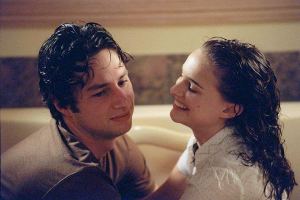
Andrew Large Largeman (Braff) is an out-of-work actor living in an anti-depressant haze in LA. He heads back to his old stomping grounds in New Jersey when he learns that his mother has recently died. Andrew has to reface his psychiatrist father (Ian Holm), the source of his guilt and prescribed numbness. He has forgotten his lithium for his trip, and the consequences allow Andrew to begin to awaken as a human being once more. He meets old friends, including Mark (Peter Sarsgaard), who now digs graves for a living and robs them when he can. He parties at the mansion of a friend made rich by the invention of silent Velcro. Things really get moving when Andrew meets Sam (Natalie Portman), a free spirit who has trouble telling the truth and staying still. Their budding relationship coalesces with Andrews re-connection to friends, family, and the joys life can offer.
 Braff has a natural directors eye for visuals and how to properly use them to convey his characters feelings. A scene where Andrew wears a shirt and blends into the wall is a perfect visual note on the characters sleep-walk through life. Braff’s writing is also familiar but satisfyingly unusual, like a repackaging of old stories told with a confident voice. His characters are interesting and memorable, but dont feel uselessly quirky, unlike the creations of other first time indie writers. The melancholy coming-out of Andrew from disconnected schlub to post-pharmaceutical hero really grabs the audience and gives them a rooting point. At times, though, it seems as though Braff may be caught up trying to craft a movie that speaks to a generation, and some will see Garden State as a generation’s voice of a yearning to feel connected.
Braff deserves a medal for finally coaxing out the actress in Portman. She herself has looked like an overly medicated, numb being in several of her recent films (Star Wars prequels, Im looking in your direction), but with her plucky, whimsical role in Garden State, Portman proves that her careers acting apex wasn’t in 1994’s The Professional, when she was 12. Her winsome performance gives Garden State its spark, and the sincere romance between Sam and Andrew gives it its heart.
Sarsgaard is fast becoming one of the best young character actors out there. After solid efforts in Boys Don’t Cry and Shattered Glass, he shines as a course but affectionate grave robber that serves as Andrews motivational elbow-in-the-ribs. Only the great Holm seems to disappoint with a rare stilted and vacant performance. This can be mostly blamed on Braff’s underdevelopment of the father role. Even Method Man pops up in a very amusing cameo.
The humor in Garden State truly blossoms. There are several outrageous moments and wonderfully peculiar characters, but their interaction and friction are what provide the biggest laughs. So while Braff may shoehorn in a frisky seeing-eye canine, a knight of the breakfast table, and a keeper of an ark, the audience gets its real chuckles from the characters and not the bizarre scenarios. Garden State has several wonderfully hilarious moments, and its sharp sense of humor directly attributes to its high entertainment value. The film also has some insightful looks at family life, guilt, romance, human connection, and acceptance. Garden State can cut close like a surgeon but it’s the surprisingly elegant tenderness that will resonate most with a crowd.
 Braff’s film has a careful selection of low-key, highly emotional tunes by artists like The Shins, Coldplay, Zero 7, and Paul Simon. The closing song, the airy Let Go by Frou Frou, has been a staple on my play list after I heard it used in the commercials.
Garden State is not a flawless first entry for Braff. It really is more a string of amusing anecdotes than an actual plot. The film’s aloof charm seems to be intended to cover over the cracks in its narrative. Braff’s film never ceases to be amusing, and it does have a warm likeability to it; nevertheless, it also loses some of its visual and emotional insights by the second half. Braff spends too much time on less essential moments, like the all-day trip by Mark that ends in a heavy-handed metaphor with an abyss. The emotional confrontation between father and son feels more like a baby step than a climax. Braff’s characters also talk in a manner that less resembles reality and more resembles snappy, glib movie dialogue. It’s still fun and often funny, but the characters speak more like they’ve been saving up witty one-liners just for the occasion.
Garden State is a movie thats richly comic, sweetly post-adolescent, and defiantly different. Braff reveals himself to be a talent both behind the camera and in front of it, and possesses an every-man quality of humility, observation, and warmth that could soon shoot him to Hollywood’s A-list. His film will speak to many, and its message about experiencing lifes pleasures and pains, as long as you are experiencing life, is uplifting enough that you may leave the theater floating on air. Garden State is a breezy, heartwarming look at New York’s armpit and the spirited inhabitants that call it home. Braff delivers a blast of fresh air during the summer blahs.
Nate’s Grade: B
Share this:

Napoleon Dynamite (2004)
 Napoleon Dynamite was an audience smash at the 2004 Sundance film festival. Fox Searchlight jumped at the chance to distribute a film written and directed by Mormons, starring a Mormon, and set in film-friendly Idaho. MTV Films, the people behind alternating good movies (Better Luck Tomorrow, Election) and atrocious movies (Crossroads, Joe’s Apartment, an upcoming film actually based on Avril Lavigne’s “Sk8r Boi” song), came aboard and basically said, Look, we really like the movie, and we want to help bring it to a wider, MTV-influenced audience. And thus, Napoleon Dynamite seems to have become the summer biggest must-see film for sk8r bois and sk8r grrrls nationwide.
Napoleon Dynamite (John Heder) is an Idaho teen that marches to the beat of his own drum. He lives with his Dune Buggy riding grandmother and 31-year-old brother Kip (Aaron Ruell), who surfs the Web talking to women. When their grandma gets injured, Uncle Rico (John Gries), stuck in the 80s in fashion and mind, takes up shop in the Dynamite home and coerces Kip to hustle money from neighbors. Meanwhile, Napoleon befriends Deb (Tina Majorino), an otherwise normal girl with a sideways ponytail, and Pedro (Efren Ramirez, who was actually in Kazaam!), the new kid at school. Together, they try and get Pedro elected to class president, but standing in their way is the mighty shadow of Summer (Haylie Duff), the most popular girl in school. Oh yeah, there’s also a llama.
 First time director, Jared Hess, and first time cinematographer, Munn Powell, orchestrate shots very statically, with little, simple camera movements and many centered angles. The style is reminiscent of the films of Todd Solondz (Welcome to the Dollhouse), or, more precisely, Wes Anderson. This shooting technique makes the characters stand out even more, almost popping out at you behind flat backgrounds like some Magic Eye picture. Hess easily communicates the tedium of Idaho with his direction. Can anyone name any other film that takes place entirely in Idaho? (Please note that My Own Private Idaho takes place in Portland and Seattle, mostly).
The star of the show is, of course, Heder. His wickedly funny deadpan delivery helps to create a truly memorable character. He achieves a geek Zen and, judging from the incredible amount of kids under-14 that appeared both times I saw this film, is most likely the greatest film realization of a dork. Its grand dork cinema, a genre long ignored after the collapse of the mighty Revenge of the Nerds franchise. So while Napoleon isn’t exactly relatable (llamas, Dune Buggy grannies and all), the right audience will see reflections of themselves. You’ll be quoting from Napoleon all summer.
Napoleon Dynamite is going to be an acquired taste. Its filled to the brim with stone-faced absurdities and doesn’t let up. If you’re not pulled in with the bizarre antics of bizarre characters in the first 10 minutes, then you may as well leave because otherwise it will feel like the film is wearing you down with its indie weirdness. Napoleon Dynamite seems to skirt the sublimely skewed world of Wes Anderson, but Napoleon lacks the deep humanity of Andersons films. What the audience is left with is a sugary, sticky icing but little substance beneath, and, depending on your sweet tooth, it’ll either be overpowering and a colossal disappointment or it’ll taste just right for the occasion. Alright, I’m done with baking analogies for the year.
 Some will find a certain condescension against the characters. Napoleon Dynamite doesn’t outright look down upon its characters, but it does give them enough room to paint themselves fools. Uncle Rico is really the films antagonist, yet hes too buffoonish to be threatening. It’s a fine line for a film to have condescension toward its characters, but Napoleon Dynamite ultimately leaves with a bemused appreciation for its characters. The film presents the good characters as unusual but lovable and ready for growth (Kip, Pedro, and of course Napoleon), but the bad characters (Summer, Uncle Rico) aren’t demonized. In essence, Napoleon Dynamite is the best example of a film that makes an audience laugh at and with its characters simultaneously.
Napoleon Dynamite is assuredly an odd duck. Some will cheer; others will want to head out the door after a few minutes. It’s hard to say which reaction an individual will have. If you have a geek-enriched history populated with unicorns, Dungeons and Dragons, and/or social ostracism, then you may be more inclined to admire Napoleon Dynamite. I laughed out loud throughout the film and found it to be an enjoyable diversion, and I went the whole review without one Jimmy Walker reference.
Nate’s Grade: B
Share this:

Super Size Me (2004)
 Morgan Spurlock was just sitting on the couch one Thanksgiving. He saw two overweight girls on TV who were suing McDonalds because they blamed the fast food giant for making them obese. Spurlock got off the couch and was inspired. He set off to see what would happen to a healthy adult body if he ate nothing but [i]McDonalds[/i] food for a 30 day period. The results are Spurlock’s award winning documentary, Super Size Me. Spurlock monitors his progress with a team of doctors. He follows certain guidelines as he begins his fast food binge: 1) He must order everything off the menu at least once; 2) He must eat McDonalds three times a day; 3) If someone asks him if he wishes to Super Size his order, he must comply.
The results are staggering, if a tad expected. Spurlock gains 30 pounds, loses his sex drive, experiences what he fears are chest palpitations, and develops symptoms of depression when hes not stuffing his face with French fries and the like. Spurlock starts out wide-eyed and giddy at the prospect of living every kids dream at first he is awed by the food but by the halfway point hes noticing a discernible change for the worse. Hes starting to develop an actual dependency on his subject. Along the way Spurlock interviews an assortment of dieticians, a man who’s eaten 20,000 Big Macs, doctors, health trainers, lobbyists for food corporations, Jared from Subway, and tries ever so hard to garner an interview with a McDonalds spokesperson (he calls about 17 times). The result is a sprawling look at what makes our fat nation tick, and the weird, wonderful, and scary people within.
 Spurlock puts a lot of gut-churning effort into stating the obvious. You mean eating nothing but McDonalds is bad for you? Stop the presses! Perhaps for his follow-up, Spurlock will unleash a searing expose telling us not to look directly into the sun, stick our tongues to icy poles, or place our hands on a hot stove. The world waits. Even though Spurlock’s McDonalds diet gimmick grows somewhat boring (watching someone eat is about as exciting as watching someone brush their teeth), Super Size Me’s true strength lies in the tangents it takes on its otherwise high-fattening journey to artery corrosion.
Spurlock examines what it is in our culture that makes us more prone to obesity, and the results are equal parts startling and fascinating. The films best moments occur when Spurlock looks at the national school lunch programs and how kids are already being molded to live unhealthy lifestyles. At the same time in our nations history, food programs are getting less healthy (pizza, fries, soda) and mandatory gym programs are on a steep decline. The effects of this segment are far scarier than watching a grown man balloon in weight.
The film follows the Michael Moore (Fahrenheit 9/11) style of documentary, minus the distasteful half-truths. Spurlock knows that humor is the best way to get a point across, so with the use of clever animation he throws every statistic you can imagine out there, hoping that some will stick. Some are obvious, some are amusing, and some of the information is startling when visually represented, like the amounts of sugar and fat Spurlock consumed on his 30-day diet. Super Size Mes results retain Moores signature underdog-fighting-the-Big-Boys method that creates a rapport with the audience, but it also refrains from any sort of bullying. Spurlock doesn’t have the broad charm of a Moore, but hes likeable enough and keeps his information as the heart of his documentary and not the fairly silly gimmick.
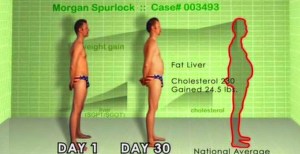 With this new genre of Gimmick Documentaries, there is a greater sense of voyeurism than in the genres usual outpourings. The central concept is watching a man essentially destroy himself, and there is a perverse pleasure in viewing medical changes that scare the crap out of Spurlock’s teams of dumbfounded doctors. So while Spurlock’s odyssey may not always be stupefying, it usually is genuinely entertaining in some form or another.
Spurlock’s excess is our revelry. Hes crafted an intelligent, entertaining, and sometimes grotesquely disturbing portrayal of our Fast Food Nation (I live in the sixth fattest U.S. city, Columbus Ohio, by the way). Fans of muckraking documentaries should be delighted, but Super Size Me has the appeal to reach out to a wider, more divergent audience. Spurlock’s film, despite some inherent flaws, is a strong wake-up call. Super Size Me is a lucid debate about personal responsibility, the boundaries of corporations, and the possible future health of the fattest nation on earth (eat your heart out Norway).
In the end though, it looks like Spurlock is having the last laugh. His film was a hit at the 2004 Sundance film festival, and shortly after McDonalds announced they were officially phasing out Super Size portions from their menu. They denied Spurlock’s film was the cause of their Super Size Slashing, but it doesnt take a genius to see through the corporate rhetoric.
I confess that Super Size Me really got to me and motivated me to live healthier. I was determined to exercise more regularly and eat less junk food. I was empowered. And then I saw a McDonalds on the way back from the theater and, well, the #1 plan, Exercise More Thoroughly, was scratched in favor of a #2 Value Meal (the double cheeseburger one). Carry on Spurlock; carry on my Fu Manchu-ed son. Your documentary is entertaining and, at points, fascinating, but I’ll get on that treadmill next week.
Nate’s Grade: B+
Share this:

Pieces of April (2003)
 The set-up for Pieces of April, a low-budget film starring Katie Holmes, is a pastiche of familiar independent film elements so much so that it could across as parody. Holmes plays April Burns, a beleaguered teen living on her own in a grungy New York apartment. Today is Thanksgiving and her family will be stopping by for a grand Thanksgiving meal prepared by April. Her cantankerous mother (Patricia Clarkson) is ailing from breast cancer, and when she tries to think of one good memory shes had with April, she can only conjure memories belonging to younger daughter Beth (Alison Pill). She also will be introducing her family to her new boyfriend, Bobby (Derek Luke of Antoine Fisher). April has 24 hours to cook a memorable meal for her family and it could be the last Thanksgiving they spend together.
In the world of independent film, it seems like theres a whole sub-genre of movies that revolve around chaotic Thanksgiving dinners and dysfunctional families. The holiday setting, her mothers cancer, April’s spirited attempts at autonomy in the big city, interracial dating and an apartment complex full of cute oddballs all seem like tried-and-true staples of indie film.
Pieces of April was written and directed by Peter Hedges, writer of What’s Eating Gilbert Grape? and co-writer of About a Boy. His pedigree would certainly state that he knows something about family drama, and Pieces of April is a nice continuation of his observational humor. Hedges has a skilled confidence in his writing. The characters feel real and we gravitate to their vulnerability and hope. We see every sincere detail of Aprils plight to make her family proud. The choice to shoot Pieces of April on digital video adds an extra element of intimacy, like were trapped inside a home video.
Holmes gives her best performance to date. April, with patches of bright orange hair and arms enclosed with bracelets, is a sweetly vibrant character. When a neighbor asks about her relationship with her mother, April describes herself as the first pancake. She’s the one you’re supposed to throw out, another neighbor explains. Holmes’ performance is like a slow simmer of frustration, optimism and determination that wins your heart. Her more dramatic moments of helplessness and disappointment are quite affecting.
The supporting cast for Pieces of April is top-notch. Clarkson gets some weighty moments as the ailing mother, like when she runs out of the car in tears because she cant afford one more bad memory with April. She gets the showy part but enlivens every moment. Oliver Platt further feeds my theory of his quest to be in every movie ever. In Pieces of April he plays the put-upon father who frets his wife could pass any moment. Pill shines as the hyperactively cheerful and overachieving Beth. Her cherubic cheeks and glowing smile leave an indelible impression, and makes me question if her face ever got sore from excessive smiling.
Pieces of April is a pleasurable little comedy thats borderline touching. It’s not much more than a small slice of family drama, but with excellent writing and strong acting, Pieces of April distinguishes itself as more than a collection of familiar staples, and as a warm and quietly charming homespun comedy with an extra helping of heart.
Nate’s Grade: B+


 nathanzoebl
You must be logged in to post a comment.