Blog Archives
Like Crazy (2011)
 The prevailing thought I kept having while watching the twee indie romance (?) Like Crazy was that this is like silly. I spend fifteen minutes with the young happy couple, Jacob (Anton Yelchin) and Anna (Felicity Jones), and then there’s already trouble. Rather than have to wait two and a half months to see one another again (a.k.a. eternity), Anna decides to overstay her visa because it’s not like that would be taken seriously in a post-9/11 world. Naturally, there are repercussions and Anna is banned from reentering the U.S., effectively putting a hitch in her romance. It’s such a short-sighted, impulsive, boneheaded decision, and it’s one that completely made me lose all sympathy for a couple that couldn’t bother to be apart for a mere two and a half months. Jacob and Anna try and hold it together but the constant starting and stopping, as well as the comforts of people closer, provide major roadblocks. I’m not a hardhearted person; I’m a sucker for a good romance. Many of my favorite movies of the past few years have strong romantic elements (Eternal Sunshine, Once, Moulin Rouge, WALL-E), but I felt next to nothing for this whiny, pitiful couple. First off, they’re only together for fifteen minutes before being ripped apart, which doesn’t exactly allow me enough time to emotionally engage. And then there’s the fact that these “crazy kids” have absolutely no passion between them, no spark, no nothing that would compel them to be together against all odds. You don’t feel anything approaching romance. And to top it off, Jacob has a perfectly lovely, charming, and available alternative played by the lovely and charming Jennifer Lawrence (The Hunger Games). She even makes this doofus breakfast in bed. This movie felt like an entire montage of small moments that never accumulated into anything believable or compelling. I’ll take Lawrence and breakfast in bed and be grateful.
Nate’s Grade: C
Share this:

Jeff, Who Lives at Home (2012)
 This lumpy, amiable shaggy dog story from the Duplass brothers is another earnest, warm-hearted comedy that marries their signature family dysfunction, mumblecore quirk to a larger, more mainstream setting. The Jeff (Jason Segel) in question is a 30-year-old slacker, who indeed lives at home, and awaits signs from the universe to guide his decision-making. Incidentally, his favorite movie we learn in a monologue set on a commode, is Signs. His older brother, Pat (Ed Helms), is a selfish twit and embarks on a quest, with Jeff, to discover if his wife (Judy Greer) is cheating on him. The boys mother (Susan Sarandon) also has a nice storyline where an anonymous admirer is sending her flirty instant messages at work. Watching her face light up as she processes being wanted, it’s a thing of beauty. The characters are all flawed, and for some they may be too annoying to sit through. The film has been accused of being aimless, but I was engaged with its plot, which kept ping-ponging from one cause to another effect scenario. The movie is really more a drama with some comedic asides, mainly due to Jeff’s stoner zen and Pat’s aggressive dickishness. Greer has an outstanding moment where she lets her character’s deep reservoir of unhappiness come out in a blinding moment of honesty, and it rang true to my ears. In fact, the entire movie feels true enough. And then it appears destiny reveals its master plan with an ending that makes your heart warm all over, championing Jeff’s mantra of optimism and interconnectedness. The simple, good-natured, sweet little movie is worth checking out.
Nate’s Grade: B
Share this:

Silent House (2012)
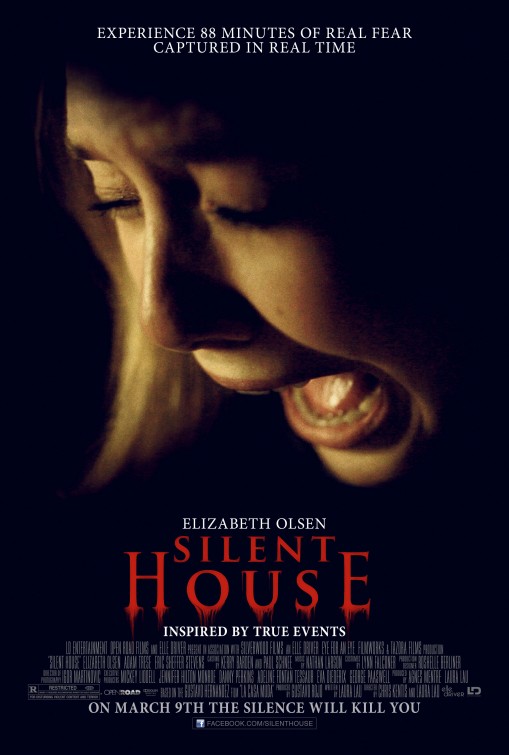 Ostensibly executed in one long, unblinking take (though you can tell the edit points; the directors admit they filmed it in 10-minute chunks), Silent House is a visceral experience in spookiness, tethered to the brilliant actress Elizabeth Olsen that unfolds in real time. It’s your standard scary house movie, lots of dark rooms and pitiful hiding under furniture; it begins as an intruder(s) stalking Olsen from room to room and then, in the final 20 minutes, transforms into a psychological thriller, with the realm between reality and hallucination blending. The bare-bones plot (girl chased through house) cranks out some decent scares due to directors Chris Kentis and Laura Lau (Open Water)’s tightly executed sense of reality, leaving us feeling as trapped and helpless as our heroine. The movie’s minor successes are also squarely due to Olsen, she of glassy eyes and hoarse scream. It’s almost a one-woman show and Olsen is so convincing in her terror, completely unnerving even when the movie is not. The climax is a bit of a letdown, to say the least, and leaves a lot of off-putting questions that cannot be answered by the movie’s absence of back-story. I won’t say the ending ruins the entire suspenseful experience of Silent House, but it’s certainly going to spur plenty of grumbling. Still, Olsen is a star and gives a terrific freaked-out performance worth getting spooked over. Also it’s based on a 2010 Uruguay movie with the same high-concept gimmick. Now you know Uruguay has a film industry. Don’t you feel better?
Nate’s Grade: B-
Share this:

The Myth of the American Sleepover (2011)
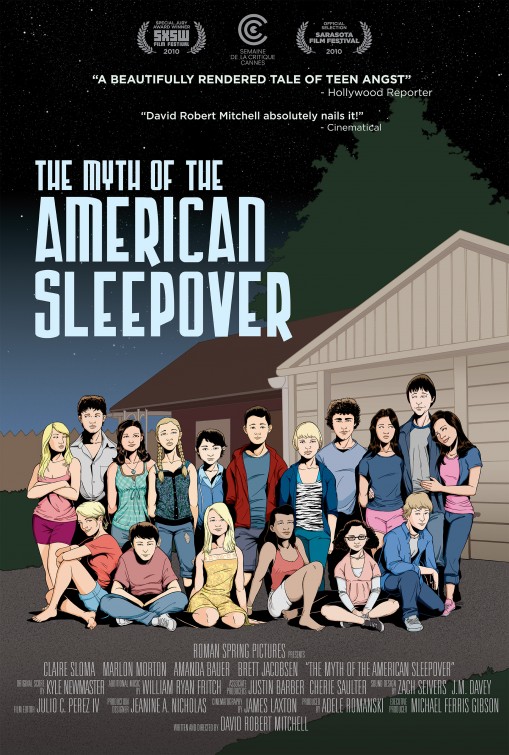 The curiously titled Myth of the American Sleepover owes as much to American Graffiti as it does to the works of John Hughes. This sprawling teenage opus by debut writer/director David Robert Mitchell resonates with all the beautiful aches and joys of adolescence, wonderfully understated but brilliantly realized. I fell in love with this movie.
Set over the course of one night in suburban Michigan, a slew of teenagers try and make the waning summer days worth remembering. Claudia (Amanda Bauer) is the new girl in school and invited to the cool gal’s (Shayla Curran) slumber party. She learns her boyfriend slept with the cool gal and plots a little boyfriend stealing of her own. Rob (Marlon Morton) is obsessed with a pretty blonde girl he once shared a look with in a supermarket. He is scouring the neighborhood, going from party to party, looking for her so he can reveal his true feelings. Scott (Brett Jacobson) is unsure of whether he wants to finish his final year of college, now the site of a painful breakup from his longtime girlfriend. One day while walking the halls of his former high school, he comes across a picture of him with twin sisters, Ady (Nikita Ramsey) and Anna Abbey (Jade Ramsey). He heads out to the University of Michigan, where the twins are enrolled, convinced he could win one, or both, of them over. Maggie (Claire Sloma) is navigating between the middle school sleepovers of her peers and the world of the cooler upperclassmen. She’s been nursing a crush on an older boy (Douglas Diedrich) who worked at the community pool all summer, and will find the courage to make a move.
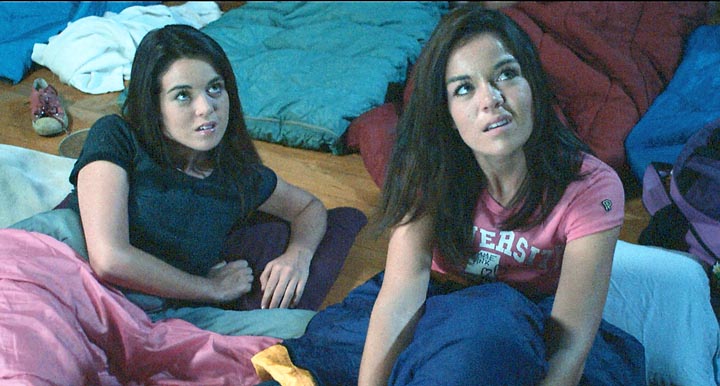 Unlike other coming-of-age entries, this is a movie that forgoes scatological comic setups and other Big Events meant to mark the passing into adulthood, like the loss of virginity, college admittance, or the prom; instead, Sleepover tackles a subject much more honestly and with tremendous naturalism. The level of detail is outstanding; set in what seems like the late 80s or early 90s, I was astounded at all the nostalgic artifacts of adolescence brought back to life. I kept going, “Oh yeah, I forgot about those,” or, “That’s totally something that me and my friends did.” I loved that the movie shows different social spheres and age ranges, so we go along with the late teen house party but we also get see a middle school/junior high sleepover that involves girls staying up late, talking about boys, and eating large bowls of chips. Obviously not everyone will have this reaction, but it just shows the commitment to recreating a very specific time, place, and sense of being. These feel entirely like real teenagers, and their troubles and desires are achingly articulated. You feel the powerful sense of yearning throughout, where the nudge of a knee, the closing distance between two hands that can cause your insides to fill up with a thousand butterflies. Sleepover is about teenagers grappling with emotional connection and personal identity, but it never drags out a soapbox or breaks from its verisimilitude. Every single character in this movie, even the ones meant to be seen in a questionable light, is deeply empathetic. Being an ensemble, you’ll gravitate to different characters and their pursuits, but the movie balances a nice mixture of storylines, cutting back and forth to build a graceful picture of the uncertainty of adolescence.
I found this movie to be so charming, so overwhelmingly affecting, and poignant without slipping into mock sentimentality, which would have been easy. It’s been a big year for nostalgia, but nostalgia is the “least authentic of all feelings,” according to Enrique de Heriz. It’s easy to sit back and say, “Oh I remember that too,” and feel the tingle of some wistful pull from the past, the yearning for a bygone time and place that has magically transformed in your mind into some idyllic spree. Does anyone remember those times, before there was an Internet, and cell phones, and social media, when you got together with your friends to witness the shared experience of a movie with female nudity (this might just be a guy thing), or when you didn’t know if you’d see your crush ever again? The Myth of the American Sleepover does, and so do I. In the words of Lou Reed: “I don’t like nostalgia unless it’s mine.”
 Indeed, it seems like the film exists in a bit of a cultural time warp, where sleepovers were the social apex and holding hands and making out were considered victories worth celebrating. There are no computers or cell phones, thank God. If you excuse the casual and extensive teenage drinking, Sleepover is a rather wholesome film. I was wary that some storyline might take an unexpected dark turn, especially with all the alcohol and hormones, but the movie maintains its sweet appeal without fail. While ostensibly existing in a late 80s/early 90s, I believe this movie is timeless and can be felt effortlessly by people of any age. The pains of adolescence and the anxiety of growing up, not to mention the peculiarities of the other sex, are universal. There is a superb scene where Rob and the girl who secretly likes him pass each other accompanied by friends. We get both sides of the story cut together; he tells his bud that one night he kissed her and then they made out. “It was a pretty good day,” he admits. She says she spent all night trying to get him to hold her hand and then just gave up. We instantly know that her side of this tale is far more accurate, but then this small exchange tells us even more about Rob, his fumbling attempt to be seen as cool with girls. Later, this same girl gives Rob a pep talk about unrequited crushes; she wonders if a person thinks hard enough about an individual, if they’ll know. Like most men, Rob misses her real meaning, but I’m happy to say that this story is tied up in such a sweet manner that I got choked up. The emotions of Sleepover are genuine and genuinely felt, no big overtures or outbursts, but the quiet moments of realizing who you are, who you like, and what you are and aren’t willing to compromise. It all feels utterly real and relatable.
The one storyline that seems to stand out amongst the rest of the panoply of sleepovers is that of Scott. He’s a college junior and at least three years outside the social realms of the majority of the other characters. You can’t help but feel at the start that he doesn’t belong and his presence, in a movie primarily about 14-15-year-olds, might feel a tad icky. Scott’s misguided attempt to get over his ex-girlfriend seems like some strange leftover plot from a sitcom. The fact that he’s trying to drown his sorrows in twin sisters almost seems skeevy. However, he comes clean early and opens up to reveal startling vulnerability, thanking the twins for a memory that would be incidental to them but has meant so much to him. It is this memory that gave him hope. The twins reveal that one of them had a huge crush on Scott back in high school, wishing he would one day reciprocate. But they won’t tell him who. He has to guess. The fact that this setup is actually a push toward personal growth and maturation is a great revelation and a relief.
 The cast of unknowns may be low when it comes to star-wattage but they lend the film another degree of authenticity. I wouldn’t say a single participant in this movie is a bad actor, though their characters are often understated, which under the wrong guidance can lead to blandness. None of these characters are exceptionally verbose or opinionated, which leaves the impression that they are thinly drawn. However, the characters coexist within the impressionistic nature of the film; it’s like a coming-of-age movie with the tone poem ambitions of Terrence Mallick. They are not as memorable or as sharp as the characters from Dazed and Confused and American Graffiti (Rob’s pursuit of his blonde dream girl, and his several near-misses, screams Graffiti homage), but the goal is a disarmingly sweet authenticity, allowing the viewer to discover relatable moments throughout the ensemble. I will say that Sloma imparts the biggest impression as the pieced, platinum pixie-gal feeling out the level of interest in her crush. I think we’ll be seeing more of Bauer and her cherubic, Scarlet Johansson-etched features as well.
The Myth of the American Sleepover is a sincere, observant, insightful, gentle, and overall wonderful little movie, brimming with life and the rocky experiences of growing up, but mostly it will make your heart sing. The details and small gestures feel completely believable; building an ode to youth that feels earnest without being sentimental and knowing without feeling like a know-it-all. There wasn’t a moment in this movie that didn’t leave me smiling, chuckling to myself, and feeling immersed in this innocent, heartfelt, exuberantly youthful world. The pleasures of Sleepover are small but numerous, and I don’t mind admitting to tearing up at several points, shaking in anticipation, and celebrating the personal triumphs of the cast of characters. The Myth of the American Sleepover made me feel like a teenager all over again, nervous, anxious, excited, and beguiled by the imprecise negotiations into adulthood. I’m sure some people will find this movie boring or too embryonic, a coming-of-age tale crystallized in dewy emo-earnestness. For me, I fell in love with this movie. It filled me with joy. I know it will do the same for others; Sleepover just needs a little tenderness and an open heart. The movie and its homespun magic will do the rest.
Nate’s Grade: A
Share this:

Martha Marcy May Marlene (2011)
 Unsettling but testing, the film Martha Marcy May Marlene is more than a mouthful. It’s about a gal, Martha (Elizabeth Olsen, younger sis to billionaire twins Ashley and Mary-Kate), who enters a creepy cult, and then in due time runs away to live with her detached older sister (Sarah Paulson). Writer/director Sean Durkin cleverly jumbles the timeline, so we follow two parallel storylines: Marcy May (her new identity) entering the cult and Marlene (her identity after fleeing?) adjusting back to the real world. At heart is Olsen, who gives a star-making turn as the troubled heroine fighting back prior programming. We get flashes of what cult life was like under charismatic leader, Patrick (John Hawkes, goin’ country once more). The sections concerning the cult are creepy but not exaggerated to break the film’s fragile realism. It’s uncomfortable stuff with lots of ritualistic raping. The film moves at a slow, deliberate pace, echoing Olsen’s dueling transformations. She’s having trouble readjusting but she can’t open up about her experiences for fear that she’ll endanger others. The film cranks up the paranoia and looks to be coming to a head when … everything just stops. End credits. Martha Marcy May Marlene feels like ¾ of a movie until you stop and think that we’re trapped in her omnipresent paranoia and that she will be essentially broken for life. While I wanted Durkin to find a way to reach that conclusion that felt conclusive and fulfilling, the ending, while abrupt, does feel appropriate. Olsen is terrific and expresses so many complex emotions even through her veneer of emotional reserve and mistrust. She has a bright future ahead of her. She’s no longer “the other Olsen sister.” Now she’ll be the “talented Olsen sister.”
Nate’s Grade: B
Share this:

Cedar Rapids (2011)
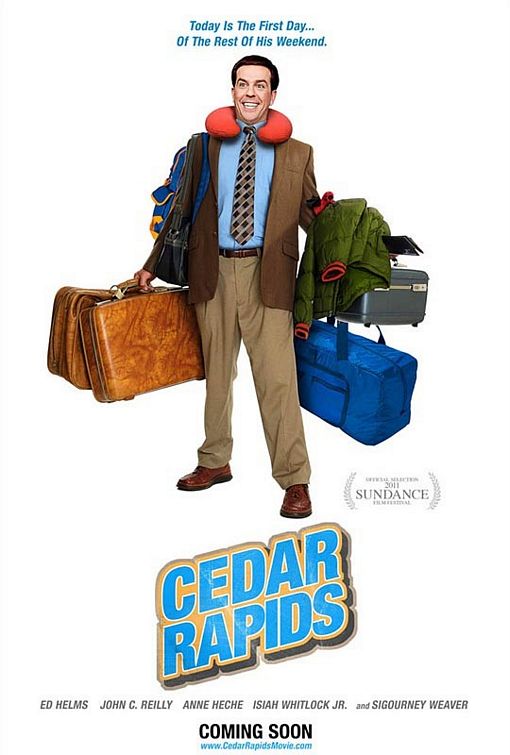 When people think about the temptations and sundry thrills of the Big City, most people are probably thinking of a sin-stained location like Las Vegas. Most people would not confuse Vegas with Cedar Rapids, and yet the Iowa city of note is the setting for a sweet and sometimes dirty, but still sweet, comedy of big-city adventures. To a guy from a town without a stoplight, Cedar Rapids is like New York City. It all depends on your perspective.
Tim Lippe (Ed Helms) is an insurance salesman from Brown Valley, Wisconsin. The town is small but the little insurance agency that could has won the coveted Two Diamond Award four years running at the annual insurance convention held in Cedar Rapids. Tim’s life is in a holding pattern. He wants to do big things but can’t find the oomph to get there. He’s involved in a romantic tryst with his (one-time) seventh grade teacher (Sigourney Weaver). Tim’s chance to make a name for himself comes when he’s selected to represent his company at the annual convention. He has to impress the right people to take home another Two Diamond Award. Never having been on a plane before, he leaves small-town Brown Valley for big-city Cedar Rapids. At the convention site, Tim rooms with Ronald Wilkes (Isiah Whitlock Jr.) and the more unsophisticated Dean Ziegler (John C. Reilly). The group meets up with Joan Ostrowski-Fox (Anne Heche), and together they work on helping Tim loosen up. Over the course of the weekend, bonds will be made, principles will be tested, and tom foolery of the first order will be had.
The premise is rather simple, small-town guy heads to the big city (well, bigger) and the culture shock that waits. But the film never looks down on Tim Lippe. While there is plenty of humor drawn from his naiveté, the movie doesn’t condescend or play up the small-town folks as rubes and squares. It’s funny to see Tim’s mild-mannered explosions of anger, mostly of the “horse pucky” variety of vulgarities, but the movie doesn’t say that the big-city folk are better than Tim. On the contrary, Tim is a principled and devoted insurance salesman, courteous to a fault. He could have stepped out of a Frank Capra movie from a bygone era (Mr. Lippe Goes to Town). Tim is sheltered, which provides some amusing fish out of water comedy, like when he initially is on alert because his roommate is African-American, a rarity in Brown Valley despite whatever the name may imply to some. Tim is a man out of time, but that can be small-town life in general. The Midwestern satire reminds me of the gentle yet knowing nudge of King of the Hill. Phil Johnston’s script sets up Tim’s dilemma as a crisis of conscience, the compromises we make in morality. Tim’s trip to the “big city” is the push the guy needs to get his life out of stasis. There’s something deeply satisfying in watching a character you care about triumph in the end, even if that triumph is a small victory befitting a small-town guy with a big heart.
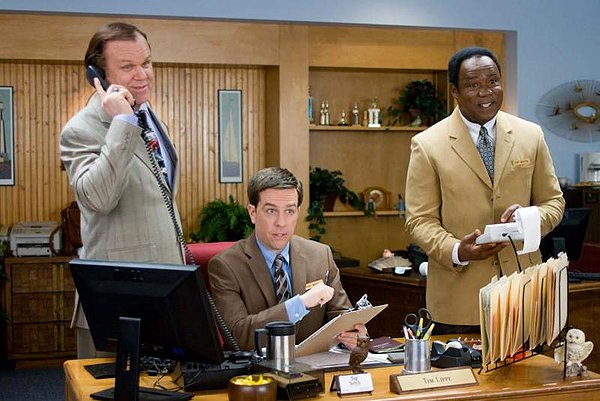 The real fun of the movie, however, is watching the effect the group has not just on Tim but on each other. They teach Tim to cut loose and live a little, but this is still Cedar Rapids, so cutting loose goes as far as nighttime pool escapades and drunken sex. His flirtatious fling with Joan brings the guy out of his shell, and the two of them are genuinely cute together without going overboard. It’s a reserved romance that feels true to the nature of both of the characters. Dean is the loudmouth knucklehead notorious for his oafish shenanigans, but once he feels accepted he goes to war for his friends. He’s a buffoon but not stupid. And then Ronald, though less developed than the other three, provides a nice foil as a straight-laced businessman who keeps it together impressively. Together it’s a team of likeable characters that have grown closer together over the course of that weekend in Cedar Rapids, and you’ll feel the same. You feel like they’ve formed a family around the earnestness of Tim.
Helms (The Hangover) is a suitable candidate for a nice, regular, Midwestern guy. Helms has honed his awkward comedy chops after several seasons on TV’s The Office, and here he sticks to what he knows. Tim Lippe is another in a line of embryonic men. Helms settles into his usual nervous tics that fans will be familiar with. His sunny naiveté wins over the audience and provides for several laughs in contrast with the jaded “big city” folk. Reilly (Step Brothers) can overdo his character’s intentional obnoxiousness. He’s chartered a successful second career as a winsome nitwit, so like Helms, Reilly relies on notes gleaned from past performances. Whitlock Jr. is mostly straight man to the others. His comedic highpoint is an impromptu impersonation of a character from The Wire to get the group out of a dangerous jam (Whitlock Jr. himself played a state senator on The Wire). Other than that, he’s more contrast than character. Heche (TV’s Hung) is a real surprise. She underplays her character, tantalizing us with tidbits that leave us wanting more, much like Tim. The way she plays Joan, you feel the connection.
 With all that said, Cedar Rapids still has its share of flaws. The naïve comedy can go so far before you start to question Tim’s senses, like his casual mistaking of a prostitute (Alia Shawkat, Whip It) for a fellow attendant. His relationship with his former seventh grade teacher is intentionally awkward, but the whole plotline presents an unseemly overtone that doesn’t fit. She’s made to be rather motherly, even when she’s rolling her eyes at her bedmate’s pie-eyed declarations of being “pre-engaged.” I think the motherly aspect makes the whole Oedipal mess even worse (Weaver just seems bored). Late into Act Three Tim goes on a drug-fueled bender that feels out of place for his character who, when first asked for a drink, requested a beer of the root kind. The character of Dean is given too many moments to just wander around and spout crude one-liners. It sometimes feels like the movie is resting while it lets Dean do his thing, and a little of this guy can go a long way.
The plot is relatively predictable and the ending is pretty pat. It works, but the actors and the characters were capable of more. The relationship between Tim and Joan also leaves something to be desired. There’s a great assembly of recognizable guests (Stephen Root, Thomas Lennon, Rob Corddry, Mike Birbiglia) that stop by but add little. Again, the potential for more feels missed. With a solid 80% of the movie taking place in a hotel, you can also start to feel a little cabin fever. And not that it matter much, but I’m disappointed that film with “Cedar Rapids” in its name was filmed in Ann Arbor, Michigan (Iowa did away with its in-state film tax credit).
The appeal of Cedar Rapids, the film, is much like the appeal of its central figure, Tim Lippe. It’s an unassuming, earnest charm, enjoying the company of likeable characters who we want to see succeed. I just wish the predictable plot had done more or trusted the actors’ capabilities. The core characters feel mostly authentic and easily recognizable, which makes the familiar, if at times bland, plot fairly forgivable. Helms and company are an easygoing bunch and you’ll be happy to tag along on their unspectacular hijinks in the “big city.” Cedar Rapids is the kind of low-key, charming little movies that often gets overlooked. It’s worth viewing for the pleasurable camaraderie of the core cast. Cedar Rapids, much like the city that bears its name, is worth a visit but does not require more commitment than that.
Nate’s Grade: B
Share this:

Sin Nombre (2009)
 Part immigrant drama and part crime thriller, this stirring film is one of the rare instances where I was begging it to be longer. Writer/director Cary Fukunaga intertwines two tales, a southern Mexican family riding atop a train car to reach the U.S. border and the moral journey of a gang member who turns on his brothers during a crisis of conscious. Everybody is on the run, from the border patrols to the blood-thirsty gang members seeking vengeance. Fukunaga gives this tale startling realism without diverting to self-consciously docu-drama camerawork. I was fascinated by the details of life atop a train, the determination of these family members for a better life, and I was thrilled with the many near misses and escapes. Sin Nombre is such an accomplished movie that it’s hard to believe that it is Fukunaga’s first feature film. It mixes social commentary with film noir, an unlikely romance and plenty of naturalistic performances. The cinematography is gorgeous and crisp, beautifully showcasing the squalor and arresting countryside. My one complaint is that the movie gets into a new gear of added conflict, and then it quickly comes to an end at an all too brief 96 minutes. I really could have done with another 20-30 minutes of our main characters on the run for their lives. Sin Nombre roughly translates to “the nameless” and I can all but assure you that Fukunaga is a filmmaker who will most definitely not remain nameless.
Nate?s Grade: A-
Share this:

American Teen (2008)
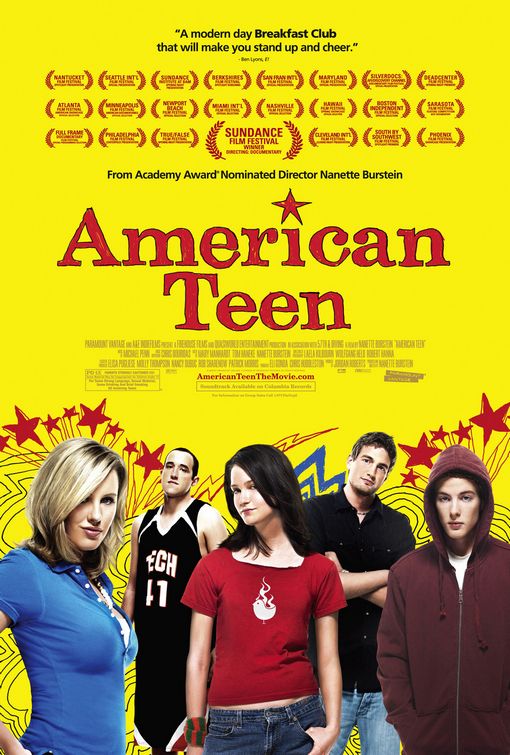 Filmmaker Nanette Burstein (On the Ropes) wanted to document the lives of actual American teenagers. After a national search, she settled on the town of Warsaw, Indiana, which we’re told in the opening narration is “mostly white, mostly Christian, and red state all the way.” American Teen is the feature-length documentary that chronicles the lives of four Warsaw teens during their senior year. The class of 2006 includes Colin, a basketball star worried about securing a scholarship. His father, an Elvis impersonator, supports his son but reminds the kid that dad has no money for school, so it’s either a scholarship or the Army. This, naturally, places tremendous pressure on a 17-year-old and his play diminishes as he tries to up his stats. There’s Megan, the queen bee at the school who feels pressured by her family to get into Notre Dame. This makes her act like a cretin, apparently. Jake is a kid who feels uncomfortable in his own acne-scarred skin. He plays video games a lot and desperately wants to find a girlfriend. Then there’s Hannah, the artsy girl prone to spontaneous dancing who feels trapped by her town.
I found American Teen to be largely unbelievable for two major reasons. First, teenagers today are way too media savvy after having grown up on a bevy of reality TV programming, the ultimate genre of manipulation. Remember way back in 1991 when MTV first started The Real World, the pioneering reality TV show? The people selected to live together as a social experiment were interesting, unguarded, a nice cross-section of the country; you felt like you could run into these people on the street some time. Then about half way into its run, the likely turning point being the Las Vegas season, The Real World participants became self-aware. They knew to exaggerate behavior for manufactured drama, to play up romantic crushes, and to work from the realm of playing a well-defined cliché character; no longer did these people feel real, instead they felt like drunken auditions for a really lousy soap opera. And all of the people started looking inordinately beautiful, chiseled hunks and leggy, waif-thin models. When was the last time they ever had an overweight person on that show? Anyway, the point of this anecdote is that thanks to the machinations of reality TV, teenagers today have grown up with the concept of cameras and they know how to manipulate reality. One could argue that you will never capture the true essence of a person by pointing a camera at them, because the instant a camera is placed to document reality it changes reality; people talk differently, either more reserved or confessional. A camera changes reality, but this discussion point is a little beyond the realm of American Teen. So I doubt the legitimacy of watching the “real lives” of “real students,” especially when these kids come from a more affluent area and probably digest other MTV semi-reality dramas like the unquestionably fake The Hills.
 So how would you behave if you knew a film crew was making a documentary in your school? I fully believe that many of the actions caught on camera are done so because the students wanted to ensure that they would be in a movie. I cannot blame them. I mean, if I was close to being involved in a film I would probably check every possibility to ensure my lovely presence eventually fills up the big screen. What do you want from kids who have grown up as a generation of self-reflective narcissists thanks to reality TV and uninvolved parents (sorry, soapbox moment)? This is why the nature of documenting reality in a high school setting is questionable. Burstein’s cameras follow Jake around and he’s able to walk up to girls and ask them out, point blank. Would he normally be so bold? I don’t know. What I know for certainty is that there would be fewer girls interested in the acne-scarred self-proclaimed geek if he didn’t have the adjoining camera crew. I’m sure girls looked at Jake and thought, “Here’s my ticket to being in a movie.” I’m not trying to be mean here because Jake is a rather nice, typically uncomfortable and socially awkward teenager who will find his niche once he leaves the confines of high school. I’ve known several Jakes in my life. But I don’t believe that a socially awkward kid like this naturally dates three different girls, all of them pretty, without the promised presence of cameras.
Also, there’s this popular guy Mitch completely thrown in at the middle of the film. All of a sudden he sees Hannah onstage rocking out at a school battle of the bands function, and the movie slows down, Hannah literally starts glowing, and Mitch says, “Wow, I have a crush on Hannah Bailey.” Allow me to doubt the sincerity of this sudden cross-clique crush. We never witness the beginning of this relationship, each side feeling the other out, the nervousness and delightful possibilities. We just get a voice over of Mitch saying he likes her and then the film cuts to like weeks into their supposed relationship when they’re goofing off at a gas station. When Hannah is invited to a party with Mitch’s friends, naturally she’s going to feel a bit out of place amongst the cool, popular crowd. He hangs out with his friends instead of his girlfriend. He makes sure to say hey to everyone else even while Hannah is sitting next to him. The next day Mitch breaks up with Hannah via the modern marvel of text messaging (ouch). You never see Mitch again until the end credits reveal that he feels he has matured. Essentially, Mitch is only seen and introduced to the movie because of his attachment to Hannah. Clearly, Mitch knew that if he buddied up next to the pixie girl he would ensure some place in the movie’s running time. It worked, because Mitch is featured in the trailer, the poster, and even tagged along on the national press tour. To paraphrase the title of Burstein’s superior documentary, the kid found a way to stay in the picture.
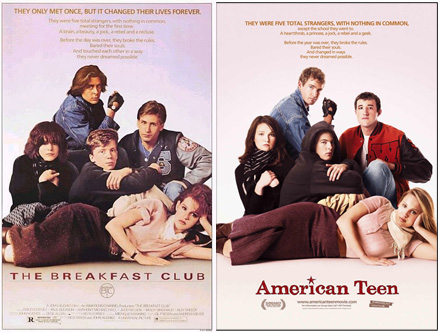 My second point of contention is that Burstein has taken scissors to 1200+ hours of footage to make her documentary about high school stereotypes, not people. Burstein has selected five figures to spotlight and she has whittled them down to one-word stereotypes: jock (Colin), geek (Jake), princess (Megan), rebel (Hannah), and heartthrob (Mitch). She isn’t destroying these lazy classifications but reinforcing them willfully. The marketing campaign around American Teen recreated the poster from The Breakfast Club. I swear, I think that art imitated life and now high schoolers are just imitating what they have seen propagated time and again as stone-cold reality in their schools: the rigid social caste system. There are so many missed opportunities by painting in such broad strokes. Colin is a jock because he plays on the basketball squad, but why can’t he also be a geek? Why can’t a rebel be a princess? I feel tacky talking in such degrading, baby-fied terms. Burstein doesn’t help her case by giving the main figures their own animated fantasy segments. Hannah is obviously the star of the film, and Burstein has seen to it that she narrates the tale as well. I suspect some canniness on Burstein’s part. Either the filmmaker felt that Hannah would most reflect the spirits of the crowds that attend indie documentaries, thus ensuring a bigger gross, or Burstein saw much of herself in Hannah and naturally wanted to make the “different girl” the star, possibly working through some of her own high school demons.
There’s also the issue of how staged some of this comes across. Am I to believe that Burstein’s camera crew managed to capture those perfect moments where the students stare out into space, thoughtfully? Am I to believe that the camera crew managed to capture everyone’s dirty little text messages then and there in the moment? Am I to believe that scenes of Hannah dramatically walking down the hallway weren’t planned? I’m forgiving when it comes to re-enactments but when a movie feels overburdened with re-enactments or posed figures, then it feels too manufactured. Just like The Hills.
Perhaps I’m coming down too hard on American Teen. After all, most documentaries distort some facet of reality and generally are edited to present a series of points. But the reason American Teen doesn’t work is because it offers zero insights into the American high school setting and little to no insights with its “characters.” Hannah is a cute girl with an independent streak but I fail to get a sense of her as a person. She gets dumped twice over the course of American Teen, suffers from crippling anxiety to the point that she misses almost a month of class, and she longs to leave the reach of her conservative town for the holy destination of California, so why then does the film not present her as a person instead of a classification? I also get the feeling that we don’t see any of would-be filmmaker Hannah’s own work because Burstein may be shielding her subject from the harsh realities or critical response.
 Obviously Megan is the villain of the piece and Burstein takes advantage of the girl’s self-absorbed sense of entitlement. Megan could be an interesting subject as far as casual cruelty. Megan vandalizes a student council member’s home because the guy had the gall to devise a different prom theme. We watch Megan literally spray paint a penis on a window followed by the word “FAG,” and then she whines that everyone is being mean to her even when the punishment she gets for a borderline hate crime is a slap on the wrists. Megan’s friend Erica makes the unfortunate decision to send a topless picture of herself in an e-mail to the guy she likes, who happens to be Megan’s friend and object of territory. So Megan briskly sends the picture to scads and scads of students with e-mail subject lines like “silver dollars” and “pepperonis.” Megan then leaves mean-spirited voice mail messages saying that Erica is destined “to live the rest of her life as a slut.” This is her friend! Burstein has the good sense of mind to interview a teary-eyed Erica after the topless photo fallout, and it probably is the emotional highpoint of the film because it’s so honest and wounded. Why not follow Erica after this? Surely her story, recovering from humiliation, is more intriguing then watching Megan scoot along her privileged life or whether or not Colin can be a better teammate. Speaking of the tall kid with the Jay Leno-sized chin, why does his dad insist that Colin needs a basketball scholarship or else “it’s the Army”? Has he not heard of student loans? Does Colin’s father believe sending his son into a war zone is preferable to amassing debt?
American Teen is a pseudo-documentary that has little intention to dig deeper under the surface of the realities of high school life. If your high school experience exactly mirrors this film, then perhaps you watched too many movies. Or the filmmakers did and tried to feed into the film idea of what goes on in a high school. Or both.
Nate’s Grade: C
Share this:

Grace is Gone (2008)
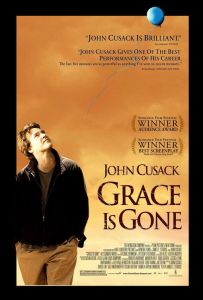 This Iraq War drama means well but it comes across as manipulative and morally questionable. John Cusack stars as a former military man who just found out his wife, on active duty in Iraq, has been killed. The bulk of the film’s conflict deals with how Cusack will tell his two daughters that mommy is not coming home again. Instead of being upfront with his children, he takes them out of school and whisks them away on a family trip to an amusement park. His reasoning is that he wants to squeeze in a few more happy memories before the kids hear the news. To me, this is irresponsible and psychologically damaging; those kids will resent their father holding onto such important information while he encouraged his kids to shop in ignorance. The film is about 80 minutes of watching a guillotine hang over someone’s head, just waiting for the moment to hit. It can get rather uncomfortable. Somewhere in this misguided drama is a poignant look at the domestic cost of the Iraq War from the family’s perspective, a perspective yet to be fully articulated by the movies. Instead, Grace is Gone is a well-acted but contrived drama that favors delaying the pains of reality to the point of incredulity.
Nate’s Grade: C+
Share this:

Hamlet 2 (2008)
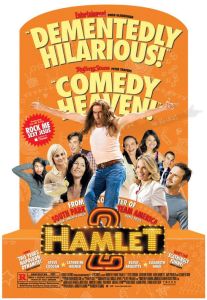 Believe it or not, there actually is a sequel out there about William Shakespeare’s most famous play concerning family dysfunction. Author David Bergantino surely doesn’t feel that he can improve upon the Bard’s classic Hamlet, but Bergantino is a writer who doesn’t cower from a challenge, like where to go next when all the main characters are dead. That’s why Bergantino took it upon himself to write Hamlet II: Ophelia’s Revenge (no joke). Apparently modern students at Globe University are playing out a family squabble very similar to anyone that has taken a high school literature class. The synopsis over at Amazon.com says it better than I could ever hope:
“When he unexpectedly inherits a creepy old castle in Denmark, Cameron tries to put his worries behind him, inviting his girlfriend and college buddies along on an overseas trip to check out the gloomy fortress. The plan is to get some serious partying done. Too bad nobody counted on the ghost of a drowned girl rising from her watery grave with vengeance on her mind! Now the only question is: to die or not to die?”
In the wake of Hamlet 2, a popular comedy at the Sundance Film Festival, I pity Bergantino. The man is going to be the Leif Ericson of pointless Shakespeare sequels: forgotten by history at the original pioneer. The film Hamlet 2 follows the miserable life of Dana Marschz (Steve Coogan). He teaches drama at a Tucson, Arizona public school and barely gets paid. His wife (Catherine Keener) is anxious to get pregnant and convinced Dana is shooting blanks. The couple is so poor that they have to rent out their home to a boarder (David Arquette). His drama class has two very WASP-y pupils (Phoebe Strole and Skyler Astin), but the rest are disinterested Hispanic students bused in from another school district. The school’s theater critic chides Dana’s laughable productions of Hollywood movies, like Mississippi Burning and Erin Brocovich. Then comes the news that drama has been slashed from the school budget. The pint-sized theater critic tells Dana to try something original to save the drama department. The answer? Hamlet 2. Thanks to a time machine, and Hamlet’s new best buddy Jesus Christ, the pair can go back and save everyone who previously perished.
 Hamlet 2 is Coogan’s show and the British comic makes his character endearing sad-sack. His character is pathetic and subject to all sorts of personal humiliations, and yet Dana is so earnest that it makes it hard not to empathize with his exploits. Coogan has a wild leer to him that gives the character a manic edge of desperation. He’s a gifted comic but he’s used to playing smug, droll characters, and Dana Marschz is the exact opposite of that mold. Coogan’s many breakdowns and bouncy spirit give the material an extra lift. He works hard for every laugh. It’s a shame, though, that he sort of disappears into the background during the staging of his infamous play.
So what is the comedic point of view with Hamlet 2? Are we to laugh at Dana and find him a buffoon? Well if that’s the case, then why serve up a musical finale that’s actually worthwhile and completely hilarious? The production values are pretty extravagant given the money limitations on the characters. Not only that, it’s so bonkers that I wanted to just watch Hamlet 2 on stage and not cut back to life outside. I wanted to luxuriate in the inspired craziness of a musical that involves time travel, Shakespeare, Albert Einstein, the song “Raped in the Face,” the devil, the Gay Men’s Chorus, lots of father issues, and Jesus moonwalking over water. That’s way more interesting than the ho-hum characters interacting backstage. In truth, the play’s the thing and it’s way too short for my liking. The performance serves as the film’s payoff, so I wanted to get every crazy kernel of shameless joy. The “Rock Me Sexy Jesus” song is irresistible and I haven’t been able to get it out of my head for days. It’s so bouncy and fun and melodic. I’ll be walking along and then I’ll start humming the damn thing. I doubt that I will come across a catchier original song in movie this year. Hopefully those bigwigs in the Academy will realize the tune’s musical merits and give it a nomination it rightfully deserves.
Then is Hamlet 2 a parody of all those treacly teacher inspiration movies, the kind that seem to always be populated by tough minority kids who just need someone to take the time and break through to them? Well Dana constantly refers to Hollywood movies like they’re documentaries, and even a whole class lecture concerns Dangerous Minds. When he accidentally injures a student, Dana jumps at his students being alert and offers in summation, “Yes it was stupid but it was theater.” The movie takes some shots against the likes of Dead Poet’s Society and Mr. Holland’s Opus, but ultimately Hamlet 2 becomes yet another inspirational teacher movie. Dana is able to rally his students to the cause of theater, prejudices are broken down, and certain students take charge of their young lives. It’s all so predictable, and predictability blunts edginess and can destroy comedy. The only true genre tweak seems to come when standoffish Octavio’s background comes to light. He’s not the underprivileged wannabe gangster but a bright kid whose been admitted to an Ivy League school early. And his parents don’t object to the play because of “ethnic narrow-mindness” but because they think it’s poorly written.
 Like Dana’s students, the film never seems to match its potential. The concept is great and so is having a main character who is inspired by theater but profoundly inept at teaching it. Dana lacks talent but can it be made up for with such big-hearted enthusiasm? There is plenty of ripe material there, but Hamlet 2 doesn’t seem to fully realize the comedic possibilities. Watching Dana fight administration officials in the name of the arts is worthwhile conflict but it’s rarely funny. Keener seems wasted as Dana’s passive-aggressive wife. An ACLU lawyer (Amy Poehler) is a great political target, especially as she fights in the name of bad art, but she appears too late in the film to be really capitalized. The climactic staging of Dana’s masterwork is another example of not fully thinking out the comic potential of a situation.
Here’s a perfect example: Elisabeth Shue appears in the film as herself, actress Elisabeth Shue. She’s quit the acting business and taken residence as a nurse in Tucson. What exactly is the joke here? Is it that Hollywood has the habit of spitting out aging actresses? Dana’s students have no idea who Shue is. Is it self-parody? If it was self-parody then the filmmakers needed to give Shue more of a personality. She’s appears infrequently and beams a nice smile but that seems like the only demand, though I must admit always in her nurse outfit, a nice visual gag. If Hamlet 2 had spent more time in revision it would utilize the comic possibilities of integrating a real-life actress playing herself in such a remote city.
Ultimately, I don’t know what to make out of Hamlet 2. It’s a marginally funny and entertaining venture that celebrates the power of the arts, which is a noble cause. Coogan straps the production on his back and carries it as far as he can go. There are some decent laughs and the closing 15 minutes is a giddy blast. However, the movie often feels flat and simply odd, missing potential punchlines and settling for second-rate comedic situations. The crafty premise afforded better material then what eventually comes across onscreen. The whole thing also feels like a mild retread of Waiting for Guffman. But take heart, because Bergantino is not about to lose the spotlight just yet. He also has written A Midsummer Night’s Scream: Hamlet II (I have no idea where the two stories connect but that’s the genius of it). It’s only a penny at Amazon.com. Get it while you can. Or don’t. Preferably, don’t.
Nate’s Grade: B-


 nathanzoebl
You must be logged in to post a comment.