Blog Archives
Dual (2022)
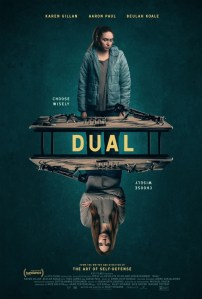 Imagine a world where anyone can create a clone, a perfect, or almost perfect, copy of yourself so that after you’re gone your family will never have to theoretically lose you? That’s the premise of Dual, an indie that played at the 2022 Sundance film festival and is now available online. Sarah (Karen Gillan) is generally miserable with her life. She doesn’t return her needy mother’s phone calls and texts. She’d rather watch porn than talk with her distant boyfriend. She’s also leaving disconcerting blood stains on her bed sheets. Turns out Sarah has a rare and incurable illness, and so she is eligible for the Replacement Program, an opportunity to get her own clone. She is gifted a clone (also Gillan), a reported exact replica except for eye color (the company offers a five percent discount for the defect). Sarah takes her doppelganger home and attempts to teach her about her life and how best to fit in. It’s not long that the Sarah clone has her own ideas about what her life could be. However, when Sarah’s terminal diagnosis improves, she intends to abort her clone. The clone triggers a legal clause that says that the ultimate decision over who gets to live as the only Sarah will be a televised duel to the death in exactly one year’s time.
Dual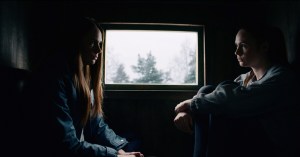 is a puzzling movie. I haven’t watched writer/director Riley Stearn’s other movies, notably 2019’s The Art of Self Defense, though I’ve read Dual is in keeping with his exaggerated, deadpan style, but to me it feels very much like an attempt to recreate a Yorgos Lanthimos world. Lanthimos is most famous for films like The Lobster and was even nominated for Best Director for 2018’s The Favourite. Lanthimos is excellent as creating these worlds that are reflections of our own but detached, deadpan, aloof, and irregular. The world of The Lobster is bizarre as a means of satirizing our social values when it comes to romantic relationships. In that world, if you cannot find a suitable mate within a period of probation, you will be transformed into an animal of your choosing. That world is bizarre in its very inception but there’s a reason that Lanthimos makes use of his stilted, stylized dialogue, to better reflect the absurdities of our culture. With Dual, the world never feels that wholly separate from our own and actually a little under-explored. The fact that society has cloning is woefully underutilized. What else does this mean about our concept of self, identity, legacy? What about clones that abandon their intended families? What about clones that murder their originals before their court-arranged duels? What about people that cheat the system and get more than one clone? What about a clone getting a clone? As the movie progressed, I kept feeling the unmistakable pull of wanting this story to be told straight and without the hip ironic posturing (I suppose that’s Swan Song, a 2021 movie I have yet to watch on Apple Plus). It just felt like there was so much more intriguing dramatic potential to be had here playing things straight, a woman facing her impending mortality, getting a “replacement you” and finding her not sticking to the script, endangering her fragile sense of preservation, and then the crisis of your friends and family preferring the clone over her. That’s some juicy stuff, but it all gets downplayed thanks to Stearn’s selected tone.
It would be one thing if Dual was hilarious with its cracked mirror approach but I just found little to actually laugh about. There are a few moments that I did chuckle, like Sarah and Trent (Aaron Paul) providing a play-by-play of their slow-motion brawl and the consequences of their amassed injuries, and the doctor that informs Sarah about her tragic diagnosis are the most well realized moments with tone (“This is why most doctors are depressed”). The bone dry, matter-of-fact style of speaking is too often the only joke. Just because characters are speaking in a detached manner does not mean you can skip over the same tenets of comedy construction. Lanthimos doesn’t just rest on his characters talking in a manner that is unexpected. There’s genuine work to make them seem of their weird world. The characters in Dual just seem like hyperactive, overly literal irritants. Often, they’ll just keep speaking about a subject and the joke is the length of the details. The Sarah duplicate doesn’t know how to drive, and as she watches her original, she remarks, “Oh, and I suppose you turn the big wheel left and the car goes left. Turn the big wheel right and the car goes right. Easy enough.” I suppose the joke is that she describes two pointless examples? Even the scenes with the doctor, which I laughed at, suffer from Stearns overwriting his dialogue exchanges. It’s not enough for the doctor to make an absurd, Kafkaesque remark, but the character must circle back and underline this over and over. The overall feeling is tiresome. There’s one example of what Dual could have been, where Trent suggests to Sarah during her money problems that she might provide “other means of payment.” The movie then cuts to them both dancing and Trent remarks, “Thank you for the hip-hop dance instruction. I’ve always wanted to learn but was too nervous.” That joke works. It’s a subversion that doesn’t overstay. I wish Stearns had pulled back and trusted his audience to get the joke without his incessant redirection of comic emphasis.
 The real reason to watch Dual is for the dueling Gillan performances. She gets to play two same-but-different versions of a character, and she really shines in the subtle differences she takes advantage of. I enjoyed the passive aggression of the clone re-examining the faults of her original, and I enjoyed how quickly she was interrogating her original while making casual, catty judgements. Paul (Breaking Bad) is also enjoyable but only appears in the second half of the movie and is underutilized. Stearns seems drawn to the mentor-pupil relationship dynamic (The Art of Self Defense) and the interaction between Paul and Gillan is a regular highlight of the movie. The actors generally elevate the material even as Stearns restricts the acting tools they can rely upon.
I’m sure there will be viewers that will genuinely enjoy the distaff comedy and pathos of Dual. There’s a clear artistic vision here by Stearns, it just didn’t fully gel for me because I felt the choices of tone and plot limited what could have been a far more emotionally engaging and intellectually fascinating story. The comedy too often settled on being quirky and too often it reminded you of this by circling and re-circling the same joke for diminished returns. Dual is not a bad movie, more a frustrating experience, one with big ideas and talent in front of the camera and behind, but it could have used more shaping and tone calibration to be its best version of itself. As it stands, it’s a fittingly amusing dark comedy with two solid performances from Gillan, and that could be enough for many to justify a 90-minute investment. For me, it felt too much like Lanthimos lite.
Nate’s Grade: C+
Share this:

CODA (2021)
 Ruby Rossi (Emilia Jones) falls under the category of CODA, a Child Of a Deaf Adult. Her mother (Marlee Matlin) and father (Tony Kotsur) and her older brother (Daniel Durant) are all deaf, and she is the only member of her household with the ability to hear. She’s balancing working for her family on their fishing trawler, maintaining good grades in school, and possibly pursuing scholarships to enroll at a music and fine arts college for singing. Ruby’s music teacher agrees to train her because he believes in her potential, but Ruby has to worry that her dream is something that cannot be shared with the people she loves most, and how would they all get on without her?
The framework of CODA is familiar to anyone who has watched a coming-of-age story or family drama, but it’s the conviction and strength of character and sheer force of empathy that makes this movie a standout film for 2021. It’s based upon a 2014 French film, The Family Beller, and follows many of the same beats from other sentimental family dramas about sticking out in your family and society, chasing your dream, often in conflict with your family’s expectations, gaining that sense of inner strength and resolve, and mending differences in perspective with hard-fought and well-earned wisdom. It’s familiar, but that doesn’t mean under the right set of hands that it cannot still be resonant and emotionally gratifying. I do not hold the familiar formula against CODA, even as the family’s goal and her personal goal come into direct conflict in sometimes forced manners. That’s because the movie does an excellent job of establishing these people as characters, establishing the family dynamic as fraught but loving, and establishing a conflict that is direct and clear as far a major point of separation.
 Ruby isn’t just the only member of her family who can hear, she’s also their vital lifeline to the outside world. She’s looked upon as the family interpreter, a position they cannot afford to pay for someone else’s services so the duties and responsibilities fall upon her. That’s so much pressure to bear for one teenage girl, knowing that she’s the link between her family’s poverty-treading existence and possibly breaking free into a larger hearing community. She feels ostracized and awkward within her own family and outside of her own family. To the rest of the school, she’s that “deaf family girl,” and it’s remarked that when she began high school she had an accent reminiscent of what deaf people can sound like, a point that her peers cruelly imitate. She worries she will forever be defined by her family’s disability even if she doesn’t share it. However, within her family, she feels ostracized because she’s different. She wonders if her mother wishes that she too were deaf, and during a heartfelt late-night talk, mom actually admits that upon her daughter’s birth she did feel disappointment when Ruby had hearing. While she knows sign language and has grown up with these loving figures, she’ll still always be the one who’s different, the one who hears the insults her family cannot.
The film does a remarkable effort about contextualizing Ruby’s fears and frustrations of being held captive in two different worlds, neither feeling fully accepted or whole, and that’s why her embarking on a personal dream that her family can never fully appreciate feels so significant. Part of Ruby might feel that singing is selfish, especially if it means limiting her family’s upward mobility by eliminating their unpaid interpreter, but it’s the thing that makes her most happy, a special gift that her family will be excluded from. There’s a wonderful moment toward the end of the movie where Ruby’s father asks her to sing to him, and he puts his hands along her shoulders and neck to feel the vibrations, and his awed and tear-stricken face is so moving, as he so desperately wants to indulge too in the beauty of his daughter’s voice. While occasionally the film goes overboard pounding these two conflicting paths into forced collision (family vs. self), the movie is personal with its big problems and personal with its big triumphs, making it transcend the trappings of formula.
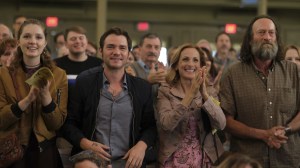 Writer/director Sian Heder got her start on Orange is the New Black, and that TV series’ hallmark has been its enormous sense of empathy for its diverse characters. This is evident in Heder’s screenplay and her observational, detail-rich simple storytelling that immerses you in this world, so even while you recognize more familiar made-for-TV plot turns, the genuine authenticity makes the movie feel like its own unique story. Heder’s direction is delicate and places the attention squarely on her performers. There is one stylistic move late in the film when Ruby’s family comes to her choir recital in support. They look around for cues when to applaud, and their minds wander as they sign about other menial topics like grocery lists, and you understand why once Heder drops you into their perspective. For a minute, the sound disappears, and you’re left studying facial expressions for cues like them. While we can imagine being deaf, it’s another matter to experience it and try and understand.
The acting is another laudable merit for CODA. I personally want three Oscar nominations for this clan, Jones (Locke & Key) for Best Actress, Matlin (Children of a Lesser God) for Best Supporting Actress, and Kotsur (Wild Prairie Rose) for Best Supporting Actor. Over the course of nine months, Jones learned American Sign Language and how to sing, which is surprising because I would have said she has a natural talent with singing. Her performance, as well as Matlin and Kotsur, feel so real, so nuanced, and so natural, like we’ve plucked these people from real life and given them this platform. It’s the best credit you can give an actor, when they seemingly disappear into the character, and the character feels like a fully breathing, flesh-and-blood person. Even the small supporting roles are well cast, well acted, and contribute to the overall authenticity of the movie. Unlike the 2014 French original movie, all of the deaf members of the family are portrayed by actual deaf actors as well.
CODA was a sensation at the 2021 Sundance Film Festival, with Apple Films buying the rights for $25 million dollars, and it’s easy to see why because it’s such a satisfying, enriching crowd-pleaser and legit tear-jerker. There were several points that had me tearing up, and then fully crying, because I was so emotionally engaged with the family, their struggles, and their triumphs and outpouring of love. You might be able to see where the movie is headed because its template is familiar and formulaic, but it’s the execution, the attention to detail, and the level of observational attention that elevates CODA and makes it so winning and so heartwarming.
Nate’s Grade: A
Share this:

Misha and the Wolves (2021)
 The Sundance documentary Misha and the Wolves, now available on Netflix streaming, is a movie about trauma, lies, and ultimately proves to be unfulfilling due to the circumstances of its own narrative limitations, both in subject and approach. It’s worth watching at only 90 interview-packed minutes, but it’s also a case of a movie that could have gone much deeper into a troubled subject that demanded more scrutiny and psychological examination than what the film has to offer.
Misha Defonseca was an elderly Belgian immigrant living in a small Pennsylvania town when she decided to share her personal story of survival one day at her community synagogue. When she was seven years old, her parents were taken by Nazis during the Holocaust. She was living with a Catholic family and hiding her real identity but she wanted to be with her parents, so she set out on foot across the country to find them, and in the process stumbled upon a pack of wolves who grew to accept her as one of their own. Misha’s story was immediately engaging, and a local publisher snapped up the rights to sell her story. Oprah’s talk show wanted to make Misha’s story their next book club selection. Disney wanted to buy the film rights. This story was going to be huge, but then Misha backed down from both media suitors. It picked up in Europe where Misha traveled and gave lectures on her spellbinding experience and they made it into a French movie in 2008. It is a truly remarkable story. The problem is that her unbelievable true story wasn’t actually true.
 It’s a story that even one interview subject admits sounded “too fantastic to be true,” and in hindsight it’s one of those stories that I’m sure many would feel foolish for believing – a little girl at the age of seven trekking hundreds of miles, on her own, through the war, in enemy territory, and then accepted by a friendly wolf pack. It definitely beggars belief but nobody wants to think skeptically of someone who claims to be a Holocaust survivor. I wouldn’t want to assume the worst of anyone’s personal experiences during such a hellish time. The primary interview subject is Misha’s first publisher she sued who is the one that first started investigating the voracity of this amazing tale. She relates how disgusted she felt doing what she did, suspecting the worst in someone who had experienced her own set of traumas. She says she felt like a villain in a story that she didn’t sign up for. Admittedly, she could have researched Misha’s claims early on to verify her account but chose not to because she was thinking of how much money she could make. However, there have been so many amazing tales of survival from the atrocities of the Holocaust so maybe Misha could have been accepted by a pack of wolves and offered protection. Maybe she did stab and kill a Nazi as a child like she said. Maybe. That need to believe survivors and the fear of calling out the storyteller for their accompanying proof is what Misha exploited to continue spinning her phony story. She exploited the good will of being a survivor and the communal sympathies of others. Why she did what she did is another matter that frustratingly goes unexplored.
There is one big narrative twist that I was predicting early on and that I think most viewers will be able to anticipate once they start asking their own questions, but for the sake of spoilers I’ll caution that this paragraph is going to talk about this gambit because I don’t know how to discuss the implications and how it dulls the movie without being specific. With that being said, early in the movie we have Misha being interviewed but there are limits to what she is responding to, limits that become more notable as her story continues at points that you’re positive a documentary filmmaker would want their subject’s direct personal input rather than having others speak for them. That’s when I began suspecting that the Misha on camera was going to be revealed to be an actor, and two-thirds of the way through the film that is exactly what happens. Our fake Misha pulls off a wig and peels off the elaborate makeup. Aha, a story about a phony Holocaust survivor has itself made use of fictitious representations. I can understand some viewers feeling hoodwinked and perhaps a little angry from this deception. I can also understand why the filmmakers elected to go this route thematically so that they could replicate the feel of what Misha’s friends and neighbors and supporters may have felt. There’s also the very pragmatic issue of not having access to the subject of your documentary. It’s a missing hole that seriously hobbles the impact and reach of the movie, and that’s where Misha and the Wolves starts to disappoint. It’s understandable to supply your own stand-in version of Misha to respond to the claims and accusations. It’s a necessary perspective. Once the jig is up, and you know for certain that Misha will not be available to explain anything, then you realize the movie is a whodunnit where it would have been far more engrossing as a whytheydunnit. There are questions we want answered for such a heinous fabrication, and I wish the film had been structured not in the details of uncovering Misha’s false identity but in trying to explain why someone would do such a thing. The movie is lacking psychological insight and without that it becomes any other well-made but disposable episode of ordinary true crime television.
 It begs the question that I wish the documentary would have gone much deeper into, namely why would anyone fashion a Holocaust story for themselves? Defonseca is far from the only person who fabricated a story about their Holocaust history. Rosemarie Kocz was an artist who said she escaped from two concentration camps and whose art hung in museums around the world including Yad Vashem in Israel. She was a fraud. Herman Rosenblat embellished his own Holocaust survival with a love story of reconnecting with the young girl who gave him apples in the camp and that was completely made up. Joseph Hirt said he met Dr. Mengele and then, upon confrontation, said he had lied to “keep the memories alive” about Holocaust history. That justification offends me and likely should offend you too, dear reader. The numerous dead do not need the stories of phony victims to keep their memories alive. When people greedily co-opt another human’s tragedy as their own, they are knowingly diminishing it by trying to transform this horror into something appealing about their own life story and experiences. If anything, these stories are making it more likely for pernicious Holocaust denial to spread, with deniers pointing to these phony personal accounts and saying, “See.” It dishonors the dead and their memory.
The story behind Misha and the Wolves is interesting and inflammatory but also very surface-level in substance ultimately, about uncovering the truth behind a liar’s lies. There is a certain level of interest in watching how the investigation picks up momentum and makes the necessary connections to finally reveal the disappointing truth, but then the movie doesn’t go a step further. It’s about how a liar’s story fell apart but there seems more potential with exploring why people falsify such stories of real-life trauma. For Misha, her own personal experiences involved tragedy at the hands of Nazis, so why was that not enough? Misha said that her story might not be reality but it is her reality. I don’t fully understand her position, but I will likely never understand why someone like Misha Defonseca does what they do. I suppose there’s an inherent attention-seeking intent. Maybe a projection of pretending to be someone else, a person who has survived amazing ordeals and come out the other side. One of the film’s subjects, Evelyn Haendel, a Holocaust survivor and investigator, declares Misha both a victim and a villain, but she dismisses the idea of these fabrications as acceptable outlets for troubled souls. In an era of increasing Holocaust denialism, these phony accounts are unfortunate fuel and are even more incendiary. Misha and the Wolves is an okay documentary on a topic that demands more attention.
Nate’s Grade: B-
Share this:

Nine Days (2021)
 Oddly enough, over the course of less than a year, we now have two movies about young souls competing to find their sense of self before being born. Will (Winston Duke) lives in a small cottage in the middle of the desert. Or so it would appear. He’s a former human who now serves as a spirit who watches over the lives of a select group of others on Earth through P.O.V. monitors. After a car accident, one of his people is killed, leaving a new opening. It’s Will’s job to interview a group of candidates and determine who is best equipped to handle being born. Will takes the process very seriously but he is also more emotionally affected by the loss of life under his guidance than he admits. Where did he go wrong, or is right and wrong even the right markers for assessment? Will must choose wisely over nine days of deliberation and insight into what it means to be human and what it means to live.
 Nine Days is a tender and thoughtful movie that has much under the surface given its metaphysical context and probing questions about spirituality, identity, and existence, but it doesn’t simply rely upon the artistic weight of ambiguity. There’s a genuinely involving emotional drama here that’s accessible while offering greater depth to be unpacked by the viewer who enjoys metaphor and implication and debate. At its essence, the movie is about a series of job interviews but for a position that we don’t fully understand what the requirements are and if even meeting the requirements is enough for the hire. It’s a primarily dialogue-driven procedure but it’s also character-focused as the entire process examines what animates Will, what haunts him, and why he does what he does. Early on, the surreal nature of what should be an ordinary event, job candidates interviewing with a boss, gives the movie an air of mystery and offbeat humor. The candidates are showing up, going through a series of questions and role play scenarios, and with each session, the candidates evolve into the personas that will define them. There’s something mildly profound about watching the development of an identity before it’s even been born. As the movie progresses, Will turns down candidates and the news is truly devastating. Not only will these spirits/souls miss out on being born on Earth, they will cease to ever exist and fade away. That is some heavy stuff. Watching each one come to terms with that sort of death can be heartrending. Just imagining having to accept the end before life ever even began.
Rather than simply fade away into the blank of nothingness, Will chooses to help these souls get one last moment of peace before their ultimate end. He becomes a celestial one-man Make-A-Wish spiritual service. It’s unknown whether these “positive memories” are from the souls’ own development or their observation of the souls that have been placed on Earth. Regardless, each rejected candidate gets a moment that Will studiously recreates as an act of kindness. This section can be rather moving as each soul gets a personal sendoff and, in those final moments to savor, we watch them become affected with the generosity and the fleeting moment of life that will be tragically denied to them. One candidate climbs aboard a stationary bicycle, and Will positions one screen after another, each with projection from that angle of the street. When taken together, it creates the illusion of a nice bicycle ride through a town square. The homemade production, even sprinkling cherry blossoms and a swinging light to illustrate a traveling through a tunnel, provide small moments of affectionate conviction. I found each of these moments to be emotionally rich and beautifully rendered on screen. The care and craft Will puts into these acts is wonderful and a tremendous insight into who he is as a character and what he values in others.
 Will is haunted by the idea that he may have been oblivious to the pain of one of his pupils, and this indecision is coloring his interview process for a replacement soul. It’s unclear what exactly Will is, or his boss, or his duties, but he vaguely amounts to a guardian angel. He has a bank of old TVs that he monitors and obsessively documents the lives of a few. He takes particular pride in one soul on Earth and listens to her virtuoso violin playing as a means of personal relaxation. Her sudden death rocks him, and when it’s revealed that she was depressed, he tries to make sense of being able to see and hear everything these souls do but not fully knowing them. Did he get something wrong in his clerical assessment? Did his understanding of her have its limits? Could she have been hiding something so all-consuming without his suspicion? It all upends Will and fosters self-doubt. He’s trying to make sense of something that may not ever make sense. That is how inscrutable human beings can be and how tragically fleeting life can become in an instant.
The other change agent for Will is the presence of Emma (Zazie Beetz), a candidate who shows up late, questions the nature of the questions she is given, and is empathetic to a fault. The other candidates are playing within the rules of Will’s questions but she’s pushing back, and it only makes Will think more and more about her and her aims. I don’t consider it too much of a spoiler that Emma will be one of two final candidates for the open spot for life. Her character causes Will to reassess his own biases, his own way of doing things as they have, and his own conception of himself and what life can be about including his own time spent on Earth, which he likes to remind the others like it’s bragging rights. I suppose one could argue that, yet again, we have a quirky female character in service of teaching the male hero about the importance of embracing life to the fullest, but I think the general makeup of the characters is superfluous to the impact of the story. We’re dealing with spirits taking a physical form here. Their appearance is immaterial to their identity at this point, at least in an otherworldly realm that (hopefully) knows no sexism and racism.
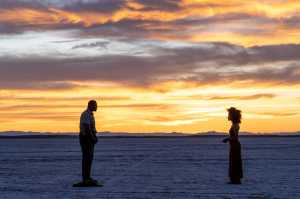 Nine Days is the film debut from commercial director Edson Oda and the movie is utterly gorgeous from a technical standpoint. The photography favors gleaming sunsets and pristine vistas to communicate the exquisiteness and otherworldly plane of existence. The desert landscape is beautifully filmed, and the interiors are also pleasing with their visual arrangements and the mingling of natural and artificial light. Oda won a screenwriting award at the 2020 Sundance Film Festival and for good measure. This isn’t just a good-looking indie, which it assuredly is, but there is deep melancholy and beauty and transcendence to be had with the very humane and compassionate storytelling trying to get at larger truths about our limited time. The storytelling has plenty of ambiguity and nuance and metaphor, but there’s an accessible core that I believe most viewers can align with and then, if they choose, can discover further meaning. There is a slightly basic “stop and smell the roses” moral, but I found there to be more lyrical beauty at different points that affected me deeper than any condensed message. The conclusion hinges on a recitation of Walt Whitman’s “Song of Myself” and it conveys not just Whitman’s celebratory humanism but also taps into Will’s own character arc. The poetic performance itself is an expression with multiple levels, celebrating life in multiple ways, and serving as a heartfelt and personal goodbye. It’s a lovely ending for a lovely little movie.
Nine Days is packed with recognizable acting faces (Tony Hale, Bill Skarsgaard), several of whom have graced Marvel superhero movies (Duke, Beetz, Benedict Wong), and there must have been something compelling for them to all accept this low-budget, contemplative indie about the human condition. It’s a little movie with a lot on its mind but it doesn’t feel the need to explain everything. There’s a sturdy foundation to begin with but enough ambiguous room for discussion and debate. It reminds me of 2003’s beguiling, divisive, and highly metaphorical indie Northfork. Both movies are poetic, understated, and deeply involved in human connection and spiritual meaning while providing room for interpretation. There’s plenty here to unpack but even on a literal level the movie works as an emotional experience. I found myself under the gentle sway of Nine Days and its mighty beating heart of humanism that extends even beyond the realm of flesh and blood.
Nate’s Grade: A-
Share this:

Minari (2020)
 Gentle, heartwarming, and deeply authentic, writer/director Lee Issac Chung’s semi-autobiographical movie about growing up in rural Arkansas in the 1980s won the top honors at Sundance and is poised for an Oscar run by its studio into 2021. Each moment in Minari feels plucked, fully realized, from the personal experiences of Chung. There’s an intimacy here that cannot be imitated. It’s a story about immigration, assimilation, hopes and the American dream, as well as struggles, setbacks, economic anxiety, and fitting in and figuring out the world around you. We spend time equally between the parents (Steven Yeun, Jeri Han) and their youngest child, David (Alan S. Kim), as the Korean transplants try their luck as farmers. Their elderly grandmother (Yuh-Jung Youn) moves in with them to provide childcare and assistance where able. At first, the kids declare their grandmother is “not a real grandmother” as she doesn’t bake cookies or do typical grandmother pastimes, but in time, she learns the ways of the new culture and becomes a lover of televised professional wrestling. It’s a small-scale story about a family trying to stake their claim at a better life and beset with challenges; the son has a heart murmur, their property is so far from other Korean immigrants to be part of a community, the land’s sources of water can be fickle for crops, the mounting mortgage payments. It ultimately becomes a push between personal goals and family unity, and then Minari ends in a way that made me feel like I was cheated out of a real ending. I suppose there’s a lesson to be had about life just moving on, resetting after tragic setbacks, and this plays into the real-life rhythms of this gently observational movie with its well of compassion. I also found myself starting and stopping the movie often and stretching out my viewing as I was distracted with other tasks. I never doubted Chung’s love for his story and his characters. Like the similarly themed Nomadland, this is a movie of quiet moments, and your mileage will vary whether they add up to a more complete whole or understanding. There are moments that tugged at my heart, like the grandmother hugging her grandson tight and swearing to protect him from any death coming in his sleep, or the kids folding paper airplanes that declared “Don’t Fight” as their parents argue. It’s a mostly restrained, quiet, slow-moving sort of story that gives you a peak into the lives of others. It’s so specific and finely textured to be genuinely authentic. The family’s very normality as an American immigrant experience is the movie’s big thesis and a reminder that there are thousands more stories to be told about what it means to be an American.
Nate’s Grade: B
Share this:

Palm Springs (2020)

I am a sucker for a clever time travel tale, or parallel universes, a sci-fi story where the creative ingenuity is front and center, and Palm Springs is a delightful new rom-com bursting with imagination. By this rate, most audiences should be familiar with the time loop formula, from comedy classic Groundhog Day to Source Code to Edge of Tomorrow to Netflix’s audacious series, Russian Doll. It’s a creative conceit that rests on building patterns and subverting expectations, allowing a writer an unparalleled opportunity to retell a story, pulling at the edges and getting to answer an assembly of “But what if?” questions. It builds out its world and makes it feel richer and more intricate, all the little stories and characters that might have been missed had there only been a single avenue. It requires a creative storyteller with a big imagination for details, but when done correctly, the time loop movie can be a wealth of satisfying payoffs and intriguing detours. Palm Springs deserves to be added to that list of hallowed time loop movies.
It’s the day of the wedding for Sarah’s (Cristin Milioti) sister. There’s one wedding guest that seems to stand out. Nyles (Andy Samberg) seems prescient on the dance floor, has a prepared speech that earns tears, and strolls through the reception like he owns it. Sarah becomes smitten with him and, against her better judgment, follows him into a mysterious glowing cave. She wakes up in her bed and relives the wedding day again, learning she too is now trapped in that 24-hour loop with Nyles. He laments that she followed him, having once encouraged another person to join him in the world of no tomorrows (a rueful Roy, played by J.K. Simmons). But with a partner, the many days have a new relevance, and Nyles and Sarah depend on each other, but is there a chance that they can escape or are they doomed to perform the Electric Slide forever?

Right away, you can tell that writer Andy Siara (TV’s Lodge 49) has given his story tremendous thought, and the fun of it is watching our main characters go through the process of discovery while learning more about each. The rules of the universe are straightforward; whether death or sleep, they will wake up back that fateful wedding morning. Nyles has felt trapped for so long and the prospect of another companion going through his same purgatory fills him with guilt, but he cannot help feeling a new purpose when he finds a partner for this weird world. Initially she’s looking for an escape, but then she opens up to the possibility to a life permanently on pause, without consequences, and how freeing this can be. Then the appeal dampens as we come to understand why this day is a personally painful one for Sarah and why she would be desperate to live another day, any other day. When she drops out for a solid stretch in the second half, you miss her just as much as Nyles and better realize what a great team they made. Palm Springs has plenty of fun with the possibilities (Nyles requests a quick death over a long drive to “beat the traffic”) but it doesn’t lose sight over why we should care about these people. It doesn’t really matter how the time loop began or whatever theory will end the loop. It’s the central relationship that will ultimately provide the emotional anchor, and it’s because of that attention that by the conclusion of Palm Springs I felt uplifted, buoyant, and happy (a mid-credits scene thankfully answers the one lose thread, providing an even more welcomed conclusion).
Make no mistake, this is a funny movie and I laughed often. Samberg (TV’s Brooklyn 99) and Milioti (Black Mirror) are terrific together and genuinely seem to enjoy one another. They have a combustible spark to them that reminded me of older screwball comedies. Having a willing partner allows Nyles to cater to different impulses but also pushes him to re-examine his perspective when he has someone new who sees the excitement in their unique position. However, except for Roy and his long drive from Irvine, they are hopelessly alone, unable to move forward, and the question arises can there be anything of significance without consequences? The screenplay has a natural dark streak with its humor, so even when things get heavy with existential quandaries, it doesn’t stop the movie from being smart and enjoyable. There are so many wonderful little payoffs, little running gags, and larger payoffs to be had with the time loop formula. It also hooks an audience by watching a character fail, and fail, and fail, only to succeed. Palm Springs is a romantic comedy that can be funny, romantic, and make me care.

Debut director Max Barbakow keeps the pacing swift and has fun playing with bold primary colors across the desert setting. The tone of the movie is delicate as it can go into silly revelry, like a surprise coordinated dance routine and a wedding outburst involving a bomb, into yearning romance, into heartfelt pathos, and then even the occasional stomach punch. For as rightfully beloved as Groundhog Day is, there’s nothing that comes close to feeling like an emotional gut punch. With Palm Springs, the time loop is given its sci-fi examination, the comedy is given is full exploration, but it’s the characters that matter most, and Barbakow prioritizes the right feelings at the right times. By the end, you feel sweetly fulfilled by these 90 charming minutes.
At first, I wondered why the Roy character was included except as a cautionary tale why Nyles would not want to rope someone else into his purgatory. But then as we visited with the older man, I realized, as he does, that he’s meant to symbolize the change in perspective (mild spoilers to follow). The family that he couldn’t stand before his loop-life has now become his personal oasis. He’s grown in appreciation and love of his family bonds. He is the example for Nyles about how one can personally grow and change when given dedication and enough time to see it through. It’s a nice moment, and while Simmons (Whiplash) is always wildly entertaining when he’s bulldozing over others, giving Roy a poignant sendoff made me feel like he was a much more integral character and his earned wisdom was its own special reward.
Palm Springs is a great detox of movie, with enough sunny comedy and winning romance to make you smile and enough tortured existential drama to provide substance. Everyone involved, from the writer to the director to the cast, is having a blast and it’s fun to join in the good times. When it comes to time loop cinema, Palm Springs is a respite of entertainment and smartly developed and richly realized execution. Find it on Hulu and kick back.
Nate’s Grade: A
Share this:

Wendy (2020)
 I was not a big fan of writer/director Benh Zeitlin’s first movie, 2012’s indie darling and surprise Oscar contender, Beasts of the Southern Wild. Some choice highlights from my mixed review include: “This movie is awash in all sorts of tones and storylines, failing to cohesively gel together or form some kind of meaningful message…. [it] offers half-formed ideas, strange, conflicting imagery, and characters that are rather thinly written and barely register… This is just a swampy mess of a movie, one that sinks under the weight of its own pretensions. It’s admirable from a technical standpoint but, as a movie, Beasts of the Southern Wild is an exercise in eclectic indie navel-gazing.” So as you can see, I wasn’t exactly heartbroken that Zeitlin took eight years for his follow-up, Wendy, a loose reinterpretation of the Peter Pan story. It has many of the same flaws as Beasts and not enough of its few virtues, which means Wendy is its own lost movie experience.
We follow a group of children from a working-class diner waitress in small-town Louisiana. They watch the trains speed by on the neighboring tracks and dream of far-off adventures. Wendy (Devin France) and her two younger twin brothers (Gage and Gavin Naqui) sneak off one night onto a passing train and meet Peter (Yashua Mack), a boy who promises to guide them to a magical island where they will never grow old as long as they believe in Mother, the spirit of the island and embodied as a giant glowing fish. Wendy enjoys the freedom but worries if she’ll ever see her mother again and if this extended excursion is worth that level of sacrifice.
 Maybe I’m just going through Peter Pan fatigue or maybe this latest variation on the mythology of J.M. Barrie just failed to provide any really thorough message, theme, or entry point of interest for me. Wendy seems to be going for whimsy and flights of fancy, once again attaching its perspective to that of children escaping into the realm of fantasy as a means of avoiding the hardships of their impoverished lives and what it means to be a working stiff (one child in the opening runs away at the prospect of becoming “a mop and broom man”). It’s meant to be diverting but it’s never really that exciting or involving, tapping into a wellspring of awe. There’s a beautifully idyllic island and a volcano, and of course our magic fish, but there aren’t nearly enough genuine magical elements to convey that desired whimsy. The freedom of a life without adults seems less free when there’s less to do. Much of the movie feels closer to The Florida Project where a group of poor kids are playing around junk to keep from being bored. This Neverland universe feels very limited as far as what can be done. They run around, they pretend, there are even some decrepit buildings, but what else? There isn’t really a society here in concert with our lost children and former lost children. It’s a pretty empty island retreat.
Perhaps that was Zeitlin’s goal, to strip away the romanticized notions we attach to forever staying young, chasing the fleeting feeling of the past while ignoring the present and adulthood, but this more critical theme doesn’t come across thoroughly either. There is one interesting aspect of the island’s unexplained magic and that is the older adults are former lost boys and girls who lost faith in Mother, thus activating their advanced aging and expulsion from Peter’s posse. I like the idea that the future villainous pirates of a Neverland are former lost boys; it gives an interesting personal dynamic for Peter. These adults, though, want to go back to being young again and they are convinced that killing Mother will achieve this, and it doesn’t go as planned. The deconstruction of fantasy with real violence doesn’t work because the consequences aren’t at the same level of realism. A child, in an effort to avoid growing old, makes a drastic decision, but the brushed-off aftermath makes the insertion of the harsher violence feel perfunctory. Peter is portrayed as an idealist leader one moment and ignorant and selfish the next, even with Wendy scolding him that there’s nothing wrong with growing up and becoming an adult, despite the mixed message of the former lost boys. The movie concludes with a goofy sing-a-long for magic resolution purposes that is played so earnestly that it makes it hard for me to believe Zeitlin was intending to be too critical of his magical world.
 Is Wendy about rejecting adulthood or the unavoidable perils of rejecting adulthood? I cannot say because the themes are so muddled with such a precious lack of significant storytelling content. Once again, a Zeitlin film feels like an improvised series of redundant scenes, where we watch kids play fight, we watch kids yell at one another, we watch kids run, we watch kids swim, all with headache-inducing handheld camerawork, but do we get to know these kids on a deeper level where they feel like people rather than figures? The plot of Wendy, written by Zeitlin and his sister Eliza, is very unclear about the rules of its magical world, which makes for a hard time to understand why anything is really happening. It also makes the movie less fun to experience because we don’t get to play along with the discovery of a fantasy world, its new parameters, and how we can develop and complicate them (not that there’s really much to discover; Neverland gets old quickly). This is definitely a movie that’s meant to convey more in feeling and inference, so the plot beats are very inconsequential outside of a few key movements. I didn’t find myself caring about any of the kids and their general well-being, even after they take it upon themselves to make some rash medical decisions. Wendy is our best realized character as she at least seems conflicted about the appeal and consequences of staying young indefinitely. The others are easily replaceable.
Wendy isn’t a bad movie and it’s clearly a very personally designed project from Zeitlin given the years of preparation. It has consistently gorgeous photography by Sturla Brandth Grovlen, the first film production shot on location on Montserrat island, and the score by Dan Romer (Maniac, Atypical) excels at the big swooning, churning melodies that crescendo into triumphant bliss. But even these positive technical qualities can only distract you momentarily from the missing center of Wendy, the story and characters and themes and discernible messages. I’m not asking for my entertainment to spoon-feed me what to think and feel from my art, but having a consistent message, or even an accessible entry point to decode and debate the art would help, as would engaging characters and a plot that felt more meaningful than just another disposable color to blend into a murky abstract mess of childhood whimsy, magic realism, and coming-of-age themes. A little of Wendy goes a long way, and two hours gets quite tedious. I just cannot foresee people falling under the spell of this movie. I wrote that Beasts had “half-formed ideas, strange, conflicting imagery, and characters that are rather thinly written and barely register,” and this much is also true with Wendy. I also wrote that Beasts was “an exercise in eclectic indie navel-gazing,” and this much is also true with Wendy. Maybe I’m just not the right fit for a Benh Zeitlin film. This is two hours of kids running around on an island without supervision and the occasional Peter Pan element thrown in. Maybe that sounds like a grand retreat as a viewer but it made me happy to be an adult and leave.
Nate’s Grade: C
Share this:

The Assistant (2020)
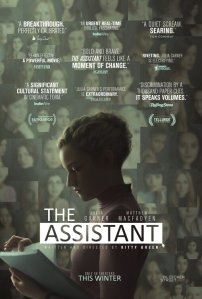 Jane (Julia Garner) is a young woman serving as an assistant to a high-profile film and TV producer, the kind of man with plenty of pull within the industry. She’s the first one into the production office and the last one out at night. Little by little, a larger picture forms of her temperamental, vindictive, and lecherous boss, especially as young women seeking to get ahead in the entertainment world as carted before him like sacrificial offerings. What will she do when the offending evidence becomes too much to ignore?
Where The Assistant lost me was in its lack or urgency with its storytelling. This is the slowest of slow burns, and it’s understandable, to a point, why this approach is the more realistic path. We’re watching the decades of inertia that make anyone standing up to harassment and abuse very difficult to find any traction or credibility. It’s much easier to just shrug it off, say “that’s just the way this awful man is,” laugh it off like some of his peers, ignore it like others, or compartmentalize, justifying your complicity as symptomatic of just how the industry works. I was waiting for the slow reveals to finally form a picture for our protagonist and push her into action, a desire to do something or say something about what she can no longer ignore or assist. The movie gets us to this point and, in its best scene, smacks her down for even seeking out this oversight. From there, the movie just becomes another repeat of what happened before, with more clues about the bad behavior of Jane’s boss, but it’s more of the same and then it just ends. I think writer/director Kitty Green (Casting JonBenet) was going for ongoing ambiguity whether or not Jane ultimately decides to leave her entry-level position or swallows her moral turpitude. However, there is a frustrating difference between an ending that is openly ambiguous and one that feels incomplete and lacking. After everything I went through, a little more definition by the end could have made the slog of work details more palatable.
 This subject is bursting with pertinent urgency and social commentary and I feel like this movie is just missing so many important things to say and do in the name of misplaced indie understatement. Understatement can be fitting as an approach to real-life dilemmas but The Assistant is understated to its unfortunate detriment, traversing from subtlety into somnolence. More time is spent establishing the mundane details of Jane’s office duties than the harassment and protection afforded to her boss. I was expecting to collect little telling details, like the male assistants’ patterned ease of composing “apology e-mails” for whatever indignation the boss feels, but we’re absent a certain momentum throughout. The first thirty minutes is packed with moments like Jane making coffee, Jane tidying an office, Jane getting food, Jane answering phones, Jane microwaving a cheap dinner. We never see her at home from the moment she leaves in the opening of the film. It’s like the movie is saying she lives at the office or must if she is to get ahead in a broken system of people using people. The people passing through are superficial to us, never more than pretty faces, or important names coming and going on the peripheral. I was feeling crushed by the obsessive details of this work routine. I expected to establish a pattern, establish a baseline, and then move from there, forcing change or at least reflection. The mundane details are meant to convey the soul-crushing nature of Jane’s job, being on the bottom of an industry she’s desperate to break into, and how un-glamorous the life of the little people can be. But she’s also a gatekeeper of sorts for the line of future victims encountering her bad boss. There’s a degree of culpability there, and it’s never fully explored because of how underplayed every moment and every scene comes across, choosing mundanity over drama. I would not begrudge any viewer if they tuned out The Assistant after the first half hour of work.
There is a noticeable feeling of dread and discomfort in the movie, but without variation or escalation it feels almost like a horror movie where we’re stuck with the person on the other wall of the action just briefly overhearing things. Imagine Rosemary’s Baby but if you were one of the neighbors just wondering what was going on. There’s an important message here and the point of view of an up-and-coming young woman as the assistant to a Harvey Weisntein-esque monster and her moral quandary of how far to ignore and how much she is willing to suffer is great. That’s a terrific, dramatically urgent starting point, and yet The Assistant is too muted and padded. There’s a remarkably thin amount of drama during these 85 minutes, with the more intriguing and disturbing action kept in the realm of innuendo and suspicion. It makes the final movie feel like the real movie is on the fringes of what we’re seeing and we just need to nudge back to the drama.
 There is one fantastic scene in The Assistant and it happens at the end of Act Two, and that’s when Jane finally seeks out the HR rep, Wilcock (Matthew Macfadyen). You sense just how much she wants to say but how much she feels the need to still be guarded, so minute by minute she tries a few more scant details, all that’s needed to limit her vulnerability and exposure. Wilcock seems like he might just take her words seriously, and then he interrupts to answer a phone call, and it’s an obnoxiously unimportant call and his behavior merges into just “one of the guys.” From there, he turns the heat on Jane, laying out her circumstantial claims and questioning what her future plans are and if this is the best course of action to see those plans through. It’s the company line sort of pressure and you feel Jane retreat within herself as soon as this potential ally becomes just another cog in a system to enable abusers. Garner (Ozark) is never better than in this scene, where the understated nature of the film, and her performance, really hits the hardest. It’s the quiet resignation and heartbreaking realization that the system is designed to protect itself. I wish the concluding twenty minutes had more of the drama that this scene points to as its direction.
The Assistant had a lot of things going for it as a queasy indie drama and it’s still well acted with searing details and a strong sense of authenticity. I feel like that authenticity, however, gets in the way of telling a more compelling and affecting story. I’m here to see the pressure, torment, and decision-making of a young woman put in an unenviable position, and what I was given was an hour of office tasks and eavesdropping. It’s got its moments but it left me wanting more.
Nate’s Grade: B-
Share this:

The Last Black Man in San Francisco (2019)
 Gorgeously shot and beautifully realized, The Last Black Man in San Francisco feels like a sacred hymn to a city, a past, a wayward love that is just aching with feeling. The Sundance-winning indie has such an immediate and invigorating sense of lyricism. Jimmie Fails (Jimmie Fails) talks about the meaning his family home has, the same home he hasn’t been living in for a decade but has been returning to touch it up and hopefully take it back. Debut filmmaker Joe Talbot has created a movie on the edge of the surreal where everything feels heightened, more emotional, like a religious experience, without puncturing its core dramatic reality. We touch upon a lot of issues and themes, from gentrification and reclaiming one’s past for pride, to the identities we choose to inhabit, to friendship and the love/hate relationship one can have with their home, and each of these pulsates with meaning and fervent feeling. In many ways, this film reminds me of If Beale Street Could Talk, not just because it’s an ensemble of African-American working class figures, but because there’s a bittersweet tenderness that taps into the profound and universal that reminds me of the kind of knowing, compassionate voice of author James Baldwin. I was often spellbound by this movie, enraptured by its transporting musical score by Emile Mosseri (the best score of the year), awestruck by its dynamic photography by Adam Newport-Berra, smiling from its presentation of bizarre comic flourishes, characters with genuine personality and peculiarities, and charmed by the overall picture the movie was lovingly constructing of a personal San Francisco bursting with meaning. If there is a slight drawback it’s that too many characters remain more as sketches than fully fleshed-out beings, and too much plot emphasis is placed upon whether of not Jimme’s grandfather really built their family home as he ardently holds true. The Last Black Man in San Francisco is a cinematic hymn of love to the emotional stability we designate for our homes. It’s a lovely, beautiful, deeply felt movie that washes over you in waves and is an artistic triumph for Fails, Talbot, and every set of hands that toiled on this uniquely personal ode.
Nate’s Grade: A-
Share this:

The Farewell (2019)
 This was a wonderful movie that just warmed my heart while holding to a beautiful melancholy. That is such a rare combination, and at its heights, The Farewell made me think it could have been plucked from the halcyon days of 90s indie cinema. The strange-but-true story follows an extended Chinese-American family that discovers its beloved Nai Nai (grandmother) back in China has terminal cancer. The family has elected not to tell her the devastating news and will reunite under the auspices of a grandchild hastily getting married (they’ve dated for only 3 months). Our protagonist is Billie (Awkwafina), a struggling New Yorker who disagrees with her family’s deception. Her extended family is convinced she won’t be able to keep her emotions in check, and so every scene plays with a great deal of subtext, as just about every character holds the burden of keeping a secret that deeply pains them. It makes for some pretty emotional moments, as different characters hold more meaning to their words and would-be goodbyes, but the movie is ultimately rather uplifting and winning. The matriarch of all this attention, played by Shuzhen Zao, is a bossy, compassionate, and deeply lovable old woman who welcomes her family’s return. I smiled every time she affectionately referred to Billi as “stupid child” and after a while noticed my eyes were getting glassy. Awkwafini, in her first stab at dramatic acting, nicely sells her tumult with an understated grace. The characterization achieved by writer/director Lulu Wang (the real-life Billie) is generous and honest, providing worthwhile moments to the larger family and giving them perspectives so while there is conflict nothing ever gets too preachy or stagy. Speaking of that, Wang films many of her scenes with an almost static camera, allowing the scene to unfold in front of us as if we’ve dropped in on these people’s lives. The film is about 80% Chinese subtitles but the story is really universal and deserves to be seen and celebrated. The Farewell is a terrific antidote to the summer blockbuster season and it left me thrilled to find a small little movie that could remind you again of the powerful pleasures of simple, sharply written storytelling (also stay tuned for the twist ending of the year in the credits).
Nate’s Grade: A


 nathanzoebl
You must be logged in to post a comment.