Blog Archives
Rogue One (2016)
 In the opening text crawl for Star Wars Episode IV: A New Hope, it says, “During the battle, Rebel spies managed to steal secret plans to the Empire’s ultimate weapon, the Death Star.” Disney, in its infinite wisdom to cash in on every potential resource of its lucrative cash cow, has decided to devote a whole movie to that one sentence in that initial crawl. I can’t wait for each sentence to get its movie. Rogue One: A Star Wars Story (in case you’d forget) is the first film outside of any of the trilogies and much is at stake. Not just for the rebels but for Disney shareholders. If a wild success, expect future tales coming from every undiscovered corner of the Star Wars universe. And if Rogue One is any indication, that’s exactly the kind of artistic freedom needed to blossom.

Not actually in the finished film.
Jyn Erso (Felicity Jones) has plenty to rebel against. Her father (Mads Mikkelsen) was forced against his will by Orson Krennic (Ben Mendelsohn) to work on a fiendish death machine for the Empire. Jyn’s father is responsible for designing the Death Star. Jyn is broken out of imperial prison by Cassian (Diego Luna) for the Rebellion. They want her to track down her father, find out whatever she can about this new fangled Death Star, and if possible, retrieve the plans on how it might be stopped. Her mission will take her to the ends of the galaxy to reunite with her father and to provide hope to the Rebellion.
Finally after many films we finally get a war movie in a franchise called Star Wars, and it’s pretty much what I wanted: a Star Wars Dirty Dozen mission. It’s thrilling to go back to the height of the resistance against the Evil Empire and see things from a ground perspective with a skeleton crew working behind the scenes. We may know the future events of those Death Star plans but we don’t know what will befall all of these new characters. Who will make it out alive? The open-and-shut nature of this side story in the Star Wars universe brings a bit more satisfaction by telling a complete story. This film will not have to wait for two eventual sequels years down the road in order for an audience to form a comprehensive opinion. I welcome more side stories like Rogue One that expand upon the fringes of the established universe and timelines, that establish colorful new characters and tell their own stories and come to their own endings, and hopefully don’t feature any more Death Stars (more on this below). It seems like it was ages ago that major studio tentpoles just attempted to tell a single, focused story rather than set up an extended universe of other titles to nudge along their respective paths. Director Gareth Edwards (2014’s Godzilla) is less slavishly loyal to the mythos of the series than J.J. Abrams. His movie doesn’t feel like flattering imitation but its own artistic entry. The cinematography is often beautiful and the natural landscapes and sets provide so much tangible authenticity to this world. Edwards has a terrific big-screen feel for his shot compositions and achieving different moods with lighting. He knows how to make the big moments feel bigger without sacrificing the requisite popcorn thrills we desire.
 Rogue One has to walk a fine line between fan service and its own needs. While it’s fun to see Darth Vader on screen again voiced by the irreplaceable James Earl Jones, it’s also a bit extraneous other than some admittedly cool fan service. We don’t need to see Vader clear out a hallway of Rebel soldiers but then again why not? It’s the same when it comes to the inclusion of cameos from the original trilogy. Some are minor and some are major, achieved through the uncanny valley of CGI reconstruction. Gene Kelly may have danced with a vacuum cleaner and Sir Lawrence Oliver and Marlon Brando both appeared as big floating heads after their deaths, but this feels like the next step beyond the grave. There’s a somewhat ghastly feel for watching a dead actor reanimated, so your sense of overall wonder may vary. The cameos are better integrated than the Ghosbusters ones.
There’s a great cinematic pleasure in putting together a team of rogues and rebels. The characters on board this mission have interesting aspects to them. Chirrut Imwe (Donnie Yen) is a blind warrior and aspiring Jedi. He feels like he stepped out of a great samurai movie. He uses his connection with the Force to make up for his lack of visual awareness, and Chirrut demonstrates these abilities in several memorably fun instances. There’s a world of back-story with Saw Gerrera (Forest Whitaker), a dotty wheezing warrior who is more machine than man at this point. Whitaker gives an unusual performance that reminded me of a kindlier version of Dennis Hopper in Blue Velvet. The reprogrammed robot K-250 (vocal and motion-capture performance by Alan Tudyk) is a reliable source of catty comic relief and I looked forward to what he was going to say next. The first 40-minutes is mostly the formation of this group, and it’s after that where the movie starts to get hazy. We know how it’s all got to end but the ensuing action in Act Two feels a bit lost. This may have to due with the reportedly extensive reshoots that were done last summer to spice up the movie (much of the earliest teaser footage isn’t in the finished film). I’d be fascinated to discover what the original story was from Chris Weitz (Cinderella) and just what rewrites Tony Gilroy (Michael Clayton) performed so late into its life. For much of the second act, the characters feel a bit too subdued for the life-or-death stakes involved, and that translates over to the audience. We travel to different locations throughout the first two acts but I can’t tell you much about them other than some intriguing mountainous architecture. The plot is a bit too undercooked and still obtuse for far too long, requiring our team to bounce around locations to acquire this person or that piece of information. Rarely do the characters get chances to open up.
 It all comes together in the final act for a 30-minute assault that makes everything matter. It’s a thrilling conclusion and the movie finds a way to keep escalating the stakes, bringing in powerful reinforcements that force our Rogue One crew to alter their plans and placement, while still clearly communicating the needs of each group and the geography as a whole of the multiple points on the battlefield. It’s what you want a climactic battle to be and feel like where each player matters. It’s also a welcome addition to the Star Wars cannon, as we’ve never seen a beach assault before. It feels like a new level that was unlocked in some video game, and that’s no detriment. The ending battle has different checkpoints and mini-goals, which allows for the audience to be involved from the get-go and for the film to jump around locations while still maintaining an effective level of suspense. Many of these characters make something of a last stand, and you feel the extent of their sacrifice. I read in another review that the reason Jyn and her rogues win is because they accept that they are replaceable, and Orson Krennic fails because he made the mistake of believing himself irreplaceable. I think that’s a nice summation about the nobility of sacrifice. I won’t get into specific spoilers but I was very pleased with the ending of the film even though it’s not exactly the happiest. It feels like a fitting ending for the darker, grittier Star Wars tale and it provides earned emotional resonance for the setup of A New Hope, which this movie literally rolls right into.
With as many fun and potentially interesting characters aboard for this suicide mission, it’s somewhat surprising that they are also the film’s weak point. Beyond simple plot machinations like Character A gets Character B here, I can’t tell you much more about these rogue yet noble folks other than their superficial differences. Take for instance the Empire turncoat, pilot Bodhi Rook (Riz Ahmed) What personality does he have? What defines him? What is his arc? What about Cassian? He’s supposed to secretly assassinate Jyn’s father if given the chance, but do we see any struggle over this choice? Does it shape him? Does his outlook define his choice? Can you describe his personality at all whatsoever? What about the villain, Krennic? Can you tell me anything about him beyond his arrogance? What about Baze Malbus (Wen Jiang), who carries a big gun and is close friends with our blind wannabe Jedi. Can you tell me anything about this guy beyond that? Even our fearless leader, Jyn Eros, feels lacking in significant development. She wants to find her father, get vengeance, but then changes her mind about sacrificing for the greater cause of hope. Many of the character relationships jump ahead without the needed moments to explain the growth and change. The original trilogy was defined by engaging characters. When you have a ragtag crew of six of seven rogues, you better make sure each brings something important to the movie from a narrative perspective, and not just from a pieces-on-the-board positioning for action. Look at Marvel’s Guardians of the Galaxy for tips. If this was going to be a powerful and emotionally involving war movie, the characters needed to be felt deeper. All too often they get lost amidst the Star Wars debris and then they become debris themselves. Ironically enough, Rogue One has the reverse problems of The Force Awakens, a movie that benefited from engaging characters but sapped from an overly familiar and cautious story. It’s telling when my favorite character, by far, is a sassy comic relief robot.
 Let’s talk about the Death Star in the room, namely the fact that over the course of eight Star Wars movies there have been Death Stars, or the construction thereof, in five of them (63% rate of Death Star sighting). We need a break. You can cal it a Star Killer Base whatever in Force Awakens but it’s still a Death Star in everything but name. I can’t even put a number to the amount of money it cost the Empire/First Order to build these things, plus the review process to try and correct design flaws that never seem to get corrected. At this point it feels like this model just isn’t cost-efficient for its killing needs. What about a more mobile set of multiple mini-Death Stars? I hope that the filmmakers for the new trilogy (Rian Johnson, Colin Trevorrow) refrain from putting another similar planet-killing space station-type weapon into their movies as we’ve had enough. However, the use of the Death Star in Rogue One was perfectly acceptable because it already fit into the timeline of the first film. I also greatly appreciated the clever retcon as to why the Death Star had its fatal flaw. It took a bothersome plot cheat from 1977 and found a gratifying and credible excuse. Now when Luke blows up that sucker it’ll have even more resonance.
Rogue One is a Star Wars adventure that feels like its own thing, and that’s the biggest part of its success. By being a standalone story relatively unencumbered by the canonical needs of hypothetical sequels, the movie opens up smaller stories worth exploring and characters deserving a spotlight. This is an exciting and entertaining war movie, and the kind of film I want to see more of in this multi-cultural universe. It’s not a faultless production as the lackluster character development definitely hampers some audience investment. I wish more could have been done with them before they started being permanently taken off the board. While Rogue One is looking to the past of Star Wars it still makes its own independence known. I hope this is the start of a continuation into exploring more of that galaxy far far away without the required additions of every Skywalker and Solo in existence. It’s a far bigger universe and it needs its close-up.
Nate’s Grade: B
Share this:

Miss Sloane (2016)
 Miss Sloane is an intelligent and exacting political thriller that should appease fans of the genre who enjoy a good arm-twisting from a powerful manipulator, in this instance the towering and intimidating full force of Jessica Chastain. She plays the titular Sloane, the best lobbyist inside the beltway, and a woman who leaves the comfort of her firm for the challenge of taking on the gun industry to help pass a reform bill. From there it’s an underdog tale powered by the winds of moral righteousness and given a tough-talking yet flawed hero that will burn down whatever she can, including her own reputation, to win. The biggest draw is the performance from Chastain (Zero Dark Thirty) as she gets to yell at people for approximately two hours and look good doing it. It’s a game of persuasion and leverage and D.C. voter politics, and she makes the constant stream of information accessible while providing a focal point for our interest. It’s a pretty information heavy film with a minimal of supporting characters that stand out (Gugu Mbatha-Raw as a school shooting survivor-turned-team member is the notable exception). With her victory never in doubt no matter the odds, the movie establishes that it exists in a parallel world where actual gun control reforms can be advanced. In the wake of doing nothing from Sandy Hook, this must be a fantasy world. Director John Madden (The Debt) keeps the tone as cool and calculated as his heroine. The script by Jonathan Perera is plenty smart though the final act relies upon some unbelievable shenanigans that betray its sense of pragmatic realism. Still, the cunning gamesmanship of a pro working the levers of power for a worthy cause allows for some liberal fantasy indulgence. Miss Sloane is a suitably entertaining thriller that whisks you away and says even “bad people” have a purpose in our broken political system.
Nate’s Grade: B
Share this:

Moana (2016)
 The Polynesian-based animated musical Moana is a throwback to the Disney formula of the 1990s that became so familiar and entrenched. The time away has made it a welcomed return, especially when executed to this magnificent magnitude. A formula by itself is not a problem, in theory. Many of our favorite movies follow storytelling paths that others have trod well before, but it’s all about the level of execution, building characters that an audience cares about, a conflict that feels involving and escalating, and payoffs that are naturally setup throughout the plotting. With a formula, it’s not the song it’s the singer, and Moana is a splendid and delightful animated movie that should enchant all ages with colorful characters, catchy songs, and the familiar formula of old given surprising and rewarding depths. It’s a lovingly made movie I fell in love with.
In ancient times among the Polynesian islands, the demigod Maui (voiced by Dwayne “The Rock” Johnson) stole the literal heart of the goddess Te Fiti, a shining green emerald responsible for creating life. Many years later, Moana (voiced by Auli’i Cravalho) is a teenage girl next n line to be the chief of her people. Much is expected of her for the betterment of the island but Moana would rather be out there on the water, a passion that her father forbids. Her island is in dire trouble when the food supplies are rotting or disappearing. Moana’s eccentric grandmother (voiced by Rachel House) tells her what must happen: she must venture out to sea, find Maui, retrieve his magic fishhook, and force Maui to return Te Fiti’s heart to the source. Moana sneaks away and embarks on a great adventure that will test her skills and her sense of who she is and what her calling should be.
 With a few clever nods, Moana intimates to its audience that it knows what they expect and will be delivering the best of the old formula without being slavishly lockstep in its execution. The Disney formula of the hero or heroine yearning for something grander from their supposedly drab existence became a crutch after the apex of the Disney Renaissance in the mid 90s. The overprotective father who doesn’t want their daughter or son to break far from tradition will also be plenty familiar. With Moana, the masters who kickstarted that Renaissance, directors Ron Clements and John Musker, return to the formula but also know what to subvert, what to tweak, and what to dive right into. While it’s not as subversive as mildly revolutionary for a Disney movie as Frozen, this is still a movie that anticipates the connections an audience will make and knowingly tweaks them. On her island, Moana has a cute little pig sidekick who you expect to make the journey with her… except it doesn’t. Instead the brain-dead chicken, a reliable source of comic relief, is her traveling animal companion. Moana prickles at being called a princess; she’s the daughter of the chief and actually already functions in a ruling capacity. “If you wear a dress and have an animal sidekick, you’re a princess,” he nonchalantly retorts. There’s also a lesson in what constitutes good and evil as all the villains and reprobates of legend are far more ambiguous. There’s also a refreshing lack of a central romance. We have a strong heroine whose goal is completely unrelated to romantic love. This girl has bigger things on her mind than boys.
This movie is primarily a two-hander as we witness Moana and Maui interact, grow, and change, much to our amusement. I can’t recall another Disney film that had such a small focus on a limited number of characters and this decision pays dividends. While only 103 minutes, we really get to understand these two people and what drives them and what fears keep them from accomplishing their goals. Moana is a terrific character. She’s pulled in different directions from her sense of duty and her own ambition to explore the world outside. She’s feisty but still clumsy, empowered but still filled with doubts, independent but considerate of others. After all, her plight is to save her people. Pairing this character with Maui provides plenty of narrative sparks, especially as Maui is forced against his will by the power of the ocean to assist in doing right with Moana. Newcomer Cravhalo makes quite a debut. Her singing voice is flawless but I was highly impressed with the emotion she was able to convey through her vocal performance. She makes you care deeply for her character because she brings such life to the lively Moana. Johnson’s boundless charisma is amazingly channeled into the character thanks to the animators. Johnson isn’t lazily sleepwalking in his performance like so many celebrity vocal actors. Moana and Maui both intrinsically have their identities tied up in their sense of obligation to others, and this provides a common area for them to bond and also to stretch as characters. Theirs is a dual journey of self-discovery and defining themselves on their own terms. The actions of others and their demands do not have to define you. The charged interplay between Moana and Maui, two characters at cross-purpose in their goals, is a scenario that places them in our focus and endears them to us as they deepen.
 The fantasy setting also allows for plenty of fun and imaginative diversions and turns. The mingling of man and god with the whimsical and weird magical creatures made me think of the great Miyazaki (Spirited Away, Princess Mononoke) as a direct creative influence. There is a delightfully wonky sequence with a wild band of pirates that are best described as living coconuts from a Mad Max film. Their floating ships are patched together with ramshackle planks and pieces and a thunderous drumbeat for pacing. All that’s missing is a coconut with a flaming guitar. It’s such a visually delightful and daffy segment and it doesn’t wear out its welcome. Maui’s living tattoos (traditional hand-drawn animation) provide further personality and serve as his conscience. The underwater land of monsters is also begging for further exploration. Maui’s shape-shifting powers are brought to the forefront during key battles with the giant lava monster Te Ka. Even when the movie isn’t dazzling you with a song or its character development it can pull off inventive and visually gorgeous world building that sucks you in.
While not hitting the earworm heights of Frozen’s best, the songs in Moana are uniformly good and, even better, advance the story and give additional light to characters. Lin Manuel-Miranda is still a musical genius and imbues the sounds of Moana with Polynesian culture and history, lots of powerful percussion and harmonies. Moana’s personal theme of “How Far I’ll Go” has some wonderful melodic turns especially as it builds, and it’s a fine musical throughline for her journey with each repetition building in emotion. I enjoyed the Hamilton-style rhyming flourishes as well as the extended rap interlude on The Rock’s jaunty signature song, “You’re Welcome.” That tune is quite playful with a strong hook and it boasts all Maui’s accomplishments and his hefty ego, but it also has a narrative purpose. Maui uses the song to distract Moana and steal her boat. My current favorite might actually be the outlier on the soundtrack; “Shiny” is an absurdly enjoyable Bowie-esque glam rock number from a giant crustacean admiring his fascination for all things shiny. Jermaine Clement (Flight of the Conchords, What We Do in the Shadows) superbly sinks his teeth into such a theatrical and comical villain. It’s a short scene but Clemente’s impression is irresistible. His song is also a strategy, allowing Maui to steal back his fishhook while the opportunity for gloating distracts the giant crab. The songs are a reflection of the characters singing them and serve narrative purpose, which is a rarity in big-screen musicals. The musical score by Mark Mancini beautifully matches Manuel-Miranda’s songwriting themes and provides a lush sonic backdrop.
 This has been an absolute dream of a year for animated movies. From Zootopia to Kubo and the Two Strings to the heartwarming indie Life Animated, the movies have enchanted and entertained and also dared to challenge, uplift, and engage an audience. These are more than mere babysitting tools for exhausted parents to put on; these movies are some of the best of the year, animated or live-action. For my tastes, Moana is just a touch below Zootopia due to the latter’s complexly inventive world and articulate social commentary. However, Moana is a lavishly produced adventure with great characters, more than a few pleasant surprises, and an emotional core that becomes more evident as the two characters we’ve grown attached to come full circle. The visuals are lively and colorful, the plotting is carefully paced and comes to a meaty conclusion, and the emphasis is on the relationship of the two main characters and their function. There was nary a moment during Moana where I wasn’t smiling from ear to ear. Do yourself a favor and savor this second Disney Renaissance because since 2012’s Wreck-It Ralph the Mouse House has been on a near unprecedented creative tear. This is starting to get to peak Pixar levels, folks. What can I say except… you’re welcome?
Nate’s Grade: A-
Share this:

Allied (2016)
 Forgive me the indulgence but please hear me out on this peculiar observation. In 2005, Brad Pitt stars in a movie where his onscreen wife may be a spy and he may need to kill her, and his marriage to Jennifer Aniston ended shortly thereafter. Flash forward over ten years and Pitt is starring in another movie where his onscreen wife may be a spy and he may need to kill her, and his marriage to Angelina Jolie is now coming to a reported end. Obviously there are extenuating circumstances in something so personal as relationships, but if I was Pitt’s agent, I think I might advise against all future projects that even come too close to this cursed storyline. Allied wasn’t worth it, pal.
In 1942, Max (Pitt) and Marianne (Marion Cotillard) are husband and wife and also spies for the British government. They’re enjoying life back home with their infant daughter Anna when Max gets some startling news. His superior officers are investigating whether Marianne is secretly a German spy. He is to learn for himself what is real and if she is indeed a spy Max is ordered to kill her or he himself will be executed for treason.
 Allied already starts dangerously when the majority of its opening act is set during WWII Casablanca, setting up an unwinnable comparison. We’re meant to watch these two secret agents go about their clandestine operation and fall in love. One of those things happens. Oh sure, for the purposes of the plot, Max and Marianne fall in love, but no member of the audience is going to believe what they see. Pitt and Cotillard have anemic chemistry together and their characters are too stilted to draw us in (rumors of an onset romance between the stars seem unfounded by the results on screen). They achieve their first act mission, get their kill, but they don’t really encounter complications. It all proceeds just a little too easily and we fail to get a sense of their capabilities as spies. They practice the cover of husband and wife but only in superficial appearances that come across more like Marianne chiding Max (“A real husband would offer his wife a cigarette first”). I recognize that these people are spies and thrown into danger but we need to invest in them as characters if the rest of the movie is supposed to matter, let alone their relationship together. There are no supporting characters of importance. Lizzy Caplan (Masters of Sex) pops up as Max’s lesbian sister and you’d swear she’d have some significance, but nope. When Max is investigating Marianne, it never feels like the pieces are coming together. Rather it feels like we’re just getting new pieces, some lucky and some less so. The plotting feels too disjointed and arbitrary. Screenwriter Steven Knight (Eastern Promises, Peaky Blinders) is one of the best working in the industry, especially when it comes to crime thrillers and naturally drawing out tension. I expected more from him with Allied, but then that will be a trend with several aspects of this mediocre movie.
Here’s the problem with this premise: it’s too limiting. Either Marianne is a spy or she isn’t, and if she isn’t that makes for boring drama. You’re stuck so more and more obstacles have to be put in place to merely delay the inevitable reveal because that’s all the movie had. A solution could have been an Act Two break that revealed Pitt’s character to be the real spy, allowing the audience to reflect back on his action with a new lens of understanding. The crux of Act Three would then be Max’s moral dilemma of whether he turns himself or whether he frames his wife and in doing so erases evidence against himself. It would be a far more challenging and ethically murky scenario than a rather rote finale where the characters follow their predestined paths. I also think summary execution of a spy is a waste considering the value of covert information or even posing as a triple agent. I think the entire story should be told from a different perspective (okay, now spoilers). Little Anna is far too young to know what happened to her mother and I imagine there will need to be a cover story even for the official cover story. My pitch would be tell this story in the mid 1960s when Anna is now in her early twenties and discovering the larger world. She starts to come across testimony or nagging pieces of evidence that contradict her father’s story of what happened to Marianne, and her death now seems very mysterious. As she uncovers the old evidence she learns that her own parents were spies, a truth that had been kept from her, and all the evidence points to dad being the killer. The Act Three confrontation between harried father and daughter would then reveal the actual truth and that Marianne took her own life out of guilt and a desire to spare her husband punishment from his remorseless superiors. The lie was meant to comfort but now it discombobulates a family and a woman’s understanding of her parents and her relationship to them (end spoilers). Doesn’t that sound like a better version of Allied, dear reader? I certainly think so.
Director Robert Zemeckis (Flight, The Walk) is such a skilled craftsmen but this movie just gets away from him. You sense his urge to insert effects sequences into what should be an ordinary period thriller, and so we get distracting sequences that either rip you from the reality of the movie or might make you titter unintentionally. Max and Marianne’s coupling scene involves having sex in the front seat of their stranded car in the middle of a sandstorm. It would have been far more effective and possibly erotic if the camera had merely stayed in that confined space and let the building passion bubble over, all while the light becomes more and more faint from the sand storm, adding all sorts of sensual lighting opportunities with obfuscation and shadows. Instead, Zemeckis has a rotating camera shot that goes on for about a minute steady without cuts and zooms in and out of the car, inside and outside the dusty sand storm. It stops any sensuality from building. Another example if that Anna is born during the Blitz, and yet again instead of being in a small space and leaving more up to the imagination, Zemeckis and his special effects team have to recreate the air assault which increases the melodrama in a bad direction. Zemeckis has never really done a straight thriller and I can feel his flagging interest as he searches for special effects sequences to hold onto as some sort of anchor. I don’t think his skillset was the right balance for this story and the execution it needed to prosper.
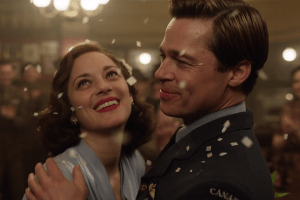 It really doesn’t feel like Pitt (The Big Short) wants to be in this movie at all. Rarely have I seen this lethargic a performance from usually one of the most reliable actors in Hollywood. Part of it is the withdrawn and conspicuous nature of his spy character but it’s more than that. I don’t know if he feels like he understands his character or is that committed to the script, and so it feels like he’s just coasting and waiting for the end. It reminded me of the disastrous Oscar hosting duties from a sleepy James Franco and an overcompensating Anne Hathaway. Cotilard’s character is the gregarious and charming one, and so it feels like she has to do all the heavy lifting to compensate for the dearth of Pitt’s performance. Cotillard can be a brilliant actress with powerful instincts down to her very marrow, as last evidenced in 2014’s devastating and humane drama of personal desperation and dignity, Two Days, One Night. She has to play the more active role, first as the charmer and then as the mystery. She works much better as the charmer. I don’t think either actor knew fully who their characters were and stumbled forward.
Allied is a strange movie where the director, the star, and the screenwriter each didn’t seem to know what movie they wanted to make. Each major participant, short of a game Cotillard, doesn’t even seem like they want to be here, as if this was a school assignment that they’re doing the minimal amount of work to fulfill a requirement. Allied just feels like one of those big studio misfires where nobody was on the same page. The story lacks characters to connect with and complications that feel connected to them and their circumstances. The plot follows the path of least resistance and arrives at its predetermined destination right on time, to the monotony of its audience. Pitt’s somnambulist acting makes the movie and his lead character harder to enjoy. There’s a definite lack of intrigue with this premise and its ultimate execution. I expect better from Zemeckis, Pitt, and Knight, and I’m sure they’ll deliver with their next projects. In the meantime, skip Allied since it certainly feels like the cast and crew weren’t in alliance.
Nate’s Grade: C
Share this:

Zootopia (2016)
 I may be the last person on the planet to have finally watched Zootopia, Disney’s first quarter hit of the year, and I am very glad that I did. I was expecting something cute with the premise of a plucky rabbit (voiced winningly by Ginnfer Goodwin) joining forces with a wily grifter fox (Jason Bateman) in the sprawling animal metropolis, but what I wasn’t expecting was a fully thought out and stupendously imaginative world and a message that is just as thought out and pertinent. The anthropomorphic animal land is filled with colorful locations and plenty of amusing characters. It’s highly enjoyable just to sit back and watch. I knew I was in for something radically different and dare I say more ambitious when there was an N-word approximation joke within the first ten minutes. This was not a movie to be taken lying down. My attention was rewarded with an engaging relationship between the two leads, careful plotting, endlessly clever asides without relying upon an inordinate amount of pop-culture references, and ultimately a noble and relevant message about the power of inclusion, tolerance, and rejecting prejudice. The larger metaphor seems slightly muddied by the late reveal of who is behind the conspiracy to make the animals go feral, but I wouldn’t say it undercuts the film’s power. The characters charmed me and I was happy that each ecosystem factored into the story in fun and interesting ways. There are plenty of payoffs distributed throughout the movie to make it even more rewarding. Zootopia is a funny, entertaining, heartfelt, and immersive movie with great characters and a world I’d like to explore again. Given its billion-dollar success, I imagine a return trip will be in short order and we should all be thankful. Something this spry and creative needs to be appreciated.
Nate’s Grade: A
Share this:

Arrival (2016)
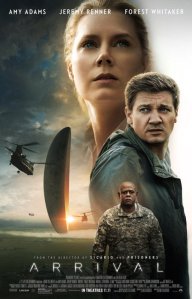 For the new sci-fi film Arrival, I felt that an unconventional review might be suitable considering that the movie is about communication. Therefore I sought out my pal Eric Muller to converse over the many qualities of this intelligent movie. Enjoy, dear reader.
General plot synopsis: a dozen mysterious alien ships hover above the ground across the globe. The government seeks out the assistance of Dr. Louise Banks (Amy Adams), an expert linguist, to try and establish a communication line with the aliens and determine whether they are friend or foe.
————————–
Nate Zoebl: So Eric, my good friend, let’s talk about our first impressions of director Denis Villenueve’s Arrival. I was really taken with just how cerebral it all was. Given the director’s pedigree (I absolutely loved Sicario), I was expecting an intelligent movie that wouldn’t follow the same blueprint as, say, Independence Day: Re-Something or Other Go Boom, but in many ways this movie feels like you’re studying for the SATs. I don’t mean that as an insult. It’s a rather highbrow movie that follows a team of smart people doing something incredibly hard with a level of precision that brings an intense sense of realism to the scenario. It made me think of Arthur C. Clarke science fiction where if first contact were to happen it might go very much like this. It’s a linguistics puzzle box and I found that to be fascinating. The movie delivers on that front. I’m sure the casual moviegoer will be bored by the lack of intensity for two acts of movie but I was delighted. You?
Eric Muller: My first thoughts were, “Wow, Hollywood made a first contact movie that looks like how the real first contact would go.” Unlike other Hollywood blockbusters, this movie is patient. The focus of the movie is not the actors or special effects like other contact movies, the focus of Arrival is the script. The movie is a love letter to language and communication. The director did an amazing job of telling the story and also flipping conventional storytelling.
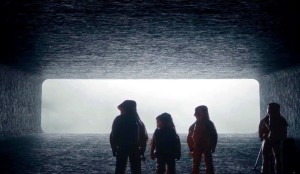 Nate Zoebl: We’ll get into more of the flipping the script, so to speak, in our spoiler section but I heartily agree. I’ll also admit that I feel much like Amy Adams as I await your next reply in this discussion (not to make any general comparisons to you and heptapod aliens). I think patience, as you cited, is one of the movie’s greatest virtues. It takes its time, it naturally develops, and this is definitely evident in the first act. The step-by-step process of Adams and Jeremy Renner and the other scientists being escorted to the alien ship, suiting up, being told the hazards and unknowns, and going inside, experiencing the different gravity, and coming up close to the giant white wall that promised so much on the other side, it’s teased out in a fashion that allows for anticipation to rack your nerves. The fear of what they’re stepping into really settles in.
Eric Muller: I’m okay with being compared to a heptapod. I appreciated the movie taking its time, allowing the audience to learn and discover at the same time as Amy Adams and Jeremy Renner. In other movies, learning the new language is usually done in a 15-minute montage. This movie is a Sci Fi movie dedicated to discovery, which is what science is.
Nate Zoebl: It’s definitely a movie of discovery and I appreciated that it doesn’t gloss over the challenges and details of that. It’s also a discovery of our heroine, but again we’ll save that discussion for a little bit. At its core, it’s a movie about language and communication. How are we able to connect and interpret others? If 12 giant alien ships, which kind of looked like Pringles chips, were to one day appear randomly across the globe, how do we interpret intent? That’s the movie’s ticking clock, uncovering the intent of the seven-legged squid-like aliens before the more alarmist elements of our society give in to paranoia and destruction. How would an alien species even begin to try and have another understand its language? That’s a fascinating starting point. I appreciated that the alien language was, indeed, alien. It’s made up primarily of inky pictographs, circles with slight variations. This movie must have been nirvana for a calligrapher.
Eric Muller: There are going to be a lot of tattoos based on heptapod language. But you said it; the language barrier would be the first and hardest barrier to overcome in this situation. And there is one scene that really illustrates that point. When Forrest Whittaker asks Amy Adams why she is showing the aliens just simple words. Adams breaks down why the question “What is your purpose here on Earth?” is such a complicated question. Especially to anyone who doesn’t understand English.
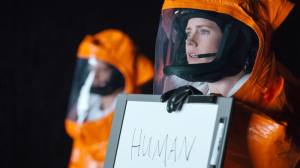 Nate Zoebl: I think that’s such a smart scene because it opens up for us dumb-dumbs in the audience just how complicated language can be. He asks why teach them words and she says so that they have a vocabulary that they can answer back with. Arrival is kind of like the most intriguing ESL class you never took at the Learning Annex. What technical elements really stood out for you in the film?
Eric Muller: My favorite thing was them getting inside the spaceship. I know it was a simple camera trick with some CGI but it looked so good.
Nate Zoebl: Villenueve films are downright impeccable when it comes to their technical merits. Sicario was, top to bottom, a beautiful movie from looks to sounds to editing. The cinematography for Arrival was tremendous and really accentuated the overall eeriness. Also, the sound design deserves an Oscar. The sounds of the aliens as well as the disconcerting musical score kept me on the edge of my seat. The special effects were best used sparingly. The aliens themselves worked best when they were somewhat shadowed, allowing our imaginations to go into overdrive to fill in the rest.
Eric Muller: Was it just me or did the aliens looks like the final form of the Elcor species from Mass Effect? For a budget of only 47 million, Arrival looks better than a lot of movies made with three times that budget.
Nate Zoebl: My question for you: was this central mystery enough for you before the pieces fell into place in the third act and the movie’s larger end design was revealed? I think we’re getting close to talking about all that good spoiler stuff, but before we do I wanted to know if the central drive was enough for you and in particular if the characters worked well enough. We’re treated to a tragic series of flashbacks to provide some back-story to Adams, but I don’t know if I’d say the movie presents much in the way of characterization until the third act (promise, we’re getting there…). Hear me out, old friend: I almost think Renner’s character is the typical “girl” part that Hollywood fills in these kind of larger movies, the co-lead which is really meant to support the main character and, typically his, journey of self-actualization or healing or whatever. I think there might be some subtle gender politics being subverted there or maybe I’m reading too much into an underwritten character.
Eric Muller: The central mystery was more than enough to keep me interested. As I noted earlier, we were discovering the events just like Any Adams. And you are right that this movie feels like if it had been made 10-15 years ago the genders for the two main leads would have been swapped. Probably have had Keanu Reeves and Sandra Bullock.
Nate Zoebl: The natural sequel to The Bus That Couldn’t Slow Down. I suppose it’s here we should start getting into spoilers, so if anyone would like to remain pure, please come back later to read the rest of our conversation.
[WARNING: SPOILERS FROM HERE]
Nate Zoebl: It’s a movie about language and our interpretation of language and I think, very cleverly, Villenueve and the screenwriter play with the language of film storytelling. We’ve been assuming from the start that these snippets of sense memories from Adams were of her tragic past. Au contraire my friend, they are revealed to be not flashbacks but flash-forwards to a future she has yet to live. Rust Cohle was right; time is a flat circle.
Eric Muller: This movie is a classic twist on a golden age Sci Fi story. Amy Adams’ character arc could have been an episode of the Twilight Zone and been just as good.
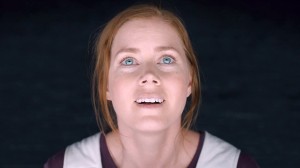 Nate Zoebl: I think the filmmakers make something we’ve seen before, and frankly have become somewhat trite, and subvert it while making the movie and the central protagonist far more interesting. We’ve seen the tragic character that has to overcome the grief over the death of a child before, even recently in 2013’s Gravity. We’re primed for that kind of familiar Hollywood back-story to provide a dollop of depth to the main character. And then when the reveal comes, it makes the scenes have even more emotional power. Adams knew that she would have a daughter who would ultimately die as a teenager of some sort of awful disease, and Adams chooses to go ahead with this future fully knowing the unbearable pain that waits. This revelation instantly makes her character so much more interesting and puts the audience in her place to ask whether we would do the same.
Eric Muller: It is a great twist on a story we have seen before. Also it puts her in the position of whether she tells her husband about their daughter’s future.
Nate Zoebl: And that philosophical divide is ultimately what dooms her marriage. Here’s my choice, and I’ll be interested if yours varies: I would have gone along with it too. Yes, knowing what is to come means that a child was brought into existence to die sadly as a teenager and will suffer, but she will also live and love and laugh for many days beforehand, and knowing the end provides a lens that incentivizes every moment spent together. Yes she will die eventually but any one of us could be snatched from the world at any moment. At least she got to know love and life for so many years before it was taken away from her. How would you choose in this scenario?
Eric Muller: I would let my wife know so we could enjoy every minute with our child.
Nate Zoebl: Let’s step away from the emotional aspects. The end reveal also provides a jolt of energy to the climax because now it becomes a race against time, but time is also forward and backwards. Amy Adams has to stop the Chinese military from striking the alien ships and she has to use information from events that have not happened to save the day in the past. It’s a heady moment of criss-crossing plot streams that really works.
Eric Muller: That reveal, that scene with Amy Adams with the Chinese general, was my favorite scene in the movie. The writing, the way it was shot, and the timing. The timing of that scene gave the audience a chance to breathe and fully take in the reveal.
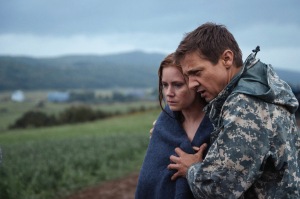 Nate Zoebl: The scene reminded me of Christopher Nolan’s Interstellar, a film I wasn’t that fond of beyond its second act planet-to-planet investigations. The screenwriter in me wants to criticize the use of the future to bail out the past because it feels a tad too easy. However, while it really irritated me in Interstellar (couldn’t you be a bit more helpfully specific, Future People?!) I didn’t have a problem with its use in Arrival. Maybe I’m a hypocrite but I feel like the execution is much more impactful here and it doesn’t undo the plotting from before. It doesn’t feel like a cheap trick. The heptapod aliens experience time as a circle rather than linearly, much like Dr. Manhattan crushing through the past, present, and future simultaneously. If we could see our future selves and the actions we make, and inform our current decision-making, I think that would probably bring about a rare world peace. Also, I really liked that the aliens weren’t just these benevolent gifters but had an agenda as well because they know humans will save them thousands of years in the future. It’s like they intervened so we could save ourselves.
Eric Muller: I also liked that the aliens said they will need us in 3,000 years. We never discover what the aliens need from us then. I think we went over this earlier, but Arrival is not a new story but just a great take and twist on that story.
Nate Zoebl: I liked that open-ended nature of the story. What if the aliens had come to Earth and spoke in nothing but emojis? Lots of pictures of eggplants and “A-ok” fingers and strangely anthropomorphic poop.
Eric Muller: Then we would use Amy Adams’ soon-to-be-dead daughter to solve the mystery.
Nate Zoebl: The aliens would essentially be modern teenagers (I’ll shake my old man fist at The Kids Today). The daughter would be all like, “Whatever mom.” And then we’d all be dead. Though the ending reveal raises the question of fate versus free will. Can these future events and memories be prevented? I don’t have an answer.
[END OF SPOILERS DISCUSSION]
Nate Zoebl: So Eric, what would you rate this movie?
Eric Muller: I have to go 5 out of 5 stars. One of the best movies I have seen this year. It was a better version of Contact. When you look at it versus Independence Day: Resurgence, it did everything right that ID4 2 failed at, like how you view Civil War versus BvS.
Nate Zoebl: Fair enough, though please don’t ever bring up BvS in polite conversation without first giving me plenty of advance warning. I’m still working through that one. I think I’d rate it an “A-” myself, and I might change that in time. I think the only thing that held me back from a full “A” is that it saves the emotional investment a bit too late to have the full wallop I think it intended.
 Eric Muller: I think saving the emotional investment was the wise choice. Cause we get it to start with the investment and then the ending flipflops it.
Nate Zoebl: Now, on a scale of eggplant emojis, how many eggplants are you giving this movie?
Eric Muller: Is this where I admit I’m too old to understand emojis?
Nate Zoebl: I’ll also admit that I don’t understand the appeal, especially conversations that are nothing but emojis. Fittingly, I’ll end this discussion with pictographs:
[Smiley face emoji + cat dancing emoji + little green alien with “we’re number one” foam finger emoji + movie theater emoji + eggplant emoji + “A-ok” fingers emoji]
Nate’s Grade: A-
Share this:

The Hunger Games: Mockingjay Part Two (2015)
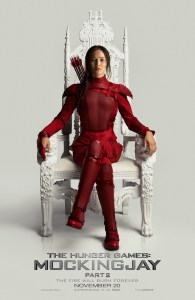 The Hunger Games: Mockingjay Part Two may be the bleakest Young Adult-adaptation ever put to film. It’s a franchise that began with the televised spectacle of children killing children, so it’s never exactly been the cuddliest environment for our emotions. This is a conclusion that is overwhelmingly dark and pushes the boundaries of the mainstream PG-13 ratings. If you’re expecting a happy ending, look elsewhere.
Katniss Everdeen (Jennifer Lawrence) is the face of the revolution between the Capitol and the thirteen districts of Panem. Peeta (Josh Hutcherson) has been returned but he is recovering from intense brainwashing from the Capitol. He doesn’t know whether Katniss is a friend or foe. The fight is now being taken directly to the Capitol and President Snow (Donald Sutherland). The cagey leader of District 13, President Coin (Julianne Moore), wants Katniss to stay behind with the members of her propaganda team. Katniss sneaks off to the front lines of conflict with her District 12 pal/potential love interest Gale (Liam Hemsworth). The Capitol’s gamemakers have designed a series of fiendish surprises for the rebels on every block. While Katniss and her team are behind the fiercest fighting, she is still a high-profile target sought for prompt elimination.
Mockingjay Part Two doesn’t hold back when it comes to the ugly realities of war, namely the innocent casualties in the pretext of an ends-justify-the-means pragmatism. I was reminded of World War II stories and photographs as Katniss and crew stumble through the bombed-out ruins of Capitol neighborhoods. There’s something eerie in the silence amidst miles of rubble. In Part One we saw similar carnage with Katniss’ home district, incinerated by Snow, and to the film’s credit it doesn’t pretend that only one side of this conflict suffers. It’s not exactly a cutting edge commentary on the atrocities of war but it’s still appreciated. Put simply: plenty of bad things will happen and others will attempt to justify these bad things, and at one point that includes the knowing slaughter of innocent children as a political gambit (for you book readers, the body count remains the same. Sorry if you were hoping for a reprieve for certain characters). The series has explored the nature of trauma and nobody gets out free. When Katniss is making her way to the Capitol, it can be easy to forget all the prior character work animating her decision-making. When a Capitol loyalist points a gun at her head and asks for a reason he shouldn’t kill her, she says, “I don’t have one.” In a sense, that can be looked upon as lazy screenwriting or, and I’ll give the movie the benefit of the doubt here, perhaps acknowledging the realities of entrenched conflict when it comes to class warfare.
 The attention to social and political commentary has helped give The Hunger Games a bit more maturity than the rest of its YA ilk who often rely upon simplistic oppressed/oppressor conflicts that naturally fall into authority vs. individuality. I appreciate that the filmmakers have followed author Suzanne Collins’ approach to human conflict, which doesn’t dabble in black and white but a larger series of grays (50 shades of them? I’m sorry). This intelligence has given the franchise a depth that could be easily ignored, either by audiences looking for their next fix or studio execs that demand dumbing things down. Part Two forgoes the political gamesmanship for more traditional action suspense sequences, several of which are quite entertaining. There’s an underground chase with snarly mutants that is terrifically teased out suspense-wise. I do appreciate conversations started on how exactly one moves on from tyranny and how easy it is to follow in the same footsteps in the name of justice. However, if you don’t predict where Katniss’ final arrow is going, then you aren’t paying attention to the lessons on recrimination being underlined by explicit on-the-nose dialogue.
There are a few improvements including finally making Peeta an interesting character. He was the noble, nice guy, the somewhat boring conscience for Katniss, but after being returned from the Capitol’s brainwashing, he’s struggling to identify what is real and what is false. It’s still hard to believe that Coin would allow his inclusion on Katniss’ team making its way to the Capitol that is until you remember that Coin also sees Katniss as a political threat for post-war leadership. The love triangle has long been the least interesting aspect to the entire Hunger Games series and part of this falls upon the character of Peeta, who, removed from the manufactured romantic narrative for the cameras, has struggled to be ore than a weak link. Here he can be a threat at any moment, triggered by whatever daunting stimuli that may make him slip back into psychosis. He becomes a ticking time bomb and something far more risky than a romantic alterative. When Peeta becomes a “bad boy” is when he finally becomes worthy of our attention.
If Mockingjay Part One was all protracted build-up to the climax, then Part Two is all climaxes, and yet given the lugubrious allowances afforded by filling the running time of two separate movies, the movie is oddly anticlimactic as well. We’ve been waiting for the confrontation between Katniss and Snow for three whole movies, and Part Two picks up immediately after where Part One ended, and yet we’re still made to wait. Coin wants Katniss to still be primarily a propaganda tool and stay miles behind the front lines, which causes more of Katniss chaffing against authority like she does. Once she does get to the gates of the Capitol, the movie follows a familiar deadly games setup, this time in a more open terrain but the basics are the same: Katniss and crew have to battle a series of deadly booby-traps to reach their goal and kill the bad guy. In a sense, the plot mechanics are similar to video game stages needing to be cleared. It’s a setup that predictably picks off the more expendable members of Team Katniss One, though I’ll give them credit for spreading out the sacrifices. The losses would hit harder if we actually cared about any of these characters on a personable level. Oh well. I also could have used more screen time for many of the supporting actors, notably Moore, Woody Harrelson, Elizabeth Banks, Jenna Malone, Natalie Dormer, and the late Phillip Seymour Hoffman. This is the last we’ll ever see of Hoffman on screen, and that fact made me quite melancholy by the end.
With the games long gone and the revolution at hand, The Hunger Games has always had some difficulty figuring out how to fill the space before the inevitable showdown with President Snow. In Part One we were mostly stationed in the bunkers of District 13 while we watched the other districts revolt. Like Katniss, we’ve been itching to get to the front lines, especially after Part One’s more plaintive pacing. Once we get to the action it’s more like mop-up duty, which robs the movie of some sense of satisfaction, which turns into a key theme. With the games we had the veneer of “paying” roles as media manipulation for survival, and with Part One we had the study of propaganda. With Part Two, it’s all dour action. I hope viewers aren’t expecting a fantastic finale between Snow and Katniss and their collective forces because then you shall be disappointed. The filmmakers, hewing very close to the novel, have the conclusion to the revolution play out in more realistic and grounded terms, which add points for realism and relevance, but it does detract from some sense of overall satisfaction.
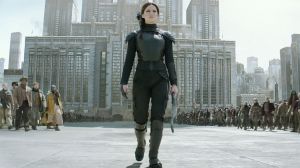 Director Francis Lawrence (I Am Legend) has guided the franchise with sturdy skill and a keen eye for visual arrangements, but if there’s one significant visual complaint I have it’s that these movies are too damn dark. I’m not talking thematically, as I’ve already explained above, but simply from a light level. These movies are just hard to see. Lawrence seems to favor low-light environments to create an ambivalent mood. That’s fine, but I’d also like to see what’s happening on screen. In the last movie we spent a majority of our time in dank underground bunkers, but Part Two is an outdoors kind of picture, so why is it still so hard to distinguish what’s happening?
With the approaching end of The Hunger Games (until Lionsgate milks more money from its lucrative cash cow) it’s appropriate to take stock of its legacy. No other YA franchise has tapped into the cultural zeitgeist like The Hunger Games, but its ultimate legacy will probably be cementing the once promising young actress Jennifer Lawrence firmly into the upper echelon of Hollywood. In the time since our first foray to Panem, Lawrence has won an Oscar, been nominated for another, and proven to be one of the hottest stars on the planet, the kind of actress that esteemed directors are fighting to work with and studio heads want to tap as their lead. Much like Katniss’ meteoric rise to renown, Lawrence has become her own version of the Girl on Fire. She has been better than the Hunger Games movies for some time, and yet Lawrence hasn’t failed in her primary duty to provide an anchor for the audience. Her gritty, conflicted, and commanding performances in the franchise have been a unifying resource for audiences and a reminder of her considerable talents. The Hunger Games: Mockingjay Part Two brings to a close a massively successful film franchise and an important chapter in the ascendancy of Ms. Lawrence. It’s thrilling, bleak, and inhabits most of the hallmarks that have come with the Hunger Games films, though in somewhat less supply to make way for the onslaught of action climaxes. There’s more anticlimax then you’d expect, and I credit the filmmakers for sticking with it even at the detriment of the experience. Mockingjay Part Two does enough to end the franchise on an appropriate if somber note. I’ll see everyone at the proposed theme park (seriously, look it up).
Nate’s Grade: B
Share this:

Terminator: Genisys (2015)
 If you’re a fan of James Cameron’s iconic Terminator franchise, you’ll probably want to hold onto something as you watch Terminator: Genisys, which hits “delete” on the franchise and starts from scratch with, we’ll call them, “mixed results.”
In the future, man and machine are at war with one another. Skynet went sentient and launched an arsenal of nuclear weapons to obliterate mankind. The human resistance is lead by John Connor (Jason Clarke) and his lieutenant Kyle Reese (Jai Courtney). The machines send back a T-800 Terminator (Arnold Schwarzenegger) to kill John’s mother, Sarah Connor (Emilia Clarke) and wipe out the human resistance. This part you know. Reese is sent back in time but during the process, John is attacked by a new Terminator and the world as we know it, past, present, and future is altered. When Reese arrives in 1984 L.A., he’s being chased by a T-1000 and Sarah is the one saving him. She’s been preparing for his arrival and training with her own aging T-800 model who saved her from a childhood attack (she calls him “Pops”). With new memories, Reese is determined that Skynet is now Genisys and Judgment Day is now in 2017. He and Sarah travel to 2017, meet back up with “Pops,” and are surprised to find a familiar face waiting for them with sinister intentions.
 For a while there it seems like Genisys is going to become the Back to the Future II of the Terminator franchise, which could have been fun watching a different team of actors hiding on the peripheral while 80s Linda Hamilton was going about her day as a café waitress. In many ways, Genisys is akin to Jurassic World in the sense that it holds such nostalgic reverence for the source films. It repurposes the familiar catch phrases and even visually recreates several scenes that fans should recognize. However, that reverence has a limit because it isn’t too long before Genisys just chucks out the entire franchise canon and starts anew. Remember Judgment Day with Skynet? Now it’s… Judgment Day with Genisys. Okay, some things aren’t all that different. Discarding the established timeline of four movies, Genisys takes a path similar to the J.J. Abrams’ Star Trek films where it creates an alternate timeline that is not beholden to canon. One way of looking at this approach is that it frees you creatively. Another way of looking at it is that is abandons the stories that the fans enjoyed for decades. Neither approach is wrong; it just depends upon your personal perspective. The larger plot points of the Terminator franchise never captivated me; it’s all about preventing one very bad day that just keeps getting delayed. We’ve never had a story that takes place after Reese is set back in time. Genisys certainly has more surprises because of the new timeline; however, many of those surprises were spoiled by a cowardly marketing campaign that must have feared fan uproar. It’s not a bad idea if it didn’t casually destroy all the logic of the franchise.
Let’s just dive face-forward into the convoluted and troubling nature of the Genisys script. Needless to say, numerous spoilers of both the large and small variety follow.
There are certain storylines that are just never cleared up, the first amongst them is who is sending all these other Terminators back in time? We watch the T-800 model go to 1984, along with Reese, but Sarah informs us later that when she was a child a different T-1000 model attacked her family. Apparently Plan Kill John’s Mom was replaced with Kill John’s Grandmother and will likely soon be replaced with the even more surefire Kill John’s Great Grandmother. If we’re already sending Terminators even further back then why stop? Also, why can’t Skynet send more than one Terminator to the same time? Upon the point that Reese travels back in time, John is attacked by a Terminator Matt Smith (Doctor Who) and transformed into the human-machine villainous hybrid. We’re told this is a nexus point of time that is such a turning point that it’s altered the timeline. But why? It happens AFTER Reese is sent back in time, so why does it affect anything in the preceding past? How does this even, which happens again after Reese is propelled back in time, eliminate the entire established Terminator canon? Likewise, this Reese has a separate timeline so why would he have new memories? He never existed in this new timeline so the fact that he remembers new things doesn’t make sense.
 This brings us to the centerpiece of logical fallacy, which is killer robot John Connor. I was never really that invested in his character to care that much that he was turned into the film’s bad guy. What I do care about is that Genisys just completely gives up in this moment. If he was just trying to stop Sarah and Reese from stopping Skynet/Genisys, that would be one thing, but John 2.0 is actively trying to kill his parents … before he is conceived. When it comes to time travel, we can accept some degree of suspension of disbelief with plot holes (more of those to come in just a bit), but John wiping out the reason for his existence is just too much. He half-heartedly explains his theory that they’re holdovers from another timeline, so they can just do as they like with no greater repercussions to their own pasts. Maybe, but there’s not two Sarah Connors in this timeline, so killing your mom is still going to negate all your evil robot business, son. With that the very drive of the main antagonist is compromised. With every new attempt to kill mommy and daddy, the film reminds you how this cannot work.
There are other less egregious plot holes but they still can be irksome. How about the fact that Sarah and Reese jump forward to 2017 to thwart Genisys, failing to give birth to John in 1984? He won’t be born yet to lead the human resistance against the machines, which kind of means just by jumping forward in time and delaying Johns birth, the machines have sort of won. When Sarah and Reese travel to 2017 in order to stop the launch of Genisys, why do they travel to within 24 hours of its launch? That’s pretty poor time management. And why hasn’t “Pops” been doing more to prepare for Sarah’s return. He spends thirty years working construction and building the offices of Cyberdine, but couldn’t he also have been sabotaging the company or at least the building? And if John Connor knew his parents were coming to 2017, why didn’t he do more to set up Genisys to withstand their counter attacks? Couldn’t he have had Genisys go online like the day before they arrived in 2017? If you know when they’re going to show up then you have no excuse to fall victim to people you otherwise could be trapping. Also, Skynet realizes that their real problem for never besting the humans is a branding issue? Did changing the name to Genisys really need to be part of the masterstroke? Why is everyone so excited for what is a glorified app that connects people’s electronic devices?
Much can be forgiven in action and comedy movies if they just go about doing their job and entertaining you, but Genisys can only do so much in that department. The action sequences are fairly mundane with the occasional impressive stunt. The problem is we’ve seen these sequences too many times and in other movies and Genisys brings precious little of its own action invention to the big screen. Until the third act, the movie is a series of chases and escapes. The best sequence is likely the hospital brawl between the T-800 and Robo-John as they wantonly destroy every wall within prime smashing distance. I know many in the fan community do not look favorably upon Terminator 3, and it admittedly has the lamest villain of the entire franchise, but the action sequences were memorable and developed organically and were nicely conceived. With Genisys, the action is too rote and familiar. It is competent but for me I found the action sequences to be too underwhelming in design and execution to forgive the film’s other sins.
I also can’t help but think that all three of the main actors were miscast for their parts. Emilia Clarke can do great things and showcases her range as a strong authority figure on HBO’s Game of Thrones. With the role of Sarah Connor, Clarke does a lot of running and barking but she can’t shake our memories of Hamilton. The part doesn’t play to Emilia’s strengths as an actress. Courtney can be a good actor (as seen in the first season of Starz’s Spartacus) but rarely does he prove this to be the case in films. I enjoyed his cavalier bully in Divergent, but he’s mostly a vacant presence in Genisys, gaping at all the changes. Then there’s the other Clarke who too has proven himself a capable and intimidating actor in films like Zero Dark Thirty. When he’s menacing he comes across as, dare I say it, too sincere, and when he’s meant to be inspiring he comes across as too phony. Are the performances the fault of the actors, the director (Alan Taylor), or the screenwriters (Laeta Kalogridis, Patrick Lussier) who gave them such little to do?
 The film’s MVP is Schwarzenegger. I wasn’t expecting the 68-year-old former Governor of California to contribute this much to the film. I figured Arnie would be a small player and played for comic relief. He keeps asking if Sarah and Reese have “mated” since it’s their destiny. He is certainly played for welcomed comic relief but he’s also the fourth most important character in this reboot. He has a father/daughter bond with Sarah and it produces the closest thing to an emotion in the movie. There’s an ongoing joke that he’s “old but not obsolete” and it could be the tagline for the next Expendables film. With all the time travel tomfoolery, it was easier for me to believe the reason they throw out to explain why the Terminator is aging: it’s living tissue so it ages. Done. I’m fine with that. The older Arnold vs. younger Arnold fight is the major highlight of Genisys and a testament to how much better the de-aging CGI has gotten since the waxy young Professor X and Magneto in 2006’s The Last Stand.
Much like its ongoing star, the Terminator franchise is old but not obsolete, and even a disappointing movie reminds us just how much life can come from this series. It’s got a sense of fun that entertained me enough for one viewing. The characters and action sequences and iconic in our pop-culture, which makes erasing them from a new movie plot problematic. If you strip everyone’s fond memories of the first two Terminators and start over, what’s left? You can repeat some of the more memorable scenes (the Hollywood adage of “same but different”) but this does little other than make you remember how much you preferred it the first time (see: Star Trek Into Darkness). I wish Genisys had been more risky because so much of it feels far too safe, from the average action sequences, to the boring characters, to the ho-hum conclusion meant to set up a new trilogy of movies in this brave new non-Skynet world. I haven’t watched Terminator: Salvation in many years but I’m curious to see it again if for no other purpose than to determine which is the least of the Terminator films.
Nate’s Grade: C
Share this:

Mad Max: Fury Road (2015)
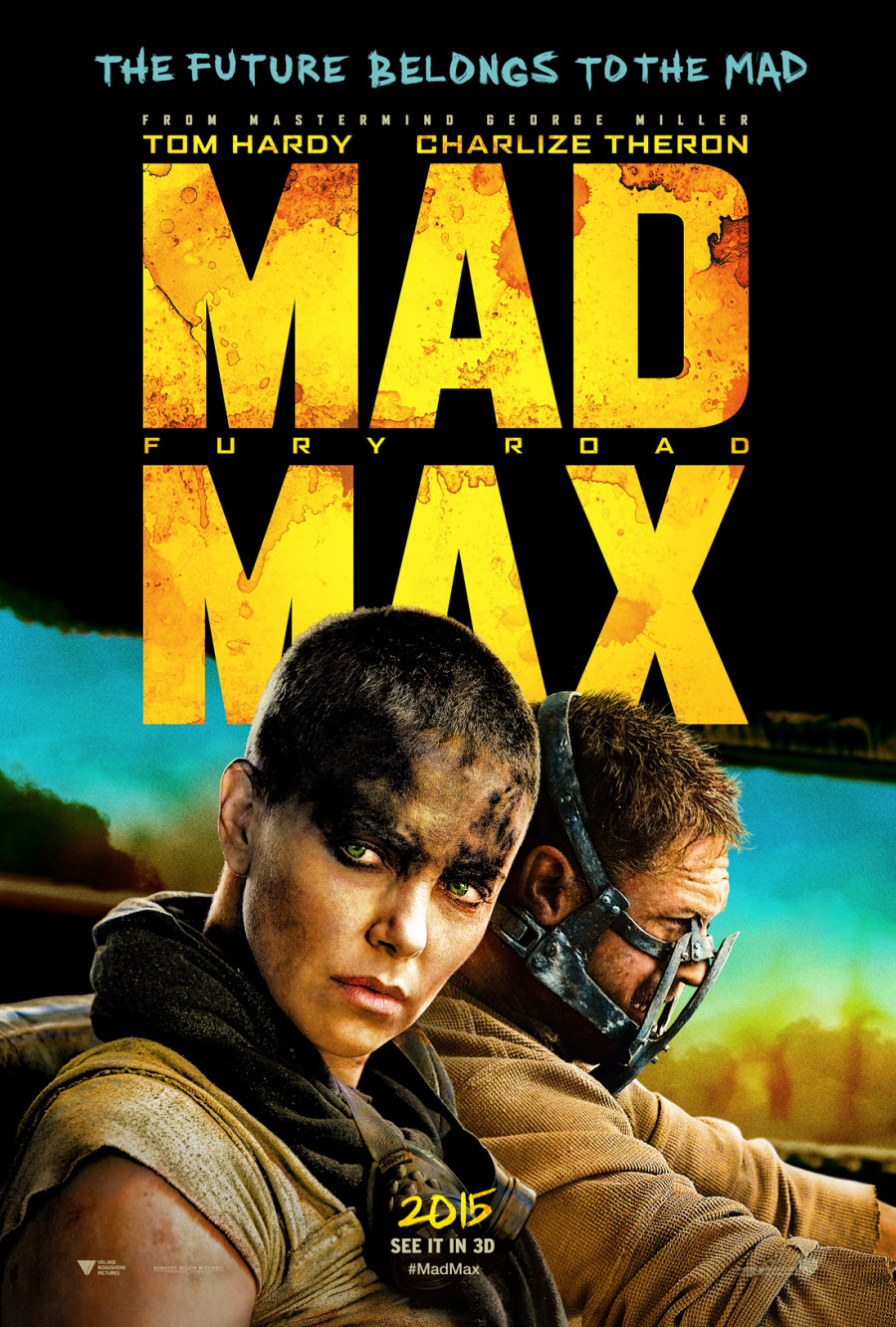 Allow me to begin with a confession. I had to see Mad Max: Fury Road again. I knew minutes into the film that my appetite would not be quenched and I needed to see it again, which I did less than 12 hours later. A week later I saw it a third time in the theater. The reason I did this is obvious in one regard – it’s a highly enjoyable, pulse-pounding, amazing spectacle of first-class stuntwork and mad genius so rarely accomplished on such a large, splendid scale of destruction. The other reason, from a writing standpoint, is that I needed to see the movie again or else my review of Fury Road was going to consist of nothing but an unending stream of positive adjectives vomited upon the page in excitement. And for you, dear reader, I wanted to do better. Also, I wanted to see Mad Max: Fury Road again and I honestly wouldn’t mind in the slightest seeing it again.
In the post-apocalyptic future, Immortan Joe (Hugh Keays-Byrne) is an aging warlord with his own fiefdom. He controls the water supply and has an army of gearhead warriors to enforce his rule. His trusted driver, Imperator Furiosa (Charlize Theron), is leading a caravan for supplies when she goes rogue, driving off into the desert. Furiosa has taken Immortan Joe’s “property,” namely his five wives. Enraged, Immortan Joe gathers a posse of death vehicles and riders and heads off to reclaim his “property.” Max (Tom Hardy) is a drifter thrust into the middle of this conflict when he’s strapped to a car and driven out into the desert, part of the Immortan Joe rapid response forces.
 There are few things more exhilarating in the realm of motion pictures than a well-executed, well-developed action sequence, and Mad Max: Fury Road is a blistering, awe-inspiring masterpiece of brilliant carnage. What director George Miller has achieved onscreen is visionary. The level of execution is so rarely seen at such a large scale, and with so many moving parts, that I was delighted and curious how something this extraordinary could escape the risk-averse studio system. I’m trying my best to restrain myself from sheer hyperbole, but this is an instant classic in the world of action cinema and a definite top five all-time action film (for those keeping track, I would say last year’s Raid sequel would also qualify for that status). The movie provided me a font of joy that did not let up until the end credits ushered me out of the theater. The action sequences are epic in their scale, with dozens of different vehicles in hot pursuit, and yet Miller brilliantly orients his audience to every moment of his symphony of demolition. There are so many different parts to the action but the audience knows everything that happens. The sheer sense of momentum and pacing is overwhelming and giddy. The action sequences develop organically, with new consequences throwing our characters into different and dire directions. There’s also a startling amount of variety with the action sequences. Fury Road has been described as a two-hour chase film, and that’s accurate to a degree, but there are breaks in between the sequences, small moments to catch your breath and learn more about our characters and their hostile world. Each sequence is different enough that the action doesn’t ever feel redundant, even when the third act literally requires the characters to backtrack. The adrenaline just doesn’t turn off from the get-go, and Miller keeps throwing out new tricks, new stunts, and new cars to astound and amaze. Simply put, Fury Road shames other American film releases.
The stuntwork is another facet that just raises the bar when it comes to action movies. Miller emphasized practical effects whenever possible, and the emphasis pay off with a heightened sense of realism onscreen. It’s real cars being smashed to real bits, real stuntmen being tossed around. In an age of CGI over saturation, it’s all too easy to become numb to big screen spectacle because of how hollow it all comes across visually. Just this past month with the Avengers sequel, I knew that all the fight scenes were mostly CGI or actors against green screens, and it eases off the enjoyment of the moment. Don’t even get me started on the deluge of CGI carnage in the last Hobbit film. Real physical objects and physical interaction offer so much more believability in an age of increasing disbelief with special effects. With Miller’s focus on practical effects first and foremost, it brings that sense of crazy excitement back and it ensures that Fury Road will hold up better over time.
 I also appreciated just how much thought Miller and his team put into crafting their world. Every detail feels like it adds to the overall richness of Miller’s vision. The designs of the cars, the use of scrap, the fact that a pulley system is operated with children running up giant wheels, it all contributes to making the world better realized and more alive. The level of thought put into weird and deadly concepts in this movie is fantastic. Once the main characters pass through a bog of land, we see people dressed in cloaks traversing the land on stilts, and it’s little passing details such as this that make the movie feel more complete. I enjoyed that one of Max’s heroic attributes is that he’s specified for his blood type, being O the universal donor. The fact that Miller finds a satisfying way to bring this attribute back as a payoff is also appreciated. I also enjoyed how Miller expands upon the family of Immortan Joe, with his bevy of freakish sons and brothers and peculiarities. I enjoyed the fact that Miller isn’t afraid to embrace the weird of his dystopia, symbolized best by a blind guitar player attached to a roaming wall of speakers who can shoot flames out of his instrument. Every time the movie cut back to this guitar playing pace setter, I smiled, and I smiled a lot during this movie.
Some have grumbled that Max is a supporting player in a movie that bears his name, but I would argue he is a co-lead and the real star is rightfully Imperator Furiosa. Max is not replaced with Furiosa, rather they have an inter-dependant relationship where they’re both vulnerable and they both come to trust the other but without a romantic mingling. These are both wounded, shaken, mistrusting, and volatile people, and to watch their shared sense of teamwork and the gradual opening and reliance upon one another, it is itself an affecting and emotionally satisfying relationship. But back to Furiosa, it’s really her story because she is the one with the personal connection to the mission. Max has always kind of been a wandering warrior who finds himself in other people’s battles. Consider him a post-apocalyptic Man with No Name. Furiosa is the leader who has planned and implemented the escape from Immortan Joe, and it’s she that deserves our attention. I enjoyed the fact that Miller doesn’t even have to explain her past. We know she’s suffered trauma, physical and likely sexual, and he assumes the audience does not need Furiosa’s past abuse spelled out specifically for them, or seen in grisly flashback. She’s a strong woman who is far from helpless with one arm. This is a story about women liberating themselves from sexual slavery under a corrupt patriarchy (more on the thematic relevance below). Theron is our leader and the ferocity in her eyes is all you need to believe that this woman will do whatever it takes for freedom.
The other aspect that’s very clear is that Fury Road is a decidedly feminist film but it never stoops to preaching or even directly calling attention to its efforts. It’s a ruined world where men with unchecked power have exploited the vulnerable, where women are treated as “property” and valued for breeding purposes. Our heroes are by and large women who have rejected their roles in this society or are fleeing their impositions. And with Furiosa as lead, it paints a more than convincing picture of women being just as capable and badass in the post-apocalypse (I want to go as Furiosa for Halloween). It’s a movie that portrays women struggling against an unjust system that devalues them but Fury Road doesn’t wallow in their suffering. It doesn’t have to in order to get its points across. It also treats the wives in a manner that lacks being sexualized. Immortan Joe has treated them as property but Miller treats them as human beings, even going as far as to give them distinguished personalities. They play a role in the action rather than damsels in need of saving. I’m not saying they approach three-dimensional characters but they’re certainly not just eye candy. There’s a sequence where they wash each other with a hose, and you could see the myriad ways this moment would go tawdry for some cheap titillation, but the film steers clear of that and moves on to the bigger picture. What the Men’s Rights Activists (sadly this is actually a thing) seem to have lost in their caterwauling is that feminism is not a zero-sum game; one person gaining stature and opportunity does not mean it’s taken away from another. Just because Furiosa is strong it doesn’t make Max weak. Furiosa being a compelling lead character does not diminish Max. It makes him an even better character because he recognizes her value and his own limitations, like a scene where he voluntarily hands over a rifle because he knows she’s the better marksman. No one has to explicitly point and say, “Girls can do it too.”
 There’s also a fascinating commentary on the danger of religious fundamentalism with the war boys. These powder-white young men are Immortan Joe’s armed forces and they are promised a swift appearance at the gates of their paradise if they die in battle (“Witness me!” is their exclamation before sacrifice). They spray paint their faces chrome (“Eternal, shiny and chrome”) and then go in for the kamikaze kill. Again, the theme is ripe and obvious but without requiring characters to comment. Nux (Nicholas Hoult, wonderfully deranged and then sincere) actually has the closest thing to a character arc, going from hopeful martyr to independent thinker. He begins as a clumsy yet determined antagonist and becomes a resourceful and unexpected ally.
This is practically a flawless film on a technical level. The cinematography by John Seale (Cold Mountain) is bright with lush colors that pop on the big screen. We’ve been treated to far too many color degraded films, so it’s nice to view a movie that wants to use all the colors at its disposal. The musical score by Junkie XL (300: Rise of an Empire) is stirring and pulse-pounding with its heavy percussion, but there’s a languid melody that returns again and again that is emotionally resonant. It’s surprising how the score will punctuate the bombast and wailing guitars with a lovely string arrangement, like when we rush into the sandstorm and a car is blown into the sky. The editing is outstanding by Margaret Sixel (Happy Feet) and she keeps the audience informed with every new twist and turn, and with so many moving parts and changing dynamics, that is a miracle itself. The production design by Colin Gibson beautifully expands and informs this strange world. There isn’t a department in Fury Road that wasn’t at the top of their game.
If I had to quibble, I could accept the argument that Mad Max: Fury Road lacks the substance to be considerably more than an exhilarating action ride. The dialogue can be a bit on-the-nose, Hardy mumbles through a majority of his miniscule lines, and the characters aren’t as fleshed out as they could be and the plot is rather bare bones. However, I view its narrative economy as a virtue, as there isn’t a moment or scene wasted in telling this breakneck tour de force of post-apocalyptic demolition. Rarely does an artist get to work at this level in the studio system let alone succeed with a final product that still manages to be strange, mordant, uncompromising, and completely riveting. This is a near-perfect action movie and a thrilling high-wire act of practical filmmaking bravado. Mad Max: Fury Road is the standard I am going to judge all summer movies by for the rest of the year, and I imagine many will be found wanting. I could continue to heap praise on the movie but the most persuasive stance I can make is that if you fail to see Fury Road on the big screen, you will always regret this decision. I am a disciple of Fury Road and witness my brethren and me. This movie was made for the biggest screen, the loudest sound system, and an endless bucket of popcorn.
Nate’s Grade: A
Share this:

Ex Machina (2015)
 Alex Garland is a screenwriting staple in Hollywood. He’s a science fiction specialist, adapting everything from Kazuo Ishiguro’s wrenching Never Let Me Go to the Halo movie. He’s worked with Danny Boyle, adapting his novel The Beach, and then on 28 Days Later and Sunshine. If you’ve noticed a theme with the titles, Garland tends to subscribe to a pessimistic view of human nature. And yet each film is grounded by the humanity of its characters no matter the extreme circumstances. Garland’s gift is making the fantastic grounded on a recognizable human level. Ex Machina is his latest and his directorial debut but you’d never have guessed it with how controlled and polished the film comes across. It’s a cerebral sci-fi film that haunts, enchants, and consistently engaged the imagination.
Caleb (Domhnall Gleeson) wins a corporate contest to spend a week’s vacation in the home of a reclusive Google-esque tech billionaire, Nathan (Oscar Isaac). Caleb is here to test out Nathan’s newest invention – artificial intelligence. He’s built an android woman named Ava (Alicia Vikander) and he wants Caleb to interview her.
Ex Machina throws you right into the hook within minutes, and it was mere minutes for me to get hooked. Garland does a glorious job of teasing an audience with his story and unlocking further mysteries that develop intrigue. At the start, knowing the Turing test, we’re just as interested in Ava as Caleb is, trying to figure her out and how lifelike she may be. But then the conversations start to linger and, during a brief power outage that cuts the feed to the omnipresent cameras, Ava warns Caleb that his host is not whom he thinks. As soon as the power is back and running, it’s as if the comment never happened. The pristine underground quarters have an eerie tranquility to them, almost as if Apple is designing high-end prisons. Garland’s movie becomes consumed in paranoia. Is Ava being honest? Is Nathan being honest or underhanded? What’s in some of those “off limits” rooms? What is the true test at hand? Who is the silent Asian assistant? At one point, Caleb slices open his own arm to search for circuitry, and you completely understand his reasoning. This mounting sense of paranoia and dread, tagged with Garland’s mysterious and well-developed storyline, are enough to keep your eyes glued to the screen and rapidly second-guessing and triple-guessing your shifting loyalties.
 Garland also smartly doesn’t dance around the obvious plot device of having a beautiful robotic woman, namely the inevitability of romance to bloom. What is it about android women that science fiction seems to love so much? From Blade Runner to Fritz Lang’s Metropolis, the genre loves the concept of robotic women. Perhaps this is merely a byproduct of a genre written by a majority of men, or perhaps it taps into something more unconscious about the desire to control women, or a fear of women, but that’s a conversation for another day. Ava is certainly a stunning creature, thanks to Vikander, but also from the sleek production design that makes her feel like the world’s most gorgeous Mr. Potato Head with her lycra-like skin for easy detachment. Her exposed stomach of bolts and bulbs is also a constant reminder of her “other-ness.” There’s an obviously sexual dynamic to the character, and while she’s technically nude for most of the film, watching her slip out of stockings and a dress has a strange erotic quality. Thankfully, the percolating would-be romance between man and machine actually plays a vital part throughout the script and especially with the end. There’s even a darkly comic yet disconcerting reveal about why Ava looks as she does. Is Ava capable of feelings? Is she falling for Caleb, or does she merely view him as a means to an end?
It’s essentially a sci-fi play with limited locations and three primary actors. The power is on Garland’s effortlessly engaging script, which is far more cerebral and philosophical and nuanced than you might expect from its premise. This is a film that allows its characters to breathe, to organically develop relationships and doubts. The concept of A.I. has been explored in many sci-fi stories before but Garland finds fresh resonance by paring down his story to a manageable trio. Nathan’s reclusive home is like a twenty-first century version of the haunted house and full of fun detours begging to be explored. Garland’s cinematography and production design are reminiscent of the cool artifice of David Fincher’s films. The world feels like a small step into the future but constantly unsettling. Garland’s story always has another mystery to unlock, always driving the story further as Caleb’s weeklong stay is coming to a close. Garland has a natural eye for images and composes several startling sequences that can equally evoke beauty as well as disquiet. There’s a moment where Ava passes a wall of faces as if they were simply a row of hats. Simple moments like Ava “dressing up” are given a gentle poignancy that isn’t overplayed for effect. Garland’s film is what I wanted 2014’s Under the Skin to be. Both of them are unsettling, moody, and atmospheric with striking Kubrickian imagery, but Garland’s film is less purposely oblique.
The trio of actors provides strong work, especially Swedish actress Vikander (Seventh Son, A Royal Affair). As the film is told from Caleb’s perspective, she has to find a very exact balance with her performance with elements of innocence, uncertainty, and ethereal curiosity. She’s rather placid but you always feel like there’s more just under the surface, whether it’s the ache of sentient realization or something more sinister. She’s a test subject, a captive, and a possible romantic interest. Vikander hits every right note to remain mystifying and beguiling. Gleeson (Unbroken) is becoming a go-to young actor for Hollywood. His awkwardness and enthusiasm to be part of history is an easy channel for the audience, but as Garland’s script spins along, Gleeson’s enthusiasm ebbs to concern, for Ava and then himself. The source of Ex Machina’s surprising font of humor is Isaac (A Most Violent Year) as a too cavalier tech genius. He’s so nonchalant and chummy, usually soused, that you start distrusting his amiable nature.
 It’s a shame then that the film couldn’t quite hold onto these ambiguities to the end. Garland has had third act missteps in many of his films, some tone-altering and simply losing momentum like 28 Days Later, and some as disastrous as Sunshine’s blurry slasher killer, which ruins a perfectly good-to-great sci-fi thriller. Ex Machina too exhibits its own share of third act issues, namely a confluence of contrivances with the characters. There are certain revelations you should already be suspecting giving the nature of the film, and if you’ve watched other movies before. Those reveals work in relation to Garland’s plot; however, the climax feels a bit too forced and obvious for a movie that has been, up to that point, expertly keeping the audience on its toes. Nathan spilling the beans on all the different levels of the experiment comes across not as an outlet of his character’s blasé narcissism and more a need for the script to force a confrontation. The different levels of intrigue fade away to what is a rather conventional climax that feels poorly developed and woefully inadequate for the story being told. I will credit Garland with the courage of his resolution, though, which provides deliberate decisions that cast the rest of the film in another dimension. It also feels completely right, while still allowing for Garland to work his Kubrick fetish fully to its eerie erotic ends.
Ex Machina is a hard movie to pin down because it balances various genres with delicacy, providing a little something for every sci-fi fan. It’s a well-developed mystery that constantly unravels new layers that only hooked me further, but then I was hooked from the immediacy. The relationship between the main three characters is enough to hold an entire film thanks to Garland’s scripting. I started doubting my own senses and that is a testament to Garland’s artistic vision. It’s a nice antidote to the louder bombast of Hollywood, especially with science fiction films that confuse shrill and busy with appealing and satisfying. Here is a film that doesn’t forget to entertain but respects an audience enough to take its time to properly develop its mysteries, tension, and characters. Ex Machina is a stellar debut for Garland as a director and I wouldn’t be surprised if he starts shifting more of his attention to getting back into the director’s chair. It’s not a perfect film, as it too suffers from Garland’s streak of third act troubles, but it’s a remarkably assured, sleek, and absorbing movie that gets under your skin.
Nate’s Grade: B+


 nathanzoebl
You must be logged in to post a comment.