Blog Archives
Lost in Translation (2003) [Review Re-View]
 Originally released October 3, 2023:
Sofia Coppola probably has had one of the most infamous beginnings in showbiz. Her father, Francis Ford, is one of the most famous directors of our times. He was getting ready to film Godfather Part III when Winona Ryder dropped out weeks before filming. Sophia Coppola, just at the age of 18, stepped into the role of Michael Corleone’s daughter. The level of scathing reviews Coppolas acting received is something perhaps only Tom Green and Britney Spears can relate to. Coppola never really acted again. Instead she married Spike Jonze (Being John Malkovich) and adapted and directed the acclaimed indie flick, The Virgin Suicides. So now Coppola is back again with Lost in Translation, and if this is the kind of rewards reaped by bad reviews early in your career, then I’m circling the 2008 Oscar date for Britney.
Bob Harris (Bill Murray) is a washed up actor visiting Tokyo to film some well-paying whiskey commercials. Bob’s long marriage is fading and he feels the pains of loneliness dig its claws into his soul. Bob finds a kindred spirit in Charlotte (Scarlet Johansson), a young newlywed who has followed her photographer husband (Giovanni Ribisi) to Japan and is second-guessing herself and her marriage. The two strike up a friendship of resistance as strangers in a strange land. They run around the big city and share enough adventures to leave an indelible impression on each other’s life.
 Lost in Translation is, simply put, a marvelously beautiful film. The emphasis for Coppola is less on a rigidly structured story and more on a consistently lovely mood of melancholy. There are many scenes of potent visual power, nuance of absence, that the viewer is left aching like the moments after a long, cleansing cry. There are certain images (like Johansson or Murray staring out at the impersonal glittering Tokyo) and certain scenes (like the final, tearful hug between the leads) that I will never forget. Its one thing when a film opens on the quiet image of a woman’s derriere in pink panties and just holds onto it. It’s quite another thing to do it and not draw laughs from an audience.
Murray is outstanding and heartbreaking. Had he not finally gotten the recognition he deserved with last year’s Oscar nomination I would have raged for a recounting of hanging chads. Murray has long been one of our most gifted funnymen, but later in his career he has been turning in soulful and stirring performances playing lonely men. When Murray sings Roxy Music’s “More Than This” to Johansson during a wild night out at a karaoke bar, the words penetrate you and symbolize the leads’ evolving relationship.
Johansson (Ghost World) herself is proving to be an acting revelation. It is the understatement of her words, the presence of a mature intelligence, and the totality of her wistful staring that nail the emotion of Charlotte. Never does the character falter into a Lolita-esque vibe. Shes a lonely soul and finds a beautiful match in Murray.
 Lost in Translation is an epic exploration of connection, and the quintessential film that perfectly frames those inescapable moments of life where we come into contact with people who shape our lives by their short stays. This is a reserved love story where the most tender of actions are moments like Murray carrying a sleeping Johansson to her room, tucking her in, then locking the door behind. The comedy of disconnect is delightful, like when Murray receives incomprehensible direction at a photo shoot. The score by Jean-Benoît Dunckel, front man of the French duo Air, is ambient and wraps around you like a warm blanket. The cinematography is also an amazing experience to behold, especially the many shots of the vast glittering life of Tokyo and, equally, its emptiness.
Everything works so well in Lost in Translation, from the bravura acting, to the stirring story, to the confident direction, that the viewer will be caught up in its lovely swirl. The film ends up becoming a humanistic love letter to what brings us together and what shapes how we are as people. Coppola’s film is bursting with such sharply insightful, quietly touching moments, that the viewer is overwhelmed at seeing such a remarkably mature and honest movie. The enjoyment of Lost in Translation lies in the understanding the audience can feel with the characters and their plight for connection and human warmth.
Writer/director Sofia Coppola’s come a long way from being Winona Ryder’s last-second replacement, and if Lost in Translation, arguably the best film of 2003, is any indication, hopefully well see even more brilliance yet to come. This is not going to be a film for everyone. A common argument from detractors is that Lost in Translation is a film lost without a plot. I’ve had just as many friends call this movie “boring and pointless” as I’ve had friends call it “brilliant and touching.” The right audience to enjoy Lost in Translation would be people who have some patience and are willing to immerse themselves in the nuances of character and silence.
Nate’s Grade: A
——————————————————
WRITER REFLECTIONS 20 YEARS LATER

I have never done this before in the four years of my re-reviewing movies, but I really just want to quote my introduction into Lost in Translation because I feel like this perfectly sets the scene, as well as giving my 21-year-old self some kudos: “Sofia Coppola probably has had one of the most infamous beginnings in showbiz. Her father, Francis Ford, is one of the most famous directors of our times. He was getting ready to film Godfather Part III when Winona Ryder dropped out weeks before filming. Sophia Coppola, just at the age of 18, stepped into the role of Michael Corleone’s daughter. The level of scathing reviews Coppola’s acting received is something perhaps only Tom Green and Britney Spears can relate to. Coppola never really acted again… So now Coppola is back again with Lost in Translation, and if this is the kind of rewards reaped by bad reviews early in your career, then I’m circling the 2008 Oscar date for Britney.” Besides the unnecessary broadside against Ms. Spears, who I’ve already apologized for with my re-review of 2002’s Crossroads, I think all this holds true. Within three films, Sofia Coppola went from an unfortunate punchline (not her fault!) to Oscar winner and indie darling.
Lost in Translation was my favorite American movie of 2003, so I’m always curious how my then-favorites stack up twenty years later. I’ve softened on American Beauty and Requiem for a Dream, and still consider The Iron Giant, Magnolia, and Moulin Rouge to be excellent. My feelings toward Lost in Translation, upon re-watch, remain mostly the same, though after two decades of watching other slow-burn, character-centric indies and widening my viewing, its highs aren’t quite the rhapsodic high for me in 2023 but it’s still an effective melancholy mood piece.
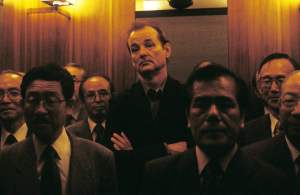 Lost in Translation taps directly into a universal feeling of yearning for connections in a time where it’s becoming easier and easier to disconnect into our own little bubbles. You don’t have to be stuck in a foreign country to feel isolated or out of sorts, and Coppola uses the external circumstances as a means of reinforcing the emotional isolation and then re-connection of her characters. This is why I brush aside some of the harsher criticisms levied against Coppola’s portrayal of Japanese culture and the locals. This is an outsider portrayal, and I don’t think there’s so much a critical judgment over Japanese culture as being inferior as just being different from what these characters are used to. They are clearly out of their element; it’s not that the culture is weird, it’s that the culture is different (that doesn’t mean there aren’t some overstayed stereotypes here as well). Trying to simply communicate with people that all speak another language is a quick and accessible dynamic to better visualize and articulate disconnect. I feel like this story could have been told from any racial or ethical perspective; it’s about two outsiders finding one another. The racial dynamics are less important. Obviously Coppola’s own personal experiences and outsider perspective in Japan are what provides the specific details with this tale, but I think what makes the movie still so effective in 2023 is because it’s so relatable on a deeper level that it eclipses any specific personal details. It’s about feeling lost and then feeling seen.
The key scene for me happens about seventy minutes into the movie, after Bob (Bill Murray) and Charlotte (Scarlett Johansson) have had an adventure with the Japanese hospital system. They’ve become one another’s insomnia buddies, teaming up to explore the city’s nightlife. As they lay side by side in bed during the wee hours, they have an intimate and poignant conversation, and it has nothing to do with sex. “I’m stuck,” she says. “Does it get any easier?” It’s about a young woman asking a middle-aged man for guidance and wisdom and him offering what he can with the caveat that he too is still struggling for his own wisdom. It’s the illusion that at some magic predetermined number of trips around the sun, the mystery of life will somehow become perfectly realized, as if now we can see the grand architectural design. There is no magic number. Everyone is trying their best and making it up as they go, and that’s what this conversation represents. She’s begging for reassurances that adult life will get easier, that she’ll find her footing, and Bob encourages her to continue pursuing her hobbies and passions even if she can’t stand her own art (which sounds like every artist I’ve ever known). Much of his actionable advice comes down to being patient including with yourself. Everybody is in their own way trying their best with what they have. He assures her that the more she gets comfortable with who she is the less things can bother her. It’s a beautiful scene and the reason it works even better is that Coppola doesn’t treat this moment with the gravity it has. It’s not even the film’s climax. Much like real life, when we look back at the exchanges that prove the most formative, we don’t have alarms ringing to better inform us that this is a moment that will have maximum import. We don’t know until it’s over.
 I have never viewed Lost in Translation as some kind of will-they-won’t-they May-December romance, and at no point was I secretly hoping that Bob and Charlotte would get together. This is because they do get together but it’s not a purely romantic connection, although once you start really analyzing romance itself, there are far more complicated and nuanced dimensions to this overly simplified concept, and one could argue this is a romance of sorts but not one about physical passion and infatuation that dominate our association. It’s about two human souls drifting along in life who find a kinship with one another when they need it the most. I never wondered at the end whether they would kiss or have some kind of affair or even run off together, because that wasn’t what was so essential to this dynamic. It wasn’t how far they would go for love, including what would they give up or who would they hurt, it was about each of them serving as a life preserver, something to hold onto during a turbulent time. I truly believe that if they had kissed and had some kind of tawdry love affair that the film would have been cheapened. When Bob carries Charlotte back into her hotel room bed, I never viewed this act as two lovers but of a father and daughter. It’s too easy to just reduce every relationship into a sexual pairing. We all have meaningful relationships with many people who occupy different spheres of our life and our experiences, and our lives could be irreversibly altered without their influence no matter how fleeting our time together may have been. To reduce everything into whether they spark something sexual or passionate is just plain boring.
This was a turning point in the careers of all three of its major figures. For Coppola, it was confirmation of her artistic voice and stepping from the long shadow of her father. She won an Oscar for Best Original Screenplay and was nominated for Best Director, only the third woman ever at that time. That’s a big deal. This was a statement film for her and she’s been making very leisurely paced, lushly photographed, somber character pieces since, very Sofia Coppola Movies (her latest promises to highlight the perspective of Priscilla Pressly). She never quite had another movie land as well as this one though 2006’s Marie Antoinette is due for a reappraisal as well. For Murray, it was confirmation that he had real dramatic acting skills that he’d shown flashes of in other movies like The Razor’s Edge and Rushmore, and it earned him his only Academy Award nomination. For Johansson, it was also the beginning of establishing her as an adult actress of serious caliber, and there was a critical stir that she had been snubbed by the Academy in 2004 not just for her role in Lost in Translation but also Girl with Pearl Earring. Johansson had been a steadily working actress since she was a child, and this was confirmation that she was ready to make the next jump. From there, she found a creative kinship with Woody Allen, and Wes Anderson, and even became an action movie star that could headline her own blockbusters. She finally got her first Oscar nominations in 2019, for both Marriage Story and Jojo Rabbit, becoming only the twelfth actor ever to be nominated twice in the same year. Murray’s star has fallen out of favor recently from his onerous onset behavior, though he did reunite with Coppola for 2020’s On the Rocks.
 One of the stranger post-scripts for this movie relates to Johansson’s singing. The karaoke scene in Lost in Translation is one of the best, and it works on a magical elemental level where the music becomes our means of expression. When Murray sings “More Than This,” it’s hard not to read more into the moment. It’s right there in the song choice. Both actors do their own singing, adding to the fun and authenticity. Johansson would later release her own album in 2008 titled Anywhere I Lay My Head. It wasn’t uncommon for young actresses to moonlight as singers for a vanity project (Paris Hilton and Lindsay Lohan did this too), but what set this album apart was that it was almost entirely comprised of Tom Waits covers. According to Yahoo, as of August 2009, it had sold only 25,000 copies, which to be fair is twenty-five thousand more than I’ve ever sold, so what do I know? She released one more music album, 2009’s Break Up.
Looking back at my original 2003 review, it’s easy to see how smitten I was discovering Lost in Translation and trying to argue its virtues in my college newspaper. I think I assumed most of my fellow collegians would rather watch raunchy comedies like Van Wilder rather than a slow-burn indie about sad people roaming a foreign city. To this day I still have an equal number of friends who deem Lost in Translation as slow navel-gazing fluff to beautiful and beguiling. As I said before, it’s a mood piece about disconnected people, and I think if you’re in the right mood, or an open mind with the patience to spare, then there’s still something appealing and rewarding about an understated movie about two lonely people finding an unexpected kinship that defies reductive romantic classification. I just experienced something on this level with 2023’s Past Lives. I’m glad that Coppola has kept the final whisper between Bob and Charlotte a secret because it doesn’t matter what he specifically says so much as the meaning of this exchange for the both of them. It’s a goodbye of sorts but also a recognition of one another’s help and compassion. It’s not for us to hear. It’s too intimate. It’s a perfect ending for a film that still proves indelible twenty years later.
Re-View Grade: A-
Share this:

On the Rocks (2020)
 Sofia Coppola’s examination on the relationship between fathers and daughters feels like it would have been more entertaining had it gone for a more farcical tone. On the Rocks follows a struggling writer (Rashida Jones) who is questioning whether her husband (Marlon Wayans) is having an affair. Her partner in this makeshift investigation is her bigwig father (Bill Murray), a notorious Lothario whose own penchant for cheating and flirting with every woman has shaped his daughter’s perspective on relationships. If this is a comedy, I can’t tell you where the comedy parts are. The premise sounds rife with potential for hijinks and comedic mishaps trying to remain elusive. The father-daughter history is also ready for some combustible confrontations and perhaps some shades of earned empathy by the end. The problem is that the movie just sort of happens. It unfurls before your eyes, and those elements are there for the taking, but Coppola’s story never seems to really grab at any of them to build more sustained engagement. It feels like Coppola has taken a zany sitcom premise and adopted the tone of a somber indie exploring middle-class ennui. The amusement is under the oppressive force of melancholy. The dramatic substance also feels too dithering and without greater observation and exploration. Jones has some outstanding moments and Murray is at his best when he’s onscreen with her, his outwardly performative qualities shining light on a relative unspoken history that hangs over them. Even Marlon Wayans is good as the possibly philandering spouse. Really, the movie seems to be about the gnawing questions of doubt and suspicion and how quickly one can succumb to them. By the end, I don’t really know what Coppola was going for here. It’s a nice enough film, it holds your interest, and it has a few surprises, though I don’t know if they amount to much. On the Rocks feels like an early draft of a much better or much funnier movie.
Nate’s Grade: B-
Share this:

Marie Antoinette (2006)
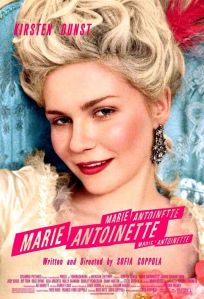 From its opening 80s New Wave soundtrack, you know Sophia Coppola’s Marie Antoinette is a period piece like none other. The famous daughter of Francis Ford Coppola has long been planning a movie around the famous queen that lost her head during the French Revolution. She premiered it at the Cannes film festival where it was booed by the homeland critics. This cast a shadow of doubt over Coppola’s dreamy pop confection of a biopic. Maybe the French don’t like having one of their most iconic historical individuals turned into a bouncing, troubled teenager. Too bad because this is the most interesting and, later, the most frustrating accomplishment Coppola achieves.
Marie (Kirsten Dunst) is a young Austrian girl married away by her family with the hopes of strengthening an alliance between France and Austria. She’s intended to wed Louie August (Jason Schwatzman, Coppola’s cousin), a rather goofy young man more comfortable with hunting than women. Their marriage is arranged by Louis XV (Rip Torn) with the intent on keeping the family line with a male heir. Trouble is, Marie’s husband is more interested in locks than her in a nightie. She’s warned in letters by her family at home, and by a caring ambassador (Steve Coogan), that her only leverage is a child. Without a child her marriage could be annulled. Life at the Versailles palace is a vortex of gossip and attention, and the idea that the queen cannot interest the king is most stressing.
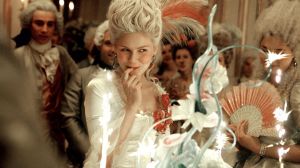 Marie Antoinette is a feast for the eyes, and that’s saying nothing about Dunst. The costumes are gorgeous, the multitudes of food look delectable, and the sets are the real deal, filmed at the actual Versailles palace for that extra oomph. I’d let them eat cake too if I got the stuff she had. Expect Marie Antoinette to at least get several Oscar nominations for its lavish technical merits; it very well might win too. There’s a really neat sequence that informs the audience through a series of family portraits about a death in the family.
Anyone looking for a strict biography on the famous queen will be left scratching their head. Coppola has thrown historical accuracy to the wind and produced a movie less about plot and character and more about an impression. She really nails the insular palace life, from its ridiculous and rigid traditions to the importance placed on blind formality. There’s a very amusing scene where Marie has to be dressed by handlers, and her clothes must keep getting swapped to the current highest-ranking person in the room. Coppola also smoothly handles this extravagant, opulent world from the point of view of her young teenage girl, betrothed by the age of 14. The world of royals and Versailles was one of constant gossip where everyone’s eyes were glued to the new girl. In many ways, Coppola’s world mirrors high school existence, just with far better clothes. When Marie is ignored yet again by her clammy husband, she goes on a wild shopping spree with fabulous shoes and fabrics in bright, sticky colors. She stays up late with a close circle of friends to watch the sun rise over the palace. Coppola firmly reminds us that Marie Antoinette was still a teenage girl and perhaps was still fighting to be one. The movie is good at stripping away the context of history and showing us the awkward lives of two kids selected to be leaders of their country. Better yet, the film is good at exploring what it?s like for teenagers to have the world at their fingertips and have no clue what to do with it. Besides shoe shopping, that is. The film is an excellent mosaic that reiterates the breezy sensation of being young and trapped in the world that never seemed big enough.
But, alas, the trouble with establishing an impression is that we get the idea pretty quickly, and yet the movie keeps going on and on without anything else to interest us. You can watch Marie lay in the field, host a tea party in her garden, marvel at sumptuous food, try on different clothes, play with her puppies, and, hell, the woman even sings an opera in one moment. I don’t know if Coppola intended to establish the tedium of life in Versailles but the audience will definitely start to feel suffocated by it. At least she never steers into a Terrence Mallick danger zone (the man would have sat in a forest with a camera in his lap and called the results a “movie”). That’s the issue with the movie. Like her 2003 Oscar-winner Lost in Translation, Coppola is more interested in mood and silence than character and plot. This approach worked splendidly in the sparely beautiful and moving Translation, but it cannot fully save this film. After a while it just all gets too repetitious and feels slight, like Lizzie McGuire’s Fabulous Versailles Vacation.
The figure of Marie Antoinette is too big to just be dressed up and put in a room. Coppola doesn’t seem to care about the politics or historical anxieties of the time. That’s a shame since France was going through one of the most amazing turnarounds in all of history. There’s no social commentary and the last quarter of the film seems to go off track. When the peasant mob does appear at the very end it feels like a misplaced subplot instead of a world-changing event. Likewise, the affair Marie Antoinette embarks on feels all too shrift and meaningless, like a high school crush of the week (might she doodle his name on her diamond-encrusted notebook?). Marie Antoinette is an interesting, ambitious period drama trying to be a youthful fantasy turned nightmare. It just doesn’t have enough going on to justify a prolonged experience.
Dunst is an actress I’ve been really hot and cold with. Sometimes she dazzles me but more often she bores me. As the title monarch, Dunst totally comes across like a vibrant teen girl still feeling out the world. She seems impetuous, sensual, and naive, all hallmarks of a growing girl that just so happens to be the queen of France. She does a lot of communication with her face. Sometimes she comes across like a silly, vapid little girl playing dress-up, but then that seems within the scope of Coppola’s aim.
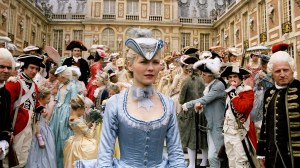 Schwartzman’s portrayal makes the king look like an aloof adolescent, but he make me laugh very easily at his pained awkwardness. Judy Davis is a hoot as the palace’s liaison of policy and manners, tsk-tsk-ing whenever etiquette is broken. The rest of the cast mostly have moments but it’s surprising to me that I’d see Marianne Faithfull, Rip Torn, Molly Shannon (!), and Asia Argento in a period piece movie. Like I said, Marie Antoinette is a costume drama like none other.
Much was made about the anachronistic soundtrack of 1980s tunes set amongst the pomp and circumstance of 18th century France. I like it because it works in engineering the breezy, bubbly youthful impression Coppola wants. It shouldn’t be that big of a deal because the music is not incorporated into the story unlike 2001’s tandem Moulin Rouge and A Knight’s Tale. It provides some of the more fun moments in the movie, though at times the lyrics become all too transparent; “I Want Candy” during a spending spree, “Fools Rush In” when Marie goes to her affair, The Strokes screaming “I want to be forgotten,” as Marie runs off.
Coppola’s luscious period piece feels more like a dreamscape in a daze. Her focus relies less on linear storytelling and character than on creating an impression of youthful decadence and emptiness. Marie Antoinette manages to simultaneously be fluffy and vague. After a while it all just gets repetitious and a bit dull watching scene after scene of Marie being indulged and bored. Perhaps some of that boredom will translate over to the audience. Coppola reminds us that Marie Antoinette was still a teenage girl beneath her powdered wig and bustle, but after two hours you might wish Coppola had more on her agenda.
Nate’s Grade: C+
Share this:

Lost in Translation (2003)
Sophia Coppola probably has had one of the most infamous beginnings in showbiz. Her father, Francis Ford, is one of the most famous directors of our times. He was getting ready to film Godfather Part III when Winona Ryder dropped out weeks before filming. Sophia Coppola, just at the age of 18, stepped into the role of Michael Corleone’s daughter. The level of scathing reviews Coppolas acting received is something perhaps only Tom Green and Britney Spears can relate to. Coppola never really acted again. Instead she married Spike Jonze (Being John Malkovich) and adapted and directed the acclaimed indie flick, The Virgin Suicides. So now Coppola is back again with Lost in Translation, and if this is the kind of rewards reaped by bad reviews early in your career, then I’m circling the 2008 Oscar date for Britney.
Bob Harris (Bill Murray) is a washed up actor visiting Tokyo to film some well-paying whiskey commercials. Bob’s long marriage is fading and he feels the pains of loneliness dig its claws into his soul. Bob finds a kindred spirit in Charlotte (Scarlet Johansson), a young newlywed who has followed her photographer husband (Giovanni Ribisi) to Japan and is second-guessing herself and her marriage. The two strike up a friendship of resistance as strangers in a strange land. They run around the big city and share enough adventures to leave an indelible impression on each other’s life.
Lost in Translation is, simply put, a marvelously beautiful film. The emphasis for Coppola is less on a rigidly structured story and more on a consistently lovely mood of melancholy. There are many scenes of potent visual power, nuance of absence, that the viewer is left aching like the moments after a long, cleansing cry. There are certain images (like Johansson or Murray staring out at the impersonal glittering Tokyo) and certain scenes (like the final, tearful hug between the leads) that I will never forget. Its one thing when a film opens on the quiet image of a womans derriere in pink panties and just holds onto it. It’s quite another thing to do it and not draw laughs from an audience.
Murray is outstanding and heartbreaking. Had he not finally gotten the recognition he deserved with last year’s Oscar nomination I would have raged for a recounting of hanging chads. Murray has long been one of our most gifted funnymen, but later in his career he has been turning in soulful and stirring performances playing lonely men. When Murray sings Roxy Music’s “More Than This” to Johansson during a wild night out at a karaoke bar, the words penetrate you and symbolize the leads’ evolving relationship.
Johansson (Ghost World) herself is proving to be an acting revelation. It is the understatement of her words, the presence of a mature intelligence, and the totality of her wistful staring that nail the emotion of Charlotte. Never does the character falter into a Lolita-esque vibe. Shes a lonely soul and finds a beautiful match in Murray.
Lost in Translation is an epic exploration of connection, and the quintessential film that perfectly frames those inescapable moments of life where we come into contact with people who shape our lives by their short stays. This is a reserved love story where the most tender of actions are moments like Murray carrying a sleeping Johansson to her room, tucking her in, then locking the door behind. The comedy of disconnect is delightful, like when Murray receives incomprehensible direction at a photo shoot. The score by Jean-Benoît Dunckel, front man of the French duo Air, is ambient and wraps around you like a warm blanket. The cinematography is also an amazing experience to behold, especially the many shots of the vast glittering life of Tokyo and, equally, its strange emptiness.
Everything works so well in Lost in Translation, from the bravura acting, to the stirring story, to the confident direction, that the viewer will be caught up in its lovely swirl. The film ends up becoming a humanistic love letter to what brings us together and what shapes how we are as people. Coppola’s film is bursting with such sharply insightful, quietly touching moments, that the viewer is overwhelmed at seeing such a remarkably mature and honest movie. The enjoyment of Lost in Translation lies in the understanding the audience can feel with the characters and their plight for connection and human warmth. A work of art like this sure doesn’t come around every day.
Writer/director Sophia Coppola’s come a long way from being Winona Ryder’s last-second replacement, and if Lost in Translation, arguably the best film of 2003, is any indication, hopefully well see even more brilliance yet to come. This is not going to be a film for everyone. A common argument from detractors is that Lost in Translation is a film lost without a plot. I’ve had just as many friends call this movie “boring and pointless” as I’ve had friends call it “brilliant and touching.” The right audience to enjoy Lost in Translation would be people who have some patience and are willing to immerse themselves in the nuances of character and silence.
Nate’s Grade: A


 nathanzoebl
You must be logged in to post a comment.