Blog Archives
Rebel Moon: Director’s Cut (2024)
 What a rarity for a movie to potentially appear twice on my worst of the year list, and such is the destiny of Zack Snyder’s Rebel Moon, originally released in 2023 and the first half of 2024, and now with added lengthier director’s cuts. So what do you get in the newest “Snyder cuts” besides fewer hours in your day? Let’s tackle the opening sequence demonstrating the power and villainy of our evil empire as they invade a crumbling city in resistance. Within short order we’ve witnessed: 1) female priestesses being forcefully disrobed and having their breasts branded, 2) an adorable little CGI pet become a literal suicide bomber, 3) a son brutally beating his father’s brains out of his skull to spare their family only for them all to be massacred anyway. Yikes. While there is a little more world-building absent from Snyder’s prior cuts, like a religious sect that turns the teeth of their conquered victims into a decorative washboard, even the extra time, and it is literally hours over the course of the two parts, feels strained and still poorly developed to better understand the world, the characters, the conflict, the history, anything that could make Snyder’s hopeful franchise its own universe. Theres now a giant metal goddess whose tears fuel space travel. All right then. One of the more interesting characters, the samurai-esque loner robot, is given more material but he’s still just as inscrutable. There’s plenty more cruelty here, slow-motion head shots painting the screen in sticky viscera. There’s also plenty more breathless and awkwardly extended sex scenes, but hey, at least those are consensual, so there’s that. I’m just stunned why Netflix would want different versions of these movies when they’re ultimately all housed under the same banner. It sure feels like the “Snyder cut” brand is now an expected marketing ploy to be exploited for added publicity. After all, why watch one long slightly bloody poorly written sci-fi space opera, when you could watch TWO versions, one of which being even bloodier and more miserable? Will there be an even Snyderier Snyder cut, adding more scenes of side characters suffering and even more festishized gore in even slower motion? Will the whole movie just be played in slow motion, now requiring nine hours? Where does it even end, Netflix?
Nate’s Grade: D
Share this:

Rebel Moon – Part Two: The Scargiver (2024)
 Back in December, Zack Snyder offered his very Snyder-y holiday take on big-budget space operas with Rebel Moon, a project that began as his Star Wars pitch that was turned down. It was what you would expect from a Snyder movie: big, loud, silly yet played completely serious, and drained of all vibrant color. Rebel Moon Part One was on my worst of 2023 list and I felt was a waste of two hours. I was not looking forward to the concluding Part Two. I was worried it would be two more hours of the same, and now having seen Part Two, a.k.a. The Scargiver, the edgy nickname of our lead rebel Kora (Sofia Boutella) fighting the good fight against the Evil Empire, I can now say that the Rebel Moon duology is now a dreary waste of four of your waking hours.
Saying Scargiver might be minimally better than Child of Fire (did you remember that was the subtitle for Part One? Don’t lie to me, dear reader, you know you didn’t) is a nominal victory. There’s more action and a clearer sense of climax, with our underdogs planning their guerrilla war against the overpowering forces approaching (we’re basically watching the training of a Vietcong-like insurgency) and then pulling off their unexpected victory. The problem is that we’re still stuck with all the same characters from Part One, few of which will prove to be emotionally engaging or intriguing. We’ve assembled our fighting force thanks to the events of Part One, but far too many of them are interchangeable and punishingly free of personality besides the default character creation setting of “stoic badass.” There’s one lady who has laser swords so at least that sets her apart. When it comes to attitude, personality, perspective, and even skill level, these characters are awash, which makes the action falter when it comes to any sort of meaningful emotional involvement. The bare bones story is so plain with broadly drawn good versus evil characters from its obvious cultural influences. The fact that it’s derivative is not itself a major fault, it’s the fact that it does so little with these familiar pieces that the movie feels like it’s trying to skate by on your familiarity. After four hours, it’s clear to me that Snyder and his co-writers composed this not as a living, breathing universe with its own lore and history and intrigue, but as a story where he could have used the Star Wars universe to fill in the gaps.
 Snyder can be a first-class visual stylist but his sense of fluid and engaging action stops at “cool images,” like living splash pages from comic books. Like Part One, there is no sense of weight to these action sequences. Things are just happening, and then in the next shot things are just happening. Occasionally there will be a sliver of relation, but whether it’s 60 minutes or 6 minutes, the effect is still the same. The action feels like it’s all happening in a vacuum, and the momentum we feel the upstarts are gaining is hampered. We went through the trouble of explaining their counter-offensives, so why does so much of it feel like it’s just watching a jumbled, ashen group of characters fire guns? This is best epitomized by Jimmy the robot (voiced by Anthony Hopkins) who has gone rogue from his programming and sits out much of the action for reasons entirely unknown. Then he arrives, takes down a few evil tanks, and I guess decides to sit back out. If this is our fighting force, what exactly has it amounted to? This makes the entire movie, and its predecessor, a frustrating viewing even for forgiving action fans. Things blow up good, and there are a few impressive visual orchestrations, but it’s so fleeting and slim.
Over the course of two two-hour movies, totaling four hours, with the promise (threat?) of more, it’s clear that what we really had here was perhaps one underdeveloped movie at best that has been unfortunately spread out over two (and counting) movies of time. Part One was entirely about assembling the team of rugged defenders, and this could have served as the first 45 minutes of the overall movie, with the events of Part Two filling in the rest. With Scargiver, the defenders don’t even start training the villagers until 40 minutes into the movie and the big battle doesn’t kick in until a full hour. Structurally, this doesn’t feel like we’re using our time wisely, and this is best evidenced by the fact that after AN ENTIRE MOVIE of character back-story, Snyder still stops the action to have his characters sit around and share their sad back-stories. Did these characters just not talk at all to each other after initially gathering person-by-person? Tarak (Staz Nair) still hasn’t put a shirt on. I felt like yelling at my TV as the character took turns, and another 15 minutes, for each member to share their tortured back-story again but with different visuals. I was almost worried that right before the battle another character would say, “Wait, before it all really goes down, I need to share, yet again, more of my back-story.” It’s not like these extra glimpses give us new understanding or even meaningfully differentiate their characters; they’re all just victims of an abusive space government that imposes its terrible will most forcefully.
 There is one tragic back-story that does separate itself from the pack, notably because it literally separates itself from the pack and is told well before our group share. Kora explains her part in the assassination of the royal family, securing the military coup that left the Evil Empire extra evil, and I guess the guy named Balisarius as supreme leader (oh how this man must have been teased for his name as a schoolchild, which might be his own tragic back-story that we’ll get three helpings of with an eventual Part Three). This betrayal is personal and stands out, with Kora being the one to shoot the little princess, a girl who, in her dying breath, says she forgives Kora. That’s rough. This is actually a good sequence from a character standpoint as it establishes Kora’s accountability and guilt convincingly. However, Snyder makes some baffling creative choices that blunt the impact of this sequence. During the assassination, the musical score favors a string quartet, which is an emotionally plaintive choice. However, the music is actually diegetic to the scene, meaning it’s coming live from the room. There is literally a string quartet of musicians playing in the room while the royal family is betrayed and slaughtered. These guys are really dedicated to their art to keep playing throughout, and I assume they must also be part of the conspiracy or else big bad Balisarus (snicker) would kill them too. You might as well have them also start stabbing the royal family with their bows. It’s details like this that trip up Snyder, a man beholden to images and ideas but lacking the finesse to make them work.
An issue I had with this conflict was the disparity in scale between the forces, mainly my nagging question of why put together a ragtag group of space adventurers to defend this town if the Evil Empire could just nuke the planet from space? Well Snyder attempts to answer this early with Part Two, and the answer appears to be… grain. This community theorizes that the empire needs their grain yield so badly that they wouldn’t do anything to damage it, so their plan is to harvest all their wheat, turn it into grain, and then use the grain like human shields, hiding behind the valuable resource as cover and distributing it across the village. This is beyond silly. First, this isn’t like an entire planet harvesting grain, it’s one little village on the outskirts. It’s not like we’ve seen a giant warehouse that goes for miles and miles stockpiled with thousands if not millions of deposits of this food. Also, we’re talking grain here (stay tuned for my exclusive Rebel Moon-related podcast called “Talkin’ Grain”). It’s not like we’re talking about some super rare mineral or substance that is only found on this one planet, something linked toward like the power source for an ultimate weapon or space travel. We’re talking about grain here. Grain. You think this Evil Empire won’t nuke the planet because they’re worried they won’t get enough grain, the same crop that can be harvested on multitudes of other planets? How about they just kill everyone and then repopulate the planet with robots to harvest the precious grain? Or how about this simple village make some upgrades as we’re in a future world with space travel and artificial intelligence but people are still harvesting wheat by hand like they’re the Amish. Regardless, I hope you love slow-mo montages of grain harvesting because that’s what you’re getting for the first 40 minutes, as if Snyder is rubbing your face in his silly non-answer.
 In the conclusion to Rebel Moon Part Two, once the dust has settled, and long since that grain has been harvested, the last five minutes sets up a would-be Part Three, informing us that an unresolved storyline is next up on the docket. The characters gang up for their next adventure, and you’re expected to be chomping at the bit for this continuation. I openly sighed. Every movie feels like a tease for the next adventure, and it seems to promise that this one will be the real one you’ve been waiting for, but it feels like franchise bait-and-switch. It’s more than incomplete or lazy storytelling, it’s a scheme to leverage interest in a world and series that deserves little. The universe of Rebel Moon is not interesting. The characters of Rebel Moon are not interesting. The visuals of Rebel Moon are fine, though some of the costume choices again can rip you right out of the reality of this universe (a guy fighting in blue jean overalls?!). In short, not enough has been established, developed, or even paid off to make Rebel Moon an interesting and satisfying movie, let alone two, let alone three, let alone however many Snyder wants to leech out of Netflix. I would say Part Two is better because at least it provides an ending but it doesn’t even do that, merely an intentional passing of the baton to the next movie, and round and round we go. Rebel Moon is a living poster stretched to its breaking point. Leave this shallow universe behind.
Nate’s Grade: C-
Share this:

Rebel Moon – Part One: A Child of Fire (2023)
 Creating an original sci-fi/fantasy universe is hard work. It involves bringing to life an entire new universe of characters, worlds, back-stories, rules, conflicts, cultures, and classes. There’s a reason major studios look to scoop already established creative universes rather than build their own from scratch. This is what director Zack Snyder had in mind when he pitched a darker, grittier, more mature Star Wars to Disney, who passed. Over the ensuing decade, Snyder and his collaborators, Shay Hatten and Kurt Johnstad, continued working on their concept, transforming it into an original movie series, resulting in Netflix’s big-budget holiday release, Rebel Moon – Part One: A Child of Fire, a clunky title I will not be retyping in full again. Snyder’s original results of the “darker, grittier Star Wars” are rather underwhelming and don’t make me excited for the concluding second movie being released in April. Why go to the trouble of building your own universe if you don’t want to fill in the details about what makes it important or at least even unique? I can see why Snyder would have preferred Rebel Moon as a Star Wars pitch, because they could attach all the established world-building from George Lucas and his creative collaborators as a quick cheat code.
In another galaxy, the imperial Motherworld is the power in the universe. The king and his family have been assassinated, and in the power struggle that follows, several planets have taken up arms to fight for independence. On a distant moon, Kora (Sofia Boutella) is doing her best to live a nondescript life as a farmer, helping to provide for her community and stay out of trouble. Well trouble comes knockin’ anyway with Admiral Atticus Noble (Ed Skrein) and his fleet looking for resources and powerless villagers to abuse. Kora’s history of violence comes back to her as she fights back against the Motherworld soldiers with cool precision. Her only hope is to gather a team of the most formidable warriors to protect her village from reprisals. Kora and company band together while her mysterious past will come back to haunt her reluctant return to prominence.
 For the first thirty to forty minutes of Rebel Moon, I was nodding along and enjoying it well enough, at least enough to start to wonder if the tsunami of negative reviews had been unfairly harsh, and then the rest of the movie went downhill. One of the major problems of this Part One of a story is that it feels like a movie entirely made up of Act Two plotting. Once our hero sets off on her mission, the movie becomes a broken carousel of meeting the next member of the team, seeing them do something impressive as a fighter, getting some info dump about their mediocre tragic backstory, and then we’re off to the next planet to repeat the process. After the fifth time, when a character says, “Anyone else you know?” I thought that the rest of the movie, and the ensuring Part Two, would be nothing but recruiting members until every character in the galaxy had joined these ragtag revolutionaries, like it was all one elaborate practical joke by Snyder. Some part of me may still be watching Rebel Moon, my eyes glazing over while we add the eight hundred and sixty-sixth person who is strong but also shoots guns real good. Then the movie manufactures an ending that isn’t really an ending, merely a pause point, but without any larger revelations or escalations to further our anticipation for Part Two in four months’ time. What good are these handful of warriors going to be defending a village in a sci-fi universe where the bad guys could just nuke the planet from orbit? Find out in April 2024, folks!
The entire 124-minute enterprise feels not just like an incomplete movie but an incomplete idea. This is because the influences are obvious and copious for Snyder. Rebel Moon starts feeling entirely like Star Wars, but then it very much becomes a space opera version of The Magnificent Seven, itself a remake of Akira Kurosawa’s Seven Samurai. With our humble farmer, our high plains drifter trying to turn their back on an old life of violence, and the recruitment of our noble fighters to ward off the evil bandits coming to harass this small outpost, it’s clearly The Magnificent Seven, except Snyder doesn’t provide us the necessary material to invest in this scrappy team. The characters are all different variations of the same stoic badass archetype, like you took one character mold and simply sliced it into ten little shear pieces. The characters don’t even have the most basic difference you could offer in an action movie, variation in skill and weapons. One lady has laser swords (a.k.a. lens flair makers) but pretty much everyone else is just the same heavy gun fighter. One guy doesn’t even bother to put on a shirt. Some of them are slightly bigger or more slender than others but the whole get-the-gang-together plot only really works if we have interesting characters. If we don’t like the prospective team members, it’s like we’re stuck in an endless job interview with only lousy candidates.
 The fact that Rebel Moon is derivative is not in itself damaging. Science fiction is often the sum of its many earlier influences, including Star Wars. Rebel Moon cannot transcend its many film influences because it fails to reform them into something coherent of its own. There is no internal logic or connection within this new universe. The original world building amounts to a slain royal family, an evil fascist regime, and maybe a magic princess connected to a prophecy of balance, and that’s it. All the flashbacks and expository data dumps fail to create a clearer, larger picture of how this sci-fi universe operates. The inner workings are kept so broad and abstract. We have an imperial evil and assorted good-hearted little guys. The movie begins by introducing a robot clan of knights that are dying out, and even a young Motherworld soldier who seems likely to defect, both opportunities to go into greater character detail and open up this world and its complications. So what does Snyder do? He leaves both behind shortly. Even though we visit a half dozen planets, these alien worlds don’t feel connected, as if Snyder just told concept artists to follow whatever whim they had. They don’t even feel that interesting as places. One of them is desert. One of them has a saloon. One of them is a mining planet. It’s like the worlds have been procedurally generated from a computer for all we learn about them. They’re just glorified painted backdrops that don’t compliment the already shaky world building. They’re too interchangeable for all the impact on the plot and characters and any declining sense of wonder.
Given the open parameters of imagination with inventing your own sci-fi/fantasy universe, I am deeply confused by some of the choices that Snyder makes that visually weigh down this movie in anachronistic acts of self-sabotage. Firstly, the villains are clearly meant to be a one-to-one obvious analog for the Empire in Star Wars, itself an analog for the fascists of World War II, but Lucas decided having them as stand-ins was good enough without literally having them dress in the same style of uniforms as the literal fascists from World War II. You have an interconnected galaxy of future alien cultures and the bad guys dress like they stepped out of The Man in the High Castle. It’s too familiar while being too specific, and the fact that it’s also completely transparent with its iconic source references is yet another failure of imagination and subtext. I just accepted that the Space Nazis were going to look like literal Nazis, but what broke my brain was the costuming of Skrein’s big baddie in the second half of the movie. At some point he changes into a white dress shirt with a long thin black tie and all I could think about was that our space opera villain looks like one of those door-to-door Mormon missionaries (“Hello, have you heard the Good Word of [whatever Snyder is calling The Force in this universe]?”). Every scene with this outfit ripped me out of the movie; it was like someone had photo-shopped a character from a different movie. It certainly didn’t make the devious character of Atticus Noble more threatening or even interesting. I view this entire creative decision as a microcosm for Rebel Moon: a confused fusion of the literal, the derivative, and the dissonant.
 Snyder is still a premiere visual stylist so even at its worst Rebel Moon can still be an arresting watch. He’s one of the best at realizing the awe of selecting the right combination of images, a man who creates living comic book splash pages. I realized midway through Rebel Moon why the action just wasn’t as exciting for me. There’s a decided lack of weight. It’s not just that scenes don’t feel well choreographed or developed to make use of geography, mini-goals, and organic complications, the hallmarks of great action, it’s that too little feels concrete. It feels too phony. I’m not condemning the special effects, which are mostly fine. The action amounts to Character A shoots at Bad Guy and Character B shoots at Other Bad Guy, maybe behind some cover. There’s only one sequence that brings in specifics to its action, with the challenge of defeating a rotating turret gun pinning the team down from escape. That sequence established a specific obstacle and stakes. It worked, and it presented one of the only challenges that wasn’t immediately overcome by our heroes.
The Snyder action signature of slow-mo ramps has long ago entered into self-parody territory (I’m convinced a full hour of his four-hour Justice League cut was slow motion), so its use has to be even more self-aware here, especially in quizzical contexts. There are moments where it accentuates the visceral appeal of the vivid imagery, like a man leaping atop the back of a flying griffin, akin to an 80s metal album cover come to life. Then there are other times that just leave you questioning why Snyder decided to slow things down… for this? One such example is where a spaceship enters the atmosphere in the first twenty minutes, and a character drops their seeds in alarm, and those seeds falling are detailed in loving slow motion. Why show a character’s face to impart an emotion when you can instead see things falling onto the ground so dramatically?
 The actors are given little to do other than strike poses and attitudes, and for that they all do a fine job of making themselves available for stills and posters and trailers. Boutella (The Mummy) is good at being a stoic badass. I just wish there was something memorable for her to do or make use of her athleticism. The best actor in the movie is Skrein (Deadpool) who really relishes being a smarmy villain. He’s not an interesting bad guy but Skrein at least makes him worth watching even when he’s in the most ridiculous outfit and awful Hitler youth haircut. There’s also Jena Malone (Sucker Punch) as a widowed spider-woman creature. So there’s that. Cleopatra Coleman (Dopesick), who plays one half of a revolutionary set of siblings along with Ray Fisher, sounds remarkably like Jennifer Garner. Close your eyes when she’s speaking, dear reader, and test for yourself. I was most interested in Anthony Hopkins as the voice of our malfunctioning android (literally named “Jimmy the Robot”) operating on mysterious programming that hints at something larger in place relating to perhaps the princess being alive. Fun fact: Rebel Moon features both actors who played the role of Daario on Game of Thrones (Skrien and Michiel Husiman).
Even with all the money at Netflix’s mighty disposal, Rebel Moon can’t make up for its paltry imagination and thus feels like an empty enterprise. I’m reminded of 2011’s Sucker Punch, the last time Snyder was left completely to his own devices. I wrote back then, “Expect nothing more than top-of-the-line eye candy. Expect nothing to make sense. Expect nothing to really matter. In fact, go in expecting nothing but a two-hour ogling session, because that’s the aim of the film. Look at all those shiny things and pretty ladies, gentlemen.” That assessment seems fitting for Rebel Moon as well, a movie that can’t be bothered to provide compelling characters, drama, or world-building to invest in over two to four hours, once you consider the approaching Part Two. I wish this movie had a more distinct vision and sense of humor, something akin to Luc Besson’s lively Fifth Element, but fun is not allowed in the Zack Snyder universe, so everything must be grim, because grim means mature, and mature means automatically better, right? Rebel Moon is a space opera where you’ll prefer the void.
Nate’s Grade: C-
Share this:

Climax (2019)
 I honestly have no idea who could enjoy Climax. I have watched dozens of movies where I knew it wasn’t for me but I could at least fathom some appeal to a select viewer. Climax is the rare film where I cannot even fathom any person enjoying it, because to even attempt to enjoy it on its fever dream level it purports would only lead to disappointment. I don’t think it’s even possible to enjoy this movie, and maybe that’s even some subversive point from writer/director Gaspar Noe. Is the very act of titling a movie called Climax with no climax itself a post-modern jape? Is that it? I’m confounded by this monotonous experimental triviality.
The plot: a Parisian group of dancers is practicing in an old school building one 1990s wintry night. One of the members spikes a bowl of sangria with LSD. The dancers unwittingly get high, freak out, and lash out, leading to one long sordid night of tumult. That’s it, folks.
 Firstly, Climax is incredibly, unbearably, crushingly tedious. It’s 97 minutes that could literally be condensed into a music video for a three-minute song as far as substance is concerned. Apparently Noe was working off of a five-page script (note to readers: typically, in screenwriting terms, one page equals one minute of movie), so it’s no surprise that the overwhelming majority of this movie feels empty. The first six minutes or so are watching boring interviews of the various dance troupe members answering mundane questions. It’s still difficult to attach impressionable personalities or points of distinction for them beyond the superficial (Tall Blonde, Girl with Glasses, etc.). After that it’s an extended dance sequence, then about twenty minutes of chit chat where the dancers are improvising, and then we have another extended group dance, and then we get to the fateful spiked punch. What I’ve just described is the first 45 minutes of the movie, also known as half of the film, and it could have all been removed without missing a beat. That’s a serious storytelling problem. Oh, I hear others preparing the defense, the movie is intended to be an experience and not a story. If that’s the case I need more of an experience. Noe described the first half of Climax as a “roller coaster” but it feels more like the long wait in line and then the brief five minutes of actual activity. Even the opening dance sequence, while energetic, is less than extraordinary. It’s not exactly a sequence that would wow me any more than a deleted scene from a direct-to-DVD Step Up sequel.
Climax fatally errs by, of all things, restraint. I could accept the slow buildup, the tedium, and even the paper-thin characters if, and that’s a big if, Noe was able to pull out all the stops with his freak-out finale and just went bonkers. However, it’s not quite the same when we don’t also experience the hallucinations and madness befalling our dancers. Instead we watch them pace around and scream, cry, sometimes writhe, sometimes fall down, sometimes fall down and writhe, sometimes fall down and writhe and cry, and that’s about the extent. It can be downright embarrassing to watch especially as Noe’s penchant for tracking shots makes the performance takes so agonizingly long. There are brief moments of unpredictability where the dancers become violent and paranoid, but these are fleeting and we’re back to watching people we don’t care about scream about imaginary things. Imagine if Noe let the audience in on these personal, psychedelic, and monstrous drug trips. Imagine how much more visually alive that would be and also how much more it would connect us with the characters, perhaps linking their hallucinations to personal traumas and anxieties. I’ve had friends discuss going along for the ride with Climax, but what ride does it even offer? The final ten minutes consists of a confusing upside-down camera angle, a scathing red light, and more antic writhing on the floor with the occasional sexual copulation. At that point, I had long lost any interest to even attempt to decipher the screen.
 None of these characters matter, so I kept waiting for the eventual bad fates to fall upon them as the movie ramped into its horror section but Climax doesn’t even do this. I was expecting things to get progressively worse and take on a tragic momentum of escalating mistakes. I was expecting something and all I got was an extended music video where the extras had taken over, trying to convince me that their little spheres of drama were worth following (there were not). The little moments of conversation between the characters feel like you’re eavesdropping on normal, ordinary, and boring people but also people without clear indication for character arcs, ironic reversals, or any of the sort of contexts that can make people interesting in narratives. There’s just no potential here for the characters and nothing that amounts to satisfaction (oh the ongoing irony of its title, I know). Here’s how bad Noe miscalculates: at the very end, we discover which character was responsible for spiking the sangria, and it’s treated like a big reveal, except this was never an important mystery and I didn’t even recognize the culprit. It didn’t matter because the mystery never mattered and the characters especially never mattered.
Noe has been a cinematic provocateur ever since his first film, 2002’s Irreversible, began with a grueling, graphic nine-minute rape scene. He seems more drawn to pushing button so he might devote an entire movie to a floating spiritual perspective (Into the Void) or shoot a love story with un-simulated sex including graphic 3D use of said parts (Love). He’s not exactly the kind of man who wants to tell a simple story in a simple way (though I would argue a majority of his stories are pretty simple). So, if it’s all about technical bravura and showmanship and pushing the envelope, then let the man be judged on those grounds, and he is found wanting with Climax. The long swooping camerawork can be impressive as it tracks all over the confines of this building but the positives are weighed down by the banality of the visuals. Far too much of this movie is simply following people walk down corridors. There aren’t key, striking visuals to sear into your memory and it feels like Noe’s heart just isn’t in this. There’s one scene where a dancer, goaded by an angry and accusatory crowd, starts stabbing herself in the face. I was expecting something far more graphic or bloody or consequential, but it’s like a shrug. It feels like he’s even bored by the assignment of directing his own movie and just keeping the camera running so he can cross the 90-minute finish line and call it over.
I come back again and again to the question of how it is even possible to enjoy Climax. I think, even if you were to be overly generous, Noe’s film just cannot measure up on any artistic or entertainment metric. If you’re eager for a crazy, trippy, immersive drug-fueled experience, get ready for something more akin to standing by and holding the hair of your friend while they vomit into a toilet.
Nate’s Grade: D
Share this:

Atomic Blonde (2017)
 Atomic Blonde is based on a 2012 graphic novel called The Coldest City (by Antony Johnston and Sam Hart), a title I doubt many were that familiar with. Charlize Theron was. She snapped up the option rights before it was published and saw it as a vehicle for herself to cut loose, have fun, and show off her affinity for fight choreography thanks to her background in dance. If you don’t walk out of this film with an uncontrollable crush on Theron, then I don’t know what movie you saw, my poor friend.
Set in 1989 Berlin, on the eve of the wall going down, Lorraine Broughton (Theron) is working undercover for her Majesty to uncover who is killing British agents in East Germany. Her local contact is David Percival (James McAvoy), a black-market kingpin and popular mover and shaker. One of his contacts (Eddie Marsan) has committed secret spy files to memory and wants an escape to West Germany. He’s even gotten the attention of other spooks, including French intelligence agent Delphine Lassalle (Sofia Boutella), who gets intimately close to Lorraine. The smuggling of the contact goes bad, lives are lost, and Lorraine has to explain to her superiors (Toby Jones, John Goodman) what went wrong and who is secretly the murderous traitor.
 This film could have just as easily been re-titled Sexy Charlize Theron: The Movie. It is a two-hour celebration of the actress and her many formal gifts. Watch her look sexy in this sexy outfit (i.e. every outfit Theron wears or doesn’t wear). Watch her look sexy strutting down a hallway in slow mo. Watch her bathe in ice. Watch her dispatch bad guys with ease, sexily. And then there’s the sapphic romp with Boutella (The Mummy), which is just an explosion of sexy that might be too much for the weaker-hearted audience members to handle. A female friend of mine used to refer to Angelina Jolie in the early 2000s as “walking sex,” a woman that simply oozed sex appeal with her every glance and movement. I think that term deservedly applies to Theron in Atomic Blonde. The surface-level pleasures are rampant, from the 80s chic clothing, to the pumping New Wave soundtrack, to the very stylized way people take long dramatic drags from their cigarettes, the movie exudes a sense of cool with every frame. There is plenty to ogle, and that includes the casual nudity of a 41-year-old Theron, who has plotted this showcase role for years as an unapologetic badass statement and maybe the nonchalant nudity is part of that (“You think women over 40 are unattractive? Well take a good gander at this, Hollywood”).
The film has style to spare but thankfully it also has enough substance to match, and by that, I mean its depiction and development of action. Coming from David Leitch, one of the co-directors of the John Wick franchise, I expected very fluid and well-choreographed action sequences, and Atomic Blonde delivers. I am happy that we have moved away from the Bourne-style docudrama approach of the jangled edits and gone the other direction, treating action sequences like the dance routines they are and allowing an audience to fully take them in and appreciate the skill and artistry. The showstopper everyone will be talking about is an extended fight sequence that closes out the second act. Lorraine ducks into a tenement building and gets into a bruising fight with several goons. This sequence goes down several floors, careens into empty rooms, and eventually ends up in the middle of a speeding car trying to make a desperate escape. It’s filmed to be one long take and the sequence is exhilarating and only becomes more so with every passing minute.
 Admirably, Atomic Blonde also brings a sense of realism to all its action. As the fight continues, Lorraine becomes understandably fatigued, as do the baddies. She is not impervious to their attacks. She’s gutsy but still vulnerable, still human. You feel the blows and the intense duration, which makes me marvel all the more at Theron’s sheer balletic grace when it comes to her ass-kicking capabilities. Having an experienced, accomplished fighter opens up the complexity of the action sequences. The stunt work is a consistent joy in this movie and what will make it stand out amidst the pack.
The only major gripe I have with the film is its rather convoluted spy plot. The Cold War as well as East Berlin is just a backdrop for the cool shenanigans. The movie toys with spy movie pastiches but clearly it only amounts to genre window dressing. It’s almost on par with the music, used to evoke a mood and not much more. It feels like even Atomic Blonde recognizes this and just blurts out more nonsensical “who can you trust?” plot mechanics to get to the next sexy set piece. If you don’t already know who the eventual traitor will be by the end of the first act, you haven’t been doing the math. The communist bad guys are an unremarkable lot but they do make for solid punching bags.
The opening scene sets up the death of a British spy as a personal blow to Lorraine (she kept a photo of the two of them in her dresser drawer) but he’s quickly forgotten and never mentioned. His assassination doesn’t even stir any simple impulses of revenge. The non-linear framing device also seems designed just to skip ahead to the good stuff or provide a break in the action where Lorraine’s superiors can provide disapproving, fuddy-duddy commentary about her blasé behavior. The plot is a bit too needlessly complicated and muddled for what the film needs. It’s as if screenwriter Kurt Johnstad (300) was given the edict to make things obtuse with paranoia and intrigue just long enough. There’s an extended coda that feels like a reshoot; however, it also has several significant plot revelations that completely change your understanding of the characters.
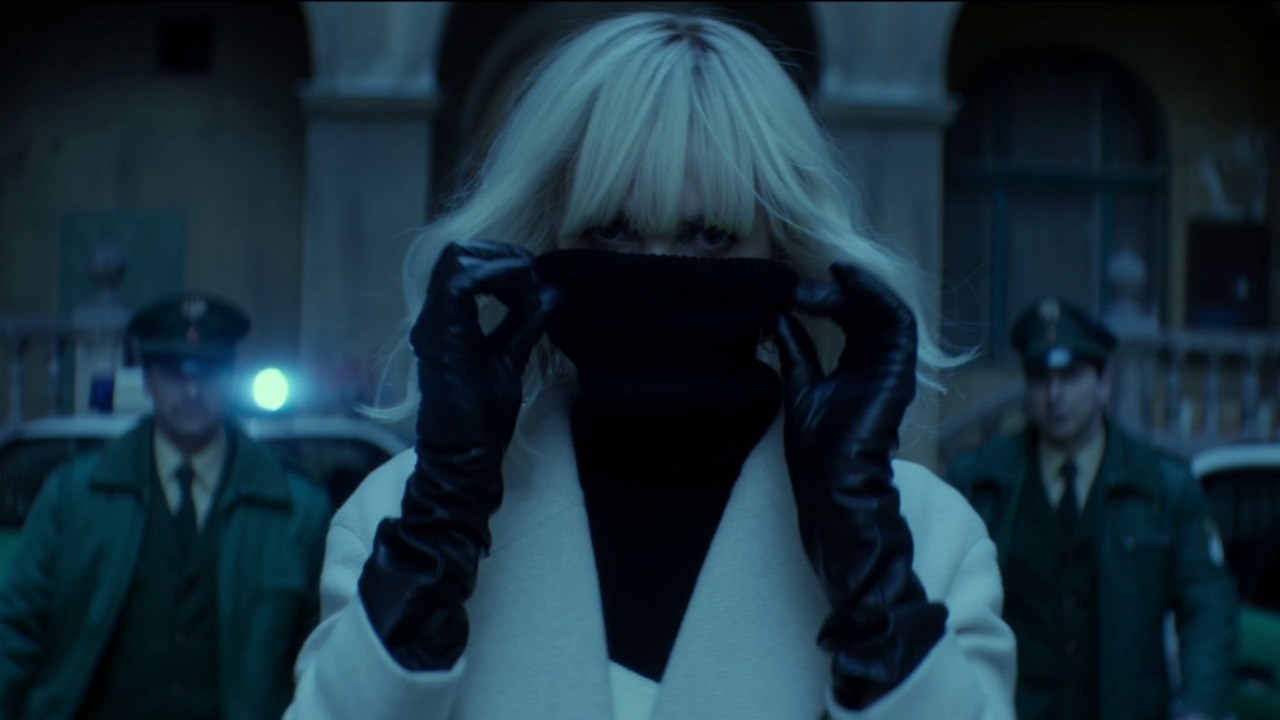 Atomic Blonde is the kind of movie that knocks you around and overpowers you with its spiky attitude. At its best, the movie pulsates with a buzzy rush of adrenaline, setting up dangerous dilemmas for Lorraine to take out with her fists, feet, and any old thing lying around. Her ingenuity during the fight sequences adds a welcomed degree of unpredictability and satisfaction, and it makes the locations become an integral part of the fight choreography as well. There’s a reason I’ve been expending most of my review on the action sequences and sense of style, because there isn’t much more to Atomic Blonde. It’s all retro fashions, stylish artifice, an overeager soundtrack, and lots of too-cool bravado, but unlike say Suicide Squad, it actually pulls it off. It’s not posturing when it works. Theron is a absurdly convincing as a super sexy super agent, and it feels like they dropped her into a James Bond story (with Sofia Boutella as the Bond girl). The added realism and long takes allow the film to feel even more viscerally kinetic. If this is the start of a Charlize Theron franchise then I say we are living in the sexiest of times.
Nate’s Grade: B
Share this:

The Mummy (2017)
 In my many years as a film critic, it’s always interesting to discover when I veer from the critical herd, whether liking a movie others do not or having issues with a movie that others lionize like La La Land. After seeing an avalanche of bad reviews, I was fully prepared to dismiss Tom Cruise’s The Mummy as another example of Hollywood hubris, but as the movie continued I found myself enjoying the proceedings. I left the theater completely dumbfounded why my critical brethren disliked it so vehemently. One critic even said this was Tom Cruise’s worst movie of his career. I can’t understand the hate for what is essentially a fun B-movie, so my review is going to be a little different. I’ve read through a bevy of bad reviews and lifted the major criticisms leveled at the film. I’ll be addressing them one-by-one and why I disagree or think the broadsides are overblown.
Here’s a quick plot synopsis for some general context. Thousands of years ago, Ahmanet (Sofia Boutella) was next in line for the Egyptian throne, and then her pharaoh father had a son. Rather than be sidelined, Ahmanet made a deal with the god Set to kill her family with a magic knife and become an all-powerful being. She was thwarted in the middle of the human-sacrifice ritual and she’s sentenced to being buried alive. She was buried thousands of miles away and the magic jewel, needed to complete the magic knife, was buried in England in a Crusader’s crypt. In present-day Iraq, Nick Morton (Tom Cruise), his sidekick (Jake Johnson), and his love interest (Annabelle Wallis) stumble upon the tomb of Ahmanet. They’re transporting her sarcophagus back to England when a cloud of crows attacks their Army plane. The plane crashes, with Nick on it, but he awakens unscathed on a morgue slab. Apparently Nick is marked by Ahmanet as her chosen vessel.
 1) “Cinematic universe fatigue.”
This is the number one indictment in all the critiques but it feels more like critics just used The Mummy as a jumping off point to add to a thesis statement on the dearth of originality in a franchise-obsessed Hollywood. I get it. In the wake of the Marvel Cinematic Universe’s unparalleled run of success, it’s not just about franchises now but also about a series of inter-connected franchises forming a universe of stories. There is also DC’s failed efforts to try their own universe, a possible Hasbro Universe (Transformers, G.I. Joe), the ongoing and morphing X-Men universe, and now the emergence of the Dark Universe, a studio’s attempt to repackage the classic monster properties of old. When done poorly, the cinematic universes reek of nakedly obvious crass commercialism. However, just being opposed to these cinematic universes on principle alone feels misguided. It’s presumptuous. It all depends on whether or not the stories can exist on their own. Batman vs. Superman and Suicide Squad didn’t crash and burn merely because they were overextended by tie-ins to other movies. They failed because they were bad stories and were terribly executed, and yes being overextended was a component but not the only one by far. Movies still need to be good.
The Mummy only gives a sense of a larger universe through the appearances of Dr. Henry Jekyll (Russell Crowe) the leader of Prodigium, a S.H.I.E.L.D.-esque agency tasked with monitoring the world of “gods and monsters.” That’s about it, a preview of a larger world of monsters with some visual Easter eggs scattered here and there. The character of Jekyll is a learned scientist that can unload a larger picture, and his institution also provides a setup for false security. He is organically placed into the narrative and Prodigium actually supplies a credible reason why they don’t just smash the key crystal that Ahmanet needs for her resurrection purposes. Crowe (The Nice Guys) is one of the best parts of the movie, and when he gets to slip into Hyde mode the movie allows him to have a malicious sense of fun. I don’t think the visual element of Hyde quite works but it doesn’t sabotage the scenes. Not all of Crowe’s exposition is necessary, especially the opening sequence finding the buried Crusaders, but he provides a stable presence, until he also presents Prodigium as a pragmatic threat. This is why I think that the most critics are condemning the idea of the Dark Universe and what it stands for in broader terms and not on the actual merits of how it set up its larger universe.
 2) “Cruise is miscast as the lead.”
I’m a fan of Cruise as an actor and especially as the lead in action movies. The man is a natural movie star and he gives his all with every performance. As a paying moviegoer, I respect that work ethic. Having Cruise play a rakish surveyor of antiquities seems like a good fit for his abilities. He’s played charming, dangerous rogues before. Here’s the thing that critics don’t seem to be processing: Cruise’s character is meant to be a jerk. He’s self-centered and prone to making impulsive decisions, like shooting a rope keeping a sarcophagus suspended in liquid mercury. Plus if you don’t like Cruise as a person or an actor he’s routinely beaten up in the movie to fine comic results. His character arc is about him becoming the kind of person who’s willing to think about others and a greater good. It’s simple but it works. I do think The Mummy goes too far in trying to explain the signposts of his character arc. Occasionally they undercut the moment to great effect. There’s a scene where Wallis (Annabelle) tries to encourage Norton that she knows there’s a good man inside him. After all, he gave her the only parachute as the plane went down. He then sheepishly says, “I thought… there was another one.” I laughed out loud so hard. The movie does work a little too hard to announce Nick’s swaggering Lothario ways (“Me thinks the lady doth protest too much”), and there’s a 25-year age gap between Wallis and Cruise, but these aren’t faults invented by only this movie. Cruise was an enjoyable lead for me and his ease with comedy, action, and drama prevailed.
3) “Tone issues abound.”
Critics are lambasting the film for being too many things with too many tones, but much like cinematic universes, it all comes down to execution. The Mummy has elements of action, horror, especially its zombie-mummies, dark comedy, like Johnson showing back up as zombie comic relief a la An American Werewolf in London, and even some inspired slapstick. When Nick is fighting a batch of zombie-mummies, he thrusts his fist through one skull and hangs another sideways against a wall, and both keep on fighting. The different elements added to my entertainment rather than detracting from it. I enjoyed that the movie could be suspenseful or silly depending upon the scene. The action sequences are serviceable to good, the highlight being the zero gravity plummet within the body of the plane. Alex Kurtzman (a writer responsible for Star Trek, Transformers, and other big studio pictures) makes an adequate director without any distinguishing sense of style. I feel like the more memorable aspects of the action are from Kurtzman thinking as a writer. Take for instance a scene where Nick is swimming underwater and we watch subterranean tombs open. The zombie-mummy Crusaders then start swimming after Nick, providing a terrific visual. The action sequences vary and develop and make good use of their geography. I also appreciated that the third act does not fall into the superhero standard of CGI monster slugfest that loses perspective and scale (even Wonder Woman suffers from this). Also, apparently in the time since Stephen Sommers’ campy 1999 Mummy film, everyone championing that movie seems to have forgotten that it was a mess of tones as well. The Brendan Frasier mummy movies were a fun, spirited, winking big-budget B-movies with style and personality. I don’t think Cruise’s Mummy film reaches those same heights but there are enough positive similarities.
4) “Underwritten female characters.”
 This is a legitimate criticism when discussing Wallis’ character. She offers very little to the overall story except to verbally explain exposition or character beats. The fact that she needs rescuing is a given. It’s an underwritten role and clearly just an excuse for a good-looking actress to be at Cruise’s side during moments of peril and derring-do. However, this accusation overlooks Boutella’s character, Princess Ahmanet. Her very back-story involves a woman striking back against a patriarchy that wouldn’t value her unless it had no alternative. She’s a killer but she has her reasons, but more importantly she’s an interesting antagonist even if her overall goal is basic world conquering. Boutella (Star Trek Beyond) has a magnetic presence on screen and seems to enjoy stretching herself with different physicalities from an alien to a mummy to a blade-legged henchwoman. She enjoys playing kickass women who lead by example, and Ahmanet is no exception. I was pleased that Ahmanet was not going to be reserved as a strictly Act Three villain. She’s prominent throughout the narrative and burrowed inside her marked man’s head, leading to dessert flashbacks and a general repetition of Boutella’s partial nude scene. The filmmakers are getting the most out of one shadow-draped PG-13 nude scene.
Suffice to say, in my view The Mummy does not deserve its savaging by the critical community. I think too many critics are assailing larger points (Tom Cruise as a person, cinematic universes) and losing sight of the actual movie itself. The Mummy is not a perfect film by any stretch but it’s a movie that has a strong sense of its identity and how to meet its goals. The Mummy is a modest B-movie with a sense of fun that offers enough surprises, suspense and action sequences, and clever visuals to entertain. If this is the start to the Dark Universe then I feel optimistic about where else the newest creature features will lead. I recommend giving this one a chance once the dust settles. You may be just as surprised.
Nate’s Grade: B
Share this:

Star Trek Beyond (2016)
 With J. J. Abrams’ departure from the franchise for the greener space pastures of Star Wars, there was a creative void to fill, and in stepped director Justin Lin (Fast and Furious series) and co-writer/star Simon Pegg, acclimating to the established new movie universe and providing a Trek movie that proves to be the most “recognizably Trek” in the series thus far. The crew of the Enterprise is stranded on an alien world after being attacked by a hive-like armada of ships. It’s a somewhat familiar formula, a distress call that ends up being a trap, from an unknown entity that is harboring vengeance against the Federation. This allows for several dispirit storylines to explore the surroundings but also the enjoyable character dynamics of the crew; the casting department hit the jackpot with this franchise, and it’s just satisfying to watch the actors deliver solid, satisfying character moments. The new character Jaylah (Kingmen’s blade-legged Sofia Boutella) is interesting, kickass, and a source of deadpan comedy conflicts with others. There’s a genuine sense of discovery that’s patiently paced, not so much the set-piece-every-ten-minutes of the Abrams films. Idris Elba (The Jungle Book) makes for an intimidating villain and I’m happy to report he doesn’t get lost under gobs of makeup. He becomes more Elba as it goes, and he’s given a credible motivation and back-story to explain his actions. The action is a bit less exciting than I was hoping for from Lin, whose special blend of crazy has been somewhat dampened as he adopts the house visual style of the franchise. Pegg and co-writer Doug Jung have steered the franchise into safer territory but also put the focus on the crew and their bonds, which is the secret weapon of Trek. You sense that Pegg and Jung are fans, and they even provide greater context and justification for the new Trek elements that drew earlier complaints, like the use of the Beastie Boys song which now becomes a fun moment of fist-pumping triumph. Star Trek Beyond (no colons necessary, apparently) doesn’t quite hit the same highs as the previous two films, but it’s a solid movie overall and might be the best movie for the most ardent fans of classic Trek. My last piece of advice: go into space construction in the future. The way they go through starships, you’ll always have a job.
Nate’s Grade: B
Share this:

Kingsman: The Secret Service (2015)
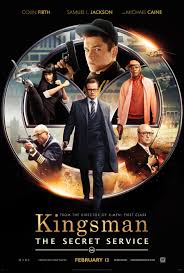 Director Matthew Vaughn’s Kingsman: The Secret Service is my favorite James Bond movie. It’s everything you’d want in a spy thriller while charting its own edgy direction. It’s a combination of Bond and My Fair Lady, and I never knew how brilliant that combination could be until Vaughn got his hands on the graphic novel source material. Newcomer Taron Egerton lays on plenty of star-making charm as a spy-in-training under the guidance of a dapper gentleman brawler Colin Firth. The spy hijinks are fun and stylish but what Vaughn does just about better than any other big-budget filmmaker is pack his movie with payoffs small and large so that the end result is a dizzying rush of audience satisfaction. The action sequences are exhilarating, in particular a frenzied church massacre made to appear as a single take. I never would have thought of the tweedy Firth as an action hero, but he sure plays the part well. There’s also an awesome villainous henchwoman who has blades for legs, and the film makes fine use of this unique killing apparatus. Kingsman explodes with attitude, wit, dark surprises, and knowing nods to its genre forbearers. Vaughn is a filmmaker that has become a trusted brand. He has an innate ability to fully utilize the studio money at his disposal to create daringly entertaining movies that walk to their own stylish beat. This is a cocksure adrenaline shot of entertainment that left me begging for more.
Nate’s Grade: A


 nathanzoebl
You must be logged in to post a comment.