Blog Archives
The Gorge (2025)
 While watching the action-thriller The Gorge, I kept thinking, “Wow, I’m surprised this didn’t get a theatrical release at all.” The Apple Plus original is the kind of movie you’d want to watch on the big screen, with large-scale action, atmospheric imagery, and a creepy sound design meant to elicit shudders. It has a dynamite premise that grabbed me right away: two elite snipers from the East and West, Levi (Miles Teller) and Drasa (Anya-Taylor Joy), are tasked with manning watchtowers overlooking a cavernous and mysterious gorge. They have heavy-duty Gatling guns to make sure whatever is in the gorge stays in the gorge. It’s a year-long tour of duty and both snipers are forbidden to communicate with one another. Naturally, out of boredom and necessity, they break the no-contact rule, first through white board messages, then through shared experiences and competitions, and finally coming face-to-face. For the first 45 minutes or so, The Gorge is actually a pretty lean and effective long distance romance of sorts. There’s ingenuity in the process of getting to know someone from across a large hole in the ground, and both actors have solid chemistry that will help make you silently yearn for a little global collaboration. The movie also has an intriguing scenario with tantalizing details that point to its secret history, until everything is literally spelled out in Act Three. The monsters, who look like a combination of Groot and zombies, are an unsettling character design, though I wanted more variety in their appearance. When the characters finally delve into the gorge for the majority of our climax, we got some new and nasty creepy crawlies, like a tree with rib bones like insect mandibles that ensnare like a Venus flytrap. Alas, I found the stuff inside the gorge to be fun and creepy with a great atmosphere to play upon what we can and cannot see, but it was the stuff above and outside the gorge that made the movie for me. That’s The Gorge for ya: come for spooky monsters, stay for the surprisingly involving romance between monster killers.
Nate’s Grade: B
Share this:

The Village (2004) [Review Re-View]
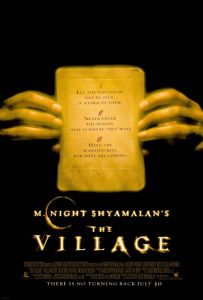 Originally released July 30, 2004:
When saying director names you can play a fun little game of word association. Someone says, “George Lucas,” and things like big-budget effects, empty storytelling, and wooden dialogue come to mind. Someone says, “David Lynch,” and weird, abstract, therapy sessions dance in your head. The behemoth of word association is M. Night Shyamalan. He burst onto the scene with 1999’s blockbuster, The Sixth Sense, a crafty, moody, intelligent thriller with a knock-out final twist. Now, though, it seems more and more evident that while The Sixth Sense was the making of M. Night Shyamalan, it also appears to be his undoing. His follow-up films, Unbreakable and Signs, have suffered by comparison, but what seems to be hampering Shyamalan’s growth as a writer is the tightening noose of audience expectation that he kowtows to.
With this in mind, we have Shyamalan’s newest cinematic offering, The Village. Set in 1897, we follow the simple, agrarian lives of the people that inhabit a small secluded hamlet. The town is isolated because of a surrounding dense forest. Mythical creatures referred to as Those We Dont Speak Of populate the woods. An uneasy truce has been agreed upon between the creatures and the villagers, as long as neither camp ventures over into the others territory. When someone does enter the woods, foreboding signs arise. Animals are found skinned, red marks are found on doors, and people worry that the truce may be over. Within this setting, we follow the ordinary lives of the townsfolk. Ivy Walker (Bryce Dallas Howard) is the daughter of the towns self-appointed mayor (William Hurt), and doesn’t let a little thing like being blind get in the way of her happiness. She is smitten with Lucius (Joaquin Phoenix), a soft-spoken loner. Noah (Adrien Brody), a mentally challenged man, also has feelings for Ivy, which cause greater conflict.
 Arguably, the best thing about The Village is the discovery of Howard. She proves herself to be an acting revelation that will have future success long after The Village is forgotten. Her winsome presence, wide radiant smile, and uncanny ability to quickly endear the character of Ivy to the audience. She is the only one onscreen with genuine personality and charisma, and when shes flirting and being cute about it you cannot help but fall in love with her. And when she is being torn up inside, the audience feels the same emotional turmoil. I am convinced that this is more so from Howard’s acting than from the writing of Shyamalan. She reminds me of a young Cate Blanchett, both in features and talent.
It seems to me that Shyamalan’s directing is getting better with every movie while his writing is getting proportionately worse. He has a masterful sense of pacing and mood, creating long takes that give the viewer a sense of unease. The first arrival of the creatures is an expertly handled scene that delivers plenty of suspense, and a slow-motion capper, with music swelling, that caused me to pump my fist. The cinematography by Roger Deakins is beautifully elegant. Even the violin-heavy score by James Newton Howard is a great asset to the film’s disposition.
So where does the film go wrong and the entertainment get sucked out?
What kills is its incongruous ending. Beforehand, Shyamalan has built a somewhat unsettling tale, but when he finally lays out all his cards, the whole is most certainly not more than the sum of its parts. In fact, the ending is so illogical, and raises infinitely more questions than feeble answers, that it undermines the rest of the film. Unlike The Sixth Sense, the twist of The Village does not get better with increased thought.
Shyamalan’s sense of timing with his story revelations is maddening. He drops one twist with 30 minutes left in the film, but what’s even more frustrating is he situates a character into supposed danger that the audience knows doesn’t exist anymore with this new knowledge. The audience has already been told the truth, and it deflates nearly all the tension. It’s as if Shyamalan reveals a twist and then tells the audience to immediately forget about it.
 Shyamalan also exhibits a problem fully rendering his characters. They are so understated that they don’t ever really jump from the screen. The dialogue is very stilted and flat, as Shyamalan tries to stubbornly fit his message to ye olde English vernacular (which brings about a whole other question when the film’s final shoe is dropped). Shyamalan also seems to strand his characters into soap opera-ish subplots involving forbidden or unrequited love. For a good hour or so, minus one sequence, The Village is really a Jane Austin story with the occasional monster.
The rest of the villagers don’t come away looking as good as Howard. Phoenix’s taciturn delivery seems to suit the brooding Lucius, but at other times he can give the impression of dead space. Hurt is a sturdy actor but can’t find a good balance between his solemn village leader and caring if sneaky father. Sigourney Weaver just seems adrift like she’s looking for butter to churn. Brody is given the worst to work with. His mentally-challenged character is a terrible one-note plot device. He seems to inexplicably become clever when needed.
The Village is a disappointment when the weight of the talent involved is accounted for. Shyamalan crafts an interesting premise, a portent sense of dread, and about two thirds of a decent-to-good movie, but as Brian Cox said in Adaptation, ”The last act makes the film. Wow them in the end, and you’ve got a hit. You can have flaws and problems, but wow them in the end, and you’ve got a hit.” It’s not that the final twists and revelations are bad; it’s that they paint everything that came before them in a worse light. An audience going into The Village wanting to be scared will likely not be pleased, and only Shyamalan’s core followers will walk away fully appreciating the movie. In the end, it may take a village to get Shyamalan to break his writing rut.
Nate’s Grade: C+
——————————————————
WRITER REFLECTIONS 20 YEARS LATER

Usually in the M. Night Shyamalan narratives, 2004’s The Village is where the cracks first started to show in the filmmaker’s game. While 2000’s Unbreakable didn’t exactly reach the box-office successes of The Sixth Sense and Signs, it still earned $250 million worldwide and was definitely ahead of the cultural curve, introducing a grounded superhero story before the oncoming wave of superhero cinema. No, it was The Village that started the questioning over whether Shyamalan’s need for big twist endings was hampering his creativity. While still earning almost the exact same box-office as Unbreakable, The Village was seen with more hesitation, a cautionary tale about a filmmaker, as Matt Singer recently put it, flying a little too close to the sun. From here, Shyamalan entered his down period, from 2006’s Lady in the Water, to 2008’s The Happening, and the big-budget sci-fi misfits of 2010’s Last Airbender and 2013’s After Earth. This was the beginning of the general public becoming wise to Shyamalan’s tricks.
The real kicker is that, twenty years later, it’s clear to me that The Village is two-thirds of a good-to-great movie, ultimately undone by the unyielding desire to juice up the proceedings with an outlandish twist ending. For that first hour, Shyamalan has done a fine job of dropping us into this outdated community, learning their rules and restrictions, and gradually feeling the dread that the old ways might not protect them from the monsters just along the boundaries. There’s an efficiency and confidence to that first hour, with carefully planned shots that establish key points of information, like little girls panicking at the sight of a red flower and burying it in the ground before going back to their chores. The cinematography is elegant and moody, and the violin-soaring score by James Newton Hoard is a consistent emotive strength. The first encounter with the monsters roaming around the town is fraught with tension, especially as our one character holds out her hand waiting for her friend/love interest to return. The cloaked monsters are also just a cool design, with their long claws and porcupine-like frills extending from their hides.
 The greatest strength is Bryce Dallas Howard (Jurassic World) as our surprise protagonist, Ivy, daughter of the community founder, Edward Walker (William Hurt). Howard had made small cameo roles in her father’s films, but she was cast by Shyamalan after he watched her perform on stage. She is spellbinding as Ivy, a woman of great vulnerability and strength, of integrity and charisma. The scene where she sits down on the porch beside Lucius (Joaquin Phoenix) and dance around the edges of flirting is sensational, and when she talks about seeing people’s colors, or auras, and then smirkingly whispers, “No, I will not tell you your color, stop asking,” in the same breath, I defy anyone not to fall in love with her like poor Lucius. This simple love story actually works well. Lucius is an introverted man given to great emotions he doesn’t know how to fully express, which pairs nicely with the chatty and ebullient Ivy. The protagonist shift works wonderfully as well. For the first hour we believe we’re following Lucius as our main character, especially since at this point Phoenix’s star power was rising and Howard had none. Then, with the sudden sticking of a knife, Lucius is taken down and the movie becomes Ivy’s story and her quest to save her beloved. Her cry of not being able to see Lucius’ color is a well-coordinated punch to the gut. This is an example of a rug pull that really works, elevating the stakes and presenting the real star, the girl so many have overlooked for one reason or another, who will be our hero when we need her most.
But then it all falls apart for me once Shyamalan reveals two twists: 1) the monsters are not real, merely costumes the adults wear to enforce their rules through fear, 2) the setting of this village is not 1897 but modern-day, with the villagers living in a secluded nature preserve. Apparently, Edward was able to gather enough violent crime victim relatives to begin this experiment in “returning to our roots.” He served as an American History professor, so who better than to create a thriving community? You know how to establish safe drinking water there, my guy? How about cabin-building? I assume one of the elders must have had some wealth as it’s revealed later, via Shyamalan’s onscreen cameo role, that the government got paid off to stop having airplanes fly over the nature preserve. I actually kind of hate this twist. It feels the most superfluous of all Shyamalan’s fabled twist endings. I was genuinely enjoying the movie and how it was spinning up until this point, but Shyamalan cannot leave well enough alone. I get that Shyamalan is crafting an allegory for the War on Terror and the constant anxiety of post-9/11 America, replete with color codes meant to serve as warning signs. I get that we’re meant to find the town elders as villains, keeping their community repressed through the fear of convenient monsters. The lessons are there to dissect, but I’m disappointed because I was enjoying the allegory on its literal level more than its intended themes. It’s also because I feel like the twists overburden the movie’s charms.
 Another reason the twist really falters is that it creates all sorts of nagging questions that sabotage whatever internal logic had been earlier accepted. Adults deciding to break free from modern society so they can start their own secluded LARP community can work as a premise, but it requires a lot more examination that cannot happen when it’s slotted as a concluding twist. Imagine the kind of determination it would take to retreat from modern society and rekindle an agrarian life from hundreds of years ago. That means abandoning all your family, friends, the comforts of modern-day, and the sacrifices could have been explored, but again, it’s just a twist. There are present-day communities, most famously the Amish, that shun the technological advances of modern society to retain an outdated sense of homespun culture and religious community, but often the members have grown up in this culture already. Regardless, retreating into the woods to start your own 18th century cosplay is a commitment, but when you know all the adults are in on this secret, why are they staying in character at all times? When it’s just two adults talking to one another, why are they keeping to their “characters” and talking in that antiquated jargon and syntax? Is it collective Method acting? Is it a sign they’ve ref-ramed what they consider normal? Have they gone so deep that their muscle memory is to say “thee” and “thou” vernacular in the mirror? They went through this elaborate facade because they lost people in the “real world,” but human impulses, violence, and accidents can occur in any community, no matter if you got cell phones or pitchforks. It starts to gnaw away at the tenuous reality of the scenario, a reality I was accepting until the late rug pull.
It also eliminates some of the stakes of Act Three when Ivy travels beyond the boundaries and may face the wrath of the monsters. It’s maddening that Shyamalan reveals the monsters are not real, mere tools to scare the children into obedience, and then has a supposed suspense sequence where Ivy stumbles upon a thicket of red flowers, the dreaded color the monsters hate. But wait, you might recall, there are no monsters, so then why does it matter? When you realize that her dad could just have taken a hike and driven to a drug store to gather medical supplies, without the supernatural threat keeping them confined, it kind of seems silly. Here you were, worried about the fate of this blind girl, when there’s no reason she had to even venture into this danger because one of the adults could have performed the same task without risking their big secret. I know they think Ivy’s blindness might uphold their secret, but why even risk her possible danger from falling down a hill she couldn’t see or a rock that twists her ankle? Her dad would rather have his blind daughter venture into the woods than do this trek “to the next town” himself. At the same time, her personal journey outside the community is robbed of the supernatural danger and it also re-frames the father as someone burdening his blind daughter with a task he could have achieved. He says she has the power of love and that will guide here, but you know a compass could also help. You could make the argument that maybe his guilt was eating away at upholding such a big secret, maybe he wanted to get caught, but I don’t buy it. Edward argues with his fellow elders that it is the next generation that will keep hold to their traditions and ways of life, and they must ensure this survival. That doesn’t sound like the perspective of a man wishing to break apart the close-knit community he helped build.
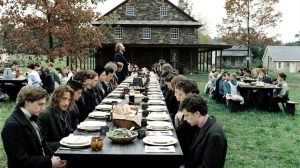 What to make of Adrien Brody’s mentally challenged character, Noah? He’s living in a time that doesn’t know how to handle his condition, but he’s also set up as a quasi-villain. He’s the one who stabs Lucius out of jealousy that Ivy favors him. He’s the one who breaks free, steals a monster get-up, and antagonizes Ivy in the woods. He also falls into a pit and dies alone. I don’t really know how to feel about this character because I don’t think Shyamalan exactly knows what to do with him.
Having recently re-read my original 2004 review, I’m amazed that I am sharing almost the exact same response as I did with my younger self. Even some of the critical points have similar wording. My concluding summation still rings true for me: “It’s not that the final twists and revelations are bad; it’s that they paint everything that came before them in a worse light.” You can rightly tell an allegorical story about people rejecting modern society and living a secluded and hidden life. You can rightly tell a story about adults posing as monsters to keep their children in line and obedient. However, if you’re going to be telling me that story, don’t supply an hour’s worth of setup that will be damaged from these revelations. After The Village, it was a steady decline for the filmmaker once dubbed “the next Spielberg” until 2017’s stripped down thriller Split, anchored by a tour de force performance from James McAvoy. It’s frustrating to watch The Village because it has so much good to offer but ultimately feels constrained by the man’s need to follow a formula that had defined him as a mass market storyteller. This was a turning point for Shyamaln’s fortunes, but the quality of The Village has me pleading that he could have shook off the need for ruinous twists and just accepted the potency of what was already working so well.
Re-View Grade: B-
Share this:

Avatar: The Way of Water (2022)
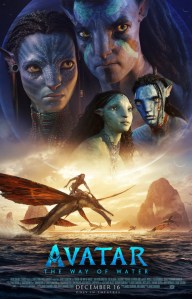 In the 13 ensuing years since James Cameron’s smash hit Avatar, we’ve debated whether or not the collective consciousness has simply moved on and forgotten what was, at one point, the highest-grossing movie of all time. What cultural dent had it made? Are there really still fans? Was it a fad of the new 3-D, itself already dissipated? Does anyone really want three or four sequels? Then Avatar: The Way of Water was released in late 2022 and it didn’t do as well as its mighty predecessor. Instead of being the highest-grossing movie ever, it’s only the third highest-grossing movie ever with a paltry $2.3 billion worldwide (how can the man even sleep at night?). It’s a lot of the same, both in its big feelings, awe-inducing visuals, and its resurrection of characters, scenarios, and conflicts of before, so you’ll likely find yourself reliving your own 2009 Avatar reaction.
Cameron’s long-awaited follow-up returns to the alien word of Pandora where our Marine-turned-Na’vi Jake Sully (Sam Worthington) has raised a large blended family with his Na’vi partner, Neytiri (Zoe Saldana, given little to do but cry this time). The first hour of this three-hour blockbuster is establishing the family dynamic with the different kids, including adopted daughter who is… somehow… the daughter of the deceased scientist Grace (both Sigourney Weaver) as well as the human child nicknamed Spider who is the biological son of Quaritch (Stephen Lang), our deceased villain. Nobody seems to stay dead in this series as Quaritch concocted his own backup plan in case of his untimely demise. He transferred his consciousness into a tank-born avatar, and this new Na’vi Quaritch has his own team of Marines in blue-skinned Na’vi bodies. They’re heading back to Pandora for some out-of-body vengeance, and thanks to their genetics, they seem to get a pass from the natural environment of Pandora mistaking them as native.
 There’s a lot of set up here, and the second hour introduces us to the coastal community, and it becomes another formula of the outsiders learning the rules and culture of the new setting and integrating, turning enemies into friends, gaining honor, etc. It’s within this second hour that the big environmental message coalesces around whaling, with one Sully son bonding with an alien whale Free Willy-style. There’s a whole hunt sequence that poaches a mother and her calf that’s quite upsetting. The parallels are obvious but subtlety is not exactly one of the storytelling options in the Avatar universe. This is a broad canvas in the biggest sense, so every message will be spelled out very finely and underlined, with character voicing obvious themes and villains practically twirling space mustaches. And that’s okay. The final hour is an action-packed showdown bringing all the characters to account and forcing Jake to face off once again with his old commander.
The visual immersion is outstanding and the real reason to sit still during all three hours of Way of Water. The Oscar-winning visual effects are transcendent, and the extended sequences underwater really captivate and achieve the sense of natural awe Cameron aspires for. It is an exceedingly pretty movie to watch, and the level of high-definition detail is astounding. There’s a tangible realism here even when it’s entirely gangly CGI characters. At no point does it feel like an empty green screen stage or an over-exposed cartoon. The world of Pandora is still interesting and worth exploring, and the coastal aliens with their evolutionary differences makes me excited to explore other corners and communities of this alien world. The story works, and the payoffs work, and each of the Sully kids has a moment to shine, though I kept confusing the two older brothers (where did one of these kids learn to say “bro” every other word?). It’s a bit strange to see and hear Weaver in a preteen alien’s body, but that disconnect is part of the point, as the character feels like a foreigner searching for meaning. Considering the decade-plus delay, the huge scope, and setting up potentially three other movies, I’m impressed that Way of Water even works as well as it does as a sequel. I was able to re-acclimate pretty easily in that first hour.
 It’s not revolutionary storytelling but not every movie need be. It follows a familiar formula but puts in the work to make the action meaningful and connected to character and for the emotional beats to resonate. I thought the upside-down sinking military vessel had some striking, terrifying Poseidon Adventure-esque visuals, and the sequence was rooted in the family trying to save one another. With so many moving pieces and characters, the plot can be overburdened and redundant at times (the Sully kids get kidnapped so often they might as well save time and tie themselves up early) but even at three hours it doesn’t feel slow or wasteful. There is a sense of repetition in bringing back so many of the same faces, like literally rehashing the same villains. I wish more consideration was given to the new Quaritch and his own existential journey of the self. Just because you have the brain of this dead evil guy, do you have to follow in his doomed path? That could have been a really intriguing and profound character journey, the cloned Marines bred to be weapons who decide their own identities. That could have sufficed as the entire movie for me. The messages are heavy-handed but effective, though Pandora already had a natural resource that Earth wanted to exploit so I didn’t think we needed a second natural resource that essentially functions as immortality juice. At this point, will the third movie introduce ANOTHER magical resource that cures cancer? Likewise, I hope the next movie doesn’t find us yet another Quaritch (a twin brother!) looking for further score-settling. The ending sets up a larger confrontation with Earth’s corporate elite that will come about with the ensuing sequels, though I would have thought since Way of Water makes a big leap forward in time that Earth’s powerful forces would have already marshaled their unhappy response to being kicked out in the original movie.
Cameron has an innate blockbuster sensibility and storytelling structure; the man just knows how to tell rousing big screen adventures like few others. I didn’t see Way of Water in theaters but I won’t make the same mistake with the many Avatar sequels that will dominates the 2020s. It’s a bit hokey though deeply sincere, and Cameron proves yet again that he should not be doubted on big stages of his own creation. It might take the domestic gross of a small country to make these sci-fi epics of his, but the man delivers like few in the rarefied field of dependable blockbuster artists. There’s going to be an Avatar sequel every two years, so this universe won’t go extinct anytime soon, and I’ll be there waiting too.
Nate’s Grade: B
Share this:

A Monster Calls (2016)
 A young mother (Felicity Jones) is dying from a terminal illness. Her son Conor (Lewis MacDougall) escapes into the world of his art and imagination to cope. This includes envisioning a giant living tree voiced by Liam Neeson who visits Conor to tell him three stories, and in the end he demands one from Conor. It’s a Hollywood cancer weepie with stylistic fantasy elements, kind of a Lifetime TV approach to Pan’s Labyrinth, and I must say I was rather unmoved through every drop of treacle. Part of my problem was that Conor has this larger-than-life fantasy creature… who only tells him stories, which lead to extended animated sequences that are beautifully rendered in watercolor paints. What’s the point of having a giant monster if all it does is tell you stories? He might as well be anything and any size then. The plot also follows a very familiar path as Conor must confront his grief and anger as his mother, one of those regular movie characters who become heavenly and wise when stricken with cancer, declines in health. I felt removed too often and kept at the fringes. Rarely did I care about these characters and that’s because the movie didn’t give me a reason to. Yes she’s dying, and yes he’s sad and troubled, but so what? A Monster Calls needed to lay more foundation with these characters who come across very thin. The ultimate purpose of the monster is a rather pat revelation and the emotional climax felt undeserving of all the swelling strings on the musical score. There just isn’t anything in A Monster Calls that separates it from a pack of maudlin imitators. The actors all do pleasant work but they aren’t given more than the barest characters to work with, which forces an audience to feel things simply by grief association. Coming from director J.A. Bayona, a visonary who startled and amazed with The Orphanage and The Impossible, I’m even more confused and let down that a man this talented would choose this. Also, at no point does a CGI tree monster Liam Neeson utilize any specific plant-based set of skills.
Nate’s Grade: C+
Share this:

Exodus: Gods and Kings (2014)
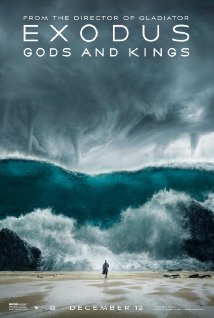 Director Ridley Scott (Prometheus) is back to work some of his Gladiator magic on another sword-and-sandals epic, the classic story of Moses, this time played by an ever-bedraggled and bearded Christian Bale. It’s been a banner year for Christianity at the movies, though most of those films have been uninspiring save for Darren Arofonsoky’s radical and ambitious Noah. That movie did not go over well with many conservative ticket-buyers. That’s the danger of adapting the biblical epics; pleasing the core audience means not straying too far from the accepted renditions of the oft-told tales, no matter if those popular renditions are themselves inerrant. Exodus: Gods and Kings is an underwhelming translation that slogs through the miraculous. It’s empty CGI wonder in place of authentic storytelling and emotional resonance.
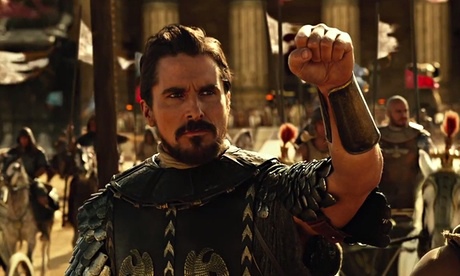 Exodus: Gods and Kings is a big-budget biblical epic that is startling in what it lacks, namely any amount of surprise or character development. The Moses story is oft told so I’m glad that Scott’s film skips ahead to when he’s already an adult. No basket in the reeds necessary. The brotherly conflict has little impact because, besides Moses, no other character is even given proper attention. Ramses (Joel Edgerton) is pretty much a thoughtless killer from the start, someone who ignores his advisers when it comes to political unrest and just slaughters his own starving people. He is by no means a dynamic villain in any shape, which is disappointing because the role has such dramatic potential. The 1998 animated film The Prince of Egypt did a better job exploring the relationship between Moses and Ramses, the pharaoh. In fact, that movie did just about everything better, and it had some pretty songs too. Stuck with a one-note villain, Exodus tries to round out Moses by making him a figure of doubt, providing an arc where he finds his voice when he finds his faith in Judaism. The film even sets it up so Moses has to go on his quest so he can just return home to his family. It’s a pretty strict hero’s journey storyline. Bale is plenty good. His character just isn’t that interesting nor is anyone else. Being stuck with this crew for 150 minutes can get to be rather tedious. That’s because the real emphasis has been put on the special effects and digital landscapes. The action is acceptable but little sticks in your memory. I’m starting to become numb to CGI spectacle. I’m starting to think back to the epics from the 1950s and 60s, when there was no such thing as computer effects. Every person assembled for those epic shots of huddled masses was a real human being, and that’s becoming more impressive with each and every CGI spectacle with copy-and-paste digital figurines.
Given the predictable nature of the plot, you try and find little moments or directions that stand out, something, anything to mark this newest Moses story as different from the numerous retellings of cinema’s past. Beyond the modern-day special effects and the strength of Scott as a visual artist, here is a short list of what you have to look forward to with Exodus: Gods and Kings.
1) An attempt to ground a biblical epic with realism. If conservative audiences were upset with Aronofsky’s portrayal of the Almighty in Noah, just wait till they see what Exodus does. It’s not that God has been removed from the tale, it’s just that God has been mitigated in a way as to provide a rational throughline to follow the supernatural events of the ten plagues and so on. There’s even the possibility that Moses is just seeing things in his head. Two different characters advise Moses that being hit on the head could be the real source for his visions of God. Joshua (Aaron Paul) spies on Moses at several points arguing with God but sees no one else. The plagues are presented in a cause and effect series of misfortunes, with the Nile being turned red due to a surge of crocodiles munching on all the fish. The polluted water then causes the frogs to leave en mass, which then causes them to die and bring about waves of flies, which bring disease to sicken the livestock as well as boils for the Egyptians. Some thought went into this, however, it’s all inconsequential with the Angel of Death killing the first-born sons. There’s no real skeptical or scientific method to explain away this one, as the biblical story relates, and so the grounded approach seems misplaced. It takes away the miraculous from the miracles. And yet, even the parting of the Red Sea is given this same approach, with it resembling low tides brought about by perhaps a meteor strike. The fantastical nature of the Moses story feels handicapped by going a more realistic route. This is not the biblical epic for realism.
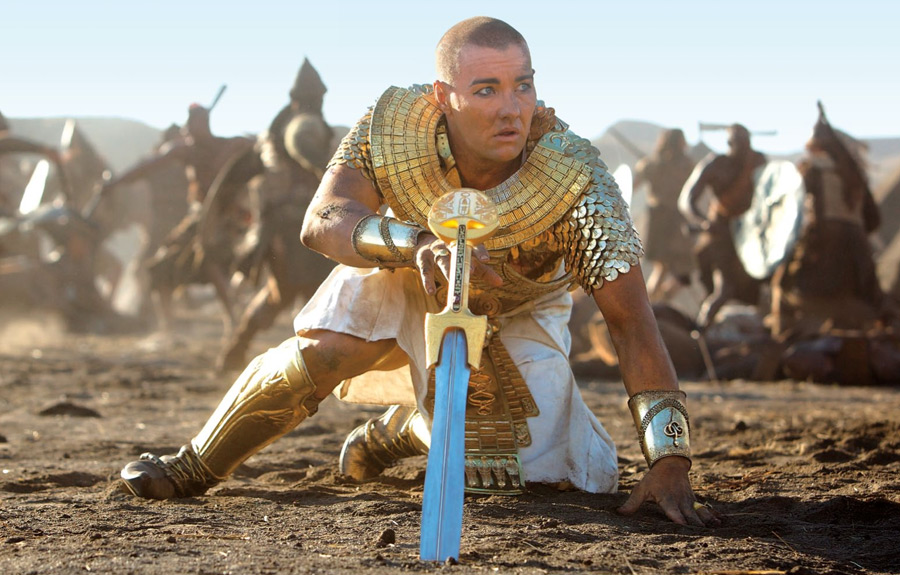 2) God is literally represented as a petulant child. When God does make Himself present for Moses, it’s in the form of a young child who is often mocking his servant. This is an angry often-bloodthirsty God who doesn’t appreciate being challenged. He complains how long Moses is taking with his war of attrition, and Moses says right back, “Impatient? You waited 400 years with ‘your people’ in slavery.” A fair complaint, and one that God does not answer.
3) Bad overall casting. Whitewashing isn’t exactly a new trend in Hollywood. It’s not like Charlton Heston looked particularly Middle Eastern. However, it’s rather distracting to watch a movie starring Egyptians and Middle Eastern Jews portrayed by a Welshman, an Australian, John Turturro, Sigoruney Weaver and Aaron Paul. I am a fan of each of these actors but they are just wrong for these parts. There are very little people of any color in the film despite the fact of its geographic location. Moses marries Zipporah, who several biblical scholars believe to be Ethiopian, which seems like a natural opportunity for some much-needed diversity in the cast. Just because you give Paul a bushy beard does not mean he suddenly resembles a Middle Eastern Jew. Same thing with adding eyeliner and bronzer to Edgerton. Then there’s the bizarre appearance of Scottish actor Ewen Bremner (The Rundown) as an adviser for the king. Taken as a whole, the whitewashing is a nagging distraction from a supposedly more grounded approach. To be fair, having relatively unknown (as far as the public is concerned) actors of appropriate ethnic background speaking in subtitled Hebrew and Egyptian sounds like a hard sell for a studio footing a $140 million dollar bill.
4) Lots of dead horses. This is not a friendly movie for our equine friends.
5) Moses sex. Well, sort of, because showing a husband and wife being physically intimate will still offend some of the more conservative ticket-buyers. So after Moses goes through his somewhat romantic question and answer ritual with his wife, the camera pans away from the disrobing couple and fades out. Classy. Now on to more CGI spectacle and carnage thank you very much.
I admire Noah more and more and think he successfully found a way to make a biblical epic accessible, challenging, and complex morally and psychologically without sparing the dark details. In essence he found a way to make a popular story new and interesting again. Scott’s Exodus just leaves me shrugging my shoulders. It’s by no means an appalling film. Beyond the big-budget modern-day spectacle, there isn’t enough going on in this movie to even justify all the expenses. The characters are too sketchy and given little to do, especially Ramses who pretty much just sneers and barks for 90 minutes. The costumes are fancy, the production design is lush, and all the technical elements are impeccable. It just falls woefully short on what should make you care. It feels like a product more than a film and a resonating story, and as such it’s delivered just in time for the Christmas shopping season for the masses. The film takes too long to get started and too long to conclude. It has some moments in the middle, especially when Moses is plotting his political insurrection, but as a whole Exodus is disappointingly lackluster. It ends up becoming empty and noisy CGI spectacle, with lots of yelling to compensate. It’s hard to find inspiration from the film when you’re checking your watch.
Nate’s Grade: C
Share this:

Rampart (2012)
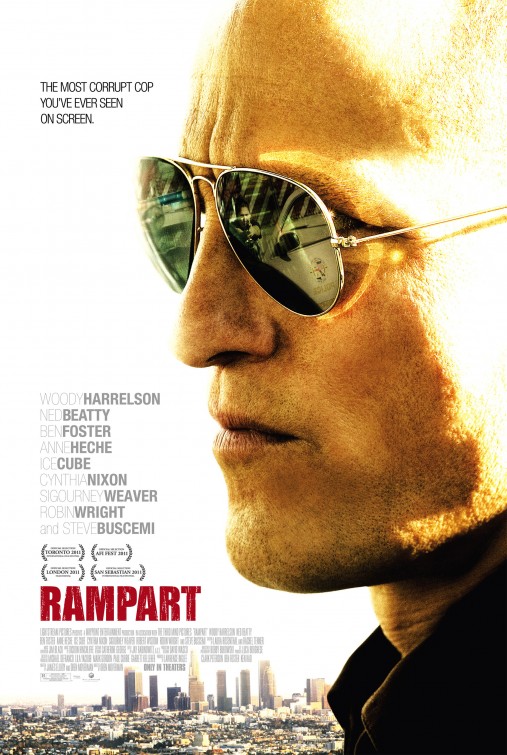 Stop me if you’ve heard this one before. A corrupt L.A. cop (Woody Harrelson) makes bad choices, alienated and frightens his family, and looks to be on the way out as a career of taking the law into his own hands is at long last catching up with him. Yeah, you probably stopped me after the third word in that sentence. This dour character-study showcases Harrelson nicely as a cocksure cop who’s so self-destructive and paranoid that he pushes everyone away. Co-written and directed by Oren Moverman, who made the terrific and searing drama The Messenger, this movie just about turns into high-gloss navel-gazing. The plot is quite loose and there’s very little traction. We get to see scene after scene of Harrelson behaving badly or violent, but what does it all add up to? We already know he’s a bad cop tortured by his own sins and the demands of the job. In a way, there’s an intriguing connection between law enforcement and soldiers who are often called to bear incredible burdens and just deal with it, forgotten by a public complacent with being safe. But really this movie is just one long trip with an angry man who keeps everyone, including the audience, pushed away. He’s complex but I can’t say we ever got to know him better. The film is well acted with plenty of recognizable stars, but why should I care? The central message about the prevailing influence of corruption is a bit heavy-handed as well; at one point Harreslon’s wife says, “You made us dirty.” Rampart is a disappointing venture for Moverman despite Harrelson’s best efforts. In the end, when you’re stuck with a dirty cop he better be worth the time.
Nate’s Grade: C
Share this:

The Cabin in the Woods (2012)
 The Cabin in the Woods has been building an avalanche of buzz in the time it’s been sitting on the shelf. Originally filmed in 2009, the horror comedy from Buffy the Vampire Slayer creative heavyweights Drew Goddard and Joss Whedon has been patiently waiting to unleash its wicked Jack-in-the-box of surprises. Directed by Goddard, and written by Whedon and Goddard, The Cabin in the Woods is a brash enterprise, a blast of entertainment and a breath of fresh air in a genre that typically teeters into self-parody. If you haven’t seen the movie yet and have a strong, or even curious, desire to do so, then stop reading. Go in as blind and unspoiled as possible. Then you can come back and read my witty words. It’s okay. I won’t take offense. In the meantime, I’ll keep myself busy. Back? Good, let’s get started then.
You know the setup. A group of dumb teenagers spend a weekend at a friend’s cabin in the middle of nowhere. There’s the jock (Chris Hemsworth), the slutty girl (Anna Hutchinson), the stoner (Fran Kranz), the bookish one (Jesse Williams), and the mousy girl-next-door virginal type (Kristen Connolly). There’s the scary old guy at the gas station, there’s the promise of debauchery and sweet oblivion. But we’re not the only ones watching the gang. A group of lab techs, led by Hadley (Bradley Whitford) and Sitterson (Richard Jenkins), is watching their every move. They control the cabin and its surroundings and are manipulating events to lead to slaughter. But why are they going to all this trouble? That’s just the tip of the iceberg here.
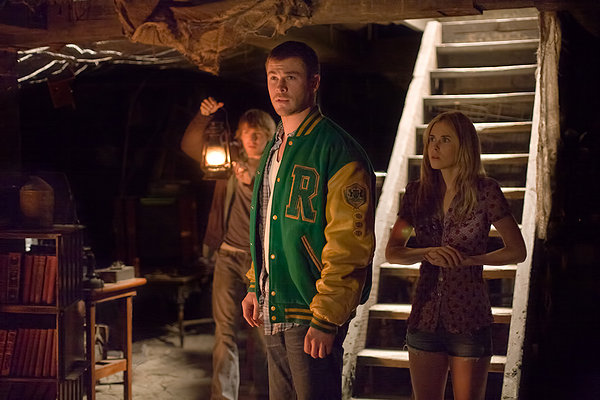 The macabre sense of humor is what will immediately separate Cabin in the Woods from its blood-and-guts brethren. The sharp dialogue is routinely laugh-out-loud funny, absurd in the right parts. Whitford’s downbeat reaction during a joyous moment of celebration had me howling. The movie is so smart, sometimes too smart for its own good. If you’re going to level one major charge against the movie, it’s that it isn’t really ever scary. Oh sure it has some stuff that should be scary given the particulars, and its 31 flavors of horror should find something that tingles everyone’s spine on some level. But this is much more of a deconstruction of the horror genre and its audience than an actual horror movie. Whedon and Goddard undercut their horror almost at every turn, settling for the ironic laugh or satirical tweak and repeatedly cutting back to the lab guys to provide a few good laughs and commentary (Jenkins has a terrific foul-mouth rant aimed at children that left me doubled over in laughter). Do not be mistaken; the lab stuff is easily the best part of the movie. Upon my second viewing, I found myself growing weary with the teens-in-a-cabin stuff and anxiously waiting our next detour into the weird and wonderful lab. The duo of Whitford (TV’s The West Wing) and Jenkins (Friends with Benefits) makes for some terrific and biting middle management corporate satire, as well as satirizing the jaded, bloodthirsty audience of slasher movies. You can tell that Whedon and Goddard love horror movies and are frustrated with the nihilistic rut the genre has found itself mired in. And as a deconstructive exercise, Cabin in the Woods is first-class. Roger Ebert succinctly called the movie a “fanboy final exam.”
It can be a tad clinical at times, failing to give us any true attachment to the characters even in an ironic sense, but when a movie is this fun, this wild, and this clever with its deconstruction of genre, I concede the point of having to root for somebody. The characters break the stereotypical mold; the jock is on academic scholarship, the smart guy happens to also be a hunky jock, the slut isn’t really slutty, the virgin isn’t squeaky-clean, and the stoner is the smartest guy in the group, aided by his cannabis (As one character later reasons, “We work with what we got”). He’s the only one who seems to be able to notice the strange manipulations at work. Once you dig into it, the very nature of how and why we watch horror is analyzed by Cabin in the Woods (get ready for some voyeurism parallels). The nature of fear and sacrifice is given some thought, though this stuff gets a bit lost in the madhouse of a final act. The movie becomes a funhouse of horrors and the frenetic carnage and chaos elevates the energy level. I cannot think of a movie that ended in such a whirling dervish of excitement and deep, demented satisfaction. This is one movie that doesn’t just end with a bang; it ends with every bang you can think of. Horror fans are going to be hopping out of the theaters, foaming at the mouth, desperate to tell every one of their friends what they just witnessed. I wish several of my friends would hurry up and see Cabin in the Woods so I had somebody to talk about its many pleasures, thrills, and surprises with. The movie has several terrific payoffs. This is the most fun I’ve had with a horror movie since 2003’s Cabin Fever. Must be something about cabins that brings out the meta-ness.
 Considering this was on the shelf for over two years while MGM worked out its bankruptcy dealings, it’s fun to see how fate has been to this lot of actors. The biggest name has got to be Hemsworth, better known as the flaxen, hammer-wielding God of Thunder Thor in the Marvel movies, and Whedon’s upcoming Avengers ensemble. He’s rather enjoyable onscreen and his hero moment is one that will definitely be a talking point. The two standouts from the cast, other than Jenkins and Whitford of course, are Connolly (“iGirl” on the Web series, iChannel) as the nubile Final Girl and Kranz (TV’s Dollhouse) as the clever pothead. Connolly has got a great face for movies, looking like the younger sister of Ellie Kemper (TV’s The Office) or Jayma Mays (The Smurfs), and I’m always a sucker for a redhead. Kranz is so good with the comedy that you may fail to notice all the work he’s actually putting into his role, which quickly becomes the audience’s voice of reason.
But the strangest quirk for a movie knotted with them comes to the casting of its resident “slut” played by Hutchinson. The woman has a sultry side that comes through without going overboard into parody. Scanning through her resume, I see that Hutchinson portrayed the Yellow Power Ranger (Lilly) for 32 episodes in Power Rangers: Jungle Fury. Now here’s where things get interesting. Being the movie aficionado that I am, I recognize that Cabin Fever also had an actress, Cerina Vincent, who portrayed the Yellow Power Ranger (Maya) for 45 episodes in Power Rangers: Lost Galaxy. Here’s where it gets even weirder. Both Hutchinson and Vincent are the only cast members in their movies to go nude in their respective films. So two actresses, both different versions of the Yellow Power Ranger, both get naked and star in horror genre deconstructive movies with “cabin” in the title! Is this one of the Mayan signs? Should I contact Dan Brown? Does it say something that the yellow ranger appears to be the most comfortable with nudity? This may be the greatest and most obscure observation I’ve ever made.
Of course there are so many fun surprises that it puts me in a bit of a critical bind. I don’t want to go into too much detail because that would spoil the fun, though rest assured that The Cabin in the Woods does not live or die based upon unknown plot twists. You may think you know given what’s already been revealed via the trailers, but really you have no idea how deep this thing goes and to what ends. Unless you just happened to be me, which at last count there was only one of (my evil twin long since slain… or was he?). I say this not as some point of pretentious bragging, but it’s because I wrote a horror screenplay a year ago that also satirized the genre tropes (for those few interested, it was called Blood Wake). I won’t go into spoiler detail, but both of our bad guys were called into question as being bad, from a greater good standpoint, and the killers had more on their minds than simply punishing dumb, horny teenagers. Well, after watching Cabin in the Woods, I know that screenplay goes back in the shelf now where it will live in eternal slumber thanks to core similarities. But if somebody’s got to be wielding the knife, at least it’s my man crush Joss Whedon.
Nate’s Grade: A-
Share this:

Cedar Rapids (2011)
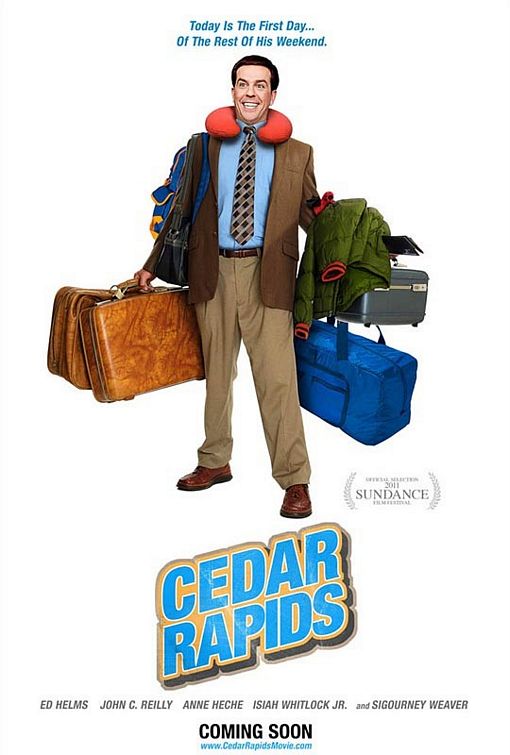 When people think about the temptations and sundry thrills of the Big City, most people are probably thinking of a sin-stained location like Las Vegas. Most people would not confuse Vegas with Cedar Rapids, and yet the Iowa city of note is the setting for a sweet and sometimes dirty, but still sweet, comedy of big-city adventures. To a guy from a town without a stoplight, Cedar Rapids is like New York City. It all depends on your perspective.
Tim Lippe (Ed Helms) is an insurance salesman from Brown Valley, Wisconsin. The town is small but the little insurance agency that could has won the coveted Two Diamond Award four years running at the annual insurance convention held in Cedar Rapids. Tim’s life is in a holding pattern. He wants to do big things but can’t find the oomph to get there. He’s involved in a romantic tryst with his (one-time) seventh grade teacher (Sigourney Weaver). Tim’s chance to make a name for himself comes when he’s selected to represent his company at the annual convention. He has to impress the right people to take home another Two Diamond Award. Never having been on a plane before, he leaves small-town Brown Valley for big-city Cedar Rapids. At the convention site, Tim rooms with Ronald Wilkes (Isiah Whitlock Jr.) and the more unsophisticated Dean Ziegler (John C. Reilly). The group meets up with Joan Ostrowski-Fox (Anne Heche), and together they work on helping Tim loosen up. Over the course of the weekend, bonds will be made, principles will be tested, and tom foolery of the first order will be had.
The premise is rather simple, small-town guy heads to the big city (well, bigger) and the culture shock that waits. But the film never looks down on Tim Lippe. While there is plenty of humor drawn from his naiveté, the movie doesn’t condescend or play up the small-town folks as rubes and squares. It’s funny to see Tim’s mild-mannered explosions of anger, mostly of the “horse pucky” variety of vulgarities, but the movie doesn’t say that the big-city folk are better than Tim. On the contrary, Tim is a principled and devoted insurance salesman, courteous to a fault. He could have stepped out of a Frank Capra movie from a bygone era (Mr. Lippe Goes to Town). Tim is sheltered, which provides some amusing fish out of water comedy, like when he initially is on alert because his roommate is African-American, a rarity in Brown Valley despite whatever the name may imply to some. Tim is a man out of time, but that can be small-town life in general. The Midwestern satire reminds me of the gentle yet knowing nudge of King of the Hill. Phil Johnston’s script sets up Tim’s dilemma as a crisis of conscience, the compromises we make in morality. Tim’s trip to the “big city” is the push the guy needs to get his life out of stasis. There’s something deeply satisfying in watching a character you care about triumph in the end, even if that triumph is a small victory befitting a small-town guy with a big heart.
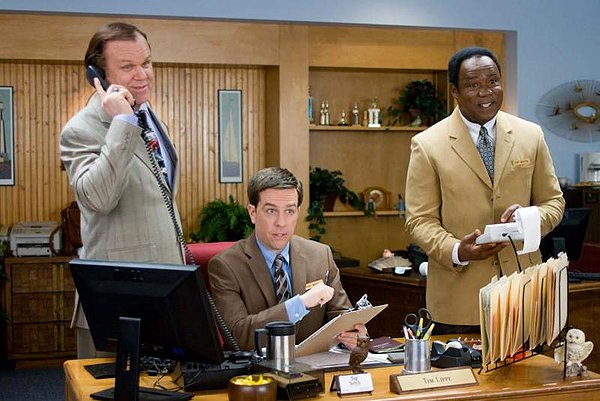 The real fun of the movie, however, is watching the effect the group has not just on Tim but on each other. They teach Tim to cut loose and live a little, but this is still Cedar Rapids, so cutting loose goes as far as nighttime pool escapades and drunken sex. His flirtatious fling with Joan brings the guy out of his shell, and the two of them are genuinely cute together without going overboard. It’s a reserved romance that feels true to the nature of both of the characters. Dean is the loudmouth knucklehead notorious for his oafish shenanigans, but once he feels accepted he goes to war for his friends. He’s a buffoon but not stupid. And then Ronald, though less developed than the other three, provides a nice foil as a straight-laced businessman who keeps it together impressively. Together it’s a team of likeable characters that have grown closer together over the course of that weekend in Cedar Rapids, and you’ll feel the same. You feel like they’ve formed a family around the earnestness of Tim.
Helms (The Hangover) is a suitable candidate for a nice, regular, Midwestern guy. Helms has honed his awkward comedy chops after several seasons on TV’s The Office, and here he sticks to what he knows. Tim Lippe is another in a line of embryonic men. Helms settles into his usual nervous tics that fans will be familiar with. His sunny naiveté wins over the audience and provides for several laughs in contrast with the jaded “big city” folk. Reilly (Step Brothers) can overdo his character’s intentional obnoxiousness. He’s chartered a successful second career as a winsome nitwit, so like Helms, Reilly relies on notes gleaned from past performances. Whitlock Jr. is mostly straight man to the others. His comedic highpoint is an impromptu impersonation of a character from The Wire to get the group out of a dangerous jam (Whitlock Jr. himself played a state senator on The Wire). Other than that, he’s more contrast than character. Heche (TV’s Hung) is a real surprise. She underplays her character, tantalizing us with tidbits that leave us wanting more, much like Tim. The way she plays Joan, you feel the connection.
 With all that said, Cedar Rapids still has its share of flaws. The naïve comedy can go so far before you start to question Tim’s senses, like his casual mistaking of a prostitute (Alia Shawkat, Whip It) for a fellow attendant. His relationship with his former seventh grade teacher is intentionally awkward, but the whole plotline presents an unseemly overtone that doesn’t fit. She’s made to be rather motherly, even when she’s rolling her eyes at her bedmate’s pie-eyed declarations of being “pre-engaged.” I think the motherly aspect makes the whole Oedipal mess even worse (Weaver just seems bored). Late into Act Three Tim goes on a drug-fueled bender that feels out of place for his character who, when first asked for a drink, requested a beer of the root kind. The character of Dean is given too many moments to just wander around and spout crude one-liners. It sometimes feels like the movie is resting while it lets Dean do his thing, and a little of this guy can go a long way.
The plot is relatively predictable and the ending is pretty pat. It works, but the actors and the characters were capable of more. The relationship between Tim and Joan also leaves something to be desired. There’s a great assembly of recognizable guests (Stephen Root, Thomas Lennon, Rob Corddry, Mike Birbiglia) that stop by but add little. Again, the potential for more feels missed. With a solid 80% of the movie taking place in a hotel, you can also start to feel a little cabin fever. And not that it matter much, but I’m disappointed that film with “Cedar Rapids” in its name was filmed in Ann Arbor, Michigan (Iowa did away with its in-state film tax credit).
The appeal of Cedar Rapids, the film, is much like the appeal of its central figure, Tim Lippe. It’s an unassuming, earnest charm, enjoying the company of likeable characters who we want to see succeed. I just wish the predictable plot had done more or trusted the actors’ capabilities. The core characters feel mostly authentic and easily recognizable, which makes the familiar, if at times bland, plot fairly forgivable. Helms and company are an easygoing bunch and you’ll be happy to tag along on their unspectacular hijinks in the “big city.” Cedar Rapids is the kind of low-key, charming little movies that often gets overlooked. It’s worth viewing for the pleasurable camaraderie of the core cast. Cedar Rapids, much like the city that bears its name, is worth a visit but does not require more commitment than that.
Nate’s Grade: B
Share this:

Paul (2011)
 This sci-fi comedy by the guys behind Hot Fuzz and Shaun of the Dead, though absent director Edgar Wright (Scott Pilgrim came a callin’), is an irreverently fun flick that lovingly sends up just about everyone in its sights. Simon Pegg and Nick Frost play a pair of British sci-fi geeks road tripping through the American southwest when they come across Paul (voiced by Seth Rogen), an alien on the run. Together they outrun various pursuers, from government agents to angry rednecks, and Paul transforms into a delightful road comedy with the different characters ping-ponging back and forth, narrowly missing but still in the hunt. It’s a cheeky even rollicking action comedy in the vein of a Midnight Run, though with way more stoner jokes. The plot nicely weaves these various elements and characters together, creating a satisfying escalation in suspense and comedy. The characters are pretty familiar and some of the gags are below the caliber of talent onscreen (really, more “people think we’re gay” jokes?), but the final product is unabashedly fun and it’s easy to feel Pegg and Frost’s enthusiasm. Paul is a light-hearted, funny, even tender sci-fi comedy that borrows from better movies but still manages to charm.
Nate’s Grade: B+
Share this:

Avatar (2009)
 Avatar cannot possibly meet expectations. Can it? The long-in-development pet project of director James Cameron has been dubbed as nothing short of a tectonic shift in moviemaking; it will “change movies forever.” Cameron had the idea for the movie 15 years ago but held on, waiting for the technology to catch up. After you’ve directed Titanic, the highest grossing movie in history, I suppose you have the luxury of waiting. The budget has been rumored to be wildly anywhere from $250 million to $500 million. Avatar was always planned as a 3-D experience and nothing short of the savior of modern movie and the theatrical experience. It would make going to the movies an event once again, something that could not be duplicated at home on puny TV screens. Given the reams of hype and anticipation, Avatar couldn’t possibly succeed, could it?
In the year 2154, mankind has posted a colonial base on the distant moon of Pandora. The planet orbits a gas giant and the atmosphere is deadly to humans after a few minutes exposure. The planet is inhabited by all walks of deadly, incredibly large life, including the indigenous Na’vi tribes, skinny, nine-feet tall blue aliens. The Na’vi also have connective tissues coming from their ponytails that allow them to connect with all nature by “jacking in,” so to speak. They are a relatively peaceful clan that makes sure to respectfully use every part of the space buffalo. It just so happens that they are also sitting on top of a huge enrichment of the mineral Unobtanium, which sells for a crapload of money back on Earth. A corporate exec (Giovani Ribisi) has hired a private army of mercenaries to forcefully move the natives. In the meantime, they are trying to reach a diplomatic solution. Dr. Grace Augustine (Sigourney Weaver) is the head of the Avatar program, where they biologically grow Na?vi bodies with some human DNA mixed in. People can then link their brains to the giant Na?vi bodies and walk and talk among the natives.
 Jake Sully (Sam Worthington) is an ex-Marine who is living the rest of his life in a wheelchair. His twin brother was apart of the Avatar program but was murdered, and he?s signed on to take his brother’s place (the avatars, naturally, are hugely expensive). Jake will plug into his avatar body and be able to feel like he can walk again. Colonel Miles Quaritch (Stephen Lang, superb) likes the idea of having a former Marine on the inside. He makes a deal with Sully: provide useful Intel on the Na’vi, and he’ll get his “real” legs back. Jake and his fellow avatars ingratiate themselves with the Na’vi, and Jake is taught the ways of the tribe by Neytiri (Zoë Saldana). Their teacher-student relationship transforms into a love affair, and Jake begins having second thoughts about his mission.
To the heart of the matter, the special effects are transcendent. This is one of those pinnacle moments in the advancement of special effects technology. Avatar is now the new standard. The environments are so incredibly realistic that if I were told that Cameron and his crew filmed on location in some South American jungle, I would believe it without a moment’s hesitation. But everything in this movie was filmed on a giant sound stage. The visual detail is lushly intricate and altogether astounding. The planet of Pandora feels like a living, breathing world, with a complex environmental system. Every blades of grass, every speck of dust, every living creature feels real. Cameron and his technical team have crafted an intensely immersive, photo-realistic alien world. The level of depth is unparalleled. I found myself trying to soak up the artistry in every shot, admiring a tree canopy four dimensions back. The planet has an extensive night period, which has allowed the planet to evolve with an emphasis on bio-luminescence. Everything from moss that glows from being stepped on, to dragonflies that look like spinning flames, to glow-in-the-dark freckles on the Na’vi allows the movie, and Pandora, to feel like it has a rich evolutionary history. The ecosystem makes sense given the particulars of this world. Cameron isn’t just giving an extra leg or another eye to make the wildlife alien. The special effects are so good that you can easily take them for granted, like Jake’s atrophied legs. Those were special effects as well and yet they looked so real that I never stopped to consider them.
The Na’vi don’t necessarily have the same level of photo realism, however, this is by far the greatest motion capture accomplishment of all time. The creatures don?t appear rubbery or waxy, and there is honest to God life in those eyes, the same life that is absent in Robert Zemeckis’ motion capture movies. The CGI characters have believable facial expressions, capturing subtle movements and realistically capturing emotion. I’m still not a fan of motion capture, but at least Cameron makes effective use of the technique by recording actors movements and mannerisms and transforming them into nine-foot tall blue cat people. That seems like a better use of the technology than having Tom Hanks play a mystical hobo.
 The 3-D is impressive as well but not the “game-changer” it was heralded to be. This is because Cameron doesn’t want to distract the audience and make them conscious of the 3-D gimmicks. There aren’t any moments where someone just hurls something at the screen randomly. There aren’t any clumsy swordsmen jutting forward. Because the 3-D glasses naturally dim the screen and make things darker, Cameron has smartly compensated by cranking up the natural light and vivid colors on screen. Nothing ever comes across as murky or hard to distinguish. Cameron has designed a 3-D environment that spaces out the different elements of the foreground and the background. There will be floating bits like ash or water that will seem right in front of your face. Short of that, you may find yourself forgetting about the 3-D because it’s not always utilized for a 160-minute action movie. It’s more just pushing the visual planes back with your depth of field. After all the praise about Avatar being the triumphant 3-D experience, I’m surprised that the best 3-D I’ve ever seen is still Zemeckis’ Beowulf. At least you still have that laurel, Zemeckis. For now.
From a narrative standpoint, Avatar has a lot of borrowed elements. It follows the exact same plot paces as Dances with Wolves. In fact, this story is exactly Dances with Wolves in space. Like Kevin Costner’s film, we follow an injured military man find acceptance and community with a native (Pandorian?) population. He falls in love, changes his world perspective, and realizes that these dignified people of the land deserve more than to be pushed aside for the greed of the Encroaching White Man. So he bands together and leads the natives against the superior military power of the White Man (It’s also the same plot formula for 2003’s The Last Samurai too). There?s even a young native that distrusts our hero at the start but eventually comes to call him “brother.” Add a few touches from Ferngully and The Matrix and there you have it. It’s the modern tale of colonialism where we, the people in power, are the enemy, though the villains of Avatar are corporations and private military contractors. That might not sit well with certain parts of the country; the same people that blithely think America can do no wrong simply because of its name. Cameron’s politics are pretty easy to identify on screen, and it’s probably too easy to dismiss the flick as “tree-hugging” eco-worshipping prattle. However, this is the same man that wrote and directed True Lies, which is nothing but the cool allure of the military industrial complex AND the villains were Arab terrorists.
Now, the characters aren’t too deep and the love story between Jake and his blue lady seems to be missing a couple reels worth of romantic development, but the movie follows its familiar beats with ease and the last act is terrific. It’s once again one of those all-out endings that gives way to a relentless series of explosions, but Cameron brings together all the creatures and characters he has established prior, which makes for a hugely satisfying and kick-ass payoff. Cameron is one of the greatest masters when it comes to constructing an invigorating action sequence, and he pulls out some great ones in Avatar. Geography is so key to staging a compelling action sequence, utilizing the particulars of the location and having an audience familiarized with the location. By he end, Cameron has fleshed out his world so well that we recall specific locations and remember their strategic value. The assault between the giant mechanical robot suits and the noble natives is great, with different points of action on the ground and in the air. Some have complained that the action sequences of Avatar are like a video game cut scene, and so what? My one complaint about the action is that we lose perspective by being with the Na’vi for so long. The audience becomes accustomed to seeing the world from the Na’vi proportional perspective, forgetting that these creatures are nine feet tall and even they look tiny on their flying dragon creature things, so how big must those things be?
 The movie is not without some level of flaws, primarily in the storytelling department. The first 90 minutes of the movie feels really solid but then the next hour kind of simplifies everything in a rush to the climactic booms. The human villains become dastardly, the Na’vi become extra noble, and the romance with Jake and his blue lady gets consummated in a sequence begging for biological questioning (Do they “jack in” to each other? Is this somehow considered bestiality?). Jake could have benefited with some more back-story as well. The earnest “I see you” Na’vi greeting can get silly after a while. The whole avatar aspect doesn’t feel fully committed and could use more explanation. The Ribisi character is a shallow glimmer of the corporate weasel that Paul Reiser played so perfectly in Aliens. Cameron never says why the Unobtanium element is so valuable in the movie; apparently, Earth is out of energy resources. There are elements that border on the ridiculous, like the giant mech robot suit having a giant Bowie knife. The end leaves the distinct impression that the defeated human beings will just come back with bigger hardware and stronger nukes. If this Unobtanium element is so valuable to the energy resources of Earth, I doubt that one butt whipping is going to stop the exploitation of Na’vi resources. The sappy end credit love song by James Horner and Leona Lewis also might elicit more than a few guffaws.
The only real groundbreaking part of Avatar is the visuals but a familiar story doesn’t stop Cameron’s technical achievement. The plot is entirely predictable, and wholly borrowed, with a crazy different environment and a fresh coat of CGI. But can a highly derivative story kill a project built upon visual wonders? Not for me. Star Wars itself was derivative of many other stories, from samurai tales like Akira Kirosawa’s The Hidden Fortress, to Buck Rogers and Flash Gordon, to Westerns like The Searchers, and war movies like The Guns of Navarone and The Dam Busters. Has that hindered the lasting impact of George Lucas’s quintessential space opera? I’d doubt you?d find too many folk with nagging complaints about Star Wars being too derivative. That’s because the characters were interesting and we cared about them, the story was satisfying, and the visual techniques pushed the medium forward. I could repeat that exact same sentence, word-for-word, about Avatar. It might not change movies forever as we know it, but Avatar is a singular artistic achievement that demands to be seen at least a few times, if, for nothing else, to stare at lifelike trees some more.
Nate’s Grade: B+


 nathanzoebl
You must be logged in to post a comment.