Blog Archives
Neighbors 2: Sorority Rising (2016)
 The first Neighbors was a pleasant surprise, a gross-out comedy with heart, cross-generational appeal, and a surprising degree of sincere attention to round out its cast and supporting characters. For my money it was a comedy that checked all the boxes. Now two years later comes a sequel that looks to repeat just about all the plot mechanics of the first except with a sorority replacing the fraternity. It looks like it’s checking the standard more-of-the-same sequel boxes. I was again pleasantly surprised, especially how little Neighbors 2 repeated the comic setups and jokes of the original (the malignant comedy disease known as Austin Powers Sequel Syndrome) and how much I still enjoyed these characters. Seth Rogen and Rose Byrne are now expecting their second child and trying to sell their house. They have to pass a 30-day escrow period without their buyers rescinding their purchase. That’s when Chloe Grace Moritz transforms the next door home into an off-campus sorority. She’s appalled at the gross and derogatory nature of fraternity-hosted parties and an unfairly arbitrary rule that sororities can’t host parties. She and a couple one-note stock fiends throw a female-friendly party house (Feminist Icon parties and bawling your eyes out to The Fault in Our Stars) where they won’t cotton to uncheck male ego. I was laughing throughout the movie with some big laughs at key points. Rogen and Byrne maintain a wonderful comic dynamic and the warring generations premise can still produce plenty of entertaining set pieces. The jokes can be sly and come at you from different angles, taking you be surprise (a “bun in the oven” joke had me almost spit out my drink). There are some things that don’t quite work, mostly how listless and self-involved the female coeds come across and some of their hollow arguments in the name of feminism. I guess equality does mean that women can behave as badly as men. Neighbors 2 replaces a bit of the heart of the first film with an excess of slapstick. There’s also a weird corporate synergistic tie-in with Minions that never quite settles. Still, Neighbors 2 is a satisfying sequel that reminds you what you enjoyed about the first film while not being indebted to what made it succeed.
Nate’s Grade: B
Share this:

Steve Jobs (2015)
 Dizzying with its dialogue, Steve Jobs tells the story of its titular man through three Apple product launches, 1985’s Macintosh computer, 1988’s Apple rival and failure, Next, and 1998’s iMac, the beginning of the re-emergence of Apple into ubiquity. It’s really an Aaron Sorkin movie above all else, which means we get absurdly intelligent characters walking and talking at rapid-fire with brilliant one-liners and snappy dialogue that bristles with musicality to it, the kind that your ears perk up for. It’s a feast for the ears; however, Steve Jobs is really an emotionally cold stage play on film. Danny Boyle (Slumdog Millionaire) is the director but the staginess of the conceit is too much for the visually nimble filmmaker to overcome. There are a few small visual flourishes as inserts but the star is Sorkin’s verbose screenplay. We get a glimpse into the prickly, egotistical, bullying, visionary, and curious man that was Steve Jobs. His continual denial of being the father to his daughter is a source of great contrarian insight. The structure of the script lends itself to repetition and artificiality. All these characters keep turning up and having these important conversations at these moments? After a while it feels like the characters are talking in circles and waiting for catharsis, and the concluding ten minutes is a detour into unearned sentiment. The movie and its major themes just do not come together with the clarity or force that the filmmakers believe. Michael Fassbender is superb as Jobs and there isn’t a bad performance in the bunch. It’s an engaging movie in the moment but I don’t feel like I know Jobs any better than before. In attempting to tell the life of one influential man, Sorkin has made the movie about himself, but The Social Network this is not.
Nate’s Grade: B
Share this:

The Interview (2014)
 Well, so maybe you’ve heard something about this little movie, The Interview? Seth Rogen and his writing partner Evan Goldberg (This is the End) weren’t intending to spark an international incident with their comedy about a pair of idiots trying to assassinate North Korea’s glorious leader, but after a few crazy turn of events, this little movie became a quixotic symbol of American patriotism. How dare North Korea get to dictate what Americans can and cannot see! Well, now The Interview is widely available in digital markets and we can agree that the fervor was for naught. The film is most shaky in the beginning, setting up Rogen as a TV producer and James Franco as the obnoxious talk show host. Once the boys get tangled up with the CIA, and especially once Kim Jong-Un comes into the picture (played by a much better looking actor, might I add, North Korean readers) the movie starts to even out and find its comic rhythms. While the ending is a little ho-hum, there are nice payoffs for several jokes and a poison strip has a wild and very funny comic development. I also enjoyed the emerging bromance between Franco and Kim Jong-Un that danced around with being subversive. However, there are two problems with the film. It doesn’t get risky enough (too many penis jokes) and James Franco. He’s been a capable comic actor but always in supporting or as a foil. Franco is not a comic lead, and his performance is much too amped and broad, needing to be dialed down to feel less desperate in overexcitement. It’ll be more a footnote in history than comedy, but The Interview is a fairly innocuous comedy that does get better as it chugs along, though clearly hits a ceiling. It’s certainly not anything worth going to war over.
Nate’s Grade: B-
Share this:

Neighbors (2014)
 The first side-splitter of the summer, Neighbors is a bawdy comedy that has enough big laughs that you may miss how well it draws its characters, punctuating preconceptions. The premise is boiled down to family versus frat, as a pair of new parents (Seth Rogen, Rose Byrne) has a college fraternity, lead by Zac Efron, move next door. You expect the raucous humor, and there are plenty of well-conceived visual gags and payoffs. I did not expect to like the characters as much or see different shades of them. Rogen and Byrne are not yet ready to be official grown-ups, and their attempts to hang with the frat parties are hilarious as well as cringe-inducing. I especially appreciated that Byrne is given the chance to be just as careless and selfish as the men; there’s even a fight between husband and wife who is the Kevin James in their relationship. Byrne is terrific and deserves even more work that lets her cut loose and be in on the joke. Then there are the frat brothers who could easily come across as brainless hedonists, and many do, but Efron and his co-bro Dave Franco have an engaging relationship where they fear what happens next after school. The movie’s theme isn’t subtle (fear of growing up) but provides enough extra substance to make the film more than the sum of its jokes. And it’s quite funny. Rogen and Byrne have great chemistry, their angry riffs are often amusing, and the escalating tit-for-tat prank war is memorable and entertaining. Neighbors works on a cross-generational level; as a man in my 30s, I related to Rogen and Byrne’s plight but also their shifting concepts of what they consider fun that they once may have mocked in their younger years (“I love brunch”). Neighbors builds to a nice climax, the cast is uniformly funny, and with enough surprising shades with the characters, it satisfies the R-rated funny bone.
Nate’s Grade: B
Share this:

This Is The End (2013)
 There are three apocalyptic comedies this year and Seth Rogen’s This Is The End is undoubtedly the biggest in profile. The plot is simple: Rogen and his pals, Jonah Hill, Jay Baruchel, Craig Robinson, and Danny McBride, are holed up in James Franco’s lavish home while the world comes to an end outside. Your enjoyment level for this movie will largely depend on your enjoyment level of the cast since they are playing self-involved, idiotic versions of themselves. While it dithers with the occasional self-indulgent sidetrack, I found Rogen to be savvy about providing enough for an audience to invest in. There’s a slew of Entourage-style cameos, though mostly pre-apocalypse, to ease us into the film. It’s fun seeing Michael Cera and Emma Watson (Perks of Being a Wallflower) play against type, but there’s so many blink-and-you’ll-miss-them figures that it can be tiring. But once it rains fire, demons emerge, and the righteous are Raptured, the movie gets outlandish and even better. For a solid hour it’s a survival tale where egotistical actors are at one another’s throats and it genuinely gets funnier as it goes. The comedy is, as you would expect, completely vulgar but hilarious often enough. A shouting match between Franco and McBride over masturbation habits, complete with angry, enthusiastic miming, is a thing of comic glory. I was not prepared for how well Rogen and his collaborator Evan Goldberg (they wrote and directed the movie) are able to handle suspense, special effects, and a climax that is equal parts silly and heartwarming. There is a rewarding payoff to a character arc amidst all the talk about penises, human and satanic, and cannibalism, and that’s saying something. I only wish the ending had more punch, settling for an extended and mostly lame pop-culture cameo that seems to sap the good times. Still, if you had to spend the apocalypse with a bunch of guys, you could do worse.
Nate’s Grade: B
Share this:

The Watch (2012)
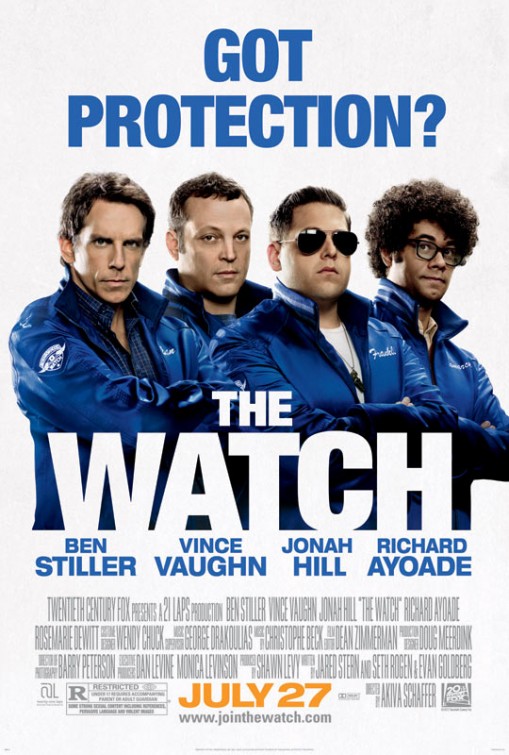 If scientists could take time away from, you know, curing diseases, and craft the perfect blend of “meh” in a lab, it would be The Watch. It’s not particularly offensive or terrible but it’s certainly not good. The humor of boys misbehaving and talking tough doesn’t ever seem to get further than the initial concept. The movie ends up becoming a more crass version of Ghostbusters, with a special fascination for the male member. This is a very penis-obsessive movie. Usually guy-centric sex raunchy comedies will definitely feature strong discussion/comedy revolving around male genitalia, but this is one of the few movies where complete storylines hinge upon penises (weird imagery, I’ll admit). Ben Stiller, Vince Vaughn, and Jonah Hill are more annoying than anything else. Poor Rosemarie DeWitt as the underwritten wife role in what is essentially a boys-behaving-badly movie (also her second 2012 movie where she’s trying to get pregnant). When the movie goes full-force into action mode, it loses just about any semblance of comedy. I laughed about three times, and that was thanks to Richard Ayoade (TV’s The IT Crowd) and, believe it or not, Will Forte (MacGruber). Sitting through 105 minutes with little laughs, irritating characters, and poorly conceived action in place of genuine comedic payoffs, well it’s not exactly a recipe for a successful summer comedy. And yet, with all its obvious faults, I couldn’t hate the movie as others have. It’s certainly not likeable but it does go about its business with a certain swagger, albeit misguided. Cocky loudmouths failing at entertainment are still marginally better than artists who don’t even try. It sounds like I’m reaching, and I am, but The Watch, certainly a bad comedy, may eventually be worth a watch when, you know, it’s on TV and you can half-heartedly pay attention to it while you go about your day.
Nate’s Grade: C-
Share this:

The Guilt Trip (2012)
 A funny thing happened after seeing The Guilt Trip. My father asked me what else Seth Rogen had been in that he had seen. And I was stumped (in retrospect, I could have said 50/50). I think that summarizes the mishmash of audiences for this mother/son road trip comedy. Rogen teams up with the ultimate Jewish mother, played by Barbara Streisand (Meet the Fockers), to travel the country. From that premise alone, it’s pretty much exactly everything you’d think it would be. The comedy is rather flat mostly because both characters feel mismatched from a comedy perspective; neither is given enough edge. I was surprised then when I found the warmhearted dramatic parts so much more skilled than the comedy (remember, sliding scale). The heart is better than the laughs. The deteriorating mother/son relationship is given some thoughtful consideration, and there are a few sweet emotional turns at the end to find a satisfying departure. It’s a rather nice movie, nothing too special or interesting, but nice can be perfectly fine under the right circumstances. I’m a Rogen fan and always enjoy his cocksure presence onscreen, and Streisand, at 70 years old, is still a natural movie star. The post-credits outtakes point to funnier material from their pairing, but director Anne Fletcher (The Proposal) sticks to the well-worn path of the road trip movie. It’s fairly inoffensive and safe, but The Guilt Trip has some light-hearted pleasures to offer its older audience, especially middle-aged parents and grandparents. Simply put: if you have to see one older-appealing movie with your family this holiday season, Parental Guidance or The Guilt Trip, take the trip.
Nate’s Grade: B-
Share this:

For a Good Time, Call (2012)
 Given the success of the female-centric mega hit Bridesmaids, it was only a matter of time before we got a slew of girls-behaving-naughty R-rated sex comedies. Enter the phone sex comedy For a Good Time, Call, which has the distinction of being co-written by Seth Rogen’s real-life wife, Lauren Miller, who also stars in the film. It advertises a good time and mostly delivers, though you might not think as much about the movie in the cold light of day.
Lauren (Miller) has just been dumped by her self-involved boyfriend and fired from her job. She’s looking for a new place to live when a mutual friend sets her up with a huge New York City apartment. The catch: her roommate is Katie (Ari Graynor), an acquaintance from college she has despised ever since a very horrifying party foul of seismic proportions. Katie’s going to lose her posh home unless she gets a roommate, so the women reach a mutual understanding. Then one day, listening to Katie’s hyperactive sexual noises, Lauren discovers how her roommate really pays the bills. She’s been running a phone sex line and getting guys off for $3.99 a minute. Lauren decides to get involved in the business end, and before long the ladies have become a professional outlet and roll in their riches. Invigorated, Lauren starts experimenting herself, letting her freak flag fly, and before long she’s also getting in on the calls.
 Graynor is no stranger to stealing a movie, as she did perfectly in the sweetly unassuming 2008 teen romance, Nick and Norah’s Infinite Playlist. This girl has had the markings of a star for years and finally she’s found the vehicle to showcase her comedic vivaciousness. To say Graynor makes this movie is an understatement to her talents. Graynor is this movie’s pulse, its lifeblood, its font of energy, its wickedness, its exuberance, its very soul. This woman is amazing. She can take a simple line and with an effortless dose of comedic verve, it can become a gut-buster. I could watch twelve movies in a row with Graynor playing at this level of exciting excellence. The part is pretty familiar, the dirty girl who has problem with a filter, but Graynor makes the most of every opportunity. I loved her adorable theatricality, like a foxy, younger, brassy Bette Midler (God, did I ever think I’d string those words together?). I loved her enthusiastic hip shake, wearing large body stockings, while singing, “I’m ready to beat date rape!” Naturally, Katie gets all the best lines but her interplay with Lauren also works well. When the movie focuses on Lauren, and by extension the unremarkable performance by Miller, you start to feel things slag. Lauren is passive becoming active, but really even by the end she can still be cited as boring. Katie is active, hungry, brash, charming, and wonderfully portrayed by Graynor, and when she dominates, you’ll ask for more.
Except for the lively theatrics from Graynor, the movie can often feel hung up on generic sitcom plot devices and character generalities. The premise itself is perfectly fine, but the movie seems to exist in some randy fantasy world. We still have a main character in the world of publishing that will obviously be offered the Big Job at an inopportune personal time (as movies have shown, every human being on the planet either works in publishing, advertising, or theater). And then there’s the Bad Boyfriend, who breaks up with our heroine in the opening moments of the movie because they are “boring” together. Any guesses whether he shows up late as well, begging her back? I’d probably be more forgiving of these contrived plot turns if the movie did more to present Lauren and Katie as real characters. As written, they are pigeonholed into opposites (prude/wild woman) and rarely do we learn more about them. Lauren loosens up, Katie gains some self-respect, and they girls becomes BFFs. That development I found rather unconvincing, probably because there was little development. All of a sudden Lauren has an interest in joining the business, and one montage later, the girls have buried the hatchet. It feels like everything changed overnight. The attempts to ladle in some forced sweetness feels, in some regards, more crass than the sex jokes. I’ll credit the movie for keeping me amused while watching, but upon further reflection, the girls and their relationship feels rather slapdash and rote.
The comedy itself gets too easily complacent with all those naughty words bandied about. Oh sure there’s plenty of effective jokes about sexually frank conversations, and the inherently awkward nature of phone sex mechanics, but For A Good Time, Call seems too easily satisfied. I wish that Miller and co-writer Katie Anne Naylor had pushed their comedic setups further, had taken a few more left turns rather than settling for the familiar sex gag. Here’s an example: Lauren’s prissy parents make an unexpected visit and the girls have to hide their business particulars. That’s a fine starting point, but where else does it go? The comic tension is too easily resolved instead of escalated. Then, surprise, the parents make a SECOND unexpected visit. This time the sex decorations are prominently displayed. We’re waiting for some good comedic tension, some squirming, but again, it’s over before the good stuff can even get going (am I right, ladies?). The Justin Long (Going the Distance) flamboyantly gay friend is never as funny as the movie thinks he is. There’s a scene where Lauren is interrupted while masturbating, but we only realize after the fact when the joke is already over. Why introduce such a scenario if you were just going to settle for a weak “smelly finger” joke? Perhaps I would find the material funnier if I was a woman, relating more to the female dynamic on screen, but do you see how condescending that line of thinking gets? I unabashedly adored Bridesmaids (my #3 film of that year). I don’t think anyone needs to grade a comedy on a curve for any reason, especially if they think they’re trying to be polite.
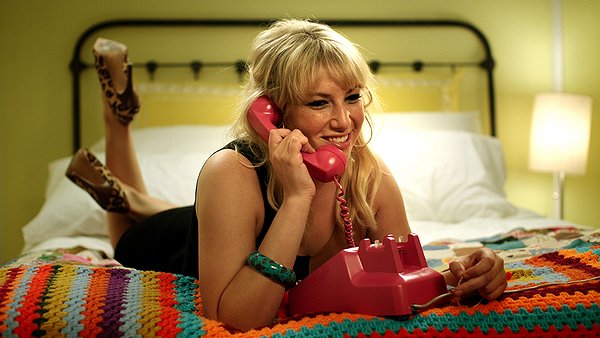 I’m not going to make more or less of its sexual politics than what is presented. I think there is genuine merit when women take ownership of their sexuality. Why should women feel judged for wanting equality when bedroom activities and impulses are concerned? Whatever helps people build a healthy self-image should be championed, as long as it’s between consenting adults. Watching Katie and Lauren personally grow based upon their unique entrepreneurship is welcomed. However, I can’t help but shake my feelings that there is something lurking, some deeper sub current that is not worth celebrating because the movie seems to play into male fantasy. Even though I adored Graynor, I think it would have served the film better if the more sexually-liberated character, the pro when it comes to working the phones, was actually a less attractive woman, perhaps a mousy gal you’d never expect such lurid behavior from. I think that would offer more comedic potential as well. I think this would also puncture some of the airbrushed fantasy of the film’s cheescake world of a phone sex line.
I have my complaints but I was laughing fairly regularly and enjoyed the experience, so if you’re just looking for a good time at the movies you can consider For A Good Time, Call. Watching Graynor sink her teeth into her role and go full gusto is a rowdy pleasure, and it’s easy to see that this woman is a star. The smutty jokes are fun and offer plenty of ribald laughs, but I always felt like the movie was too complacent, too settled, and curiously clumsy when it came to comic payoffs. The film is pretty flatly directed by Jamie Travis. The characters are pretty thin, and the plot feels ripped from a flimsy TV sitcom, but I laughed aplenty and found the movie difficult to dislike. It’s not the most nuanced sex comedy, or the most ribald, but For a Good Time, Call delivers enough big jokes and Graynor is too sensational to miss.
Nate’s Grade: B
Share this:

50/50 (2011)
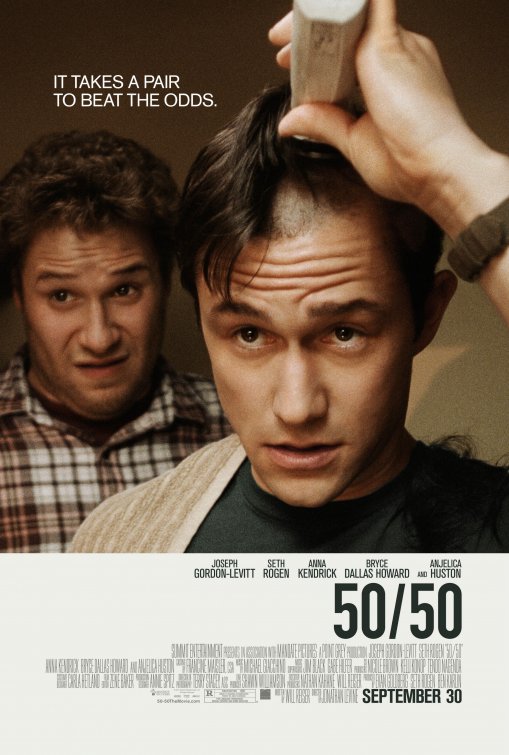 50/50 is based upon the experience of screenwriter Will Reiser, a writer for HBO’s Da Ali G Show who contracted cancer before his 30th birthday. Reiser’s real-life travails with his buddy Seth Rogen (who serves as executive producer) through the good times and bad. I guess when you get cancer it helps to have an established movie star as your good friend. It also helps when you write a terrific script, which Reiser has accomplished. Originally titled I’m With Cancer, I guess the studio felt that a movie with “cancer” in the title was a hard sell to mass audiences (On a related note, Showtime’s comedy-drama The Big C, about Laura Linney finding the humor through cancer treatment, was previously titled The C Word. I don’t know about you, but when I heard “the c word” the first thing that comes to mind is not “cancer.”). Even with a more oblique title, 50/50 manages to walk between comedy and drama with flair. It’s probably the funniest movie you’ll ever see about cancer. Definitely funnier than My Sister’s Keeper.
Adam (Joseph Gordon-Levitt) is a relatively healthy 27-year-old. He likes his job writing for a Seattle National Public Radio station. He likes his girlfriend, Rachel (Bryce Dallas Howard), an aspiring painter. He likes his best friend, Kyle (Rogen), a dude prone to speaking whatever is on his mind. Then one doctor’s visit changes everything. Adam has a very serious form of spinal cancer. He begins chemotherapy to try and stop the tumor’s growth. Rachel drives him to his hospital treatments, helps him during his long nights of nausea, but ultimately it proves too much to bear. She leaves him. Luckily, Adam has a young therapist, Katherine (Anna Kendrick), helping him put his life in order. Adam’s chances of surviving this rare cancer are exactly as the title proclaims, 50/50. As he comes to grips with the measures needed to survive, Adam finds himself growing closer to his therapist in a completely unprofessional degree.
50/50 may be the least sentimental movie I can recall about the realities of living with cancer, and that is its greatest attribute. That doesn’t mean that the movie doesn’t cover serious issues in a flippant manner. Instead of hitting cheap sentiment and milking cancer for easy tears, the movie, thanks to Reiser’s sharp script, forgoes false feelings and finds something more rare and true. There’s no real playbook for something as unexpected as a person in their 20s being diagnosed with terminal cancer. It seems like a cruel irony to be stricken with an illness so young. Adam doesn’t drink, doesn’t smoke, and doesn’t even drive due to the danger. He’s pretty mild-mannered and a bit of a pushover. Adam tries to not let cancer get to him, to shrug off the heavy implications, and to just make it seem like any other personal setback. If he doesn’t treat it like a big deal, maybe it won’t be and his friends and family can follow his lead. This kind of self-manufactured blasé attitude, even in the face of cancer, seems like an apt approach for a younger relaxed generation. Naturally, this denial-heavy approach doesn’t exactly work. It’s too easy to confuse numbness with acceptance. Fortunately, Reiser does not let his story slip into easy maudlin theatrics. We don’t need anybody reminding us, or Adam, how serious his situation is. On the other hand, we also don’t need anybody moralizing about any self-help slogans. Not everyone sees adversity as a blessing into Discovering Who You Truly Are. Reiser refrains from his characters making anything approximating Big Life Statements. Cancer does not lead to automatic personal epiphanies. If it did, we’d have a lot more people inhaling carcinogens and volunteering to work in the Chernobyl ruins.
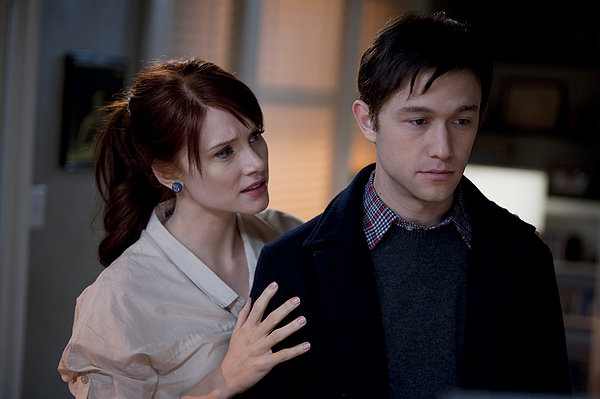 50/50 doesn’t ignore the sometimes odd and dark humor that arises from life’s predicaments. That means this is the only cancer movie where the guys try and use the disease as a way to convince girls to sleep with them. At no point do I remember this occurring with Terms of Endearment or Beaches. And this opportunistic babe hunting doesn’t make the boys come across as sleazy. Adam can’t even enjoy the one-night-stand as his back pain robs him of the pleasure of his nubile well-wisher. The tone is very controlled. The raunchy comedy is not a distraction; at no point does any situation feel like a comedic setup. The comedy comes from the characters being genuine to who they even through the trying circumstances. If your friends are funny, chances are they’ll still be funny talking about cancer. The humor doesn’t make light of things nor does it just play everything for laughs. Humor is how we humanize, how we make the insurmountable digestible.
50/50 also treats its characters with a bittersweet sense of reality; these people are flawed and relatable. They are not instantly made into self-actualized saints thanks to cancer. Adam’s girlfriend actually breaks down because she cannot handle the extra responsibilities and emotional wear and tear. Their relationship fizzles. This seems far more realistic considering many people will feel like they did not sign-up for sleepless nights, 24-hour care, and watching their loved one waste away. It’s a strong individual that can endure that kind of collateral pain, but the movies make it seem like every romantic partner is unnaturally selfless. They become ideal partners, but really most of us would just bail. Reiser easily could have easily written his ex-girlfriend as an insensitive shrew. While she does cheat on the guy, thus making her easy to dispel, Howard makes her vulnerability relatable. She even comes back trying to make amends, forcing kisses upon him to weaken Adam’s resolve. Kyle relishes the opportunity to finally be able to tell off Rachael, a girl he admits to disliking from the start. I don’t get the instant hate, but maybe it’s my complete adoration for Howard even when she’s playing a bad girl that blinds me to her offenses. To dismiss her as a “bitch” seems unfair. How would you react if your boyfriend/girlfriend were suddenly diagnosed with cancer? Could you last?
I found all of the characters to be empathetic and relatable (though a lead who waxes about the glory days of radio and works for NPR seems a bit hipsterish), especially in their personal struggles surrounding Adam’s illness. Adam’s mother, Diane (Anjelica Huston), can be overbearing and would have easily been kept as a caricature in other movies. In 50/50, the film examines her own struggle – a husband with Alzheimer’s who can’t talk to her and a son with cancer who chooses not to talk to her. The isolation she feels, the loneliness, always putting other people’s needs ahead of her own, this is culmination of the caregiver, a role as I’ve stated that too often gets canonized. In 50/50, the reality of living with illness is dealt with in a meaningful manner. The people surrounding you are also affected by your illness. You cannot shut them out to spare them from pain. Adam realizes this too as the film progresses to its moving conclusion.
 The heart of 50/50 concerns two sets of relationships. The one that will catch the most attention is Adam’s budding romantic relationship with his therapist. Their romance feels like it emerges naturally, albeit in a slightly hurried up pace for our small timetable. It’s a romance built upon the chemistry of the two actors, the strength of their individual performances, and the fact that Reiser forgoes anything obviously romantic. He cleans out her car. She gives him a ride home. It’s little things that seem like they matter on a personal level, not the outsized theatrics of romantic gestures. The movements are small but they add up, and we can feel it too. So when Adam, at his lowest point, calls her and says, filter down and radiating in emotion, “I bet you’d be a good girlfriend,” it’s a moment that feels earned. I also greatly appreciated Katherine’s own insecurity about being a therapist. Too often movies depict therapists as omniscient beings that have a fortune cookie answer for all of life’s mysteries. Kendrick hides behind evaporating smiles as her character’s defense mechanism. In 50/50, we get to see a character that is honest about her insecurities about a job that advises others. It’s refreshing. The other main relationship is between Adam and his best friend, Kyle. His best buddy is his spark, the guy who gets him out, who shakes him from moping around. He cares but goes through unorthodox methods to show that care, including trash talking and ball busting. He remains likable to his shaggy core because he has Adam’s best interests in mind, even if that means scoring with girls.
Director Jonathon Levine (The Wackness) gives the movie an improbably beautiful look. This is one cancer comedy that is simply pleasing to watch for the cinematography alone. He doesn’t overpower the narrative with self-aware visual touches, though there is one that stands out. When Adam receives the news from his doctor, the audio becomes distorted after the shocking word “cancer” is uttered. The picture becomes blurred. The world seems to have been swept away. I imagine this sonic body blow is pretty much how Reiser recalls receiving the news, and if not it still feels authentic. The score by Michael Giacchino (Up, Super 8) is subtle and doesn’t intrude too often, ably assisting the drama instead of smothering it.
50/50 is an unsentimental film that manages to be moving and genuinely entertaining on its own terms. It can be rude but that doesn’t mean it lacks sincerity. The characters and their dilemmas feel all too relatable, even the ones we hope don’t become us. The 50/50 production has followed a subdued edict, forgoing sappy melodrama and easy pathos. These emotions are earned the old fashioned way, through characters we care about and drama that feels truthful. The mixture of the course and sweet gives the film a decidedly Judd Apatow (Knocked Up) flavor even though his name is nowhere to be seen. Gordon-Levitt, who at this point can do no wrong in my eyes, gives one of the best performances of his already accomplished career. The comedy, lead by Rogen’s obnoxious best friend, keeps the movie from being bogged down in melodrama. It’s the only way to stay sane, and 50/50 recognizes this and delivers a film that earns its tears and laughs.
Nate’s Grade: A-
Share this:

Paul (2011)
 This sci-fi comedy by the guys behind Hot Fuzz and Shaun of the Dead, though absent director Edgar Wright (Scott Pilgrim came a callin’), is an irreverently fun flick that lovingly sends up just about everyone in its sights. Simon Pegg and Nick Frost play a pair of British sci-fi geeks road tripping through the American southwest when they come across Paul (voiced by Seth Rogen), an alien on the run. Together they outrun various pursuers, from government agents to angry rednecks, and Paul transforms into a delightful road comedy with the different characters ping-ponging back and forth, narrowly missing but still in the hunt. It’s a cheeky even rollicking action comedy in the vein of a Midnight Run, though with way more stoner jokes. The plot nicely weaves these various elements and characters together, creating a satisfying escalation in suspense and comedy. The characters are pretty familiar and some of the gags are below the caliber of talent onscreen (really, more “people think we’re gay” jokes?), but the final product is unabashedly fun and it’s easy to feel Pegg and Frost’s enthusiasm. Paul is a light-hearted, funny, even tender sci-fi comedy that borrows from better movies but still manages to charm.
Nate’s Grade: B+


 nathanzoebl
You must be logged in to post a comment.