Blog Archives
The 40-Year-Old Virgin (2005) [Review Re-View]
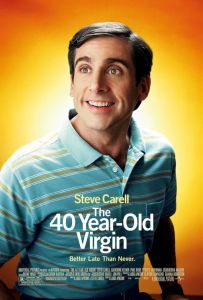 Originally released August 19, 2005:
Yes it’s an uproarious sex farce, that’s a given from the ads, but this movie is also surprisingly sweet and genuinely moving. A lot of credit goes to star/co-writer Steve Carell and co-writer/director Judd Apatow, creator of some of the best, most honestly funny TV series unjustly cancelled. Apatow is a master at mining human comedy for pathos, where you get a great sense of character and really feel for those onscreen, and yet nothing feels cheap or unwarranted, all the while deriving comedy from the situations. We need more men like Apatow in the film industry. Carell can do it all whether it’s deflecting his insecurity, which we feel so bad when he comes up with outrageous things he’s overheard to make himself seem like one of the guys. The supporting cast is top-notch. They’re basically the stock roles in a sex comedy and yet they bring so much more to the table, with a true-to-life boys-will-be-boys camaraderie that you can identify with. The character relationships in The 40-Year-Old Virgin really elevate the story and the jokes and make the film something really special. It’s not merely a barrage of gross-out humor; it’s a nice story with some very tender moments. This is a movie that goes well beyond its gimmick premise, never feeling like a skit blown up into a feature film. It mixes in psychology, heartbreak, awkwardness, but also insights into loneliness and human connection. The best character-based comedy in years.
Nate’s Grade: A
——————————————————
WRITER REFLECTIONS 20 YEARS LATER
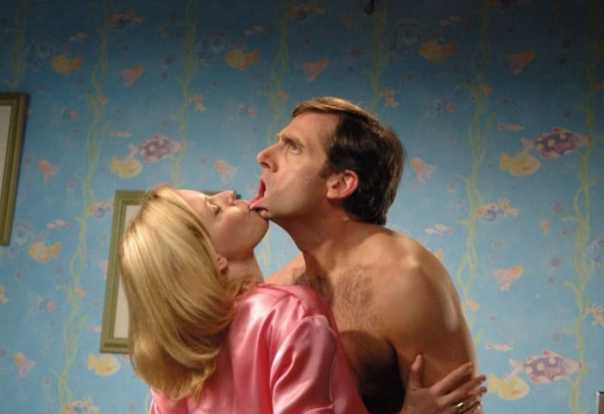
It’s always an interesting prospect to revisit beloved comedies decades after their impact. Comedy is, by its nature, a form of entertainment with the shortest shelf life. What one generation and time considers funny may prove antiquated or offensive the next or, just simply, not funny. I challenge readers to watch the old vaudeville routines and really try to laugh, not just snicker or titter but laugh, the kind of laughter where you have to hold your sides and worry about losing bladder control. Shakespeare wrote many comedies but I would argue most would view them today as clever rather than gut-busting. That’s just the nature of funny, which is in constant flux. One day you’re a popular comedian building your brand on copious “I hate my wife” jokes, and the next you’re a has-been who has transparent issues hating women. I experienced this before when I revisited the movies of Kevin Smith, a filmmaker who made a significant formative impact on my burgeoning sense of comedy and indie cinema. I found that the same movies that proved so funny and outrageous in my teenage and young adult years now, in the light of distance and decades, felt painfully dated and grasping, gassed and flailing. Comedy is a cultural time capsule.
The 40-Year-Old Virgin was a delightful surprise when it was originally released twenty years ago, but it wasn’t only a popular sex comedy, it began a new era of dominant comedy, the Judd Apatow Era. The prolific producer had been responsible for critically acclaimed TV series that always got cancelled too soon, like Freaks and Geeks (created by Paul Feig), Undeclared, and The Ben Stiller Show. He was a well-regarded writer with a sharp eye for talent, but it wasn’t until 2004’s Anchorman that Apatow had a hit under his name, a comedy that crossed over from a small cult audience into the zeitgeist. After The 40-Year-Old Virgin’s reign, the Apatow style of comedy became hip and desirable. It was a winning mixture of broad body humor and character-driven pathos, usually following lonely men suffering from arrested development and finding kinship, agency, and a fuller sense of who they are by the end. There were regular set pieces like traditional comedies but these were more focused on character moments and vibes, which lead to roaming running times and loose-goosey, improv-heavy jam sessions. It was the combination of salty and sweet that proved a winning combination, starring less conventional leading men like Steve Carell, Seth Rogen, Jason Segel, and Jonah Hill, many of whom also wrote or co-wrote their own movies. The Apatow factory created a comedy coaching tree of influential big screen storytellers.
 It was the apex of studio comedy and then… it wasn’t. This isn’t so much a tale of the world growing fickle to the Apatow formula, though with time any formula can start to wear out its novelty. Apatow went on a cold streak for me, first with 2009’s misanthropic and misshapen Funny People and then again with 2012’s This is 40, a sequel to Knocked Up that was obnoxiously wallowing in its sense of woe-is-me rich privilege (it definitely wasn’t my life turning 40). After that, he became something of a shepherd for exciting new comic voices, creating starring vehicles for Amy Schumer (2015’s Trainwreck) and Pete Davidson (2020’s The King of Staten Island) and Lena Dunham (HBO’s Girls). Then he made 2022’s The Bubble, a limp COVID-era satire of studio filmmaking that was painfully unfunny. It felt like Apatow had run out of things to say and even things to laugh about. It was pretty depressing for this comedy giant.
However, the downturn in Apatow’s influence also coincided with the downturn in studio comedies. These mid-budget vehicles used to dominate the box-office and then by the end of the 2010s, they seemed to vanish, seemingly folded into larger-budgeted superhero movies and/or ceded to streaming venues. This became even more entrenched in the theatrical environment during and “after” COVID. Even the occasional A-list starring vehicle, like 2023’s No Hard Feelings with a brassy Jennifer Lawrence performance and the selling point of a full-frontal nude fight scene, could only muster so much attention. Take for instance a Will Ferrell and Reese Witherspoon comedy released just this year directed by Nicholas Stoller (Neighbors). Can anyone even remember the title? I had to look it up myself and I watched it. Have moviegoers grown to expect comedies being lesser or have people lost their sense of humor in the Trump Era where every day can feel like a burdensome weight on your very soul.
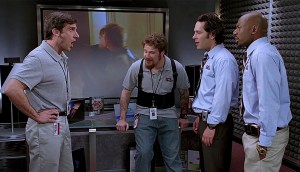
I genuinely enjoyed most of the Apatow-related comedies of the 2000s, and The 40-Year-Old Virgin holds up because its central appeal is on the engaging characters, their winning camaraderie, and the relatable vulnerability and awkwardness of sex and dating. While some of the jokes and attitudes have changed in twenty years, there is a timeless quality to the inherent vulnerability of feeling like you cannot connect with others and the steps taken to rectify that, risking shame. Dating is still a minefield for awkward yet relatable observational comedy just as it was and just as it always will be. Apatow and co-writer Carell anchored their movie on a repressed man’s awakening, taking the formula of a sexual awakening we usually see in teen/young adult movies and applying it to an older man. It redefines a sub-genre but also provides a little sadness and sweetness, as we can’t help but hope that Andy (Carell) will luck in on pleasurable experiences denied him. He’s not a creep, and the explanation for how a man could hold onto his virginity for 40 years (the CDC stats say 0.3% of women and 1.2% of men aged 40 to 44 are indeed virgins) is painfully plausible. After a few embarrassing experiences, he just waited with the expectation it would happen eventually, and the longer it took, the more shame built, and the less certain he was to pursue a romantic relationship. He knows once his secret is out that people won’t just look at him differently, they’ll look at him as if he’s a freak and think less of him. That’s why it’s genuinely sweet how involved his co-workers get to help Andy get over this hump, so to speak. While each co-worker has a different perspective of advice, they open up about their own troubles with women and self-confidence. It’s not like this is a searing relationship drama, but the fundamentals that make it worth investing are there, and that begins and ends with the characters and their conflicts and their camaraderie.
 Each of Andy’s co-workers is giving him bad advice because each one of them wants him to be someone else. Cal (Rogen) advises Andy to be inscrutable and standoffish, turning everything into a question while revealing nothing personal. It’s reminiscent of those smug 2000s pick-up artists that trained a generation of young men into thinking the way to a woman’s heart was to insult her. He does have a hilariously specific note (“Be like David Caruso in Jade”) that still made me laugh hard. Jay (Romany Malco) advises Andy about it being a numbers game, to embrace a bravado to ensnare women, and to pick them up where they are most impressionable. David (Paul Rudd) is still hung up on his ex and is lovelorn, so his advice is often coated in reflexive bitterness. He’s the friend who advises Andy to explore more about his own desires, leading to a very funny sequence where Andy sets up his home environment for his attempt at masturbation, turning around family pictures to spare their eyes. It’s actually through the character of Marla (Kat Dennings, Thor), the teen daughter of his girlfriend, that Andy finds a level of self-acceptance for being a novice to human sexuality. I think it’s telling that the best advice he receives on the subject is from a teenage girl rather than his horndog pals who consider themselves female experts.
The movie pivots into a more focused romantic comedy by its second half once Andy finally works up the nerve to ask out Trish, played by Catherine Keener (Get Out, Being John Malkovich). This is a natural transition because now Andy has a person to practice all the advice and prove himself. They have a chummy and self-deprecating chemistry together, so the challenge becomes how long he can hide what amounts to his secret shame. Things are going so well he throws out obstacles to delay their physical copulation because he’s afraid that’s when she’ll realize he isn’t worth it. You’re rooting for Andy to get over his hangups and recognize he’s actually a nice guy and that Trish would be really happy to have sex with him, especially after waiting over twenty-plus dates. This is one of Keener’s warmest performances in her storied career. This was Carell’s star-making role. He had been a notable scene-stealer before in Bruce Almighty and Anchorman, but now he was a leading man, further solidifying that same year with the role that would define him, as Michael Scott on the American version of The Office. The both of them are a winning pair and you want their shared adorkable energy to work out for the best.
Much of the comedy still works very well, like the famous chest-waxing scene where Carell really had his chest hair ripped out, but there are some elements that would have been scuttled had The 40-Year-Old Virgin been released today. It’s hard to conceive of a modern studio comedy that would allow two straight guys insulting each other with the many ways they are irrefutably gay. The 2000s was a time rife with gay panic jokes. What has aged the worst is the advice to prey upon “drunk bitches” because they have fewer defenses. Given the term, “prey upon,” you’ll no doubt surmise that this advice is predatory. This dubious thinking is something that would set up a guy as one of the bad men in Promising Young Woman, and it would have proven fitting had one of those women gotten one over on the guys. Frustratingly, Jay has a brief moment of recompense and self-reflection when his long-suffering girlfriend has had enough of his cheating ways, but then she goes right back to him and reveals she’s pregnant. We’re missing a scene that would help solidify how this event changes Jay, but instead he’s basically rewarded for his bad behavior with a baby and a woman forgiving him once again.
 You’ve probably heard about the loneliness epidemic of modern men, a media-friendly term exploring how many of today’s available men are having difficulty making connections with women and some of them using this rejection and/or fear of rejection as the excuse to radicalize themselves. There’s been so much written on the subject, but I think most of it really just comes down to empathy. When you care about other people, and allow yourself to think about their needs and desires, it communicates an openness to others and that their time and emotional investment is worth it. It’s hard to fathom a swath of young men, the ones who identify as reactionary incels, deigning to view empathy as a strength rather than character defect. Empathy communicates two important self-realizations: 1) other people matter, and 2) being vulnerable and possibly being hurt is worth the risk. You can’t have one without the other. When young men reach that epiphany and acceptance, they will discover women are, amazingly, much more open to seeing them as a romantic partner worth their time, affection, and their bodies. Nobody owes anyone their bodies or emotional bandwidth. Sharing your life with others should be valued, not entitled.
This is also a perfect spot to talk about one of the minor co-stars, Shelley Malil as co-worker Haziz, who was charged with stabbing his girlfriend 25 times in 2008. He was released from prison in 2018 after serving eight years of a twelve-years-to-life prison sentence, which doesn’t sound very close to “life” for me, but on the flip side, “12 years to all years” seems like too expansive of a window of time to serve.
Twenty years later, The 40-Year–Old Virgin still funny and sweet and entertaining because it nails the tenets of what makes movies worth coming back to again and again, our connection to the characters and their relatable plights. Even two decades later, we can still see elements of ourselves in these characters, though maybe fewer. This was the announcement of the Judd Apatow Era of big screen yuks, and frankly I’d be happy to return to it if we got more movies like this and Knocked Up, a comedy I liked even more upon release. My original review was correct for all the accolades The 40-Year-Old Virgin deserved and still deserves, and so it remains a comedy classic with more on its dirty mind than many adult dramas.
Re-View Grade: A
Share this:

Teenage Mutant Ninja Turtles: Mutant Mayhem (2023)
 As an elder millennial, the Teenage Mutant Ninja Turtles have been a formative franchise for me. I grew up on the cartoon, got the toys for Christmas, died endlessly during the shockingly hard underwater stage of their Nintendo video game, and generally have a soft spot in my 80s nostalgia for the likes of Leonardo, Donatello, Raphael, and Michelangelo, plus their surrogate father, Master Splinter. Apparently Seth Rogen felt the same way, and he and his writing partner Evan Goldberg have spearheaded a new animated variation of TMNT that just so happens to also be co-written and directed by the man behind my favorite film of 2021, The Mitchells vs. The Machines. It was a recipe to guarantee my personal enjoyment, and Mutant Mayhem thusly delivered. The biggest selling point for me was how lovingly realized the “teenage” part of the title was, getting a foursome of actual adolescents to portray our heroes, and using high school experience about acceptance and fitting in as effective and even poignant parallels. I loved just hanging out with these characters, who view their surrogate dad (voied by Jackie Chan) with a mixture of love and embarrassment, and who want to be accepted by a world predisposed to finding them monstrous. Naturally, becoming crime-fighting heroes is their best method for winning over the public, with a young and aspiring journalist April O’Neil (The Bear‘s Ayo Edebiri) hoping to improve her own social standing at school by breaking the existence of these unknown mutants. The comedy is robust and layered while allowing for nice character details and moments, giving each turtle their own satisfying arc. The action is fun and inventively staged while still being thematically relevant. The vocal cast is great, and the young actors are tremendous together, sparking an enviable improvisational energy that made me smile constantly. The art style has an intentional messiness to it, like smeared colored pencil drawings, and the imperfections are themselves part of the vast visual appeal. It’s a family movie that will succeed with old fans and new, and Mutant Mayhem is the best film depiction yet of the famous heroes in a half-shell.
Nate’s Grade: B+
Share this:

The Super Mario Bros. Movie (2023)
 Colorful and eminently pleasant, The Super Mario Bros. Movie is about everything you would expect from an Illumination project. To begin with, there’s not a lot of story in the 30-plus years of Mario video games, so it’s not surprising that the story is kept relatively familiar with characters each inhabiting simple motivation (Mario wants to impress his dad, Luigi wants to be brave, Peach wants to protect her people, Bowser wants to be accepted by his unrequited love). Much of the movie is establishing a new location and giving some moment of fan service before moving on, like an extensive Mario Kart Rainbow Road sequence or Mario meeting Donkey Kong. It feels like the risk-averse creative process started with a list of characters, levels, and references and then how to squeeze them in. This is a movie kept at a kiddie level, which is fine even for adults to enjoy, but it means there is a lowered ceiling of ambition (so… many…. needle-drop song selections…). Much of the movie is fleeting and fine, with highlights including Jack Black’s performance as the love-struck Bowser, the training sequences making use of the bizarre physics and accoutrements of the Mushroom Kingdom, and a delightfully nihilistic little blue star with a cheery child’s voice. The movie is earnest to the point of being a little corny, which might be refreshing for parents and children used to a recent slate of overly glib kid’s movies trying to act smarter than they are. This movie is cute and harmless and a sugar rush to be forgotten after it wears off. Now re-watch the 1993 version that attempted to take the same source material and make a parallel world Blade Runner with Dennis Hopper as King Koopa. There’s also one hundred percent less Chris Pratt.
Nate’s Grade: B-
Share this:

The Fabelmans (2022)
 Steven Spielberg has been the most popular film director of the last fifty years but he’s never turned the focus squarely on himself, and that’s the draw of The Fabelmans, a coming-of-age drama that’s really a coming-of-Spielberg expose. The biographical movie follows the Fabelman family from the 1950s through the late 60s as Sammy (our Steven Spielberg avatar) becomes inspired to be a moviemaker while his parents’ marriage deteriorates. As a lifelong lover of movies and a childhood amateur filmmaker, there’s plenty here for me to connect with. The fascination with recreating images, of chasing after an eager dream, of working together with other creatives for something bigger, it’s all there and it works. I’m a sucker for movies about the assemblage of movie crews, those found families working in tandem. However, the family drama stuff I found less engaging. Apparently Sammy’s mother (Michelle Williams) is more impulsive, spontaneous, and attention-seeking, and may have some un-diagnosed mental illness at that, whereas his father (Paul Dano) is a dry and boring computer engineering genius. I found the family drama stuff to be a distraction from the storylines of Sammy as a budding filmmaker experimenting with his art and Sammy the unpopular new kid at high school harassed for being Jewish. There are some memorable scenes, like a girlfriend’s carnal obsession with Jesus, and a culmination with a bully that is surprising on multiple counts, but ultimately I found the movie to be strangely remote and lacking great personal insight. This is why Spielberg became the greatest filmmaker in the world? I guess. I’ll credit co-writer Tony Kushner (West Side Story, Lincoln) for not making this what too many modern author biopics have become, a barrage of inspirations and connections to their most famous works (“Hey Steven, I want you to meet our neighbor, Ernest Thalberg, or E.T. as we used to call him back at Raiders U.”). The Fabelmans is a perfectly nice movie, with solid acting, and the occasional moment that really grabs hold of you, like a electrifying meeting with a top Hollywood director in the film’s finale. For me, those moments were only too fleeting. It’s a family drama I wanted less family time with and more analysis on its creator.
Nate’s Grade: B
Share this:

Donnie Darko (2001) [Review Re-View]
 Originally released October 26, 2001:
Donnie Darko (Jake Gyllenhaal) is your normal malcontent teenager in late 1980s Reagan America. He bickers with his older sister, worries over the right moment he’ll kiss his new girlfriend, and tries to ignore the advice of many imprudent adults. Donnie’s your typical teenager, except for his imaginary friend Frank. Frank is a sinister looking six-foot tall rabbit that encourages Donnie into mischief and gives a countdown to the impending apocalypse. And I haven’t even gotten to the time travel yet.
One night as Donnie wanders from his home at the behest of Frank, an airline engine mysteriously crashes through the Darko home and lands directly in Donnie’s room. The airlines are all at a loss for explanation, as it seems no one will take responsibility for the engine or knows where it came from. Donnie becomes a mild celebrity at school and initiates a relationship with a new girl, Gretchen Ross (Jena Malone). One of his classes consists of watching videos of self-help guru and new age enlightenment pitchman Jim Cunningham (Patrick Swayze). His school has even, under the persistence of self-righteous pain Kitty Farmer, persuaded Cunningham to speak and try to help students conquer their “fears.”
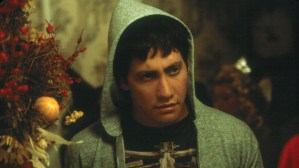 Donnie is also seeing a therapist for his emotional problems and taking medication for borderline schizophrenia. Around this time is when Donnie starts to inquire about a strange old woman, obsess over the possibilities of time travel, as well as see weird phosphorescent pools extend from people’s chests. He also floods his school at the urging of Frank. This is no Harvey-type rabbit.
The longer Donnie Darko goes on the more tightly complex and imaginative the story gets. First time writer-director Richard Kelly has forged an excitingly original film that is incredibly engaging with charm and wit. He masterfully mixes themes of alienation, dark comedy, romance, science fiction, and a sublime satire of high school. Donnie Darko is the most unique, head-trip of a movie unleashed on the public since Being John Malkovich. Kelly has a created an astonishing breakthrough for himself and has ensured he is a talent to look out for in the future.
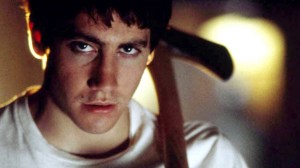
 Gyllenhaal (October Sky) is superb as disenchanted Donnie, a Holden Caulfield for middle suburbia. His ghastly stare conveys the darkness of Donnie but his laid-back nature allows the audience to care about what could have merely been another angst-ridden teenager. Swayze is hysterical as the scenery-chewing Cunningham. The rest of the cast is mainly underwritten in their roles, including stars Drew Barrymore (who was executive producer) and ER‘s Noah Wyle, but all perform admirably with the amount they are given. Not every plot thread is exactly tidied up but this can easily be forgiven.
Donnie Darko is a film that demands your intelligence and requires you to stay on your toes, so you can forget any bathroom breaks. The film is one of the best of 2001 but also one of the funniest. You’ll be honestly surprised the amount of times you laugh out loud with this flick. The theater I saw this in erupted every half a minute or so with boisterous laughter.
Donnie Darko is a film of daring skill and great imagination. You don’t see too many of these around anymore.
Nate’s Grade: A
——————————————————
WRITER REFLECTIONS 20 YEARS LATER
Not to sound too annoying, but I’ll cash in my hipster points here and declare that I was on the Donnie Darko bandwagon from the start. The eventual cult phenom was originally released in October 2001, mere weeks removed from 9/11, dooming its commercial appeal considering a major plot point happens to involve deadly airline debris. I was a sophomore in college across from a little indie movie theater, the Drexel, that was like a wonderful escape for a budding cinephile looking for his next fix of weird and daring movie experiences. I recall seeing the trailer for Donnie Darko and being immediately intrigued, but its release date kept bouncing back month after month until it finally opened at the Drexel in February 2002, and I was there opening day. I saw it twice, brought friends with me, and I wrote about it as one of my earliest reviews as my college newspaper’s film critic. I wanted to get the word out that this was something special. The first day it was available on DVD, I went to Best Buy looking for a copy and the store employee was deeply confused about its existence. He probably knows now, as the movie achieved cult status on DVD and became an iconic indie fixture for many a Millennial.
Revisiting the films of 2001 has been reliving many films that made such formative impacts on my life: Memento and its airtight structural sleight-of-hand, Moulin Rouge and its ambitious and messy celebration of old, new, reverent and irreverent, and now Donnie Darko (this isn’t even counting films I never wrote reviews for and thus were ineligible for this re-watch, like Hedwig and the Angry Inch and Amelie – 2001 was an excellent year at the movies). I have probably watched this movie more than any other in the 2000s, with the late exception perhaps of The Room that came on strong for me at the end. My friends and I would debate it, quote it, and work toward bringing others into the cult of Darko. Looking back now twenty years, I’m happy to report the movie’s power is still just as alluring and transcendental. What earned this movie its fawning fandom? Why did writer/director Richard Kelly, only in his early 20s, find success with his weird little indie while others went painfully ignored? I think it comes down to Kelly’s ambiguous approach, threading a delicate needle so that there are enough pieces present to put together an interpretation that can prove satisfying while personal and potentially different from your friend or neighbor with an equally valid interpretation.
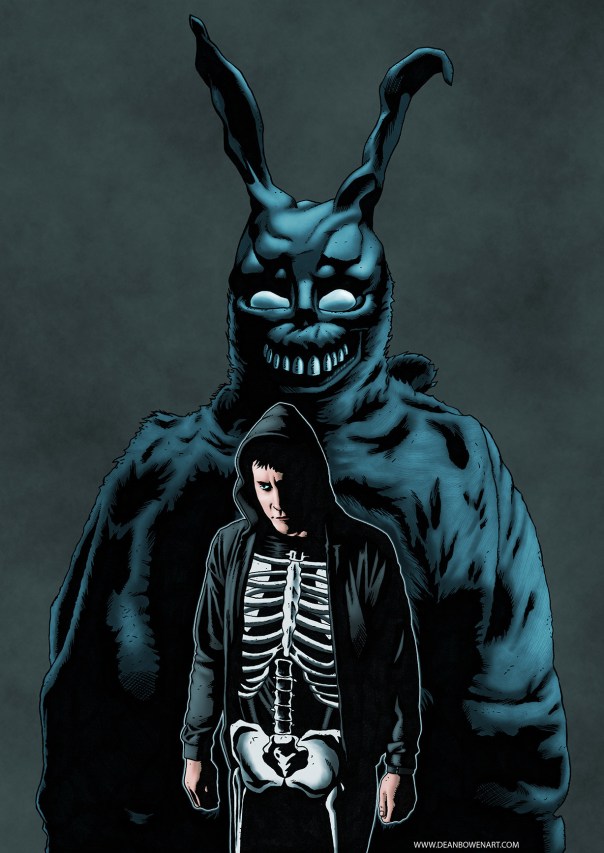
 What helps is that Donnie Darko doesn’t feel like it’s weird for weird’s sake, like a formless collection of strange ideas and confounding imagery operating on an unknowable surreal dream logic. What Kelly has done is mix and match parts of an intriguing apocalyptic puzzle. There’s relatable high school drama about pushing back against the hypocrites and phonies of the adult world, there’s a mystery about who or what is behind Frank the bunny, the creepy otherworldly figure serving as Donnie’s Virgil-like guide, and the character study of a lonely, troubled kid trying to find a better sense of understanding of himself, his place in the world, and his sense of what lies beyond. I could just as readily view Donnie Darko as a spiritual refresher, and I’ve always sided more with a divine interpretation than sci-fi. Donnie and his therapist talk about the question over God’s existence and Donnie says he doesn’t feel like he can get anywhere debating it, so he has simply agreed to give up. Donnie talks about dying alone and how if everyone is resigned to do so then this must be a condemnation of God. Kelly establishes these early conditions as the beginning of an arc that leads to Donnie not just accepting a messianic status but volunteering for one, dying alone but in a manner that serves as victory. This to me is why he laughs at the end after being transported back to a fateful spot. He rolls over in his bed and closes his eyes knowing an end for him is not an end but a vindication (the honking from Frank the second time serving as a “we did it” victory celebration). Through his sacrifice, the world will continue (“I hope when the world comes to an end, I can breathe a sigh of relief, because there will be so much to look forward to.”). Through bizarre circumstances, a young man has found spiritual renewal, bringing him to a personal fulfillment as well as the larger picture of averting a looming apocalypse for a tangent world.
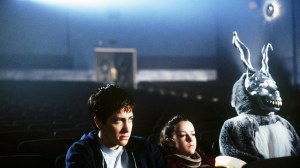
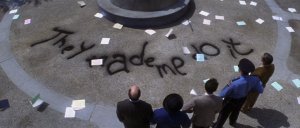
This has been my preferred reading of Donnie Darko, with divine forces selecting Donnie as the universe’s lone hero and mysteriously guiding him along his journey, each intervention and urging from Frank leading to the culmination of events that would convince Donnie of his duty. When Donnie is talking to Frank the bunny in an empty movie theater (playing a double feature of Evil Dead and The Last Temptation of Christ, one of my favorite jokes), he asks Frank, “Why do you wear that stupid bunny suit?” Frank turns and asks, “Why do you wear that stupid man suit?” Under my interpretation, Frank is a supernatural force, call it an angel or whatever you want, but he is not human and only using the form of a doomed man as a necessary vessel. When Donnie breaks into his school and breaks the water main, under the hypnotic control of Frank’s urging, we see that the vandal has also spray-painted “They made me do it” on the school mascot. The school and police go class-by-class and have students rewrite the phrase on a chalkboard, analyzing their handwriting. Donnie’s handwriting is clearly different. Could it be that Donnie, under the influence of Frank, also wrote as him, adopting his handwriting? With that, perhaps instead of Donnie writing a would-be confession it was actually Frank. “They made me do it,” Frank writes in apology to Donnie, not just for prodding him along but ultimately for the pain and suffering the real Frank of this world will cause for Donnie. “I’m sorry that all of this has to happen to you, Donnie. It wasn’t my choice. They made me do it for their plan.” I think that’s a more intriguing examination than Donnie just saying he was told to flood the school by his imaginary friend.
 This is one reason why I was not a big fan of Kelly’s eventual director’s cut DVD release in 2004, which added twenty minutes to the film and changed many edits, song choices, and special effects sequences. The director’s cut went too far for me, specifically spelling out Kelly’s vision of time travelers from the future trying to coach Donnie as their variable. Whole sections from Roberta Sparrow’s book, The Philosophy of Time Travel, were printed on screen, explicitly connecting the various pieces in a way that had previously been left as ambiguous. My disappointment with the director’s cut reminded me of the disappointment Star Wars fans felt when George Lucas went back and tinkered with the original trilogy. Lucas has said the re-releases were the films he had always intended them to be, that the earlier theatrical editions were the imperfect versions of his creative intentions. The problem is that millions fell in love with those versions of the movie, even if they were an imperfect vision of their creator. Richard Kelly always intended for the opening song to be INXS’ “Never Tear Us Apart,” but hearing that felt wrong to me after watching the same scene played to Echo and the Bunnyman’s “The Killing Moon” with the theatrical cut. Kelly’s imperfect version was the one I fell in love with, the one that spoke to me as a 19-year-old and as a 39-year-old, and that’s the one I vastly prefer.
Another reason for Donnie Darko’s success is more than likely the appeal and performance of young Jake Gyllenhaal. Over twenty years, Gyllenhaal has become one of the best actors of his generation and criminally overlooked by the Academy. He’s only been nominated for one Oscar for 2005’s Brokeback Mountain, not for 2017’s Stronger, or 2007’s Zodiac, or, most egregiously, for his hypnotically disturbing portrayal in 2014’s Nightcrawler. Gyllenhaal has mesmerized for so long and handles the many confusing aspects of Donnie with aplomb. It would be easy to play Donnie as a cliched rebellious teenager, but Gyllenhaal really digs into his questioning nature; he’s hungry for answers, desperate even, and tired of being disappointed in the adults of his life. That’s why it becomes emotionally satisfying for me when Donnie appears to achieve some semblance of answers by the end, his laughter is victorious and cathartic.
 Jake Gyllenhaal is terrific but the rest of the cast is outstanding. This was the first time I saw Maggie Gyllenhaal, as Donnie’s older sister, one year before her star-making turn in 2002’s Secretary (stay tuned, 2022). Jena Malone (The Hunger Games sequels) was a remarkably downhearted presence, able to imbue teenage heartache and unease so preternaturally. Ever since her role as the snitty, judgmental gym teacher Kitty Farmer, I perk up whenever I see Beth Grant in a movie or show. To this day I still consider her wondrous line reading of, “Sometimes I doubt your commitment to Sparkle Motion” to be one of the greatest achievements in mankind’s history. Mary McDonnell (Battlestar Galactica) has two scenes that still get me as Donnie’s mother, where she fights back tears at the suggestion of Donnie’s therapist to up his medication as doing what she thinks is right for her son, and a final scene with that same son where she responds to his query that having a “weirdo for a son” is, in fact, wonderful. The parental care and empathy that she exudes is poignant. I still laugh when Holmes Osborne, as Donnie’s father, cannot contain his inappropriate titter to hearing about his son’s vulgar outburst directed at Ms. Farmer. The adult actors (Drew Barrymore, Patrick Swayze, Noah Wyle) all got the bigger headlines at the time, but it’s these actors that have stayed with me the most.
With so many people being launched into success and acclaim from this movie, it’s a sad surprise that Richard Kelly himself was never able to recreate his winning alchemy. He wrote the shooting draft for 2005’s Domino, a needlessly excessive and irritating movie. His big follow-up, 2008’s Southland Tales, was a disaster at the Cannes Film Festival and Kelly cut a half-hour before it was ultimately released stateside to head-scratching. I was eagerly anticipating Southland Tales and then I watched it and minute-by-minute the sinking realization set in that this was not going anywhere and anytime soon. It was like Kelly was trying to throw every dispirit idea he ever had into one movie for fear he’d never make another. I haven’t re-watched it since and feel no need to do so. The last movie Kelly directed was 2009’s The Box, an adaption of the William Matheson short story featured on newer incarnations of The Twilight Zone. It too failed at the box-office, suffered from a confusing and muddled narrative, and from there Kelly was radioactive to Hollywood. He hasn’t a credit to his name since. With each directorial effort, you can feel Kelly trying to recreate that formula from Darko, bringing the different weird pieces and tones together by the end to form a satisfying mosaic open to interpretation. Southland and The Box both feel over-extended, strained, and cluttered with too much salient junk. I truly wish Kelly has another shot to tell a big screen story after everything he’s been through. I’m sure he has more stories to tickle our brains. Maybe he just needs an editorial guidance.
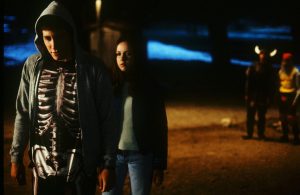 The other thing of curious note is that a sequel, S. Darko, was released in 2009 starring Donnie’s little sister Samantha, played by Daveigh Chase (The Ring). It’s not very good at all and strains to be an imitation of its predecessor, right down to Samantha having to be the sacrifice to go back in time and save her friend’s life. Kelly had nothing to do with the sequel, which was written by Nate Adkins, who would go onto create the Netflix franchise, The Christmas Prince. There is nothing of note in this cash-grab of a sequel to even reward your curiosity in watching it.
Donnie Darko was a movie I loved when I originally saw it and I’m happy so many others were able to become fans and share the good news of Darko. I’m happy this movie exists and has stuck with me all these years. It’s still transporting and invigorating and funny and soulful and tantalizing. I still love the lilt of Michael Andrews’ minimalist score. I love the scene of Donnie reaching out to Cherita Chen, the target of rampant bullying, to promise her one day everything will be better for her. I still get fascinated by the instant-iconic design of that Frank the bunny mask, an image that has lead to thousands of Halloween costume imitations. My original review was more driven by distilling its plot so that I could hook a reader into making the trip for themselves. Otherwise, my thoughts remain relative the same in twenty years of reflection. This is a gem of a movie that was never really recreated by its creator, which makes it all the more remarkable and special. If you haven’t joined the cult of Donnie Darko, there’s no time like the present, folks.
Re-View Grade: A
Share this:

An American Pickle (2020)
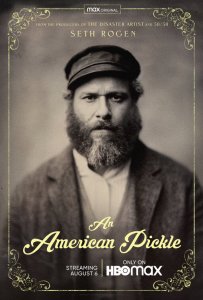 Delightfully droll and surprisingly poignant, An American Pickle is a light-hearted fable elevated by a terrific dual performance from Seth Rogen. He plays Herschel Greenbaum (Rogen), an immigrant from Easter Europe seeking a new life with his pregnant wife Sarah (Sarah Snook). Due to an accident at the pickle factory, Herschel is locked in a vat and kept in stasis for 100 years, brined for the future. His only living relative is a great-grandson, Ben (Rogen), a struggling app developer who is equal parts fascinated and annoyed by his long-lost family member. Right away I knew this was a movie with its sense of tone locked firmly in place. The opening few minutes establish the heightened, comically depressing life in the Old Country (“Her parents murdered by Cossacks. My parents murdered by Cossacks!”) and courtship where Sarah dreams of being rich enough to own her own gravestone. Then after Herschel is resurrected and the news media is obviously doubtful, a doctor explains and the narration goes, “A doctor explains. It is good. Everyone accepts,” and the same doubtful reporters now nod in approval. The movie knows its ridiculous but asking you to simply go along. By then I knew this was the movie for me. The first half of this relatively brisk comedy is where it’s at its best. Rogen does an exceptional job portraying Herschel, a man out of time trying to reconcile the life and loved ones lost. There are genuinely emotional moments that affected me, and Rogen doesn’t even try to undercut them with a wink or a nod. Beyond the technical ingenuity of playing identical roles in the same space, Rogen imbues each Greenbaum as a distinct character. Herschel is easily the more compelling character and Ben can be quite annoying, especially in the latter half as he tries to sabotage his great-grandfather through a series of petty recriminations. The last half hour can become a bit too episodic, repeating the escalating family feud without feeling like we’re getting much further narratively. It feels like a series of shorts more than a sustained storyline, like the first half. Yet I laughed repeatedly from writer Simon Rich’s (Miracle Workers) clever and aloof storytelling voice. This is a first-caliber chuckler of a movie, with a few hearty guffaws here and there. Top it off with a surprising veneer of emotional reflection and a fabulous performance from Rogen in comedy and drama, and I would cite An American Pickle as one of the more charming, diverting, and enjoyable comedies of the year. In a pandemic-ravaged year of anxiety, we need a little sweetness with a dash of tart, and that’s what Pickle packs.
Nate’s Grade: B+
Share this:

The Lion King (2019)
 Ever since the run-up of Disney’s live-action remakes, I’ve been predicting what would happen with the newer films, and it all seems to be coming true. The problem with Disney remaking hit animated movies from the 80s and 90s is that there hasn’t been enough distance. The immediate audience is going to demand their nostalgia exactly as they remember it, and they will not be happy with anything less. It’s not like a scenario where the original movies could be improved upon, like 2016’s beautifully tender Pete’s Dragon. What these live-action remakes offer is an uglier, inferior version of an animated classic. There’s no reason for most of them to exist. They won’t be different; they won’t be interesting. It’s a sludgy, auto-tuned cash grab that shows no end in sight. Before this year, I did not expect Tim Burton’s Dumbo to be the best of the three 2019 Disney live-action remakes, but here we are. I guess the concept of Disney eating its own tail with these live-action remakes is symbolic of the studio “circle of life,” and the perfect segue way to The Lion King, a remake missing the wonder and magic of the 1994 original.
King Mufasa (voiced by James Earl Jones again) rules over an African prairie and preparing his young son Simba (JD Mcrary and Donald Glover as an adult) for his eventual rule. Mufasa’s scornful brother Scar (Chiwetel Ejiofor) conspires to have Mufasa killed and Simba banished. Blaming himself for his father’s death, Simba runs away and finds kinship with a meerkat named Timon (Billy Eichner) and a warthog named Pumba (Seth Rogen). They preach a carefree life of “no worries.” This new life is interrupted when Nala (Beyoncé Knowles), Simba’s childhood friend, returns seeking help to remove Scar from the throne. Simba must confront his fate and treacherous uncle and bring balance back to his ailing homeland.
 The biggest appeal of director Jon Favreau’s Lion King remake is the stunning special effects. It’s been ten years since James Cameron brought to life a photo realistic alien world that dazzled audiences, and the advances have only made the professional fakery more startling. This movie was completely “filmed” inside a computer. Every single shot, every blade of grass, every pebble, every photo realistic morsel onscreen is the result of digital wizards. In 2016’s The Jungle Book, there were still some physical elements filmed, chief among them the human boy, but now it’s all done away. The remake looks like an HD nature documentary. One could question the use of the technology, $250 million to recreate what ordinary cameras on location could achieve, but I’ll choose to congratulate Disney and Favreau on the remarkable technical achievement. The Jungle Book was a big leap forward and The Lion King is that next step. However, the special effects are ultimately the only selling point. Come see how real it all looks, kids. The rest of the remake left me feeling unmoved and occasionally perplexed.
This is an almost exact shot-for-shot recreation of the original movie. It made me think of Gus van Sant’s 1998 Psycho remake and why anyone would go to this much trouble to make a copy. You’ll feel a tingle of recognition with different shots and scenes and then that feeling will transition to disappointment and lastly resignation. It’s the same, just not as good.
So what exactly is different with the live-action Lion King of 2019? Very very little. Despite totaling a half hour more movie, it really only has one added incidental Beyoncé song, a small character beat where Timon and Pumba explain their philosophy on more fatalistic terms, an explanation how Nala left the pride lands, and more poop and fart jokes. The filmmakers have added realism in appearance but also added more scatological humor, which seems like an odd combination. There is a literal plot point attached to giraffe poop. Instead of a whispery feather, petal, whatever finding its way to the baboon Rafiki to let him know Simba is still alive, now we watch the life of a tuft of fur as it travels from creature to creature, at one point being consumed on a leaf by a giraffe. The next image is a ball of poop being rolled by a beetle with our tell-tale tuft of lion fur. I guess it’s more emblematic of the whole “circle of life” theme, but I didn’t think Disney was going to literalize the poop aspect. The new Beyoncé song is fairly bland and unmemorable. That’s it, dear reader. Lion King 2019 is 95 percent identical to Lion King 1994 in plot, and yet the original writers do not earn a screenwriting credit thanks to arcane animation writing guild rules, and that is madness. It’s their story, it’s their characters, and it’s almost entirely their dialogue, and to not have their names rightfully credited where they belong is wrong.
 There are some definite drawbacks to that photo realism as well. When lions and other animals are photo realistic, they have facial structures that don’t exactly emote, so it looks like all the animals often just have their jaws wired shut. You’ll listen to the vocal actors go through a range of emotions and watch these plain, unmoved faces that you start to wonder if maybe all of the dialogue should have just been voice over. As soon as I saw Mufasa speaking, I was immediately shaken by the image and longed for the expression of the animation. I never got over it and it made me feel removed from the film, even more so. This is the trade off of realism; animals don’t actually speak, you know. Another trade off is that the film becomes much more intense especially for younger kids. I would not recommend parents take the littlelest ones to this movie because now, instead of watching a traditionally animated band of characters brawl, you’re watching realistic lions and hyenas scrape, claw, and hurl one another to their deaths. If kids were traumatized by parts of the original movie, I can only imagine the nightmares that await. Strangely, the photo realism also mitigates the film’s sense of scope and impact. The stampede sequence feels far less dangerous because the camera doesn’t pull back that far, showing a massive herd from a distance. Subsequently the sequence loses some of its urgency. Then there’s also simply identifying who may be who when those fights come, because you’re trying to pick out realistic animals instead of distinct creatures with specific character designs.
The aspects you enjoyed with the 1994 Lion King will still be enjoyable, even if they suffer in direct comparison. Hans Zimmer’s score is still magnificent. The songs are still catchy, though some of the arrangements are a bit under-cooked, like the speak-sung “Be Prepared.” The song “Can You Feel the Love Tonight?” occurs absurdly early in the Simbla/Nala reunion and takes place in the sunny afternoon. So much for “tonight” (the famous Nala “bedroom eyes” moment is also quite diminished from a real lion’s face). The jokes are still funny because they were funny the first time. The things that worked the first time will still work to some degree, even if the presentation leaves something to desire. Several of the vocal artists just sound flat, especially Ejiofor (12 Years a Slave) who comes across so blasé. I missed the casual menace of Jeremy Irons. The best vocal performances belong to Eichner (Difficult People) and Rogen (Long Shot), maybe because they’re already broad personalities, or maybe because they felt the most comfortable to occasionally steer away from the original script, finding small room to roam. Florence Kasumba (Black Panther) also delivers a snarling and effective performance as one of the hyena leaders, Shenzi. They’re the only vocal performances that fare well in competition.
 I need to defend the art of animated films. There is nothing wrong with animated films simply because they are animated. A live-action version is not better simply because it’s more “real.” I hear this same argument when it comes to making a live-action anime. Animation is a wonderful medium and has a magic all its own that often live-action cannot emulate. The animated Lion King is beautiful with bold colors, strong visual compositions, and emotive characters with specific designs. The live-action Lion King is missing much of that, at least when it’s not recreating exact shots from its predecessor. I don’t know who this movie is going to appeal to. Parents will be better off just playing the original for their children at home. Die-hard fans of The Lion King might enjoy seeing their favorite story told with plenty of cutting-edge special effects magic. I would have been happier had the filmmakers attempted something like Julie Taymor’s transformative and ground-breaking Broadway show. I would have been happier had they just recorded the Broadway show. The new Lion King is a lesser version of the 1994 movie, plain and simple, and if that’s enough for you, then have at it. For me, these Disney live-action remakes are making me feel as dead in the eyes as a photo realistic lion.
Nate’s Grade: C
Share this:

Long Shot (2019)
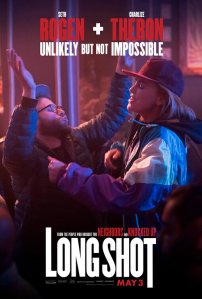 Secretary of State Charlotte Field (Charlize Theron) is preparing for the moment she feels her whole life has been leading up to: a presidential run. the current president (Bob Odenkirk) has decided not to run for a second term and wants to endorse her. Charlotte and her team of dogged, loyal assistants (June Diane Raphael, Ravi Patel) are sifting through ways to improve her negatives as a candidate, and that’s where Frank Flarsky (Seth Rogen) comes in. He’s an activist journalist that has just been fired and he also happens to personally know Charlotte; she was his babysitter. He comes aboard her campaign with the condition that she really fights for what’s important and not cave to the powerful lobbies and interest groups. He rewrites her speeches and the two of them grow closer together, bonding over their past and a possible future, not just as president but as boyfriend-girlfriend. They must keep their feelings a secret for the time being. If the press found out it might kill her candidacy before it ever really began.
The film’s biggest strength is the emphasis with the leading characters and the crackling chemistry between Rogen and Theron. It’s a fairly familiar dynamic between the more buttoned-up personality learning to cut loose and the more wild and impulsive personality learning a degree of self-restraint and responsibility. And to be fair Long Shot does pull from this familiar foundation for a starting point with its odd couple dynamic. However, it goes further by making their differences more attuned to politics and compromise. Fred is unwilling to back down for the things he knows are right and would rather have nothing than a watered-down version of the important issue he had been fighting for. Charlotte is more the political animal and used to working with others, including scoundrels and morons, in order to affect change. She’s about incremental, pragmatic change for the greater good and he’s about ideological purity as a moral imperative. This isn’t just a small character quick either; it’s a defining conflict between both characters and a subject that gets further examination as Charlotte confronts the realities of running for president and the many compromises of self and vision may or may not be needed.
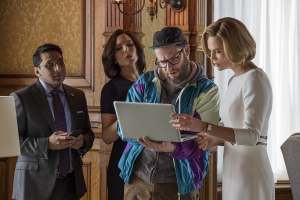 Being a woman running for president is an obstacle course of having to deal with latent sexism and other people’s expectations of what is socially appropriate. Charlotte is going to be judged harsher for the same behaviors men will be excused for; this isn’t a new observation by any means (apply your favorite double standard here) but the film makes you understand the pressure and scrutiny that befalls her at every turn. It defines her character, which is why finding someone she can unwind with and be her true self away from the cameras is such an understandable and desirable escape valve. She’s running to inspire little girls that they too can be president but at she also has to assess the cost of how much she’s willing to hide or lose from herself in order to get across that finish line, and if she does, what will be left? That’s the role for Alexander Skarsgard, the Justin Trudeau-like Canadian prime minister, who represents what is left of a person after bowing to opinion polls. Again, this isn’t new material, especially as anyone who can recall the 2016 presidential election will recall the questions of physical and mental fortitude that only seemed attached to one candidate and not as much the other. What this political reality does is provide a relevant substance for the romance and comedy portions of the film, making the characters feel more human. When Fred is articulating just what he must do to serve as a secret boyfriend for Charlotte, and a potential future they would have, you can hear his heartbreak with each new syllable. You also realize that he shouldn’t have to endure that and maybe these two are destined not to be together because of how unfortunate our politics and media environment have become.
Rogen and Theron are a blast together and have a fun rhythm they play off each other for unexpected comedy beats. His mellow vibes and good-natured joviality, as well as general awkwardness around people in power, are a nice fit with her sterner self. The best parts of the movie are just watching both of these actors enjoy their company. I won’t say that the romantic spark became overly apparent but what was undeniable was how well they paired as an onscreen buddy duo. With each new movie and every different role, Theron proves she’s one of the best actors of her generation. She can kick your ass, she can make you cry, she can win your heart, she can make you bust a gut. In short, Charlize Theron can do anything. She has several disarmingly funny moments, like when she’s high on ecstasy and pulled into an international crisis and has to maintain her cool. Rogen could easily fall back on his ease playing the oafish, insecure, crass characters of his past, but he does a fine job imbuing his charm, energy, and authenticity with Frank. Rogen is an anxious and generous scene partner who typically elevates his costars, and he and Theron as so good together that it sells their romance even better than the writing.
 Thankfully, Long Shot is consistently funny and bases much of its humor on the characters and their needs and developments. The movie isn’t just a retread of the incredulous fantasy of some ugly dude successfully romancing a beautiful woman. We’ve already had this dynamic explored in another Rogen comedy, 2007’s Knocked Up (in another universe where Katherine Heigl’s career didn’t stall, I could have seen Long Shot serving as an unofficial reunion for her and Rogen). There are jokes to be had about the unbelievable nature of this central romance and Rogen’s overall appearance, and that’s expected. What made me happier was that these wisecracks served a purpose to highlight how professionally damaging this potential relationship could be for Charlotte’s chance of winning office. They didn’t just feel like gratuitous put-downs. The joke emphasis is heavily tilted in favor of our two leads but there are nice moments with the supporting cast, like Raphael’s constant passive-aggressive comments, Bob Odenkirk’s buffoonish sense of betrayal with TV being turned against him, Randall Park’s frankness, and Skarsgard’s awkward and obsequious flirting. I don’t think the filmmakers fully knew what to do with O’Shea Jackson Jr. and provide some last-minute character shading that felt clumsy.
Long Shot follows the Judd Apatow rom-com formula closely and demonstrates that if you get funny, talented people together, provide them solid characterization and realistic conflicts, you can produce a winning romantic comedy that matters. Rogen and theron make an excellent team, the political content is savvy without getting too far into the weeds, and the romance is sweet and agreeable, with two genuinely enjoyable people coming to realize what they would be willing to risk for the other person. Long Shot is a reliably funny, bawdy, and heartwarming little movie with a little more on its mind than gross-out comedy set pieces. It’s worth seeking out this summer. I’d happily vote Theron for anything, especially if she was running for elected office as Furiosa. That’s a candidate that get results.
Nate’s Grade: B
Share this:

The Disaster Artist (2017)
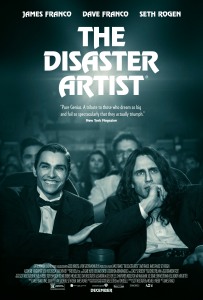 As an avid devotee of The Room, and a connoisseur of crappy cinema, I have been looking forward to this movie for literal years. I’ve been fascinated by Tommy Wiseau’s movie ever since I first saw it in 2009, and I’ve since watched it over 40 times. In my review for the movie, I said if I had to pick only five DVDs to take with me on a desert island, I might just select five copies of The Room. It’s that rare form of bad movie that is a thousand brushstrokes of bad, where you can discover something new with every viewing, and you desperately want to have your friends discover this miracle of filmmaking. It’s become a modern-day cult classic and theaters have been playing rowdy spoon-tossing midnight screenings of Wiseau’s film since its initial 2003 release (humble brag: I’m responsible for it playing on a monthly basis in Columbus, Ohio since 2009, the only regular public screening in all of Ohio). From its successful re-branding as a “quirky new black comedy,” fans had burning questions that needed answering, and that’s where Room actor Greg Sestero co-wrote a behind-the-scenes book, The Disaster Artist. One fan was multi-hyphenate James Franco, who purchased the adaptation rights, attached himself as director and star, transforming into Wiseau and tapping his younger brother to play Sestero. Who would have guessed all those years ago that these beleaguered actors would soon have Hollywood celebrities portraying their astonishment? The Disaster Artist might be one of the best films of the year by chronicling one of the worst films ever made.
Greg Sestero (Dave Franco) is a struggling actor in San Francisco when he meets the Teutonic acting force that is Tommy Wiseau (James Franco). Tommy doesn’t behave like anyone else, for good or ill, and it inspires Greg to become friends with him. Tommy says he’s the same age as Greg, though is clearly double, and that he’s from New Orleans, though he definitely sounds more vaguely Eastern European. Tommy also has a lot of money and elects to move to L.A. to make it in the film industry, and he wants his best friend Greg to join him. Greg finds some beginning levels of success but Tommy is rejected at every turn, determined as too weird and off-putting by casting directors. He doesn’t want to play a villain; he sees himself as the hero. Tommy won’t wait for Hollywood and decides to make his own movie. He’ll write it, direct it, and be the star, and Greg can be his onscreen best friend. The Room, Wiseau’s magnum opus, was a stunning document of filmmaking ineptitude that had to be seen to be believed, and many of the people involved were certain it would never be seen at all.
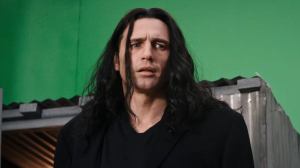 I was worried that the film version would simply be many painstaking recreations of scenes from The Room and watching characters snicker. Thankfully, the recreations are kept to a minimum and The Disaster Artist personalizes the story in the friendship between Tommy and Greg. If anyone has read the book, you’ll know there is a wealth of juicy anecdotes about the bizarre onset antics and about the human enigma himself, Wiseau. The film could have been three hours long and just thoroughly focused on all of the crazier aspects of the behind-the-scenes and I would have been satisfied. However, the ace screenwriters, Scott Neustadter and Michael H. Weber (The Fault in Our Stars), have elided all of those crazy details into a story about a personal relationship. The most memorable tidbits are still there, like the 60 plus takes needed for Tommy to say one line, but the sharper focus allows the film to resonate as something where you can genuinely feel invested in these people as characters rather than easily mocked send-ups. Greg feels greatly put upon by Tommy but he admires his fearlessness, and deeper down he feels indebted to Tommy for getting him onto the road to his dream. Thanks to Tommy, Greg was able to move to L.A., find a place, become an actor with representation, and book commercial spots. Tommy is also an anchor weighing him down. Greg will routinely have to place his rising career opportunities at the mercy of Tommy’s capricious sense of loyalty. It’s a movie that explores the value of friendship and the lengths people will go.
This is also an extremely funny movie. Part of the allure of The Room is how it feels like a movie made by space aliens who didn’t quite understand human interactions. The head-scratching choices and dropped subplots and redundant, nonsensical plotting are all given examination, allowing the audience to be in on the joke even if they have never seen Wiseau’s actual movie. This is a film completely accessible to people who have never seen The Room; however, if you have seen The Room, this movie is going to be 100 times more fascinating and enjoyable. The sheer bafflement of what transpired is enough to keep you chuckling from start to finish. The Disaster Artist is wonderful fun, and the actors involved are here because they love Wiseau’s movie. The celebrity cameos are another aspect that helps to add to the film’s sense of frivolity, spotting familiar faces in roles such as Casting Agent #2 (Casey Wilson), Actor Friend (Jerrod Carmichael) and Hollywood Producer (Judd Apatow). Watching everyone have a good time can be rather infectious, but The Disaster Artist succeeds beyond the good vibes of its cast.
 Rather than lap up the easy, mean-spirited yuks, The Disaster Artist goes further, following a similar point of view with 1994’s terrific Ed Wood by portraying these men as deeply incompetent filmmakers but also as sincere dreamers. Wiseau is clearly overwhelmed by the demands of being, let’s be generous, a traditional filmmaker, but he is also a person who set off to achieve a dream of his own. He was denied other avenues so he took it upon himself, and a mysterious influx of money he doesn’t like to discuss, and this self-made-movie star built a vehicle to shine brightest. Sure, ego is definitely a factor, though one could argue it plays some degree in all creative expression needing an audience. Wiseau didn’t let a little thing like ignorance of storytelling, film production, or how to handle cast and crew as human beings with needs stop him from plowing ahead to prove his doubters wrong. The filmmakers definitely find a certain nobility in this artistic tenacity, as did Tim Burton with Ed Wood. It’s natural to pull for the underdog, even an underdog that is so naïve it might be worrisome. You can laugh freely at Wiseau, and you will, but you may also start to admire his gumption. As the opening barrage of celebrity interviews posits, you could not make something like The Room even if you were the greatest filmmaker on the planet. It is nothing short of an accidental masterpiece. It is a movie that has entertained millions of people and one they feel compelled to share with friends and family, compelled to bring others into this strange, beguiling cult of fandom. While Wiseau may not have made a “good movie,” he has made one for the ages.
James Franco (11.23.63) deserves an Oscar nomination for playing Tommy Wiseau. I’m serious. He is channeling some Val-Kilmer-as-Jim-Morrison lightning when it comes to simply inhabiting the spirit of another person onscreen. It’s crazy that a movie so bad could inspire another movie that might legitimately compete for legitimate awards. James Franco is entrancing with his performance as he fully channels Wiseau, an almost mythic figure that we have never seen the likes of before. The accent is pitch perfect and impossible not to imitate after leaving the theater. Wiseau can be manipulative and cruel but he can also be generous and selfless. He takes great ownership over his friendship with Greg, so he believes all of his actions are to help their unique bond, even when he’s pushing that same person away. He so desperately wants acceptance but seems incapable of achieving it on anybody’s terms but his own. Wiseau is a fascinating film figure, and the movie does a fine job of neither overly romanticizing him nor vilifying him. Even despite his missteps, you may find yourself feeling sympathy for Wiseau, and that’s a major credit to the screenwriters and James Franco’s magnetic performance.
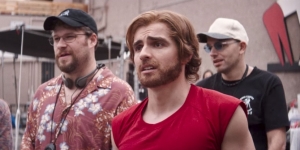
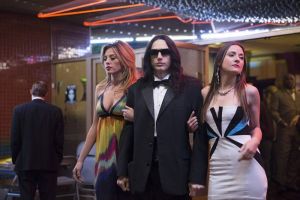 The other actors, a.k.a. everyone in Franco’s sphere of friends, are committed, enjoyable, and plugged into why exactly audiences have grown to love The Room for years. Dave Franco (Now You See Me 2) is effectively the perspective of the audience, deliberating how much of Tommy to put up with and when to walk away. Seth Rogen (Sausage Party) gets the most sustained comedic run as a script supervisor who is bewildered by Wsieau’s methods. Alison Brie (Netflix’s GLOW) is our chief source of confused expressions as Greg’s girlfriend. Ari Graynor (I’m Dying Up Here) wrings great laughs from her awkwardness with Wiseau as filmmaker and onscreen anatomically-challenged lover. Megan Mullally (Will & Grace) is Greg’s disapproving mother who worries about what kind of relationship her son has with a much older man. Zac Efron (Baywatch) is hilariously excitable as the inexplicable drug dealer, Chris R. Speaking of excitable, Jason Manzoukas (The House) and Hannibal Buress (Spider-Man: Homecoming) are a great team as the film equipment rental guys who can’t believe their luck with Wiseau. Even two-time Oscar nominee Jacki Weaver (Silver Linings Playbook) gets some nice moments as an older actress who justifies in a heartfelt message why exactly everybody on set would go out of their way to work on such an awful movie.
If you’re a fan of The Room, then you’ll absolutely adore The Disaster Artist, and if you’ve never seen The Room, you’ll still find plenty of entertainment in Franco’s film. Wiseau’s 2003 film has to be experienced to be fully believed. The film-about-his-film provides the added extension of a coterie of characters to share in our bemusement and bafflement, providing a chorus of commentary. However, the movie isn’t all jokes at Wiseau’s expense. It evolves into a love letter for the power of art to bring distaff people together with a shared dream. Like Ed Wood, Wiseau might be incompetent by traditional measures of filmmaking but he ignored the naysayers and followed his artistic vision. Under Franco’s direction, he’s a modern-day Don Quixote, or just a really weird guy who lucked into a miraculous alchemy that gave birth to a cult classic. At the end of the movie, Tommy thinks he’s a failure. Greg reminds him to listen to the audience reaction. They are hooting, hollering, applauding, and having the time of their lives. He’s responsible for that and he should be proud of his accomplishment. I unabashedly love The Room. I introduce the theatrical screenings in Columbus. I loved The Disaster Artist book. This movie is everything I was hoping for, and it just so happens to be one of the funniest, most genuinely pleasurable films of the year.
Nate’s Grade: A-
Share this:

Sausage Party (2016)
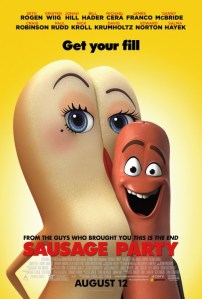 Following the “secret life of” Pixar story model, Seth Rogen and Evan Goldberg’s hard-R animated movie about anthropomorphic food literally uses just about every possible joke it can from its premise. I was expecting plenty of puns and easy sexual innuendo, but what I wasn’t expecting was a religious parable that actually has substance and some crazy left field directions the movie takes that made me spit out my popcorn. Sausage Party seems like a one-note joke as we follow Frank, a sausage (voiced by Rogen), and his girlfriend Brenda, a hotdog bun (Kristen Wiig) and their food friends over the course of the Fourth of July weekend. The supermarket items have been told that loving gods will take them to a wonderful promised land. The reality is far worse as the humans consume and “murder” the supermarket products. The messy food massacre sequences are some of the cleverest moments in the movie, which too often relies on a lot of easy profanity and vulgarity and broad ethnic stereotypes (it earns points for pointing out its lazy ethnic stereotypes too). However, when it veers into its religious commentary and the plight of the atheist, the movie becomes far more than the sum of its sex jokes. It’s consistently funny with some hard-throated laughs toward the end, especially in the jubilantly demented third act that takes an extreme leap first into violence and then into food-based sexuality. The concluding five minutes might be some of the most insane images put to film I’ve ever seen. The only equivalent I can even think of is the concluding act of Perfume. I credit Rogen, Goldberg and their team for taking a potentially one-joke premise and finding something more interesting and substantial, while still finding plenty opportunities for crass humor when called for and then some. Sausage Party is not a film for everybody but it’s also a film that is hard to forget, although you might feel guilty about munching on your popcorn at some point.
Nate’s Grade: B


 nathanzoebl

You must be logged in to post a comment.