Blog Archives
Seed (2008)
 Uwe Boll had some things he wanted to say with his low-rent horror flick, Seed. Like much of Boll’s output it’s based upon a video game. However, Boll opens the flick with a warning that footage of animal abuse and disturbing images will be incorporated into the movie. Seed gets the ball rolling with a two-minute montage of animals being cruelly beaten and mutilated before the title ever finds its place on screen. Boll’s opening text says that he decided to use this disturbing snuff footage because he “wanted to make a statement about humanity.” Yeah, sure Boll. Isn’t it a bit trite and easy to castigate the human condition for evil when you just roll out visceral real-life footage of cruelty? By highlighting the real stuff Boll is calling into question the significance of his whole stupid slasher movie. It opens with real-life cruelty and then plays out 90 minutes of fake cruelty, so what’s the point? I don’t think Seed has any interest in the subtext that can elevate horror movies. I think Boll just wanted to make his own torture-heavy horror film and found some animal abuse footage on the cheap (PETA probably gave it to him free of charge). The opening smacks of exploitation and opportunism and has zero thematic connection to the flaccid and empty-headed horror movie that follows. If I sound angry that’s because I don’t need to see animals having their skulls crushed in to get it.
Seed (William Sanderson) is a killer of astounding proficiency (for further details: see below). Matt Bishop (Boll BFF, Michael Paré) is the detective that’s been tracking Seed all these years. You can tell he’s a haunted cop because he has a drinking problem and hears the cries of dead babies. Eventually, Bishop tracks down Seed’s hideout and he arrests the murderous fiend. Seed is sentenced to die by the electric chair. The problem is that the prison doesn’t have a pristine electric chair, and the law says that if a man survives three jolts of juice then he’s free to go (for further details: see below). The warden (Ralf Moeller) decides to take command. He and a group of prison employees bury Seed alive and tell the world he died on the faulty electric chair. Of course Seed comes back and rekindles that old killing feeling.

 If Sanctimony was Boll’s attempt to manufacture the clever Saw-esque serial killer, a higher scale of serial killers, then Seed is at the opposite end of the serial killer equation. This is a dull slasher movie and Seed is about as dull as killers can be. His main attributes are that he’s a huge guy with a sack on his head, which is kind of similar to about 1000 different slasher movies. He looks particularly close to Leatherface from The Texas Chainsaw Massacre. I guess the slasher recipe is add one obscure mask plus one set of overalls plus dirt = killer. The guy has zero personality and is merely a silent killing machine that, in typical slasher fashion, always roams around at a deliberately slow pace. Sanderson (star of SEVEN Boll films) is unrecognizable as Seed and this is mostly because he wears a sack on his head and says maybe one thing for the entire 90-minute running time. I don’t recall Sanderson being as bulky either. Boll’s attempt at a horror movie wallows in exploitation and prolonged torture. As always, he’s late to the party.
Seed is credited as bring solely written by Boll, and the man screws it all up within minutes. When it comes to horror movies there will always need to be a somewhat healthy suspension of disbelief but only up to a point. Every movie no matter the genre or internal logic will have a breaking point. Seed cruises through that breaking point alarmingly early. Through the use of newspaper clippings, Boll introduces us to the backstory of Mr. Seed (he uses newspaper clippings for 90 percent of all exposition, meaning someone at the police department has a big thing for scrapbooking). We are told that from 1973-1979, Seed killed an astounding, and numerologically convenient, 666 people in those six years. Just take a second and think that figure over. One person in a ratty cloth mask and overalls killed 666 people. Ted Bundy and John Wayne Gacey weren’t even anywhere near that figure and they are highly prolific serial killers. Boll wanted to make his serial killer scary but he totally overcompensates and destroys any credibility the film could possibly attain. Why 666? There’s no way it’s a coincidence considering the pull of that number in our pop culture. Was that a target quota for Seed? Did he make a chart to know when he was falling behind?
The sheer magnitude of that number obliterates the facade of “reality” Boll wants to create in his movie. These cops have to be the worst investigative unit in history. Seriously, could they not tabulate any clues or patterns or habits of Seed after 665 murders? I think the FBI would have stepped in hundreds of unsolved murders ago. And yet Boll then shows again how staggeringly inept these local cops are. They find out Seed’s home, which is of course a dilapidated shack in the middle of nowhere. This naturally begs the question that Seed would have to venture out long distances to find so many victims, and yet no witnesses of any sort? But Boll ignores this and steamrolls ahead. What showcases the utter stupidity of these boys in blue is that they ride out in the middle of the night, into the middle of the woods, and decide to raid Seed’s house with only six officers. I’m sorry, but if any man killed 666 people with his own hands then you don’t plan on taking him down with a small unit of cops who have already proven to be inept. You bring in tanks.
 The premise itself is deeply flawed and begging for mockery. Seed proposes that there is a law on the books that somehow mandates prisoners must be set free if you can’t kill them after three jolts from the electric chair. We’re talking 45 second long jolts of 15,000 volts of electricity frying your brain. Your heart will eventually explode with all that electricity. So how does this law truly work? Surely no one would actually abide by it or fear that the government would punish them for breaking this law? Seed never specifies where it takes place, though the vibe I get is more southern, and they love to kill people in the South, especially Texas. Did the electric company propose this three-strikes-and-you’re-alive policy as an incentive to inmates? Do low-income prisons have a higher turnaround rate? Does this law cover firing squads and hangings as well? A judge and jury have found Seed guilty and sentenced him to be executed. That judicial ruling is not absolved because an inmate could withstand a high degree of voltage. The premise turns an execution into a contest.
Most slasher movies involve a near superhuman antagonist, and Seed follows suit. He can attack and kill four prison guards who try to gang rape him in his cell (what part of 666 kills says, “please expose your penis near me”?). He can step on a prison guard’s forearm and crush it so that it looks like a swaying doll part. He can bust out of a coffin and dig himself out of a grave. Now I did some quick math and a 6 feet by 6 feet by 3 feet grave is 108 total cubic feet. The lightest dirt will weigh is 42 pounds per cubic foot. That means that Seed had 4536 pounds of force weighing down on him in that grave. Yet he was able to free himself and go on his rampage. If Seed is this indestructible force then it’s ridiculous that Pare could kick him a few times and the man went down during the police capture. Which is the worse screenwriting sin? Having Seed wiggle out of 4500 pounds of force or the fact that the prison guards did a lousy job of BURYING ALIVE a man who killed 666 people! Why would you ever bury this maniac alive?! That seems hardly definitive. Common sense begs cutting off the man’s head just to be certain.
When it comes to horror movies, building an atmosphere is essential but there’s a notable difference between building dread and simply killing time. Boll does not know this difference. Seed doesn’t even get placed on the electric chair until 46 minutes in. The first 33 minutes of the movie is pointless because it retells Seed’s capture via a flashback while he sits on death row. Watching Seed finally get captured isn’t really important to the story, and a good half of that misspent time is simply gross and grainy home videos. Seed sends videotapes to the police to taunt them. The tapes are shot in a dungeon-like location and involve living creatures rotting thanks to the miracles of time-lapse photography. Naturally this raises two quibbles: 1) No one had personal video recording devices in the mid 1970s, let alone a maniac living in the middle of nowhere, and 2) watching dogs and babies die of dehydration and then decompose to ash means that these video projects took many weeks to accomplish. That’s a lot of time. Boll spends five plus minutes of screen time just showing these grainy snuff videos with the police recoiling. Perhaps the extent of their investigation was watching these gross videos and making faces. How many videos do the police have from Seed? It seems like Seed’s version of the fruit of the month club.
 But getting back to misspent time, Boll thinks just holding onto a shot and not cutting makes it scary or tense. It doesn’t. I don’t need nearly two minutes uninterrupted of watching guards fiddle with Seed’s chains as they try and latch him into the electric chair. I don’t need almost a minute of one shot panning around a boat departing the prison isle. I don’t need nearly two uninterrupted minutes of watching the prison doctor’s bedtime rituals before he eventually gets murdered. I especially don’t need over five uninterrupted minutes of watching Seed hit a woman in the head with a mallet. I’m not being facetious when I tell you that he literally hits her 40 times until her head is purified into a bloody stump of a neck. Seed literally paints the walls with this old woman’s blood (how did this genius not get caught?). The soundtrack soars to laughable heights and the scene just goes on and on, figuratively bludgeoning the audience as well. Boll believes that just holding onto a moment of depravity makes it sinister. It doesn’t when there’s no audience connection whatsoever to the tired material. Boll does craft one nicely tense sequence where Pare and the cops capture Seed. There’s a moment when one officer is tiptoeing through the basement of Seed’s home and the only source of light is the flicker of the police siren. It’s visually appealing and works to create tension as well. But this moment is short-lived. I’ll never know how a burly guy can see through a cloth mask in the dark and sneak around in a dilapidated home filled with crap covered in tetanus.
It may be hard to notice for some, but Uwe Boll is actually improving as a filmmaker, at least from a technical standard. Seed looks like an actual movie. Seed is grisly and nihilistic and futile. The killer is a bore and the story is poorly structured, taking far too long to get Seed in the ground and wrecking havoc. Boll’s screenwriting shortcomings are fully evident as he strings together genre clichés and ridiculous plot points that obliterate credibility. He grasps at making statements about the human capacity for cruelty. Well I didn’t need a Uwe Boll movie to educate me on man’s inhumanity to man, especially one this shoddy and empty. This movie isn’t even entertaining; it’s a chore to sit through. This is the first Boll movie that I sat just waiting for it to be over. There is no reason to watch this thing. During the extended scenes of video watching by the police, one of the cops watches a baby decompose and replies, “Sick bastard.” I think Boll was projecting here. And I didn’t need footage of animals being slaughtered to reach that conclusion either.
Nate’s Grade: D-
Share this:

Untraceable (2008)
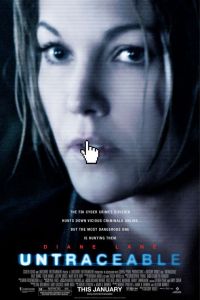 The Internet can be a scary place, no question. There’s plenty of weird crap in wide-open world of the World Wide Web. There are sites devoted to teaching people how to make bombs in the privacy of their own kitchen. If you can name a fetish, chances are there’s a pay sex site already built for it (I tried “clown porn” and was not disappointed, and by that I mean that I found a site for it and WAS deeply creeped out). According to the ongoing Dateline specials, everyone wants to “talk” to adolescent girls while they’re home alone. In short, the Internet can be a scary place. Untraceable, a barrel-scrapping genre movie, taps into our fears of the unknown in cyber space.
Agent Jennifer Marsh (Diane Lane) is a member of the Portland, Oregon office of the FBI. She specializes in tracking down cyber criminals and bringing them to real-world justice. There’s a new Web site called “Kill With Me.com” that invites anonymous users to serve as executioners. The site creator creates death traps that increase in deadliness the more users click onto the site; so a man bleeds out faster the more people that want to catch a glimpse of it. Lucky for the FBI, the cyber killer is doing all this nasty business in Portland. Marsh and her cyber assistant (Colin Hanks) try finding the location of the IP site but, somehow, it skips around the world and cannot be pinpointed. The victims of the site are specifically chosen, and Marsh is struggling to put it all together. Then the cyber killer begins stalking her and lets others join in on the fun.
 Untraceable is rather hypocritical in nature. It wants to titillate an audience but then shame them for embracing the titillation; the movie is purveying the same crap that it derides. The premise of a digital age serial killer that transforms murder into an online democratic act sounds nifty. Plenty of insightful questions generated by this premise like the nature of exploitation, media, and the culpability on the account of the insatiable viewing public. It’s too bad, then that Untraceable just uses the premise as a jumping off point to create a half-assed Saw. The movie is mostly concerned with reworking the familiar tropes of the serial killer genre, this time with some extra dashes of torture and Saw-style death traps. But the movie doesn’t fully commit to horror so much of the gore is implied. The extra attention to torture seems timidly tacked on to the framework of a thriller, likely grossing out the older folk that came to the movies thinking they were going to watch Diane Lane assert justice on this new fangled Internets thing. The movie has a vague fear of technology and computers and seems programmed to scare people that don’t know any better, namely the people who think computers are bigger toasters.
The script by relative neophytes is where the movie treads water. The villain is revealed fairly early, like a half hour in, and this revelation does nothing to help build tension. The culprit responsible for the laughably implausible death traps is a gangly eighteen-year-old twerp (Running with Scissors‘ Joseph Cross; yes that kid). I understand that in serial killer movies the villain usually takes on some form of supernatural abilities, like the ability to be everywhere and never be seen, or the ability to draw super strength at opportune times. When Untraceable apathetically reveals its villain the movie seems like it’s already giving up and conceding, “Okay, this is the big bad dude and he weighs about 110 pounds soaking wet. We know he could never outmatch anyone that is over five feet tall.” Marsh’s home life is also given obligatory screen time, including Marsh’s mother keeping watch of the home, but it never matters. In this world, birthday parties just get in the way of FBI manhunts.
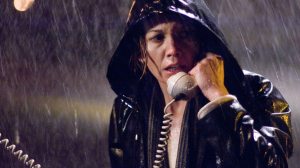
The film also requires character to act inexplicably stupid at a moment’s notice in order for the plot to hum along. Marsh is such an expert on cyber crime, and yet she doesn’t bat an eyelash when her young daughter downloads a mysterious computer program sent to her by a “friend”? Never mind that this FBI expert logs onto the “Kill With Me” site on her home computer, allowing the killer to hack into her computer and look through all her personal information and cyber dirty laundry. The worst lapse occurs after our tech-savvy killer has effectively hacked into Marsh’s OnStar computer system in her car. The engine shits down and the car slows to a halt. Marsh leaves her car to use a roadside telephone to tell another cop that the killer has hijacked her car. The cop on the phone advises her to be on alert. Right after she hangs up, the car’s engine and lights become operational once again. Marsh trots over to her car, whose door had been open since she left, and simply hops back inside without checking the vehicle at all. She is swiftly tazed and kidnapped by the killer who was routinely hiding in the back seat. It’s not like a trained FBI agent would be able to miss the inescapable sight of somebody hiding in a tiny backseat with little room to crouch. I can excuse smart people making stupid decisions, but when a movie like Untraceable has experts not following through on situations that require their expertise, then it comes across as contrived. Really, a cop wouldn’t even peek in the backseat?
 Lane holds her own, and even that is an accomplishment for something so rote. She’s an actress easing into her forties and finding a new tap of talent. Frankly, she should have won the Best Actress Oscar for 2002 with her fabulous work in Unfaithful. That movie came out five years ago, and yet the Diane Lane in Untraceable looks so much older. I think the filmmakers were trying to make her look more harried by not applying makeup or utilizing soft focus. You can see her wrinkles and her age, and these are all well earned for a great actress, and Untraceable wants to maker her look her age in a time where Hollywood seems to dump out an actress’ business card once she hits 40. I just thought that was interesting, but the most interesting facet of this entire movie is that the actor who plays the head of the FBI team (Peter Lewis) looks remarkably close to 2008 Republican presidential candidate Mike Huckabee. It’s uncanny. If Huckabee ever plans on contributing to a filmed biopic of his life, then Peter Lewis should be on his shortlist.
Untraceable scrapes the serial killer genre for some form of life. The novel premise gives way to predictably lackluster thrills and gaping plot holes. Lane saunters around with a gun for two hours, mixed in with some extended sequences of torture, including one that involves hundreds of heat lamps. Look, I know I’m no cop, but couldn’t someone simply trace the massive electric bill this guy is generating? It’s just sloppy police work all around. Why? Because the movie requires giant lapses in judgment so that it can continue. The world can be a sick place, but has it always been this way? A better movie would dig deeper; this movie just wants to fry a cat and call it a day.
Nate’s Grade: C
Share this:

I Know Who Killed Me (2007)
 We interrupt the nonstop barrage of Lindsay Lohan media coverage and speculation to bring you her movie, or, more accurately, further proof that Lohan is in desperate need of a career makeover. The tabloid target has a pretty shoddy track record of late when it comes to picking acting projects, so it’s no wonder that her splashy private life has overshadowed her cinematic duds. Thanks to a second summer DUI Lohan was unable to promote her new movie, I Know Who Killed Me. This may be a blessing in disguise because if I were her I would want to draw the least amount of attention possible to what is destined to contend for the worst film of 2007.
We open to Aubrey (Lohan) reading her story in her high school class. The story revolves around a stripper named Dakota and the amorous attention she earns from creepy older gentlemen. One night Aubrey goes missing and the police believe she may be the next victim of the local blue-gloved serial killer that hacks off the limbs of his victims. The last girl, currently residing in the morgue, is missing her right forearm and her right leg. Her parents (Neal McDonough, Julia Ormond) fear the worst. Then a motorist finds Aubrey’s mutilated body on the side of the road. She wakes up in the hospital and will survive, except the problem is that she has no idea who any Aubrey is; her name is Dakota and she worked as a stripper. She vows to find the “real” Aubrey.
This films is sleazy and tries to energize a lame straight-to-video thriller with some tawdry turns. Without Lohan’s name, I Know Who Killed Me would never have gotten a theatrical release. The torture sequences are drawn out to the soundtrack of Lohan’s muffled screams. The violence fails to excite or horrify, but instead it just seems like a sorry attempt to ape the success of recent torture-heavy horror flicks.
 The sex is even less believable. Aubrey/Dakota, fresh from the hospital, beds the quarterback in one of the least convincing, most unintentionally hilarious sex scenes of recent memory. She throws the jock onto her bed and pins him down for a good pumping. In the ensuing two minutes, the pair engage in exaggerated and noisy PG-13 sex where the woman stays on top and keeps her bra on the whole time (does any woman do that?). The whole time the movie cuts back and forth to Aubrey/Dakota’s mother listening and furiously cleaning the kitchen sink. I think the juxtaposition is intended to be funny, and it is, just not in the manner the filmmakers were probably hoping for.
The movie would be more revolting if it weren’t so incomprehensible. I Know Who Killed Me begins to disassemble at a fantastic rate of idiocy once it attempts to explain its central Aubrey/Dakota conflict. But the movie only presents two options: 1) Aubrey and Dakota are the same person and she just created a fictional persona as a means of post-traumatic stress (yawn), or 2) somehow there are TWO Lohans on this planet (what?). The first scenario is pretty dull and obvious and way too feeble for such a dank exploitation thriller. The second scenario requires a scheme so convoluted and ridiculous that it cannot be taken seriously. In the end, the movie becomes Saw meets The Parent Trap, and it’s every bit as terrible as you would concur from such a description.
For the sake of the morbidly curious, I will be discussing some heavy-duty spoilers to fully shine the spotlight on how ludicrous the movie gets. Don’t say you were not warned. Aubrey/Dakota keeps swearing she is indeed her own woman but no one seems to believe her. She researches the unexplainable via the Internet and it is here that she gathers the theory of stigmatic twins. The idea is that whatever happens to one twin will magically happen to the other, no matter the distance and no matter the situation. In the online example, a man with gambling debts is shot in the throat, and thousands of miles away his twin brother bleeds to death thanks to a perfectly placed and ill-timed hole in his own throat. I Know Who Killed Me tries to wrap up its questions with answers that would seem preposterous even in a soap opera. Not only does the film give us the old long-lost twin chestnut but it also goes the extra inane inning to say that one twin endures whatever happens to the other. So when Aubrey is losing limbs during her capture, Dakota is mysteriously waking up some considerable weight loss. If my limbs were disappearing I might consult a doctor. Essentially, if there’s any merit to this theory, the best way to get revenge on your twin (long-lost or not) is through extreme masochism.
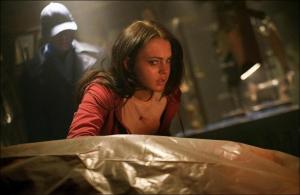 I Know Who Killed Me is littered with stupid behavior and stupid plot points that stick in your brain. A doctor fixes Aubrey/Dakota with a pair of prosthetics – a fake leg and a robot arm. He slides the robot hand onto her stump and it reacts to her nerve impulses. As soon as I saw this scene I blurted out, “Oh my God, Lindsay Lohan becomes the Terminator!” Where the scene earns its stupid wings is that the doctor says she’ll have to charge her prosthetic when not in use or else the battery will go dead. Naturally, I’m thinking he’s referring to the robot arm of doom, but no, he’s talking about her freaking leg. Aubrey/Dakota’s leg amputation is below her knee; therefore this fake leg is little more than a pole. There’s nothing mechanical to it. Why does it need to be plugged in? Will it hop away? It doesn’t matter because the leg and arm never pose any trouble or danger for Aubrey/Dakota. It’s a strange setup without any payoff.
The bloody ending to I Know Who Killed Me is such a mess that it takes special attention just to pick apart its awfulness for further clarity. Aubrey/Dakota figures out the whole complicated rigmarole and declares in titular fashion, “I know who killed me.” Given the silly stigmatic twin theory, even this statement is incorrect from a tense standpoint (if it was true she wouldn’t be able to utter the words). Aubrey/Dakota and her dad head off to the dismembering serial killer’s home without bothering to contact the authorities. She says they don’t have time because, apparently, cell phones do not exist in this universe. I don’t know how it’s possible for Aubrey/Dakota to dig up a grave with one arm. When she goes running into the woods she’s looking for an owl from a vision. That’s good. It’s not like the woods are big or have more than one owl. For that matter, how did Aubrey even get kidnapped in the first place when she was among a large crowd on a busy sidewalk? Would no one have noticed and done something? Even the identity of the serial killer cannot give the movie a sense of finality that it wants. This is your standard serial killer movie where the killer has no working motivation and their identity is relatively meaningless. The limb-slicing maniac might as well have been the janitor seen in the background of one scene for a fleeting moment.
 Lohan gives a performance that suits the material – dreadful. Her idea of a bad girl seems more like a perturbed and insolent child. Lohan gets to hurl her share of F-bombs but never seems adult in whatever she’s doing onscreen. I Know Who Killed Me is a depressing low point for such a once-promising young actress who had the world on a string.
Director Chris Sivertson seems to know he’s the captain of a doomed vessel. He overwhelms the movie with irritating lighting excesses. Sivertson takes a cue from Shyamalan and ramps up the color symbolism; there’s blue roses, blue gloves, blue killer tools, blue stained glass of blue roses. You may start to wonder if the Blue Man Group suddenly became a symphonic serial killing side project.
I Know Who Killed Me is a disaster in every sense of the word. The ineptness on display is staggering. The movie is trash from start to finish but it’s not even redeemable trash. The movie tries to cover its numerous plot holes with images of Lohan canoodling with a stripper pole. I Know Who Killed Me is a ludicrous, incomprehensible, and rather sundry thriller that won’t help Lohan’s troubled life. I have a lot of good will for Lohan after her performances in Freaky Friday and Mean Girls. I want her to succeed, but truthfully, if she needs to know who’s killing her career, the answer is in a mirror.
Nate’s Grade: D
Share this:

Zodiac (2007)
 Zodiac is something altogether different from a genre best known for cannibalism, skin suits, and express shipping of human heads. It has more in common with All the President’s Men than director David Fincher’s 1995 masterpiece, Seven. This is a serial killer thriller steeped in police procedural, closed door deliberations, and the slow drip of a decades long investigation into the Zodiac killings that terrorized California from the 1960s and 70s. Watching close to 3 hours of procedure with nary a car chase or a shoot-out may not sit right for fans of the genre, but I enjoyed the film for the same reasons people will decry it — the details. I loved how methodical this film is, how dogged and stubborn it is, and I found myself being enveloped into the minutia of the case.
It all began with a young couple looking for a bit of privacy in 1968. They park at a lover’s lane and nervously engage in a bit of the old “neckin.” A passing car interrupts them, and then that car returns with its headlights blasting into the couple’s faces. This man then takes out a gun and starts firing, killing the woman and badly injuring the young man. Robert Graysmith (Jake Gyllenhaal) is a political cartoonist for the San Francisco Chronicle when a curious letter has stirred up a lot of discussion. It’s a cryptic message with a puzzle attached made up of symbols and codes. The author demands his puzzle run in the newspaper, and if not, more will suffer at his hands. There are further attacks along the California coast and the mysterious figure finally gives himself a name at the end of one of his letters: Zodiac.
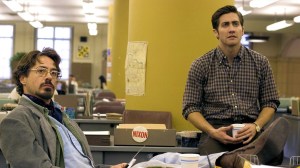 San Francisco detectives David Toschi (a great, raspy Mark Ruffalo) and William Armstrong (Anthony Edwards) are called in after Zodiac executes a cab driver in the city. The Chronicle‘s star crime reporter, Paul Avery (Robert Downey Jr.), pesters the police for details and eventually gets under Zodiac?s skin. Graysmith becomes obsessed with the case through a life-long love of puzzles and the case eventually consumes him, dooming his marriage to a pretty girl (Chloe Sevigny). Thanks to the tutelage of Avery, Graymsith becomes an amateur detective of his own, and his zeal to solve the case outlasts the actual police.
The Zodiac killer was really the first mass media serial killer. As the news of brutal attacks spreads, the media ate it all up and enlarged the figure of Zodiac to grand heights. And he was eager to help inflate his image, taking credit for crimes and slayings that were not his doing. The killer used the media age to terrorize the populace and increase his notoriety, similar tactics used by today’s stream of terrorists. The detectives didn’t just have to navigate all the shifting evidence but the formation of an urban legend.
This is before the day of DNA and super computers, so all progress comes from good old-fashioned police work. Long hours are spent pouring over mounting evidence while coordinating around bureaucracy; because Zodiac has struck in several different small communities it can take a saint’s patience to figure out the correct jurisdiction and compile the various parts in various offices. The film packs a lot in its running time introducing scores of information, suspects, witnesses, and varying theories, but the film cannot be faulted for pace; nearly every scene takes place weeks, months, even years after the last.
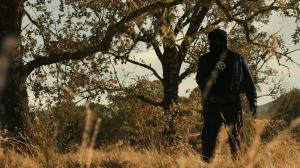 Zodiac is Fincher’s most restrained work even at a gargantuan running length. Fincher is a master tactician with slick visuals but has a penchant for getting too dazzled by needless visual flourishes (did the camera really need to zoom through the handle of a coffee pot in Panic Room?). He tones down the excess but still maintains a refined visual palate that makes the film feel fluid. The period detail is incredibly reconstructed, giving an authentic feel for a very serious story. But Fincher knows that with Zodiac the impetus lies with the story, and he devotes his considerable style to the service of the story. The mood balances nicely with intrigue, humor (after Zodiac singles out Avery fellow journalists start wearing “I’m Not Avery” buttons), and some truly terrifying moments involving the Zodiac attacks. The violence is sparse but when it does occur it is shocking, particularly watching a knife plunge repeatedly into the writhing body of a woman at a lake. One key element of sustaining such an ominous mood is fabulous song selection. Very often pop songs can be counter-productive to a movie, coming across as a lazy attempt to cobble together a soundtrack to shill. With Zodiac, “Hurdy Gurdy Man” becomes a powerfully haunting medley for the killer and the sonic linchpin for the film.
Fincher does an excellent job of transporting us back in time and recreating the sense of paranoia that grappled many. There is a great scene late in the film where Graysmith comes to the sudden realization that he may have walked right into the spider’s parlor. The scene plays out to an agonizingly uncomfortable length, and you too feel like running out the door as fast as your legs can take you. By not knowing definitively who the Zodiac may be, the film gets a boost of suspense from a multitude of creepy suspects. In an interesting decision, Fincher uses different actors of different shape during the Zodiac attacks, playing against the varying reports from witnesses and survivors.
There?s a sizeable danger trying to find a climax to a case that remains open to this day and where no one has been officially charged. Zodiac does as good a job as possible to present a fitting, mostly satisfying conclusion. The movie presents the best theory and points a convincing finger at who Zodiac perhaps really was.
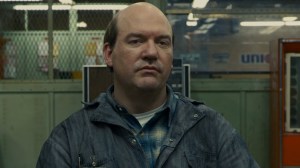 Zodiac is expertly crafted but has a handful of minor flaws that hold it back. The overall script is rather nimble with how it dishes new information to digest, however the intricacies can amass and become too great, and some scenes congest too much without needed forward momentum which causes the flow to get caught up in an expository pile-up. Still, the film is demanding but not overwhelming and not without reward. The film follows the ups and downs of the Zodiac investigation, and that means characterization runs short and simple. I fear the only false note amongst a vastly talented cast is Gyllenhaal, an actor I adore. He works fine in the portrayal of a young kid in the newsroom trying his hand at crime solving, but it’s the film’s second half where the actor falters. He fails to sell the obsession and desperation that dominates his life, instead looking wiped out but no worse for wear, like the temporary results of an all-nighter before a big test.
It was five years since Fincher’s last film, and he wasn’t sitting on his laurels when he crafted Zodiac, an exceptionally intelligent and demanding movie. Decades pass, suspects weave in and out, evidence and testimony contradict one another, it’s all a lot to keep track of but I found myself absorbed in the case just like Graysmith. This is a serial killer movie that could bring the smarts back and redefine the genre, that is, if fans are willing to sit through 3 hours of police work. If not, well they might get their kicks out of the more genre loyal The Zodiac, released in 2006. And that movie’s only 97 minutes long.
Nate’s Grade: A-
Share this:

Sanctimony (2000)

Sanctimony is the English-language introduction to the filmography of Dr. Uwe Boll and the very last movie I had yet to see for my first edition of my expansive column. Boll wrote and directed the movie about a clever serial killer that’s baffled law enforcement. It’s interesting coming into Sanctimony with all the Uwe Boll homework in the back of my head. I know what flaws I’m looking for, I pay attention to the retched line delivery from the actors, and I genuinely know what I’m getting into. It’s seems that Boll works somewhat in a bubble; almost all of his technical crew is the same from film to film, and Michael Paré, Jurgen Prochnow, Clint Howard, and Patrick Muldoon seem to be the stable Uwe Boll Players. Sanctimony is where it all began and where everything went so horribly awry for moviegoing audiences.
A killer is loose and terrorizing Seattle, cutting out the eyes, ears, and tongues of his victims. The media has dubbed him the “Monkey Maker killer” (think “speak no evil, hear no evil, etc.”). Detective Renart (Paré) and his partner Dorothy Smith (Jennifer Rubin) are assigned the case. After some investigation of a stabbed homeless girl, their initial suspect seems to be Tom (Casper Van Dien), a wealthy and cynical stockbroker. His lawyer balks at any charges and Tom goes free. Coincidentally, more bodies start piling up haphazardly. As Renart puts more pressure on Tom, he starts targeting those close to him, like his pregnant wife (Catherine Oxenberg, who seduced Van Dien in 1999’s The Omega Code). Tom has some master plan ready to shock the world, and only the dogged persistence of Renart can stop his wicked ways.
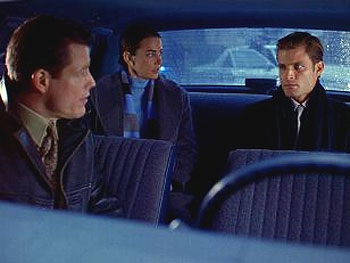 Sanctimony is really a crossbreeding of what Boll liked best about Seven and American Psycho. Like David Fincher’s masterpiece, Boll really wants his serial killer to be slicing and dicing with a message; this killer gets his kicks from cutting out different body parts. Tom eventually goes after his pursuer’s pregnant wife, just like Seven, and clumsily aims for some kind of myopic preaching. Tom sure does like to spit out a diatribe about the plague of humanity, even after he’s just dismembered a call girl. Boll seems very intent on crafting Tom into a Patrick Bateman-esque character, one whose soul has been lost to the bottom line of the business world (how many hotshot stockbrokers are based in Seattle?). But while American Psycho was complex, satirical, and deeply metaphorical, Sanctimony is stupid. Boll wants Tom’s speeches to have terrifying power to them, but instead they come across as theatrical and lifeless. Tom says, “Raping and pillaging have been the official government policy of any government that’s ever thrived.” If you’re impressed by this assertion, Sanctimony might just be the movie for you. If you yawn at this sub-standard Political Science 101 ejaculation, then you’re likely beyond the film’s short-armed reach. Boll’s writing has a vague inauthentic feel, like he learned everything about crime procedural from TV. In the year 2000, a character actually summarizes America with the words, “apple pie and baseball.” By now I think the only people that characterize America that way are conservative politicians and out-of-touch, disdainful foreigners.
Boll’s serial killer thriller plays all the genre clichés. First, naturally, there’s the clever serial killer who must torment his persecutors as a game. Then there’s the umpteenth example of a cop haunted by the lives he can’t save and his stalwart dedication to the case straining his marriage. When will these wives ever understand? Renart and Dorothy naturally get thrown off their case, thus finally allowing them to solve it as in every cops-and-robbers movie. Maybe movies should just begin with the cop thrown off their case; it would save everyone a hell of a lot of time as far as casework. Partners must always die to spurn our hero into action, though I’d have to assume Dorothy’s too young to be days away from a blissful retirement. Killing her seems ill advised too, especially since her last known whereabouts would be a dinner date with Tom. Way to be the number one suspect and give yourself borrowed time, dude.
I hate to admit it, but despite all its glaring simplicity and predictable bumps in the road, Sanctimony is passably entertaining, that is, until the ridiculous ending draws near. As with most serial killer films, the killer is practically a super being with an agenda. Except, in Sanctimony, Boll doesn’t even give his vengeful hand of God an agenda but just an inescapable rage. The film climaxes with Tom going on a shooting spree at his wedding party and then being gunned down by Renart. Boll uses lots of slow-mo and swelling dramatic music, but the scene had no set-up from earlier and makes little to no sense. What was his master plan? Was Tom trying to outlive his looming terminal illness and create a name that will long live on, likened to the horror he has wrought? He said he couldn’t stand the curse of people, so was his plan to just take out as many people as possible? If so, surely leaving the cops obvious tell-tale signs was not helpful, especially if he was just going to out himself on live TV as a murderer anyway. Sanctimony ends with far too many loose ends and unexplained motives that, in hindsight, seem to suggest Boll’s clever serial killer wasn’t so clever after all.
Since the heroes of Sanctimony are so rote and familiar, the only place for Boll to make artistic strides is in his depiction of his killer, Tom. This is where Sanctimony and Boll really drop the ball. Before we know anything about him, Boll has already introduced us to Tom’s office, which should more accurately be described as a lair. It’s gigantic, poorly lit, and surrounded by ominous rock faces. He even has an array of monitors at his super desk of villainy. The only thing missing is a desk full of files labeled, “Plan, Evil.” We never really understand what Tom’s motivations are, though Boll thinks he’s helping by lining up speeches about Tom’s views on people (hint: it’s not optimistic). Even his choices of murder have no lasting message; Tom just kills whoever is weak and available. If he’s an ordinary killer then what’s the point of even basing a flick around him?
Sanctimony presents a lot of Tom’s ire but never digs any deeper. He attends a laughable S&M club where they make snuff films in the back for your viewing pleasure. The leader of this demented boys club wants to harness male fury as motivation, for what I don’t know. So what does Tom do next? He goes home and chokes and attempts to rape his fiancé, clearly indicating that this unique support group is not working. She rejects him, so Tom walks the empty Seattle streets (!) with his knife openly drawn and stabs a homeless girl. Was he frustrated over his failed rape attempt? Is he reacting against a woman asserting power over him? We’ll never know, because Sanctimony is only interested in skirting the waters of characterization. In Boll’s movie, people fall into types and aren’t given anything else to work with. Tom is the killer. He kills. That’s all you’re going to get. Even though the movie is only 87 minutes long, Boll is disinterested in spending time with his characters. He’s rather just draw up a sketch from someone else’s work and move along.
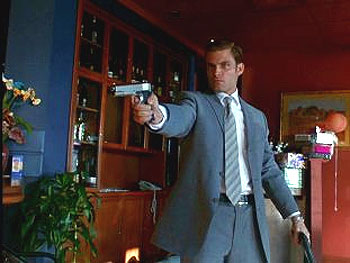 The acting is somewhat better than most Boll movies and yet still a degree below typical straight-to-video blandness. Van Dein (Starship Troopers) is amusingly believable as a stone-faced serial killer. His limited acting range actually strengthens the character’s sense of frustration. He’s got a menacing stare to boot. Paré (Hope Floats) phones in his performance but gets some points for being in the film’s most weirdly awkward moment, when Renart has to step in as nude model for his wife and her giggly photographer peers. Bizarre doesn’t go far enough in describing the scene. Rubin (Little Witches, Amazons and Gladiators) is the hard-nosed female cop trying to make it in a man’s world, and gives a decent if unmemorable performance. I was more intrigued by her ever-present striped scarf, which seems to follow her everywhere from the shooting range to inside her home. Roberts has very little screen time and is still third billed.
Sanctimony is Uwe Boll’s stab at the serial killer genre, so it shouldn’t be surprising that it’s formulaic and bereft of suspense and imagination. This is a generic rip-off of far better serial killer flicks. The characters are all brief sketches and genre clichés, and Boll can’t even come up with a compelling agenda for his killer. I kept waiting for Sanctimony to fully explain itself, but once the wedding shoot-out is complete the film leaves you addled and perturbed. Boll has castrated his drama, rendering it unimportant, lazy, and sloppy. Boll may have several ideas floating around his head but he never brings them in for a clarification. Whatever intellectual goals he may have intended for Sanctimony will be lost on an audience grasping for meaning and entertainment. How dumb is this movie? Well, it defines what “sanctimony” means in the opening credits via dictionary. It should be very ominous when a movie is forced to define its own title. Ominous, indeed.
Nate’s Grade: C-
Share this:

Saw (2004)
 Saw was pieced together by two first-time filmmakers, director James Wan and writer Leigh Whannell. They envisioned that old movie favorite, the imaginative serial killer. Their killer would put people in horrific life-or-death situations, testing our will to live even if it meant rummaging around the intestines of a live human being for our key to freedom. With a budget of a mere million dollars, Wan and Whannell have executed a dark, slick, sometimes thrilling, sometimes laughable fright flick. The only question is if audiences are hungry enough for the splashes of blood Saw can deliver, or if they’d rather watch Sara Michelle Gellar turning Japanese.
Adam (Whannell), a private photographer, and Dr. Gordon (Cary Elwes), a workaholic surgeon, are in a very strange circumstance. They’ve both just awoken and find themselves chained by their feet at opposite ends of a bathroom with a dead body between them. Neither has any idea how they got there. Dr. Gordon theorizes that they’re the culprits of the Jigsaw Killer, a psycho that places his victims in elaborate death traps they must fight to get out of. In the pants pockets of Adam and Dr. Gordon are audio tapes from Jigsaw establishing the rules of this “game.” In eight hours, if Dr. Gordon does not kill Adam, his wife and daughter will be killed. Jigsaw has even left them clues to their escape, most notably a pair of rusty saws not strong enough to cut through their chains, but still plenty strong to slice through their feet if they so choose. Outside this game, Detective Tapp (Danny Glover) is closing in on the identity of the Jigsaw Killer and may be the only hope Adam and Dr. Gordon have.
 Saw is a grisly horror movie that hits the right macabre marks. Horror is such a tricky genre, and you can either build tension in an effective what’s-around-the-corner kind of way (The Ring, 28 Days Later), or, if that fails, and it often does (The Grudge anyone?), you can cut your losses by showing the gory goods (Texas Chainsaw Massacre, any slasher film). This isn’t to say one version is inferior to the other; sometimes we just want to be grossed out. Saw is a horror film committed to horror, sometimes to a rather unpleasant and sadistic point. In a way, the fact that Saw goes for broke in its depiction of the grotesque makes it more enjoyable than recent horror fair that tried to hedge their bets on jump scares and nosy cats.
In some manner, Saw is like a dumber, trashier Seven. They both involve serial killers with agendas and they both give the killer the upper hand. While Seven is a masterpiece of the thriller genre, Saw is a mostly entertaining horror entry. Its premise is razor-sharp and really hooks an audience. We know only as much as the characters do, so their discoveries work two-fold. The pacing is tight, the cinematography is exceptional for its budget, and the end had me jump out of my seat. I will say this; Saw reluctantly seems to think that it needs to reveal the identity of the Jigsaw killer, as well as his motives, to satisfy an audience. I think no answer could ever be satisfying; however, the actual reveal of Saw‘s true killer had me wanting to give the filmmakers a standing ovation. There are fleeting moments of greatness here among the misery. Whannell knows when to show which cards, and it makes the story more enticing.
There are glaring issues with Saw. The acting is one of them. Elwes is usually a stable character actor, but chain him to a wall and say,”Go!” and the man will overact as if his real wife and child depended on it. Whannell, a first time actor and the co-writer, goes deliriously over the top in some battle of scenery chewers. Don’t feel too bad if you feel like laughing during certain moments of “emotional turmoil.”
Saw seems to exist in that magical place known as It Could Only Happen in Movies World. For example, a serial killer designing highly elaborate, and personally clever, death traps could only happen in a movie. I love the fact that the film even shows evidence that the Jigsaw Killer builds dioramas of his future death traps. If he entered them in the Third Grade Sadistic Science Fair, I’m fairly certain he?d at least earn a blue ribbon or a gift certificate.
Yes, only in a movie are we expected to believe one man can kidnap people, lug them around, set up his elaborate Rube Goldberg puzzles, and then kick back and elude police capture. The entire premise of Saw is whole-heartedly ludicrous, and the plot turns are heavily contrived, but, as an audience, you must yield such ordinary eye-rolling to enjoy the pleasures of Saw. If you can swallow plot holes and just go with the film’s skewed logic, there is some enjoyment to be had.
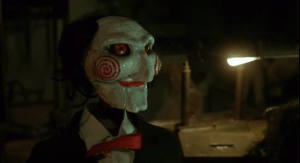 Wan can also be his worst enemy. Too often he punctuates chase scenes with pounding heavy metal, which does little more than numb an audience. Wan’s film loses some of its focus in the middle as the audience endures flashback after flashback. To goose up the viewing, Wan shoves in extraneous flashes of gore. Just like The Exorcist prequel, flashes of something horrific do little more than to cause an audience to yelp. They’re immediate. If you want true gut-churning reactions, you have to build, and in the end Saw remembers what it came to do and sprints to the finish line.
Saw also exists in the grimiest possible world. Whether it be parking garage, office, or even personal apartment, the characters of Saw exist in some netherworld of filth crying out for an army of scrubbing bubbles. I’m sure this was intentional, but can’t any place in horror movies afford a coat of paint nowadays?
Saw is a gruesome, twisted, sometimes sadistic horror movie with a knock-out premise, a moderately good ending twist (not the final end, though), and some lag time in between. Wan and Whannel really stretch their budget to impressive ends and imply more blood and guts than are shown. Fans of hardcore gore horror should be pleased with Saw, though they may find themselves giggling at it from time to time. I was hooked by its premise and found myself getting more intrigued as the revelations began to sift. Many will find Saw too ugly, gory, or stupid, but for fans of the genre, it should satisfy the itch recent PG-13 horror couldn’t efficiently scratch. Saw is violent, contrived, ridiculous, but also, in the end, gruesomely entertaining in parts.
Nate’s Grade: B-
Share this:

Taking Lives (2004)
 While viewing Taking Lives my mind wandered quite a bit. There was one point where I actually gave credence to a theory that Taking Lives was so intensely bland that is was parodying the glut of serial killer films. Then I just concluded that the movie was dumb. Angelina Jolie plays one of those hard-as-nails criminal investigators who just happen to be drop dead gorgeous. She’s on the hunt for a Canadian serial killer who murders then assumes the lives of his victims. He’s been doing this for over 20 years. My main question is … how? Taking someones identity has so many variables to it. What if any family member found you? Theyd know for sure you wouldn’t be their loved one. Oh yes, and the killer masks the identity of his victims by cutting off their hands and smashing their faces in. Would that even work? All you have to do is draw some blood and do a DNA test. Taking Lives is so by-the-book that it even dares to have a scene where the serial killer calls Jolie and claims that he and her are exactly alike. The ending veers so far off track into the land of implausibility that its almost entertaining. Almost. The only reason to even poke your head in a theater to see this is for a gratuitous nude scene involving Jolie, and even that you’ve seen before in better movies.
Nate’s Grade: C-
Share this:

Monster (2003)
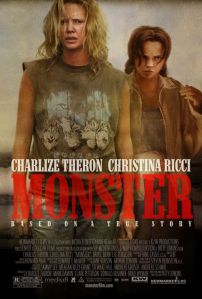 Monster follows the life of Aileen Wuornos (Charlize Theron, now nominated for a Best Actress Oscar), Americas only known female serial killer. In the late 1980s, Wueros was a roadside prostitute flexing her muscles with Florida motorists. She describes hookin’ as the only things shes ever been good at. One day Wuornos has the full intention of taking her own life, but she meets 18-year-old Selby (Christina Ricci) at a lesbian bar and finds a companion. Driven by a growing hatred of men from sexual abuse, Wuorno’s starts killing her johns to try and establish a comfortable life for her and Selby.
Let’s not mince words; Theron gives one of the best performances I have ever seen in my life. Yes, that’s right. One of. The. Best. Performances. Ever. This is no exaggeration. I’m not just throwing out niceties. Theron is completely unrecognizable under a mass of facial prosthetics, 30 extra pounds, fake teeth and a total lack of eyebrows. But this is more than a hollow ploy to attract serious attention to the acting of a pretty face. Theron does more than simple imitation; she fully inhabits the skin of Aileen Wuornos. The closest comparison I can think of is Val Kilmer playing Jim Morrison in The Doors.
Theron is commanding, brave, distressing, ferocious, terrifying, brutal, stirring, mesmerizing and always captivating. It may be a cliché, but you really cannot take your eyes off of her. Her performance is that amazing. To say that Theron in Monster is an acting revelation is perhaps the understatement of the year.
With previous acting roles in Reindeer Games and The Cider House Rules, Theron is usually delegated to pretty girlfriend roles (who occasionally shows her breasts). Who in the world thought she had this kind of acting capability? I certainly did not. If Nicole Kidman can win an Oscar for putting on a fake nose and a so-so performance, surely Theron should win an Oscar for her absolute transformation of character and giving the performance of a lifetime.
With this being said, and most likely over said, Monster is by no means a perfect film. Minus the terrific central performance, Monster is more of an everyday profile of a grotesque personality. The film weakly tries to portray Wuornos more as a victim, but by the end of the film, and six murdered men later, sympathy is eradicated as Wuornos transforms into the titular monster. Some supporting characters, like Ricci’s narrow-minded Christian up bringers, are flat characters bordering on parody. The supporting characters are generally underwritten, especially the male roles that serve as mere cameos in a film dominated by Sapphic love.
Monster is proof positive that human beings will never be phased out by advancing machinery when it comes to acting. Monster boasts one of the greatest acting achievements in recent cinematic history, but it also coasts on sharp cinematography and a moody and ambient score by BT (Go). Monster is a haunting film that you wont want to blink for fear of taking your eyes off of Theron. She gives an unforgettable tour de force performance that will become legendary.
Nate’s Grade: B
Share this:

Red Dragon (2002)
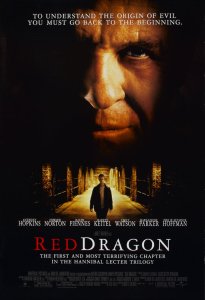 The following is a conversation overheard between two studio producers:
Person #1: So this Hannibal movie made like a ton of green. What else can we do to squeeze out some more money?
Person #2: Hey, do you remember a movie called Manhunter based on the first Lector novel?
Person #1: Nope.
Person #2: That’s fine because nobody else does.
It’s official folks: Hannibal Lector, America’s favorite cannibal, is now more comical than scary. See the element that 1991’s Silence of the Lambs carried with it was a stealthily gripping sense of psychological horror. It hung with you in every closed breath you would take, surrounding you and blanketing your mind. I mean, there aren’t many serial killer movies that win a slew of Oscars. And while the follow-up, last year’s Hannibal, gleefully bathed in excess at least Ridley Scott’s sequel was so over-the-top with its Baroque horror that it was entertaining. So what’s Red Dragon, the latest Lector flick based on Thomas Harris first novel like? Well it’s like the bastard child of Lambs and Hannibal after a drunken one-night-stand neither would be proud of in the pale light of morning.
 In an extended prologue we see the capture of the good doctor with a good appetite, Hannibal Lector (Anthony Hopkins, completing his trilogy of the character). FBI Agent Will Graham (Edward Norton) seeks his advice on a profile of a serial killer, not knowing that Lector more than fits the bill. A violent struggle ensues that leaves Graham with a long scar across his abdomen and Lector locked away for nine consecutive life sentences.
Turns out there’s another madman on the loose. The Tooth Fairy, dubbed by tabloid journalist Freddy Lounds (Phillip Seymour Hoffman), has butchered two families in their homes and inserted shards of broken mirror into their eyes. The FBI coaxes Graham out of retirement to try and track down the Tooth Fairy. But it seems in order to make any significant ground he must seek help from an old advisor – Hannibal Lector.
The crux of the film follows Graham’s attempts to figure out the identity of the Tooth Fairy, which we learn fairly fast is pretty boy Ralph Fiennes. Seems Fiennes has a cleft palette and years of physical and sexual abuse to toil over. He desires to transform into a mythical Chinese creature known as the Red Dragon. But wait, the lonely Fiennes is befriended by a lovely blind woman (Emily Watson) who identifies having people look differently at her. Can her affections melt the cold heart of a cold-blooded killer? Well, if they did thered be no other half of this movie.
What Red Dragon feels like is more of a checklist of what we expect to see in a Hannibal movie than anything of creative nourishment. It’s like a slimmer version of Lambs plot. Once again there’s an FBI agent who recruits Hannibal for advice on tracking down a serial killer. Once again there’s a disturbed killer trying to transform himself. Once again Hannibal Lector scares the crap out of anyone at will. Check, check, and check. Creative stagnation? Double check. The most disappointing aspect is the rudimentary feel this whole exercise has. Even though Red Dragon is a prequel it still seems like it’s begging to meet our expectations of two earlier films.
The first stab at the Red Dragon novel was in 1986 by director Michael Mann (Ali, The Insider) with the thriller Manhunter. William Peterson (before his work at CSI) was a more brooding Graham, Tom Noonan was a spookier Tooth Fairy, and the tension was stacked better. There were no comparative expectations.
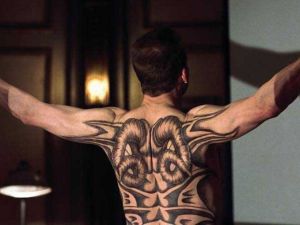 Norton is the finest actor of his generation but has certain trouble breathing life into Graham. The character is far more straight-laced than what we’ve been told is an expert at delving into the minds of killers. Grahams relationship with Lector doesn’t have any of the complexity, or interest, that Jodie Foster’s Clarice Starling had. He can even be very flat-footed in his detective work for a specialist. He stares at the home videos of the two slain families for about an hour wondering what the connection is while we in the audience shout it out to him. Lets go to the videotape Ed!
Anthony Hopkins returns as the devil in the flesh and seems to have another grand old time. Lector worked in Lambs because he was caged up, like a wild animal not meant for four glass walls. You never knew what would happen. He’d get in your head and he would know what to do with your gray matter — not that he didn’t have a culinary degree in that department with Hannibal. With Red Dragon, Hannibal is just window dressing to another serial killer. He’s a supporting character in a story that he has nothing to do with. He’s reduced to comic relief with his sudden attacks of chattering teeth and velvety voice. The amazing supporting cast of actors all do well, especially the beaming Watson who will shine in anything you put her in. Just try.
Ultimately the story of Red Dragon is far from flawless and meanders for quite a while. It would have been a marginally competent movie had it not been trying to replicate Silence of the Lambs so damn hard. So, is this the last youll see of Hannibal Lector? No as long as clinging cash registers can still be heard. Cue evil laughter.
Nate’s Grade: C+
Share this:

15 Minutes (2001)
 Let me say this now and clear so everyone knows – DO NOT PUT EDWARD BURNS IN THE LEAD OF ANYTHING! Burns falls under that league of actors that can contribute and possibly do fine as supporting players but cannot carry a film. Now, moving on…
Robert DeNiro plays the head of a police force, but he’s also a local celebrity with his face everywhere from newspapers, to People magazine, to his own coffee franchise (I made up one, guess it). The woman from the NBC show ‘Providence’ with the gigantic Jersey hair plays the reporter that fawns over him and the girlfriend that reports him. She’s meaningless. Kelsey Grammar plays a heavy-handed out for blood journalist of a tabloid TV show that panders to our primal desires of violence. The show is seen as exploitative and possibly subversive – not to mention in poor taste. You may be asking how does Edward Burns get caught up in this? Well he’s an ace arson investigator that crosses paths with mega-star DeNiro. But see, Burns’ character HATES the media. Quite a contrast, eh?
 Burns and DeNiro form an unlikely team and go through the rigid “Buddy Cop Movie” drill that’s been played numerous times before. They dislike each other, they tease and try to show up one another, they come to respect and appreciate the other and work as a team. Yawn.
DeNiro phones in a performance in like none he has ever done before, even Rocky and Bullwinkle. Grammar hams up his over-killed role. Burns is his typical atrociousness. If you look closely you’ll find the actor who played the older brother in Family Matters a.k.a. The Urkle Show in this flick. Man, his career time with Jaleel White must be paying off.
The real spirit of the film is in its two debut actors who also serve as the villains. These two are from Eastern Europe and search for old friends that seem not so friendly anymore. Some altercations happen and a killing spree begets them trying to rub out the lone red-headed witness of their murders. Along the way they discover they can sell the videotapes of their crimes to the top bidder and make a fortune. The two baddies are fun to watch and a joy to see whenever they return back to the screen. They seem to punch up 15 Minutes particularly during the tedious dead spots. These two actors seem to be the only life of the film, and it’s a terrible shame when we must veer off back to our lame storyline with Burns. credit this as another case of the villains being far more interesting than the heroes — the Austin Powers syndrome.
 The major disappointment of 15 Minutes is what it looked like it would be. With the early teaser trailer it looked like it would be a scathing satire on media and our glorification of criminals as heroes. When the full length trailer came out it dropped to looking like another crazy serial killer flick. Sadly, it never rises above this. There are a few moments with some bite but 15 Minutes gums it along as far as satire is concerned. It’s more concerned with a standard by the book plot. The whole notion of using the videotapes and selling them to Grammar’s TV tabloid doesn’t even show up until twenty minutes before the film is over!
15 Minutes is a thriller that tries to be smart and savvy but tries to be by staying under standard conventions. The very ending to this film could have gone in a million different ways, some very satisfying, but it goes the predictable action-thriller way. Yawn. That’s what you’ll be doing a lot with 15 Minutes – regaining lost sleep.
Nate’s Grade: C


 nathanzoebl
You must be logged in to post a comment.