Blog Archives
Southland Tales (2007)
 Richard Kelly is a talented writer/director who scored big with his first film, modern cult classic Donnie Darko. I was in love with the ominous yet inspired Darko from the moment I saw it, which, not to toot my own horn, was February 2002, way before the cult got started. I have been eagerly anticipating Southland Tales, Kelly’s writing/directing follow-up, even after its notorious 2006 Cannes Film Festival reception where critics readily cited terms like “indulgent,” “bloated,” “messy,” and, “disaster.” My love of Darko shielded me from such negative affronts, and so I watched Southland Tales undaunted and with as open a mind as possible. The regrettable truth is that even after Kelly shaved off a half-hour from the Cannes version, Southland Tales is every bit a mess as had been advertised; however, it is occasionally worthwhile and subversively ambitious.
Kelly begins his massive yarn with a nuclear attack on Abilene, Texas in 2005. America is plunged into World War III and fights, simultaneously, Iran, Syria, Afghanistan, and North Korea, while the conflict with Iraq continues. The Internet is now in control of the government, who passes sweeping security measures, chief among them IdentiCorp. This government arm uses thousands of trained cameras to keep watch over the lives of ordinary citizens, including when they duck into public bathroom stalls. Violent neo-Marxist groups have placed cells around the country, ready and willing to strike to destroy the last vestiges of American capitalism.
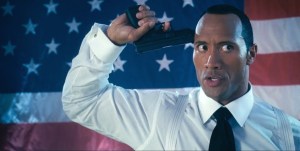 Fuel resources have almost run dry and the world looks to scientist Baron Von Westphalen (Wallace Shawn, hamming it up and having a good time) for a solution. The Baron has devised a substance known as Fluid Karma, which works under the properties of the churning oceans and will produce a radius of power. Fluid Karma also works as a powerful hallucinogenic drug and the Baron tested it on wounded Iraqi vets like Pilot Abilene (Justin Timberlake). Coldly narrating the film, Abilene stands guard outside the Baron’s laboratory and also peddles the drug on the side.
It is the summer of 2008 and the presidential election is months away. The Republican candidate, Senator Bobby Frost (Holmes Osborne), is in crisis mode. His spoiled daughter (Mandy Moore) is frantic because her husband, actor Boxer Santaros (Dwayne “The Rock” Johnson), has vanished. He’s awakened in the California desert with amnesia and shacked up with porn star Krysta Now (Sarah Michelle Gellar); the duo has written a prophetic screenplay called “The Power.” Krysta and a pair of tattoo babes (Nora Dunn) plan to blackmail the Frost campaign with video of Boxer frolicking with the adult movie star. They want the campaign to endorse Proposition 69, which would rescind the encroachments on civil liberties by the U.S. government.
A group of neo-Marxists, led by pint-sized Zora Carmichaels (Cheri Oteri), have kidnapped a police officer, Roland Taverner, and are using his twin brother Ronald (both played by Seann William Scott) to frame the police and Boxer. And I haven’t even begun to talk about Senator Frost’s wife (Miranda Richardson), the president of Japan having his hand lopped off in a loony sequence, the frequent inverting of T.S. Elitot’s quote about the way the world ends, a commercial where two cars literally have sex, and a rip in the space-time continuum that people are putting monkeys inside.
Extraordinarily messy and scattershot, Southland Tales has 1000 ideas rolling around inside without much traction. It’s as if Kelly thought he was never going to get the chance to make another movie again so he crammed every thought and topic he ever had into one 144-minute cross-pollinated jumble. The movie veers wildly and chaotically from political satire, to crude comedy, to sci-fi head-trip, all the way to Busby Berkley musical. There’s a little of everything here but few of the dispirited elements mesh and the film runs a good two hours before any sort of overall context becomes remotely approachable. One second the movie is satirizing a Big Brother control state and the loss of American civil liberties, and in the next second a character is threatening to kill herself unless Boxer allows her to orally pleasure him. You got, among other things, zeppelins, global deceleration, perpetual motion machines, Zelda Rubenstein, drugs, holes in time, twins, a murderous Jon Lovitz, ice cream trucks that house military-grade weapons, blackmail, Kevin Smith in a ZZ Top beard and no legs, reality TV, the American national anthem cut together with an ATM robbery, Biblical Revelation quotes courtesy of Timberlake, and, why not, the end of the world. What does it all mean? I have no idea but I credit Kelly for his ambition.
 Plenty of stuff happens for a solid two hours but little to nothing feels like it amounts to anything, and several subplots just get dropped. There are long stretches where I cannot explain even “what’s happening” from a literal description. This sprawling, magnificently self-indulgent meditative opus consists too much of side characters running into each other and having vague, pseudo-intellectual conversations that go nowhere. There are a lot of nonsensical speed bumps in this narrative. Sometimes the screen is just nothing but a series of newscasts overloading the audience with details on the reality of this alternative America; it’s filler. The conclusion is rather frustratingly abrupt; after slogging through two-plus hours of oblique questions it finally seems like we may reach some tentative answers, and then Kelly pulls the pin on his grenade and collapses his tale. Krysta tells Boxer in a moment of clarity, “It had to end this way.” Really? It did? This way?
The movie feels like a giant garage sale with scattered treasures hard to find but buried beneath loads of kitsch. Kelly clearly has bitten off more than he can chew and yet there is a bizarre undeniable power to some moments here. Roland (or is it Ronald) Taverner watches his mirror reflection a step behind; it’s unsettling and eerie and very cool. Timberlake has a drug-induced dance number where his scarred (both physically and mentally) Iraq veteran character is covered in blood, drinks beer, and lip synchs to the Killers’ song “All the Things I’ve Done,” which has the pertinent lyrics, “I’ve got soul but I’m not a solider,” and “You gotta help me out.” All the while, leggy dancing girls in blonde bobs strut and coo around him. It’s weird and tangential to the plot but it has a certain draw to it. The conclusion featuring the Taverner twins seeking forgiveness even generates some redemptive quality. Religious questioning and the philosophy of souls occupying the same realm plays a heavy part and gives the film an approachable reflection that tickles the brain, even if Timecop, sort of, visited the same ground, albeit secular, first (you’ll kind of understand when you see the movie). Southland Tales is grasping at profound and relevant messages, and yet some images achieve this easily, like a toy soldier crawling on the L.A. streets or a tank with Hustler stamped across its side for product placement. These simple images are able to transcend Kelly’s pop manifesto.
 None of the actors really equip themselves well with the outrageousness. Scott comes off the best but that’s because his character(s) is/are the only figure(s) the audience is given a chance to emotionally connect with. The Rock, listed for the first time simply as Dwayne Johnson, is an actor that I genuinely like and think has tremendous comic ability, as evidenced by 2003’s The Rundown. With this film, however, he comes across too constantly bewildered and shifty, like he really needs to pee and cannot find a bathroom. Gellar is woefully miscast and I think she knows it given her leaden performance. Southland Tales is the kind of film where every role, even the two-bit nothing parts, is played by a known face, be it Christopher Lambert, John Larroquette, Curtis “Booger” Armstrong, Will Sasso, and a horde of Saturday Night Live alums.
Kelly’s previous film succeeded partially because an audience was able to relate and care about the central characters, which is not the case with the comically broad Southland Tales. Kelly seems to work best when he has some restraint, be it financially or artistically; the director’s cut of Donnie Darko explained far too much and took some of the magic out of interpreting the movie on your own terms. Southland Tales runs wildly in the opposite direction and is a giant mess unseen in Hollywood for some time, though for the doomsayers comparing Southland Tales to studio-killing, self-indulgent, era-defining Heaven’s Gate, may I argue that Oliver Stone’s Alexander was far more self-indulgent, longer, wackier, and duller. Due to its unpredictable nature, you can never say Southland Tales is boring.
Southland Tales the movie begins as Chapter Four of Kelly’s saga, the first three chapters being made into comic books, and really, when I think about it, a comic book is the right medium for this material. The confines of narrative film are too daunting for Kelly’s overloaded imagination. Southland Tales is oblique, incoherent, strange, and unfocused but not without merit. I doubt Kelly will ever be given the same artistic legroom to create another picture like this, so perhaps Southland Tales has helped to reign in Kelly’s filmmaking. A reigned-in Kelly is where he does his best work, and I look forward to Kelly’s remake of Richard Matheson’s story, “The Box,” presumably with no dance numbers and sexually active motor vehicles.
Nate’s Grade: C
Share this:

The Simpsons Movie (2007)
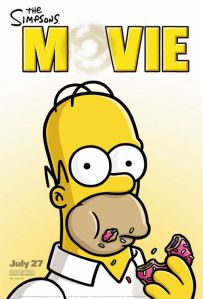 No movie has carried the burden of expectations quite like what befalls The Simpsons Movie. The animated TV satire has become a cultural phenomenon in its 18 seasons on the air. The Simpsons is a unique comedy with something for everyone; sharp cultural and political satire, slapstick, sincere family values, crass jokes, witty pop-culture zingers, and sly sight gags that take the eighteenth viewing to fully capture. In fact, I can only slightly explain the significance the show has had on my own life. For starters, it has influenced my sense of humor and writing, but the show also pretty much takes up full-time residence in my brain. I have told people for years that I believe 85% of my grey matter is filled with movie trivia and Simpsons quotes. There isn’t an experience in life that cannot be linked by an appropriate Simpsons quote (“Every time I learn something new it pushes something old out of my brain.”). I can quote episodes like some people can quote Bible verse. To many, The Simpsons is like a modern Bible for comedy.
With that said, the long-in-development movie version of our favorite yellow-skinned Springfield family is now in theaters. The loose plot of the film follows a typical Homer screw-up. He’s adopted a pet pig and disposed of its waste in the endangered Springfield Lake. The environmental calamity causes the EPA, led by a duplicitous department head (Albert Brooks), to place a dome over the town of Springfield. It doesn’t take long for the town to figure out it was Homer that doomed them, so the Simpsons family flees to Alaska to start anew before they learn that the government has plans to fully wipe Springfield off the map.
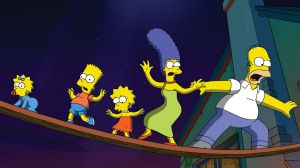 I suppose expectations will create a different prism for each person to view the film. The Simpsons TV show has never been terribly rude, and when it comes to satire it jabs more than eviscerates; in reality, the show has a terribly large heart and treads in moral and ethical dilemmas. It’s been more sweet than sour. Some fans might be hoping for the same transformation that South Park took when it hit the big screen in 1999. South Park made the leap with a brilliant movie that seemed to stretch the scope of what the show could do; it was more than a bigger and longer version of the TV show, it was an exceptional and blistering and hilarious satire that also was the most damn infectious musical of the decade. The Simpsons Movie doesn’t take full advantage of the opportunities a movie offers, though we do have a handful of non-network appropriate items like Marge uttering a blasphemy and Bart going the full yellow Monty. The Simpsons Movie doesn’t push the series into something too vulgar or unfamiliar. The movie feels like three episodes strung together. Whether or not that’s good enough for your entertainment dollar will be questionable. For me, having a feature-length version of my favorite TV show that’s written by the “Golden Age” writers is enough to guarantee at least two viewings.
The Simpsons Movie is easy to enjoy. The 11, count ’em 11, former show writers know exactly what makes the series work and how to stay true to the core of the show. There is some great lampooning of elected officials, including President Schwarzenegger declaring he “was elected to lead, not to read.” There are plenty of solid moments from the great plethora of supporting characters, like Ralph’s reaction to seeing a naked Bart, Mr. Burns remarking that for once the rich white man has the power, Cletus the Slack-Jawed Yokel idiot-proofing a safety measure, and Kent Brockman describing the environmental disaster as so serious, “it has its own theme music.” The Simpsons has such a large cast of memorable characters that it’s only fair that some will grumble that their favorites didn’t get more screen time (more Ralph and Mr. Burns, please), but the beauty of The Simpsons is that every person has their own set of favorites. The guest appearances by Tom Hanks and Green Day are well incorporated and fun. Albert Brooks has a long involvement with the show and is fantastically droll as always.
 However, ignoring my fan-coated bliss, the movie is not a comedy home run. The film does seem to lose some comedic momentum when it spends time on action. The emotional interludes feel a bit awkward but they still hit hard for me because I’ve followed these characters since I was 7 years old. The subplot involving Bart looking for a better father figure in Flanders has been done before and better like when Bart got a Big Brother to spite his father (“Simpsons did it!”). That’s the trouble with 400 episodes; there’s little material the show hasn’t already covered. The family excursion to Alaska never really feels like it fits with the plot, but then again the TV show always takes unexpected diversions. The Simpsons Movie is consistently funny, always amusing, fairly clever, but rarely will anything prompt uncontrollable laughter. It’s a bit of an easygoing good time, but will that be enough for the die-hard fans who are hoping the movie will contend with the pinnacles of all human artistic creation?
I think The Simpsons will go on forever. It’s a handful of seasons away from breaking Gunsmoke‘s record as the longest-running prime time TV show (20 years). The big screen version is an entertaining and amiable version of the show. That’s good enough for me. I just pray that a sequel takes less time to hit the theaters.
Nate’s Grade: B+
Share this:

Thank You for Smoking (2006)
 As soon as I saw a trailer for Thank You for Smoking I was in love. I found the book for cheap and read it with months to spare before the film reached my local theater. Admittedly, my expectations were high because the book was wonderful, and Thank You for Smoking as a movie is equally wonderful and a very good film adaptation.
This is a wickedly funny satire that skewers all sides in the political debate about Big Tobacco, and the film doesn’t take a stand, which is refreshing. It has a firm grip on its humor and gleefully gives its finger to political correctness. There?s a lunch group called the M.O.D. (Merchants of Death) squad where reps for Alcohol, Firearms, and Tobacco, of course, argue over whose product is harder to spin. It’s likely the snort-because-you-can’t-believe-they-said-that movie of the year. The tar-black humor in Thank You for Smoking rolls off so casually. This is a comedy that respects the intelligence of its audience and doesn’t dumb down its barbs or its satire. Aaron Eckhart was born to play the role of Nick Naylor, tobacco’s master spin artist and public charlatan. Naylor is conniving, slippery, and yet immensely likable not in spite of these traits but because of them. Eckhart is downright charming and you can see how he could dupe a nation, even if he’s only doing it for the challenge. Thank You for Smoking has one of the finest assembled casts in a long time, and every member fires on all cylinders. This is a film brimming with confidence and it’s evident with every frame. You almost might feel guilty for wanting to capture a contact buzz from how polished, assured and witty the flick is.
I never thought I’d say so but it sure looks like adapter/director Jason Reitman has a far more promising future right now than his dad, Ivan. Jason, the son, keeps the movie brisk, packed with characters, subplots, jokes, and a visual whimsy. This is a terrific adaptation of a terrific book, and Reitman really hones in on the mechanics of debate and lobbyist practices with aplomb. A scene where Nick teaches his adoring son the tricks of debate with ice cream is outstanding. Thank You for Smoking crackles with dialogue to die for, like Nick’s boss BR (J.K. Simmons) saying, “We sell cigarettes. They’re cool, and addictive, and available — the job is practically done for us.” My only complaints with the film, besides that it’s too short at just 90 minutes, is the manufactured danger seems a bit too slight and too easily overcome. Nick quite simply vanquishes whatever threat his reporter sex buddy Heather (Katie Holmes) posed. Otherwise, Thank You for Smoking is a superb movie all around and there’s no reason you shouldn’t see it. Take the hit.
Nate’s Grade: A
Share this:

Team America: World Police (2004)
 The MPAA is mad, plain and simple. It’s an organization intended to rate movies so our wee ones don’t stumble into something not intended for their virgin eyes. They also have a long history of haggling with filmmakers over ratings and the necessary cuts to ensure a commercial rating. And, in their eyes, puppet sex was deemed too indecent. You see, the MPAA initially gave the all-puppet action movie Team America: World Police, the new film from South Park creators Trey Parker and Matt Stone, an NC-17 for an extended scene of two marionettes engaging in enough sexual positions to make a G.I Joe blush. However, we’re talking about puppets, people! Puppets! They’re not even anatomically correct. Does anyone find it crazy that a governing board says watching two dolls bang together in “simulated sex” (is there any other kind with puppets?) is inappropriate for all ages under 17? Surely, if the MPAA is to be eventually reformed, this will be Exhibit A.
 Team America is an elite team that fights terrorists and police the globe in red, white, and blue helicopters, jets, and flying limos (the team logo is a bald eagle with the earth in its beak). The team leader Spottswoode recruits Broadway actor Gary, star of the musical Lease (key song: “Everyone has AIDS”), because they need someone to pretend to be a terrorist and flush out their secret plan. Gary is reluctant at first but agrees to join the team.
Team America flies to Paris and Cairo to battle terrorists. They snuff the terrorists, but world monuments like the Eiffel Tower and Sphinx get lost among the collateral damage. Things look promising for Team America, and Gary expresses feelings for Lisa, a blonde psychologist haunted by the loss of a teammate and a lover.
Terrorists strike the Panama Canal in retaliation, and a group of celebrities led by Alec Baldwin condemn Team America. Michael Moore, with hotdog in each hand, protests outside Team America’s headquarters. In these moments of disarray, we learn the true source of the Weapons of Mass Destruction and brains behind the attacks is North Korean dictator Kim Jon Il, who has a plan for “9/11 times 2,358.”
While not reaching the satiric highs of the South Park movie, Team America is a political movie that lambastes both sides of the coin. This has been a very heavy year for political films, from leftist documentaries like Fahrenheit 9/11, The Hunting of a President and Going Upriver: The Long War of John Kerry, to more subtle jabs at the current administration (the very Cheney-like VP of The Day After Tomorrow), to more obvious indictments (the stuttering, axiom-loving dumbbell candidate in John Sayles’ Silver City). So in a year bursting to the seams with political screeds, it’s quite refreshing to have a movie that lampoons both the Right and the Left.
Team America satirizes the arrogant, shoot first ask later, cavalier foreign policy America has been accused of (“We’re going to bring democracy to you if it kills you.”). The film also criticizes Hollywood celebrities who feel that their uninformed, unsolicited opinions are germane to the political process. In the end, it’s the celebrities who get the worst of the beating (Matt Damon appears to be, um, challenged). Parker and Stone shrewdly satirize pretentiousness and ego, no matter which side it falls upon. They lose their focus as the film enters its final gory act, instead resorting to garish ways of killing puppets.
 Team America has a good one-two combination with its political punch, but where it really shines is the knockout it delivers to bombastic Jerry Bruckheimer action films. This is a delirious send-up of a wide array of action movie clichés, including team members and their secret crushes as well as their hidden traumas. Characters will fight or die in slow-motion for dramatic effect. Characters will all have some special talent that will come into play at an important moment. Kim Jon Il has a typical villain lair, including large shark tanks and trap doors. When a character dies in the opening sequence he mutters the line, “I feel so… cold[.” Hilarious! There’s even an entire training montage set to a song called, “Montage” (sample lyric: “Show a lot of things happening at once, remind everyone of what’s going on!/ And with every shot show just a little improvement – to show it all would take too long!/ That’s called a montage!/ MONTAGE!/ Even Rocky had a montage!/ MONTAGE! “). There’s also a love song all about Pearl Harbor sucking as a movie.
Like all the other films by Parker and Stone, Team America is a robust musical. The songs aren’t as sharp as the ditties from the South Park movie, but they’re still quite amusing. The Team America theme is a rousing anthem called “America, Fuck Yeah!” which is a perfect example of the film’s simultaneous mixture of the profane and the brilliant. Later in the film, when Team America is taking a public backlash, there’s a somber remix of the theme that’s even funnier.
Some things are just funnier because of the limitations of puppets. Watching two marionettes try to fight is hilarious, because they really do nothing but kick their legs and limply slap each other. Before Team America, I never realized how funny it was just to watch marionettes walk. They’re so awkward and jumpy, that just seeing them step from side to side can put a smile on your face. When the music of Kill Bill comes onscreen, and the puppets walk in slow dramatic fashion, it’s even more absurd and funny.
 Parker and Stone also have fun with self-awareness, like when they take Gary on a tour of the sights of Washington D.C. and he stands next to an actual tombstone at Arlington National Cemetery. There’s also a Matrix parody that actually comes off as fresh. There’s a giddiness to watching puppets swear, fight, vomit, stagger drunk, and even do the nasty. It’s a gimmick that doesn’t get old.
This is also one terrific looking movie. The sets are massively intricate and the photography by Bill Pope (who did shoot the Matrix films) bathes the proceedings in beautiful mixtures of light and dark. There may be moments you forget that what you’re watching are miniatures. It is filmed to look like a typical action movie. The music is a spot-on parody of action films, with its heaviness on flutes when the villain is around, to the foreign lady mournfully singing during scenes of tragedy. There’s fantastic craft and detail worked into Team America that I can unequivocally say Team America: World Police is the best looking, R-rated all-marionette musical action movie… ever.
Team America may be the funniest film of the year. There are some moments of drag, and sometimes less profanity would make certain punch lines better (unfunny homophobic jokes like the acronym F.A.G.), but the movie is a comedy that’s pee-your-pants funny. Team America is definitely not for kids (what kind of irresponsible parent assumes “puppets = for kids” and ignores an R-rating?). Because of the equal opportunity satire, this may end up being a movie that conservatives and liberals both claim to be their own. For fans of erudite satire, crude humor, and puppet sex, Team America will be a blast. Make sure to stay throughout the end credits to hear a special closing song not in the film.
Nate’s Grade: B
Share this:

Starsky & Hutch (2004)
 The big screen adaptation of yet another 1970s television show has about one joke in it that the 70s were funny. So after scene after scene of people with funny hair, in funny clothes, and talking funny, Starsky and Hutch doesn’t so much coast as it skids to a flat, lifeless halt. Ben Stiller and Owen Wilson are an amiable duo and Vince Vaughn makes a credible cocaine creep, but director Todd Phillips (Road Trip) is left to unsuccessfully hammer his film with sight gags. Scenes and jokes will stretch on much longer than their recommended shelf life. Will Ferrell makes a welcomed cameo to give the film its only moment of juice. Snoop is wasted. You may laugh at all this but the Beastie Boys did it better with their “Sabotage” video and that was ten friggin’ years ago.
Nate’s Grade: C
Share this:

S1mone (2002)
 Director Viktor Taransky (Al Pacino) needs a hit like a crack addict (my apologies to Chris Rock). His new movie is in the can but his temperamental star (Wynona Ryder in a juicy cameo) pulls out and demands all footage of her be left on the cutting room floor. The studio is close to dropping Taransky’s film deal, and the studio head just happens to be Taransky’s ex-wife (Catherine Keener).
Under this intense pressure Taransky retreats to mourn his failed potential, until an eccentric one-eyed computer engineer gives him the key to his solution. It seems that instead of interacting with actors and their egos and trailer demands, Taransky has found a new movie star — one completely made up of ones and zeroes named Simone. Taransky edits Simone into his film and soon after the nation is in love with the digital blonde. Simone mania sweeps the nation and soon her smiling image graces all sorts of memorabilia. The public can’t get enough of the mysterious Simone who never goes to public functions and only seems to speak or appear for Taransky.
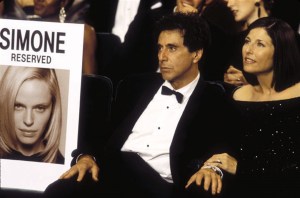 Writer/director Andrew Niccol (Gattaca) has some fun with the premise but tries to have his cake and eat it too when it comes to his satire. S1mone starts out satirizing egotistical stars, then the Hollywood system, then the press, then the public as star worshipers. The movie is all over the map trying to have something witty to say about all these different topics but is too busy to settle down on any one for a while. The satire S1mone embodies feels deflated from all the work it’s trying to do.
Pacino has always been able to do comedy but seems wearier than ever. He indulges in his comic like over-the-top aggression he’s been doing since Dick Tracy. Keener plays another of her icy businesswomen roles although she thaws quite easily and quickly in the film.
There’s a rather funny subplot involving Pruitt Taylor Vince and Jason Schwartzman as tabloid reporters on the prowl of the elusive Simone that deserves much more attention than it gets. The bulk of the movie could have been these two entertaining characters.
 When Taransky finds that his creation has become more than he can handle he tries to discredit her through a series of very funny public appearances and avante garde film choices. But then S1mone sadly goes back to its more mediocre roots. Taransky tries to get rid of Simone but it all horribly backfires.
As the film progresses you start to realize all the gaping holes that come up – like how can Taransky, a self-described computer illiterate, handle the most technical computer program of all time? How come no one would find out that Simone lacks a birth certificate, social security number or even tax records for her studio work? And why does the audience have to sit through the disgustingly cute daughter of Taransky and Keener, who just happens to be a computer whiz-kid, besides the fact she’ll have a late fourth quarter save of dad?
It’s not that S1mone is necessarily a bad film; it just has this missing piece to it when you watch it. Some scenes are funny, many drag, and the whole thing needed to be tighter and punchier. And to clear up any confusion, it is indeed an ACTRESS who plays Simone. Her name is Rachel Roberts.
Nate’s Grade: C+
Share this:

Not Another Teen Movie (2001)
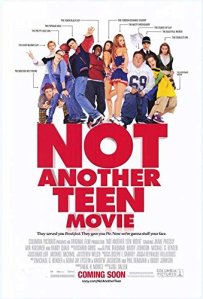 Spoofing is often believed the cheapest and lamest form of comedy. One runs jab after jab, and gag after gag relentlessly hoping that some hit but content that if they don’t more will follow with the potential to. But many of the jokes in a spoof aren’t textured; there’s nothing below their surface. Spoofs can be done well or they can be embarrassing and wretched to sit through. Count Not Another Teen Movie in the latter category.
At John Hughes High School (can you feel the parody, can you?) it’s life as we know it for stereotypes and clichés. The Bitchy Cheerleader has just dumped the Popular Jock and the Cocky Blonde Guy has initiated a bet that PJ cannot turn anyone into prom material. The men size up their choices, including an albino girl singing about her lost pigmentation (one of the few funny gags), and decide on the Pretty Ugly girl who is beyond all hope with her glasses and ponytail. Meanwhile, the Cruelest Girl is trying to find a way to seduce her brother, the Popular Jock, a trio of Virgins try and, what else, lose their virginity, and the Best Friend with Hopeless Crush tries to work his klutzy charm.
 In a genre full of Freddie Prinze Jr.’s greatest hits (or misses, however you want to look at it) a parody wouldn’t be too difficult to prescribe. All too often the film has no edge and falls back on scatological humor as its savior once too often. An exploding toilet and a flying vibrator can only do so much. There has to be things behind it. Alas, there is nothing. For every one part funny (a character tries to find the right moment to start a slow and building applause) there are three parts inane, satirically flaccid, crudely useless, or bordering on exploitative (the foreign exchange student who drapes around completely nude the entire film). The jokes arrive many times cold and require a good deal of familiarity with the subject material it’s spoofing. NATM seems to not think too greatly of the audience for it. The film continually seems to explain jokes after they happen or reacquaint the audience with the source for spoofery. The worst example may be that the movie has to SHOW a character watching a scene from ‘Pretty in Pink’ mere seconds before it spoofs that very scene.
The movie, as a whole, has about six good gags and bits but the rest is watch-checking time. Some comedic threads don’t even get the proper treatment to become good jokes. The Token Black Guy’s introduction is rather funny, but then all he does in the film is repeat the words he said he could only say. Now, if the other characters had begun to question this law of teen movies, and asked him questions then this idea could have been ripely handled. As it stands it’s another joke in a line of jokes that go nowhere but we keep going back to repeatedly.
 The flick was directed by Joel Gallen, marking his film debut after years as an MTV producer. Gallen shows no finesse when it comes to comedy as everything is rammed into the ground. His film is a spoof with nothing to do, much like the bad but better Scary Movie 2 earlier this year. Jokes come and go but they serve no purpose in moving things along or setting up greater jokes. This is comedy lost in the woods.
NATM is an attempt to satirize the teen genre, which should have been a rather easy job to do but instead just becomes another sad addition to it. And a rather poor and limp addition at that. NATM doesn’t know that the audience isn’t laughing with it but at it.
Nate’s Grade: C-
Share this:

Haiku Tunnel (2001)
 Josh Kornbluth plays Josh Kornbluth, super temp in the world of office politics and incompetent corporate superiors. He’s a working man’s hero (well, a secretary’s hero) as a round ball of puffy passive-aggressive professionalism. When asked to go permanent for a tax attorney (“We’ll even cover your
psychotherapy”) is when Josh’s world begins to enter into comedic haywire. He’s more adept at creatively finding ways around work then at actually accomplishing it. Kornbluth is a terrific comedic and a truly memorable figure. He co-wrote and co-directed the film with his brother from their stage play. Haiku Tunnel often channels the spirit of the wicked satire Office Space (a film that only gets funnier every time I watch it), but has enough of a feel all its own to be distinguishable. The film has some great lines and some imaginative characters to boot. Haiku Tunnel is witty and often times hilarious, not to mention dead-on with its precision like satiric strikes. Kornbluth is a definite entertainment find and Haiku Tunnel is a gem of a film worth looking for.
Josh Kornbluth plays Josh Kornbluth, super temp in the world of office politics and incompetent corporate superiors. He’s a working man’s hero (well, a secretary’s hero) as a round ball of puffy passive-aggressive professionalism. When asked to go permanent for a tax attorney (“We’ll even cover your
psychotherapy”) is when Josh’s world begins to enter into comedic haywire. He’s more adept at creatively finding ways around work then at actually accomplishing it. Kornbluth is a terrific comedic and a truly memorable figure. He co-wrote and co-directed the film with his brother from their stage play. Haiku Tunnel often channels the spirit of the wicked satire Office Space (a film that only gets funnier every time I watch it), but has enough of a feel all its own to be distinguishable. The film has some great lines and some imaginative characters to boot. Haiku Tunnel is witty and often times hilarious, not to mention dead-on with its precision like satiric strikes. Kornbluth is a definite entertainment find and Haiku Tunnel is a gem of a film worth looking for.
Nate’s Grade: B+
Share this:

Jay and Silent Bob Strike Back (2001)
 Kevin Smith returns back to his comedy roots. No more movies with a message (Chasing Amy and Dogma) it’s back to good ole’ snowballing and stink palming. His latest, Jay and Silent Bob Strike Back, is like a giant thank-you card to all his fans that have made the man who he is today. It ties up the entire View Askew universe so Kevin can drift off into uncharted ventures of film making and not have to keep referencing the same damn characters. Plus there’s plenty of good-natured vulgarity to go around.
 The plot of Jay and Silent Bob is nothing too heavy but seems to keep the film on a continuous pace, unlike the sometimes stagnant feel Mallrats had (what, they’re in one location for 90 minutes). It seems that after getting a restraining order at the Quick Stop on them, Jay and Silent Bob learn that Miramax is making a movie from a comic book that is in fact based off of them. Learned of the riches they could make they seek out the comic’s author Holden McNeil (Ben Affleck’s first appearance in the film) and demand a piece of the pie. Holden tells them that he long ago sold his right to his partner Banky Edwards (Jason Lee, in his second appearance in the film) and that there’s nothing they can do to stop the film. Jay suddenly gets the idea that if they stop the movie from ever getting made then they don’t have to worry. So off go our stoner duo on a mission to sabotage and satirize Hollywood.
Along the way are a hitch-hiker (George Carlin) advising the best way to get a ride is to go down in your morals, a confused nun (Carrie Fisher), the cast of Scooby Doo offering a ride (which will be 100x funnier than the feature film coming out this summer), a beautiful band of international diamond thieves (Eliza Dusku, Ali Larter, Jennifer Swalbach-Smith, Shannon Elizabeth), a rescued chimpanzee, a dogged Wildlife agent (Will Ferrell), and a full barrage of hilarity once Hollywood is finally hit.
 The best barbs are laid out by Ben Affleck and Matt Damon bickering about the other’s film choices on the set of Good Will Hunting 2: Hunting Season. This moment is truly inspired and full of great humor from Gus van Sant too busy counting his money to yell action to Damon turning into a vigilante hero. I almost fell on the floor laughing during this sequence.
When Jay and Silent Bob hit Hollywood is when the comedy starts hitting its stride as this Jersey Greek chorus interacts with the Hollywood life and encounters many a celebrity. The jokes are usually right on target except for Chris Rock’s performance of a racism obsessed film director. Rock’s portrayal becomes grating to the moviegoer far before it’s over, though he does get a few choice lines.
Smith as a director has finally elevated his visual art into something that can sustain itself instead of his earlier just-hold-the-camera-and-shoot movies. There are pans, zooms, quick cuts, cranes, action sequences, and even CGI. Smith is evolving as an artist but still staying his “dick and fart joke” self, and Jay and Silent Bob Strike Back is evidence. And that’s fine by me.
Nate’s Grade: B
Reviewed 20 years later as part of the “Reviews Re-View: 2001” article.
Share this:

Shrek (2001)
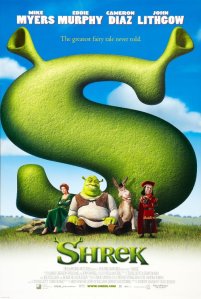 Shrek is Dreamworks’ kick in the pants to fairy tales and some of the staple creations of the Mouse house. There’s nothing a bug eating green ogre named Shrek likes more than his peaceful privacy. But this is brought to an immediate halt when all sorts of fairy tale creatures invade his swampy domain. To regain his privacy Shrek takes it up with Lord Farquad (say the name fast) who agrees to relocate the fairy tale creatures he outlawed to Shrek’s swamp in the first place if he travels to a castle and rescue a princess. Shrek agrees and along the way gets a buddy for the trip with a talking donkey, named appropriately enough, Donkey.
Shrek is amazing world of computer artistry. The characters move so life like and the detail is so magnified that it is a living and breathing world all its own. Mike Myers and Eddie Murphy are the comic duo of Shrek and Donkey and provide a good portion of laughs on their journey. With Mulan and now Shrek, Murphy seems like a natural when it comes to animation voicing. He gives it his all. Cameron Diaz is also a nice contributor as the voice of Princess Fiona, which kinda’ looks like her too creepily enough. Rounding out the cast is the always over-the-top John Lithgow as the stilted Farquad.
The humor of Shrek is enough to please kids with the fart and burp jokes, but lends its aim for more adult humor as well. There are a few jabs at the Disney Empire that are more than hilarious and the story keeps them coming. Shrek turns out to be a delightful tale of an ogre who’s a green softy at heart.
Nate’s Grade: A


 nathanzoebl
You must be logged in to post a comment.