Blog Archives
Scream 6 (2023)
 When horror franchises dramatically shift their locations to somewhere new, like New York City, it’s usually a bad sign that the series is desperately looking for new creative life. Not every franchise can rebound like a Leprechaun in Space. Most of them just become another Jason Takes Manhattan, where now instead of Character Group A running and dying from the masked killer, it’s now Character Group B running and dying from the same masked killer. It’s more reminiscent of cartoons where the backgrounds might change but the on screen events are stuck in the same drab routines. The Scream franchise was rebooted with 2022’s satisfying fifth installment, so I hoped that a sixth Scream could at least exceed where so many others have failed. Those hopes were quickly fulfilled in what I consider to be one of the best sequels of the seminal slasher series with all of its air-quote irony.
There are more than a few entertaining new turns as the bloody hi-jinks head to the Big Apple. It feels bloodier and gorier than most of the Scream movies, but it also has well-developed suspense sequences that work extremely well at making you squirm. Every brutal burst of violence elicited a “oomph” exhalation from me, and I found myself tensing up as the initial scene constructions transformed. I was quite enjoying myself from set piece to set piece. Take for instance an escape that requires the characters to flee from one high-rise window to another across an alley via a rickety ladder. Or take a subway escape packed with masked Halloween revelers to make you paranoid who among the many Ghostfaces might be the potential killer (I enjoyed the other costumes of horror old and new – I saw you Midsommar May Queen). Even a hide and seek sequence inside a convenience store can be thrilling. All credit to returning Scream 5 directors Matt Bettinelli-Opin and Tyler Gillet, the same pair that delivered 2019’s wonderfully twisted Ready or Not. These gentlemen have proven that they know how to squeeze the most tension from any scenario no matter how bizarre. I loved that the opening kill (Ready or Night alum Samara Weaving) goes in a different direction, revealing the culprit right away, and then it goes in even another direction. There are still some new cool tricks to be had with the sixth installment in a 27-year-old horror series.
 I was asked if you had to watch any of the prior Scream movies to enjoy Scream 6, and while it’s not necessary, you will be missing out on some of the larger connective tissue and themes. You should definitely have familiarity with Scream 5 since it’s a direct sequel and continuation of the core (four) characters. I was surprised how much more emotional resonance I found with the Carpenter sisters than any of the other characters, new or legacy, from the earlier movies. I think it was smart having Sam (Melissa Barrera) be the daughter of the first Ghostface as was her seeing visions of her late father, this time as an adult Skeet Ulrich, which might have been the wrong choice considering the character never lived to be this age (is her imagination doing one of those age approximations you see for runaway kids?). Our lead heroine is trying to navigate where her instincts are taking her, which might be a darker path that she feels trepidation about ignoring for only so long. Sam’s therapist balks when he discovers her actual parentage, which makes him maybe the worst therapist. Her relationship with her younger sister Tara (Jenna Ortega) is more complex than any of the close friendships of Sydney Bristow. Even with all the carnage and bloodshed, Scream 6 still finds breather moments to let the sisters react realistically to their dilemma and how it affects their own relationship. I’m glad these characters returned because they serve as the emotional focal point of an otherwise famously glib franchise.
The biggest drawback from Scream 6 is the tacit understanding that this will not be the final film in the franchise given its box-office success, the first film to cross the $100 million-dollar threshold since 1997’s Scream 2. This feels like a culminating climax as the characters now view their lives not as their own but as part of a “franchise,” which means the stories will keep going on beyond them and that nobody is safe, not even the “leads.” For a series entrenched in heavy meta-textual irony, it feels like it’s reaching the end of its genre self-awareness cycle when the movie acknowledges itself as its own IP. The scope of the movie is retrospective, not just reaching back and acknowledging the history of where things began for the legacy characters but for every movie. Each one of the former Ghostfaces is being collected and commented upon, with murder nerd Easter eggs left at each crime scene or in its contextual arrangement. It’s the kind of totality that I would expect from a movie franchise coming to an end, and nodding at its various twists and turns, finding places to even include elements from the lesser beloved Scream sequels. There’s even an unspoken satirical jab at the number of characters that miraculously survive, as if the film is throwing up its hands and saying why not, as if this is the last movie and the rules of who survives and who dies are inconsequential because we’re subverting expectations, as we’ve been explicitly told, so expect the unexpected.
 The other aspect of this drawback involves some slight spoilers but I’ll try and tread lightly. After our genre-savvy movie geek explains the stakes of this new episode, the characters start to review one another as potential suspects, and the new supporting characters even cast an accusing eye on the returning characters saying they could have cracked from their trauma. There’s emphasis on the drive to subvert expectations and break away from the patterns of old.
And here is where I’ll venture into some light spoilers so if you want to skip ahead to the next paragraph, please do so, dear reader. There is an ongoing thread where an Internet subculture has re-framed the Carpenter sisters as the real villains of their own horrendous story, and it’s an intriguing element that brings the echo chambers and confirmation bias and novice sleuths-in-the-making of the Internet to further examination. It’s reminiscent of any bottom-feeding conspiracy that asks people to pick apart their reality for “the real story” magically hidden in plain sight. The Scream franchise is famous for its fun guessing game of who the real killers could be from our gallery of suspects, and Scream 6 is no exception. However, the subversion that could have really separated this Scream from its elders is by having the killers actually be… nobodies (the Rian Johnson twist). What if the mask comes off and it’s a brand new character? I’m sure many viewers would feel like they had been betrayed, but then the point emerges that it’s simply some conspiracy theorist who has gone full-tilt crazy into the cult and taken matters into their own hands, attempting to hold “the real killers” to account or to prove they were truly guilty. And the larger point is that the “fake news” has already won out. It doesn’t matter what happens from here, what news coverage should stamp out ignorance, because you can’t pull every cult member out of their self-inflicted cocoon of delusion, which means there will always be more to take their place. That’s the legacy of what has transpired, that there will never be a real escape any longer. I thought that would be such a jarring and thematically intriguing and summative ending.
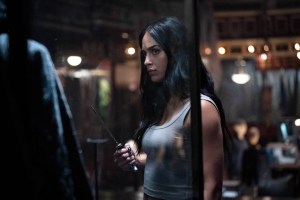 For the many fans of the slasher series, I believe Scream 6 retains plenty of the same pleasures of its prior movies while stretching out into new and interesting directions. It helps that I cared about the central sisters, at least enough by the low bar of horror movie standards. It’s bloody, fun, twisty, and satisfying enough that it could have served as a capper for the entire franchise. But it won’t be. I look forward to this new creative team re-evaluating trilogies better than Scream 3 did. In the meantime, this is a bloody good time to be had for long-term fans and newcomers from the 2022 reboot alike.
Nate’s Grade: B
Share this:

Babylon (2022)
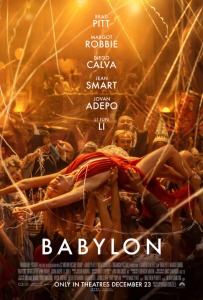 I completely understand how Babylon is such a divisive movie, and this seems entirely the point of writer/director Damien Chazelle (Whiplash, La La Land). It’s over three hours long, it’s got a budget of around $100 million dollars, and the entire enterprise just shouts artistic hubris, at best, and petulantly self-indulgent miasma at worst. Any movie that literally opens with a sequence that includes shots of an elephant defecating and a prostitute urinating on her giggling john is clearly trying to provoke a very strong response, and Chazelle’s expose on the early romanticized days of Old Hollywood is, chiefly, intended to revile and disgust. Chazelle’s mission is to rip apart the cozy nostalgia and hazy romance of the dawning of the film industry, to proclaim that Hollywood has always been a cesspool of exploitation and misogyny and racism and greed. The movie wallows in giddy exploitation but also hijacks the illusion of achieving stardom and asks whether or not the lasting art is worth all of the horror and ugliness of the systems that produce it. Babylon is a wild party of a movie with multiple sequences brimming with pure brilliant filmmaking bravura, and it also ends in a way that just might collapse Chazelle’s righteous fury and contempt.
Within the first half-hour, we are introduced to the three main characters we’ll be charting over many years. Nellie LaRoy (Margot Robbie) crashes a big house party that would make Gatsby jealous. She’s come to California to follow her acting dreams, which her family and small-town peers would sneer at, and she is faking it until she makes it with her boisterous personality. Manny Torres (Diego Calva) is a Mexican-American just trying to get his big break in Hollywood and willing to do whatever it takes to pal around with those in the movies (he is one of our primary elephant wranglers). Jack Conrad (Brad Pitt) is the highest-paid silent movie star famous for his sweeping epics as well as his drinking and multiple broken marriages. Over the next few years, as the industry transitions into the precarious era of sound, each of these three will experience their own rise and fall as they struggle to hold onto their dreams despite the many personal compromises and risks they have to endure to cling to that glitz and glamor.
 If Baz Luhrrman’s Great Gatsby and The Wolf of Wall Street had an illicit baby, and then it was raised by Boogie Nights-era Paul Thomas Anderson, you might get Babylon. It is a big movie founded on the principle of grandiose excess in all capacities. First off, it’s three hours long though this might be some of the fastest-paced three hours, albeit twenty minutes could have been trimmed here and there. I was never bored once, partly because the structure of the movie is episodic in nature, boasting varied sequences that run the gamut from brilliant to ridiculous to brilliantly ridiculous. From an overall thematic standpoint, there isn’t really any subtlety or nuance. The movie is like having the director screaming in your face. Chazelle’s depiction of Old Hollywood is one of direct shame and wanton hedonism, and beyond the obvious “It was always this bad” moralizing there isn’t much more that Chazelle has to articulate, except for a strangely misguided and arguably antithetical coda (more on this later). For almost three hours, Chazelle holds the industry accountable on their buzzy, boozy wavelength of high energy and thrills.
Babylon is presented as a big raucous party where you’re happy to be a guest but also glad you can go home to your own bed. This isn’t a movie that excuses the misdeeds of its degenerates and hangers-on and the systems of power that enshrined the horrible to be even more horrible. Babylon pushes its many characters into uncomfortable questions of what they’re willing to compromise for fame. It’s a process of assimilation and people cutting free their identity, which can be liberating for some and lacerating for others. A significant supporting character is a black jazz musician who begins to find success in the pictures. Then the producers want the man to blacken his face even further, and the ensuing anguish and rage is so palpable that it’s hard to think Chazelle has anything but seething contempt for the sordid history of his own industry. Babylon yearns to be shocking, to be provocative, and it does so easily, sometimes too easily. It’s exceptionally gratuitous to a fault, cavorting with topless women, drug binges, abrupt and callous violence, and all sorts of lewd bacchanalia. Chazelle is demystifying Hollywood’s self-serious fable, and he’s doing so by boldly leaving no bodily fluid untapped and un-splattered.
 This movie is a lot, and it’s also offering very little on a thematic level, so I can understand why plenty of people would hold their repulsed noses and say, “Not for me.” I get it. Not everyone is going to want to watch Nellie projectile vomit onto a hoity-toity snob during a party where she’s trying to re-frame her coarse, lower class identity to be accepted by the brain-dead social elites. Hollywood is presented as a vehicle for self-actualization, but the system is relentless and unforgiving, and even those who achieve success are never afforded a secure perch. The careless regard for safety in Old Hollywood is highlighted by memorable moments, like when a Medieval war epic is halted as a dead extra has a spear sticking straight up in his gut. The crew argue that the man was known as a drinker and therefore it must have been an accident of his own doing. And then the movie skips back to filming, this man’s passing given no more passing thought. And yet there are thousands arriving every year to work themselves senselessly to be the next awaiting sacrifice for this town. It’s an industry built upon human suffering and I can see how many viewers would view the many examples as wallowing in the muck for titillation. The difference for me is that I don’t feel like Chazelle is glorifying any of these antics…
…With the exception of the ending, of which I will discuss more in depth because I find it to be wholly curious and in conflict with every fiber of the movie up until this very final point. I don’t think much of this would spoil the movie for you, but if you wish to avoid my discussion of the conclusion, then skip to the next paragraph, dear reader. The film has a very definitive perspective on the movie industry’s sadistic history and yet in the last five minutes, Manny is subjected to a montage of cinematic high points, zooming ahead into history to include such movies as Terminator 2, Titanic, The Matrix, and Avatar, and he weeps. For 170 minutes, Chazelle has taken us along the road of perdition of Hollywood exploitation and degradation, complete with a skin-crawling trip through hell with Tobey Maguire. And then in the final ten minutes, Chazelle says, yeah, but maybe all of that exploitation and death and disaster was all worth it because we now have movies like… Avatar. It’s the conclusion where Chazelle, as my pal Ben Bailey would say, reveals himself as an art maximalist, that only the art remains and only the art shall matter, arguing that all the vile behavior we’ve endured has meant nothing. It’s the opposite of what the rest of the movie has been purporting, and it’s strangely sentimental for an unsentimental film. It feels like a misguided misstep that concludes with excuse-making and moral relativism, which is far queasier than any of the gratuitous sequences of nudity, drugs, vomit, piss, and rat-eating.
 The technical qualities of Babylon are outstanding, and when working in such symbiotic symphony, they can be absolutely thrilling to exhibit. The sterling production design, extravagant costuming, and swinging cinematography work with the fevered editing and pumping score, and expertly recreate this era with amazing scope and lived-in period detail. I’m still humming the score’s memorable, jazzy, percussive leitmotifs days later. There are sequences that are simply stunning, such as the first day on a movie set for Nelly and Manny, both of them making names for themselves through problem-solving and scene-stealing, and the revelations and race-against-time brinkmanship are electric. The introduction of sound also creates many complications, brilliantly encapsulated in a comedic sequence where Nellie is trying to adjust to this new reality on a soundstage. It’s a comedy of errors cracked up to a hallucinatory madness by the end. Chazelle also delivers one of the best fart jokes in film history, where Conrad is in a bathroom questioning the appeal of sound and why audiences would want to hear, and as punchline, a giant fart erupts from one of the bathroom stalls. The parties are ribald, with the opening making use of an elephant as a literal distraction stomping through a mansion, and a latter one that ends in a frenzied man-to-snake fight. The entire sequence with Maguire is best left as a stupefying surprise, a sequence that reminded me of the dread-fueled Wonderland scene in Boogie Nights. In my view, even if you found the movie was thematically shallow, the individual sequences are so entertaining and so technically executed that the movie demands to be seen.
I’ve noticed some complaints that Chazelle’s messy opus could have pulled from actual Hollywood scandals, that he didn’t need to make up characters and fictional scenarios. That’s fair, but Chazelle wants to impart an impression rather than a case-by-case history of literal bad men. There are characters meant to resemble clear inspirations, like Fatty Arbuckle (who was innocent, by the way) and the affair of Greta Garbo and Marlene Dietrich or Errol Fylnn’s penchant for underage girls, but I don’t think the movie loses its spirit or bite because it’s not strictly recreating existing historical scandals. It’s still an expose on Old Hollywood without the names.
 Babylon is a rip-roaring experience that condemns the history of cinema through the expansive art of cinema, and it’s a wild party populated by sleazy provocateurs and capitalists. Even some of the criticisms of Babylon I can find artistic explanations for, from its gratuitous nature to even the sidelining of its minority and queer stories, perspectives themselves cruelly sidelined and erased from the studio system of Hollywood. Even its overwhelming explicit nature is partly the point, as characters spin round and round, indulging in every debauchery to avoid the march of mortality. Robbie’s high-energy performance is like if a bag of cocaine became a sentient human being. It’s all about sensation and distraction and the many willing to give everything to be part of that, and for almost three hours, Chazelle makes the manic chaos absorbing and horrifying before going soft in the end and arguing that maybe it’s all worth it. Babylon is dazzling filmmaking that will exhaust and nauseate as many as it potentially thrills. I’m glad Chazelle decided to use much of his carefully built artistic cache to make something this extravagantly divisive and ambitious.
Nate’s Grade: A
Share this:

The Babysitter: Killer Queen (2020)
 I very much enjoyed 2017’s The Babysitter from the very start. The characters had such vitality to them, Samara Weaving (Ready or Not) gave a star-making performance, and it was a wild ride while also having an emotional core with the relationship between the babysitter and her charge, a designated Satanic sacrifice. It was silly, clever, but also satisfying with its character dynamics, and it proved successful for Netflix so they felt, well, why not do it all again? The Babysitter sequel, subtitled Killer Queen, has a strong whiff of desperation trying to awkwardly rekindle the good times. The original writer, Brian Duffield, is not here as a writer but returning director McG is one of the credited writers, which made me wary. Sequel-itis plagues the story as our surviving teen Cole (Judah Lewis) gets into ANOTHER tight spot with ANOTHER group of Satanists looking to sacrifice him to make their dreams come true, and it also happens to also include the SAME supporting villains from the first movie. Even the cheeky onscreen titles go, “Again?!” Why must these killer Satanists only obsessed with this one specific kid as a sacrifice? Diversify your options, folks. It all feels more of the same but just not as good, not as memorable, and not as entertaining. It’s a low-investment movie, something where your ceiling of demands is already pretty generous, so if you enjoy comically over-the-top gore then there are a few moments that might make this sequel palatable. It’s a movie with a “so what?” attitude, adopting a flippant nihilism that makes the attempts at drama a little more forced and inauthentic when they occur, not that the comedy is much better outside the splatterhouse violence. The ending is also rather anticlimactic because it simultaneously involves a deus ex machina while also finding a way to be derivative of another very memorable ending of another Samara Weaving movie. I didn’t think a sequel was needed, and I wasn’t expecting much from a sequel, and I got about what I was expecting. The Babysitter: Killer Queen is a fast-paced and amenable work of cinematic junk food, a genre movie that might have enough genre elements to prove tasty, but by hewing so close to the original, Killer Queen feels more imitation than imagination, and it’s clearly inferior to the original.
Nate’s Grade: C+
Share this:

Bill and Ted Face the Music (2020)
 Bill and Ted might be one of the most inexplicable franchises in Hollywood. It began as a riff on 80s high school movies by writers Ed Solomon and Chris Matheson, taking the California surfer/stoner goofball supporting character staple and saying, “What if people deeply uninformed about history traveled through time?” 1989’s Bill and Ted’s Excellent Adventure movie was a comic delight, and Bill and Ted became unexpected icons, action figures, and even a Saturday morning cartoon. The 1991 sequel could have easily repackaged another escapade through time but instead it went a completely different, darker, and weirder direction. Bill and Ted’s Bogus Journey followed its characters through death, hell, heaven, and back again. It’s been almost thirty years since Bill and Ted left the pop-culture spotlight behind. What more challenges could you present? Bill and Ted Face the Music is a sweet sequel that explores the, dare I even utter the word, legacy of these cheery doofuses, and while it’s not at the same level as its clever predecessors, I was more than happy to take one last trip with these gents. Most excellent.
It’s been decades since Bill S. Preston Esquire (Alex Winter) and Ted Theodore Logan (Keanu Reeves) hit the big time with their band Wyld Stallyns but life hasn’t quite worked out how they imagined. They had been told their music would bring peace to the world, but they’re in their 50s now, fame now behind them, and they have yet to live up to those heavy expectations. Bill and Ted are struggling to still write that perfect, magical song, the one they were destined for, but both men have growing doubts over whether or not they can make it happen. Their adult daughters (Samara Weaving, Brigette Lundy-Paine) want to help and take the ole phone booth time machine for a spin, collecting famous great musicians throughout time to help collaborate with their dear old dude dads before all of reality unravels if that fabled song cannot be written.
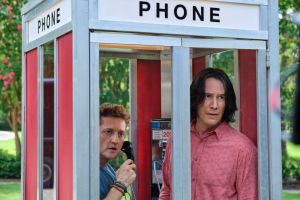 Just as Bogus Journey rejected being a lazy reprise, Face the Music inclines to chart its own path as a sequel rather than replicating the hits of old while also staying reverent to why people loved the originals. This is more a time travel movie, and the daughters even go on their own Excellent Adventure rounding up famous musicians through history as a B-story, but the main story is squarely on Bill and Ted facing off against themselves and their collective insecurities. When challenged, the Bill and Ted of present-day figure that they can skip ahead to the future and simply take the world-saving song from their future selves, who obviously would have written it by then. It’s a move the franchise has used before, relying upon future actions to take care of present problems, so it’s fitting for the characters but this is the first film to explore this as a negative. Bill and Ted are desperate and looking for an easy solution and skipping to the end will do that. However, their future selves are pathetic has-beens who have yet to write the ultimate song, and they resent their past selves for setting them up for failure. There are many face-to-face meetings between present and further future versions of Bill and Ted and their interactions become an adversarial tit-for-tat. I looked forward to each new pit stop with future Bill and Ted to see how their lives were and if they were still trying to set up the past Bill and Ted for a long-simmering retribution. The fact that this storyline has a genuinely sweet and even poignant reconciliation is a joyous addition.
Thankfully, Bill and Ted are still the same lovable, affable, and relentlessly positive dudes we’ve known and loved since the 1980s. I appreciate over three movies how much these guys legitimately appreciate and love each other. That’s one reason why it’s so enjoyable to hang out with these guys regardless of what their adventures entail. It would be easy for Bill and Ted to have become jaded in their old age, cynical from not fulfilling their hallowed destiny. They could have some animosity between the two of them that need to be buried in order to work together, rekindle that old magic, and save the world. But the screenwriters know who these characters are. Even when things aren’t going their way, they stay who they are, hopeful and supportive. I also appreciated how this translates to their relationships with their daughters, who clearly love their fathers and want to follow in their footsteps. They even refer to them as “dads” rather than “dad.” The conclusion rests on the daughters and fathers working together, and the positivity that radiates through their relationships allows the ending to reach a surprisingly emotional high for a family of good-natured goofballs.
 Face the Music is a bit overstuffed with subplots and characters, and I do wish there could have been some careful pruning to allow more room for the daughters. Bill and Ted’s wives, the princesses from Medieval England, have been recast again (Erinn Hayes, Jayma Mayes), and once again they are barely featured. There is an early conflict between the wives and husbands, and the prospect of losing them motivates Bill and Ted to save their marriages, but this conflict is entirely sidelined after the “end of the world” dilemma overtakes the plot. The wives are in their own subplot and also traveling through time or to parallel dimensions, though we never spend any time with them. There must be entirely cut scenes with them. Their perspectives could have been a whole other movie but they’re only an afterthought, as these characters have always been. Kristen Schaal (My Spy) appears as the daughter to Rufus (the late George Carlin), and we’re introduced to her mother, a deadly robot (Barry’s Anthony Carrigan) set to kill Bill and Ted for questionable reasons, the return of the Grim Reaper (William Sadler), plus all the assembled historical figures with the daughters. Also, just about every supporting family character makes an appearance too. It feels like too much, like the movie is constantly racing forward, juggling people and stories, when we didn’t need it all.
The daughters are more reflections of their fathers than independent characters. Each character, Thea and Billie, is a younger impression of their father and little else. They like the same music their dads like. They have the same goals their dads have. They have the same personalities their dads have. Both actresses are fun and Brigette Lundy-Paine (Netflix’s Atypical) does a wicked impression of a young Reeves, including adopting his sway-heavy gait, but I wish they had more to chew over. It seems cliché to make the central conflict of a third Bill and Ted movie an inter-generational one, where the fathers cannot relate to their daughters, and the four of them go on a fantastic journey that helps to bridge their differences and allow each side to better understand and relate. It might sound cliché but it could also have been compelling as well, and it would have elevated the daughters and their relationship into a primal position, rather than using the relationship with the near non-existent wives as the throwaway motivation for their call to action.
 It’s been quite a while since Winter and Reeves have played these parts, and while they both have clear affection for their characters, it’s not quite a seamless relaunch. Reeves (John Wick) has been playing hardass action heroes for so long that it feels like he can’t easily recapture goofball energy. His line deliveries can feel far more stilted and low-energy. Winter hasn’t acted onscreen since 2013 and has transitioned into being a documentary director. He delivers a more spirited performance and hits the comedy notes more effortlessly than Reeves, but the time apart from acting shows. Watching both men imitate their younger selves and going through the same shtick can have a different impact on the viewer. Hearing the same catch-phrases but with deeper, gravely voices isn’t quite the same thing and serves as a warning of the enterprise living in its own shadow. My pal Ben Bailey found an old Bill and Ted to be rather sad. I think that’s part of what Face the Music leans into (including its knowing title). They haven’t succeeded like they wanted. That weighs on them. Neither character is about to contemplate suicide but there is a sense of disappointment about how their careers turned out that they’re barely staying ahead of, which adds a melancholy dimension to these characters still falling back on what they know because it’s all that they know how to do. It’s not overpowering but it’s an acknowledgement of the loss of time.
Bill and Ted Face the Music is a charming, likable, and sweet-natured sequel that wraps up the franchise well, reminding fans why the Bill and Ted characters were so enjoyable from the start. In our COVID times, I’m finding it easier to shrug away some of the movie’s flaws, like its low-budget being noticeable, chintzy CGI special effects, and too many supporting characters on top of not integrating the daughters into the main action in a more significant fashion. It’s 90 minutes of laid back, light-hearted fun with actors and filmmakers who clearly love this franchise, and the screenwriters could have merely coasted and did no such thing. We didn’t need a third Bill and Ted big screen adventure but I’m happy that it still feels, even thirty years later, remarkably like Bill and Ted.
Nate’s Grade: B
Share this:

Guns Akimbo (2020)
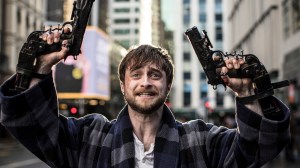
 Imagine waking up one day and having real-working handguns bolted into your hands. That’s the wild premise to Guns Akimbo (akimbo means, in this context, “flung out haphazardly”), a frenetic action comedy that never takes itself too seriously. Miles (Daniel Radcliffe) is a computer programmer who takes it upon himself to harass online trolls. One of these trolls, the proprietor behind the death match game show Schism, takes it personally. He drugs Miles and has his cartoonish goons give him the gun-hands. He’s the latest contestant on Schism, and the top-ranked assassin Nix (Samara Weaving) has been selected as his competition. Miles has to fend for his life, while not arousing panic or the police, and he can’t even open a door.
It’s a bonkers, proudly juvenile action comedy that starts off at a breakneck speed and rarely lets up, and there’s a good reason for that – Guns Akimbo is a lot of flash and little else. It’s a movie that’s constantly in your face with its stylistic tricks, crass humor, wanton violence, and bizarre touches, and for a decent portion of the movie it kept me entertained. The rush of colors, movement, and profane insanity can be enjoyed on a certain level that doesn’t require much in the way of thinking. If you need a turn-off-your-brain action comedy, Guns Akimbo can work on that level, but if you think a little more the illusion begins to dissolve. I start to question the reality of this world, which seems more akin to something from The Purge but lacks the satirical through line of the Purge franchise. The satire of Guns Akimbo feels tacked on and often forced, much like the setup of its premise. There’s really nothing about firearms or gun culture covered, which seems bizarre considering the premise. The “troll culture” aspect of the movie is barely covered, setting it up as a straw-man argument to lambaste the general indifference to human suffering. We never really return to it except for brief moments to score easy points. Miles is a troll to trolls, and they get so incensed that they go to extreme lengths for vengeance from… being trolled? Is this to imply how fragile online trolls are as people? The world of the movie seems to acknowledge its Running Man-style online death game shows but the rest of the world goes on normally without commenting. It feels like someone just dropped in a fantastic element into the normal world and nobody acknowledges it as such. I thought maybe at the end it would turn on the Schism viewers but no. They’re basically like those five or six audience faces we jump around for reaction shots, like in The Truman Show. The satire of the movie feels more like a superficial finish.
 From the first sequence of stylized violence on, I made a note of how overly edited the action was. It wasn’t quite to the hyper-edits of Michal Bay’s kaleidoscopic realm but it was noticeable and made it harder for the action to be understood and appreciated. You get the premise of the scenarios, two cars chasing after one another and firing, but it’s presented in such a blizzard of images, sounds, and colors that it’s more the impression of the scene rather than a development. This impression was always present when we watch Nix storm through a drug den and lay waste to every armed goon inside. Here is a scenario where all I want is some stylized violence and fun fight choreography, but what I got was more of the same incomprehensible jumble. Nix shoots. Bullets hit skulls. Blood splatters. The camera is constantly zooming, or careening, or flipping upside down, and after a while I just gave up and accepted it’s all only impression-based. It’s about the immediate energy and not what’s actually happening onscreen. I wasn’t going to get any interesting fight choreography. I wasn’t going to get any memorable bits of crazy action. It was like a junkier version of Wanted, with a super-powered player running through a level and clearing over-matched opponents. Without more, the same action can get boring. The same happens in a junkyard clash between gangs. The only action sequence with a satisfying development was a car chase where Nix attacks with the spinning wheel of her motorcycle. Guns Akimbo has decided to overwhelm your senses to distract from its action restrictions.
As a crazy comedy, Guns Akimbo is more successful and fun. I found the physical comedy to be a consistent and enjoyable source of entertainment. While the action might get boring, watching Miles simply deal with the logistics of his gun-bolted hands made me laugh and cringe constantly. How does one go to the bathroom with gun-hands? Put on their pants? Open a door? Drive a car? It’s a dose of slapstick that doesn’t have to dip into edgy material in order to make its mark. Radcliffe is genuinely fun to watch during these sequences, as it plays to his strengths of melding awkward clumsiness and nervous high-strung energy. Thankfully Radcliffe is set for life thanks to the Harry Potter movies because he has consistently chosen really weird and interesting film roles, almost to the point where his presence in a (non-studio) movie is enough to guarantee a watch. He brought stunning humanity to a farting corpse in 2016’s Swiss Army Man and gave a tour-de-force physical performance. He’s an actor who commits no matter how silly the role, and it’s a delight to watch him try and make sense of the escalating madness around him with his unique physical disability. I was enjoying even the smaller moments like Miles’ difficulty hiding his alarming ailment with transparent lies or his interaction with a mentally ill homeless man (a scene-stealing Rhys Darby).
 As the movie kept going, I felt my interest growing and that was because of the increased presence of Weaving as Nix, who is clearly the star of this crazy movie. Weaving should have been a Hollywood star after Netflix’s The Babysitter, and she was just as wonderful as the heroine in last year’s Ready or Not. Her character isn’t exactly much more than a murder pinup, a comic character come to life. She’s nearly unrecognizable in her punk rock assassin attire, including literal bullet teeth. She’s all nihilist attitude and clunky one-liners (“Suck my clit” needs some work). She has a tragic back-story that sets her up for vengeance and that’s all that’s needed from what could be a completely interchangeable back-story. It only serves as a needed character motivation point, one that is more compelling even in its shallow nature than Miles, who is on the run for his life but really is about trying to save his ex-girlfriend (Natasha Liu Bordizzo) who serves mainly as a damsel in distress for the last act. While I enjoyed Radcliffe as a performer, this is Weaving’s movie from the moment she struts into the frame. Her charisma pops off the screen even as her character is criminally blasé. She’s the kind of character that will pick up a dismembered middle finger just to give someone the gesture. Nix is more so a collection of weird and hip and sexy tics than an interesting character, but it’s Weaving and her jubilant, dangerous degree of fun that makes the character a scrubby version of Harley Quinn.
Guns Akimbo is like tasty junk food that can satisfy a very specific cinematic craving but you know, even as you’re consuming it, that this won’t be anything special. I wish the film had gone further in any direction, whether it was with the comedy, whether it was with more finely choreographed action, or whether it was in more outlandish set pieces like in 2007’s Shoot ‘Em Up. If you want to be a crazy cartoon, be a crazy cartoon. Give me even more characters like Nix and over-the-top violence that does something different besides geysers of head shot wounds. Guns Akimbo might work as a lesser Crank movie. This movie seems either to be too satisfied with itself or knowingly hiding its shortcomings with energy, edits, and attitude. I can’t tell which. Guns Akimbo is easy on the brain and maybe a little too easy on itself. My 13-year-old self would have loved this movie.
Nate’s Grade: C+
Share this:

Ready or Not (2019)
 Ready or Not is like the twisted lovechild of the home invasion thriller You’re Next and the meta-horror funhouse that is Cabin in the Woods, and it’s a total blast. This is no game.
Grace (Samara Weaving) is marrying into a rich family of socialites, famous for their family’s history with board games. Grace’s husband is reluctant about his bride joining the family he had walked away from for years. There is one big tradition: every new member of the family has to play a game upon their wedding night, dating back to the great grandfather who founded the family company through a chance encounter. Grace pulls a random card that says hide and seek, and that’s the game they must play. She’s bemused at being enlisted into a child’s game but little does she know that the family is arming themselves to find and murder her. They fear that if they cannot kill her before dawn, they will all be doomed thanks to an old curse.
 The movie is entertaining from beginning to glorious ending thanks to finely developing its unorthodox premise and staying consistent tonally, whether it’s dark humor or tension. This is a very funny movie. In fact, I laughed more and harder during this film than I have with movies sold as comedies. It’s not afraid to spin its macabre premise for fun, but it impressively doesn’t lose sight of character and scenario along the way. That means that the screenwriters are deriving their humor from the absurdity of their situations and finding organic wellsprings of comic relief. The humor doesn’t detract from the danger of the moment while also enlivening the rest of the movie. The incredulity of the situation leads to some wonderfully ironic moments, like one relative studying YouTube videos for how to operate a crossbow, someone looking up on Google whether or not deals with the devil are real, and a running gag of the estate’s maids meeting horrible accidental deaths. And then there’s the ending, which finds a wonderful way to essentially have its cake and eat it too. I won’t spoil it but the ending to Ready or Not is a fist-pumping, cheering, clapping, highly memorable closer, and one of the best endings in years. It’s one of those endings you can’t wait to talk about with others.
All of the various family members have little notes to play and character beats that provide a more realized glimpse into their histories and the family dynamics than I would have anticipated. It made me feel like the filmmakers had given great consideration to even the smallest of details in what is, at its core, a murderous version of a children’s game. There’s the wife to Adam Brody’s character who is all-in on whatever it takes to maintain this family because she hints at what kind of horrible life predated her new life here. Then there’s the patriarch of the family who is all about ceremony and staying true to the rules until he has to experience the smallest challenge and wants to use whatever cheats he can at his disposal, arguing that great grandfather would use security cameras too if he could and why should they be penalized for simply playing the game in a more technologically advanced era. He’s just another rich douchebag who drops his pretenses the moment something isn’t handed to him. The characters are varied so that you can never feel relief when anyone is in a room, and that even includes the children, who seem destined to become new participants in this cycle.
 Even with its tongue-in-cheek humor and premise, there is a lot of clever thinking put into Ready or Not. There are plenty of setups that connect to later payoffs, including that amazing finish. The screenplay by Guy Busick and Ryan Murphy thinks things through step-by-step so that it’s always ahead of the audience. If any of us found ourselves in this scenario, we would likely try and escape as quickly as possible to an outside refuge. They provide an explanation for that hurdle. Then when Grace finds a way out, the screenplay finds a logical yet clever way to curtail that escape. There is a gruesome sequence where Grace suffers a specific injury and then has to pull herself out of a bad situation, and the movie sets up a gnarly out that connects to that injury, and I sat with baited breath just waiting for the puzzle pieces to connect, and Ready or Not has several moments like this. It’s a fun movie because while it doesn’t take itself that seriously it’s very serious about its storytelling and structure.
Weaving deserved to be an A-list actress after her star-making performance in Netflix’s The Babysitter. This woman is so magnetic and so great at roles that require a tightrope of tone; she sizzled as the darkly advantageous yet lovable babysitter in that other movie, and with Ready of Not she’s our increasingly baffled heroine just trying to make sense of the insanity. The audience gravitates toward Grace pretty quickly as a grounded woman who seems genuine about her desire to have the family that she never formed as a foster child. There’s a latent tenacity that emerges from Grace as she pushes herself through one survival scenario after another. Unlike the similarly themed You’re Next, Grace is not some secret badass raised by crafty survivalists. She’s a normal person thrust into a very abnormal situation, and her responses stay reasonable and formidable when called upon. She is our center for the fun and she makes a winning heroine, and Weaving is so good at the heavy moments, the gross moments, the sly moments, that she deserves to have great material handed to her because she is ready, Hollywood.
Ready or Not is a sneaky, nasty, delightfully dark little movie that left me hooting, hollering, squirming, and grinning with satisfaction. It’s a late summer surprise that delivers everything I was hoping for and has great, delicious fun with its humor and violence. It’s smartly paced, smartly structured, with supporting characters that leave a mark as well as thematic questions over culpability and group think. This is the kind of movie I wish Hollywood was making more of, with screenwriters that can take a premise and write the best possible version of that and with the best possible ending. Any misgivings I have for this movie are small quibbles, like maybe more specific payoffs linked to onscreen deaths, but even that would detract from later events and payoffs, so even my quibbles can be excused. Ready or Not deserves to be seen with a raucous crowd that will appreciate it to its full extent. I look forward to the Twister-heavy sequel.
Nate’s Grade: A
Share this:

Three Billboards Outside Ebbing, Missouri (2017)
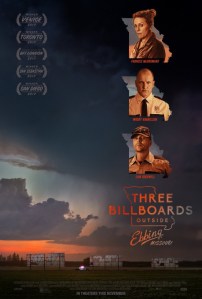 Mildred (Frances McDormand) is a divorced single mother working in the small town gift shop of the small town of Ebbing, Missouri. It’s also been seven months since her teenage daughter was raped, murdered, and set on fire. She rents out three billboards on a rarely used side road to advertise her frustrations with the slow pace of law enforcement. The billboards say, “Raped while dying,” “Seven months and no arrests,” “How come, Chief Willoughby?” The chief (Woody Harrelson) tries to pacify the grieving mother while keeping his loyal officers in check from retaliation. Deputy Dixon (Sam Rockwell) is trying to apply pressure to get the billboards removed by any means. The small town loves their sheriff and turns on Mildred, which suits her just fine. The more people that disagree with her the more it helps fuel her sense of righteous indignation. Mildred engages in an escalating series of battles with the police and town that might just make justice impossible.
Three Billboards Outside Ebbing, Missouri feels like a Coen brothers’ movie played straight, and it’s borderline brilliant in its depiction of homespun characters allowed tremendous emotional latitude. These are people with complex depth who are allowed the power to be contradictory. They can be vicious one moment and kind the next, wise one moment and impulsive and self-destructive the next, capable of great acts of mercy and cruelty. This achieves two things: 1) making the characters feel far more convincingly drawn, and 2) making the characters consistently surprising. This is a messy movie but I don’t mean that as any intended insult. It’s messy in scope, messy in tone, and yet it thrums with the messy feelings and messy complications of human tragedy. What happened to Mildred’s daughter is utterly horrifying and her rage is righteous; however, that doesn’t sanctify her. She makes mistakes, pushes people away, and can be cruel even to her own family. I was expecting Harrelson’s police chief to be a sort of villain, either incompetent or conniving, willfully ignoring the murder investigation. This is not the case at all and he is full of integrity and rightfully beloved in his community. As happens in many criminal cases, the trail of evidence just ran cold, but Mildred would prefer every male in the city, state, and even the country be blood tested to find a culprit. Her demands are fundamentally unreasonable and Willoughby points out the many civil rights protections in possible violation. Just because Mildred has been wronged does not make her the hero, and just because Willoughby is the face of local law enforcement does not make him the enemy. They are people with much more in common than they would ever admit. The awful circumstances of the plot have pit them against one another in an escalating tit-for-tat that serves as projection for Mildred’s blinding fury against a world that would rob her of her daughter.
 The dichotomy of sweetness and terror is best exemplified in the transformation of Mildred and Dixon, one of the most satisfying and engrossing film experiences of the year. Thanks to writer/director Martin McDonagh’s deft handling, these two characters start at opposite ends and grow before our eyes. Mildred tests the limits of her resolve and anger and makes costly mistakes. Dixon begins as the screw-up with a badge (hat he literally misplaces) rumored to have tortured a black prisoner in jail. He seems like the dim-witted poster boy for unchecked masculine privilege. He feels like an enforcer of the corruption we (wrongfully) assume is at work in this small town. As Mildred descends into darker decisions, Dixon ascends and chases a redemptive arc, which is amazing considering the damning behavior he engages in at the halfway mark. These two characters start as adversaries and develop into begrudging allies in a completely organic way that doesn’t blunt either character. That transformation is thrilling to watch and terrifically satisfying on its own terms. By the very end of the movie, I was ready and willing to watch its hypothetical sequel setup, especially if it meant I got to spend more time with these carefully crafted people.
McDonagh’s film juggles many tones, effortlessly switching from laugh-out-loud comedy to crushing drama and back again. I was genuinely surprised how many times I laughed and how hard I was laughing. During my second theatrical viewing, there was an old woman in the back who was quite vocal in her bafflement about how anyone could be laughing. And if you were told the specifics of the plot and its heavy subject matter, I would tend to agree. McDonagh has a preternatural feel for how to find humor in the most unlikely of places. The humor dissipates as the film marches into its second half, a natural byproduct of having to raise the dramatic stakes and make things feel serious. This is the first grounded drama in McDonagh’s filmography (In Bruges, Seven Psychopaths). He doesn’t shortchange the impact of his drama by weaving in more heightened comedic moments. The characters feel realistically developed and portrayed and are allowed to exist in moral grey areas. There’s a minor character played by Peter Dinklage who is positioned as a romantic option and a bit of a fool, but by the end you feel degrees of sympathy even for him. Even this most minor of supporting characters (not a comment on Dinklage’s stature) has earned your emotions. That’s great storytelling but it’s also tremendous execution from the director. Another sure sign of McDonagh’s command for tone is that he undercuts his story’s moment of triumph. I’ll dance around spoilers but Three Billboards looks to end in a way where several characters would claim a hard-won victory, and McDonagh casually strips that away. Even though this is a movie, and even though there are moments of broad, irony-laced comedy, the complexities and disappointments of real life emerge. Even to the very end, Three Billboards doesn’t follow the expected rules of How These Things Go.
 The excellent acting gives further life to these tremendous characters. McDormand (Fargo) is radiating with ferocious resentment and indignation. Her character is a walking missile that just needs to be pointed in the right direction. Her stares alone could cause you to shrivel. McDormand hasn’t been given a character this good in years. She opens up the full reserve of her deep acting reservoir, able to flit from great vulnerability to intense repulsion. She has plenty of big moments where she gets to tell off the disapproving townspeople and media members. It’s ready made for easy laughs, but McDormand is so good that she shades those moments with subtler emotional nuance. You get the laugh and you also get further character insight. It’s a performance of such assured strength that I imagine you’ll be hearing her name often during the awards season. Rockwell (The Way, Way Back) has also never been better. He has to play a similarly deep array of emotions, from idiot comedy to heroic dramatics, and at every point Rockwell is stunning. He makes every joke twice as funny. When Dixon becomes a larger focus of the story is when he undergoes more intensive introspection. He goes from buffoon to three-dimensional character. Harrelson (War for the Planet of the Apes) also delivers a worthy performance as a proud yet wounded man who is trying to do right against a world of pressures and self-doubt.
Three Billboards is an impressive, absorbing, searing film gifted with some of the best-developed characters in 2017. The portrayal of the characters is so complex and given startling life from such amazingly talented actors. You’ll watch three of the best performances of the year right here. You get a really strong sense of just how life has been irrevocably altered from this heinous crime, not just with Mildred but also for the town as a whole. Things cannot go back to being the way they were. The characters you like can make you wince. The characters you don’t like you might find yourself pulling for. Thanks to the complexity and nuance, the film delivers a raft of surprises, both pleasant and painful. These people feel closer to real human beings. McDonagh’s brilliant handling of tone and theme is a remarkable work of vision, cohesion, and execution. This is a darkly comic movie that can make you bust out laughing and an affecting human drama that can make you cry. It takes you on a journey that feels authentic and wildly entertaining. Three Billboards Outside Ebbing, Missouri (which should have simply been called Three Billboards) subverts typical Hollywood clichés by making sure, even during its wilder flights of comic fancy, that everything is grounded with the characters first and foremost.
Nate’s Grade: A


 nathanzoebl
You must be logged in to post a comment.