Blog Archives
Deadpool & Wolverine (2024)
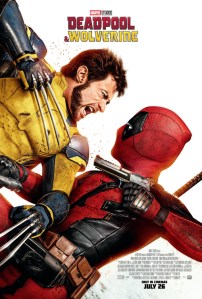 Thanks to some release shuffling, there was only one Marvel movie being released in 2024, the fewest since 2012 (excluding the COVID punting of 2020). There’s been a lot of ink spilled over “superhero fatigue,” especially the recent downturn of certain Marvel movies like Quantumania and The Marvels, though as I’ve written before, I don’t think audiences have become sick of superhero cinema, they have become more demanding from mediocre superhero cinema. Audiences just want something more than the same old same old. Enter Deadpool & Wolverine, resurrecting one of the greatest Marvel heroes and transplanting the first new Fox hero into their new corporate landscape. It’s the least serious Marvel movie yet by design and, judging by its runaway box-office success, that was what the people wanted in a summer blockbuster that made them remember the escapist joys of men in tights with anger issues.
Wade Wilson (Ryan Reynolds), a.k.a. the merc with the mouth Deadpool, is a man out of time. His universe is scheduled for elimination by the Time Variance Authority (TVA) because of the demise of Logan (Hugh Jackman) who served as an anchor being. Apparently, for reasons that don’t seem to make sense if you think of universes lasting longer than one human lifespan, once the anchor being goes, the universe dies out. Wade is thus in search of another Wolverine, but the one he finds is “the worst Wolverine,” a tragic hero drowning his sorrows and refusing to help. The two bickering mutants get cast to a dimensional dumping ground where they run into all sorts of castoffs and forgotten figures, chief among them Cassandra Nova (Emma Corrin), the twin who ate Professor Xavier in the womb rather than the other way around. She holds dominion in this strange realm, and Wade has to appeal to her, or eliminate her, to get out of this ashy purgatory and convince this wounded Wolverine to be a hero.
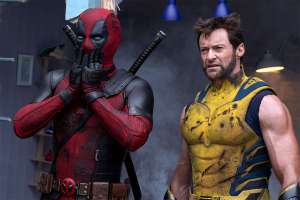 The Deadpool half of the title means that this movie is interested in serving as a meta-satire of superhero cinema, which means its breezy, surface-level charms can feel after a while like a fanboy sugar high. It’s hard to maintain the novelty of a fourth-wall breaking vulgar superhero with the third movie, but now we have Deadpool closing the book on the Fox era of twenty-first century superhero cinema as well as getting to play in a new sandbox of pop-culture references and superhero cliches. Welcome to the Marvel Cinematic Universe (MCU), Wade Wilson, though, as stated on-screen, you’re entering at a bit of a low point. For a while, at least, the movie can get by by having its resident prankster mug his way through the MCU catalog, fawning like the biggest fanboy (he did unsuccessfully audition for the Avengers). The opening sequence literally involves Deadpool digging up the adamantium corpse of Logan and using his unbreakable bones to inflict bloody carnage. It’s quite an attention-getter as well as something of a promise: we’re not going to undo the dramatic conclusion of 2017’s Logan, and even though this is the MCU, this movie isn’t going to go soft as it wades in its signature off-color comedy and bloody chaos.
Your mileage will vary depending upon what the hit-to-miss percentage is with the comedy. I found a lot of the homoerotic/homophobic banter to be dull and repetitive, but this kind of comedy ethos has been present from the first movie, the more-is-more approach. There’s an extended series of cameos that are fun castoffs from Fox comics universes, and the actors are definitely having a blast reliving their characters, or in one very special case, getting to live it once and for all. I wish there was more specific MCU commentary, but I cackled loudly when Reynolds turns to Jackman and taunts, “Disney’s going to make you keep doing this until you’re 90!” I really wish there was an extended critique of the state of post-credit scenes introducing new characters that we all know will never be seen again (remember Harry Stiles or Brett Goldstein?). Deadpool could have gotten stuck in an endless loop of end credit sequences. I enjoyed that a car’s product placement was subject to constant abuse and destruction, while still trying to maintain that sleek car commercial framing. The angry/shouty dynamic between Wolverine and Deadpool makes up for a lot, so even if the jokes are less than stellar, the cranky buddy dynamic still delivers.
 However, much like the 2022 Multiverse of Madness, the actual multiversal trips are quite few and quite disappointing. There’s a silly montage of Wade approaching the different Wolverines of different universes (no Dougray Scott, huh?) but almost all of the movie is spent between a dusty netherworld and a subway station. Again, with the promise of great possibility, these movies seem to say, “Will you settle for maybe TWO gray locations?” I was let down by the main setting reminding me of 2009’s Land of the Lost dumping ground for the nexus of discarded universes. When this whole multiverse phase comes to its inevitable conclusion, it’s going to feel like a promised epic family vacation that went about an hour down the road, visited two gas stations, a McDonalds, and then hastily turned around.
On the other side of the titular ampersand, Jackman is acting in a completely different movie, perhaps giving one of his most dramatically rich performances as the superhero. This is a different Wolverine than the one we saw in 2017’s Logan, so it allows Jackman the freedom to be able to hit some of the essential elements of the character while also getting a new opportunity to follow a different direction. This is a Wolverine haunted by his own sense of cowardice and blaming himself for the death of his X-Men. This is less the grumpy antihero we’ve grown to love over twenty years and more akin to the main character in 2023’s Godzilla Minus One, a war veteran who folded under pressure and attempts to live through their guilt and shame, ultimately finding solace in seeking the noble sacrifice but on the bigger stage now. This is a genuinely traumatized character working through the different dimensions of his trauma, and Jackman doesn’t for a second treat it like a joke. He’s set up to be the cranky straight man to Reynolds’ chatty goofball, and there is comedy to be had with that dynamic, but Jackman is so convincing with his portrayal, again twenty-four years into this character, that he made me tear up at a few points. That’s right, dear reader, Hugh Jackman is so great in his role, that he almost made me cry. Yes, in a third Deadpool wankathon movie. And that is why Jackman is such an incredible actor. The attempt at heart has never felt authentic for me with Deadpool, no matter how many side characters he collects and assures us that they “mean something.” However, by including Wolverine, the filmmakers allow the viewers to import our decades of accrued feelings onto him. It’s a cheat, but it works with an actor of Jackman’s caliber. Plus, who wouldn’t want to see more of this man in the role that he defined for a generation?
 Look, the movie operates more so than any other MCU enterprise on an expectation reflection system, likely supplying what you want out of a project like Deadpool & Wolverine. If you’re looking for a darker, sillier jaunt, there’s probably enough to serve as a diversionary change-of-pace. If you’re looking for a low-stakes reset, you’ll likely find it, though much depends on Where We Go From Here. If you’re looking for the same brash sense of humor and vulgarity from the two previous Deadpool movies, you’ll be satisfied. If you’re looking for something a little more thematically rich and rewarding, well this is the third Deadpool movie and I would ask why that’s a priority, but Jackman practically delivers just that. If you’re looking for a movie that rewards impish fan service, then here’s your winner, rewarding viewers who can even recall the vague minutia of the rise and fall of studio projects of old. I’ll always wish that more of the jokes hit their marks, or that the action could be a little more stylish, or that Reynolds and company had more trenchant satire for their corporate overlords rather than an occasional naughty tweaking that feels pre-approved, like writing a roast of a host. I would say it’s no more than the sum of its parts, but it almost made me cry and ended in such a jubilant fashion that I didn’t really care about the wishy-washy timey-wimey nonsense that the movie barely wants to pay attention to as well. Deadpool & Wolverine is an unexpected elegy for the Fox universe but also a reminder of the appeal of both of its titular stars.
Nate’s Grade: B
Share this:

IF (2024)/ The Imaginary (2024)/ Imaginary (2024)
Every so often, I find myself drawn to reviewing movies in pairs, whether it’s because of the same source material (the 2022 Pinoochios), similar perspectives (2018’s BlackkKlansman and Sorry to Bother You), or even diametrically opposed artistic responses to a similar theme (2016’s Manchester by the Sea and Collateral Beauty). However, in my twenty-five years as a fledgling film critic, I don’t think I’ve ever reviewed three movies at the same time for whatever relevancy, yet that is what I find most appropriate for this trio of exceedingly similar films about imaginary friends. Earlier in the year, Blumhouse released Imaginary, their horror-thriller take on an imaginary friend refusing to go away. At the start of the summer, writer/director John Krasinski gave us IF, a live-action fantasy/comedy about imaginary friends finding their former children as adults. And recently, Netflix released an anime movie The Imaginary, a Studio Ghibli-esque fantasy about forgotten imaginary friends trying to find new kids and new homes. I’ve elected to review all three at once and, much like the Pinnochios, declare a winner through different categories.
Begin the critical gauntlet! Bring on the (imaginary) bloodshed!
- PREMISE

Two of these movies went in a sweetly sentimental direction and the other went in the horror direction, so let’s tackle that one first. Imaginary gets at a rarely spoken truth: children can be super creepy. Watch a child hold an involved conversation with some entity that isn’t there, or just stare into the dark and say, so plainly, “That’s where the eyes are watching me,” or any number of personal anecdotes to make you shudder, and you’ll understand the significant horror potential with a malevolent creature that the child can communicate with that adults cannot see. This also lends itself to a low-budget film production as so much of the wicked entity is implicit and unseen. It’s a cost-saving genius when you can just use your, wait for it, imagination. Now Imaginary isn’t the first horror version of this premise, but it deserves points for taking a childhood concept and thinking of an effective way to transform it into a diseased and malignant antagonist, haunting its adult child Jessica (DeWanda Wise) and seeking a new child, likely her youngest step-daughter Alice (Pyper Braun). It then presents its conflict like a curse that the past generation is trying to spare the next generation from suffering through. Of course this also includes getting adults to recognize the threat as they are often dismissing it. Nobody wants to believe that Chauncey the teddy bear is the one urging you to self-harm.
The other two movies take a far more family-friendly approach to their imaginary premises. There’s a lot of shared real estate between The Imaginary and IF. Both are about outdated imaginary friends finding refuge together in a sort of halfway house, a… foster home for imaginary friends (someone should make a cartoon series about that). Both of the movies follow imaginary friends trying to find new children who will accept them and give them a new life. IF briefly follows the possibility of reuniting the forgotten imaginary friends (a.k.a. IFs) with their former owners now grown up into adulthood. This is actually the movie at its best, as the creatures find a renewed sense of purpose and reconnect with a person they cherished but had to let go. For a strange reason, Krasinski only dabbles with this poignant story direction, switching gears to find them new homes with new kids, which serves as another story direction that is also quickly ditched. IF seems to be trying on so many different versions of its premise and then discarding them like the IFs themselves. The Imaginary has more focus on its central predicament, finding new homes before these characters fade away, or worse, get eaten by a cannibalistic imaginary fiend looking to gain more years of his own existence by consuming the life force of his imaginary peers. It also has the urgency of its main character, an imaginary boy named Rudger, hoping that his child wakes up from a car accident, and if so, that she’ll still need him. The other characters are trying to set Rudger up for a life after his child, since they’ve all experienced the same fate and are trying to help him adjust to not just letting go but also being open to a new child. It’s simplified but has plenty to still explore, plus a creepy super villain.
Winner: The Imaginary
2. WORLD-BUILDING

This is what really separates IF from The Imaginary. The world of imaginary figures populated in Kransinski’s movie are cute but their larger world context is unfortunately underdeveloped. This is likely because much of the movie is connected to the personal journey of one twelve-year-old girl, Bea (Cailley Fleming), trying to keep herself busy while her father (Krasinski) undergoes vague “heart surgery.” The IF Coney Island respite feels like a secret nursing home where the discarded friends just kind of hang out. There’s even swimming and painting lessons. There’s no further examination on whether these are only the IFs from this zip code, though Bradley Cooper voices a talking glass of ice water whose child originated in Arizona, so that’s undetermined. I was also hoping for an imaginary friend from decades back, like Franklin Roosevelt or Alexander Hamilton’s imaginary friend, or from other countries. Each character design can say something inherently about their past child creator, what they regarded as fulfilling or lacking from their present. Alas, the world-building is mostly one little girl’s discovery of her new friends and then how they ultimately support her with her family predicament looming over every scene. Seriously, for a father going through major surgery, the family in IF is pretty blase about Bea’s whereabouts. Her grandmother (Fiona Shaw) doesn’t seem too pressed about letting an unattended adolescent run around New York City for hours. Bea’s experience with helping the IFs are reflections of her optimism and hope. It all comes back to her, so the movie chooses to ignore the larger possibilities of its magical unseen world.
The Imaginary feels modeled after the Studio Ghibli movies that have delighted children and adults for generations. Its main character is Rudger, an imaginary friend, and not the child who birthed the imaginary friend, Amanda. That creates a different sense of discovery, as Rudger also learns about the hidden library housing other imaginary friends and the rules. He’s to stare at a bulletin board and await a prospective child he feels a connection to, then holds onto a picture of them to transport into the child’s imaginative play where they can contribute to the creative adventure. However, there are dangers like if you die in the imaginary world, you can die for real, which is never fully explored as a real threat. The imaginary characters are told to stay indoors at night, as they don’t want to run into Mr. Bunting, the cannibalistic antagonist. I got a little lost with the different rules, some of which seemed to be emphasized more or canceling out previous rules, but I appreciated the level of thought given to making its world alive.

This is also where Imaginary begins to get lost in its own hazy imagination. Imagine the bedroom door-hopping mechanic from Monsters Inc. but with the narrative formula of Insidious, and there you have Imaginary. The world of imagination is treated very similarly to a hellish dimensional getaway, much like what happens in Insidious where dad had to retrieve his son in the demon’s phantasmagorical realm. Because the spooky imaginary world relates back to the main character’s childhood, we have a few other characters that have history with this trauma. Jessica’s father Ben has been committed to a hospital and seemed mentally ill, until you realize he rescued his little girl from evil Chauncey and lost his mind in the process. He’s not some lost cause, he’s a hero. Also, there’s a former neighbor and babysitter (Betty Buckely, always welcomed) who is obsessed with childhood psychology and willing to do some extreme things to continue her obsession with Chauncey. It’s at least widening the scope to look at how these traumatic events have impacted other people, not just the little girl bottling up those nightmares. However, beyond the simple explanation of Chauncey existing as a parasite feasting on the imaginative power of children, little else is established about the creature or its own world. At one point, a character relishes the possibility of imagination as a wish-fulfillment service, but why would this evil creature delegate its power? It reminds me of all sorts of other movies where characters side with some apocalyptic power thinking they’ll somehow be the lucky exception.
Winner: The Imaginary
3. CHARACTERS

This is where IF shined the brightest. The little girl is cute and optimistic, a fitting tonal foil to Ryan Reynolds being such a loquaciously sardonic naysayer. She wants to be so helpful, though keeping herself so busy might just be her coping mechanism to try and stop her dreadful encroaching thoughts about the possibility of losing her second parent. Her taking the lead to help the IFs then allows for little episodic asides for the different characters to share their stories and their former creators. Having a protagonist be so driven at being empathetic is a natural conduit for championing the feelings and triumphs of others. It works. Reynolds is still doing his fast-talking cynical schtick, so your mileage will vary how well it continues to appeal. Curiously, I don’t think the character of Blue (voiced by Steve Carell) is fully utilized. He’s a more childlike exaggeration of the character features already provided by Bea’s involvement. Blue resembles the McDonalds’ Grimace, and is outwardly friendly, unafraid of big emotions, and a bit silly, but his elevation in the script as being the primary IF sidekick is arbitrary. The same story could have afforded tapping, say, the excitable unicorn (voiced by Emily Blunt) as the primary sidekick and produce similar results. Again, I think there’s so much that could have been further explored as to the existential requirement of the different imaginary characters, how they represented what their former kids felt they needed. Their exact existence was what a child yearned for (the strong IF to protect the child who is afraid, the squishy lovable IF to comfort a lonely child, etc.).
The characters from The Imaginary fall into general archetypes that any Miyazaki fan will be familiar with. There’s the bossy know-it-all, the excitable goof, the silent contemplative, the wise and warm-hearted authority figure, the dangerous rogue. They all work but it’s the larger themes that resonate more than any specific individual character. Mostly, the conflict is whether Rudger decides to move on from his creator and find a new child/home. He has loyalty and emotional attachment to little Amanda but the reality is that, at some point, she will grow up and he’ll be left behind. Whether that happens now, because she passes away, or years later through becoming an adult, there will be a parting and he will need to consider a new life. The loneliness and melancholy of this existence is ignored through the kooky characters, strange worlds, and pressing points of danger, so the reality of Rudger’s eventual loss is thematically sidelined.

With the Blumhouse Imaginary, the characters are relatively stock types for a supernatural horror mystery. There’s some effort to make it about Jessica trying to ingratiate herself with her new step-children, the oldest who looks at the new mom with great suspicion and resentment. At one point, the old mom serves as a jump scare, hiding in the house; the old mom is mentally ill but the stepdaughter thought, erroneously, that mom was “getting better.” Jessica is trying her best to rise to the challenges of being a parent, but it’s hard when there’s a sneaky ghost trying to emotionally manipulate your youngest to hurt herself. I don’t know why Jessica decided to move her new family back into her childhood home, the source of her trauma, except if you looked at the real estate market, it might have been by far the best deal she could swing. What’s some reawakened childhood trauma when it comes to skipping ballooning mortgage payments? Have you seen interest rates and the price of houses post-pandemic? That’s the real terror for adults.
Winner: IF
4. EMOTIONAL INVOLVEMENT/CONCLUSIONS
Despite what Pixar may have set in stone, it’s not a requirement for a children’s movie to make you cry. I did end up tearing up from two of these movies, and it should likely be obvious which of the three was the outlier. Krasinski’s movie is designed as a big warm hug, complete with soothing, milky light pouring in from every setting. I thought it looked very similar to how Steven Spielberg’s preferred cinematographer, Janusz Kaminski, shoots natural light, and lo and behold Kaminski was the cinematographer for IF (excuse my pat on the back here). Bea’s big emotional moment where she tells her story of adventure to her unconscious father in his hospital bed pulled some heartstrings, but what I felt even more emotionally cathartic were the asides where Bea helps the IFs reunite with their former kids. When an IF is being thought about, they start to glow from within, like happiness radiating out. It was these little moments, like Blossom (voiced by Phoebe Waller-Bridge) getting to dance with Bea’s grandmother like they used to, or the simple act of Blue wishing good feelings to his nervous former-child with a silent shoulder touch and world-clarifying exhale. It was the acknowledgement that these friends, while gone, are still fondly remembered, and that they will always have that connection even if their exact relationship has changed through the years. The Imaginary operates on a similar emotional wave of adults reuniting with their former childhood friends, and it’s that sweet acknowledgement of appreciation and love that hits hardest. It reminded me a little bit of 2001’s Amelie where she’s on a mission to help strangers remember beloved items from the past. The overarching worry about losing her father seems unnecessary as a complication, especially how “heart surgery” is kept so purposely vague and seemingly uneventful until that bedside chat. There is a difference between wanting to protect your kid from the possible trauma and downplaying it to the point where it becomes a strangely superfluous plot device.

I won’t pretend there’s much to get emotional over with the Blumhouse Imaginary, though there is one Act Two twist I thought was simply astounding, but in order to explain I will need to go into spoilers, so you have been warned, dear reader. For a solid hour, we watch Alice play with a teddy bear that she calls Chauncey, the embodiment of her imaginary friend. So far so good. Then after a disturbing session with a child psychologist, the professional shows Jessica her recorded session. This is where we discover that Chauncey the bear… has never been there. Alice has been talking to the unseen entity of Chauncey and Jessica has been the only person who was seeing a teddy bear. That’s right, the twist is that the bear was never there. Bam.
Winner: IF
Three imaginary friend movies and the exploration of the meaning these figures have to children and adults after years removed. I had my quibbles with each movie, but with adjusted expectations, each movie can supply a degree of entertainment. The animation in The Imaginary is gorgeously fluid, so that alone will prove a draw to hand-drawn animation fans such as myself. Krasinski’s family film is gooey at its well-meaning core though it has underdeveloped avenues I wish had been given more articulation and exploration. The Blumhouse Imaginary movie is fairly formulaic but has a couple enjoyable twists and turns, even if they’re ridiculous. There is a potent storytelling reservoir with imaginary friends, both benevolent and malevolent, so I imagine (no pun intended) this won’t be the end of these stories making their way to the big screen.
Nate’s Grades:
Imaginary: C
IF: B
The Imaginary: B
Share this:

The Adam Project (2022)
 Watching the trailer for Netflix’s The Adam Project, I wasn’t too impressed. It felt like a combination of familiar and popular movies like Back to the Future, E.T., and Looper. It seemed like another assembly of popular sci-fi movie tropes and I wasn’t expecting much else. Then as I watched the movie, I realized how enjoyable and engaging this original story by writer T.S. Nowlin was and what must have attracted Tom Cruise to want to star and produce this project in 2012. It met a long developmental hell, as is common in the industry, before being given a second life at Netflix with Ryan Reynolds as star and director Shawn Levy (Free Guy). It kind of muffs the action and sci-fi spectacle, but The Adam Project is a movie that’s big where it counts.
Adam (Reynolds) is a pilot in 2050 who is fighting against a corporate evil that uses time travel to enshrine its power. Adam’s own wife (Zoe Saldana) crash landed in 2018. In desperation, he travels back in time to find her and team up against their future foes, except he lands not in 2018 but in 2022, and he meets his younger, twelve-year-old self (Walker Scobell). It so happens that Adam’s ship is marked to respond only to his DNA, so he needs his younger self to help while he recovers from his injuries. Unfortunately, the future is antsy to eliminate Adam and sends killer super soldiers and missile-launching spaceships. Both Adams come to the conclusion the only way to prevail is to stop the initial first steps of the invention of time travel, meaning going back further to see their departed father, Louis Reed (Mark Ruffalo), the inadvertent creator of time travel.
 Where The Adam Project really shines is with its core ideas and relationships, which is the emotional heart of a movie. It’s peculiar because we’re so used to seeing the other half, the sci-fi action spectacle, prioritized at the expense of story and characterization. Usually a studio puts much more emphasis on a movie looking good, or at least passably entertaining, and less on the substance that would make it meaningfully so. Credit to the filmmakers that they understood what the core appeal of this movie was and that is the idea of characters out of time getting a chance to interact, learn, and reconcile. Who among us wouldn’t want another opportunity to talk with a loved one before they are gone? Who among us would not be hesitant to eliminate the special confluence of events that lead a special someone into our life? The idea of two different aged versions of one character butting heads is inherently fun but also meaningful, because every one of their squabbles or disagreements is telling from a character standpoint. We’re learning about the differences between these two versions and two different timelines. The older Adam is resentful of his younger self, of his naivety, and looking to toughen him up or settle some scores he thinks will be cathartic. The younger version resents his older self for being so domineering, for being so cynical, and for pushing him into uncomfortable situations to relieve long-standing grudges that he hasn’t dwelled over yet. It also allows older Adam to remember things that he has forgotten from the perspective of his younger self. The buddy banter is capable and spry but it’s also revelatory about the characters, which makes every interaction more important.
Adam’s father doesn’t come back until the second half of the film, and then the movie transforms into a real family affair and takes on extra pathos. Dear old dad is the square pushing back against the ethical implications of knowingly participating with time travel. Here we have three different characters, all related, but each has a different perspective and competing goals: Younger Adam wants to beat the bad guys but also is freshest in his grief over his dad and wants to save him; Older Adam wants to rescue his wife but also has a score to settle with his departed father; and Dad gets a chance to see his grown son, something he will never otherwise witness, but is adamant about refusing to help and prosper from time travel foreknowledge shenanigans. That’s a good combination of conflicts and personality differences, and through the relatable lens of broken relationships repairing between two sons and their father, it elevates each routine action moment later.
 My other surprise was how mundane the action plays in The Adam Project. I started to notice how the action was usually pretty small-scale with only a handful of future soldiers fighting in relatively open and empty spaces. The big future addition is an electrified baton that older Adam utilizes, as younger Adam gushes, much like a lightsaber. It has the power to propel enemies in a force blast that launches out in a circumference, but I kept questioning why Adam wasn’t knocked over by this force as well? It’s a cool device but little else is utilized to separate the past and future. When the characters murder people, they vanish in fiery clouds, free of blood, and we’re told this is what happens when a person is killed outside their timeline. I think it was meant to make the audience forget the mechanics or downplay that all these vanishing soldiers are actually being murdered from existence. The younger versions of these characters are still present but it’s not like there’s another version that will take their place. Their lives ended in this moment as they traveled back in time to this final fate. No do-overs for them. The finale of The Adam Project is a mess of bad CGI and a world-destroying machine; both it and the plot are on apocalyptic autopilot at this point. The preceding movie was much better to simply fall victim to such a dumb climax. It’s not enough to dent the positives that came before it, but the movie succumbs to the pressures of big blockbuster silliness it had avoided.
Here is a vehicle that makes perfect use of the charms of its leading man. Reynolds (Free Guy) has always been a charismatic performer, a fast-talking rogue you can’t help but fall for, but not every movie role allows him to play to his strengths, Sometimes he’s just on quip overload and can come across like the overly ironic, insincere, vacuous version of his motormouth persona. His glib demeanor has a way of eating him whole. Here, the actor gets to essentially be playing off himself, and it works so much better. Reynolds is also a natural with kids (see 2008’s Definitely, Maybe) and there’s an inherent big brother/little brother vibe to the Adam interactions that makes them heartwarming while also amusing. Newcomer Scobell is able to hold his own with Reynolds, no small feat. He has a vibrant, excitable energy that feels youthful without getting into annoying Anakin “yippee” Skywalker territory. Reynolds may be the star but you’ll enjoy spending time with young Adam too, and this is also a credit to Scobell and his performance. Ruffalo and Jennifer Garner (a welcomed 13 Going on 30 reunion) are enjoyable if extremely under utilized; each could have had a whole movie from their vantage point.
 The Adam Project is an action movie that looks like typical pandering studio junk at first glance but gets the hard stuff right, namely the reasons why you should care about any of the flying bodies, explosions, and world-ending CGI. It’s about the characters, and here we have a dynamic that keeps things interesting and fun while also making the dilemma personable and emotional. The same stakes given to saving the world are also given to having one more conversation with a departed father or with trying to get things right in your past while time is still ahead of you. The Adam Project might be overlooked or discounted because of how its parts appear to be generic and stale, but it’s the care with which they are assembled that won me over. I’m just amazed that, for once, a Hollywood big-budget tentpole release emphasized the right stuff.
Nate’s Grade: B
Share this:

6 Underground (2019)/ Portrait of a Lady on Fire (2019)
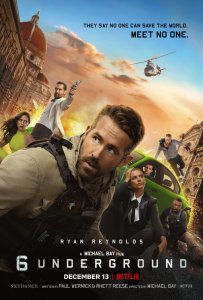 I recently watched two movies this holiday season that could not be any more opposite, so naturally I decided to pair them together as a joint review. 6 Underground is a chaotic and bombastic action-thriller that cost $150 million dollars, is directed by maestro of the machismo Michael Bay, and is widely available for streaming through Netflix and its bottomless pit of money. Portrait of a Lady on Fire is a small, subtle French film depicting a reserved love story that takes its sweet time and is as much a repudiation on how women are commonly portrayed in art. One of these two movies is an obnoxiously arduous enterprise that many have dubbed represents the worst in movies, and the other is a hard-to-find foreign indie that is one of the best films you will see in 2019. Two very different uses of cinema, and I’ll let you decide which is which by the end of this double review, dear reader.
The mastermind of the special forces team of “ghosts” is billionaire inventor “One” (Ryan Reynolds). He’s assembled a team of specialists that have faked their own deaths to work as an elite team taking out an elite array of bad guys, tyrants, and war criminals. That’s the plot of 6 Underground. What follows is a collection of loud noises, colorful explosions, blood splatter, and mainlined madness pumping through all of your demolished senses.
 6 Underground is like a direct pipeline into Michel Bay’s childhood brain. It’s Bay at his most unfiltered, which means that the tone isn’t just over-the-top, it destroys the top, establishes a new higher top, and then obliterates that designation as well. Watching the movie is like a descent into juvenile hysteria and I couldn’t help laughing at the excess. It’s the kind of action movie where cars don’t just fly and careen off the road, they split in two and smash just so the driver’s dead body plops out in the camera angle. It’s the kind of movie where the bad guys don’t just get shot but get shot in lovingly disgusting ways, like a bullet going through a cigar and a pimple-popping setup leading to brain explosions. It’s the kind of movie where a dangling eyeball is played for giggles. It’s the kind of movie where people aren’t just getting hit by cars, they’re getting propelled into other objects from the blunt force. It’s the kind of movie where the bad guy names his generals The Four Horsemen. It’s the kind of movie where a character removes a bullet-proof helmet right before re-entering a firefight for… reasons. It’s the kind of movie with 100 needle-drop music selections, including, by my count, five Muse songs (but not one use of the Sneakerpimp’s “6 Underground,” which is an egregious oversight). It’s the kind of movie where someone unleashes a crashing crate full of metal poles and they launch like heat-seeking projectiles, filleting bad guys and bad guy cars. The opening twenty minutes is a non-stop car chase through the streets of Florence, Italy that must lead to billions in damages and, in one moment that screamed the only self-aware flash in the entire two-plus hours, the cars are racing through museums and laying waste to precious works of art. It’s like Bay is winking at his critics and saying, “This is how you see me, a gleeful provocateur that destroys the very concept of high art, so here I am, doing it for real.” To say this movie is crazy is a disservice to the word itself.
6 Underground is pure, testosterone-pumping id, and it can become exhausting without any foundation to hold it all together. The plot is extremely generic and feels like a relic from the 1990s, a billionaire assembling an elite team of criminals/killers/spies to go undercover and take out the world’s bad guys. They’re “ghosts” in the fact that they’ve faked their deaths, but what exactly is gained from this process beyond, say, going off the grid? The idea of them being dead is meant to be freeing, but their friends and family are still living and can be used to apply pressure on these still-living people. Except this never happens. The plotting is incredibly sloppy and elects to skip around in time in a misplaced attempt to seem cool. The entire opening twenty minutes feels like it’s one-upping itself out of naked fear that somehow an audience will be bored, like the viewer is somehow building a tolerance to the mayhem and will walk away unless it just keeps going up up up. The opening sequence has a florescent green sports car spinning through the streets, chased by armed vehicles, while bullet-removal surgery is being performed in the backseat, while an eyeball is being dangled to open a security code, while the narrative jumps back and forth in time to present whose eyeball this belongs to and what happened, and that’s even before the art museum smash-up and a slow-mo spin that twirls into absurd self-parody, where someone screams not to hit a woman with a baby, which we narrowly miss, followed by someone screaming not to hit a dog, which we next narrowly miss. Then there’s nuns on bicycles knocked onto the ground who respond with raised middle fingers. It’s so much, all the time, with Bay’s hyper edits and swirling camerawork that you feel beaten down. It’s all the outrageous spectacle we’ve seen in other Bay films but now it’s condensed to its essence and splashed into your eyeballs.
 There aren’t so much characters in this movie but action movie avatars or, even simpler, Person-Shaped Entities Who Hold Guns or Drive Fast. Reynolds is playing the same variation we’ve seen for the last few years since his success in Deadpool, which makes me think this is the only Ryan Reynolds we’ll be getting in movies from now on. The plot even provides completely frivolous flashbacks to provide answers to the non-burning question of how the crew was gathered together. I suppose it’s an excuse to squeeze in more action sequences but that only ever happens with the parkour Brit member. Speaking of which, the parkour action sequences are, by far, the best parts of this movie and it made me wonder what a parkour action movie under Bay’s command could be like. Every character has three modes: Badass, Quippy, and, least convincing, Self-Serious. These are not recognizable people, and the female characters are even less versions of not-people. The movie thinks it’s being cool by assigning code names that are just numbers, like they won’t get close to one another without the convenience of names. It’s just another sign of how disposable every character is and how little thought was given to character arcs beyond redemption. There’s one mission in Hong Kong that utilizes them as a team but even that is fleeting as far as developing a more cohesive camaraderie. They’re basically like distaff superheroes that have been forcibly crossed over for some special event and are waiting to return home for solo adventures. You could create a sequel with a brand-new team and not miss a beat.
Is any of this bombastic silliness genuinely entertaining? Much of Bay’s popular works exist in that strange space where you willingly shut off your brain for the popcorn thrills. I like half of the Transformers movies (though quite dislike the other half) and think Pain and Gain showed real promise, before it wore out its welcome, that Bay hasn’t been able to better tap into. I’m not an automatic hater of Michael Bay as a filmmaker; he’s a born cineaste when it comes to style. Even when his movies are running off the rails, they’re never truly boring. With the unlimited freedom of Netflix, Bay was able to unleash his full chaotic imagination, and the results can prove to be entertaining in spurts. I found more bafflement just trying to process everything. Bay’s advertising instincts are part of his style, so every over-saturated moment of 6 Underground looks like it could be a commercial for the military, cars, perfume, or some expensive watch. It’s a world of wanton excess and disposable thrills, and that relates to its portrayal of women too. Women become another interchangeable object to be fetishized and commoditized by Bay’s roving camera. It’s the male gaze cranked up on high, lovingly depicting fast cars, sexy women, and human carnage. Even the brains and blood being blown apart feel fetishized (bad guys don’t just get shot; they ooze goop for several seconds from gory head wounds). It’s a movie that wants to overpower you by every means available, with the excessive trivialities of action movies, with aggressive style that desperately wants to be seen as cool, and with its exaggerated concepts of hyper masculinity.
 At the complete other end of the movie spectrum is France’s gentle, understated period drama, Portrait of a Lady on Fire. Set in 1760 on a remote island, Marianne (Noemie Merlant) is commissioned to paint the portrait of Heloise (Adele Haenel) for the purpose of snagging her a husband. Heloise had been planning to become a nun but her family pulled her from the convent once she became their only living daughter, a.k.a. hope for the family to secure prosperity through marriage. Marianne must hide her true intentions and grow close to her subject, memorizing her face enough to paint it in secret. An intimacy builds between the two women that will change both of their lives even long after the fateful painting is finished (spoilers?).
Writer/director Celine Sciamma has primarily worked with contemporary stories (Girlhood, Tomboy, Water Lilies) but, in stepping back in time, she has tapped into something elementally beautiful and poignant. It is very much a slow-burn of a movie but, in essence, that is the most relatable form of love, a feeling that builds, transforms, and can eventually consume. There’s a liberation for the characters in the time they share together, first as companions and then as lovers. This is a transitory time, one locked in isolation and free from men, though the presence of the patriarchy is unavoidable as it limits their life choices. For Heloise, she had no desire to become someone’s wife and then it was no longer her choice. Her greatest value lies in marriage, and a portrait during this era was essentially someone’s dating profile picture. It’s on Marianne to paint an accurate depiction that can ensnare this woman a husband, which gets even more complicated when Marianne falls for her. The movie tenderly moves along with guarded caution, as two women explore their feelings for one another in a time that didn’t care about their feelings. This is a love story that feels alive but also realistic in how it forms and develops. It’s about halfway through the movie before the ladies finally make their intentions known. I can understand why this might be too slow for many viewers but the movie never came across as dull for me, and it’s because I was so drawn into this world, these characters, and their yearnings being unleashed.
 When it comes to movies exemplifying the difference in the female gaze, allow Portrait of a Lady on Fire to be one of the prime examples. This is miles away from the crass objectification featured in the likes of Michael Bay’s oeuvre and his very explicit definition of sexy. This is a movie where the only nudity casually happens after the sex (and body hair isn’t a big deal). There’s more ASMR action for the senses (lots of loud lip-smacking sound design) than ogling naked bodies. The emphasis isn’t on the contours of lithe feminine forms but more on the emotional and physical impact of a person as a whole. There’s one scene that is tremendously affecting and quite sexy, and it begins with the painter telling her subject every small physical response she has studied while painting her. It’s little observations that are romantically relayed. The subject then turns around and says, “Who do you think I’ve been looking at as I’ve posed for hours?” and proceeds to unfurl her own richly earned romantic observations about her painter’s physical responses. It’s such a wonderful scene bristling with palpable sexual tension and infatuation, so much more being said in glances than in declarative speeches. The movie also opens up a larger discussion of the male gaze as it pertains to the world of art. They must play into the established conventions driven by a rigid patriarchy designating how women are best represented in media, and the implications to modern cinematic portraits are clearly felt. Funny enough, Heloise is chastised for not smiling enough in her portraits to woo a worthwhile suitor.
I assumed this love story wasn’t going to have a happy ending given the confines of its era, but I want every reader to know that Portrait of a Lady on Fire just absolutely crushes its ending. You may expect it coming, in a general sense, but the resolution to this love story floored me. There are two consecutive scenes that each elicit different emotions. The first is a winsome feeling of being remembered, of having a sense of permanence after the fact, of a moment in time that will long be fondly recalled and celebrated for its fleeting perfection and lifelong significance. Then the next scene involves a payoff of great empathy that almost brought tears to my eyes. It delivers a long-desired payoff to a character’s lifelong request, and the camera simply holds for over a minute while we watch the indescribable impression this woman is experiencing. It’s so joyous, so heartfelt, and so luxuriously earned that I felt like my heart was going to burst. The fact that both of these emotional conclusions happen without a single word being uttered is even more impressive.
 The acting from the leads is phenomenal and the nuances they navigate are so precise and subtle. This isn’t a movie about grand gestures and big dialogue exchanges. It’s a romance in that genteel fashion of furtive movements and words encased in subtext. We’ve seen this kind of restrained love story before in other period pieces, as well as gay cinema with its socially forbidden love. The intimacy between these two women must start slow and, like a fire, be given the right amount of oxygen to allow it to spread. There’s an understandable bitterness that this love will not be allowed but this cannot abate the desire to proceed anyway. These women are more than just tragic figures coming into one another’s orbit. They’re fleshed-out and multi-dimensional characters with their own goals and imperfections. They feel like real people, and while disappointed by their limitations within a patriarchy, they will continue to pursue their personal dreams. The portrayal is so empathetic that your heart can’t help but ache when it isn’t swooning from the sumptuously understated romance of it all.
6 Underground is a hyper-edited, hyper-masculine, and hyper-tiresome action vehicle that exhibits every unchecked impulse of Bay as a filmmaker. The plot is inconsequential because it’s all just gristle for action sequences, which aren’t even developed scenarios as they are (occasionally literal) eye-popping moments of excess. Someone in those Netflix suites really should have second-guessed giving Bay a blank check and little-to-no supervision. At the other end of the movie spectrum is an intimately felt and intimately developed forbidden love that feels natural, nuanced, and enormously engaging. It reminds us that movies only need compelling characters or a compelling scenario to grab us good. I’m fairly certain Bay’s music licensing budget was more than this French indie. Portrait of a Lady on Fire isn’t a revolutionary movie. We’ve seen variations on this story before, but what makes it unmissable is the degree of feeling and artistry crammed into every breathable moment. I know there’s an ample audience that will enjoy 6 Underground, especially with its wider availability, and that’s fine. Netflix paid a pretty penny betting there are enough people looking for the film equivalent of a drunken, disheveled one-night stand. If you’re looking for something more authentic, deeply felt, and, let’s face it, generous to women, then look for Portrait of a Lady on Fire, a beautiful indie romance that warmed my heart, broke it, and then fastened it back together.
Nate’s Grades:
6 Underground: C-
Portrait of a Lady on Fire: A
Share this:

Detective Pikachu (2019)
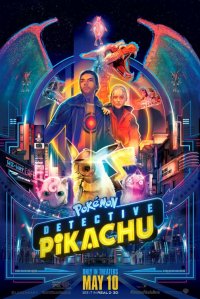 This may be my least useful review in my career as a critic but I’ll try my best when it comes to Detective Pikachu. I’m not a Pokemon fan. It came to popularity as I started high school and was generally after my time. I can state unequivocally that this movie is not made for people like me, and that’s fine. I imagine fans of the long-running television series and games will be delighted to see this world brought to life with great care and top-notch special effects. I sat through the 105 minutes slightly amused but feeling no strong feelings one way or another. It’s a pleasant enough movie with decent world building and a predictable plot (taken verbatim from the game of the same name apparently). It’s charming enough for an outsider but offers not much else. It feels like a PG-Deadpool Ryan Reynolds attached to a Who Framed Roger Rabbit?-style universe where Pokemon and humans interact normally. No one ever seems to fully articulate how the Pokemon battles are essentially dog fighting and that they’re enslaving these creatures for blood sport, but it’s not like I was expecting that commentary either. In a world of living monsters, the human characters are a bit boring. Justice Smith’s character is annoying and inconsistent. He seems a bit oblivious to how much he remembers about his missing father, which is more curious with some end reveals. Bill Nighy appears as the most obvious villain. Suki Waterhouse is here as a shape-shifting hench woman. The real draw is Reynolds as the voice to a Pikachu looking to pick up the pieces of its lost memory. The humor is brisk and has more hits than misses, even if the aim is somewhat low. Detective Pikachu is a family-friendly comedy that will likely please the hardcore legion of Pokemon fans and leave the rest of us shrugging our shoulders and saying to ourselves, “Well, that was a thing.”
Nate’s Grade: B-
Share this:

Deadpool 2 (2018)

It took the leaked release of the Deadpool test footage, and the ensuing enthusiastic fan response, before Fox finally decided to invest in a big screen, R-rated superhero movie. The result was 2016’s Deadpool, a huge smash and proof that a lucrative audience will turn out for more adult-oriented, outrageous, grisly versions of comic book movies. Because of Deadpool, we finally got an R-rated Logan that proved to be an outstanding swan song for Hugh Jackman’s iconic hero. Now Deadpool is getting the spotlight he has earned with a big, splashy summer release, but with success come expectations. Can it live up to the ever-increasing hype? In short: if you were a fan of the original, you’ll be happy enough, because Deadpool 2 isn’t much more than the sum of its zany parts.
Wade Wilson a.k.a. Deadpool (Ryan Reynolds) is killing bad guys for hire and considering starting a family with the love of his life, Vanessa (Morena Baccarin). Trouble emerges when Cable (Josh Brolin) travels from the future to kill a rebellious, troubled young mutant teenager, Russell (Julian Dennison), who will one day grow up to be a monstrous villain. Deadpool reaches out for help and forms an elite squad of determined heroes, notably the luck-assisted Domino (Zazie Beetz). Can Deadpool save the kid, save the day, save the future, and save himself from incessant fourth wall breaks?
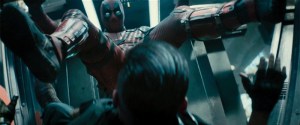
I was worried that a Deadpool sequel would fall into some of the same detractions that a Guardians of the Galaxy sequel did, and this is still applicable. Deadpool, much like the original 2014 Guardians film, was a breath of fresh air and a far looser, weirder, funkier super hero movie with a nose-thumbing, prankish attitude. We didn’t know what to expect from a Deadpool movie and now we do, and with that knowledge comes an anticipated formula of checklists to adhere to, and so any resulting sequel will invariably feel less fresh. It happened with Guardians of the Galaxy vol. 2 so to compensate James Gunn concentrated on fleshing out secondary characters into people you might shed a tear over. Deadpool 2 doesn’t bother because Deadpool 2 doesn’t take anything really seriously. That’s one of the hallmarks of the series and also one of the aspects that holds it back. There can never be a sense of stakes with a gleeful, fourth wall-breaking cartoon of a character who bounces back like Wile E. Coyote. The sequel introduces a sense of stakes with a startling turn in the first ten minutes of the movie, but by the end, even that will be corrected so that the Deadpool universe returns to stasis. The limitation of the Deadpool universe is that nothing feels meaningful or even ambitious. The movie wants to be a cheeky, transgressive good time and it achieves this single goal.
The appeal of Deadpool 2 is still its comedic voice and unpredictability. The laughs will be frequent and there are some subversive and unexpected directions that fully take advantage of the R-rating and the anarchic, nasty comic spirit of the franchise. The formation of the X-Force team and how their first big mission plays out had me howling with laughter. The meta humor commenting on the nature of super hero movies, as well as the film industry in general, begins with the very opening image (a nod to another successful R-rated super hero movie of last year) until the very last moment where Deadpool goes back in time to prevent some stinging cinematic grievances (there is no post-end credit scene, so you can skedaddle early). This is clearly the role Reynolds feels a spiritual kinship with, and his caddish, charming, persistent persona makes the perfect conduit for the film’s vulgar insanity. Whether it’s spitting insults, splashing in over-the-top violence, or making odd observations about the similarities between the songs from Frozen and Yentl, Deadpool 2 is first and foremost a bloody, depraved meta comedy.

Director David Leitch (Atomic Blonde) steps in for the departing original film’s director, Tim Miller, and continues his hot streak of stylish, action thrillers. Leitch has shown a propensity for staging intense action sequences to best showcase intricate choreography. With Deadpool 2, the most exciting moments are when the camera and editing allows the audience to fully appreciate the creativity of the choreography and stunt team. A shot of Cable leaping over the speeding caravan about to smash into him brings on a well-earned wow. Coming from that bruising world, I’m continually impressed with how Leitch approaches his action and finds organic points to develop and complicate matters. The prison caravan attack is the action peak with well-constructed, parallel lines of activity to follow and collaborate upon. It’s our first taste of Deadpool and X-Force versus the might of Cable. The characters enter the fray at different points and get separated from the runaway caravan, which keeps the momentum going. While the comedy is prioritized, Deadpool 2 can still unleash enough exciting, silly, and satisfying action.
The biggest additions to the sequel are an adversary and an ally, and both leave a favorable impression while still making you wish that Deadpool 2 had done more with them. Brolin (Avengers: Infinity War) bulked up considerably to play the gruff cyborg from the future, and his super serious, macho straight man provides a terrific comic foil for Deadpool, much like the stuffy Colossus in the first film. Brolin’s character is a capable fighter with a pretty streamlined back-story (shades of Looper abound) but it’s hard not to feel a little disappointment with how he’s ultimately utilized. He’s a great asset that feels put away for too long. Zazie Beetz (TV’s Atlanta) has a fun introduction especially as it relates to her mutant power, great luck. Deadpool scoffs at this as a power, and “being deeply un-cinematic,” but Domino proves otherwise as she’s able to dodge split-second danger in grand, complicated, Final Destination-like circumstances. Every time she’s onscreen, Domino brings a curiosity quality to the movie, and it’s usually something imaginative and fun. Beetz has an innate spunky energy, which makes it sad when the movie often asks her to be dour and dismissive. It’s taking such a lively character and constricting what makes her amusing and unique.

The biggest thing holding back the film, besides a general sense of “more of the same” or its inherent lack of stakes, is that the entire storyline is built around saving a mutant teen…. and I kind of hated the kid. My first impression was not good and it didn’t get much better from there. Part of it may be that Russell is meant to be an angry, obnoxious teenager, and maybe part of it is the generally grating performance from Dennison (Hunt for the Wilder People), but I could not care about this kid. Unfortunately, a lot of thematic emphasis is placed on saving the soul of this one annoying, wayward teenager. He’s supposed to be a point of redemption for Deadpool and a promise to be fulfilled, but my pal Ben Bailey came up with an instantly better revision. Instead of introducing this new teen character who will one day grow up into a super villain that slaughters Cable’s future family, why not have it be Negasonic Teenage Warhead (Brianna Hildebrand)? We already have an investment in her character and it would provide a better, more personal sense of stakes for the story. Plus, Hildebrand (Tragedy Girls) is actually a good actress.
If you were one of the many fans who enjoyed the irreverent antics of the first Deadpool, then you’ll enjoy Deadpool 2 as it’s more or less the same movie with a slightly limited freshness date. These movies are fun, funny, and ridiculous, but they’re also good for little else than a wicked good time, and that’s okay. There isn’t much ambition to be anything more than an irreverent satire on super heroes with edgy humor and explosive violence. The running theme of the sequel questions what Deadpool has to keep on going, and he’s told it’s one very specific F-word: “family.” I think it’s a different F-word, namely “franchise.” Fox (Disney?) will need the services of the merc with the mouth for an extended engagement as long as audiences do not tire of the same studio brand of naughtiness reheated with a few different ingredients added per revisit.
Nate’s Grade: B
Share this:

The Hitman’s Bodyguard (2017)
 The Hitman’s Bodyguard feels like a 90s Tarantino knockoff remake of Midnight Run, and I don’t mean that in any pejorative sense. This is a movie that knows exactly what it aims to be and strikingly new and original isn’t one of those qualities. When you deliver a late summer movie that has this much depraved entertainment and energy, I don’t mind.
Michael Bryce (Ryan Reynolds) is a disgraced bodyguard-for-hire who lost a high-profile client to an out-of-nowhere sniper. Stuck shielding coked-out white-collar traders, he still knows more than a thing or two about keeping a client safe. His former flame, Interpol agent Amelia Roussel (Elodie Yung), is tasked with getting notorious contract assassin Darius Kincaid (Samuel L. Jackson) to the International Criminal Court at The Hague. Kincaid is the only living witness who can testify against Vladislav Dukhovich (Gary Oldman), a former Belarus military dictator. Coincidentally, all of the witnesses and evidence against him seem to always disappear. Roussel’s team is ambushed and she reluctantly seeks out Bryce for assistance. He has 24 hours to keep Kincaid alive and transport him to The Hague, but Kincaid has some ideas of his own, like arguing, escaping, and visiting his wife (Salma Hayek). It’s a battle of wills and a healthy deployment of the versatile F-word.
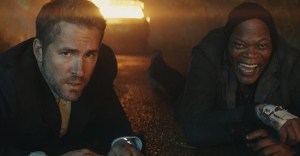 When it comes to genre filmmaking, especially in action or horror, the level of entertainment is much more related to the singer and not the song. Sure a well developed script with interesting characters, organic complications, and memorable set-pieces connected with payoffs are still desired, but often it’s execution that separates the brashly fun bombast from the dreck that dots late night cable. The selling point of this movie is its central pairing of Jackson (Kong: Skull Island) and Reynolds (Deadpool). Hell, both of them aren’t straining too hard from their familiar big screen personalities, Jackson the gleefully stubborn badass and Reynolds as the incredulous smart-alleck with the quick wit. Some critics will chafe and say that the actors are stuck in stale riffs and acting on autopilot. I look at this as a certain virtue of the film. They hired Jackson and Reynolds and let them do exactly what we demand that Jackson and Reynolds do. They were hired for a specific reason. Their crackling repartee keeps the movie alive even as the first half feels too sludgy getting everything going. The comedy can be a tad forced (riding on a bus with chirpy nuns! Gatorade bottle of pee?) and exaggerated at times (really, a fart joke, sound designers?) but this isn’t a film for subtlety, and Jackson and Reynolds, who can outdo just about every working actor for sarcasm and volume, are at their best when they’re big and broad. The rapport elevates even moments that would otherwise be redundant.
I thought the action scenes were going to take a backseat to the Jackson/Reynolds buddy road trip, popping up here and there to move things along and kill off an antagonist or two. To my great surprise, the action in The Hitman’s Bodyguard is uniformly great. Director Patrick Hughes (The Expendables 3) makes each action scene its own story and he thankfully varies the scenarios so they nicely stand out. There’s a terrific motorcycle chase through Amsterdam’s canals and streets, smashing things to bits in the most exciting ways. The action is often divided into two parallel points following Jackson and Reynolds, which allows the film to pair the right sequence for the right character. There’s a late foot chase that’s filmed in refreshing long takes (newest Hollywood action trend?) that stops into the back kitchen of a restaurant and then a hardware store. Each location is well utilized to provide a unique opportunity for the fight choreography and use of props. The movie does a very successful job of approaching action by thinking how to use geography, character, and purpose to plot. Hughes also has a solid inclination when to punch for humor with visual gags, including a few gems involving a minivan. When the comedy wasn’t completely working, I knew I could rely upon the dependable thrills.
The movie also has one of the dumbest attempts at injecting urgency into a story. The plot hinges upon Darius Kincaid arriving at The Hague at an exact time to testify against Oldman’s dictator. In a moment that made me blurt out laughing, an expositional device/news lady informs us that if nobody comes forward to testify then The Hague has to drop all charges, Oldman’s dictator goes free and apparently becomes the president of Belarus immediately again, and probably the end of democracy. First, this false sense of urgency requires witnesses to arrive at a court. That’s not how testimony works. You can give a sworn statement anywhere. You can appear in court via teleconference. The location is not the problem here. And then his testimony is aided by (slight spoilers) photographic evidence of the dictator’s genocide… except it’s all digital pictures. This entire movie hinged on the mad rush to get Jackson to The Hague when he could have just made an email attachment with the incriminating pictures at any wifi spot. There’s also the factor that if it was one second after five or so the court would not accept any testimony. I don’t think courts work that way, especially when it’s a decision over dictators and due process. And yet a wall clock is treated like the ticking clock on a bomb detonator. It’s so dumb I question whether the filmmakers were self-aware and making a satirical riff.
 While being an enjoyably profane experience, The Hitman’s Bodyguard doesn’t know when enough is quite enough. It has problems walking away and routinely falls upon overkill in several elements. There’s almost way too much plot here. Every character has a back-story that nabs a lengthy flashback with an ironically chosen pop song. There are obvious betrayals that the film thankfully doesn’t belabor in revealing the culprits, but did we need them anyway? Hayek seems to have said yes just to be a vulgar badass that would attract Jackson. It’s fun but her shtick gets old quickly. She’s all unchecked exaggeration. Hayek’s character is just here to provide a counterpoint for Kincaid to wax poetic about romance and relationships, to nudge Bryce to “man up” and realize what he’s let slip away. The romantic elements are presented on the same wavelength as the comedy, meant to be a shoulder-shrug of cocksure cool. When they try and get earnest on their own terms it doesn’t quite work out tonally. The movie also runs rampant with false endings, going from one escape to another just as it should be winding down. It’s like the filmmakers were having so much fun they didn’t know when to walk away from their story.
I think every ticket-buyer knows what they’re getting when they walk into The Hitman’s Bodyguard. It’s two actors doing what they do best, in an action vehicle that cribs from Midnight Run, and with a sense of style and attitude that resembles a bluntly ironic return to 90s R-rated action excess. Fortunately, the execution of these genre tropes and elements lead to one of the more profanely entertaining popcorn flicks this summer season. It’s a movie that doesn’t take itself too seriously, coasts on above average action and the charged comic chemistry of its two loud-mouth leads. It’s a movie that doesn’t require much thought and rewards you for the effort. The Hitman’s Bodyguard is everything you want it to be, and if that’s good enough for you, then you’ll find satisfaction here.
Nate’s Grade: B
Share this:

Deadpool (2016)
 Deadpool is easily the most fan service of comic characters, so it makes sense that his big screen spotlight is a movie that feels a fan service movie. The “merc with a mouth” is a character that doesn’t take himself seriously and neither does his big screen adventure, which is the biggest appeal of an otherwise standard super hero formula hiding under waves of winking irony, crass humor, and gleefully bloody violent mayhem. Ryan Reynolds plays Wade Wilson, a hired gun that undergoes a risky experimental treatment by a shady black ops organization to cure his terminal illness. It makes him generally indestructible with a rapid healing ability but his flesh is also horribly scarred and Wade is afraid his girlfriend Vanessa (Morena Baccarin), a hooker with a heart of gold, will reject him. Even in the opening credits, you know this isn’t going to be a typical super hero movie. The time is ripe for a film that knowingly ridicules the tropes of the super hero film industry, and Deadpool scores some big laughs when its making fun of itself and its super peers. The dark humor can often surprise with how go-for-broke it can get, like Wade and his Vanessa’s flirty one-upsmanship of hypothetical sexual trauma. There’s a clever montage of Wade and Vanessa’s romantic history told through sexually-specific holiday celebrations, and the inclusion of a couple of low-rent X-Men provides a comic foil for Deadpool to bounce off from. The action is fun and the movie is entertaining from its opening credits to the now-mandatory post-credits bonus. Reynolds is spiritually attuned with the irreverence of the anti-hero, finally plugging into a part that makes full use of his charm, motor mouth, and physicality. Deadpool’s runaway box-office success (grossing more than any X-Men film and on at least half the budget) will hopefully allow Hollywood to feel comfortable allowing their less than family-friendly comic titles to stay true to their intentions. Then again maybe they’ll just take all the wrong messages and think that audiences just want to hear more swearing from people in spandex. Deadpool is a super hero movie that prioritizes fun over everything else, and while it may not be for everyone, at least it’s trying to be for someone different.
Nate’s Grade: B
Share this:

Self/less (2015)
 The most surprising thing about Self/less occurred approximately 115 minutes into the film itself, when it revealed that Tarsem Singh was the director. Tarsem is known for lavish visual cinematic canvases such as The Cell and Immortals, and to realize that this is the same man responsible for an otherwise disappointing and visually mundane sci-fi thriller, well it was a shock. Why hire a visual stylist and then restrict him to such a limited palate? Self/less is an intriguing premise (borrowed a tad from Seconds) and it keeps all the interesting ethical and psychological questions at bay to follow a generic thriller formula. There’s not one real surprise in this film; even the reveals and surprises will be easily telegraphed. Ben Kingsley plays Damian, a dying rich man who undergoes a risky experiment to live longer, having his consciousness transferred into a younger human host played by Ryan Reynolds. It’s another chance to be young, party, enjoy sexual relations with women who are more likely to go home with somebody who looks like Reynolds. There’s a catch: if he stops taking his special red pills, the host’s brain will take over control. That’s because, surprise, the bodies aren’t grown in labs but are human volunteers. Here could be some topical class exploitation and social commentary, but Self/less ignores the more intriguing direction at every point to play it safe. Damian finds his host’s family and from that point on it’s a series of chases with bad guys. One of those chases is actually fairly entertaining, utilizing a conjoined automobile in a clever and devastating way. It never feels like Reynolds and Kingsley are playing the same character. Reynolds’ charm is subsumed by this role and he feels adrift. I’ll admit that this movie is efficient and each scene pushes the story forward; it’s just the direction of that story I’d like to alter. Alas, Self/less is a competent but fairly underwhelming thriller that squanders its premise.
Nate’s Grade: C+
Share this:

Ted (2012)
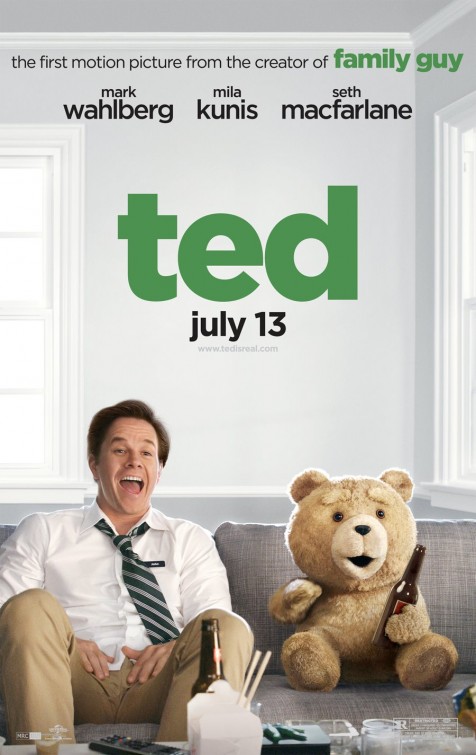 Seth MacFarlane has become an industry powerhouse. The man has three animated TV shows on air (Family Guy, American Dad, The Cleveland Show) and essentially carved an entire niche of modern comedy. His brand of irreverent, offensive, tangential humor has turned the man into a demigod among young audiences and helped him rake in millions. A journey to the movies seemed inevitable, and so comes Ted, which MacFarlane directed and co-wrote with two of his Family Guy scribes. The best assessment I can give is that if you enjoy MacFarlane’s brand of humor on TV, you’ll probably enjoy Ted. If not, then you’re in for a prolonged, obnoxious two hours.
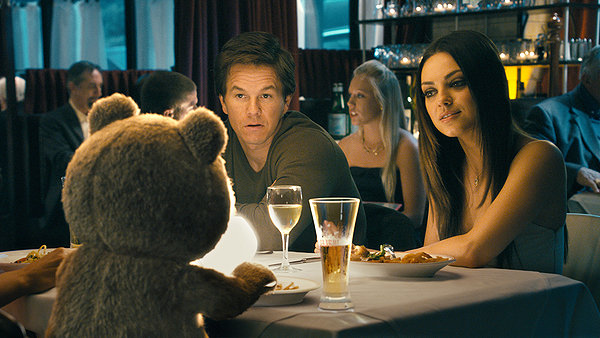
One day when young John Bennett was a young boy, he wished his teddy bear would come alive so he’d always have a best friend. And as a narrator tells us, nothing is stronger than a young boy’s wish (curious gender is specified and then never touched upon for some kind of joke). The next morning Ted (voiced by Seth MacFarlane) comes alive. Flash forward 30 years and Jon (Mark Wahlberg) works at a rental car company, has a stunning girlfriend in Lori (Mila Kunis), and regularly gets stoned with his best pal, Ted. The two guys are inseparable, which causes friction between John and Lori. After another notorious incident of Ted behaving badly, Lori insists that he move out. John has to start acting more responsible and treating Lori like she deserves, but Ted’s influence usually leads to trouble. Both Ted and John are in desperate need of growing up.
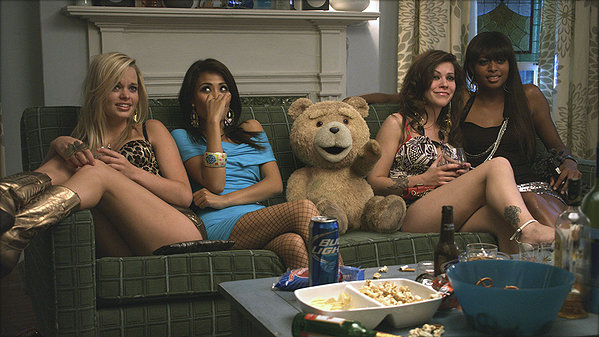 It was no surprise for me that Ted was exactly what I expected from Seth MacFarlane. It’s just a bigger, raunchier version of the style of humor he’s patented on television: tangential non-sequitors, scenes that go on far too long, obscure pop culture references, pointless shock material, and the basic premise that the jokes hinge around some creature merely doing things. Like Brian the Dog, or Roger the alien, Ted is a creature that shouldn’t necessarily exist, and thus so much humor is built around just seeing Ted exist. Is it supposed to be hilarious watching him drive? How about hit on women? Do bong hits? Far too often the only joke the movie seems to offer is that Ted is a teddy bear doing stuff. If you replaced him with, say, a normal human being, would any of those jokes work? Would it be funny watching a normal person drive, hit on women, and do bong hits? Maybe but probably not. It’s all one joke: look at something unnatural doing natural things. And that’s my issue with MacFarlane’s brand of humor. These jokes are not given proper attention, setup, and development. The film rarely subverts your expectations with how every joke will play out, and if you already know the jokes before the movie delivers them then what’s the point? The one joke I did laugh at, and a good guffaw at that, was Ted’s boss who kept responding to Ted’s screw-ups with good words and promotions. That was a surprise. But here’s the thing: once it’s established, you know what will happen the next time. So the second time it’s still funny but not as much. By the third time, his nonplussed reaction is completely expected and thus all traces of funny have been squeezed dry. In comedy, it’s all about surprise, and I find with MacFarlane that he rarely strays from his routine.
As far as jokes going on too long, let’s talk about a myriad of subplots that seemed to go on forever. There’s an entire storyline where an obsessed fan played by Giovanni Ribisi (Contraband) kidnaps Ted. This storyline makes up almost the entire third act and occurs after the reconciliation between John and Lori, so the movie already feels like it should be over. And then it keeps going. And it keeps going longer. And then there’s a car chase and a foot race through Fenway Park, which serves no purpose other than to probably fulfill a childhood wish of MacFarlane’s to film on said hallowed grounds. And it’s during this final act where the crass movie tries to become… sentimental? It just doesn’t work. You can’t have 100 minutes of rude, offensive, vulgar humor and then try and then try and go all gooey and soft and make people feel something akin to emotion. The reason that the Judd Apatow films can work with emotion is because from the get-go they make you care about the characters and their relatable conflicts. But there’s a difference between emotion and cheap sentiment, and Ted hasn’t earned genuine emotion. I didn’t like any of these characters. They all seemed like louts and jerks and dolts, none of them charming. Thus the end and its wish-upon-a-star conclusion are cheap sentiment and the kind of conclusion that you believe without a doubt that the characters in Ted would mercilessly mock.
 Let me specify for the moment that there is a distinct difference between gross-out gags and gags that are just gross. There is also a difference between jokes that are shocking but funny and jokes that are just desperate to offend. In my experience with MacFarlane’s brand of humor, as well as McFarlane’s fratty devotees (if I was rushing a fraternity, I have no doubt Ted would be my favorite movie, bro), that difference is not understood. Watching an over-the-top racist Asian stereotype is merely offensive without proper context to draw out humor beyond the odious and obvious. Just punching a child in the face isn’t funny. Just having someone defecate on the floor isn’t funny, though the panicked removal of said feces was humorous in flashback. I may have chuckled and giggled from time to time with Ted, but most of the time I was just saddened by how desperate McFarlane and his writers were to shock rather than to entertain.
Thank God Wahlberg (The Fighter) was in this movie. While Ted is best left in small doses, the boorish best friend archetype, Wahlberg has been sharpening his comedic muscles (the only muscle in need of work it seems) and has become a terrific straight man. Anyone who remembered 2010’s The Other Guys knows that Wahlberg can be flat-out funny when given great madness to play off of. With Ted, Wahlberg’s commitment to the innate absurdity of the movie goes a long way. His breathless rendition of an exhaustive list of white trash girl names had me laughing harder than anything else in the movie, and I admit I was also impressed by Wahlberg’s speedy delivery. The character of John is a pretty standard role at this point in American comedy, one of arrested development. However, it seems to take so long, blown chance after blown chance, for John to finally find some sense of responsibility. Just like everyone else, he is at the mercy of Ted’s corrosive influence.
I probably wasn’t the ideal specimen for MacFarlane’s first foray into movies. I’ve never been more than a mild fan of his TV work and its hit-or-miss-but-mostly-miss brand of tangential humor, though I admit American Dad has grown on me (the only MacFarlane show where the jokes seem related to the story situations). MacFarlane unleashes the vulgar material he’s been holding back from TV, which makes for some laughs. The obviously stoned guys sitting in front of me thought the movie was hilarious, even during quiet moments where nothing was going on. I’m disappointed that a MacFarlane movie is pretty much exactly as I would have suspected, essentially a MacFarlane TV show blown up to a bigger screen. The jokes here are so limited, mostly deriving from Ted the teddy bear just doing things a teddy bear normally doesn’t. I wish the comedy were more developed, more nuanced, more concerned with doing something other than shock. The most shocking aspect of Ted is how utterly forgettable the whole enterprise is even with a magical talking teddy bear.
Nate’s Grade: C


 nathanzoebl
You must be logged in to post a comment.