Blog Archives
Men, Women, and Children (2014)
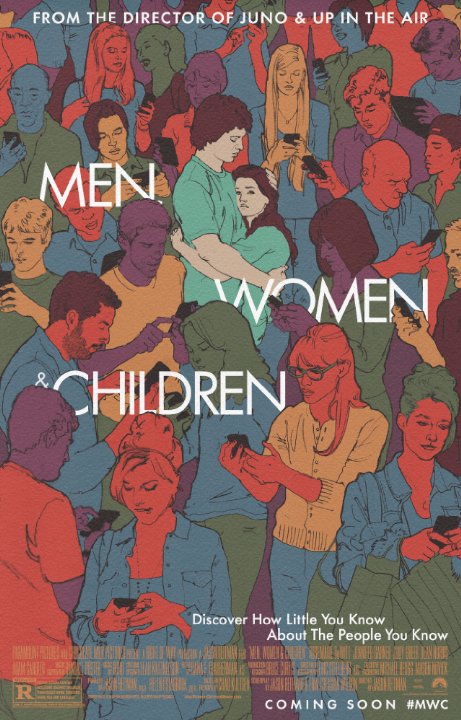 Jason Reitman was a director on the hottest of hot streaks with Hollywood. His first three films (Thank You for Smoking, Juno, Up in the Air) were hits but also an ushering of a new creative voice that felt mature, engaging, and immediate. His 2011 film Young Adult was divisive but I loved its nihilistic narcissism and satire. It looked like this guy couldn’t miss. Then in the span of less than a year, Reitman released Labor Day and Men, Women, and Children, two surprisingly misguided movies. Men, Women, and Children aims to be a Crash-style mosaic of modern-life in the digital age, but what it really feels like is a twenty-first century Reefer Madness.
The movie feels like it was made in the 1990s, like it should be a companion piece to the equally over-the-top and alarmist Sandra Bullock thriller, The Net. The movie’s thesis statement amounts to “the Internet is dangerous,” but this is a statement that everyone already acknowledges. The ensuing evidence from Reitman is so scattershot, so melodramatic, and so cliché-ridden, that it feels like an inauthentic lecture that is already past its prime. Firstly, did you know there is porn on the Internet? I hope you weren’t standing up when I dropped that bombshell. The film posits that because pornography is widely available with a few keystrokes, it has desensitized (primarily) male sexuality. It presents a slippery slop scenario, where the user more or less forms an addiction to online porn and has to keep going to more extreme places to chase that new high. This leads to their inability to accept their imaginations for pleasure or actual flesh-and-blood females. It’s not like Men, Women, and Children is a case study but this feels like the same alarmist rhetoric that’s been hashed since the 1970s. The characters are allowed to have their lives ruined by their pornography addictions, but the storytelling feels particularly disingenuous when it’s squared with the film’s heavy-handed message.  That core message is about the inability to communicate with the people around us thanks to modern technology meant to connect us 24/7 (oh, the unexplored irony). The message of the movie isn’t anything new or profound but it’s cranked up to such a comically over-the-top measure. I have no doubt the filmmakers were well-intentioned but their heavy-handed and tin-earned approach is a wild miscalculation that makes the film, and its dire message, more unintentionally funny than meditative.
It also hurts the film’s overall thesis/message when there are so many characters and storylines vying for attention. Reitman attempts to cover just about every aspect of Internet ills as if there is a mental checklist. We’ve got the porn addiction (check), there’s also a faltering marriage where both parties seek out online affairs (check), an fixation with online role-playing games (check), exploitation of teenagers for personal gain (check), stilted communication via social media (check), harmful communities encouraging body shaming (check), cyber bullying (check), and let’s just throw in general malaise (check). The plot is stretched too thin by the multitude of storylines, many of which fail to be interesting or find some shred of truth. There are two mother characters in this film that simply do not exist in real-life, at least the “regular” social milieu the film wants to portray. Jennifer Garner’s character is so obsessed with her daughter’s online life that she literally goes through every text, every tweet, every online post, and is also secretly recording her keystrokes. This militantly paranoid mother is such a broad and farcical caricature of parental concern. At the other end of the spectrum is Judy Greer’s mother, a failed actress trying to vicariously live through her teenage daughter. She’s photographing her daughter in provocative poses and outfits with the intent to jumpstart a modeling career, but it sure comes across like jailbait child pornography. There’s little chance a character could be this naïve and self-deluded to justify running a pervy website to market her underage daughter. Both of these characters are so removed from relatability that they become the two opposite poles of the film’s cautionary message.
I think Reitman was looking for something along the lines of American Beauty, but that movie had a group of characters that were fleshed out and given careful attention. The characters in Men, Women, and Children rarely break away from their one-sentence summations. That may be the biggest disappointment. Reitman has been exceptionally skilled at developing characters. However, the people that populate the world of Men, Women, and Children are really just slaves to the film’s message, plot points that rarely break away from their overtaxed duties. The teenage characters come across as the better half, especially a budding relationship between the ex-football star (Ansel Elgort, Fault in Our Stars) and Garner’s daughter (Kaitlyn Dever, Short Term 12). While their story is still underdeveloped, the actors work toward something that approximates reality, which is sorely missing throughout the movie. Sure, Dever gets to say clunky lines like, “I have a secret Tumblr account. It’s the only place where I can be who I am,” but at least this storyline goes beyond the obvious. The anorexic teen storyline has a lot of potential, even if she follows the same steps as every disappointing and disillusioned deflowering tale since Fast Times at Ridgemont High. Even the cheating spouses storyline goes slack, taking on the malaise of Adam Sandler’s character. The greater irony is that both parties use the same online service, Ashley Madison, to cheat on one another, though only Sandler pays for the service. I’ll give you one sense to how poorly developed these characters are. Sandler and Rosemarie Dewitt play Words with Friends in bed. She plays “gaze” (insight: she’s feeling undesired), and he responds with the word “sag” (insight: he’s feeling a deficit in passion). 
To make matters worse, the entire film is taken to new pretentious levels of ludicrousness thanks to the entirely superfluous narration of Emma Thompson. She’s a disembodied god commenting on the foibles of these lowly mortals stumbling around, and the narration constantly cuts back and forth to the Voyager satellite and its trek through the outer reaches of our solar system. Huh? Is any of this necessary to tell this story? It creates a larger context that the movie just cannot rise to the occasion. Thompson’s narration provides a further sense of sledgehammer irony, with Thompson’s detached narration giving added weight to describing things like pornographic titles. The movie keeps going back to this floating metaphor as if it means something significant, rather than just feeling like another element that doesn’t belong muddying the narrative and its impact.
The biggest positive the film has going for it is the acting by the deep ensemble. Nobody gives a bad performance, though Sandler does come across a bit sleepy. The problem for the actors is that a good half of the movie is watching characters read or text. Reitman at least gooses up his visuals by superimposing Facebook screens and online texts, but the fact remains that we’re watching people type or scroll through the Internet. It’s not quite cinematic and feels better suited for a written medium (the film is based on a book by Chad Kultgen). You haven’t lived until you watch actors texting for two hours.
At this point in his career, I’m getting worried about the direction Reitman is headed. He started off with four very different but excellent movies, two in collaboration with Diablo Cody. Each was elevated by its careful concentration on character and by its darkly comic worldviews. With Labor Day, Reitman took a sharp left turn into a Douglas Sirk-styled domestic melodrama. It was misguided and corny and could be written off as a momentary misstep. Now with Men, Women, and Children, Reitman has delivered two miscalculated and soapy melodramas that lack any of the acuity and creative voice of his earlier films. Men, Women, and Children especially feels like an alarmist and heavy-handed message about the evils of technology and how it’s warping modern communication; if the film was better written, had fewer characters, had more relatable characters, ditched the pretentious narration, and focused its scattershot message into something more nuanced or definable, then there might be something of merit here. It’s not that the commentary is entirely devoid of merit, but Reitman’s overblown approach does him no service. Men, Women, and Children plays out like a hysterical and outdated warning that is too feeble to be effective and too thin to be entertaining.
Nate’s Grade: C
Share this:

The Watch (2012)
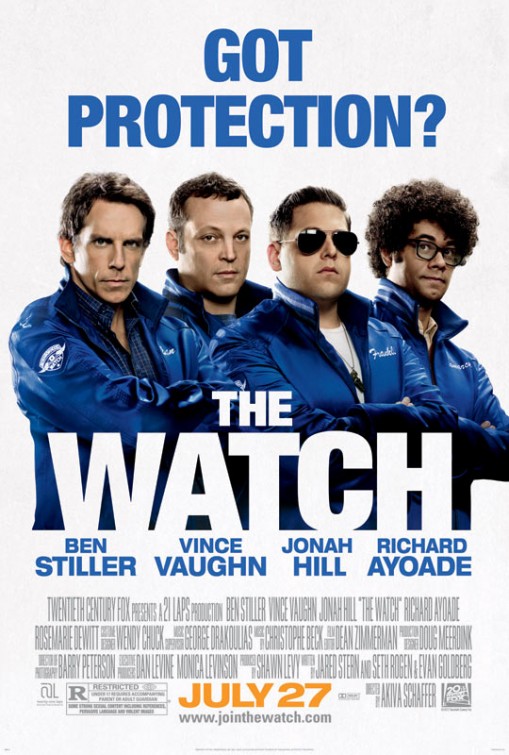 If scientists could take time away from, you know, curing diseases, and craft the perfect blend of “meh” in a lab, it would be The Watch. It’s not particularly offensive or terrible but it’s certainly not good. The humor of boys misbehaving and talking tough doesn’t ever seem to get further than the initial concept. The movie ends up becoming a more crass version of Ghostbusters, with a special fascination for the male member. This is a very penis-obsessive movie. Usually guy-centric sex raunchy comedies will definitely feature strong discussion/comedy revolving around male genitalia, but this is one of the few movies where complete storylines hinge upon penises (weird imagery, I’ll admit). Ben Stiller, Vince Vaughn, and Jonah Hill are more annoying than anything else. Poor Rosemarie DeWitt as the underwritten wife role in what is essentially a boys-behaving-badly movie (also her second 2012 movie where she’s trying to get pregnant). When the movie goes full-force into action mode, it loses just about any semblance of comedy. I laughed about three times, and that was thanks to Richard Ayoade (TV’s The IT Crowd) and, believe it or not, Will Forte (MacGruber). Sitting through 105 minutes with little laughs, irritating characters, and poorly conceived action in place of genuine comedic payoffs, well it’s not exactly a recipe for a successful summer comedy. And yet, with all its obvious faults, I couldn’t hate the movie as others have. It’s certainly not likeable but it does go about its business with a certain swagger, albeit misguided. Cocky loudmouths failing at entertainment are still marginally better than artists who don’t even try. It sounds like I’m reaching, and I am, but The Watch, certainly a bad comedy, may eventually be worth a watch when, you know, it’s on TV and you can half-heartedly pay attention to it while you go about your day.
Nate’s Grade: C-
Share this:

Your Sister’s Sister (2012)
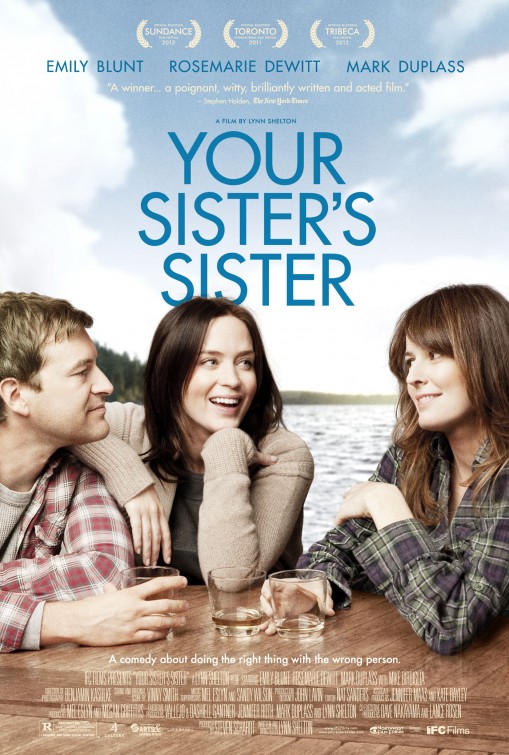 Lynn Shelton is quickly becoming one of my favorite indie film artists. Her writing and directorial offerings are somewhat relegated to the fly-on-the-wall hipster “mumblecore” category, but what separates Shelton is her narrative momentum, her laser-like focus with character, and her sense that a movie needs to build to something significant. With 2009’s Humpday, it was two dudes who might have sex as a test of their masculinity (you really need to see the movie for the full context). With Your Sister’s Sister, it’s the full ramifications of a bunch of delicious relationship secrets getting out there. Everyone in the film has something to hide and something to lose, and watching it all play out with humor and sweetness and honesty that is rare in movies.
Jack (Mark Duplass) is still coming to terms with the death of his older brother. His best friend, Iris (Emily Blunt), who was his brother’s girlfriend at the time of his passing, offers a suggestion. She arranges some alone time for the guy to clear his head. He bikes out to her family cabin but is surprised to find a guest already there, Hannah (Rosemarie DeWitt), Iris’ older sister. Hannah and Jack break the ice by bonding over their personal loss: his brother and her ending a seven-year relationship with her girlfriend. Over a long night of drinking, the two decide to impulsively have sex. The next morning is even more awkward when Iris shows up at the cabin, planning to finally reveal her own feelings for Jack. What follows may be one of the few character-based sitcom plots I’ve witnessed.
 Much like Shelton’s previous movie, the greatest strength of the film is how beautifully naturalistic it all feels while still telling an engaging story. The film has a relaxed vibe that washes over you, allowing you to immerse yourself in what feels like a real group of friends. There’s a tremendous naturalistic ease the film exudes, with the actors so familiar with one another that they truly feel like family. When I have well developed characters, and actors who seem so knowledgeable of their character’s tics and flaws and secrets and smallest details, I could honestly listen to them talk for hours. I don’t want to mistakenly give the impression that this movie is a dull yakfest where the participants are in love with the sound of their own exceptional voices. Each scene in this movie advances the plot further, twisting the screws, complicating matters, and brimming with delightful awkwardness and tension. With 2009’s Humpday, I wrote: “What I really appreciated about Humpday is that every moment feels genuine and every scene has a point. I was amazed that Shelton and her small unit of actors had made it so that every conversation had purpose; there is so little fat to this screenplay. Each scene reveals something new about a character or pushes the narrative forward toward its uncomfortable climax, and each moment never breaks the reality of the story.” And the same can be said for Your Sister’s Sister as well.
While the premise is a bit of a sitcom novelty with some farcical developments thrown in, the depth of the characters and the fantastic acting help to make sure that Your Sister’s Sister is nothing but graceful and beguiling. And the escalating conflicts, personal revelations and complicated feelings, always find a way to come across as organic to the story. That’s another amazing part of the film, that even with all the sexual hijinks that it still manages to feel grounded and surprisingly relatable. These are interesting, complicated, flawed, and spectacular characters, and watching them interact, profess their love through small actions and big declarations, seeing their heartfelt camaraderie, and watch them navigate their troubled lives to find some semblance of a happy ending is a joy to watch. This is a potent little movie, fully realized, poignant, funny, and genuine.
The film was shot over the course of 12 days and Shelton has said that much of the dialogue was improvised, working off her outline. Improvisation is a dangerous tact when dealing with a dialogue-driven film, such as this one. Just because it’s coming off the top of your head doesn’t mean it’s going to sound good. Not everyone is gifted with the ability to improv dialogue that is true to character, revealing, advances the story, as well as just being entertaining. Luckily, Your Sister’s Sister is the exception.
If Your Sister’s Sister does have a weakness, it’s the third act that seems to stall out without giving us much in development before tidying the broken relationships up again. The film’s comedic structure could feel, in lesser hands, like a generic sitcom. It is to Shelton and her actors’ credit that the twists and turns still manage to feel as believable as possible. The third act hits when all the secrets come out, pushing the characters away. Rather than (minor spoilers) ramping things up, we merely endure an extended wordless sequence of images of Jack biking around and the sisters burying the hatchet. Then it’s time for our big happy romantic declaration that tidies everything up, and we’re done. While satisfying on an emotional level given our empathy for the trio, the third act does seem very thin for an otherwise lean and well-structured story. It feels like perhaps Shelton only had enough plot for two acts.
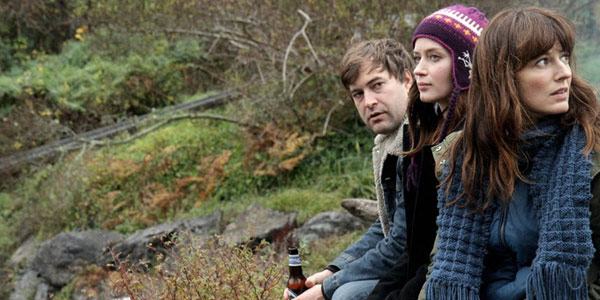 The main trio is a rather engaging ensemble that convincingly plays a besotted group of friends and family. Duplass (Safety Not Guaranteed) has gotten considerably more attention since starring in Shelton’s last movie; the man and his schlubby, smirky charm are ubiquitous. He has a way of being edgy without pushy and nonplussed and flummoxed without going overboard. Duplass has a natural fit for comedy but the man can really excel with the meatier drama bits as well, displaying the painful yearning of a man caught between his desire and the need to move on. He’s a winning and likeable presence that can still be endearing even when he’s flailing around or making others uncomfortable.
DeWitt (The Watch) was a late addition to the cast, replacing Rachel Weisv (The Bourne Legacy) when scheduling conflicts got the best of her. She deserves extra kudos for how good she is considering the miniscule prep time she had compared with her costars. DeWitt is amusing in how cagey and sardonic she can be, and her chemistry with Blunt (Looper) is outstanding. I greatly enjoyed the subtle nuances between them, the way their body language and gestures added extra layers to their relationship, the familiar communication and sisterly code, and just the smallest details that felt well thought out. The relationships in Your Sister’s Sister feel sweetly genuine, and with the benefit of great actors, it lays the groundwork for characters we care about.
Three people sharing time in a cabin might not seem like an exciting setup for a movie, unless, of course, there’s some supernatural presence murdering them in grisly fashion. However, when you lock away three great actors who know their characters inside out, a smart script that allows them the space to develop but pushes the movie forward scene-by-scene, and direction that feels seamless with the storytelling, then you have something special, and that something special is Your Sister’s Sister. While I think Shelton’s previous film had more at play concerning male relationships and sexual politics, this one, with a more straightforward, farcical plotline, is still plenty entertaining and with strong character work (the ending does leave one very large question unanswered). This is charming, sweet, unassuming little indie film that will provide a solid dose of smiles and laughs.
Nate’s Grade: B+
Share this:

Rachel Getting Married (2008)
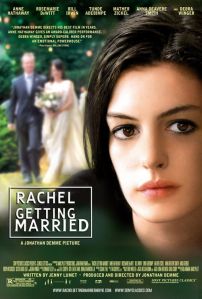 Jonathan Demme’s dark comedy is a movie at battle with its context. At heart, there is a fantastic and engrossing family dysfunction that rears its ugly head and re-opens old wounds. Watching Rachel (Rosemarrie DeWitt, who didn’t get nominated for an Oscar why?) unleash years of repressed pain upon the likes of her toxic, needy, narcissistic little sister Kym (Anne Hathaway), just fresh from drug rehab, is enthralling because of how raw and hurtful the emotions are. You can feel the sting of the words. Through the arguments, a picture emerges of this family’s tragic history and he emotional tug-of-war between the siblings. This is the great stuff, but then the setting of the movie overpowers the drama and sidelines it. Rachel Getting Married will make you feel like you are apart of this martial extravaganza, so we see about fifteen minutes of toasting from EVERY PERSON, because, really, much of this is all exposition from characters who won’t be heard from again. We also see about 15-20 minutes of eclectic musical performances, dancing, and all the rest that comes at the close of a reception. While the wedding/reception is an interesting multicultural blend, it feels like an unyielding intermission from the terrific family drama. Hathaway is as good as advertised and soaks up the troubled life of a notorious problem child defined by little else than her problems. DeWitt is outstanding as the big sister tired of being pushed aside. Demme’s handheld camerawork, and the extensive ensemble of slightly eccentric characters, made me feel like this was an Oscar-serious version of one of the Christopher Guest mockumentaries like Waiting for Guffman. There is succulent family misfortune here, with great acting, but I wanted less wedding and more Rachel and friends.
Nate’s Grade: B
Share this:

Cinderella Man (2005)
 Let’s talk a little about screenwriter Akiva Goldsman. This is the man responsible for travesties like Lost in Space and the franchise killing, pun-crazy Batman and Robin. There’s plenty of junk writers in Hollywood and plenty of good writers just saddled by junk to make a living, and either might apply to Goldsman. How in the world did he become a Hollywood go-to guy?It probably has something to do with Ron Howard. Goldsman adapted the screenplay for Howard’s film A Beautiful Mind and both walked away with Oscars. Suddenly the man who wrote Mr. Freeze saying, “You’re not sending MEEE to the COOLER,” had an Oscar on his mantle. Goldsman and Howard, in retrospect, seem like a match made in heaven. They both enjoy big Hollywood event movies that spoon-feed an audience and shave off the gray areas. Cinderella Man serves as the duo’s second collaboration and it’s exactly what you would expect a big Hollywood event movie to be from them.
Jim Braddock (Russell Crowe) is an up-and-coming New Jersey boxer who’s on a warpath to the heavyweight title. His wife Mae (Renee Zellweger) loves him dearly and he dotes on his three kids. Life seems so perfect in 1929 America. And then the Depression hits. Braddock breaks his hand in a fight and his skills slip tremendously. The boxing commission revokes his license and Braddock is forced to take a dock job to provide for his family. Times are tough and there doesn’t appear to be a way out, until Braddock’s old boxing manager (Paul Giamatti) offers him a one time only bout in the ring. Braddock is seen as a has-been but he knocks his opponent flat out. More fights come and so do more victories, and Jim Braddock seems destined for a remarkable storybook comeback. But then there’s the reigning champ Max Baer (Craig Bierko), an arrogant playboy. Baer also is a ferocious fighter and has actually killed two men in the ring. The championship leads through him and Braddock is unafraid. Mae is terrified she’ll become a widow and pleads with her husband not to fight. But now that he’s been through the gutter, Braddock knows what he?s fighting for: the survival of his family. To do that, he?s headed for a title match with Baer.
 What elevates Cinderella Man from an “okay” film into a “mostly good” film is the singular brilliance of Russell Crowe. This man is simply one of the most amazing actors we’ve ever seen, and he’s been on an incredible hot streak since 1999’s The Insider (forget 2000’s Proof of Life, please). Yet again mastering another accent, Crowe excels at playing a noble man with guarded emotions and honest intentions. He’s an actor that can display such an intense wealth of emotions in the same moment. When he visits his old boxing bosses, hat in hand, begging for enough money to turn the electricity back on, Crowe has laid a sucker punch to your emotions. It’s getting to the point where I will go out and see any movie Russell Crowe stars in just to soak up his brilliant performance. He can throw a phone at my head anytime. Crowe’s stellar and resonant acting will hopefully be noticed come Oscar time; however, I doubt much else of Cinderella Man will be remembered.
Crowe’s sparring partner doesn’t fare as well. I’ve liked Zellweger in a lot of her roles (even the sappy One True Thing), but she’s entirely miscast as Braddock’s underwritten stand-by-your-man wife. She scrunches her face too much and squints for most of the movie.
Two great actors make the most of their meager roles. Giamatti serves as Braddock’s growling pit dog of a corner man and works up a good froth. Bierko almost transcends the film’s one-note villain caste and becomes a figure of showboating sensuality. He struts in the ring with a gallant pride that’s fun to watch, even though you know Howard?s whispering in your ear, “Booooo. Don’t like him. He’s the mean man. Booooo.”
The production design on Cinderella Man is great and really recreates the look and feel of the 1930s in all walks of life. The cinematography, on the other hand, seems washed out and overly dark in spots, though it may have just been my theater?s projection. I miss Roger Deakins, DP on A Beautiful Mind. Deakins knew how to beautifully light a scene and capture the audience with a precise, eye-pleasing angle. In contrast, Cinderella Man seems to think that sepia tones defined the time period of the 1930s.
Howard still has little to no trust in his audience. He can’t rely on the performances of his actors to express their motivation. We know why Braddock is fighting during the Depression, Howard. We don’t need split-second cuts of his family for reminders. It’s almost like Howard wants to point to the screen and tell the audience what to feel. It should be obvious by now but ambiguity doesn’t work here. That’s why Braddock is seen as almost saintly (never mind the connections to organized crime). That’s why Baer is seen as dastardly (never mind that in 1933 Baer heroically wore a Jewish star and knocked out Hitler’s favorite prize fighter, Max Schmeling). It seems that the details just get in the way when Howard wants to turn true-life stories into calculating crowd-pleasers.
At the docks, just in case we don’t get how tragic the Great Depression is (you know, in case you forgot what either the words “great” or “depression” meant), Howard has to bend over backwards to show someone stepping over a newspaper declaring how high unemployment is. When Braddock finds a friend in Hoovertown (Central Park turned into a neighborhood of shanties) we see him run over by a horse and buggy as another man crushed by the system or a runaway metaphor. When Baer fights in the ring Howard makes sure to get that sneering close-up of our villain. And surely anyone who’s a womanizing playboy must go down for the good of the nation. Howard is aggressive in his pandering.
Thanks to Goldsman and Hollingsworth’s mawkish script, Cinderella Man has the myth of complexity to it when it’s really content to go the easy route. It plays this story too close to the rules: embittered hero with humanity intact, stalwart wife, cocky villain, the grumbling manager. Cinderella Man is stripped of complexity and Goldsman and Hollingsworth want to lead the audience by the nose. When Braddock promises his son in a heart-to-heart that he’ll never split up the family, we know it’s only a matter of time before it happens. Their script is also full of workmanlike dialogue that does enough to just push the story forward but give little shading to its people (Zellweger’s, “You are the champion of my heart, Jim Braddock” is particularly not great.
 Cinderella Man really is a film more about the Depression than boxing, except for its pummeling and gritty final act of non-stop boxing. The script paints an almost insulting idea that the Depression was good for people to learn important life lessons, like family comes first, hard work will be rewarded, and one man can heal a nation. Seabiscuit fell into this same trap with its depiction of the Depression but at least Gary Ross’ film dealt with characters that weren’t tired genre archetypes. Cinderella Man could be described as “Seabiscuit in a boxing ring,” as yet again the triumph of an underdog pulls the country back together and gives the common man something to believe in. What I’d like to see is Braddock vs. Seabiscuit in a ring or even on the horse’s turf. Then we can finally decide once and for all who is responsible for getting America out of the Depression (somewhere FDR is spinning in his wheelchair-accessible grave).
The film does come alive when Braddock steps into the ring. The boxing matches are finely choreographed and pack a real wallop. You can practically feel the bruises and taste the sweat during the 15-round bout between Braddock and Baer. These scenes give you a good understanding of the progression of a boxing match and the real strategy that can turn a loser into a winner. Howard also has a smart visual cue during these lively moments. Whenever a bone gets broken, like Braddock’s hand, we cut to an X-ray shot of that scene and see the bone snap. It might seem old in a CSI-drenched landscape of entertainment but it’s effective and neat.
Cinderella Man is a rousing, heartstring-tugging crowd-pleaser that will inspire hope and redemption. Until you look at it more objectively. It?s easy to get sucked into Howard’s underdog tale and that’s because it’s been tailored to satisfy your emotions. Crowe rises above this heavy-handed yesteryear yarn with a riveting performance. I’m positive most people will walk away from Cinderella Man feeling uplifted and touched and would view me as being overly cynical. But with a maudlin story by Goldsman that simplifies the details, Cinderella Man feels like a feel-good-movie that’s been rigged. These people have no trust in their audience, so why should you put your trust in them?
Nate’s Grade: C+


 nathanzoebl
You must be logged in to post a comment.