Blog Archives
Mr. Deeds (2002) [Review Re-View]
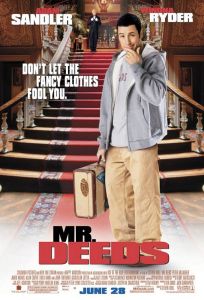 Originally released June 28, 2002:
Adam Sandler seems like the reason they created the “no shirt no shoes” policy for restaurants. His niche is playing the lovable goodhearted goofball that triumphs over the pretentious jackass and somehow wins the heart of the fawning one-dimensional love interest. Sandler appeals to the masses as our nation’s greatest warm-hearted simpleton. He’s the Jimmy Stewart of slobbery. So why mess with that? Well for starters, if you want entertainment anymore you might want to.
Mr. Deeds, Sandler’s latest idiot opus, is disastrously, even tragically unfunny. In the film Sandler stars as the only known heir of a multi-billionaire media mogul. Longfellow Deeds (Sandler) is a simple New Hampshire pizza delivery boy who treats people with respect and kindness. However, the mantra “cruel to be kind” must be alive and well because Sandler mercilessly beats people to about an inch of their life throughout Mr. Deeds for brutish comic effect.
Peter Gallagher and his monstrous eyebrows serve as the stand-in villain. Hes a greedy tycoon who wants the Deeds fortune all to himself. Gallagher actually plays his part well and seems to at least have some fun with the broad comedy role. Winona Ryder, on the other hand, does not. Ryder has never proven she can handle any comedy other than black, and slapstick just ain’t her thing. She painfully goes from scene to scene clueless as a tabloid journalist hiding her identity so she can get the scoop on Deeds, only to fall madly in love with him.
The film has some glimmers of comedy, mostly from its supporting cast including John Turturro as a very sneaky Spanish butler. It’s nice to see Turturro in something this high profile and get some recognition this journeyman deserves. There’s also a really funny cameo served up by a former tennis giant himself known for his boorish temperament. Steve Buscemi should be charged with grand theft movie because his three minutes on screen as the crazy-eyed local are funnier than anything with Sandler onscreen.
 The movie becomes far too redundant of Sandler’s other comedies to the point where seeing former stars like Rob Schneider in his Big Daddy character is somehow supposed to be funny. This kind of stuff is strewn throughout the film. It feels like everyone’s going through the motions. Now I’m not a total Sandler basher, because I do believe the man can be funny when worked right. Billy Madison is still hysterical to me upon every viewing and I do get some fun watching The Wedding Singer, but Mr. Deeds is sub-par Sandler even for Sandler.
I’m sure most of the people buying tickets for this have no idea that the concept is based upon the Frank Capra film starring Gary Cooper. But what good is Gary Cooper? He didn’t write cutesy greeting cards or save a litter of kittens from a raging inferno like Sandler’s Deeds. In the end, this mostly laugh-free comedy is short on imagination, energy, and entertainment.
Nate’s Grade: C-
——————————————————
WRITER REFLECTIONS 20 YEARS LATER
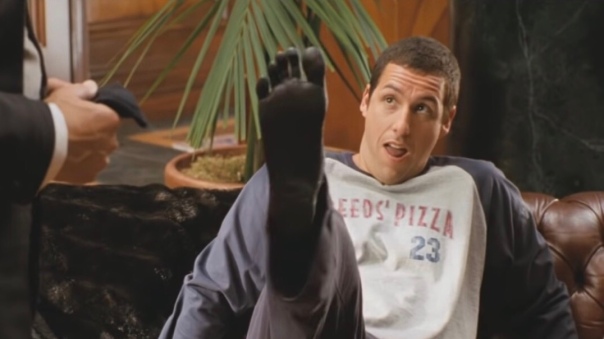
Adam Sandler became his own industry. The Saturday Night Live funnyman became a movie favorite starting in 1995’s Billy Madison, still my favorite of the early Sandler era, finding the right balance of stupid, irony, absurdity, and crass humor. His ribald comedy albums were must-owns for any teenager in the 1990s. By the early 2000s, he had accumulated a team of collaborators of directors (Steve Brill, Frank Coraci, Dennis Dugan) and writers (Tim Herlihy, Fred Wolf, Steve Koren) who would churn out comedies on a near yearly basis. From 1998-2015, Sandler starred in 20 movies that can be deemed Sandler vehicles, a soft-spoken schlub with a heart of gold who is prone to explosions of violence and seems endlessly underestimated or misunderstood by a larger world of condescending, out-of-touch elites. There is a wild spectrum of quality during this period, and as the years progressed Sandler began to transform from the slovenly goofball provocateur to the laid-back, wisecracking family man trying to convince non-believers of his righteous old-fashioned wisdom. His once outsider status had calcified into a sentimental, middle-aged “these kids today don’t get it” laziness. Many of his later movies felt like glorified excuses for his family and friends to take extended vacations around the world. Since 2016, Sandler has migrated his slob squad to Netflix and continued his usual schtick to lesser publicity. The only time Sandler seems to have broken through since he hit that late 2000s plateau is his occasional dramatic performance, like 2019’s intense and gritty Uncut Gems. He’ll even star in a basketball drama for Netflix this month (Hustle). The real reason I picked Mr. Deeds to re-watch for this month was so I could better compare and contrast for a later re-watching of 2002’s Punch-Drunk Love, Sandler’s first dramatic acting revelation thanks to Paul Thomas Anderson. As for Sandler’s take on Frank Capra, it never overcomes his trademark laziness.
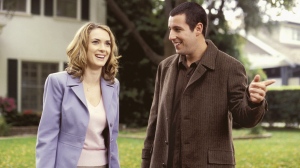 The story of Mr. Deeds began as a heartwarming tale about a small-town man whisked away to the big city who provides a little small-town good charm to those in need. 1936’s Mr. Deeds Goes to Town was nominated for five Academy Awards including Best Actor for Gary Cooper, Best Picture, which it lost to The Great Ziegfeld, and Capra winning the Oscar for Best Director. It’s a well-regarded and wholesome movie that champions many of the major themes prevalent in Capra’s popular filmography. To take this starting point and say, “what if we made Adam Sandler the star and he just assaults people before convincing people to follow their dreams?” The problem with Mr. Deeds is that everything comes at great ease for our protagonist, who is never asked to change or think differently; no, it is the world that needs to change and be a little more like Longfellow Deeds (Sandler). He’s a humble man-of-the-people who will literally carry the elderly on his back to help them cross the street. The New York City natives just view him as a small-town rube but he’ll convince them all that his simple ways are the real way to live. Except if you watch this movie and think, “I need to pattern myself after that guy,” then you are either wholly susceptible to the slightest influence or you’re looking for an excuse to hurt others with impunity. Mr. Deeds regularly beats the crap out of people who he feels have crossed a line. His newfound riches essentially inoculate him from any consequences (as is the American way). I guess the slapstick is supposed to be riotous but it just made me uncomfortable and bored. Apparently, when Sandler tackled Allen Covert to the ground to beat him silly, Covert really did hit his head against the pavement and went unconscious for a minute. The entire concept of the movie rests upon Deeds being a likeable fellow others wish to emulate, but under the guise of Sandler-ification, he comes across as the kind of guy you’d walk across the street to avoid.
Let me use one example to highlight the failure of the Deeds character. He’s in a fancy restaurant and is hailed over by a gathering of rich elites who want to hobnob with the newest moneyman. For whatever reason, their suck-up turns into broad insults, which is confusing considering how many of them are financially dependent on his company. As they yuk it up in sycophantic laughter, Deeds shakes his head and says, “You all invited me here so you could look down on me. Well, let me tell you that here you may all laugh at me, but down in Mandrake Falls we would laugh at you all.” Examine that for just a little bit longer, dear reader. He’s not saying that the good people of his hometown would act better than these big city folk, accepting others for who they are and being welcoming and sincere. No, he’s saying if they were in Mandrake Falls, they would be laughed at and made fun of for being all different. It’s less a declaration that his small-town way of life is better and more wholesome and more a confessed threat if they ever found themselves in the minority. I think Sandler and company thought they had their hero on a moral high ground, but this line proves otherwise, and then he just physically assaults them all too.
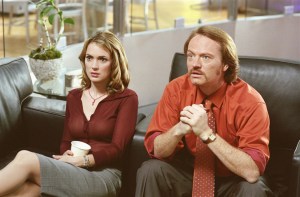 The comedy is predictable and lackluster, and the longer the movie went the further I sank into a general state of apathy. The poems by Mr. Deeds are supposed to be lame, so I guess the comedy is just how bad they are? That just sounds like excuse-making, though thankfully it’s just one trifling example and not much is hinged upon Deed’s greeting card dream. Much of the movie revolves around the budding romance with an undercover reporter, Babe (Winona Ryder), who comes to love the man for some reason unknown to anyone observing. It becomes a bit of a screwball comedy with her attempts to keep her cover, but by the end she’s meant to serve as the audience surrogate and convince us that this man was worth our investment. The only parts of Mr. Deeds that made me smile or come close to laughing were the absurd supporting characters getting little moments. I loved Steve Buscemi, who became a Sandler regular, as a crazy-eyed town weirdo spouting bon mots like, “Time heals all wounds… except these crazy eyes.” I enjoyed John Turturro’s commitment to his sneaky yet helpful Spanish butler. I enjoyed the John McEnroe cameo and night on the town indulging their boorish behavior. I enjoyed watching Jared Harris go broad comedy as an obnoxious newsman. The actor has such innate, weathered pathos to him that I cannot even recall ever seeing him in another comedic role. I liked Eric Avari (The Mummy) as the second-in-command guy who chums it up with Deeds. I enjoyed moments that didn’t involve Sandler or Rider, but those are the two main stars, so time away from them was fleeting though appreciated. The general unfunny nature didn’t offend me like some other bad comedies, but it sapped whatever care and energy I had for the movie.
In the realm of Sandler cinema, Mr. Deeds is on the lower end. It’s not among the worst of his worst. It’s passable to watch if you’re just skimming for the occasional comedy nugget. I didn’t feel insulted but I was also coming to this movie with decades of hindsight of the Sandler cinematic universe, able to discern his more prominent themes and cliches and reflexes. I’ve never watched the 1936 Capra movie though I’m curious to do so now for the simple reason of seeing just how far away Sandler’s version veers. They also turned the Mr. Deeds story into one season of a 1970 TV series starring Monte Markham (Captain Don Thorpe on Baywatch!). There’s something inherently engaging about a moral person placed in a new environment and how the environment changes to that person rather than the other way around. It’s essentially the plot of WALL-E, one of my favorite movies. It works. Except with Sandler’s version, the filmmakers were on Sandler autopilot, a condition he rarely broke free from (Drew Barrymore collabs seem to be the exception). From here, the Sandler movies got lazier and stodgier and more sentimental yet also phonier. I haven’t watched a Sandler-lead comedy since 2016’s The Ridiculous Six, his first Netflix release. I genuinely wish he would stick to more dramas. He has real acting strength, first explored in Punch-Drunk Love (you can’t get here soon enough), and I’m hoping I’ll only better appreciate that movie having re-watched a shining example of what Paul Thomas Anderson was aiming to deconstruct.
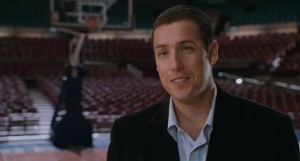 As for my earlier review in 2002, it’s entirely accurate. Everything I said still applies, even the C-minus grade. You could charitably say Mr. Deeds was where the Sandler formula became fully entrenched. It was a big hit ($170 million worldwide) and vindication after Sandler attempted something truly weird and different that flopped (2001’s Little Nicky). You can see the gears turning, and so the next decade-plus brought us more of the same Sandler schtick. For one of the most dangerous comics, he became safe and sated and all too happy to pack it in for mass appeal. Consider this otherwise forgettable movie a footnote in the arc of Sandler’s comedy oeuvre, and that’s about it. Mr. Deeds is just as shrug-worthy in 2022 as it was back in 2002.
Re-View Grade: C-
Share this:

365 Days: This Day (2022)
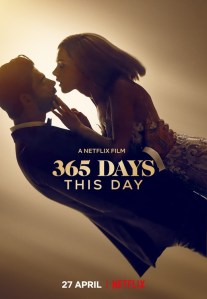 At this point, every viewer turning into 365 Days: This Day is doing so for very specific reasons: either for an erotic charge or morbid curiosity to see how bad this bad franchise can sink. The original film was a pandemic breakout for Netflix in 2020, reigning supreme as their number one movie for over a month internationally. It’s based on Polish writer Barbara Bialowas’ trilogy of best-selling erotic novels, clearly inspired from the successful Fifty Shades of Grey series, itself inspired from the Twilight series, the gift that keeps on giving. The first 365 Days got its name from its lead character being held captive by a mafia scion who just knew that this woman would fall in love with him during the time it took the Earth to revolve around the sun. This obviously problematic dynamic led many viewers to detest the movie and its depiction of romance where consent is definitely a concern, not that it would be the first Stockholm syndrome romance in cinema history. 365 Days was a hit explicitly for its explicit and off-putting aggressive sex scenes. Now that we have two sequels prepped, the question remains whether it can still maintain its performance or whether the franchise suffers from diminished returns. Simply put, this sequel isn’t as problematic as the first movie but it’s just as boring and possibly more pointless.
At the end of the first film, Laura (Anna-Maria Sieklucka) survived her tunnel attack but lost her pregnancy. She hasn’t told her jailer/boyfriend/now-husband Massimo (Michael Morrone) about the baby. They wed, they honeymoon, and she begins to resent feeling like a caged woman (oh lady, I thought that was what won you over?) and then she sees Massimo having sex with his ex-girlfriend. She runs away with Nacho (Simone Susinna), a hunky gardener with even more tattoos than Massimo. The new man whisks her away to his beachfront abode and says he only wants to protect her. Masismo is flummoxed trying to find the absentee Laura while a rival crime family schemes to take her out and make a move while Massimo is so torn and distracted.
 The first thing you’ll realize very early on in 365 Days: This Day is that there simply is not enough material here to cover almost two hours of running time. This movie is starched beyond the breaking point, and I’m not even making a pun here. There are twenty-two songs credited to this movie, and when a song plays, it’s not like some needle drop that only plays for a few seconds to impart a very specific impression. These songs are like full renditions. That’s why the movie often feels like a collection of music videos and luxury resort commercials. We’ll watch Laura and Massimo frolic on the beach, go horseback riding, and slinking into a bubble bath, all inter-cut together. If you just cut to an R&B group occasionally singing to the camera, it would all feel complete. Sometimes we are mere seconds between songs. Just as one is ending, another begins, and after 40 minutes of this, I began to question whether this was a deliberate creative decision by the filmmakers to limit the number of scenes relying upon the actors speaking. This is a blessing because both Sieklucka and Morrone have difficulty making the pseudo-smoldering dialogue sound right through broken English. There are lines like, “I can’t calm down, I’m Polish!” and Laura referring to her bedroom activities as “a sex.” The literal second line of dialogue is a reference to the bride not wearing any underwear. I think there might be 200 words spoken in this entire movie and a high percentage of them will make you groan or roll your eyes.
I have to devote an entire section to discussing the golf scene. You see, on their luxurious honeymoon, Massimo and Laura spend some time on the links but their kinky foreplay doesn’t take a break. She lays on the green, spreads her legs, and his grips his golf club (do you get it? do you get it?) and then literally putts a white ball across the green and between her open legs (do you get it? do you get it?). As it was happening onscreen, I joked to my girlfriend that it would follow this route, and sure enough, the filmmakers could not resist. It is the comedy high-point of the movie.
 It’s not like all these songs are soundtracking sequences of arched backs and heavy thrusting. There are even more music montages for luxury porn than for the soft-core porn. We watch Laura and her friend shop in luxury. We watch them drive in luxury. We watch them walk along the luxurious beach. We watch them jet ski in luxury. We watch them dine in luxury. This is why the majority of the first half of the movie feels like the raw footage from a commercial shoot for a getaway vacation. It’s padding upon padding because the characters of Massimo and Laura are wafer-thin. I was trying to even come up with adjectives to describe either lover, let alone full sentences, and my efforts sounded like a second grader trying to bluff their way through a book report. These characters are so boring that the movie won’t allow them to have any drawn out conversations because then the jig would be up. Even when Massimo confesses to having a brother he never toward Laura, this moment isn’t given extended time for her to interrogate. It’s off to the next shopping or driving montage with sun-dappled cinematography. This is also why the filmmakers have inserted a second couple for us to watch their own blossoming romance, but even this gets resolved so quickly with Massimo’s buddy proposing to Laura’s best pal Olga while they’re all still at the same honeymoon location. They’re supposed to be a distraction and they can’t keep our attention because it’s more characters without defining characteristics beyond their body parts.
The sex is put on hold for half of the movie (with the exception of an occasional frisky dream filling the gap, no pun intended) and 365 Days: This Day becomes a ridiculous soap opera. To fully detail the depths this movie resorts to I’ll need to go into spoilers, if that’s really a concern for you, like this movie is being watched for its storyline. The turning point of the film is when Laura catches Massimo fornicating with his ex BUT WAIT because that wasn’t Massimo but… his coke-addicted, twitchy identical twin brother, Adriano (Morrone is actually far more enjoyable in this dual part). He and the ex are scheming to drive Laura and Massimo apart and then kill them both. They’re being paid by the rival crime family that Nacho belongs to, being the son of the competing mafia boss. This overcooked drama reaches such absurdist heights that it ends on a Mexican standoff with the villains being gunned down, Laura getting shot badly in her abdomen, Massimo finally finding out about his lost child, and a question over where Nacho’s loyalty lies, possibly eliminating Massimo so he can have Laura to himself once and for all. This is like three seasons of soap opera storytelling crammed for the very end of what had otherwise been a ploddingly paced movie lacking needed plot events. Even this sequence is stretched thin by the inane cross-cutting from Laura in danger with Adriano to Massimo and Nacho walking down hallways in excessive slow-motion. I laughed out loud as we jumped from overcooked drama to languidly paced hall walking. The movie has the audacity to end on a cliffhanger, which I suppose also happened with the first movie. If you’re dying to find out what happens to these people in Part Three, I just feel sorry for you.
 While the sequel is less problematic over consent than 365 Days, it’s also more boring and tediously forced to draw out the weakest, basest of stories that was never meant to be more than a wish-fulfillment appeal to people’s baser impulses. I don’t want to shame anyone that finds this movie sexy or stimulating. Good for you; attraction is uniquely personal and your found yours. However, this series is making me re-evaluate the Fifty Shades of Grey movies, none of which were good but man at least they were better than this. All of this makes me think the next franchise, inspired by the international streaming success of 365 Days, will be even worse to make me re-evaluate the artistic accomplishment of this very boring, very dumb movie. It is a spiral that will never end and only make us sadder.
Nate’s Grade: D
Share this:

Human Nature (2002) [Review Re-View]
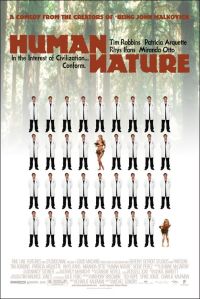 Originally released April 12, 2002:
Screenwriter Charlie Kaufman jumped on to Hollywood’s A-list when his feature debut Being John Malkovich was unleashed in 1999. Malkovich was a brilliant original satire on identity, be it celebrity or sexual, and was filled with riotous humor but also blended beautifully with a rich story that bordered on genius that longer it went. Now Kaufman tries his hand expounding at the meaning of civilization versus animal instinct in Human Nature. As one character tells another, “Just remember, don’t do whatever your body is telling you to do and you’ll be fine.”
Lila (Patricia Arquette) is a woman burdened with excessive body hair ever since she was old enough for a training bra (with the younger version played by Disney’s Lizzie McGuire). Lila feels ashamed by her body and morbidly humiliated. She runs away to the forest to enjoy a life free from the critical eyes of other men. Here she can commune with nature and feel that she belongs.
 Nathan (Tim Robbins) is an anal retentive scientist obsessed with etiquette. As a young boy Nathan was sent to his room for picking the wrong fork to eat his meal with. He is now trying his best to teach mice table manners so he can prove that if etiquette can be taught to animals it can be ingrained toward humanity. Lila and Nathan become lovers when she ventures back into the city, eliminating her body hair for now, because of something infinitely in human nature – hormones. The two of them find a form of content, as neither had known the intimate touch of another human being.
“Puff” (Rhys Ifans) is a grown man living his life in the woods convinced by his father that he is an ape. One day while walking through the woods, Nathan and Lila discover the ape-man and have differing opinions on what should be done with him. Nathan is convinced that he should be brought into civilization and be taught the rules, etiquette, and things that make us “human.” It would also be his greatest experiment. Lila feels that he should maintain his freedom and live as he does in nature, how he feels he should.
What follows is a bizarre love triangle over the reeducation of “Puff,” as Nathan’s slinky French assistant Gabrielle (Miranda Otto) names him. Lila is torn over the treatment of Puff and also her own society induced shame of her abundant amount of body hair. Nathan feels like he is saving Puff from his wayward primal urges, as he himself becomes a victim of them when he starts having an affair with Gabrielle. Puff, as he tells a congressional committee, was playing their game so he could find some action and “get a piece of that.”
 Kaufman has written a movie in the same vein as Being John Malkovich but missing the pathos and, sadly, the humor. Human Nature tries too hard to be funny and isn’t nearly as funny as it thinks it is. Many quirky elements are thrown out but don’t have the same sticking power as Kaufman’s previous film. It’s a fine line between being quirky just for quirky’s sake (like the atrocious Gummo) and turning quirky into something fantastic (like Rushmore or Raising Arizona). Human Nature is too quirky for its own good without having the balance of substance to enhance the weirdness further. There are many interesting parts to this story but as a whole they don’t ever seriously gel.
Debut director Michel Gondry cut his teeth in the realm of MTV making surreal videos for Bjork and others (including the Lego animated one for The White Stripes). He also has done numerous commercials, most infamously the creepy-as-all-hell singing navels Levi ad. Gondry does have a vision, and that vision is “Copy What Spike Jonze Did as Best as Possible.” Gondry’s direction never really registers, except for some attractive time shifts, but feels more like a rehash of Jonze’s work on, yep you guessed it, Being John Malkovich.
Arquette and Robbins do fine jobs in their roles with Arquette given a bit more, dare I say it, humanity. Her Lila is trapped between knowing what is true to herself and fitting into a society that tells her that it’s unhealthy and wrong. Ifans has fun with his character and lets it show. The acting in Human Nature is never really the problem.
While Human Nature is certainly an interesting film (hey it has Arquette singing a song in the buff and Rosie Perez as an electrologist) but the sum of its whole is lacking. It’s unfair to keep comparing it to the earlier Malkovich but the film is trying too hard to emulate what made that movie so successful. Human Nature just doesn’t have the gravity that could turn a quirky film into a brilliant one.
Nate’s Grade: C+
——————————————————
WRITER REFLECTIONS 20 YEARS LATER

I’m at a loss with 2002’s Human Nature. I thought in the ensuing twenty years I would have more to say with coming back to the early burst of brilliant writer Charlie Kaufman in the immediate wake of his successful debut, 1999’s Being John Malkovich. 2002 was a big year for Kaufman; he had three movies released that he wrote, all of them wildly different. His best work was Adaptation, a reteaming with Malkovich’s Oscar-nominated director Spike Jonze, that earned Chris Cooper a Best Supporting Actor Oscar and Kaufman was close to winning for Best Original Screenplay and sharing the honor with his pretend twin brother, the both of whom were portrayed by Nicolas Cage. It was the most challenging and creative and fulfilling of the three. There was also Confessions of a Dangerous Mind, the debut for George Clooney as a director, was a lark of a movie, taking Gong Show host Chuck Barris’ “unauthorized autobiography” where he claimed he was doubling as a CIA black ops hitman. I recently re-watched this one months ago and my opinion even lowered because there’s nothing to the movie beyond the central irony of the unexpected reality of this unexpected man being a spy and assassin. There’s no real insight into Barris as a character and he comes across as scummy and unworthy of a big screen examination. It’s a story that only exists to be ironic and missing the messy humanity and pathos of Kaufman’s best.
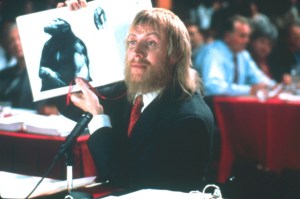
But Kaufman’s most forgotten movie in his screenwriting career is definitely Human Nature, the debut film for Michel Gondry, one of Kaufman’s other collaborators along with Jonze, both men having gained great acclaim for eclectic and visionary and just plain weird music videos. It follows three main characters, each debriefing their tale to an audience. Lila (Patricia Arquette) is accused of murder and discussing her lifelong malady of growing intense amounts of body hair, enough so that she worked as a gorilla woman in a circus sideshow. Puff (Rhys Ifans) is a man raised in the wild who intended to be an ape and returned to society, been trained in etiquette, and become an example of the transformative power of civilization. Dr. Nathan Bronfman (Tim Robbins) is telling his story after death with a bullet hole in the middle of his pasty forehead, as the scientist who found Puff, trained him, and romanced Lila before cheating on her with his French assistant (Miranda Otto). Immediately, the movie presents questions for us to unpack: how did Nathan die? Who was really responsible? What will be the connections between these three very different characters? Then there are assorted kooky side characters that come in and out, but the focus is mostly on this trio, perhaps a foursome with Otto, and the shame is that there is only one really interesting character among them.
Lila is the only protagonist worth following. She feels like a freak, even served in a “freak show,” and must hide her secret from lovers who would object to her untamed mane. She’s vulnerable and hopeful but pressured to conform to be accepted, and her journey to radical self-acceptance would have been an entertaining movie all on its own. However, by fragmenting the narrative with Puff and Nathan, she gets far less attention and her story becomes, for far too long, just her willfully sublimating herself to Nathan’s standards of beauty. Lila frustratingly feels like a character furiously trying to do whatever she can to keep the affections of a bad man. It’s reductive to the movie’s most interesting character. Puff and Nathan, in contrast, just feel like ideas, opposite poles in a discussion over the differences between animal instinct and the ideals of human civilization in all its hypocritical splendor. Even though both men are given comic-tragic back-stories, neither is really a richly defined character. Puff is all impulses and his urges become a tiresome comic device when we watch him hump somebody or something for the eightieth time. Nathan’s preoccupation with social niceties is meant to be absurd (teaching table manners to mice?) and petty, a meaningless articulation of “high culture and values.” I did laugh out loud when Nathan was teaching Puff how to respond at the opera, complete with a constructed box seat. Nathan is a satirical punching bag for a bourgeois sensibility. Neither him nor Puff feel like characters, instead more like conflicting points of view of humanity.
 The other disappointing aspect to Human Nature is as I declared in 2002, it feels like quirky for quirky’s sake screenwriting. Kaufman has become a screenwriting legend and he’s able to marry absurd, bizarre, and dangerous elements into meaningful and subversive and satirical masterstrokes, but the man cannot be expected to perform at the highest heights every time. Human Nature is stuffed full of wacky moments and wacky characters and it doesn’t feel like it ever amounts to more than the sum of its transitory parts. In contrast, 2022’s Everything Everywhere All At Once is an example of how one can take the most bizarre ideas and still find ways to tie them back in meaningful ways that braid into the larger theme. However, much of Human Nature feels like a quirk dartboard being hit over and over, a catalog of strange visuals and goofy ideas (Lila breaks out into song!) that fails to coalesce into a larger thesis like an Adaptation or an Eternal Sunshine of the Spotless Mind or the vastly underrated Synecdoche, New York, Kaufman’s directorial debut. He’s a master of the idiosyncratic, but Human Nature suffers because ultimately what does it have to say? Puff is set up for ridicule. Nathan is set up for ridicule. Even Lila is set up, though for murder. In the end, when Puff returns to the wild in a public galivanting that feels like a ceremonial bon voyage from the society that came to love him, he then scampers out of the woods and escapes back to the comforts of society with Nathan’s French mistress. In the end, is the point that we’re all rubes and hypocrites?
This was Gondry’s first film and it feels like a training vehicle for what would be his real masterpiece, 2004’s Eternal Sunshine of the Spotless Mind, one of my favorite films ever. Gondry’s style is still recognizable, especially reminiscent of his tactile, kitschy, avant garde music videos he directed for Bjork, the queen of weird 1990s music videos. Gondry’s hardscrabble, idiosyncratic style was a natural match with Kaufman’s vivid imagination. It’s surprising that they never reunited after Eternal Sunshine. Gondry had a few movies (2006’s The Science of Sleep, 2008’s Be Kind Rewind) but they felt lacking, trifling without a stronger writer to guide and ground them in human drama. Gondry even tried his hand at studio action to middling results with 2010’s The Green Hornet. He mostly retreated back to music videos and commercials and had a short lived series on Showtime with Jim Carrey as a former children’s TV entertainer whose fantasy is blending with reality. It seemed like a good fit for Gondry, and a nice starring role for Carrey, but it was canceled after two seasons. Even the realm of music videos seems so far removed now, where Hollywood was snatching up every visual virtuoso.
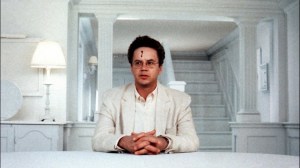
Human Nature has plenty of familiar faces, no doubt eager to attach their names to a daring Kaufman movie. Arquette is winning and the best part of the movie. She would later win an Academy Award for her decade-in-the-making performance in Richard Linklater’s Boyhood. Now I enjoy her in a chilly, villainous role as the shady corporate boss on Apple TV’s stunning sci-fi satire, Severance. Robbins is officious to a fault here. He too would later win an Oscar for 2003’s Mystic River. Poor Ifans, so big after his scene-stealing role in 1999’s Notting Hill, who never seemed to capitalize on his success (even his Spider-Man villain got the weakest treatment in No Way Home). He’s had a long career and prominent TV roles with Berlin Station and the Game of Thrones prequel series, House of the Dragon. I did laugh out loud at his “yahoo” after being zapped by his electric shock collar. You’ll also see Rosie Perez, Peter Dinklage, Robert Forster, Toby Huss, Hillary Duff, and Mary Kay Place. As I said in 2002, acting is not the problem with Human Nature. It’s the writing and characterization that lets these people down.
I usually like to devote a paragraph to going back and re-evaluating my initial words from twenty years ago, but I agree with everything I wrote. Everything. That’s initially why I thought this would be a shorter review. What more am I going to say other than my initial opinion of this movie is the same opinion I have upon re-watching? With the distance, it’s even more clear to me that Human Nature is the weakest film of Kaufman’s career. Even a movie I didn’t really gel with, like 2020’s I’m Thinking of Ending Things, at least has a lot more ambition I can recognize. It’s a character study obfuscated with too much eccentric clutter but there’s still an artistic vision there, even if it didn’t work for me. Kaufman is too unique a voice to only have made three movies in the last 14 years, and it makes it even more frustrating when I don’t connect with his long-in-the-making projects. Human Nature is too limited in scope and characterization. It’s slightly interesting as a footnote to a great screenwriter but little more.
Re-Review Grade: C
Share this:

Everything Everywhere All At Once (2022)
 Even after only two movies, I would trust the directing duo Daniels (Daniel Kwan and Daniel Scheinert) with any movie. They have earned a lifetime pass from me. If these men can make the farting corpse of Harry Potter not just one of the weirdest movies of 2016, not just one of the best films of that year, but also one of the most insightful toward the human condition, then these men can do anything. It’s been six long years for a follow-up but it sure has been worth it. Everything Everywhere All At Once is, to be pithy, a whole lot of movie. Everything Everywhere (my preferred shorthand from here) is a miracle of a movie. It’s a wonder that something this bizarre, this wild, this juvenile, this ambitious, and this specific in vision could find its way through the dream-killing factory that is Hollywood moviemaking. This is the kind of movie you celebrate for simply existing, something so marvelously different but so assured, complex but accessible, and deliriously, amazingly creative. I’m throwing out a lot of adjectives and adverbs to describe the experience of this movie and that’s because it filled me with such sheer wonder and divine happiness. I am thankful that the Danirels are making their movies on their terms, and two movies into what I hope is a long and uncompromising career, I can tell that both of these gentlemen deserve all the accolades and plaudits they have coming. I’ll try my best not to sound like a simpering moron while I try to explain why this movie is so thoroughly outstanding.
Evelyn (Michelle Yeaoh) is a middle-aged Chinese immigrant who is taking stock of her disappointing life. She and her husband, Waymond (Ke Huy Quan), own a floundering coin-operated laundromat. They’re under audit by a dogged IRS agent (Jamie Lee Curtis). Evelyn’s disapproving father, Gong Gong (James Hong, still so great even into his 90s), has moved from China to live with the family, and he was never a fan of Waymond, looking down on his daughter for marrying the man. Then there’s Joy (Stephanie Hsu), Evelyn and Waymond’s twenty-something daughter, who wants to bring her girlfriend to dinner but mom still doesn’t accept her daughter’s queerness and uses the excuse of Gong Gong’s generational disapproval. Then, at the IRS agency, Waymond’s body is taken over by another Waymond, Alpha Waymond, who informs Evelyn that she is the key to saving a universe of universes, and she’ll have to tap into her alternate selves and their abilities to battle the evil destroyer, Jobu Tupaki, who wants to destroy all existence, and who also happens to be an alternate universe version of Joy.
 Multiverses are definitely all the rage right now as they present nostalgic cash-grabs and cameos galore, but Everything Everywhere is a multiverse that is personal and specific. It’s based on all the paths the protagonist never took, and each allows her confirmation of what her life could have been, often more glamorous or exciting or initially appealing. A movie star. A famous singer. A ballerina. A skilled chef. Evelyn is a character paralyzed by the disappointment of her life’s choices, the malaise that has settled in, and the nagging feeling that things could have and should have been better. In one of the best jokes early on, Evelyn is told she’s the Chosen One not because she is special but because she is, literally, living the worst of all possible lives of the multiverse of Evelyns (then again the pinata Evelyn didn’t look like an upgrade). She has taken all the many bad paths and dead ends, but this positions her as the only one who has the power to tap into every other power and ability from her multiverse duplicates. It’s one thing to be feeling like you should have made a different choice in the past, and it’s another to get confirmation. This backhanded revelation could just serve as its own joke but it actually transforms into a philosophy that coalesces in the final act, that of all the universes and possibilities we could have had, the best one is the one we are actually present for. In another universe, one very much styled like In the Mood for Love, where a Waymond who was rejected by Evelyn long ago reconnects with her, mournful of what could have been, and says, “In another life, I would have really liked doing laundry and taxes with you,” in reference to Evelyn’s dismissive summation of what his unrequited romantic “what if” would have lead to. It’s such a poignant moment. By the end of the movie, it’s become a journey of self-actualization but tied to self-acceptance, where kindness and empathy are the real super weapons and the answer to the tumult of postmodern nihilism.
Smartly, the Daniels have made sure that a universe-hopping threat is actually connected to our hero in a meaningful manner. By making the villain an alternate version of Joy, it raises the stakes and forces Evelyn to have to confront her own parenting miscues and frayed relationship with her daughter. It’s the kind of decision-making that reinforces the emotional and thematic core of a movie that is spinning so fast that it feels like you might fall off and vomit new colors. Joy is an avatar of generational disconnect, inherited disappointment and resentment, but what really makes her relatable is the growing feeling of being over it all. Given the power to see everything in every universe, Joy concludes that life is overwhelming and without meaning. It’s the same sort of nihilism we might feel today as we doom scroll through our phones, eyes glazed over from the barrage of bad news, outraged click bait, and feeling of abject helplessness while the world spins on in an uncertain direction. It’s not hard to feel, as Joy, that it’s all too much to bear, and if she can experience everything then does it present value to anything? If she can always just sidestep to another universe, what does that do to the value of life? That’s the ethical conundrum with Rick and Morty, a show where they can swap characters from other dimensions to fix more costly mistakes. What Daniels attempts with Everything Everywhere is to tackle the same question but approaching a different answer: that despite everything, life matters, our relationships matter, and kindness and empathy matter most. Watching Evelyn and Joy, and their many different versions of mother and daughter, try to reach an understanding, it’s easy to feel that struggle and relate to wanting to feel seen. As Evelyn encouragingly says to one character at their lowest point, “It is too much to handle, yes. But nobody is ever alone.”
 This is a dozen different kinds of movies, all smashed together, and each of them is utterly delightful and skillfully realized and executed. If you like martial arts action, there are some excellent fight sequences including a showstopper where Waymond wrecks a team of security guards with a fanny pack. The action is exciting and the martial arts choreography is impressive and filmed in a pleasing style that allows us to really appreciate the moves and countermoves. If you like wild comedies, there are many outlandish moments that combine low-humor and highbrow references. I’ll simply refer to one as finding payoffs for IRS auditor trophies shaped like butt plugs. This is one of the funniest American comedies in years. If you like family dramas, there is plenty of conflict across the board between Evelyn and Waymond and Joy, plus the specter of Gong Gong, and each person trying to communicate their dissatisfaction and desires for a better life. If you removed all of the crazy sci-fi elements, googly eyes, people’s heads turning to confetti, and what have you, this would still be a compelling human drama. When the movie isn’t working through ridiculous tangents, or eye-popping action, or a staggering combination of kitsch and intelligence, it’s building out its emotional core, the heart of the movie, the thing that makes all the gee-whiz fun matter, the family in flux. Likewise, this is a powerfully optimistic movie, life-affirming in all the best ways without being pandering, and one that is without any flash of ironic condescension. Sincerity is powerful and all over.
The movie is elevated even higher by the strength of the performances. Yeoh (Crazy Rich Asians) has spent decades as a martial arts master, and of late she’s been branching out in more demanding dramas, but this is easily the finest performance of her career for nothing less than playing a dozen different characters. She is sensational. The early Evelyn is full of despair and regret, and as she gets to explore each new version of herself, there’s an excitement that’s bristling, as she gets to see the successes she could have been and celebrate. Yeaoh is hilarious and deeply affecting in the central role and still very much a badass. She showcases starting range, it makes you weep that she has never gotten to play so many different kinds of roles because she’s so good at all of them. Hsu (The Marvelous Mrs. Maisel) is the wounded soul, and her sneers and seen-it-all attitude are killer without losing track of the pain at the core of the character. Her emotional confrontations with her mother still hit hard. But the secret weapon of this movie is Quan, the former child actor best remembered as playing Data in The Goonies and Short Round in Temple of Doom. Yes, that same actor. He too gets to play such a wide, wild variety of Waymonds, from the doting and meek husband, to the confidant warriors, to the smoldering former flame, but with each new Waymond, Quan makes you fall in love with the original more. The character of Waymond and his central philosophy of kindness is so moving and needed, that we almost get to fall in love and re-evaluate this man the same way Evelyn does. Also of note, Curtis (Knives Out) is having an absolute blast as her menacing IRS agent.
 It’s truly amazing to me that a movie can have some of the silliest, craziest, dumbest humor imaginable, and then find ways to tie it back thematically and make it yet another important thread that intricately ties into the overall impact of the movie. The genius of Daniels is marrying the most insane ideas with genuine pathos. Take for instance that one of the many multiverses involves people with hot dogs instead of fingers. It’s a goofy visual, and it could simply have been that, a passing moment to make you smile, but the Daniels don’t stop there. They continue developing their ideas, all of their ideas, and find additional jokes and purposes few could. Okay, so this is a big divergence from history, so how could humans evolve to have hot dogs for fingers? Well the movie actually showcases this moment in a hilarious 2001: A Space Odyssey reference. And then the film says, “Well, if this was the way of life, what other practices would evolve from here when it comes to communication and intimacy?” It’s that level of development and commitment that blows me away. The same with what starts as Evelyn’s misunderstanding of the Pixar movie Ratatouille. It works just as a joke in the moment, but then it comes back as its own reality, and even that reality has a thematic resonance by the end. This level of imagination, to take the weirdest jokes and make them meaningful, is special. In one second, I can cry laughing from a raccoon and in the next second a rock can make me want to cry. In essence, even though Everything Everywhere is beyond stuffed, nothing is merely disposable.
That doesn’t mean that the film doesn’t also fall victim to repetition at points. My only criticism, and it might even be eliminated entirely after a second viewing, is that Daniels can over indulge when it comes to their narrative points. Some things can get stretched out, so that they hit points with five beats when three could have been sufficient. It’s this kind of mentality that pushes the running time to almost two hours and twenty minutes, which feels a bit extended. However, the messiness and overstuffed nature of the movie is also one of its hallmarks, so I don’t know if this criticism will even register for many, especially if you’re fully on board their wacky wavelength.
If you can, please go into Everything Everywhere All At Once knowing as little as possible. The carousel of surprise and amazement is constant, but the fact that there is a strong emotional core, that all the many stray elements become perfectly braided together, no matter how ridiculous, is all the more impressive. This is stylized filmmaking that is very personal while also being accessible and universal in its existential pains and longing. It’s style and substance and exhilarating and genius and emotionally cathartic and moving and everything we want with movies. It’s the kind of movie that reignites your passion for cinema, the kind that delivers something new from the studio system, and the kind that deserves parades in celebration. Simply put, as I said before, this is a miracle of a movie, and you owe it to yourself to feel this blessing.
Nate’s Grade: A
Share this:

The Lost City (2022)
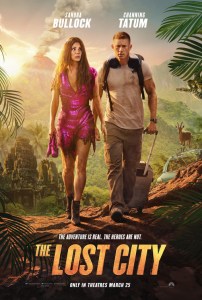 It’s a new spin on Romancing the Stone and as long as the leads are charming and the movie is fun, I have no problem with rehashing this formula. The Lost City mostly succeeds thanks to the winning chemistry between Sandra Bullock and Channing Tatum. She plays a self-loathing romance author and he’s her hunky and clueless cover model, and they both get into a treasure-hunting escapade and chased by scary men with guns thanks to a crazed rich kid (Daniel Radcliffe) looking for a titular lost city of yore to bolster his own rep. The movie stays on a consistently light wavelength even when death and sudden violence occurs. That jokey mentality assures the audience that the movie will not take things too seriously, and that relaxed-yet-antic attitude translates into fairly amusing banter with our leads. The movie does a good job of spacing out its comic set pieces and keeping things moving for its short 90 minutes. Not everything works as well as the leads though. Some storylines feel underplayed or forgotten until called upon for moments that don’t feel earned. Radcliffe feels wasted as a petulant baddie without any fun or memorable angle. One of the best aspects is what happens to the movie’s surprise cameo (spoiled via the movie’s own trailer) but the ending resolution of this feels entirely pointless and undercuts its nerve. It’s a movie that delivers exactly the kind of experience it advertises, and it’s nice to still be able to see a comedy in theaters lifted by the appeal of two stars having a ball together. The Lost City is a formula rom-com with enough good-natured screwball comedy and enjoyable zaniness to coasts on charm and star power.
Nate’s Grade: B
Share this:

The Time Machine (2002) [Review Re-View]
 Originally released March 8, 2002:
The Time Machine is one of the most famous works of fiction in history. It was writen long long ago by the great H.G. Wells. It presents a fantasy glimpse into our future, but in it Wells also gave readers the opportunity to ponder what would happen if they could go back and change their own lives. People have used the story as a cautionary allegory to our own times, like the 1960 film version of The Time Machine. Now, a bigger budget Hollywood remake attempts to put another spin on the Wells classic.
Alexander Hartdegen (Guy Pearce) is an absent-minded professor interested in cracking down the physics of time. He’s chided by some of his peers for crackpot theories and his fascination with any new gadget. He’s supposed to meet Emma (Sienna Guillory) at Central Park and tonight’s the big night he plans to propose to her. He eventually catches up to Emma and the two go strolling off into the park. Shortly after popping the question the two become victims of a mugging and in the fray Emma is left dead. The death drives Alex to create his fanciful time machine, which only happens to take four years time.
Alex gives his big brass LA-Z-Boy looking machine a try and travels back to that fateful night to avoid Emma’s death. Alex avoids the mugger all right, but while purchasing flowers his fiancé gets plowed over by a runaway carriage instead. It seems that one cannot change the past. Alex decides to give the future a chance and travels to a very Back to the Future 2 looking 2037. Someone astutely asks Alex if his time traveling machine makes a good cappuccino.
 When Alex hops a little further into the future the moon is breaking up because of ill-fated lunar construction. Moon rocks are hurtling toward the surface and disrupting everyone’s day. (It was in this moment that a scene of rocks smashing into the World Trade Center was cut for taste) Alex jumps back into his machine but is konked out by some lunar cheese and falls asleep at the wheel. The next thing you know Alex is in a mysterious future world.
The place where The Time Machine really bogs down is once Alex arrives in 80,000 something or other. The child-like thrills and adventure of Alex zipping between the past and near future are buried underneath the standard post-apocalyptic movie world. The people dress in loin cloths and rags (though some of the female natives wear revealing tops that look like see-through chain mail) but still have perfect teeth. When Alex doesn’t understand the linguistics of 80,000 AD the next words that he hears are English from Mara (pop star Samantha Mumba). It’s amazing that English survived 81,000 years when Latin didn’t last a mere 2,000 and change.
It turns out these people who live in huts resembling hot air balloons along the faces of cliffs are called Eloi. The Eloi don’t have anyone looking old enough to carry an AARP membership and are apprehensive to speak of why. Perhaps it’s because creatures resembling something that would belong in The Mummy Returns pop up from the sand to capture whatever slow moving prey they can and return to for an underground feast.
The creatures, called Morlocks, are the offshoots of evolution. Seems after the whole moon destruction thing (whoops!) those who took refuge below the surface have evolved into dusty hunchbacked cannibals. Their rowdy ranks are controlled by Uber-Morlock (I’m not making up that name) who resembles an albino bassist for Poison or Skid Row. It’s actually acclaimed actor Jeremy Irons under all that pancake makeup and fleshy spine-showing prosthetic. The less said about Irons the better.
It’s during this part that The Time Machine reverts into a half-baked Stargate. Alex encourages the Eloi race to stand up to their oppressors and fight for their freedom. He becomes part of the Eloi community, rallies the troops into rebellion, and also has to save the damsel in distress.
The Time Machine remake isn’t the political statement the 1960 film was on man’s folly with technology, particularly nuclear weapons. What this suped-up version is all about is special effects and plenty of them. The effects are for the most part dazzling, especially the scene where Alex travels to 2037 and we see the development of New York City with skyscrapers assembling themselves.
 Simon Wells (The Prince of Egypt) directed this remake and is actually the great-grandson of the famous adventure’s author, H. G. Wells. Trivial Pursuit fans everywhere rejoice. Wells had to sit out the last 18 days of shooting due to “exhaustion” and Gore Verbinsky came off the bench to finish the directorial duties. The film clocks in at a scant 90 minutes but there are definite moments of drag.
Pearce (Memento) is a hunky hero and for the most part is admirably gung-ho with the role. Samantha Mumba’s motivation must have been to stand and look pretty the entire film. To think that Mumba might be the most talented of the recent singers-come-actors (Mandy Moore and Britney Spears) is a distressing thought all its own.
As The Time Machine kept dragging into its Mumba-filled period, I began day dreaming of an alternate, darkly comic version. In my head, Pearce’s character keeps traveling back again and again to save his beloved only to lose her a different way each time. I could picture a humorous montage of his girlfriend dying an assortment of colorful deaths and Pearce just getting more frustrated and jaded. I could picture them skating only to have her plunge below the ice. I could picture the couple dining at a fine restaurant only to have her choke and Pearce just throw his napkin onto the table and sigh loudly. I was enjoying my alternate take on The Time Machine so much that I didn’t want to return to the one that was playing.
The Time Machine has its moments of thrills and excitement but they are mostly condensed to the opening third. This remake doesn’t have the political edge or wow-factor the original did. It plays more to the rules of conventional Hollywood than the wide open possibilities Wells wrote about. Pearce tries valiantly and the special effects are really something, but more often than not The Time Machine is not worth your time.
Nate’s Grade: C
——————————————————
WRITER REFLECTIONS 20 YEARS LATER

The 2002 Time Machine is fanciful schlock on the verge of being populist spectacle. It’s not just another adaptation of the famous H.G. Wells sci-fi novel, it’s also emerging from the shadow of the 1960 movie that broke ground in the realm of special effects. Storytellers will often find new relevant meaning to be mined from the resources of old, and literature with classic stories can still be compelling decades and centuries hence as long as they are served with care and empathy. In theory, another Time Machine movie could be a worthy venture especially in a realm of modern special effects marvels and a more socially conscious viewpoint. If the 1960 film was a cautionary tale about mankind’s impending doom from nuclear arms and technological hubris, you would think a movie born from the ashes of the Cold War would follow a different approach, perhaps something more in line with the colonialism critiques from Wells. It’s surprising then that the 2002 movie also follows the “be careful with your machines, mankind” thematic warning of the earlier version. It made me think of Tim Burton’s maligned 2001 Planet of the Apes remake where they could have gone with ANY ending possible except one, the original’s famous twist ending, one of the most famous endings ever, and what did the new movie do? The same ending. Re-watching the 2002 Time Machine, it’s more fun than it has any right to be and there are aspects worth celebrating, but much like its hero, it’s a victim of unmet potential.
 Firstly, this is a pretty entertaining studio movie that blows by quickly at only 96 minutes. The screenplay is by John Logan, the same writer with credits like Gladiator, The Aviator, Rango, Hugo, Skyfall, and other quite successful, quite large studio hits. And yet this movie doesn’t just feel like another paycheck for the man. The opening half of this relatively brief movie definitely feels like the favorite half. It’s here where the movie introduces the protagonist’s personal loss being the motivating force that drives him to make a time machine, something absent from the 1960 original and an exciting and emotional way to separate itself. Watching Alexander (Guy Pearce) go back to save his love has an immediate appeal, and watching him fail again brings forth the idea of being unable to change the past. Even twenty years later, I still think about the darkly comic version of this story, just as I did in my initial review in 2002, where Alexander tries again and again to save his beloved only to lose her to some new calamity. It would have a lighter approach even while dealing with darker humor, and it would certainly contribute to the film’s central thesis that man is unable to change the miscues of the past.
You would think The Time Machine would follow a theme about correcting the mistakes of the past to prevent future danger; many time travel tales follow a hero trying to thwart a terrible future, although sometimes they inadvertently cause that same terrible future in grand ironic tradition. This movie doesn’t really dwell on fixing the past but more so upon learning from it. During its post-apocalyptic second half, the focus isn’t on preventing it or going back to warn mankind of the folly of its ways. It’s about adapting to change, which can be viewed as defeatist or pragmatic. The future world of 800,000 years ahead is messed up because of the actions of mankind’s past, namely the lunar collision thanks to bad condo construction (thanks, capitalism!). It’s none too difficult to place a general ecological/climate change message in place, the exploitation of the present spoiling the future for generations yet to come. However, the movie isn’t about Alexander going back to teach mankind how to avoid its own mistakes. Unlike the 1960 original, he stays put in this uncertain future world with his new Eloi family and Eloi girlfriend (Samantha Mumba). He’s content to remain in this new time and live his life, ignoring the foresight of a time machine. There’s a message there about looking ahead in one’s life, not dwelling on the past at the expense of the future, but it’s also unexpected for a time travel action adventure. It’s usually about preventing the horrible future, not learning to live with it and make a better tomorrow. This also could be read as the present giving up on avoiding the mistakes of contemporary excess.
 You can probably tell what kind of person that you are depending upon which half of The Time Machine you prefer. For me, the first half has all the surprises and time jumping and fun, and the second half settles into standard post-apocalyptic rally-the-masses formula. It’s not bad but it honestly feels like an entire second act is missing from the development of the plot. In quick succession, Alexander learns he’s in a far-flung future, the customs of the Eloi, the danger of the Morlocks, their hunting practices, their cannibalistic impulses, what caused them, and then who their leader is, and how there are multiple Eloi-Morlock colonies throughout the world. It’s a lot of absurdly fast exposition that just unfolds to the convenience of our hero, and so little of it occurs from the virtual A.I. figure (Orlando Jones) that seems entirely designed to be an exposition device. It’s during the second half that the playfulness and ideas give way to a grungy future with efficient if unspectacular chase scenes from monsters. I am convinced that the Morlock leader played by Jeremy Irons was originally intended to be the older, more evolved, and more callous ends-justify-the-means version of Alexander. That kind of twist would have brought things back to the personal realm of those first minutes traveling through time. Alas, he’s just another monster with bad hair. It seems like wasted potential for the last twenty minutes of this movie to just be another climax involving blowing up the monsters and rescuing the damsel.
Apparently there was significant contention behind the scenes over the look of the Morlocks. The creatures were designed by the famous Stan Winston studios and then director Simon Wells and the producers wanted to change their look, making them more humanoid and recognizable. This infuriated the effects team who strongly disapproved of this creative direction. I appreciate that the production went to the trouble of expensive prosthetics and costumes rather than just making all of the Morlocks ugly CGI monstrosities. I was worried that twenty-year-old humanoid CGI would not age well, but thankfully I didn’t have to bother with that fear.
 This was the first live-action movie for Wells as director. He spent over a decade in the world of animation and helmed An American Tale: Fievel Goes West, Balto, and The Prince of Egypt. After the mediocre reception to The Time Machine, Wells didn’t direct another movie until almost ten years later, 2011’s Mars Needs Moms, a film that reportedly cost the studio over $200 million in losses. It was one of the biggest box-office bombs ever. It’s not much of a surprise then that Wells hasn’t been able to direct another studio movie until just this year, and even that is a small-scale adaptation of a children’s TV show, to the best of my knowledge. The man has directed two movies in the last two decades. On a more fortunate note, Wells has had steady work in his old field of animation as a consultant and storyboard artist for just about every Dreamworks cartoon (Kung Fu Panda, How to Train Your Dragon, The Croods, etc).
Re-reading my old review, there’s not much more to extrapolate. I agree with just about every word I wrote back in 2002. It’s fun for me when I watch these films twenty years later and have the same remarks in my head only to discover my younger self had the exact same response.
While not breaking new ground or even attaining its own creative potential, the 2002 Time Machine is a perfectly reasonable genre movie that you could put on and kill 90 minutes. It’s relatively fun, has some bigger ideas, and some surprising moments where it appears on the verge of poignancy. One of those is when the A.I., who has survived 800,000 years of isolation, talks about the misery of remembering every face he ever interacted with, cataloging every detail, and how this is tearing him apart and how valued having a lone friend was for him. It’s such a thoughtful and empathetic moment that seems to come out of nowhere and leave just as fast before you can really dig into it for genuine pathos. The Time Machine feels this way, like whenever it presents something intriguing, intelligent, or emotive, it then it has to veer sharply back to the bigger, dumber lane of blockbuster filmmaking for the masses.
Re-View Grade: C+
Share this:

Marry Me (2022)
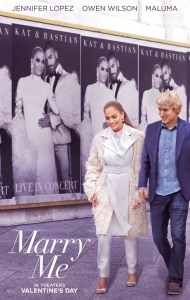 Marry Me has a premise that is so silly that it feels like it would be the setup of a fake movie within some other movie universe, something depicting the creative lunacy of Hollywood for easy satirical laughter. But no it’s real. Based upon a graphic novel by Bobby Crosby of the same name, Jennifer Lopez plays music superstar Kat. She’s a best-selling and provocative performer and her latest single, “Marry Me,” is ruling the charts. She co-wrote the track with her fiance, and the two plan to marry live during one of her stage shows. Then news leaks that her fiance has been cheating on her with her assistant. Kat is stunned and as she’s still processing her hurt feelings onstage she spots a “Marry Me” sign in the audience, held up by Charlie (Owen Wilson), an ordinary math teacher and single father. She agrees to marry him on the spot, and Charlie is rushed onstage and the two tie the knot. Now, what to do and can they make this actually work?
 Think of Marry Me as Notting Hill but where it starts at the level of international fame for romantic coupling. I found the premise to this movie, at first glance, to be absolutely preposterous. I was hoping that the movie wasn’t going to spend so much time worrying how to legitimize this silly impulsive marriage between two complete strangers. Fortunately, from their first “I do” onward the pair doesn’t really view their subsequent “relationship” as more than a publicity stunt. He’ll get more attention for his school and causes that are important to him. She’ll get a run of media attention and allow her to rebrand herself in the wake of her history of cheating louses. I was happy that the movie, at least early, doesn’t try to make this spontaneous union credible. Kat wonders, “Hey, maybe something so crazy just might work,” and of course we know it magically will, but at least they’re not panicking about how they just got married and how they are going to make this relationship work when they could as easily get annulled and got about their separate lives again. So from there, Marry Me follows the path of having these two fake lovebirds become real lovebirds over the course of their shared time.
We know it’s all going to work out, their romantic fate is sealed, but the process needs to still feel organic and earned, and that’s where I found Marry Me to be unsatisfying. Rom-coms will live and breathe depending upon their quotient of cute moments to swoon moments, ultimately winning you over and desiring the coupling. This movie already starts with the couple together, at least in a legal sense, but they don’t know one another and have no immediate feelings for one another, so the movie is like any other rom-com. They have to fall in love for real now, almost like an arranged marriage. However, I found the interactions between Kat and Charlie to be far chummier than passionate or romantic. Lopez and Wilson have zero chemistry together. There is no heat between these two. He’s too laconic and she’s too pressing. As the movie progressed, I could believe they were becoming friends. He got her to be more self-reliant, and she pushed him outside his moderate comfort zones with social media and self-promotion. They’re better friends but I felt nothing romantic between them and that’s a pretty big problem. In fact, that’s the biggest problem in a romantic comedy. If I walk away feeling like the leads would be better friends than lovers, then you haven’t put in the work, and that’s the case here.
 We associate fun and cute moments from rom-coms, amusing scenarios that force our couple to work together or wacky situations where they learn more about the other in a new setting, and Marry Me feels too unimaginative here as well. This is another vital area for the development of the relationship to feel genuine, and simply just for audience enjoyment. The three screenwriters are unable to take the Notting Hill-dynamic of an ordinary person thrust into an unwanted, elevated level of fame and scrutiny and do anything with it. Charlie’s life never feels too disrupted from before; his casual public walks with Kat do not have dozens of paparazzi hounding them, annoying fans inserting themselves into his personal life, envious family members and exes coming back into the picture for attention, or even Charlie’s past being litigated by the media. His new life feels strangely absent the surreal touches we would expect and want from this plucked-from-obscurity setup.
The script assembles the standard rom-com tropes without anything more personable to make it feel meaningful to this story and these characters and their conflicts. Charlie asks Kat to come to the school dance, and this sounds like it has potential to be fun, but it never goes further than the mere idea. She’s there, the kids are flummoxed and naturally starstruck, and she sings a song to them. That’s it. When the third act comes calling, we’re left impatiently for the resolutions to hit their predictable end points. We know that the bad ex will still be the bad ex, we know that the big decision about whether to go to the fancy music industry gig or the humble Mathlete championship is no struggle, and we know the valiant efforts to travel back in time will be crossed at the exact moment desired. Marry Me disappoints because it squanders its unique or alluring plot elements and too often settles for resuscitating stale genre tropes.
 Marry Me feels almost out of time, like an early 2000s rom-com star vehicle for Wilson (Loki) and Lopez (Hustlers). Both actors are in their 50s now, and ostensibly playing characters in their 40s, but the movie treats them like they might as well be in their late 20s. He’s divorced with a pre-teen daughter and she’s had multiple high-profile marriages, but so much more could have been articulated, especially about a 40-something woman trying to keep her perch in an industry always looking to replace aging superstars with the next young pretty thing available. This perspective gets the occasional mention, but that conflict feels mysteriously ignored, like even approaching the idea would be insulting rather than establishing an intriguing new level of self-reflection and potential connection for these two middle-aged characters. A big screen rom-com with characters in their 40s, or beyond, is such a rare find, let alone having one of those characters in the shallow field of entertainment. Ignoring this opportunity is confusing.
While the writing and chemistry is lacking in Marry Me, the two stars are still enjoyable to watch. I didn’t believe their romantic union but I believed that they genuinely enjoyed hanging around one another. So while Marry Me doesn’t work as the story of two people miraculously falling in love under contrived circumstances, it can work as the story of a burgeoning friendship of unlikely friends. If you think of it from that angle, the movie is a lot more agreeable and entertaining to watch over the course of its 110 minutes. Lopez and Wilson are still charming leads, and the movie never gets too serious or overwhelming to actively dislike. It’s ultimately a middle-of-the-road rom-com, low-key enough to coast on the appeal of its stars but absent anything to make the characters and their romance feel personable and meaningful. It’s no different than something you might see on cable in the middle of an afternoon. You can do worse than Marry Me as far as formulaic rom-coms go, but you could certainly do better, and I advise you dear reader, in your rom-coms as well as your relationships, not to settle for less.
Nate’s Grade: C
Share this:

The Worst Person in the World (2021)
 Joachim Trier is a filmmaker that dazzled me with his debut feature Reprise, which I placed as my number three film of 2008. The Norwegian filmmaker has amassed a small collection of quirky, introspective, bohemian dramas exploring the growing pains of being young in Oslo. His movies tend to be deeply empathetic and refreshingly free of judgment, which then allows the audience to empathize with the characters even when they are failing or floundering in life and in love. In some ways, Trier’s open approach to building character over time reminds me of Richard Linklater, and it’s easy to find a loose thematic connection between Reprise, 2011’s Oslo, August 31st, and now this new movie, besides the same actors he returns to again and again. It’s more a humanist spirit that pervades the films, capturing life’s moments, big and small, that formatively alter who we are. The Worst Person in the World is a pretty straightforward character study of an impulsive, indecisive woman trying to live her life and having a challenging time of things.
Julie (Renate Reninsve) is a conundrum of a character. She’s far from the titular worst person in the world but she’s certainly flawed, a young woman in Oslo turning thirty without a clue about what she wants from life. She drifts from one job to another, one academic pursuit to another, and one man to another, growing restless whenever stability seems to be materializing. She’s the kind of person who is always looking ahead but unsure of where ahead even lies. At first her boyfriend Aksel (Anders Danielsen Lie) seems alluring, a successful underground cartoonist known for his boundary-pushing work. But the man is fifteen years her senior and more eager to start a family than Julie is. Then one night she crashes a wedding and meets Eivind (Herbert Nordrum), a carefree barista, and they hit it off while trying not to cheat on their respective others. Julie keeps thinking about this other man, her other possibilities, and wonders what if.
 Each of the twelve segments feels like a new version of herself Julie is trying on, feeling out the edges to see if it fits well. With each segment, we can learn a little bit more about her in different contexts. The format makes the moments feel like formative memories more than just scenes driving the story forward to the next. Often there are great leaps of time in between, and some segments are relatively short, like a few minutes. Some of them are comical, some of them are heavily sexual and/or sensual, and many of them are unrepentant for Julie. Then as the movie continues the chapters get longer, becoming more reflective and remorseful. Every now and then, Trier’s sense of style, something more explicitly pronounced in his earlier films, will seize the moment to better illustrate the internal life of Julie. When she’s making a significant choice to leave her current boyfriend, time literally stands still as she runs through streets and frozen pedestrians to leap into the arms of her new lover. When Julie is tripping on magic mushrooms, the depths of the world dip, and she’s in rapid free fall away from that same lover. My favorite stylistic flourish is when Julie is reflecting upon what she has accomplished by age 30 and how this compares to her mother, grandmother, and so on, going back to her deceased great-great-great grandmother, who died before getting to thirty as the average life expectancy of her era was tragically only 35 years old.
I think Julie represents a certain generational “buyer’s remorse/FOMO,” a restless spirit that is always thinking about what she doesn’t have as opposed to what she does have. This is evident in what we see in her romantic relationships. Each of the two suitors that Julie bounces between offers different experiences, one more akin to her carefree and aimless sensibility, and the other more focused, certain, and forward-looking. As she settles into a routine with one man, her restless nature kicks back in, and she starts thinking about what the other has to offer. It’s a constant push-and-pull that will sabotage any potential long-term romantic relationship. This leads to Julie making rash decisions, never really allowing herself to get comfortable, and hurting the people she cares about, even professes to love, and yet she’s far from hateable. She may even be relatable for some.
 During the more morose final act, this is where the movie slows down and Julie perhaps realizes that settling down is not the same thing as settling. I say “perhaps” because I don’t know by the end if Julie has really changed as a person through these dozen chapters. I’d like to think so, hopeful that our experiences and challenges reset our nascent thinking and broaden our perception. By the end, Aksel has had some very dramatic and negative turns, forcing him to re-evaluate his limited time on this planet and his personal actions, always looking ahead when he wishes he had more appreciated the moment. He says he doesn’t want to live on through his art and would rather simply live in his apartment. It’s all too little by the time it comes to a finite end. He wishes he and Julie had never broken up, that they had raised children, and he simply had more time with the person he knew was the love of his life.
For Julie, this somber final stretch allows her to contemplate her own naivete and what drives her away from others, that no matter what career path she takes, what man she chooses to shack up with, what goal she prioritizes, that little will change unless she focuses on resolving her own internal issues and hangups first (if you guessed emotionally distant father, congrats and collect your prize). She’s so scared of missing out on something better, of being denied her true self, but in pursuing this aim at all costs, she’s missing out on other experiences that can be just as rewarding and fulfilling. Making a choice does not mean you are burdened with the unmet possibilities of the myriad of choices you did not make. It’s about committing to a person, a vision, a possible version of yourself, and giving it a real chance.
Much of this hinges on the shoulders of the lead actress, and Reinsve shows why she earned a Best Actress award at the Cannes Film Festival. Reinsve had a small supporting part in Trier’s Oslo, August 31st but is best known as a Norwegian theater star, and here she makes quite a lead film debut for herself. Looking like a dead ringer for a Nordic Dakota Johnson, Reinsve gets to showcase an impressive variety of emotions as a constantly evolving, self-sabotaging individual. At every point, she feels like a genuine human being, even as she’s losing interest in her current situation or lover, and even when she’s struggling you can appreciate how committed Reinsve is to being as honest and messy as Julie turns out to be. Another standout is Danielsen Lie (a constant in Trier’s films) who gets the biggest emotional arc and has the saddest moments. Aksel’s late epiphanies will hit but the character’s troublesome nature might blunt the depth.
 I’m undecided whether the twelve-chapter (plus prologue and epilogue) structure of the narrative actually helps or hinders the impression of Julie. Some of these moments feel far less important than others, or examine a hobby or side-step that Julie takes before abandoning again. There’s a certain frustration that’s going to be inherent in watching a serial quitter. You might even yell at the screen to pick something, taking on the silent yet exhausted expression of Julie’s mother whenever she mentions her next life direction. The addition of an off-screen narrator that drops in and out for some wry commentary seems like something Trier should have committed to more to provide some observational distance with the on-screen antics or ditched entirely. The concluding epilogue is open-ended enough to allow the viewer to be pessimistic or optimistic; has Julie learned about herself enough to settle on a career and allow herself to be happy? Can she ever be happy? It’s enough to keep the viewer guessing, which is appropriate for the ambiguity of the characterization, but it misses out on feeling like an ending. It’s more a pause at this juncture of Julie’s life, and maybe that was the design all along. It’s not a journey of one continuous climb to self-actualization but a series of starts and stops and unfortunate missteps.
Julie is far from what The Worst Person in the World might lead you to believe. She’s confused and struggling and searching for what will eventually click, some sense of herself that rings true that finally gets her to stop and enjoy her present rather than fretting about what she may be missing. Ultimately, only focusing on what you do not have will never allow you to appreciate what you do, but life and learning is a process and everyone comes to these realizations from a different path, if they ever come to it. Trier’s movie is a little meandering, a little lopsided in structure, and I don’t quite know if the pathos is earned by the overly somber conclusion. It is another observational, funny, and occasionally melancholy tale from Trier, a filmmaker who still has deep feelings for his characters and their all-too human foibles.
Nate’s Grade: B
Share this:

Cyrano (2021)
 I did not expect the new Cyrano to be a musical at all, though it is a reprisal of a 2018 stage musical by Erica Schmidt. This fact made the movie even more entertaining and surprising, separating it from the pack of Cyrano de Bergerac adaptations (there is a 1970s Cyrano musical with Christopher Plummer in a Tony Award-winning role). This is an old story and this new version still taps into the potent recesses of unrequited love, social scorn, and the farcical angle that transitions into tragedy. You still understand why audiences from multiple generations come back to this story to laugh and cry anew (it began as a play in 1897 by Edmond Rostand). However, when modern filmmakers are tackling these tried-and-true stories of old, I expect, or at least hope for, something new to justify this latest cinematic addition. It could be an elevated point of view given short shrift before, allowing us new eyes into an old tale. There are plenty of earlier versions that haven’t been as considerate to minority positions. It could be updating or transposing the story to a different setting. It can be simply making it weird. Director Joe Wright’s 2012 Anna Karenina adaptation was an attempt to do something different, with the strange concept that it was taking place on a theatrical stage. I guess because the elites felt so obsessively observed? It didn’t really work, but I admire Wright’s game efforts in trying something different with an oft-told tale. With Cyrano, the story translates well into the realm of a screen musical, and one where Wright wants to work within that unique toolbox, letting the audience get caught in the sweep of the movie magic.
Cyrano (Peter Dinklage) is a dwarf but one of the smartest men alive in 1640 France. He’s unafraid of jousting with pompous actors, pompous aristocratic dandies, and even assassins (their pomposity is up for debate). His true challenge is telling Roxanne (Haley Bennett) that he loves her. This is made even more difficult when Roxanne falls head over heels for Christian (Kevin Harrison Jr.). She seeks out her good friend Cyrano’s help to inquire about the boy’s feelings being reciprocal. Christian does indeed fancy Roxanne except he’s unable to articulate his thoughts. Cyrano agrees to serve as the carrier of his words and write his feelings for him in order to better woo Roxanne. Letter by letter, flowing with poetic verse, Roxanne falls in love with Cyrano’s soul, thinking it belongs to Christian. This is made even more complicated by a fiendish fop, De Guiche (Ben Mendelsohn), who expects Roxanne to marry him and give herself over to him, body and soul.
 The other thing you need to know is that Cyrano is a deeply un-hip musical, and its square-ness is also part of its offbeat charm. This is not 2017’s crowd-pleasing The Greatest Showman. These songs are not manufactured to be pop ditties fit for radio airplay. These are songs written and composed by the members of the band The National, an alt rock band better known for their soulful dirges (the lead singer performed the mournful end credits cover of “The Rains of Castamere” for that infamous Game of Thrones episode). The songs of Cyrano by Aaron and Bryce Dessner and Matt Berninger are not going to be the ones you clap your hands to and sing along in the car with your friends. There are no catchy anthems here, no inspirational melodies to rise to triumphant fist-pumping crescendos. These are songs that are methodical, mournful, and, at points, atonal, like twisting the words and sounds to fit an unnatural shape. However, this is the same appeal of songs by The National, how they make uniquely composed tunes that challenge and break free of standard melody conventions. For some, they will find the songs of Cyrano to be slow and low in energy, too self-serious to the point of parody. But for people willing to take the lyrics and songs on the terms presented, there is a smoldering sense of splendor to them, something unexpected, just like the character of Cyrano. Beauty found in unexpected places.
There is one song in particular that disarmed me with how affecting it was. “Wherever I Fall” isn’t even a song sung by any of the main characters. It’s the refrain of a bunch of otherwise nameless and faceless soldiers, the ones who know they will not survive a suicide march into enemy fire during the Franco-Spanish War. This is the song for the fallen and it’s heart-breaking. We take turns with each man writing one last letter and offering instructions to the carrier, which take on the form of last rites. Each man reflects on their life and their cherished loved ones that will read their letter after their inevitable demise. The entire construction of the song is heavy with emotional weight, but I was surprised how much it got to me. I was tearing up for men who weren’t even featured as characters before, or at least served as extras in other scenes that didn’t draw my attention. Bonus points for making the first soldier Glen Hansard (Once). “Someone to Say” has a sweet and lyrical melody that comes in and out as a bountiful motif, and it’s the romantic tug for our lovers. “Every Letter” and “I Need More” have a thrumming intensity of strings and heartbeat-like percussion that reminded me of the soaring 1990s/early 2000s singer-songwriters like Tori Amos and Dido. As I adjusted to its somber wavelength, the music grew on me. It’s music for a rainy day made into an old-fashioned musical that isn’t trying to score points for being edgy.
 Dinklage (I Care a Lot) is an excellent choice for Cyrano. While he might be the weakest singing voice of the cast, Dinklage is definitely the most accomplished actor and proves it again. His character’s inner struggle and true feelings consuming him is wonderfully portrayed by Dinklage. He has his big outbursts, where he inflicts his wit like a sharp-edged weapon, and others where it’s the total of years of frustration from being sidelined and overlooked and discounted, but it’s the quieter moments where Dinklage retreats behind his sad puppy eyes that got me the most. Bennett (The Girl on the Train) has a spark to her that reminds you why Cyrano would fall in love from a distance. Her light at the beginning of the movie threatens to be snuffed out by bad men, and it feels like a real loss. Bennett and Dinklage are also reprising their roles from the stage musical, so their natural chemistry and comfort with the roles improves the experience. Mendelsohn (Captain Marvel) is a pro at playing those officious, lecherous, pathetic roles, and once again he’s on target. His creepy rendition of “What I Deserve” sounds like the skin-crawling mantra for male chauvinism writ large. It might even make you retch.
Wright’s (Darkest Hour, Hanna) direction makes fine use of the big screen space, and his penchant for long takes and sweeping camera movements for verisimilitude enhance the viewing experience by allowing us to better immerse in the world and appreciate the talents of the professionals. It’s a musical that lets you enjoy it being a movie musical, and its editing is judicious without being disorienting. The movie doesn’t feel like its trapped by its stage-bound origins. The lush setting of Italy and its pristine estates adds an extra layer of enjoyment that makes the movie more transporting.
Cyrano is a sneaky movie, one that seems old and new, serious and impish, square and traditional while still making its own stamp on classic literature. Much of your enjoyment factor will likely rest upon your assessment of the music and songs, which is a fair critical point for a musical. I found them to be romantic and gloomy and so achingly serious that I found it to be adorable. The music worked for me, as a moderate fan of The National, but if you cannot click with the songs or accept that everyone is not going to be a trained singer, then your enjoyment level will certainly dip. I found this movie to be a modestly pleasant surprise that won me over by its depressing finale.
Nate’s Grade: B+
Share this:

Monster’s Ball (2001) [Review Re-View]
 Originally released December 26, 2001:
Monster’s Ball has already garnered two Oscar nominations, including one for the lovely Halle Berry for Best Actress, and received numerous end of the year accolades. Is Monster’s Ball the startling ruminations on race that you’re being told? Well… yes and no.
Set in the South, Hank Grotowski (Billy Bob Thornton) and his son Sonny (Heath Ledger) are prison guards at the state penitentiary and preparing for an execution. The man to die is Lawrence Musgrove (Sean Combs) who will be leaving behind an young son and making a widow out of Leticia (Halle Berry). The tension in the Grotowski home escalates especially as Hank has chosen to care for his own ailing father (Peter Boyle), who still finds the time to spout out racist rhetoric through an oxygen mask. One last confrontation leaves a permanent mark of emptiness on the family.
 Leticia is struggling to just make ends meet and fight an impending eviction. Her car keeps breaking down on her, she’s been let go from her job as a waitress and she has to raise a son by herself all the while trying to encourage him to lose weight. Leticia is breaking down and her world around her is crumbling. One night Leticia gets into an accident walking home along the roadside and needs assistance badly. The one who pulls the car aside to help is actually Hank. As time goes by he helps Leticia however he can whether its giving her a ride home from the diner or just staying with her so she won’t be alone.
Hank and Leticia come together out of mutual need and grief. They are two people entirely wrong for each other that kindle a passion that seems to transcend race. Leticia needs someone to take care of her, after having a husband on death row and fighting to stay above the poverty line. Hank needs someone to take care of, out of a mixture of compounded loneliness and grief.
Thornton reprises the repressed protagonist of The Man Who Wasn’t There with his portrayal of Hank. His lips are pursed, looking a tad like Mr. Limpet, and he expresses more with a furrowed brow and stare than words could manage. Thornton’s performance is good, and the audience does really end up rooting for Hank, but the performance doesn’t resonate, possibly because of the writing for the character. I guess one could say Monster’s Ball is Halle Berry’s legitimization as an actress. Berry gives the performance of her career and has moments where she’s on the verge of ripping your heart out.
Monster’s Ball is not exactly the scorching portrait of race relations that it has been hyped to be. It’s really more of a story about two characters with race being underscored except for a convenient occasion where it can become the catalyst to a fight.
The film also takes some of its metaphors rather simply. The connection between father and son includes Hank and Sonny using the same prostitute. Hank eats every night in the same diner and always orders a bowl of chocolate ice cream (get it?) and black coffee (get it?).
 All the ballyhoo over the explicit sex scene (thank you so much news-fluff) is undeserving. The sex scene is no different than a hundred seen before and many on Showtime during the late hours. The scene serves its purpose thematically in the story for its characters but it really isn’t “hot and steamy” as it’s been dubbed to be. Move along, folks.
Besides the acting Monster’s Ball has some other accomplishments up its sleeve. The cinematography is gorgeous and uses lights and darks to an incredibly effective degree. There are many scenes where you might be paying more attention to how the scene looks than the scene itself. The music is also commendable for the simple task of not becoming intrusive and actually enhancing the story. This is what scores are intended to do.
Monster’s Ball may be the biggest suck-in-air-uncomfortably movie to come out in a long time. I found myself enacting this measure every time someone did something horrible, said something racist or surprisingly died. This may be because I had the entire theater to myself for my own amusement. Monster’s Ball is certainly a well-written and well-acted film. It’s just not up to snuff when it comes to Best Picture speculation.
Nate’s Grade: B
——————————————————
WRITER REFLECTIONS 20 YEARS LATER

Monster’s Ball was Lee Daniels’ first movie as a producer and years before his first directing effort, 2005’s Shadowboxer, but it’s clear as ever in 2021 that his influence is all over this movie. The elements that would come to define Daniels’ later movies, like Precious and The Paperboy and The United States vs. Billie Holiday, are here, and that’s the awkward and sometimes jarring discordant elements of the serious and the soapy, of camp and sincerity (the movies are also so unabashedly horny). A Lee Daniels’ movie is trying to say something, sometimes poorly, often too many things and too spread out, and Monster’s Ball is one of those statement movies, or at least it was upon release. It was a screenplay developed in the mid 1990s by actors Milo Aaddica and Will Rokos, and while it attracted talent at points it didn’t really gain traction until Daniels came onboard as its shepherd. You can see what would be so attractive to Daniels, with the mixture of odd elements as its own eclectic brew. It’s a romance that should not work. It’s life lessons about racism that seem heavy-handed. It’s a thrust-heavy sex scene that goes on for four uncomfortable minutes. I think there’s a recognizable argument to be had that this romance doesn’t quite work. It’s more out of necessity than connection, but maybe that’s even the point. These are two wounded people finding solace in one another, and maybe that’s enough in a world of pain and uncertainty, just finding someone who, in Leticia’s words, “makes you feel good.” Monster’s Ball isn’t as wild and campy as other Daniels’ joints, but you can see the DNA of his other movies, the seeds of artistic flowers that would bloom into his style. It’s got a bit more of an arty, indie sheen here, but Monster’s Ball might as well be Lee Daniels’ Monster’s Ball as far as its key influence, certainly more than director Marc Forster.
Re-watching this movie many years later, it’s clear to me that it is not a movie about race relations, though this is an implicit subject as well, but much more an examination on generational toxic masculinity. This makes much more sense for me with the prominence given to Hank’s (Billy Bob Thornton) perspective over Leticia (Halle Berry). It’s about him learning to break free of his racial prejudices, yes, but that’s more one sign of him learning to break free of the tyranny of his father’s influence, and his father (Peter Boyle) is an infirm cartoon of toxic masculinity. This is a man who brags about his wife dying and how many women he cheated on her with. This is a man who calls his grandson Sonny (Heath Ledger) weak because he displayed empathy for an inmate on death row. It’s his close-minded, harmful definition of what constitutes a “real man” that has become the lingering poison infecting the Grotowski family tree. It’s not subtle in the slightest, but Monster’s Ball is effective in communicating cycles of abuse. Hank carries many of his father’s tendencies and views his own son with contempt for not being able to meet these same restrictive definitions of manliness that his father imposed on him. When his son needs him the most, in his cry for help, is where Hank fails him, telling him he does in fact hate him, and that’s when he loses him forever. The rest of the movie is tracing Hank’s journey to breaking free from the vile influence of a decrepit old man.
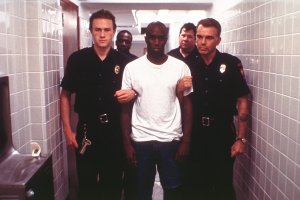 To that end, the story structure of Monster’s Ball works better. In the span of 110 minutes, Hank has to reflect on what the negative influences of his life are and to break free of them. When he finally decides to put his father in a nursing home, the lady in charge smiles and says, “You must love your father.” Hank is quick to reply, “No, I don’t. But he’s my father.” There is no love between these men because love was most likely viewed as weakness. It’s the last thing Sonny says before killing himself, after his father says he hates him: “Well I’ve always loved you.” When Leticia looks at a picture of Sonny, something that Hank doesn’t share until late in the film, she remarks that Sonny doesn’t look like Hank. He replies that Sonny has his mother in him, implying the things that made him better came from her. This is a character journey that literally culminates in a man performing oral sex on a woman as a sign of his personal growth. Taken by itself, it sounds laughable, but it mostly works in the context of the movie. Surely his father would view the giving of pleasure to another as a waste of energy and time, so his desire to give rather than receive ends up being his character’s defining push away from the negativity of his father.
My issue is that Leticia feels less like a fully-fleshed out person and more like an infantilized victim. She’s a single mother struggling to keep her job, keep her home, and keep her son’s weight in check. Her husband is on death row. She’s got a lot of opportunities to be given dimension and insight. However, the movie never seems to deem her ready for that attention until the very very end, literally the last scene of the movie. Beforehand, she’s more a prop to the development of others, someone to gauge Hank’s personal growth and someone to be inflicted with all manners of indignities and abuses. When she interacts with Hank’s father, and he’s as awful as you would expect, her residual pain and outrage is the final straw for Hank who then moves the old man out. Her entire relationship with her son feels awkwardly handled. Fiction can illuminate the lives of complicated people, people with flaws that don’t always make the best decisions, but her single-minded obsession with her son’s weight, and her subsequent beating of him, feels like another chain of abuse but without the explanation. Otherwise, it’s just a woman in pain berating her son, and then the boy has to die, and it feels excessive. I know that Hank and Leticia bond over their mutual grief over having lost a son, but it feels like Leticia is more a martyr for Hank’s growth. During their protracted sex scene, her voice cracks and sounds uncomfortably childish. At the end, she asks Hank to take care of her because she needs it. She comes across like an infantilized version of a woman who is there to cry and be pretty.
 That’s why the final moment of the movie rings so curious for me. After Hank puts his father away, what is the conflict here? Leticia agrees to move in with Hank after being evicted, and it all seems to be going well. Then while he’s out retrieving his favorite ice cream, she discovers that Hank has drawings by her late husband, reshaping her understanding of Hank. But what is that reshaping? Before he was a guy she served at a diner who happened to help her during the most trying time in her life. Does she think he was seeking her out to take advantage of her? How? She got the diner job because she lost her previous job, and it’s not like he sought her out, but she might not be privy to any of that context. It feels like an artificial conflict that’s meant to boil over and possibly spell doom between these two. Can this budding relationship survive this revelation? But I’m still unclear what exactly the revelation is. He worked at the prison? He was involved in the execution of her husband in a way, walking him to the chair? This seems artificially inflated to me. And yet it is only here that the movie gives her the final say, allowing Berry to wordlessly process this new information and whether or not it dramatically changes anything between her and Hank. She never comments to him about it. You just have to study her face, and it’s here where the movie at long last treats Leticia with the courtesy of nuance.
Monster’s Ball was made famous for two reasons: the extended sex scene between Berry and Thornton and her Best Actress Oscar victory, the first ever for a woman of color (and still the only one twenty years later). Let’s start with Berry’s performance, which was definitely a leap above what she had been demonstrating with trashy thrillers and lame comedies. Berry is good here but the Lee Daniels of it all makes it feel like her performance is being pulled into less subtle, more overtly soapy directions against her better judgements. When she gets into a whiny space, I kind of winced, not because her character was undeserving of complaint, but because the movie was shifting her into that infantilized victim box. Berry is good here, but after re-watching Sissy Spacek’s In the Bedroom performance and Nicole Kidman’s Moulin Rouge! performance, I’d rate her third of the chief 2001 Best Actress nominees. Berry is an actress I had mixed feelings about early in my critical career (2004’s Catwoman did not help), but I’ve come around to appreciate her more. I greatly enjoyed her varied performances in 2012’s Cloud Atlas. She recently directed her first movie where she plays a middle-aged kick boxer, and that sounds punishing and possibly eye-opening.
I’m not the only one that seems to come back to the infamous sex scene; it constitutes almost all of the trivia about the film on IMDB (interesting not-sex-scene fact: Wes Bentley was going to play Sonny but mysteriously dropped out –he admitted to struggling with heroin addiction later– and the studio gave the production 48 hours to find a replacement, and that’s how Heath Ledger got it). Also, I had to revise this paragraph several times to remove any phrases that might come across as unintended innuendos. You could argue the sex scene is a turning point. It happens at the halfway point of Monster’s Ball and beforehand Leticia and Hank have expressed no romantic interest. Afterwards, it becomes about their possible odd-couple romance, if that’s what it can even be called. The scene is played raw and desperate, which is why it made me feel uncomfortable. It wasn’t because I was watching two actors pretend to physically go at it for an extended period, it’s because these characters were so sad and reaching out in desperation to feel anything fleeting. The attention given to the scene just feels thematically wrong. It’s not offensively gross but it feels a little too prurient, a little too salacious for what the characters are going through emotionally. Thornton has even said in interviews that this movie might have contributed to his eventual divorce from Angelina Jolie, which seems strange to me considering she was also filming steamy scenes with Antonio Banderas at about the same time (2001’s Original Sin).
 Director Marc Forster has had an interesting career since helming this four-million dollar indie. He’s done Oscar-bait dramas (Finding Neverland, The Kite Runner) and quirky indies (Stranger Than Fiction, Stay) and big Hollywood action movies (Quantum of Solace, World War Z). He was hand-selected by producer Brad Pitt to direct World War Z. Forster has no distinct, visible style to him but effectively alters to the genre and story he’s directing. In some ways, this is what a director should be, and yet Forster has never gotten credit for his versatility. Nobody is going to say Quantum of Solace is their favorite James Bond movie, or even the best of Daniel Craig’s run, but it’s not really Forster’s fault that movie didn’t work. His last two movies were smaller dramas, 2016’s All I See is You and 2018’s misguided Christopher Robin, and he’s attached to movies about the Holocaust, a downed World War II pilot, the formation of Greenpeace, and Thomas the Tank Engine, so the man’s versatility continues to go undervalued.
This is my final re-review of the 2001 film slate, and my original review I think mostly holds up. I was thinking the same thing about lazy metaphors and lacking substantial racial commentary, but I better appreciated the scope of the movie not on race but on the effects of toxic masculinity. I think I was more dazzled by the photography in 2001 (or 2002 when it was made available to us in central Ohio) than in 2021. Monster’s Ball is a clumsy but well-intentioned movie that has some pristine elements to it but I don’t quite know if it ever coalesces into the important movie it desires. It’s an interesting artifact of Lee Daniels before he became an industry unto himself, and with Berry showcasing just what she was capable of if given the right opportunity. This began a run of “pretty actress goes drab” of Oscar winners (2002’s Nicole Kidman, 2003’s Charlize Theron, 2004’s Hilary Swank), and so the biggest lesson of Monster’s Ball after all might have been providing a successful template for future actresses to follow a path to Oscar gold.
Re-View Grade: B-


 nathanzoebl
You must be logged in to post a comment.