Blog Archives
Knocked Up (2007)
 Judd Apatow scores again. The man has a long history of creating memorable and heartwarming character-based comedy, and Knocked Up is another winner. This man creates thoroughly human and engaging stories that focus on our own foibles and triumphs. Apatow wrote and directed yet another poignant, clever, and uproarious comedy that has so much more below the surface and becomes universally appealing.
Alison (Katherine Heigl) is out on the town celebrating her promotion at the E! Entertainment Channel. She’s going to go from behind the camera to in front of the camera. It’s at this Los Angeles club where she meets Ben Stone (Seth Rogen), a doughy Jewish slob of a man content to drift through life penniless and high. Their night of partying leads to a drunken one-night stand. Eight weeks later Alison is going through extreme nausea and can’t figure out what kind of flu bug she has, that is, until she remembers her one night out. She locates Ben and informs him that she is pregnant and, yes, he is the father. The two decide to try and make it work, forging a relationship as they plan on becoming parents. Alison’s sister Debbie (Leslie Mann) and her husband Pete (Paul Rudd) and their two kids are a potential glimpse into the future. Pete and Ben hit it off real well, to the point that Alison feels like her mate might not be the one for her even if his DNA is growing inside.
 Naturally, this is a comedy where sex is at its very inception. The humor is ribald and playfully profane. I believe one of the greatest compliments you can give a comedy is when you cannot single out a single set piece or moment as an instant standout. Knocked Up is packed with many wildly funny scenes but it also has killer one-liners from start to finish and sharp pop-culture references (Ben on an exercise bike: “Matthew Fox? From Lost? You know what’s interesting about that guy? Absolutely nothing.”). Ben credits the flick Munich for the ability to get Jews laid. Ben watches the 2003 version of Cheaper by the Dozen with horror, saying that 12 kids is no laughing matter. The roommates are plotting a flesh-friendly website that notes the time and location of celebrity nudity in films. This commercial venture plays right into the frat house lifestyle for this band of stoners that bet their friend not to shave his beard for a year for free rent.
Knocked Up is bawdy and hilarious, sure, but it’s also far more realistic and a lot more emotionally involving than any romantic comedy Hollywood has offered in years. Apatow seems to have mined his personal parental experiences for a lot of hard-earned truths. The film is most natural when it showcases the male perspective of prolonged adolescence and an unplanned pregnancy, but Knocked Up also has a mature and thoughtful view on marriage and feminism. We see the array of personal challenges a woman would go through but the movie still manage to slip in humor amidst the uncertainty. There’s a montage looking for the right gynecologist. The gauntlet of sexual positions is explored while pregnant, with Ben afraid that his child’s first impression will be daddy’s manhood constantly poking it. When Alison and Debbie go shopping for pregnancy tests we see them fill their cart with every kind of tests, and then test after test comes back positive. “Hey this one has a smiley face,” says Debbie, before realizing, “Oh, that’s not a good thing.” Debbie then tests the reliability of the tests herself and for a brief moment panics when she thinks she may be pregnant for a third time. She then calms down and says, sarcasm-free, “Whoa, that would have sucked.” The inclusion of Debbie and Pete offers a whole other relationship viewpoint, something that Alison and Ben can learn from. She’s paranoid and blunt, and he’s apathetic and passive-aggressive, and Alison is terrified that she and Ben are doomed to a similar fate. The insights into marriage and secrecy are realistic and give the film so much more meat to its bones. This isn’t just a movie about what to do with an unplanned pregnancy; it’s fully about male-female dynamics and what it takes to make a family work.
 In the end, you really care about these characters because Knocked Up is a raunch-fest that has a sweet gooey center of sentiment. Ben is pushed into adulthood by this unexpected development and, as they say, puts away childish things after a lot of trial and error. There’s an undercurrent of emotional vexation under most of the comedy, like when Pete confesses that he doesn’t know if he can accept love, and Ben cannot pity this because he sees his love being rejected. Alison doesn’t quite have as big of an arc, but she never gets callously cast to the side and forgotten. She too has a lot of growing up to do very quickly, and when both characters welcome their newborn into this world it’s rather moving and exciting to experience it alongside them. Ben’s confesses to his child that not putting a condom on was the best decision he ever made. In any other movie this ending conversation might seem trite or hokey, but Apatow has paid so close attention to his characters that the emotional payoff is earned and rewarding.
Another hallmark of an Apatow production is how perfect the cast seems with one another. There’s a real camaraderie with the actors and it produces natural onscreen chemistry and amusing improvisation. Rogen and Rudd, teaming again after 40-Year Old Virgin, can riff off one another for a whole movie and I would gladly pay to watch. I loved when the two boys go to Vegas, take mushrooms, see Cirque Solei, and then freak out in their hotel room (“There are five different kinds of chairs in this room”). I was laughing so hard I had tears in my eyes, and I’m sure the crux of this moment was born from the freestyle exchange between the actors. Ben’s roommates have a believable kinship to them as a collection of amicable oddballs and stoners. Mann and Heigl also seem believable as sisters, much more so than would Anne Hathaway, who was originally cast as Alison but left due to creative differences (I guess the difference was she didn’t wish to be apart of a good movie). The Knocked Up cast work together like a truly wonderful team that appreciates the material and each other.
Rogen is destined for stardom after this movie. He can make anything funny with exceptional comic timing and line delivery that never feels forced. Hearing his unique giggle at the end of jokes, you can sense that this sweet and amiable guy would crack himself up and for good reason. Rogen was great in 40-Year Old Virgin and is even better in a bigger dose. Heigl gets to play more familiar notes, from stressing that work will discover her little bun in the oven to the expected birthing scream session. She has a good rapport with Rogen and brings a lot of warmth to her role. Rudd is so effortlessly charming and easy going. Mann plays a perfect bitch, but she also has a nice scene where she explodes at the realization that her days of youth are finally behind her. Special mention must go out to Kristen Wiig. She steals every scene she’s in as an E! Channel employee that makes plenty off-the-cuff passive insults against Alison during two staffer meetings.
 I’ve read online that several leftist bloggers are angry and flabbergasted that Alison does not get an abortion. They argue Ben is a fat and unappealing slob, she’s an attractive career woman, and not having an abortion in this situation is, as one put it, “stupid.” Excuse me, but this may be the first mainstream comedy that actually discusses the prospects of an abortion (or as one character deems it, a “smashortion,” as not to offend the delicate sensibilities of his roommate). I also take umbrage to anyone saying 1) choosing not to have an abortion is a bad decision, and 2) that these critics would be so daft to miss the point that if Alison had an abortion there would be NO MOVIE.
Knocked Up is a very funny and very wonderful sex comedy for adults, but it also happens to be an endearing and heartfelt romance. The cast is excellent, the comedy rarely misses a beat, and Apatow is a instant classic hitmaker. Just like The 40-Year Old Virgin, Apatow has explored a deeply personal topic for all the comedy and pathos he could wring from the material. Knocked Up is nothing short of a knockout. I hope you’re happy with your decision Anne Hathaway. I know I am.
Nate’s Grade: A
Share this:

In the Land of Women (2007)
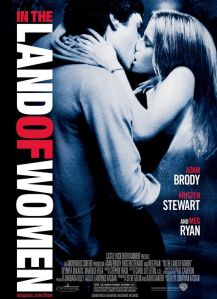 Nepotism is about as prevalent in Hollywood as venereal diseases. Plenty of people get their foot in the door because they just so happen to share genetic material with successful filmmakers. It happens all the time in the world of business, and movies rake in the cash, so the Kasdan clan isn’t any exception to the rule. Papa Lawrence has a storied pedigree. He’s responsible for Body Heat, Raiders of the Lost Ark, The Big Chill, The Accidental Tourist, and two, count ’em, two Star Wars movies (the good ones). His oldest son Jake has directed Zero Effect and Orange County. Now younger son Jon Kasdan is taking the leap into the family business with In the Land of Women.
Carter (Adam Brody) is a Los Angeles writer for soft-core pornography. He?s just been dumped by an up and coming Spanish actress (Elena Anaya). He feels lost and comes up with a plan that will help inspire him to write his serious novel that’s been gestating for ten years. He heads out to a small Michigan suburb to live with his crabby hypochondriac grandmother (Olympia Dukakis). Across the street is a glum family. Sarah (Meg Ryan) is coping with raising a family and undergoing chemotherapy for the lump in her breast. Her teen daughter Lucy (Kristen Stewart) is full of angst and hates her mom. Carter inserts himself into the family’s life and may just heal longstanding wounds.
 In the Land of Women is a strange experience because it feels like the entire movie is cobbled together by subplots. There doesn’t seem to be a strong central storyline, a strong central character, or any real connective tissue. You start to feel the lack of direction and discipline from Kasdan. The characters are all underdeveloped when they aren’t behaving in unbelievable manners. This is another drama where the characters take long strolls and wax introspectively about their life, spelling everything out with rare clarity to strangers. This would be more permissible had the film presented any other avenue for character development. Ryan gets the sick mom storyline, Stewart gets the awkward and angry teen storyline, and Dukakis gets the crazy grandma storyline. It may be a land of women but these aren’t very well constructed women, and I’m uncertain what exactly Carter has learned from this supposedly life-changing experience. He met some women, he listened; in fact, I think that’s where the film takes its first wrong turn. Carter is a self-described great listener, so guess what happens when he meets women who have bottled up their secrets and true feelings? Yep, he listens. And we watch him listen for most of the movie. This allows characters to unload dramatic monologues that do the major work for characterization, but it still keeps our main character, the traveler to the titular land of women, as nothing more than a low-key cipher. He’s a handsome couch for the female characters to unwind. When Carter is typing his Big Serious Novel I’m clueless as to how he has changed as a person and how he reached his point of enlightenment.
I get the unmistakable feeling that Kasdan is really trying to make his own Garden State. This is another story of personal maturation and it takes places with a visit home to a simpler life with comic oddballs. He’s taken the elements that made Garden State click, including a hip and frequently heard soundtrack, but Kasdan must have missed the part where Garden State benefits from strong, likeable characters and a plot. Just like Carter, Kasdan is striving for something grandiose to say about the world, but the end results are no better, and no worse, than something you could catch on a nondescript cable channel. The movie is stuffed with familiar moments, like the bustling teen party, the precocious teen wise beyond her years, the feeble love triangles, and the asshole jock boyfriend. The handful of new wrinkles that Kasdan does explore is easily forgotten; Carter’s job deserves far more discussion. When the Hollywood life butts back in Kasdan doesn’t push the juxtaposition as hard as he should, so Carter’s troubles feel puny, especially compared with cancer. In the Land of Women has some touching moments to it and an occasional wise bit of dialogue, and they stand out amongst an otherwise underwhelming panorama.
 In the Land of Women reaches its awkward peaks when it treats Carter?s mother-daughter interaction like two choices for romance. Carter is supposed to be 25, making him about 20 years younger than mom and 10 years older than daughter. In my book, that’s an “ick” on both accounts. Carter gets to smooch both women (hell, one of the kisses is the poster) and the audience gets to squirm both times. Our sense of guilt is alleviated by multiple characters telling us that Sarah’s father is having an affair, so then it shouldn’t matter if she finds understanding and warmth in the arms of a young emo pup. But what makes these sidesteps so awful is how clumsy and meaningless they prove to be.
The acting in the movie is well done. Brody is apt for a romantic comedy leading man. He’s got oodles of laid back charisma and a winning sense of humor that made him the breakout star of a prime time soap. He’s affable and enjoyable to watch, but his relaxed acting style doesn’t help an undefined character. Stewart is a wonderfully natural actress and largely communicates with her gangly physicality. She has the teen contempt down perfect and looks like an average teenager, which compounds how icky it seems to see her kiss Carter. Ryan hasn’t been onscreen in 3 years, and to tell the truth, I kind of missed her. She gets some standard emotional scenes as an afflicted, underappreciated mother and sells them well.
Jon Kasdan’s filmmaking debut isn’t going to do much to redefine his artistic image other than that of a lucky genetic benefactor. In the Land of Women is earnest and well acted, but the movie is just far too underdeveloped and shapeless to succeed. The film is a collection of non-starting subplots and familiar elements; you just feel that the movie needs a kick in the ass to get on track. The soundtrack is pleasant, the production is competently made, but the story is ultimately lacking and underwhelming. The land of women and men deserves better.
Nate’s Grade: B-
Share this:

Shortbus (2006)
 How do we define pornography? John Cameron Mitchell (creator of Hedwig and the Angry Inch) wrote and directed an examination on human relationships that also employs hardcore sex. Yes, the actors are really having sex and we really see, among other things, a man fellate himself to climax. There’s hetero sex, homo sex, masturbation, and, in small flashes, a whole sweaty orgy of people of all shapes, sizes, colors, and tastes. This movie celebrates the sheer possibilities and enjoyment of sex. Mitchell isn’t the first serious filmmaker to show people really doing it, and the movie shows sex in a realistic fashion that is rarely seen, with all the humor, playfulness, and stumbles that can arise. It?s refreshing and a great window into the depths of human interaction. That’s the deal: everyone in this film is reaching out to feel something. The script mostly follows the pursuit of a sex therapist who has never had an orgasm. The sex will get the headlines but it’s the quiet reflections on human connection that really sneaks up on you and can hit hard. The movie doesn’t cover every facet with ease, like a stalker-esque character, and some of the acting is a bit amateurish; however, it’s a daring film that has a disarming sweetness to it and an open-hearted message that’s rather romantic after all. And no, it’s not porn.
Nate?s Grade: B
Share this:

Catch and Release (2007)
 Catch and Release may in fact have the most bizarre meet-cute in movie history. Gray (Jennifer Garner) is mourning the loss of Grady, the man that would have been her husband. She seeks a refuge from all the well-wishers and lies down in a bathtub with the shower curtain drawn. Fritz (Timothy Olyphant), one of the deceased’s best friends, enters the room with a female caterer. They position themselves against a wall and engage in some opportune sex. Gray is trapped and forced to hear the whole thing. The caterer keeps screaming, “Sock it to me” in increasing orgiastic pleasure. I was waiting for some more 1950s hipster dirty talk, like, “Lay it in me, Daddy-O.” Eventually the sex comes to an end and Fritz lights up a post-coital cigarette. But then Gray flings the shower curtain back. Aha! It’s boy meets girl in the most preposterous fashion, but that’s Catch and Release for you, a romantic comedy with enough to be different but still too limited to become anything other than a lukewarm date movie.
Now absent one less earner, Gray is forced to move into a house occupied by Sam (Kevin Smith) and Dennis (Sam Jaeger). They were friends of Gray’s ex as well. Then life proceeds to give Gray a series of curve balls. She discovers that her dead fiancé had over a million dollars in the bank and an 8-year-old son with another woman (Juliet Lewis), a flighty New Age massage therapist. Grady might not have been the same man Gray thought she was set to have and to hold (her married name would have been Gray Grady?).
 Things get off to an interesting start. The proposed wedding party has been transformed into a wake. Then as she is trying to cope with loss and put the pieces of her life together she’s further undone by revelation after revelation of secrets her ex kept from her. That’s pretty dark for a usual airy genre but also a pretty interesting setup for something different. Catch and Release flirts with being unconventional but then is on a fairly predictable trajectory once its promise settles down and completely dissolves.
Thankfully, despite all the doom and gloom there isn’t any grating sense of whininess. The perspective feels knowing and in search of wisdom through life’s unexpected calamities. Writer/director Susannah Grant (Erin Brockovich, Ever After) has a worthy adult sensibility that helps make the film feel a bit more credible and less like an inane melodrama. Catch and Release feels less pre-programmed and unlike most paint-by-numbers romantic comedies, and yet it still wears the weight of its genre around its neck and can never take a step forward without taking two backwards. There’s ample opportunity for a romantic comedy that begins at the literal end of a relationship, with the widow discovering more than she ever knew about her dearly departed (a rom-com version of The Constant Gardener? Call me, Hollywood). However, the movie seems too content to walk the same beaten path many have before it. It may be nothing more than a throwaway genre movie but it got my hopes up that it could have been something more. I feel spurned and betrayed, somewhat like Gray must have felt.
Catch and Release is a hit-and-miss date movie that can never really reel in what it wants to do. The film has some somewhat inspired moments but is also dominated by romantic comedy clichés and sitcom generalizations when it comes to its characters and setting. Of course the nice guy has had a lifelong crush on Gray. Of course the fat guy is also funny and rude. And of course we’re going to house all of these people under one roof so it will produce plenty of Gray-Fritz interactions that will lead to their eventual coupling. Plus, who could forget the classic eleventh hour misunderstanding followed by the pursuit that ends in a glib line like, “What took you so long?” The movie seems to be trying too hard to make Fritz seem like a suitable replacement when we never really know much about him. He’s kind of sleazy and he knows it, but when exactly does he become likeably sleazy? Their union feels forced and unrealistic, even by romantic comedy standards. It also feels like Grant named Garner’s character Gray just so she could include this passage:
Gray: “What’s your favorite color?”
Fritz: “Gray.”
 This prompted an entire row of teenage girls to go “ahhhhh” in my theater. I wanted to laugh, but then I was grossly outnumbered in my theater.
Catch and Release is mostly a grab bag of other romantic comedies. It doesn’t even know what to do with the fly fishing metaphor it valiantly tries to lift into some deeper meaning. I don’t get it myself. Gray says that her dead ex was always a “catch and release” man; does this mean he never had the heart to finish off his prey, or that he was too sympathetic with struggling creatures? It doesn’t matter what the metaphor attempts are because it allows for the cast to put on their rubber boots and wade in the cool waters of predictability. At least only one character works in the usual romantic comedy job pool (publishing, advertising, theater). Though Sam does come up with quotes for boxes.
Garner is such a winning actress but still finding her stride. She’s being positioned to fill the void of Meg Ryan and Julia Roberts, which is fine, but when I see her more as a modern Sigourney Weaver, someone who can excel in light comedy but also kick your ass when the time came. Gray’s world goes into upheaval and Garner is up to the task balancing emotion and wry life observations, but too often there’s little else for her to do but pout or crinkle her eyebrows. Her cheekbones certainly get quite a workout in Catch and Release but I wouldn’t exactly call that dramatic acting. I have been a fan of Olyphant since 1999’s Go. He’s always had a scary sexiness to him, and works best playing assholes you just can’t help but love. Grant totally drops the ball on his character. Fritz is behind the eight ball early and never really recovers when it comes to audience loyalty. Olyphant is also given a problematic shaggy haircut that manages to neutralize his natural alluring danger and still make him seem aloof. His role is a stock role and nothing more.
 Thank God for Kevin Smith. Grant wisely chose Silent Bob as her comic relief and Smith has such natural laid back charm and great timing that he should get more acting gigs full time. His presence is deeply missed when he steps offstage and the film returns back to its familiar roots. I don?t know why Grant has Sam eating or making food, or talking about eating in almost every scene. After the fourth scene in a row where Sam has a chicken leg in his fist, it gets tiresome, like she defined a character by hunger. Smith has the best scenes and the best chemistry, whether it’s with Garner, Lewis, or a little kid. I think someone should cast Kevin Smith as the lead of a romantic comedy. Now that’s an unconventional date movie I’d pay to see.
Catch and Release has some glimmers of promise before succumbing to the weight of the romantic comedy genre. The movie just cannot get past mounting clichés and shallow characters, plus some fairly contrived situations like the bizarre meet-cute. Garner and her dimples will survive to enchant another day. At the end of the day, Catch and Release is just like any other romantic comedy movie, and there’s plenty more of those in the sea.
Nate’s Grade: C+
Share this:

Date Movie (2006)
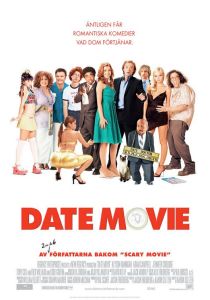 This film was just another nail in the coffin of spoof comedy. Date Movie was supposed to be a spoof on romantic comedies, but what it ended up becoming was a spoof on anything. The film confused referencing with parodying, and they are world’s apart. Just because, for a split-second, someone dressed like Ben Stiller throws a dodge ball does not mean it is a parody. This painfully unfunny comedy went from setup to setup, blindly trying to grasp for a joke and falling back on scatological humor. Most of the film references mean nothing and don’t even parlay into jokes, the joke itself is simply the reference, like the appearance of Napoleon Dynamite and King Kong. There was not a single point in this entire movie where I laughed out loud, a death sentence for a comedy. This movie makes Scary Movie and its geysers of semen look like Shakespeare.
Nate’s Grade: D+
Share this:

Stranger than Fiction (2006)
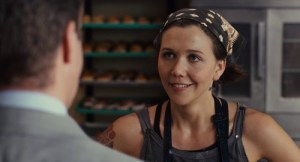
 Ever think your life would make for a good story? Be careful what you wish for. Harold Crick (Will Ferrell) is hearing voices. They aren’t telling him to kill or do anything subversive. In fact it’s just one voice, an English woman, and she isn’t instructing Crick to do anything. No, she’s more so just… narrating. She comes in and out and expresses the doldrums of Crick?s life. He’s an IRS agent whose life revolves around order, repetition, and numbers. We can even see his inner tabulations thanks to some snazzy onscreen visual effects. Crick is sent to audit Anna (Maggie Gyllenhaal), a baker with a disdain for civil servants and authority. Crick is stricken by this shrewd beauty and finds himself wanting her, something the Narrator affirms for him. Crick’s life takes a dour turn when the Narrator lets on that Harold Crick had set in motion his “imminent death.” Crick is confused and seeks advice from Professor Hilbert (Dustin Hoffman) an expert on literature. Then they figure out the Narrator is Kay Eiffel (Emma Thompson), a famous writer who has the unfortunate habit of bumping off every one of her main characters.
Make no mistake, Stranger than Fiction is funny, but it’s a different kind of funny than most people are accustomed to with Ferrell. In my theater, I kept an eye on a gaggle of teenagers sitting several rows in front of me. I just wanted to observe their body language and what I saw was a lot of fidgeting, getting up for trips to bathrooms and popcorn, and lots of whispery talk. I can only imagine the disappointment of those teenagers expecting Ferrell to rip his clothes off and run around like a buffoon. They were likely busily thumbing away at their ever-present cell phones, text messaging their friends. People that are looking for a wild, sidesplitting, slapstick comedy are going to shaking their head. Stranger than Fiction is funny, but it’s in a very dry, witty way, much like British humor; it’s a humor you can admire for being clever but might not make you roll in any aisle.
 The biggest fans of Stranger than Fiction will be bookworms. This is a very literate movie that works better for those with an appreciation or outright love of literature and storytelling. Professor Hilbert doesn’t initially believe Crick until he learns that Crick’s narrator said, “Little did he know.” That, ladies and gents, is all a professor of literature needs. He has to rule out what kind of story Crick may be apart of, so he subjects Crick to a series of hilarious questions along the lines of treasure-inheriting, nemesis-making, and magical-creature befriending. Crick keeps a notebook to tally examples in his life that may point to whether he is part of a Comedy or a Tragedy. Professor Hilton even explains the difference: in grand Shakespearean tradition, a comedy ends with people getting hitched and a tragedy ends with people getting snuffed. This is all fabulously witty and extremely fun, but I can think you’ll see why hard-core fans of Old School and Talladega Nights might be heading for the exits.
Writer Zach Helm has created a wonderfully whimsical tale that’s trippy but manages to still have warmth and a firm heart. It’s far more embraceable a movie than, say, Adaptation, and less smug. He has a smart sense of humor and loves deconstructing literature, like the Jasper Fforde (The Thursday Next books) of screenwriting. We are really sucked into the movie from the moment we can hear Thompson. The story has an innocence to it and this existential comedy feels out there but still grounded; it’s surprisingly poignant and full of dramatic revelations. Even better, Helm has done something that few have achieved: he wrote a story-within-a-story that works. Kay’s narrative voice is highly droll in her observations on Harold Crick’s life. It sounds like a genuine novel, and on top of that, a novel I would enjoy reading. Stranger than Fiction is all the proof I need that Helm is a talent to keep track of.
 The performers all seem to have the same affection for the material. Ferrell is making that leap from funnyman into leading man, the same dramatic territory Robin Williams first tiptoed in Good Morning Vietnam and, likewise, Jim Carrey approached in The Truman Show. Ferrell won’t turn any heads but he underplays his performance maturely, playing a sad but sweet drone of a human being finally taking charge of his life under very insane circumstances. There’s a quiet moment toward the end where Ferrell is told he must accept his fate and he sits, shell-shocked, tearing up, his voice getting softer with every word. It’s only a moment but it piques my interest in what Ferrell may have in the tank. The comedy he can do in spades, including a desperate moment when he tries narrating his own life to coax his Narrator out of hiding.
Who will turn heads, however, is Gyllenhaal. I can already see a nation of teen boys falling in love with her tattooed, punky baker. To them I say, get in line pals, Gyllenhaal has made me dot my I’s with hearts ever since her star-making performance in 2002’s kinky romantic comedy, Secretary. She’s easy to fall in love with and expresses a fragile compassion to her role. The romance between Anna and Crick is unexpected but these two people need each other, and you feel that need as you watch their eyes light up as their relationship blossoms. Late moments between them add to the tenderness of the film and you will be on your knees pleading Crick is spared so he can return to loving Anna. I think Wreckless Eric’s “Whole Wide World” will become a potential staple on romantic teenage mix CDs sent to their sweethearts from now on.
Thompson and Hoffman have appealing supporting performances. Thompson has marvelous fun thinking of different grisly outcomes in store for Crick. Her interaction with the hospital staff to see the “not gonna make it people” is a howl. But Thompson is too good of an actress to play it straight. Once she discovers the life-altering implications of her writing she is crushed by guilt, obsessed over killing good people cruelly. Frankly, if I had anyone narrating my life, Thompson’s voice would definitely rank high. Hoffman plays a dedicated literary professor like a straight man, and everything seems on the level for him, even the fantastic. It’s a nice touch for a film that doesn’t require broad strokes.
 The movie doesn’t have the depth of feeling or dark turnarounds that I know Charlie Kaufman would have done. Stranger than Fiction has a lot of fun with a very ripe premise, and is very intellectually stimulating, but you do feel like it could have gone further, exploring the reaches and implications of its metaphysical setup. What if someone who read Kay’s manuscript thought it was such a masterpiece, a shining light of literature that could move mountains, that they knew Crick must die, and that they must kill him to make certain of it. Or what about the relationship between author and character, and the role each has over the other and perhaps a battle over the future, a typewriter, and a happy ending at the end of a tunnel. However, while all of these options would further explore the novel premise, it would betray the movie’s whimsical tone. This isn’t a very dark movie. It has an authentic sweetness to it, and Crick is a gentle and kind man, and to do anything too heavy would work against the film’s tone. The movie explores existential queries and the topics can be grim, but ultimately Stranger than Fiction is life affirming.
Stranger than fiction also has a buoyant, unexpectedly pleasing romance to it. Again, it doesn’t show the depth of love and human feeling that Kaufman’s Eternal Sunshine could, but this is an unfair comparison. This romance is more a subplot that carries increasing weight thanks to heartwarming performances and the winsomely adorable Gyllenhaal. The romance in Eternal Sunshine was the story, and everything else was outside variable coming into contact. It might sound dismissive to call Stranger than Fiction as decaf Charlie Kaufman, but it really is a compliment. Kaufman is the most exciting, brilliant, creative, insightful, and whacked out screenwriter working today. I would give one of my kidneys to write even one story that could be described as decaf Kaufman. Stranger than Fiction may not examine as many themes, conflicts, or relationships as Kaufman might with the material, but this movie is a sweet fable that floats by like a fluffy cloud on a sunny day. It’s just so damn pleasant you sort of soak it in and fall in love, not wanting to leave.
Stranger than Fiction is strange, all right, but gloriously so. Scribe Zach Helm has concocted an existential fairy tale aimed for bookworms and outsiders. The premise is clever but the film doesn’t stop there, and Helm explores the implications of his premise with whimsy, charm, and a sweetness that is hard to rebuke. The wacky story seems reminiscent of Kaufman’s works, but it has a more heartwarming and embraceable appeal. Great performances from a game cast help to push the material even further into excellence. It has a small handful of flaws, perhaps a too limited scope, but that doesn’t stop Stranger than Fiction from being one of the best stories of 2006 and one of the best movies too.
Nate?s Grade: A-
Share this:

The Last Kiss (2006)
 Zach Braff has exploded in such a short amount of time. He was underappreciated on the perennially underappreciated Scrubs, but then his breakthrough came in 2004 with Garden State, an aloof, charming love story about personal awakening. After just one movie Braff is now a name-above-the-title headliner. For his second film, The Last Kiss, Braff stars as another young man going through another personal crisis. He even selected the radio-friendly songs for the soundtrack just like he did with Garden State. This new movie is actually a remake of a 2001 Italian film, adapted by Oscar-winning screenwriter Paul Haggis (Crash). But there’s one big difference between Garden State and The Last Kiss? Garden State is actually good.
Michael (Braff) works as an architect in Wisconsin. He’s having a bit of a crisis with the state of his life close to his impending thirtieth birthday. His girlfriend, Jenna (Jacinda Barrett), is pregnant with his child and the two are planning for their future, but all around them relationships are falling apart. Chris (Casey Affleck) feels crushed by the demands of his newborn child and wife. Kenny (Eric Christian Olsen) is looking for guilt-free sex. Izzy (Michael Weston) is a wreck after having his heart broken by his ex. Jenna’s parents (Blythe Danner and Tom Wilkinson) may be splitting after 30 years of marriage, not all of them blissful.
With all this in mind, Michael worries that his life seems too scripted now and deficit in surprises. Then along comes Kim (The O.C.‘s Rachel Bilson), a young flirty college student that shows a strong interest in Michael. He must decide where his life is heading and whose hand he’ll be holding.
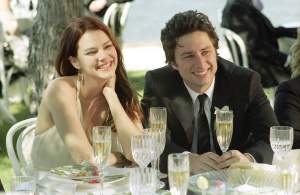 One of the reasons The Last Kiss is hard to get into is that the film never really elaborates why this foursome of guys have it so bad. Chris complains about a dead marriage but maybe his wife would nag him less if he spent more time trying to chip in around the house instead of avoiding his fatherly duties. Kenny is all gung-ho about a hot girl who’s interested in relationship-free sex, but then he runs the other way when, heaven forbid, the girl mentions the idea of commitment. Next thing you know, Kenny is not only running away from this girl but he’s joining Izzy on his cross-country road trip. He’s leaving the state because of the potential whiff of commitment. My friend, after we saw the movie, thought it was too stereotypical (woman: says one thing, wants other, man: scared of anything lasting). She suggested that Kenny slowly turns around his stance and wants to commit to this girl, who he obviously feels to be special. But that would mean The Last Kiss actually cares about the characters of Kenny and Izzy. These two serve more as a spare tire in a male relationship, and both their storylines are tied up with great time to spare.
Worst of all is Michael’s plight. He’s told by his buddies that he’s snagged the “perfect girl,” and from what we see she really is a lovely catch. Michael is freaking out because his life seems too tidy and empty of “surprises” now that a baby on the way. Boo hoo. So to jazz up his surprise-free life he has a fling with a college girl. Surprise! Isn’t your life better now, Michael? If it weren’t for the affable charm of Braff, who emits certain Dustin Hoffman Graduate vibes, the audience would feel no varying degree of sympathy for the dolt. Michael really bruises two innocent people just to needlessly reaffirm what he already knew. It’s hard to get behind all this. We don’t have to like characters, or their actions, but it hurts the drama when you’re simply watching one character hurt others for foolhardy reasons only evident to that character. In Unfaithful, we never really knew why Diane Lane had an affair but at least we saw complexity and strong repercussions.
There’s an element of maturity here and there with the screenplay, but twice as many moments of juvenile fantasies/fears (Look out, women will trap you and control you and expect equal work in return!). The movie has some adult material that works and hits its target but it also falls apart with idiotic musings. The best moments seem to come from the examination of the fading marriage between Jenna’s folks. It’s an interesting slice of life not commonly seen in youth-obsessed Hollywood, and Danner’s outbursts about what it takes to hold a 30-year union together ring true. But this moment falls victim, like many, to a tidy, simpleminded answer. Almost every storyline in The Last Kiss ends with a bow on it all wrapped up. Michael’s told not to give up and he essentially sleeps on his porch, wearing down the anger of his girlfriend through dogged persistence. In fact, the ending reminds me a bit of Secretary, another romance that ended with one lover proving their devotion by staying in one place a really long time. It’s almost insulting that the film presents Michael behaving badly and then excuses him as long as he just sticks it out. It’s not the idea that’s insulting; it’s the fact that The Last Kiss uses this ending as a cheap and easy out.
 One of the benefits of movies directed by actors is that they tend to generate good performances. Director Tony Goldwyn (A Walk on the Moon) has assembled a nice cast that gives more than the material they get. The real find is Barrett, who may just be the greatest alum of a reality TV show (she was on the London edition of MTV’s The Real World). She showed promise in 2003’s The Human Stain and The Last Kiss is really her declarative ascent. She might start getting a lot of offers that would have normally gone to a Meg Ryan or a Julia Roberts. She shows a range of emotions and her breakdowns are hard to watch because of how well she sells her distress. She handles has a natural ease about her, which pairs nicely with Braff’s laid back, unorthodox charisma. Bilson is cute and crimples her doll face in a way that makes her character seem more naïve than seductress. Braff plays his role a bit subdued. He flashes enough life to not seem like he’s sleepwalking though the same steps he plowed in Garden State. Still, it’s not a very remarkable performance for someone people keep tabbing as a potential voice of a generation (a term nobody could feasibly live up to).
The Last Kiss is an unconvincing, simpleminded, disingenuous drama populated by whiny dolts afraid of the good things they have. It’s hard to sympathize with any of these flawed characters when we never really feel like their gripes hold water. Michael can’t believe his life seems planned out with a wonderful woman who’s having his baby. Solution: screw it up for variety. While it may be the spice of life, it’s also a heedless decision for someone who needs to wreck everything in order to realize what he has/had. This would all be easier to swallow if The Last Kiss didn’t tie everything up with a happy ending that lacked the groundwork. In the end, according to the film, all bad behavior can be wiped clean if you just wear down your significant other. The drama feels forced and the conclusions feel inappropriate. All human beings make mistakes and so do filmmakers.
Nate’s Grade: C
Share this:

The Devil Wears Prada (2006)
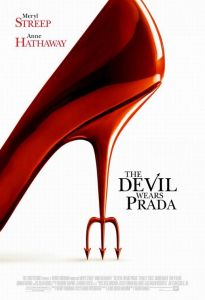 One part fantasy, one part incisive satire on the fashion industry, The Devil Wears Prada, on paper, may not be more than another formulaic entry where a young innocent gets caught up in the temptations of power and influence. I know little about the fashion industry other than what I can gleam from TV’s insanely watchable Project Runway and even I was charmed. Andrea (Anne Hathaway) is an idealistic journalism student paying the bills working as the assistant to Runway magazine’s ferocious editor in chief, Miranda (Meryl Streep). Andrea’s plain style of dress draws sneers and snickers from her rail-thin, nose-raising colleagues, and some smart snark from Miranda, who always seems to eviscerate people without raising the timber of her voice. The movie is typical with its rise-and-fall power structure, but even though it may be lightweight, The Devil Wears Prada is lots of fluffy fun, and all signs of life point to Streep. It’s almost a foregone conclusion that you’ll get a worthy Streep performance, but she’s totally unleashed in The Devil Wears Prada. Every time she sweeps into a scene she commands attention and steals the movie. We’re all just living in this woman’s world on borrowed time, and she knows it. Streep is in grand comedic form, dominating the movie with glares; just an inching of her facial expression can cause titters. It’s a juicy role and, mark my words, the most Oscar-nominated actress in history is going to get another nom for this performance. Hathaway proves to hold her own as well beyond those dark doe-eyes and cherry stem lips. The movie starts to drag in a third act trip to Paris, and Andrea’s empathy seems to get a bit out of tune (she feels worse about being better at her job than a co-worker than missing her boyfriend’s birthday). The Devil Wears Prada is an enjoyable, easily digestible piece of high-gloss fluff elevated by Streep’s dominating turn as a fashion lioness.
Nate’s Grade: B
Share this:

The Lake House (2006)
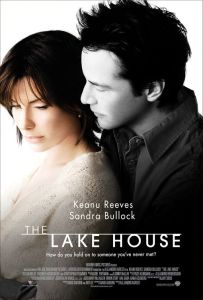 The first time I saw the trailer for The Lake House, a time-travel romance that reunites the stars of Speed, I said to myself at its conclusions, “If this lake house drops below 55 miles per hour…” I know, I’m a comedic genius, that much is obvious but what I was really reminded of was a 2002 film called Happy Accidents, a delightful gem of a movie with a similar time-travel romance. In that film you felt like anything could happen with its intricate plotting and off kilter, potentially seriously disturbed characters. Now it seems like Hollywood’s on board. The Lake House is based on an Asian film I’ve never heard of (though, in all honesty, I’ve never heard of 99.99% of them; sorry Asian cinema). This new East-West The Lake House doesn’t come across as that romantic but it’s hard to deny its points of interest.
Kate (Sandra Bullock) has taken a new job in Chicago and is moving out of a giant glass house on stilts that overlooks a lake. She leaves a note for the new resident, Alex (Keanu Reeves), an architect that struggles to fulfill his talent and his father’s (Christopher Plummer) legacy. Alex is confused; to his recollection, no one has lived in this house for years. Kate writes back and slips her notes into the nearby nostalgic mail box. But there’s something magical with this mail box. Kate is living in the year 2006 and Alex is living in the year 2004. Neither understands how it’s possible they’re even communicating by transporting letters through the mailbox. What’s even worse is that they’re falling in love with each other through their correspondence. Talk about your long-distance relationships.
 To go along with this kind of movie you really need to take it at face value. Once you start that slippery slope of questioning paradoxes of time travel or the narrative plot holes, you’ll be left in the cold for the remainder of the film. Yes, there are all sorts of logic paradoxes to clog the brain with, like the fact that every time Alex does something thoughtful, like plant a tree by Kate’s building, she won’t notice because she’s never had memories of anything being different. The characters themselves just shrug at the movie’s concept and accept this bizarre predicament. No explanation is given for this short circuit in the time space continuum, and frankly, no explanation is needed. The Lake House is not emphasizing the “why” but more the “what now?”
The Lake House is still a Hollywood romance in most senses. There’s little doubt that a happy ending is just around the corner, but at least the wrinkles and the road map to that point are not altogether predictable. The typical big moments are foreseeable, including that ever popular 11th hour misunderstanding, but The Lake House manages to tickle with surprise in the details of its journey. You don’t so much pull for the leads to get together but just see them tackle this mighty daunting obstacle before them.
The biggest flaw of The Lake House is that you never really believe these sad pretty people are falling in love. There is something indelibly romantic about falling in love with someone just from their words, constructing a potential soul mate with the few puzzle pieces given to you through long correspondence. Unfortunately, there’s nothing in those many pieces of parchment that Alex and Kate pass along that pinpoints why either pen pal would fall for the other. Both seem to have spotty luck with the opposite sex or are at least seeking more from a mate. But if The Lake House is any indication, these people have been chiefly seeking celibacy and verbosity in a mate. They talk about their lives, they talk about their pasts (in Kate’s case is a bit more extended), but it’s not too long before they start swooning and clutching those letters ever so tightly. The audience is left to fathom what invisible combination must have been unlocked that these sad pretty people have fallen for each other. While a lack of sustainable, let alone believable, romance in a romantic drama might be disastrous, at least The Lake House has a conceit strong enough to engage the brain even if it fails to engage the heart.
 The time jumps manage to keep the audience on its toes, plus there’s some fun in witnessing Alex and Kate try to locate each other and become bewildered. Director Alejandro Agresti (Valentin) and playwright David Auburn (Proof) play around with different techniques like split-screens and dissolves to present their lovers together. The conversational back-and-forth voice over does present problems; how exactly can they interrupt each other? The Lake House leans a little too hard on faith that we want to see these people end up together. Problem is that Kate and Alex are essentially void of depth; two characters defined more by the clunky subplots around them than their own personalities. Bullock and Reeves don’t help matters much, each perpetuating a vacant pretty android quality, like they’re waiting for a button to be pushed to explain human emotion.
I don’t know about you but if I was writing to someone in the past I’d use my knowledge and tell them to play certain lottery numbers or sports bets (“The Red Sox win what?”). Maybe it’s simply unromantic to start the basis of a relationship on gambling earnings. Then again, maybe it’s just unromantic to start a relationship with Keanu Reeves anyhow.
The Lake House is an old fashioned Hollywood romance but with some intriguing wrinkles and a playful structure. There’s a degree of predictability, the high-wattage stars fail to generate even low-wattage heat, but with the time-slip premise the film cannot be judge as familiar. The unusual situation and obstacles presented are more interesting than the main characters. Their love feels artificial and neither Kate nor Alex is rather deep, involving, or particularly smart (e-mail anyone?). Despite the limited help by the leads, The Lake House is a pleasant, different, if not terribly romantic Hollywood drama. For Hollywood, sometimes “pleasant and different” is enough for an enjoyable evening with the stars and someone special by your side. For everyone else, rent Happy Accidents.
Nate’s Grade: B
Share this:

Howl’s Moving Castle (2005)
 The flick is wonderfully imaginative, as to be expected from Miyazaki. The Pixar people really do an excellent job of bringing these films to an American audience and treat the English dubs with reverence. I’m not someone who’ll bemoan an English dub when it comes to anime but it’s nice to see effort and respect. The story is a bit similar to Princess Mononoke with the warring factions, the mystic and the industrial, and Miyazaki’s refusal to paint in black and white. There are so many delightful touches here from the fire demon to the door portal to one segment that just involves two old ladies ascending stairs for three minutes. And yet it’s the spirit Miyazaki infuses and the attention to story and character that sets his films apart. There’s a genuine sense of magic while watching his films and Howl is no different. The only bit of contention I had with the movie is how abrupt the ending is. Howl’s Moving Castle is a bit soaked with confusion and some narrative cop-outs (“Surprise! I’m the prince responsible for the war!”). I would have loved another 30 minutes in this world as well as a better opportunity for Miyazaki to bring his story down with a smoother landing. Still, saying this is a slightly lesser Miyazaki film is like saying a million dollars is less awesome than 2 million dollars. Howl’s Moving Castle is another sterling addition to a master storyteller.
Nate’s Grade: A-


 nathanzoebl
You must be logged in to post a comment.