Blog Archives
The Namesake (2007)

Extremely heartfelt, this cross-generational family drama runs aground on some familiar territory but is boasted by strong acting. Whenever the film’s focus falls to the arranged married couple settling into a new country and a new relationship, that is when The Namesake is the most affecting and interesting. Too much time is spent on Gogol (Kal Penn) as their son who has completely embraced American culture and throws off his Indian roots. Of course he comes around in his opinion but his character never feels fully formed or completely believable, more like a composite of a prodigal son. Director Mira Nair has an obvious personal attachment to this tale of an Indian family trying to make their way in the U.S. of A, and she never misses her mark when dealing with the intensely decent and selfless father and his love for his wife. It’s a shame then that the movie shifts too much focus at the halfway point onto Gogol. The Namesake is touching and entertaining that’s a cut above thanks to sensitive performances.
Nate’s Grade: B+
Share this:

Waitress (2007)
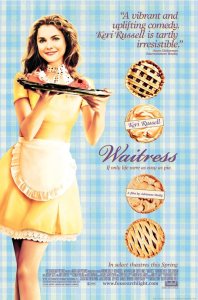 Kerri Russell is irresistibly charming in this winning romantic comedy from the late write/director Adrienne Shelly. I fell totally in love, head over heels, with Waitress and I’m not ashamed to say it. In a perfect world, Russell would earn an Oscar-nomination for her sure-handed, witty, and incandescent performance as a pregnant woman who has an affair with her new gyno doc (Serenity‘s Nathan Fillion). This is a star-making performance and it is sealed when the movie relies solely on her emerging smile for an entire minute to communicate a blossoming figure. The supporting cast is great in their eccentric roles well and the movie concludes in a happy if unconventional manner. Waitress is the kind of movie that makes you feel great. The sheer exuberance on display is infectious and it makes it an even bigger tragedy that Shelly will never grant the world another wonderful slice of entertainment.
Nate’s Grade: A
Share this:

Blood and Chocolate (2007)
 A werewolf tale set in Europe where the remaining handful of werewolves hunt men for sport by night and swish around being Eurotrash by day. The film plays closely to the teens-as-super creatures formula that seems to be chiseled by the likes of The Craft, Underworld, and The Covenant. What’s kind of hilariously goofy is that these werewolves actually just turn into normal, White Fang-looking wolves; no hulking man-beasts. They tend to run, and in a feat of cheesy special effects, blur into a wolf thanks to a magical glow. But there are instances when they would be much better off staying as people than transforming into wolves, like for ridiculous wolf-on-wolf fight scenes. The whole concept seems rather uninspiring; would you feel a sense of power simply because you could transform into a medium sized canine at will? I can’t see many practical instances where this would benefit someone. What’s the appeal? Regardless, the peculiarly titled film is rather dim with plot and character and whimpers to a hasty yet predictable conclusion. Agnes Bruckner, that’s a talented and beautiful young actress. Someone out there find here something worthy.
Nate’s Grade: D+
Share this:

Lars and the Real Girl (2007)
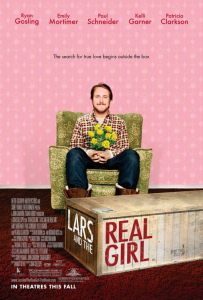 In order to be affected by the sweet romantic spell of Lars and the Real Girl, the viewer must accept everything as a fable; to try and apply real world logic would destroy the film’s magic. Lars (Ryan Gosling) is a painfully shy man still haunted by the knowledge that his own birth killed his mother. He lives in his brother’s garage and has difficulties interacting with regular folks. Then one day comes Bianca who just happens to be made of silicone; she’s a Love Doll, though Lars’ relationship with the upgraded Barbie is completely platonic. Lars is using the doll to deal with his own intense loneliness and his family and the town, a.k.a. the most understanding town in the world, play along to help Lars along on his emotional recovery. Gosling, in short, acts the hell out of this movie. His performance is a bit mannered but he channels so much pain and unresolved emotions that it’s a marvel to watch. He makes Lars more than just a weirdo with a weird coping mechanism; he makes Lars deeply, excruciatingly human and filled with unmet desire for affection. Gosling is so immensely talented that I don’t know if there are any limits to what he can bring to a character. The film has just enough psychology to it that the slew of characters deepen as we progress and the audience grows attached. By the end, I was amazed at how much genuine emotion I felt for a giant hunk of silicone. Give credit to the filmmakers who play Lars out with conviction and grace, and give major credit to Gosling.
Nate’s Grade: B+
Share this:

Juno (2007)
 Juno is a hysterical teen comedy with equal parts sweetness and sour. The idea of an underage pregnancy certainly presents a lot of conflicts and seriousness but the film avoids direct messages on the big topics thanks to large doses of levity and some hard-earned wisdom. With this serving as a companion piece to Knocked Up, I suppose Hollywood is convinced there’s something inherently funny about unplanned pregnancy. Remember that, suddenly expectant fathers and mothers.
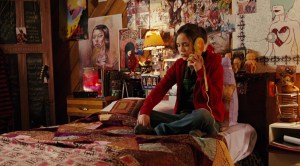
16-year-old Juno MacGuff (Ellen Page) drinks her “weight in Sunny D” to take pregnancy test after test, but each pee-dipped stick gives the same result: Juno is going to become a mommy. The father is Paulie Bleaker (Michael Cera), a fellow high school student who has a fondness for jogging shorts and orange Tic-Tacs. Juno’s father and step-mother (J.K. Simmons, Allison Janney) lament that they wish their daughter would have told them she was expelled or into hard drugs instead of being pregnant. Still, they are supportive and Juno decides to give away her bun in the oven to a childless couple, Mark and Vanessa (Jason Bateman, Jennifer Garner).
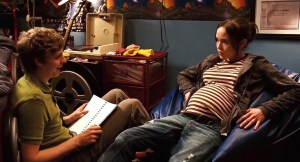 Juno doesn’t patronize or dismiss the gravity of what is indeed happening (a life is being brought into this world); Juno says she is trying to come to grips with issues “way beyond my maturity level.” There are moments that reveal real sadness and regret for some of these characters, and moments of palpable doubt about what it means to officially grow up and assume responsibility for another. Juno also refrains from easy high school stereotypes and coarse humor. Juno is an intelligent comedy that doesn’t make light of its circumstances even if the sarcasm is off the charts. It’s this winning combination of wicked wit and heart that makes [I]Juno[/I] destined to be a crowd-pleaser.
Writer/blogger/former stripper Diablo Cody makes one hell of an impressive screenwriting debut. The dialogue is practically sparkling and revels in the hip, hyper-literate realm that used to dominate the teenage speech patterns of shows like Dawson’s Creek. Sure, it’s not terribly realistic when characters can spout pithy one-liners mixed in with heavy jargon and lots of cool speak, but what do I care when I’m cracking up with laughter so often. But Juno cannot easily be dismissed as glib because Cody throws in some incisive moments that display shades of vulnerability and tenderness with her wacky assortment of characters. Even the aloof oddballs have moments that deepen them from just being quirky for quirky’s sake. These people are more than just receptacles for Cody’s wonderful words; they may begin that way but through the course of 96 minutes they manage to transform into flesh-and-blood where we, the audience, feel their pain and celebrate their happiness. You may be surprised, as I was, to discover yourself holding back tears during the movie’s inevitable and tidy conclusion.
The heavily acoustic score banks on a lot of pleasant, leisurely strumming but it suits the film and the song selections are apt. The very end involves a long acoustic duet rendition of the Moody Peaches’ “Anyone Else But You” and it may be one of the most disarmingly sweet, romantic moments of the year (the repeated lyric “I don’t see what anyone can see in anyone else” is a perfect summary for two outsiders finding their match). In fact, it’s probably the most potentially romantic song ever to include the line “shook a little turd out of the bottom of your pants,” but then again I do profess ignorance when it comes to romantic odes that include defecation references. Somewhere there has to be a Barry White song that has to cover this.
 Director Jason Reitman feels like a natural fit for this smart-allecky material. He lets the story take center-stage and, just as he proved with last year’s Thank You for Smoking, he can coax terrific performances from a strong body of actors. He keeps the pace chugging along and keeps form command of the many storylines and characters needing to be juggled. Juno is a comedy that says more about a character through a handful of smart, wry observations that cut to the bone, which is helpful considering the short running time means the film needs to do the most with its time.
Page should have been crowned a star immediately after her blistering performance as jail bait with claws in Hard Candy, but perhaps her top notch comedic turn in Juno will right this slip-up and give Page the opportunity to star in, at least, the same amount of movies as, oh, I don’t know, Amanda Bynes (Seriously, Hollywood, are you just throwing money at her?). Page is the perfect embodiment of the wiseacre teenager that thinks she knows more than anyone else. She recites the refined dialogue with such precision and ease, always knowing what segments to enunciate or de-emphasize to maintain a seamless comedic tone. Page brings great empathy to a know-it-all character and is the snarky spirit that makes Juno resonate.
The supporting cast around Page doesn’t let her down. Cera gives another fine performance of comic awkwardness befitting a teenager contemplating fatherhood. Simmons and Janney make a great pair of unflappable parents, particularly Janney who gives an ultrasound doc a memorable tongue-lashing for an off the cuff remark about Juno. Bateman works the same laid-back demeanor that he excelled at on TV’s Arrested Development. Rainn Wilson (TV’s The Office) makes a very funny cameo in the beginning.
 Garner as an actress has been somewhat hamstrung by her roles, either focusing on her multitude of ass-kicking abilities or landing her leads in romantic comedies that don’t require more than dimples and twinkling eyes. In Juno she is driven by her desire to have a baby; she’s affluent, prim, and an easy joke thanks to her stick-in-the-mud seriousness. But then Juno and the audience get a glimpse about how important being a mother is to Vanessa, and Garner nails a rather touching scene where she directly speaks to the growing child inside Juno’s belly upon Juno’s request. She speaks softly to the baby, briefly mentioning how loved they will be, and then she marvels at feeling the baby move. In lesser hands this scene could have induced eye rolls but instead seems genuine and a turning point for how we see Vanessa.
If Juno does have a flaw it is a minor one. The film places its teen romance on the back burner for so long that when it resurfaces and positions itself front and center the storyline lacks credence and believability. The conclusion would have had more emotional weight had the filmmakers spent more time on the teen romance angle, but regardless I was still amused, entertained, and grateful for the ending that came.
Juno is a delightfully tart and hysterical comedy that is easily quote-able thanks to Cody’s quick-fire retorts and snappy dialogue. Page is destined for greatness and Reitman proves once more that he can handle anything thrown at him with deftly comic aplomb. This is an impressive and assured comedy that bristles with comic vitality and confidence. This holiday season, make sure to take a trip to Juno.
Nate’s Grade: A
Share this:

Dan in Real Life (2007)
 What is it about advice columnists that make filmmakers want to turn their lives upside down? I suppose there’s some karmic twist seeing someone who instructs others fall on their face when it comes to living their own life. I can readily think of several movies, mostly in the romantic comedy and sentimental weepie genre, that all involve an advice columnist who has their life torn asunder by fate. I suppose the extra dose of irony seems less cruel when dished out to someone who, supposedly, has all the answers. Dan in Real Life is an observant and enjoyable movie that centers on the stumbles and joys of the life of cinema’s favorite whipping boy.
Dan (Steve Carell) is an advice columnist raising three daughters on his own. His wife died years ago from an undisclosed illness and ever since he has been trying his darndest to be the best, if not slightly overprotective, dad. His oldest (Alison Pill) is eager for the car keys, his middle daughter (Brittany Robertson) is defiantly insistent upon her undying love for a boy, and his youngest (Marlene Lawston) is the kind of tyke that provides sage wisdom in time of need, usually at the very end of the movie. The lot of them head out to the family home along the Rhode Island coast to spend the week with the extended brood. Dan sleeps in the laundry room, is hated by his spiteful daughters, and forced into a blind date thanks to his concerned parents (John Mahoney, Dianne Wiest).
 While Dan is out trying to decompress he stumbled across Marie (Juliette Binoche) in a bookstore. They spend hours talking, well Dan does, and suddenly the rain cloud over his head seems destined to fade. He stammers to tell his family the good news when he discovers that his brother, Mitch (Dane Cook), has brought his new girlfriend to meet the folks and it’s, surprise, Marie. Dan respects his brother and tries to control his feelings of desire but still cannot help but flirt and pine for Marie, who is all too aware of the under the radar advancements.
I’m actually somewhat amazed at how well Dan in Real Life plays out in real life. The idea of a big family get-together as a source of comedy has been done to death, and this clan exists in an exaggerated world popularized by movies where families have spirited games of charades, robust sing-a-longs, and then perform a talent show complete with decorative furnishing. The family’s emphasis on togetherness plays out in expected wacky scenarios that would be regularly seen on TV sitcoms, but it is refreshing that an entire film based around an annual family reunion instills no fraternal bickering or bitterness. That’s got to be something new, and again, potentially a pure product of the cinema. Dan in Real Life has familiar staples and walks some dangerously sappy territory but the film manages to surprise and amuse because it all comes back to being character-centered. There’s a great scene where Dan is hiding in a shower and Marie is forced, in order to maintain the rouse, to step naked into the shower with him. Dan is thrown into some contrived situations, like the shower scene, but it is his wounded, deferential sensibilities that save him and also save the film from movie-of-the-week trappings.
Director/co-writer Peter Hedges (Pieces of April) knows how much anguish Dan can suffer before pulling back, and it gets to a point where Dan starts to seem like a comic Job (that might be redundant). Of course, like most sitcoms, lessons will be learned and wisdom will be doled out thanks to full and honest communication, and Dan in Real Life is no different in that regard. There’s a level of believability to the film that helps ground it even during the familiar sitcom moments, like the late rush to testify one’s feelings of true love.
 Carell isn’t a stranger to drama or comedy with some painful underpinnings to it, just look at his work in Little Miss Sunshine or the brilliant awkwardness of TV’s The Office. He’s very effective at communicating the exhausting exasperation of raising a trio of feisty females. There are some tender moments and Carell plays them well. He just has a physically natural look of sad befuddlement with his droopy yet piercing eyes and those bushy brows, so he knowingly underplays broad expressions and gestures and this works exceedingly well with the film’s un-sensational tone. When Dan does unleash the wilder, sillier side it’s usually a culmination of his pent up feelings; being denied happiness that appears within reach. He is a quietly becoming unwound as he tries to squash the feelings he doesn’t want to extinguish.
Binoche is a famous French actress who has an Oscar to boot, but she is simply radiant in this film and makes her character a prize worth perusing. She has an adorable sense of displacement and she and Carell exhibit a nice chemistry. Even in the tight timeframe, both the plot (3 days) and the film’s running length (93 minutes), Binoche manages to make us believe that someone could fall in love with her so easily.
Dan in Real Life is laid back, affable, and a sweet homespun comedy that escapes the sitcom trappings it very easily could have fallen prey to. What makes Dan so winning, ultimately, is how quietly and unassuming it goes about telling a familiar story of a sad man taking his first steps toward happiness. The movie has a gentle nature to it and succeeds thanks to an effective Carell performance and a really great turn by Binoche. Dan in Real Life is a feel-good drama that seems primarily aimed at adults, at least those with a working knowledge of the terrors of teenagers. This isn’t anything new or groundbreaking but it is heartfelt, somewhat moving, and very easy to like. My advice: give this movie a chance and prepare to be surprised.
Nate’s Grade: B
Share this:

Music and Lyrics (2007)
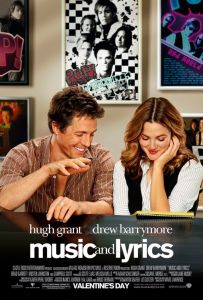 As bland and flavorless as the 1980s pop pap it hopes to skewer. For die-hard fans of the romantic comedy genre, there may be some minor level of enjoyment, but for the rest of us (those without ovaries) Music and Lyrics is predictable to the end and Hugh Grant and Drew Barrymore don’t elicit any semblance of chemistry. The songwriting is noticeably a cut above thanks to Fountain of Wayne’s bassist Adam Schlesinger writing them, but even the participation of one of my favorite bands can’t make Music and Lyrics worth seeing. The Duran Duran-esque music video that opens the film is a hoot and it all goes downhill from there, especially if you find it difficult to accept long durations of the cutesy baby act of Barrymore.
Nate’s Grade: C
Share this:

Across the Universe (2007)
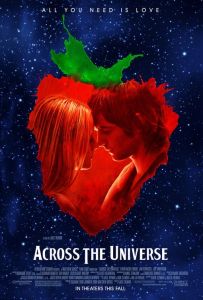 Julie Taymor is a one-of-a-kind artist. She made her name developing Disney’s The Lion King for the theater with highly elaborate and inventive costuming and staging. She then turned her vision to film and directed two strange yet visually splendid entires, 1999’s Titus and 2002’s Frida. Her latest is Across the Universe, a film constructed around actors singing Beatles songs. Hey, everyone likes the Beatles, so what could go wrong?
It’s the late 1960s and Jude (Jim Sturgess) has traveled from Liverpool (where else?) to Princeton to find his father. He makes friends with troublemaker Max (Joe Anderson) and they elect to travel to New York City and find their voice in these tumultuous times. They get a rather spacious apartment and their landlady, Sadie (Dana Fuchs), is a redheaded rock singer. Joe’s little sister, Lucy (Evan Rachel Wood) who just lost her boyfriend in the Vietnam War. JoJo (Martin Luther) and Prudence (T.V. Carpio) find their way to this apartment and into the increasing group of young, music-minded kids in the midst of a social revolution. Lucy fall hard for one another but their relationship is strained because Max has been shipped off to fight in Vietnam and Lucy is joining an increasingly violent radical resistance group.
 I can’t decide whether it is clever of simply lazy to structure a whole screenplay around 30-some songs by one band. Many of the tunes are used for pointless reasons like “Dear Prudence” is reduced to coaxing a character out of a closet literally, though she is gay so perhaps there’s a double-meaning there, but it’s still lame. In fact, the entire character of Prudence is pointless and grafted onto the story with no real care or precision. She disappears and then miraculously pops up again, with happy girlfriend in tow, and then that’s it. But what really chafes is that when Taymor uses the Beatles’ songs to tell the bulk of her story that means that little feels authentic. Lucy and Jude spout their love songs so quickly after their first encounter. Their romance doesn’t feel believable and, more importantly, it doesn’t feel worthy of our time and interest.
Across the Universe is dripping with Baby Boomer nostalgia and the film leaves no cliché left unturned in its account of history. This jumbled melting pot of every late 1960s cultural event feels as shallow as a junior high report on the subject. Everything from the Watts riots, to the assassination of Martin Luther King Jr., to the Columbia protests and LSD activist Ken Kesey and his colorful bus are elbowed into a story that feels empty and crowded at the same time. Across the Universe is a tad overextended and even goes to the trouble of climaxing with a rooftop jam similar to the Beatles’ last public performance together.
Taymor is a talented visionary but sometimes she lets her creative impulses take over her better judgment. The movie ultimately feels like 30-some music videos strung together by a flimsy boy-meets-girl story that will sink or swim depending upon the song-by-song visual follies. Sometimes Taymor excels with the sublimely surreal like some underwater canoodling to “Something,” Uncle Sam reaching out from a recruitment poster to the tune of “I Want You (She’s So Heavy),” and a spectacular rendition of “Happiness is a Warm Gun” where Max and other war vets cope with their trauma while multiple Salma Hayeks tempt them in sexy nurse outfits. But then Taymor gets a little too carried away with her runaway train of an imagination and her visuals can become simplistic (splattering strawberries = blood shed) or just way too funky, like a truly awful animated excursion where the wonderful Eddie Izzard speak-sings “For the Benefit of Mr. Kite” as a creepy circus ringleader. What does “Come Together” have to do with pimps and prostitutes and Joe Cocker as a bum? The worst moment may be when Taymor decides to visualize the parenthetical of “I Want You (She’s So Heavy)” by having underwear-clad soldiers hauling the Statue of Liberty over the jungles of Vietnam while they sing, “She’s so heavy.” I’m also uncertain about the flagrant jumps into theatricality like the synchronized acrobatic dancing; it’s a bit jarring at times.
 The cast is rather strong from a vocal standpoint and they recorded their performances live instead of within the confines of a recording studio. Wood has a particularly pure voice. Sturgess and his throaty pipes remind me of Ewan McGreggor in Moulin Rouge. Fuchs gives a favorable impression of Janis Joplin. Bono is great in his limited time on screen and hums one dandy version of “I Am the Walrus.” There isn’t a weak singer in the bunch and simply listening to them is one of the highlights of the film, but then I could accomplish this by plugging in the soundtrack. The new arrangements of the Beatles songs are a bit lackluster; they seem too bare and stripped down into vanilla ballads. “Something” sounds exactly note-for-note like how the Elliott Smith version sounded that hauntingly played over the closing credits of American Beauty. I seriously thought that Across the Universe just lifted Smith’s version.
Inherently goofy and occasionally garish, Across the Universe is a misguided trip through the back catalogue of the Beatles. There is a moderate level of fun with the concept and the quirky visuals, but the film plods on and on and eventually the appeal of the gimmick is long exhausted. The singing is strong and the visuals have a sense of whimsy when they work, but in the end the Beatles already had one failed movie constructed entirely from their songs (1978’s Sgt. Pepper’s Lonely Hearts Club Band starring Peter Frampton and the Bee Gees) and now they have one more for a new generation of fans.
Nate’s Grade: C
Share this:

Stardust (2007)
 Director Matthew Vaughn is about as far away from his previous film as he can get. 2005’s Layer Cake is about as far from princesses and unicorns and pixie dust as can be expected. He turned down X-Men 3 to helm this adaptation of famed comic scribe Neil Gaiman’s graphic novel, Stardust. In style with one of the film’s characters, allow me to say to Vaughn, well played, sir.
In turn of the century England, Tristan (Charlie Cox) is trying to woo Victoria (Sienna Miller), the haughty town hottie in the small village of Wall. The town is called such because there is a winding stonewall that runs alongside that people are forbidden to cross. He’s given seven days to retrieve a fallen star for Victoria to prove his affection for her. In order to do so, he needs to venture beyond the wall, and beyond the wall is another world altogether. The fallen star is a result of an dying king (Peter O’Toole) hurling his enchanted necklace to the heavens. The jewelry collides with a star and causes it to crash to earth. But it’s no smoldering rock taking refuge in that crater; the star has actually taken the form of a slender, long-haired blonde woman named Yvaine (Claire Danes). I can only hope other astral bodies that crash into this planet will result in the same lucky outcome. But Tristan is not the only one after the fallen star. Three very old witches have taken notice and seek to cut out the star’s heart and consume it, which will grant them youth once again. The oldest witch (Michelle Pfeiffer) uses the last bit from the previous star to shed her wrinkles, but every time she uses a speck of magic she loses part of her much-desired youth. Also on the hunt for the star are the king’s ruthless sons, each trying to retrieve their father’s necklace and declare themselves the next king, and each trying to bump off their family competition.
 Stardust is very much in the fractured fairy tale style of The Princess Bride, complete with nudges and winks. The movie works more with the macabre, but this only seems to heighten its magical qualities. I loved the ongoing wisecrack-filled commentary from the increasing number of ghost princes (“Well played”), and I loved that each was stuck in limbo Beetlejuice-style looking as they did when they died. Stardust is stuffed with hocus pocus hokum but it never seems foolish; the movie takes great steps to present the rules and characters of its universe, and as all of the assorted creatures race toward a showdown, Stardust makes total sense. It doesn’t betray the logistic parameters it establishes for such a fantastical parallel world. It means that if you can accept the opening 20 minutes than you should be fine for the duration of Stardust. The film spins a familiar tale of hidden princesses, races against time, battles over a throne, and wicked witches, but it handles the material with aplomb. Stardust‘s biggest asset, beyond the cheeky sense of humor Vaughn instills, is that literally anything could happen next. Suddenly there’s a flying pirate ship out to harness lightning, or a goat-turned-inn keeper, and it’s all so exciting what could be waiting around the corner next.
Vaughn assembles a lot of pieces and then keeps the momentum strong. He makes judicious use of special effects and keeps the audience involved with all the story’s moving pieces. Vaughn has taken the usual fantasy quest framework and channeled the imagination and dry wit of Gaiman. Not every moment runs as smooth as possible, and some are downright awkward, but Stardust stokes a nice balance between high-flying adventure and doodle-on-your-notebook romanticized love. Vaughn’s steady control and vision allow the material to really shine because the audience can open themselves to the magic of the movie.
The acting ensemble brings a lot of enjoyment to this enchanted tale. Pfeiffer is a bewitching villain and relishes her bad girl role; she’s a devious delight but is even better when dealing with the physical comedy of her increasingly aging body. De Niro is immeasurably enjoyable thanks to a role that conflicts with audience expectations for the famous force of movie masculinity. I was howling with laughter watching him cross-dress, swish, and become a giant exaggerated gay stereotype. It might seem trite or offensive to some had it not been for the setup and the film’s tolerant philosophy. Danes delivers a performance that seems to teeter on camp. She ramps up her vocal inflections thanks to her hyper English accent and seems to perform like she’s in front of a mirror and testing out all of her facial muscles. A bit odd. Cox fits snugly into the Hollywood slot of bland male lead.
 The one main drawback for the film is that the screwball bickering between Tristan and Yvaine never really works. The constant arguing rarely comes across as funny and is too poorly veiled to camouflage the film’s romantic intentions. The romantic setup is pretty formulaic. The audience will know right away that Tristan is not meant for his conceited and high-maintenance village girl, and that true love is staring him in the face along the course of his most fantastic voyage. We know from the first second of their meeting that their combative relationship will in time transform into a romantic relationship. But that’s not to say Stardust isn’t a romantic fable. Its heart is simple but it is genuine. While its path is predestined and unshakable, this does not stop the audience from feeling something between Tristan and Yvaine and their eventual coupling. I may be going soft, or perhaps Stardust just won me over completely, but I found myself even slightly moved by the romantic climax.
Stardust is assembled, like most fairy tales, from the working parts of other tales. It’s rather predictable with its big moments (boy meets star girl, boy loses star girl, boy regains star girl), but oh what a fun time the film has from point to point. Stardust is vibrantly alive and cheerfully creative and watching the film almost becomes a dizzying experience. It has a sweet and gentle romance at heart, and its knowing whimsy and charms are hard to resist. You’ll never look at Robert De Niro the same way again.
Nate’s Grade: A-
Share this:

Once (2007)
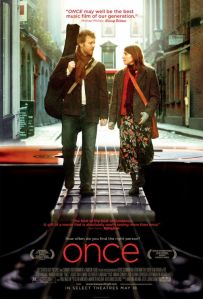 Once is the perfect antidote to noisy summer blockbusters assaulting the theaters. It’s a small, hardscrabble indie that’s completely unpretentious, unassuming, and sweetly divine. Once is not mawkish, nor overly sentimental, but it does leave you with the sensation that you’ve just had your best hopes about love reaffirmed, no small feat. This is a movie for people that love music and the innate power it can unleash.
A Dublin street singer (Glen Hansard) works in his father’s shop and fixes vacuums by day, while he sings his heart out in public at night. Then one day he meets a Czech immigrant (Markéta Irglová) who becomes his biggest fan. They start seeing more of each other and share their joint passion for music. It’s through the music that the beginning of a special relationship forms between them, however each has their own baggage. He’s nursing a broken heart after his girlfriend cheated on him and then moved to London. She lives with her mother and works several jobs to take care of her young child. Her husband left the family but there’s a chance he may return. Together, they write enough songs and raise enough money to record an actual album in a studio, something that can stand the test of time.
 When you boil it down the story is very simple. Boy meets girl. They run into each other some more. They help each other write music, ending with the accomplishment of a studio-produced album. Then they part. That’s it from a synopsis point of view, but Once is far more than that. This is an honest to God real-life musical, where the songs advance the storyline and the lyrics express the emotional desires and changing moods of our leads. People don’t break out into choreographed song and dance numbers; no, this is set in a modern and realistic world. Once could be described as a musical for people that hate traditional musicals but I think that sells the film too short on its merits. Once is a very stripped down but enormously romantic love letter to music and human connection. Watching the movie is akin to be serenaded by a soulful crooner that clearly wears its idealistic heart on its sleeve. There’s something undeniably magical about watching Once; you feel transported by the sheer exuberance of feeling and emotion. The openness may seem awkward or a bit cheesy to a more cynical lot. The story is a rather bare-bones affair (no pun intended), but that’s where the film takes the opportunity to explore the burgeoning relationship between our leads in their short yet important time together.
Of course it helps a musical if the music is something worthy of listening. I’ll say this: Once is the first movie since 1999’s Run Lola Run that I immediately went out and got the soundtrack for after watching. Unfortunately, as Once is still expanding most large retail stores do not carry it just yet. I guarantee by the end of the summer that every one of them will have it well stocked. The songs are largely acoustic guitar and piano arrangements, and the heartfelt, slightly biting yet optimistic lyrics are reminiscent of acts like Bright Eyes and The Shins. The music is softly beautiful and lilting and a great showcase for Hansard’s sensitive yet powerfully evocative vocals. Irglova is a classically trained Czech pianist and sings with a breathy Bjork-like style that blends well with Hansard’s graceful and rich tenor.
The music is a big reason for the film’s success as a sweeping romance and human drama. The standout track is “Falling Slowly,” which is a stunning turning point for the film and for the characters. In the film, they assemble in a piano shop and put together an impromptu duet. The song builds, and our singers coalesce smoothly, and the soothing sounds stir something inside them as well as the audience. Both characters are realizing that they can make beautiful music together, and they’re exploring one another’s desires and intentions. They definitely sense something new; the music is what binds them, but the music is also their most lucid platform for expressing their escalating feelings.
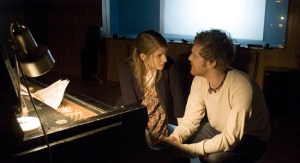 Writer/director John Carney, who used to be a bassist in Hansard’s band The Frames, gives the movie a fly-on-the-wall viewpoint, probably more due to a limited budget of around $150,000. In fact, the home movies footage Hansard watches of his former flame looks identical to the rest of the movie. The performances are naturalistic if a bit amateurish, but this also works with the realistic tone of the film. Much of the 85-minute movie consists of full-length songs and performances, so any audience that isn’t really jazzed by the music may grow restless.
The MPAA, in its irritating wisdom, has decided that Once should be rated R, thus distancing it from an armada of impressionable youth. Once has a handful of F-bombs, though you could argue their inclusion is diminished because of the occasional indecipherable nature of heavy Irish accents. The restricted rating is a shame because this movie doesn’t have a profane bone in its body. Teenagers, people who are struggling for meaning and acceptance, and re-configuring their musical tastes, should see this movie. I think they would relate to the personal struggles and the romanticism. Hansard may populate many a teen girl’s bedroom in poster form soon enough.
Once is a lovely and charming modern musical. I suppose the music is really going to be the breaking point for people; either you enjoy its sweet harmonies and light acoustic arrangements, or, um, you don’t. I adored the music and was transported by the deeply romantic current running through the film. Once is a small movie with a big heart and some wonderful music. In between pirates, robots, super heroes, and wizards, I think there’s plenty time to squeeze in a beguiling and earnest musical.
Nate’s Grade: A


 nathanzoebl
You must be logged in to post a comment.