Blog Archives
The Phoenician Scheme (2025)
 It’s so nice to connect with a Wes Anderson movie again. I’ve been mostly a fan from the beginning but his career has as many ups as downs for me, often getting lost in his distinct dollhouse style of artifice and losing the sense of wounded humanity that marks his best movies. I haven’t truly loved a Wes Anderson movie since 2014’s The Grand Budapest Hotel, which I consider one of his very best. It’s been a long ten years of feeling indifferent or distant to that signature Anderson twee whimsy. I took my wife to see 2021’s The French Dispatch in the theater, and this was her first Anderson movie, and it also happened to be his worst movie, plus with Timothee Chalamet, an actor she isn’t fond of. I feel like I ruined her impression of this indie auteur and the question over his enduring popularity. 2023’s Asteroid City had some interesting ideas and dramatic potential, but its multiple framing devices and layers of obfuscation smothered what I could have enjoyed about its drama buried underneath. It is with that accruing disappointment that I began to question whether new Wes Anderson movies just weren’t for me, and that’s why I find The Phoenician Scheme a welcomed return to form that makes me relieved. The idiosyncratic tactician that is Anderson can still make a movie that engages me on different levels, including an emotional one, which I’ve been missing for so long from his recent output.
So I’m going to do something a little different with this review. I’m going to specify and articulate why this movie works for me, namely why it resonates and succeeds where his other movies of late have not. I suppose you could argue every film critique is charged with explaining the nuts and bolts of an opinion, but I’m going to really try and crack open why The Phoenician Scheme is a better movie overall.
 1) Emotional investment. Primarily Anderson is known for his heavily mannered, expertly curated style, which is why he seems to be the go-to pastiche for A.I. film juxtaposition experiments (“What if Wes Anderson directed Star Wars?” etc.). Many of Anderson’s movies are populated with hurt people trying to reconnect, a subject that has great emotional appeal. However, if you cannot connect with the characters or their dynamic or the relationship stakes, then it can feel like an afterthought to all that fancy production design and camera placement. With The Phoenician Scheme, the movie is an adventure film but it’s really about a father (Benicio del Toro as Zsa-Zsa Korda) trying to reconnect with his estranged adult daughter (Mia Threapleton as Sister Liesel). The father is a billionaire robber baron set in a vaguely mid 19-century setting. The daughter is a newly enshrined nun who believes that her father had her mother killed. Right away, we have very different perspectives and exciting conflict between them. He’s an arms dealer and willing to have key parts of his scheme involve a famine and slave labor. Her very involvement in the convent is itself a reaction to her father, who sent her away to live there at age five. She doesn’t want to be like him, who she views as on the wrong side of morality, but she also wants to get to know this man better and get her own answers. Her convent needs her to proceed to get a significant donation from her father. He wants to hire her on a trial basis to see if she’s fit to be his sole heir. They’re stuck together on an adventure that forces them closer, and the ensuing relationship that begins to build, with old hurts melting away to new revelations and new aches of yearning, comes across as very involving and emotionally rewarding. I was actually quite taken by the father-daughter relationship and their bickering, which organically gives way to better understanding and personal growth from both parties. They make each other a little better than they could be, and they recognize that despite their differences and hurt, they do genuinely care about the other. Korda is such an unflappable dilettante and yet the very notion that his daughter thinks he might have killed her mother from rumors deeply upsets him. The rest of the movie is essentially both characters directly and indirectly trying to prove themself to the other and also acknowledge and accept the other person. The core of this movie works because the core relationship is given serious and deliberate development to be meaningful. It’s about a broken family recognizing their connection to one another and desire to be connected.
2) The vignettes do add up. The folly of The French Dispatch was that it was a collection of short films, meaning that every twenty-minutes or so it felt like having to start over again with character introductions and relationship development. It didn’t feel like it added up to much. With The Phoenician Scheme, the film is structured around the different investors that Korda has to convince to cover a higher percentage of a budget shortfall for the big plan. It might sound pretty lackluster on paper but it becomes a larger goal that each segment builds to, and each new investor and setting allows Anderson to explore a new aspect of his characters. One situation involves a literal game of basketball and another involves taking a bullet to save an investor. Each situation allows us to change things up without losing the momentum of building toward that larger goal, as well as continuing to build the progression of the character relationships. With a vignette movie, each segment is a beginning, middle, and end that starts over with the next. With this, we have those mini stories with each new investor, but the whole is still advancing. It allows Anderson to explore a variety of comedy and story options while still keeping his attention to the bigger picture, thus earning our continued investment and more payoffs.
 3) This is still a very funny movie. That droll yet whimsical tone we expect from Wes Anderson is very present, and I was smiling and laughing throughout. I particularly loved a running joke where Korda offers each new guest a hand grenade like a welcome present. Korda also has repeated assassination attempts, which is the impetus for him reaching out to his daughter because he knows he won’t outlive every assassination attempt. However, in the meantime, each new assassination attempt is presented as another predictable annoyance, and I enjoyed that with every one Korda admits, “I think that guy used to work for me.” The basketball game of horse is wonderfully absurd and dryly serious at the same time, elevated by Bryan Cranston’s considerable commitment to the bit. Another great source of comedy is Michael Cera as the third significant character to the adventure, Bjorn, an assistant to Korda and also an entomologist. He’s such a delightful nonplussed addition to the trio, providing an outsider perspective to the family drama and reminding us how not normal everything is. I heartily enjoyed how his nerdy passion for bugs keeps inserting itself in all sorts of unexpected situations. The excesses of Korba’s lifestyle, and his seeming history of amorality, allows for just about anything to be possible or referenced, opening the comedy even further into surreal asides still tethered to characterization.
4) The added religious elements provide a deeper introspection for the characters and the viewer. Every time Korba has a near-death experience from his latest assassination attempt, we have a black and white sequence of Korba interacting with the afterlife. In one sequence he’s being judged by St. Peter, then God, then his own deceased wives. Each opportunity with the afterlife is a reminder for Korba about his sins and mistakes and a motivator to do better. The stylized realm is mysterious without being overt in its directions, allowing Korba to stumble around looking for guidance, like when God is annoyed that He isn’t recognized as the Big Guy. I was amused by these little interludes but they also act like a moral intervention for our main character, and his growing interest is a sign that his daughter’s influence is affecting him. It adds a depth to the character as well as a weightier sense of celestial consequences for a life of misdeeds, and it helps to better realism the character’s arc as well as set him up for change. It allows an introspection over legacy. These are also the segments you’ll get the most blink-and-miss-them cameos, like Bill Murray, Willem Dafoe, Charlotte Gainsbourg, and F. Murray Abraham.
 5) Smaller ensemble to devote characterization. Everyone wants to work with Anderson, and he keeps an impressive list of actors who continuously reappear, even if it’s only for seconds, anything to just be back into the ornate world of a Wes Anderson fantasy. His last few films have been stuffed with characters but there wasn’t enough for everyone to do (go ahead, try and remember what Steve Carrell did in Asteroid City). The narrative gets fractured trying to provide enough moments and screen time for all these distaff characters. A larger cast is not inherently a doomed prospect, but it does mean more attention and development needs to be made, and with less time, to ensure those characters are meaningful and well developed. The French Dispatch and Asteroid City couldn’t do that for me. This time Anderson condenses his important characters down to a manageable trio. We have other supporting players but they typically come and go through the different vignettes, each getting their turn with the main players. This keeps the focus on the winning character dynamic of the father-daughter buddy comedy, and with Bjorn bumbling along and finding himself becoming more fond of Liesel. There are some fun twists and turns with the three characters but no matter the external obstacles or silliness, the emphasis remains on these three and their relationships. It all works so much better.
6) The acting by the Anderson newcomers is greatly enjoyable. It’s shocking that this is the first time Michael Cera (Scott Pilgrim Takes Off) has been in a Wes Anderson movie because his comic sensibilities are a natural fit for this universe. The direction his character goes lets Cera have even more ways to have fun, and each new turn made me love his character and the performance even more. I also love that, despite all the revelations, at his core, Bjorn really is a nerd who loves talking about insects. The real discovery is Threapleton (The Buccaneers), though maybe we shouldn’t have been so surprised considering she is the adult daughter of Kate Winslet (do you feel old now too?). She holds her own with her many scenes with del Toro and is able to hone her withering glare into a considerable weapon of disapproval. Watching her character blossom and test her boundaries, like when she says she’s only drank communion wine and is introduced to a new form of alcohol at every jaunt that she feels compelled to try. It’s a character that is slowly recognizing more about herself and the possibilities of this life.
 The Phoenician Scheme isn’t a deviation from the tried-and-true Wes Anderson formula; it’s a better calibration of what makes that style and formula continue to resonate for so many fans. I’m apparently in a small minority with my esteem for this picture, and that’s fine by me. I’ve outlined through this review the reasons why it was a much more enjoyable and worthwhile entertainment for me, and if you found yourself nodding along, then perhaps it could work its query magic on you as well. It’s nice to be charmed again by a Wes Anderson movie but to also feel something rather than distant appreciation for the carefully composed sets and photography. I actually cared about these characters and their journey. The end results mattered to me. Their plights mattered. If you’re like me and falling from the Wes Anderson bandwagon, then perhaps The Phoenician Scheme might pull you back aboard.
Nate’s Grade: A-
Share this:

Nimona (2023)
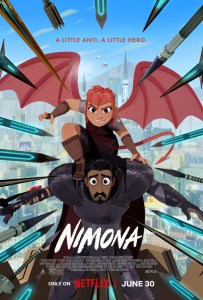
Based on the graphic novel by ND Stevenson (She-Ra), itself a web comic from 2012-2014, Nimona was developed by Blue Sky Animation Studios and originally scheduled to be released in 2020, and then Disney bought Fox, shut down Blue Sky, and pushed back against the gay content of Nimona before just canceling it altogether in 2021, and then Netflix came in and saved the project and released it, gay and all, during the last day of Pride Month. It’s been a long, protracted journey for Nimona to get to your screen and, reader, it was worth it. The movie is a rambunctious and revisionist fairy tale that is both subversive and deeply sincere, enough so that an emotional confrontation of accepting someone on their own terms elicited genuine tears on my part (for those keeping record, that’s three straight animated movies in the month of June that caused me to cry). Nimona (voiced superbly by Chloe Grace Moretz) is a high-energy prankster in a fantasy world melding Medieval culture with future technology. She befriends a fellow outsider, Ballister (voiced by Riz Ahmed), after the kingdom views him as a wanted villain. Together, they try and clear Ballister’s name by finding the real killer, and maybe they can wreck some stuff too just for fun. The cell-shaded style, a familiar aesthetic in the realm of video games, adds a bright and slickly appealing quality to the animation, and the frenetic pace and anarchic humor keep the movie bristling with entertainment, while the emotional core (vulnerable outcasts finding community) sneaks up on you and delivers a more resonating climactic finish than simply vanquishing a baddie. The ending even has rich thematic notes of The Iron Giant, which is never a bad influence. The queer content is also treated without sensationalism and treated as any other aspect of human compassion. The heart and message are just as impressive as the visuals and the humor. Nimona is a funny all-ages adventure that deserves its big screen moment after its long gestation.
Nate’s Grade: B
Share this:

Sound of Metal (2020)
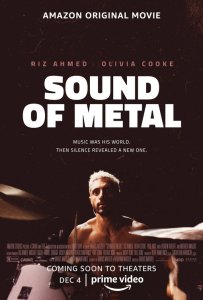
I don’t think I’ve better empathized with hearing loss and deafness than with Sound of Metal, a moving and observant drama about a heavy metal drummer quickly losing his sense of hearing. Riz Ahmed (Nightcrawler) plays Ruben, a former junkie who is four years sober and worried about losing his girlfriend/band mate (Olivia Cooke) with his recent diagnosis. He’s attending a treatment center meant to cater to a deaf community and transition others into this community. Ruben is defiant, depressed, angry, all the stages you can imagine with grief. The movie is at its best during its quiet and contemplative moments where we empathize with the terror and alienation of Ruben. When he first joins the center, we don’t get subtitles for the many signed conversations between members. It’s only after Ruben learns ASL, integrates into the community, and opens himself up to the program that we too get to be knowledgeable. The sound design is exceptionally utilized to illustrate Ruben’s changing perspective, and some later choices with it might make you long for the peacefulness of silence. The movie is exquisitely thoughtful and considerate while maintaining a subtle, character-driven approach that keeps things from wallowing in self-pity. For many of the deaf, hearing loss isn’t seen as a disability but a community with its own culture and quality of life. It’s understandable that Ruben is focused on loss but the movie doesn’t dwell in loss, more so transformation and acceptance. Ahmed is fabulous in the lead role which requires him to rely primarily upon non-verbal expression for extended periods. His eyes are his best vessel for communicating Ruben’s emotional state, and Ahmed is sensational. Paul Raci is also great as the leader of the treatment center and the responsibility and generosity he feels to those in his care. Sound of Metal is an immersive, sensitive, authentic and poignant drama with an Oscar-caliber lead performance and a depth of compassion for the many people of the deaf community.
Nate’s Grade: B+
Share this:

Venom (2018)
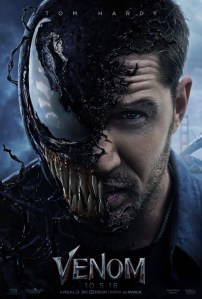 Sony does not have a sterling track record of late when it comes to their superheroes. After the dismal response to 2014’s Amazing Spider-Man 2, Sony reached out to the creative team at the Marvel Cinematic Universe (MCU) to better guide their flagship property. A solution was worked out wherein the MCU would essentially make a Spider-Man movie and borrow the character for their own films and Sony would reap the profits, and it worked wonderfully with 2017’s Spider-Man: Homecoming. Now Sony seems to be falling into a similar trap, getting ahead of themselves with an itch to build a larger superhero universe of properties. Venom is a fan favorite Spider-Man villain, so to give the guy his own movie even without Spider-Man is already a risk. The ensuing Venom solo film is a big gooey mess of a movie that needed to decide whether it was going to be scary, funny, goofy, serious, PG-13 or R-rated, or good or bad.
Eddie Brock (Tom Hardy) is an investigative reporter who has relocated from New York to San Francisco. He’s got a cushy job, a loving fiancé (Michelle Williams), and he loses it all thanks to his ego and drive to uncover the secret experiments of a wealthy Elon Musk-esque business magnate, Carlton Drake (Riz Ahmed). Then Eddie discovers the secret of Drake’s lab, an alien symbiotic substance that crashed on Earth. It bonds with Eddie and appears in his head as a guttural voice egging him into bad behavior and the hopeful munching of heads and bodily organs. Eddie must learn to work with his new partner to thwart Drake and another alien symbiote with plans for world domination.
 Venom struggles to separate itself from the plethora of superhero films out there and forge an identity of its own, unfortunately without Spider-Man and the larger Marvel world. It’s even in the tagline: “The world has enough superheroes.” If this is the anti-superhero movie it can’t pull that far apart. The set-up was there for something potentially different. Venom could have been the villain instead of merely an anti-hero, with Eddie Brock wrestling with his inner demons in a way that evoked the classic tortured duality of Jekyll and Hyde. I think that approach certainly would have brought out more from director Ruben Fleischer (Zombieland, Gangster Squad). Instead the filmmakers assert that their goo-laden superhero is a bit edgier, a bit looser with the ethics of justifiable homicide when it comes to snacks, and to make it certain they employ a clear-cut villain who has even less compunctions so as to make Venom look better in comparison. This is a pretty lazy anti-hero archetype that follows the superhero formula to the core. If the Venom symbiosis was presenting problems in Eddie’s life, or presented a lethal force that tempted him to the dark side that needed to be tamed or at least withheld, that would be one thing, but it’s the same-old tool for empowerment. Thanks to the Venom alien, Eddie is able to stand up to bad guys he shrunk from before. Thanks to the Venom alien, Eddie is able to be a better reporter and reactive citizen. Hooray. For a movie that advertised there were too many superheroes, they just flatly rolled out another.
The major problem with Venom is that nobody seems to be on the same page as to what kind of movie they are making. Firstly, Tom Hardy seems to think he’s making his own version of Jim Carrey’s The Mask, hamming it up to great comic effect, stuttering and sloshing his way from scene to scene. This movie would be vastly less interesting if it was not for Hardy and his committed performance of borderline Nicolas Cage-style nuttiness. The film became that much more entertaining once Venom and Eddie were bonded and Hardy had to reconcile the back-and-forth in his head and in public. There are moments that I’m almost convinced the movie is asking its audience to laugh at it and Hardy rather than with it, like when he takes a dip into a lobster tank to cool off. It made me think of All of Me but with an alien parasite. The buddy comedy aspect and interaction was a highlight. The movie is better when it either embraces its goofy elements or at least pretends not to be as serious. The serious version of this movie seems to infect most of the supporting players, notably Williams and Ahmed. Poor Michelle Williams (Manchester by the Sea) is another underrated love interest, and in the one scene where she does have agency and power, she immediately gives it back over to Eddie. Ahmed (Rogue One) just looks lost, going from overblown monologue to confusing monologue, making it hard to grasp what his motivations are from scene to scene. Is it space exploration, conquering, or saving the Earth? There’s a part at the end confrontation where Ahmed and Hardy are literally fighting one-on-one and it’s hilariously mismatched. There’s no way a tiny guy like Ahmed would be able to contend with Hardy in a fistfight. That’s the more unbelievable moment yet.
 The story has many shortcomings and logical constraints that exist for sloppy stalling purposes. Take for instance the opening scene where a U.S. space shuttle crashes back to Earth and lands in Malaysia (have the people of Malaysia suffered enough downed aircraft?). One of the four alien symbiotes escapes and latches onto an EMT worker, taking control of her body. We then flash forward six months and Drake’s company is testing the symbiotes and having poor results, losing all but one that bonds with Eddie Brock. Why even have four of these things? Why have two to eventually die off-screen when one would do? But really why have any of this setup? The Bad Guy Symbiote is effectively stranded in Malaysia for six months until it figures out that little white girls are the ticket to slipping past airport security guards (and I guess stupid secret lab guards as well). Why not have the breakaway symbiote be the Venom one? Why even have the means of their arrival crash in Malaysia if they’re all just winding up in San Francisco anyway? The only logical answer is the filmmakers wanted the Big Bad sidelined long enough to set up more plot, but it’s so sloppy. The same can be said about how Eddie eventually ends up face-to-face with his special symbiote. Jenny Slate’s (Gifted) scientist character is to sneak Eddie into the lab, without her supervision of where to specifically go, and for him to… take pictures of the suffering test patients? Why does she need an intermediary to take pictures? Why can’t she do this and then submit them to Eddie? If she fears that the tests are as dangerous, why does she let Eddie stumble around? When the bad guys initially give chase they use flying drones as their killer weapons. I figured they would use these aerial machines to fire at Eddie as he speeds away on his motorcycle, but no, instead they use them as kamikaze bombs. How is that effective? Why do the good people of San Francisco seem to shrug at a series of bombs going off around their city? This is pretty much the definition of modern terrorism. How about when the Venom symbiote goo is separated from Eddie and he’s taken away, and the symbiote has to escape from a hospital and it has a choice of small dog or human being as its escape vehicle… and it chooses the small yappy dog. The movie is littered with these kinds of head-scratchers and leaves the overwhelming impression that much of this story and ensuing production was thrown together in the most haphazard fashion.
The action and special effects are also pretty messy and lackluster. The Venom alien goop just looks like Hardy is constantly dripping black paint. The effects do not look drastically improved from when we first caught glimpse of a big screen Venom in 2007’s Spider-Man 3 (though no candy corn fangs). There’s a lengthy attack sequence between Venom and an entire squad of SWAT officers that takes place in the haze of a teargas cloud. It’s meant to evoke a sense of horror as Venom pops up randomly, except it just makes everything too chaotic to maintain interest. Too many sequences take place at night to obfuscate the special effects work. The final act is the worst part as Venom faces down another symbiotic goo-monster, and it ends up being a clash between a black-skinned goo monster and a grey-skinned goo monster outdoors at night with quick camera edits. Good luck trying to comprehend what is happening on the screen. It’s such a bleh villain as well, just a bigger slightly more evil version of Venom, and its world-dominating plan involve bringing the other symbiotes to Earth, which will take, by my calculations, at least a few decades, at best, of space travel time. It’s one last noisy, dumb moment in a movie filled with loud and dumb moments to pass the time.
 I still can’t find a straight answer whether Venom was initially filmed as a PG-13 film or as an R-rated movie and re-edited into a safer, more commercial PG-13 form. In its current incarnation, I don’t think an R-rating would have added much more to it, but that’s because the film doesn’t feel like it was conceived as an R-rated property. That’s a shame considering it features an alien creature that eats people’s heads. There is one scene where Venom eats a mugger’s head and the next scene he reverts back to Eddie Brock, and we see Eddie leave the shop in clear sight. The dead body of his headless victim is curiously missing even though it should be in full view. What happened? Also, what happens to the shop owner who is now witness to this traumatic event? Are the police or insurance agents going to believe her tale about an alien monster biting the head off a man whose body was left in her business? Is anyone going to want to shop there again once word spreads that a guy had his head removed? The Venom movie we get doesn’t earn this scene and it doesn’t get to wave away the scrutiny it invites.
Venom is a mediocre superhero movie that doesn’t know what it wants to be. It says it doesn’t want to be a superhero film, but it falls under the same plot trappings. It seems like it’s a silly comedy, but then it asks you to take it seriously. It seems like a serious action thriller, but then it has a goo-covered anti-hero say, without a hint of irony, that it’s “time to save the world.” Then there’s the painfully on-the-nose post-credits scene meant to bait the audience into interest in future sequels (stop doing this, Hollywood). This is a sloppy movie on all levels. The saving grace is Hardy’s dedicated, ridiculous, tic-heavy performance, which at least smoothed over the rough patches at various points for my enjoyment. Otherwise, the best part of the Venom movie is a three-minute clip for the animated Spider-Man movie Sony is scheduled to release in December. Those delightful three minutes are better than anything else Venom has to offer in its slapdash, goo-filled tonal mishmash. Check out the underrated genre gem Upgrade instead, the superior Venom.
Nate’s Grade: C-
Share this:

Rogue One (2016)
 In the opening text crawl for Star Wars Episode IV: A New Hope, it says, “During the battle, Rebel spies managed to steal secret plans to the Empire’s ultimate weapon, the Death Star.” Disney, in its infinite wisdom to cash in on every potential resource of its lucrative cash cow, has decided to devote a whole movie to that one sentence in that initial crawl. I can’t wait for each sentence to get its movie. Rogue One: A Star Wars Story (in case you’d forget) is the first film outside of any of the trilogies and much is at stake. Not just for the rebels but for Disney shareholders. If a wild success, expect future tales coming from every undiscovered corner of the Star Wars universe. And if Rogue One is any indication, that’s exactly the kind of artistic freedom needed to blossom.

Not actually in the finished film.
Jyn Erso (Felicity Jones) has plenty to rebel against. Her father (Mads Mikkelsen) was forced against his will by Orson Krennic (Ben Mendelsohn) to work on a fiendish death machine for the Empire. Jyn’s father is responsible for designing the Death Star. Jyn is broken out of imperial prison by Cassian (Diego Luna) for the Rebellion. They want her to track down her father, find out whatever she can about this new fangled Death Star, and if possible, retrieve the plans on how it might be stopped. Her mission will take her to the ends of the galaxy to reunite with her father and to provide hope to the Rebellion.
Finally after many films we finally get a war movie in a franchise called Star Wars, and it’s pretty much what I wanted: a Star Wars Dirty Dozen mission. It’s thrilling to go back to the height of the resistance against the Evil Empire and see things from a ground perspective with a skeleton crew working behind the scenes. We may know the future events of those Death Star plans but we don’t know what will befall all of these new characters. Who will make it out alive? The open-and-shut nature of this side story in the Star Wars universe brings a bit more satisfaction by telling a complete story. This film will not have to wait for two eventual sequels years down the road in order for an audience to form a comprehensive opinion. I welcome more side stories like Rogue One that expand upon the fringes of the established universe and timelines, that establish colorful new characters and tell their own stories and come to their own endings, and hopefully don’t feature any more Death Stars (more on this below). It seems like it was ages ago that major studio tentpoles just attempted to tell a single, focused story rather than set up an extended universe of other titles to nudge along their respective paths. Director Gareth Edwards (2014’s Godzilla) is less slavishly loyal to the mythos of the series than J.J. Abrams. His movie doesn’t feel like flattering imitation but its own artistic entry. The cinematography is often beautiful and the natural landscapes and sets provide so much tangible authenticity to this world. Edwards has a terrific big-screen feel for his shot compositions and achieving different moods with lighting. He knows how to make the big moments feel bigger without sacrificing the requisite popcorn thrills we desire.
 Rogue One has to walk a fine line between fan service and its own needs. While it’s fun to see Darth Vader on screen again voiced by the irreplaceable James Earl Jones, it’s also a bit extraneous other than some admittedly cool fan service. We don’t need to see Vader clear out a hallway of Rebel soldiers but then again why not? It’s the same when it comes to the inclusion of cameos from the original trilogy. Some are minor and some are major, achieved through the uncanny valley of CGI reconstruction. Gene Kelly may have danced with a vacuum cleaner and Sir Lawrence Oliver and Marlon Brando both appeared as big floating heads after their deaths, but this feels like the next step beyond the grave. There’s a somewhat ghastly feel for watching a dead actor reanimated, so your sense of overall wonder may vary. The cameos are better integrated than the Ghosbusters ones.
There’s a great cinematic pleasure in putting together a team of rogues and rebels. The characters on board this mission have interesting aspects to them. Chirrut Imwe (Donnie Yen) is a blind warrior and aspiring Jedi. He feels like he stepped out of a great samurai movie. He uses his connection with the Force to make up for his lack of visual awareness, and Chirrut demonstrates these abilities in several memorably fun instances. There’s a world of back-story with Saw Gerrera (Forest Whitaker), a dotty wheezing warrior who is more machine than man at this point. Whitaker gives an unusual performance that reminded me of a kindlier version of Dennis Hopper in Blue Velvet. The reprogrammed robot K-250 (vocal and motion-capture performance by Alan Tudyk) is a reliable source of catty comic relief and I looked forward to what he was going to say next. The first 40-minutes is mostly the formation of this group, and it’s after that where the movie starts to get hazy. We know how it’s all got to end but the ensuing action in Act Two feels a bit lost. This may have to due with the reportedly extensive reshoots that were done last summer to spice up the movie (much of the earliest teaser footage isn’t in the finished film). I’d be fascinated to discover what the original story was from Chris Weitz (Cinderella) and just what rewrites Tony Gilroy (Michael Clayton) performed so late into its life. For much of the second act, the characters feel a bit too subdued for the life-or-death stakes involved, and that translates over to the audience. We travel to different locations throughout the first two acts but I can’t tell you much about them other than some intriguing mountainous architecture. The plot is a bit too undercooked and still obtuse for far too long, requiring our team to bounce around locations to acquire this person or that piece of information. Rarely do the characters get chances to open up.
 It all comes together in the final act for a 30-minute assault that makes everything matter. It’s a thrilling conclusion and the movie finds a way to keep escalating the stakes, bringing in powerful reinforcements that force our Rogue One crew to alter their plans and placement, while still clearly communicating the needs of each group and the geography as a whole of the multiple points on the battlefield. It’s what you want a climactic battle to be and feel like where each player matters. It’s also a welcome addition to the Star Wars cannon, as we’ve never seen a beach assault before. It feels like a new level that was unlocked in some video game, and that’s no detriment. The ending battle has different checkpoints and mini-goals, which allows for the audience to be involved from the get-go and for the film to jump around locations while still maintaining an effective level of suspense. Many of these characters make something of a last stand, and you feel the extent of their sacrifice. I read in another review that the reason Jyn and her rogues win is because they accept that they are replaceable, and Orson Krennic fails because he made the mistake of believing himself irreplaceable. I think that’s a nice summation about the nobility of sacrifice. I won’t get into specific spoilers but I was very pleased with the ending of the film even though it’s not exactly the happiest. It feels like a fitting ending for the darker, grittier Star Wars tale and it provides earned emotional resonance for the setup of A New Hope, which this movie literally rolls right into.
With as many fun and potentially interesting characters aboard for this suicide mission, it’s somewhat surprising that they are also the film’s weak point. Beyond simple plot machinations like Character A gets Character B here, I can’t tell you much more about these rogue yet noble folks other than their superficial differences. Take for instance the Empire turncoat, pilot Bodhi Rook (Riz Ahmed) What personality does he have? What defines him? What is his arc? What about Cassian? He’s supposed to secretly assassinate Jyn’s father if given the chance, but do we see any struggle over this choice? Does it shape him? Does his outlook define his choice? Can you describe his personality at all whatsoever? What about the villain, Krennic? Can you tell me anything about him beyond his arrogance? What about Baze Malbus (Wen Jiang), who carries a big gun and is close friends with our blind wannabe Jedi. Can you tell me anything about this guy beyond that? Even our fearless leader, Jyn Eros, feels lacking in significant development. She wants to find her father, get vengeance, but then changes her mind about sacrificing for the greater cause of hope. Many of the character relationships jump ahead without the needed moments to explain the growth and change. The original trilogy was defined by engaging characters. When you have a ragtag crew of six of seven rogues, you better make sure each brings something important to the movie from a narrative perspective, and not just from a pieces-on-the-board positioning for action. Look at Marvel’s Guardians of the Galaxy for tips. If this was going to be a powerful and emotionally involving war movie, the characters needed to be felt deeper. All too often they get lost amidst the Star Wars debris and then they become debris themselves. Ironically enough, Rogue One has the reverse problems of The Force Awakens, a movie that benefited from engaging characters but sapped from an overly familiar and cautious story. It’s telling when my favorite character, by far, is a sassy comic relief robot.
 Let’s talk about the Death Star in the room, namely the fact that over the course of eight Star Wars movies there have been Death Stars, or the construction thereof, in five of them (63% rate of Death Star sighting). We need a break. You can cal it a Star Killer Base whatever in Force Awakens but it’s still a Death Star in everything but name. I can’t even put a number to the amount of money it cost the Empire/First Order to build these things, plus the review process to try and correct design flaws that never seem to get corrected. At this point it feels like this model just isn’t cost-efficient for its killing needs. What about a more mobile set of multiple mini-Death Stars? I hope that the filmmakers for the new trilogy (Rian Johnson, Colin Trevorrow) refrain from putting another similar planet-killing space station-type weapon into their movies as we’ve had enough. However, the use of the Death Star in Rogue One was perfectly acceptable because it already fit into the timeline of the first film. I also greatly appreciated the clever retcon as to why the Death Star had its fatal flaw. It took a bothersome plot cheat from 1977 and found a gratifying and credible excuse. Now when Luke blows up that sucker it’ll have even more resonance.
Rogue One is a Star Wars adventure that feels like its own thing, and that’s the biggest part of its success. By being a standalone story relatively unencumbered by the canonical needs of hypothetical sequels, the movie opens up smaller stories worth exploring and characters deserving a spotlight. This is an exciting and entertaining war movie, and the kind of film I want to see more of in this multi-cultural universe. It’s not a faultless production as the lackluster character development definitely hampers some audience investment. I wish more could have been done with them before they started being permanently taken off the board. While Rogue One is looking to the past of Star Wars it still makes its own independence known. I hope this is the start of a continuation into exploring more of that galaxy far far away without the required additions of every Skywalker and Solo in existence. It’s a far bigger universe and it needs its close-up.
Nate’s Grade: B
Share this:

Jason Bourne (2016)
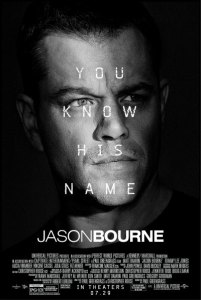 After the indifferent reception of its 2012 spin-off, original super spy Jason Bourne (Matt Damon) and director Paul Greengrass (Captain Phillips) are back and it feels like everyone is falling into familiar paces. The titular fourth film in the franchise (excluding Bourne Legacy) is easily the weakest (excluding Bourne Legacy) and the seams of the formula are starting to show. Once again an ally has intel to expose some sort of secret and illegal government conspiracy that ties into a revelation about Bourne’s past, and once again this ally is killed as the Act One break to spurn Bourne onward, and once again there’s a secondary assassin working for the morally murky government agency head, and once again there’s a signature car chase sequence, and once again there’s a final choice Bourne needs to make about what kind of person he wants to be given his new perspective on his old killin’ ways. The frantic Greengrass staple camerawork and editing can make just about anything bristle with some energy and suspense, but rarely was I fully feeling what was happening onscreen (except for the caveat of admiring how attractive Alicia Vikander’s face looks on the big screen). Short of the final car chase through Vegas with a SWAT truck barreling through traffic, the action sequences are pretty routine and unmemorable. The foot chases and fisticuffs, a hallmark of the franchise, feel slightly blasé in their development. The action isn’t bad but it feels more than a bit staid. The stakes aren’t as high and maybe that’s because it feels like there is little more to reveal about our hero’s hidden past. Is the next movie going to divulge the long lost secret that he never paid a parking ticket? Tommy Lee Jones makes an enjoyably crusty adversary. Vikander has just enough of an angle to provide more substance as a character than the typical agency analyst reciting exposition. The film ends with some promise of looking forward rather than back, and I hope that further adventures with Jason Bourne (excluding Bourne Legacy) stray a little more from the well-worn formula and provide better reasons for this spy to come out of his hiding.
Nate’s Grade: B-
Share this:

Nightcrawler (2014)
 The surprise of Nightcrawler is that it works well on different levels: as a psychological descent with a deranged lead, as a media critique on sensationalism, and as a genre thriller. Jake Gyllenhaal (Prisoners) gives a truly transfixing performance as Leo Bloom, an ambitious sociopath who will stop at nothing to become the best at what he does. It so happens he films accident and crime footage to sell to the local news stations, and he’s not beyond getting his hands dirty if it means a better camera angle or a better payday. The actor reportedly lost 30 pounds and he appears otherworldly, his lanky frame and gaunt face making his bulging eyes pop. There’s a hypnotic intensity to his performance and a darkly comic irony that he speaks almost entirely in business buzzwords and jargon. The film chronicles his rise to power and how he uses his leverage to manipulate the people around him. The media satire is a little heavy-handed but still makes its points, especially in an age of scandal and hysteria. Rene Russo is also great as the desperate and bloodthirsty news producer who is charmed by Bloom but then gets too far in. Writer/director Dan Gilroy (brother of Tony) has crafted a haunting central figure that is morally repulsive yet entirely engaging, especially with a career-best performance from Gyllenhaal. He’s a fascinating psychological case, even if he remains relatively the same character from the start. He makes every moment an opportunity in suspense. Gilroy has a natural sense for visuals and especially how to pace his tension, drawing it out with precision in the final act as Bloom’s arrangements cause disaster. The nighttime Los Angeles setting and swirling tension remind me of Michael Mann’s Collateral. This is a movie that sticks with you long after thanks especially to the power of Gyllenhaal.
Nate’s Grade: B+


 nathanzoebl
You must be logged in to post a comment.