Blog Archives
The Core (2003) [Review Re-View]
 Originally released March 28, 2003:
I knew about 15 minutes in that The Core was not going to take its science too seriously. Aaron Eckhart, as a hunky science professor, is addressing military generals and essentially says, “We broke the Earth.” He tells them that because the Earth no longer spins (don’t think about it, you’ll only hurt yourself) the electromagnetic shield will dissipate and the sun will cook our planet. And just to make sure people understand the term “cook” he sets a peach on fire as an example. At this point I knew The Core was going to be a ridiculous disaster flick with its tongue firmly planted in its cheek.
Earth’s core has stopped spinning and horrific disasters are starting to be unleashed with anything from drunken bird attacks to lightening strikes in Rome. I always love how in disaster films Mother Nature always instinctively goes after the monuments, the landmarks, the things of cultural importance. The United States government hires a ragtag group of scientists and NASA pilots to journey to the center of the Earth and jump-start our planet. Of course everything that can go wrong on this fantastic journey will eventually go wrong.
The Core is so improbable, so silly, that it ends up being guilty fun. If you let go, ignore the incredible amounts of birth imagery (the sperm-like ship tunneling through to get to the egg-like core), then the very game cast will take you for a fun ride.
There’s a scene where the government approaches kooky scientist Delroy Lindo to build the super-ship that will take them to said core. When asked how much he thinks it’ll cost Lindo laughs and says, ”Try fifty billion dollars.” The government responds, ”Can you take a check?” I was pleasantly reminded of an episode of Futurama where the space-time continuum is disrupted and time keeps skipping forward. The old scientist and a Harlem Globetrotter (it was a very funny episode) theorize that to create a machine to stop this problem they would need all the money on the Earth. Flash immediately to the two of them being handed a check that says, “All the money of the Earth.” Richard Nixon’s head, in its glass jar, then says, “Get going, you know we cant spend All the Money on the Earth every day.”
 The assembled cast is quite nice. Hilary Swank assumes a leadership role quite nicely. Eckhart is suitably hunky and dashing. Stanley Tucci is very funny as an arrogant science snob. Tcheky Karyo (the poor man’s Jean Reno) is … uh, French. I don’t think anyone would believe that these people were the best in their fields (only in movies are scientists not old white men but hunky and sexy fun-lovin folk).
Director Jon Amiel (Entrapment) seems to know the preposterous nature of his films proceedings and amps up the campy thrills. An impromptu landing of the space shuttle in an L.A. reservoir is a fantastic action set piece, yet is likely the reason the film was delayed after the Columbia crash. The cornball science and steady pacing make The Core an enjoyable if goofy ride. The film does run out of steam and goes on for 20 minutes longer than it should.
The Core is pure escapist entertainment without a thought in its head. And in dire times of war and harsh realism blaring at us every evening, there’s nothing wrong with a little juicy escapist fair. Buy a big tub of popcorn and enjoy. Does anyone else wonder if we broke the Earth just after its 5 billion-year warranty was up?
Nate’s Grade: C+
——————————————————
WRITER REFLECTIONS 20 YEARS LATER

I never knew just how influential the 2003 disaster movie The Core has been. It’s a schlocky Hollywood sci-fi thriller built upon junk science but still enjoyable junk food entertainment. However, the science was so unrepentantly bad, that the science community as a whole decided to do something about it, and in 2008 the Science & Entertainment Exchange was launched. Founded by the National Academy of Sciences (NAS), its director Rick Loverd told Salon magazine how influential pop culture can be in its depiction of science, citing Star Trek inspiring scientists, Top Gun inspiring pilots, and CSI inspiring young forensic students. He also cites the power of seeing positive representation, like 2016’s Hidden Figures. The Science & Entertainment Exchange is an organization that is intended to consult on the application and depictions of science in cinema, hoping to make things more realistic. Apparently, The Core’s director, Jon Amiel (Entrapment), was so taken back when a science advisor was bad-mouthing the movie to Scientific American because he was under the impression that his movie, including restarting the Earth’s iron core with atomic bombs, had been scientifically accurate. Among the scientific community, they regard The Core as the nadir of big screen accuracy (as an example of a movie that got the science fairly accurate, they cite 2014’s Interstellar). I bet you never knew how truly influential and world-changing The Core was, albeit for being a junk movie. However, as it was in 2003, and even twenty years later, this is exactly my kind of junk.
I recognized the campy appeal of The Core right away. It’s a goofy movie from the premise to the science to the action set pieces but it’s all played one hundred percent straight, which makes it that much more entertaining and amusing. The opening sequence involves people with pacemakers dropping dead (approximately 1.5 million people worldwide). Then the birds start acting funny and crashing into buildings and cars and panicked outdoor crowds. For a disaster movie literally about the possible demise of the planet, this is such a strange and minimalist start to the looming threat at hand. The movie feels like it’s a throwback to the science fiction mission movies of the 1950s with a touch of the worldwide disaster movies of the 1970s. Even with the modern special effects, which are as delightfully cheesy as the rest of the movie, it doesn’t feel akin to the disaster epics of Roman Emmerich. The movie feels cornier and more dated and less interested in large-scale disaster spectacle. The surface-level disaster carnage is marginal, mostly an out-of-control lightening storm in Rome that knows to always steer for the monuments and cultural artifacts. The Core, at its core, is about the fantastic journey of its brave scientists. Take for instance a scene where the Serge is locked behind and being crushed to death by extreme pressure. I don’t know how anyone could keep a straight face while Aaron Eckhart, our handsome lead scientist, shouts, “Serge!” over and over while Tcheky Karyo (The Patriot) pretends he’s being squished to death while the walls get closer and closer to his face. That’s the kind of stuff I want, not CGI waves killing thousands in large-scale yet antiseptic spectacle.
 The movie takes about an hour before it really gets going, which is also admirably silly. Why devote so much time to setting up the reality of this dilemma for the complications and solutions to seem so throwaway? Seriously, the government uses one hacker (DJ Qualls) to control the entire Internet so that they can cover up the news about the possible impending apocalypse. It reminds me of an episode of The X-Files from the early 1990s where the government sends out an “all-Internet alert.” Perhaps the screenwriters felt we needed more time to accept the outlandish premise, which is strange because most disaster movies get a significant benefit of the doubt from audiences. Just having a person in glasses, and maybe a lab coat, or sweater if you want it to be more casual, explaining in a grave tone while removing their glasses dramatically, is likely all we need to accept the craziness to come. However, we do spend more time with our characters so that, when they depart one-by-one through sacrifice and accident, I actually cared enough because I was enjoying their comradery. I enjoyed Stanley Tucci being a blowhard who would even record his own narration as they travel through the Earth. I enjoyed Bruce Greenwood as the stern father figure that of course has to die first. I enjoyed Delroy Lindo as our excited but exasperated drill scientist. I enjoyed Hilary Swank as, essentially, the “best damn pilot I’ve ever seen.” I liked simply watching them all banter and bond together. It had enough development that their losses actually felt like losses and/or the accumulation of a character arc.
The question arises how do you keep things interesting when you’re burrowing through layer after layer of rock, and the answer is to just make things up. How about a layer of air? Could the Earth, compact as it is through billions of years of gravitational forces, have a layer of air like it was an English muffin? I did enjoy how the team had to restart their vessel before the magma poured into the vacant and awaiting space from their entry point. Of course, that raises the question now that magma is filling this vacant layer, have these scientists unintentionally ruined this unknown layer of the Earth? How about a layer with diamonds the size of states? These internal layers might as well be alien planets for as little they connect to reality.
 The movie is overlong and too uneven, but for fans of schlocky science fiction, it’s a delicious combination of campy entertainment. The silliness, played completely straight, even down to the part where Richard Jenkins explains man’ hubris is at fault for destroying the rotation of the Earth, is the grand appeal. I’m not going to call The Core a good movie but it sure feels like it knows exactly what kind of movie it is, and boy does it lean into that. My original review in 2003 caught on right away and I still recognized that same knowing vibe (why do we need a visual demonstration for the obvious concept of the sun cooking the Earth?). There really is a lot of birthing imagery too with the shape of the vessel burrowing to that egg at the center, so there’s that as well. The special effects are pretty murky and hokey for this kind of budget, but in 2023, that even works to the bountiful charms of the movie. I won’t pretend that most people will watch The Core with derision regardless of whether or not you’re an actual scientist. It inspired a generation of movies to be more scientifically sound, and it also inspired one of the biggest filmmakers on the planet. The metal that encases the spaceship? Unobtanium. You cannot tell me James Cameron wasn’t watching and taking notes.
Re-View Grade: B
Share this:

The Humans (2021)
 I was left cold and confused by The Humans. It’s an adaptation of a Tony-award-winning play, by the playwright himself, and I don’t know what all the fuss is about. It’s a sparse movie set during a tense Thanksgiving dinner while a dysfunctional family moves one of their own into her New York City apartment. The conversation style is very natural and the characters behave like recognizable people; however, that doesn’t make them particularly interesting. This was the same issue I had with last year’s Shit House movie, a movie that confused realistic conversations with interesting conversations. Just eavesdropping on people and getting the occasional spark of conflict is not enough. I was relatively bored throughout and then when the movie tries to lurch into paranoia horror I had no idea what was happening. It feels like a dull drama that had no real ending and then someone said, “What if we spent the last ten minutes of this chamber piece conversation walking down dark corridors and inspecting noise?” The acting talent here is tremendous, including Amy Schumer in a rare dramatic role, and it just feels like a waste of their time. I don’t know what proved so appealing to critics here.
Nate’s Grade: C
Share this:

Kajillionaire (2020)
 If you’re not familiar with quirky writer/director/performance artist Miranda July, she specializes in a special kind of weird that borders on surreal and also a surprising emotional poignancy. It’s been 9 years since her last feature film, The Future, and she’s back with what might be her most narratively focused and accessible yet still wonderfully weird movie yet. We follow a family of grifters (Richard Jenkins and Debra Winger as the parents) and their day-to-day struggle to con, skim, or steal enough money to get by to the next day. Old Dolio (Evan Rachel Wood) is their only child, and her role in the family is thrown into question when a new member joins their team. Melanie (Gina Rodriguez) has connections to a raft of senior citizens so desperate for attention that, if they all pose as Melanie’s family, they should be able to con these old folks of possessions they can resell. From there, the movie becomes a push-and-pull relationship between Old Dolio and the influence of her shifty family, and she questions her place in this fringe unit and whether her parents actually love her or see her as another means to get a score. Kajillionaire is loose in plot but populated with interesting characters who feel fully realized by July’s writing. She’s so good at studying human behavior and capturing it that the quirky details all feel so genuine and meaningful. Even Old Dolio’s name is a reminder of her parents’ opportunism and problematic parenting skills. She was named after a homeless man who won the lottery under the hopes that he would be grateful and put her in his will (he ended up spending his fortune on experimental cancer drugs). That’s the difference with July. A silly name could just be a disposable oddity, but for her it’s a reflection of a character’s worth and history. There are moments in the movie that achieve a level of artistic transcendence where every piece is humming beautifully together, like one moment where a dying elderly man off-screen directs the grifter family to pretend to be like his own flesh-and-blood family. They play pretend at domesticity, each assuming a doting role, and the tranquil scene of a fake family feels beautifully attuned. The moments stand out more than the whole but July’s empathetic appreciation of human fallibility keeps her from ever condemning Old Dolio’s scheming parents too much. Even the very end finds a way to turn betrayal into a message of humility. Wood (Westworld) drops her voice several octaves, wears baggy clothing, and looks extremely awkward when it comes to human contact. Rodriguez (Annihilation) is the voice of the audience and her test of how far she’s willing to excuse the selfish behavior of this clan of cons. Her burgeoning friendship and maybe more with Old Dolio is a rewarding enterprise for the characters and the audience. Kajillionaire is a gentle little movie that plays at a low-key range of human emotions yet it can still be deftly funny and surprising and heartfelt on its own unique terms. With Miranda July, she makes weird entrancing and human.
Nate’s Grade: B+
Share this:

The Shape of Water (2017)
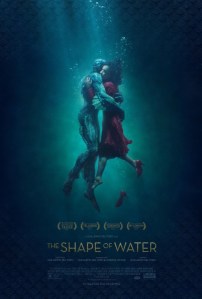 You haven’t seen a romance like director Guillermo del Toro’s latest monster mash (monster smash?), The Shape of Water. del Toro, an aficionado of cinematic creepy crawlies, has swerved from big-budget studio fare into a smaller, stranger period romance between a woman and an amphibious creature who already arrives pre-lubricated (I apologize already for that joke). I was compelled to watch The Shape of Water twice to better formulate my thoughts, mostly because I was not expecting the movie to be so enthusiastically whimsical, adult, and romantic, and the best beauty and the beast tale of this year.
Elisa (Sally Hawkins) is a lonely mute woman working on the cleaning staff at a classified government laboratory. Her neighbor, Giles (Richard Jenkins), is a hopeless romantic trying to find his place in the world as a gay man. Her best friend, Zelda (Octavia Spencer), is supportive but thinks they should mind their own business. An Amphibian Man (Doug Jones) from the Amazon is confined to a cell and repeatedly beaten by Richard Strickland (Michael Shannon), the vile head of security at the station. They believe the creature’s ability to breathe underwater and on land will be the key to winning the space race. The scientist in charge, Dr. Hoffstetler (Michael Stuhlbarg), is secretly a Russian spy, though his allegiances are more to the fragile creature than any country. Elisa teaches the creature sign language, the joys of hard boiled eggs, and lots of cheery music. She also falls in love with the creature and grows determined to save the Amphibian Man by breaking him loose.
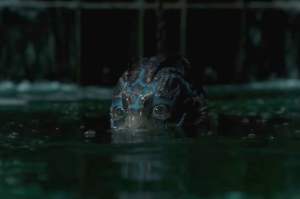 From the get go, del Toro drops us into a world that is not our own, as he’s so skilled at doing. This version of 1960s Baltimore feels as though it’s the twentieth century equivalent of a fairy tale village, and our monster is also the princess in need of rescue. Our heroine has a strange scar that foreshadows her place of belonging. The entire film bristles with a sense of expertly curated magic realism even though there isn’t anything explicitly magical. The supernatural and fantastical are met with a casual acceptance, as they would be in any storybook legend of old. When Elisa discovers the Amphibian Man in his tank, it’s literally at the ten-minute mark or even earlier, and she is unfazed. She immediately accepts the existence of this scaly mere-man, establishes a line of communication, and befriends the creature. It’s as if del Toro is trying to prime the audience for what’s to come and hoping to skip over the intermediate waiting period of incredulity. For del Toro, the real fun is once the characters connect, and belaboring that necessary connection is not in the audience’s best interests or time.
The movie glides by on effusive outpouring of charm, given such vibrant, sweeping life thanks to del Toro’s repertoire of pop-culture influences and his passionate love of cinema. The Shape of Water feels like del Toro and co-writer Vanessa Taylor (Hope Springs) took one of the old Universal horror B-movies and decided to make it into one of the most personal, delightful, and curious filmgoing experiences of the year. It’s film as escape for society’s outsiders. The sense of whimsy is ever-present without being overpowering or diluting the drama. It never feels quirky for its own sake of satisfaction. You’ll recognize several of del Toro’s artistic references, the re-purposing of cultural artifacts, but the magic suffused within every frame is thanks to del Toro and his team of filmmaking artists. If Amelie was going to fall in love with a sea creature, it might look something like this The Shape of Water.
The movie is also surprisingly, refreshingly adult in its depiction of human beings. Again the opening minutes set a standard of what to expect. We get a sense of Elisa’s daily routine before leaving for work, and one crucial component involves furious masturbation in her bathtub (set to an egg timer for sport?). This is a far more sensual movie than I was ever anticipating. There are multiple sequences of Hawkins disrobed and offering herself to the Amphibian Man. We never see any underwater action but we do hear about some of the mechanics of how the coupling is even remotely possible physically (“Never trust a man,” Zelda chuckles upon hearing those dirty details). It’s not all sexy time indulgences. There’s a sharp undercurrent of very real and very upsetting violence, typified by Strickland’s ruthless determination to break the creature. He’s a Bible-thumping sadist generally dismissive of those he finds different and lesser and yet he’s drawn to Elisa. Why is that? Because she’s a diminutive woman who cannot talk, and this sexually excites him like nothing else. He even comes on to her, thinking his interest is a form of masculine charity. There are some shocking moments of very real violence and its lingering effects. Strickland’s on-the-job injury becomes a metaphorical moral gauge for the putrid character’s state of being. The Shape of Water is a movie that does not blunt anything, whether it’s the sexuality or violence of its story (beware pet lovers: this is the second 2017 entry where an amphibian being hidden from the government eats somebody’s house cat). This is a fable for adults, a grimy Grimm’s tale with a sprinkle of Old Hollywood sparkle.
 The Shape of Water is also a deeply romantic and earnest love story about two outsiders finding a connection in the most unlikely of places. Engineering a story that pushes two oddball characters together, each finally finding a kindred spirit, is an easy recipe for a satisfying conclusion; however, their romantic connection has to feel rightly earned. If we don’t believe the characters have fallen for one another, that this potential relationship elevates their existence, that the colors of the world seem brighter when around this person, then it doesn’t work. You have to buy the love story and it must be earned. Amazingly, del Toro is able to craft a love story with a mute woman and an Amphibian Man that checks most of the boxes of Hollywood romantic escapism. Elisa has an openhearted way of looking at the world, and her acceptance provides her with a bravery few others have. The creature presents somebody who views her not as a woman with a disability, as something lesser, but as something whole and wholly fulfilling. Everyone wants to be truly seen by someone for who they are rather than what they’re not.
While del Toro is supremely skillful at making Elisa’s romantic yearnings felt, there is one inherent weakness in this girl-meets-fish dude tale of love. The Amphibian Man isn’t really much of a character and far more of a symbol to the other characters. To Elisa, he’s her hope. To Giles, he’s a wild animal. To Strickland, he’s a defiant challenge to be tamed. To Zelda, he’s the questionable new boyfriend for her pal. To Hoffstetler, he’s a beautiful creature. To the U.S. government, he’s a potential scientific breakthrough. To the Soviets, he’s a liability and a potential future weapon. We’re told the indigenous people of the Amazon worshiped the Amphibian Man as a god but ultimately he remains a cipher others project onto. The love story feels a little too one-sided from an audience investment perspective. Still, the romance works and that fact alone is incredible considering the unique pairing.
 Hawkins (Maudie) is the beating heart of the movie and delivers a wonderfully expressive portrait of a woman finding her voice, so to speak. She’s relatively upbeat and that fits the whimsical tone of the picture. Hawkins plays a woman excited by the possibilities of the world. She reminded me of Bjork’s tragic heroine from 2000’s Dancer in the Dark, a woman who saw the extraordinary in ordinary life, who could perceive a symphony of music just on the outer edges of everyone else’s hearing. Going completely wordless for the movie, save for one very memorable fantasy sequence, requires a lot of daunting physical acting from Hawkins, and she’s more than up to the task. I guarantee a scene where she tearfully forces Giles to say out loud her signing will be her Oscar nomination clip.
When we talk about the weird and wild promise of cinema, it takes a controlled, assured vision and precise execution to bring together the dispirit elements and allow them to coalesce into something that feels like a satisfying, mesmerizing whole. The Shape of Water is del Toro’s gooey love letter to monster movies while stepping outside of homage and into the realm of something daring and different. I could talk about the Busby Berkley musical number as declaration of love, or that the story is told from socially marginalized voices finding an affinity together, or the small character moments that give generous life to supporting figures like Zelda and Hoffstetler, or that it leaves implied stories to be chewed over for extra richness like Giles likely being outed at his work to the dismay of his closeted superior, or the perfect casting for secondary antagonists, or the exquisite cinematography that seems to utilize every shade of green the human eye is capable of seeing, or the stunning production design, or the sweetly eccentric whistling musical score by Alexadre Desplat, or the grace of Doug Jones’ performance in the amphibian suit, or just how funny this movie can be, even the sadistic villain. I could talk about all that stuff but I’ll simply condense it all to a plea to give The Shape of Water a chance. It’s rare to see a storytelling vision this precise that’s also executed at such a high degree of difficulty. In other hands, this could have been an unholy mess. With del Toro, it’s a lovely mess.
Nate’s Grade: A-
Share this:

White House Down (2013)
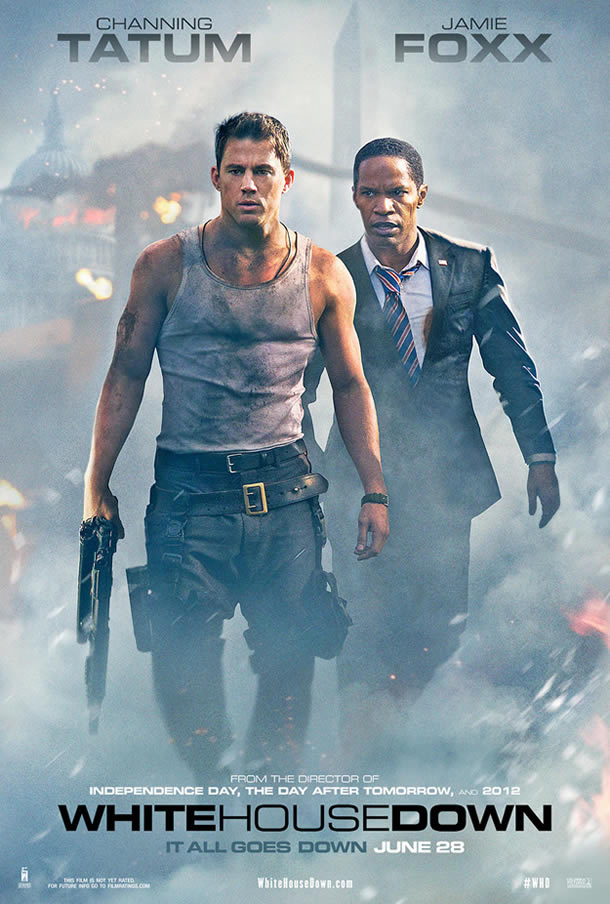 Director Roland Emmerich, the maestro of the dumb fun blockbuster, is never going to get the credit he deserves but the man is something of a mad genius when it comes to putting together spectacle-rich, low-calorie but still satisfying summer entertainment. Take White House Down, the second of 2013’s Die-Hard-in-the-White-House movies. It’s really more of a buddy film contained to that famous structure. It’s not a smart blockbuster by any means but it makes up for any and all flaws with its sheer overpowering sense of fun. Stuff gets blown up real good, the action is brisk, and there are satisfying payoffs for story elements that felt like they were, at first glance, merely thrown together. You may walk away surprised at how much you’re enjoying the comedic interplay between Secret Service agent Channing Tatum and president Jamie Foxx. Plus it’s fun to see the president in on the action instead of merely as a hostage, like the earlier Olympus Has Fallen. In direct comparison, I’d have to say White House Down is the better of the two movies, both in payoff and action. It’s nice to have a movie that’s just fun to watch, that goes about its blockbuster business with precision, supplying a few decent twists, and giving us heroes worth rooting for and action sequences that are well developed and that matter no matter how ridiculous. Emmerich movies are blissfully free of self-serious malarkey, though his weakest hit, 2004’s Day After Tomorrow, got a bit preachy. His movies know what they are and know the demands of an audience. What I needed this summer was a movie designed to make me cheer the impossible. White House Down is a romp.
Nate’s Grade: B+
Share this:

The Cabin in the Woods (2012)
 The Cabin in the Woods has been building an avalanche of buzz in the time it’s been sitting on the shelf. Originally filmed in 2009, the horror comedy from Buffy the Vampire Slayer creative heavyweights Drew Goddard and Joss Whedon has been patiently waiting to unleash its wicked Jack-in-the-box of surprises. Directed by Goddard, and written by Whedon and Goddard, The Cabin in the Woods is a brash enterprise, a blast of entertainment and a breath of fresh air in a genre that typically teeters into self-parody. If you haven’t seen the movie yet and have a strong, or even curious, desire to do so, then stop reading. Go in as blind and unspoiled as possible. Then you can come back and read my witty words. It’s okay. I won’t take offense. In the meantime, I’ll keep myself busy. Back? Good, let’s get started then.
You know the setup. A group of dumb teenagers spend a weekend at a friend’s cabin in the middle of nowhere. There’s the jock (Chris Hemsworth), the slutty girl (Anna Hutchinson), the stoner (Fran Kranz), the bookish one (Jesse Williams), and the mousy girl-next-door virginal type (Kristen Connolly). There’s the scary old guy at the gas station, there’s the promise of debauchery and sweet oblivion. But we’re not the only ones watching the gang. A group of lab techs, led by Hadley (Bradley Whitford) and Sitterson (Richard Jenkins), is watching their every move. They control the cabin and its surroundings and are manipulating events to lead to slaughter. But why are they going to all this trouble? That’s just the tip of the iceberg here.
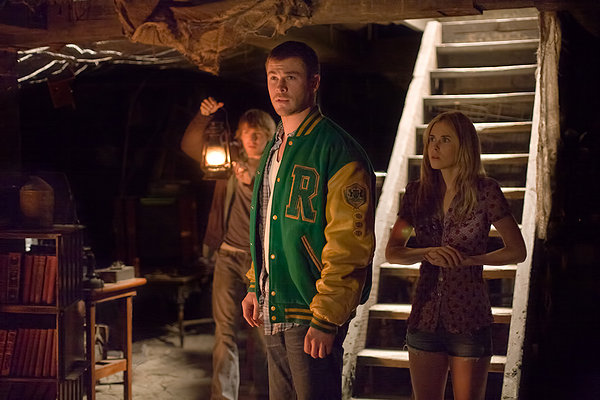 The macabre sense of humor is what will immediately separate Cabin in the Woods from its blood-and-guts brethren. The sharp dialogue is routinely laugh-out-loud funny, absurd in the right parts. Whitford’s downbeat reaction during a joyous moment of celebration had me howling. The movie is so smart, sometimes too smart for its own good. If you’re going to level one major charge against the movie, it’s that it isn’t really ever scary. Oh sure it has some stuff that should be scary given the particulars, and its 31 flavors of horror should find something that tingles everyone’s spine on some level. But this is much more of a deconstruction of the horror genre and its audience than an actual horror movie. Whedon and Goddard undercut their horror almost at every turn, settling for the ironic laugh or satirical tweak and repeatedly cutting back to the lab guys to provide a few good laughs and commentary (Jenkins has a terrific foul-mouth rant aimed at children that left me doubled over in laughter). Do not be mistaken; the lab stuff is easily the best part of the movie. Upon my second viewing, I found myself growing weary with the teens-in-a-cabin stuff and anxiously waiting our next detour into the weird and wonderful lab. The duo of Whitford (TV’s The West Wing) and Jenkins (Friends with Benefits) makes for some terrific and biting middle management corporate satire, as well as satirizing the jaded, bloodthirsty audience of slasher movies. You can tell that Whedon and Goddard love horror movies and are frustrated with the nihilistic rut the genre has found itself mired in. And as a deconstructive exercise, Cabin in the Woods is first-class. Roger Ebert succinctly called the movie a “fanboy final exam.”
It can be a tad clinical at times, failing to give us any true attachment to the characters even in an ironic sense, but when a movie is this fun, this wild, and this clever with its deconstruction of genre, I concede the point of having to root for somebody. The characters break the stereotypical mold; the jock is on academic scholarship, the smart guy happens to also be a hunky jock, the slut isn’t really slutty, the virgin isn’t squeaky-clean, and the stoner is the smartest guy in the group, aided by his cannabis (As one character later reasons, “We work with what we got”). He’s the only one who seems to be able to notice the strange manipulations at work. Once you dig into it, the very nature of how and why we watch horror is analyzed by Cabin in the Woods (get ready for some voyeurism parallels). The nature of fear and sacrifice is given some thought, though this stuff gets a bit lost in the madhouse of a final act. The movie becomes a funhouse of horrors and the frenetic carnage and chaos elevates the energy level. I cannot think of a movie that ended in such a whirling dervish of excitement and deep, demented satisfaction. This is one movie that doesn’t just end with a bang; it ends with every bang you can think of. Horror fans are going to be hopping out of the theaters, foaming at the mouth, desperate to tell every one of their friends what they just witnessed. I wish several of my friends would hurry up and see Cabin in the Woods so I had somebody to talk about its many pleasures, thrills, and surprises with. The movie has several terrific payoffs. This is the most fun I’ve had with a horror movie since 2003’s Cabin Fever. Must be something about cabins that brings out the meta-ness.
 Considering this was on the shelf for over two years while MGM worked out its bankruptcy dealings, it’s fun to see how fate has been to this lot of actors. The biggest name has got to be Hemsworth, better known as the flaxen, hammer-wielding God of Thunder Thor in the Marvel movies, and Whedon’s upcoming Avengers ensemble. He’s rather enjoyable onscreen and his hero moment is one that will definitely be a talking point. The two standouts from the cast, other than Jenkins and Whitford of course, are Connolly (“iGirl” on the Web series, iChannel) as the nubile Final Girl and Kranz (TV’s Dollhouse) as the clever pothead. Connolly has got a great face for movies, looking like the younger sister of Ellie Kemper (TV’s The Office) or Jayma Mays (The Smurfs), and I’m always a sucker for a redhead. Kranz is so good with the comedy that you may fail to notice all the work he’s actually putting into his role, which quickly becomes the audience’s voice of reason.
But the strangest quirk for a movie knotted with them comes to the casting of its resident “slut” played by Hutchinson. The woman has a sultry side that comes through without going overboard into parody. Scanning through her resume, I see that Hutchinson portrayed the Yellow Power Ranger (Lilly) for 32 episodes in Power Rangers: Jungle Fury. Now here’s where things get interesting. Being the movie aficionado that I am, I recognize that Cabin Fever also had an actress, Cerina Vincent, who portrayed the Yellow Power Ranger (Maya) for 45 episodes in Power Rangers: Lost Galaxy. Here’s where it gets even weirder. Both Hutchinson and Vincent are the only cast members in their movies to go nude in their respective films. So two actresses, both different versions of the Yellow Power Ranger, both get naked and star in horror genre deconstructive movies with “cabin” in the title! Is this one of the Mayan signs? Should I contact Dan Brown? Does it say something that the yellow ranger appears to be the most comfortable with nudity? This may be the greatest and most obscure observation I’ve ever made.
Of course there are so many fun surprises that it puts me in a bit of a critical bind. I don’t want to go into too much detail because that would spoil the fun, though rest assured that The Cabin in the Woods does not live or die based upon unknown plot twists. You may think you know given what’s already been revealed via the trailers, but really you have no idea how deep this thing goes and to what ends. Unless you just happened to be me, which at last count there was only one of (my evil twin long since slain… or was he?). I say this not as some point of pretentious bragging, but it’s because I wrote a horror screenplay a year ago that also satirized the genre tropes (for those few interested, it was called Blood Wake). I won’t go into spoiler detail, but both of our bad guys were called into question as being bad, from a greater good standpoint, and the killers had more on their minds than simply punishing dumb, horny teenagers. Well, after watching Cabin in the Woods, I know that screenplay goes back in the shelf now where it will live in eternal slumber thanks to core similarities. But if somebody’s got to be wielding the knife, at least it’s my man crush Joss Whedon.
Nate’s Grade: A-
Share this:

Let Me In (2010)
 Essentially a faithful remake of the Swedish pre-teen vampire romance, Let the Right One In, this American reinterpretation loses points in originality and freshness but makes up for it with a bigger budget and better acting. Even fans of the original, and count me as one, must admit that Chloe Grace Moretz (Kick-Ass) as a pint-sized vampire stuck forever in pre-pubescence, and Richard Jenkins (The Visitor) as her aging caretaker, are upgrades. The true surprise is the eerie assuredness of the entire production from director Matt Reeves, he of shaky-cam Cloverfield fame. The entire film just feels so placidly precise, even as it draws tension and sets up for one vicious poolside climax. Some of the audience unfriendly moments from the original have been exorcised (say goodbye to lingering gender identity questions), but Let Me In still happily dwells in an unsettling place, forcing its characters to do questionable things in the name of companionship and forcing the audience to decide how they fell about that. Also, the film still retains its ambiguity for interpretation; whether you view it as a depressing saga of use and abuse, or an disaffected teen romance is entirely up to you. Let Me In won’t grab peoples’ attention in the same way its Scandinavian predecessor did, but it doesn’t screw it up either. And these days, that’s got to count for a lot.
Nate’s Grade: B+
Share this:

Dear John (2010)
 Best-selling author Nicholas Sparks is probably a perfectly reasonable human being. I’m sure he’s great at parties and that people love him. He may even have a dynamite recipe for sugar cookies. But I don’t know what happened to Sparks to turn him into the romance genre’s angel of death. His novels have followed a familiar practice of big Third Act deaths that usually deny readers their cherished happy endings. Is the motive to push people to make the most of our preciously little time spent on Earth? Is Sparks just sadistic and has found the secret to eternal life — the tears of millions of housewives and teenager girls. Whatever his rationale, another commonality for Sparks is that the film adaptations of his books are pretty corny and dreadful. A Walk to Remember, Nights in Rodanthe, Message in a Bottle; all about romance ultimately denied, none coming close to watchable. Dear John can at least be called watchable; however, watching should be limited to the confines of your living room TV when there’s nothing else on.
It’s the spring of 2001, and John Tyree (Channing Tatum) is enjoying his two-week leave from the military. He’s out surfing the fine North Carolina beaches when he rescues the handbag of Savannah (Amanda Seyfried) from being washed away. They two of them casually chat and soon those chats lead to barbecue invitations, parental visits, and kisses in the rain (a romantic movie tradition). Savannah takes an interest in John’s eccentric father (Richard Jenkins) because she recognizes his condition as autism. She’s been helping to watch her neighbor’s autistic child. Savannah would like to start her own horse camp for the autistic (sounds like an insurance nightmare). Life seems so full of promise and John promises to be back as soon as his military commitment expires in six months. Then 9/11 happens. John re-enlists and extends his tour another two years. This places great strain on his relationship with Savannah, but they write each other countless letters that manage to find John no matter what far-flung village he’s stationed at. Can their love exists on a series of hand-written letters? Well, look no further than the classic implications from the film’s title.
 Dear John goes through all the traditional Nicholas Sparks waterworks trademarks: young love leads to yearning, which leads to heartbreak, which leads to more yearning, which then inevitably leads toward one of the leads dying and everyone learning some sort of shallow profound meaning about life, blah blah blah. There are plenty of heightened melodramatic elements thrown into a fairly traditional, unspectacular love story, but all potent potential moments of drama feel underwhelming pretty much because the audience doesn’t care. John and Savannah are perfectly nice people and their love has that hopeful bloom, but their relationship is no more involving than watching a pretend couple in a commercial for greeting cards or life insurance. These people are vanilla. It makes it astounding, then, that such highly charged elements like cancer autism, and 9/11 fail to leave any impact. Dear John confuses listing dramatic events as drama itself. The dramatic stakes feel entirely too mellow and the film generally has a detached feeling, like it’s purposely distanced from the material for fear of getting too involved. This is a relationship movie that has its own commitment issues.
The military angle is respectfully explored, though not in much depth. John is torn apart by the pull of returning to his beloved but also of serving his country and, more personally, keeping his band of brothers in arms together. It’s a complicated scenario but the military commitment is another item in a list that should grab your interest but fail to do so. 9/11 isn’t given any deeper consideration other than the fact that it serves as a roadblock between our two lovebirds. If you want to see a more nuanced, complicated, and empathetic view of today’s overburdened military, check out the movie Stop-Loss, which also stars Tatum.
 The film drops any facade of being a romantic drama about midway through when Seyfried gets completely sidelined. She’s less a character and more an agreeable plot device; she’s self-aware and kind and knowing and receptive yet also naive. This makes her sudden character shift rather jarring, which seemingly paints Savannah as extremely co-dependant. Dear John then transforms into a serviceable father/son drama. There are some nice and moving moments between John and his father; this should have been the real focal point of the movie. Jenkins acts circles around everybody in this movie. It’s wonderful seeing a grown-up in these kind of movies show the kids ho this acting thing is done. Tatum actually might become a pretty good actor. He convincingly plays the more emotional moments well. He may very well prove to be the Patrick Swayze of his generation. Tatum can dance (Step Up), make the girls cry, and also handle some rock-socking action (G.I. Joe, Fighting, most of Tatum’s other movies). I think there’s an actor buried beneath that daunting physique waiting to blossom. Don’t disappoint me, Channing.
Dear John is a formulaic romance trained to seek pre-programmed audience responses (“Now you will laugh. Now you will cry. Now you will cry again. Now you will once again continue to cry…”). Lasse Halstrom (What’s Eating Gilbert Grape, Cassanova) directed this movie but you’d never be able to notice. I don’t want to be too harsh on the film because the acting is pleasant the story isn’t repulsive and does have some good moments, but mostly the movie comes across as bland and remote. The romance seems absent a beating heart to keep things moving. It’s all too lifeless. The character of Savannah best summarizes Dear John as a whole: mild pretense of wisdom, pretty to look at, genial, but fairly bland and difficult to convince is worth your valuable time.
Nate’s Grade: C
Share this:

The Visitor (2008)
 The follow-up by Thomas McCarthy, the writer/director of the sparkling Station Agent, is an affecting indictment on our nation’s immigration policies that manages to say a lot of important things in small touches, ditching histrionic messages. Walter (Richard Jenkins, in a commanding and deeply empathetic performance) discovers a pair of illegal immigrant squatters living in his seldom-used New York City apartment. He strikes up an unlikely friendship that moves in subtle strokes that keeps the movie very character-based. The second half of the film revolves around Walter’s attempts to work within the system to free his new friend from detention. I could have spent more time with Walter and Tariq, the Syrian immigrant who teaches Walter how to play the African drum. The Visitor explores a man learning in his autumn years how to reconnect with people, and it has moments of astonishing emotional clarity. McCarthy is a filmmaker that can spin narrative gold from just about anything; The Station Agent had a hot dog vendor, a single mom, and a dwarf. The Visitor is further proof that McCarthy is an extremely talented man who knows how to target and tap the humanity of his unique characters. There are very few moments in this movie that feel false.
Nate’s Grade: B+
Share this:

Intolerable Cruelty (2003)
 Miles Massey (George Clooney) is the preeminent divorce attorney in Los Angeles. But after years of bankrupting homes after people have broken them (this allusion may be too tricky), hes grown tired of the same old same old. Enter Marilyn Roxroth (Catherine Zeta-Jones), a conniving gold digger who has been ruined by Massey defending her dimwitted hubby (Edward Herrmann). Now shes out for revenge, which could be in the form of romancing Massey while bringing him down.
Intolerable Cruelty is something of a strange breed. It’s the Coens most striving foray into mainstream success, with the weight of the world on Clooney and Zeta-Jones exchanging sparks and verbal repartee. For the most part, things work: the leads do have a winning chemistry; Zeta-Jones is positively glowing in Roger Deakins’ beautifully milky cinematography (she found out she pregnant late in the shoot, which could explain the glow).
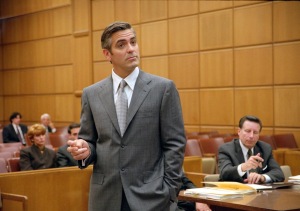 The stumbling block for Intolerable Cruelty and its central romance is that neither of the leads, though at times charming, isn’t exactly likable or able to root for. An integral part of any romantic comedy is empathy for the leads so much that we want them to get together, possibly with swirling crescendos. But in Intolerable Cruelty, both leads make a living off deceiving and taking advantage of others. So while their War of the Roses-esque pursuit to out-scam the other can provide some entertaining twists (and some forced and out of place), the whole duplicitous one-upsmanship doesn’t blossom credible love between the leads or the audience.
I have a strong feeling that Intolerable Cruelty was a story the Coens hopped on late, did some rewrites and invited old Coen friends to join in the jubilee. This is the first time the Coens have worked with other writers (the people who brought us such duds as (Big Trouble and Life), and certain storylines or subplots that glaringly feel disjointed from the screwball-comedy tone of the film. An asthmatic hit man named Wheezy Joe (who got the biggest laugh with his demise) is funny but in the wrong Coen film. When Clooney and Zeta-Jones both hire the services of Wheezy Joe to off the other, you know the story took a fantastical wrong turn. A creepy decrepit owner of Clooney’s law firm also feels like a leftover from a different film. This movie also has the most ripping up of legal documents I’ve ever seen in a movie.
Clooney is quite funny as a chattering legal eagle with a Cary Grant edge. Hes ready and willing to play against his movie star image, which works wonders for comedy, though the running gag where he must look at his teeth in any reflective surface never takes off. It took me until Intolerable Cruelty to realize how much of a beautiful woman Zeta-Jones is. Her warm smile could light up an auditorium. The supporting characters are all underused but very memorable. The opening with Geoffrey Rush’s TV exec walking in on his canoodling wife is very funny, and he plays the long-haired arrogant type well. Cedric the Entertainer is hilarious as a private eye determined to ”nail yo ass” that I started privately wishing the film would spin to follow his life and not Clooney’s.
Intolerable Cruelty is a nice diversion for the Coens, with some good laughs here and there (my favorite being the courtroom scene where Clooney and Zeta-Jones go head-to-head for the first time), but one would hope that the Coens will get back to doing hat they do best, which is quirky yet beautiful independent films. In the end, it seems that the Coens have created an oddity for themselves — a normal movie. We expect more Joel and Ethan.
Nate’s Grade: B-


 nathanzoebl
You must be logged in to post a comment.