Blog Archives
Solaris (2002)
 A most amazing thing occurred when I sat down in my theater to watch Steven Soderbergh’s sci-fi remake, Solaris. The majority of the theater was women, no small part Im sure to George Clooney and the promise to see his posterior not once but twice. As the film progressed I kept hearing the rattling of seats and the exit doors. When the lights came back on more than half my theater had walked out on Solaris. I have never seen this many walk outs for any film before, and if one has to hold this title Solaris certainly does not deserve this dubious honor.
Clooney plays Chris Kelvin, super future psychologist who is struggling to overcome the grief over the suicide of his wife, Rheya (Natascha McElhone). Clooney is dispatched to a space station orbiting the mysterious glowing planet Solaris. Seems strange goings on, are, well, going on. When he arrives he finds that the station head has taken his own life and the two remaining crew members on board could use more than a few hugs. Clooney goes to sleep (in a bed resembling bubble-wrap) and is startled awake when his dead wife is suddenly lying right beside him. But is it his wife? Is it merely his memories being recounted? Is it Solaris messing with his gray matter? Does Rheya have consciousness of the past or of her self? What are her thoughts on her new materialization? Good luck Steven Soderbergh, existentialist party of one.
It’s not that Solaris is necessarily a bad film, it’s just that it’s plodding, mechanical and overly ambitious. There are long periods of staring, followed by brief exposition, then more staring, sometimes earnestly but mostly slack-jawed. Solaris is attempting to be an existential meditation on identity and self, but what really occurs is a lot of nothingness. For a movie that was over three hours in its original 1971 Russian conception, and a mere 93 minutes in its slimmer Soderbergh size, I could likely get this movie done in 6 minutes. It could be argued that its arduous pacing amplifies its methodical subject matter but whatever.
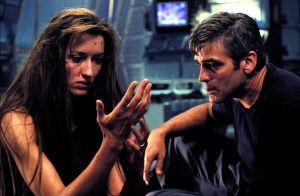 Clooney has said in interviews how Solaris was the most challenging role of his career. To this I make a collective noise of disagreement. Clooney turns from grief-stricken to confusion, then back to grief-stricken with nary a line of dialogue. The effect is more dampening than emotional. Clooney’s conscious gets even worse when he banishes New Rheya into the cold vacuum of space then Another Rheya appears the next night. He just can’t escape this dead woman.
I’m very pleased to see the glassy-eyed, apple-cheeked beauty McElhone in movies again. She seemed to be on the cusp of mainstream acceptance after prominent roles in 1998’s Truman Show and Ronin, yet she just disappeared. McElhone is a wonderfully expressive actress and deserves to be a leading lady.
Soderbergh’s take on existential dread could be described as a noble failure. Solaris is the type of overreaching, underachieving film only really talented people could make. And for anyone wanting to leave after the double dose of Clooney’s derriere, they both happen in the first 30 minutes. You can go after that if you so choose.
Nate’s Grade: C+
Share this:

The Ring (2002)
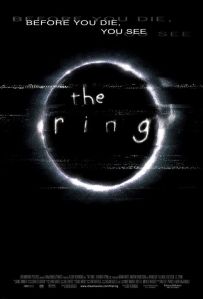 So have you heard the one about the videotape where you die seven days after you watch it? No it isn’t a new late fee ploy by Blockbuster. It’s the great premise for the entertaining new horror movie The Ring. After you watch this eerie video your phone rings. A raspy voice on the other end tells you that you have seven days, then, one week later to the minute, you die. How cool is that?
Seattle reporter Rachel Keller (Naomi Watts) learns of this urban legend at the funeral of her teenage niece, who died suddenly and mysteriously. Through research she observes that her niece’s three friends all died at the same hour on the same day, though through different circumstances. She recovers pictures of the four of them at a campsite, where they had watched the video, except their faces are blurred in pictures taken after they had watched the tape.
The Ring has its shares of creepy scares but midway in it makes an unexpected turn. Rachel, being the good journalist she is, goes to the camp and pops in the dreaded videotape. She watches it and makes us watch it too! Afterwards, working against the death clock here, she tries piecing together clues left on in the tape’s grisly and stark images to solve the mystery of who is behind it. It’s at this moment that The Ring turns into an extended beyond-the-grave episode of Law & Order.
As with most mysteries, the intrigue and questions are more interesting than the eventual answers. As Rachel’s investigation picks up steam we start to lose interest. Of course it wouldn’t be a supernatural thriller these days without a Sixth Sense-like twerpy kid. This one features Rachel’s son (who looks like the lost Culkin child) who has premonitions of death.
 Watts, who wowed critics with her breakout role as the good girl/bad girl in Mullholland Drive, is luminescent as a leading lady. Watts can deliver parts passion, fright, curiosity and concern without blinking an eyelash. She is an exciting actress to see develop.
The Ring is directed with a vibrant sense of foreboding by Gore Verbinski (The Mexican). He delivers some definite cover-your-eyes moments but also creates a wonderful atmosphere of fear throughout with illuminating visuals. There is an absence of gore and any real violence, just an emphasis on intense atmosphere like what the classic horror films would achieve.
The scares that The Ring can conjure are genuine and the film has a nightmarish undertone to it. This Hollywood remake of the Japanese cult classic can stand on its own legs with confidence, even with an overextended ending that you may require initiating another person to explain to you. So, anyone want to watch a killer movie?
Nate’s Grade: B
Share this:

Mr. Deeds (2002)
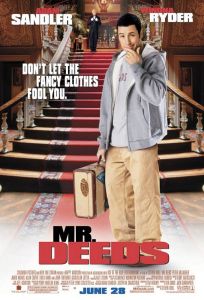 Adam Sandler seems like the reason they created the “no shirt no shoes” policy for restaurants. His niche is playing the lovable goodhearted goofball that triumph over the pretentious jackass and somehow wins the heart of the fawning one-dimensional love interest. Sandler appeals to the masses as our nation’s greatest warm-hearted simpleton. He’s the Jimmy Stewart of slobbery. So why mess with that? Well for starters, if you want entertainment anymore you might want to.
Mr. Deeds, Sandler’s latest idiot opus, is disastrously, even tragically unfunny. In the film Sandler stars as the only known heir of a multi-billionaire media mogul. Longfellow Deeds (Sandler) is a simple New Hampshire pizza delivery boy who treats people with respect and kindness. However, the mantra cruel to be kind must be alive and well because Sandler mercilessly beats people to about an inch of their life throughout Mr. Deeds for brutish comic effect.
 Peter Gallagher and his monstrous eyebrows serve as the stand-in villain. Hes a greedy tycoon who wants the Deeds fortune all to himself. Gallagher actually plays his part well and seems to at least have some fun with the broad comedy role. Wynona Ryder, on the other hand, does not. Ryder has never proven she can handle any comedy other than black, and slapstick just ain’t her thing. She painfully goes from scene to scene clueless as a tabloid journalist hiding her identity so she can get the scoop on Deeds, only to fall madly in love with him.
The film has some glimmers of comedy, mostly from its supporting cast including John Turturro as a very sneaky Spanish butler. It’s nice to see Turturro in something this high profile and get some recognition this journeyman deserves. There’s also a really funny cameo served up by a former tennis giant himself known for his boorish temperament. Steve Buscemi should be charged with grand theft movie because his three minutes on screen as the crazy-eyed local are funnier than anything with Sandler onscreen.
 The movie becomes far too redundant of Sandler’s other comedies to the point where seeing former stars like Rob Schneider in his Big Daddy character is somehow supposed to be funny. This kind of stuff is strewn throughout the film. It feels like everyone’s going through the motions. Now I’m not a total Sandler basher, because I do believe the man can be funny when worked right. Billy Madison is still hysterical to me upon every viewing and I do get some fun watching The Wedding Singer, but Mr. Deeds is sub-par Sandler even for Sandler.
I’m sure most of the people buying tickets for this have no idea that the concept is based upon the Capra film starring Gary Cooper. But what good is Gary Cooper? He didn’t write cutesy greeting cards or save a litter of kittens from a raging inferno like Sandler’s Deeds. In the end, this mostly laugh-free comedy is short on imagination, energy and entertainment.
Nate’s Grade: C-
Share this:

Rollerball (2002)
 The year is 2005 and the number one sport, at least in the former Soviet Union for some reason, is a mixture of roller derby, football and some kind of ESPN X-game. The man behind Rollerball is Alexi Petrovich (Jean Reno), who still thirsts for that lucrative cable contract with the U.S. and just might do anything to get it. Play suspicious music here.
Jonathan Cross (Chris Klein) is an NHL draft pick in trouble with the law after a stupid high speed street race. His pal Marcus Ridley (LL Cool J) tells him of a new extreme sport catching on in Central Asia, and Jonathan accepts his offer. The two are enjoying their success in Spandex but start to have reservations when they notice Petrovich including more violence as a ratings booster. Jonathan can’t just look the other way. Because he’s the good guy. So after a botched escape (shot infuriatingly all in what seems like night vision green) he collects his fellow ballers to rebel against Petrovich and whatever. As you can easily see, the story of Rollerball is not exactly its strong point. Not that there is a strong point in Rollerball.
 The original Rollerball came out in 1975 and was full of political themes like corporate dictatorships and Orwellian observations on a dominated, passive society where war and nationalism have been replaced with a roller sport. Though the themes of this James Caan vehicle were a bit heavy-handed at times, the action was rather impressive especially as the corporations try their best to squash Caan in a bloody onslaught of an ending. The 1975 Rollerball had a political message and some nice action. What does the 2002 version have? Try banality and plenty of it.
Klein came to the limelight through movies like American Pie and Election, and if his dimwitted deer-in-headlights look wasn’t doing it for you before then God help you with his performance in Rollerball. Rebecca Romijn-Stamos plays Klein’s teammate and lover on the Rollerball circuit. Reno deserves a trophy for even delivering the majority of his lines with a straight face.
Oh how the mighty have fallen John McTiernan. You once directed such great 80s action movies like Die Hard, The Hunt for the Red October, and Predator but now you spend your days remaking old Norman Jewison films. It began with the lukewarm remake of The Thomas Crown Affair and now a boring re-cooking of Rollerball follows it up. Can a remake of F.I.S.T. or Fiddler on the Roof be the only thing we have to look forward to now?
 The most jarring problem with Rollerball, and there are so many to choose from, is the hack editing choices made. The way the movie plays one wonders if they threw all their footage in a wood chipper and grabbed whatever pieces they could and glued them into a movie. Scenes exist but appear in no discernible pattern or order. All one sees in their chair is a whirl of colors and you might be wondering if you stepped into Kaleidoscope: The Motion Picture.
The story behind this Rollerball was that it was originally slated to come out August of 2001 but after test screenings that left people howling the studio bumped it to the winter and cut it from an R to a more commercial PG-13. Lost in this cost-cutting maneuver are gore (which you would think would be important for a violent future gladiator sport) and a nude scene involving Romijn-Stamos. Which version would you have rather seen?
Rollerball is a laughably noisy and empty film that will leave your head spinning for all the wrong reasons. It’s likely the worst flick you’ll see for 2002 right now, that is, until the following week when Britney’s near-certain train wreck of a film debut opens. But until that time Rollerball is the true champion – of boredom and stupidity.
Nate’s Grade: D
Share this:

Vanilla Sky (2001)
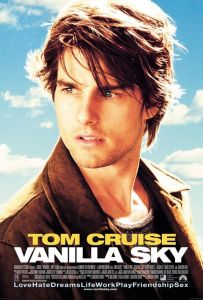 Talk about a film’s back story. Tom Cruise signed on to do a remake of the 1997 Spanish film Abre Los Ojos (Open Your Eyes) which was directed by Alejandro Amenabar. During the filming the romance between Cruise and Penelope Cruz (no relation) got a little hotter than expected onscreen and broke up his long-standing marriage to Nicole Kidman. At the time she was finishing filming The Others which is the second film by Amenabar. This, by the way, is much more interesting than Vanilla Sky unfortunately.
Cameron Crowe’s remake starts off promising enough with Tom Cruise running around an empty Times Square like a Twilight Zone episode. Afterwards the film begins to create a story that collapses under its own weight. David (Cruise) is a rich boy in control of a publishing empire inherited through his dear old deceased dad. He has the time to throw huge parties where even Spielberg hugs him, and even have crazy sex with crazy Cameron Diaz, whom he tells his best friend (Jason Lee) is his “f*** buddy.” David begins to see a softer side of life with the entrance of bouncy and lively Sophia (Cruz) and contemplates that he might be really falling in love for the first time. But this happiness doesn’t last long as jealous Diaz picks up David in her car then speeds it off a bridge killing her. Then things get sticky including David’s disfiguration, his attempts to regain that one night of budding love and a supposed murder that he committed.
 Crowe is in over his head with this territory. His knack for wonderful exchanges of dialogue and the perfect song to place over a scene are intact, but cannot help him with this mess. Vanilla Sky is an awkward mish-mash of science fiction. The film’s protagonist is standoffish for an audience and many of the story’s so-called resolutions toward the end are more perfunctory than functional. The ending as a whole is dissatisfying and unimaginative. By the time the wonderful Tilda Swinton shows up you’ll likely either be asleep or ready to press the eject button yelling “cop out!”
Seeing Vanilla Sky has made me want to hunt for Amenabar’s Abre Los Ojos and see what all the hype was about, because if it is anything like its glossy American counterpart then I have no idea why world audiences went wild for it.
Nate’s Grade: C
Reviewed 20 years later as part of the “Reviews Re-View: 2001” article.
Share this:

Planet of the Apes (2001)
 Taking a storied, and for the most part successful, franchise like Planet of the Apes and trying to rework it is frightfully difficult. You don’t want it to turn off the original’s fans but not be different enough to have its own voice. When I heard that Tim Burton was going to helm this reworking I became optimistic about the prospects of a Burton Planet of the Apes and began to eagerly anticipate its release. What I got, despite some stellar visuals, is a disappointing low point for many people involved, and that does include the man that gave us “Good Vibrations.”
Capt. Leo Davidson (Mark Wahlberg) is a trained pilot inhabiting a space station orbiting the rings of Saturn. The members inside are performing tests on the intelligence of apes (foreshadowing poking you in the eye) and seem to be coming back with optimistic results. A cosmic energy storm erupts near the station and Leo’s chimp is sent out into a pod to investigate. When the ape disappears (oh the foreshadowing is starting to hurt) Leo decides to venture out himself to save his monkey despite the instructions of his superiors. He gets pulled into the energy field and crashes on a distant planet where he discovers that apes are on top of the food chain and humans are the sport. Captured by the ape commander Attar (Michael Clark Duncan), he is taken to Ape City. He is sold into slavery but wins the attention of a human rights activist Ari (Helena Bonham Carter) who agrees to help him escape and get to his crashed vessel. General Thade (Tim Roth) still carries a torch for Ari but has an entirely different viewpoint when it comes to humans. At one moment he grabs Wahlberg and pulls apart his mouth to murkily inquire “Is there a soul in there?” When Thade begins to learn about Ari’s assistance to the human escape he mounts a full army to travel to the Forbidden Zone and annihilate the humans once and for all.
 Burton’s Apes remake, excuse me… “re-imagining,” lacks the social commentary, originality, and heck, even entertainment level that its predecessor possessed. Burton adds his usual great touches of style and the sets are vast and a wonder to see, but what movie is all set watching? This isn’t the simian Home and Garden channel. Burton dresses his players up nice thanks in part to Rick Baker’s fantastic makeup but the components in Apes redux are all dressed up with nowhere to go.
The script is credited to four writers but I wonder why anyone would want to take any credit for it. The story is not only half-baked it seems to never have come out of the oven. The tale is full of numerous incongruities that make this new Apes feel stagnant, especially during its middle portion. The story never gives us any real characters or an exciting line to follow. It’s more like a story pitch than a full story. There are many moments where dialogue is paraphrased from the original in an attempt at a humorous wink, but it’s worthy of more groans than applause.
Unlike the first Apes series, the humans of Burton’s ape world can speak… they just don’t have anything interesting to say. Estella Warren fills in as the good looking and useless heroine that spends her days frolicking about in ripped rags. She’s supposed to be the love interest for Mark but she fails at that (even though she’s the planet’s only attractive female) with Carter getting more googly eyes cast her way. There’s something weirdly natural seeing Kris Kristofferson as a scrubby post-apocalyptic dweller. It seems like he was made to lurk through caves and grunt. Wahlberg himself seems to sleepwalk through the entire film and speaks in only one monotonous tone.
Roth gets to huff and puff a lot and does quite a good menacing job. Every expression of his has a dominating glare of power and every piece of dialogue spoken in a gruff snarl. He has total capture of a great villain and serves his end well enough as the story provides. Carter gives a light touch as the sympathetic human defender but the long awkward moments where her and Mark gaze at each other gave way to great howls from my audience. Giamatti hams up his role with verve and provides some of the best moments of levity for this overwrought film.[
The original Planet of the Apes ending was one of the greatest twists of cinema. It was entirely logistical and packed a great punch. The ending of Burton’s “re-imagining” packs as much punch as a wet noodle. The ending is TOTALLY IMPOSSIBLE given the set-up of the events in the film. Not only is it a disappointing head-scratcher but ]it also manages to rip off the first film’s ending with no shame. It truly may be the worst ending possibly ever. I bet a room full of monkeys could have written a better ending, and I’m willing to put money on it.
 Let me explain why it’s impossible through the use of spoilers. So Mark is in the future. He follows his little monkey friend and crash lands on a separate planet IN THE FUTURE. On this planet, Mark’s space station has been looking for him and crash landed. Their monkey experiments get loose and bing, bang, zoom, we got fully evolved monkeys ruling the place (don’t even bother asking where the horses came from). Now, after learning all this, Mark takes a space pod and zooms his way back to present day Earth. He crash lands against the Lincoln Memorial steps only to discover that Lincoln has been replaced with General Thade and Earth is populated with highly evolved apes that still speak English. What? How? What? This cannot be because the film establishes a frame where Earth already has a long history of non-evolved monkey rule. Wahlberg crash landed on a DIFFERENT planet in THE FUTURE that should, therefore, have no bearing whatsoever on what happens to Earth or its past. The Apes remake rips off the most famous twist ending ever by serving up an incongruous version that makes no sense and cannot happen.
Planet of the Apes had all the right components for an exciting and sleek sci-fi ride but falls far short. Burton adds enough of his Gothic vision but this will likely go down as the weakest film on his resume. The usually reliable Danny Elfman’s score is nothing more than hyped up symphonic white noise. Burton may go home with a large check but I pray they don’t do a “re-imagining” of the next Apes picture. Marky Mark and the Furry Bunch are stuck in a hollow, head-scratching bore. Fans of the original series may find interest in comparing and contrasting, but if that’s cause enough to make a film then give me 100 bucks and I’ll make my own versions in my backyard. And they’ll at least make more sense than this monkey mess.
Nate’s Grade: C
Share this:

Traffic (2000)
 The war on drugs may be one worth fighting but it’s a battle that every day seems more and more impossible. Traffic is a mirror that communicates the fruition of our current procedures to stop the illegal flow of drugs.
Traffic is told through three distinct and different narratives. One involves an Ohio Supreme Court justice (Michael Douglas) newly appointed as the nation’s next Drug Czar. While he accepts his position and promises to fight for our nation’s children, back at home, unbeknownst to him, his daughter is free-basing with her bad influence boyfriend. Another story involves a wealthy bourgeois wife (Catherine Zeta-Jones) awakened to her husband’s arrest. Her shock continues when family lawyer Dennis Quaid informs her of her husband’s true source of income. He’s to be prosecuted by two DEA agents (Don Cheadle and Luis Guzman) unless she can do something. The final and most compelling narrative involves Benicio Del Toro as an honest cop in Tijuana battling frustration with the mass corruption surrounding the city. Each story weaves in and out at various points in the film.
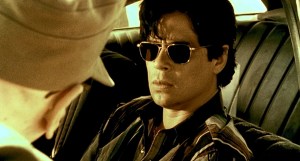 Traffic was photographed and directed by the man with the hottest hand in Hollywood, Steven Soderbergh. He uses a documentary feel to his filming that adds to the realism. Different color tones are assigned toward the three narratives as reflections of the emotional background. Soderbergh expertly handles the many facets of the drug industry and pulls out his typical “career best” performances from his onslaught of actors.
Benicio Del Toro is the emotional center of Traffic. His solemn demeanor and hound dog exterior reflect a good man trying to fight the good fight in a corrupt environment. He effortlessly encompasses determination, courage, and compassion that you’ll easily forget the majority of his lines are in Espanol. Benicio is an incredibly talented actor and one with such vibrant energy whenever he flashes on screen. It’ll be wonderful watching him collect all his awards.
Catherine Zeta-Jones also shows strong signs there may well indeed be an actress under her features. Her role is one of almost terror as you watch her so easily slip into her imprisoned hubby’s shoes. The ease of transformation is startling, but in an “evil begets evil” kind of fashion. The fact that she’s pregnant through the entire movie only makes the shift from loving house wife to drug smuggler more chilling.
 The entire cast does credible acting performances with particular attention paid toward the younger actors deservingly. Don Cheadle throws in another terrific performance showing he’s sublimely one of the best actors around today.
Traffic oversteps its ambitions and aims for a scope far too large. It is based on a 6 hour BBC mini-series, so trying to cram that material into a two hour plus format is taxing. As a result we get an assembly of characters, but too many with too little time in between to do any justice. Screenwriter Stephen Gaghan (Rules of Engagement) condenses the towering impact and influence drugs have well enough, but he intercuts the stories too sporadically that attachment never builds for either of the three narratives. He does balance the Douglas Drug Czar one carefully as not to fall into the cliched vigilante metamorphosis. But the mini-series had more characterization and depth to its tale.
Traffic is a good film but it has edges of greatness never fully visioned. Soderbergh shines bright yet again and all accolades will be deserved. Traffic is undeniably a good film, but it’s one you may not want to watch a second time.
Nate’s Grade: B
Reviewed 20 years later as part of the “Reviews Re-View: 2000” article.
Share this:

Shaft (2000)
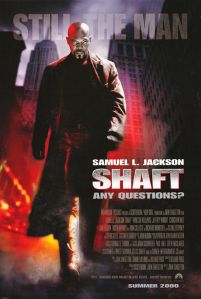 Samuel L. Jackson takes on director John Singleton’s remake – shut you mouth! I mean “newer” Shaft and spins it with effortless style and some surprising scenes of wit and even suspense. Shaft used to be a landmark in cinema, and for the black community as well, as it went full forward smashing taboos. It was more of a statement than good art because it wasn’t really art (the character in the novel was white, by the way). Jackson’s Shaft is more of a thug then the kinder gentler lady pleasure that was Richard Roundtree. This Shaft is never once preoccupied with being any landmark but doesn’t strive to be anything more then entertaining fun. The story is what surprised me most because it actually had interesting people and a well told tale. Taking a cue from the Batman franchise the villains are far more interesting and luminous then anyone else, and Christian Bale and a star-making performance by the always talented Jeffrey Wright end up making each of them a wonder on screen. Their chemistry together is worth the price of admission alone, even if you are tired of Bale playing white-collar pretty boys now (he still murders in each though!). Shaft is a loud and fast breath of summer but it’s one that surprising and very entertaining.
Nate’s Grade: B
Share this:

Gone in 60 Seconds (2000)
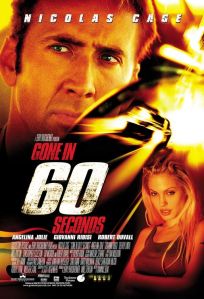 The movie I’ve seen trailers for since last summer finally hits theaters in a summer full of hungry patrons all wishing for the biggest explosion and coolest effects. But with its star heavy cast and array of sleek cars can Gone in 60 Seconds propel itself to the front of the race with audiences?
Nicolas Cage plays a reformed car thief forced back into the fray when his screw-up brother (Giovanni Ribisi) botches a deal for a local toughie. To rescue his delinquent bro Cage must steal 50 cars over the next three days for the man. So Cage wastes two days assembling his team of usual stereotype frat kids who are “the best and brightest” to aid in the mission. That leaves 24 hours for Cage and company to steal 50 cars and save the day minding any moral objections over grand theft auto.
 Gone in 60 Seconds is a living dream of testosterone with fast cars, sexy girls, and colossal explosions. But all the action is mercilessly loud yet surprisingly tame and empty. All the action lacks true tension or any real semblance of excitement. The director uses poor choices of rapid quick-cut edits that dull any build up of excitement. Most of the action doesn’t even center on the theft of cars, it just happens. Excluding one chase scene toward the end Gone in 60 Seconds is a popcorn movie with no flavor.
The script and characters take a back seat toward the effects and speeding cars but this to be expected from producer Jerry Bruckheimer, the man who gave us the equally boisterous Con Air and The Rock. This time the holes of the plot are easier to see and the dialogue no less cheesy especially when car talk turn innuendous. It’s easy to argue that story should be forgotten because audiences came to see cool cars and cool crashes, but it’s also easy to argue that those cool crashes and cars are distractions (as is Angelina Jolie) from the thinly strained story. When you have time to really analyze the plot in an action film you know the action isn’t up to par.
Gone in 60 Seconds could also serve as an apt description for Angelina Jolie’s running time. The recent Oscar winner dons bleached dreads and those pouty lips but is still seen less than Waldo – and that is a criminal mistake with someone like her. Gone in 60 Seconds has a bounty of Oscar winners with scant supporting screen time yet it can’t fool the crowd.
Gone in 60 Seconds may fit the criteria for a grand summer fireworks show but can never deliver the goods. It may be flashy, loud, and fast but this flick just isn’t running on empty, it’s past the “E.”
Nate’s Grade: C-
Share this:

House on Haunted Hill (1999)
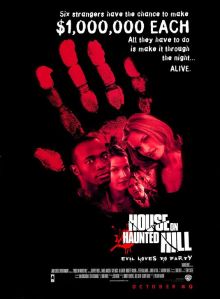
There are some classic horror pics in haunted houses, and the Vincent Price cheese-fest original of House on Haunted Hill is one. The original was campy fun and worth rewatches, but how does the remake fare with a 40 year age gap between the two?
What House on Haunted Hill miraculously achieves what Jan DeBont’s Haunting had tumble through its sticky CGI fingers: the establishment of a true unsettling mood. All throughout Hill you can actually feel the seething, eerie mood inspired from the wonderfully creepy ambiance of the constructed sets. It has a darker component and launches into many sequences of frightening imagery that seem like left-overs from Jacob’s Ladder but are no less effective. So maybe the plot is basically a premise that once established pretty much thins out to non-existence. You will be thinking to yourself that half of the flick is people wandering aimlessly in the bowels of an asylum when they should have enough common sense to not be.
There is no relevant acting since the cast is regarded to fill out the standard stereotypes and yell cheesy zingers at one another with F-bombs spliced into every line. This ain’t yo’ daddy’s House on Haunted Hill! Geoffery Rush, who talked funny in Shine and won an Oscar and who talked funny in Shakespeare in Love and got an Oscar nomination, gleefully plays the host of the supernatural shindig. And he talks funny. Taye Diggs surmises the “funny non-white” character, Chris Kattan surmises the “goofy nutball” character, Famke Janssen plays the “bitchy wife… who can crush people with her thighs” character, and the rest of the cast are interchangeable blondes who actually do get a bit interchanged physically.
Hill is a good shift in your seat spooker up until the end which just really drops the ball beyond belief into a cheap cop-out. Everything up until the part where the “ultimate evil” cloud of charcoal or something is visually haunting and solid entertainment even if it has to run to gore well once too often. But this whole slow moving cloud descends the movie into mediocrity and it just gets more hokey as it goes. The effects for the “ultimate evil” are preposterously bad and wouldn’t frighten a 4-year old with a bladder problem.
Up until the final ten minutes or so, House on Haunted Hill is a guilty pleasure directed sharply to instill the correct senses one should bring out of the story and setting. Hill has moments of inspiration and memorable scenes of horrific faceless demons and hallucinatory flashes of the macabre and bizarre. But the absurdly thrown together ending drowns what could have been a real Halloween treat.
Nate’s Grade: B-


 nathanzoebl
You must be logged in to post a comment.