Blog Archives
Evil Dead (2013)
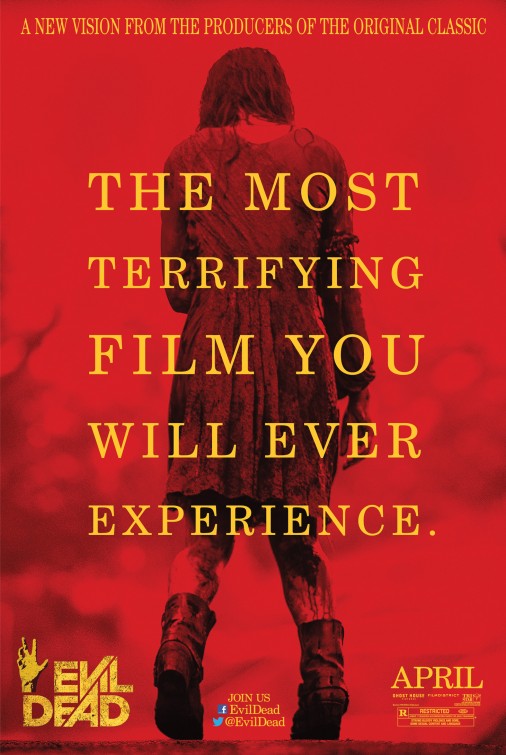 Upping the gore quotient considerably but having little else of merit, the remake of Evil Dead loses just about everything that made the original special. Gone is the sense of humor, unless you just count the quantity of gore to be the qualifier for “humor,” and gone is any real sense of a creative spark. It looks good thanks to director Fede Alvarez, and the practical gore effects can be memorable and truly disgusting in the best possible way, but it just doesn’t feel like an Evil Dead movie. It makes the same mistakes that your typical dumb horror movies do, from a lack of clarity to one-dimensional characters (I think Blonde Girlfriend had one line of dialogue for the first hour) to repeated rule breaking. There are a bunch of callbacks to the original Evil Dead but they serve little other purpose. The finale, after a series of fake-outs, involves a weak showdown with a Big Bad that’s anything but. I expect better from a remake sanctioned and produced by the original director, Sam Raimi, and star Bruce Campbell. Maybe they knew it was only a matter of time before their 1981 film, and its superior 1987 sequel, would be remade by a cannibalistic Hollywood, so they wanted to cash in while they could. Or maybe they just argued, if anyone was going to make a poor remake, it might as well be them. If you’re hungry for gore, then Evil Dead may suffice, otherwise it’s a horror movie that’s too familiar, too mediocre, and ultimately too disappointing to recommend.
Nate’s Grade: C+
Share this:

Frankenweenie (2012)
 Tim Burton’s stop-motion remake of his own 30-minute short is a cute movie, even with the creepy subject matter. It’s the story of a boy and his dog and coming to terms with loss, although that seems to get stalled since the kid brings his dog back to life. Frankenweenie is, as my pal Eric said, Burton’s love letter to the Universal monsters of old, as other kids resurrect their pets into mummies, vampires, werewolves, etc. As a story, it’s pretty plain and seems thin and padded out. The animation is fun to watch but I couldn’t shake my questions about the character design. It feels like the only parts that move on these bulky faces are their tiny mouths. It’s a strange design that undercuts the animators’ efforts, and I couldn’t help comparing it to the superior and expressive animation from ParaNorman. I’d say this is the weakest stop-motion film with Burton’s name attached to it, but by no means is Frankenweenie a bad film. It’s got some fun jokes and any story about the loss of a beloved pet is going to have plenty of heart. There are some pretty solid jokes but they all seem to pool in the first act. I enjoyed Sparky the dog’s romance with the neighboring poodle, more so than any of the human relationships. Beyond the kid/dog aspect, I found it hard to engage with the movie. If you have to see one stop-motion animated film about the supernatural, check out ParaNorman instead.
Nate’s Grade: B-
Share this:

Total Recall (2012)
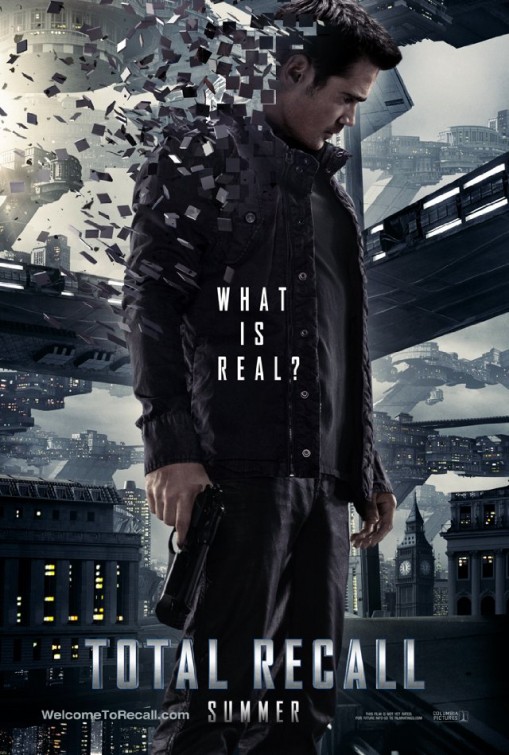 The latest needless remake takes the basic elements of 1990’s Total Recall and streamlines them into one very long chase sequence. And for those concerned males, the three-boobed lady makes a triumphant reappearance, because surely the movie wouldn’t be the same without her. Though in the age of the Internet, the sight of a three-boobed woman seems less indelible to impressionable male minds. But I digress. I was ready to dismiss this as another soulless Hollywood remake. Then I found myself enjoying Total Recall, and even the stuff that was dumb I had to also admit was cool. Take for instance a commute that goes through the center of the Earth. How exactly could such a thing be built? What does one do for maintenance? How does this not affect the Earth’s rotation? But then I forgot all about it because, in pure movie terms, it was cool. The zero gravity change-up as the transport changes directions at the core – cool. The fact that we get a zero gravity action sequence in this environment – cool. The fact that this transport system becomes a conduit for an invasion – cool. The plot mechanics are all familiar, notably the memory wipes and the super spy histories, but I didn’t care because the movie rarely lets its foot off the gas. When this thing starts, it doesn’t let up. The chase sequences are well executed amidst an imaginative array of locations, from a flying highway to a series of hanging housing developments. It’s not terribly smart but Total Recall is an entertaining escapist thriller that delivers some robust action and enough imagination in its future settings. Plus, there’s a woman with three boobs in it.
Nate’s Grade: B
Share this:

Silent House (2012)
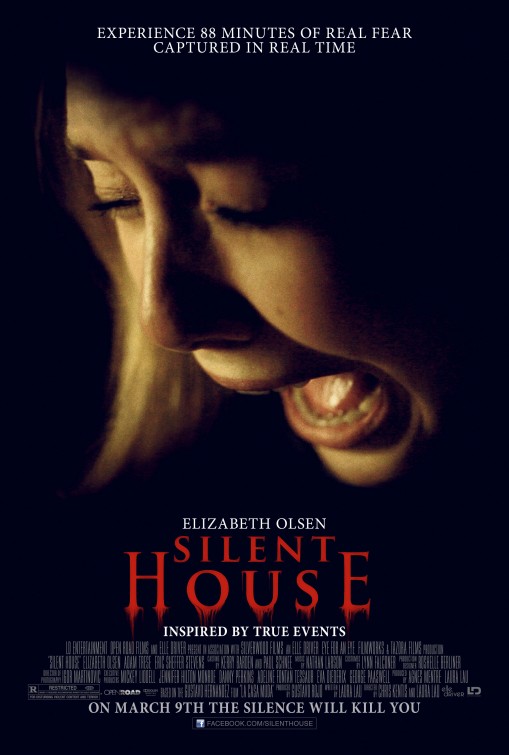 Ostensibly executed in one long, unblinking take (though you can tell the edit points; the directors admit they filmed it in 10-minute chunks), Silent House is a visceral experience in spookiness, tethered to the brilliant actress Elizabeth Olsen that unfolds in real time. It’s your standard scary house movie, lots of dark rooms and pitiful hiding under furniture; it begins as an intruder(s) stalking Olsen from room to room and then, in the final 20 minutes, transforms into a psychological thriller, with the realm between reality and hallucination blending. The bare-bones plot (girl chased through house) cranks out some decent scares due to directors Chris Kentis and Laura Lau (Open Water)’s tightly executed sense of reality, leaving us feeling as trapped and helpless as our heroine. The movie’s minor successes are also squarely due to Olsen, she of glassy eyes and hoarse scream. It’s almost a one-woman show and Olsen is so convincing in her terror, completely unnerving even when the movie is not. The climax is a bit of a letdown, to say the least, and leaves a lot of off-putting questions that cannot be answered by the movie’s absence of back-story. I won’t say the ending ruins the entire suspenseful experience of Silent House, but it’s certainly going to spur plenty of grumbling. Still, Olsen is a star and gives a terrific freaked-out performance worth getting spooked over. Also it’s based on a 2010 Uruguay movie with the same high-concept gimmick. Now you know Uruguay has a film industry. Don’t you feel better?
Nate’s Grade: B-
Share this:

Fright Night (2011)
 Horror is a genre that’s been notoriously cannibalistic, especially as of late. I don’t mean flesh-eating, I mean the glut of remakes that has polluted the horror market in recent years. After remakes of Halloween, A Nightmare on Elm Street, Friday the Thirteenth, The Hills Have Eyes, House of Wax, Prom Night, My Bloody Valentine, The Amityville Horror, The Fog, The Texas Chainsaw Massacre, Black Christmas, Sorority Row, Dawn of the Dead, The Crazies, Don’t Be Afraid of the Dark, I Spit on Your Grave, Last House on the Left, The Thing, and scads more, you’d be forgiven for believing that the remake of 1985’s Fright Night would be another soulless cash grab. It turns out that it’s way better than even the original and quite an entertaining movie that got lost in the shuffle.
In a quiet little suburb outside Las Vegas, students are going missing. Ed (Christopher Mintz-Plasse) suspects that there is a vampire in town. Ed’s former friend, Charley Brewster (Anton Yelchin), dismisses this idea, especially since the would-be vampire in question is his new neighbor, Jerry (Colin Farrell), a home construction worker who seems to work at night mostly. But lo and behold, after Ed goes missing, Charley concludes that his old friend was right all along. Jerry has his eyes set on Charley’s single realtor mom, Jane (Toni Colette), and maybe even Charlie’s sprightly girlfriend, Amy (Imogen Poots). The only ally Charley can muster is a drunken Vegas magician in the Criss Angel tradition. Peter Vincent (David Tennant) has been studying vampires for years due to his tragic personal connection to vampires, notably Jerry.
 Fright Night finds that horror sweet spot, equal parts scary and funny. Credit screenwriter Marti Noxon who cut her teeth on TV’s seminal show (yeah, I said it) Buffy the Vampire Slayer; there’s even a reference to a “Scooby gang” for we Buffy fans. Noxon does a terrific job of establishing a suspenseful situation and then developing it nicely, teasing it out. There’s a sequence where Charley is trying to rescue a neighbor lady that just involves a series of hiding places but uses a simple setup of ducking around corners so well. When our plucky protagonist checks in with Vincent for some assistance, we’re introduced to an array of exotic vampire-hunting weapons and artifacts that the Vegas magician has under glass. With a setup like that, you better believe we’re going to be using those weapons later, and how. The character development is richer than most teens-battle-monster genre films. The relationship between Charley and Ed, and the awkwardness and resentment of two friends growing apart, feels rather believable even dropped into the middle of a vampire adventure. The standard girlfriend role is given a bit more weight, as she’s the one who feels confidant and aggressive. She knows what she wants, and as played by the adorably named Imogen Poots (Solitary Man), you want to be what she wants. Seriously, this actress is striking in her Grecian features and I like a woman who knows how to handle a mace. There are also small touches that I really enjoyed that helped round out the movie. At one moment, a woman is being fed on by Jerry and she spots Charley hiding behind a door. Rather than cry out for help, she carefully draws a shaking finger to her mouth, wishing him to keep quiet and not to save her. The resolution of this rescue attempt is shocking in all the right ways. It’s a surprise that feels completely within reason, and organic twists and turns are always the most satisfying.
Noxon’s script continually surprises even when it starts to follow a by-the-numbers plot. Instead of an axe lopping off a vampire’s head, it just goes about halfway through thanks to the rigidity of bone. That’s a nice touch, but then when that same vampire tries to bite our hero and can’t move his fairly severed neck closer, then that’s when Noxon has capitalized on her cleverness. And she capitalizes often enough for Fright Night to be a real step above most vampire action flicks. Noxon also finds clever spins on vampire mythos; to get around the whole can’t-enter-without-an-invitation rule, Jerry just attempts to blow up the Brewster’s home to drive them out (“Don’t need an invitation if there’s no house”). There’s a particularly ingenious method to light a vampire on fire. And the entire character of Peter Vincent, played brilliantly by Dr. Who actor David Tennant, is a hoot and a great addition. He’s a riot as a cynical, profane, and selfish stage performer. His character is such an enjoyably comic foil, and Tennant plays him with aplomb, that you almost wish for a Peter Vincent spinoff movie.
Director Craig Gillespie shows that he is shocking adept when it comes to staging a horror film. I would not have expected this level of competency from the director of Lars and the Real Girl. It embraces its R-rating and the bloodshed is plentiful though the gore is restrained. Gillespie draws out scenes with judicious editing, letting the dread build steadily. The tension of something simple like Jerry standing in a doorway, waiting for any verbal slipup to come inside, can be terrific. Gillespie also has some nifty visual tricks up his sleeve to complement Noxon’s crafty screenplay. There’s one scene where Jerry walks into a hotel lobby and is confronted by a security guard. The camera pans over a series of security monitors that do not pick up Jerry. Then in the background we see Jerry hurl the guard to the ground to bite him and in the foreground we see the security footage minus Jerry. There’s an ongoing tracking shot inside a fleeing minivan that’s not exactly Children of Men but still a good way to feel the fever of panic. The final showdown between Charley and Vincent versus Jerry is suitably climactic and rewarding, nicely tying back elements that were introduced earlier and giving Poots an opportunity to vamp out, literally and figuratively.
 Farrell (Horrible Bosses) is a charming, sexy, alluring menace as Jerry, which is exactly what you’d want in a vampire (sorry Twilight fans). Vampires are supposed to be seductive; they’re inherently sexual, what with all that biting and sucking and sharing of body fluids. If Jerry is going to be dangerous, he also has to be seductive, and Farrell is exactly that. With his swaggering walk, with his pose-worthy stances, with his grins, he’s a great ambassador for vampire kind. But this guy does more than preen; he’s also a credible threat. He’s the bad boy that is actually quite bad. Farrell’s enjoyment of his villainous role is noticeable. Jerry taunts Vincent: “You have your mother’s eyes.” He shoots and misses the big bad vamp. “And your father’s aim,” he add, chillingly. Having a strong villain can do wonders for an action movie, and Jerry is a formidable foe played with great relish by Farrell.
Not everything goes off without a hitch. The special effects can be dodgy at times, especially when Jerry goes into full CGI vampire face. The vampires tend to look like shark people, with long exaggerated jaws and rows of gnarly teeth. It’s not a particularly good look. While Noxon’s script excels in most areas, there is still enough dangling plot threads. Charley’s mother is really never a figure of significance. Her potential romance of her neighbor/vampire is a storyline that is never capitalized upon, oddly enough. That seems like the kind of storyline you’d build a whole movie around. She’s written out of the movie in hasty fashion, immediately going from a sequence of driving to being unconscious in a hospital bed. How did that happen exactly? After the Brewster house explodes, nobody seems to make a big deal out of this, like it’s just some regular neighborhood occurrence. What kind of neighborhood watch is this?
Fright Night is just a fun night out at the movies. It’s got plenty of laughs thanks to Noxon’s clever script, plenty of scares thanks to Gillespie, and plenty of sex appeal oozing from Farrell (though “sex appeal” and “oozing” don’t sound like an advisable linguistic match). It’s not much more than a vampire action flick but it’s a really good vampire action flick, clearly a cut above the dreck that usually just relies on its audience’s understanding of genre convention to cover up for its shortcomings. There’s no reason you cannot be a good movie with this genre, and Fright Night is proof of that. Convincingly acted, cleverly staged, and surprisingly well-executed, this is one genre movie that hits the right vein.
Nate’s Grade: A-
Share this:

The Woman in Black (2012)
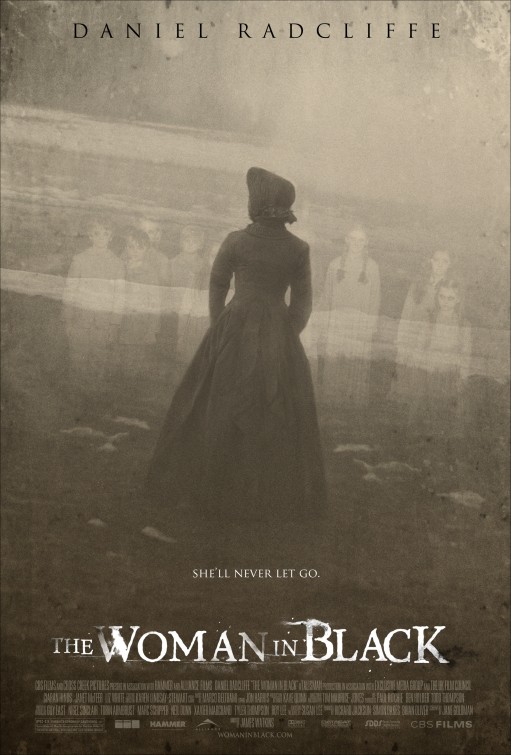 It’s got a decent ending but it’s a long, lumbering walk to get there. This handsomely mounted Hammer throwback involves Harry Potter himself, Daniel Radcliffe, slowly walking through a spooky old Victorian haunted house. And he slowly peeks around a door. And he slowly holds a candle. And I slowly go to sleep. There’s a 40-minute sequence where I swear only two things are spoken. Radcliffe plays a widowed father who has to investigate a haunted house to make ends meet. The movie has a few genuinely creepy moments, mostly owing to set design, but it gets hooked on jump scares and doesn’t know how to quit. The jump scares, accompanied by what sounds like an eagle screeching as music, happen at near two-minute intervals, like some sort of alarm the movie can’t turn off. Alas, The Woman in Black is a pretty staid ghost story where once again a restless spirit is terrorizing others and somebody takes it upon themselves to help that spirit find closure. The plot is so transparently predictable that it becomes fairly frustrating when the movie takes so long to get to its pre-designated stops. The pessimistic ending is weirdly given the most positive spin imaginable. For fans of this horror sub-genre, there may be enough going on to entertain. I just keep learning that ghosts are never grateful and satisfied even when you help them. Ghosts are jerks.
Nate’s Grade: C
Share this:

Contraband (2012)
 January at the movies has long been a time for two kinds of releases: 1) award-worthy films expanding into wider release, and, 2) crap. That’s about it. I’ll let you figure out which category the action thriller Contraband belongs in.
Paul (Mark Wahlberg) was once the best smuggler in the business. He’s since gone legit, starting a family and his own private security business. His brother-in-law (Caleb Landry Jones) gets into trouble with some bad men. He tosses a load of smuggled drugs to elude Customs ships, but now Briggs (Giovanni Ribisi) wants the value of the drugs or else. Paul knows he has no choice but to put together one last job to save Kate’s (Kate Beckinsale) brother. Paul leaves his family in the hands of Sebastian (Ben Foster), a trusted accomplish on many missions. John puts together a team and plans to board a ship headed for Panama City. While there, the team will load large sums of confederate money. The sale of the fake currency should square things between John and Briggs. However, little goes according to plan.
 Contraband is a lousy heist picture that feels like it’s making it up as it goes. First off, the premise of John having to go back into his art of smuggling to settle a debt has been overdone, and the fact that John’s idiotic brother-in-law is as fault makes it hard to care that something might happen to the idiot. But why God do they bring this screw-up, the brother-in-law, along with them? He’s already proven to be a poor decision maker and a moron, and, surprise surprise, when in Panama the guy gets them into more danger. So irritating is this character, always foolishly making things worse for John, that you wish they had thrown this dolt overboard. This is a movie structured with a small beginning, a small end, and a great big fat middle, and it’s that middle that involves our destination to Panama. With heist movies, as well as most thrillers, we don’t want things to go according to plan. We want to see organic complications and watch our team of characters adjust. With Contraband, the complications don’t feel natural so much as like careening plot elements from other movies. John’s quick visit goes out of control, with the team losing their payment money for the confederate loot (guess who’s responsible for that? Guess?), and they have to go find a budding crime lord, Gonzalo (Milk’s Diego Luna), and then this crime lord just happens to be plotting a heist at THAT EXACT MOMENT and John and his team should come along and then the heist goes bad, as always, and the team ahs to get away, but Gonzalo demands to be taken to a hospital by gunpoint, and then the cargo ship is going to leave port, and, and, and, and, etc. There are so many breakneck plot turns thrown in that it feels like a broken blender spewing half-formed plot residue everywhere. It’s the film equivalent of the If You Give a Mouse a Cookie story (“If you give a smuggler a deadline, he’ll need a contact. If you give him a contact, he’ll need to do the contact a favor. If he does the contact a favor, he’ll have to do this one job for him. If he does this one job for him, he’ll need a crew. If he needs a crew, he’ll need… etc.).
Let’s take a moment to analyze the peculiar masks Gonzalo and his team choose to utilize. They literally wrap duct tape around their faces. That’s got to be the dumbest mask in the history of cinema, and there have been some stinkers. They couldn’t afford pantyhose? Anything? They had to use tape? First off, you can’t conceal key features, like your eyes and mouth, and lastly, isn’t it going to be something of a bitch to rip those things off? The only person who could properly wear a duct tape mask would be someone suffering from alopecia (condition that leaves a person hairless). Otherwise you’re sacrificing your eyebrows. Maybe this is just how things are done in Panama.
So much of this movie feels like it’s on autopilot, just drifting like that cargo ship. At this point, I don’t even think Wahlberg is trying to hide his indifference to the material. He’s a man with a shady past who went legit and has a family now, but in order to protect that family he is drawn back to his shady past. How many times has this plot device just been used in the last few years? The rest of the characters fill out the crime thriller cheat sheet: young screw-up who serves as plot catalyst, parent in prison to provide cautionary tale, best trusted pal that ultimately proves to be untrustworthy, and the harried, often victimized wife. Poor Beckinsale (Underworld) who gets beaten, threatened with a gun in her face, and victimized to a degree that it feels like exploitation. This woman can never catch a break. She gets few moments in the film where she is free from being terrorized with violence. I have no idea what would attract an actress like Beckinsale to this part other than the allure of a paycheck. Contraband stalls when it comes to thrills, and part of this is because the villains seem so lame. Briggs just comes across as an inept criminal, like somebody’s own screw-up brother-in-law that tagged along to play with the big boys. He’s routinely beaten and bossed around. It’s hard to take his threats seriously, so the movie cuts its losses and just has him threaten Kate some more. It becomes old quick. The only thing that keeps Contraband going is the great distance between Paula and his family, a divide that keeps Paul vulnerable. Too bad that the movie can’t think of anything thrilling to do with this scenario and settles, all too frequently, on scaring the wife. Wouldn’t the film have been more engrossing if Paul’s wife had been kidnapped this whole time? Would that not cause a better sense of urgency than the vague threat that a character we don’t care about might get offed for being stupid?
 From an action standpoint, the thrills rarely materialize, relying on a contingent of blunders and coincidences to provide the thrills. There wasn’t a moment where I worried for a character on screen. This may be because I didn’t care for a person on screen, thanks to workmanlike characterization, but it’s also got to fall on the feet of Icelandic director Baltasar Kormakur (who starred in Wahlberg’s role in the original Icleandic version of this flick) and his nascent camerawork. There will be moments where his camera does stutter-step zooms, mimicking the docu-drama camerawork that’s been en vogue with action cinema. And then he’ll never repeat it. There’s a shot of Gonzalo blowing the armored car up and it’s filmed in a high-speed, stylized shot to distill the strange beauty of the force, and then this never happens again. It’s like Kormakur is sampling all 31 flavors of action movie styles and can’t decide on a visual tone. The action is too dependent on arbitrary coincidences for it to be satisfying of thrilling; we’re just waiting for the next out-of-nowhere plot turn to move things along. The ending attempts to tie up things nicely but feels asinine and laughable in how John can take out three villains in one well-orchestrated, tidy swoop. Don’t even get me started on the impracticalities of John hearing a lone cell phone ringing to be able to trace his wife in an entire construction site. The resolution feels ludicrous and a stroke of dumb luck.
Contraband is a convoluted, knuckleheaded thriller that drags because of arbitrary maneuverings, poor characterization, a fat middle section plot-wise, and pedestrian action. The movie feels like it’s being made up on the spot. As a result of all this tiresome lateral plotting, Contraband feels like it’s going nowhere and spinning into oblivion. I found myself nodding off at various points, my brain bored by all the generic goings-on. The constant victimization of Paul’s wife is a rather ugly development for a movie that confuses salty language and furrowed brows for toughness. The movie is devoid of any sense of fun. It just becomes an empty enterprise of actors going through the motions to work of genre pap. Even by the dirt-low standards of January cinematic offerings, Contraband isn’t worth a cent of your hard-earned money.
Nate’s Grade: C-
Share this:

Tinker, Tailor, Soldier, Spy (2011)
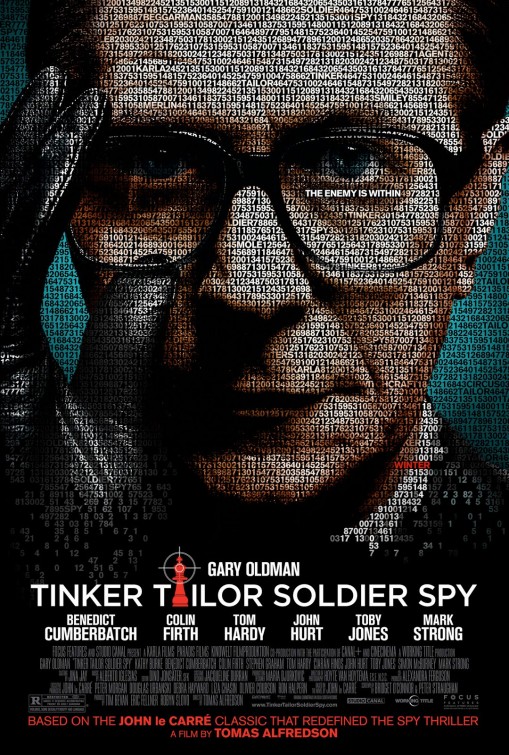 Billed as one of the most dense films of the holiday season, I was startled to discover that Tinker, Tailor, Soldier, Spy is not nearly as puzzling as people have protested. The adaptation of John le Carre’s famous novel follows retired British spy George Smiley (Gary Oldman) performing a clandestine investigation to flesh out a mole in the highest level of the agency. Directed by Tomas Alfredson (Let the Right One In), condensed form a 7-hour BBC miniseries, and stuffed with a wealth of terrific Brits, the movie is tricky, clever, and rather brainy, ultimately coming to the conclusion that these little communities of intelligence knew little. The movie has a rich array of characters and teases out back-story in flashbacks, meaning the film hops around time wise and will also take turns with different perspectives. It demands your attention but, honestly, I found it easy enough to follow. But in the end, what does all that narrative trickery and obfuscation get you? It’s a fairly dispassionate film about dispassionate people played out in a dispassionate manner. For some this will be hailed as a virtue, communicating the duty-first sacrifices and compartmentalization of these secret spies. For me, that just sounds like a cop out. Beyond the mystery, it’s hard to get involved in the movie. The reveal of the mole is anti-climactic, though the resolution, set to the tones of Julio Iglesias, is aces. The meticulous production design is stellar, including an agency meeting room that looks like it was wallpapered with checkerboards. The details of the ins and outs of the agency are absorbing. I’m debating whether I should watch the movie again, looking for nuance I must have missed. Tinker, Tailor, Soldier, Spy is an espionage thriller with a bit too many stiff upper lips.
Nate’s Grade: B
Share this:

The Girl with the Dragon Tattoo (2011)
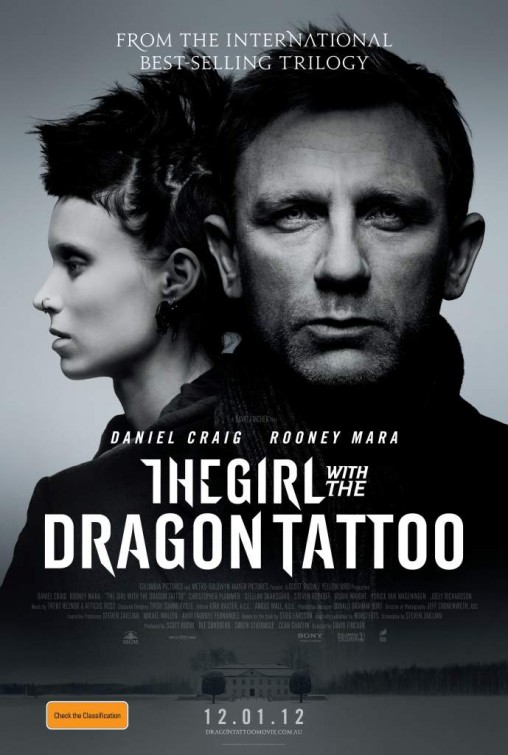 Nothing says holiday treat for the whole family like a nearly three-hour movie about rape. Late author Stieg Larsson’s best-selling trilogy made three very successful Swedish films, all released last year in indie theaters. It was only a matter of time before Hollywood optioned The Girl with the Dragon Tattoo, benefiting those averse to reading subtitles. At least they hired the right director in David Fincher, a man used to plumbing the depths of human depravity in films like Seven, Fight Club, and Zodiac. Fincher’s take is pretty dark and hardcore, but once you wash all that perfectionist grime off, I prefer the Swedish film in just about every way.
Crusading journalist Mikael Blomkvist (Daniel Craig) is smarting from a court case that found him guilty of libel. He’s commissioned by a wealthy businessman Henrik Vagner (Christopher Plummer) to investigate the 40-year-old disappearance of his granddaughter, Harriet. Henrik strongly believes she was murdered by one of the sinister members of his extended family, a group of shady characters with some allegiance to Nazism. Mikael is assisted by the unorthodox computer hacker Lisbeth Salander (Rooney Mara), a rail-thin Gothic gal clad in tattoos and piercings. Their partnership sometimes gets blurry as they grow closer over the course of the investigation. Together the pair investigates a series of grisly, ritualistic murders related to Harriet’s disappearance, and the closer they get to discover the truth the more dangerous things get.
 So the burning question: is Fincher’s take better than the original Swedish version? Well, in some areas yes but in many areas I’d have to say no, that I prefer the lower budget, no-name Swedish version. Obviously a director of Fincher’s caliber is going to significantly raise the quality of a production, and the technical merits of Fincher’s Dragon Tattoo are without question. This is a seedy, grimy, prurient, and very dark (in both lighting and thematic material) little movie. There’s always been an eerie beauty to Fincher’s cool aesthetics, and it’s on display here as well. Many of Fincher’s Social Network crew carried right over to Dragon Tattoo, so the editing is crisp, the cinematography sleek, and Trent Reznor and Atticus Ross’ score is a storm of ominous tones. Their plaintive score is actually a fairly unmemorable muddle, never approaching the energy, intricacy, or diversity of their Oscar-winning score for The Social Network. However, the extra polish and the glut of familiar actors takes away from the intrigue of the movie. When something meant to be gritty is too artistically stunning, it detracts from the thematic intent of the story. That sounds like a contrary way to insult Fincher for making his movie look too good, but perhaps that’s the best way of stating the point. Niels Arden Oplev is nowhere near the filmmaker that Fincher is, nor did he have the budget or creative freedom afforded Fincher, but perhaps someone of lesser talents was better suited to best tell this tale. By all means, the American Dragon Tattoo is a more visually alluring film, but Oplev’s film is more fully felt. I recently rewatched the Swedish version again for points of comparison and found myself much more involved in the characters, the story, and the actors, even though I had already seen the movie. Fincher’s version may be the better-looking movie, but surprisingly Oplev’s is just the better movie, period.
The adaptation by Steven Zallian (Schindler’s List) actually hews closer to Larsson’s book than the Swedish film, though Zallian redirects the film into a new ending. But the additions don’t seem to add anything of substance to the narrative (Blomkvist’s teenage daughter; dead cat), and the new ending feels more confused than helpful. Most of all, Zallian’s script devotes less time to the characters of Lisbeth and Blomkvist. I had a better understanding of these characters and their complicated, shifting relationship in the Swedish film. That narrative was much cleaner with helpful, clarifying procedural details and a dose of ambiguity. Simply put, the story just flowed better in the Swedish film. The personal connection Blomkvist had to Harriet (she was his babysitter long ago) has also been severed. Many of the story’s problems are still the same regardless of language or adapter. There is a clear disparity when it comes to audience interest in the two leads. What’s more interesting, a punky, bisexual, computer hacker or a disgraced, somewhat bland journalist? Exactly. Also, the story takes far too long to put our lead characters together, over an hour at that. The murder mystery is filled with murky plot points, pieces that seem like they might be integral but then turn out to be incidental. It takes a good while to process and familiarize oneself with the expository details of the case, but under Zallian’s draft, the mystery is given less room to breath. For a movie clocking in at 150 minutes, things feel untidy and rushed. The resolution feels drawn out to ungodly Lord of the Rings-lengths; I swear there must be a solid 20 minutes after the eventual serial killer is dealt with. It just feels like it goes on forever. Still, the characters are what ultimately makes Dragon Tattoo engaging, and Zallian’s efforts cannot dampen the captivating, curious nature of Lisbeth Salander.
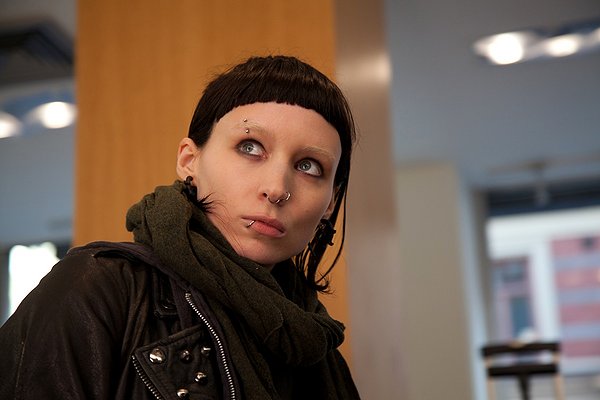
Both Craig and Mara give fine performances but I prefer both Swedish actors to the A-listers. Craig is certainly a better actor than his Swedish counterpart, but the role is a middle-aged journalist and not James Bond, and thus a better fit for the unknown Swedish actor, Michael Nyqvist (Mission: impossible: Ghosts Protocol). Blomkvist isn’t supposed to be an ass-kicker. As a result, you don’t feel his terror as he gets in deeper and lands in serious physical jeopardy. Likewise, following in Noomi Rapace’s (Sherlock Holmes: A Game of Shadows) shoes was going to be a difficult feat for any actress, but Fincher got the girl he wanted, Mara, who tore down Mark Zuckerberg with precision in The Social Network. Mara commits herself completely to the role and undergoes a severe physical transformation (bleached eyebrows, wiry frame, nipple piercings), but she lacks the intensity of Rapace, the spiteful attitude, the recklessness and the resourcefulness. Rapace felt like a caged animal that could explode at any moment; Mara feels more like a lost puppy. I’m being intentionally cavalier with my word choice. Mara is quite good as Lisbeth; it’s just that Mara can’t quite measure up to the preceding tattooed girl. It feels like there’s a lot more going on with the Swedish Salander, whereas the American (still Swedish) Salander is waiting for her cue. It’s like Mara has dressed the part and waits for the character to just click over.
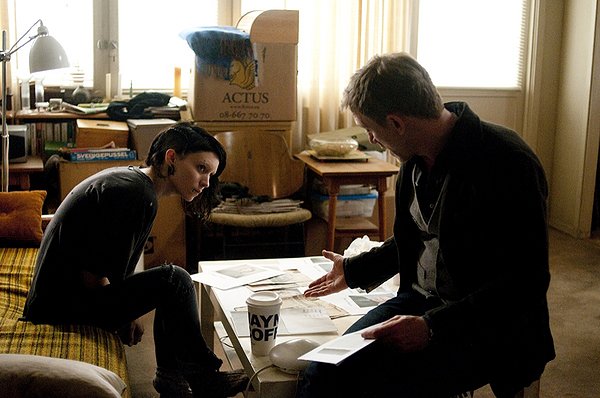 I’m not one for lazy analysis, but I feel like the uncomfortable issue of sexual violence/ voyeurism needs to be addressed, and I find that everything I wrote a year ago in my original Girl with the Dragon Tattoo review could readily apply to its Hollywood counterpart. So here goes: “The book’s original title was ‘Men Who Hate Women’ and that seems apt given what occurs on screen. Sure there’s a serial murderer on the loose but that’s par for the course. Even the grisly ritualistic killing stuff. But Lisbeth encounters a lot of malice and hostile male aggression, some of it very sickening. There’s a startlingly extended rape sequence, followed by some sadistic, if justifiable, revenge. It all contributes to an overall tone of queasy misogyny that seems to waver between intentional and unintentional. I’m not sure tone-wise whether the movie ever creeps into unsettling voyeurism at the behest of women in explicit sexual peril, but it certainly is a distraction. It can get pretty hard to watch at times in this disturbing thriller. I hope the eventual sequels don’t follow this same queasy, upsetting tone but I also worry that this may be unfortunately part of the books/movies’ appeal.”
For those new to Lisbeth and Larsson’s sordid saga, The Girl with the Dragon Tattoo will more than likely play well, a squalid thriller with the nicest coat of gloss you could ever hope for given the material. This is dark, rape-heavy stuff, and an odd adult drama to position as a Christmas release, but the collective appeal of the best-selling books should guarantee so many butts in the seats. It’s likely a safe bet that a high majority of those paying customers are unfamiliar with the Swedish version of the same story, which is a shame because, short of a few technical advances, I believe the Swedish film to be the superior movie. It had better acting, more appropriate casting, a rounder narrative that fleshed out the characters, their relationships, and their histories better, and a better score (sorry Trent, better luck next time). It’s still a movie that registers a “good” on most critical accounts, and Lisbeth Salander is still a fascinating person, a wounded warrior that catches the imagination. I’ll be curious to see if the subtitle-free Girl with the Dragon Tattoo does well enough at the box-office to warrant filming the next two decidedly lesser books. Whatever the case, there will always be the Swedish films and Ms. Rapace’s star-making performance.
Nate’s Grade: B
Share this:

The Thing (2011)
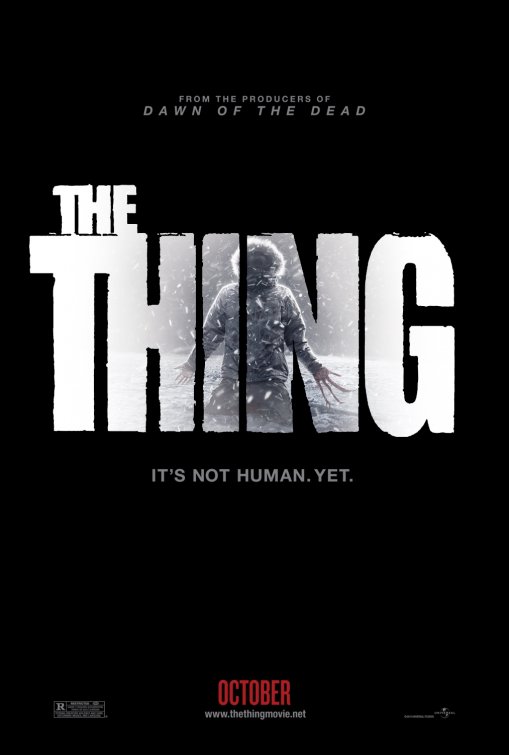 Has any modern filmmaker endured more crappy remakes of their films than John Carpenter? The man has suffered through remakes of Halloween, The Fog, Assault on Precinct 13, and now his 1982 creep-fest The Thing, itself a remake of the 1951 Cold War allegory, The Thing From Another World, gets the same awful treatment. This new Thing is some hybrid of remake and prequel, because it’s set before the events of the 1982 film but it pretty much follows the same overall plot. Once again a group of scientists (this time they’re Norwegian!) on a remote Antarctic outpost discovers an alien body buried in the ice. Once again the alien breaks loose and can assume the fleshy form of man. But this new film forgoes the rampant paranoia and rising tension of Carpenter’s film for cheap Boogeyman thrills. The alien monster is introduced early and the rest of the film succumbs to people looking around pensively, afraid it will jump out and attack. This alien creation is an odd quirk of evolution; a species that seems to be made of nothing but gnashing teeth, spindly legs, and vaginal imagery. How these things built and fly spaceships, I have no idea. Some of the gore effects are crafty and stomach-churning, but nothing is as memorable as the practical effects used sparingly and to great effect in the 1982 flick. This Thing is too much of a familiar monster to make an impact.
Nate’s Grade: C


 nathanzoebl
You must be logged in to post a comment.