Blog Archives
Annabelle (2014)
 The Conjuring was one of the breakout hits of 2013, so it’s no surprise that Hollywood fast-tracked a spin-off to take advantage of Conjurin’ fever. Enter John R. Leonetti, the accomplished cinematographer on The Conjuring and director of bad sequels like Butterfly Effect 2 and Mortal Kombat: Annihilation. Now in the spotlight, little Annabelle is proving to be a star of her own as far as box-office grosses are concerned. It’s too bad her new movie is about as lifeless as she is.
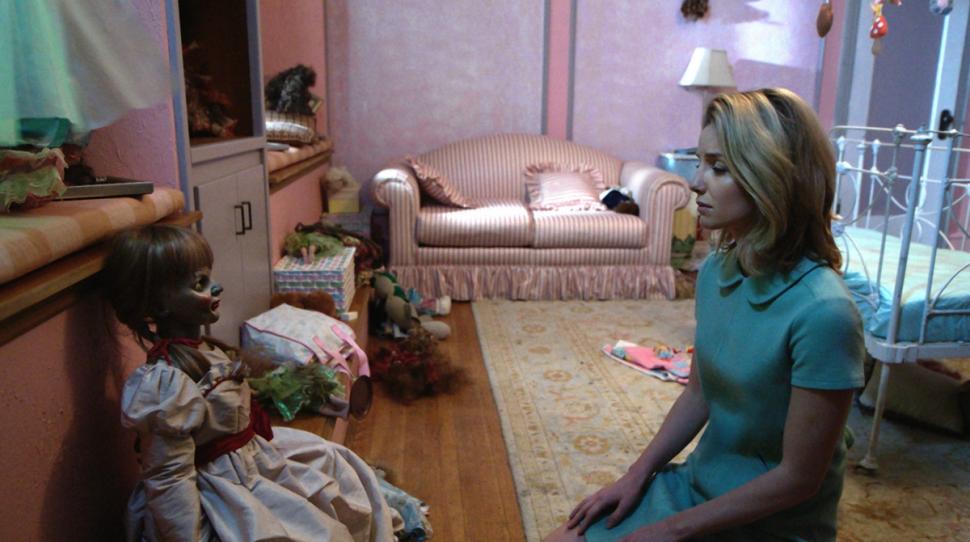
In the late 1960s, Mia (Annabelle Wallis) is pregnant with her first child when murderous cultists terrorize her home. They are dispatched but not before one young woman slices her own throat holding one of Mia’s expensive porcelain dolls, the Annabelle one. Her husband (Ward Horton, who looks like a living Ken doll) is afraid to leave her alone and reaches out to the church to help his wife. Strange things are going on in their home, mostly concerning the infamous Annabelle doll.
 The impact of Annabelle will depend directly upon your good will concerning The Conjuring and what your law of diminishing returns is with a creepy doll. To be abundantly clear, the Annabelle doll is one creepy looking thing. But how much can an audience take of a creepy looking doll that doesn’t have any articulation or expression? The character, and it feels like a stretch to label the doll as such, worked effectively as a prologue to The Conjuring due to the relative brief appearance. The doll was creepy enough for ten minutes and then the audience moved on. Now in a starring vehicle all to herself, Annabelle risks overexposure and the realization of just how limited this little demonic figure might be. A killer doll that comes to life is a genuinely unsettling proposition, one richly explored in a classic Twilight Zone episode that’s still spooky to this day. However, Annabelle doesn’t really do anything, and I suppose that’s the point. The doll is a conduit for the larger, invisible demonic force at play. We already know that it’s not the doll or a ghost but a demon posing as such. Ultimately, the doll isn’t anything more than a device to go back to again and again, a horror staple in place of true unnerving tension and dread. Hey, it’s hard to carefully manufacture and ratchet suspense, so why not just keep going back to a creepy looking doll instead?
With a lackluster antagonist, it’s no surprise then that Annabelle has to rely on all the hoary tropes of horror just to fill out its running time. The plot by writer Gary Dauberman plays out like the filmmakers watched Rosemary’s Baby, a documentary special on Sharon Tate, and said, “That’s it, we got out movie.” The Manson family-like cult is a plot element cast aside too quickly. They bring the demon to the doll, but the followers of this demonic presence never terrorize the couple again. It seems like one of many missed opportunities. Instead we get a slow series of events of the doll/demon messing around with Mia. There’s the kindly older priest that’s called into service, who does nothing. There’s a helpful neighbor mourning the loss of her own child who ends up an insulting plot device (more on this later with spoilers). And oh are there characters behaving stupidly, chief among them our heroine. She’s rather slow to realize the danger she is in and often leaves her baby alone to investigate said supernatural shenanigans. You know, the baby that is the object of desire for this demonic force. Rather than be proactive and have any sense of agency, Mia is that older type of horror heroine who runs around screaming and cowering in corners. It gets tired. There’s one scene where she’s trying to escape via an elevator that keeps opening on the same haunted floor. She literally hits the elevator button four times each time expecting something different, and the camera angle remains the same, leading to titters from my audience.
 While The Conjuring certainly wasn’t a brave new direction in the realm of cinematic horror, it was skillfully executed and masterfully setup its scares. Annabelle does have a few decent boo moments, many of which were showcased in the trailer, but it cannot overcome the burden of all its clichés and wooden characters. Audiences are used to characters making poor decisions in horror films, but you still should have some level of believability or internal logic to their decision-making that doesn’t make your brain hurt. Sadly, Annabelle cannot rise above the limitations of its titular “monster” and so it has to rely upon an assemblage of familiar horror tropes to make due.
This paragraph is going into spoilers concerning the ending so I’d advise any reader wishing to remain pure to skip to the next paragraph. The great actress Alfre Woodard plays that grieving neighbor lady, the one who is joyously buying Mia baby clothes for her little one. During a climactic confrontation, Mia demands to know what the demon entity wants. It communicates via crayon scrawls on the ceiling: “Her soul.” One of the film’s creepier moments. Then the baby disappears and she wants to know what it will take to save her child. Mia looks to a window and written on it is, “Your soul,” just as it gently pushes itself open. Again, a creepy moment. I was starting to get the impression the film was picking up momentum. She’s about to sacrifice herself when she’s pulled back inside. This is where the film goes from bad to insultingly bad. I kept repeating under my breath, “Don’t do it, don’t do it,” and wouldn’t you know, they did it. Woodard realizes her purpose: she must sacrifice herself so this nice white couple will be safe. She dives out the window and evil is vanquished… sort of. It’s a stupid character arc made all the more unpleasant by the racial casting choices. I’d rather Woodard just save herself.
This small prequel has proven to be a smash at the box-office, so where does Annabelle go from here? Another prequel seems unlikely considering the events of this movie cover the birth of the demonic doll and lead directly to the prologue of The Conjuring, where this spunky little doll met her match with the married paranormal investigators played by Vera Farmiga and Patrick Wilson. The real Annabelle is encased in a glass prison. The only direction seems to be forward, with Annabelle breaking free of her prison and having a night on the town. Maybe she can locate Chucky and that Twilight Zone doll. I just hope future adventures with Annabelle, and its box-office grosses almost assure there will be, veer away from the overload of uninspired genre clichés. There’s not enough effort on display to warrant this solo side project for a creepy doll that mostly just remains creepy. Annabelle the film could have used less of Annabelle the doll. Then again an unblinking and silent doll was still the most interesting character on screen.
Nate’s Grade: C-
Share this:

Dawn of the Planet of the Apes (2014)
 Anyone else think the titles of these Apes prequels should be retroactively switched? Coming off the heels of the surprisingly excellent flick Rise of the Planet of the Apes, those damn dirty apes are back with another summer blockbuster that’s just as mature, engrossing, emotionally resonant, and visually remarkable. Dawn of the Planet of the Apes takes place ten years after the events of the previous entry, with mankind devastated by the “Simian Flu,” the same bug that has kick-started the evolution of the primates. Caesar (Andy Serkis in motion capture) is leading a fairly conservative life; he has a home, a family, a wife, and a community he’s trying to build. Then a group of humans wander into their territory needing access to the remains of a dam for a power supply. The apes do not trust the humans, but Caesar accepts their terms, looking to avoid war. However, fear, resentment, and hate fester on both sides, and it’s not long before it’s apes vs. humans and you witness one of the greatest things your eyeballs will ever see – an ape firing two machine guns while riding a horse. Plot-wise, this film is more a bridge to a larger conflict between the two factions. The human characters (including Jason Clarke, Keri Russell, and Gary Oldman) are given short shrift. And that’s fine because the movie belongs to the apes; they are the stars rightfully. Half of this movie is in subtitles for ape sign language. Director Matt Reeves (Let Me In, Cloverfield) dwells in the moments other blockbusters don’t have time for. He lingers in the shadows, with silences, and we slowly integrate into the world of the apes and their own power dynamics. The all-out action of the third act doesn’t feel like a natural fit for the thoughtful movie that has played out until that point. The visual effects are again top-notch and the motion capture tech captures a stunning range of human emotions that you can witness play out across the CGI creations. Toby Kebbell (Wrath of the Titans) portrays Koba, the more hawkish member of the ape tribe, and he is just as good as Serkis, which is saying a lot. I’d still call Rise a better overall film, but Dawn is a more than worthy follow-up that reminds audiences what great storytelling can achieve with the right people behind the scenes.
Nate’s Grade: A-
Share this:

Oz the Great and Powerful (2013)
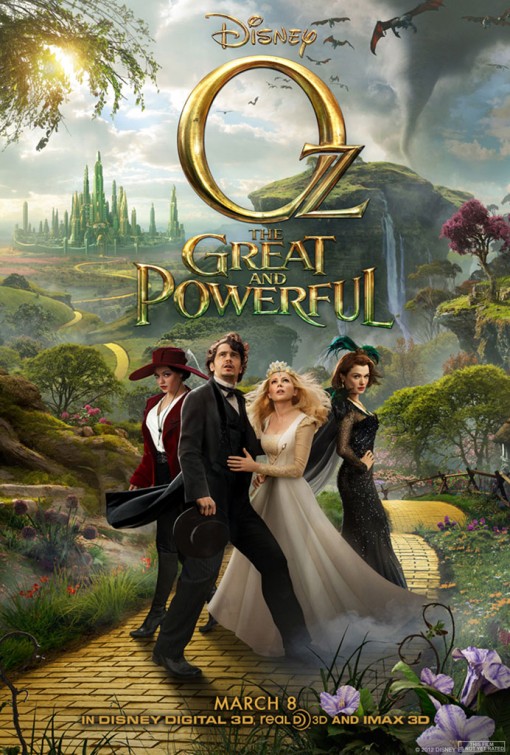 Usually when I’m watching a bad movie I have to stop and think where did things go so wrong, where did the wheels fall off, what choice lead to the disaster I am watching play out onscreen. In the case of Disney’s Oz the Great and Powerful, a Wizard of Oz prequel that pretty much hovers over the cusp of bad for its entire 130 minutes, I have to stop and think, “How could this movie ever have gone right?” I don’t think it could have, at least not with this script, this cast, and the edict from the Mouse House to keep things safe and homogenized, smothered in CGI gumbo and scrubbed clean of any real sense of venerable movie magic.
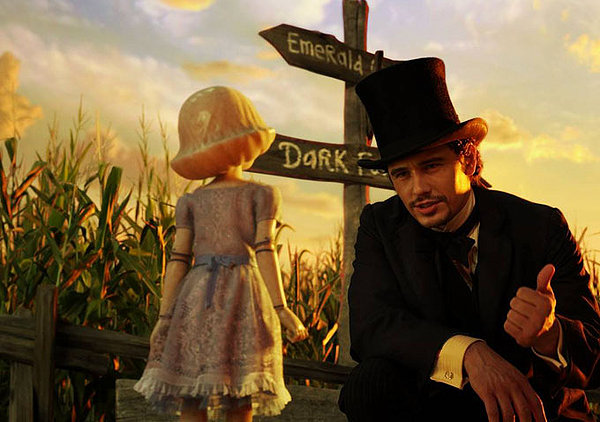
In 1905 Kansas, the magician Oz (James Franco) is used to bilking country folk out of their meager earnings. He’s a con man and runs afoul with a strong man in his own traveling circus. He makes a hasty escape in a hot air balloon and, thanks to a coincidental tornado, is whisked away to the Land of Oz. The people have long been told that a wizard would come and rescue them from the tyranny of the wicked witch. Theodora (Mila Kunis) and Evanora (Rachel Weisz), sisters controlling the Emerald City, task Oz with killing the other witch, Glinda (Michelle Williams). If he succeeds, Oz will become king and riches will be his. Along his journey he collects a band of cuddly sidekicks (flying monkey, China doll, munchkin) and learns that he may indeed be the hero that Oz needs to save the day.
 Oz the Great and Powerful is really just 2010’s Alice in Wonderland slapped together with a fresh coat of paint and some extra dwarves. I say this because, like Alice, this movie suffers from a plot that feebly sticks to the most generic of all fantasy storylines – the Great prophecy speaks about a Great savior who will save us from the Great evil. Naturally, the so-called chosen one has internal doubts about the burden they face, initially ducking out before finding that inner strength they had all long to prove they were indeed the one prophesized. It even got to the point where I was noticing some of the same plot beats between the two movies, like how last in the second act we spend time with a woman dressed all in white who we’ve been told is the villain but who is really the good guy. Then there’s the now-routine rounding up of magical creatures to combat the evil hordes in a big battle. Considering Alice was billion-dollar hit for Disney, it’s no surprise they would try and apply its formula to another magical universe hoping for the same results. Well I thought Alice was weak but Oz is even weaker. However, at least nobody absurdly starts breakdancing by the end. Small victories, people.
Beyond the formula that dictates the plot, the characters are poorly developed and broach some off-putting gender stereotypes. The character of Oz is portrayed as a scoundrel who eventually learns to be selfless, but I never really bought the major turning points for his character arc. Do all major characters need to be flawed men in need of redemption in magical worlds? I understand what they were doing with his character but I don’t think it ever worked, and certainly Franco’s performance is at fault as well (more on that later). The ladies of Oz, however, just about constitute every female stereotype we can expect in traditional movies. One of them is conniving but given no reason for why this is. One of them is pure and motherly. And then one of them gets lovesick so easily, falling head over heels for a boy in a matter of hours that she’s willing to throw her life away in spite. And all of these witches, who can actually perform magic unlike the charlatan Oz, sure seem like they don’t need a man to run the kingdom for them and tell them what to do. It’s sad that a conflict that involves feudal power grabs should devolve into a misconstrued love triangle. Then there’s the role of the little China Girl (voiced by Joey King) who adds absolutely nothing to the story except as another female in need of assistance and doting, except when she inexplicably behaves like a surly teenager in a tone-breaking head-turning moment. Oz keeps resting the very breakable doll on his shoulder, like a parrot. I suppose it’s better than tucking her in his pants.
The movie is also tonally all over the place. It wants to be scary but not too scary. Personally, I always found the talking trees to be spookier than the flying monkeys but that’s my own cross to bear. It wants to be funny but often stoops to lame slapstick and Zach Braff (Garden State) as a goofy flying monkey sidekick. It wants to be exciting but it never takes a step beyond initial menace. Its big climactic battle is more like a children’s version of something you’d see in the Lord of the Rings. The movie fails to satisfyingly congeal and so every set piece feels like it could be from a different movie.
 Some notable casting misfires also serve to doom the project. I like Franco (Rise of the Planet of the Apes) as an actor, I do, but he is grossly miscast here. He does not have the innate charm to pull off a huckster like Oz. Franco usually has an off kilter vibe to him, one that’s even present in this film, that gives him a certain mysterious draw, but he does not work as an overblown man of theatricality. Combined with lackluster character, it makes for one very bland performance that everyone keeps marveling over. It’s like all the supporting characters, in their fawning praise, are meant to subconsciously convince you that Franco is actually succeeding. Kunis (Friends with Benefits) is also a victim of bad casting. She can do the innocent ingénue stuff but when she (spoiler alert) turns mean and green it just does not work. When she goes bad she looks like Shrek’s daughter and she sounds like a pissy version of her character from Family Guy, which is ineffectual to begin with. Kunis cannot believably portray maniacal evil; sultry evil, a corrupting influence like in Black Swan, most definitely, but not this. There are lines where she screeches at the top of her lungs and it just made me snicker (“CUUUUUURSE YOOOOOOU!”).
I had faith that a director as imaginative as Sam Raimi (Spider-Man, Drag Me to Hell) would be a stolid shepherd for a fantasy-rich project such as Oz. I never got any sense of Raimi in this movie. It felt like he too was smothered completely by the overabundance of special effects. It’s a common complaint that modern movies are buried under an avalanche of soulless computer effects, but usually I find this bromide to be overstated. Having seen Oz, I can think of no more accurate description than “soulless computer effects overload.” At no point in the movie does any special effect come close to feeling real. At no point do you feel immersed in this world, awed by its unique landscapes and inhabitants (it feels often more like the land of Dr. Seuss than Oz). I chose to see the film in good ole standard 2D, though the 3D eye-popping elements are always quite noticeable. At no point do you feel any sense of magic, the most damming charge of all considering the legacy of Oz. The original Wizard of Oz holds a special place in many a heart. We recall feeling that sense of wonder and magic when we watched it as a child, the idea that movies could be limitless and transporting. While watching Raimi’s trip to Oz, I only felt an overwhelming sense of apathy that grew disquieting.
Then there’s the matter of the questionable messages that the movie posits. It celebrates the power of belief, which is admirable, but it’s belief in a lie. Oz is a fake, yet the movie wants to say that faith in false idols is something worth celebrating. Oz and his cohorts put together a deception to fool the denizens of the world into a false sense of security. Everyone believes in the Wizard of Oz so he has power but it’s all a sham. We’re supposed to feel good that these people have been fooled. Didn’t The Dark Knight Rises basically showcase what ultimately happens when a society’s safety is based around a lie and false idols? I understand that as a prequel one of its duties is to set up things for when Dorothy comes knocking, but do I have to be force-fed disingenuous moral messages?
Oz the Great and Powerful is a wannabe franchise-starter that feels like it never really gets started. There’s a generic hero’s journey, some underwritten characters, mixed messages, and poor casting choices, namely Franco and Kunis. The sense of movie magic is absent and replaced with special attention to marketing opportunities and merchandizing (get your own China Girl, kids). It feels more like the movie is following a pre-planned checklist of stops, cribbing from Alice in Wonderland playbook, and trying to exploit any nostalgia we have for this world and its characters. Except we love Dorothy, the Scarecrow, the Tin Man, the cowardly Lion, and Toto. I don’t think anyone really had any strong affection for Glinda or the Wizard. Just because we’re in the same land with familiar elements doesn’t mean our interest has been satiated. The Wizard of Oz backstory has already been done and quite well by the Broadway show Wicked, based upon the novels by Gregory Maguire. That show succeeded because it focused on the characters and their relationships (extra points for a complicated and positive female friendship dynamic). We cared. That’s the biggest fault in Raimi’s Oz, that amidst all the swirling special effects and fanciful imagination, you watch it without ever truly engaging with it. You may start to wonder if your childlike sense of wonder is dead. It’s not; it’s just that you’re old enough to see a bad movie for what it is.
Nate’s Grade: C
Share this:

The Hobbit: An Unexpected Journey (2012)
 I would argue that Peter Jackson’s Lord of the Rings epic has left the biggest impact on the world of popular culture over the past decade. It’s hard to remember a time when the multi-billion dollar trilogy, and winner of just about every Oscar dreamt up, was seen as a risky proposition. Would there be an audience for this kind of movie, let alone three of them? Well, ten years later, and mountains of money still being counted, this question has been put to rest. And so the discussion naturally veered to that other J.R.R. Tolkien book, the first one, The Hobbit. The production of it was held up for years with legal battles over who owned the rights and then with MGM’s bankruptcy. Everyone wanted a piece of the pie at this point. They knew the fortunes that would come. Jackson returned to direct The Hobbit, which was designed to be two movies but then late into filming was transformed into a trilogy. Now we have three Hobbit films because, quite simply, three movies equal more money. Everyone’s doing the whole elongated film franchise now, from Harry Potter to Twilight to The Hunger Games. Why give up the cash cow so easily? The first chapter, An Unexpected Journey, arrives this year, and you’ll probably relive whatever feelings were felt for Lord of the Rings. I know I did.
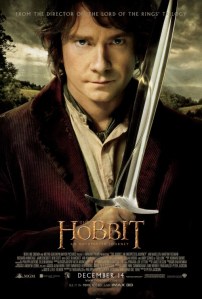
Sixty years before the events of The Lord of the Rings, young Bilbo Baggins (Martin Freeman) is a fastidious hobbit keeping to himself. Then one day the wizard Gandalf (Ian McKellen) visits and brings with him a dozen dwarf guests. The dwarves, lead by Thorin Oakensheild (Richard Armitage), are looking to reclaim their ancestral home, the Misty Mountain. The greedy dragon Smaug overtook the mountain many years ago (did you know dragons apparently lust for treasure like pirates?). The group needs a burglar, and hobbits are small and make minimal sound, making Bilbo an ideal candidate. Naturally Bilbo refuses the notion of a dangerous adventure, but then he changes his mind (what? It’s not going to be 8 more hours of Bilbo doing housework). Bilbo and the dwarves encounter elves, orcs, trolls, wizards, and all sorts of creatures as they make their way across Middle Earth to the Misty Mountain.
 I was more excited for the Hobbit films when they were initially going to be directed by Guillermo del Toro (Pan’s Labyrinth). I thought that master of creepy crawlies would come up with something decidedly different, but alas it was not meant to be. Jackson hopped back in the director’s chair and provides a nice sense of continuity between the film franchises. The man knows this world like the back of his hand. He still has his great sense of visual grandeur, and often the movie is gorgeous to behold. The locations give the realm of Middle Earth such a better tangible feel than had he gone the George Lucas route and spent all his time with green screens. Even the more heavily-effects-laden sequences, like the underground orc lair, are rich, dense, terrific film locations you want to get lost in, absorbing every detail. From a technical standpoint, the film is never less than beautiful. Jackson also maintains a superior handling of action, knowing how to extend a set piece and build tension. The villains in The Hobbit might not be as meaty or memorable as they are in Lord of the Rings (a testy, one-handed albino orc feels like a lackluster heavy) but they provide enough credible danger. If you loved the Lord of the Rings films, and their fans are legion, then you’ll likely enjoy the first part of the prequel trilogy. If I had to rate the first chapter of The Hobbit, I’d say it’s closer to 2002’s Two Towers in overall quality, the film I liked the least in the Rings trilogy.
Now that we know there’s a healthy audience for these movies, I worry that Jackson has lost his sense of objectivity. There is no reason this movie needed to be as long as it is. There’s certainly no reason that a 300-page book, primarily aimed at children, needs to be padded out into three movies, each promising to be close to three hours in length (9 hours out of 300 pages = 1.8 pages per minute). Instead of the Jackson who nipped and tucked Tolkien’s gargantuan tomes, removing Tom Bombadill, now we have a Jackson who adds lengthy appearances of characters only briefly mentioned before in the book (kooky naturist wizard Radagast). There are also cameos from the Lord of the Rings cast to provide some further connective tissue. Now we have Bilbo and his gang visiting just about every single gnarly creature in Middle Earth, or so it seems. Now we have a quest that doesn’t even begin until close to an hour into the film. And that quest seems a lot less urgent; rather than, you know, saving the world, our characters are out to… reclaim a mountain for the dwarves. The drop in urgency makes the tale and its detours feel like dawdling. The concluding hour is fairly well paced, especially once Gollum shows his ugly mug, but the movie feels like it has precious little forward momentum. I don’t have high hopes for the future films. Fans of Tolkien’s works will likely just be thrilled to see every facet of their favorite story brought to startling life, so they won’t care about lag. At the conclusion of this movie, as our characters are dropped off by giant eagles, they look in the distance and see the Misty Mountain, their hope renewed. However I was yelling, “Get those eagles back! Why do you have to walk the whole way there?” Looks like even more long movies of walking lie ahead (cue Clerks II Rings vs. Star Wars clip).
 This is also a far different film than the Lord of the Rings epics when it comes to tone. It’s far more childish and filled with comedy, also aimed at children. I don’t mean the term “childish” to see like a negative broadside, though that’s the connotation. The world of Middle Earth isn’t ensnared in the perils of Sauron just yet, so even though we got trolls and dragons and the like, the temperament is chippier. There are a lot more comic escapades here and it’s easier to accept when, you know, the world isn’t being threatened with an eternally evil malevolence. There’s a lot of bumbling and physical comedy at play, especially when the dwarves take over poor Bilbo’s home. Later on, there’s an orc king who has what is unmistakably a pair of testicles hanging below his chin. I mean you cannot possibly look at the image and interpret it as anything differently. You probably would never see something like that, for better or worse, in the Lord of the Rings films.
The biggest news for me with The Hobbit was Jackson filming at 48 frames per second (fps). It’s twice the rate of how we’ve perceived movies since the 1920s. It is a brave leap forward in technology. I was worried I wouldn’t be able to have the opportunity to view The Hobbit in this exciting new format. Having come through the 48 fps experience, I’ll say that it has its pros and cons. On the negative side, it certainly breaks with the standard filmic look we’re so accustomed to, that dream-like state that’s removed from reality. Often the picture looks like it was recorded on video, giving the movie a stagy BBC feel to it. For some, this change will seem cheap or less grand. The biggest piece to get used to is that at 48 frames, everyone’s movements seem overly exaggerated. Everyone moves like they’ve had eight cups of coffee. It’s these hyper movements that make me think of that horrible TV feature on some HD TVs that plays down judder by amplifying movement, so everything looks like a video game cut scene. Your eyes may feel a bit more strained, as mine did after the three hours, trying to capture all the jostling movement. The 48 fps also has a tendency to blur quick motion, making it harder to pay attention to the particulars of action sequences.
Now, with that being said, I personally feel that the benefits far outweigh the detractions. The level of detail and clarity is outstanding. I felt immersed in this world. And with the 48 fps, it’s also the greatest theatrical 3D experience I’ve ever had. You feel like you’re literally inside the movie. When things fly at the screen you may just duck your head on instinct. The movie worked best when it could explore the different physical realms of Middle Earth. The underground orc world was magnificent to explore. There were several moments that made me gasp, taking my breath away at the level of detail. It takes a while to get used to and for your eyes to adjust, but I think the awkwardness dissipates and you’re left to gawk in awe with the effects and presentation. I doubt we’ll be seeing too many other films presented in this manner. Firstly, I think half the public is going to hate it. 48 fps really only works for films that necessitate a big canvas. You need a world that you want to be a part of, something to dazzle the senses, which means it will probably be best utilized with sci-fi and fantasy films. Hitchcock at 48 fps would certainly not be worth the extra frames.
 Freeman (BBC’s brilliant Sherlock, The Hitchhiker’s Guide to the Galaxy) is a perfectly enjoyable lead. Bilbo is much more of that classic British nattering type, more comedic in nature than the sad burden of Frodo, and Freeman is naturally a skilled comedic actor. He doesn’t overdo any sort of hobbity nebbishness either, and when it comes to the dramatic parts he can sell those just as well. McKellen (X-Men) is as wonderful as ever as the wise yet playful wizard. The real breakout star of the movie is Armitage (BBC’s Robin Hood) as Thorin Oakensheild. The man has such gravitas to him, a commanding screen presence, and it helps when he has a completely badass slow-mo strut that burns into your memory how awesome the actor and character are (fun observation: at 48 fps, slow motion looks almost like “normal” movie speed). I anticipate Armitage to give the squealing fans of Aragorn (Viggo Mortensen) a new heartthrob to declare their loyalty.
Jackson’s return to The Hobbit: An Unexpected Journey is pretty much more of the same, though with a less urgent plot, a broader scope of comedy, and some extra technical wizardry. Watching it will pretty much rekindle whatever feelings you had for the duration of the Lord of the Rings pictures. If you know this stuff verbatim, you’ll happily take every second of detail. If you’re like me and enjoyed the films but didn’t tattoo them in your memory, then you’ll likely have a pleasant if occasionally tedious experience with The Hobbit. I’m fairly certain that Jackson could have judiciously sliced a solid 20-30 minutes out of this unexpected journey; maybe they have fewer journeys with every magical being this side of Middle Earth. Still, the film is grand and sprawling and spectacular to witness. If you were interested in the 48 fps presentation, I’d recommend it but know what you’re going in for. It will be a very different experience and one that you’ll need some adjustment time to properly attune to. Unless you’re a techie, I’d advise watching the movie in a standard 24 frame presentation and then seeking out the high frame rate for a second helping, already knowing what to expect from the plot. I plan on seeing the next two Hobbit films in the 48 fps presentation. Hopefully by that time, come December 2013, my eyes will have recovered.
Nate’s Grade: B
Share this:

Prometheus (2012)
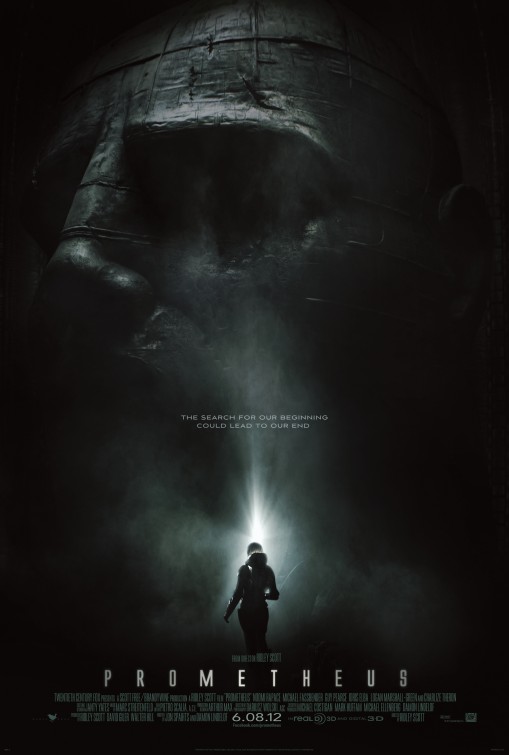 Ridley Scott has always wanted to go back to the Alien franchise that began with his 1979 sci-fi staple. There have been a lot of coy discussions over whether his big-budget sci-fi spectacle Prometheus is indeed an Alien prequel or not. Scott keeps hinting it has the DNA of the franchise but exists on its own. This movie has some Big Questions on its mind, like where did we come from, but the biggest question out there is whether it really is an Alien prequel or not. Well rest assured, that question will be sufficiently answered. Now if you have more than that, you will be left empty-handed with this gorgeous but ultimately confounding sci-fi thriller.
In 2089, a team of archeologists, lead by Elizabeth Shaw (Noomi Rapace), discover an ancient star map from 30,000 years in mankind’s past. This is not the only ancient illustration displaying the same constellation. Sure enough, in every ancient civilization across the globe, the same star pattern. Shaw believes it is an invitation and th key to finding the “engineers” who may be responsible for life on Earth. Four years later, the wealthy Peter Weyland (Guy Pearce) has funded a trip to that exact point in space, which harbors a moon that seems extraordinarily like Earth and capable of sustaining life. The ship is run by Meredith Vickers (Charlize Theron). who keeps asserting her company’s authority on this mission. Along for the ride is a cocksure pilot (Idris Elba), an android named David (Michael Fassbender), and Shaw’s own lover, a scientist in his own right, Charlie Halloway (Logan Marshall-Green). When the gang gets to that moon, they uncover large buried structure with some nasty surprises inside. Suffice to say, they should have stayed home.
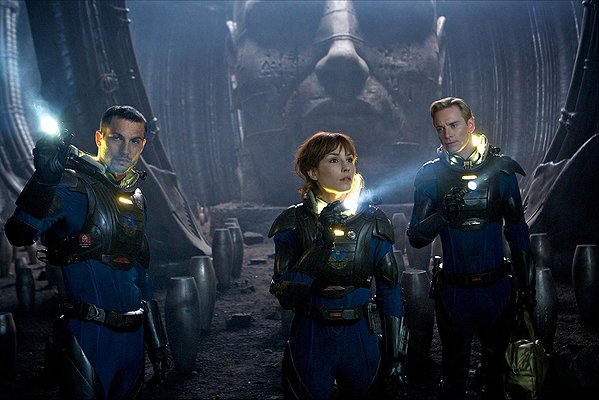 You can always count on Scott to deliver a visually extravagant picture, and Prometheus is packed with stunning, arresting visuals that fill up the big screen with lovely detail. The scale of some of these sets is massive, and your eyes just want to soak up every detail. The alien world is vast and eerie and you just want the characters to spend the rest of their lives exploring it (Scott shot in Iceland but it looks remarkably like a whole different world). The interior sets on the space ship are also sleek and cool. There’s a terrific sense of immersion in the movie. Scott has always done a great job at building worlds that feel completely lived-in, and Prometheus is another example of his talents. The special effects are astonishing but best when not dealing with the biological life forms. The giant spaceship is incredible; its inhabitants? Not so much. Apparently our DNA grandfathers looked like giant Michelin men (thankfully we take more after our mother’s side). Prometheus demands to be seen on the biggest screen possible.
Prometheus harkens back to the original Alien in its suspenseful “haunted house in space” setup. The movie has some terrifically taut moments and a great overwhelming sense of dread. The scientists let curiosity get the better of them, so they poke their heads in dark corners, touch unknown alien material, and get up close and personal with things better left unmolested. If slasher movies elicit a “Don’t go in there” audience response, then Prometheus certainly elicits a “Why are you touching that?” reaction. And yet, deep down, we want them to keep pushing further because like the best suspense films, we can’t stand the tension but we really want it to keep going. Probably the most memorable scene of them all involves Shaw performing her own hurried abdominal surgery to remove an alien from inside her. It’s creepy and caused me to wince repeatedly, but man is it fun and gruesome and a nice payoff to an earlier setup. The rest of the movie is pretty standard with its thrills, including the canon fodder supporting characters getting picked off unceremoniously, and the large-scale devastation climax. The movie delivers the goods when it comes to entertainment and suspense, though mostly in the first half. It’s almost like the movie is awed by the visuals as well, and then halfway in remembers, “Oh yeah, we got to do more than just poke at things,” and then it’s a rush to the end with a cascade of conflicts that don’t seem properly developed.
The film lays out a very essential question about the origins of mankind and plays around with theological concepts but it only plays in the shallow end of the philosophical pool. The screenplay by Jon Spaihts (The Darkest Hour) and Damon Lindelof (co-creator of TV’s Lost) deals with the conflicting origin stories via religion and observable science but never goes into specifics. “Religion” is always symbolized as a cross necklace that Shaw wears and her falling back point upon what she “chooses to believe.” The discovery that our alien forefathers have a similar appearance would be a huge revelation, except the movie spoils it with a clumsy prologue that shows us right off the bat what the “engineers” look like. Prometheus actually posits an Intelligent Design argument for human existence, albeit one the Raelians have been promoting for years, the idea that intelligent life outside our galaxy seeded Earth. Yet the one scientists on the crew, the one who objects to 300 years of evolutionary evidence, remains mum on the matter. I suppose the filmmakers didn’t want their monsters-in-space movie to be bogged down with that much pithy philosophy, but I would have appreciated some meatier conversations other than, “Should we touch this?” It’s not nearly as thought provoking or as compelling as it thinks it is.
As I sit here and I write this, the plot becomes a wispy memory of strong set pieces and eerie mood, but I cannot connect the story. It makes little sense and by the end of its 124 minutes we’re left with hardly any more answers than we started with (some spoilers to follow). Our genetic “engineers,” as they call them, remain pretty nebulous. I suppose one could argue that it would be impossible to fully understand an alien race’s habits and purposes without resorting to pandering, but that strikes me as a cop out (I’m reminded of Spielberg’s similar approach in Kingdom of the Crystal Skull, where the characters that wanted to know were punished for their intellectual curiosity by alien forces). Why did these super aliens create life on Earth and leave maps to a planet that was little more than a weapons depot? Why would these superior beings create life hundreds of thousands of years ago and then leave clues 35,000 years ago that would lead to the destruction of their little experiment? The motivation seems rather hazy. It’s not like the aliens created life on all these planets and waited to be contacted so that they knew their little biological Easy Bake oven was done and then they could reclaim a new planet. It’s not some imperialist empire or colonization scheme; it appears to just be wanton destruction. That seems like a waste of effort. Did these aliens keep checking back, see our ancestors hunting and gathering and go, “Oh my Space Deity, I can’t believe we created life on this planet? We were so wasted. Well, just wait until they conquer space travel and then we’ll kill them with a weird biological weapon.” If your desire is to destroy life, why even have a waiting period? If these “engineers” wanted to destroy Earth why not do it when there was far less clean up? Is there some kind of parent-child relationship I’m just not getting here?
 Fassbender (X-Men: First Class) makes the biggest impression as the fastidious android, David. He’s by far the most interesting character and he’s not even human. It doesn’t take long to figure out that David has his own agenda, and Fassbender plays the character with this eerie passive-aggressive arrogance. You get the sensation that he looks down on his human clientele, but you don’t know what lengths he will go. “How far will you go to get your answers?” he asks before doing something very not nice. He makes statements like, “Who doesn’t want to kill their parents?” and there’s an icy placidity to him; he’s just off enough to be menacing and unsettling without going overboard. Fassbender is excellent.
The rest of the cast cannot be at fault for failing to measure up to Fassbender (is that a Shame joke I stumbled upon?). Rapace (Sherlock Holmes: A Game of Shadows) is given top billing and does an admirable job of being a kickass heroine, which we already knew she was fully capable of in the Swedish Girl with the Dragon Tattoo trilogy. She even has a Ripley-esque haircut, which I doubt is a coincidence. Theron (Snow White & the Huntsman) gets to once again practice her ice queen routine, but I wish she had more to do than occasionally glower and bark orders. Her character’s secret background should be obvious to anyone well versed in the film economy of characters. Elba (TV’s superior Luther) tries to stick it out with some twangy Texas accent but can’t make his way through. His natural British accent pokes through routinely. Then there’s Guy Pearce (Lockout) as the wealthy benefactor who bankrolled the whole project. Apparently he was hired to film viral videos as himself, because in the movie he’s like a 100-year-old man in some pretty poor makeup (he resembles old Biff in Back to the Future: Part 2). Why hire an actor of Pearce’s caliber if you’re just going to hide him under a veil of old-age makeup? The actors do what they can but the film doesn’t give them much to work with. They’re stock roles and absent development. You don’t notice for a long while because you’re so caught up in the exploration and the gorgeous visuals, but when the end comes you realize that you hardly knew these people.
After all the pre-release coyness about whether this belonged in the Alien universe, Prometheus seems to be a victim of its own sky-high hype. The movie is moody and dark and intriguing and visually magnificent, but the plot does not hang together at all. The central mystery of the origins of mankind is given a face to start with, but that’s about it. The confusing story tries to mask its plot holes but eventually they just overtake the movie. It’s an entertaining movie in the moment but Prometheus pretty much evaporates as soon as you leave the theater and start thinking, “Hey wait a minute, that didn’t make any sense.” Why are mankind’s “engineers” a regretful bunch of jerks? Scott’s visuals are impressive, the film has a killer mood that’s hard to shake, but the plot is pretty shaky and reliant on supposedly smart people making pretty dumb decisions (why yes, I’ll try and touch the alien snake monster thing). That’s fine for basic thrills but it doesn’t elevate the movie into something headier, meatier, and more satisfying, like the original Alien. Prometheus was never going to meet the unattainably high expectations of fans stoked by tremendous trailers and the promise of Scott’s triumphant return to sci-fi, but much like the characters in the film, I was glad to go on this journey but wished I had more to take home with me.
Nate’s Grade: B
Share this:

Rise of the Planet of the Apes (2011)
 I owe the makers behind Rise of the Planet of the Apes a huge apology. I have been vocally dismissive of a new Apes film from the first moments I heard about the project. I just thought rehashing this material was a stupid move. Then I heard James Franco (127 Hours) was going to be the lead, and I sighed. Then I saw the trailers and verbally impugned them in my theaters. Upon the conclusion of the trailer I yelled, “You can still shoot them!” and my criticism drew applause from those around me. The concept that we suddenly made apes smarter and they could now enter the Bronze Age, brandishing spears, didn’t overwhelm me. Just because the apes suddenly had tools didn’t seem like enough to topple mankind from the top of the evolutionary ladder. So in the months and weeks ahead I sneer, jeered, and overall dismissed Rise of the Planet of the Apes. And then the reviews came out and they weren’t just good, they were ecstatic. I went begrudgingly into the theater, waiting to hurl my own feces at the screen (figuratively, of course). Then I was completely taken aback by how much I unabashedly loved it.
Will Rodman (Franco) is a young scientists working hard at create a miracle cure for Alzheimer’s. His corporate company has been testing their drugs on chimps to mixed results. One day a promising ape, made smarter by a dose of ALZ 112, goes bananas and is put down by security. The lady ape left behind a baby ape that has taken on traits from the ALZ 112. Will takes the little chimp home to care for the “company property.” But then he ends up adopting the chimp, which his ailing father (John Lithgow) names Caesar. Due to the super drug, Caesar shows remarkable intelligence and looks to be getting even stronger. It looks like Will might have found his cure, and his boss (David Oyelowo) will make billions. But then complications ensue, as they always do, and Caesar is taken to an animal preserve facility run by a crooked father/son team (Brian Cox and Harry Potter’s Tom Felton). Caesar is mistreated and distraught to adjust to a life in pens. He makes plans to escape but then decides to rally his fellow imprisoned apes to a greater cause with the help of some of the ALZ 112.
Even through Franco is the headliner he’s really nothing more than a supporting character, a catalyst. The real star of the movie is undoubtedly Caesar the chimp. After about he 45-minute mark, Franco is reduced to making frowny faces while he scowls, trying to ascertain where his favorite monkey is. His dialogue is mostly reduced to different iterations of yelling Caesar’s name in different locations (the guy even manages to smirk in his sleep in one scene). But the major surprise is that Caesar is not only a compelling leading character but also a well-developed one at that. This is a living, breathing character brought to life thanks to top-notch computer wizardry and the talents of Andy Serkis, the leading authority for soulful motion-capture performances. Caesar may be the greatest single special effect of all time, not because of its life-like quality (it’s close, but again the creature’s features seem too waxy). But the reason Caesar is so impressive is because of the depth of emotion that can be read onscreen. This is a textured performance where you can read varying emotions through the looks of eyes, the twitching of facial muscles, the biting of lips. The emotions are genuinely recognizable; he flashes guilt, anger, frustration, heartache, disbelief, betrayal, fear, shame, just about everything in the book. From a DNA standpoint, chimps and humans share 96 percent of the same genes, so it’s understandable that we can relate to the plight of our distant relatives. Serkis is responsible for providing the groundwork for CGI creations like Gollum and King Kong, so he’s the world’s go-to guy when it comes to providing a framework for animators (Robert Zemeckis, why have you never called this guy?). It’s an amazing special effect accomplishment and works side-by-side with the storytelling to make Caesar a complicated, interesting, and deeply empathetic hero. He’s a terrific center for the movie and a figure that you root for, even with the tacit understanding that cheering on the apes’ escape is also tantamount to cheering the decline of the human race. But by God, during the apes-run-amok climactic sequences you are cheering for mankind’s downfall hardcore.
The Planet of the Apes saga (six films) is, let’s be honest here, rather abysmal. Everybody loves the first movie but the quality sharply drops from there, with four sequels in four years each managing to answer the depressing question, “Can this thing really get any worse?” The 2001 Tim Burton “re-imagining” was just embarrassing and filled with loopy logic (how can the apes take over Earth’s past when Marky Mark crashes on a DIFFERENT planet in the FUTURE?). Given that, the filmmakers behind Rise of the Planet of the Apes did not have to achieve much to separate themselves from the monkey-stank of the sci-fi franchise. The film serves as a prequel to the series but it’s easily the best film since the original. Easily. For one, the storytelling is not overwhelmed by the allegory of sci-fi packaging. The world is decidedly our own and the problems the characters grapple with are fairly relatable. Will may be responsible for the annihilation of the human race but his motivation is pure – he wants to save his ailing father. That’s a believable motivating force that would push the character to action over caution, testing his special serum without fully examining all the side effects. You know what they say about the road to Hell (my friend Eric Muller always suspected Franco would be linked to the end of civilization)? But in a Planet of the Apes movie there is a wealth of thoughtful human drama. Animal rights are one of the more obvious messages the movie deals with, but the film takes a character-driven approach following the animal himself. You care about these characters and when one CGI ape was cradling a dying CGI ape, I swear I was getting choked up over those computer pixels. That’s how emotionally involving this new Apes film can be. It’s refreshing to have a Hollywood action film that has more on its mind than blowing stuff up all good like.
 But when the action shapes up, mostly during a stirring man vs. apes climax, the film easily delivers. The nimble screenplay by Rick Jaffa and Amanda Silver (their first film since 1997’s Relic!) is a terrific example of economical big-budget pacing. Every scene moves the story forward and doesn’t waste a frame. The final running time is only 105 brisk minutes but it squeezes in so much entertainment and emotion. Director Rupert Wyatt keeps the thrills coming on a human-scale, never letting the enormity of the events getting too out of hand. Sure suddenly there are like 500 apes all of a sudden and all of them are super smart, but I can roll with that. The stakes are always clear and the action is easy to follow and easier to get swept up in. There are a few shout-outs to the original film’s iconic lines, which will either come across as fun or ham-handed. And thankfully a plausible scenario is put forth to explain why the humans would be overtaken by the apes. That’s not to say that everything is smartly woven into the narrative. Several of the side characters are but crude renderings. Frieda Pinto’s (Slumdog Millionaire) underdeveloped love interest could be completely taken out with minimal effect on the plot. Likewise the Evil Business Head seems to have nothing but speeches that remind you his sole interest is making lots of moolah.
Rise of the Planet of the Apes is a Hollywood movie with a soul. Finally late in the summer a major studio movie emerges that has the right balance of brains, brawn, and thrills. It’s an exciting action movie, a poignant drama from an animal’s point of view, a tour de force of special effects that manage to make the film more emotionally involving, and a sci-fi prequel that’s actually worthy of its name. Serkis’ gifts for physical performance are invaluable to the emotional core of the movie. By going back to its DNA, Rise of the Planet of the Apes has given new life to a franchise whose best days were 40 years ago. I don’t see where the series can go from here. A prequel to the prequel seems superfluous. A sequel would only really showcase the waning days of humanity and also seem superfluous. Then again, until the moment I was watching Rise of the Planet of the Apes I would have said this very movie was superfluous too. Instead this is the finest summer spectacle of the year and destined to make my top ten list for the year. If you can’t beat them, join them, damn dirty apes and all.
Nate’s Grade: A
Share this:

X-Men: First Class (2011)
 Marvel’s X-Men franchise had some serious damage it needed to undo. The once mighty superhero series had been harmed by that age-old foe – bad sequels. The collective stink from 2006’s X-Men: The Last Stand and the 2009 Wolverine debacle, the franchise had lost some serious luster. While the recovery was not nearly as deep and cataclysmic as what the Batman franchise had to deal with in the wake of 1997’s Batman and Robin, a film that flirted with salting the earth, the X-Men needed some kind of facelift. Enter director Matthew Vaughn (Kick-Ass, Stardust), the man who was going to save the series back in 2006 when original director Bryan Singer flew away to direct a different man in tights. Vaughn was originally tapped to direct Last Stand but he dropped out and was replaced by the hack Brett Ratner (Rush Hour). Thus began the slide toward mediocrity. Now Vaughn is back to tidy up unfinished business, taking the series back to its historical roots in the 1960s. It seems that a trip back in time was just what was needed to make the X-Men fresh.
Back in 1944, Erik Lehnsherr is a prisoner in a Polish concentration camp when Dr. Schmidt (Kevin Bacon) discovers the young boy’s great potential. When enraged, Erik can control anything metallic. In upstate New York at the same time, young Charles Xavier discovers a young shape shifter named Raven. She’s blue from head to toe and afraid. They’re delighted to find one another, fearing they were the only ones “different” in the world, children of the “atomic age.” All three of these people are headed for a collision course. In 1963, Charles (James McAvoy) has become an Oxford professor, Raven (Jennifer Lawrence) has followed him to England, and Erik (Michael Fassbender) has been systematically hunting down the Nazis responsible for his pain and suffering. Dr. Schmidt has now become Sebastian Shaw, a younger-looking playboy with the intent to push the Soviets and Americans to nuclear war. Shaw has his own team of mutant henchmen, including telepath Emma Frost (January Jones, proving once again that she can really only ever be good as Betty Drapier) who walks around in white lingerie the whole movie. Together with CIA agent Moira MacTaggert (Rose Byrne), Charles and Erik assemble their own team of young mutants to thwart Shaw.
Similar to 2009’s Star Trek, this film provides the opportunity to reboot a franchise by going back in time. It transports the series back to the beginning of the friendship between Charles and Erik, and spends the next 130 minutes filling in the rationale for the “why” of their varying personal philosophies. By dialing back, we’re able to play around with 40 years of back-story and histories. While we know the end results, that these two giants will become enemies, that Charles will lose the ability to walk, and that Raven/Mystique will eventually side with Erik, that doesn’t mean there isn’t pleasure to be had in watching the journey. There are all sorts of self-aware in-jokes for fans and a few nifty cameos that left me howling with glee. The script, credited to Vaughn, his writing partner Jane Goldman (Kick-Ass), and four others, smartly moves the film forward; no scene seems at a waste. Even better, the film strikes a tone that manages to take its real-world implications seriously (nuclear brinksmanship, Holocaust, and fighting for equality and acceptance) without diminishing its popcorn thrills.
As a summer movie, X-Men: First Class has enough razzle-dazzle to compliment its intelligent social pontification. Vaughn and his screenwriters have composed action sequences that neatly incorporate the mutant abilities of its subjects while building the tension and smartly utilizing the contours of geography. I hate action sequences that don’t play to the potential of location and subject. An evil teleporter (Jason Flemyng) finds a fiendishly clever way to dispatch 20 CIA agents. Magneto efficiently takes out former Nazis residing in Argentina in one chilling sequence (“I’m Frankenstein’s monster,” he tells one man). Shaw makes for an actual formidable opponent for our fledgling heroes. The personal connection he has with Erik, on top of Bacon’s devilish glimmer of villainy, makes Shaw a strong antagonist that the audience can rally against. Vaughn has a splendid reveal with Shaw. Back when he was a Nazi doctor, he asks young Erik to move a coin with his abilities. The shots consist entirely from one side of his office, showcasing it to be a bookish study. Then when Shaw calls the Nazi guards to bring in Erik’s mother for a little more direct incentive, the camera flips position. We see the opposite side of the room, a medical station on the other side of large glass panels. Inside is a torturous display of medical cutlery. It’s a fantastic reveal that kicks up the tension while adding to the terrifying character of Shaw. The action highpoint, a mutant vs. mutant battle amidst the Soviet and American naval fleets, provides plenty of parallel action to follow that keeps the movie alive and kicking.
The film mixes a frothy, James Bond-esque spy thriller feel in production design and whatever-goes plot savvy, but then recomposes real life events as mutant enhanced. Alert the history textbooks, because the Nazi scientists experimented on mutant children and that mutants averted World War III. Some will chafe at the alternative history approach, but I find it to be more interesting, suspenseful, and a natural fit with the overall Cold War paranoia feel of the setting. Melding the X-Men into history makes for a more intellectually stimulating adventure, tipping its hat at various historical revisions that payoff as small rewards for a well-informed audience. I’m not saying that the movie is like Noam Chomsky’s take on X-Men by any means, but it’s certainly the most heady film in the series since the departure of Bryan Singer (he serves as producer on this flick). Indeed, this is a rather talky X-Men adventure with plenty of philosophical debates and speeches. But then it’s got naked women in blue too. But you see, it’s not just naked women in blue, it’s that a naked woman in blue can become a political statement – man!
And it’s on that note I’d like to say a few words. Mutants have always been a central metaphor for the oppressed, be they Jews, African-Americans, homosexuals, whatever minority group you’d like to slot in. That’s been one of the secrets to the continued success of Marvel’s flagship series – anybody can identify with the fear of being judged, feared, and despised because of who you are. That’s why the character of Raven/Mystique, short of Magneto, is the most fascinating character in the movie. Her true form, scaly and blue, is what keeps her feeling like an outcast. She doesn’t have an invisible power like her surrogate big brother, Charles. She constantly disguises herself in order to fit in, albeit her disguise is the alluring natural figure of Jennifer Lawrence (Winter’s Bone). “Mutant and proud,” she says in disdain when she stares at her bluish reflection in the mirror. It is through Erik hat she begins to believe in this mantra, gaining pride that “blue is beautiful” and she need not even wear clothes to cover who she is up. Raven/Mystique is the figure torn between the two philosophies argued by Charles and Erik. She is the central figure that has to struggle with reality vs. idealism. It’s also a little funny that a movie piggybacking the civil rights movement of the 60s (mutant rights!) also trades in the casual misogyny of the 1960s (women in lingerie as outfits, regularly practiced sexism). I suppose some of this is intentional. I guess the women’s movement will be saved for a sequel.
While the retro setting ties in nicely with the series’ core metaphor about being different/disenfranchised, the dichotomy of ideas presented by Charles and Erik are not given equal measure. That’s because, quite frankly, Erik is a much more powerfully interesting character and more sympathetic than a rich kid who can read people’s minds. Charles Xavier and Magneto have always represented a comic book version of Martin Luther King Jr. and Malcolm X when it came to the ideas of integration, equality, and representation. Charles believes that mutants should assimilate and that humanity will accept in time; peaceful and hidden. Magneto, on the other hand, takes a more militant stance and feels that mutants need not hide who they are out of fear or shame, that they are the dominant species and should not be threatened by the weaker Homo sapiens. But where X-Men: First Class runs into some trouble is that the ideological deck is completely stacked in Magneto’s favor. He’s the one who suffered through concentration camps, Nazi experimentation; he’s seen the worst of what mankind of capable of. He’s a tormented man seeking vengeance, which is character motivation that is easy for an audience to fall behind. Then, even after the mutants save mankind’s bacon during the Cuban Missile Crisis (the first person who tells me this is a spoiler gets a history book thrown at them), they still get treated as the enemy. Almost everything that plays out onscreen aligns with Magneto’s ideology, which makes it hard not to be on Team Magneto as the movie draws to a close. I suppose the film utilizes our knowledge of future events to counterbalance Magneto’s pessimistic world philosophy.
The other issue that lends more credibility to Magneto than perhaps the filmmakers were hoping for is the fact that he’s the most interesting character in the movie, easily. The X-kids are a pretty bland bunch of boys and gals. This is the first class the filmmakers chose? Did they have recruiting violations at the school? Havok (Lucas Till), a goy who can shoot energy beams, Banshee (Caleb Landry Jones), a guy who can scream loudly and fly, somehow, Angel (Zoe Kravitz), a gal with fairy wings and an acid tongue, and then Darwin (Edi Gathegi), a guy who… adapts? Darwin’s power is so obtuse to explain, it’s no wonder he doesn’t last long in service to his country (it’s a bit tacky that when one character says “slavery” the edits have to cut back to the one black mutant for a reaction shot). Each one of these teenagers has a different reaction to their powers. Some are ashamed, some are afraid, others proud or apathetic. But they are all singularly uninteresting. Once they establish their power, they become less a character and just another piece on a game board to be positioned. And Lenny Kravitz’s kid in fairy wings? Plus she spits little fireballs? I’m sorry but that should have been the first thing removed from rewrites. This crew makes it sure that we empathize even more with Magneto as he refines his powers to reach his personal vengeance, which is the film’s pre-designed payoff. We’re not really looking for the team to band together, which they inevitably do, but we’re awaiting that splash of vengeance. And when it does come, it’s satisfying, stylish, and dramatically fitting (“At the count of three, I’m going to move the coin.”). The fact that the movie still has like 15 minutes of material afterward is almost inconsequential.
Vaughn certainly delivers the spectacle, it’s the actors that produce the real fireworks. This is a vehicle for McAvoy (Atonement, Wanted) and Fassbender (Ingloruious Basterds, Jane Eyre), and both men provide admirable gravitas. McAvoy’s role offers a more jocular performance, showing Charles to be a bit of a lady’s man in his younger years, harnessing his telepathic powers to bed him some beauties. Then again, as I’ve been told from my female friends, looking like McAvoy will certainly also help matters. But this is Fassbender’s show. He has a chilly intensity to him, rather than just being cold and indifferent like January Jones. His performance captivates you from the start, and his slow-burning hatred consumes the man. It’s a dramatically rich performance given the material. After being discriminated against for being a Jew, than a mutant, he has to sell that his character, haunted and rage-filled, would ironically follow the same social Darwinism that his Nazi tormentors evoked. And Fassbender sells every bit of an iconic Marvel villain coming into his destiny. However, his Irish accent slips out in the film’s final reel, and I’m really curious why the studio couldn’t have shelled a few bucks to fix that with ADR. Rushed for time, or revealing that Magneto has unheard of Irish lineage?
Going back in time manages to open up all sorts of possibilities for the X-Men franchise. There could be a whole slew of sequels that play around with the rich, complex back stories of the X-Men without having to serve the aging stars of the original trilogy. Vaughn keeps the proceedings amazingly fluid, stylish without being overtaken by visual artifice, and the swinging 60s provides a groovy backdrop. The action delivers when needed, the smart script doesn’t downplay the clash of ideas to go along with the clash of fists, and the special effects are relatively up to snuff as summer escapism goes. The movie is not without its misses, including a cadre of lackluster junior mutants. But Vaughn has re-energized a flagging franchise and given hope for a future (past?). In the pantheon of X movies, I’d place X-Men: First Class as an equal to X2, the best in the series. It may not be at the head of the class, but this superhero flick earns is stripes with a solid effort and strong potential.
Nate’s Grade: A
Share this:

X-Men Origins: Wolverine (2009)
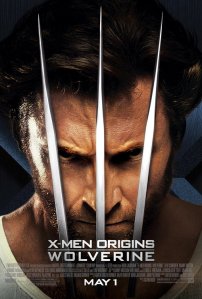 X-Men Origins: Wolverine has been slashed from all sides. First, the movie has not been able to shake bad buzz, from extra reshoots to rumors about conflicts between the studio and the director. There was even one rumor that the head of 20th Century Fox Studios ordered a wall repainted a happier color. Then in early April it got even worse. A DVD-quality print of Wolverine was leaked onto the Internet and spread like crazy, and once something finds itself inside the realm of cyberspace it cannot be put back. The reaction to the leaked copy was mixed, at best. The studio went into damage control mode, stating that the leaked copy was an unfinished work print, that they too were not thrilled with this version and paid millions for reshoots, and the final version that would be released in theaters had 20 minutes of new stuff and 10 minutes additionally edited out. But guess what? The wolverine’s out of the bag, it’s the same exact version minus some completed special effects shots. What amuses me about this whole situation is that the studio is on record trashing the movie, saying they were unhappy with this version, and yet this is the final release. After having seen Wolverine, at least I can say that those Fox execs know mediocrity when they see it.
We get to witness the storied history of Wolverine (Hugh Jackman), which goes all the way back to the pre-Civil War era. Born James Logan, and a mutant, the kid had the unusual ability to produce three jagged bone claws from his knuckles. Logan also had the ability to miraculous heal like his older brother, Victor “Sabertooth” Creed (Liev Schreiber). The two of them make use of their primal, animal instincts and near invulnerability by fighting in every major U.S. war, from Civil to Vietnam. Eventually that kind of thing gets noticed, and General Stryker (Danny Huston) recruits the brothers to be apart of a mutant mercenary group. The group also includes the likes of William “Deadpool” Wade (Ryan Reynolds), “The Blob” (Kevin Durand), and some other unimportant mutants (one of them played by a Black Eyed Pea, will.i.am). Wolverine walks away from the group when he decides that he isn’t cut out for a cutthroat life.
The man finds a quiet place to live along the Canadian Rockies. He’s found a hard-working job, lumberjack, and a good woman, Kayla (Lynn Collins), who loves him. All of this is ruined when Sabretooth comes back around, intent on eliminating the former mercenary members one by one. Stryker appeals to Wolverine to apply for the Weapon X program. He says he can give Logan the tools for his revenge. Wolverine then undergoes the famous procedure that bonds his skeleton with adamantium, an unbreakable metal, and his bone claws become extra sharp metal. Stryker has other plans, naturally, and Wolverine breaks out of the facility. Stryker tells his assassin, “Bring me back his head.” Sorry pal, but you’re the one that just spent half a billion dollars giving Wolverine an unbreakable spinal column.
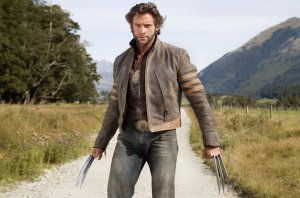 Is this origin tale worth telling? Short answer: no. The mysteries behind Wolverine’s back-story aren’t too involving and the answers make the character less interesting. I don’t really care why Wolverine got his metal skeleton or how he came to be an amnesiac, I just accept that the man has some mystique to him. I care even less that one of the answers to those mysteries is a murdered lover. The plot is incredibly thin; Wolverine meets one mutant who tells him to meet another mutant who tells him to meet another mutant, etc. Eventually the film heads for a mutant showdown that plays out like a lame video game, specifically the mid-90s Mortal Kombat (the Final Boss super villain resembles the blade-handed Baracka). What are Gambit (Taylor Kitsch) and Emma Frost doing in this? That?s not the end of the mutant cameos, either. I feel like the only thing we learn about Wolverine is that his super sense of smell cannot detect the difference between real blood and stage blood. The filmmakers think character development involves someone saying no to slaughtering innocents, and then other characters keep telling him, “You’re not an animal.” The movie meanders from one unimaginative special effects set piece to another, stopping at points to shove in various mutants that serve little purpose to the story other than diehard comic fans will be more forgivable.
Oh, but what to do when your main character is indestructible, your main villain is also indestructible, and your other lead villain cannot be killed because he?s due for an appearance in X-Men 2? Why you bring in a third, nigh indestructible being into the stakes, however, this being doesn’t already play into the established X-Men onscreen mythos, so this guy’s okay to kill off, that is, until he too gets a movie built around his character and then that movie has to backtrack to fill in on time before its capped ending. We already had a healing ability mutant with super claws vs. a healing ability mutant with super claws smackdown in X-Men 2, where Lady Deathstrike fought Wolverine. That fight was brutal and well staged. The fights in Wolverine’s big show are uninspired; how much stabbing can you watch between people who instantly heal? Also, apparently another side effect of the Weapon X program is that these metal claws are self-cleaning, because every single damn time Wolverine stabs someone there isn’t a droplet of blood to be found on his claws. It?s hard to get emotionally involved in characters that are fearless and have little at stake. Which, of course, is why Logan had to be given a cruddy romance where he gets to hold his dead lover?s body in his arms and bellow to the heavens for what feels like the 80th time. Seriously, twenty percent of all the dialogue in this movie is some combination of growling, spitting, and bellowing.
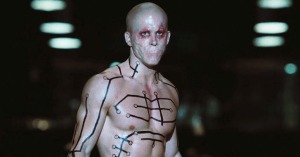 Wolverine isn’t a terrible movie but it’s rather shoddy and thoroughly mediocre. I never thought I’d see this character do the beyond-cliché action movie motif of strutting in slow-mo while an explosion sizzles in the background. This is the kind of film that involves a super team standing shoulder-to-shoulder to walk down like they’re from The Right Stuff. This is the kind of movie that opens with a needless family squabble about Logan finding out the pointless identity of his real father. What was that about? (After killing his father, I remarked to myself, “I guess that he gets that whole healin’ thing from his mother’s side of the family.”) This is the kind of movie that hires Ryan Reynolds and then disarms the man of his greatest asset, his smart mouth. This is the kind of movie that theorizes the only thing to kill an adamantium-skeleton man is with an adamantium bullet, like a sort of werewolf. This is the kind of movie that sends a super assassin, with super bullet-bending powers, out to kill Wolverine but does not arm the super assassin with those special adamantium bullets. Why not shoot this guy in the eye? That is an open body cavity. This is the type of movie where the final super villain is controlled by, get this, key commands like “Engage.” This is the kind of movie where an assortment of characters refrain from killing super bad murderers out of the morally pretentious idea that they, too, would be no different from the super bad murderers. Excuse me, executing super bad murderers would be doing the world a favor here. This is the type of movie that fills the running time with pained dialogue like, “You wanted the animal, you got him,” and, “Nobody gets to kill you but me,” and the best line of them all: “I thought you were the Moon and I was your Wolverine. Turns out you’re the Trickster and I’m just the fool who got played.” Top that, screenwriters.
Whatever the budget was for this movie, well, apparently it wasn’t enough. The adamantium effects looked perfectly reasonable in the first X-Men film and that was nine years ago, so I cannot understand why the claws look astoundingly fake this go-round. They look like direct animation, like Wolverine is holding cartoon claws a la Who Framed Roger Rabbit? When did they become so thick too? These claws are like the size of the steak knives you get at restaurants.
Jackman deserves some of the blame here since he is listed as a producer and he hand selected director Gavin Hood (Tsotsi, Rendition) who does not have the interest or the eye for this kind of material. Hood lacks the finesse and vision to stage exciting action sequences, which explains why he falls back on tired genre tropes like the slow-mo strut in front of fireballs. I am dead certain that this stupid super assassin was pushed into the movie after film producers saw how much money the bullet-curving Wanted made the previous summer. The movie borrows heavily from recent Marvel Origin comics, or so I’m told, which is where the whole “Wolverine through the ages” storyline comes from. Personally, I don’t much care for the idea that Wolverine’s healing ability also deters aging until you hit that agreeable, desirable Hugh Jackman age range, but fine, whatever. The movie takes great effort to showcase Jackman’s flawless physique, and this dude is ripped to the point that you can see bulging veins. I just wished Jackman made more use of his acting muscles in this movie. He snarls and glares, and even has a softer moment or two with Collins, but rarely does Wolverine get to prove why he is such a beloved comics character.
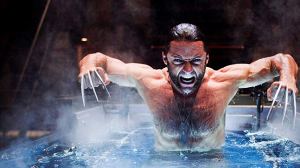 Thank goodness for Liev Schreiber (who actually also co-starred with Jackman in the forgettable romantic comedy, Kate & Leopold) because this man entertained me from start to finish, which is more than I can say about his movie. Schreiber has fun with his role and totally buys into the character’s animal instincts. He relishes the kill. The bizarre sibling rivalry between he and Wolverine is the best part of the movie, and the interplay between the two actors is when the movie has its few moments of life. Like Watchmen, the film finds its creative peak during the opening credits, as we watch Jackman and Schreiber claw and bite their way through American battlefields.
Here’s an easy solution to the Wolverine amnesia issue that doesn’t involve the use of admantium bullets. Kayla (Silverfox) has the power of hypnosis through touch, so why not in the emotional climax have her touch her dear lover Wolverine and wish, “Forget me. Forget all about me.” There, problem solved, and this way it works emotionally and organically with the story. It took me an hour after seeing X-Men Origins: Wolverine to come up with a better ending, so just imagine what more time will allow. Jackman and company are lost thanks to a mediocre script that sacrifices character for action beats, and even then the action is fairly mundane. There are a handful of cool moments, like Wolverine propelling himself onto a helicopter from an exploding car, but after four movies nothing has come close to producing the adrenaline rush that was the X-Men 2 sequence where Logan unleashes his berserker rage on the commandos in the mansion. By the end of his first solo outing, Wolverine is left without any memory. I won’t say we should all be so lucky but the X-Men filmmakers would be better off paying little attention to this origin tale, unless they want to bring Schreiber back, which they should do at all costs.
Nate’s Grade: C
Share this:

Hannibal Rising (2007)
 People love a good villain, and is there any greater villain in modern movies than Hannibal Lector? The flesh-eating, etiquette-minded fiend was most memorably portrayed by Anthony Hopkins in the Oscar-winning Silence of the Lambs. Even though he was only in the film for a whopping 16 minutes (the shortest screen time ever for a Best Actor), Hopkins stole every second. The character has resurfaced in additional movies like 2001’s Hannibal and 2002’s Red Dragon.
The history behind Hannibal Rising is that long-time film producer Dino Di Laurentiis owns the rights to the Hannibal character and essentially told author Thomas Harris, the man behind every Hannibal book, that he was making another movie starring America’s favorite cannibal, and it was going to be a prequel set amidst his boyhood days, and he was going to do it with or without Harris. With a proverbial gun pointed at his head, Harris decided if anyone is going to ruin his character it might as well be himself. He simultaneously wrote a new Hannibal book and a screenplay for it, both tied to be released within a few short months of each other. The results are about what you would expect for an artistic venture born from people wanting more money.
 Hannibal Lector is a young kid living in Latvia. His family even has an ancestral castle but this doesn’t matter because it’s 1944 and the Germans and Russians are going at it. His father and mother are mowed down by gunfire as his family flees to a cottage in the woods for protection. Sadly, this will not be the worst thing that happens to Hannibal. A group of deserted soldiers, led by Grutas (Rhys Ifans), finds the cottage and takes refuge in it, hiding from their superiors, the ongoing battles, and the viciously cold winter. Long story short: there’s nothing to eat and the soldiers kill and eat Hannibal’s sister to survive. Flash forward to 1956, and Hannibal (Gaspard Ulliel) is a rebellious Stalinist youth. He escapes his boarding school and heads out to France to find his aunt, Lady Murasaki (Gong Li). She teaches him about the ways of the samurai and sharpens his fighting skills, because that’s what Asian people do in Hollywood movies. Hannibal is haunted by nightmares of his sister’s murder and his inability to protect her. He vows to find the current whereabouts of the men who took her from him and exact bloody revenge.
I guess when you get down to it I never needed to know the back-story to Hannibal Lector. He was such a dominating, frightening, and fascinating presence in Silence of the Lambs, someone who could worm his way inside your head and download everything he needed to know to exploit you. And yet, the man still adhered to his own set of standards, as Clarice remarked that he only ate the “rude.” He’s like a kinky literary professor. In 2005, Hannibal Lector was declared by the American Film Institute as the greatest film villain . . . ever. What I’m trying to get at is that no explanation for what made Hannibal into the demented figure he is would ever be satisfying. I don’t need to know why Hannibal is how he is, just as I didn’t need to know why Willy Wonka is; they just are. There’s also a logistical quirk: because we know this is a prequel, it means Hannibal Lector is never in any danger. He has to survive to populate more books and movies. Hannibal Rising was doomed to fail the second anxious studio execs got dollar signs in their eyes.
The film really drops the ball by turning the most unique villain in modern literature into a mere creepy kid out for vengeance. Hannibal Rising is a gloomy revenge flick dressed up to feel more astute and highbrow, but it’s nothing but a run at Charles Bronson Death Wish territory. Hannibal tracks down his sister’s killers one by one and plots his bloody revenge, and with each death the film seems to deflate. The character is given a stable of psychological devices you’d find in trashy serial killer page-turners. The fact that he remains moderately sympathetic is a testament our warm feelings for a guy that eats people. Hannibal Rising also ducks risky territory by making the marked men bastards even 10-something years later. They’re either corrupt authority figures or petty criminals; Grutas even runs a houseboat that he cycles sex slaves in and out of. Splendid. Now, it would be truly daring if the film had the courage to show these men as people trying to do right in the world, continually haunted by the choices they made to survive. That would call into question the nature of violence and forgiveness. The film even hints that Hannibal might have unknowingly eaten his sister as well. The psychological ramifications of that could be really interesting. But no, that’s too much, so what we get are a bunch of sneering stock baddies for Hannibal to systematically pick off.
 Hannibal Rising shows its agenda with one very telling scene. When young Hannibal is living with his aunt he scours through her collection of samurai art. Then one mask catches his attention and he places it against his face, and wouldn’t you know it, the mask looks very similar to the one he will eventually wear like 40 years later. Why even include this scene? In 1991’s Silence of the Lambs, Hannibal wore this famous mask for all of one scene. The filmmakers are tipping their hat at what we know with Hannibal; the film is more concerned with reminding us about our memories of a character off screen than the one that’s in the story.
Despite all these failings, Hannibal Rising still manages to be passably entertaining. I credit director Peter Webber (Girl with Pearl Earring) and actor Gaspard Ulliel. Webber keeps the pacing light for a two-hour movie and adds a fine Gothic feel with a crisp, autumn look. He tries hard to bring some art to an overly glorified revenge flick. Ulliel (A Very Long Engagement) is something of a minor revelation. He digs deep into his character and finds a perverse pleasure in his portrayal of the cinema icon. He’s scary and weird but manages to still be grossly entertaining even when he’s doing gross things. It’s the sheer power of his performance that makes the film worth watching. I didn’t see this coming from the cute, boyish lovesick kid from Engagement, but Ulliel creates a clockwork-like performance of sinister eeriness. When he glares, his eyes burning with sharp intensity, he has this little dimple on one side of his face, like a permanent mark from evil grinning. He has a terrific look to him and I’d dare say there would be plenty of surprised moviegoers that find themselves thinking Hannibal Lector is a tad sexy. Hopefully Ulliel is destined for better things after mastering English so well, something his Engagement co-star seems to still be struggling with in American movies.
There really is no reason for this movie to exist. It’s not bad by any means, it’s just entirely unnecessary. It’s passably entertaining and has some grisly gore to it but much of it is pure genre. I’m more interested with the older, wiser Hannibal than this young pup. In the pursuit of the almighty dollar, Hannibal Rising sure wants to be a tasty dish. The problem is that this dish has already gone cold.
Nate’s Grade: C
Share this:

Star Wars: Revenge of the Sith (2005)
 I was in Dublin, Ireland of all places when I saw Star Wars Episode III: Revenge of the Sith. I was enticed to get off my sick bed and see George Lucas’ final Star Wars installment. As a kid I loved the original trilogy. My expectations were piqued by the promise that Revenge of the Sith would be bigger, badder, and suitably darker than any previous Star Wars installment. It did get the series’ first PG-13 rating and a stern warning to parents from Lucas for nothing. I had equal hopes for the other two prequels, 1999’s The Phantom Menace and 2002’s Attack of the Clones, but said hopes were dashed upon actually watching the movies. This was the last film and I had my fingers crossed ole George would finally get it right.
It’s now several years into the war between the Galactic Republic and the separatists led by General Grievous, leader of the droid army. Anakin (Hayden Christenson) and Obi-Wan (Ewan McGreggor) fight for the Republic and the chancellor of the Senate, Palpatine (Ian McDiarmid). Anakin is having nightmare that his secret wife Amidala (Natalie Portman) will die in childbirth. He seeks out a way to save her and is tempted by certain promises by shadowy figures that the dark side of the force can restore life. From there things are set into motion that turn the Republic into an evil Empire, the Jedi into a near extinct band of warriors, and Anakin into the iconic Darth Vader.
My friend Josh Browning brought up the idea that Star Wars would be so much cooler without George Lucas. I gave this idea some thought and have come to the same conclusion. Can anyone ever say “no” to the Jedi master in plaid? Directing flaws aside, where Lucas really needs assistance is his writing. The biggest qualms I’ve had with the new set of Star Wars, horrible acting aside, is how unforgivably boring they are and the tepid romance. The original Star Wars were about action, adventure, and things that mattered. The prequel set has been mostly about trade, taxation, Senatorial control, and separatists. The majority of the prequels have been sleep-inducing and riddled with pacing issues.
 In an Entertainment Weekly interview, Lucas said 60% of his prequel story was related to the final film. With some quick calculations, that means that there was 20% plot in The Phantom Menace and the remaining 20% in Attack of the Clones. No wonder nothing seemed to be going on! This also creates the problem of Sith having far too much plot to deal with in too short of a reasonable time frame. Things feel left out or not fully explained, like why the hell does General Grievous have a cold? I know I’m missing something but it’s lazy filmmaking to make an audience do extra homework to flesh out your storytelling.
As stated, my other main gripe was the half-baked romance Lucas had between Anakin and Amidala. In Attack of the Clones, the romance is spontaneous. He hasn’t seen her in like 10 years and now they’re instantly smitten? There is no beginning to this romance, no nurturing, no progress. The romantic troubles are worsened by Lucas’ disinterested writing. Lucas cannot write dialogue to save his life. Romantic bon mots like “Hold me like you did at the lake” and “I’ve been dying a little bit day by day, ever since you reentered my life” will not exactly stoke a fire in your loins. Plus Portman and Christenson have as absolutely no chemistry.
Now, the reason I’ve reviewed the romance from Attack of the Clones is because it serves as the linchpin for why Anakin goes bad and becomes Darth Vader. It’s a mighty big question about what turned Anakin from man into one bad mutha, and his quest to save his wife is a satisfyingly plausible answer. But the transition doesn’t have near the punch Lucas intends because of his weak romance he’s penned. Lucas’s shortcomings as a writer finally pull the rug out from Anakin’s big moment.
The acting is another weakness. True, the acting hasn’t always been the top priority with any Star Wars film, but these prequels have shown that Lucas would rather stand behind a computer than in front of an actor. Portman has generally seemed bored and lacks any interest in hiding it. In Attack of the Clones she seemed sedated. In Revenge of the Sith she gets to cry a bunch. In Lucas land, that’s seen as character development.
 I thought Anakin could not get any more annoying than Jake Lloyd’s awful “yippee”-filled run in Menace, but I’m starting to reconsider this. Anakin mopes around and when he gets upset he whines in a falsetto voice. I will say Christenson was rather good in Shattered Glass where his arrested development acting techniques expertly channeled the manipulative Stephen Glass (if you do have a choice, go rent Shattered Glass). But in the more operatic Star Wars world, Christenson routinely comes off like a kid playing dress-up. Even after he’s gone full evil and growls and screams and glares, he comes off like nothing more than a poodle trying to be a guard dog. Of course neither performer is helped any by Lucas’ absentee directing style with actors.
The only members of the Star Wars prequels that will walk away unblemished are Ewan McGreggor and Ian McDiarmid. McGreggor has got the Alec Guinness voice down and proves to be a capable and dignified leading hero. McDiarmid has a juicer role than Anakin and really relishes his villainy.
Sith is the best of the three Star Wars prequels but that isn’t saying a whole lot. Whereas Menace and Clones were boring, Sith is just kind of slow and okay. It’s an improvement but the bar wasn’t exactly set very high. The formula is about the same: the first two acts are again quite plodding and then Lucas unleashes a torrent of action to close out his film. Sith does break apart because, surprise, things actually happen and they actually matter. After about six hours of buildup, actions meet consequences, characters meet their demise, and our boy wonder becomes the dark Jedi. People have been waiting decades for these moments and when they arrive they hit like a thunder bolt. Most of the time at least.
 The special effects are uniformly fantastic, which has never been an issue for Lucas. Yoda moves and emotes fantastically, actually besting some of his flesh and blood thespians. The interaction of live elements and CGI seems improved. Planets are rendered beautifully and the lava world is simply visually stunning and just plain cool.
The action is exciting but a bit overly edited in light saber battles. As we march into Act Three, there’s a terrific sense of climax with Yoda going off to battle Palpatine and Obi-Wan knowing he must put down Anakin. At long last I felt jolts, shivers, and goose bumps at what was to come. The concluding half of Sith is great rollicking entertainment and visually luxurious to watch. See George, light saber duels and character deaths are far more entertaining than trade disputes and embargo talk. The excitement’s back in the Star Wars franchise but it’s a shame it had to only appear this close to the finish line.
The final chapter on the Star Wars universe is closed. Well, for now. The lure of mountains of cash will probably ensure we haven’t seen the last of some of these beloved characters. Revenge of the Sith is a moderately satisfying closing episode to the Star Wars saga. The film still is an exhibition of Lucas’ filmmaking flaws (writing, pacing, his handling of actors) but Sith finally reaches the excitement and grandeur the original Star Wars had. My Dublin theater was roaring, clapping, yelling and screaming throughout. And for the first time during the prequels, so was I for awhile. And you know what the absolute best part was? Not one single word from Jar-Jar Binks!
Nate’s Grade: B-


 nathanzoebl
You must be logged in to post a comment.