Blog Archives
The Conjuring (2013)
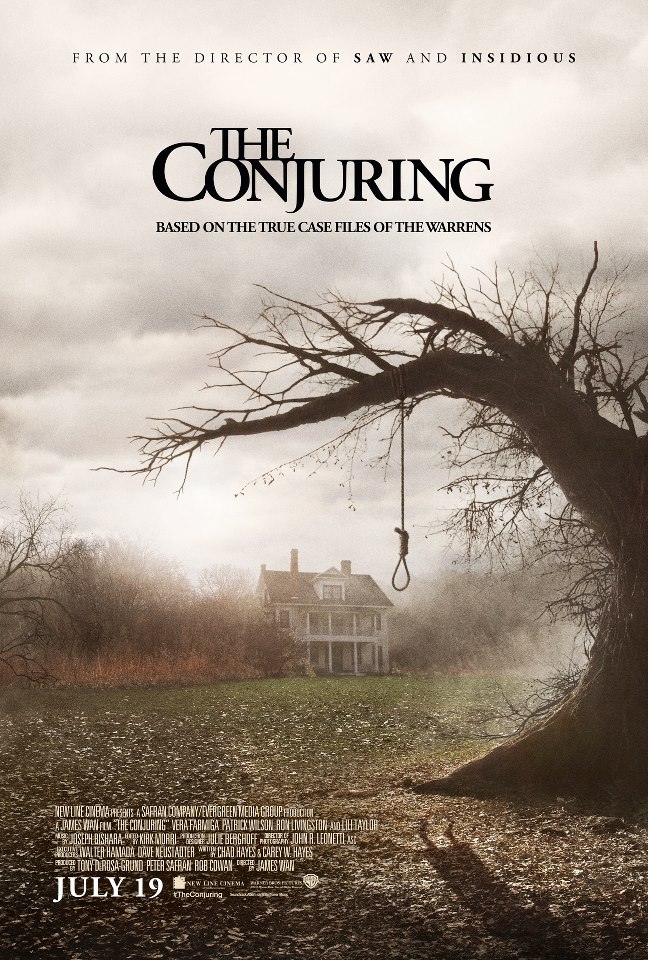 Does it seem like it’s getting harder and harder to scare people? Perhaps audiences have grown jaded by a real world kept at a fever pitch of post-9/11 anxiety and economic uncertainty. It seems that one solution is to just up the gore/gross factor, or overdose on grisly nihilism, but there has to be a law of diminishing returns to pointless shock value. The core elements of a good scary movie will usually be the same: make us care about the people onscreen and make us dread what happens next. What The Conjuring does so well, almost effortlessly, is what all provocative horror movies should accomplish, and that’s the formation of a truly effective spooky atmosphere. There may not even be any gore whatsoever in this film and very minimal jump scares, two overused tools in modern horror filmmaking. This is old school horror played to spine-tingling satisfaction.
Ed and Lorraine Warren (Patrick Wilson and Vera Farmiga) are the top paranormal investigators in the nation. In 1971, they’re asked to determine what is tormenting the Perron family in rural Rhode Island. Carolyn (Lily Taylor) and Roger Perron (Ron Livingston) and their five daughters cannot rest as a vengeful spirit is wrecking havoc with their lives. The spirit wants a body count and won’t go away before it has blood.
 Director James Wan (Saw) and his team take their time to build a direct sense of unease, a chilling mood that leaves you dreading what may happen next. The success of a horror film isn’t necessarily the fear of what you see but more so what you fail to see. The buildup, in essence, is more pivotal than the boo part. Credit also needs to go to twin screenwriters Chad and Carey Hayes (Whiteout, House of Wax) who show off their skill at setting up scares and delivering (I credit their work on Baywatch Nights because, well, someone has to remember that spin-off). The child game of Hide and Clap, where one person wanders blindfolded trying to find their compatriots, requesting three claps to locate them, is just a flat-out terrific idea to parlay into a horror movie. There’s the staple of dramatic irony, realizing what the onscreen character does not, and the increasingly suspenseful dredge into unknown danger. Another example is a wind-up toy that, when its jingle is complete, should reveal something ghostly in its mirror. This is a great device that delivers tension in budding anticipation. Then there’s one daughter’s habit of sleepwalking, which again leads to some effective unease. The Hayes find smart ways to introduce elements to their ghost story and then integrate them again and again in satisfying and spooky ways. Plus there’s all those groping in the dark moments and a super effective sound design. The film does an excellent job of developing old school scares, taking its time to get under your skin.
It also helps when you actually care about the character being tormented. The Conjuring does a good job of making its characters relatable given the outlandish circumstances. At no point does any character really violate the Law of Stupidity, where our allegiance reverses. They even present plausible reasons why the family can’t simply move out of its haunted abode (financially under water, no one to buy the estate, the ghost will just follow them). The Perron clan is a loving family that feels real. The Warrens themselves are given their own vulnerability, which is important since they are the experts. Having a know-it-all character without a weakness doesn’t make for an interesting battle against the paranormal. Lorraine can sense things, yes, but she also loses part of herself every time, thus endangering herself with every new case, making herself more susceptible to the forces she feels she’s been chosen to defend others from. When Lorraine accidentally leaves behind a family locket, with a picture of her daughter, it brings an escalated threat level that hits home for the Warrens. The acting form top to bottom is also exceptional. They don’t oversell the scares. You feel their fear in a palpable way.
Another aspect of a haunting story is the mystery surrounding the angry spirit. If it’s a compelling investigation, you’re intrigued by every new clue or revelation and enjoy how the pieces come together. While there isn’t a complex backstory to the haunting of the Perron home, The Conjuring has enough creepy historical details to add to the overall atmosphere. I enjoyed that the evil spirit cursed anyone who lived on her property, eventually divided up into different owners. I liked that the spirit had a mother-child fixation, turning mothers against their children. And I liked that these peripheral ghosts, many of whom killed themselves in ghastly fashions, also pop up to terrorize the Perrons. It adds further depth to the world of the film while upping the spooky factor.
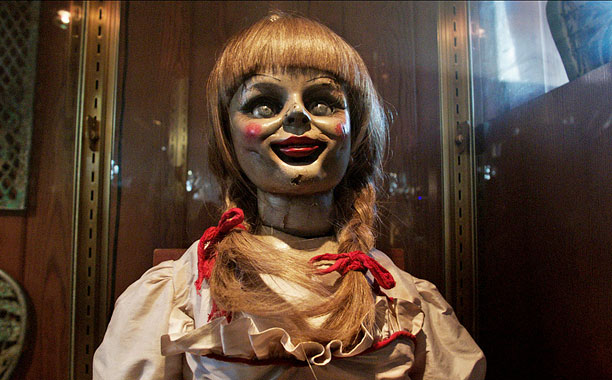 I need to single out one section of the plot that was eerie but also a bit confounding. The opening case doesn’t have anything to do with the Perron family but it does set a nice mood. It’s about a cracked, fraying, and altogether creepy porcelain doll that appears to be possessed and leaving notes for its roommates (“Miss me?”). We later see this creepy doll again because the Warrens have an entire garage filled with creepy artifacts from previous investigations. They argue destroying the possessed items because it would unleash all those demonic forces, so instead the garage serves as a sort of prison (a priest comes by every so often to re-bless the premises, which sounds like a nice side gig for the Vatican). I’ll accept the Warrens reasoning that locking away these dangerous items, each with its own troubling story, is safer for mankind. It’s also just a great set that begs for further analysis to pick apart every artifact. What I do not understand at all is that it looks like the Warrens have no protective lock with this door. Their young daughter stumbles in at one point. I don’t want to give anybody parenting tips, but if you have a room stocked with demonically possessed items that can escape, perhaps, I don’t know, you get a padlock for that door to safeguard against unwanted intrusions.
While entertaining to the end, the third act doesn’t have the same effect because it transitions wholly from a haunted house story into an overt exorcism film. For my tastes, it’s less interesting and exorcism films have always come across as fairly lazy for me. Once you bring a demonic possession and a set of familiar rules, it sort of goes on autopilot and rarely strays from the same template as the most famous of exorcism movies (Naturally I’m talking about Repossessed). For fans of that horror subgenre, they’ll be tickled, but I found it a lesser way to steer the movie to its conclusion. I realize that we’re dealing with the parameters of a personal account (I’m hesitant to say “true story” when it comes to paranormal events, but that’s my own bias), so I understand that this is the direction the story must conclude. I just thought it was a slight downgrade.
If you’re looking for a scary movie this summer, then The Conjuring will do the trick. It’s an old school horror movie that’s more concerned with properly established atmosphere, a mood of dread, and paying off well-developed plot elements that pack a punch. The best compliment I can give Wan, the Hayes, and everyone else involved is that I was squirming throughout much of the movie, uneasily shifting and dreading what was next. There’s a maturity to the film and Wan’s direction, as if he’s patterned his style after the films of the 1970s themselves. After Insidious, Wan definitely knows a thing or two about keeping an audience afraid. There are several moments of unsettling imagery that should find a way to creep out just about everyone. Just remember: don’t invite dolls to live with you, do investigate those strange bruises, and always lock up your demonic possessions, people. In short, The Conjuring doesn’t reinvent the wheel when it comes to ghost stories but it doesn’t have to, because this movie is scary good.
Nate’s Grade: B+
Share this:

Anna Karenina (2012)
 I’ve never read a Russian novel before, mostly because I don’t need to read 900 pages of bleakness and repressed happiness. With that said, I knew very little going into Anna Karenina (the very title sounds too heavy in syllables, like you’re stuttering). What didn’t help matters was director Joe Wright’s edict to set the story as if it was being performed on a living stage. This bizarre visual concept is interesting for a little while until you realize that it never goes further than the obvious note that the lives of the elites were played out in public for cruel judgment. The staging also gave me many periods of confusion where it felt like a character fantasy was taking place. The peculiar staging seems superfluous and the real draw for the film, not the relatively fine performances or Tom Stoppard’s (Shakespeare in Love) adaptation. I don’t think it works as a movie because, much like Wright’s Atonement, it feels too self-satisfied in its own mannered artifice. It’s an overload on style and the film neglects to give me a reason to care about the story and the characters. Keira Knightley as the titular heroine is hard to embrace, Aaron Taylor-Johnson (Savages) seems miscast as her dashing lover, and Jude Law (Hugo) comes across as unreasonably tolerable of his wife’s flights of fancy, so much so it makes it hard to sympathize with her downward spiral. It’s a pretty movie and I applaud its attempt to do something different, but Wright’s Anna Karenina feels too fanciful to come across as tragic.
Nate’s Grade: B-
Share this:

Hysteria (2012)
 The birth of the vibrator doesn’t seem like a tale that demands telling until you realize that the most prolific sex toy of all time started during one of the most sexually repressive cultures, Victorian England. In 1880, the plague of the era was a malady known as “hysteria.” Half the women in London seemed to suffer from this condition where, as the doctors of the times believed, a woman’s uterus had become unaligned and needed to be properly readjusted; the readjustment produced a “paroxysm” of relief. To treat hysteria, these trained professionals would oil their hands, insert them inside a woman’s vaginal canal, and apply alternating pressure. They were getting these women off. Hysteria presents a charming document about the invention of the vibrator, a miracle of modern science. However, I wish the movie had taken a more mature approach to the material.
The alignment process was an arduous one, and Dr. Robert Dalrymple (Jonathan Pryce) needs a new set of hands. Enter Mortimer Granville (Hugh Dancy), a crusading young doctor who butts heads with the medical establishment over things like washing hands and germs. Under Dr. Dalrymple’s tutelage, the practice is never busier, relieving upper class women of hysteria. It’s going so well that Dr. Dalrymple would like to eventually pass the practice on to his young protégé, as well as his proper young daughter, Emily (Felicity Jones). Then there’s the doctor’s other daughter, Charlotte (Maggie Gyllenhaal), who clashes with authority, is outspoken about women’s suffrage, is critical of the limited role women play in society, and devotes her time to a lower-class shelter to provide refuge and education to those in need. She represents a brand-new kind of woman in time, and Mortimer cannot get a handle on her. Mort is suffering some pretty serious hand cramps from his line of work when he gets a splendid idea from his childhood friend and amateur inventor, Edmund St. John-Smythe (Rupert Everett). It seems with a quick fix, the electric feather duster may have other more scandalous uses.
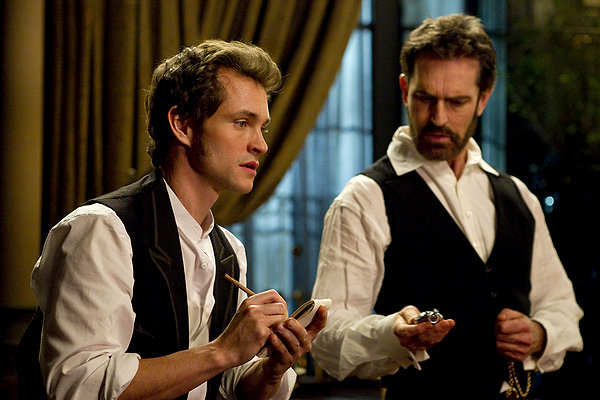 Hysteria is short of being hysterical but it’s certainly charming and provides an interesting history lesson with a light touch. The very nature of women’s hysteria is a fascinating moment in history where men were bending over backwards to find medical assessments for what is, in essence, horniness. The fact that these women’s doctors were getting carpal tunnel from all the manually stimulation of their clients has got to be one of the strangest workplace hazards. In certain regards, the invention of the vibrator has saved lives, or at least the hands of medial practitioners. It’s probably also made a whole lot of women a whole lot happier. Feminine sexuality was just an obtuse concept to the well-educated men in charge. One character says, with absolute certainty, that women cannot achieve sexual pleasure unless through insertion. As another fun historical note of male ignorance when it comes to female anatomy, when Deep Throat was being banned in the U.S., the federal judge who deemed it obscene cited, in his writing, that one of the many dangers of the provocative flesh film was that it mistakenly exposed women to the idea of an orgasm without insertion. This is almost 100 years later and yet men in high places of power are still carrying on complete ignorance of something they very literally know very little about. In that regard, Hysteria is jolly fun as we watch women get their jollies. There’s always something fun about watching uptight characters cut loose, especially when they find pleasure that has been denied them.
Having a talented cast is also a benefit when you’re working in comedy. Dancy (Adam) plays our straight man with fine properness. He has a few moments where he gets to delightfully squirm thanks to bold women and bold topics. He’s got some solid chemistry with Gyllenhaal (Crazy Heart), who is the feisty spitfire we expect in this sort of movie. Gyllenhaal is charming without being obnoxious, and her English accent is impeccable. Pryce (G.I. Joe: Rise of Cobra) and Jones (Like Crazy) are funny in their understated, stuffy British formal way, while Everett (Stardust) provides a great comedic jolt as the self-possessed, blithe technophile, ready at a moment’s notice for a good wisecrack. Sheridan Smith (How to Stop Being a Loser) also deserves special mention as a maid who was formerly employed as a prostitute. Her randiness is a nice counterpoint to all that Victorian repression and she pushes the movie further into sex farce.
While amusing, I wish the filmmakers would have taken a, dare I say it, more mature approach to a very interesting subject of history. The structure and very aim of the movie is that of a typical romantic comedy, which is a shame given the atypical subject matter. It’s pretty much a romantic comedy transplanted to merry old England. Much of the humor of the movie is divided into two camps: 1) watching the uptight Victorian-era Brits cut loose with decorum, or, 2) self-aware humor about the ignorance of the age. The first is always fun since we’re watching people sneak their true feelings through the wall of social repression. Director Tanya Wexler makes sue of a lot of sight gags and heartily enjoys cutaway reaction shots of ladies going orgasmic. It’s enjoyable but the fact that Wexler has to keep going back to the reaction shots for jokes, it loses its effect. Then there’s the self-aware humor built entirely upon dramatic irony, where the writers tweak the knowledge of a bygone era with all of our clever foresight: “Oh those stupid Victorians, not believing in things like germs and female orgasms.” After a while, the self-aware humor becomes tiresome. We get it; these silly Brits did not understand female health and proceeded to rule in their ignorance. I wish the movie left behind the easy jokes for some stronger social commentary. To this very day, we have men legislating women’s bodies and their reproductive rights (see: Oklahoma saying life begins weeks before conception, or Virginia demands medically-unnecessary vaginal probes for no other purpose than to shame women, and so so much more…). Ignorance knows no end, and one imagines the rom-com that makes fun of our current social mores and understanding.
 It’s during the last act where Hysteria really starts to come apart at the seams. Beforehand, it’s been a fairly light comedy with some punctuations of commentary from Charlotte and her idealistic desire for equality. But then, and spoilers will follow, the movie suddenly transforms into a courtroom drama with Charlotte on trial. Her very mental health is on trial and if she’s found to be a hopeless case of incurable hysteria, then she’ll be shipped to a sanitarium and have her uterus forcibly removed. Wow. That is some heavy stuff for a movie that spent an hour making sex jokes. The courtroom setting leads to some pretty transparent speechifying; any subtlety goes out the window and we listen to messages about women’s suffrage, equality, and empathy. This conclusion feels like it was ripped from another movie. It’s tonally jarring. Then, after our lead takes his moral stand and confesses to his belief that there is no such thing as hysteria, that women are just stuck in sexually unfulfilling relationships in a sexually repressed age, everyone goes home to think about life. Then, thirty days later when Charlotte gets out of prison, she’s met by Mortimer where he, I kid you not, proposes to her on the spot. For a movie about breaking misconceptions about women, tying things up with a marriage proposal seems almost hypocritical. It also marks a pretty big leap in the burgeoning romantic relationship between Charlotte and Mort. It seems rushed and a strange way to end a movie about female empowerment. The rom-com elements have won out over any higher messages.
Hysteria starts strong but goes limp. Hysteria runs out of juice. Hysteria is a pleasant experience but doesn’t deliver a proper climax. Hysteria is not the feel-good movie of the year. The very nature of the movie lends itself to all sorts of innuenduous critical blurbs. It’s a rom-com transplanted to Victorian England and I wish that it tried a little harder with the material rather than settling for easy jokes relying upon the ignorance of the age. The cast is superb and the movie is certainly fun, but it falls apart in the end when the messages overtake the narrative. So what is the best Hysteria blurb? I’ve had better.
Nate’s Grade: B-
Share this:

The Three Musketeers (2011)
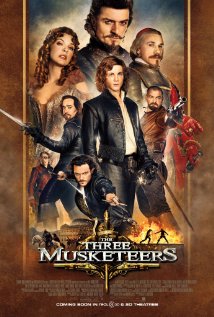 I suppose I should have known better seeing director Paul W.S. Anderson’s name attached to the loose adaptation of The Three Musketeers. From the previews, I thought that the film could perhaps settle on an enjoyable level of stupidity, something of a wink while it obliterates all fidelity to Alexander Dumas source material. Well, the movie sure is stupid but it’s far from enjoyable. This swashbuckling-on-steroids flick has got 17th century zeppelin-battleships, booby-trapped secret passages, and a confluence of English accents in France, but by far the dumbest part of this incredibly dumb movie is that war (or the “looming apocalypse”) rests entirely upon a diamond necklace. A ludicrous amount of the movie’s conflict rests on getting the Queen of France her stolen necklace back so that her husband doesn’t think she’s unfaithful. Instead of two people just having a conversation to clear up a misunderstanding, the movie pushes this marital conflict as the climactic push that will lead to global war. The action sequences are dull and none of the actors seem to be successful at faking enthusiasm. What does it say that Anderson rips off his own Resident Evil series as he concludes Musketeers, setting up a sequel that surely will never exist? This movie is bereft of any whiff of fun even with all its fantastical elements crashing through classic literature. It had a slight chance of being the right kind of stupid, but instead it’s just stupid times a thousand. Beware, canonical literature, because as long as Anderson lives none of you are safe.
Nate’s Grade: D+
Share this:

The Raven (2012)

When “The Raven” was released in 1845, it was a literary sensation. I can’t say that the 2012 movie of the same name will be met with anywhere near the devoted fanfare. Edgar Allan Poe (John Cusack) has become embroiled in a deadly criminal investigation. The famous author is penniless, drunk, and depressed, but what else is new? What is new is that some Poe admirer has been stalking Baltimore and killing people in grisly styles fashioned after Poe’s macabre stories and poems. Detective Fields (Luke Evans) recognizes the connection to Poe and enlists the author to aid in capturing the murderer. Poe’s upper-class love, Emily Hamilton (Alice Eve), is captured by the unknown madman and buried alive. Poe must race against time to stop a killer, rescue the girl, and write a new horror-themed story to be published via the killer’s demands.
The Raven feels like an ill fit from the start. What is the point of featuring an American literary icon when all you’re going to do is plop the man into a pretty rote police procedural/serial killer thriller? The deadly flaw of The Raven isn’t its concept; it’s that the finished product didn’t embrace the particulars of its literary mash-up enough. Is it really a good use of Poe to just have him tag along on a police investigation? I wanted this premise to crackle with a devious slyness, a cleverness of genre and concept that the movie seems incapable of producing. You’re taking America’s singular literary voice of the Gothic and macabre and putting him into a game with a deranged fan. That’s a great start. I’m interested in that movie. But there needs to be some follow-through. This should be a battle of wits, an opportunity for Poe to backslide into the murky chasm of his own creations, bearing some pinning of guilt at having birthed a mad killer with the power of his words and imagination. This should be a psychological descent into hell for a man already famously tortured. Instead, the movie just becomes another rote serial killer movie but somebody typed in the name “Poe.” The various corpses, inspired by Poe’s works, just end up being gory, easily telegraphed deposits for clues. We don’t see these people in peril, terrified by the fiendish ye olde Saw-like death traps. We don’t even understand the process of the killer. The movie just ends up becoming one long, tiresome chase from dead body to next dead body, with Poe literary association haphazardly ladled in to tie stuff together. After a while, it feels like somebody took a thoroughly uninspiring serial killer script and just transported it into mid 19th century America. It’s nice to know that some clichés are timeless.
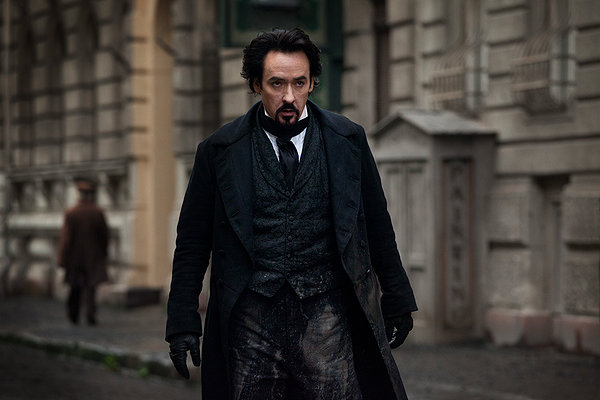 The movie never feels like it works properly, and the potential of its premise is completely unrealized. The murder mystery isn’t really ever given suitable footing to be a mystery, except in that tried-and-true “who’s going to be the bad guy” reveal. There aren’t really any clues left behind. So when characters suddenly come up with epiphanies on their murder investigation, you wish they would at least show their work. For a movie written by screenwriters with names like Ben Livingston and Hannah Shakespeare, The Raven certainly isn’t smart. The Poe stories feel tacked on in an arbitrary fashion instead of being interwoven into foundational elements of the story. Who cares how the characters die if their deaths have no impact on Poe or anyone else? The “how” of the equation becomes inconsequential. The title poem doesn’t even bear any weight on the story. The love interest/damsel in distress character is so bland and underwritten, that it’s hard to really feel Poe’s gnawing sense of urgency. Sidling the gloomy Gus Poe with a puppy-dog love story seems like a poor misunderstanding of the man and his demons. To top it off, the girl isn’t even his cousin (surely the oddest criticism of mine thrown at a movie)!
The movie doesn’t really ever become a convincing thriller either. The pulpier elements are ignored or downplayed, played with stodgy seriousness for a movie this ridiculous (Saw-style death traps in 1849?). Director James McTeigue (V for Vendetta), who after this and 2009’s Ninja Assassin is starting to look like a one-hit wonder, badly misplays the action elements. The dingy cinematography is unnaturally dark, making it exceedingly difficult to understand certain sequences and giving the audience yet another reason to lose interest. The impressive production design is totally mitigated when there’s not enough light to even see it. I understand given the nature of the story that we’d be dealing with lot of shadows and darkness, but this is just one poor looking movie. The only way you’d feel excitement from this movie is if in a fit of amnesia you forgot what you were watching and suddenly thought it might be a different, better movie, only to be disappointed ten minutes later when that sinking feeling reemerges and you realize, no, I am still watching The Raven.
I love me some John Cusack (Hot Tub Time Machine), but this guy is just the wrong fit for the movie. His sensibilities never really gel with the character, so Poe’s sense of melancholy comes across as more haughty boredom. He is not the right fit for the material. Eve (She’s Out of my League) has got nothing to do but look pretty and scream occasionally. The worst crime of all is utterly wasting one of my favorite contemporary character actors, the phenomenally great Brendan Gleeson (The Guard). He plays the uptight father of Poe’s love interest, which means he gets to pop onscreen and glare at Poe while looking worried. It’s a criminal waste of this man’s considerable talents.
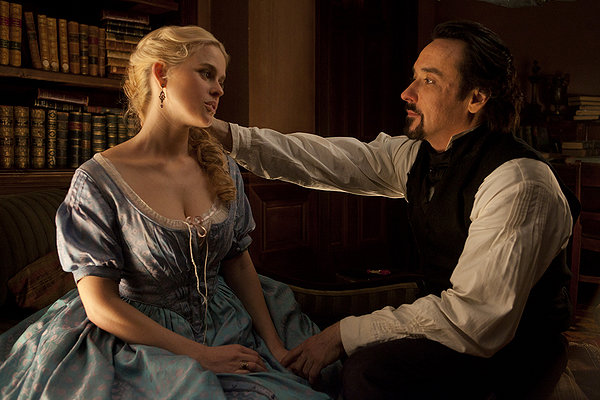 I think the best part of The Raven is actually it’s mostly unseen killer. It’s not because the guy is particularly clever or interesting or even remotely memorable (when they reveal who it is, make sure to pay attention to the constant reiteration of who he is, because if you’re like me, you plum forgot). The reason this guy is good is because of his impetus. He’s ultimately terrorizing Poe so that he can force the author to create more stories. Call it an extreme case of motivation. I can see our studious killer justifying his bad behavior, claiming to give the world new gifts of literary brilliance that we can all share, stories that will last the test of time. Isn’t that worth a few dead bodies, he’d argue. Ultimately, this rationale becomes more egotistical, about flattering the killer and his devious appetites, which is a shame. I’d prefer if the bad guy were more devoted to the cause of helping to shape the Canon of transcendental literature. I almost wish that the movie were told from this skewed perspective. I could have dealt with an entire catalogue of famous authors being victimized under the auspices of producing great literature. What if this one sick person is responsible for wresting the great works of the 19th century out of the authors’ minds and onto the page? I think we all owe this terrible individual a debt of gratitude.
I’m finding myself disliking The Raven the more thought I put into it, which, admittedly, my brain is actively fighting against. It does not want to spend more time processing this bore of a movie; a fun premise never fully realized, a conflict never truly developed, and characters that are the 19th century equivalent of the stock roles you’d find in any mechanical CSI/Law & Order TV episode. So in the interest of literary fairness, I’ve decided to channel the spirit of Edgar Allan Poe for the final word on The Raven:
And The Raven, never flowing, still is going, still is going,
On the pallid screen I silently stare at in unblinking bore,
And its plot is not that smart, missing heart and clues to start,
And it seems like the writers were tasked with an unfriendly chore,
The movie does not work; it’s dull and empty to its very core,
And so I lastly ask does this movie properly entertain?
Quoth The Raven – “nevermore.”
Nate’s Grade: C
Share this:

John Carter (2012)
 John Carter has been in the longest development hell of any movie project in the history of cinema. If nothing else, that’s at least an accomplishment. Author Edgar Rice Burroughs first published his tale of interplanetary adventure in “A Princess of Mars” way back in 1912. It was his first published work, even before the phenomenon that would make him a star, Tarzan. Ever since 1931, filmmakers have been trying to realize Burroughs’ grandiose sci-fi vision but have never been able to finish. In the last decade, the movie has gone through different stages of development, with Robert Rodriguez, Kerry Conran (Sky Captain and the World of Tomorrow), and Jon Favreau attached as director at different points. Then Disney snatched up the rights and hired one of its own, Pixar director Andrew Stanton, to do what nobody has been able to do for 80 years –bring Burroughs’ vision to the big screen. It doesn’t hurt when Disney gives you a reported $250 million to spend.
John Carter (Taylor Kitsch) is a Civil War veteran haunted by his past. He’s chased by a group of bandits and stumbles into a cave that transports him to Mars, known as Barsoom to the natives. Carter discovers that he’s found himself in the middle of another civil war, this time between the cities of Zodanga and Helium. The Tharks are a race of 10-foot tall four-armed warrior creatures, and their leader, Tars Tarkus (Willem Dafoe), sees Carter as the turning point in getting his people’s lands back. Carter will also help solidify Tars Tarkus’ place as leader to his people. John Carter is a coveted free agent on the red planet. Princess Dejah Thoris (Lynn Collins) wants John to help her people survive against the Zodangans, lead by Sab Than (Dominic West). Dejah’s father (Cirian Hinds) has brokered a shaky peace on the promise that she and Sab Than will marry. The mysterious Therns, lead by Matai Shang (Mark Strong), are the real power players on Mars. They have offered a powerful new weapon known as the “ninth ray” to give Sab Than the upper hand. All John really wants to do is return home, but first he has to find a way back.
 John Carter is an amusing, entertaining throwback to old-fashioned B-movies. Even the depiction of life on Mars is charmingly retro, what a future would look like to a man from the early twentieth century perspective. As a result, the aliens fight with Bronze era weapons and guns that behave like trinkets from a Western. Even the minimalist alien design, the Roman-esque costumes, the fact that everyone can breathe air, and low-grade technology of these advanced species (flying machines that look like Da Vinci designed them) come across as nostalgic, vestiges of the past more so than insights into the future. It’s like watching those old sci-fi TV shows from the 1950s and how they predicted man would have colonized the solar system by now and already have a working lunar colony (Newt Gingrich is trying his best). The movie channels the spirit of old adventure serials and captures a certain gee-whiz, childlike sense of fun. There are moments where Stanton has a playful sense of storytelling, like a near montage of Carter’s determined escapes from officer Powell (Bryan Cranston? Why not?). While being PG-13, there is still a feeling of the Disney-fication of the tale, complete with tamer outfits for Dejah Thoris (do a Google image search) and an adorable alien “dog” sidekick that befriends John.
The best moments are easily the scenes where John integrates into the indigenous Thark tribes, finding a sense of community and a bonding with Tars Tarkas. If the movie had only featured this alien race instead of all those warring people-who-have-red-henna-tattoos-on-so-they-must-be-aliens-right, I think the movie would have succeeded better. One alien race focuses the narrative but instead we get four (three?). When our climax does come into view, the pieces have all fallen into place and the action is suitably thrilling. Stanton’s live-action debut isn’t the homerun that Brad Bird’s Mission: Impossible 4 was, but the large-scale action is satisfying and imaginative enough. The payoffs work and Stanton has nicely intertwined his storylines so that everything comes to a head. The Earthbound framing device, with Edgar Rice Burroughs (Daryl Sabara) reading the diary of his rich departed Uncle John, enriches the narrative once the full context is revealed, gearing up the audience for a long-awaited reunion to end the movie on a perfect high note.
What John Carter also has going against it is the pull of time. It’s hard not to see how derivative the story and characters are; Burroughs’ original novels were hugely influential to science fiction writers, and you can see similarities in Star Wars, Avatar, and other works. Scenes in this movie will feel like rip-offs from other movies, like an arena battle with giant alien hordes from Attack of the Clones, riling up a native alien species against its imperial antagonists in Avatar, Deja Thoris clearly has her DNA all over Princess Leia, and the dynamics of jumping through space travel via gateways made me think of how excellent a movie Stargate was (watch it again; it’s terrifically executed). Carter can easily be credited as the predecessor to superheroes. Now it’s unfair to say that John Carter rips off these other sci-fi movies when every one of them was released long after Burroughs’s novels had been widely published. It’s unfair, but you can’t help but feel the way you feel, and I was feeling a fairly resounding sense that I had seen much of this tale before and better. The actual terrain of Mars is a little less than inspiring. Its rocky vistas don’t make it feel too noticeably alien. We don’t ever really get a good view of alien culture outside of the Tharks. John Carter’s one big addition is that the character, given his physiological makeup and Mars’ gravity, can leap to impressive heights that were only previously known by Italian plumbers in video games. This means we get a lot of John Carter jumping up, jumping around, jumping like a Martian jumping bean. But just because you can jump really high, doesn’t that mean you’d be plummeting at a high rate of force? Wouldn’t John seriously break his legs leaping 500 feet in the air and then landing?
 The script, credited to Stanton, Mark Andrews (co-director of Pixar’s upcoming Brave), and Pulitzer Prize-winner Michael Chabon, is weighed down with expositional slog that it cannot break until the third act. I was expecting a better and more graceful story given Stanton’s previous film, WALL-E, which could be taught in film classes as a textbook example of elegant visual storytelling. With John Carter, it feels like we’ve been hit with the Martian phone book. We’re inundated with unfamiliar names and given scant time to adjust. While a gamble that the audience intelligence will catch up, it also makes for a confusing half of a movie. It’s hard to keep track of all the different names; Tharks this, Hellium that, Zodanga this, Jeddak that, Therns here, Barsoom there, etc. The movie doesn’t gradually expand its Martian history, it just plops us, along with Carter, right into the middle. The opening structure is also a bit confusing, as we’re jumping around time without any proper setup. Still, the movie cannot be accused of being stupid; hokey and convoluted, yes, but not stupid.
And boy do we get a lot of talking for an action movie set on Mars. The middle section is quite heavy with yapping. Kids who came thank to their trust of the Disney name will probably be bored as the movie explains to us things we already know and things we don’t care about knowing. For a two-hour plus film that has a lot of political infighting, I’m surprised that the movie is pretty pedestrian when it comes to its politics. It all really comes down to an arranged marriage to broker peace. That’s not very complicated. The main villains, the ghostly Therns, are completely incomprehensible when it comes to motivation. I have no idea what they stood to gain. If they have a gateway that can take them to Earth, or they have their own copies on Earth, why aren’t they using this to their advantage? Why aren’t they grabbing more Earthmen to form an army of jumping Jacks? Why the significance of the “ninth element” when we all know the fifth element is love? But more importantly, as last year’s Green Lantern proved, it hurts your movie when your hero can’t be bothered to be heroic. It takes far too long for John Carter to seem like he gives a damn about anything. I understand he’s a war-weary vet, but the movie feels like 90 minutes of him shrugging while everyone on Mars desperately pleads with him to save them.
Kitsch (X-Men Origins: Wolverine) is going to be having a fairly big breakout year given his mug appearing in several high-profile, high-budgeted movies. The guy has already proven with steady work on TV’s Friday Night Lights that he can act, though the results are not so convincing with John Carter. I think he was going for some sort of gruff, Clint Eastwood-esque loner but he just comes across as wooden. Add his character’s reluctant nature, and it makes for a pretty uninvolving hero. Fortunately for Kitsch (what an unfortunate last name), the supporting cast is there to pick up the slack. Collins (TV’s True Blood) is the real breakout star of the movie. She’s feisty and strong and passionate and altogether easy on the eyes she could give Leia a run for her money in a metal bikini competition. Collins’ performance is filled with urgency, like she’s compensating for our taciturn lead actor. When she’s on screen you feel engaged in the story. Dafoe (Spider-Man) finds the right mixture of humor and pathos as the leader of the Tharks. West (300) has such a slimy sneer to him, it’s magnificent to watch. I’m starting to think that Strong needs to take a break from playing villains (I count eight bad guy roles sine his breakout in 2008’s RocknRolla) except that he’s so good at playing them. I think if Mark Strong ever plays himself in a movie about his own life, he’ll inevitably be the bad guy.
John Carter is an entertaining throwback to the adventure serials of old, a retro sci-fi action film that falters somewhat from a talky, uneven, exposition-laden script. When this movie works, it works quite well. There’s just too much stuff in this movie, too many alien races, too much exposition, and too many other movies that make John Carter feel derivative. What was once amazing and imaginative in 1912 will not have the same effect on audiences in 2012, especially those who have grown up on pop culture inspired by John Carter. I don’t think anyone can say the final product was worth the wait, but John Carter is a modestly fun adventure. I wouldn’t mind taking another trip to Mars, just as long as it doesn’t take 80 years.
Nate’s Grade: B-
Share this:

A Dangerous Method (2011)
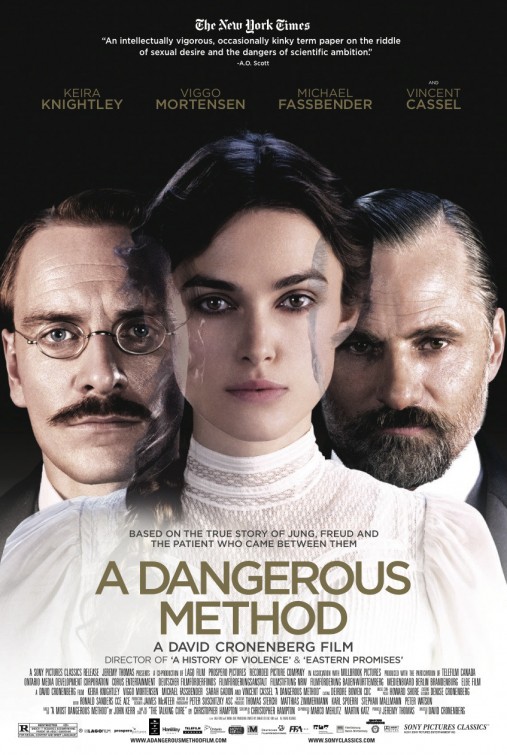 At first glance, the movie seems like an odd fit for director David Cronenberg, that is until you realize that, as Freud himself might approve, the entire movie is bubbling with sexual repression and kink. The movie showcases the friendship between the two titans of psychoanalysis, Sigmund Freud (Viggo Mortensen) and Carl Jung (Michael Fassbender), and the strange patient (Keira Knightley) who brought them together and tore them apart. This is a very intimate chamber drama, confined to lots of men in suits talking in great detail about psychology and philosophy and desire (there are three separate scenes of dream decoding and lots of letter correspondence voice over). Knightley is superb as a hysterical patient torn apart by her socially inappropriate desires. It may be a tic-heavy performance but my God can the woman act. She’s like a feral beast at points. The majority of the film follows Jung’s affair with Knightley and his friction with the single-minded Freud, who incidentally is never without a cigar clenched between his teeth. Jung wants to expand their field of study to include paranormal activities; Freud wanted to stay within the realms of science to give their movement credibility. Cronenberg’s period drama can be a bit too sedate at times given its aberrant sexuality. You don’t really empathize with either Freud or Jung, and thus the drama is a robust and intellectually stimulating exercise but only an exercise. For people who do not share an interest in psychoanalysis, they’re in for a long slog. A Dangerous Method is a rather short film, only 99 minutes, and would have benefited from being a bit more dangerous with its subdued subject matter.
Nate’s Grade: B+
Share this:

Sherlock Holmes: A Game of Shadows (2011)
 Delivering pretty much more of the same, Sherlock Holmes: A Game of Shadows isn’t exactly an improvement over the classic detective’s first foray into out-and-out Hollywood action cinema. The real treat of the budding franchise is the comic interplay between Holmes (Robert Downey Jr.) and Watson (Jude Law). Their harried banter makes for the best moments. Once again the plot is overwrought, the side characters underdeveloped (poor original dragon tattooed girl, Noomi Rapace, given absolutely nothing to do but run in a gypsy skirt), mysteries that you give up and just wait for Holmes to explain, and a villain that proves to be lackluster. For Moriarty (Mad Men’s Jared Harris) to be the nemesis, the intellectual equal of Holmes I’m going to need to see much more than this. There is a fine sequence at the very end where Holmes mentally envisions the steps of his attack and then Moriarty joins in: “You think you’re the only one who can do that?” They hold an entire duel fought step-by-step in the imagination. I wanted more experiences like this, but director Guy Ritchie (Snatch) falls back on his signature stylized action sequences of fast whooshing and quick spinning. The action is a step up from the first Holmes, and that will be enough for most ticket-buyers. I’ll admit there is a certain meta-literary charm at watching Arthur Conan Doyle’s signature detective fighting his way through an armed body of baddies. Whatever your feelings were for the 2009 Sherlock Holmes, I’m fairly certain you’ll revisit them in their entirety with Game of Shadows. I know I did.
Nate’s Grade: C+
Share this:

Meek’s Cutoff (2011)
 The early frontiersmen lead difficult, backbreaking struggles as they migrated west to start anew. The pioneers had a perilous journey, and judging from Meek’s Cutoff, they had a hard time asking for directions. We follow a wagon train hopelessly lost in Eastern Oregon, blindly hoping they are getting ever closer to water. This awful movie feels about as adrift as the characters. Director Kelly Reichardt (Wendy and Lucy) recreates pioneer life in obsequious detail, which means that for most of the interminably long 104 minutes we’re watching characters walk. And walk. And walk. Hey, now they’re doing something, nope back to walking. Michelle Williams (Blue Valentine) has the most personality of this taciturn bunch, but I couldn’t have cared less about her lot. The movie is practically indignant about the narrative demands an audience has for its movies. This is not some arty examination on the treacherous nature of the human spirit, or some conceited claptrap like such. And in a growing trend of 2011 Sundance films, Meek’s Cutoff ends absurdly abrupt, just as the characters appeared at a crossroads and on the verge of mercifully doing something interesting. Instead, Reichardt ritualistically kills the movie on this spot, robbing the audience of any payoff after 104 minutes of fruitless and tiresome artistic masturbation. If I wanted to watch a recreation of frontier life without any regard to character or story, I’d watch the History Channel. This is an exasperating, maddening, crushingly boring movie that makes you feel trapped on that misbegotten wagon train.
Nate’s Grade: D


 nathanzoebl
You must be logged in to post a comment.