Blog Archives
A Christmas Carol (2009)
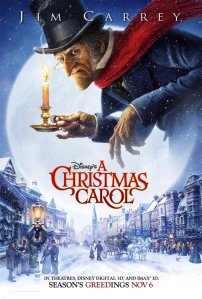 I still am at a loss over the appeal of the motion-capture system that director Robert Zemeckis fancies as of late. The creative mind that gave us classics Back to the Future and Who Framed Roger Rabbit? has embraced a technology that straddles the middle between live-action and outright animation. Motion-capture attaches electronic nodes to actors and digitizes their movements and facial features to later be conceptualized by computer wizards. And to this I say… so what? It seems like a whole slew of unnecessary work that adds little else than a vague starting point. Why not let the animators start from scratch? Why hamstrung creative professionals because Cary Elwes was feeling like making a certain gesture as “Portly Gentlemen #1?” I just don’t get it. To me, the motion-capture system is stranded in some artistic netherworld where it isn’t live-action and it isn’t animation. Zemeckis has cranked out his third mo-cap baby this decade, a retelling of Charles Dickens’ famous Christmas Carol. Why Zemeckis thought an old holiday chestnut would work best in this format, I’ll never know.
Cold-hearted Scrooge (Jim Carrey) is set to be visited by three spirits on a very magical Christmas Eve. The old man goes through Christmas past, present, and future to reevaluate his life and the true meaning of “peace on earth and good will toward men.” You know the drill, folks.
I like A Christmas Carol. I do. So do plenty of nice people. There’s a reason this oft-told tale still manages to resonate with generation after generation and that?s because it’s a good story. Of course it’s also an extremely familiar story to just about anyone outside of a womb at the moment. I expected Zemeckis and his crew to use their technology to jazz up the old story and give it a fresh new life on the big screen. Despite a handful of excursions flying through ye olde London, the extra slathering of special effects doesn’t enliven this holiday tale. I remember having great fun with Zemeckis’ previous motion-capture movie, 2007’s Beowulf (which does not play nearly as well in 2-D). That movie played around with the 3-D environment to great effect and made you feel apart of the experience. In contrast, A Christmas Carol does shockingly little with its depth of field, rarely placing distance between the foreground and the background. It’s a fairly lackluster 3-D experience. Maybe I wasn’t relaxing my eyes the right way, though I did notice how conscious I was of trying to elevate the 3-D experience myself. My disappointment is magnified by the fact that Zemeckis has been a pioneer for the 3-D playbook that Hollywood has now dubbed as the savior of the theater going experience.
 I wonder if Disney execs imposed limitations on the use of the 3-D immersion, not wanting to scare children by making them feel like they’re in the middle of a ghost story (there are some spooky moments already). The whole draw of motion-capture, and animation, is to transport an audience untethered by the limits of traditional practical filmmaking. This newest incarnation of A Christmas Carol fails to justify its existence. Why should I pay to see the most familiar story of modern day if there isn’t any new offering? At least The Muppet Christmas Carol gave me something different. And it had Muppets.
When I was younger in the mid 90s I was a huge fan of Carrey’s rubber-faced antics. I quoted Ace Ventura verbatim with my fellow seventh graders in 1995. So I understand the attraction of having him play multiple parts, but why exactly in a Dickens story? It’s not a comedy unless it’s adapted into one, and Zemeckis hews very close to Dickens and mostly recites the tale word-for-word. Scrooge isn’t funny, the ghosts aren’t funny, so why hire a renowned comedian to portray them all? This is a straight-laced adaptation and as such not the best use for Carrey’s talents. Is the move any better because Carey played all three ghosts? Is the movie any better because Gary Oldman gets to play Bob Cratchett and voice Tiny Tim? Is the movie any better because Elwes is credited for five inconsequential roles? Celebrity vocal casting is rarely effective in animation and so it seems the same in motion-capture.
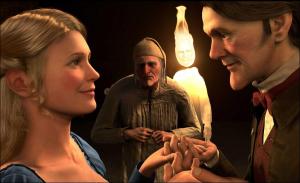 The technology has improved from the dead-eyed zombie children days of Polar Express, but it still seems like little more than less refined animation to my eyes. The movements are more fluid but the color palate is subdued into amber hues and candlelit locales. It doesn’t exactly use all the technological tools in the toolbox. It’s like a five-star chef toasting a Pop Tart: a waste of potential. I didn’t care for the skewed proportions on people either. Scrooge has a wiry frame with long spidery limbs and a triangular torso, and his character design kept reminding me of Jack Skellington. It’s too otherworldly considering nobody else comes across as a garish caricature in design form. The character designs for the three spirits are also fairly underwhelming. The Ghost of Christmas Past is a wispy flame. The Ghost of Christmas Future is nothing but a shadow. Is there a connection here? Otherwise, a shadow is pretty lame for the one ghost that can get really inventive and scary. Really, a shadow? I can do that myself without the aid of computers. And was it Carrey’s shadow to make it officially motion-capture? Because God forbid no other shadow could do or give the same performance of being draped over shapes.
I actually had to vehemently fight the urge to nap during A Christmas Carol. Maybe it was my poor sleep from the night before, maybe it was the fact that the 3-D glasses make everything darker (they still manage to hurt my eyes after prolonged use), but it was likely due to the fact that Zemeckis added a coat of polish to a holiday classic but declined to find purpose for doing so. Does this story get better with zooms through London, or Scrooge being shrunk and chased by demonic horses? It all seems like folly to me, like somebody’s idea to goose literary classics. Can you imagine Jane Eyre being shrunk and climbing through the walls of her Victorian era home? It all seems like an annoying distraction. Zemeckis? A Christmas Carol is exactly what you’d expect, which means you’d be just as well to flip through the TV channels and find any number of Christmas Carol versions. The Muppet Christmas Carol might even be on. Give that one a try instead. It even has some nice songs. And it’s got Muppets.
Nate’s Grade: C
Share this:

A Serious Man (2009)
 The Coen brothers, Joel and Ethan, have been making stupendous movies for three decades, but they have never really gone too introspective. Usually their movies follow quirky characters making poor decisions and getting in too deep in a cruel world. A Serious Man is the first Coen film that feels personal. Set in the same landscape of the Coen’s own upbringing, 1960s Minnesota, A Serious Man gives a few insights into how these two remarkable men became who the filmmaking geniuses they are today. But if that isn’t enough for film fans, the movie is also hilarious and brilliant.
It’s 1967 in suburban Minneapolis. Larry Gopnik (Michael Stuhlbarg) is a meek physics professor up for tenure. Larry is beset at all sides, from his redneck neighbor encroaching on his land, to being bribed by a Korean student unhappy with his grade, to the news that his wife, Judith (Sari Lennick) is leaving him for his colleague, the more dignified Sy Ableman (Fred Melamed). Sy suggests that the best course of action is for Larry to move out to a hotel: “The Jolly Roger is eminently habitable.” The tenure board is having second thoughts because of anonymous letters, Larry’s daughter is stealing money from his wallet for a nose job, his son spends more time getting high than practicing for his bar mitzvah, and Larry’s unemployed, socially awkward brother (Richard Kind) is sleeping on his couch. Larry seeks counsel from three rabbis and tries to find meaning as to why his life is spinning out of control.
 This is a bleak comedy with almost all of the laughs coming from how much worse things get for Larry. Now, it’s not a pitch black comedy, something akin to being loathsome and eager to push an envelope; you simply can’t help but laugh at how he universe is ganging up on this poor man. His life is spiraling out of control and he is helpless to stop it, and his search for some sort of theological wisdom just leaves him more confused. The various rabbis don’t really have an answer to explain his suffering, and instead they each give comically nonsensical answers or stories. The junior rabbi, projecting his own low stature, asks Larry to seek God in small things, like the parking lot highlighted by his office’s lone window. “Just look at that parking lot,” he gushes hopefully. One rabbi gives a fantastic story about a Jewish dentist discovering a strange Hebrew message carved on a patient’s (a goy’s) teeth. The story eventually goes nowhere and the rabbi’s advice is merely a shoulder shrug and this bit of feeble wisdom: “Helping others? It couldn’t hurt.” To the Coens, Larry is the modern-day equivalent of Job, befalling misery and looking heavenward to ask, “Why me?” He could easily be any one of us. In the face of turmoil, it feels like the Coens prescription is to laugh, the only way to remain sane in this world. And so we do laugh, dubiously, and this is how we cope with life and its ongoing uncertainty.
And A Serious Man is seriously funny. I snorted out loud three times, unable to control my growing guffaws. The supporting group of characters is all wonderfully utilized, popping in for a perfectly timed plot development or a joke. This movie is relentlessly funny, structured like a runaway car that picks up momentous speed. Not a single frame feels at waste. The conversations between the supporting characters are priceless; every character has their precise place in this narrative, and the Coens manage them brilliantly. The writing is intricate and the Coens again showcase their magnificent ear for local color. Each of these people has a different speech pattern, from one Hebrew school kid’s abundant use of the F-bomb, to Larry’s daughter insisting she has to use the bathroom to always wash her hair, to Larry’s bathroom-hogging brother’s conditional response of, “Out in a minute.” It’s almost like a musical how well the various comedic elements harmonize. The mostly unknown cast of actors is all superb; I love how the Coens select actors with such great, easily recognizable faces. These people stand out just visually. Stuhlbarg, a theater veteran, is a terrific lead, and his performance is steeped in pursed-lip incredulity. I loved every conversation with the powerfully unctuous Sy Ableman, a character who hides his distaste in pompous vocabulary. I loved Larry’s interactions with his South Korean blackmailer and his broken English. I loved how Larry’s son will interrupt important occasions just to complain about the TV picture quality of F-Troop. I loved that the only person concerned for Larry’s well-being is the Columbia records salesman who signed up Larry for a subscription because he failed to reject their offer.
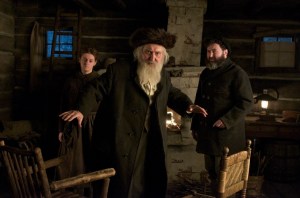 I haven’t done extensive research on this one, but A Serious Man may be the most Jewish film ever, or at least since Barbara Streisand cross-dressed in Yentl. I’m not talking movies that explore a significant chapter in Jewish history, like the Holocaust, but I can think of no other movie so steeped in the minutia of Jewish culture. A Serious Man even opens with a seemingly unrelated anecdote with a 19th century Eastern European Jewish couple arguing, completely in Yiddish, whether a guest is alive or a dybbuk (demon). Not only do we get notable religious events and observances like bar mitzvahs, sitting shiva, counsel from rabbis, the concept of a religious divorce known as a get so that a “serious man” could remarry in the faith, but the Coens get everything right down to the tiniest detail, like the exact sound of soup slurping. Even the overall tone, perseverance in the face of struggle, is an extremely Jewish perspective given what has transpired historically to the Jewish people.
The abrupt ending will likely win no favors from the people that thought they were shortchanged by No Country For Old Men‘s anticlimactic close, but it certainly fits the movie’s bleak worldview. Larry is, by his own accounts, trying to be a “serious man” in an ever-changing community, so beware what happens if he compromises his moral values. The pessimistic finale leaves much to the imagination and whether you want to connect the events as uncoordinated random plot points, or as an ongoing celestial judgment, well the Coens are canny enough to let you figure it out. They don’t have any more answers than the rabbi and the goy’s teeth.
This will not be a movie for everyone, especially considering 90 percent of the laughs come from one man’s unrelenting misery. Larry isn’t exactly the deepest character, making it spotty to emotionally invest in his troubles. However, I found him to be an everyman cipher allowing the audience a safe entry point into the Coen spectacle of doom. The Coen brothers have always been technical marvels, but they seem to have raised their inconsiderable talents at the close of this decade. No Country for Old Men was a genre masterpiece, Burn After Reading was an entertaining farce, but perhaps A Serious Man is the most lasting picture. How do we explain bad things and bad things happening to people striving to be serious men and women in the world? I?’m not sure if the Coens have an answer or even think the answer is important. I think their viewpoint is to enjoy the ride and laugh while you can. As the Korean student’s father puts it, “Accept the mystery.”
Nate’s Grade: A
Share this:

Year One (2009)
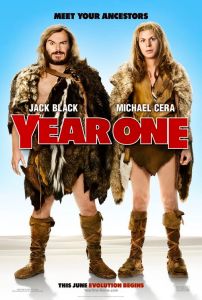 This is a slapdash comedy that?s too toothless to be satire and too dumb to be witty. Jack Black and Michael Cera play a pair of banished cavemen who stroll through various episodes from the Old Testament, like Cain and Abel and a circumcision-crazed Abraham, before settling in for a wild time at Sodom. This uninspired riff on the Bible rarely lands any laughs. The comedic aim of the film is extremely low; the scatological humor consists of farting peasants, bestiality, eating poop, urinating on your face, genital mutilation, and lots and lots of pedophilic jokes thanks to a grotesque, lispy Oliver Platt. Year One (of what exactly?) is a big step back for co-writer/director Harold Ramis and a general waste of everyone’s time and talent. Black and Cera do have an interesting and playful ying-yang chemistry but they have so little to do given the rambling, episodic nature of the plot. The characters make anachronistic pop culture references or talk in self-aware circles, the celebrity cameos do little, and the jokes lack any lasting momentum. Somewhere Ramis wants to make statements about religion and faith but the flick is too timid to do anything, so the movie limps to a finish with its lame “be your own chosen one” message. This is a prehistoric comedy with rocks in its head.
Nate’s Grade: C-
Share this:

Inglourious Basterds (2009)
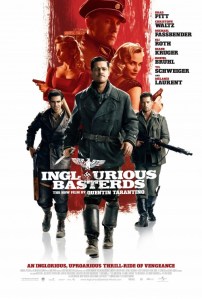 Quentin Tarantino has always been an artist that thumbs his nose at convention. Just as critics accused his last film, Death Proof, as wallowing in exploitation muck, here comes Inglourious Basterds, very loosely based on the correctly spelled 1978 Italian movie. War movies seem like a natural fit for the QT mold with their staunch violence, tough guy bravado, and vengeance-filled storylines. Tarantino has been working on the script for this film for over ten years, taking a break to produce the Kill Bill features. The finished product is a bloody alternative history wish-fulfillment fantasy with little conscience. This isn’t any sentimental, well-meaning, reflective war movie. This is war Tarantino-style and a celebration of war movies in general. Cinema becomes the weapon we win the war with.
In 1944, Lt. Aldo Raine (Brad Pitt) is given a unique mission. He is to assemble and lead a crew of Jewish-American soldiers for one purpose — to kill Nazis. They will be dropped into German-occupied France and will use guerilla tactics to dismember Nazis and strike fear into the higher ranks. Aldo personally assigns each soldier with the task of collecting 100 Nazi scalps. “And I want my scalps,” he commands. The “basterds,” as they’re called, face steep opposition. S.S. Colonel Hans Landa (Christoph Waltz) has earned the nickname “Jew hunter” for his terrifying precision at sniffing out Jews hiding along the French countryside. In the film?s terrific opening sequence, he systematically interrogates a French farmer into giving up the Jews he is hiding. Shoshanna (Melanie Laurent) is a Jewish teenager who manages to miraculously escape this bloodbath.
Years later, she owns and operates a movie theater in Paris. The German high command wants to screen their newest propaganda masterpiece, Nation’s Pride about the exploits of sniper Fredrick Zoller (Daniel Brühl), in Shoshanna’s theater. Finally she can plot her vengeance, except that Landa will be providing security for the special screening. Meanwhile, Aldo and the basterds scheme to meet up with German actress Bridget von Hammersmark (Diane Kruger), who is secretly working with the British as a spy for Operation Kino. The top-secret mission involves attending the movie premier at Shoshanna’s theater and then killing all the high-ranking brass in attendance, thus ending the war.
 Those looking for a rip-roaring good time of watching Pitt prance through the countryside dispatching evil Nazis will be disappointed to learn that Inglourious Basterds is, after all, a Tarantino movie. That means there is talking. Lots of talking, but it’s great, glourious talking with deep undercurrents of menace. The movie boils down to about six set pieces and most of that time involves long, drawn out conversations where the tension percolates underneath the surface. The characters play a cat-and-mouse game of deception, and the conversation transforms into a slow fuse waiting to go off. The characters engage in an “I know, and you know I know” bout of play acting, going about their business as if all is calm, when each is waiting for the next move. Tarantino turns dialogue scenes into slow-burning combat, and eventually those lit fuses do finally go off and the scene will erupt in a great splash of violence. Then we are left to assess the situation and collect our bearings, much like the characters if they are fortunate enough to be alive. This is a talky war movie, and Tarantino does fall in love with his dialogue rhythms and allow his characters to overindulge and circle the same plot points more than is needed, like the sequence with von Hammersmark in the bar, but the naysayers looking for an action romp that complain nothing goes on are missing the point. A tremendous amount is going on, you just have to look beneath the surface, lie in wait, and luxuriate in the simmering tension that Tarantino plays like a pro.
Tarantino has an encyclopedic knowledge of film that allows him to blend and deconstruct genres, and Inglourious Basterds feels like an homage not to World War II but war movies in general, with a dash of spaghetti westerns. When the French farmer watches Landa drive up to his home, linked with the great Enrico Morricone’s score, you definitely feel like you’re in a western transported into mid-twentieth century Europe. The conversations feel like high-noon showdowns. Tarantino’s direction feels less stylized and idiosyncratic this time. He still plays around with time and back-story, even recruiting Samuel L. Jackson to be a God-like narrator, but Ingloruious Basterds is mostly a literal and linear pop deconstruction of war movies. When Tarantino deviates sharply from the known historical timeline, it feels within reason given the cracked mirror world he?s created. Tarantino can turn World War II into a campy Warner Brothers cartoon, replete with goofy over-the-top caricatures of Hitler and Goebbles. He can also takes digressions and hard right turns with his story, allowing characters to chew over the finer intricacies of German silent cinema. It’s bloody, messy, but boy is it entertaining as hell.
 Any conversation over Inglourious Basterds is inevitably going to gravitate to its fascinating central villain, Hans Landa. German actor Waltz plays the infamous “Jew Hunter” and he is astounding to watch; he enlivens every moment onscreen and won a Best Actor award at the Cannes Film Festival. Landa is an extremely intelligent and polite inquisitor. He comes across almost like a diabolical S.S. version of Colombo: he’s three steps ahead, feigns ignorance, circles his prey, and finally strikes after mentally tearing down the suspect. Waltz is practically giddy in some sequences, enthusiastic for such sick endeavors. He likes to screw with people and make them nervous. And yet, thanks to the wily brilliance and magnetism of Waltz, you develop a perverse appreciation for the man. Despite the horrors he is responsible for, you may actually find yourself liking Landa. He has moments of great cunning, like his deliberate reasons for switching to English with the French farmer or his off-the-cuff destruction of von Hammersmark’s alibi. When he suddenly and fluently launches into his fourth language, it is one of the film’s finest “oh crap” moments. This is a truly memorable character that dominates every scene, and Waltz gives an astounding star-making performance destined to be remembered when it comes time to draw Oscar nominees.
The rest of the actors do well but no one approaches the planet that Waltz resides on. Pitt seems to knowingly be shooting for parody with his performance. His accent is twangy and coats every word in a honeyed glaze; you almost expect him to wink at the camera after each line. He’s still amusing to behold in the rather few instances that Aldo graces the movie. Laurent (The Beat That My Heart Skipped) and Kruger (National Treasure) both have intriguing albeit underwritten roles, and both actresses give the best performances in the film after Waltz. Eli Roth (writer/director of Cabin Fever, one of my favorite movie indulgences) looks the part as the commanding “Bear Jew” with his lean physique and Louisville slugger, but I couldn’t tell what he was doing with his accent. Is he supposed to be from New York or Boston? In war movies, there was usually a colorful collection of characters but Inglourious Basterds doesn’t really do much to accentuate its second tier players. The only basterd that leaves an impression is Til Schweiger (Driven, Far Cry), all humorless resolve and flinty stares. And what happened to the basterds in the final act? Where did everybody go? Yes, that really is Mike Myers doing one of his Austin Powers-esque British impressions.
 What is truly surprising is that Basterds unflinchingly looks at all the ugly aspects of war. The movie doesn’t neatly categorize the villains and the heroes. Zoller is a German sniper that killed 300 Allied troops and yet he is portrayed as grounded and romantic, a film lover able to chip away at Shoshanna?s steely reserve. To the basterds, they refuse to see past the uniform and armband; there is no difference between a Nazi and a German soldier. They will mutilate both on principal. Tarantino also gives time to examining the collateral damage of war, watching innocents gunned down in the name of duty. Shoshanna’s plot for vengeance involves the horrific deaths of scads of people whose only sin may have been being German in Paris. Operation Kino is described by Landa as a “terrorist plot” and isn’t it, really? But then Aldo disputes that a “Nazi ain’t got no humanity” and that collaborators and bystanders are just as culpable. Aldo and his basterds march through France committing what could sensibly be described as war crimes, and these are the good guys! Even with all the camp and stylized violence, there may be moments where you want to cringe and ask yourself, “Am I supposed to be enjoying this??
There are those that bemoan that Tarantino is wasting away his remarkable talents on such low-rent enterprises. He is too caught up in genre filmmaking, they claim. He needs to go back to his earlier audacious works, like Reservoir Dogs and Pulp Fiction, films of startling intelligence and playfulness. He needs to stop making collages of movies and go back to making real movies, they cry. Ingloruious Basterds will not please these critics. This is a verbose deconstruction of war movies that runs over 150 minutes and mostly involves characters seated and chatting. It will clearly not be for everyone, especially those sold into thinking Basterds was going to be a more graphic version of The Dirty Dozen. This movie is more Cinema Paradiso than The Dirty Dozen. If Tarantino wants to keep making high-gloss genre goofs, that’s fine with me as long as the end results are as creative and entertaining as this movie. Who else is going to make a World War II fantasy with excellent use of David Bowie’s song “Cat People”? No one makes movies like Tarantino. I rest my case.
Nate’s Grade: A
Share this:

Public Enemies (2009)
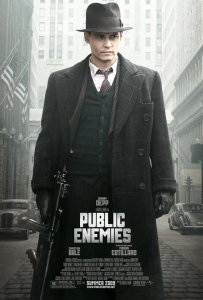 Considering the talent in front of and behind the camera, it’s hard not to describe Public Enemies as anything but a letdown. This Depression-era gangster film is heavy on period details and very tight-fisted when it comes to characterization. You’d think given 140 minutes and the natural charisma of Johnny Depp that an audience would come to some kind of understanding with notorious bank robber John Dillinger. Nope. The characters remain perfunctory the entire time, pushed into conflicts by a brisk pace that manages to squeeze in three bank robberies, two prison breaks, and many police shootouts. Because the movie barely takes time to breathe, the love story between Dillinger and Billie Frechette (Oscar-winner Marion Cotillard, a dead ringer for pop singer Katy Perry) is never credible, the tension never feels palpable, and director Michael Mann (Heat, Collateral) seems overly smitten with his distracting high def digital photography. You never really feel any sense of danger or interest. The characters on screen feel like strangers even after 140 minutes. Depp makes the movie more tolerable than it would be without his presence. Mann, one of three credited screenwriters, seems to assume the audience is well versed in Dillinger history and so he skips over plenty of fertile territory. Public Enemies certainly hums with plenty of polish but it comes across as mostly mundane due to such flimsy character work. It’s a collection of good scenes that fail to make up a satisfying whole.
Nate’s Grade: B-
Share this:

Reservation Road (2008)
 This movie beguiles me. I watched it over a month ago and I am still turning it over in my brain, and not just for the fact that I get it confused with the similar sounding yet also disappointing Reservation Road. It’s another movie that presents the suburbs as a prison of bourgeoisie social moirés about how men and women are expected to live to be happy. The movie looks magnificent thanks to skilled cinematography by Roger Deakens, even if it falls back on redundant visual metaphors (look, the windows are shaped like prison bars!). The acting by Leonardo DiCaprio and Kate Winslet, the unhappily 1950s married couple Frank and April Wheeler, is mostly impressive. Michael Shannon deservedly was nominated for an Oscar as an unhinged realtor’s son who cuts through all the troublesome and fake niceties. It is a terrific performance and jolts the movie with much-needed energy, somewhat like Renee Zellweger’s role in Cold Mountain. I think that’s where my biggest area of concern is: the movie is just kind of placidly dull. Watching people be miserable for most of a two-hour running time isn’t a deal-breaker, but the movie needs to have some life to it. Revolutionary Road feels just as morose and restrained as its assortment of doomed married couples eeking out an existence. Perhaps that is an achievement to be heralded for director Sam Mendes. Then again, perhaps it just means I felt purposely remote and directionless and just waited for the movie to expire.
Nate’s Grade: B-
Share this:

The Mummy: Tomb of the Dragon Warrior (2008)
 The Mummy: Tomb of the Dragon Emperor, the third film in the once popular Mummy franchise, is facing an uphill battle. It’s been a long seven years in between films and some, like myself, would argue that the franchise is already creatively exhausted. This stuff is the brainchild of writer/director Stephen Sommers (Van Helsing), who decided he would rather make a movie based upon an action hero than rehash mummies (see you this summer, G.I. Joe: The Movie). In comes director Rob Cohen who has given the world such cinematic abominations like XXX, Stealth, and The Fast and the Furious. Surely this was the proper artist to re-energize a semi-dormant franchise. The results are about as unexceptional as you’d expect.
In 1947, Rich O’Connell (Brendan Fraser) and his wife Evie (Maria Bello, replacing Rachel Weisz) are in retirement from adventure seeking. They live at a palatial estate. Their son Alex (Luke Ford) is in college except they do not know that Alex is really surveying ancient tombs in China. The lad has stumbled across the massive tomb of Han (Jet Li), China’s first united emperor. Han was a ruthless warlord that conquered all. He punished Zi Juan (Michelle Yeoh) for falling in love with one of his generals and not the mighty emperor. Zi Juan managed to cast a spell on the evil emperor that trapped him in metal. And he sat undisturbed in his tomb for 2,000 years until Alex came along. Eventually the spirit of Han is released and some Chinese military officials wish to serve their departed emperor. Han is seeking the location to Shangri-La to bathe in the pool of immortality, and then he will awaken his army and continue his quest for world domination. The Far Eastern exploits bring the O’Connell family unit together to save the world yet again.
 The first film was a cheesy, campy tongue-in-cheek adventure that managed to be consistently entertaining. The second film retained the same fun and humorous atmosphere, though it subscribed to the “bigger is better” theory of sequels and ramped up all the action to a cartoonish degree. Seven years later, the third Mummy movie is a complete bore. Tomb of the Dragon Emperor feels like two movies sewn together; ancient Chinese warlords and treasure-hunting archeologists do not come across as a good fit. The terracotta warriors are a great source for an imaginative tale, but this is not it. So Emperor Han has mastered the elements of fire, water, earth, metal and wood (when did wood become an element? I don’t see that one on the periodic table) and the guy can also turn into giant monsters like a three-headed dragon. The writers of this Mummy entry have goofed by making the villain too powerful. Yeah he can be slain by a magic sword (there’s always something magic-y) but this is a foe that can control oceans, water vapor, clouds, rain and snowstorms, ice shards, and that’s just with one element. I must confess that I cannot fathom Han getting too much use from the wood element. On top of that, he can transform at will into ferocious creatures, so what is the point of turning back into a tiny human? Why would anyone fight hand-to-hand when you could fight as a 30-foot monster of your own design? The problem with making the villain too powerful is that when they do not take advantage of their clear advantage, then the villains just look stupid. “The Dragon Emperor” looks stupid for fighting as a 5′ 6″-sized man instead of a killer dragon. Which would you fight as? At least the Mummy from the other films had limitations.
Even worse than being incomprehensible and dumb, none of the action sequences are thrilling or exciting. The action sequences are fairly sub par, resorting to shootouts and the occasional car chase. At least a car chase through the streets of Shanghai during Chinese New Year takes advantage of the location, allowing Rick and Evie to use firecrackers like missiles. The martial arts work is poorly choreographed and poorly presented thanks to some butchered editing. This is one of the worst edited big-budget films of recent memory. Tomb of the Dragon Emperor seems to be making it up as it goes. There are moments where characters will state where they need to travel to and then in the next second they’re preposterously there. Someone talks about the path to the hidden land of Shangri-La and then the next moment, hey, there they are. How did these places remain hidden for centuries? Very little makes sense in this movie. I’m not asking for complete believability in a film involving immortal bad guys and ancient spells, but at least let me able to follow along. I felt like I could tag along with the first two Mummy films and I had fun to a certain degree, but this time I felt like I was being dragged. I won’t even go into great depth about the appearance of yetis except to reveal that there is a moment where one yeti dropkicks a Chinese soldier over a gated wall and another yeti raises his arms straight in the air, signaling in football terms that it is indeed “good.”

Rachel Weisv not pictured.
Once again it all comes down to an all-out CGI battle between Han’s CGI army and the CGI zombie opponents buried under the Great Wall of China. The second Mummy movie ended in a similar fashion, and frankly I’ve become bored with the CGI armies clashing en masse unless I’m emotionally invested in the story. The effects work isn’t too fancy either. Most of the CGI creatures look flimsy and there’s nary a sense of wonder for a movie dealing with awesome supernatural forces.
The cleverest moment in the entire film involves the departure of Rachel Weisz. The Oscar-winning actress decided that she had had enough rumbles with the undead and bowed out of reprising her character of Evie. Smart move, lady. The film opens with Evie reading to an audience from her adventure novel based upon her encounters with a certain mummy. A woman asks her if the book’s female heroine is based upon the real-life Evie. She closes the book, smiles, and says in Bello’s first close-up that, “No. I can honestly say that she is a completely different person.” It’s all downhill from there for Bello, whose terrible British accent veers wildly to the point that she sounds like eight different kinds of Brits inhabiting one mouth.
The Mummy franchise is not where I go looking for parental drama. I understand that the 2001 Mummy sequel introduced Rick’s son, but why did this movie need to be set so far ahead in the future? The only reason this movie is set in 1947 is so that Alex can be like a twenty-something adventurer. The Mummy Returns was set in 1933 and Alex was eight years old, so by use of basic math he is now 22. There is no other prominent plot point, character revelation, or action set piece that relies on the date being 1947. Okay, so we’ve arbitrarily aged the kid, so surely the film will present some parental dilemma. Nope. The closest the movie gets to capitalize on Alex’s advanced age is pushing Rick to acknowledge his son’s accomplishments. The film’s idea of exploring family dynamics is a passing statement about making sure to express your love. Nothing is really gained by inserting the familial connection between Rick and Alex, who just as easily could have been a non-blood related character.
 The inherent issue with an older Alex is that Fraser and his son look about the same age. Fraser has remarkably aged very little over the course of nine years since the first Mummy movie; sure there’s a few facial lines and a hardness that wasn’t there, but this man clearly looks like he is in his late 30s. Alex looks like he’s in his mid-twenties and the actor, Ford, is actually only 13 years younger than Fraser. It just doesn’t work at all. It looks like Rick and his younger kid brother, not his son. But lo, I think I have figured out the true reason behind position Alex as a younger, dashing version of Rick O’Connell, dispatcher of mummies. Fraser’s three-picture deal was fulfilled by this mediocre movie. If the producers want to have further mummy and non-mummy escapades, they have targeted Alex as their leading man of derring-do.
I like Fraser, I like him in these kinds of movies, but even he feels like he’s running out of gas with Tomb of the Dragon Emperor. The location switch from Egypt to China fails to give the franchise a new kick. The Chinese martial arts material bookends the movie and seems out of place, let alone poorly designed. Jet Li must have had a great time cashing his check because the kung-fu master appears for like 15 total minutes as himself. The lackluster action, questionable plotting, cardboard characters, and dearth of enjoyment make this a sequel a potential franchise killer. The tongue-in-cheek energy and cheesy fun of the other movies is completely absent. You can forgive stupid when it’s fun, but stupid and boring is a deadly combination for a huge effects-laden action movie. Hopefully The Mummy: Tomb of the Dragon Emperor will serve as proof that bad jokes, bad visuals, bad editing, bad plotting, and bad accents do not somehow go vanish because of lingering goodwill from previous films. This is one movie that should have stayed buried.
Nate’s Grade: C-
Share this:

The Reader (2008)
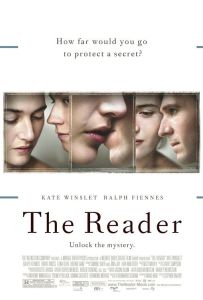 Every now and then, the assorted members that make up the Motion Picture Academy make, shall we say, quizzical selections. There are snubs and undeserving winners, but then there’s the crazy nomination where you see the movie and say to yourself, “What the hell were they thinking?” In recent years I’ve usually found at least one Best Picture nominee that left me scratching my head. In 2007 it was Atonement, in 2004 it was Finding Neverland. But I could at least fathom a guess as to why each of those movies appealed to the Academy and garnered a Best Picture nominee. I’m stumped when it comes to 2008 Best Picture nominee, The Reader. Based upon an award-winning novel, I can only surmise that Academy voters saw the words “Kate Winslet” and “Holocaust” and thought the movie had to be far worthier than the likes of WALL-E or The Dark Knight.
In post-World War II Germany, teenager Michael Berg (David Kross) begins a torrid affair with an older woman, Hanna Schmitz (Winslet). He’s 15 years old; she’s easily twice his age. She instructs her young lover to read to her before they engage in sexual activity, which turns reading into an act of foreplay. The summer affair ends abruptly when Hanna runs off after her employer has given her a promotion. Michael is heartbroken that his lover has flown the coop. Flash forward several years and Michael is attending law school in Berlin. He and his fellow students visit an ongoing trial that features a group of former female concentration camp guards. To Michael’s shock, Hanna is on trial as one of the murderous Nazi guards. The young boy is beset by his feelings of love for a person who has committed despicable deeds. Hanna is keeping a deeper secret and will go to her grave to keep it. Eventually an adult Michael (Ralph Fiennes, wasted) finds his life returning to an imprisoned, older Hanna, possibly his life’s greatest love.
 The Reader contains interesting story elements: sex, guilt, romantic affairs with former Nazi prison guards. But rarely do any of these interesting elements actually transform into an interesting story. The movie just kind of lies there, basking in some phony reflective pause when the movie manages to be so distant and uninvolved. At times the movies seems to have little interest in its own self. This movie feels like it was made to be Oscar-bait because it deals with Big Themes and Important Topics, or at least the film wants to appear like it deals with said items. The Reader is mostly shallow. It pretends to present a moral quandary but director Stephen Daldry (The Hours) doesn’t bother to analyze the contradictions of his characters. The film alternates between characters shouting obvious declarations and just stumbling around in contemplation, bumping into the furniture. It’s simultaneously annoying and boring. The movie wants to put a human face on monstrous deeds, which can be a noble pursuit. The Reader fails to be a “challenging” movie when it can’t be bothered to challenge its characters to do something.
The message of quasi redemption at the center of this specific film is either laughably naïve or downright insulting. Hanna keeps a personal secret shame at all costs, and she would rather go to prison for life as a Nazi murderer than let people know she cannot read. I’m sorry, but that’s dumb. The fact that it seems like The Reader presents the theory that Hanna’s illiteracy mitigates her guilt is offensive. I’m sure the 300 people that were locked in a burning church to die would be sympathetic that their killer couldn’t read See Spot Run. In what world is illiteracy more shameful than genocide? If you’re going to float ridiculous notions at least commit to exploring their very ridiculousness, and therefore acknowledge that there is something amiss. The Reader instead seems to flutter from idea to idea without ever truly delving deeper. If you’re going to craft a character that’s more afraid of a library than a book burning, at least try and explore this enigma. There’s drama in the disconnect. But the movie never feels like this should be an issue. Can’t you see, silly movie goers, that Hanna is but a symbol for the German people who couldn’t read the signs to come and were ignorant to the extent of Hitler’s horrors. She would rather stick to her duty than claim moral responsibility. That’s fine, but there are a great number of movies, and countless more books, that have examined the psychological culpability that can turn a populace into silently willing participants in mass murder. The Reader would rather spend its closing moments exploring the magical healing power of literature. The fact that the film eliminates the novels’ section where Hanna reads news articles and novels about the Holocaust (thus gaining moral clarity) is dumb. Instead of gaining insight into her actions she reads Chekhov. The movie ends up transforming into a weird and wrongheaded episode of Reading Rainbow.
 Winslet’s acting is fine. She’s such a gifted actress that I doubt you’ll see her give a bad performance even if the movie doesn’t live up to her talent. She isn’t doing anything showy to make Hanna a sympathetic character, which works out well, but the film’s distant perspective means that Hanna seems more like an aloof cipher. She’s this formless blob of a character that expresses a mixture of human emotions but doesn’t resemble a recognizable human. This is the fault of the director and screenwriter who chose to replace subtext with ponderous silent stares (note to all “deep” filmmakers: THEY ARE NOT THE SAME). Winslet slips into the character with the same ease she has slipping out of her clothes. The Reader is another nudity-filled performance for Winslet, her eighth movie featuring her nude (also her fourth Oscar nomination for a nude performance, there must be some connection). As readers can attest, I am no prude when it comes to the female form, but even I thought things were getting a little gratuitous. In the first 45 minutes, Winslet is naked in almost every scene she shares with Kross. It’s almost as if the nudity is supposed to disarm the audience and make Hanna a more intimate. Winslet is one of her generation’s finest actresses, which is reason enough that she shouldn’t be handed a Best Actress Oscar for substandard material.
The Reader may not be a traditional Holocaust film and in fact it’s really not so much about the Holocaust. Sure, that colossal event casts a shadow over Germany, but the movie is mostly about a cold and daft woman and the callow boy who loves her. It’s about two characters, but it the movie is too reserved and then some. Everybody just seems numb, which makes for a boring movie after a while. I repeat: a boring movie about underage sexual affairs with freaking’ Nazis! Winslet’s fine performance is not enough to redeem the whole movie. I think much was lost in translation from page to screen. The Reader actually was more effective when it was just a cradle-robbing unorthodox love story. But then, those flicks don’t typically get nominated for Best Picture Oscars.
Nate’s Grade: C
Share this:

Changeling (2008)
 This is one crackerjack of a story. The true-life tale of a mother, Christine Collins (Angelina Jolie), who loses her son, only to have the LAPD give her a different boy is easily gripping. The pace is a bit elegiac but the movie never gets boring, partly because Christine is beset by a multitude of adversity by the corrupt members of the 1920s LAPD who want the case to go away. Changeling can seem to fall prey to outrage cinema, and the audience is clearly going to demand some justice after watching Christine undergo a torture chamber of abuse. And justice is what we get. The last 45 minutes of this movie is protracted courtroom sequences where the antagonists get stomped upon with righteous fury. It just keeps going on and on, as if to compensate for the massive grievances Christine endures. Writer J. Michael Stracynzski (Babylon 5) makes the drama stick close to the facts of the case, which is admirable but it also makes Changeling anchored to reality when there is nothing, repeat nothing, subtle in this movie. It’s hardcore melodrama all the way through, but I didn’t mind one bit. Jolie’s frantic performance suits the melodramatic material. She leaves it all on the floor, as they say in sports. Clint Eastwood doesn’t seem to be too enraptured by the material, routinely slipping into his understated direction that seems at odds with such a juicy story. Changeling feels like a tremendously fascinating story that isn’t necessarily presented in the best fashion. Still, this is fine stuff.
Nate’s Grade: B+
Share this:

The Bank Job (2008)
 An intelligent and rather crackling heist movie that also happens to be based on a true story. The 1971 British bank heist has so many characters involved that you may need a helpful cheat sheet, especially when it comes to varied loyalties. There are three separate groups all playing their own game, and when the heist doesn’t go exactly according to plan, and then the movie gets even more complicated. It’s a flavorful and funny heist movie that also doesn’t ignore the severe repercussions and life-and-death stakes. The Bank Job is an engrossing crime caper that still manages to thrill and surprise an audience.
Nate’s Grade: B+


 nathanzoebl
You must be logged in to post a comment.