Blog Archives
Warrior (2011)
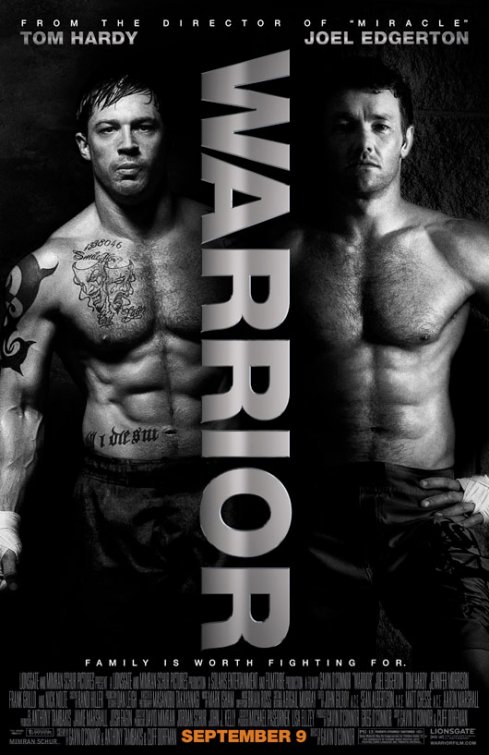 This may be a mixed martial arts (MMA) movie in appearance, but really Warrior is put together like a traditional boxing movie. Director/co-writer Gavin O’Connor (Miracle) takes a kitchen-sink approach to storytelling; just about every damn dramatic thing you can think of, short of emergency baby deliveries, is stuffed into this movie. You’ve got two brothers, one a hard luck school teacher (Joel Edgerton) trying to save the bank from taking his home (his family is broke due to his sick daughter’s medical condition), and the other (Tom Hardy) an Iraq War vet who saved lives and wants no glory, for he’s haunted by the men in his platoon who did not survive. Add a drunken father (Nick Nolte) trying to live life on the straight-and-narrow who wants to get back in his sons’ good graces, the teacher’s community rallying around him, the Marine’s comrades in service rallying around him, and some major personal issues between brothers (Hardy feels that his bro abandoned him and their sick mother), and two competing underdog tales, and my God, it’s hard not to feel beaten into submission. But damn if it isn’t effective stuff. I was tearing up at multiple points, completely sucked into the drama, riveted by the brutal, adrenaline-pumping MMA fight scenes, and pining for family reconciliation. Hardy and Edgerton flex more than their muscles on screen; each gives terse, heartbreaking, completely convincing performances as broken-down men struggling for redemption. You don’t have to no a lick about MMA to get hooked by the heavy emotional beats of the movie. Warrior is by no means a subtle movie, but it pushes all the sports genre buttons expertly, presenting a gratifying, affecting meat-and-potatoes drama that grown men are given permission to get weepy over.
Nate’s Grade: A-
Share this:

The Zookeeper (2011)
 A lamebrain comedy with a horrible, repulsive romance where we watch a sweet, hapless zookeeper (Kevin James) romance a shallow woman (Leslie Bibb) who dumped him years ago and wants him to change, despite the fact that he’s great at his job, loves what he does, an the animals love the big lug as well, so much so that the animals all take turns giving the guy mating advice. That doesn’t sound like a bad premise for a comedy, though James takes the admission that animals could always talk a little too in stride. Their advice typically amounts to stuff like “puff out your chest” and “pee on this tree.” The potential of the premise is dashed when the comedy usually takes one of two routes: 1) James being clumsy, or, 2) James being fat. Rarely will The Zookeeper stray from these two troughs of canned laughs. There’s a bizarre montage of product placement for T.G.I. Friday’s where James takes a gorilla out to the restaurant. There’s Rosario Dawson looking splendid as the Obvious Love Interest Who Will Not Materialize Until James Has to Chase Her Down to Stop Her From Leaving. And there are poop jokes. Oh, the poop jokes. At one point there was a studio bidding war over this screenplay, which has five names attached to the finished product. I can’t imagine the end result was worth fighting over when it’s so predictable, flat-footed, and unfunny. And why have animals singing over the end credits? Surely that little dash of CGI was an extra few million dollars that could have been spent wiser, like purchasing a different script.
Nate’s Grade: C-
Share this:

Cats & Dogs 2: The Revenge of Kitty Galore (2010)
 Obviously this movie is bad. A sequel to a lukewarm family film from nine years ago, the chances were slim that Cats and Dogs 2: The Revenge of Kitty Galore would have ever worked. They don’t even have the temerity to have the subtitle read “Pussy Galore” for fear that repeating the most famous Bond girl name might cause parents discomfort. It’s a live-action talking-animal movie that posits that cats and dogs have been fighting an ages-old feud and they all have secret lairs and technology at their service despite lacking opposable thumbs. Really, premise alone you’re already lowering the standards, and with standards firmly and securely lowered, you may even laugh once or twice (that’s probably about it). It depends on how susceptible to puns you are because that is the primary joke vehicle. The film makes an attempt to throw animals into a Bond-styled action thriller with, pardon me, shaggy results. The character animation is poor, the dialogue feels like it was stitched from one groan-worthy pun after another, and yet Cats and Dogs 2 doesn’t offend with its sheer badness. Premise alone, you sort of watch the thing in a vegetative state.
Nate’s Grade: D+
Share this:

Tropic Thunder (2008)
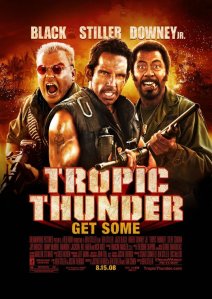 Ben Stiller has been kicking around the idea for Tropic Thunder for nearly 20 years. It took a lot of time to get the script in fighting shape, but the time was well worth it. Tropic Thunder is tasteless and occasionally appalling but it is also wickedly, deliriously funny.
Set inside modern-day Vietnam, Hollywood is filming another epic war movie but this one’s in trouble. It’s over budget, behind schedule, and the first-time director (Steve Coogan) can’t control his actors. Tugg Speedman (Stiller) is a fading action star looking for another hit. Jeff Portnoy (Jack Black) is a crass comedian who’s after some real acting credibility. He’s also addicted to heroin and worries that people will only ever see him as a funny man who farts. Kirk Lazarus (Robert Downey Jr.) is a five-time Oscar-winning actor who, thanks to makeup and a lot of hubris, is playing the film’s African-American sergeant. Alpa Chino (Brandon T. Jackson) is a rapper breaking into acting and is steamed that the Hollywood producers gave the sizeable black role to a white guy.
The director is at his wit’s end and being bullied by producers back in America. He is advised by “Four Leaf” Tayback (Nick Nolte), the Vietnam vet whose story the film is based upon. Tayback says to get real emotion and real fear that the actors should be stranded in the jungle without their precious handlers and demands. So the director takes Speedman, Portnoy, Lazarus, Alpa, and newcomer Kevin Sandusky (Jay Baruchel) in a helicopter and out into the wild. Trouble is, the actors have been left in the middle of an actual drug war, except they think it’s all apart of the script.
 Tropic Thunder is all things to all comedies. It could be tagged as being a bit incoherent but that’s because the movie has so much going on. It’s a sharp satire of Hollywood moviemaking and the raging egos of actors, it’s a send-up of Vietnam war movies and their bloody clichés, it’s a fairly worthwhile action film, and it’s a stupendously politically incorrect comedy with plenty of crude humor mixed side-by-side with genuine wit. It’s a comedy that has the potential to leave you aching from slapstick humor one second and biting satire the next. This feels like a complete comedy and not merely a series of sketches. Every character has an arc, some great moments, and each actor brings something different and something wonderful to the fray. This is clearly Stiller’s greatest achievement as a director.
The focus of Tropic Thunder is all over the place, and no one is safe from Stiller and his co-writers Etan Cohen and actor Justin Theroux. This is a brutal insider satire that plays it broad and loud. There are great jokes that ridicule the pomposity of the entire movie industry and the pitfalls of celebrity as a whole. I loved the jabs at celebrities going overseas and adopting children like they’re souvenirs. The movie has caught flak from disability groups that are mad about the movie’s liberal use of the term “retard.” I don’t want to say these people are missing the point of satire, or the fact that an R-rated comedy should offend on some level, but the joke is clearly on Hollywood and how movies exploit those with mental handicaps under the guise of telling their harrowing and inspiring stories. Movies have long been chronicling the adventurous lives of those with disabilities, which also has the side effect of making these people seem less like, well, just people. In the film, Speedman stared in a movie called “Simple Jack” about a mentally challenged boy who thinks he can talk with animals. Then the character has to pop up later in the film, complete with hysterical dialogue that blows apart just how exploitative these movies are (“I’ll see you in my head movies, but this is one head movie that makes my eyes rain”). It’s performed in just the right tone to make you laugh at the industry and the individual and not because of any disability.
The way the film establishes character back-story is genius. Tropic Thunder introduces all four major characters through fake commercials and trailers, like Grindhouse. The trailers are hilarious and a great way to kick off the movie. Stiller stars in a sinking action franchise where the world keeps being overtaken by fire (“Now, the one man who saved the world five straight times — will have to do it again”). The action franchise’s idea is to just reverse the scenario and, as sequels do, make everything bigger. Black’s trailer revolves around an obese family of super flatulent idiots all played by Black. The sequence is constant farting but it’s so over-the-top and pumped with contempt for lame-brained Hollywood comedies. The best trailer is the one that gives us Downey Jr.’s character, the esteemed Kirk Lazarus. Set in an Augustine monastery around the Middle Ages, Downey plays a monk who finds that he must conceal his inflamed passions for another man of the cloth (a figure I won’t spoil). Think of it as a 12th century Brokeback Mountain, and Stiller and company know exactly where to hammer Hollywood: the go-go eye stares, the hesitant naughtiness, and the ridiculous marketing angles – the title is inexplicably Satan’s Alley. The opening collection of fake trailers serves as perfect comedy bon mots for the feast that is to follow. They whet your appetite and may be the greatest opening 10 minutes of any comedy in memory.
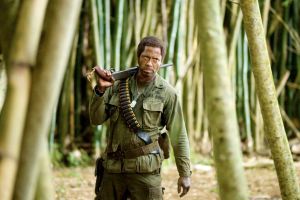 Downey Jr. gives an unforgettable performance comprised of sheer brilliant comedic bliss. I loved every second he was onscreen and I fully expect the man to get an Oscar nomination for his work here. Now, the role of a Method actor playing a black actor naturally presents a tightrope that needs to be walked just the right manner to maintain a satiric tone that doesn’t turn ugly. Let me state clearly that blackface is never funny. It is repugnant and Hollywood has a rather depressing history with the unsavory practice (Gene Kelly and even Bing Crosby sadly did it). Tropic Thunder is not a Stepin Fetchit-style minstrel show where Downey makes eye-rolling racist stereotypes. The joke is not that Downey is playing a black man, the joke is that he is such an arrogant and egotistical actor that he thinks he can play anyone. Besides, Jackson chides him throughout the film for his unorthodox portrayal, which tells you where the filmmakers stand. Downey elevates every scene he steps into and gives a performance, like the film, that is densely layered with comedy. He never breaks character even when the cameras aren’t filming and even when he’s alone. He’s two steps removed; channeling a performance as a heralded Australian actor playing his idea of a 1970s black male. When Alpa derogatorily drops the N-word, Lazarus slaps him and then begins a speech with, “For over 400 years they have been using that word to keep us down,” and ends it reciting the lyrics to the theme song from The Jefferson’s. In that span of time, Downey takes you along on every stop in the dense, hilarious mind of Lazarus.
While the rest of the actors don’t ascend to Downey’s heights (years ago this would have doubled as a drug reference), the ensemble of Tropic Thunder works together smoothly and they help make the film so much more enjoyable. Black is great when he’s trying to be seen as a “serious” actor when they are filming. I love his rushed and hushed line deliveries. But he’s even funnier after going through the wringer of heroin withdrawal. A sight gag involving Black digging through his speedo had me in stitches. Stiller is playing his usual dimwitted blowhard but propels the plot forward. He knows exactly how to oversell for laughs, like when he’s being riddled with bullets in dramatic slow-mo or when he’s playing Simple Jack. Baruchel is a nice counter foil to the uncheck bravado and craziness of the other actors. Jackson has fun voicing his mounting vexation with Lazarus. Coogan and Nolte provide good small moments, and Danny McBride steals his scenes as a pyrotechnic special effects expert that wants to “make Mother Nature piss her pants.”
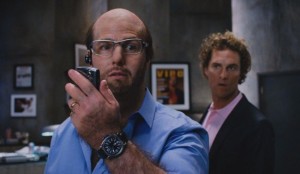 By now you’ve likely heard all about Tom Cruise’s small role in the movie as an irate, bald, fat, extremely hairy studio executive. It’s nice and amusing but I could have done with something different. Downey is unrecognizable in both physical appearance and through his speech; he fully inhabits a character that fully inhabits characters. Cruise, on the other hand, is instantly recognizable even with glasses, a paunch, and a shiny dome. It’s Tom Cruise playing a profane asshole but the joke wears thin. Cruise either needed to do something different or just be seen less, including his hip hop dance moves. And yet, Tropic Thunder has a running joke about Hollywood taking its beautiful A-listers and thinking that, through the power of makeup and superficial physicality, they can play any role. We’ve had a streak of Best Actress Oscar winners that have won accolades by stripping away their beauty and packing on the pounds (check out Charlize Theron in Monster). It seems like even the pretty girls are getting the ugly girl roles now; what’s a homely actress to do nowadays? So, in a way, Tropic Thunder is making fun of this line of thinking, that fat suits and some makeup are the great equalizer, but then it has Tom Cruise more or less falling into the same trap. He puts on a fat suit, a bald cap, but it’s still him and you hear Tom Cruise in every utterance. Maybe it would have been funnier if Cruise were playing a parody of himself since he is a studio executive at United Artists.
Tropic Thunder is a wildly funny movie that takes no prisoners when it comes to its sprawling satire. Stiller and company cut down the self-absorbed lifestyle and mentality inside the film industry and insecure actors. The film really shares the spotlight and each actor provides something different and welcome, and there isn’t a weak link in the bunch. Downey Jr. gives a brilliant comedic performance that will be long remembered. The movie is rude, crude, stupid, smart, and all over the place thanks to such a broad comic canvass. It took many years for Stiller to finally get Tropic Thunder off the ground but the wait was worth it. This is a rare comedy that eels loose, hits hard, and may warrant multiple viewings just to catch all the jokes-within-jokes. This is a movie with plenty on its mind, perhaps too much, but I wish more comedies were as well executed and skillful in their gags about gas passing.
Nate’s Grade: A
Share this:

Hotel Rwanda (2004)
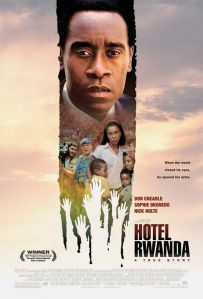 Hotel Rwanda almost didn’t get off the ground. You see, veteran supporting actor Don Cheadle is a favorite actor for directors but he’s not exactly box-office gold. Initial producers of Hotel Rwanda wanted none other than Will Smith to star. I don’t know about you good people but a sobering, challenging movie shedding light on the Rwandan genocide would lose some credibility if Smith was the above-the-title star. Producers also wanted Denzel Washington as a candidate; a better choice but still not right. The true-life portrayal of Paul Ruseabagina needed to be done by an actor that didn’t look like he could kick your ass. Paul was an ordinary man that didn’t ask to be a hero, not a hero looking for a fight. Cheadle was the perfect man for Hotel Rwanda. It just took a while for it to happen.
Back in 1994, Rwanda underwent a tumultuous civil war. In Rwanda, there are two ethnic groups, the Hutus and the minority Tutsis. Though the two look indistinguishable, there is an underlying tension because way back when Rwanda was under Belgian colonial control, the Belgians separated the Rwandan people by arbitrary rules like nose size, skin tone, etc. There is a rising tide of Tutsi resentment (radio propaganda refers to them as “cockroaches” needing to be exterminated). The Rwandan president has been assassinated and Hutu radio broadcasts are already pointing the finger at Tutsis.
 Paul Ruseabagina (Cheadle) is a Rwandan hotel manager that stocks up favors by scratching the backs of the right people. The wheels of Rwandan authority need to be constantly greased, and Paul knows when to deploy a well-timed gift, joke, or bribe. Paul?s wife Tatiana (Sophie Okonedo), a Tutsi as well as their children, is concerned when she starts seeing neighbors taken away at night. Paul assures her that their Tutsi relatives will be safe. Hutu rebels begin to start corralling neighborhoods to root out any Tutsis. Paul and his family retreat back to the hotel. As the violence increases more refugees arrive at the hotel for sanctuary, but Paul must keep the illusion that the hotel is still operational to ward off violence.
The United Nations promises to do something, but they remain only peacekeepers and not peace enforcers. The commanding officer (Nick Nolte) laments that he has only a handful of U.N. peacekeepers in charge of the whole nation. The United Nations and the West does do something: they evacuate all the white people. Citizens of Western nations are escorted out of the conflict, while they leave the rest of Rwanda to its own devices. Paul?s clinging hopes for Western involvement get bleak, and he assumes the responsibility for saving as many lives as he can, Hutu or Tutsi.
Cheadle gives one of the best performances of the year and he’s been nominated for a Best Actor Oscar. The strength of his character’s power lies in Paul’s ordinariness. He’s not a figure of intimidation, nor is he some kind of altruistic saint. There’s more than a passing resemblance to Oscar Schindler in Schindler’s List. Like Schindler, Paul is a man reluctantly pulled into risking his life for others and by the end he becomes consumed with saving as many lives as he can. Cheadle is so commanding that he can make you wince just by watching the weariness in his eyes.
There’s a moment late in Hotel Rwanda, where Paul is stalking the hallways trying to find his wife and children. And in an instant he suddenly remembers careful instructions he gave to his wife. Paul nearly bowls over with the sudden pang of terror but keeps his stride. It’s a sharp and powerful moment where the audience thinks alongside Paul and experiences the same awful gasp. In that moment, as well as countless others, Cheadle has worked his way so deep into his character that the two are one in the same. Cheadle has long been one of the most underrated actors, and now with Hotel Rwanda there is no doubt that Cheadle is one of the greatest living actors we have.
But Hotel Rwanda is not just a one-man show. Sophie Okonedo also garnered a Best Supporting Actress Oscar nomination. Okonedo is no pushover and she does more than needle Paul when it comes to the well being of their family. She’s a strong, caring, thoughtful woman. What makes her even more impressive is that, as a Tutsi, she could be murdered at any time. She gives an equally powerful performance of a woman finding strength amongst her own fear.
Writer/director Terry George keeps the emotion high by smartly relying on restraint when telling his portrait of horror. The events of the Rwandan genocide are so appalling, that it would have been so easy, and even understandable, had George loaded his film with scene after scene of graphic violence to jar the viewer. However, George refrains from numbing an audience with violent depictions, and instead chooses quieter, more somber moments that turn out to be far more terrifying than just seeing blunt violence. Hearing an aid worker recount witnessing a massacre of children to wipe out the next generation of Tutsis will chill you to the bone. There are some disturbing moments, like when Paul takes a very bumpy ride in the mists, but George refuses to numb an audience and works our emotions to a breaking point.
 Hotel Rwanda is sobering and very emotional, but you will also leave the theater with an overwhelming feeling of shame. It’s easy to watch films about dated atrocities like depictions of the Holocaust. You can say, “Well, I wasn’t alive. If I was, and people like me, surely we would not sit back and let such actions take place under our watch.” Not this time. Not with Hotel Rwanda. Everyone seeing Hotel Rwanda more than likely was alive in 1994, and we did exactly as a character warned: we watched what was happening on TV and went back to eating our dinners. Nolte’s U.N. rep tells Paul that the West refuses to see him and Rwandans as valuable (“You’re worse than a n****r [to them]; you’re an Af-ri-can.”). You?ll feel many emotions while viewing Hotel Rwanda and the deepest and longest lasting may be shame.
The film is clearly in the genre of “outrage cinema,” normally a genre that overpowers a viewer’s emotions. In lesser hands Hotel Rwanda would have been unrelenting to maintain a level of shock. George allows an audience to feel for the story’s characters before he lets the horrors loose. The result is that an audience attaches itself to characters because of who they are, not just because of the anguish they endure. As the intensity of the situation mounts we feel stronger ties to the people of Hotel Rwanda. That is good cinema.
Hotel Rwanda is an emotionally gripping portrait of the dignity found during our darkest days. George has skillfully created a sobering movie. Cheadle and Okonedo deliver wrenching performances as the faces of good amongst ongoing genocide. This isn’t like Black Hawk Down where the faces of screaming, angry black people merge into one black form the audience uneasily grows to hate. In Hotel Rwanda, the heroes are everyday Africans, the bad guys are everyday Africans, and the West is the apathetic referee unwilling to act. Hopefully after George’s film, it’ll be hard to hear about a million massacred and go back to eating your dinner.
Nate’s Grade: A
Share this:

Hulk (2003)
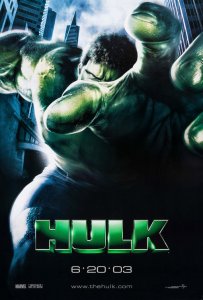 Comic book movies are all the rage these days. The X-Men films, Spider-Man, even Daredevil all managed some level of success because they were, at their heart, entertaining pulp and treated the source material with some sense of reverence. Now Ang Lee’s monstrous film Hulk lumbers into theaters and one could best describe it as being too serious for its own good.
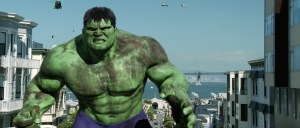
Bruce Banner (Eric Bana) is the quiet guy, the one who bottles everything inside. His lab partner Betty Ross (Jennifer Connelly) has recently broken off their relationship due to his emotionally shut-off demeanor. Well Bruce gets hit with a lethal dose of gamma rays and it kicks up something inside him. You see, Bruces long-absent father (Nick Nolte, looking frightfully like his drunken mug shot photo) experimented some kind of regeneration serum on himself. When he fathered Bruce he passed on whatever genetic alteration. So now when Bruce gets mad he turns into a 15-foot raging Jolly Green Giant (the CGI in this movie is not good). He starts enjoying the freedom letting go can bring. Nothing gets him more mad than some yuppie (Josh Lucas, badly miscast) trying to buy out his lab and then kill him to sell his DNA to the military. Along the way, Betty’s father (Sam Elliott) tries to hunt Bruce and his greener-on-the-other-side alter ego for the good of us all.
 Director Ang Lee has injected most of his films with a sense of depression and repression, from the biting and darkly astute The Ice Storm to the stoic Gary Cooper-like silence of the aerobatic samurai in Crouching Tiger, Hidden Dragon. He’s a master filmmaker without question. Lee bites off more than he can chew with Hulk much like the gifted Cameron Crowe did with the sci-fi Vanilla Sky. Lee is so damn ambitious that Hulk tries to be everything and it ends up fulfilling nothing. His film is the most ambitious and the most tedious super hero/comic book movie of all time. What does it say when the super green Hulk has more personality than the bland Bruce Banner?
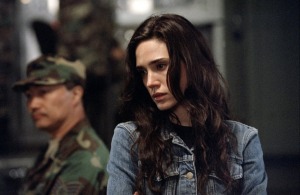
The acting is a non-issue here. Connelly remains one of the most beautiful women in all of movies and has incredibly expressive eyes and brows. She has this strand of hair thats always in the right side of her face. It’s so awkward. Bana gets the least fun part as the mentally scarred kid afraid of his own anger. He doesn’t do much but then he isn’t given much. Elliott overacts with impressive gusto whereas Nolte overacts like every line was his last breath.
After about an hour or so of beleaguered talking and flat characters, I started to become restless. I wanted to see Hulk smash, Hulk smash good. Instead what you get is endless scenes of cheesy speeches, sci-fi babble speech, phony philosophy, and mind-numbingly awful pacing. Seriously, Hulk has worse pacing than glaciers. You’ll see the Mona Lisa yellow faster than this movie will be over. And in some weird paradox, I think it will never be over.
 Lee attempts to make the film a living comic book. You’ve never seen this many wipes short of a Brady Bunch marathon on TV Land. Lee splits his screen into multiple panels and slides them around much like the layout of a comic book. However, this visual cue is overused and calls attention to itself in a how arty are we kind of pretentious way. If Hulk was attempting to be a comic book movie, then where the hell did all the action go? This movie could have been subtitled The Hulk Goes to Therapy because everything excluding an over-the-top final act revolves around people working out childhood issues. Man, there’s nothing I like to see more during the summer than a $150 million dollar movie about people working out childhood issues. Oh yeah!
Hulk is an overlong and ambitiously meandering film thats incredibly serious, incredibly labored, and incredibly boring. Someone needs to tell the creators of this film to lighten up. The big-screen adaptation of the big green id may have heavy doses of Freudian psychoanalysis (try and tie THAT with the merchandizing onslaught) but the film is barren when it comes to fun. Even comic book fans should be disappointed. I heard a story of a kid who saw Hulk and asked his mom when the movie was going to start, and she replied, “90 minutes ago.” Should you see Hulk in the theater at full price? No. Instead, give your money to me. It will have more resonance and action than anything this bloated, joyless, self-important vacuum of entertainment could offer.
Hulk mad? Audience mad! Audience leave theater. See other better movies instead. Hulk sad. No Hulk 2. Audience happy.
Nate’s Grade: D+


 nathanzoebl
You must be logged in to post a comment.