Blog Archives
Saturday Night (2024)/ September 5 (2024)
Recently two ensemble dramas were thought to have awards potential that never materialized, and I think I might know at least one reason why: they are both undone by decisions of scope to focus on either a single day or a 90-minute period to encapsulate their drama.
 With Saturday Night, we follow show creator Loren Michaels (Gabriel LaBelle) the night before the premiere episode of the iconic sketch TV series, Saturday Night Live. The story is told in relative real time covering the last 90 minutes before its initial 11:30 PM EST debut in 1975. We watch Michaels try and deal with squabbling cast members, striking union members, failing technology, his ex-wife (Rachel Sennot) who also happens to be a primary producer of the show, muppets, and studio bosses that are doubtful whether this project will ever make it to air. I understand in essence why the real-time setting is here to provide more pressure and urgency as Michaels is literally running out of time. The problem is that we know the show will be a success, so inventing doubtful older TV execs to add extra antagonists feels like maybe the framing by itself was lacking. Think about Air but you added a fictional exec whose only purpose was to say, “I don’t think this Michael Jordan guy will ever succeed.” There are interesting conflicts and subplots, especially with the different groups that Michaels has to manage, but when it’s all stuffed in such a tight time frame, rather than making the movie feel more chaotic and anxious, it makes those problems and subplots feel underdeveloped or arbitrary. I would relish a behind-the-scenes movie about SNL history but the best version of that would be season 11, the “lost season,” when Michaels came back to save the show and there were legitimate discussions over whether to cancel the show. Admittedly, we would already know the show survives, but does the public know what happened to people like Terry Sweeney and Danitra Vance? Does the public know what kind of sacrifices Michaels had to make? That’s the SNL movie we deserve. Alas, Saturday Night is an amiable movie with fun actors playing famous faces, but even the cast conflicts have to be consolidated to the confined time frame. This is a clear-cut example where the setting sabotages much of what this SNL movie could have offered for its fans.
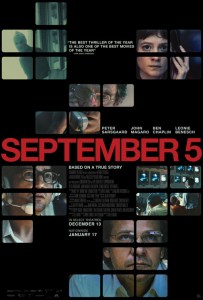 With September 5, we remain almost entirely in the control room of ABC Sports as they cover the fateful 1972 Munich Olympics after the Israeli athletes are taken hostage by terrorists. It’s a subject covered in plenty of other movies, including Steven Spielberg’s Munich and the 1999 Oscar-winning documentary One Day in September, but now we’re watching it from the perspective of the journalists thrust into the spotlight to try and cover an important and tragic incident as it plays out by the hour. It’s an interesting perspective and gives voice to several thorny ethical issues, like when the news team is live broadcasting an oncoming police assault, which the terrorists can watch and prepare for as well. The movie is filmed in a suitable docu-drama style and the pacing is as swift as the editing, and that’s ultimately what holds me back from celebrating the movie more. It’s an interesting anecdote about media history, but September 5 fails to feel like a truly insightful addition to the history and understanding of this tragedy. It’s so focused on the people in the studio and restrained to this one day that it doesn’t allow for us to really dwell or develop in the consequences of this day as well as the consequences of their choices on this fateful day. The movie feels like a dramatization of a select batch of interviews from a larger, more informative documentary on the same subject. It’s well-acted and generally well-written, though I challenge people to recall any significant detail of characters besides things like “German translator” and “Jewish guy.” It’s a worthy story but one that made me wish I could get a fuller picture of its impact and meaning. Instead, we get a procedural about a ragtag group of sports journalists thrust into a global political spotlight. There’s just larger things at stake, including the inherent drama of the lives at risk, than if they’ll get the shot.
Nate’s Grades:
Saturday Night: C+
September 5: B
Share this:

Ghostbusters: Frozen Empire (2024)
 I am a lifelong Ghostbusters fan, I enjoyed the 2021 reboot, and I come to the sequel, Frozen Empire, as one of those fans that grew up with the cartoon series in the 1980s. There is a contingent of Ghostbusters fans who dismiss the movie as merely a comedy about a bunch of schlubs who resort to paranormal shenanigans to make a buck, and these fans dismiss anything larger in world-building, mythology, or direct sincerity as missing the point. I disagree. There can be a vivid, flourishing world of supernatural beings and connections to the human world, if you can tell a compelling story with characters we want to follow. Frozen Empire is an okay TV episode expanded into movie form, finding little for most of the voluminous characters to do. There’s an ancient evil and tying back the legacy characters, who don’t present much meaning beyond extended cameos. The 2021 movie had me on an emotional level, saying goodbye to a character and seeing how that loss has affected multiple generations of his estranged family. The closest thing Frozen Empire features to emotion is young Phoebe Spangler (Mackenzie Grace) wanting to be treated like a responsible adult and making friends with a ghost girl. It’s kind of sweet, and it’s smart to tie this friendship into the larger threat. The movie has several side plots littering the peripheral, from Finn Wolfhard trying to catch Slimer and being trusted to drive the Ecto-One, to Paul Rudd trying to find his footing as a stepdad, to Kumail Nanjiani as a junk dealer learning to follow his family’s noble mission of protecting others. I liked learning more about Winston’s (Ernie Hudson) Men in Black-style secret agency of studying ghosts and testing out new supernatural tech, and it presents a fun new setting where we can learn more. The ultimate story about defeating an evil spirit, coming together as a team, and learning to give others room to succeed or fail all seem a little pat, a little too familiar. It’s fine that this movie has lower stakes, even with a would-be apocalyptic threat of ancient evil. Not every movie needs to avert the apocalypse. It feels like little thought has been given to extending the new characters from the 2021 movie. There are too many characters to service here, which is why everyone other than Phoebe feels like a nascent supporting character or overextended cameo at worst (did we need the return of Podcast?). It’s still a fun movie that any Ghostbusters fan will likely find enough to enjoy, but it also feels like it might be the last Ghostbusters movie, at least this iteration, and it ends with a reminder of what the franchise can be, at its best, but also a warning of what it can be without careful development and vision.
Nate’s Grade: B-
Share this:

Teenage Mutant Ninja Turtles: Mutant Mayhem (2023)
 As an elder millennial, the Teenage Mutant Ninja Turtles have been a formative franchise for me. I grew up on the cartoon, got the toys for Christmas, died endlessly during the shockingly hard underwater stage of their Nintendo video game, and generally have a soft spot in my 80s nostalgia for the likes of Leonardo, Donatello, Raphael, and Michelangelo, plus their surrogate father, Master Splinter. Apparently Seth Rogen felt the same way, and he and his writing partner Evan Goldberg have spearheaded a new animated variation of TMNT that just so happens to also be co-written and directed by the man behind my favorite film of 2021, The Mitchells vs. The Machines. It was a recipe to guarantee my personal enjoyment, and Mutant Mayhem thusly delivered. The biggest selling point for me was how lovingly realized the “teenage” part of the title was, getting a foursome of actual adolescents to portray our heroes, and using high school experience about acceptance and fitting in as effective and even poignant parallels. I loved just hanging out with these characters, who view their surrogate dad (voied by Jackie Chan) with a mixture of love and embarrassment, and who want to be accepted by a world predisposed to finding them monstrous. Naturally, becoming crime-fighting heroes is their best method for winning over the public, with a young and aspiring journalist April O’Neil (The Bear‘s Ayo Edebiri) hoping to improve her own social standing at school by breaking the existence of these unknown mutants. The comedy is robust and layered while allowing for nice character details and moments, giving each turtle their own satisfying arc. The action is fun and inventively staged while still being thematically relevant. The vocal cast is great, and the young actors are tremendous together, sparking an enviable improvisational energy that made me smile constantly. The art style has an intentional messiness to it, like smeared colored pencil drawings, and the imperfections are themselves part of the vast visual appeal. It’s a family movie that will succeed with old fans and new, and Mutant Mayhem is the best film depiction yet of the famous heroes in a half-shell.
Nate’s Grade: B+
Share this:

Gangs of New York (2002) [Review Re-View]
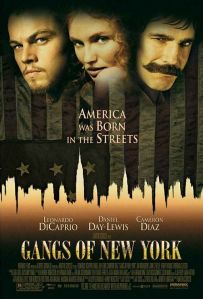 Originally released December 20, 2002:
Watching Martin Scorsese’s long-in-the-making Gangs of New York is like watching a 12-round bout between two weary and staggering prize fighters. You witness the onslaught of blows, see the momentum change several times, and in the end can’t really tell which fighter is victorious. This is the experience of watching Gangs of New York, and the two fighters are called “Ambitions” and “Flaws.”
The film begins in the Five Points district of 1840s New York among a vivid gang war over turf. Amsterdam (Leonardo DiCaprio) witnesses the slaying of his father, Priest Vallon (Liam Neeson), at the blade of William “Bill the Butcher” Cutting (Daniel Day-Lewis) and his “Native” Americans gang. So what does this son of a dead preacher-man do? Well he grows up, plots revenge by making a name under the wing of the Butcher becoming like a surrogate son. But will vengeance consume him?
 Watch Leo DiCaprio assemble toughs, rake heels, and ne’er do wells to his Irish gang of rapscallions with facial hair that looks to be tweezed! Witness a one-dimensional Leo suck the life out of the film like a black hole! See Leo become the least frightening gangster since Fredo. Watch the horribly miscast Cameron Diaz play pin-the-tail-on-an-accent! Witness as she tries to play a pickpocket with a heart of gold that falls hopelessly and illogically in love with Leo! Marvel how someone looking like Diaz would exist in a mangy slum! See the brilliant Daniel Day-Lewis upstage our stupid hero and steal every scene he inhabits! Witness one of the greatest villains in the last decade of movies! Watch Day-Lewis almost single-handedly compensate for the film’s flaws with his virtuoso performance! Admire his stove-top hat and handlebar mustache!
Witness a wonderful supporting cast including John C. Reilly, Jim Broadbent and Brendan Gleeson! Wish that they had more screen time to work with! Wonder to yourself why in all good graces this film took nearly two years of delays to get out! Speculate away!
Gangs has the sharp aroma of a film heavily interfered with by its producers. The whole exercise feels like Scorsese being compromised. Gangs is a meticulous recreation of 1860s New York that often evokes an epic sense of awe. The story has more resonance when it flashes to small yet tasty historical asides, like the dueling fire houses and the Draft Riots. But all of these interesting tidbits get pushed aside for our pedantic revenge storyline with Leo front and center. You know the producers wanted a more commercial storyline, which probably explains why Diaz has anything to do with this.
 The script is credited to longtime Scorsese collaborator Jay Cocks, Steven Zallian (Academy Award winner for Schindler’’s List) and Kenneth Lonergan (Academy award nominee for You Can Count on Me). So with all these writing credentials, don’t you think one of them would realize all of the dumb things going on with the story? The ending is also very anticlimactic and ham-fisted. Just watch as we segue from a graveyard to present day New York, all thanks to the Irish rockers of U2!
I know this much, Day-Lewis needs to stop cobbling shoes and act more often. Gangs is his first visit to the big screen since 1997’’s The Boxer. He spent part of this hiatus in Italy actually making shoes. I don’’t know about everyone else but this man has too much talent to only be acting once every five years. Somebody buy his shoes and get him a script, post haste!
Scorsese’s Gangs of New York is at times sprawling with entertainment in its historic vision and at other times is infuriating, always dragging behind it a ball and chain called “stupid revenge story/love story.” I’’m sure the film will get plenty of awards and Oscar nods in prominent categories, and this seems like the Academy’’s familiar plan: ignore a brilliant artist for the majority of their career and then finally reward them late for one of their lesser films. So here’’s hoping Scorsese wins the Oscar he deserved for Raging Bull and Goodfellas.
Nate’s Grade: C+
——————————————————
WRITER REFLECTIONS 20 YEARS LATER
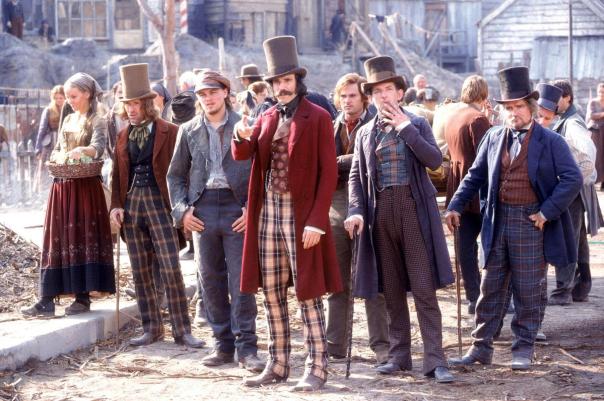
It is rare to find a movie that is almost exact in its percentage of good aspects and poor aspects. This 50/50 balance is best exemplified by 2002’s Gangs of New York. The ten-time Oscar nominated movie (and zero-time winner) was intended to be director Martin Scorsese’s epic, and twenty years later it’s still his biggest movie in size. Scorsese waited twenty years to tell this sprawling story of New York City’s early criminal underworld, so at 160 unwieldy minutes it’s no surprise how overstuffed and unfocused the finished product ended up. It’s a movie with so many engrossing historical anecdotes, amazing texture and supporting actors, and a stunning return to upper-tier acting by Daniel Day-Lewis, and yet it is hampered by Leonardo DiCaprio’s lackluster storylines, both for vengeance and for love (maybe a love of vengeance?). It’s so bizarre to watch this movie because there can be sequences where the movie just excels, and then there are sequences where I just want to sigh deeply. It’s like the movie is in conflict with itself, and you, the viewer, are ultimately the frustrated victim.
Let’s focus on the good first. Day-Lewis had essentially retired from acting and went to work in Italy as a cobbler until Scorsese appealed to him to reconsider acting. Every second this man is onscreen deserves your utmost attention. DiCaprio was the advertised star of the movie but Day-Lewis was the real star. The movie is almost a Trojan horse of sorts, luring you in with a standard revenge plot line only for you to lose all interest and root for the charismatic villain. Day-Lewis is so enthralling, so commanding as Bill the Butcher that every moment he is absent feels like an eternity. He remained in character for the duration of the shoot, spooking waitresses, and learned how to throw knives from circus performers and how to cut meat from an actual butcher. Considering the man’s famous Method-acting approach, I wonder just how many skills Day-Lewis has acquired over decades. This man could be the living embodiment of Michelle Yeoh’s character in Everything Everywhere All at Once, able to, at a moment’s notice, tap into a uniquely honed skill-set upon need. I wish that itself was a movie; Day-Lewis filming a role when terrorists invade the set, and now he has to utilize every lesson and skill of his past acting roles to defeat the baddies and save the day. He may be the most interesting man in the world. Since Gangs, Day-Lewis has only appeared in five other movies, and amazingly he has been nominated for Best Actor three times, winning twice (that averages an Oscar every 2.5 movie roles). This man has become like an acting Halley’s Comet, waiting for him to swing around again and burn brightly and then, just as suddenly, pass back into the lengthy waiting period.
I loved the historical asides in this movie. I loved the scene showing, in one unbroken take, Irish immigrants stepping off the boat into New York harbor and getting immediately signed into service, given a rifle and uniform, and lined up to board another boat to fight the Confederacy. I loved the entire character of Boss Tweed (Jim Broadbent) and how transparently corrupt he is, reminding me of Claude Rains in Casablanca. I loved him competing with the dozens of other firefighting units squabbling over turf while a house burned down to cinders. I loved him scrambling for some entertainment for the masses, and he asks Bill to gather up four nobodies that they can publicly hang, and then we cut right to these relatively innocent men saying their last words before being hanged, including one man’s young son watching. It’s an incredible sequence. The culmination of the 1863 Draft Riots is terrific and maximizes the messy nature of the movie best, communicating the many breaking points that lead to this notorious riot. The opening of this movie is wonderful and a terrific mood setter as we watch the members of the Dead Rabbits assemble for battle, with the rattling percussive score by Howard Shore (The Lord of the Rings), finally breaking outdoors and watching gangs advance like armies. I loved the narrated history of the different gangs settled in New York and their peculiarities and fixations. I loved the before and after stories of Happy Jack (John C. Reilly), who settled as a corrupt police officer, and Monk McGinn (Brendan Gleeson), a mercenary who tries to go straight through, of all things, politics. I loved that the movie reminds us that just because these people reside in the North doesn’t stop them from being racist (an archbishop is especially aghast at a black man being allowed in his church). I loved the occasional P.T. Barnum appearance. I loved the proliferation of so many tall hats amidst all the handlebar mustache-twirling villainy. I loved when the movie felt like a living documentary, soaking up the richness of the recreated history.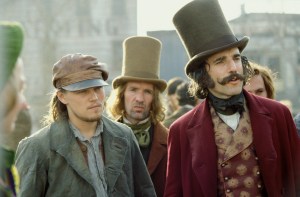
Where the movie sputters is with just about all that involves DiCaprio’s character, Amsterdam. The revenge storyline is just so boring compared to everything else going on, enough so that I think even the movie forgets about it. Amsterdam becomes Bill’s budding protege and literally saves his life at several points (if your goal is for him to die, why save the man?). He’s such a boring character because all he thinks about is vengeance, so every relationship he builds is only about how much closer to achieving his goal he can be. Amsterdam is a thoroughly dull character, and DiCaprio doesn’t come across as a credible tough guy yet, especially diminished in the large shadow from Day-Lewis’s Butcher. It wasn’t until 2006’s The Departed where I felt like he shed his boyishness fully to play a credible adult man. DiCaprio has been great with Scorsese, and this movie was the start of a decade of collaborations (four movies, two Oscar nominations), but he feels miscast here as a brooding hero given inordinate attention.
Worse is the romance with a pick-pocket prostitute played by Cameron Diaz. I pity Diaz. She’s been given the spunky love interest role in the Oscar-bait movie, which is generally underwritten and only viewed as aiding the hero’s journey of our male lead or being the offramp not taken (“Don’ get y’er refenge, Amsti’dam, ‘stead come wit me to San Fran in Calyfer’nia”). This is not a good character and she’s meant to give voice to the female underclass perspective, so it’s even more irksome when her headstrong, defiant nature gets sublimated as a rote romantic option. Diaz is also woefully miscast and my 2002 quip of her playing “pin-the-tail-on-the-accent” is accurate. I might argue that maybe dramas aren’t her strong suit, but she was great in Being John Malkovich and In Her Shoes and The Holiday, though all of those had notable comedy elements. She has the ability but this might just have been too unfamiliar for her, and so she struggles throughout with a character defined by her sexual connections to the villain and the hero.
While these characters and the performances are the biggest misses in Gangs of New York, there are other misguided or poor elements adding to that 50/50 margin. The opening sequence is great until the actual gang warfare begins and you realize that Scorsese, arguably the greatest living American director, cannot direct action to save his life. The action is choppy and lacking any of the kinetic qualities we associate with most Scorsese movies. Not even the talents of editor Thelma Schoonmaker can help save this deficit. The movie’s overall scattershot nature also makes it rather uneven and difficult to build momentum. The ending plays out like a footnote to the Draft Riots and robs the viewer of whatever catharsis could be granted from the long vengeance plot. If the whole movie has been leading up to Amsterdam’s vengeance, well robbing him of it could be meaningful, if the self-destructive nature of vengeance had been a theme. It’s not like Amsterdam has suffered at all, beyond the occasional stab wound or black eye, so him learning a lesson about the futility of vengeance would seem inappropriate and trite. I also want it known for posterity that there is an un-credited actor listed online as playing “Hot Corn Girl.”
”Twenty years later, Gangs of New York is still a frustrating and sometimes exhilarating viewing. It began a road for Scorsese that led to him finally winning his first, and still only, Oscar for directing The Departed. The sprawling nature of the movie is both a blessing and a hindrance. It allows for a wider scope and cast of characters but it also means that if you’re liking a subplot or a supporting character, you’ll have to wait your turn before they re-emerge. My old review back in 2002 perfectly sums up the majority of my feelings in 2022. There’s much to see and much to like with Gangs of New York but also too much to restrain its potential greatness.
Re-View Grade: C+
Share this:

West Side Story (2021)
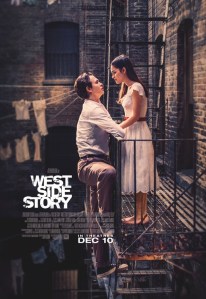 Steven Spielberg, now approaching seventy-five years of age, has experienced such rarefied success as a film director that the man can do whatever he wants. It just so happens he wanted to tackle his first big screen musical, something he’s a little late on considering peers like Martin Scorsese (1977’s New York, New York) and Francis Ford Coppola (1982’s One from the Heart) beat him to the musical punch early. The question isn’t why direct a musical at this stage of his glorious career, it’s why direct a remake of 1961’s Best Picture-winning West Side Story? We already have a perfectly good and revered movie version, and there are other musicals that haven’t even gotten their first big shining moment on the silver screen, so why go back to this particular show a second time?
Once again, we’re following the two New York City street gangs, the Jets, who are made up of Italian and Irish white kids, and the Sharks, made up of Puerto Ricans. Tony (Ansel Elgort) is trying to reform his ways after spending a year in prison for gang violence. The Jets are pleading with him to get back involved, to push back against the Sharks encroaching on their territory. He meets Maria (Rachel Ziegler) at a dance and the two fall instantly in love. The problem is that Maria is Puerto Rican, her brother is the leader of the Sharks, and this relationship would be forbidden and dangerous. Tony and Maria plan to run away together and escape the conflicts of this tragic turf war.
 I’ll risk musical theater heresy and admit outright that Spielberg’s West Side Story actually improves on the much-hallowed 1961 original in several ways. The most immediate and obvious is that we have Hispanic actors playing Hispanic characters. No regrettable brown face including the actual Hispanic actors this time (it’s just humiliating to watch Rita Moreno, in her Oscar-winning role, have to be darkened up to be “more Puerto Rican”). That’s a pretty good improvement already, though it’s not unexpected; 1961 was also the year Breakfast at Tiffany’s was released with its notorious Mickey Rooney performance in jaw-dropping yellow face. Granted, jaw-dropping today, not so back then. 1961 was still only a few years removed from John Wayne taping his eyelids back to portray Genghis Khan. This was the unfortunate norm.
Another immediate improvement is the visual dynamism of 60 years of technical filmmaking advancement. I recently re-watched the 1961 original, a film I haven’t watched since probably the 1990s as a teenager, and it’s a relatively good movie but it’s also a good movie of its time, and by that I mean there are limitations to the presentation. One of the most appealing aspects of movie musicals is how they expand upon our humdrum reality, the splashes of color and synchronicity and bold imagination. I’m not saying the movie musicals of the 1960s were particularly lacking, as there are many classics and favorites, but because of filmmaking practicalities and predilections, movies could only go so far at the time. With 60 years of technological advancements, today’s movie musicals, when under the right guidance, can expand the world of song-and-dance fantasy like few of the past. You need only compare the showstopper “America” in both films, the dancing high-point of either film. The original is on a rooftop for its entire duration. The new version is all over the city block, finally culminating on a crossroads and bringing the denizens of the town out in girl power empowerment. It’s such a high-energy and celebratory sequence and the scale and variance really make it feel so much more joyous and exciting. The choreography is also an improvement. Again, not a slight against the 1961 original, but in the ensuing 60 years we’ve also advanced in the technical precision and creativity of dancers. The 2021 West Side Story is impressive top to bottom with the dancing of all the performers, and with Spielberg as director, he wants you to best appreciate their talents while also making the movie as visually dynamic as he can.
 Spielberg proves an absolute natural at helming a big movie musical. Nothing against Robert Wise, the 1961 director who helmed plenty of influential Hollywood titles like The Sound of Music, The Day the Earth Stood Still, I Want to Live, and Star Trek: The Motion Picture. He was also the editor on Citizen Kane. The man clearly knew how to tell a big screen story across multiple genres. It’s not a shame to say his visual prowess doesn’t quite stack up to a Steven Spielberg, who just happens to be one of the most popular and versatile filmmakers of all time. Spielberg’s camera is much more active than the original movie, and he’s consistently bringing us into the scene, having characters duck in and out of frame, and circling around, always interacting with the world. It makes the movie much more visually immersive and exciting, enlivening an already lively number like the dance hall rivalry between the Jets and the Sharks where each side crowds the edges. The movie operates on a high level of visual pleasure because Spielberg knows exactly how to play to the strengths of the musical genre. Spielberg incorporates the location in each setting and has fun visual flourishes, clearly having given great thought how to visualize every line in each song. The opening of “America” involves women placing clothes on a line, and as the clothes move, it reveals our newest chorus member giving voice to the continuing song. The way the camera moves through the neighborhood to note the encroachment of gentrification. The way he frames the faces of our young lovers. The way he uses shadows as menace. The way he makes every space feel like it’s perfectly utilized for the best shots and edits. Now that Spielberg has proven so adept at handling musicals, somebody please give this man another for our collective benefit.
The top actors are not the leads but two very mesmerizing supporting players. Ariana DeBose, previously seen as one of the ensemble members in 2020’s Hamilton, is pure dynamite as Anita. She explodes with verve and personality and attitude and vibrant life, and the camera loves every second she’s on screen. She gets the bigger emotional arc than Maria. She gets the jubilant song, the aforementioned “America,” and gets her crushing moments of heartache as well. DeBose is phenomenal, and likewise so is Mike Faist (Panic) as the leader of the Jets. Like Anita, this character is brimming with anger and attitude and the movie does a much better job than the 1961 film of presenting him with a point of view that can develop some empathy. Faist is lanky yet so smooth in his movements, and he gets more dancing than just about anyone. He’s balletic in his dancing while still upholding his spiky attitude. Both of these actors are so self-assured in their roles, so vulnerable behind the surface, and so accomplished with their dancing and singing that one wishes the movie would devote more time to both of them.
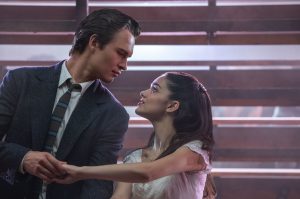 As for our leads, Ziegler and Elgort (Baby Driver) are good but unexceptional as our naifs in love. Ziegler can sing beautifully and definitely has a natural innocence to her appearance. Her eyes are so large and glassy that she reminded me of an animated character at points. Elgort is solid in his singing but I can’t help but feel that he’s been lapped by his co-stars. There is a comic relief musical number, “Gee Officer Krupke,” where the various Jets have fun imitating the nay-saying adults who hastily cast judgement upon these juvenile delinquents. It’s a silly number about guys goofing around and could easily be the first on the chopping block to be cut for time. However, over the course of this fun diversion, I realized that person-to-person in the Jets crew, the same guys that just appeared as background players to fill out a scene previously, how good every person is, and how much more time I wish they had gotten than Elgort. Part of this is that the romance aspect of West Side Story has always been the weakest part of the show. It’s based upon Romeo and Juliet and tied to those tragic plot events, but when both Maria and Tony are ready to run away and marry one another after a single night, and especially after the fateful rumble where Maria is so astonishingly quick to forgiveness (and horniess), the romance plays so incredulously. As a result, the two lovers are essential to the story but also the most boring characters too.
I think the adaptation by Spielberg screenwriting stalwart Tony Kushner (Munich, Lincoln) has smartly updated plenty of political elements, amplifying racial tensions but looking at it over a broader scope. Giving Tony a mentor figure in an older woman who runs her drug store shop, played by Moreno, is a great choice, especially as she represents a medium between the two sides as she is Puerto Rican but her deceased husband was white. It’s smart to have someone from the community and so wise to try and impart lessons to Tony, especially as he wants to change for the better. One update from Kushner didn’t quite jibe for me and felt like token-ism. The youngest member of the Jets, a prepubescent pipsqueak, has been replaced with a trans man fighting for membership. I understand the basic character arc is the same, the outsider trying to be accepted by the group, but the consideration of trans acceptance in the 1960s wasn’t exactly enlightening. The other Jets tease and question the gender identity of the trans man, but this perspective never feels well integrated into the play’s prejudicial world. I suppose more could have been done like having the Sharks harass this character, belittling them over their identity, and then the Jets feeling like one of their own had been attacked and in that they would finally be accepted. Except this inclusion would be around the degradation and potential assault of a trans person, which itself is not the best reason to include a trans character if you’re just setting them up for trauma. I don’t know. This character could have easily been removed if this was all there was.
 One other aspect I found cumbersome was the creative decision to not include English subtitles during the Spanish-speaking portions of the movie. I cannot understand the artistic rationale for this at all. Sure, Spanish-speaking viewers will be fine, and I could piece enough together with context clues and my rudimentary understanding of like 75 Spanish words, but what are we accomplishing here? It just feels alienating, and it inadvertently likens the viewing experience to what the Jets are going through, feeling like they cannot fully understand their new neighbors. I doubt that Spielberg and company wanted to reinforce the perspective of xenophobia, but purposely removing a key portion of your movie from the majority audience in the U.S. seems so strange to me. If it was just scant conversations or moments, I’d excuse it, but the untitled Spanish accounts for like ten percent of the whole movie. Imagine watching any foreign movie without the subtitles on screen. How much meaning are you able to devise on your own?
West Side Story 2021 is a good time for fans of musical theater and a testament that just because something is old and beloved doesn’t mean it can’t even be improved upon with the right people and goals. Both movies are about the same length, 150 minutes, which seems the de facto standard for movies this holiday season, and you’d have a good time with either. I think the updated version adds more visual creativity, impressive choreography, and remodeled racial and political considerations to make it land better for modern audiences. It might not have been needed but I’m glad all the same we now have two West Side Story movie musicals to cheerfully tap along to.
Nate’s Grade: B+
Share this:

tick… tick… BOOM! (2021)
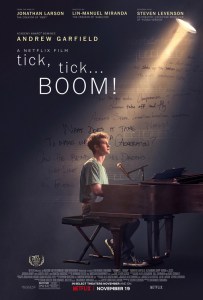 Netflix’s tick, tick… BOOM! is a cause celebre that has attracted none other than the likes of Lin Manuel-Miranda. This is Miranda’s directorial debut, which Netflix won in a bidding war, and it’s filled to the brim with Broadway legends and theater titans who all want to rally to the cause of bringing alive the other show of Jonathan Larson’s tragically short career. Larson would go on to create the hit musical Rent but died before it opened to the public, succumbing to a sudden aortic aneurysm at the age of 35. He never lived to see the tremendous success of Rent and that legacy is the emotional substance of tick, tick… BOOM!, if you happen to know about it. The story, and consequently the movie, feel like a lob to the insulated world of theater aficionados. The movie is semi-autobiographical about Larson (Andrew Garfield) on the verge of turning 30 in New York City in 1990 without achieving his big artistic dreams. He’s been toiling with a satirical sci-fi musical opus for years and is close to finishing it for a make-or-break presentation. The movie is based on Larson’s one-man show detailing his creative process and being young and hungry in New York in the early 90s. It was moderately successful and paved the way for Rent, but it was further adapted in 2001 into a three-person show, which has expanded even further with the film. The songs, written and composed by Larson, are enjoyable but none of them really stand out. I may have liked the least substantial one the best where Larson sings about his distaste at serving brunch patrons in a parody of Stephen Sondheim’s Sundays in the Park with George. The sequence is also wall-to-wall with Broadway cameos. I could not better emotionally connect with the movie. It hangs with looming tragedy of Larson’s surprise death, only five years away, as he wants to do something great with his life and make artistic waves. I think if you removed that added dramatic irony of tragedy, it’s watching a young artist struggle in the theater scene and hold onto his vision, integrity, and friendships, something we’ve seen but benefits with the verve of perosnality. As a story, it’s fallen into a trap where the struggles can be quite relatable to aspiring creatives and also not specific enough to greatly care about Larson as a character onscreen. Garfield sings well and is perfectly charming. Miranda proves apt with the language of film to translate from the confines of the stage. The entire project feels suffused with admiration and good intentions. tick, tick… BOOM! is a labor of love from many theater professionals. It’s an amusing but emotionally limited musical experience. Still, with this much talent, heart, and good will, it’s worth watching for no other reason to see what Miranda and his theater brethren can do together when trying to celebrate one of their own.
Nate’s Grade: B
Share this:

In the Heights (2021)
 Weeks ago, I listened to the original Tony Award-winning 2008 Broadway recording for In the Heights, the first major musical by multi-hyphenate artistic virtuoso, Lin-Manuel Miranda. I had never heard the music before and I found that, over the course of a couple hours, little of it stuck with me. There were a handful of tracks where I thought it was nice but nothing grabbed me the way that Hamilton’s soundtrack did from the very start. Because of that musical dip, my expectations lowered slightly for the long-anticipated movie musical of In the Heights. Well, dear reader, let me say what a monumental world of difference seeing the songs in their proper context, with character relationships, and the able performances of the actors can do for making the music come alive. In the Heights is an exuberantly joyous experience, one brimming with energy and good vibes and a warm-hearted welcome that serves as the best argument movie theaters can have to come back and experience the pleasures of the big screen with your friends and family.
Usnavi (Anthony Ramos) is a twenty-something bodega owner in New York City’s Washington Heights neighborhood and dreaming about returning to his home in the Dominican Republic. His young cousin Sonny (Gregory Diaz IV) helps him stock the shelves and keep the family business going. We follow the many faces of the neighborhood, like Abuela (Olga Merediz), who has helped raise everyone as a sweetly matronly figure, Nina (Leslie Grace), returning home from her first year at Stanford as the “girl who made something of herself,” Benny (Corey Hawkins) who was in a relationship with Nina and is looking to work his way up as a cab dispatcher, Daniella (Daphne Rubin-Vega) who is moving her popular salon into another neighborhood, and Vanessa (Melissa Barrera), an aspiring fashion designer who dreams of relocating into Manhattan’s fashion district. Usnavi has been nursing a crush over Vanessa for ages, but will he finally make a move before leaving the country for good to return to the Caribbean?
 This is such a positive and overwhelmingly optimistic story that it becomes infectious, a pleasing balm to sooth all that ails you. It’s very easy to get swept away in the enthusiasm and energy of the movie, enough so that after the exemplary opening number setting up our characters, our setting, and our relationships and goals, people in my theater actually clapped, and I almost felt like joining them. In the Heights succeeds through how relatable and specific it comes across, lovingly showcasing the diverse population of Washington Heights and the community that feels at home here. It’s built upon the celebration of its specific, Latin-American heritage and culture but the movie is also constructed to be so accessible and welcoming to others to learn and join in. The themes and conflicts of these people have specific touchstones to their community, like the threat of deportation and the encroachment of gentrification taking away their neighborhood, but the inner conflicts like feeling the pressure to succeed and questioning whether your dreams are practical are worries that anyone regardless of ethnic background can relate to. In the Heights finds that sweet spot where it’s reverential to its own cultural background and open for anyone.
Naturally, in a musical, much of the appeal will live or die depending upon the quality of the music and the vitality of the performances. With In the Heights, the music and lyrics are quite good and the presentation is phenomenal. If you’re a fan of Hamilton, and if you have ears I assume you would be, it’s fun to listen to the early seeds that would become the signature sound for Lin-Manuel Miranda. There are similar salsa/merengue melodies and hip-hop-infused syncopations that will be familiar to the legions of Hamilton fans, including some rhymes (“Eyes on the horizon” among others). In many ways it’s like watching a junior thesis project of a genius. The opening number does a fantastic job of table setting as well as bringing the audience into this world and getting us excited for more. Usnavi, and Ramos especially, takes full control of our attention and command of the world with fast-paced delivery and extra charisma. There are more bouncy, humorous tunes like “No Me Diga” set in a salon replete with literal bobbing weaves, more traditional Broadway ballads like “Breathe” about a character expressing her doubts and guilt, and the Cole Porter-esque smooth jazz of our young lovers dancing and declaring their affection for one another like “When the Sun Goes Down.”
 But the best moments are the ones that open up the big space and bring the whole community of Washington Heights into the mix. The electricity of the opening number is rekindled in “96,000” where a trip to the local pool turns into a jumping jamboree where everyone dreams about what they would do with a winning lottery ticket sold at Usnavi’s bodega. It allows each character an opportunity to share their dream and what is important to them, providing each person a platform to be more defined. It also taps into that bubbling optimism that permeates the entire movie. The grand finale also has the same effect as characters sing their hearts out about lessons learned and wisdom gained and, thanks to the medium of film, it provides a happy ever after resolution that was unavailable on stage. Miranda is excellent at weaving musical themes to come back into multi-harmonic convergences and crescendos, and it all comes to a rousing and uplifting conclusion.
Another concern about big screen musicals is whether they can translate to the visual landscape of cinema, whether they can escape the trappings of the stage, and In the Heights is exactly how musicals should be filmed. Director John M. Chu (Crazy Rich Asians) got his filmmaking start with the Step Up dance franchise and knows, whatever the film, how to keep things moving swiftly and full of vivacious energy. Even at nearly two-and-a-half hours long, In the Heights doesn’t feel like it has any noticeable down time. The filmmaking choices adapt with the needs and intents of the songs, so when we have a fast-paced multi-part song and dance, the editing adopts this speed, and when we have large ensembles the cinematography widens to take in the expansive group choreography. When things need to slow down and become more intimate, Chu’s camera adopts to this and relies on longer tracking shots and close to medium shots. The pool choreography in “96,000” is splashy fun and lively and very colorful, and the quick visual cues and edits of “In the Heights” incorporates the neighborhood into the music to make New York City feel like a living participant. Chu’s direction takes full advantage of what film can offer but still makes the viewer feel the same intimacy and vibrancy of live theater.
 There are two standout movie moments. The first is the song “Paciencia Y Fe” that does so much symbolic heavy lifting about the immigrant experience, discrimination, and the long struggle for personal dignity, that it made me tear up by the end for a character that, only moments before the empathetic expose, was a nominally nice old lady. The other is “When the Sun Goes Down” between Benny and Nina, which begins with them gazing out a fire escape and takes a magical turn into dancing along the walls of their building like Spider-Man. That transitional moment, from the ordinary to the extraordinary, is the only real magical realism in the show, so Chu has been saving it up for his big moment. The dance is beautiful to behold, and the perspective has an Inception-style spin that alters their balance and perspective of what is up. It’s a beautiful movie moment, captured in long takes, and reminiscent of Fred Astaire’s fanciful fantasias.
Ramos (A Star is Born) played John Laurens in the initial stage show of Hamilton, and its filmed production on Disney Plus, and now he gets his own starring vehicle. He is tremendous as Usnavi, convincingly laid back and charming while also being amusingly anxious around his crush. The awkward romantic fumbles are adorable. Ramos’ singing and skill with the flow of rap lyrics is impressive, but he’s also providing a performance first and worrying about the singing second, not that he should be worried on that front. Hawkins (Straight Outta Compton) surprised me with the range of his singing, and he’s such a pleasant presence to have along. Gregory Diaz IV (Vampires vs. the Bronx) is hilarious at times, like when he’s adopting a macho voice to ask Vanessa adult questions, but he can also break your heart like when he reveals his own legal vulnerability. His poolside solo is also a delightful interjection about what his own rap skills comprise. Merediz (Godmothered) is the only holdover from the original stage show and she is so captivating in her signature number that it’s easy to understand why she was nominated for a Tony Award. There are so many amusing and enjoyable supporting characters populated by familiar faces, like the women of the salon (Rent’s Ruben-Vega, Brooklyn 99’s Stephanie Beatriz, and Orange is the New Black’s Dascha Polanco) providing comic relief and a playful attitude, Jimmy Smits as the noble father giving of himself for his daughter’s future, and Miranda and Hamilton’s Christopher Jackson as dueling sweet treat vendors vying for summer supremacy. You’ll enjoy your time in Washington Heights thanks to these fine folks.
It’s unfair to directly compare In the Heights to Hamilton, like looking at an artist’s portfolio and complaining it isn’t quite up to the standards of Da Vinci, but one area where In the Heights does come up short is the depth of its characterization. The film exudes good vibes as it skips over topical and important political issues with an optimism that might, arguably, borderline on naivete. This feels almost like the opposite-minded compliment to Spike Lee’s Do the Right Thing, another tale of a New York City block one very hot day. The characters are kept at a genial level of interest that makes them enough to feel for and root for, but they’re not exactly deep portrayals with complex conflicts. All the characters have a singularly defined personal conflict that can be resolved by the end, and the lessons about learning to listen to others, appreciate family and self, and find home where you feel it are not exactly revolutionary or complex. Again, this stuff works, and I understand why the story needs characters that have lesser complexity and definition to fulfill the different levels of life. It’s just when compared to the depth of the real people of Hamilton where you realize that maybe the colorful characters of Washington Heights are held to a lesser standard and simply not as multi-dimensional.
 In the Heights is a joyous experience that I think I’ll enjoy more upon re-watching and listening to the soundtrack over the summer months. I can completely understand why people fell in love with this musical upon its initial release and touring, and I can also acknowledge that it’s clearly an earlier artistic steppingstone to greater later achievements for Miranda. That’s not to take anything away from the pleasures of this particular story, these particular characters, and especially these particular songs. In the Heights is a lively and welcoming musical experience that carries a deep affection for its cultural roots and invitation for others to join that celebration. It’s powerfully optimistic that it’s so easy to be swept away and smile with its charms and uplift. In the Heights takes advantage of its cinematic opportunities, the charisma and energy of the talented cast, and the soaring and lovely melodies and catchy rhymes from Miranda. In the Heights is a great way to kick off a return to a summer season at the movies.
Nate’s Grade: A-
Share this:

Late Night (2019)
 Late Night follows the fictional long-running TV talk show host Katherine Newberry (Emma Thompson) who has been informed by her network exec that his current season will be her last season. She will be replaced and the show will be retooled. Along comes Molly (Mindy Kaling), an aspiring comedy writer who works in a chemical plant. She’s hired on the spot to serve as a token and offer more diversity in Newberry’s all white, all-male writers room. She has to find herself, find her voice, stand up for herself, and try to get the show to change with the times if it’s going to potentially survive the eager network axe.
For fans of the inner workings of show business, and the ups and downs and push and pull of creatives, Late Night was made for you. I’ve always been fascinated by the nuts-and-bolts of creative ventures in the entertainment industry and especially a writer’s room where people hash out ideas, build out a storyline, and generally bring our TV to life. I enjoyed the short-lived show where Jim Rash would interview different TV showrunners about their writer’s room processes and how they would resolve creative decisions. It’s one reason I loved HBO’s The Larry Sanders Show, a deeply satirical and self-deprecating look at the bowels of Hollywood. So if you’re like me and enjoy the inner workings of creative people working in tandem, then Late Night is already starting on fertile ground for you. Kaling’s world is informed by her years of television writers room experience, as well as running her own show, and that experience better informs the reality of Late Night, from the joke-writing process, to the wariness of content that may push away sponsors, to the means of staying relevant in a vastly changing landscape of how people get their media and entertainment. You feel Molly’s sense of triumph, and disappointment, when her first joke is placed into the monologue and then removed. The movie feels informed and real to its tiniest detail, which makes it all the more interesting.
 The film is consistently funny because Kaling is writing with such a sharp grasp of her characters. Right away the dynamic between Katherine, a cynic with an acid tongue, and Molly, an idealist but a novice who is pushing for reforms, establishes so much wonderful conflict and eventual resolution. It’s universally enjoyable watching a character come into her own, transform the lives of others for the better, and to have characters who butted heads form a mutual friendship and understanding. That’s all present, but with Kaling’s command of writing the characters come first. They drive the story, and while the destination is rather predictable with this sort of thing, that doesn’t make the journey any less satisfying. The character of Katherine Newberry is interesting because she’s a woman who has established her own perch in late night, but she’s still older, white, and from an elitist, privileged bubble. She’s stuck in the middle, which makes her such an interesting character to explore and push into new territory. Kaling has mined some talk show headlines for her story’s drama and it doesn’t feel cheap. Past mistakes are given weight and force characters to reckon with them in a way that acknowledges the extent of the ramifications and the people that have been hurt. Kaling also has a generous sense of writing for her supporting players, giving many a small moment to make an impression and enough for serviceable secondary character arcs.
There’s a definite message afoot with Late Night and it goes about it in a way that makes it far more accessible — as entertainment. Rather than dragging out a soapbox, the movie does the smarter ploy by demonstrating why a homogeneous writers room of the same kind of voice/perspective can be limiting and potentially regressive. Molly is the long-overdue change agent to the show, to the characters, and to the old ways of thinking of what television, and by extension the entertainment industry, had to be simply because it had always been that way. The film’s sense of advocacy for representation is strong and a central tenet, but this doesn’t get in the way of telling a good story with enjoyable characters. By demonstrating through its tale, Kaling has smartly packaged her movie as an empathy test designed to expand the perspectives of its audience, to get them to think how difficult it may be for a woman, let alone a woman of color, to find work in her chosen field. It’s the kind of movie you could take your grandparents to and have them nod along in approval.
Allow me to get a little personal here as I reflect on the topic of representation. I think recognizing one’s self and one’s stories is a huge deal. The power of empathy is potentially endless but that doesn’t mean that all stories need to be told from the familiar template of a straight white dude encountering conflict and change. With good storytelling, anybody can feel for anybody’s plight, but that doesn’t mean that those in the industry should stop trying to give voice to others who have historically been marginalized. TV, and particularly late night TV, is something of a boy’s club and needing more women. A recent analysis on late night TV concluded, with the exception of TBS’ Samantha Bee, that the typical late night talk show writing staff is only one quarter female. More people deserve more opportunities to shine because we, as a society, benefit when we have a plurality of stories from a plurality of voices and perspectives. It makes us all better.
 During the summer of 2018, I wrote a rom-com Web series (The Spirit Inside Me) that was told from the perspective of a bisexual woman and dealt with an eventual romance with another woman. You better believe I consulted with my queer friends to make sure every script didn’t feel like it had been written by a straight dude. Then we started to make it a real thing throughout the fall and winter of 2018/early 2019, and the mission statement of the series, and for me, was to try and get as many women involved in the production as we could. There were nine total episodes and I wanted to try and line up as many female directors as possible (if able all of them would be directed by women). Our show was from a feminine perspective, concerning an unorthodox LGBTQ relationship, and I wanted a feminine perspective to imbue as many facets of the production as possible. We put out notices for crew and emphasized that we were looking for women first. You would have thought I had just insulted people’s mothers the way some men responded back. They told me this was “reverse discrimination” and insulting and that the best talent should win out. I dismissed these whiny grievances and continued to seek and hire women. I know many women, even in our small community of filmmaking, don’t get as many opportunities as men. I wanted to give them those experiences. I felt it would make our series better and, personally, it just felt like the right thing to do because I could. With the show currently in editing (stay tuned!), it’s actually one of my happiest decisions as I really enjoyed seeing several women rise to their opportunity and shine. I’m not writing this to pat myself on the back or seek woke plaudits. This is such a slight example of mine over the overwhelming obstacles women face breaking through in a male-dominated industry that doesn’t want to share, but I felt it was worth sharing, dear reader.
Late Night was a movie that kept me smiling and feeling good all over. It warmed my heart, it made me laugh, and it gave me a group of characters to latch onto that earned my affections. Thompson is tart and witty and wonderful. Kaling is lovable and charming and hopeful. They make for a dynamic, combustible combination. Late Night is a fine example about the benefits of diversity, representation, and empathy, and it’s also a cute and funny movie that will make you happy by the time the credits roll. Tune in.
Nate’s Grade: B+
Share this:

The Commuter (2018)
 Liam Neeson has been bedeviled on an airplane. He’s been bedeviled on a train. At this point, Neeson is going to find trouble on every form of public transportation. The Commuter is the fourth collaboration between America’s favorite geriatric action star and director Jaume Collet-Serra (Unknown, Non-Stop, Run All Night). None of those movies had the success of Taken but several had some pleasures or an intriguing mystery or hook. The Commuter makes Non-Stop look like Agatha Christie in comparison.
Michael MacCauley (Neeson) is an ex-cop-turned life insurance salesman who commutes into New York City every weekday. He recognizes many familiar faces on the train, except for Joanna (Vera Farmiga), an expert on human behavior. She makes a strange offer: find a passenger by the code name of “Prynn” before the last stop and he’ll receive $100,000. The passenger, a high-value witness, will be less well off. Michael taps into his old cop instincts to deduce who might be the desired target. As each stop passes, he has less time to figure out the identity and decide whether he’ll go through with it all.
It’s impossible to ignore the fact that the plot is so bizarrely similar to 2014’s Non-Stop, with Neeson as a former cop trapped on a mode of travel, being harassed by a mysterious figure, and tasked with discovering the identity of someone on-board before it’s too late while he’s possibly being set up to take the fall. It’s almost as if the producers said, “Hey, let’s get the director of Non-Stop, the star of Non-Stop, and why don’t we just make Non-Stop but, like, on a train?” And then that man bought a new house in celebration of his genius. I look forward to the next entry in the Neeson-Stuck-on-Transportation Trilogy where he’s stalking a ferry approaching Niagara Falls and being blackmailed into finding hidden diamonds. The major problem, besides being so recycled that it could have been retiled Phoning It In: The Movie, is how nothing makes sense at all. With lower-rent genre thrillers, things don’t always have to make the best of sense. Even the best thrillers suffer from leaps of logic but are excused because of how engaged we are in the movie. With The Commuter, I was so detached from the movie that I was impatiently waiting to get off on the next stop, no matter what was waiting on the other side.
 The villainous scheme is predicated on so many people doing so many stupid decisions that are far more complicated than they have any right to be. First, this villainous organization essentially looking for a witness on the train has been tipped off from an inside source in the FBI. Except this source cannot say what that witness looks like. Also, why is the FBI allowing such an important witness travel by his or herself minus protection and among the public? I know for a fact that there’s an FBI office in New York City. The FBI members picking the witness up also don’t know what this person looks like, which again begets stupidly bad communication. The bad guys are also pretty bad if they have to resort to such efforts to suss out a witness. Can’t they find somebody to hack a phone? The bad guys steal Neeson’s phone to limit his communication. Yet, as he does in the movie, he simply asks another passenger to use their phone. What was the point of all of that? The villains also immediately inform Neeson that his family has been kidnapped, allowing little room for raising he stakes. Why don’t they wait to see who gets off and leaves with the FBI and use a sniper to take them out? Maybe it’s not about killing the person but destroying the evidence, so in that case you do random bag checks from a train worker. That’s it. Then there’s the nickname given to the target (“Prynn”). Who gave birth to this nickname and why would the witness carry the one item in public that would confirm their identity? If that’s the case, why did any of the bad guys need Neeson? He seems best served as a patsy considering he acts like a maniac, at one point pointing a gun at people and making demands, before settling back and assuring the passengers he’s trustworthy. That’s what stable people do, naturally. Why should anyone believe anything this guy says?
Here’s an example of how dumb this movie is. There are a few characters introduced in the opening act that you know will come back again because of the economy of characters and because name actors don’t take do-nothing parts in genre fare (unless you’re Chloe Sevigny in The Snowman, apparently). I’m waiting for confirmation that one of these characters is revealed to be working with our nefarious villains. A character has a very specific phrase they share with Neeson. Then, upon figuring out who the sought-after witness is on the train, he or she relates their story about bad cops and how one of them used the exact phrase. Fine, as expected, but then Neeson doesn’t respond. It triggers nothing from him even though he had only been with these people hours ago. It’s only later when this same phrase is said for the THIRD time does Neeson finally connect the dots. If a magic phrase is going to be the trigger then why have this extra step? It just makes Neeson look dumb and it doesn’t speak well to the film’s opinion of its audience.
 Regardless of how nonsensical a thriller comes across, as long as it delivers the suspenseful genre goods, much can be forgiven. This is another area where The Commuter doesn’t perform well. There’s one decent hand-to-hand fight filmed in a long take that has a solid visceral appeal, but other than that this movie takes turns either looking ugly or like its budget wasn’t simply enough. The location calls for very cramped and limited environment that will require some combat ingenuity that the movie just isn’t up to the task for. Watching Neeson stalk from car to car, playing his Columbo detective games with resolutely stock characters (Lady Macbeth’s breakout star Florence Pugh deserves better), is not as fun as it sounds, and it doesn’t sound that fun. Maybe if the rote characters were better drawn, if the evil scheme was a bit cleaner, if the hero was more morally compromised, then maybe the downtime wouldn’t be as boring. There’s a ridiculous derailing sequence and then there’s another twenty minutes after. Collet-Serra can only bring so much to the movie, and the script doesn’t have enough clever inventions or reversals to spur much in the director’s imagination. As a result, everything feels like a deflated by-the-numbers thriller that would be better appearing on late night TV.
Neeson (Mark Felt: The Man Who Brought Down the White House) is on action autopilot as he settles into the shed skin of one of his past Collet-Serra performances. He’s gruff, he’s cunning, he’ll take your best and keep swinging, and as he reminds the audience at three separate points, he’s sixty years old. He can still offer simple pleasures, and if your only requirement for entertainment is watching Neeson punch people and things, then The Commuter will fulfill your needs. His character is supposed to be placed in a moral question of self-interest but there’s never any doubt. If Neeson was a corrupt cop, I think that would be a better character arc and starting point for a guy questioning selling out a stranger. I’m surprised at how generally wasted every actor is, notably Farmiga (The Conjuring 2), who is literally only in two scenes on screen (her role is mostly nagging phone calls). She’s the only person given a little personality. Perhaps that’s because we already know where her allegiances lie so the sloppy screenplay doesn’t have to keep her an inscrutable suspect to interrogate.
The Commuter is a dumb ride to the generic and expected, and then it just keeps going. If you’re really hard up for entertainment and have a love affair with Neeson’s fists, I suppose assorted thrills could be found, but for everyone else this is one to miss.
Nate’s Grade: C-
Share this:

The Only Living Boy in New York (2017)
 The Only Living Boy in New York may have made me hate New York. I was rolling my eyes at about every moment of this movie, not just because it wads cliché, not just because it confused the cliché with transcendent and relatable commentary, not just because the characters were aggressively loathsome and inauthentic, and not because it appears to be someone’s idea of Graduate Lite (though, yes, these are all contributing factors). It’s because the movie takes the easy way out at every route and wants to be congratulated for its artistic integrity.
Thomas (Callum Turner) is a twenty-something who feels that New York City has lost what made it special. He’s drifting through life, thinking about becoming a writer, and also trying to romance his best friend Mimi (Kiersey Clemons). His mother (Cynthia Nixon) self-medicates via dinner parties. His father (Pierce Brosnan) has a different approach, namely sleeping with another woman, Johanna (Kate Beckinsale). Thomas follows Johanna and makes his presence known to her. He convinces himself he’s falling in love with her and impulsively chases her as a romantic option as well.
 I think the movie wants me to be charmed by its male lead, the young protagonist that looks like a lanky Richard Gere. This twerp made me so angry and he pretty much embodied a creepy blend of entitlement. He’s tired of being in the friend zone with Mimi, but he keeps pushing, sneaking unauthorized kisses, and trying to wear down her defenses after she’s told him no. She’s annoyed that her friendship is by itself not good enough for him, and even though they had one “magic night,” that he won’t accept her repeated stances about not wanting to be together romantically. But what’s a woman’s ability to choose matter to Thomas, who we’re constantly told from every other character in this stupid movie, is clever, bright, good, virtuous, and a prized talent in the making. The movie never shows you these things, never provides evidence of his talents or even his virtues, and so it becomes another series of empty gestures. He’s just so captivating that all the women of New York can’t help themselves around him. This wouldn’t feel so tone deaf and backwards if the film did a better job of making Thomas feel like a living, breathing human being rather than some misguided, coming-of-age hipster creep.
The premise here has promise, a wayward son who ends up having an affair with his father’s mistress. That could work and devise plenty of palpable dramatic tension. Except because we never get to know Thomas beyond a superficial level, the affair only feels like another conquest of entitlement. Even a more interesting subtext, punishing his father for putting their family dynamic at risk, is only kept at a distance. What does Thomas learn about himself, his father, Johanna, or the world through his affair? If you cannot come up with a good answer then that means your plot point is lacking substance. Perhaps they just like the danger or the attention of one another, and yes Beckinsale (pick an Underworld movie) is an attractive woman so that’s a plus for a horny young lad. Most frustratingly, nothing seems to be pressed by this affair. It pushes some eventual third act confrontations but Thomas and Johanna’s tryst, for lack of a better term, just kind of lies there. It doesn’t do much, which is strange considering what it involves. It feels like its real purpose is to engineer jealousy from Mimi, which is gross. Johanna is never more than another trophy for the most blithe boy in New York.
The drama is pitched to a level that feels like it dances into self-parody, except it plays everything so unrelentingly serious. The narration begins by calling out life moments pulled from movie watching, but then it presents these very moments without any ounce of satire. We open with a New York dinner party where the attendees lament how the city has lost its soul (“The only soul left is Soul Cycle,” someone says like the worst 1980s stand-up comedian). Oh no, CBGB’s closed down. Oh no, there are Starbucks on multiple corners. Oh no, a city of ten million plus people is now only a commercialized hell, worry the rich elites from their ivory towers and their faulty memories of New York City being more pure when it was older. Not one character feels like an actual human being in this screenplay by Allan Loeb (Collateral Beauty). This is the kind of elitist, out-of-touch, artificial, self-involved characterization of New Yorkers that hacky conservative writers like to cling to when criticizing their big city targets.
 The actors do relatively fine work with what they’re given, though special mention to Brosnan who tries his hardest to imbue notes of complexity in a character that, for 90 percent of the movie, is set up as a snide and disapproving patriarch. I don’t want to give up on Turner (Assassin’s Creed) as an actor because the part did him no favors. Mostly I just felt sorry for them. Cynthia Nixon deserves better. The charming Kiersey Clemons (Dope) deserves better. Jeff Bridges is an executive producer, so he deserves what he gets as an alcoholic author/mentor with an out-of-nowhere ending that feels pulled from a soap opera. These characters are powerfully boring, shallow, and unappealing.
At only 88 minutes long, The Only Living Boy in New York still feels punishing in length, protracted, and not worth the overall effort. Even the title makes me irritable. It’s a reference to the Simon & Garfunkel song that you better believe will get played, one more desperate attempt to glom onto the legacy of The Graduate. The title refers to Thomas, our entitled hipster of a lead, but does that mean that he’s the only one who really feels things, man, because the rest of us are just dead to the world, living our lives, and this hip young man just sees through all the nonsense of the day-to-day and, man, if only we could give him the platform he so rightly deserves then we’d all be better off. I wanted the cameraman to abandon the film and run a few corners and join a new set (it’s New York City, so by the law of averages, there has to be another film shoot a few blocks away). The Only Living Boy in New York is insufferable, haughty, pretentious, privileged navel-gazing masquerading as deep thought; it is smug New York hipster twaddle.
Nate’s Grade: D+


 nathanzoebl
You must be logged in to post a comment.