Blog Archives
The Day After Tomorrow (2004)
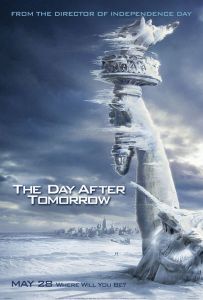 I must confess a giant moment of geekery: for a month or so I waited patiently until the Wednesday before the new disaster opus The Day After Tomorrow opened so I could finally say, The Day After Tomorrow opens … the day after tomorrow. Im surprised the marketing department didn’t beat me to that punch.
Jack Hall (Dennis Quaid) is an environmental scientist concerned about global warming trends and the chaos they could cause. He tries to alert government officials to these dangers but is met with a cold shoulder. Jacks son, Sam (Jake Gyllenhaal), is traveling to New York for a school quiz tournament on the slightly less grave mission of earning the affections of one of his classmates. Somewhere between the establishment of these two stories, all hell breaks loose. Jack and another researcher (Ian Holm) share data and discover that the world is headed toward a gigantic climate shift, a new Ice Age. While the world is crumbling, Jack is determined to reunite with his son, trapped in New York.
The special effects of The Day After Tomorrow are indeed awe-inspiring, but once they finish the viewer is left with a story that is, shall we say, overcast. Unlike director Roland Emmerichs other disaster films with aliens or giant lizards, a cataclysmic climate shift is not a beatable foe, so the story is left without resolution. It’s kind of hard to vilify the weather.
 What do you do once the world starts another Ice Age? Not much besides keeping your butt from freezing off. So this means that the crux of the after scenes revolve around Jack trying to reunite with his son. Jack tells his son to hole up where he is and, cue heroic music, he will come find him. Sure. Does anyone stop and question, Why? I know why Jack treks, on foot no less, from Philadelphia to New York, but it isn’t even necessary. His son and their friends are fine where they are and the only severe threat they face is when the giant frosty eye of the storm looms overhead. Quaid’s character has no opportunity to assist them during even that scene. Im sure someone thought it would be a touching display of a fathers love for his son, but its really just winds up looking foolish. He tells his son not to move, then disobeys his own advice to venture out. Nothing of significance happens because of Jack’s journey. He might as well have stayed home and read a book.
The acting of any disaster flick is really confined to yelling and … panting, I suppose (which could also accurately describe the acting prowess of the late night programming of Showtime). Quaid is a sturdy hero but seems to look ten years older than normal. Gyllenhaal is one of my favorite young actors (I adore Donnie Darko) and, to his credit, he does a suitable job of running around and yelling.
Perhaps the funniest thing in The Day After Tomorrow is a Vice President who refuses to listen to environmental concerns that looks a heck of a lot like our current VP, Dick Cheney. The timeliness also extends to a somewhat witless president who, when faced with a crucial decision, turns to his VP and asks, What do you think?
The necessary scenes of planetary and civilization destruction are first-rate in the film. Emmerich is our premiere master of laying waste to the world, particularly New York City. Emmerich keeps our view of the carnage mostly restrained to long shots where we can witness the full magnitude of devastation he is trying to put forth.
 The weather effects are top notch, especially a series of tornadoes that devastates downtown Los Angeles. There are some beautiful visual moments, like seeing thousands of birds migrating from impending doom, or a final image from above of the iced Statue of Liberty. Tomorrow also has a clever moment late in the film when the frost storm hovers over New York and forces characters to outrun advancing … frost. Its not as stupid as it sounds. And, as per usual in disaster flicks, Mother Nature always knows where to strike – landmarks. How else does one explain the precision of taking out the Hollywood sign?
For a good hour, The Day After Tomorrow is great escapist entertainment. The scenes of destruction are riveting, and the moments leading up to them have great suspenseful pacing. The film’s climax is its half-way point, which is never a good sign. After all the floods, rain, snow, twisters, and everything Mother Nature has in her arsenal, we are left with characters scrambling around running from … wolves. Going from tidal waves to wolves is not exactly an increase in suspense.
There is a hilariously awful moment in the film involving Sam’s wife, played by Sela Ward. Sela is a nurse at a hospital watching over a child with cancer. She refuses to leave him alone and waits for an ambulance to arrive, because, for some reason, the cancer kid can only be transported by ambulance. It’s just distasteful and dumb that this storyline even exists: brave woman determined to stay by the side of cancer child.
The Day After Tomorrow is an exciting diversion that doesn’t know what to do with itself after all the big money shots are spent. Its like a balloon once the air is all out. Perhaps the creators should have consulted any prior warning about stranding an audience in a story that no one cares much about. It’s worth seeing, but it’s also worth leaving after Mother Nature unloads her goods.
Nate’s Grade: C+
Share this:

Fantasia 2000 (2000)
 The first updating of long gone Walt Disney’s dream anthology hits the IMAX screens in a resounding fury of classical music and first rate animation. Like its predecessor though, it’s uneven in its quality. Some segments are more impressive or creative than others. In the 2000 redux the best of the best would be characterized by “Rhapsody in Blue,” a Gershwin blues number brought to stunning life by characters of simplicity yet definition. The animation on each is commendable and different from the next segment to follow it. “The Sorcerer’s Apprentice,” the only segment from the original to be included, shows its wrinkles and grain more than ever when blown to IMAX’s wide canvas. The standout, to me anyway, was clearly the final segment closing the just-over-an-hour animated orchestra called “The Firebird.” The imagery and animation are so sleek and beautiful that I thought I was going to break down by how stupendous the artwork was. This is a tale that leaps from the screen and lets you share some of the beauty with it – further enhancing the festival of the Mouse. Without these stand alone segments this ballet of song and ink would be rather adequate and nothing more, but with the addition of these two marvelous segments it becomes something worthwhile… at least for 20 minutes. Hey, it’s the most exposure classical music will get on the youth of today.
Nate’s Grade: B
Share this:

Toy Story 2 (1999)/ Princess Mononoke (1999)
 There is a false prejudice circulating the land of merry movie goers as they skip from one theater to the next. This assumption is that animation is a kids only event, that’s it’s something to appease the screaming masses under three feet of height. Lately movies are giving more credit to the cause that animation can be a wonderful escape and isn’t just for the kids.
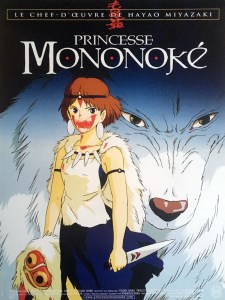
Animation can take people to worlds that otherwise could not have existed, and so is true with Princess Mononoke the 1997 Japanese import with a fresh English dubbing. Mononoke speaks of the battle between harmonious nature and forging industrious man. Often the film displays such scenes of visual passion that it seems like an animated love letter to those wishing to venture out to find it. The story is vivid and non-judgmental, you see the stories and reasons behind both warring forces and not everything is easily black and white. The English dub does not distract from the overall enjoyment as many professional actors yield their vocal talents to this masterpiece. Princess Mononoke leaves a spellbinding impression of intense ecological thought and aching beauty. The best anime has to offer.
 At the other end of the animation spectrum lies Toy Story 2, the kid friendly three-dimensional quest of action figures and plush dolls. What is amazing about Toy Story 2 is how it not only matches its ground breaking predecessor but even surpasses it both in visuals and story. Story is packed with sly humor not just for kids, and it contains a poignant message about mortality and what one seizes with the opportunities they are given. The animation is mesmerizing and the humor is fast and fierce. Toy Story 2 proves that not all sequels are bad ideas.
Fresh from the gate are two examples of the great gifts animation has to offer. Couple these with the wonderful The Iron Giant, a ferociously funny South Park movie, an okay Tarzan, and the upcoming Disney redux Fantasia 2000 and it appears to be a solid time for animation. Go out and see some.
Nate’s Grade: Both movies A


 nathanzoebl
You must be logged in to post a comment.