Blog Archives
Thor (2011)
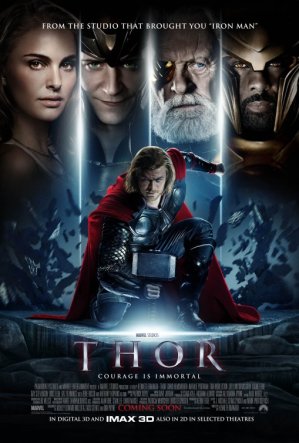 I had strong misgivings going into Thor. How was a powerful Norse god going to seem remotely relatable? How was the most improbable member of Marvel’s Avengers ensemble going to be explained in a way that didn’t feel like a ton of cheese richly slathered in hokum? I was expecting this movie to be a silly, trippy, LSD-enhanced flashback (rainbow bridges! Pass the bong!) that could barely strain any sense of believability. It’s one thing to have stories about super heroes who have gotten their powers via genetic defect, scientific accident, or act of God. But what about when your character happens to be a god? It just seemed too goofy for it all to be pulled off with any conviction. A Thor movie seemed destined for some Xanadu-level of camp. Get a load of the blonde with the big hammer, boys. Not every super hero flick has to be as brooding and dark as The Dark Knight. Marvel’s own Iron Man was a great example of a briskly entertaining movie. Now that I’ve prefaced my experience, let me publicly admit that Thor is indeed a somewhat silly but mostly fun entry in the mighty realm of summer blockbusters.
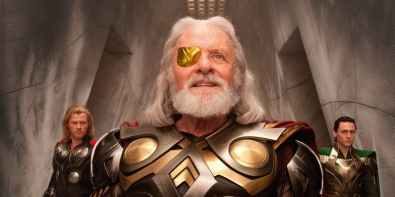
Thor (Chris Hemsworth) is the god of thunder on Asgard, a distant planet populated by the Norse mythical figures (apparently, they visited Earth and the Scandinavian amongst us worshipped these… space aliens?). Thor waits to inherit the throne from his father, Odin (Anthony Hopkins), a wise king who has kept a tenuous truce with the fierce Frost Giants, inhabitants of another planet. But Thor is not ready to assume the responsibilities of leadership. He’s quick to action and temper, arrogant, and defies his own father’s orders by trying to start some intergalactic conflict with the Frost Giants on their home turf. Thor is robbed of his powers, his mighty hammer, and banished to Earth to walk amongst the smelly Earthlings. He crashes in the New Mexico desert and is retrieved by a team of scientists (Kat Dennings, Stellan Skarsgard) led by Jane Foster (Natalie Portman). The group wants to learn where exactly this man from the sky came from. So does the government, led by the S.H.I.E.L.D. agency who takes possession of Thor’s hammer. Thor thinks if he can reunite with his beloved hammer, then he can go home. But for a thunder god, he’s got a lot of lessons to learn. While Thor is out of the picture, his younger brother, Loki (Tom Hiddelston), plots to take what he feels he is owed – the kingdom of Asgard.
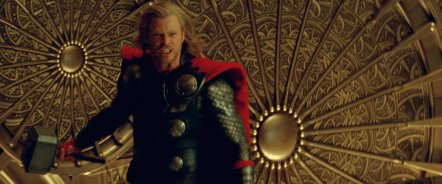 The biggest surprise for me was that the Asgard sequences are the best part of the movie; thankfully the majority of the running time is spent in this fantastic realm. I credit Kenneth Branagh’s direction, which neither hides the silliness of the material nor fully acknowledges it. By the time Thor hurtles to Earth, I was completely engaged in the operatic tale of fathers and sons, gods, jealousy, hubris, intergalactic conspiracies, you know, the stuff of juicy drama. It jus so happened that these characters wear funnier costumes. The family dynamic between Thor and Loki, the infighting and the scheming, intrigued me. Some critics have thrown around the word “Shakespearean” to describe the movie’s outsized family conflict, but I think that’s just the critical community getting lazy. Would they even approach that term is Branagh was not the director? This opening section of Thor effectively explains the history of Asgard as well as its place with the other eight worlds, the shaky relationship with the Frost Giants, the family responsibilities at play as Odin must decide the future of his ABBA-infused nation, as well as the various mechanics of how this different world operates, like Idris Elba (The Wire, Luther) stationed at the end of the rainbow as a gatekeeper to the other worlds. I liked discovering how all the pieces of this world fit together. If analyzed out of context, any part of the Asgard section just seems stupid. But taken in the film, Thor‘s crazier, more fantastic elements come together and spark genuine interest. I wanted to spend more time in this magical realm. The more ridiculous and fantastical that Thor got the more interesting it became.
But unfortunately Thor was sent tumbling to our ordinary planet. It is the Earth section that seriously deflates the movie’s vibe. It’s a relief that the fish-out-of-water comic relief is kept to a minimum, because the character of Thor isn’t an idiot, just an arrogant brat. But it’s the period on Earth where the God of Thunder learns his Really Important Lessons and finally understands what it means to be a good leader. It’s all very expected and the execution is less than inspired. The trio of scientists that Thor encounters (Portman, Skarsgaard, Dennings) could easily have been consolidated into one character. Their contributions to the story are weak. Skarsgard is mostly there for fatherly advice and the occasional expository ejaculation. As a gawky little sister scientist, I don’t even know why Dennings is in this film other than to make my eyes happy. I anticipated that Portman would assume the “love interest” spot in comic book movies that we now reserve for Oscar-winning actresses, and I assumed that role would be underwritten. But I never expected Portman’s part to be this underwritten. She’s practically nonexistent except for that winning smile of hers. Over the course of… two days, she falls in love with our banished brute. But to be fair, it’s not every day that a guy looking like Hemsworth falls out of the sky. New Mexico isn’t exactly looking like a great singles mingles hotspot. Anyway, their relationship is supposed to be the trigger that makes Thor realize he’s been a selfish and reckless fool. But their scenes lack any tension, any charm, anything of interest. They feel like two actors sitting in chairs telling stories. You don’t feel any romance between them. The drabby Earth sequences only serve as a losing contrast to the crazy Asgard territory. You can’t compete with rainbow bridges (imagine the tolls on those suckers).
 Branagh has never directed anything of this magnitude in size before, and it shows at parts. While none of the action sequences are particularly bring, none of them are particularly thrilling. The beginning battle between Thor and his pals on the Frost Giant planet (Jotunheim) is so poorly lit that the darkness forces you to squint to focus on what’s happening. Why spend $150 million on a super hero flick and shoot a dankly lit action scene? What’s the point in that? The choppy editing can also be too hectic to follow with all the quick-cuts that fail to orient the action geography. Really, there are only three serious action sequences in Thor, but then again I remember Iron Man having a light load when it came to on screen action. That film was devoted to character and performance. This film, under Branagh’s watch, is devoted to just making the entire universe of Thor credible. It’s a lot to take in, and Branagh’s biggest accomplishment is producing a sense of grandeur to the film that saves it from falling into the sticky clutches of camp. The world of Asgard feels convincing in production design and infrastructure; the cities look like pipe organs. Branagh’s film expands the Marvel universe significantly, broadening the scope for future installments. Mercifully Thor does not hard sell the upcoming Avengers movie as appallingly as Iron Man 2.
The acting in Thor is as splashy as the Asgard scenery. Hemsworth gave a notable performance as the doomed father of James Kirk in 2009’s Star Trek. He as only in the film for that ten-minute prologue, and yet the actor found a way to do much with what he was given. You got to see his character hurdle through a gauntlet of emotions: fear, duty, relief, desperation, and acceptance. His sacrifice still can make me tear up, and Hemsowrth deserves some of that credit. However, Thor is a different matter entirely. Obviously it’s going to be a more challenging role to play a buff cocky god with a magic hammer. Buff he does quite well. Cocky he does fairly well, but this is not a great starring vehicle for the actor. Hemsworth looks too self-satisfied, like he’s playing his character as an intergalactic hotel heiress. In sharp contrast, Hiddelston (Wallander) commands your attention. Those penetrating eyes, the cold yet calculated demeanor, this is an actor who feels like he walked off a Shakespeare production and just changed his headgear. You want to spend more time with Loki than watch Blondie futz around on Earth. Loki has much more depth to him than Thor; he feels betrayed by his family and an outcast to his society. I’m glad that we’ll be seeing more from this trickster in future Marvel movies (have I said too much?). Hopkins knows how to sell silliness like few other actors. And for those who have been wondering where Renee Russo has been for the last six years, well here she is, as Thor and Loki’s mother, a role that’s best suited to confirm that she is still alive.
 I was expecting far worse judging upon the scraps I had seen from the Thor advertising campaign. So I suppose that beating my low-flying expectations might not necessarily be something to champion. Thor is an inherently goofy, yet mildly satisfying and credible action film. It doesn’t have the style or panache of other heroes, but the fact that Branagh could make a two-hour Thor film that didn’t cause me to laugh derisively from start to finish is an accomplishment. Again, that sounds rather dismissive. I’m just very surprised that this movie works. Because if you take it apart, it doesn’t seem like it should. The acting ranges wildly in quality, with Hiddelston outshining everyone else. Thor is a solid if inconsistent start to the summer season of blockbusters. If you must turn your brain off for some movie, you’d do far worse than Thor. It has pretty colors.
Nate’s Grade: B
Share this:

Black Swan (2010)
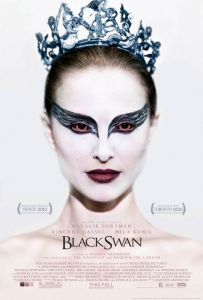 The prissy world of prima ballerinas and tutus doesn’t seem like a natural fit for sex, murder, lunacy, and mayhem. Director Darren Aronofsky (Requiem for a Dream, The Wrestler) is used to exploring the punishments of the human body and the strain of the mind, so you know that Black Swan isn’t going to be your traditional dance movie.
Nina (Natalie Portman) has been a company ballerina in New York City for years. She spends her hours at home practicing the grueling routines in hopes to break out for a lead role. Her mother (Barbara Hershey) is a former ballerina herself who gave up her shot at the big time when she had Nina. Then the head of the dance company, Thomas Leroy (Vincent Cassel), has decided that Tchaikovsky’s Swan Lake will be the first show of the season. It’s a bit tired, he admits, but he has a plan to juice it up: the same dancer will portray both the swan queen (tragic protagonist) and the black swan (villainous temptress). All of the dancers are committed to doing what they can to earn that coveted lead role. Nina’s primary worry is Lily (Mila Kunis), a dancer who is imperfect in technique but honest and free in her movements, garnering the attention of Thomas. In the process, Nina is losing her grip on reality. She’s hearing weird things, seeing weird things, and something dark wants to take center stage.
 Black Swan is a grade-A mind freak of the first order, a tonal fusion of sight and sound that echoes earlier masterworks of the eerie psychological horror like Rosemary’s Baby and The Shining. This is a movie that gets under your skin; I literally had a nightmare the night after watching it, though I don’t want to give people the wrong impression. Black Swan is not a horror film by the traditional standard we’re accustomed to today. The entire film has a downright Kubrickian vibe, from its devoted tracking shots, to the overdose on classical music underscoring the dramatic tension, and the unraveling of the human mind toward eventual psychosis. Aronofsky keeps the audience tethered to Nina, at times literally. The camerawork will rarely stray away from Portman, like we’re caught within her orbit and forced to see the world through her fractured perspective. She is our eyes to the world but, as becomes increasingly apparent, we cannot trust what we see. The unreliable POV leads to some fantastic freak-out moments that will consistently leave you scrambling. The diligent pacing marvelously matches the dissolution of Nina’s psyche. As her paranoia and delusion take control, Nina comes undone one thread at a time, with Aronofsky on the other end providing the tugs. The spiraling mental determination culminates with a glorious 20-minute finale that manages to be tense, beautiful, haunting, and powerfully moving. There are moments in this film that gave me goose bumps (a blood red-eyed Portman growling, “It’s my turn” is a chilling highpoint). I became determined to see Black Swan again even before the closing credits arrived.
Aronofsky makes use of every tool at his disposal to heighten the intense atmosphere. The attentive editing and camerawork create a shifty mood, communicating Nina’s desperate groping for direction. But beyond that, Aronofsky employs subtle sound effects to rattle you, keep you off guard. Routinely there will be the fluttery sound of wings flapping or hushed whispers. It’s enough to make you shudder time and again. It’s a small touch that elevates the mood and instantly snaps you to attention whenever you hear the eerie echoes. The disquieting sound effects are coupled with equally subtle visual effects. As Nina absorbs herself in her ballet role we occasionally will witness the pores of her skin raise, as if invisible hair, or fathers, are protruding. Sometimes these raised bumps will wash over her body in waves. As Nina becomes more consumed with her darker impulses, the special effects take a surreal role in conveying her madness.
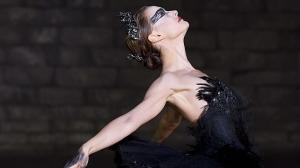 The film is also rather sensual without becoming trashy, late-night Cinemax fodder. Portman’s descent is linked with loosening up her own sexuality. She can portray the innocent and delicate white swan, but she’s having significant problems portraying the ominous and seductive black swan. She’s told to let go, lose herself to her physical impulses, and explore the confines of her nubile body. Black Swan is probably the artiest high profile film to feature prominent female masturbation since 2001’s trippy Mulholland Drive (the two movies have plenty of similarities in ambition). Nina’s suspicions about her rival transform into confusing erotic fantasies that will delight the teenage males in the crowd. Black Swan treads the erotic terrain with a European sense of maturity and candidness. The sex and masturbation and bisexual smooches don’t feel like gross, gratuitous shots at cheap titillation.
Portman ably takes the frazzled lead and gives an enthralling performance that will be hard to beat come Oscar time. The role is a lot more than screaming and crying. Although to be fair, Portman cries a whole lot. You may lose count the amount of times Portman is seen crying on screen. Her character is fragile but not fighting for sympathy. She can be distant and a little cold, obsessed with reaching the unattainable state of perfection. This pushes her to the extreme, goaded by her somewhat loopy mother. Portman has always been an attractive presence on screen, but she is also fairly transparent when she’s bored with her material (watch those Star Wars prequels and argue differently, I dare you). With Black Swan, she throws herself into a role like I’ve never seen before from Portman. I did not think the kewpie-dolled actress was capable of such heights. The immersion is entrancing. She physically trained for over a year before production to be able to do most of those pirouettes and fouettés. I’m not being overly generous with the dancing accolades; Portman comes across as smooth as a professional. The fact that Portman is capable of expressing so much devastating emotion through dance is astounding. My eyes were glued to her every movement. This is the performance that officially lifts Portman to the acting big leagues. She dances circles around the acting competition for 2010.
While it’s certainly Portman’s show, the supporting cast all shine in their small roles. Kunis (Forgetting Sarah Marshall, Book of Eli) is made to exemplify the edgy opposing force in Nina’s life. Kunis’s natural charm and alluring presence might make her the most likeable character in the film, even though her wild ways will keep you guessing about her true motives. Hershey (Hannah and Her Sisters) seems like a doting and supportive mother at first glance, but the actress reveals shades of desperation and mania. Winona Ryder (Star Trek, Girl, Interrupted) makes a welcomed near-cameo as the ballerina pushed out of the spotlight. And then Cassel (Ocean’s Twelve, Eastern Promises) plays lecherous creep like few others.
 The film manages to make ballet feel like a contact sport. These people punish their bodies, their artistic vessels. The rigorous routines require dancers to be in sleek form, which often leads to abuse via bulimia. The excruciating balance and coordination required places unusually high demands on the human body, particularly on the feet that must support the body in extreme positions. Broken toes and split nails are the least of the worries. Black Swan succeeds in showcasing the fierce brutality of dance; however, the movie also showcases the intrinsic beauty. I am a self-described novice when it comes to dance, especially ballet at that, but even I was spellbound by watching the dancing, notably the exhilarating Swan Lake opening night performance. The camera is positioned to be like another dancer, so we’re swooping and spinning around the stage with the featured performers. This gives the audience an intimate glimpse into the fluid movements and, just as importantly, the nuanced and sensual expressions of the performers. I would have scoffed at the idea of a ballet performance being anything more than frou-frou-ness, but Black Swan made me a believer. Witnessing the beauty and gracefulness of the dancing is proof that all that hard, punishing preparation is worth it.
Probing the stress of the body and fraying endurance of the mind, Black Swan richly explores the sacrifices we make for art and ambition. The world of ballet is highlighted as a hotbed for scandal and intrigue and female sensual desire. Not bad for all that hoofing around in frilly tights. Black Swan is anchored by Portman’s captivating descent into madness, a performance that will surely be awarded in the ensuing months to come. Aronofsky has fashioned a riveting psychological thriller with enough artfully crafted chills and spooks to make for one visceral experience at the art house. Beyond bringing the tingles of spine and bumps of goose, Black Swan digs into the psychological underpinnings of competition, devotion to art, and personal glory. There’s much more going on here than ballet. It’s a grade-A mind-freak but under Aronofsky’s skilled direction and Portman’s transfixing acting, Black Swan is also a grade-A piece of art and one of the most stunning works of cinema this year.
Nate’s Grade: A
Share this:

The Other Boleyn Girl (2008)
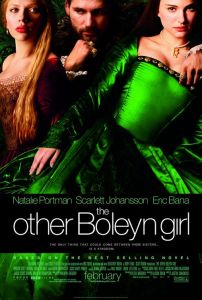 The story of Henry the Eighth and his many wives is a tale full of romance, danger, betrayal, and sweeping historical changes; it’s the most popular soap opera of its age. The 700-page book was naturally going to get slimmed down as a feature film, and The Other Boleyn Girl feels a bit too streamlined for all the heavy historical events that take place. The production values are all top-notch and the story has some juicy moments. It presents an intriguing angle by showcasing the conniving rivalry between the Boleyn sisters (Scarlett Johansson, Natalie Portman). The acting falls under that period film gravity where the actors all speak stately and enunciate every syllable slowly, like they were testing out the sound for the first time. Portman is especially fun in a villainous role. Eric Bana is completely at odds with history as Henry VIII, but I suppose it would be harder for modern audiences to accept young nubile ladies vying for the affection of a huge, ugly man with a leg of mutton in his grip.
Nate’s Grade: B
Share this:

The Darjeeling Limited (2007)
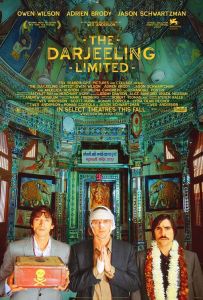 I’m starting to think Wes Anderson may become his own worst enemy. The man seems trapped in his precious, idiosyncratic style that revolves around intricate, dollhouse-style production design, slow-motion and simple pan shots, clever-to-smug characters, family dysfunction that coalesces somewhat by the end, and a soundtrack full of hip, retro songs. I like Wes Anderson; I loved his first three films, was rather lukewarm on 2004’s Life Aquatic, but The Darjeeling Limited is pretty much a bland rehash of the same. Instead of a father reconnecting with his long-forgotten son it’s three brothers reconnecting in the wake of their father’s death and mother’s abandonment. The humor is fairly subdued and while the movie is brief it seems to run out of gas early on and get repetitive. I think Anderson is more interested in showing off his highly elaborate production design than crafting interesting things for his characters to do inside those complex sets. I didn’t feel a blip of emotion for any of the character, all of who have some lasting fear of women ever since their mother ran out to become a nun. There’s kind of an unsettling misogynistic vibe in the movie against women, which is an unfortunate surprise. There’s a spiritual quest that some may relate to but I found it superficial at best, intended to gloss over the plot holes and character miscues. I wish Anderson well, but his next venture behind the camera might work better if he threw out his fraying filmmaker playbook.
Nate’s Grade: C+
Share this:

V for Vendetta (2006)
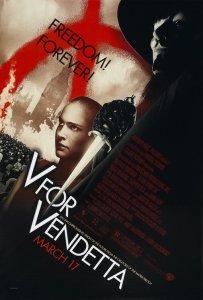 Legendary comics author Alan Moore has a particular disdain for Hollywood adaptations. They just haven’t gone so well for this scribble scribe. There was 2001’s From Hell (I may be the only one in the world that actually likes it, Heather Graham’s atrocious cockney accent aside) and 2003’s The League of Extraordinary Gentleman. Moore is even responsible for the creation of the John Constantine character, who had his own 2005 big screen venture. I suppose you could see why he has certain contempt for the movie versions of his much-heralded stories. Now comes V for Vendetta, based on Moore’s 1988 comic and adapted into a screenplay by the Wachoswki brothers. While I may have no idea how close V for Vendetta is to Moore’s graphic novel, I can say that the movie is a smart, superb thriller that dares you to think while you?re stuffing popcorn into your mouth.
“Remember, remember, the fifth of November, gunpowder treason and plot. I see no reason why the gunpowder treason should ever be forgot”
In the future, America has lost its super power status after overextending itself in war. Britain has turned into a hostile totalitarian government, led by chancellor Sutler (John Hurt). Evey (Natalie Portman) works for the state-controlled TV station. One night, while walking out past curfew, Evey is attacked by some undercover cops looking for a good time. A mysterious masked man named V (Hugo Weaving) comes to her rescue. His grinning, bearded mask resembles Guy Fawkes, a revolutionary that tried to blow up the British Parliament 400 years ago on November 5th. V starts taking out high profile government figures and then infiltrates the government airwaves, asking others to rise up against the corruption they see around them. He promises to blow up parliament one year to the day of this message. Finch (Stephen Rea, so expressive with his hangdog demeanor) is assigned to find out who this V is and how to deal with him. In reality, Finch discovers a lot more troubling information about his own government. Evey is linked with V and tracked down for interrogation and potential execution. As the date approaches, Evey must battle her own loyalties and strike out against what she feels is right and just.
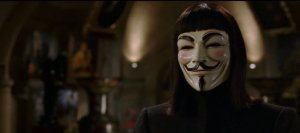 What makes V for Vendetta so exciting is its playground of ideas. This is a dynamically intelligent, complex movie but it never lets the smarts get in the way of a rousing good time. This is a very political movie that’s very relevant today, like the exchange of freedom for security and the use of fear mongering to serve an agenda. I love that the government’s leaders were a rogue?s gallery of corruptible figures; the Bill O’Riley-like TV pundit blowhard, the church leader who just happens to be a pedophile, the scientist whose good intentions justify the worst in human experimentation. V for Vendetta is a thinking man?s comic book movie, one that actually has actual respect for its audience and refuses to dumb down its message. The movie starts at a gallop and never lets up intellectually, and that’s so wonderfully refreshing from a film of any stripes. While I would not classify myself in the camp that views V for Vendetta as an anti-Bush administration screed, I’d have to say the movie does stir people out of a sense of apathy. I was even moved by the film’s hopeful conclusion, which is more than I can say about any other comic book movie (yes, even Elektra).
Director James McTeigue has previously served as the Wachoswki brothers’ assistant director. V for Vendetta is his debut as a director and what an auspicious debut it is. The movie is visually lush thanks to Aliens cinematographer Adrian Biddle (sadly, he died December 2005), but the smartest notion McTeigue accomplishes is putting story above special effects (ahem, George Lucas?). The command McTeigue has as a first-time director is impressive; how many people would be this restrained with all the fancy tools Hollywood has to offer? It’s his restraint and priorities that allow V for Vendetta to excel. And when the film does call for action, McTeigue judiciously uses visual trickery to enhance the scene. A late scene involving slow-mo V taking out a cadre of soldiers while they reload is amazing both in its “hey, look at this!” visual acuity and that it fits perfectly within the narrative. Nothing is self-consciously showy for the sake of wowing an audience, and every beat of action feels organic to the storyline. V for Vendetta is a terrific debut with some great set pieces.
Weaving is awesome as our hero. Since at no point does V ever take off his mask, it wouldn’t have been unheard of to simply hire a stunt guy to play the part and dub Weaving’s voice in later. But no, Weaving decided to be the part and adds so much to the character. He knows when to turn his head, nod, lean to a side, just like a silent film star interpreting the moment through action; it sounds ridiculous but it definitely helps paint a clearer picture of V. Then there’s Weaving’s incredible voice, making V sound like the world’s craziest, coolest Shakespearean lit professor.
Portman has finally made me appreciate her as an actress. She had a long winter between 1994’s The Professional and her 2004 one-two punch of Garden State and Closer, but I now finally see that Portman is a fine actress and not just a promising talent. She’s the heart of the film, the focal point for the audience to journey along, and she’s excellent at every point. I also give her props for having her head shaved on camera (I can only imagine what the eventual porn version will do with this scene).
 I’m left in the cold by this over inflated discussion on how “daring” V for Vendetta is by having the hero of a major Hollywood movie be a terrorist, one that says things like, “Violence can be used for good,” and, “Sometimes blowing up buildings can change the world.” Yeah, sure, but it’s a well-mannered, well-read, cultured terrorist versus a giant evil totalitarian government that kidnaps people, strips them of their rights, and enforces cruelty and prejudice. So exactly how daring is that? Of course audience sympathy is going to fall to the little guy, in this case a terrorist, which is the only hope of shaking things up and righting wrongs in the system. That doesn’t exactly strike me as subversive. This movie isn’t promoting terrorism any more than Munich was when Spielberg allowed the Palestinians to have a voice. The movie is anti-oppression if anything.
My only complaints are minor. The movie gets a bit repetitious in its windup to the climax (oh look, we’ve cut again to the Big Brother round table), and that somewhere along the middle V for Vendetta gets log-jammed with subplots. Everyone has a story to tell in V for Vendetta and we see every personal tale, and after a while it kind of grinds the flow of the story down. However, this problem is sidestepped after awhile and V for Vendetta gets back on track, driving full-force toward its conclusion like a runaway train.
What sounds on paper as something incredibly silly, including a kissing scene involving a motionless clay mask, V for Vendetta plays out with such excitement, visual prowess, and vibrant intelligence; this is a very political movie that?s very relevant today and I loved it all the more for it, but V never forgets to be entertaining at the same time. McTeigue has fashioned together a stirring and fascinating directorial debut, and even though the Wachowski brothers have their fingerprints all over this film, the pretension is kept to a minimum. V for Vendetta is exactly what the Matrix sequels should have been: a pulpy mix of brains and action, not a snore-fest that beats you down before putting on a show. It’s a shame Moore didn’t want his name attached to the finished product, because V for Vendetta is 2006’s first great movie of the year.
Nate’s Grade: A-
Share this:

Star Wars: Revenge of the Sith (2005)
 I was in Dublin, Ireland of all places when I saw Star Wars Episode III: Revenge of the Sith. I was enticed to get off my sick bed and see George Lucas’ final Star Wars installment. As a kid I loved the original trilogy. My expectations were piqued by the promise that Revenge of the Sith would be bigger, badder, and suitably darker than any previous Star Wars installment. It did get the series’ first PG-13 rating and a stern warning to parents from Lucas for nothing. I had equal hopes for the other two prequels, 1999’s The Phantom Menace and 2002’s Attack of the Clones, but said hopes were dashed upon actually watching the movies. This was the last film and I had my fingers crossed ole George would finally get it right.
It’s now several years into the war between the Galactic Republic and the separatists led by General Grievous, leader of the droid army. Anakin (Hayden Christenson) and Obi-Wan (Ewan McGreggor) fight for the Republic and the chancellor of the Senate, Palpatine (Ian McDiarmid). Anakin is having nightmare that his secret wife Amidala (Natalie Portman) will die in childbirth. He seeks out a way to save her and is tempted by certain promises by shadowy figures that the dark side of the force can restore life. From there things are set into motion that turn the Republic into an evil Empire, the Jedi into a near extinct band of warriors, and Anakin into the iconic Darth Vader.
My friend Josh Browning brought up the idea that Star Wars would be so much cooler without George Lucas. I gave this idea some thought and have come to the same conclusion. Can anyone ever say “no” to the Jedi master in plaid? Directing flaws aside, where Lucas really needs assistance is his writing. The biggest qualms I’ve had with the new set of Star Wars, horrible acting aside, is how unforgivably boring they are and the tepid romance. The original Star Wars were about action, adventure, and things that mattered. The prequel set has been mostly about trade, taxation, Senatorial control, and separatists. The majority of the prequels have been sleep-inducing and riddled with pacing issues.
 In an Entertainment Weekly interview, Lucas said 60% of his prequel story was related to the final film. With some quick calculations, that means that there was 20% plot in The Phantom Menace and the remaining 20% in Attack of the Clones. No wonder nothing seemed to be going on! This also creates the problem of Sith having far too much plot to deal with in too short of a reasonable time frame. Things feel left out or not fully explained, like why the hell does General Grievous have a cold? I know I’m missing something but it’s lazy filmmaking to make an audience do extra homework to flesh out your storytelling.
As stated, my other main gripe was the half-baked romance Lucas had between Anakin and Amidala. In Attack of the Clones, the romance is spontaneous. He hasn’t seen her in like 10 years and now they’re instantly smitten? There is no beginning to this romance, no nurturing, no progress. The romantic troubles are worsened by Lucas’ disinterested writing. Lucas cannot write dialogue to save his life. Romantic bon mots like “Hold me like you did at the lake” and “I’ve been dying a little bit day by day, ever since you reentered my life” will not exactly stoke a fire in your loins. Plus Portman and Christenson have as absolutely no chemistry.
Now, the reason I’ve reviewed the romance from Attack of the Clones is because it serves as the linchpin for why Anakin goes bad and becomes Darth Vader. It’s a mighty big question about what turned Anakin from man into one bad mutha, and his quest to save his wife is a satisfyingly plausible answer. But the transition doesn’t have near the punch Lucas intends because of his weak romance he’s penned. Lucas’s shortcomings as a writer finally pull the rug out from Anakin’s big moment.
The acting is another weakness. True, the acting hasn’t always been the top priority with any Star Wars film, but these prequels have shown that Lucas would rather stand behind a computer than in front of an actor. Portman has generally seemed bored and lacks any interest in hiding it. In Attack of the Clones she seemed sedated. In Revenge of the Sith she gets to cry a bunch. In Lucas land, that’s seen as character development.
 I thought Anakin could not get any more annoying than Jake Lloyd’s awful “yippee”-filled run in Menace, but I’m starting to reconsider this. Anakin mopes around and when he gets upset he whines in a falsetto voice. I will say Christenson was rather good in Shattered Glass where his arrested development acting techniques expertly channeled the manipulative Stephen Glass (if you do have a choice, go rent Shattered Glass). But in the more operatic Star Wars world, Christenson routinely comes off like a kid playing dress-up. Even after he’s gone full evil and growls and screams and glares, he comes off like nothing more than a poodle trying to be a guard dog. Of course neither performer is helped any by Lucas’ absentee directing style with actors.
The only members of the Star Wars prequels that will walk away unblemished are Ewan McGreggor and Ian McDiarmid. McGreggor has got the Alec Guinness voice down and proves to be a capable and dignified leading hero. McDiarmid has a juicer role than Anakin and really relishes his villainy.
Sith is the best of the three Star Wars prequels but that isn’t saying a whole lot. Whereas Menace and Clones were boring, Sith is just kind of slow and okay. It’s an improvement but the bar wasn’t exactly set very high. The formula is about the same: the first two acts are again quite plodding and then Lucas unleashes a torrent of action to close out his film. Sith does break apart because, surprise, things actually happen and they actually matter. After about six hours of buildup, actions meet consequences, characters meet their demise, and our boy wonder becomes the dark Jedi. People have been waiting decades for these moments and when they arrive they hit like a thunder bolt. Most of the time at least.
 The special effects are uniformly fantastic, which has never been an issue for Lucas. Yoda moves and emotes fantastically, actually besting some of his flesh and blood thespians. The interaction of live elements and CGI seems improved. Planets are rendered beautifully and the lava world is simply visually stunning and just plain cool.
The action is exciting but a bit overly edited in light saber battles. As we march into Act Three, there’s a terrific sense of climax with Yoda going off to battle Palpatine and Obi-Wan knowing he must put down Anakin. At long last I felt jolts, shivers, and goose bumps at what was to come. The concluding half of Sith is great rollicking entertainment and visually luxurious to watch. See George, light saber duels and character deaths are far more entertaining than trade disputes and embargo talk. The excitement’s back in the Star Wars franchise but it’s a shame it had to only appear this close to the finish line.
The final chapter on the Star Wars universe is closed. Well, for now. The lure of mountains of cash will probably ensure we haven’t seen the last of some of these beloved characters. Revenge of the Sith is a moderately satisfying closing episode to the Star Wars saga. The film still is an exhibition of Lucas’ filmmaking flaws (writing, pacing, his handling of actors) but Sith finally reaches the excitement and grandeur the original Star Wars had. My Dublin theater was roaring, clapping, yelling and screaming throughout. And for the first time during the prequels, so was I for awhile. And you know what the absolute best part was? Not one single word from Jar-Jar Binks!
Nate’s Grade: B-
Share this:

Closer (2004)
 A funny thing happened to me when I sat in a theater to see Closer. It was packed, surely due to the film’s heavy star power. As the film played out I began to notice that my audience was laughing consistently, at moments that weren’t necessarily meant for humor. I don’t think they were laughing at the film, instead I think it was a defense. You see, I’m sure the majority of those couples read Closer to be a much different film than it is. They saw the pretty faces of Jude Law, Natalie Portman, and America’s sweetheart Julia Roberts. They were expecting something, let’s say, lighter than the cruel savagery of Closer. When America’s sweetheart Julia Roberts compares the taste of two men’s semen, you know this isn’t any Gary Marshall movie (forgetting Exit to Eden, and please do).
Dan (Jude Law) is an obituary writer planning to pen a novel one of these days. He locks his eyes on Alice (Natalie Portman), a stripper from the States, while walking one day. She gets hit by a car and Dan takes her to a hospital. Flash forward and Dan and Alice are dating but his eyes are already wandering. During a photography session with Anna (Julia Roberts) he kisses her but is spurned. He takes his revenge on some soul in cyberspace, pretending to be Anna and arranging a meeting. That sap turns out to be Larry (Clive Owen), and they actually do start dating. Then things get messy. Couples leave one another, get back together, swap lovers, and come crawling and begging for forgiveness or punishment. The rest of Closer is like a long game of relationship Red Rover.
 Director Mike Nichols has a definite affinity for his four actors (they are the only ones in the film with speaking parts). He shoots Closer as an actor’s showcase, with constant close-ups and no handheld camerawork. He places the emphasis on his actors. The results are more familiar to Nichols’ early films like Who’s Afraid of Virginia Woolf? and Carnal Knowledge. However, Closer isn’t as insightful as it thinks it is. It presents cruel characters doing dastardly acts, but this is stuff that wouldn’t impress Neil LaBute (In the Company of Men). There is intelligence to the film?s dialogue but it’s wasted on a ramshackle story.
The acting of Closer both helps and hurts the film. It seems that the two primarily wronged characters (Larry, Alice) give the better performances.
Owen is the standout performer of the ensemble. Playing the Dan role onstage has given him an intimate feel for the story’s characters. He’s the most decent of all four until the weight of circumstances finally pushes him to the limit. He’s the character the audience sees themselves in, so it helps that Owen gives a great performance of quiet dignity and slow self-destruction. He expresses more emotional turmoil in his eyes than most actors do with their whole body. Portman is having a breakthrough year for herself. First she showed pluck and grace in Garden State, and now with Closer she has graduated to the adult table. She radiates a fragility that makes you want to hug her. Portman will probably always look like a little doll (which works for her role as a stripper).
The beauty of Roberts and Law hurts the ugliness of their characters. I make no bones about my general dislike of Roberts as an actress. Her acting in Closer is like a soft-spoken, pouty child. She jumps from man to man, looking sullen or pensive, but comes off more petulant. Law is better, but his handsome devil is not in the details. Dan is a womanizing cad but we never get any understanding for why he acts as he does. Law can be hypnotizing, but like Roberts, his pretty facade takes away from the impact of Dan’s ugly behavior.
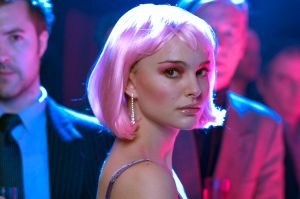 Despite the title, you get no closer to getting to know or understand the characters. It’s really almost a stretch to call them characters because they’re more accurately different positions in an argument. The only characterization Closer has to offer is suffering and inflicting suffering. Closer really has one voice coming out of the mouths of different pretty actors.
The film has the annoying habit of skipping ahead in time and not telling the audience. We’re left to catch verbal asides that time has passed. After a while you’ll get the hang of it simply by assuming that the beginning of every new scene is the start of a new date in time. Closer is nothing but a string of uncollected scenes, usually involving people leaving a lover or starting a new fling. The actors come on, do their part, then they leave and we move on to a different scene. This is not staged as a movie.
The trouble with Closer is that it never really feels like it’s going anywhere. There’s no progression. Sure, couples swap, people get revenge, but the connection of sequences is lacking. The way it is, Closer could have gone on forever. It’s a series of scenes smashed together, not a story that rises and falls and builds to a climax.
Closer is an exploration into the darkness of human behavior starring some of the prettiest actors Hollywood can spare. The story goes nowhere, the ending doesn’t accomplish much, the characters lack convincing depth, but some of the acting is good and there is a ray of intelligence to the film. Fans of the above-the-title actors should enter Closer with caution. It’s a dark film with little to feel good about. Closer is brooding, moody, and probably the first and last time we?ll hear Julia Roberts talk about the taste of semen. Unless, of course, Gary Marshall starts pre-production on Exit to Eden 2: Rosie O’Donnell’s Bondage Boogaloo.
Nate’s Grade: C+
Share this:

Garden State (2004)
 Zack Braff is best known to most as the lead doc on NBC’s hilarious Scrubs. He has razor-sharp comic timing, a goofy charisma, and a deft gift for physical comedy. So who knew that behind those bushy eyebrows and bushier hair was an aspiring writer/director? Furthermore, who would have known that there was such a talented writer/director? Garden State, Braff’s ode to his home, boasts a big name cast, deafening buzz, and perhaps, the first great steps outward for a new Hollywood voice.
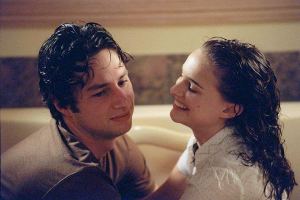
Andrew Large Largeman (Braff) is an out-of-work actor living in an anti-depressant haze in LA. He heads back to his old stomping grounds in New Jersey when he learns that his mother has recently died. Andrew has to reface his psychiatrist father (Ian Holm), the source of his guilt and prescribed numbness. He has forgotten his lithium for his trip, and the consequences allow Andrew to begin to awaken as a human being once more. He meets old friends, including Mark (Peter Sarsgaard), who now digs graves for a living and robs them when he can. He parties at the mansion of a friend made rich by the invention of silent Velcro. Things really get moving when Andrew meets Sam (Natalie Portman), a free spirit who has trouble telling the truth and staying still. Their budding relationship coalesces with Andrews re-connection to friends, family, and the joys life can offer.
 Braff has a natural directors eye for visuals and how to properly use them to convey his characters feelings. A scene where Andrew wears a shirt and blends into the wall is a perfect visual note on the characters sleep-walk through life. Braff’s writing is also familiar but satisfyingly unusual, like a repackaging of old stories told with a confident voice. His characters are interesting and memorable, but dont feel uselessly quirky, unlike the creations of other first time indie writers. The melancholy coming-out of Andrew from disconnected schlub to post-pharmaceutical hero really grabs the audience and gives them a rooting point. At times, though, it seems as though Braff may be caught up trying to craft a movie that speaks to a generation, and some will see Garden State as a generation’s voice of a yearning to feel connected.
Braff deserves a medal for finally coaxing out the actress in Portman. She herself has looked like an overly medicated, numb being in several of her recent films (Star Wars prequels, Im looking in your direction), but with her plucky, whimsical role in Garden State, Portman proves that her careers acting apex wasn’t in 1994’s The Professional, when she was 12. Her winsome performance gives Garden State its spark, and the sincere romance between Sam and Andrew gives it its heart.
Sarsgaard is fast becoming one of the best young character actors out there. After solid efforts in Boys Don’t Cry and Shattered Glass, he shines as a course but affectionate grave robber that serves as Andrews motivational elbow-in-the-ribs. Only the great Holm seems to disappoint with a rare stilted and vacant performance. This can be mostly blamed on Braff’s underdevelopment of the father role. Even Method Man pops up in a very amusing cameo.
The humor in Garden State truly blossoms. There are several outrageous moments and wonderfully peculiar characters, but their interaction and friction are what provide the biggest laughs. So while Braff may shoehorn in a frisky seeing-eye canine, a knight of the breakfast table, and a keeper of an ark, the audience gets its real chuckles from the characters and not the bizarre scenarios. Garden State has several wonderfully hilarious moments, and its sharp sense of humor directly attributes to its high entertainment value. The film also has some insightful looks at family life, guilt, romance, human connection, and acceptance. Garden State can cut close like a surgeon but it’s the surprisingly elegant tenderness that will resonate most with a crowd.
 Braff’s film has a careful selection of low-key, highly emotional tunes by artists like The Shins, Coldplay, Zero 7, and Paul Simon. The closing song, the airy Let Go by Frou Frou, has been a staple on my play list after I heard it used in the commercials.
Garden State is not a flawless first entry for Braff. It really is more a string of amusing anecdotes than an actual plot. The film’s aloof charm seems to be intended to cover over the cracks in its narrative. Braff’s film never ceases to be amusing, and it does have a warm likeability to it; nevertheless, it also loses some of its visual and emotional insights by the second half. Braff spends too much time on less essential moments, like the all-day trip by Mark that ends in a heavy-handed metaphor with an abyss. The emotional confrontation between father and son feels more like a baby step than a climax. Braff’s characters also talk in a manner that less resembles reality and more resembles snappy, glib movie dialogue. It’s still fun and often funny, but the characters speak more like they’ve been saving up witty one-liners just for the occasion.
Garden State is a movie thats richly comic, sweetly post-adolescent, and defiantly different. Braff reveals himself to be a talent both behind the camera and in front of it, and possesses an every-man quality of humility, observation, and warmth that could soon shoot him to Hollywood’s A-list. His film will speak to many, and its message about experiencing lifes pleasures and pains, as long as you are experiencing life, is uplifting enough that you may leave the theater floating on air. Garden State is a breezy, heartwarming look at New York’s armpit and the spirited inhabitants that call it home. Braff delivers a blast of fresh air during the summer blahs.
Nate’s Grade: B
Share this:

Cold Mountain (2003)

Cold Mountain (2003)
Premise: At the end of the Civil War, Inman (Jude Law, scruffy) deserts the Confederate lines to journey back home to Ada (Nicole Kidman), the love of his life he’s spent a combined 10 minutes with.
Results: Terribly uneven, Cold Mountain‘s drama is shackled by a love story that doesn’t register the faintest of heartbeats. Kidman is wildly miscast, as she was in The Human Stain, and her beauty betrays her character. She also can’t really do a Southern accent to save her life (I’m starting to believe the only accent she can do is faux British). Law’s ever-changing beard is even more interesting than her prissy character. Renee Zellweger, as a no-nonsense Ma Clampett get-your-hands-dirty type, is a breath of fresh air in an overly stuffy film; however, her acting is quite transparent in an, “Aw sucks, give me one ‘dem Oscars, ya”ll'” way.
Nate’’s Grade: C
Share this:

Star Wars: Attack of the Clones (2002)
 Yes, it’s easy to say that Attack of the Clones is better than Phantom Menace, but hey, most anything was better than watching that movie about trade and taxes. The truth of the matter is that for a long while Clones is just as boring as Menace, especially anything involving Anakin onscreen. It’s slow moving, dull, and remarkably poorly written. Lucas cannot write dialogue and someone needs to take away his yellow writing notebooks before he strikes again. The movie only shows life during the last 45 minutes when it finally cooks with a non-stop rush of action. Before then though I would recommend resting up for this period.
Can anyone ever say “no” to the Jedi master in plaid? What Lucas needs desperately is collaboration, writing and directing. Lucas needs to loosen up the reign of his empire before the three Star Wars prequels undermine the original set. He may have the technology to create any manner of CGI creature but he has no power to get his actors to show any of the realistic and animated life. It seems all Lucas cares about is directing blue screens and leaving his actors out to dry.
 And that much ballyhooed romance between Anakin and Amidala? Oh ye God, what romance? You could find something more alive in a monastery. Portman and Christenson have as absolutely no chemistry (unlike the romantic pairs in another, huge Hollywood movie out now). Portman has perfected the staring ahead method. I don’t know if that’s supposed to be romantic. Now I like Natalie Portman, I really do. Her performance in The Professional gets me every time, but her acting is stiff and overly serious here.
I thought Anakin could not get any more annoying than Jake Lloyd’s awful “yippee”-filled run in Menace, but I’m starting to reconsider this begrudgingly. It’s easy to see why Christenson was chosen, he looks like the lost N’SYNC member. His acting on the other hand is not with the force. The Clones Anakin mopes around and when he gets upset he whines in a falsetto voice. It’s actually quite funny to see the future Darth Vader, evil master of the Dark Side and much feared, whining like a six year old throwing a tantrum. This Anakin needs a time out and a lolly.
When Anakin returns to become a protector for the senator, upon their first meet in ten years he shoots her the puppy eyes and says, “I see you have grown as well — grown more beautiful.” Subtlety, thy name is not Anakin Skywalker. The very next scene where they’re alone he’s trying to put the moves on her, though he does not try and use the force to undo her bra. Then somewhere along the line his dogged persistence just wears Amidala down and she relents. She says, “I’ve been dying a little bit day by day, ever since you re-entered my life.” Ugh. You’re likely to find more romantic passages in a Harlequin bodice ripper at 7-11.
 The romance in Clones is like spontaneous romance. There is no beginning, the nurturing of it is not shown, we don’t see the eventual progress. All that happens is he shows up and then instant romance. It just happens. I don’t think so. It’s like a kid went to a girl’s third grade birthday party, then they meet in high school for the first time since that day and are instantly in love. Do you buy that? Well I certainly don’t.
The scenes revolving around Obi-Wan are the only ones worth opening your eyes for. Ewan McGregor has got the Alec Guiness voice down and proves to be a capable leading hero. His voyage to see the clone army and Jango Fett is the subplot that we want, but the movie keeps skipping back and forth between this and the inept romance. By this time everyone knows that Yoda shows off his fighting mettle with a light saber. This is a great idea and the audience I saw it with was having the time of their life during this moment. It’s the only part of the movie that taps into the feeling of whimsical fun of the original trilogy.
Lucas curtailed the criticism of Menace saying it was the setup for all five other movies. I imagine he’ll say the same thing with this one, except that it was setup for four movies. Yes it’ll make a huge amount of bank. Yes it’s a technical achievement but what good are all the bells and whistles if we as an audience are bored? You’ve got one more Star Wars left George, please do it right.
Nate’s Grade: C+


 nathanzoebl
You must be logged in to post a comment.