Blog Archives
Garden State (2004) [Review Re-View]
 Originally released July 28, 2004:
Zack Braff is best known to most as the lead doc on NBC’s hilarious Scrubs. He has razor-sharp comic timing, a goofy charisma, and a deft gift for physical comedy. So who knew that behind those bushy eyebrows and bushier hair was an aspiring writer/director? Furthermore, who would have known that there was such a talented writer/director? Garden State, Braff’s ode to his home, boasts a big name cast, deafening buzz, and perhaps, the first great steps outward for a new Hollywood voice.
Andrew Large Largeman (Braff) is an out-of-work actor living in an anti-depressant haze in LA. He heads back to his old stomping grounds in New Jersey when he learns that his mother has recently died. Andrew has to reface his psychiatrist father (Ian Holm), the source of his guilt and prescribed numbness. He has forgotten his lithium for his trip, and the consequences allow Andrew to begin to awaken as a human being once more. He meets old friends, including Mark (Peter Sarsgaard), who now digs graves for a living and robs them when he can. He parties at the mansion of a friend made rich by the invention of silent Velcro. Things really get moving when Andrew meets Sam (Natalie Portman), a free spirit who has trouble telling the truth and staying still. Their budding relationship coalesces with Andrews re-connection to friends, family, and the joys life can offer.
 Braff has a natural director’s eye for visuals and how to properly use them to convey his characters’ feelings. A scene where Andrew wears a shirt and blends into the wall is a perfect visual note on the character’s sleep-walk through life. Braff’s writing is also familiar but satisfyingly unusual, like a repackaging of old stories told with a confident voice. His characters are interesting and memorable, but don’t feel uselessly quirky, unlike the creations of other first-time indie writers. The melancholy coming-out of Andrew from disconnected schlub to post-pharmaceutical hero really grabs the audience and gives them a rooting point. At times, though, it seems as though Braff may be caught up trying to craft a movie that speaks to a generation, and some will see Garden State as a generation’s voice of a yearning to feel connected.
Braff deserves a medal for finally coaxing out the actress in Portman. She herself has looked like an overly medicated, numb being in several of her recent films (Star Wars prequels, I’m looking in your direction), but with her plucky, whimsical role in Garden State, Portman proves that her careers acting apex wasn’t in 1994’s The Professional when she was 12. Her winsome performance gives Garden State its spark, and the sincere romance between Sam and Andrew gives it its heart.
Sarsgaard is fast becoming one of the best young character actors out there. After solid efforts in Boys Don’t Cry and Shattered Glass, he shines as a coarse but affectionate grave robber that serves as Andrew’s motivational elbow-in-the-ribs. Only the great Holm seems to disappoint with a rare stilted and vacant performance. This can be mostly blamed on Braff’s underdevelopment of the father role. Even Method Man pops up in a very amusing cameo.
The humor in Garden State truly blossoms. There are several outrageous moments and wonderfully peculiar characters, but their interaction and friction are what provide the biggest laughs. So while Braff may shoehorn in a frisky seeing-eye canine, a knight of the breakfast table, and a keeper of an ark, the audience gets its real chuckles from the characters and not the bizarre scenarios. Garden State has several wonderfully hilarious moments, and its sharp sense of humor directly attributes to its high entertainment value. The film also has some insightful looks at family life, guilt, romance, human connection, and acceptance. Garden State can cut close like a surgeon but it’s the surprisingly elegant tenderness that will resonate most with a crowd.
 Braff’s film has a careful selection of low-key, highly emotional tunes by artists like The Shins, Coldplay, Zero 7, and Paul Simon. The closing song, the airy Let Go by Frou Frou, has been a staple on my playlist after I heard it used in the commercials.
Garden State is not a flawless first entry for Braff. It really is more a string of amusing anecdotes than an actual plot. The film’s aloof charm seems to be intended to cover over the cracks in its narrative. Braff’s film never ceases to be amusing, and it does have a warm likeability to it; nevertheless, it also loses some of its visual and emotional insights by the second half. Braff spends too much time on less essential moments, like the all-day trip by Mark that ends in a heavy-handed metaphor with an abyss. The emotional confrontation between father and son feels more like a baby step than a climax. Braff’s characters also talk in a manner that less resembles reality and more resembles snappy, glib movie dialogue. It’s still fun and often funny, but the characters speak more like they’ve been saving up witty one-liners just for the occasion.
Garden State is a movie thats richly comic, sweetly post-adolescent, and defiantly different. Braff reveals himself to be a talent both behind the camera and in front of it, and possesses an every-man quality of humility, observation, and warmth that could soon shoot him to Hollywood’s A-list. His film will speak to many, and its message about experiencing lifes pleasures and pains, as long as you are experiencing life, is uplifting enough that you may leave the theater floating on air. Garden State is a breezy, heartwarming look at New York’s armpit and the spirited inhabitants that call it home. Braff delivers a blast of fresh air during the summer blahs.
Nate’s Grade: B
——————————————————
WRITER REFLECTIONS 20 YEARS LATER
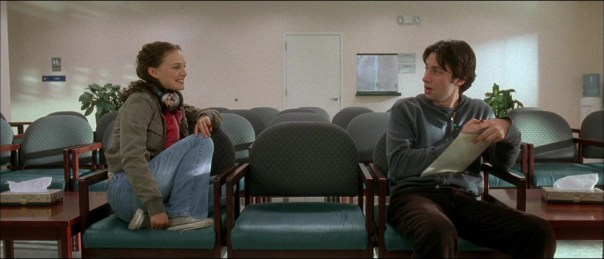
In the summer of 2024, there were two indie movies that defined the next years of your existence. If you were under 18, it was Napoleon Dynamite. If you were between 18 and 30, it was Garden State. Zack Braff’s debut as writer/director became a Millennial staple on DVD shelves, and I think at one time it might have been the law that everyone had to own the popular Grammy-winning soundtrack. It wasn’t just an indie hit, earning $35 million on a minimal budget of $2.5 million; it was a Real Big Deal, with big-hearted young people finding solace in its tale of self-discovery and shaking loose from jaded emotional malaise. If you had to determine a list of the most vital Millennial films, not necessarily on quality but on popularity and connection to the zeitgeist, then Garden State must be included. Twenty years later, it’s another artifact of its time, hard to fully square outside of that influential period. It’s a coming-of-age tale wrapped up in about every quirky indie trope of its era, including a chief example of the Manic Pixie Dream Girl, even though that term was first coined from the AV Club review of 2005’s Elizabethtown. Twenty years later, Garden State still has some warm fuzzies but loses its feels.
 Andrew Largeman (Braff) is a struggling actor in L.A. who returns to his hometown in New Jersey to attend the funeral of his mother. Right there we have the prodigal son formula mixed with the return-to-your-roots formula, wherein the cynical figure needs to learn about the important things they’ve forgotten from the good people they left behind for supposed bigger and better things in the big city. There’s a lot of familiarity with Garden State, both intentionally and unintentionally. It’s meant to evoke the loose, rougher-edged romantic comedies of Hal Ashby and older Woody Allen. It certainly feels more like a series of scenes than a united whole, and that can work in Braff’s favor. His character has gone off his meds for the first time since he was a child, and he’s experiencing a personal reawakening. He’s opening himself up more to the people and possibility of the world, so the movie works more on a thematic level to unify itself rather than strictly from a foundational plot with key turns. If you can connect on that relatable level, then you will likely be able to experience the same whimsy and enchantment that so many felt back in 2004. However, with twenty years of distance, I now see more seams than when I was but a wide-eyed 22-year-old romantic. Andrew is more a reactive symbol, more personified by his hardships or inability to chart a path for himself than by a personality. He’s easily eclipsed by the quirky characters dancing all around him, with Braff smiling ever so wryly at the sweet mysteries of life. This stop-and-smell-the-roses approach was also explored in 2014’s Wish I Was Here, Braff’s directing follow-up that placed him as a family man questioning himself amidst marital malaise. This movie was far less celebrated, I think, because of the thematic redundancy but also because Braff was playing an older character that needed to, kind of, grow up. It was more tolerable when Braff was playing a mid-20s melancholic experiencing his first brush with romantic love. Less so ten years later.
Natalie Portman had been an actress that I was more cool over until 2004 with the double-whammy of Garden State and her Oscar-nominated turn in Closer. She’s since become one of the most exciting actors who goes for broke in her performances whether they might work or not. In 2004, I thought her performance in Garden State was an awakening for her, and in 2024 it now feels so starkly pastiche. Bless her heart, but Portman is just calibrated for the wrong kind of movie. Her energy level is two to three times that of the rest of the movie, and while you can say she’s the spark plug of the film, the jolt meant to shake Andrew awake, her character comes across more as an overwritten cry for help. Sam is even more prototypical Manic Pixie Dream Girl (MPDG) than Kirsten Dunst’s bouncy character in Elizabethtown. Her entire existence is meant to provoke change upon our male character. This in itself is not an unreasonable fault; many characters in numerous stories are meant to represent a character’s emotional state. It’s just that there isn’t much to Sam besides a grab-bag of quirky characteristics: she’s a compulsive liar, though nothing is ever really done with this being a challenge to building lasting bonds; she’s incapable of keeping pets alive, and Andrew could be just another pet; she’s consumed with being unique to the point of having to stand up and blurt out nonsense words to convince herself that nobody in human history has duplicated her recent combination of sounds and body gestures, but she’s all archetype. She exists to push Andrew along on his reawakening, including introducing him and us to The Shins (“This song will change your life”). She’s entertaining, and Portman is charming, but it’s an example of trying so hard. I thought her cheeks must have hurt from holding a smile so long. I’m sure Braff would compare Sam to Annie Hall, as Diane Keaton was perhaps the mold for the MPDG, except she more than stood on her own and didn’t need a nebbish man to complete her.
 There are some enjoyable moments. It’s funny to watch a young Jim Parsons in a suit of armor eating breakfast cereal and expounding the romance language of Klingon. It’s funny to have a meet-cute in a doctor’s office while Andrew is repeatedly humped by a dog with personal boundary issues. It’s fun to go on a madcap journey around town with your former high school friend-turned-gravedigger that ends up in a sinkhole in a quarry, where characters can literally scream into the void. It’s darkly funny to run into a former classmate who became a cop who is still a screw-up except now he has authority. It’s poignant to listen to Andrew’s story about accidentally paralyzing his mother when he was an angry young child who, in a fit of rage, pushed her, and she hit her head on a faulty dishwasher latch. Given all these elements an overview, it feels like Garden State was Braff’s very loose collection of ideas and stories, jokes and bits collected over the years. It’s entertaining and quirky and silly and occasionally poignant, but it’s never more than the sum of its parts. Garden State wants to be about a man changing his life and perspective, but it’s really more a Wizard of Oz-style journey through the quirky indie backlot of kooky Jersey characters. The scenes with Andrew’s distant father (Ian Holm) feel too removed to have the catharsis desired. He feels like an absent character from the movie, so why should we overly value this father-son reconciliation?
Admittedly, that soundtrack is still a banger. It soars when it needs to, like Imogen Heep’s “Let Go” over the race-back-to-the-girl finale, and it’s deftly somber when it needs to, like Iron and Wine’s cover of “Such Great Heights” and “The Only Living Boy in New York” paired with our big movie kiss. It’s such a cohesive, thematic whole that lathers over the exposed seams of the movie’s scenic hodgepodge. Braff tried to find similar magic with his musical choices for 2006’s The Last Kiss, a movie he starred in but did not direct (he also provided un-credited rewrites to Paul Haggis’ adapted screenplay). That soundtrack is likewise packed with eclectic artists (he even snags Aimee Mann) but failed to resonate like Garden State. It’s probably because nobody saw the movie and Braff’s character was, as I described in my 2006 review, an overgrown man-child afraid his life lacks “surprises” now that he was going to be a father. Sheesh.
 Garden State is a movie that is winsome and amusing but also emblematic of its early 2000s era, of young people yearning to feel something in an era where we were afraid of feeling too much because of how painful the real world stood to be as an adult. Rejecting pain is rejecting the full human experience, which we even learned in Inside Out. There could have been a richer examination on parental desire to protect children from experiencing pain but creating more harm than good (kind of the theme of 2018’s God of War reboot). It’s just not there. My original review was far more smitten with the movie, doubled over by Portman’s performance and the effectiveness of Braff as a writer and a director. My criticisms at the end of my 2004 review are all shared with my present-day self, especially the dialogue: “Characters also talk in a manner that less resembles reality and more resembles snappy, glib movie dialogue. It’s still fun and often funny, but the characters speak more like they’ve been saving up witty one-liners just for the occasion.” I’d downgrade the movie ever so slightly, though there is still enough charm and whimsy to separate it from its twee indie brethren. In 2004, Garden State felt like a seminal movie for a breakthrough filmmaker. Now it feels like a fitfully amusing rom-com with slipshod plotting and a supporting character that needed re-calibration.
Re-View Grade: C+
Share this:

May December (2023)
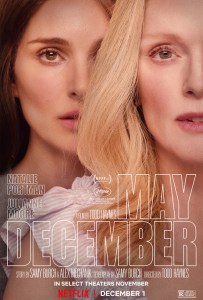
The critical darling May December reminded me of another 2023 Netflix prestige awards contender, David Fincher’s The Killer. That genre movie was about trying to tell a realistic version of the cool super spy assassin and I found that enterprise to be fitfully interesting but mostly dull and unfulfilled. This movie seems to be going for a similar artistic approach under director Todd Haynes (Carol, Far From Heaven), tackling a sensationalized ripped-from-the-tabloids tale of perversity but telling a more realistic version, which also leaves the movie fitfully interesting but mostly dull and unfulfilled. May December is a frustrating viewing experience because you easily recognize so much good, so many exciting or intriguing elements, but I came away wishing I had seen a different combination and execution.
Elizabeth (Natalie Portman) is a famous actress with an exciting new movie role. She’s going to play Gracie (Julianne Moore), a woman who gained national scandal for her sexual relationship with a then-13-year-old Joe. The two of them have been together for several decades and have several children and now are inviting Elizabeth into their home to better understand her character. Each person is on their guard. Elizabeth wants to keep prying to uncover emotional truths that she can gobble up to improve her future performance and career. Gracie is wary of making sure the version of her story that she wants for public media consumption is what Elizabeth receives. And Joe (Charles Melton), now in his mid-thirties and looking more like an older brother than father to his graduating children, is reflecting about the history of his relationship and who was culpable.

There’s so much here in the premise of an actress studying her subject and wreaking domestic havoc in her attempt to discover secret truths that would rather stay hidden. May December uses this premise as an investigative device, allowing the inquisitive actress to serve as the role of the audience, trying to form a cohesive vision of events from each new interview. It allows the first half of the movie to feel like a true-crime mystery, uncovering the different sides of a sordid story and the lasting consequences and legacy for so many. There’s a very lurid Single White Female approach you could go, where the avatar of the person starts to replace the real person, where Elizabeth crosses all sorts of lines and even thinks about crossing some of the same lines that Gracie had; what better way to get in the mind of a predator, right? I was waiting for this interloper to destabilize this carefully put-together illusion of a “normal family,” but by the end you feel like little has been learned and most everything reverts to its prior stasis. I suppose that’s, again, the more realistic version of this kind of story, that even when confronted with uncomfortable revelations most people will fall back on what they know. May December’s underwhelming conclusion is that, by the end, maybe people are actually who we think they are.
Haynes’ cinematic specialty is exploring the artificiality of movies, from having multiple actors portray Bob Dylan in 2007’s I’m Not There, to destabilizing the nostalgia of the 1950s Douglas Sirk-styled romantic drama with 2002’s Far From Heaven. He’s also inherently drawn to stories of emotional and sexual repression. This movie is all about performance as identity; it’s about an actress trying to refine her tools, but it’s also about a middle-aged woman who has adopted performance as her defense system (this also might explain why Gracie’s lisp seems to come and go). Some part of her has to know that she crossed some very serious lines, no matter how many times she explains away their relationship as merely “unconventional.” Even though they’ve kept this union for 25 or so years, it still began when Joe was 13 years old and she was an adult. There are very intriguing dimensions to this dramatic dynamic, with the excuse of a Hollywood version of their “love story” to motivate each participant to reflect with renewed perspective. The problem is that Gracie has worn her mask for so long that I doubt there is another version of her any longer (“I am naive. In a way, it’s a gift”). As a means of survival, she projects herself as a well-intentioned victim of scrutiny rather than as a child predator who has manipulated her husband into codependency for decades. This means that, frustratingly, there isn’t much there to glean once the facts of the case have been collected, which makes watching a bad TV actress try and better emulate a bad person incapable of introspection seem like an empty exercise in artistic masturbation, and maybe that’s the point?

The conversation around May December being some kind of “camp comedy” (it was recently nominated for Best Comedy/Musical by the Golden Globes) has left me genuinely stupefied. I think the term “camp” is used a little too loosely, as some seem to conflate any heightened emotion as equivalent to camp. May December is really more an example of melodrama. It’s near impossible to retell the Mary Kay Letourneau story without the use of melodrama, so its inclusion doesn’t merely qualify the movie as camp. But at the same time Haynes is making deliberate use of certain elements that make the movie even more jarring, like the oppressive and operatic musical stings that hearken to earlier 1950s melodramas. These musical intrusions are so broadly portentous that it’s practically like Haynes is elbowing you and saying, “Eh, eh?” I suppose you can laugh at how arch and over-the-top the musical stings are, but is this a comedic intention? Are we supposed to laugh at how out of place this musical arrangement is in modern filmmaking, or is Haynes trying to draw allusions to old Hollywood melodramas and make a case for this being similar? Whatever the case may be, I guess one could laugh at the stilted performances but then I think that’s approaching the movie from an ironic distance that makes it harder to emotionally engage, which seems like the whole point of the exercise, to go deeper than lazy tabloid summation.
The performances from the female leads circling and studying one another are rather heavy on mannered affectations and arch irony, but it’s Melton (TV’s Riverdale) who emerges as the soul of the movie. He’s so easy going and dutiful, quick to defend his wife and assure everyone that even at 13 years old he knew what he was doing and consented to their affair. Of course this is nonsense, and the real draw of the movie is watching this family man begin to crack, and when he does it’s like every repressed emotion comes spilling out. It makes you wish that he had been the main character of the story and Elizabeth more the supporting character trailing after.

Allow me a tangent, dear reader, because I’m reminded of the 2023 re-release of 1979’s notorious Caligula where a producer tried to re-edit the famously trashy movie, hewing closer to author Gore Vidal’s original screenplay and less the explicit excess of producer and Penthouse publisher Bob Guccione’s editorial influence. It seems like so much effort to reclaim one of cinema’s most over-the-top movies, but can you really make a classy version of a movie about the cruel Roman emperor that has a wall of spinning blades as an execution device and copious floating brothels? The movie is forever known for its trashy and outrageous elements because it is emulating an outrageous tyrant of history given to hedonistic and lascivious excess. Nobody wants the “classy” version of this sensational story because that’s the tamped-down and boring version of this story (granted, there are plenty of prurient Guccione additions that we could also do without). Taking sensational melodrama and trying to subvert the sensationalism under the guise of genre deconstruction can work; however, the key is that the “classy” approach has to be a more compelling alternative to the soapier, melodramatic version. I think I would have enjoyed the more sundry and soapy version of May December because with this version I felt too removed, and the movie itself felt too removed and uninterested in so many of its more potent elements for the sake of drifting ambiguity. It’s a drama that seems to stew in downy contemplation but without enough compelling examination to make the effort fulfilling. I kept waiting for the movie to open up, and then the movie just ran out of time. It’s got some admirable goals, and a strong performance from Melton that makes your heart ache, but May December would have been better served either being far more trashy or far more serious rather than straddling a middle ground that left me distant and impatient and ultimately disappointed.
Nate’s Grade: C+
Share this:

Cold Mountain (2003) [Review Re-View]

Originally released December 25, 2003:
Premise: At the end of the Civil War, Inman (Jude Law, scruffy) deserts the Confederate lines to journey back home to Ada (Nicole Kidman), the love of his life he’s spent a combined 10 minutes with.
Results: Terribly uneven, Cold Mountain‘s drama is shackled by a love story that doesn’t register the faintest of heartbeats. Kidman is wildly miscast, as she was in The Human Stain, and her beauty betrays her character. She also can’t really do a Southern accent to save her life (I’m starting to believe the only accent she can do is faux British). Law’s ever-changing beard is even more interesting than her prissy character. Renee Zellweger, as a no-nonsense Ma Clampett get-your-hands-dirty type, is a breath of fresh air in an overly stuffy film; however, her acting is quite transparent in an, “Aw sucks, give me one ‘dem Oscars, ya’ll” way.
Nate’’s Grade: C
——————————————————
WRITER REFLECTIONS 20 YEARS LATER

I kept meaning to come back to Cold Mountain, a prototypical awards bait kind of movie that never really materialized, but one woman ensured that it would be on my re-watch list for 2003. My wife’s good friend, Abby, was eager to hear my initial thoughts on the movie when I wrote my original review at the age of twenty-one. This is because Cold Mountain is a movie that has stayed with her for the very fact that her grandfather took her to see it when she was only nine years old. While watching, it dawned on nine-year-old Abby that this was not a movie for nine-year-olds, and it’s stuck with her ever since. I think many of us can relate to watching a movie with our parents or family members that unexpectedly made us uncomfortable. For me, it was Species, where I was 13 years old and the movie was about a lady alien trying to procreate. I think my father was happy that I had reached an acceptable age to go see more R-rated movies in theaters. Social media has been awash lately with videos of festive families reacting to the shock value of Saltburn with grumbles and comical discomfort (my advice: don’t watch that movie with your parents). So, Abby, this review is for you, but it’s also, in spirit, for all the Abbys out there accidentally exposed to the adult world uncomfortably in the company of one’s parents or extended family.
Cold Mountain succumbs to the adaptation process of trying to squeeze author Charles Frazier’s 1997 book of the same name into a functional movie structure, but the results, even at 150 minutes, are unwieldy and episodic, arguing for the sake of a wider canvas to do better justice to all the themes and people and minor stories that Frazier had in mind. Director Anthony Minghella’s adaptation hops from protagonist to protagonist, from Inman to Ada, like perspectives for chapters, but there are entirely too many chapters to make this movie feel more like a highly diluted miniseries scrambling to fit all its intended story beats and people into an awards-acceptable running time. This is a star-studded movie, the appeal likely being working with an Oscar-winning filmmaker (1996’s The English Patient) of sweep and scope and with such highly regarded source material, a National Book Award winner. The entire description of Cold Mountain, on paper, sounds like a surefire Oscar smash for Harvey Weisntein to crow over. Yet it was nominated for seven Academy Awards but not Best Picture, and it only eventually won a single Oscar, deservedly for Renee Zellweger. I think the rather muted response to this Oscar bait movie, and its blip in a lasting cultural legacy, is chiefly at how almost comically episodic the entire enterprise feels. This isn’t a bad movie by any means, and quite often a stirring one, but it’s also proof that Cold Mountain could have made a really great miniseries.

The leading story follows a disillusioned Confederate defector, Inman (Jude Law), desperately trying to get back home to reunite with his sworn sweetheart, Ada (Nicole Kidman), who is struggling mightily to maintain her family’s farm after the death of her father. That’s our framework, establishing Inman as a Civil War version of Odysseus fighting against the fates to return home. Along the way he surely encounters a lot of famous faces and they include, deep breath here, Phillip Seymour Hoffman, Natalie Portman, Giovanni Ribisi, Cillian Murphy, Eileen Atkins, Taryn Manning, Melora Walters, Lucas Black, and Jena Malone. Then on Ada’s side of things we have Zellweger, Donald Sutherland, a villainous Ray Winstone, Brendan Gleeson, Charlie Hunam, Kathy Baker, Ethan Suplee, musician Jack White, and Emily Descehanel, and this is the storyline that stays put in the community of Cold Mountain, North Carolina.
That is a mountain of stars, and with only 150 minutes, the uneven results can feel like one of those big shambling movies from the 1950s that have dozens of famous actors step on and as quickly step off the ride. Poor Jena Malone (Rebel Moon) appears as a ferry lady and literally within seconds of offering to prostitute herself she is shot dead and falls into the river (well, thanks for stopping by Jena Malone, please enjoy your parting gift of this handsome check from Miramax). Reducing these actors and the characters they are playing down to their essence means we get, at most, maybe 10-15 minutes with them and storylines that could have been explored in richer detail. Take Portman’s character, a widowed mother with a baby trying to eke out a living, one of many such fates when life had to continue after the men ran to war for misbegotten glory. She looks at Inman with desperate hunger, but it’s not exactly lust, it’s more human connection. When she requests that Inman share her bed, it’s just to feel another warm presence beside her, someone that can hold her while she weeps about the doomed fate of her husband and likely herself. There’s a strong character here but she’s only one stop on our expedited tour. The same with Hoffman’s hedonistic priest, a man introduced by throwing the body of a slave woman he impregnated over a ridge, which might be the darkest incidental moment of the whole movie. His character is played as comic relief, a loquacious man of God who cannot resist the pleasures of the flesh, but even he comes and goes like the rest of our litany of very special guest stars. They feel more like ideas than characters.

This is a shame because there are some fantastic scenes and moments that elevate Cold Mountain. The opening Civil War battle is an interesting and largely forgotten (sorry Civil War buffs) battle that begins with a massive surprise attack that produces a colossal explosion and crater and turns into a hellish nightmare. Granted, the movie wants us to sympathize with the Confederates who were bamboozled by the Yankee explosives buried under their lines, and no thank you. The demise of Hoffman’s character comes when he and Inman are captured and join a chain gang, and they try running up a hill to get free from approaching Union troops. The Confederates shoot at the fleeing men, eventually only with Inman left, who struggles to move forward with the weight of all these dead men attached to him. When they start rolling down the hill, it becomes a deeply macabre and symbolic struggle. The stretch with Portman (May December) is tender until it goes into histrionics, with her literal baby being threatened out in the cold by a trio of desperate and starving Union soldiers (one of which played by Cillian Murphy). It’s a harrowing scene that reminds us about the sad degradation of war that entangles many innocents and always spills over from its desired targets. However, this theme that the war and what it wrought is sheer misery is one Minghella goes to again and again, but without better characterization with more time for nuance, it feels like each character and moment is meant to serve as another supporting detail in an already well-proven thesis of “war is hell.”
Even though I had previously watched the movie back in 2003, I was hoping that after two hours of striving to reunite, that Inman and Ada would finally get together and realize, “Oh, we don’t actually like each other that much,” that their romance was more a quick infatuation before the war, that both had overly romanticized this beginning and projected much more onto it from the years apart, and now that they were back together with the actual person, not their idealized imaginative version, they realized what little they had in common or knew about each other. It would have been a well-played subversion, but it also would have been a welcomed shakeup to the Oscar-bait romantic drama of history. Surely this had to be an inconvenient reality for many, especially considering that the men returning from war, the few that did, were often not the same foolhardy young men who leapt for battle.
Zellweger (Judy) was nominated for Best Actress in the preceding two years, for 2001’s Bridget Jones Diary and 2002’s Chicago, which likely greased the runway for her Supporting Actress win from Cold Mountain. There is little subtlety about her “aw shucks” homespun performance but by the time she shows up, almost fifty minutes into the movie, she is such a brash and sassy relief that I doubt anyone would care. She’s the savior of the Cold Mountain farm, and she’s also the savior of the flagging Ada storyline. Pity Ada who was raised to be a nice dutiful wife and eventual mother but never taught practical life skills and agricultural methods. Still, watching this woman fail at farming will only hold your attention for so long. Zellweger is a hoot and the spitfire of the movie, and she even has a nicely rewarding reconciliation with her besotted old man, played by Brendan Gleeson, doing his own fiddlin’ as an accomplished violin player. As good as Zellweger is in this movie is exactly how equally bad Kidman’s performance is. Her Southern accent is woeful and she cannot help but feel adrift, but maybe that’s just her channeling Ada’s beleaguered plight.

I think there’s an extra layer of entertainment if you view Inman’s journey in league with Odysseus; there’s the dinner that ends up being a trap, the line of suitors trying to steal Ada’s home and hand in the form of the duplicitous Home League boys, Hoffman’s character feels like a lotus eater of the first order, and I suppose one reading could have Portman’s character as the lovesick Calypso. Also, apparently Cold Mountain was turned into an opera in 2015 from the Sante Fe Opera company. You can listen here but I’m not going to pretend I know the difference between good and bad opera. It’s all just forceful shouting to my clumsy ears.
Miramax spent $80 million on Cold Mountain, its most expensive movie until the very next year with 2004’s The Aviator. Miramax was sold in 2010 and had years earlier ceased to be the little studio that roared so mighty during many awards seasons. I think Cold Mountain wasn’t the nail in the coffin for the company but a sign of things to come, the chase for more Oscars and increasingly surging budgets lead the independent film distributor astray from its original mission of being an alternative to the major studio system. Around the turn of the twenty-first century, it had simply become another studio operating from the same playbook. Minghella spent three years bringing Cold Mountain to the big screen, including a full year editing, and only directed one other movie afterwards, 2006’s Breaking and Entering, a middling drama that was his third straight collaboration with Law. Minghella died in 2008 at the still too young age of 54. He never lived to fully appreciate the real legacy of Cold Mountain: making Abby and her grandfather uncomfortable in a theater. If it’s any consolation to you, Abby, I almost engineered my own moment trying to re-watch this movie and having to pause more than once during the sex scene because my two children wanted to keep intruding into the room. At least I had the luxury of a pause button.
Re-View Grade: B-
Share this:

Thor: Love and Thunder (2022)
 Thor: Love and Thunder reminds me a lot of Guardians of the Galaxy vol. 2, admittedly a film I’ve come more around on since my initial viewing in 2017. When Ragnarok was released later that same year, it was an irreverent blast, a breath of fresh air for a franchise that didn’t really know what to do with its hero, and under director Taika Waititi’s sensibility, the character had new, witty life. A similar response occurred with the original Guardians of the Galaxy as the world fell in love with the offbeat characters and storytelling and style from writer/director James Gunn. Before 2014, we didn’t know what to expect with a Guardians movie. When the sequel was released, we had a template of expectations, and the follow-up didn’t feel quite so fresh, quite so lively, and falling back on repeating too many of the same moments or jokes because it’s what was expected. It felt a bit burdened with the creative shackles of upholding these expectations. The same feeling of same-ness permeates Love and Thunder, and to be fair that’s also because the success of Ragnarok raised our expectations for a Waititi MCU movie.
Thor (Chris Hemsworth) is trying to find his way after the events of 2019’s Endgame. He’s gotten in shape, spent some time palling around with the Guardians of the Galaxy (returning in 2023!), and reconnected with the love of his life, Jane Foster (Natalie Portman). She’s been chosen by Thor’s old broken hammer to be its new wielder, granting her superhero status. Except in her human status, she’s dying from stage four cancer. Just as Jane comes back into his life, Thor might have to come to terms with losing her all over again.
 This movie just doesn’t feel like it has the same natural prankish energy of Ragnarok, though part of this again might be myself acclimating to Waititi as a filmmaker and storyteller. Prior to Ragnarok I had only known him for the delightful vampire mockumentary What We Do in the Shadows, and since Ragnarok Waititi has become his own industry, winning a screenwriting Oscar, lending his name and acting to hit TV shows, including a version of What We Do in the Shadows, and even Disney wants his mark on Star Wars. In short, the man is everywhere. In 2022, we now have a much better idea of what to expect from a typical Waititi project. Love and Thunder is recognizable to the man’s omnipresent brand, and still a fun movie with some solid gags, but it also feels a bit sloppy and repetitive.
I kept thinking about all the powerful dramatic potential in the different storylines that are barely explored because the driving plot is a universe-hopping caper to save a bunch of kidnapped children (yes, the children represent something, the next generation, renewal, legacy, but let’s carry on). Tackle the pathos of Jane Foster, who in her normal human state has her body betraying her. She feels weak and incapable of the greatness she feels burdened to still accomplish with her declining time. With the power of Thor, she becomes a superhero, and with super swole arms. However, this power trip also has its own ironic downside. Every time she powers up, the magic hammer is actually draining more of her life force, meaning she’s actually speeding up her terminal illness. Here is a character given a dire situation and an escape and yet that escape only worsens the illness. There’s such powerful drama there to explore as she comes to terms with how to spend her final moments, among them reconnecting with her super ex-boyfriend. This could have sufficed as the entire movie and told from her perspective.
Then there’s Gorr the God Butcher, gloriously played by Christian Bale like he’s in a James Wan horror movie. Here is another example where the villain doesn’t just have a sympathetic back-story but where they are correct in their aims, though maybe not in their methods (think Killmonger arguing Wakanda should do more). Gorr is tired of the gods crushing the little guy with their general entitlement, indifference, and selfishness. These fancy deities aren’t worthy of worship. The power structure needs upending. It’s easy to get behind Gorr’s plight and see connections to our own imbalanced world. This too could have sufficed as the entire movie and told from his perspective. Now, things could have gotten even more interesting and complicated for Jane, because she’s not officially a god unless she’s yielding Thor’s hammer and joins those rarefied ranks. It would pose another question of whether wielding this power would be worth her remaining time, especially with a heat-seeking missile coming for her on a righteous quest of vengeance that is slowly eating him alive. Both are dying but can they fulfill their goals?
 If these storylines had been given careful development and the necessary time to breathe, Love and Thunder could have been one of the most interesting movies in the ever-expanding MCU cannon. Instead, it’s galloping to work so hard to stick to the Waititi brand expectations, to reignite our feelings of Ragnarok, and so these promising elements ultimately get shortchanged by hit-or-miss comedy bits. I liked several of them even despite myself. The set piece where Thor and Jane and friends travel to Omnipotence City has such imaginative heights. Russell Crowe is having a grand time as a hilarious Greek caricature of Zeus that is more concerned about the upcoming company orgy and brushing feta crumbles from his beard. I loved the almost Lego Movie-esque zany sight gags of the cohabitation of gods from different religions (Korg’s god sits on an iron throne of scissors, its own visual joke). It’s such a fascinating concept that I wish we could have spent even more time here. Let’s see the Egyptian gods mingling with the Sumerian gods while pranking some weird alien deity. The set piece serves two narrative purposes: gathering a powerful magic weapon, and learning the gods are sitting out the battle with Gorr for their own short-sighted self-preservation. It’s mostly a pit stop. Again, there was more pathos that could have been explored here as people meet gods, but this is my cross to bear. The general banter is amusing and has more hits than misses even if the hit percentage is lower. I laughed every time the magic axe would silently pop onscreen in jealous judgement. I even enjoyed the screaming goats even though from their first moment they are the exact same joke. Regardless, whenever Thor and company would travel to a new place and I heard that familiar goat scream, it would make me giggle despite my reservations.
I also had my qualms with the concept of Eternity, a magical place located at the center of the universe but destined to grant a wish to whomever gets there first. It’s too transparent as a plot device and its very existence this far into the MCU creates too many nagging questions. In the history of the universe, no other creature successfully reached this wish-granting locale? And if this existed at least to Thor’s understanding, then why didn’t the characters think about this as an option to thwart Thanos and his universe-halving finger snap? I know the answer, because it wasn’t written into a movie until now, but this is the drawback of throwing ultimate power plot devices without more careful context. Eternity could have been a secret just to the inner circle of the famous gods, unknown to all but a few, but even that strains some credulity. If Zeus is such a carousing hedonist of legendary status, I’m sure he would have either blabber-mouthed its existence or sought it ought for his own gain. I genuinely liked the set piece at Eternity, a small planet that sucks all color from existence, making the imagery even more striking like the inky panels of a comic. The same question happens when Thor shares his power late in the movie. Couldn’t the Avengers have used this too?
I fully acknowledge that my criticisms are butting against the movie Waititi wanted to tell. I’m pushing for its inherent dramatic potential while it wants to be a more comic and romantic adventure about the power of love. I think by the end it gets there, and the dramatic confrontations have some emotional weight to them, especially about the idea of what we leave behind for others after we’re gone. Although, even this is mitigated by the general stakes-lowering reality that death never seems so permanent in the world of comics and monetarily useful IP. It’s a joke how many times Loki has been brought back from the dead and Thor doesn’t even know that his trickster brother has been brought back from the dead again (again again). We’ve now established time travel and an emphasis on the multiverse of alternate universes, which means at a moment’s notice, any meaningful death or sacrifice has the possibility of being undone. This is also the reality of a moneymaking machine that has dominated the movies and pop-culture landscape for 14 years. No death is ever going to be for real in this environment so why should I put so much emphasis on the dramatic potential of what losing a loved one, or your sense of self, can have? I can sit back and enjoy the lesser, but still enjoyable, Waititi quirk on display for two hours of silly.
 Hemsworth (Spiderhead) is so sharply skilled at comedy that I feign to remember his previous existence as a dramatic actor. He’s still on the same sublime, charismatic yet blithely self-effacing vibe he was with Ragnarok. Portman (Annihilation) comes back after close to a decade for a clear reason to leave her mark on what had been an otherwise forgettable character and giving her a renewed sense of power and direction and agency. Bale (Ford v. Ferrari), as mentioned, is fantastic. I appreciate that his character isn’t physically huge and bulky. He looks quite the opposite, like he’s wasting away, like somebody slathered an ashy coat of paint from living-skeleton Bale after The Machinist (yes, also the obvious Voldermort comparison). He is relishing every teeth-stained syllable as a nightmare creature living from the shadows. The prologue with his character is heartbreaking and yet understated (and truth be told, having young children in my household, it hit me more personally), and I turned to my fiancé and said, “I’m supposed to not like this guy?” I wish the opening credits were then a montage of Gorr seeking and slaying wicked gods. Bale is playing his role like he’s definitely not in a Waititi movie about goofy screaming goats; he’s playing Gorr like a tragic hero of myth. This is why I would have been happy had the whole movie been told from his perspective. The new characters from Ragnarok suffer the most and become sidelined as “Others Along on the Quest.” For Korg, this is fine, but for Tessa Thompson’s Valkyrie, I mourn her absence. Also, both characters are definitively queer now, though Korg might be more a question, making Love and Thunder the gayest movie in the MCU, and just after Pride Month, so take that for what you will, folks.
As a fun matinee, Love and Thunder will amuse and brighten, even if its comedy highs don’t quite hit as high this time under the burden of franchise expectations. Love and Thunder is a movie that will be best known for Portman and Bale, both of whom elevate the scattershot material with their dedication and professionalism. It might even be known for Crowe’s hammy scene-stealing, or the super-powered cadre of cute kiddos, or even the screaming goats. It’s a movie more of moments and ideas, too many underdeveloped or lacking the gravitas they deserve, especially concerning Jane and Gorr. I feel like a grump bemoaning that the big superhero movie should have more time spent on a woman contemplating her own existential demise as well as man’s relationship and fealty to our gods. Still, it’s Waititi doing his signature brand of quirk with $200 million of house money from Disney. Thor: Love and Thunder is a lesson in diminished returns but when you have Ragnarok as your starting point, it’s at least guaranteed to still be worth your two hours once and deliver some chuckles and smiles.
Nate’s Grade: B-
Share this:

Star Wars: Attack of the Clones (2002) [Review Re-View]

Originally released May 16, 2002:
Yes, it’s easy to say that Attack of the Clones is better than Phantom Menace, but hey, most anything was better than watching that movie about trade and taxes. The truth of the matter is that for a long while Clones is just as boring as Menace, especially anything involving Anakin onscreen. It’s slow moving, dull, and remarkably poorly written. Lucas cannot write dialogue and someone needs to take away his yellow writing notebooks before he strikes again. The movie only shows life during the last 45 minutes when it finally cooks with a non-stop rush of action. Before then though I would recommend resting up for this period.
Can anyone ever say “no” to the Jedi master in plaid? What Lucas needs desperately is collaboration, writing and directing. Lucas needs to loosen up the reign of his empire before the three Star Wars prequels undermine the original set. He may have the technology to create any manner of CGI creature but he has no power to get his actors to show any of the realistic and animated life. It seems all Lucas cares about is directing blue screens and leaving his actors out to dry.

And that much ballyhooed romance between Anakin and Amidala? Oh ye God, what romance? You could find something more alive in a monastery. Portman and Christensen have as absolutely no chemistry (unlike the romantic pairs in another, huge Hollywood movie out now). Portman has perfected the staring ahead method. I don’t know if that’s supposed to be romantic. Now I like Natalie Portman, I really do. Her performance in The Professional gets me every time, but her acting is stiff and overly serious here.
I thought Anakin could not get any more annoying than Jake Lloyd’s awful “yippee”-filled run in Menace, but I’m starting to reconsider this begrudgingly. It’s easy to see why Christensen was chosen, he looks like the lost N’SYNC member. His acting on the other hand is not with the force. The Clones Anakin mopes around and when he gets upset he whines in a falsetto voice. It’s actually quite funny to see the future Darth Vader, evil master of the Dark Side and much feared, whining like a six year old throwing a tantrum. This Anakin needs a time out and a lolly.
When Anakin returns to become a protector for the senator, upon their first meet in ten years he shoots her the puppy eyes and says, “I see you have grown as well — grown more beautiful.” Subtlety, thy name is not Anakin Skywalker. The very next scene where they’re alone he’s trying to put the moves on her, though he does not try and use the force to undo her bra. Then somewhere along the line his dogged persistence just wears Amidala down and she relents. She says, “I’ve been dying a little bit day by day, ever since you re-entered my life.” Ugh. You’re likely to find more romantic passages in a Harlequin bodice ripper at 7-11.

The romance in Clones is like spontaneous romance. There is no beginning, the nurturing of it is not shown, we don’t see the eventual progress. All that happens is he shows up and then instant romance. It just happens. I don’t think so. It’s like a kid went to a girl’s third grade birthday party, then they meet in high school for the first time since that day and are instantly in love. Do you buy that? Well I certainly don’t.
The scenes revolving around Obi-Wan are the only ones worth opening your eyes for. Ewan McGregor has got the Alec Guiness voice down and proves to be a capable leading hero. His voyage to see the clone army and Jango Fett is the subplot that we want, but the movie keeps skipping back and forth between this and the inept romance. By this time everyone knows that Yoda shows off his fighting mettle with a light saber. This is a great idea and the audience I saw it with was having the time of their life during this moment. It’s the only part of the movie that taps into the feeling of whimsical fun of the original trilogy.
Lucas curtailed the criticism of Menace saying it was the setup for all five other movies. I imagine he’ll say the same thing with this one, except that it was setup for four movies. Yes it’ll make a huge amount of bank. Yes it’s a technical achievement but what good are all the bells and whistles if we as an audience are bored? You’ve got one more Star Wars left George, please do it right.
Nate’s Grade: C+
——————————————————
WRITER REFLECTIONS 20 YEARS LATER

Something unexpected has happened in the ensuring twenty years since the Star Wars prequels were first released to a generally muted response from the rabid fandom. A generation has grown up with these movies as “their Star Wars.” In my own anecdotal experiences, many teenagers do not just view Episodes I-III as entertaining movies, they even view them as their preferable Star Wars trilogy. After the latest Star Wars movies, Episodes VII-IX, some fans have even been looking back on George Lucas’ much maligned prequels with revised appreciation. “At least there was a cohesive vision,” they’ll say, in comparison to the wild pendulum swings between directors J.J. Abrams (Force Awakens, Rise of Skywalker) and Rian Johnson (Last Jedi). Have we all been too harsh on Lucas and his moribund attempts to inject life into his three-movie arc charting the fall from grace from legendary villain, Darth Vader a.k.a. Anakin Skywalker? The short answer is… no. While I agree that children who grew up with the likes of Jar Jar Binks and CGI overkill will consider Episodes I-III more their style, the flaws of these films are undeniable when compared to the superior storytelling and characterization of the others. Even in comparison to the new Star Wars, these movies still suffer. So please remove your rose-colored glasses, fandom, and accept that even with time, Attack of the Clones is still a lousy adventure.
I think a majority of Star Wars fans experienced the five stages of grief upon the 1999 release of The Phantom Menace, the first new Star Wars movie in 16 years. I remember a classmate who wore Star Wars T-shirts every day for weeks in fevered anticipation of the new movie, including T-shirts relating to the new characters and merchandizing opportunities (what the “new characters” were, even Darth Maul). After the movie came out, I remember charting over the last weeks of school his response, going from claiming that, “Of course it was great,” to a more measured, “Well, it wasn’t what the originals were, but it’s still good,” to, “It has its problems but…” and finally the acceptance that it just wasn’t a very good Star Wars movie or even a good movie. He stopped wearing T-shirts emblazoned with Phantom Menace characters.

This was the backdrop for the production of 2002’s Attack of the Clones, a realization that must have spurred Lucas to do better. During the many years of pre-production for Phantom Menace, Lucas was cloistered by yes men agreeing that every new addition was going to be sensational. Lucas was astonished to learn about the volume of hatred against Jar Jar Binks, a character he thought would transcend and become the most popular character in all of Star Wars. The intense negative feedback threw the old Jedi Master in plaid for a loop. Maybe residing in a creative bubble that only reinforces everything you say isn’t the best environment. We were told that Lucas had learned from his mistakes from Phantom Menace. He even brought on another screenwriter to help him, Jonathan Hale (The Young Indiana Jones TV series), something he didn’t do for the concluding Episode III: Revenge of the Sith. At the time, I was among the throng of fandom that wanted to cling to hope, that maybe The Phantom Menace was an aberration, that maybe that same feeling of elation could return of the Star Wars of old. And then I watched Attack of the Clones and it confirmed what I and many feared: Phantom Menace was no fluke; it was merely the way things were going to be from here onward.
The prequels had two major storytelling goals: 1) to explain the transformation of Anakin Skyler into the mighty Darth Vader, and 2) to explain the rise of the evil Empire and its Emperor. To offer some compliments before the onslaught of criticisms is unleashed, I think Lucas does an agreeable job with developing the latter goal. This movie came out around the time of Bush’s War on Terror where the threat of attack was enough to call pre-emptive strikes and where the president was given special war powers that, to this day, and the formal conclusion of the wars in Iraq and Afghanistan, haven’t been fully relinquished. There are several obvious and eerie parallels to the political instability of its initial release but also for today in 2022. We are witnessing one political party lurching toward rampant authoritarianism, a repudiation of democratic norms and ideals, and celebrating personality over principles and winning at any cost. Watching the different alien races of the Republic champion the need for a strong, decisive ruler to cut through the bureaucratic red tape of representative democracy, someone who seems above politics, someone who will protect the people, and someone who sees opponents as enemies of the state, well it’s not hard to make the connections. This is the path of fascism, the rise of dictators, and it was the same brew of nationalism, grievance, fear-mongering, bigotry, scape-goating, and information distortion during the 1930s as it is during the 2020s. For those angry Star Wars fans upset by the diversity of the newer movies, screaming, “Keep politics out of my Star Wars,” you do understand the entire thing has been a metaphor for fighting fascism, right? It’s not even subtle.

However, where the movie pitifully fails is by linking Anakin’s downfall with his romantic relationship with Padme (Natalie Portman). There was potential here with a forbidden romance where Anakin fights against the oath of chastity to the Jedi and both must try their best to subsume their out-of-control feelings. I’m sure that’s what Lucas thought he was making. It didn’t quite work out that way. The romance in Attack of the Clones is laughably bad. The dialogue is cringe-worthy and deeply inauthentic. Every character speaks like a robot. When Anakin starts to finally court Padme, he shares his infamous “I don’t like sand” observation, but he directly pivots toward liking his current location because it’s “soft and smooth,” and it is WITHIN SECONDS of saying this that he stares weirdly at Padme and they share their first kiss. That line worked! Upon meeting Anakin, almost every character remarks how much he’s grown up, as if Lucas is trying to say, “He’s no longer a kid, so it’s okay for him to try and get some.” Padme repeats this observation at several points, and I started to question what exactly was the age difference between these two. Nothing about this romance feels genuine. At one point, they literally roll down a hill like two children rough housing. The romance is so hilarious juvenile and poorly developed. In my original review in 2002, I referred to it as a “spontaneous romance,” and that’s exactly what it feels like. Anakin’s yearning looks more like a child having a temper tantrum. Also, Padme ignores a host of red flags including when Anakin confesses to killing “men, women, and children” in a blind rage upon his mother dying. She also tells him to stop looking at her because it makes her uncomfortable, and does he stop? No.
The other problem is that the actors are clearly bored with one another. Natalie Portman has since become of my favorite actors, but she’s always been an actress that has trouble hiding her boredom with a role she doesn’t connect with. You can feel her eagerness to be done with the franchise in every green screen scene (just keep chanting, “Only one more movie, Natalie”). Her destiny is to be a mother and to be the catalyst for Darth Vader becoming Darth Vader, and she’s never been looked as anything more. Sure, you can argue she’s headstrong and resourceful in a general sense, but then she has to be scraped by an arena monster so she can bare her midriff during the climactic action scuffle. I don’t think any actress can make this clunky dialogue work, like, “I’ve been dying a little every day since you came back into my life.” Is that supposed to be complimentary? Another quick dialogue criticism: EVERYONE is always addressing everyone all the time with titles. “My old friend,” and, “Master,” and, “My Padewan,” and, “Master Jedi,” in case anyone forgets for a moment what the character relationships are.
This was Hayden Christenson’s first movie as Anakin and it’s worth noting that for a time being he was regarded as a hot up and coming actor. He was nominated for a Screen Actor’s Guild Award for 2001’s My Life as a House, and he’s genuinely fantastic in 2003’s genuinely fantastic Shattered Glass, a film role that takes full advantage of the actor’s whiny, pubescent acting tendencies. Christenson was widely lambasted for his performances in Episodes II and III. His performance is definitely weak, especially compared to the heft of James Earl Jones’ voice. He’s not good as Anakin Skywalker but nobody would have survived this role. It was one thing to find out big bad Darth Vader used to be an annoying little twerp of a kid, and it’s not that much better to also discover that annoying kid matured into an annoying, moody teenager. It’s demystifying one of cinema’s greatest villains and providing so very little in return. Patton Oswalt had a comedy bit about not caring where the stuff you love actually comes from. There was a rash of villain back-stories in 2000s cinema, with Vader and Hannibal Lector and Michael Myers, and none of these stories lived up to providing a satisfying explanation. Christensen has been unable to exit the shadow of the Star Wars series. He has a brief stint as a leading man, most notably in 2008’s Jumper, but has receded into the world of direct-to-DVD offerings, appearing in five movies since 2010. He’ll be reprising Darth Vader in Disney’s upcoming Star Wars TV series, so it will be interesting to see if the brunt of fandom that once rejected him now accepts him.

The other sad aspect of the prequel trilogy is just how meaningless so much of the action feels. I was watching the extended climax on Genosis, which feels clearly inspired by 2000’s Gladiator, and just shrugging at all the onscreen CGI carnage. I just didn’t care. While the prequels have more action and special effects wizardry, and the lightsaber battles are more intense and acrobatic, the emotional stakes are still so absent. Watching a dozen CGI characters kill a different dozen CGI characters is no more exciting than watching dominoes fall unless there is an emotional connection to what is happening. Any emotional connection with the prequels is strictly imported from the prior movies. I find it hard to believe that people can watch Episodes I-III and genuinely care about the conflicts of these characters. The prequels also reveal that Lucas was at his best not just with collaboration but also with restraints. With all the money in the world, the man doubles down on his worst directing and writing impulses, and everything onscreen feels weightless and vapid and intended to sell a new line of toys. The movie takes so long to get going because it divides its time between a romance that does not work and an investigation into a clone army that can only go so far. It’s memorable and a little fun to watch Yoda (voiced by Frank Oz) as a mighty Jedi lightsaber warrior, but that’s about all that I found Attack of the Clones had for me as far as intentional entertainment value.
I also want to note that the movie really clears any doubt about the aura and competency of the Jedi. These guys suck at everything. They get killed pretty easily. They are terrible at sensing the encroaching Sith and Dark Side. They are terrible at upholding rules, order, galactic safety. They just suck at everything they do. They carry a cool laser sword and can play mind tricks and that’s about it. Maybe Lucas was intentionally laying a critique at the guardrails of democracy, saying we cannot trust the guardians to stand alone to protect against the rise of fascism, but I think I’m projecting too much thematic clarity onto a man that thought Jar Jar Binks was destined for greatness. Another side note: it’s hilarious to me that Lucas has Jar Jar as the Senator that proposes giving Palpatine the emergency war powers. It’s like Lucas said, “Oh, you don’t like my silly Jamaican rabbit alien? Well, what if I made him an essential footnote to the end of the Republic? You can’t erase him now, unless you’re me, and I’ll tinker however I want!”
My 2002 movie review was right on, which has been something of a rarity for the early part of this re-review. I enjoyed the line about this Anakin needing a “timeout and a lolly.” I would probably lower my rating down to a C. I’d rather watch this or any of the prequels before 2019’s Rise of Skywalker, but that’s because I was more invested in those characters and their stories and thus far more disappointed in how Abrams handled his finale. Maybe that’s to its benefit, that the characters are so poorly written, and poorly acted, and the CGI action is so blandly imagined, that I’d rather watch Attack of the Clones and let my eyes glaze over.
Re-View Grade: C
Share this:

Lucy in the Sky (2019)
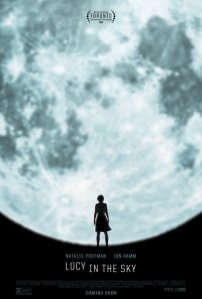 I don’t really know what this movie was trying to say. I think co-writer/director Noah Hawley (TV’s Fargo, Legion) was better trying to humanize the story of Lisa Novak, the astronaut who drove 900 miles, while wearing diapers to skip bathroom breaks, to confront the current lover of an ex-boyfriend, all three NASA employees. It was a story so bizarre, so tabloid ready, that a big screen adaptation was inevitable. What I wasn’t expecting was an artist to take this and discard the attention-grabbing details and turn this into a ponderous existential meditation. Lucy (Natalie Portman) has recently returned from Earth and our big blue planet doesn’t feel the same after she’s touched the majesty of space. Her life seems small, meaningless, boring, and she can’t shake her terrestrial depression. She begins an affair with a co-worker (Jon Hamm) to feel that same special sensation again, but she’s chasing something uniquely elusive. Lucy in the Sky is structured like a meandering Terrence Malick movie was crossbred with a heavy-handed addiction melodrama. It’s not a good fit. The ever-changing aspect ratios are meant to convey her emotional state, but just when I thought I had a handle on how to decode them, Hawley would frustratingly break the rules with them. As far as I can tell, the wider ratio (during space) is meant to convey… good things, and the smaller, boxier ratios (Earthbound) are meant to convey… not good things. But then wide shots will be filmed in super widescreen and it throws away that interpretation. It’s an annoying visual tic in a movie that feels over-directed. The blunt characterization for Lucy fails to open her up beyond that of a self-destructive addict. She had a demanding mother (Ellen Burstyn), an existential crisis, and a boring husband (Dan Stevens), so does that explain her behavior? Portman commits to the madness and I give her credit, though her thick Texas accent made me rear back (it sounded like Reba McEntire). The movie is almost worth watching just for her game performance, kind of like last year’s similar artistic misfire, Vox Lux. Lucy is definitely unhinged by the time she’s making her fateful cross-state road trip. She mutters that women are regarded as “too emotional” as a common slight to sideline, but her behavior isn’t exactly dispelling this criticism. Maybe trying to turn “diaper astronaut love triangle” into a symbol for female discrimination wasn’t exactly the best call. Lucy in the Sky is an arty mess that is trying so hard to say something profound but loses the very appeal of its source material. Either you embrace “diaper astronaut love triangle” or you don’t.
Nate’s Grade: C
Share this:

Vox Lux (2018)
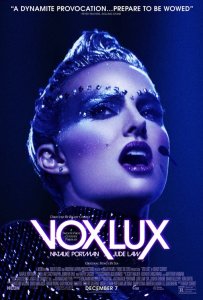
I don’t know what this movie was trying to say about anything. Vox Lux stars Natalie Portman as the adult Celeste, a survivor of a school shooting as a teen who became an international pop star in the months after. Is there something writer/director Brady Corbet wants to say about the transformation of tragedy into mass entertainment? The dulling effect of an entertainment industry to grind up human beings and re-purpose them into shiny, inauthentic, easily marketable figurines? I don’t know. I warily thought as we open on an upsetting school shooting, “I don’t know if the final product will justify this tone,” and it doesn’t. There are decisions that feel like they should mean something, like having the same actress, Raffey Cassidy (Tomorrowland), play both young Celeste and her eventual teen daughter, but what? It feels like an idea looking to attach to an interpretative message. Then there’s a modern terrorist group dressing like one of Celeste’s iconic music videos. She distances herself from the violence and even publicly challenges the perpetrators. This will obviously come back and mean something, drawing upon her own beginning stages of fame derived from the bloodshed of others, right? Or during her big concert the terrorists will invade and attack her, bringing the main character face-to-face with the ramifications of hubris. None of these things happen. Instead, Portman enters the scene at the 45-minute mark and proceeds to lash out at others, lament her parenting deficiencies, gets drunk, and then puts on her show. That’s it. It’s like Vox Lux forgot to be a movie for the final 20 minutes and just becomes a numbing series of EDM pop dance numbers. Portman is actually very good and digging deep into her anxious, entitled, and spiraling pop star, rounding out her dimmed humanity when Corbet cannot. There’s a solid storyline here between the adult Celeste trying to reconnect with her teen daughter who she’s been neglecting. This isn’t it. The pretension level of the pedantic exercise made me think of Lars von Trier as filmed by Darren Aronofsky. Skip it.
Nate’s Grade: C-
Share this:

Annihilation (2018)
 Alex Garland has been one of Hollywood’s most stable sci-fi screenwriters for some time. In 2015, Garland made his directorial debut with Ex Machina, a sly and invigorating potboiler that made you think. It helped make Alicia Vikander a star and Garland himself was nominated for an Academy Award for his original screenplay. The movie even won an Oscar for best visual effects, beating out some pretty pricey competition. With one movie, Garland displayed a natural knack for directing. His follow-up, Annihilation, is based on a book by Jeff VanderMeer and has already run into some trouble. After poor test screenings, the producer tried to force changes but these were refused. In a face-saving outreach, Annihilation will only be playing theatrically in North America and will debut on Netlfix weeks later for the rest of the world. The suits are not confidant in the larger public clicking with Annihilation, and they might be right. This isn’t going to be one of those films that people leave declaring their love over in effusive terms, despite what the critical praise may lead you to believe. This is a movie that you leave saying, “Huh.” It’s so powerfully inscrutable to the point that most other conventional forms of cinematic entertainment and narrative are smothered. And yet, it’s that inscrutability that might be the movie’s biggest point and might be its biggest asset.
Lena (Natalie Portman) is a biologist whose husband (Oscar Isaac) has been missing for a year ever since he ventured into a strange environmental disaster zone. Then he reappears with a mysterious illness and little memory of the events. Lena joins an all-female crew of scientists (Jennifer Jason Leigh, Tessa Thompson, Gina Rodriguez, Tuva Novotny) to find out some answers by exploring The Shimmer, the site where an alien meteorite collided with coastal land and has been changing local life forms at an alarming pace.
 Like I said, this movie is a conundrum, not just in a “What did I just watch?” sort of analysis but also in a, “Did I actually like that movie?” personal introspection. There isn’t really a mystery here to unpack as there is an enigmatic experience to explain. I’m doing something I don’t normally like to do, which is immediately type my review shortly after seeing a movie. I generally like to marinate on my feelings after experiencing a movie; however, with this one I felt compelled to put furious fingers to the keyboard, trying to explore my myriad conflicted feelings and find my way out the other side, or at least articulate that journey. I’ll try and steer away from any major spoilers though I worry that even discussing some of my confounding responses will require some thematic and plot context, so beware readers who wish to go into this experience completely pure.
Annihilation is an existential horror movie about biology’s indifference to mankind; at least that’s my best thematic interpretation. In the beginning, Lena is explaining the history of cellular life, the simple splitting of cells that begat all life on the planet. There was no larger forethought, no agenda, and no malice, only the enacting of DNA programming. Ultimately, I think the alien mutations are running on a similar principle. This isn’t an invasion by any traditional definition. This isn’t anything nefarious. This isn’t even anything as clearly identifiable as a virus spreading its illness. This is simply life stirring in a few new recipes. There’s a general level of indifference to the overall setting, which makes the environmental wonders and horrors more dispiriting. For those who demand clear answers from their storytelling, they will be left sorely disappointed. Annihilation doesn’t have any real answers for why these things are happening. They just are occurring, much like the beginning steps of cellular life that found new modes of survival on Earth billions of years prior. It’s just another stage in the development of life. The fact that humanity can be so easily cast aside, it’s hard not to feel insignificant. There’s a mounting sense of existential dread about man’s inevitable demise. One character dubs their mission suicidal and is corrected by another. “People confuse suicide with self-destruction,” she says. “Very few people are suicidal, but all of us are self-destructive.” The plotline confirms this as characters fall victim to hubris and curiosity. However, one may argue there is biological in destruction and reconstitution.
 Be warned, dear reader, this is a rather slow movie with a lot of space for breathing, the kind of thing meant to establish a particular atmospheric mood. If you connect with the material, it works, obviously. The problem with Annihilation is that because it’s so inscrutable, because it keeps you at a distance on purpose, that it allows more opportunities to check out. We’re anticipating weirdness and a general breakdown in the group of scientists, and Garland seems to understand this, which may be why he gradually delivers his genre scares. There is an amazing sequence in the middle that is the fuel of nightmares, made all the more searing and scaring by a horrifying sound design that’s even worse when you connect it with the visual source. I was almost compelled to look away and spare my memory this ghastly sight. There are other unsettling moments and the overall feel of the film is definitely one of discomfort and dread, but it’s this scene I’ll always remember and that also solidified the nasty surprises from Mother Nature. Unfortunately, these moments are few and far between. The eventual ending should be easy enough to predict thanks to Garland’s flash-forwards tipping your expectations, that is, if you can actually understand the ending. I still cannot say for certain what happened and why or whether I cared about a why. If, as stated above, the point of the movie is man’s inability to find a recognizable motive in the replication of life by biological factors, then that lends itself to a generally unsatisfying end.
One interesting idea that I regret gets short shrift is just the fact that this is an all-female group of scientists venturing where literally only men have gone before. I’m not celebrating this as some sort of nod at feminism but because it offered an interesting storytelling avenue. All the previous groups were all men and they either were killed by the new environmental dangers or went crazy and killed each other. Minor spoilers, but the women fall under the same sway, destined to the same fate, and it feels like a shame. If you’re going to make a point of questioning whether the deterioration of order and sanity is related to an all-masculine entanglement of thinkers, then don’t just have the women repeat the same decline. Or maybe that’s the point? I don’t know.
 Portman (Jackie) does an convincing job of alternating looking confused and spooked, mimicking most of the audience reaction. Her character isn’t asking to be found likeable, only capable, though the first time we get a little taste of her as a person is far too late into the movie. Her marriage might not have been built on the strongest foundation, which again leads to the potential thematic deliberation over self-destruction and rebirth. Leigh (The Hateful Eight) is a bit too flatly monotone for my liking. It feels like she’s sleepwalking through the film, like maybe she was on Ambien and can’t remember even performing in this movie. Tessa Thompson is underwhelming especially with knowing how fully captivating she can be onscreen (see: Thor: Ragnarok). The other notable actress is Rodriguez (TV’s Jane the Virgin) who put on some muscle and swagger and has a terrific breakdown sequence that showcases some unnerving desperation.
I still cannot even say if I liked Annihilation. There are aspects I can definitely admire, like the commitment of its actors, the emphasis on a more scientific approach to an outbreak/invasion thriller, and Garland’s general sense of place. I still think the majority of audiences are going to leave shrugging. Annihilation is more akin to an Under the Skin or Solaris than a monster hunt. It’s quiet, philosophical, and also often boring. It has its thrilling points, its moments of mystery and intrigue, but it also feels like a slow windup to the eventually disappointing reveal that won’t be enough to justify the lethargic pacing. In the end, this is a difficult movie, but not in a way that requires a thorough decoding like mother! or even in a way that requires repeat viewings to play out the twists. Annihilation is difficult by design, keeping its audience from fully engaging, and then offering little in the way of answers or resolution. And I still don’t know if I like that. Dear reader, this is a confounding movie but it might not be the good kind of confounding.
Nate’s Grade: C+
Share this:

Jackie (2016)
 Jackie (Natalie Portman) is still reeling from the loss of her husband, President Kennedy (Caspar Phillipson). In the weeks that followed the assassination in 1963, her life was a whirlwind of change. She was leaving the White House while another administration took control of her husband’s office and agenda. She was leaving a life of glamour and privilege and it all came to a halt. Bobby Kennedy (Peter Sarsgaard) is worried about the Kennedy policies getting lost as well as his own potential presidential prospects. Lyndon Johnson (John Carrol Lynch) is worried about asserting his own control. While trying to work through her grief, Jackie must protect her husband’s legacy among all the well-wishers, political vultures, and craven opportunists.
We’re left with an immersive, impressionistic look at America’s most famous first lady since it’s hard to distinguish the layers of performance from the woman herself. She was used to adopting the façade of what the public expected of her, how her husband’s friends looks at her with desire and dismissiveness, and the differences between her private life and her public persona. It’s a fascinating glimpse into the interior space of a famous woman that so many people think they know well because of her glamour and television appearances, but do they really? Her identity is in free fall. She gave up everything for this man and now he is gone and her cherished position is gone. It’s said each first lady leaves her stamp on the office, and now Ladybird Johnson is already itching to undo that stamp, erasing Jackie’s presence and supplanting it. Will these last few days define her and will they define her husband? While dealing with raw grief, Jackie also takes the position of being the first to protect her husband’s legacy. While planning the particulars of the funeral march and exact burial site, she’s really framing his place in the greater annuls of history, tragically cut short and questionably memorable. His life has been taken from her and now the only thing she can do is protect his place in history. The funeral details and conflicts they consign the new Johnson administration to are interesting, as is Jackie’s simmering disdain for the Johnsons, but it’s more than just placation; Jackie has an underrated knack for theatrical optics. The country is in mourning, just like its (former) first lady, and she offers a spectacle as an outlet. Some term it vanity and even Jackie admits that many aspects were for her, for her grief, for her rage at the world and her doubters, for her wounded soul searching for meaning. She wanted the American public to see her in mourning but she wanted just as much to see them in mourning too.
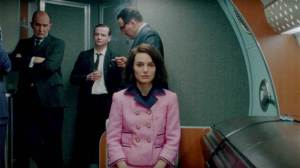 Eschewing the standard cradle-to-grave biopic, as well the noveau approach of using one clarifying moment to better examine and sum up the person (see: Selma, Steve Jobs), Noah Oppenheim’s script is a triptych, a hypnotic exploration that zips along non-linear but thematically-tethered memories. It’s a more interesting approach because we’re not locked into a linear progression of plot events, though the immediate aftermath and her interview with the Newsweek reporter (Billy Crudup) serve as the directional compass. It also provides a clever conceit for meta-textual levels. We have scenes that lay as direct conflict with the public Jackie and the private Jackie, and we have scenes that lay into the different levels of performance, from her show model tour of the White House furnishings and fixings to putting on the brave face to speak to her children. Director Pablo Larraine (No, Neruda) shoots the movie in a style reminiscent of its 1960s time period, with a film stock that blends the difference between documentary and recreation, further adding another stylistic level to the proceedings. The various threads of connectivity are so much more interesting to dissect with this storytelling approach and it makes the movie a much deeper and more contemplative experience to unpack.
There’s a scene in the middle of Jackie that stood out to me. During a night of drinking, Jackie puts on the record for the Broadway production of Camelot and wanders the large empty spaces of the people’s house. For my younger readers, the Kennedy administration was dubbed by many as “Camelot,” first coined by Jackie, out of a sense of its idealism, youth, and inspirational promise to change the world into a nobler place. It’s practically a mythical time and the real people get lost amidst the romantic spectacle. Nowadays, our presidents can often be the same mythical figures as the kings of old, figureheads whose humanity and details we iron out and soften as we eulogize and entomb them. The music echoes through the different chambers but there’s no one to hear it, no one to enjoy it, the vast emptiness communicating much of Jackie’s anguish. “There will be great presidents again but there will never be another Camelot,” she says. That moment is left as a passing memory, a picture of nostalgia that will only have its realism dampen in time as it becomes enshrined in American myth making. Amidst all her privilege and esteem, there is an existential sense of loss for Jackie and the nation as a whole into the turbulent 60s.
The other rich aspect is that we are watching a woman process her grief in real-time and it can often put a lump in your throat. I challenge anyone not to feel an outpouring of empathy when Jackie has to explain to her two very young children why daddy isn’t coming back from Dallas, having to explain something horrendous to those so innocent. In some scenes it feels like Jackie is numb to the world around her, focused on the little things as an escape from her horrible reality and its trauma. We do get a recreation of that fateful day in Dallas twice. The first is the immediate aftermath with Jackie bloodied and protected by the Secret Service, keeping her at a distance from us too in the audience. The next is a closer view inside the car as we’re with Jackie when the awful event happens, and the sudden shock of gore is still a disturbing gut-punch no matter how much you anticipate the moment. We watch her crazed instincts trying to collect the pieces of her beautiful and broken husband, stressing she was trying to keep everything together, figuratively and literally. The scene plays out longer and it serves as an emotional climax to the film, a frank reminder that for everything people believe they know about this woman, at heart, for all her riches and fame and privilege, she is simply a human being trying to make sense of death. It’s this final moment in the car that reminds us.
 This is an acting showcase and Portman (Black Swan) excels, delivering the best female performance I’ve seen this year at the movies. It’s an Oscar bait dream role and she nails it. She goes beyond mere imitation though Portman does an excellent job of that. Thanks to critic/blogger Jeffrey Wells for this great quote about the imitable real-life Jackie from author Tom Wolfe’s novel, The Right Stuff: “She had a certain Southern smile, which she had perhaps picked up at Foxcroft School, in Virginia, and her quiet voice, which came through her teeth, as revealed by the smile. She barely moved her lower jaw when she talked. The words seemed to slip between her teeth like exceedingly small slippery pearls.” Portman stunned me early with her exquisite recreation of Jackie and then she stunned me moments later with the depth of emotion she was able to convey in the scene where she stares into the Air Force One mirror, dabbing her husband’s blood from her face as her eyes are swollen with tears. Lorraine favors plenty of exacting close-ups to watch the array of emotions play across her face. She has moments of strength, moments of pettiness, moments of heart-tugging lows and weakness, and Portman is always fascinating, holding your attention rapt as you study her study. It’s a mesmerizing performance and one that deserves to earn Portman her second gold statue.
Jackie is a movie that has stayed with me for days after I’ve seen it. The exceptional and empathetic work by Portman is the first thing I recall, and then the thematic and symbolic relevance of the storylines as they fold on top of one another, providing a hypnotic and immersive portrait of a very famous woman who sought and spurned the spotlight. As far as I’m concerned this is the definitive film presentation of Jackie and Portman’s searing performance is the dazzling standard that won’t be beat. You walk away having additional appreciation for this woman but also further curiosity. The movie doesn’t expressly state who she is as a human being, providing a range of personas, some that conflict with one another, and allows you to put it all together for your interpretation. It’s a bold gambit and a fitting gesture for a woman defined by others’ perceptions.
Nate’s Grade: A-
Share this:

Thor: The Dark World (2013)
 Loosely based off the Norse mythology, Marvel’s hammer-wielding hero isn’t exactly the easiest character to relate to even as a superhero. Thor is a god after all. Not to be outdone, the man is also royalty, next in line to be king, so he’s in a special class of privilege. And yet 2011’s Thor was a pleasant surprise, a superhero movie that didn’t take itself too seriously, had modest aims, and embraced its sci-fi fantasy mélange. It was a movie where the sillier it got the better it worked. Now Thor: The Dark World, a.k.a. Thor 2, is ready to dominate the fall box-office and prove that Joe and Jane Popcorn can cheer for a pagan god.
Following the events of The Avengers, Loki (Tom Hiddleston) is taken back to his home world of Asgard and put in prison. Loki’s brother, Thor (Chris Hemsworth), is trying to get back to Earth to reunite with his love, scientist Jane Foster (Natalie Portman). Thor is being groomed for the throne of Asgard by his father, Odin (Anthony Hopkins). Meanwhile, the nine worlds are nearing a convergence and dimensional gateways are opening, including one that infects Jane with an ancient biological weapon, the aether. The aether was used as a weapon by the dark elves, a race of creatures that was long ago defeated but its general, Malekith (Christopher Eccleston), has been dormant and in hiding. Alterted, he assembles his surviving army to attack Asgard, kidnap Jane Foster, retrieve the aether, and destroy all life in the universe.
 Thor is still a second tier character when it comes to Marvel superheroes (the guy just isn’t that interesting) but his franchise has, in only two starring films, become the most interesting. The scope of the Thor movies seems infinite. Whereas the other Marvel heroes are Earthbound and straightforward, Thor transports an audience to all sorts of alien worlds/cultures/conflicts, all of which open up more tantalizing storytelling avenues. Nothing seems out of place in a setting such as this, and so the surprises are more satisfying. I thought the best parts of 2011’s Thor were the Asgard moments, less the strained fish-out-of-water comedy of Thor assimilating on Earth. Thankfully, almost all of Thor 2 takes place off Earth save for a rousing, creative, inter-dimensional hopscotch of a climax. The realm of Asgard is given suitable scope thanks to the screenwriters and first-time feature film director Alan Taylor, who worked in TV for years. Taylor’s notable work on HBO’s Game of Thrones is probably what got him this gig, and his vision with fantasy is given significant breadth here. The Thor universe is an interesting mix of fantasy and sci-fi, reminiscent of Star Wars, and Taylor provides the necessary sweeping visuals, exciting action, and glorious shirtless close-ups we come to expect from our fantasy vistas. I was consistently impressed with Taylor’s command of visuals and shot selection, particularly how the man was able to juggle the various tones and needs of the script while still keeping an exposition-heavy film fun and light.
With rainbow bridges, dark elves, and enchanted hammers, thank goodness that Thor 2 keeps a steady and welcome sense of humor, never getting too serious even with the end of existence on the line. This jovial tone is refreshing when properly executed and contributes to the overall fun of the picture. We’ve had such sturm und drang when it comes to our superhero movies, particularly last summer’s Man of Steel misfire. I appreciate a dark and gloomy superhero tale like Nolan’s Batman films, or a satirical swipe like the original Kick-Ass, but we need stories that fit with their tone. When it comes to Thor, he’s still saving the world, rescuing his damsel, but the attitude, while on its face regal and serious, is anything but. The Thor movies accept the absurdities of its setting and just shrugs, plowing along. And now with Jane on Asgard, the fish-out-of-water comedy gets a different perspective. She gets to meet Thor’s parents (awkward) and an Asgardian who has a thing for the hunky Norseman (double awkward… I’ll stop the 90s catch phrases now). Thor 2 also gives Jane Foster much more to do, placing her front and center as a person integral to the stability of the universe. During the snazzy climax, she gets to run around and contribute in a meaningful manner. The there’s the plucky Kat Dennings (TV’s 2 Broke Girls) who gets to rattle off one-liners like a pro, many of them grounding the elevated levels of silliness. Much of the humor comes from the cocksure characters and their quips, particularly Loki.
And that’s as good as any place to interject my notion that Thor isn’t truly the main character in this film, despite what the title preceding the colon may lead you to believe. That honor goes to Loki, the greatest villain in any modern Marvel movie by far. He’s got the clearest arc in the movie, going through arguably the most personal pain, coming to a crossroads, and his conclusion certainly sets up sizable ramifications down the road for the presumptive Thor 3. Played by Hiddleston (War Horse), the character draws you in, even when he’s throwing his self-aggrandized temper tantrums you want to spend more time with him. He’s far and away the most developed and interesting character onscreen, and Hiddleston has such a gleeful malevolence to him that makes the character all the more electric and unpredictable. Thor 2 is really the story of Loki coming to terms with his life’s choices, the choices his adopted parents made, his sense of self and birthright, and moving forward, becoming his own man again. This is why Thor 2 ascends another entertainment rung by tying Loki into the main story, forcing him and Thor to work together against a common enemy.
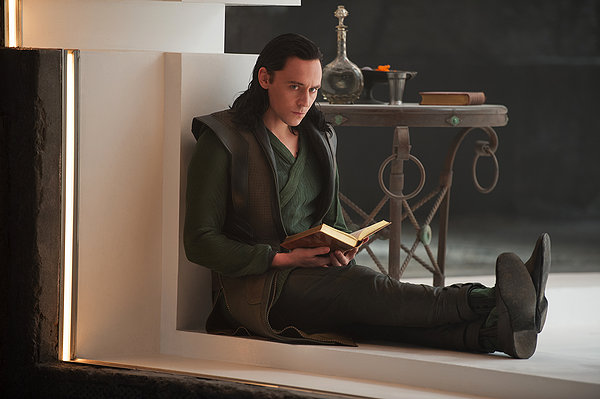 In a film dominated by a charismatic Loki, it’s no wonder that Thor 2’s real bad guy falls woefully short. Malekith is a confusing and altogether lackluster antagonist in every conceivable way. He has no personality to him; he’s simple-minded with the goal of eradicating the universe. I don’t know about you, but my bad guys better have a pretty good reason for destroying the universe since they kinda live there too. This is one of the lazier villain plot devices because it has no nuance, no shading. Apparently before there was a universe there were dark elves. I don’t want to get caught in a chicken-egg paradox here, but was there a universe before the universe, cause I look at the universe like existence’s garage. The cars inside may change but the garage was standing before it all. Anyway, Malekith wants to destroy all life because he wants to, because certainly you’d think there would be enough space in space. He’s not even that threatening or given any particular advantage beyond some firepower. It’s no wonder that Loki runs circles around this chump in the villain department. Eccleston (Unfinished Song) is not at fault. The heavy makeup he’s under smothers the actor’s ability to polish this terrible character.
The rest of the acting fares better. At this point, we know what we’re getting with Hemsworth (Snow White and the Huntsman) as the title character. He’s a sturdy leading man with just enough appeal to satisfy, though part of it is that Thor is just dull as a hero. He was more entertaining when he was cocky and irresponsible. Portman (Black Swan) holds her own though the romance between her and Thor feels more forced. Hopkins (Red 2) strikes the right mix between regal and camp. While their roles aren’t exactly integral, it’s nice having a superhero movie stuffed with great actors like Idris Elba, Ray Stevenson, Adewale Akinnuoye-Agbaje, Clive Russell, and there’s even an amusing appearance by Chris O’Dowd, who effortlessly oozes charm (take note, Thor).
This a superhero movie that separates itself by its sheer sense of fun. Thor: The Dark World takes what worked in the previous movie and provides more of it. The campy, silly Asgard stuff is given even more time, the mischievous sense of humor is renewed, the fantasy worlds given more depth and better action/effects, and fan favorite Loki gets a big starring role this time with extra brotherly bickering. It’s not the best superhero movie, nor is it the best Marvel film of recent years, but Thor 2 knows what kind of movie it wishes to be and how to best achieve this. It’s a loopy, droll, and rather imaginative big-budget superhero film, while still finding ways to be somewhat generic with its overall plotting and character turns. While the action is suitably epic, it’s the character interactions that are the most enjoyable aspect. It seems excessively lazy to say that if you enjoyed the first Thor, you’ll probably enjoy the second one as well, but there it is. Perhaps next time the storyline won’t be as convoluted and we can get even more Loki. Barring that, I’ll accept additional Chris O’Dowd screen time.
Nate’s Grade: B


 nathanzoebl
You must be logged in to post a comment.