Blog Archives
Crazy Heart (2009)
 Crazy Heart is more than a country tune come to life. This is a transfixing slice-of-life flick that serves up a big piece of country lifestyle. This is a dusty, slow burning character piece where consummate actors just dissolve inside the bodies of their characters. Jeff Bridges is country music legend “Bad Blake,” a chain-smoking, alcoholic, hard-living dude who’s given up on everybody in his life, he included. Fame long gone, he performs from hole-in-the-wall bars to bowling alleys for small change and the embrace of middle-aged groupies in seedy motels. Jean (Maggie Gyllenhaal), an aspiring journalist, interviews Blake and the two seem unable to keep their flirtation at bay. She’s prone to making bad decisions, and he’s looking for somebody that will actually care about him as a person. The relationship between these two is starkly realistic, and the actors interact with astoundingly unrestrained intimacy; there isn’t a glimpse, a pivot, or a nuzzle that feels trite. The love-of-good-woman-grants-second-chance plot device may feel overdone, but Crazy Heart is more than the sum of two great performances (and they are great). There’s a heavy, elegiac pall to the movie, where tiny details quiver with insight about Blake’s life. Writer/director Scott Cooper explores the grimy, dismal lifestyle of a man living on the fumes of fame, rethinking his life’s choices and becoming reinvigorated with creative inspiration. Even better, everyone performs their own singing and they are all, without fail, excellent. Who knew that Colin Farrell could be a convincing country music star?
Nate’s Grade: A-
Share this:

Fame (2009)
 Was there anyone out there clamoring for a remake of the 1980 movie Fame? If so, was there anyone clamoring for a remake that drains all life and intensity and passion from the original, leaving behind a squeaky-clean, shallow, and dumbed down version perfect for teenagers? As we churn through Freshman Year to Senior Year, we will follow scads of teens (played unconvincingly by actors in their 20s) that aren’t worth our time. The movie is overproduced and utterly simplistic. Fame is a genuine waste of most of the talent on screen.
Apologies to the Fame theme song, but I was hard-pressed to remember anybody’s name even minutes after the movie ended. Literally, I was walking back to my car and for the life of me could not remember a single character’s name. This is because the movie crams about a dozen characters and gives little to no time to them for development. We don’t get scenes, more like snippets of scenes, snapshots compressing four years of life, and yet Fame also fails in displaying any maturation during that time period. I understand that the actors have to act like they?re plainly “acting” at the start, but the script doesn’t focus much on the rigorous training these kids undergo. Somehow in between one of the many fadeouts, the students are just better. Cutting to the chase makes for fine drama, don’t you think? Screenwriter Allison Burnett (Feast of Love) foolishly thought the audience would be more interested in watching the characters in sub-par soap opera dynamics rather than long moments of training talent. Inside the classrooms are expert teachers played by the likes of Kelsey Grammer, Bebe Neuwirth, Megan Mullally, and the stupendous Charles S. Dutton. We would all have been better served by spending more time at school.
 The structure works out to this: small character snippet, then song and dance number, small character snippet, then song and dance number. Repeat. But the movie’s fatal flaw is that it has no showstopper. This is a movie about forging talent, and yet the song-and-dance numbers feel uninspired. They look competently choreographed but there’s little to dazzle because the sequences are few, treated indifferently, and edited within an inch of their lives. We are rarely afforded the luxury of enjoying the dancing. At least the Step Up movies knew that the audience didn’t come for the story. The high points for the film include a Halloween party with some impressive stutter-stop gyrations (does the school have a production design class to make all those fancy costumes and sets?) and an improvisational jam in the school cafeteria. One kid lays down a beat, others join in adding texture to the jam session. Though I suppose the aspiring actors are left with little to do. This moment isn’t necessarily fully believable but it effectively communicates the creative energies that should be coursing through a school dedicated to performing arts.
I don’t care about any of these characters, mainly because these people are one-line descriptions of characters. These are cardboard cut-outs of characters, and they do a disservice to cardboard. Jenny (Kay Panabaker, looking like Ellen Page?s little sister) is the mousy girl-next-door who needs to come out of her shell. On the opposite end, Malik (Collins Pennie) is an angry street kid who needs to tap into his life experiences for acting power (Burnett also has to make sure the “street kid” character has a deadbeat dad and a little sister who was killed in a drive-by shooting). One girl’s entire story is that she wants to be a dancer and wouldn’t mind annoying her stuffy WASP parents. She invites her new Hispanic wannabe DJ boyfriend (Walter Perez) out to dinner. Cut to thirty minutes later ad she’s breaking up with him to tour with a dance company. It’s supposed to be a moment of drama but I defy anyone to care. Why should I care about this relationship or these characters when the movie doesn’t bother to care?
 The conflicts are usually contrived (oh no, the girl with the most talent in the rap group is told… she has the most talent), mostly involving grumpy, disapproving, fabulously wealthy parents. Denise (Naturi Naughton) is given both of these aforementioned conflicts. Her father demands she play piano, but she wants to sing, so how about she can play piano and sing? It hasn’t hurt Alicia Keys. In other instances, the conflict makes the characters annoyingly naïve, like when Jenny goes to the trailer of a sleazy soap actor to record an audition alone. When the characters do get a chance to speak their minds, well, you wish they would go back to dancing or singing. This also has to be the first time that Sesame Street is responsible for a student flunking out (an actor student gets a small-time gig on the long-running educational show and can’t keep her grades up at the same time).
Let’s face it, in the world of performing arts not everyone is on an even playing field of talent. The movie stumbles early during its montage of auditions, which provides some comic relief in watching the hopeless and untalented. Mostly, this audition process is a blur, but Fame loses serious credibility points when it reveals that some of the auditioning students who WERE the comic relief actually were accepted! How does that work? The movie wants me to make fun of a character for being bad and then the next minute the movie tells me that this applicant beat out thousands of other aspiring performers. I’m sorry, but that’s a credibility gap that Fame never recovers from.
For dancers and singers, it’s clear when they have talent, and it’s easy for a film to indulge. But what happens to the actors? Everyone in the movie is already an actor, per se, so when we get treated to supposedly revealing monologues, meant to display great acting talent, it comes across as unremarkable. The only time I have been blown away by a actor auditioning in a movie was when Naomi Watts just became a different person in 2001’s Mullholland Drive. It was sensational the way that she oozed sensuality and took control of her audition scene. Is it too much to ask that the actors who go through four years of intensive work in their chosen discipline be … better? But my biggest irk was the pseudo-filmmaker (Paul Iacono) who displays no discernible talent. His biggest creative break that we see is taping a drunken student poorly reciting NWA’s “Boys in the Hood” and then vomiting. But wait; being an auteur, he also uses split screens. I really hate it when movies involve amateur filmmakers because it always goes one of two ways, either 1) the movie overdoes it to the point of parody, or 2) the movie underplays the actual creative work, meaning that there is no foreseeable impression of talent. Why can’t amateur filmmakers ever be authentically good in movies? In Fame‘s case, I never saw anything that would justify this kid’s placement at such an esteemed performing arts school; and HE was one of the opening comic relief kids too. Is there a legacy program that they have to adhere to at this school or something?
 Now, Fame is rated PG but is it too much to ask for something a little edgier than another sanitized high school musical? For one thing, the movie dances around the subject of its would-be gay ballet dancer (Paul McGill) being gay. It’s implied in mannerism but that’s all the bait you get, folks. Any school that deals in theater, performing arts, dancing, and acting, well let’s just say that there?s more than one token homosexual. The original 1980 Fame dealt with sex, drugs, abortion, and the hardships of pushing your body to the limits for a dream. You don’t ever see these performers sweat. Instead, they sit around and spout bland “follow your dreams” platitudes.
The best moment in Fame is the end credits, and I don?t mean that to be disingenuous. During the end credits we roll through the various actors and they cut loose, dance, act goofy, and get an opportunity to be silly. And it is in those final moments where these people feel like people, where they have become unrestrained by the director and the screenplay. The movie itself is overly labored without having anything to show for it. The large amount of characters and quick jumps through time make it downright impossible to connect. Worst of all, the signature performance sections are few and lacking true style. This is a derivative, easily forgettable remake that doesn’t even know the right steps to be an entertaining movie.
Nate’s Grade: C
Share this:

Anvil! The Story of Anvil (2009)
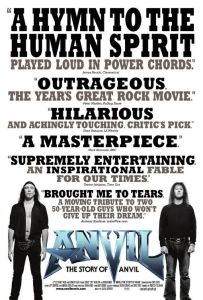 Imagine a real-life This is Spinal Tap! and you’ll have a fertile starting ground to tackle the rock documentary, Anvil! The Story of Anvil. There are so many unintentional references to that landmark mockumentary that you’ll be forgiven for suspecting that Anvil is fake. They even have music knobs that go to eleven! You see, Anvil played with other rock and roll headliners like The Scorpions, White Snake, and Bon Jovi in 1984. They were on the cusp of fame and stardom and then… it just didn’t happen. Flash forward, and the Anvil band members are still playing together and fighting for the fame that has eluded them for over 25 years. Singer/lead guitarist Steve “Lips” Kudlow lives in his native Canada and delivers lunches to school cafeterias. Drummer Rob Reiner (absolutely no relation to the director of Spinal Tap) works meager construction jobs. They both have wives and children, but they haven?t put their dreams on hold and know the fame they deserve is just one more opportunity away.
The band is not without its fans, and one of them is Tiziana Arrigoni, a Swedish woman who loves heavy metal and books Anvil an ill-fated tour of gigs throughout Eastern Europe. And just like Spinal Tap, everything that can go wrong generally does go wrong. The band misses several trains. The clubs they play are small, mostly attracting a handful of die-hard fans and drunks. They get lost in Prague and arrive two hours late to their gig. The club owner refuses to pay the band, instead offering them plates of goulash for their payment. The deepest cut is when the band is booked for the “Monsters of Transylvania” show in Romania at a venue that can seat 10,000. Lips even marvels that, “The mayor of Transylvania is gonna be there!” Only 175 attend the event (it is unclear whether or not the mayor was in attendance). The hapless Tiziana breaks down and cries, “I try,” and you honestly believe her; what kind of European venues should a Canadian metal band 25 years past their prime be playing? I can’t imagine anyone else with no managing experience could do better given the circumstances. Lips seems to see the same silver lining: “Everything on the tour went drastically wrong. But at least there was a tour for it to go wrong on.”
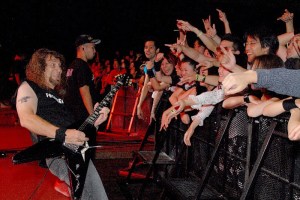 This section of the movie ends at about the half-hour mark and I was left wondering what would be next. Then I understood the smarts of director Sacha Gervasi as a filmmaker because by watching Anvil endure the inequities of failure and humiliation early on, the audience will quickly sympathize with these rock dinosaurs. They fight for their dreams and surely they deserve better, and you will be on their side. This isn’t a spoof or a self-conscious skewering of a bunch of over-the-hill hasbeens. You feel for these guys, and the film offers several moments of surprising poignancy as they struggle to make ends meet, labor in dead-end jobs, and spend time with their loving families doing simple things like eating a pizza. Both Lips and Reiner are described as great family men, though one wonders what kinds of life moments they have missed out chasing fame. Don’t feel too bad for Tiziana either; she ends up marrying the band’s bassist. Their wedding reception is the greatest comic moment in the movie. Anvil rocks out at the reception and the disinterested audience looks like they are being held captive.
It’s the relationship between Lips and Reiner that gives the movie its heart. These aren’t the most self-aware subjects and are given to outlandish statements, but they’re just so overwhelmingly positive in the face of relentless adversity. He walks into various record company offices and hand delivers the newest Anvil album, hoping to get his calls returned eventually. In Canada, Lips and Reiner meet with an A&R man for EMI, and it is painful to watch. The A&R guy takes notes like a secretive psychiatrist and then he shuts off the music after no more than seconds. He tells the Anvil guys that if EMI doesn’t feel like it can give the band what they deserve then they won’t go forward with any album release. He’s brushing them off and making it sound like he’s doing them a favor. And yet Lips keeps chugging along like the little engine that could because he has to. The band mates look to him for inspiration. Often a band’s relationship is compared to a marriage, and this seems appropriate for Lips and Reiner. They’ve been friends since high school, stuck together through thick and thin, and their brotherhood is undeniably touching. Lips talks about the intense pressure he endures and how he feels like leaping off a cliff sometimes. Reiner, right there by Lips’ side, adds, “Well, you won’t jump off the cliff because I’ll stop you,” and then he just beams with pride in their friendship. Lips looks over and he too gets choked up. It’s a genuinely heartfelt moment and encapsulates the emotion mined in the film.
The family members seem to politely go along with the boys? wishes, especially the wives who say in revealing interviews that they too have put their lives on hold for their husband’s ambitions. In one scene, Lips’ sister agrees to loan her baby brother the money to record another Anvil album. She starts to cry on camera and we’re left with the quiet contemplation over what she may be so tearful about. Does she feel joy helping her brother continue on his quest, giving him another jolt of life and a reason to live for, or does she feel guilt and resignation knowing that she is enabling a comeback that is never going to happen, only delaying her brother’s cruel return back to reality. The Anvil boys do have patient and mostly supportive family members, though Reiner’s sister likes to get in easy digs here and there, calling Anvil a “joke.” At one point, Reiner’s wife rebuts the oft-repeated claim that these middle-aged headbangers need to “give up and get a real job” by being candidly self-reflective, talking about her own desire to touch fame through her husband’s achievements, and that she too dreams as much as her husband. It’s a nice moment and an insightful peak into the family lives of rock musicians.
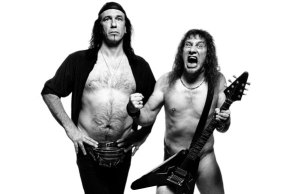 If Anvil has one obvious flaw it’s that Gervasi turns the film into a valentine to his favorite band from his youth. The movie ends on a 1985 picture of Gervasi with Lips, and apparently the director also served as a roadie on one of the band’s mid 80s Canadian tours, so I understand his enthusiasm for a subject near and dear to his heart, but his movie also forgoes any real criticism of the band. There is conflict that goes unexplored. Why didn’t the band actually make it? The movie seems to excuse the band from any blame, although perhaps writing rock songs without a hook might have doomed their radio play. They were skilled musically but can their decline into obscurity all be chalked up to fate and bad management? When the band records their thirteenth album, the “comeback” album, why do they even bother going after major labels? Why do they not go to a niche label, a label that specifically markets to heavy metal fans, the only people who may still acknowledge the demand for another Anvil album? Why, in today’s technologically evolving music market, are these guys not selling the album themselves and online, like what Radiohead did in 2007 for their album, In Rainbows? We see in interviews that notable rock musicians from Metallica and Anthrax admired Anvil, so why didn’t any of them help out when the band was falling apart? What is at the heart of the pain between Lips and Reiner? I’m pleased that Gervasi didn’t lambaste his teenage idols but his movie also could have benefited from further inquiry. He may be too close to the topic to make Anvil a seminal music industry documentary, but Gervasi does keep the movie engaging and, like Lips himself, keeps the darkness at bay no matter the situation.
Anvil! The Story of Anvil is an entertaining documentary that manages to be funny, sad, touching, and inspirational. It doesn’t dig too deep but then again you?re kind of pleased just to be along for the ride and explore these aging musicians? family lives. I don’t consider it a spoiler to say that the men of Anvil get some well-earned recognition by the end of the movie, coming full circle from that 1984 Japanese rock festival. You don?t have to be a fan of metal music whatsoever to enjoy this movie; in fact, the film curiously never plays a full song from the band. Anvil is an enjoyable labor of love for Gervasi, and it’s hard not to fall under the same nostalgic spell.
Nate’s Grade: B
Share this:

Repo! The Genetic Opera (2008)
 In a dystopian future, organ failure has become an epidemic. Fortunately, the GeneCo Corporation and its CEO Rotti Largo (Paul Sorvino) have devised a solution. They will loan out new organs to those in need. However, if the customer happens to be late on a payment then GeneCo sends out the Repo Man. This hooded figure will track you down and surgically remove GeneCo’s property, and perhaps they’ll harvest the rest of you too. People become obsessed with surgery upgrades (just think what wonders a third kidney could do for you). Blind Mag (Sarah Brightman) is a famous opera singer that signed a contract for new corneas. She’s now reconsidering retiring from the stage, no matter what that means. There’s also a powerful pain killer known as Zydrate that can be extracted from fresh corpses. Anyone caught robbing graves will be shot on sight.
One repo man, Nathan Wallace (Anthony Stewart Head), is working to keep his daughter safe. Shilo (Alexa Vega) has a rare blood disease she inherited from her mother, who died in childbirth. Nathan must keep her locked away in order for her to survive. His daughter must never know his true identity as a repo man. Rotti is informed that he is dying from inoperable cancer. His trio of bratty, homicidally crazy children (Paris Hilton, Bill Moseley, Nivek Ogre) are all fighting over who will get to run GeneCo once dad’s dead. Rotti plans a big bloody finale for everyone at the Genetic Opera’s final curtain call.
To answer the most burning question, yes it is an opera. There are perhaps five spoken lines and the rest of the movie is completely sung; you will get a solid 85 minutes of people singing while they engage in plenty of questionable acts. To say that Repo is unique is a disservice to the flick. I cannot imagine watching another movie that combines opera, vivisection, surgery addiction, Gothic costuming, and Paris Hilton actually doing a credible performance. Knowing that it is indeed a full-fledged opera, it mostly eliminates the snickers that arise from watching actors break into song at curious moments; when they’re singing all the time you’re more aware when they stop. It’s a futuristic rock opera that exists in the realm of a horror movie. There are several dispirited elements that can be occasionally awkward but that isn’t necessarily the flick’s fault. I just haven’t witnessed too many folks singing while arm-deep inside an exposed chest cavity. The movie isn’t as bloody or gory as repulsed film critics have lead you to believe. There are about four sequences of horror gore, though the film does resort to casual violence that can be off-putting, like stabbing extras. Repo possesses a wickedly entertaining and gleeful spirit.
 But how is the music for such an avant guard enterprise? It’s pretty solid, actually. It won’t be everyone’s cup of tea, naturally with some vulgar lyrics, but the music is certainly well crafted, with strong melodies, catchy hooks, squealing guitars, and some rather impressive singing. The music is reminiscent of industrial rock acts but it also has some pretty flavorful pop styling (the pounding hard rock beats reminded me of the underrated band, kidneythieves). These are tunes that will stick in your grey matter. Some of the highlights include “Infected,” where Shilo laments her condition and says, “I’m infected/By your genetics!/Mother can you hear me?/Thanks for the disease!” The tune is likely the catchiest of them all and has a fun pop-punk melody that becomes a leitmotif. Vega also proves immediately that she can sing. “Zydrate Anatomy” is led by the charming vocals of the Graverobber (Terrance Zdunich, who co-wrote the music and lyrics) as he exposits to the audience the ins and outs of the drug market. The guitars careen and the backup junkie chorus (“A little black vial? A little black vial!”) add some depth to the tune. But least you think it’s all Goth rock, Repo mixes in traditional arrangements as well, including plenty of harried violins, cellos, and some classical opera music. There are also subdued ballads like “I Didn’t Know I’d Love You So Much” and “Genetic Emancipation” that conclude the film on a high note. It all blends together into a unique soundscape that’s well worth singing along to.
Unlike the big screen version of Mamma Mia, the cast of Repo can actually sing, and they sing quite well. Vega (Spy Kids) sounds like a better Avril Lavigne than Avril Lavigne. She’s an ingénue that actually gets some good songs. Fans of Buffy the Vampire Slayer will recall that Head gave a standout performance on the TV show’s musical episode, and here he shows his amazing lung capacity. Head has a rich tenor voice that is lovely to hear. He howls with soulful anguish and holds onto notes for long duration. It’s tricky to present a performance only through song and Head has the most complex role (in one song he laments that “I’m the monster!/I’m the villain!”). Head also switches over into a gravely demonic voice, like his maniacal “I’m on the job” voice to frighten his victims. The personality shift is a credit to Head’s vocal range. The rest of the cast includes singers with actual opera experience (Sorvino, Brightman) and musicians (Skinny Puppy’s Ogre), and then there’s Hilton. She’s already proven with one flop album that the hotel heiress is not the surest singer in the world. However, she works with the material as a spoiled rich kid consumed by her vanity (at one point her face literally falls off).
 Repo! The Genetic Opera plays better as a soundtrack than as a movie. The story is mostly simple but still manages to be confusing at points because of unresolved subplots. The characters are given glimmers of outgrowing their stock roles, but most of them just accept their underwritten fates. Repo seems like it’s on the verge of making social commentary on vanity, man’s compulsion to destroy himself to live outside one’s means, the disposable nature of beauty, destiny versus free will, but it never really delves deeper. The surface is barely skimmed and then the movie kind of chugs along at a super brisk pace. The movie has a trashy, campy atmosphere that can wear thin at times, especially under director Darren Lynn Bousman’s lackluster lens. I know this is low budget but Bousman doesn’t conceal the budget limitations too well and his shot selections can seem rather redundant and mundane for a music video, let alone a feature length film. With that said, this is still worlds more ambitious than Bousman punishing audiences with another Saw sequel (he directed Saw 2-4 and took time off from 5 for this flick). Some of the songs, while fun, seem out of place given the narrative, like the punkish “Seventeen” where Vega declares her womanhood and pretends to be a rock star and pounces around her bedroom, complete with dancing stuffed animals. It’s almost like a Miley Cyrus/Hannah Montana moment of strange daydreaming. The finale at the opera is a tad overwrought and yet it seems appropriate given the operatic backdrop.
I’m dumbfounded that some critics would cite Repo! The Genetic Opera as the worst film of 2008. How could something this ambitious, with such a killer soundtrack, be worse than 88 Minutes, The Hottie and the Nottie, and the atrociously harmful Meet the Spartans? The movie is far from perfect and is bizarre, messy, and somewhat shambling, but I have a healthy appreciation for a film that tries something different, whether or not it succeeds. A bloody rock opera seems like it’s begging to be considered midnight movie material, but it’s better than that. This curious experiment works better as a soundtrack than a movie, but it’s well worth seeing because, really, when are you going to catch another freaking movie like this? If you ever venture inside a Gothic-themed club, you can expect to see this movie playing on a TV somewhere until the end of time. My advice: buy the soundtrack and get ready to have the songs take root in your brain.
Nate’s Grade: B-
Share this:

Young @ Heart (2008)
 Old people and rock and roll seem like contradictory terms. It’s easier to imagine a 70-something grandma listening to the soothing tunes of Lawrence Welk or the Andrews Sisters than the likes of Sonic Youth and The Clash. Young @ Heart is a documentary that follows a unique chorus made completely of senior citizens (the youngest member is 72) who travel the country singing contemporary rock songs. Now, bear witness to great-grandmothers rocking at a reasonable hour and partying on days where they take their meds.
Once old people reach a certain aged age they fall into the same category as children, and by that I mean you can position them to do anything out of the ordinary and it suddenly becomes adorable. Seeing a baby wear a top hat? Cute. Seeing an old person dance to a modern rock song? Cute. I don’t make the rules, folks, but the end of life and the beginning of life have much in common, which includes the universal appeal of young and old doing things unlikely for their age. So, yes, Young @ Heart has a steady supply of adorable moments, especially as you watch how joyous many of the members are when they practice. Many members of the chorus have severe medical ailments and profess that participating and singing has medicinal benefits. They feel young and energized, and sometimes the members will defy doctor’s orders to attend. It is clear how much singing can mean to these people, and watching them come alive is undeniably heartwarming, but it’s downright moving when the Young at Heart chorus branch out. They perform at a prison and literally bring incarcerated prisoners to tears. I’ll admit that I was fighting back tears myself during the stirring performance of Coldplay’s “Fix You,” which is given a somewhat profound new meaning. The lyrics, “Lights will guide you home,” and “When you lose someone you can’t replace,” are given more relevance when sung by octogenarians who have all experienced recent loss amongst their ranks.
 With such a naturally intriguing premise, it’s a shame then that director Stephen Walker doesn’t do more with the material. In many ways, Young @ Heart is a rather ordinary documentary that forgoes several opportunities to dig deeper. The interviews are rather basic and rarely penetrating, and the narrative structure of practicing for the big show means that the concluding fifteen minutes will be locked into being the performance. Walker narrates the movie and often inserts himself into the film because it seems like he wants to be part of the fun. Documentaries can succeed from objective and subjective point of views, but I get frustrated when people like Walker don’t want to merely tell the story but piggyback so they are part of the story. It smacks me of narcissism.
I think there was a stronger dramatic dynamic with Young @ Heart than what Walker captures, and I think he misses this because he had lowered ambitions for the film simply to document the seven-week period of practice. Every now and then you’ll discover a moment that points to what Young @ Heart had the potential to become, but Walker’s intention is more along the lines at gushing at what geezers can do. I get that Walker feels affection for his subjects but couldn’t he have gone further than the old-people-sing-young-people-songs gimmick? Some times the film feels like it has as much depth as a prototypical behind-the-scenes featurette on a DVD.
Walker evenly divides the film between performances and interviews and he also doesn’t overdose on the pathos even after deaths hit the Young at Heart clan. The movie has several music videos where the old folks sing to songs like “Golden Years,” “I Wanna Be Sedated,” and “Stayin’ Alive.” As you can see, each song is given something of a twist. However, the music videos come across as cheesy and unnecessary since seeing the performers live would be more interesting and real. Including several music videos, of songs that we never see the chorus practice no less, seems like wasted time that could have been spent getting to know our cast of characters better. I’d rather better know them as people than laugh and giggle at them performing The Bee Gees at a bowling alley.
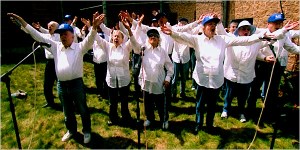 There are some chorus members that separate from the pack like 92-year-old Eileen Hall who used to be a burlesque dancer many moons ago. She’s the oldest in the film and yet in many ways has the most indomitable spirit, frequently cracking jokes and making suggestive statements that Walker deems to be “flirting.” Fred Knittle is a man who was told he’d have two years to live after suffering his latest heart attack. By the time he rejoins the chorus he’s at two years and four months and running. He ably steps into the solo spot to sing “Fix You” after the original singer passes away. The moment is so pure and emotional that it reminds you about the power of music in a non-saccharine way. One of the more interesting figures in the film is Bob Cilman, the music director of the Young at Heart chorus. Here is a man in his 50s teaching contemporary rock songs to the elderly, and yet the film never explores this man and his infinite patience. What are his reasons for doing the Young at Heart chorus? What does he think about his own life’s purpose? The movie would have strongly benefited by spending more time exploring the life of this man and his unique mission. I want to know what makes him tick.
My faults with the film do not fall upon the subjects. This batch of senior citizen rockers is a delightful group and watching them perform can be entertaining and occasionally inspiring. However, I cannot fully recommend it because its scope and interests are far too narrow given the subject matter. Director Walker would rather treat his senior subjects like they were posing for a calendar in adorable poses, and I’m glad he has such warm affection for these lively octogenarians. But his affection clouds his filmmaking judgment and Walker ignores plenty of palpable drama. The concluding concert will certainly produce smiles and some toe tapping, but this drama could have been so much more. I can honestly say that, beyond the communal experience, there is no reason to catch this movie in a theater. It will play the same on your TV screen. If only Walker had listened a little harder to his older subjects then maybe he would have realized that true wisdom does not come merely from a cute gimmick.
Nate’s Grade: C+
Share this:

Hamlet 2 (2008)
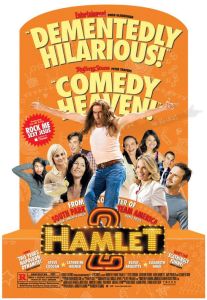 Believe it or not, there actually is a sequel out there about William Shakespeare’s most famous play concerning family dysfunction. Author David Bergantino surely doesn’t feel that he can improve upon the Bard’s classic Hamlet, but Bergantino is a writer who doesn’t cower from a challenge, like where to go next when all the main characters are dead. That’s why Bergantino took it upon himself to write Hamlet II: Ophelia’s Revenge (no joke). Apparently modern students at Globe University are playing out a family squabble very similar to anyone that has taken a high school literature class. The synopsis over at Amazon.com says it better than I could ever hope:
“When he unexpectedly inherits a creepy old castle in Denmark, Cameron tries to put his worries behind him, inviting his girlfriend and college buddies along on an overseas trip to check out the gloomy fortress. The plan is to get some serious partying done. Too bad nobody counted on the ghost of a drowned girl rising from her watery grave with vengeance on her mind! Now the only question is: to die or not to die?”
In the wake of Hamlet 2, a popular comedy at the Sundance Film Festival, I pity Bergantino. The man is going to be the Leif Ericson of pointless Shakespeare sequels: forgotten by history at the original pioneer. The film Hamlet 2 follows the miserable life of Dana Marschz (Steve Coogan). He teaches drama at a Tucson, Arizona public school and barely gets paid. His wife (Catherine Keener) is anxious to get pregnant and convinced Dana is shooting blanks. The couple is so poor that they have to rent out their home to a boarder (David Arquette). His drama class has two very WASP-y pupils (Phoebe Strole and Skyler Astin), but the rest are disinterested Hispanic students bused in from another school district. The school’s theater critic chides Dana’s laughable productions of Hollywood movies, like Mississippi Burning and Erin Brocovich. Then comes the news that drama has been slashed from the school budget. The pint-sized theater critic tells Dana to try something original to save the drama department. The answer? Hamlet 2. Thanks to a time machine, and Hamlet’s new best buddy Jesus Christ, the pair can go back and save everyone who previously perished.
 Hamlet 2 is Coogan’s show and the British comic makes his character endearing sad-sack. His character is pathetic and subject to all sorts of personal humiliations, and yet Dana is so earnest that it makes it hard not to empathize with his exploits. Coogan has a wild leer to him that gives the character a manic edge of desperation. He’s a gifted comic but he’s used to playing smug, droll characters, and Dana Marschz is the exact opposite of that mold. Coogan’s many breakdowns and bouncy spirit give the material an extra lift. He works hard for every laugh. It’s a shame, though, that he sort of disappears into the background during the staging of his infamous play.
So what is the comedic point of view with Hamlet 2? Are we to laugh at Dana and find him a buffoon? Well if that’s the case, then why serve up a musical finale that’s actually worthwhile and completely hilarious? The production values are pretty extravagant given the money limitations on the characters. Not only that, it’s so bonkers that I wanted to just watch Hamlet 2 on stage and not cut back to life outside. I wanted to luxuriate in the inspired craziness of a musical that involves time travel, Shakespeare, Albert Einstein, the song “Raped in the Face,” the devil, the Gay Men’s Chorus, lots of father issues, and Jesus moonwalking over water. That’s way more interesting than the ho-hum characters interacting backstage. In truth, the play’s the thing and it’s way too short for my liking. The performance serves as the film’s payoff, so I wanted to get every crazy kernel of shameless joy. The “Rock Me Sexy Jesus” song is irresistible and I haven’t been able to get it out of my head for days. It’s so bouncy and fun and melodic. I’ll be walking along and then I’ll start humming the damn thing. I doubt that I will come across a catchier original song in movie this year. Hopefully those bigwigs in the Academy will realize the tune’s musical merits and give it a nomination it rightfully deserves.
Then is Hamlet 2 a parody of all those treacly teacher inspiration movies, the kind that seem to always be populated by tough minority kids who just need someone to take the time and break through to them? Well Dana constantly refers to Hollywood movies like they’re documentaries, and even a whole class lecture concerns Dangerous Minds. When he accidentally injures a student, Dana jumps at his students being alert and offers in summation, “Yes it was stupid but it was theater.” The movie takes some shots against the likes of Dead Poet’s Society and Mr. Holland’s Opus, but ultimately Hamlet 2 becomes yet another inspirational teacher movie. Dana is able to rally his students to the cause of theater, prejudices are broken down, and certain students take charge of their young lives. It’s all so predictable, and predictability blunts edginess and can destroy comedy. The only true genre tweak seems to come when standoffish Octavio’s background comes to light. He’s not the underprivileged wannabe gangster but a bright kid whose been admitted to an Ivy League school early. And his parents don’t object to the play because of “ethnic narrow-mindness” but because they think it’s poorly written.
 Like Dana’s students, the film never seems to match its potential. The concept is great and so is having a main character who is inspired by theater but profoundly inept at teaching it. Dana lacks talent but can it be made up for with such big-hearted enthusiasm? There is plenty of ripe material there, but Hamlet 2 doesn’t seem to fully realize the comedic possibilities. Watching Dana fight administration officials in the name of the arts is worthwhile conflict but it’s rarely funny. Keener seems wasted as Dana’s passive-aggressive wife. An ACLU lawyer (Amy Poehler) is a great political target, especially as she fights in the name of bad art, but she appears too late in the film to be really capitalized. The climactic staging of Dana’s masterwork is another example of not fully thinking out the comic potential of a situation.
Here’s a perfect example: Elisabeth Shue appears in the film as herself, actress Elisabeth Shue. She’s quit the acting business and taken residence as a nurse in Tucson. What exactly is the joke here? Is it that Hollywood has the habit of spitting out aging actresses? Dana’s students have no idea who Shue is. Is it self-parody? If it was self-parody then the filmmakers needed to give Shue more of a personality. She’s appears infrequently and beams a nice smile but that seems like the only demand, though I must admit always in her nurse outfit, a nice visual gag. If Hamlet 2 had spent more time in revision it would utilize the comic possibilities of integrating a real-life actress playing herself in such a remote city.
Ultimately, I don’t know what to make out of Hamlet 2. It’s a marginally funny and entertaining venture that celebrates the power of the arts, which is a noble cause. Coogan straps the production on his back and carries it as far as he can go. There are some decent laughs and the closing 15 minutes is a giddy blast. However, the movie often feels flat and simply odd, missing potential punchlines and settling for second-rate comedic situations. The crafty premise afforded better material then what eventually comes across onscreen. The whole thing also feels like a mild retread of Waiting for Guffman. But take heart, because Bergantino is not about to lose the spotlight just yet. He also has written A Midsummer Night’s Scream: Hamlet II (I have no idea where the two stories connect but that’s the genius of it). It’s only a penny at Amazon.com. Get it while you can. Or don’t. Preferably, don’t.
Nate’s Grade: B-
Share this:

Mamma Mia! (2008)
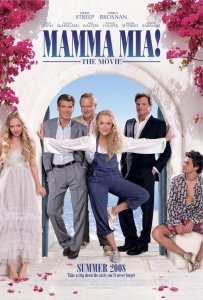 Mamma mia here we go again. This movie is going to be a middle-aged woman’s dream come true. It boasts a cast whose median age is in the mid 50s, one former yet still dashing James Bond, lots of good vibration getaway vibes, songs by a pop group whose heyday was over 30 years ago, and a heaping helping of girl power. In short, Mamma Mia will entertain the same mixture that made Sex and the City a monster hit, notably middle-aged women, teen girls, and gay males. I’ve seen the stage show and enjoyed it, as have millions of others around the world, but the movie fails to capitalize on reaching a broader audience. Mamma Mia is content to serve the faithful and delivers a less than satisfactory product. The world of cinema is not the best place for this material.
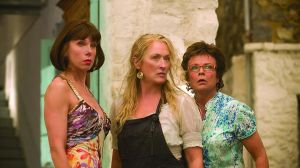
Raised all her life on a Greek island in a Mediterranean paradise, Sophie (Big Love‘s Amanda Seyfried) is getting married. Her disapproving mother, Donna (Meryl Streep), runs a hotel and has raised her daughter by herself. Then one day Sophie goes through her mother’s diary and discovers she has three possible fathers, Harry (Colin Firth), Bill (Stellan Skarsgård), or Sam (Pierce Brosnan). She invites all three to the island to vet her real father. In agitated response, Sophie invites her old gal pals Rosie (Julie Walters) and Tanya (Christine Baranski) to help her during this paternity crisis. Over time old loves will be rekindled, new love will bloom, and there will be a lot of singing.
 Let Mamma Mia stand as a future testament as to why you do not generally let someone helm a film when they have no film experience whatsoever. The creative talent behind the hit Broadway musical refused to grant anyone in Hollywood the rights to their worldwide sensation. So the stage director, Phyllinda Lloyd, is now also the film’s director, and oh my goodness was not the right choice. Her film inexperience shows with every second. The movie just doesn’t look right from beginning to end. There’s a noticeable “off” sensation due to Lloyd poorly shooting her scenes, editing her scenes, and directing her actors. I kept wanting, through sheer force of will, to nudge the camera angles, to change the composition a tad to make them more visually appealing, because Lloyd shoots the movie in bland static angles with minimal coverage. Mamma Mia looks so amateurish and fussily so, like Lloyd is purposefully thumbing her nose at the art of cinema. Lloyd also doesn’t bother to place any choreography in her scenes, and her actors just sort of spin and sway to the music like they were dancing in front of a bedroom mirror. It’s remarkable that a movie with so much riding on it looks so shoddy.
Presented in the reality of a stage, Mamma Mia is a shallow but fairly fun time. The movie version transports the musical into an actual Greek locale, which, to knock Lloyd yet again, she makes no real use out of (she mostly shoots her actors against rock faces and under harsh, glaring sunlight). What works on stage, when presented under the pretenses of the real world, comes across as incredibly cheesy and goofy beyond all relief (get a load of the high-stepping snorkerlers). The song and dance numbers, the character interactions, the sitcom generic plot (ripped off from 1968’s Buona Sera, Mrs. Campbell), they all start to transform into camp and beg for mockery. All of a sudden the entire island turns into a Greek chorus and provides backup during the impromptu singing. It’s strange and comes so late that it never feels properly established. The characterization is pretty slim, and once the movie establishes its characters it pushes the petal to the floor. The plot whizzes by in a whirlwind of one Abba song after another, with minimal breaks in between just to change setting and barely elbow the characters forward. I don’t think the actors had any chance to breathe in between the song numbers because I know I could barely exhale before another song assaulted my senses with forced giddiness.
But here’s the odd thing. The film is so silly and played to constant high-energy capacity that after a while Mamma Mia begins to wear you down. You may begin to smile, you may begin to clap, but you’ll be guaranteed to start humming the incredibly infectious tunes. Mamma Mia is essentially an Abba jukebox with a third-rate story strung along for the ride. As a story, it leaves much to be desired, but as a musical experience it makes you realize how glorious those Abba songs are. They’re like perfect pop bundles that somehow make you feel better even if the lyrics are more bittersweet than you realize at the time. The 18 Abba songs showcased, along with a few others during a weird curtain call sing-a-long, will certainly lift your spirits just as long as you concentrate more on the music than on the often-forced context.
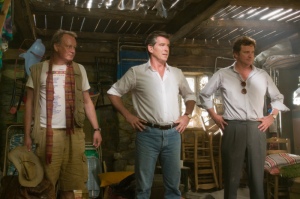 The actors are better than the material, clearly. Streep is her generation’s finest actress but she tries too hard to convince you of the great girl-power fun she’s having. The singing, on the other hand, is all over the map. Streep and Seyfried have the strongest voices of the bunch, which is good considering they also have the most musical numbers to sing and twirl to. Neither has a particularly sensational voice but then again they certainly distance themselves from their pitiful peers. Most of the other actors just have droning vocals but Brosnan, oh boy, I have to congratulate the man for having the courage he does. You feel embarrassed for the guy; I mean this is James Bond here. I found myself turning away whenever he opened his mouth, not wanting to look the man in the eye. Every time he started singing my theater crowd of Mamma Mia faithful began snickering and giggling. I almost feel so bad that I should send the guy a card saying, “Sorry about the singing, but hey, you’ll always have the paycheck.”
The real audience for a Mamma Mia movie is the fans of the Mamma Mia theatrical show, and the movie is tailored to their interests. The big screen version isn’t interested in converting new fans, hence the amateurish direction and disregard for reaching out for broader appeal. Mamma Mia the movie is pretty much a less zippy and ten times goofier version of the stage show except with bad singing. If that sounds like a fun evening out, then by all means enjoy. This is a mess of a movie and not a terribly good movie at that, and yet the power of those Abba songs will inject enough goodwill that you will forgive some of the movie’s transgressions. Some. Pierce Brosnan’s singing is something that cannot be forgiven nor forgotten.
Nate’s Grade: C+
Share this:

August Rush (2007)
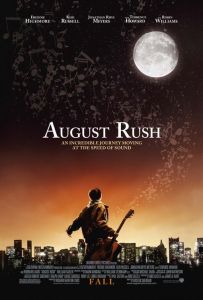 Am I too cynical for my own good? I’d like to think that I appreciate authentic works that tug at my heartstrings, and I’m a believer in the power that music can have, which are part of the reasons I named Once the best film of 2007. In comparison, August Rush tries to go all message and winds up skirting over why I should even care what happens to its characters.
In 1994 or so Lyla (Keri Russell) is a concert cellist in New York City. Louis (Jonathan Rhys Meyers) is the lead singer in a rock band touring the area. They meet atop a rooftop, look deeply into each other’s eyes, and then have sex. Parents, do not condone this behavior with your daughters and sons. But they’re separated through lame circumstances and nearly miss each other several times. This romantic encounter has spawned a son growing in Lyla’s womb. She gets into a car accident late in the pregnancy and was told by her manager/father tells her the baby has passed away. He is a liar because the baby was born and he signed it up for adoption.
 Flash forward 11 years. The child has gown up into the likes of Evan (Freddie Highmore) who lives in a boarding school for orphan boys. He knows his parents are out there in the world somewhere and he believe he can find them through the connection music. He gets lost in New York City and follows a troop of child musicians to the Wizard (Robin Williams). He looks after a gathering of orphan musicians that play on street corners. It’s like Oliver Twist meets American Idol with an extra dose of sugar. Sure enough Evan stars drawing a crowd and the Wizard wants to make sure he doesn’t lose his biggest earner.
This film is a ludicrous and manipulatively maudlin mess. August Rush plays all the big notes; the film’s script is entirely comprised of big moments that waddle and crash into one another, and as such it ignores any details. Like the fact that Evan has the ability to connect to his long-lost parents simply by strumming an instrument, but he’s never heard of musical notes or touched an instrument until he was 11. If the kid hears music everywhere, which reminded me a lot of Bjork in the superior Dancer in the Dark, wouldn’t it stand to reason he would try to, I don’t know, play music? Now I’m not saying he’d have access to every musical instrument at the boy’s boarding house but surely he could have drummed something? I find it unbelievable that a musical prodigy would wait until he was 11 before he picked up an instrument. Also, he learns what sounds are labeled as what letter notes by a cherubic little tyke with some powerful pipes of her own. He goes immediately from learning what an F sharp is to scribbling complex musical notation on blank sheets of music stanzas. How does he know all the symbols and placements and everything that the little girl did not teach him in their brief instructional moment? I’ll go back even further. How come Lyla and Louis give up trying to find each other so easily? Why does Louis wait 11 years before he searches the Internet for Lyla, who, being a world-class cellist, would not exactly be low profile? And why does a pregnant Lyla not do more to, you know, get in contact with her child’s father when he’s even in the exact same city? It’s details like these that August Rush hopes to will the audience to ignore, but to me it was proof time and again that the film’s indifference to plot, character, and maintaining any level of credibility even on a heightened “urban fairy tale” level.
If you replaced the stars then this movie would prove to the world that it belongs on the Lifetime TV network. It’s a melodramatic free-for-all that turns the topic of music into a quasi-religious experience. Now I know for many that music actually can maintain a religious level of power and sweep, but I challenge people watching August Rush to replace the word “music” in the dialogue with any other word to fully realize how cheesy the dialogue is. Let’s try replacing “music with “the force,” and now read this choice line of dialogue: “You know what [the force] is? God’s little reminder that there’s something else besides us in this universe; harmonic connection between all living beings, every where, even the stars.” And: “[The force] is all around you, all you have to do is listen.” This is the kind of film where characters can look up into the void with wistful, wide-eyed looks and somehow connect over the ether. That’s how the characters stay together and eventually reunite in a predictable and sappy manner.
The music itself is rather unremarkable. It’s well composed but I wouldn’t be able to recall it again even if I had a gun to my head. When the movie trumps the message of the transcendent power of music it doesn’t help when the music it presents is less than special.
The acting befits the same cheesy atmosphere of the movie. Highmore is pretty vacant and looks like he’s shrugging from scene to scene, that is, until he bangs his hands against a guitar neck and everyone somehow calls this genius. I think part of Highmore’s problem is that regular folks just think that honest-to-goodness geniuses don’t really have to work hard for results. This is, of course, false. Mozart was a prodigy, yes, but he didn’t just yawn and write down invisible notes that were dancing in front of his eyes waiting all day to be transcribed. He worked hard. Highmore just looks off into the distance and he seems to be in a trance. It’s annoying.
 Russell gets to pine for something just outside her reach (turns out it’s a son) but she doesn’t flash an iota of the grace and magic she showcased in Waitress. Meyers gets to “sell out” and then reunite his mid 90s alternative rock band. Here’s the thing — the sound EXACTLY THE SAME after 12 years and yet on their first gig back together they have a huge crowd? The movie is trying to tell me that the tastes of pop culture wouldn’t change in a dozen years. Williams manages to give hints about a troubled past as a musical prodigy eaten up by a system hungry for the next big thing. He also bellows and growls and comes across like a creepy Fagan for a team of street urchins.
August Rush is sticky, sappy, manipulative and maudlin feel-good rubbish. This is the kind of movie that most people will probably never get. Perhaps people who live, breathe, sleep, and eat music will feel more inspired by its message of human connection and spiritual fulfillment via the power of music. That’s swell but it still doesn’t excuse the fact that August Rush is a overly serious, laughable, syrupy work. If you’re going to dismiss its faults as the film being a “fairy tale” well then the film still doesn’t establish any hard rules for its universe. The characters are still one-note and behave in annoying and moronic ways because the plot demands it of them. And classifying the film as a fairy tale still doesn’t make the music any better. I can’t believe this stuff had a shot of beating the spectacular songs from Once for 2007’s Best Song Oscar. In fact, August Rush wishes it was Once because that low-budget charmer was able to communicate the power of music honestly and profoundly with the added benefit of beautiful tunes. I would like to recommend that all people thinking about renting August Rush.
Nate’s Grade: C-
Share this:

Sweeney Todd: The Demon Barber of Fleet Street (2007)
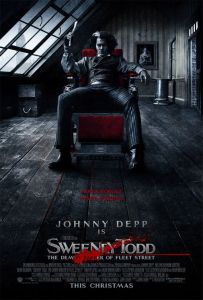 Famed musician/lyricist Stephen Sondheim’s tale of murderous barbers, cannibalism, and poisoned hearts first debuted on Broadway in 1979. Sondheim has been very protective of his material when it comes to film rights, but it wasn’t until the combination of visionary director Tim Burton and acclaimed actor Johnny Depp that Sondheim allowed his revered musical to be made into a movie. The result is faithful production that expands the scope of the musical while maintaining an intimate, chamber-music feel. Sweeney Todd flirts with being a masterwork but settles for being incredibly damn entertaining.
Benjamin Barker (Johnny Depp) returns to London after 15 years in prison on a flase charge. Judge Turpin (Alan Rickman, suitably creepy) wanted Barker’s wife for his own and conspired to have the barber sent away. Now under the auspices of Sweeney Todd, Barker has come back to seek his wife and daughter. He sadly learns that his wife is dead and his teenaged daughter, Johanna (Laura Michelle Kelly), is the ward of the Judge. Sweeney reopens his barber business above a flagging pie shop run by the eccentric Mrs. Lovett (Helena Bonham Carter). Sweeney plots his revenge against the Judge and his henchman, Beadle Bamford (Timothy Spall, suitable rat-like). Anthony (Jamie Campbell Bower), who traveled with Sweeney back to London, has set his sights on Johanna and intends to run away with her as soon as she can escape the Judge. Meanwhile, a rival barber named Pirelli (Sacha Baron Cohen) recognizes Sweeney from the old days and wants his silence paid for. It’s not too long before things get dicey, throats get cut, and people get turned into meat pies.
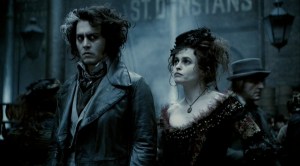 People unaware of the Sondheim musical are going to be in for a big shock. The film is about 80 percent sung, and the singing never rises to big, show-offery numbers of crescendo power vocals; the songs are more in the variety of speaking and vocals frequently overlap. The movie has greater clarity to the lyrics, and for the first time I as able to actually decipher Joanna’s words in the song “Green Finch and Linnet Bird.” Fans of traditional musicals, the kind that feature songs centered on female deer or large corn exporting states, may be aghast at how adult and violent the musical is. It’s just as much a grand horror movie as it is a musical. No doubt people are not generally accustomed to soaring medleys set to gashed throats and spurting blood. Sweeney Todd is captivating tale where almost all the characters are villains in some sense, and yet you do build sympathies even after innocents are killed and baked into flaky desserts.
Unlike other recent big screen versions of popular Broadway song-and-dance shows, Sweeney Todd is not simply the stage version transported to a bigger stage. This is a movie, through and through, and a perfect marriage. Burton is the perfect visionary to filter the twisted sensibilities of Sondheim’s masterpiece onto the silver screen. As a director, his work has been artistically backsliding since the start of this decade, but Sweeney Todd puts a firm stop to that. The technical aspects of Sweeney Todd are brought to life with great care and imagination. The Gothic sets are gorgeous and the costumes and cinematography are fitfully drab and dour, like everyone is living in a silent movie devoid of color; it takes a lot of hard work to create a near monochromatic playing field for the actors. And so when the blood does splash, and oh does it splash, the film pops with vivid color. Sondheim’s playful lyrics and rapturous music has never sounded better; it practically swoons.
The movie opens up the play in ways that a staged performance never could. Instead of keeping a distance from the bloodletting, usually something symbolic or as graphic as coloring a red line across a victim’s neck, Burton thrusts the audience right into Sweeney’s shop. The blood sprays in bright geysers and the violence is fully realized, fully felt, even if it’s never terribly realistic. The full weight of Sweeney’s vengeance and eventual destructive madness can be felt when the audience is witness to its wrath, and that includes the graphic murders. The medium of film ups the horror elements and transforms Sweeney Todd into a stronger work by amplifying the tension. The last scene with Mrs. Lovett is far more haunting than anything that could have been achieved on a stage. Burton also adds lots of dark humor thanks to his open visual palate, like during the song “By the Sea” where Mrs. Lovett fantasizes about her and Sweeney cozying up together in different scenarios. The film transports the viewer to the different pretend locales all the while Depp remains gruff and indifferent. He maintains the same curmudgeon from fantasy postcard after fantasy postcard. It’s the cheeriest segment in a grimly perverse musical that could rival Hamlet for dead bodies.
 In an effort to slice a three-hour musical to a manageable two-hour movie, screenwriter John Logan (The Aviator, Gladiator) has pruned the story down to the essentials, namely everything that impacts Sweeney’s ultimate pursuit of vengeance. Johanna and Anthony, the hopeful lovers, have been pared down the most. Their only scenes now revolve around intruding upon Sweeney or helping him meet his venomous goals. The lecherous songs the Judge sings to himself about his lust for Johanna has also been cut (my wife was severely disappointed by this cut, saying, “You’ve got the Rick, come on!”). The most notable omission is the opening medley “The Ballad of Sweeney Todd” that serves as a Greek chorus-like overview of the sordid tale ahead. The song provides a lot of back-story and exposition that can be more easily covered by Burton fashioning visual flashbacks of Sweeney’s former life. The ballad and other absent songs are still used instrumentally throughout the film. Logan has also turned Toby (Ed Sanders), Pirelli’s assistant, into a much younger character, turning him into an urchin boy with fresh memories of life in a workhouse. I’m not entirely sure Toby’s protective song to Mrs. Lovett “Not While I’m Around” becomes an ode to puppy love and loses some believability. Also, normally Toby is played as a man-child who isn’t entirely whole in his mental faculties; however, the movie version turns him into a plucky Oliver extra. It seems less devastating and tragic.
But what about the singing? Depp won’t be knocking down doors on Broadway anytime soon but he delivers a very satisfying baritone that, while lacking in power or refinement, delivers in spades with emotion. His singing is full of great texture. His song “My Friends,” an ode to being reunited with his razors, is full of brio and nuanced longing, but he really shows his talent when Sweeney loses it. He’s a man obsessed with vengeance and when it escapes his grasp he snarls with scary intensity. When he launches into “Epiphany,” where he determines the whole human race is fit to have their throats slit, he barks at strangers on the street and howls at the sky, smiling at his glistening razors in hand. What can be forgotten with musicals is that there is so much more to a performance than simply an adept ability to sing the right notes. With Sweeney, Depp spins an incredibly rich performance that plumbs the dark recesses of a man whose only purpose is vengeance. In the end, when he’s saturated in blood and the full reality of his actions is upon him, Depp goes from remorse to psychosis to horror to acceptance in, like, a minute flat. Seeing such a classic Broadway character done justice by an actor of Depp’s immense talent is thrilling and a bit of a relief to Sweeney fans.
 Carter has the weakest, thinnest voice of the cast. Mrs. Lovett is a larger than life figure that has been played on Broadway by the likes of Angela Lansbury and Patti LuPone. The role is usually played more boisterous, more comically broad. It’s a juicy part and full of brash bravado. Carter stumbles through “The Worst Pies in London” and she seems to step all over her lines, rushing through and losing the comedic flavor. But like I said before, a performance is so much more than singing, and it is here where Carter imbues great complexity to her role. Her unrequited love for Sweeney consumes her and her relationship with Toby places her in an awkward predicament. Carter flashes a wealth of emotions through the power of her eyes. It’s a battle between maternal and sexual urges. Stylistically she resembles a rag doll someone tossed in the trash but it all works.
It’s refreshing and exhilarating to see a perfect marriage of material and artistry. Burton has transported Sweeney Todd into a faithful and jubilantly dark movie that doesn’t shy away from the grotesque. It’s a stirring, wonderfully Gothic rendition of Sondheim’s masterpiece. Sweeney Todd is blissful, spirited entertainment that’s not exactly for the squeamish, but this is one musical that can simultaneously touch the heart while turning the stomach.
Nate’s Grade: A
Share this:

Music and Lyrics (2007)
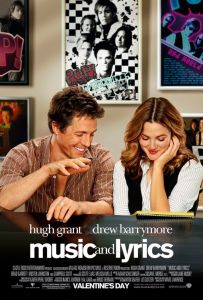 As bland and flavorless as the 1980s pop pap it hopes to skewer. For die-hard fans of the romantic comedy genre, there may be some minor level of enjoyment, but for the rest of us (those without ovaries) Music and Lyrics is predictable to the end and Hugh Grant and Drew Barrymore don’t elicit any semblance of chemistry. The songwriting is noticeably a cut above thanks to Fountain of Wayne’s bassist Adam Schlesinger writing them, but even the participation of one of my favorite bands can’t make Music and Lyrics worth seeing. The Duran Duran-esque music video that opens the film is a hoot and it all goes downhill from there, especially if you find it difficult to accept long durations of the cutesy baby act of Barrymore.
Nate’s Grade: C


 nathanzoebl
You must be logged in to post a comment.