Blog Archives
The Gorge (2025)
 While watching the action-thriller The Gorge, I kept thinking, “Wow, I’m surprised this didn’t get a theatrical release at all.” The Apple Plus original is the kind of movie you’d want to watch on the big screen, with large-scale action, atmospheric imagery, and a creepy sound design meant to elicit shudders. It has a dynamite premise that grabbed me right away: two elite snipers from the East and West, Levi (Miles Teller) and Drasa (Anya-Taylor Joy), are tasked with manning watchtowers overlooking a cavernous and mysterious gorge. They have heavy-duty Gatling guns to make sure whatever is in the gorge stays in the gorge. It’s a year-long tour of duty and both snipers are forbidden to communicate with one another. Naturally, out of boredom and necessity, they break the no-contact rule, first through white board messages, then through shared experiences and competitions, and finally coming face-to-face. For the first 45 minutes or so, The Gorge is actually a pretty lean and effective long distance romance of sorts. There’s ingenuity in the process of getting to know someone from across a large hole in the ground, and both actors have solid chemistry that will help make you silently yearn for a little global collaboration. The movie also has an intriguing scenario with tantalizing details that point to its secret history, until everything is literally spelled out in Act Three. The monsters, who look like a combination of Groot and zombies, are an unsettling character design, though I wanted more variety in their appearance. When the characters finally delve into the gorge for the majority of our climax, we got some new and nasty creepy crawlies, like a tree with rib bones like insect mandibles that ensnare like a Venus flytrap. Alas, I found the stuff inside the gorge to be fun and creepy with a great atmosphere to play upon what we can and cannot see, but it was the stuff above and outside the gorge that made the movie for me. That’s The Gorge for ya: come for spooky monsters, stay for the surprisingly involving romance between monster killers.
Nate’s Grade: B
Share this:

Top Gun: Maverick (2022)
 Until just the other day, I had never seen Top Gun. Growing up in the 80s into the 90s, I was familiar with the film as it was a staple in friends’ homes, as was the lousy Nintendo video game, and one of the major pillars of Tom Cruise becoming a superstar, but I was too young when it came out and then it got buried behind other movies I always intended to catch up with. Honestly, as I got older, I just didn’t have much interest in rote military thrillers the likes of Tom Clancy (I dub them “dad movies,” as they’re my father’s long-standing Clancy-loving preference). Then came the 2022 sequel, Top Gun: Maverick, and it became Cruise’s highest-grossing movie of his blockbuster career and the fifth highest-grossing movie of all time. I’m probably one of the last few people on the planet to finally catch Maverick and I’m a little befuddled what made this movie as highly praised, to the point where it’s a given it will be nominated for Best Film awards and even stands as populist chance of winning. Maverick is a perfectly enjoyable action movie with satisfying character arcs. It’s an example of what big-budget moviemaking can accomplish when the right artists are aligned. However, let’s not start jumping on any couches and going nuts here. It’s a solid sequel elevated by a great finish.
We follow Maverick, a.k.a. Pete Mitchell (Cruise), as he’s tasked with training the next generation of top guns for a very specific, highly dangerous aerial assault mission to take out a foreign nuclear arms lab. The big issue is that one of these pilots, Rooster (Miles Teller), is the son of Maverick’s former wingman, Goose (Anthony Edwards), who died in the 1986 original movie. Mav has been denying Rooster senior-level opportunities out of fear of being responsible for the death of father and son, but Rooster will not be ignored and denied, and they’ll square their feelings of guilt and resentment over the course of this impossible mission.
 I can see why this movie would be successful. It plops our older hero down in a teaching role which allows the satisfying arc of building a team, gaining his own feet as a teacher, and the two-way transmission of respect. It’s a formula that works. We watch the younger pilots grow and become more capable, we watch Maverick settle into a natural teaching role, reaching out to others, and we also watch him and his team stick it to the naysaying Naval authority with every victory. It’s all there and developed with enough precision by screenwriters Ehren Kruger, Eric Singer Warren, and Cruise-lifeline Christopher McQuarrie to operate smoothly. In the 1986 movie, we had hotshot pilot Maverick learning personal responsibility and teamwork, though much of that original movie was preoccupied with so… many… characters telling young Mav how gosh darn special he really is and how the U.S. Navy needs him so bad. The emotional reconciliation also works between Maverick and Rooster (I guess the name and the mustache are affectionate odes to dear deceased dad) and serves as an effective emotional foundation for old fans and new. The drama works and the legacy elements and cameos feel better incorporated, though the “Great Balls of Fire” piano bar singalong was awkwardly forced nostalgia bait. The romance with Jennifer Connelly’s single mother barmaid even feels a little wiser and more honest rather than setting her up as a good-looking woman cheering our hero onward. Nobody’s going to leave the film citing the prerequisite love story as their favorite part, but it’s at least more thoughtful and less tacked-on than I was dreading. For all these reasons, Top Gun: Maverick has the tools to succeed as a sequel that can transcend its initial nostalgic fandom.
 Where the movie really takes flight is in its action photography and the final act. Director Joseph Kosinski (Oblivion, Spiderhead) filmed the aerial sequences with IMAX cameras and the in-cockpit perspectives make the action far more immersive and thrilling. The actors were charged with being their own camera operators while flying in their planes, so Kosinski would wait on the ground and then review the footage and then send the actors back up in the air for further takes. It’s a painstaking process, made more so by Cruise’s obsessive insistence on making things as real as possible, and it pays off remarkably. The dazzling footage within the cockpits as they swoop and swerve has an exciting verisimilitude that can’t be replicated by computer effects. The dogfights are easy to understand and follow thanks to the careful visual orientation from Kosinski, smooth editing that doesn’t become jumbly, and clearly stated goals and mini goals within the mission training (McQuarrie is so good at this stuff). It made me wish that they never got out of the air. It also made me envious of the grandiose IMAX presentation.
It’s the final act that really seals the deal from an entertainment standpoint. The team tackles their mission at the 90-minute mark, and it’s thrilling and everything you’d want in an action set piece. The way the mission is structured in well-defined pieces working in tandem reminded me of the Mission: Impossible franchise during its 2010s swing into becoming the best studio action franchise. It makes for a satisfying and thrilling conclusion, and it’s not a real spoiler to say that the team of underdogs defies the great odds and succeeds, but then the movie surprised me. There was still twenty minutes left, and Top Gun: Maverick says, “Oh, you think we’re done? We’re not going to just give you a good climax, we’re going to give you a buffet of action peaks, each somehow elevating the movie even higher while still working with the established character arcs.” It is a feat of deft studio action construction. After the mission, there’s a personal behind-enemy-lines rescue and escape that literally hinges upon a recognition of nostalgia as intrinsic value. I won’t explain the exact particulars, but the characters literally survive relying upon the devices and training of old, surely a reassuring nod to the older generation audience members. It’s like the movie has taken Cruise’s penchant for showmanship to heart and wants to give you everything it can. The results are a good action movie flying off the charts by the end with a fantastic finish.
 Still, it’s hard for me to join the cheering masses declaring Top Gun: Maverick as one of the best films of recent years. It’s slickly made, solid in its storytelling and emotional foundation to produce satisfaction, and it’s filmed with visual panache from its commitment to practical effects and realism. The final act is a fabulous sendoff that shows the heights of blockbuster popcorn cinema. Maverick is without a doubt the superior Top Gun movie. The original had its own sense of style from director Tony Scott, one that became synonymous as the visual vocabulary of Hollywood military thrillers for decades. It’s also hard to watch the movie in 2022 and not see the dozens and dozens of imitators that came after, making the movie feel less enticing and more simply the progenitor of a genre formula that isn’t my favorite to begin with. Maverick improves in every way and sheds the worries of being a late-sequel nostalgic cash-grab. It’s a good and effective movie with a rousing and uncommon finish, and maybe that’s enough. Maybe people are looking for something that feels like comfort food done right, and I suppose that could be Top Gun: Maverick for many, as the box-office numbers would chiefly indicate. I might not be in its inner fandom but I can see what others would celebrate, even if I do less.
Nate’s Grade: B+
Share this:

Spiderhead (2022)
 Before writing this film review I sat down and read George Sanders’ short story “Escape from Spiderhead,” published by The New Yorker in 2010 and available to be read here. It would probably a better use of your time than watching the Netflix movie adaptation, and it surely won’t take 90 minutes, though that’s an assumption on my part. The story follows Jeff (Miles Teller), a prisoner who is undergoing experimental drug trials for a lighter sentence. Chris Hemsworth is miscast as the sunny, smarmy head of the drug trials, mostly featuring a drug that induces extreme feelings of desire and love and attachment. The movie is simply too predictable once you acknowledge the plot elements of secret drug trials and tests of loyalty and emotions. You’ll likely foresee the movie’s big reveals far before the screenplay by Rhett Reese and Paul Wernick (Deadpool, 6 Underground) reaches the obvious ploys for twists to turn Sanders’ more introspective, nuanced, and psychological story into a rah-rah formula sci-fi action movie. The first act is relatively promising and close to its source material, but the intriguing and philosophical questions about human connections, guilt, compliance, free will, and corporate hegemony are brushed aside for a silly series of action scenes, brawls, and big escapes. Mostly, I found Spiderhead to be dull because it was too predictable and because it didn’t have much more to say than any over-extended Black Mirror episode. It’s a passable sci-fi allegory that’s light on allegory and settles for being another anesthetizing streaming byproduct.
Nate’s Grade: C
Share this:

War Dogs (2016)
 As I watched War Dogs, the darkly comic true-life story of war graft, gunrunning, and bro-tastic bravado, I kept wishing to copy and paste other characters into what was an interesting plot. A pair of neophytes was awarded military arms contracts from the Pentagon during the Iraq War, and their schemes to skirt U.S. laws to import guns across borders, illegal and faulty munitions, and uneasily work as a go-between with a client (Bradley Cooper) on the U.S. terrorism watch list are filled with perplexing yet juicy details. The biggest problem is that the two main characters, played by Miles Teller and Jonah Hill, are so powerfully archetypal to the point of unrelenting blandness. We have the naïve everyman pulled into a life of big bucks, big risk, and big power only to have it all come crashing down. Hill’s character is the loud, uncouth part we’ve come to expect from the Oscar-nominated actor, and I defy anyone to tell me anything about Teller’s character other than occupation and his relationship to other people. These parts are so thinly drawn that I didn’t care about them once they finally got into deep trouble. I believe that director/co-writer Todd Phillips, he of The Hangover series, has the right qualifications to make a flinty neo-noir thriller, but War Dogs is more his half-hearted version of a glib Scorsese movie, or a David O. Russell version of a Scorsese movie. The voice over narration is dull and doesn’t help illuminate Teller’s character at all, and the other stylistic flourishes, from pointless inter-titles to a non-linear plot, add up to very little. Half of the movie’s scant jokes are the ongoing sound of Hill’s off-putting wheeze of a laugh. I’m not kidding, after an hour the movie still treats his laugh like it’s a potent punchline. There is entertainment value to be gleaned from War Dogs chiefly from its larger-then-life story and the intriguing, shadowy world of war profiteers. It’s a movie that made me wish I had read the magazine article it’s based upon instead, which would have also been shorter.
Nate’s Grade: C
Share this:

Fantastic Four (2015)
 Few movies have had such a prominent stink of negativity attached to them as Fox’s Fantastic Four reboot, a movie that is already being considered amongst the worst superhero movies of all time. Director Josh Trank (Chronicle) was given the freedom to go darker, emphasize more science fiction, and select a cast of respected actors rather than bankable names. Then came rumors of aloof and secluded behavior on set from Trank. Then came rumors that Fox and producer/co-writer Simon Kinberg (X-Men: Days of Future Past) effectively shuttered Trank from his own movie, reshooting 40-minutes of a 90-minute film to salvage the wayward production (get ready for plenty of stuff in trailers not to be in the finished film). Not quite the room-clearing disaster of rampant speculation, the new Fantastic Four is a superhero movie that never really gets started and has constant battles with tone, characterization, and plot. It seems like the real villains of the movie are the Fox executives who signed off on the “gritty, gloomy” rendition and then interfered when they got too scared, managing to undercut the original vision, muddy an already messy film, and make things even worse. The behind-the-scenes drama is easily more interesting than anything that happens in this movie.
Reed Richards (Miles Teller) is a science genius recruited by Dr. Storm (Reg E. Cathey). Reed invented a makeshift teleporting device as a young child with the help of his friend, Ben Grimm (Jamie Bell). At Dr. Storm’s lab, Reed works with Storm’s children, Sue (Kate Mara) and Johnny (Michael B. Jordan), and a morose computer programmer, Victor Von Doom (Tony Kebbell). The group transports to another dimension but is attacked by a strange green energy cloud. Victor is left behind. The surviving foursome exhibits unique abilities. Reed can stretch his body. Sue can turn invisible and create force fields. Johnny can fly and set his body on fire. Poor Ben is a hulking rock monster. Reed promises to find a way to reverse what happened to them, but the re-emergence of Dr. Doom puts the fate of the entire world at risk.
 It should be of little surprise that Fantastic Four feels like two different movies awkwardly and inarticulately smashed together. For the first hour, the movie follows the path of our heroes and their contraction of their powers. Rather than the gee-whiz fun of getting superpowers, the characters view themselves as freaks, their bodies turned against them, and their colleagues deeply afraid of them. It’s a far moodier antidote to the vicarious thrills of gaining special abilities. There are some effective sequences that channel David Cronenberg’s The Fly and Scanners, and it’s these brief moments where you feel Trank’s vision connect the most. Doom walking down a hallway and making heads explode, in a PG-13 way, is horrifying and cool. The problem for Trank, and the movie as a whole, is that this first hour still isn’t a very good movie. It takes far too long for these characters to get blasted by green space goo and become supers. The setup is so protracted and needless. Did we need to see how these characters came together? Did we need to see their childhoods? It’s not essential to see the team come together when we can already start from that point. In a sense, it reminded me of how needless I felt Pixar’s Monsters University was; did we need to see how these colleagues became friends? Despite this action-free opening half, the screenplay could have fleshed out the four main characters to justify the added time, but it’s hard for the movie to justify much.
These are some of the most boring and underdeveloped characters in recent comic book lore. If these versions of the Fantastic Four existed in the 1960s, they wouldn’t have made it to issue number two. Reed is smart. Sue is smart too but also standoffish (and adopted). Johnny likes fast cars. Ben is tough and loyal. Victor is a pessimist who called dibs on flirting with Sue. That is really about it, folks. Ben disappears for most of the film, called in to make the trans-dimensional jump because Reed feels like Ben deserves to be there since he helped create an early prototype with Reed. Actually, let’s talk about that scene. It’s a high school science fair yet the only other displays we see are clearly for much younger children, and yet Dr. Storm is visiting an all-ages school science fair to groom talent? That seems weird. Why does Dr. Storm not make the same offer to Ben, who helped Reed design and build his early teleporting machine? Regardless, Reed leaves his childhood pal behind with Ben’s abusive family. That’s because he’s a good friend. Then, once the horrible transformations occur and Ben gets the worst of it, Reed runs out on him again. Sure it’s in the pursuit of finding a cure, but who’s to say he couldn’t do that in the already constructed government super science lab? Sue doesn’t even go on the first trans-dimensional voyage; it’s just a boy’s club. Sue spends more time in this movie staring at computer screens and looking intently than any action. It’s probably for the best, though, because the scenes of her flying around in a bubble made me think of Glinda the Good Witch. I’m not a Kate Mara fan. I’ve found the majority of her performances to be stilted, but even I can admit she’s given nothing to do here but move her eyes from the left to the right and inform Miles Teller about Portishead, a band that’s only 20-plus years old. It’s sad but the most interesting part of Johnny is that a black actor, a point that caused certain more irritable fans to foam at the mouth at the adaptation, is playing him. If these super heroes aren’t going to be super until halfway through the movie, they better be interesting characters. They are not even close.
 It’s with the return of Dr. Doom that the Fantastic Four makes its inept transition into the second movie, the one reshot by the producers and the studio. In an implausibly fast amount of time we’re given our villain of the movie and he sets off to open a black hole to destroy Earth because… we’re self-destructive? So humanity is self-destructive so Doom is going to destroy humanity? I would also like to know exactly how Doom survived for over a year in the alternate dimension when it clearly looks like there is nothing of substance for miles, unless green goop is edible. Did he just lose the need to go to the bathroom? Doom’s powers are rather nebulous, which makes it even less interesting when the Fantastic Four decides to, get this, work together to beat the bad guy. For a movie that hasn’t had one action sequence until its final act, now our characters must band together to stop Doom and his giant flashing blue light black hole thingy. The special effects are pretty undistinguished and hard to read at times. I’d also like to remark how hideously this other dimension looks. It’s all rocky crags and dark clouds; it’s like a less successful timeshare for the residents of Mordor. It doesn’t quite look like the paradise that Doom describes it as (the brochure lied to us!). This jumbled conclusion feels so ham-fisted and rushed, a villain and a typical world-destroying fate that must be thwarted at the last minute. Things just sort of happen rather than storylines finding payoffs, and then it’s all sort of over and the resolution echoes the very end of Avengers: Age of Ultron, even with the credits cutting off the vocal iteration of the title heroes. It’s so transparently different in tone, sloppy in development and execution, and so quickly introduced and resolved, that the whole conclusion comes across as forcibly laughable.
At the end of watching the dire Fantastic Four reboot, I felt more sympathy for Josh Trank. He still deserves blame for helping to conceive and develop such a misshapen story and squander his actors. After three duds and whatever you want to call the 1994 Roger Corman adaptation, it feels like maybe this franchise is just cursed. Maybe these characters are too dated and their powers are too silly. Then again we know that these characters can work in the format of a movie because a good Fantastic Four movie already exists, and it’s called The Incredibles. It doesn’t seem like anyone is going to come away completely clean from this misfire and financial flop, especially now that Trank and executives are engaging in a P.R. blame game. Fox was hoping for a rekindled franchise. Now they may be hoping to work out a deal for Marvel to buy back the rights to the characters. I would have been interested to see the full vision of what Trank was going for, especially since the one scene that feels most adamant is the best sequence in an admittedly mediocre superhero film. At least the movie would feel cohesive. It probably wouldn’t be good but at least it would be committed to trying something different. Instead, the movie tries to be different from the superhero blockbusters populating the landscape and then, at the last minute, tries to follow their lead and become one of them, becoming its own misshapen and poorly developed blob. It’s not the worst superhero movie in history (that honor still has to belong to the atomic bomb of taste, Batman & Robin), but even achieving sustained mediocrity is too much to expect.
Nate’s Grade: C-
Share this:

Insurgent (2015)
 A return to the world of Divergent yields little forward momentum, in fact just enough to end on the point that I thought where a sequel would naturally begin. Turns out we needed a whole other movie, Insurgent, to arrive at this obvious narrative next step. Insurgent picks up with Tris (Shailene Woodley) and company on the run following the coup of two of the five social factions. Tris is a Divergent, able to apply herself to multiple factions, and she and her kind are the only ones who can open a secret box left behind by the founders of this post-apocalyptic civilization. The film does enough to hold your attention and we get to visit the other two factions we missed the first time, providing further shape to what is still a confusing world. I think the Divergent series will always fall short of the YA pacesetter, The Hunger Games, but they offer their escapist moments of entertainment. The second film is a bigger, louder, and more heavily coated CGI affair, especially the magic box’s mental trials that amount to a repeat of the first movie’s psychological trials of fear. Woodley is the strong center of the film and she processes her own PTSD over being forced to kill friends in order to survive; you do start to sense that Woodley is growing restless with the franchise. The third book is, as required by the mandate of milking YA franchises, being split into two movies, and while it served little to the Hunger Games, I hope better for the Divergent series, a group of movies inferior and somewhat mystifying but still interesting enough. For now.
Nate’s Grade: C+
Share this:

Whiplash (2014)
 Writer/director Damien Chazelle (Grand Piano) made quite a deal of noise at this year’s Sundance Film Festival with Whiplash, winning the top honors. Usually, the movies examine the angelic teachers, the ones we all remember fondly that broke through to us and cared enough to make a difference. This is not that movie.
Andrew (Miles Teller) is a second-year student at a prestigious New York City music conservatory. He drums and dreams of being plucked from his class to the jazz band of Fletcher (J.K. Simmons), a renowned jazz musician with a volatile temper. He verbally berates his students, antagonizes them, belittles them, throws chairs at them, brings them to tears, and harasses them, but all in the guise of pushing their talents, pushing them out of being so easily coddled by their parents and an “everyone’s a winner” society. Andrew is elated to be asked to be Fletcher’s newest drummer but the pressure to perform, and maintain that level of perfection, eats away at him. Andrew eats, sleeps, and obsesses over being the greatest drummer possible, a pupil in Fletcher’s image.
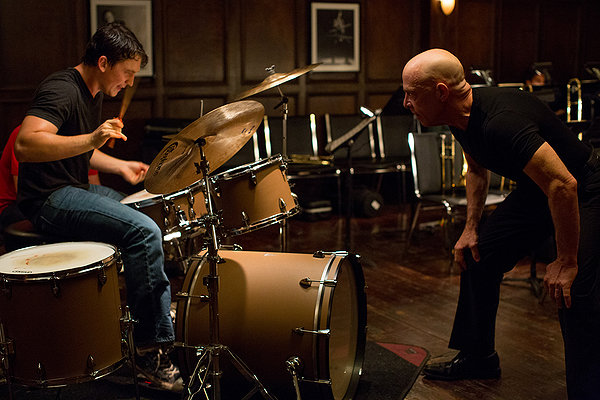 I know very little about music beyond a simple “I like this/I don’t like that” delineation, but I was enthralled from beginning to end with the sheer intensity of Whiplash. Even though the film is something of a cinematic crucible, a hellish musical boot camp, a Full Metal Jacket for Julliard, it’s not caught up in the half notes and technical elements; this is a movie about two powerful forces coming into direct conflict. It’s a battle of wills, a struggle for dominance, and a character study about the potential drive it takes to be considered one of the living legends. The emphasis is on the characters completely, and the movie never drags (or rushes) with its cleanly arranged plot points as it reaches its thrilling conclusion, a final act that completely takes the experience to another level. It keeps switching gears and defying our expectations in the best way. Chazelle always seems to be one step ahead of his audience. We know that Andrew is going to alienate his girlfriend (Glee’s Melissa Benoist), thus causing acrimony and resentment on both sides, leading to a breakup hinging upon some question of priorities. We suspect it’s coming and lie patiently in wait, dreading that this predictable subplot will take away the focus of the film. And then Chazelle has Andrew sit down and break up with his girlfriend right then and there, citing the exact same chain of foreseeable cause and effect. Andrew sees where this story will head and wants to prevent further heartbreak. He nips this relationship in the bud, and his girlfriend is simply stunned at his blunt assessment (“You think I would prevent you from being great?”). It was at this point I knew Chazelle was going to deliver something not just special but downright masterful.
At the start it looks like the film is going to be a student-mentor study, and it does become this, though in a fascinating yet psychologically disturbing manner. The fiery and all-consuming passion of Fletcher infects Andrew, as he wants to be great above all else, including meaningful human relationships. He’s always been something of a loner who has difficulty keeping friends, made all the more evident by his uncomfortable and snippy Thanksgiving dinner with his family. His ambition is to be the best and he’s willing to sacrifice everything else. This paves the way for a character study of obsession, as we watch Andrew become a slave to his ambition, to the drive to always be better. He drums until his hands are calloused and soaked in blood. He gets a mattress in a rehearsal space, spending all of his free time on his obsession. He’s also battling for validation from Fletcher, whose approval will make Andrew feel like all those blood, sweat, and tears were worth it. The film raises some very intriguing and open-ended questions over the self-destructive nature of ambition. In one perspective it’s a story of perseverance and utilizing every setback, every humbling humiliation to push oneself further then what was possibly known. On the other hand, it’s about a young man who struggles for the unforgiving tough love of an abusive father figure who molds him in his image. Chazelle’s explosive finale also sticks with the ambiguity. It is no doubt an ascendant moment for Andrew but the implications are left for you to interpret on your own.
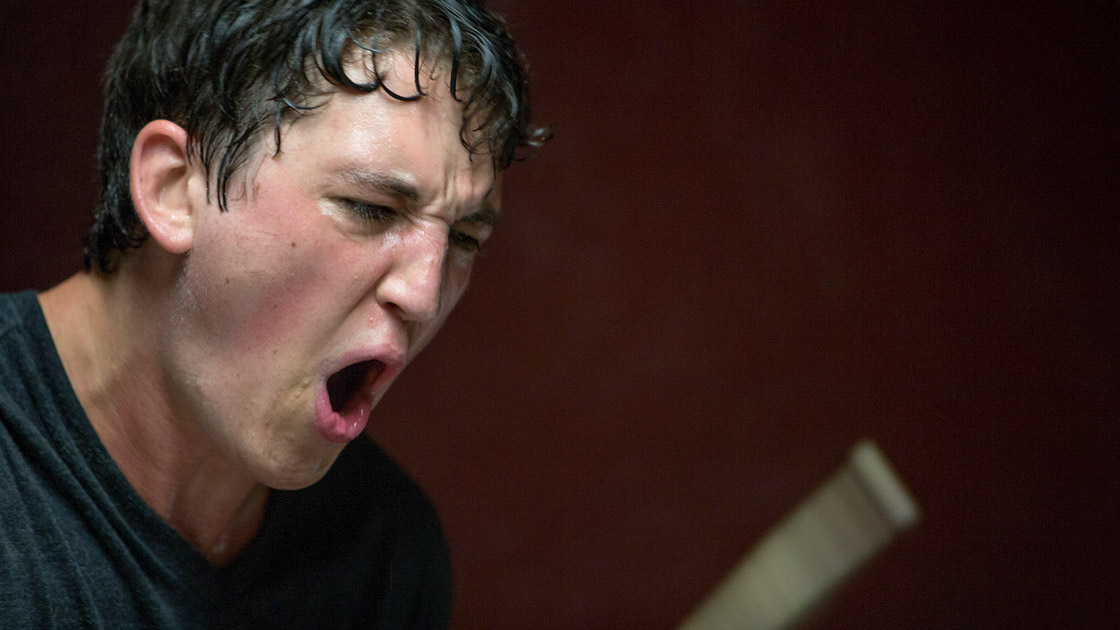 Primarily the story of two forces of nature, both Teller and Simmons, especially, give captivating performances that will blow you away. Simmons (TV’s The Closer) has been one of our best character actors for years on TV and film, but man does he just sink his teeth completely into his ferocious character. He’s truly terrifying to watch but you can’t take your eyes off him. Like the other characters, as soon as he enters a room you’re put on edge, wondering what he might say next, what might lead to the next tantrum of frustration and rage. Simmons is remarkable but especially in the way that he imbues his character with traces of sympathy (also thanked by Chazelle’s screenplay, naturally). Fletcher subscribes to the (arguably insane) philosophy that he has to constantly push his students or else they will persist on mediocrity. There is a method to his madness; he’s desperately looking for the next Charlie Parker, a legend in his midst that he can help mold thanks to his aggressive teaching techniques. He truly believes the ends justify the means and he is doing the world a favor. Likewise, Teller (The Spectacular Now, Divergent) is awestruck by his professor’s rep but then desperate to regain that hallowed approval. Their relationship becomes poisonous and antagonistic and Andrew seems to be exhausting himself simply to prove Fletcher wrong. Teller is one of the most exciting young actors in Hollywood and his commitment to the character and his physical endurance is impeccable. It cannot be understated how thrilling it is to watch Teller pound away on those drums, especially during the finale where the energy level might just exhaust the audience as well (you do feel spent afterwards, in a good way). Part of Teller’s performance has to be with his style and precision of drumming throughout, and it’s amazing that he is able to convey different emotional states through a musical instrument. Teller is an effortlessly intuitive actor and his instincts are rarely wrong.
Shot in only 19 days, Whiplash is a rare film that feels blisteringly vibrant, coursing with an insatiable energy, powered by performances of intense dedication and with a script packed with bubbling conflict. It’s a small movie that manages to knock you off your feet, from the caliber of the performances to the caliber of the musicianship. I didn’t know if this movie could live up to the hype post-Sundance, and I was a little apprehensive at first, but I fell completely under the sway of Chazelle and his storytelling. The smooth edits, the clean connect-the-dots plot points, the room for ambiguity and nuance, the stellar final act, it’s everything a movie lover could ask for while still never forgetting to entertain. This is a powerful movie that packs many a wallop but also raises interesting ethical questions about the drive for accomplishment, whether personal attachments are hindrances, and chiefly whether the ends justify the means, especially if those ends could be considered cruel and abusive. Whatever the ends may be, see this incredible film, which just happens to be one of the finest of the year.
Nate’s Grade: A
Share this:

Divergent (2014)
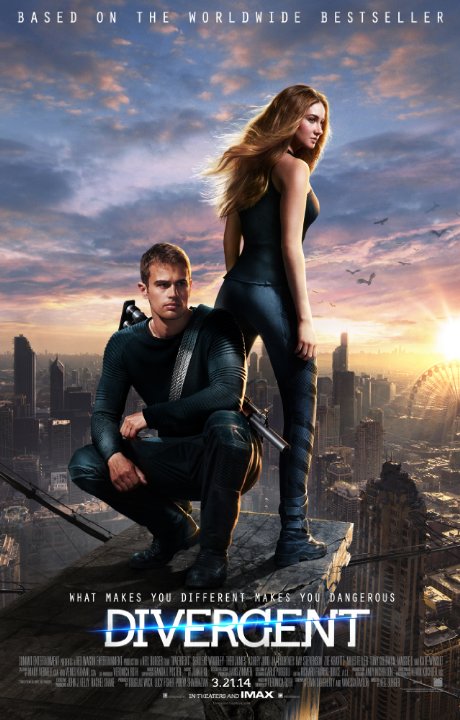 High school for many was a personal version of hell, with its class system and pressure to conform. Divergent built a whole future dystopia around this relatable concept. The problem with the movie is that the source material doesn’t think that much further.
In the future, 100 years after a great war that scarred the world, the survivors have holed up in the remains of Chicago with a large fence as their protection. The government decided to split off into five different factions, each with their important purpose. The five factions (Abnegation, Candor, Erudite, Amity, and Dauntless) work in harmony. Tris (Shailene Woodley) comes from a family of Abnegation, the selfless ones who run the government, though Jeanine (Kate Winslet), the head of Erudite, would like her faction to be on top. At the choosing ceremony, a candidate can select which faction they wish to live within. However, if rejected, that person will be factionless and on the outskirts of society. Rather than choose the comfort of her boring life, Tris decides to join Dauntless, the faction in charge of the security of the city. Before she can say goodbye to her family, she’s off joining a new one, but Dauntless has many tests to weed out the weak. Paramount in her mind is the fact that Tris is told she’s a divergent, one who doesn’t fit neatly into any one of the factions. Divergents are being singled out and executed because they are feared; they can’t be so easily controlled. Tris has to prove herself against tough competition in Dauntless while hiding her true divergent nature.
 Having not read the best-selling Young Adult books, I went into Divergent and walked away entertained enough though questioning the larger appeal. My movie partner told me that the adaptation hews closely to the book, fitting in all the major plot beats; she even said it was a better adaptation than the first Hunger Games, so fans should be relieved. What the movie came down to was one long plot about Tris getting through the Dauntless tests. It’s like a post-apocalyptic Full Metal Jacket, just minus the war half. With this tight focus, the film actually plays better and is easier to digest. The stakes are made clear and the hurdles are easy to understand. In a way it reminded me of the Ender’s Game film where we watch a recruit move up the ranks of their sci-fi training, though Ender’s was better at establishing dimension to its world. I did like the small touch that the Abnegation people won’t allow themselves to see their reflection because they see it as vain. I could have used more touches like that.
There are simple pleasures watching Tris, the plucky underdog, rising to the challenge and besting her snobby peers. The games get more intense and Tris learns from trial to trial, eventually learning how to hide her divergent nature by blending in against her nature. There’s also an intensity to this world that’s appreciated; people will die if they can’t keep up (there is one shocking sequence where a batch of jealous recruits literally try and kill Tris). The physical trials are fun but the mental ones are even more entertaining because they function around the candidate’s fears. It’s a tad lazy to simply broadcast a character’s fear for them to confront in a dream, but it provides some creepy imagery and new wrinkle for Tris to master. Even the requisite romance that every YA property has to have is handled respectfully without overdoing it. The mentor/teacher relationship with Tris and Four is a natural conduit for their budding romantic feelings, though James (Underworld: Awakening) looks way older than Woodley (The Descendants). In reality, he’s 30 and she’s 22, though she’s supposed to be… 17? 18 years old? I don’t know but it just didn’t sit right.
 Where the movie gets into problems is the larger world outside those Dauntless camps. It feels too ill defined and purposely vague. What’s on the other side of the giant electrified fence (hopefully dinosaurs)? I suppose that’s what sequels are for (they’re already filming the second Divergent for March 2015). The world just feels too small even for one city, and the history doesn’t feel integrated into the cultivations of this society. In a sense, the movie doesn’t give you enough to go on with its world building and spends far too much time dragging out its story. At a hefty 142 minutes, a time frame becoming de rigueur with YA adaptations, the film feels laboriously padded. I kept thinking the movie was going to check out at any moment, robbing me of some semblance of a complete ending. Fear not, there is an ending, though one that feels far too definite to continue a franchise. The bad guys are so obviously guilty, that even while still being at large, it’s hard to fathom a scenario that doesn’t unite everyone against the common threat. Does every YA post-apocalyptic mold eventually lead to unlikely heroes becoming the focal points of revolutions? I’m being facetious, but also highlighting just how derivative this movie is. Divergent borrows from its larger influences liberally, having enough story sense to know how to construct a satisfying tale of heroes and villains. It’s a well-polished film thanks to director Neil Burger (Limitless) but it’s also lacking necessary elements to distinguish it from the glut of dystopian imitators and predecessors.
I just can’t wrap my head around the world of Divergent. It lacks the clean clarity of, say, The Hunger Games, where the game is kill-or-be-killed and it’s very much a class warfare allegory. In Veronica Roth’s novel, the post-apocalyptic Chicago is divided into five factions but this isn’t a caste system. The different factions are looked at as equals, meant to cooperate harmoniously. So there goes any sort of class conflict when the factions are presented more as lifelong clubs. The design is that branching people off into five groups will somehow prevent the strife that lead to the unnamed war of the past. This doesn’t really make a lot of sense to me. Why would limiting people’s options for careers and lifestyles eliminate conflict? I understand the not so subtle message about conformity and the strength in controlling others, but it still doesn’t hold. Then there’s the notion that a divergent is a dangerous rogue, but it’s not like the divergent are mutants or genetically different. These are just people who don’t fit neatly into one of the five faction options. If you eliminate the conformity obsession, who cares? It’s only an aptitude test in the end, like what you take in middle school that say, “Hey, you like drawing, maybe you’d like to be a police sketch artist” (true personal anecdote of mine). It’s not something that looks deep into the souls of boys and girls and presages their future. It’s an aptitude test for crying out loud. The world of Divergent also feels strangely unfulfilled, with too many lingering questions about the logistics of how this future Chicago is able to function. There’s a confusing aura around this world and it doesn’t get explained because we spend so much time in Dauntless boot camp.
There was a weird motif I kept noticing throughout the film and that’s the future’s unsafe disregard for medical safety. The Dauntless kids are all about the running, jumping, punching each other in the face, but it all begins at their choosing ceremony. The candidates walk to the front of an auditorium, slice their palm with a ceremonial knife, and then squeeze blood into a bowl representing the faction they select. Of course they reiterate “faction before blood” so it’s a little strange that the ritual involves their blood. Anyway, what I picked up was that every candidate was using the same knife, only with he most perfunctory of wiping the blade. That is just unclean and a way for blood-based disease to spread. Then later during the mental round of testing, Four injects Tris and himself with the same needle. Clearly these post-apocalyptic people have forgotten all about AIDS and other deadly diseases. Why else would Jeanine be so calm as her hand is covered in someone else’s blood? I’m surprised she just didn’t lick it for effect.
 The actors are all well cast for their parts, with Woodley again proving herself as one of the best young actresses today in Hollywood. Her part isn’t anywhere as complex or demanding as her terrific turn in The Spectacular Now, but she’s able to slide in emotion where possible, expressing much through the power of her eyes. She’s a heroine you want to root for, and when she goes into badass mode it feels earned. James is suitably hunky while still being mysterious and broody. Interestingly enough, Miles Teller, Woodley’s onscreen beau in Spectacular Now, is here as a bully and Ansel Elgort, who plays Tris’ older brother, will soon play Woodley’s onscreen beau in The Fault in Our Stars. It’s like this weird cross-section of Woodley’s film history of boyfriends. The adults do fine jobs with their limited time, with Winslet (Labor Day) being a better realized version of what Jodie Foster was possibly going for in Elysium. My favorite adult actor was Jai Courtney (A Good Day to Die Hard, Jack Reacher) who hasn’t found the right fit for his talents, until now (he was great on Starz’s Spartacus TV show). As a no-nonsense Dauntless captain, he’s imposing in many respects and also intriguingly devious. He’s a grade-A heavy and adds a jolt to the scenes he’s in.
Poised to be the next YA breakout franchise, Divergent will likely be a hit with its target audience and reap the rewards at the box-office, though I think its flaws will hold it back from being embraced by a wider audience with no affiliation with the books. It’s an entertaining story with good actors and enough well constructed payoffs, but it’s also confusing, vague, and lacking enough urgency, class conflict, and developments to parlay into a more interesting story once Tris graduates from the Dauntless ranks. As a standalone film, Divergent works enough and duly entertains, thanks again to Burger’s visual sensibilities and the strength of Woodley. I’m just not invested at all in this world or its larger characters to compel myself to find out what happens next. I ravenously tore through the Hunger Games books, but to each their own. As a big screen sci-fi film, it’s strange that Divergent would work best in its smaller moments and settings. It’s too bad the movie doesn’t diverge enough from the pack of YA-modeled adventures. Well there is one thing to look forward to: I’ll see if I get my wish for dinosaurs in March 2015.
Nate’s Grade: B-
Share this:

The Spectacular Now (2013)
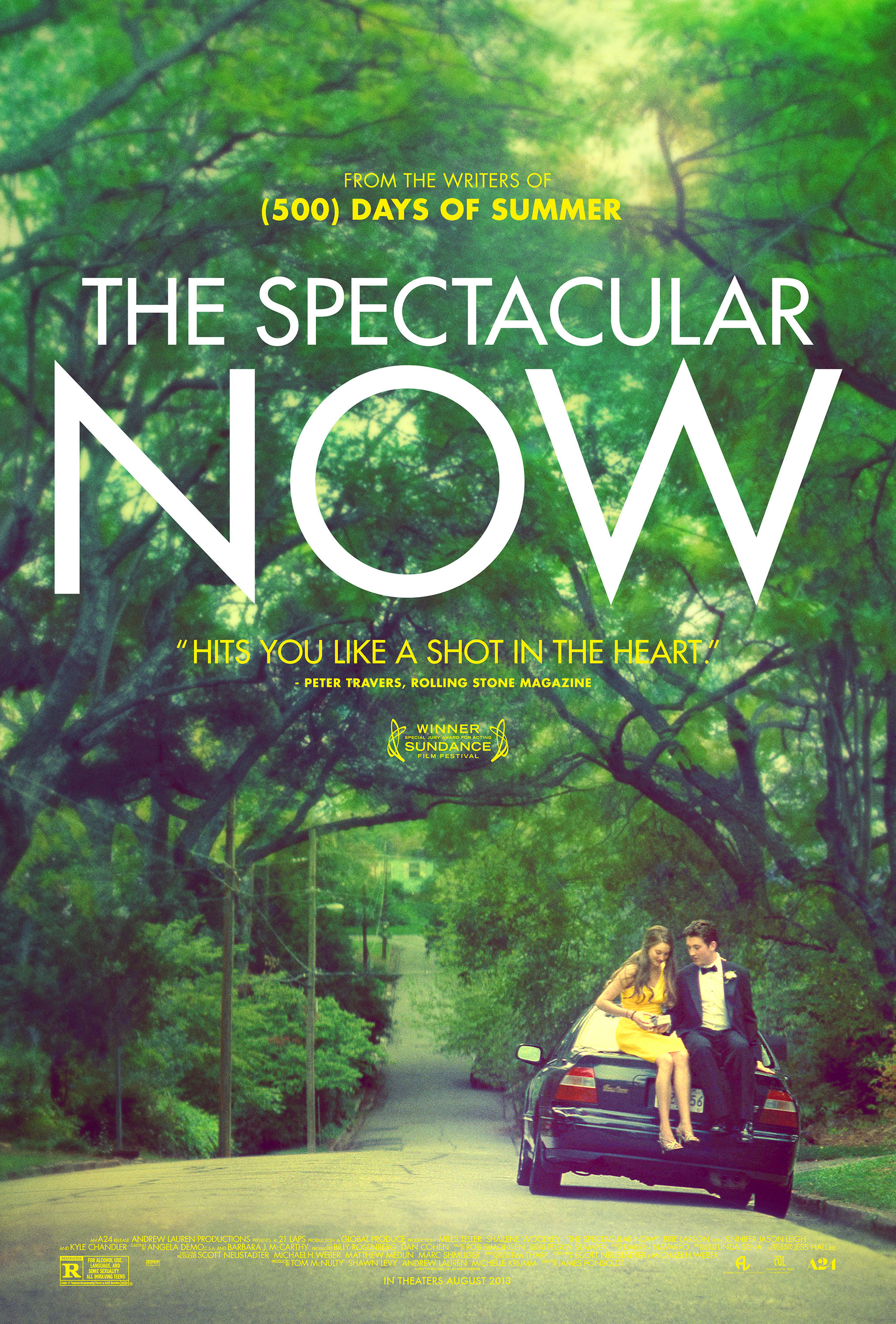 I say this as a fan but John Hughes was probably the best and worst thing that happened to the modern teen movie. He certainly brought an extra level of pathos and relatability to the genre, but then again he also dealt in stereotypes, often languishing his characters to stock archetype ghettos (the Jock, the Prep, the Nerd, etc.). In the ensuing decades, it’s been hard to break as many teen films, of those aimed at teenagers, have casually dealt in these easy labels. That’s why something like The Spectacular Now is such a welcomed respite. Here is a teen movie that aims to tell a story about people and their problems, not simply a regurgitation of high school cliques and clichés. This isn’t a film where all the pieces magically come together; this is a high school movie that more closely approximates real life. This is more Cameron Crowe than John Hughes material.
Sutter (Miles Teller) is the most popular guy in school, or so he’d tell you. He’s the life of every party, the kind of guy who everyone enjoyed, and the guy who could charm the pants off any girl. He’s recently broken up with his girlfriend Cassidy (Brie Larson), though still harboring serious feelings for her. Of course the best way to get over the old girl is with a new one, and Sutter sets his sights on Aimee (Shailene Woodley). She’s a smart, somewhat quiet gal that immediately takes a shine to the spotlight that is Sutter’s affections and attention. He’s not entirely over his old girlfriend, still angling to get back together, but also Sutter’s whole perspective could be summed up as an extreme case of carpe diem. The kid is partying like there’s no tomorrow because he’s convinced he has no real future, so he’s going to live it up while he can.
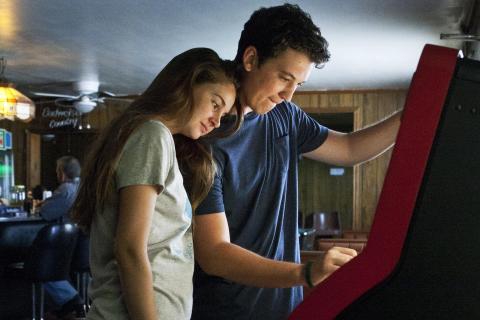 You’ve easily seen this movie before but it’s rare to see it given so much depth, maturity, and care. At heart, this is the story of Sutter learning he’s a screw-up and getting his life back in order, learning some self-control and responsibility, and winning over the good girl. But The Spectacular Now is so much more than that, and it’s especially sadder than you may have expected with its wise-talking, charming protagonist. This is the story of a teen coming to grips with parental abandonment, gaining insight into his own delusional detours to avoid pain, and the horrible realization that he is, in his present reckless condition, a bad influence dragging down the future of the girl he genuinely cares for. That’s a lot of heavy emotional drama and none of it revolves around the clichéd staples of teen movies, like those checkpoints such as prom and the Big Test. This is the story about one damaged man coming to terms with the state of his damage and gaining the courage to change his direction. He’s an alcoholic but the movie doesn’t ever put the narrative on hold for soapbox preaching. If anything, Sutter’s alcoholism is handled so subtlety, with most character silently acknowledging but unsure or indifferent to act, that it may strike a few chords with audience members. Then there’s the fact that none of this is heavy-handed; the filmmakers have done a fabulous job of giving each character credibility. They behave like real human beings. Even the easily slotted antagonists, namely Cassidy and Sutter’s deadbeat dad, are given shades of recognizable humanity and depth. Even though Cassidy waffles in her feelings for her ex, I cannot dislike her because her character portrayal is so honest. She’s struggling with her feelings for a screw-up with redeeming qualities. That’s fairly relatable, even if she’s not our winsome romantic lead. The filmmakers drag a typical teen movie story into our real world setting, adding depth and telling observance. You will recognize many of these characters.
There are few superlatives to describe the cuteness of the blossoming relationship between Sutter and Aimee. It’s so smooth and relaxed yet completely believable, and the two actors have such a warm and natural chemistry with one another, enough that I seriously contemplated if they dated outside the film (rumored but nothing conclusive). You feel their budding affections, the sweet swoon of young love, and the hiccups along the way. Woodley (The Descendants) does an outstanding job with her mannerisms and affectations; her awkwardness around her feelings is adorable, but not in that prefabricated cutesy way often ascribed to the oft-mentioned Manic Pixie Dream Girl roles. She’s a fairly normal teenager on the fringes of high school, keeping her nose down and looking ahead. In movie terms, you couldn’t readily classify a gal like Aimee, and that’s because she’s a real character fully fleshed out by the screenwriters and the actress. Woodley’s performance is near invisible of acting tropes and constraints. She just dissolves into the character as all exceptional actors do.
But this is Sutter’s movie and, in accordance, Teller’s (Rabbit Hole) film. The young man puts on an acting camp in this film, shedding the various layers of armor from his sad clown of a character. As I said, we’ve seen this character before, but Teller and the screenplay are able to give Sutter such extraordinary depth. The carefree life-of-the-party character is turned into an introspective character study, essentially examining the darker side of Ferris Bueller. He’s using alcohol and his blithe attitude to blunt the pain that he fears he’ll end up like his old man, that his life has already peaked and he’s not even out of high school. Teller is such a successful charmer that he already wins you over to his side despite some boorish behavior because we see that the guy has a good heart. In the film’s opening, he’s propping up his friend to finally get the guy a girl, and the ensuing mess ends Sutter’s own relationship. The last act involves Sutter coming to grips with the negative impact of his actions, notably on Aimee. Teller is so effective at giving you glimpses of the sadness eating him whole. His concluding scenes when he finally breaks down feel like a hard-fought victory for the character as he confronts his doomed fate. At every turn, Teller impresses, and compounded with Woodley, they form an unbeatable team of sterling young acting talent.
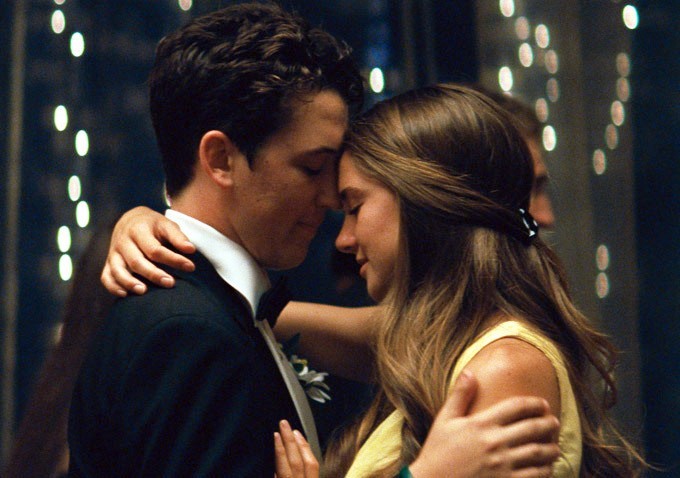 Special mention to Kyle Chandler (Super 8) for his pivotal walk-on roll as Sutter’s bad dad. He’s so pathetic and so desperate and so wonderfully realized by Chandler. He doesn’t get a Big Scene, he doesn’t get a Big Speech, he doesn’t even do anything out of the ordinary for a shifty, unreliable, selfish drunk, but those few minutes he’s onscreen, it all becomes so deeply sad and clear where Sutter’s life is headed without intervention.
The only depiction that I had trouble believing was Sutter’s almost consistent drinking and driving. Throughout the film, he has his trusty Styrofoam Big Gulp cup with him, spiked with booze. The man hasn’t graduated high school yet and is already a high-functioning alcoholic. Because of this I can believe that people would not be alarmed seeing him drive after imbibing a few drinks. However, the man is constantly drinking while behind the wheel of an auto and several times he appears completely trashed. I find it alarming as well as a bit far-fetched that not one character, not even Aimee, would raise objection to Sutter’s continued dangerous behavior. We also witness several scenes of Sutter drinking in bars. It’s conceivable he has a fake ID at his disposal, and it’s even more conceivable that he could talk his way into any establishment, but it’s more food for thought. Then again maybe this is just one of those towns where nobody cares about innocent lives being snuffed out by drunk drivers.
The Spectacular Now is an earnest film that doesn’t overdo it, providing challenging life lessons to fully formed, complex, believable characters. It doesn’t sugarcoat the heartache and harsh reality out there for vulnerable teens. It’s a charming romance tied up with an insightful character study of one young man hiding his sadness and anxiety of life’s disappointments with humor and booze. Thanks to the tremendous acting of its onscreen pair, you root for Sutter to turn his life around because you see value in him as a person, even if he doubts it himself. You’re on his side from the start, and you know how nicely he matches up with Aimee. You want this movie to pull off the spectacular, and for long stretches it feels just as if that will happen. The ending aims for ambiguity but is far more hopeful than its source material. I was charmed thoroughly by this film and its lead characters but even more I was thoroughly engaged in their dilemmas, moved by their struggles, and encouraged by their perseverance and growth. The Spectacular Now (extra points for never even having a character spout the title) is a funny, warmhearted, measurable restrained, knowing film that could open eyes. It may not be spectacular to some, but it’s surely a great film.
Nate’s Grade: A-
Share this:

Project X (2012)
 We’ve all had the fantasy of throwing an awesome party, a revelry of youthful exuberance, and cutting loose. The house party is a teenaged rite of passage. Project X is produced by Todd Phillips, the director behind The Hangover as the advertising would like to burn into your associative memory. You’d expect some wacky comedy and boorish behavior from boys living out their wildest fantasies. I felt a deep sadness watching the events of Project X. I won’t bemoan it as evidence of the decline of Western civilization but it’s certainly not helping matters.
Thomas (Thomas Mann) is a gawky, awkward, nice kid who’s celebrating his 17th birthday. His upper middle-class parents are going away for the weekend and trusting their only child with care of the home. Naturally, Thomas’ best friends, Costa (Oliver Cooper) and JB (Jonathan Daniel Brown), take this opportunity to stage a party. They invite all the popular girls at school, spread word via radio and Craigslist, and hundreds descend on Thomas’s family grounds with the intent of partying harder than Andrew W.K. Kirby (Kirby Bliss Blanton), long a friend of Thomas, is crushing on the guy and he doesn’t realize it. His attentions are on Alexis (Alexis Knapp), the school’s unattainable Hot Girl. As Costa clarifies, this party is meant to be a game-changer for their social lives. They’re supposed to reach for the stars tonight, which means groping strangers and puking in the bushes. Aim high, boys.
 This did not have to be a found footage movie, and Project X would have been better if stripped of this tedious gimmick. By making this a found footage movie, it roots the quickly escalating madness in a reality that cannot sustain it. The film’s credibility goes out the window without a thought. A wild party that rages out of control is a believable setup, but when you toss in so many out-of-nowhere outlandish elements, including an angry midget, a crazed drug dealer armed with a flame thrower, a high-story zipline (who put that there?), and the groundswell of a consequences-free riot, you strain all sense of believability. I also found it unrealistic how blasé people reacted to the presence of a camera in certain situations. I think people at a school might not want to be recorded for who knows what purpose. But easily the scene that stands out is a locker room with a bunch of guys in various states of undress. Seriously, not one character, not even a minor character, raises any issue with someone casually recording a place where men are undressing. I’ll grant the exhibitionist antics of the party (the courts of our land have ruled that flashing is not considered an “invasion of privacy”). Then there are also the lighting changes at Thomas’ house. All of a sudden certain rooms have very distinct, stylish blues and greens for lighting. Where did that come from? Did someone find a colorful bulb? These are the dumb questions that arise under the belabored pretenses of a found footage movie. There’s no reason this movie shouldn’t have ditched the found footage gimmick and simply played it straight.
Congratulations Project X, for it was you who cemented the death knell of my youth. I don’t have anything against party movies (Superbad is great, Can’t Hardly Wait ain’t bad either) and I don’t shrink from the presence of ribald, juvenile, inappropriate and/or illegal underage activity. Dazed and Confused is one of my favorite films of all time and that movie is nothing but kids getting drunk and stoned. But lo, Project X was the first party movie I’ve watched where my sympathies lay not with the party animals but with the annoyed neighbors and parents. Maybe it’s a sign of getting older; maybe it’s just the culmination of my upstairs neighbors playing heavy-bass electronica music at all hours of the night when I have to work in the morning. Or maybe it’s just a clear indication that this movie fails on any level to make me care about these moronic, annoying, unbearable characters. So when these twits are off celebrating the wanton hedonism unleashed in their backyard, I thought of the neighbor with a baby who just wants his kid to sleep. Is that an unreasonable request? The man isn’t presented as some incensed, dangerous madman, and what does he get for daring to question the noise level of this party? The man gets tazed. That’s what you get for expecting anyone to possibly be moderately considerate about their actions affecting others (I sense a God Bless America-style rant approaching). I just found this whole thoughtless, empty exercise to be exploitative, mean-spirited, and exhausting. Am I that old or is this movie simply that bad?
 You want to know how flimsy the plot is for this monstrosity? You could have written the entire thing on a napkin. Why bother with characters or story? This movie is seriously like someone took the Smashing Pumpkins’ music video for “1979” (possibly the best cruising song) and expanded it to feature length. Even at barely 80 minutes, this is one creaky movie that struggles to pad out its running time. The party mostly consists of two-second shots of people jumping around, girls shaking their asses, people smashing things, people vomiting, and the occasional boob flash to remind you how similar in tone the film is to the sleazy Girls Gone Wild series. That’s at least half the movie, if I’m being generous. What did I just describe? A music video! A music video is composed of, often, nonsensical images that serve little purpose other than to stimulate. There are plenty of segments that are nothing but pounding music and people dancing. If you buy the soundtrack (and why wouldn’t you since it’ll be ringing in your ears for days) and do some pseudo-inebriated dance movies, you’ve basically recreated the plot in your own living room. Project X is a music video writ large, not just in its style but in its single-minded execution to do nothing but string a series of rapid imagery. Good Lord, if this stuff made the final film what was left on the cutting room floor?
Project X also has the ignoble distinction of making me loathe a character not just in his very introduction but also in the very opening SECOND of the film. The first second I got of Costa told me everything I needed to know. His smarmy, irritating, faux “gangsta” machismo persona was enough. I knew this guy was going to be a douchebag. One second in, Project X, and you’ve already dug yourself a pretty significant hole. The Costa character is unfunny from beginning to end. There is not a single joke, a single one-liner, a single reaction of his that made me laugh. He is an insufferable character and a transparent combination of Superbad’s McLovin’ and Jonah Hill’s character. I hated every wretched second his face was onscreen. The other two friends didn’t make me want to punch my TV, which was the only positive thing I could say about either of them. Thomas is your typical mild-mannered, awkward teen (read: the Michael Cera role) who gets to cut loose and grow a spine of sorts. He has no personality and I couldn’t work up the effort to root for him. I can’t really say anything about JB because he adds absolutely nothing to the movie. He has no personality as well, other than his girth and desire to bed some ladies. It’s like the movie forgets he even exists. I know I did.
I know that making a feminist diatribe against this movie is a waste of time but indulge me for a moment, dear reader. I understand that this entire enterprise is untamed male fantasy and wish fulfillment. I don’t have a problem with this notion, on the surface. But why do all the women of this fantasy have to be reduced to, in Costa’s words, “drunk bitches” and “hos”? The women of this universe, which is supposed to be our own remember, are merely walking toys ready to be exploited for male entertainment. We don’t get characters; we get attractive women in great states of inebriation and exhibitionism. It’s ridiculous the amount of older, attractive women who would be enticed by… a high school party? Don’t these people have college parties they’d rather be attending? At one point JB identifies one of the girls at the party as a woman who posed for Playboy, because that’s all women are good for in this movie. Why would Alexis agree to bed Thomas just because it’s his birthday? We see no connection, and he’s certainly not a wealth of charisma. It doesn’t matter. Women are to be ogled. They are decorative furnishings.
 Then there’s the aggravating romance between Thomas and his best girl friend, Kirby. First off, if this is the quality you get with girl-next-door types then I am moving to that neighborhood. This woman is a bonafide hottie, so when the guys make dismissive comments that Kiby is just one of the guys, I question what criteria these men have for female beauty. Any of these guys would be lucky to ever interest a woman of this stature. And then there’s the fact that she so easily forgives Thomas after he makes an ass of himself and tries to hook up with another girl hours after sleeping with Kirby. It’s like the movie advertising that you, American teenage males, can have it all and with a minimum of humility and empathy.
I guess the real question is whether any of this gratuitous debauchery is fun. The whole movie runs on the caffeinated, fist-pumping highs of unchecked male ego and fantasy, but it’s trying so hard to be the most epic party ever, and that’s the only ambition the film has. This is one sleazy and off-putting movie. Even some of its egregious faults could be partially forgiven if the movie was any funny. It just isn’t. It’s loud and profane and anarchic but without interesting, relatable, or even defined characters, and the plot is so feeble I could sum it up thusly: Nerds throw party. Shit happens. They get to be cool. In between those momentous plot points is a lot of incoherent imagery of people dancing, women being objectified (by the camera, the filmmakers, the audience), and pounding music. The plot is so simplistic, so plainly an afterthought, that the entire hedonistic festivity reeks of lazy exploitation. Congratulations, Project X, you’ve turned me into my parents. Now get the hell off my lawn and get a job and make better movies!
Nate’s Grade: D


 nathanzoebl
You must be logged in to post a comment.