Blog Archives
Wake Up Dead Man (2025)
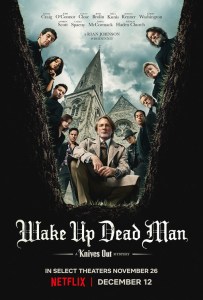 Being the third in its franchise, we now have a familiar idea of what to expect from a Knives Out murder mystery. Writer/director Rian Johnson has a clear love for the whodunit mystery genre but he loves even more turning the genre on its head, finding something new in a staid and traditional style of storytelling. The original 2019 hit movie let us in on the “murderer” early, and it became more of a game of out-thinking the world-class detective, Benoit Blanc (Daniel Craig). With the 2022 sequel Glass Onion, the first of Netflix’s two commissioned sequels for a whopping $400 million, Johnson reinvented the unexpected twin trope and let us investigate a den of tech bro vipers with added juicy dramatic irony. With his latest, Wake Up Dead Man, Johnson is trying something thematically different. Rather than adding a meta twist to ages-old detective tropes, Johnson is putting his film’s emphasis on building out the themes of faith. This is a movie more interested in the questions and value of faith in our modern world. It still has its canny charms and surprises, including some wonderfully daffy physical humor, but Wake Up Dead Man is the most serious and soul-searching of the trilogy thus far, and a movie that hit me where it counts.
In upstate New York, Pastor Jud (Josh O’Connor) has been assigned to a church to help the domineering Jefferson Wicks (Josh Brolin). The congregation is dwindling with the exception of a few diehards holding onto Wicks’ message of exclusion and division. The two pastors are ideologically in opposition, with Pastor Jud favoring a more nurturing and welcoming approach for the Christian church. Then after one fiery sermon, Wicks retires to an antechamber and winds up dead, with the primary suspect with the most motivation being Pastor Jud. Enter famous detective extraordinaire Benoit Blanc to solve the riddle.
 I appreciated how the movie is also an examination on the different voices fighting for control of the direction of the larger Christian church. Wicks is your traditional fire-and-brimstone preacher, a man who sees the world as a nightmarish carnival of temptations waiting to drag down souls. He sees faith as a cudgel against the horrors of the world, and for him the church is about banding together and fighting against those outside forces no matter how few of you remain to uphold the crusade. Pastor Jud rejects this worldview, arguing that if you think of the church as a pugilist in a battle then you’ll start seeing enemies and fights to come to all places. He’s a man desperate to escape his violent past and to see the church as a resource of peace and resolution but Wicks lusts for the fight and the sense of superiority granted by his position. He relishes imposing his wrath onto others, and his small posse of his most true believers consider themselves hallowed because they’re on the inside of a special club. For Pastor Jud, he’s rejecting hatred in his heart and looks at the teachings of Jesus as an act of love and empathy. It’s not meant to draw lines and exclude but to make connections. These two philosophical differences are in direct conflict for the first half of the movie, one viewing the church as an open hand and the other as a fist. It’s not hard to see where Johnson casts his lot since Pastor Jud is our main character, after all. I also appreciated the satirical tweaks of the church’s connections to dubious conservative political dogma, like Wicks’ disciples trying to convince themselves the church needs a bully of its own to settle scores (“What is truth anyway?” one incredulously asks after some upsetting news about their patriarch). It’s not hard to make a small leap to the self-serving rationalizations of supporting a brazenly ungodly figure like Trump. At its core, this movie is about people wrestling with big ideas, and Johnson has the interest to provide space for these ideas and themes while also keeping his whodunit running along pace-for-pace.
There is a moment of clarification that is so sudden, so unexpectedly beautiful that it literally had me welling up in tears and dumbstruck at Johnson’s capabilities as a precise storyteller. It’s late into Act Two, and Blanc and Pastor Jud are in the thick of trying to gather all the evidence they can and chase down those leads to come to a conclusive answer as to how Pastor Jud is innocent. The scene begins with Pastor Jud talking on the phone trying to ascertain when a forklift order was placed. The woman on the other side of the line, Louise (Bridget Everett, Somebody Somewhere), is a chatty woman who is talking in circles rather than getting to the point, delaying the retrieval of desired information and causing nervous agitation for Pastor Jud. It’s a familiar comedy scenario of a person being denied what they want and getting frustrated from the oblivious individual causing that annoying delay. Then, all of a sudden, as the frustration is reaching a breaking point, she quietly asks if she can ask Pastor Jud a personal question. This takes him off guard but he accepts, and from there she becomes so much more of a real person, not just an annoyance over the phone. She mentions her parent has cancer and is in a bad way and she’s unsure how to repair their relationship while they still have such precious time left. The movie goes still and lingers, giving this woman and her heartfelt vulnerability the floor, and Pastor Jud reverts back to those instincts to serve. He goes into another room to provide her privacy and counsels her, leading her in a prayer.
 The entire scene is magnificent and serves two purposes. This refocuses Pastor Jud on what is most important, not chasing this shaggy investigation with his new buddy Blanc but being a shepherd to others. It re-calibrates the character’s priorities and perspective. It also, subtlety, does the same for the audience. The wacky whodunit nature of the locked-door mystery is intended as the draw, the game of determining who and when are responsible for this latest murder. It’s the appeal of these kinds of movies, and yet, Johnson is also re-calibrating our priorities to better align with Pastor Jud. Because ultimately the circumstances of the case will be uncovered, as well as the who or whom’s responsible, and you’ll get your answers, but will they be just as important once you have them? Or will the themes under-girding this whole movie be the real takeaway, the real emotionally potent memory of the film? As a mystery, Wake Up Dead Man is probably dead-last, no pun intended, in the Knives Out franchise, but each movie is trying to do something radical. With this third film, it’s less focused on the twists and turns of its mystery and its secrets. It’s more focused on the challenging nature of faith as well as the empathetic power that it can afford others when they choose to be vulnerable and open.
Blanc doesn’t even show up for the first forty or so minutes, giving the narration duties to Pastor Jud setting the scene of his own. Craig (Queer) is a bit more subdued in this movie, both given the thematic nature of it as well as ceding the spotlight to his co-star. Blanc is meant to be the more stubborn realist of the picture, an atheist who views organized religion as exploitative claptrap (he seems the kind of guy who says “malarkey” regularly). His character’s journey isn’t about becoming a true believer by the end. It’s about recognizing and accepting how faith can affect others for good, specifically the need for redemption. Minor spoilers ahead. His final grand moment, the sermonizing we expect from our Great Detectives when they finally line up all the suspects and clues and knock them down in a rousing monologue, is cast aside, as Blanc recognizes his own ego could be willfully harmful and in direct opposition to Pastor Jud’s mission. It’s a performance that asks more of Craig than to mug for the camera and escape the molasses pit of his cartoonish Southern drawl. He’s still effortlessly enjoyable in the role, and may he continue this series forever, but Wake Up Dead Man proves he’s also just as enjoyable as the second banana in a story.
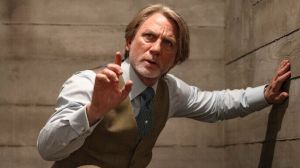 O’Connor (Challengers, The Crown) is our lead and what a terrific performance he delivers. The character is exactly who you would want a pastor to be: humble, empathetic, honest, and striving to do better. It’s perhaps a little too cute to call O’Connor’s performance “soulful” but I kept coming back to that word because this character is such a vital beating heart for others, so hopeful to make an impact. It’s wrapped up in his own hopes of turning his life around, turning his personal tragedy into meaning, devoting himself to others as a means of repentance. He’s a man in over his head but he’s also an easy underdog to root for, just like Ana de Armas’ character was in the original Knives Out. You want this man to persevere because he has a good moral center and because our world could use more characters like this. O’Connor has such a brimming sense of earnestness throughout that doesn’t grow maudlin thanks to Johnson’s deft touch and mature exploration of his themes. O’Connor is such a winning presence, and when he’s teamed with Blanc, the two form an enjoyable buddy comedy, each getting caught up in the other’s enthusiasm.
Johnson has assembled yet another all-star collection of actors eager to have fun in his genre retooling. Some of these roles are a little more thankless than others (Sorry Mila Kunis and Thomas Haden Church, but it was nice of you to come down and play dress-up with the rest of the cast). The clear standout is Glenn Close (Hillbilly Elegy) as Martha, the real glue behind Wicks’ church as well as an ardent supporter of his worldview of the damned and the righteous. She has a poignant character arc coming to terms with how poisonous that divisive, holier-than-thou perspective can be. Close is fantastic and really funny at certain parts, giving Martha an otherworldly presence as a woman always within earshot. Brolin (Weapons) is equally fun as the pugnacious Wicks, a man given to hypocrisy but also resentful of others who would reduce his position of influence. The issue with Wake Up Dead Man is that elevating Pastor Jud to co-star level only leaves so much room for others, and so the suspect list is under-served, arguably wasted, especially Andrew Scott (All of Us Strangers) as a red-pilled sci-fi writer looking for a comeback. The best of the bunch is Daryl McCormack (Good Luck to You, Leo Grande) as a conniving wannabe in Republican politics trying to position himself for a pricey media platform and Cailee Spaeny (Alien: Romulus) as a cellist who suffers from deliberating pain and was desperate for a miracle delivered by Wicks. He’s the least genuine person, she’s hoping for miraculous acts, and both will be disappointed from what they seek.
Wake Up Dead Man (no comma in that title, so no direct command intended) is an equally fun movie with silly jokes and a reverent exploration of the power of faith and its positive impact, not even from a formal religious standpoint but in the simple act of connecting to another human being in need. This is the richest thematically of the three Knives Out movies but it also might be the weakest of the mysteries. The particulars of the case just aren’t as clever or as engaging as the others, but then again not every Agatha Christie mystery novel could be an absolute all-time ripper. That’s why the movie’s subtle shifts toward its themes and character arcs as being more important is the right track, and it makes for a more emotionally resonant and reflective experience, one that has replay value even after you know the exact particulars of the case. If you’re a fan of the Knives Out series, there should be enough here to keep you enraptured for more. Because of that added thematic richness, Wake Up Dead Man has an argument as the best sequel (yet).
Nate’s Grade: A-
Share this:

Jupiter Ascending (2015)
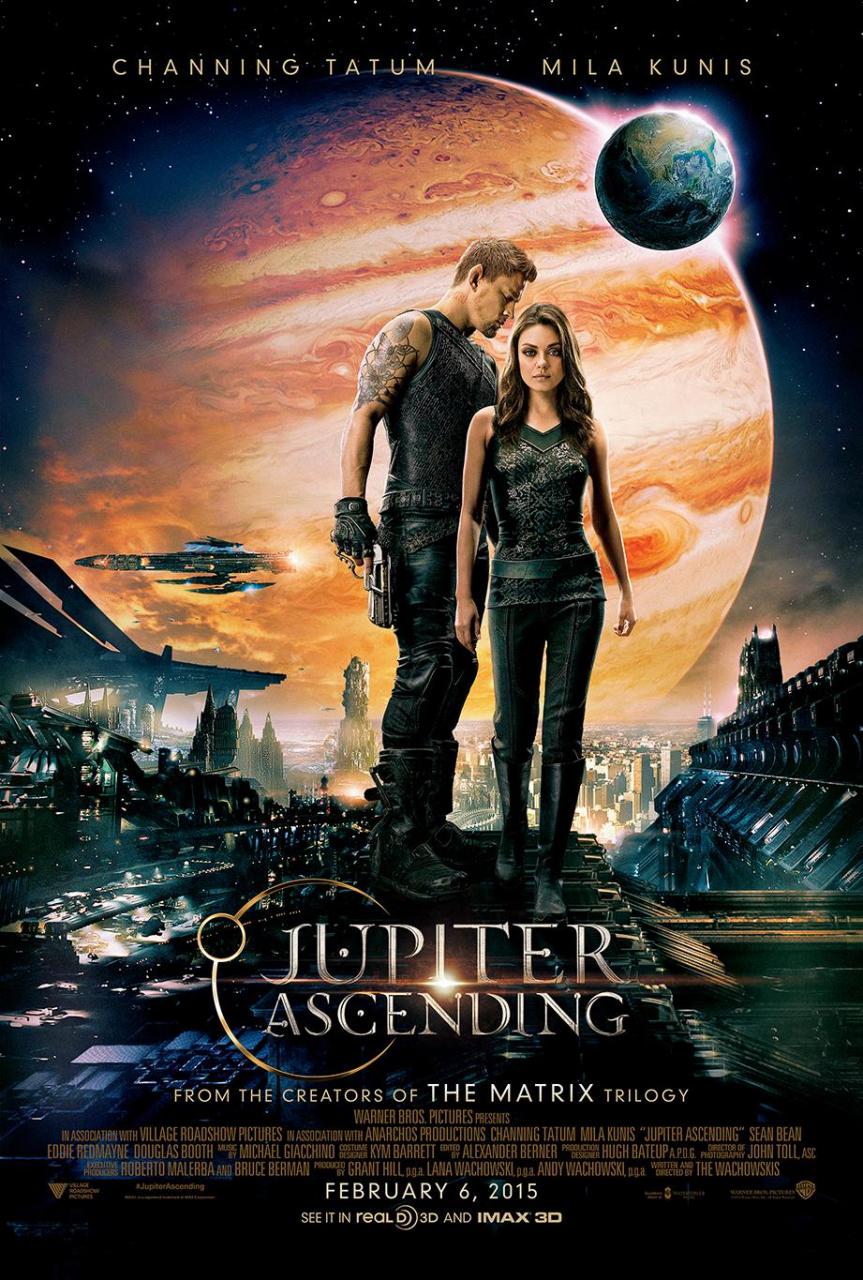 Few would dispute the imaginative powers of Andy and Lana Wachowski. They probably got a free pass from Warner Brothers after creating The Matrix, one of those culture-changing movies that come along so rarely. I was leery of Jupiter Ascending, their newest original science-fiction opus, when Warner Brothers delayed its summer release by nine months. The trailers and commercials were also doing a dandy job of hiding what exactly the movie was about besides cool visuals. I was holding out hope, thinking that maybe Jupiter would be silly but fun in a Fifth Element way, but instead ladies and gentlemen, we have an heir to 1980’s campy Flash Gordon.
Jupiter Jones (Mila Kunis) is an unhappy maid who cleans toilets for a living. Then one day she becomes the most important person in the universe. She discovers she is the reincarnation of the matriarch of House Abrasax, whose three children, Titus (Douglas Booth), Kalique (Tuppance Middleto), and Balem (Eddie Redmayne), are fighting over their inheritance. The biggest prize of them all is Earth, and now the appearance of Jupiter complicates ownership. Various alien species are sent to kill her, but Jupiter has a savior in disgraced galactic solider Caine Wise (Channing Tatum). He’s a “splice,” a result of gene splicing people with animals. He rescues Jupiter and they head off world to explore the much larger, much stranger universe.

Oh look, she’s falling again.
Right away, mere moments after leaving the theater, I knew the first step to make Jupiter Ascending a significantly better movie: completely remove the title character. First off, her name is awful and makes me think she’d be a character in the Jetsons universe. Mostly, she’s a terrible protagonist because she is merely a fairy tale wish fulfillment masquerading as a person. Her normal life is miserable but secretly she’s a space princess who is the reincarnation of a space queen. Allow me to momentarily pause and question this line of monarchy and inheritance law. Apparently Jupiter shares some genes with the deceased Lady Abrasax, but she has no direct bloodline. Does that automatically thrust her into another family’s inheritance squabbles? Why should they even consider her claim valid? Why does that place her at the top of the pecking order? When did we start recognizing reincarnation with inheritance law?
Back to the matter at hand, Jupiter is an annoyingly weak character that’s supposed to follow the arc of weak to strong, inactive to active. Except she doesn’t. Beyond accepting her incredible new position, there’s really not much that changes for her. She remains, from start to finish, weak-willed, gullible, always in need of saving, and so wretchedly annoying and without merit. Her cousin arranges her with a doctor for Jupiter to donate her eggs, but he expects a majority of the money. Why does she need this middleman in this arrangement? It’s another reminder how dim the character is and devoid of agency. And then all of a sudden a romance materializes between her and Caine because of course it does. I use “materializes” because there is no actual setup of any kind beyond the fact that Kunis and Tatum are attractive specimens. Their romantic dialogue will produce dangerously violent eye rolls.
The Wachoswkis are certainly imaginative filmmakers but their ambitious world-building impulses get the better of them and their story. The imagination is on full display when it comes to the visuals, the production design, costumes, and alien designs. There’s a grand mixture of creatures big and small, and even an elephant pilot because why not? However, the storytelling meant to house these cool things is notably deficient. Jupiter Ascending feels less like a story that naturally develops and whose complications arise in a semi-logistical fashion. It feels like somebody guiding you on a tour of Weird Stuff. It’s not so much a story as a collection of Weird Stuff, Weird Incidents, Weird Places, and Weird Creatures. You feel like you’re being skipped off from one exhibit to another, especially when Jupiter is kidnapped and threatened by each of the three Abrasax children in a row. Seriously, the entire scenario is on repeat, so when Jupiter continues making naïve choices, you can slap yourself extra hard having been through this purgatory just moments before. It’s only a matter of time before she gives in to whatever Abrasax demands again. There’s a general sense of repetition to the plot compounded by Jupiter’s incessant need to be saved (she seems to be falling a lot, out of spaceships, buildings, vehicles, etc., which also gets tiresome). The scheming Abrasax children seem to just slide in and out as the plot requires, with little in the way of resolution.
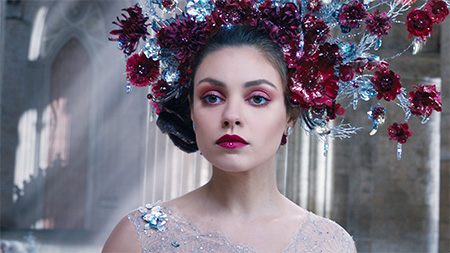 It’s impossible to discuss the film without acknowledging how damn goofy the whole enterprise comes across. Caine is part wolf, part albino, part human, and apparently part angel since he got his wings removed as a punishment. Does that seem like a good combination of elements or like the aftermath of a drunken writing session? Let’s just run down some of these names: Jupiter Jones, Balem, Kalique, Stinger, Gemma Chatterjee, Phylo Percadium, Chicanery Night (!). To be fair, it’s not like Luke Skywalker or Darth Vader are less preposterous names. Caine has a pair of anti-gravity boots but they’re really just hovering rollerblades. There’s just something silly about watching a guy rollerblade, even if you attach a futuristic spin to it. There’s a hidden factory beneath the stormy Eye of Jupiter, and yet this same important factory seems ready made to fall apart if the slightest projectile pierces its exterior (it’s the Death Star all over again). There are weird small aliens, weird alien bounty hunters who can turn invisible but don’t, weird space police that are really bad at their jobs, weird robots with human faces, and there’s also weird stereotypical Russian immigrants for Jupiter’s obnoxious family. Perhaps all the goofy camp will enchant you but I never got onboard mostly because the story and central characters left me so thoroughly unengaged.
Another ongoing problem is that the Wachowskis are constantly telling you things rather than showing you and allowing the story to organically develop. There are no less than three times when Character A looks at Character B and literally verbalizes what they are thinking or feeling in this moment. It’s lazy screenwriting, beholden to constantly having to explain everything to an audience because either you think they are dumb or your plot is far too convoluted; either way, a problem. Such sample pieces of dialogue include these informational asides: “Bees are genetically programmed to recognize royalty,” and, mere seconds later, “Bees don’t lie.” There you have it; bees don’t lie. Now you know.
The most frustrating part of Jupiter Ascending is that there is a genuinely interesting movie buried under so much of this silly nonsense and ear-clanging noise. The starting premise that Earth is nothing more than a stock portfolio for an alien species, that’s good. The idea that a trio of siblings is squabbling over who gets their galactic inheritance, which includes the deed to Earth, that’s good. The idea that human life is seeded on planets merely to be harvested into an eternal youth elixir for the rich and powerful, that’s even better. It’s not exactly a nuanced critique of capitalism but it’ll do. I’m disappointed that we don’t find out more about a larger market for this rejuvenation technique. There has to be more customers for such a miracle product than one rich family. If this were an intergalactic King Lear or even a space version of Margin Call, it would be far more exciting and creative. Instead, the bigger ideas are grounded into pulp so that we can have more CGI-drenched action sequences. There’s one segment that tonally breaks away from the film, diving headlong into Douglas Adams-style satire on bureaucracy. Like most of the film, it has its moments of entertainment, but it comes from nowhere and has trouble fitting with everything else. I’ll give credit where it’s due and praise the special effects, as well as the overall production design. It’s too bad that the action too often feels like a bunch of pixels exploding, failing to provide a sense of immersion. It’s hard to get a feel for most of the action and its use of space, save for portions of the finale. There is one very fun and well-choreographed fight between Caine and a… dragon… sentry guy (I don’t really know what to call these winged henchmen). That fight is exciting. It’s a shame there aren’t more of them. Bring on more dragon sentry guys.
Kunis is certainly miscast on the part, though I doubt any actress could pull off such a lackluster heroine who is always needing to be rescued. Kunis is more adept in the realm of comedy (Ted) or seduction (Black Swan), neither of which is featured with Jupiter. Let me say one more reason this Jupiter Jones character is awful; part of her struggle concerns whether or not to marry a playboy space prince. I don’t know if the Wachowskis believed that Jupiter was supposed to be a “strong” figure, but reducing feminine value to her being married feels rather reductive for sci-fi (not that there isn’t a storied history of women being treated as objects of fantasy in the genre). Tatum’s (22 Jump Street) remarkable charms are dulled by his silly albino beard and general guard dog characterization. He’s less a character than a protector who inexplicably instantly falls in love with his charge. Both actors will no doubt rebound in short order.
 Reserve some pity for poor Eddie Redmayne, a man who will be experiencing the highs and lows of acting this month. He’s the frontrunner to win Best Actor for his stirring work as Stephen Hawking in The Theory of Everything, which is what makes his performance here even more astonishingly awful. He speaks in this effete whisper for the entire movie, one that is hardly audible at all, except for the occasional line where he screams and spasms, making the contrast all the more funny. He constantly holds his head back like he’s in danger of nosebleeds. This is a performance of such startling misdirection that I physically felt bad for Redmayne. He seemed to be reaching out to me, pleading through his glassy eyes, communicating, “Help me, help me.” Even if his character’s vocal range wasn’t so nonthreatening, Balem makes for a terrible main villain. As a rich lord with power at his disposal, he works, but late in the movie all of that is removed, and he has to be a physical threat. After 90 minutes of watching him on screen, you will never be able to see him as a credible physical threat, and even the movie doesn’t fully treat him this way, and yet the plot still places him in this role. He’s not a heavy. Balem is laughable but he’s another component of a generally laughable movie.
Jupiter Ascending is a rarity in Hollywood, a big-budget epic that overpowers you with a singular sense of style and imagination; it just so happens that so much of the creative fireworks are laughably terrible. The Wachowskis don’t do anything in half-measure, and the film is put in overdrive. There’s a mess of characters and peculiar details to make this world feel larger than life and tethered to the idea of fun. Then why oh why did we have to be saddled with such boring, one-dimensional characters and a secret princess storyline lifted from countless sources? In the past, the Wachoswkis have found ways to turn pop philosophy and pop-culture into an entertaining alchemy that separated them from the sci-fi pack of imitators, which were legion. I still have great fondness for the original Matrix (you can keep the sequels), V for Vendetta, and especially Cloud Atlas of late. The Wachowskis are ambitious filmmakers and they have the imagination and narrative sensibilities to achieve great things. It’s just that with Jupiter Ascending it feels like their real passion was in all the background artifacts, the minutia of the worlds, the alien costumes and makeup, the histories of worlds. It certainly wasn’t on a story or characters or a credible romance. And yet even after all of these words, I have to admit that Jupiter Ascending is entertaining, just not in the way its creators may have intended. It reminds me of 2014’s disastrous Winter’s Tale, a passion project that was so baffling and bafflingly terrible. If you’re curious and willing to part with some money, gather some friends and check out Jupiter Ascending. Just make sure you’ll have suitable time planned afterwards to discuss its particular brand of big screen lunacy.
Nate’s Grade: C
Share this:

Third Person (2014)
 Paul Haggis is the Oscar-winning writer/director of Crash, so a man not known for subtlety. And that can be fine, but with his latest effort, Haggis wastes his time on a sluggish triptych that doesn’t come together in any satisfying or clever manner. Like Crash, we follow multiple storylines that we expect to intersect or crisscross. Liam Neeson plays an arrogant author checked into a French hotel trying to write his next novel. He engages in a series of cruel and flirty games with his mistress (Olivia Wilde). Adrien Brody plays a fashion spy in Italy who grows a conscience to help an immigrant regain her daughter. Mila Kunis is a New York actress struggling to get her life in order so she can regain some measure of custody for her son. Right away, the characters are rather bland and remote, refusing to provide much depth or development. Then there’s the fact that the plot requires so little of them, falling into a deadly lethargy that it can’t shake free from. You keep waiting for something more significant to take place but the characters just dawdle, spouting dialogue that never feels authentic. I kept waiting for the twist spoiled by the trailer for Third Person, and by the time two hours passed, I had to note that it was not a mid-movie twist spoiled by the trailer, it was the twist ending. Did the marketing department watch their own movie? I’ve never seen that before; late plot developments, yes, but never the twist ending. There is a reason why these characters are so poorly developed but it’s still not a satisfying reason to watch blasé people blunder around with little direction for over two hours, especially when they have no discernible connection to one another beyond heavy-handed linked themes. Hey, at least Third Person has a favorable amount of Olivia Wilde nudity to keep your interest. After that’s done, though, you can check out just like this array of substandard and morose characters.
Nate’s Grade: C
Share this:

Oz the Great and Powerful (2013)
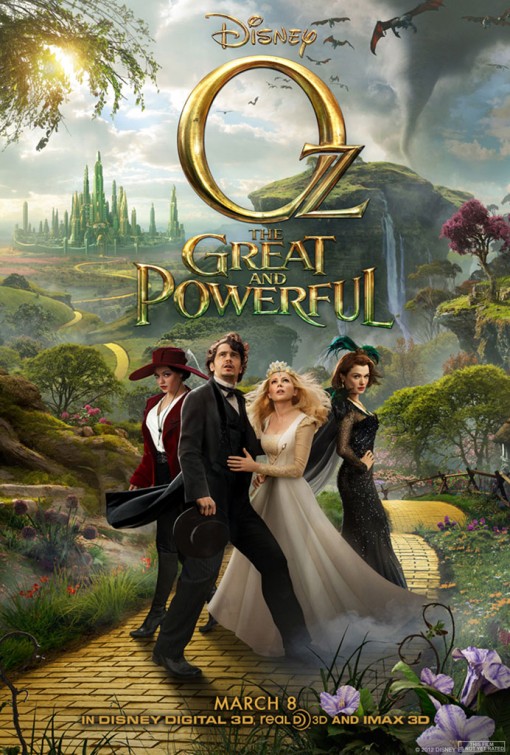 Usually when I’m watching a bad movie I have to stop and think where did things go so wrong, where did the wheels fall off, what choice lead to the disaster I am watching play out onscreen. In the case of Disney’s Oz the Great and Powerful, a Wizard of Oz prequel that pretty much hovers over the cusp of bad for its entire 130 minutes, I have to stop and think, “How could this movie ever have gone right?” I don’t think it could have, at least not with this script, this cast, and the edict from the Mouse House to keep things safe and homogenized, smothered in CGI gumbo and scrubbed clean of any real sense of venerable movie magic.
In 1905 Kansas, the magician Oz (James Franco) is used to bilking country folk out of their meager earnings. He’s a con man and runs afoul with a strong man in his own traveling circus. He makes a hasty escape in a hot air balloon and, thanks to a coincidental tornado, is whisked away to the Land of Oz. The people have long been told that a wizard would come and rescue them from the tyranny of the wicked witch. Theodora (Mila Kunis) and Evanora (Rachel Weisz), sisters controlling the Emerald City, task Oz with killing the other witch, Glinda (Michelle Williams). If he succeeds, Oz will become king and riches will be his. Along his journey he collects a band of cuddly sidekicks (flying monkey, China doll, munchkin) and learns that he may indeed be the hero that Oz needs to save the day.
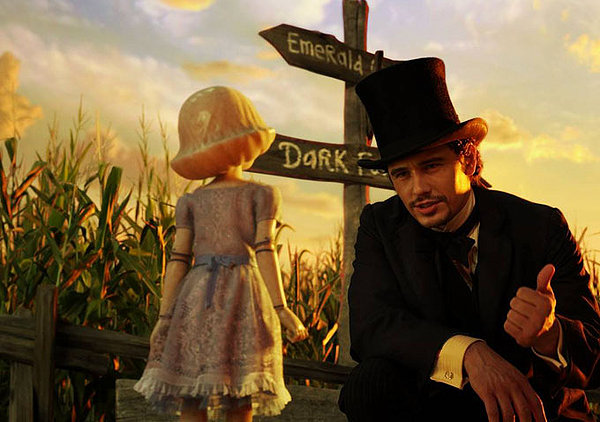 Oz the Great and Powerful is really just 2010’s Alice in Wonderland slapped together with a fresh coat of paint and some extra dwarves. I say this because, like Alice, this movie suffers from a plot that feebly sticks to the most generic of all fantasy storylines – the Great prophecy speaks about a Great savior who will save us from the Great evil. Naturally, the so-called chosen one has internal doubts about the burden they face, initially ducking out before finding that inner strength they had all long to prove they were indeed the one prophesized. It even got to the point where I was noticing some of the same plot beats between the two movies, like how last in the second act we spend time with a woman dressed all in white who we’ve been told is the villain but who is really the good guy. Then there’s the now-routine rounding up of magical creatures to combat the evil hordes in a big battle. Considering Alice was billion-dollar hit for Disney, it’s no surprise they would try and apply its formula to another magical universe hoping for the same results. Well I thought Alice was weak but Oz is even weaker. However, at least nobody absurdly starts breakdancing by the end. Small victories, people.
Beyond the formula that dictates the plot, the characters are poorly developed and broach some off-putting gender stereotypes. The character of Oz is portrayed as a scoundrel who eventually learns to be selfless, but I never really bought the major turning points for his character arc. Do all major characters need to be flawed men in need of redemption in magical worlds? I understand what they were doing with his character but I don’t think it ever worked, and certainly Franco’s performance is at fault as well (more on that later). The ladies of Oz, however, just about constitute every female stereotype we can expect in traditional movies. One of them is conniving but given no reason for why this is. One of them is pure and motherly. And then one of them gets lovesick so easily, falling head over heels for a boy in a matter of hours that she’s willing to throw her life away in spite. And all of these witches, who can actually perform magic unlike the charlatan Oz, sure seem like they don’t need a man to run the kingdom for them and tell them what to do. It’s sad that a conflict that involves feudal power grabs should devolve into a misconstrued love triangle. Then there’s the role of the little China Girl (voiced by Joey King) who adds absolutely nothing to the story except as another female in need of assistance and doting, except when she inexplicably behaves like a surly teenager in a tone-breaking head-turning moment. Oz keeps resting the very breakable doll on his shoulder, like a parrot. I suppose it’s better than tucking her in his pants.
The movie is also tonally all over the place. It wants to be scary but not too scary. Personally, I always found the talking trees to be spookier than the flying monkeys but that’s my own cross to bear. It wants to be funny but often stoops to lame slapstick and Zach Braff (Garden State) as a goofy flying monkey sidekick. It wants to be exciting but it never takes a step beyond initial menace. Its big climactic battle is more like a children’s version of something you’d see in the Lord of the Rings. The movie fails to satisfyingly congeal and so every set piece feels like it could be from a different movie.
 Some notable casting misfires also serve to doom the project. I like Franco (Rise of the Planet of the Apes) as an actor, I do, but he is grossly miscast here. He does not have the innate charm to pull off a huckster like Oz. Franco usually has an off kilter vibe to him, one that’s even present in this film, that gives him a certain mysterious draw, but he does not work as an overblown man of theatricality. Combined with lackluster character, it makes for one very bland performance that everyone keeps marveling over. It’s like all the supporting characters, in their fawning praise, are meant to subconsciously convince you that Franco is actually succeeding. Kunis (Friends with Benefits) is also a victim of bad casting. She can do the innocent ingénue stuff but when she (spoiler alert) turns mean and green it just does not work. When she goes bad she looks like Shrek’s daughter and she sounds like a pissy version of her character from Family Guy, which is ineffectual to begin with. Kunis cannot believably portray maniacal evil; sultry evil, a corrupting influence like in Black Swan, most definitely, but not this. There are lines where she screeches at the top of her lungs and it just made me snicker (“CUUUUUURSE YOOOOOOU!”).
I had faith that a director as imaginative as Sam Raimi (Spider-Man, Drag Me to Hell) would be a stolid shepherd for a fantasy-rich project such as Oz. I never got any sense of Raimi in this movie. It felt like he too was smothered completely by the overabundance of special effects. It’s a common complaint that modern movies are buried under an avalanche of soulless computer effects, but usually I find this bromide to be overstated. Having seen Oz, I can think of no more accurate description than “soulless computer effects overload.” At no point in the movie does any special effect come close to feeling real. At no point do you feel immersed in this world, awed by its unique landscapes and inhabitants (it feels often more like the land of Dr. Seuss than Oz). I chose to see the film in good ole standard 2D, though the 3D eye-popping elements are always quite noticeable. At no point do you feel any sense of magic, the most damming charge of all considering the legacy of Oz. The original Wizard of Oz holds a special place in many a heart. We recall feeling that sense of wonder and magic when we watched it as a child, the idea that movies could be limitless and transporting. While watching Raimi’s trip to Oz, I only felt an overwhelming sense of apathy that grew disquieting.
Then there’s the matter of the questionable messages that the movie posits. It celebrates the power of belief, which is admirable, but it’s belief in a lie. Oz is a fake, yet the movie wants to say that faith in false idols is something worth celebrating. Oz and his cohorts put together a deception to fool the denizens of the world into a false sense of security. Everyone believes in the Wizard of Oz so he has power but it’s all a sham. We’re supposed to feel good that these people have been fooled. Didn’t The Dark Knight Rises basically showcase what ultimately happens when a society’s safety is based around a lie and false idols? I understand that as a prequel one of its duties is to set up things for when Dorothy comes knocking, but do I have to be force-fed disingenuous moral messages?
Oz the Great and Powerful is a wannabe franchise-starter that feels like it never really gets started. There’s a generic hero’s journey, some underwritten characters, mixed messages, and poor casting choices, namely Franco and Kunis. The sense of movie magic is absent and replaced with special attention to marketing opportunities and merchandizing (get your own China Girl, kids). It feels more like the movie is following a pre-planned checklist of stops, cribbing from Alice in Wonderland playbook, and trying to exploit any nostalgia we have for this world and its characters. Except we love Dorothy, the Scarecrow, the Tin Man, the cowardly Lion, and Toto. I don’t think anyone really had any strong affection for Glinda or the Wizard. Just because we’re in the same land with familiar elements doesn’t mean our interest has been satiated. The Wizard of Oz backstory has already been done and quite well by the Broadway show Wicked, based upon the novels by Gregory Maguire. That show succeeded because it focused on the characters and their relationships (extra points for a complicated and positive female friendship dynamic). We cared. That’s the biggest fault in Raimi’s Oz, that amidst all the swirling special effects and fanciful imagination, you watch it without ever truly engaging with it. You may start to wonder if your childlike sense of wonder is dead. It’s not; it’s just that you’re old enough to see a bad movie for what it is.
Nate’s Grade: C
Share this:

Ted (2012)
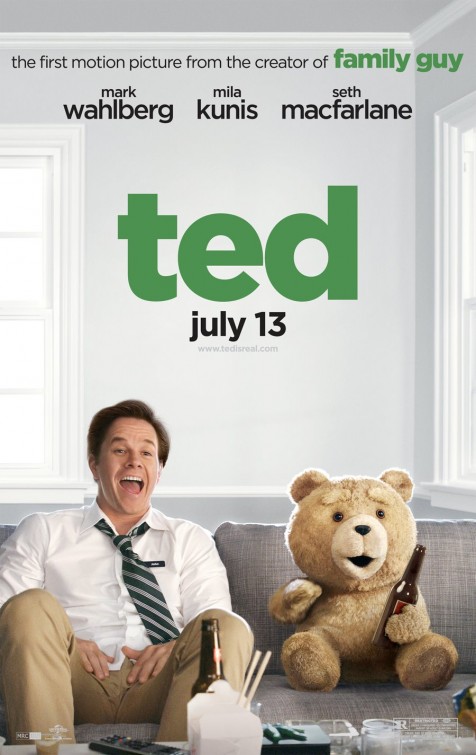 Seth MacFarlane has become an industry powerhouse. The man has three animated TV shows on air (Family Guy, American Dad, The Cleveland Show) and essentially carved an entire niche of modern comedy. His brand of irreverent, offensive, tangential humor has turned the man into a demigod among young audiences and helped him rake in millions. A journey to the movies seemed inevitable, and so comes Ted, which MacFarlane directed and co-wrote with two of his Family Guy scribes. The best assessment I can give is that if you enjoy MacFarlane’s brand of humor on TV, you’ll probably enjoy Ted. If not, then you’re in for a prolonged, obnoxious two hours.
One day when young John Bennett was a young boy, he wished his teddy bear would come alive so he’d always have a best friend. And as a narrator tells us, nothing is stronger than a young boy’s wish (curious gender is specified and then never touched upon for some kind of joke). The next morning Ted (voiced by Seth MacFarlane) comes alive. Flash forward 30 years and Jon (Mark Wahlberg) works at a rental car company, has a stunning girlfriend in Lori (Mila Kunis), and regularly gets stoned with his best pal, Ted. The two guys are inseparable, which causes friction between John and Lori. After another notorious incident of Ted behaving badly, Lori insists that he move out. John has to start acting more responsible and treating Lori like she deserves, but Ted’s influence usually leads to trouble. Both Ted and John are in desperate need of growing up.
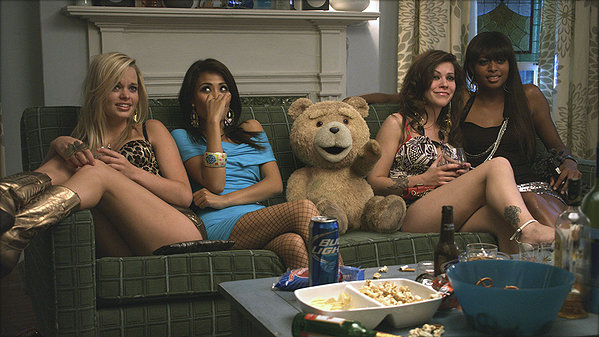 It was no surprise for me that Ted was exactly what I expected from Seth MacFarlane. It’s just a bigger, raunchier version of the style of humor he’s patented on television: tangential non-sequitors, scenes that go on far too long, obscure pop culture references, pointless shock material, and the basic premise that the jokes hinge around some creature merely doing things. Like Brian the Dog, or Roger the alien, Ted is a creature that shouldn’t necessarily exist, and thus so much humor is built around just seeing Ted exist. Is it supposed to be hilarious watching him drive? How about hit on women? Do bong hits? Far too often the only joke the movie seems to offer is that Ted is a teddy bear doing stuff. If you replaced him with, say, a normal human being, would any of those jokes work? Would it be funny watching a normal person drive, hit on women, and do bong hits? Maybe but probably not. It’s all one joke: look at something unnatural doing natural things. And that’s my issue with MacFarlane’s brand of humor. These jokes are not given proper attention, setup, and development. The film rarely subverts your expectations with how every joke will play out, and if you already know the jokes before the movie delivers them then what’s the point? The one joke I did laugh at, and a good guffaw at that, was Ted’s boss who kept responding to Ted’s screw-ups with good words and promotions. That was a surprise. But here’s the thing: once it’s established, you know what will happen the next time. So the second time it’s still funny but not as much. By the third time, his nonplussed reaction is completely expected and thus all traces of funny have been squeezed dry. In comedy, it’s all about surprise, and I find with MacFarlane that he rarely strays from his routine.
As far as jokes going on too long, let’s talk about a myriad of subplots that seemed to go on forever. There’s an entire storyline where an obsessed fan played by Giovanni Ribisi (Contraband) kidnaps Ted. This storyline makes up almost the entire third act and occurs after the reconciliation between John and Lori, so the movie already feels like it should be over. And then it keeps going. And it keeps going longer. And then there’s a car chase and a foot race through Fenway Park, which serves no purpose other than to probably fulfill a childhood wish of MacFarlane’s to film on said hallowed grounds. And it’s during this final act where the crass movie tries to become… sentimental? It just doesn’t work. You can’t have 100 minutes of rude, offensive, vulgar humor and then try and then try and go all gooey and soft and make people feel something akin to emotion. The reason that the Judd Apatow films can work with emotion is because from the get-go they make you care about the characters and their relatable conflicts. But there’s a difference between emotion and cheap sentiment, and Ted hasn’t earned genuine emotion. I didn’t like any of these characters. They all seemed like louts and jerks and dolts, none of them charming. Thus the end and its wish-upon-a-star conclusion are cheap sentiment and the kind of conclusion that you believe without a doubt that the characters in Ted would mercilessly mock.
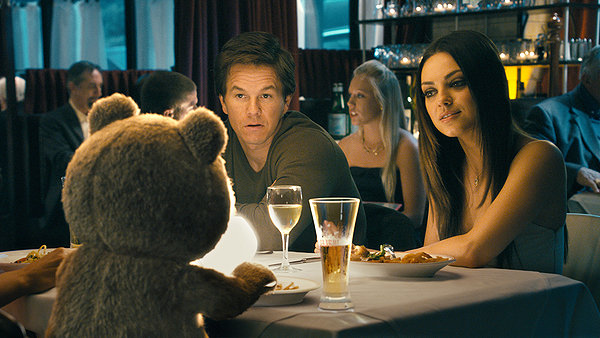 Let me specify for the moment that there is a distinct difference between gross-out gags and gags that are just gross. There is also a difference between jokes that are shocking but funny and jokes that are just desperate to offend. In my experience with MacFarlane’s brand of humor, as well as McFarlane’s fratty devotees (if I was rushing a fraternity, I have no doubt Ted would be my favorite movie, bro), that difference is not understood. Watching an over-the-top racist Asian stereotype is merely offensive without proper context to draw out humor beyond the odious and obvious. Just punching a child in the face isn’t funny. Just having someone defecate on the floor isn’t funny, though the panicked removal of said feces was humorous in flashback. I may have chuckled and giggled from time to time with Ted, but most of the time I was just saddened by how desperate McFarlane and his writers were to shock rather than to entertain.
Thank God Wahlberg (The Fighter) was in this movie. While Ted is best left in small doses, the boorish best friend archetype, Wahlberg has been sharpening his comedic muscles (the only muscle in need of work it seems) and has become a terrific straight man. Anyone who remembered 2010’s The Other Guys knows that Wahlberg can be flat-out funny when given great madness to play off of. With Ted, Wahlberg’s commitment to the innate absurdity of the movie goes a long way. His breathless rendition of an exhaustive list of white trash girl names had me laughing harder than anything else in the movie, and I admit I was also impressed by Wahlberg’s speedy delivery. The character of John is a pretty standard role at this point in American comedy, one of arrested development. However, it seems to take so long, blown chance after blown chance, for John to finally find some sense of responsibility. Just like everyone else, he is at the mercy of Ted’s corrosive influence.
I probably wasn’t the ideal specimen for MacFarlane’s first foray into movies. I’ve never been more than a mild fan of his TV work and its hit-or-miss-but-mostly-miss brand of tangential humor, though I admit American Dad has grown on me (the only MacFarlane show where the jokes seem related to the story situations). MacFarlane unleashes the vulgar material he’s been holding back from TV, which makes for some laughs. The obviously stoned guys sitting in front of me thought the movie was hilarious, even during quiet moments where nothing was going on. I’m disappointed that a MacFarlane movie is pretty much exactly as I would have suspected, essentially a MacFarlane TV show blown up to a bigger screen. The jokes here are so limited, mostly deriving from Ted the teddy bear just doing things a teddy bear normally doesn’t. I wish the comedy were more developed, more nuanced, more concerned with doing something other than shock. The most shocking aspect of Ted is how utterly forgettable the whole enterprise is even with a magical talking teddy bear.
Nate’s Grade: C
Share this:

Friends with Benefits (2011)
 Sometimes chemistry can make up for a lot, and the dynamic, natural, and playfully flirty chemistry between stars Justin Timberlake and Mila Kunis makes up for a lot of their movies shortcomings (if you know what I mean). Friends with Benefits is another tale about a guy and a girl, both friends, who embark on a challenge to have casual sex and not form emotional/romantic attachments. No matter how many romantic comedy clichés it points out for ridicule, it doesn’t excuse the fact that the movie becomes one big, mushy, clichéd rom-com itself, albeit with saltier language (if you know what I mean). The randy humor will occasionally feel like it’s trying too hard, afraid to let an obvious joke lie dormant for too long. That’s where the sheer star power and amiable chemistry of the leads comes in handy. Kunis and Timberlake are both rather easy on the eyes, but they have a sharp sense of comic timing and a natural interplay. Hooray, a movie about friends where they feel like actual friends. Under the direction of Will Gluck (Easy A), the film has a jaunty pace except for an extended layover in Los Angeles that seems to sap the comic mojo and chart the film’s obvious rom-com reconciliatory ending. Friends with Benefits is sexy, funny, and an easy way to waste a couple hours (if you know what I mean).
Nate’s Grade: B-
Share this:

Black Swan (2010)
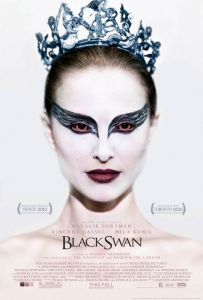 The prissy world of prima ballerinas and tutus doesn’t seem like a natural fit for sex, murder, lunacy, and mayhem. Director Darren Aronofsky (Requiem for a Dream, The Wrestler) is used to exploring the punishments of the human body and the strain of the mind, so you know that Black Swan isn’t going to be your traditional dance movie.
Nina (Natalie Portman) has been a company ballerina in New York City for years. She spends her hours at home practicing the grueling routines in hopes to break out for a lead role. Her mother (Barbara Hershey) is a former ballerina herself who gave up her shot at the big time when she had Nina. Then the head of the dance company, Thomas Leroy (Vincent Cassel), has decided that Tchaikovsky’s Swan Lake will be the first show of the season. It’s a bit tired, he admits, but he has a plan to juice it up: the same dancer will portray both the swan queen (tragic protagonist) and the black swan (villainous temptress). All of the dancers are committed to doing what they can to earn that coveted lead role. Nina’s primary worry is Lily (Mila Kunis), a dancer who is imperfect in technique but honest and free in her movements, garnering the attention of Thomas. In the process, Nina is losing her grip on reality. She’s hearing weird things, seeing weird things, and something dark wants to take center stage.
 Black Swan is a grade-A mind freak of the first order, a tonal fusion of sight and sound that echoes earlier masterworks of the eerie psychological horror like Rosemary’s Baby and The Shining. This is a movie that gets under your skin; I literally had a nightmare the night after watching it, though I don’t want to give people the wrong impression. Black Swan is not a horror film by the traditional standard we’re accustomed to today. The entire film has a downright Kubrickian vibe, from its devoted tracking shots, to the overdose on classical music underscoring the dramatic tension, and the unraveling of the human mind toward eventual psychosis. Aronofsky keeps the audience tethered to Nina, at times literally. The camerawork will rarely stray away from Portman, like we’re caught within her orbit and forced to see the world through her fractured perspective. She is our eyes to the world but, as becomes increasingly apparent, we cannot trust what we see. The unreliable POV leads to some fantastic freak-out moments that will consistently leave you scrambling. The diligent pacing marvelously matches the dissolution of Nina’s psyche. As her paranoia and delusion take control, Nina comes undone one thread at a time, with Aronofsky on the other end providing the tugs. The spiraling mental determination culminates with a glorious 20-minute finale that manages to be tense, beautiful, haunting, and powerfully moving. There are moments in this film that gave me goose bumps (a blood red-eyed Portman growling, “It’s my turn” is a chilling highpoint). I became determined to see Black Swan again even before the closing credits arrived.
Aronofsky makes use of every tool at his disposal to heighten the intense atmosphere. The attentive editing and camerawork create a shifty mood, communicating Nina’s desperate groping for direction. But beyond that, Aronofsky employs subtle sound effects to rattle you, keep you off guard. Routinely there will be the fluttery sound of wings flapping or hushed whispers. It’s enough to make you shudder time and again. It’s a small touch that elevates the mood and instantly snaps you to attention whenever you hear the eerie echoes. The disquieting sound effects are coupled with equally subtle visual effects. As Nina absorbs herself in her ballet role we occasionally will witness the pores of her skin raise, as if invisible hair, or fathers, are protruding. Sometimes these raised bumps will wash over her body in waves. As Nina becomes more consumed with her darker impulses, the special effects take a surreal role in conveying her madness.
 The film is also rather sensual without becoming trashy, late-night Cinemax fodder. Portman’s descent is linked with loosening up her own sexuality. She can portray the innocent and delicate white swan, but she’s having significant problems portraying the ominous and seductive black swan. She’s told to let go, lose herself to her physical impulses, and explore the confines of her nubile body. Black Swan is probably the artiest high profile film to feature prominent female masturbation since 2001’s trippy Mulholland Drive (the two movies have plenty of similarities in ambition). Nina’s suspicions about her rival transform into confusing erotic fantasies that will delight the teenage males in the crowd. Black Swan treads the erotic terrain with a European sense of maturity and candidness. The sex and masturbation and bisexual smooches don’t feel like gross, gratuitous shots at cheap titillation.
Portman ably takes the frazzled lead and gives an enthralling performance that will be hard to beat come Oscar time. The role is a lot more than screaming and crying. Although to be fair, Portman cries a whole lot. You may lose count the amount of times Portman is seen crying on screen. Her character is fragile but not fighting for sympathy. She can be distant and a little cold, obsessed with reaching the unattainable state of perfection. This pushes her to the extreme, goaded by her somewhat loopy mother. Portman has always been an attractive presence on screen, but she is also fairly transparent when she’s bored with her material (watch those Star Wars prequels and argue differently, I dare you). With Black Swan, she throws herself into a role like I’ve never seen before from Portman. I did not think the kewpie-dolled actress was capable of such heights. The immersion is entrancing. She physically trained for over a year before production to be able to do most of those pirouettes and fouettés. I’m not being overly generous with the dancing accolades; Portman comes across as smooth as a professional. The fact that Portman is capable of expressing so much devastating emotion through dance is astounding. My eyes were glued to her every movement. This is the performance that officially lifts Portman to the acting big leagues. She dances circles around the acting competition for 2010.
While it’s certainly Portman’s show, the supporting cast all shine in their small roles. Kunis (Forgetting Sarah Marshall, Book of Eli) is made to exemplify the edgy opposing force in Nina’s life. Kunis’s natural charm and alluring presence might make her the most likeable character in the film, even though her wild ways will keep you guessing about her true motives. Hershey (Hannah and Her Sisters) seems like a doting and supportive mother at first glance, but the actress reveals shades of desperation and mania. Winona Ryder (Star Trek, Girl, Interrupted) makes a welcomed near-cameo as the ballerina pushed out of the spotlight. And then Cassel (Ocean’s Twelve, Eastern Promises) plays lecherous creep like few others.
 The film manages to make ballet feel like a contact sport. These people punish their bodies, their artistic vessels. The rigorous routines require dancers to be in sleek form, which often leads to abuse via bulimia. The excruciating balance and coordination required places unusually high demands on the human body, particularly on the feet that must support the body in extreme positions. Broken toes and split nails are the least of the worries. Black Swan succeeds in showcasing the fierce brutality of dance; however, the movie also showcases the intrinsic beauty. I am a self-described novice when it comes to dance, especially ballet at that, but even I was spellbound by watching the dancing, notably the exhilarating Swan Lake opening night performance. The camera is positioned to be like another dancer, so we’re swooping and spinning around the stage with the featured performers. This gives the audience an intimate glimpse into the fluid movements and, just as importantly, the nuanced and sensual expressions of the performers. I would have scoffed at the idea of a ballet performance being anything more than frou-frou-ness, but Black Swan made me a believer. Witnessing the beauty and gracefulness of the dancing is proof that all that hard, punishing preparation is worth it.
Probing the stress of the body and fraying endurance of the mind, Black Swan richly explores the sacrifices we make for art and ambition. The world of ballet is highlighted as a hotbed for scandal and intrigue and female sensual desire. Not bad for all that hoofing around in frilly tights. Black Swan is anchored by Portman’s captivating descent into madness, a performance that will surely be awarded in the ensuing months to come. Aronofsky has fashioned a riveting psychological thriller with enough artfully crafted chills and spooks to make for one visceral experience at the art house. Beyond bringing the tingles of spine and bumps of goose, Black Swan digs into the psychological underpinnings of competition, devotion to art, and personal glory. There’s much more going on here than ballet. It’s a grade-A mind-freak but under Aronofsky’s skilled direction and Portman’s transfixing acting, Black Swan is also a grade-A piece of art and one of the most stunning works of cinema this year.
Nate’s Grade: A
Share this:

The Book of Eli (2010)
 Where did the Hughes brothers go? Albert and Allen Hughes have four movies to their names, one of them a documentary about pimps, and their last flick was 2001’s From Hell. I know that Jack the Ripper thriller underperformed at the box office, starring a pre-Pirates Johnny Depp, but was it enough to throw these guys in movie jail for nine years? The Hughes brothers are talented filmmakers, first evidenced by their debut feature Menace II Society, which they wrote and directed when they were only twenty years old. I actually really liked From Hell. I get that it isn’t anywhere as complex as the source material from famous comics scribe Alan Moore, but the movie was slick, stylish, twisty and twisted and satisfying (although, Heather Graham has the worst accent in the history of movies). Where have these brothers been all this time? Nine years later, the Hughes brothers take a whack at the popular genre of the moment –Apocalyptic Cinema. The Book of Eli kind of comes across like a Hollywood version of The Road. It’s all about duplicating the look, without getting too bleak, and failing to replicate the sense of humanity in desperation. Why worry about that when you can have explosions?
It’s been 30 years since the sun scorched the Earth. Food is scarce. Gangs roam the highways. The law is a forgotten concept. Eli (Denzel Washington) is a loner heading westerly and trying to make out a meager existence. He takes the boots off a dead man, hunts emaciated cats for food, and looks for a safe shelter from the blistering sun. He struts into a dusty town looking for clean water. The town is under the rule of Carnegie (Gary Oldman), a man in search of a very specific book for his own purposes. It just so happens that Eli is in possession of this book. Eli refuses to hand over his property, speaking about his mission to transport the book to where it belongs. Carnegie sends his thugs out to kill Eli and retrieve the book. Helping Eli is Solara (Mila Kunis), a teenage prostitute who feels Eli has answers that nobody else has.
 What we have here is a post-apocalyptic Western. Denzel is the lone drifter that comes into a town besieged by lawlessness or a corrupt agency of power. He even has a fight in a saloon that doubles as a whorehouse. He takes on an unlikely younger apprentice and enforces his own moral code through a series of shootouts. It just so happens that in Eli, he also has a giant machete and knows kung-fu. This is pretty strict genre stuff, mixing in apocalyptic elements for some extra flavor. The Hughes brothers give everything an ashy grimy gloss, making the most of desolate locations they shot in New Mexico (“When you need some place that looks like the end of the world, film New Mexico!”). The sparse locations and desaturated cinematography do well in establishing an unforgiving reality of the landscape.
The Hughes brothers certainly have a sense of style when it comes to the camera lens, yet they don’t approach being too self-conscious with their visuals. There’s an extended fight sequence that plays entirely in silhouette. There isn’t an overabundance of special effects in the film to clutter up the bangs and booms. There is one shootout outside a home (with Michael Gambon no less) that mimics some of the unblinking camerawork of Children of Men, swinging from side to side throughout the escalating firefight. It’s a fun visual motif that thrusts the viewer in the middle of the action. Otherwise, the action is all fairly standard stuff. It?s entertaining to watch Denzel take out a bushel of bad guys time and again, but what does that add up to with such a worn out story and half-hearted characterization? The script by Gary Whitta is heavy on apocalyptic mood and light on details. Cue more ass kicking.
Washington is stoic, almost Eastwood-like in his grit. He’s an easy antihero to root for, the reluctant avenger that manages to slice and dice his way through trouble. I won?t say this movie forces Washington to stretch his reserve of acting muscles, but it is undeniably pleasing to watch him perform his own fighting stunts. Oldman hasn’t gotten an opportunity to play a scenery-chewing villain in quite a while. Let’s face it; Evil Oldman will always overrule Good Oldman. This man was created to play sociopaths that have no ability to control the volume of their voice. This man needs a chance to bellow once every movie. Kunis proved she was a capable actress in Forgetting Sarah Marshall, but her role is fairly limited here to sidekick. She stares with her dark eyes and gets to hold a gun. That’s about it. The Hughes brothers have populated their post-apocalyptic world with familiar faces. Tom Waits is a merchant, Ray Stevenson (HBO’s Rome) as the Number One Henchman, Jennifer Beals as the blind mother to Solaris, and Gambon as a well-armed homeowner with an appetite for human flesh. That?s a good stable of actors to fill out a bunch of stock roles. It certainly makes The Book of Eli more entertaining.
The religious element doesn’t dominate the film but it does serve as food for thought. You see the book of Eli’s in high demand is actually he King James Bible. But you see, this isn’t any bible wrapped in leather with a metallic locked binding (all this for a Bible?); this is the LAST BIBLE ON EARTH. That is why Carnegie craves it. In the 30 years since the vague apocalyptic event, apparently mankind rounded up all the Bibles and burnt them, perhaps to express their displeasure with God. Eli operates on the premise that Denzel has the only Bible in the known world, which just seems downright silly. Did people search through every habitable dwelling, every library, and every hotel drawer? There have to be hidden Bibles out there. Even in this extreme setting, it seems to strain credibility to think that mankind is left with one copy of the most widely published book in the history of the world.
 Ignoring this fact, the religious element remains nebulous even though the film chronicles the journey of the Christian text. God is referred briefly but mostly the talk steers around the ideas of “faith” and “fate” and “the right path.” Eli feels he has been chosen for a special mission, and so he trudges west with his eyes on the prize. Carnegie wants to use the Bible as a “weapon” to pervert people’s faith into giving him more power. He wants to abuse religion as a motivational force to expand the reach of his control. Here’s the thing though, Carnegie has control over a town already and rules by fear. This seems to be working fine for him. So he wants to rule by love instead, using the Bible to spread the Gospel of discipleship? It’s somewhat unclear what exactly Carnegie plans to use the text for especially considering that most of the remaining population is illiterate anyway. He could just as easily hold up any book (The Da Vinci Code is shown, why not that one? It even has “code” in the title) and proclaim it the Word of God. It’s not like these people, struggling just to eat and find water, are going to question the power structure.
Not content with being a competent genre film, The Book of Eli ends on one of those ghastly twist endings that forces you to rethink everything that came before it. It doesn’t ruin the movie, but this twist certainly leads a charge toward building a counterargument toward disproving it. I won?t get into particulars but it seems unlikely that Denzel would be as good a shot as he was if the twist holds up.
The Book of Eli has its share of thrills and some interesting visual style, but there isn’t anything here you haven?t seen in hundreds of other post-apocalyptic movies. The dusty landscapes, the biker gangs, the aviator goggles, the cryptic threats, the necessity for leather as a fashion statement. This isn’t a bad movie by any means; it’s just another entry in a cluttered genre that, with our renewed fascination of the end times, is only getting more cluttered. Washington and the assortment of actors put in fine work but it’s ultimately the story that lets them down. This is a by-the-books genre flick with a touch more style courtesy of the Hughes brothers and a touch more gravitas courtesy of Mr. Washington. My advice to the human race: stock up on Bibles. Apparently, in the post-apocalyptic future, they will be more valuable than gold. Invest now while you still can. I got 15 of them and will entertain all offers.
Nate’s Grade: C+
Share this:

Extract (2009)
 Writer/director Mike Judge’s third movie isn’t quite as funny or just plain fun as his previous pair, Office Space and Idiocracy. Set in a local factory, we follow the misadventures of the boss (Jason Bateman) as he deals with incompetent employees, looming lawsuits, and a wife (Kristen Wiig) who he feels disconnected with. What Judge has is two competing movies; one of them garners the bulk of the first 45 minutes and proves to be funny. The other gets most of the second half and plays out sloppy and dumb. The more interesting half involves Bateman trying to feel guilt-free about wanting to have an affair, so his friend (Ben Affleck, very funny) hires a clueless gigolo to seduce the wife. This scheme actually works but causes humorous complications, like when the gigolo keeps going back for more. This comedic scenario would be enough for one movie. The other half of the tale involves Bateman trying to sell the company but the buyer is wary of an impending lawsuit due to an accident on the work floor that left a man sans his testicles (so much wasted potential here). Mila Kunis is the sexy con artist behind the scenes, encouraging the ball-less worker not to settle. Obviously Judge had work-related gags he wanted to tackle, but he proves that his real interests lie in the complicated relationship comedy. Extract fumbles forward not knowing what kind of movie its really wants to be, so it settles for hackneyed solutions and abrupt endings. Extract would have been a better comedy completely removed from the workplace.
Nate’s Grade: B-
Share this:

Max Payne (2008)
 I have no idea whatsoever what the point of this movie was. Adapted from the popular video game, Max Payne follows a hardened police officer played hysterically super serious by a grumpy Mark Wahlberg. He scowls, he grumbles, he chews over laugh-out-loud “tough guy” dialogue as he searches for his wife’s killer. For whatever reason, this storyline dovetails with a super drug on the streets that makes people see hallucinations of winged demons/angels. The entire storyline has no merit except to squeeze in some semi-cool effects shots. But when you know they’re all just hallucinations, what does it matter? Can that really be scary? But then these creatures seem to interact with reality and pull people to their deaths, so what are the rules here? There’s not an ounce of fun to be had amidst this drabby neo-noir landscape. The plot is a formulaic revenge tale, where every turn is easily telegraphed and every character is a one-note stock role, complete with the video game favorite of doe-eyed pixie girl who carries huge guns (Mila Kunis, why?). Even the action sequences are dour and dull. Max Payne is a movie that was built to exist in moments and not as a whole. The most troublesome aspect of this whole sodden adventure is how much the film openly fetishizes guns. The end credits are like a reel of money shots, watching glistening CGI guns rattle off. What better way to end such a thoughtless exercise in pseudo entertainment.
Nate’s Grade: D


 nathanzoebl
You must be logged in to post a comment.