Blog Archives
Man of Steel (2013)
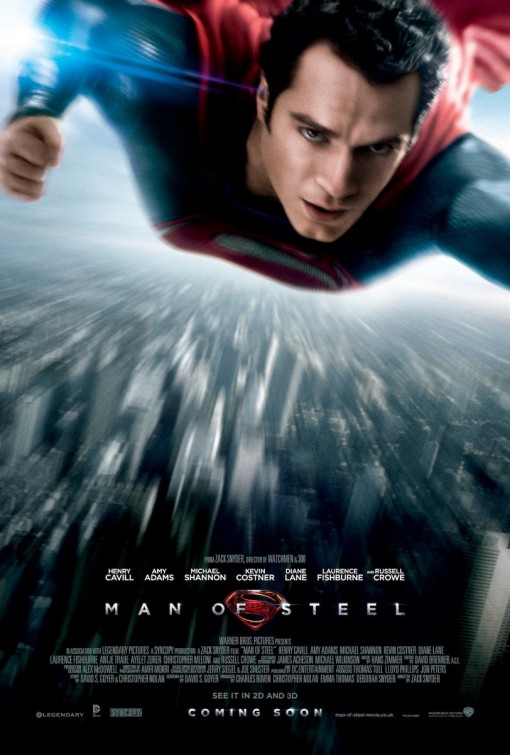 I think I began my review for 2006’s Superman Returns the same way but I don’t care. Does Superman have any relevant appeal in today’s society? I understand being a moral pinnacle has been his MO from the start, and I understand that today’s generation likes its heroes dark and broody and tortured. I know you can make Superman into an interesting figure (the man just celebrated his 75th anniversary, so there have to be some people who identify), though it is a bigger challenge, surely. I think taking a darker tack can be achievable but needs finesse. Christopher Nolan and David Goyer, having fashioned the highly successful Dark Knight trilogy, seem like a formidable pair to shepherd a darker Superman into the twenty-first century. Combine that with director Zack Snyder (300, Watchmen), and you’re guaranteed a pretty movie. Where does Man of Steel go wrong?
You know the drill at this point: Superman a.k.a. Clark Kent (Henry Cavill) was originally born on the doomed alien planet Krypton. His biological father, Jor-El (Russell Crowe), sent his son to Earth with the hope that he could survive and achieve great things. Raised by Jonathan and Martha Kent (Kevin Costner and Diane Lane), he then accepts his destiny to be mankind’s protector, butting heads and flirting with dogged reporter Lois Lane (Amy Adams). Except now Superman has the entire genetic code of Krypton’s history (?) transported into him via a “codex” (whish resembles a charred baby skull). General Zod (Michael Shannon), imprisoned off planet when Krypton was destroyed, is determined to retrieve that code and start his race anew. He and his crew travel to Earth and demand superman turn himself in, or else Earth will suffer.
 Where this movie gets into deep trouble is that it fashions Superman into an inactive loner, turning him into a super bore. He has such superhuman strength at his command but his doubtful dad has taught him that humanity would lose its mind if he revealed himself. And so Superman goes through half this movie hiding his super ability. He actively avoids conflict and confrontation. It’s basically the same formula as the Incredible Hulk TV show, where Bruce Banner would drift from town to town, warning others not to make him angry, then mournfully have to leave yet again. He can’t help himself save lives but, in flashback, dearly departed dad admonishes him for it (Clark: “Should I just have let them die?” Pa Kent: “Maybe.”). I think the isolation the character endures is essential to understanding his heavy burden, but at the same time this was compensated by Clark Kent, Superman’s opportunity to blend in with the natives, assume a frail phony identity, and to flash some much needed personality. In Man of Steel, he doesn’t become Clark Kent, news reporter, until the very last scene. It’s not a movie about a man becoming Superman but Clark Kent, experience-free reporter.
Two of the chief complaints about Bryan Singer’s 2006 Superman movie were that it was too reverent to its source material, namely the Richard Donner films, and it lacked sufficient action. Well, both of those issues are tackled in the very opening of Man of Steel. Goyer reworks plenty of Superman mythology from a science fiction angle, and so we get stuff about alien invaders, genetic bloodlines, clone baby labs, teraforming, and all sorts of spaceships. The characters keep referring to Superman as “the alien,” and dad worries that the knowledge of his super son will upset people’s worldviews about humanity and God (have no fear, there’s still messianic imagery to sledgehammer you with). I’m fine with Goyer playing fast and loose with Superman’s history but his alterations need to have solid reasoning. Nolan played around with Batman’s history and it worked because, in the context of the world and characters he developed, it fit. Does Jor-El riding a dragon like a live-action Heavy Metal fit? Does a billion people’s DNA transposed into Superman’s cells fit? Do Superman’s actions during the quite controversial ending fit? Does Clark’s stepdad, Jonathan Kent, willingly dying in a tornado fit? Does Lois Lane immediately knowing who Superman is, before he even adopts the Clark Kent disguise, fit? I doubt it, though it still could have worked. However, Goyer’s script is a mess structurally, preventing the story from gaining serious traction. First, we start with twenty-something minutes on Krypton, which could be condensed in half, then we slam into the present and this new formula appears: present, flashback, present, flashback, present. That happens for another twenty minutes. Then there’s 40 minutes of Superman dithering as the reluctant hero. Then the last hour plus is a nonstop barrage of meaningless action that squeezes out room for character growth.
I’ll credit Snyder and company for likely tripling the action quotient of any previous Superman movie (maybe even all of them combined), but I never thought such action would be so boring. Oh sure, it delights for a while with advanced special effects and Snyder’s eye for visuals, but the action sequences drag out far too long. A long action sequence? Isn’t that what you’re always demanding, critic Nate? Well anonymous and theoretical detractor, yes, I enjoy a well-developed and sustained action sequence. The problem with action sequences is that they have to matter. They have to accomplish something even if it’s just there are less enemies or the hero got from point A to point B. There has to be, at bare minimum, something that is accomplished. Sadly, this is not the case with the action in Man of Steel, which is why the sequences drag and feel like they are twice as long as their already bloated length. There’s a brawl between two evil Kryptonians and Superman and after a whole 10-15 minutes of sparring, the bad guys get on a ship and leave. Come on, Zod has like a crew of twelve henchmen. Can’t one of them at least die in a preliminary battle? Worse, the final confrontation between Zod and Superman could just as easily been eliminated. They punch and yell and punch and yell and stuff gets all smashy, but by the end of the fight, nothing has substantially changed, except the foundational surroundings (more on that below). Having two invincible beings punch each other for a half hour is not engrossing. For a lengthy action sequence to work there need to be complications, organic to the situation, and the stakes should escalate. James Cameron and Steven Spielberg are masters at crafting escalating action. J.J. Abrams is pretty good himself. Even Michael Bay has his merits. I don’t know whether to lay the crux of the blame on Snyder or the screenplay he had to give life.
 As the plodding action continued to pound me senseless, I was left to seriously ponder just how epic the scale of Superman’s collateral damage truly is. At one point, when Supes is fighting in the small-town center of Smallville, he tells the residents to, “Stay inside. It’s not safe.” What then proceeds to happen is a fight that rips up almost all the pavement in town, takes down a helicopter, a few fighter jets that crash in town, exploding, as well as a train car, plenty of ricocheting gunfire, and debris everywhere. But have no fear because those citizens stayed away from the windows and locked their doors! More than likely they are dead. The concluding clash in Metropolis is like 9/11 times eight. I counted three different skyscrapers that came tumbling down, and this is after the Krypton gravity field has ripped up the city and smashed it to dust, as well as missiles exploding around the city and Zod’s various spaceships. Then there’s the fight where Zod and Superman are blasting through just about every high-rise office building, and even when they collide outside it creates such force that buildings crater. They even fly into space, destroy a satellite, which then comes down as fiery debris that rains down on poor Metropolis. The final plan to foil the bad guys involves, get this, opening a black hole above a major city. It’s not like that sounds as if it will have catastrophic blowback.
The 9/11 imagery is unmistakable and I don’t care if it has been 12 years now. Couldn’t Superman at least react to the desolation he was causing? I really hope some enterprising soul via the Internet tallies the number of estimated deaths because I sincerely believe it would reach into the millions (Update: Ask and ye shall receive). Superman decimates the city and I thought less about the gee-whiz factor of the special effects and more about the innocent lives being lost amidst the CGI devastation. It looks like an atomic bomb went off. Perhaps a sequel will start with Lex Luthor rebuilding Metropolis.
And that’s the problem when you try and make sense of Man of Steel’s more realistic, grounded approach. This is a Superman that came of age in the 80/90s. While touches like young Clark experiencing sensory overload with his powers, like a scared autistic child, are clever and nice avenues toward relatability, you still have to square the more bombastic, over-the-top, and downright stupid moments that clash with that refined tone of greater realism. Nolan wanted Batman to exist in a recognizable world, so it makes sense that he and Goyer would attempt to do likewise with DC’s other champion. The prospect of an invincible alien among us is a potent source for some thoughtful and topical drama. It’s just not going to happen when Superman can demolish cities without blinking an eye or when anyone else fails to register the scale of this tremendous trauma. We don’t even have outside reactions or opinions to the earth-shattering revelation that we are not alone in the universe.
Then there are just the little things that annoyed me. Jonathan Kent dies in an effort to save the family dog. This comes off as lame, especially when Superman could save dad but has to hold back, per pa’s wishes, so as not to expose himself. Except, by the end, when the United States accepts Superman, doesn’t this invalidate all of Pa Kent’s worldview? If so, then the man died for nothing. Also, General Zod wants to transform Earth into Krypton. Except… on Earth all Kryptonians have godlike powers. Wouldn’t the man just want to keep that? Also, why does Zod never dispatch more than two Krypton lackeys to fight Superman? He has all these godlike warriors and decides to just keep them locked away in his spaceship. That just doesn’t make sense from a tactical standpoint. Also, Pa Kent tells his son to do his best to blend in, but in one scene bullies harass Clark as he’s reading from Plato. Yes, because your typical teenager can’t rip himself or herself away from the likes of Plato. Careful: Plato is a gateway read to Epicurus. Then there’s the overbearing product placement. Usually I give movies a pass if they’re not obnoxious with product placement; however, Man of Steel stages entire action sequences so we can get long-lasting looks at the logos for Sears, 7-11, and IHOP: “This callous destruction brought to you by the good (surviving) people at Sears.”
 Cavill (Immortals, TV’s The Tudors) sure has the look for the part. He’s appropriately bulky but because the role is too often inactive loner, always holding back, that makes his performance somewhat bland and more reticent than necessary. Part of this is also that Snyder has historically been a poor actor’s director. You can tell throughout the film as talented, Oscar-nominated and winning thespians like Crowe and Shannon will just give off deliveries, little tinny trills that clunk, moments that a director should have stepped in for. Shannon (Take Shelter, Premium Rush) is one of our best working wacko actors, but even he comes across as a bit too unrestrained and stiff, especially when he has to scream “I will find HIM” half a dozen times in a row. I thought Zod’s second-in-command played by German actress Antje Traue (Pandorum) had more personality and better moments. Adams (The Master, Trouble with the Curve) is a good choice for a plucky Lois Lane, especially one sharp enough to see through Clark’s disguise. The movie is packed with good character actors like Laurence Fishburne, Harry Lennix, Christopher Meloni, Michael Kelly, Richard Schiff, Mackenzie Gray, and two actors from Battlestar Galactica. That’s nice. The best actor in the movie is Dylan Sprayberry as teen Clark.
Snyder’s reworked Superman for our modern age just doesn’t cut it as popular entertainment. Its misshapen structure, heavy with exposition, doesn’t provide enough space for the characters to develop, and the general edict to make Superman an inactive loner on the fringes of society is a surefire way to keep an audience at bay. The CGI-heavy action sequences feel like they go on for an eternity, straining and struggling to keep your attention because the stakes fail to escalate or have consequences outside ridiculous amounts of collateral damage to rival the worst of Mother Nature. The over-amped sci-fi reworking tries to make a clean break from the demands of Superman’s mythology, and while some revamps work, most feel needless and ham-fisted, like Pa Kent’s somewhat pointless death. But the worst charge is that the movie is just too boring. I know people have levied this charge against Superman movies in the past, particularly the 2006 Singer film that I will still stand by my positive review for. Man of Steel is a good looking movie for certain, often a great looking movie, but all those pretty pictures are for naught because of a flawed approach and overindulgence with tedious action sequences. Given its box-office riches, I expect this Superman retread will garner the sequel that Singer’s film did not. I just hope the next chapter in the new adventures of Superman experiences a Dark Knight-level rise in quality.
Nate’s Grade: C+
Share this:

The Iceman (2013)
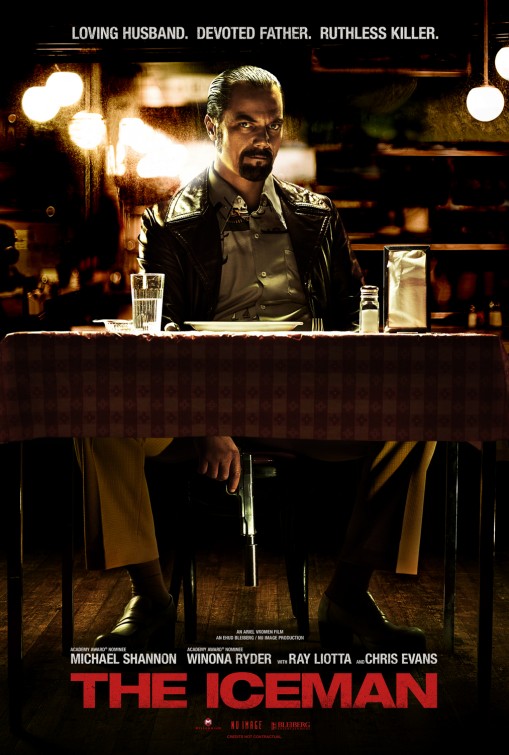 We’re fascinated by hired killers. Chalk it up to morbid curiosity or perhaps perverse, secret wish fulfillment, but we’re all titillated a tad by the murderous for hire. The Iceman is all about Richard Kuklinski (Michael Shannon), who worked as a contract killer for the mob from 1966 to 1988. He’s estimated to have killed over 100 people. A mob middleman (Ray Liotta) is impressed that Kuklinski shows no fear with a gun in his face, and so the guy gets hired to rack up the bodies. At the same time, Kuklinski has a wife (Winona Ryder) and two daughters, all of whom have no clue what daddy does for a living until he’s finally brought to justice.
The main issue at play with The Iceman is that it’s trying to draw out a character study for a rather impenetrable person. It’s hard to get a solid read on the character of Richard Kuklinski. The compartmentalizing of these two very distinct lives is a fascinating psychology to explore, one I wish the filmmakers had spent a majority of the screen time upon. The internal justifications, struggles and compromises would make for an excellent and insightful look into the psychology of killer rationalization. However, I don’t know if this movie would even be possible from this subject. Kuklinski is by all accounts a pretty detached guy. There just doesn’t seem like there’s a lot to him. His circumstances are interesting, beaten into an emotionless cipher by his father, brother to a fellow sociopath, and trying to make a reasonable life for himself while keeping his inner urges at bay. The sociopath-tries-to-make-good storyline is reminiscent to fans of TV’s Dexter, and there’s plenty of room to work there. It’s an intriguing contradiction, the man who cares for so little protecting his family. In the end, we don’t really get a sense of why beyond the illusion of the American Family that Kuklinski wants to hold onto, to make himself seem normal, to prove to his family he could break free from their influence. Even typing this I feel like I’m giving the film more depth than it actually illustrates. Even though he tries to play the part of devoted family man, we rarely see any evidence of devotion. He provides, yes, puts his kids in private school, but he puts his family at risk and doesn’t seem to have affection for them as much as propriety. They are his things and nobody will mess with them. Your guess is as good as mine if he genuinely loves any of them.
 Too much of the film gets mired in standard mob clichés. This guy upsets that guy; this guy wants the other guy dead. It all becomes the focal point of the movie, Kuklinski getting caught up in, essentially, office politics. Even the true-life details of the grisly methods of death feel like wasted potential for a better story. He goes on a job, he botches a job, he gets let go, so to speak, he strikes up a new partnership with another contract killer, Mr. Freezy (Chris Evans in a bad wig). That last part could have been a movie unto itself, watching an odd couple of hitmen plan, execute, and then dispose of their targets. The Iceman nickname comes from their process, freezing the dismembered corpses for months so that coroners cannot get a read on when the bodies were slain. While Evans is entertaining, this entire portion of the movie could have been eliminated, its bearing on the plot minimal. Likewise, the movie has several small roles populated by recognizable actors, which become a series of one-scene distractions. Kuklinski goes out on a hit and it’s… James Franco. Then there’s Friends actor David Schwimmer as a sleazy, ponytailed, nebbish mob screw-up. Stephen Dorff has one moment as Kuklinski’s angry, desperate, murderous brother in prison. The actors are all fine, with the exception of Franco, but many of them are just another reminder of the film’s disjointed attention.
I mentioned in Pain and Gain the notion of portraying true-life criminals as sympathetic figures, and the queasy nature of this complicit interpretation. The Iceman never really tries to make Kuklinski sympathetic or some form of an antihero, and I think the movie is better for it. One of the earliest moments in the film is Kuklinski slitting the throat of a guy who harassed him and defamed his lady. This is BEFORE the guy is even hired as a contract killer too. It seems like when the guy can’t murder he becomes a worse family man. Even in the end, he’s testing a new batch of cyanide on the neighborhood cat. The movie presents Kuklinski as he is, though you’ll be forgiven for feeling some initial pings of sympathy when you seem him try and protect his family. Granted his family could also very well use protection from him.
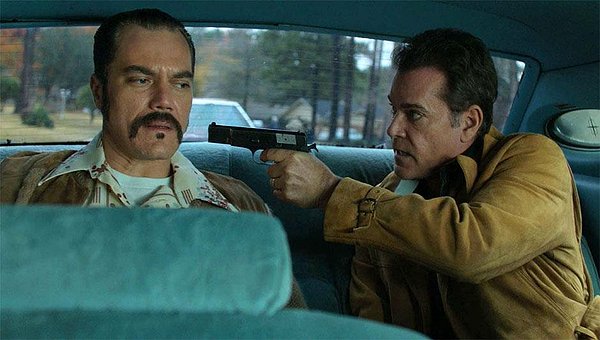 Shannon’s (Premium Rush) performance is what keeps you watching. There are few actors who are as intense as this guy, though I’m used to seeing him play unhinged psychos bouncing off the walls. Kuklinski is just as troubled as his other roles but he’s all reserve, steely nerves, and anger that eventually bubbles over into violent rage. Shannon is still such a good actor that even with a thin character, or at least thin characterization, he can be completely compelling to watch onscreen. One of the more peculiar, inconsistent elements of the film is Shannon’s constantly-changing facial hair. I think I lost count at about nine or ten different facial topiary variations. There were times where it will be different in consecutive scenes. I guess that’s a tipoff of a time jump, but his morphing, period-appropriate facial hair also became a point of amusement.
What makes The Iceman so disappointing in retrospect is how much potential it seems to squander. There’s a great story to be had with a contract killer by night and a family man by day. That contradiction, the struggle, the psychology is all rich material to work with. It’s just that Kuklinski is not necessarily that guy; he’s not too deep, at least not in this version, and his killer work problems are just not that compelling. If this is what the filmmakers were going to do with their real-life subject, then they might as well have just used Kuklinski as inspiration. Take the best parts and then compose a different lead character, someone more emotionally transparent or relatable or just plain old interesting. Just because it’s a real story doesn’t mean you’re indebted to telling every true facet of it, especially when a better story is within sight. Shannon is a terrific actor and does his best to make the film worth watching, but from distracted plotting to unmet analysis and emotional exploration, it’s hard to walk away from The Iceman and not feel a bit chilly.
Nate’s Grade: C+
Share this:

Mud (2013)
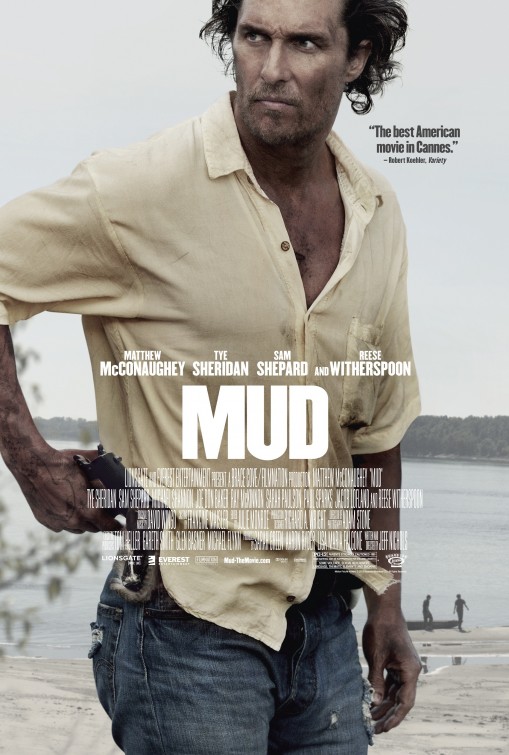 If you aren’t familiar with writer/director Jeff Nichols, do yourself a favor and get acquainted and fast because this guy is headed for indie stardom. Nichols’ last movie, the somber and unbearably tense thriller Take Shelter, was my top film of 2011. Mud, in contrast, is a harder sell, something akin to a modern-day Mark Twain fable about romantic outsiders, fugitives, friendship, and boys coming of age. Matthew McConaughey plays the titular character, a wanted man hiding out on a small island along the Mississippi River. He befriends two teens that help him rebuild a boat so that Mud can escape with his lady (Reese Witherspoon) and evade a team of dangerous bounty hunters seeking vengeance. Nichols is truly gifted at his ability to craft wholly believable characters regardless of circumstance. There is a great sense of setting here, without nary a judgment to the lower class moorings and difficulties, just as Nichols expertly showcased rural Midwestern life and day-to-day anxieties in Take Shelter. His new film is admittedly slow and takes a while to rev up, but the performances are just so good and richly delivered, from top to bottom, that you’re happy to go along with the somewhat loping ride. It’s such a pleasure to witness McConaughey fully engaged with a role, pushing him to utilize new and exciting acting muscles. Nichols also doesn’t soft-pedal the hardships of his characters. While it’s poignant and satisfying how the various plot threads come together for a thrilling conclusion, Mud also has the grace to leave several storylines absent tidy bows. There’s real heartbreak, real disappointment, and recognizable people of all walks trying to do good and find their place in this complicated world. If Mud is playing near you, it should shoot to the top of your must-see list.
Nate’s Grade: A-
Share this:

Premium Rush (2012)
 It looks like the silliest movie of the summer, and that includes a film where people travel through the center of the Earth as part of their daily commute. Premium Rush is going to have some inherent silliness given that it’s an action movie about bike messengers, plus there’s the whole title that seems like a time warp to the addled surfer-speak of the early 90s (radical, dude!). There’s just something silly about the world of bike messengers in a technologically advanced world. However, once the film gets started, silliness and all, I got completely caught up in it and went happily along for the ride.
Wilee (Joseph Gordon-Levitt) is a bicycle messenger in New York City. He lives on the speed and rush of the job, riding a bicycle with fixed gears and no brakes. He’s still trying to get in good graces with Vanessa (Dania Ramirez), a fellow bike messenger and his ex-girlfriend. At the end of his shift, Wilee gets one last mission. He’s to deliver a very important envelope by 7:00. That envelope happens to carry a receipt for a very lot of money, which is the equivalent of a bank notice in some criminal circumstances. Police detective Bobby Monday (Michael Shannon) tracks down Wilee and insists that he hand over the package. Monday, you see, has some very deep gambling debts to some very angry people, and he needs that package. Wilee refuses, races off, and Monday gives chase, using his police connections to try and snag the plucky cyclist.
 Your presumptions of how silly the realm of bicycle messengers are get dashed quickly when you realize how insanely dangerous this profession can be. These guys, and gals, are speeding through downtown New York City traffic, careening around vehicles, and flying through lights. We see a few high-speed accidents but I wouldn’t be surprised if nearby hospitals have an entire organ donation pile labeled “bike messengers.” Director/co-writer David Koepp (Ghost Town) does a great job of making the audience feel the adrenaline rush of all that speed. You will get swept up in the thrills and forget all about the silliness. For a man who hasn’t directed action before, though written plenty of it, Koepp has a natural feel for developing his action and showcasing the cyclist’s impressive skills. Simply put, this is one movie where the action really speeds along.
The high-speed navigation of New York City is entertaining in and of itself, but Koepp goes one further and places Wilee in a series of dangerous predicaments where he has to determine his next split-second route. He mentally plays out the different scenarios, most of them involving him getting creamed by a car. It’s a fun visual quirk and a great opportunity for physical humor as well since some of the potential outcomes are quite worrisome. Koepp gooses his story with plenty of visual flourishes that gives Premium Rush an added degree of fun. The narrative also jumps back and forth linearly, fleshing out characters and giving us a better sense of how the pieces of the plot all snap together. It’s flashy and fun and thrilling with some great practical stunt work, and that’s more than enough to make you forget any misgivings you may have had with the premise.
Tonally, the film has a nice tongue-in-cheek sense of humor; it’s not enough to be self-aware or veer into meta territory, but it’s a concerted lightness, a springy attitude that further elevates the fun quotient. No more is this sense of humor better realized than with the villainous Bobby Monday. He’s a corrupt cop but he’s also hilariously off, just like every Michael Shannon (Take Shelter) character it seems. He’s a horrible gambler, and even he knows it, but he still comes back to the math-heavy Asian games that he’s not suited for. This character’s entire crazed demeanor has a comic desperation to it, which does temper his predatory danger. But you’ll never know what he’ll say next, or what strange, over-the-top delivery will accompany the next bon mot. In one scene, he complains about the trashy nature of primetime TV, bemoaning that he heard, during the family hour, some kid say “suck it.” He also laments how prevalent the term “douchebag” has become as an insult. It’s these little oddball touches that reminded me of the excellent 2003 action movie The Rundown, specifically Christopher Walken’s whacked out bad guy. Now there’s nothing that approaches the absurd poetry of Walken’s tooth fairy speech, but Shannon and his offbeat rhythms add another level of enjoyment.
 I salute Joseph Gordon-Levitt’s rise in Hollywood circles, now among the ranks of spry action heroes. Gordon-Levitt has long been one of my favorite actors, delivering tremendous performances in films like Brick, Mysterious Skin, (500) Days of Summer, and of course last year’s cancer dramedy 50/50. He’s got a natural charisma to him that doesn’t seem manufactured, that isn’t overworked, and he delivers committed performance after committed performance. It’s easy to like this guy and be impressed with his performances. Now, Premium Rush isn’t going to going to shoot to the top of this guy’s resume, but he makes a credible action lead that’s easy to root for. He has an affable, devil-may-care attitude, and flashbacks to his early romance with Vanessa give a peak at how overwhelmingly charming the man can be when he turns it on. I will not admit whether I have a shrine devoted to Gordon-Levitt (or “Jo Go-Lev” as I prefer to call him).
My only major complain with the film is that it becomes a tad repetitious leading into its final act. All of this effort is spent on tracking down a ticket, so you are comfortable with it changing hands repeatedly. The good guys have it. The bad guy has it. And so on. I think the film would feel less repetitious if these changes in ownership didn’t happen so frequently. It feels like nobody can hang on to this thing for more than a few minutes.
For a summer awash in disappointment, it’s nice to come across a modest action movie that’s well-executed and just plain fun. Premium Rush delivers an end-of-summer blast of fun and some neat visual whimsy. Gordon-Levitt carries the film well and the great Michael Shannon punctuates the movie with such entertaining weirdness. I was laughing routinely, getting caught up in the rush of speed, and even coming to enjoy the various silly detours, like when an army of bicycle messengers is called out for action like some gang. This is not a movie to take too seriously, but much like Battleship, it’s a summer formula action movie that sticks to its guns and finds plenty of enjoyment. I never would have thought at the beginning of the summer that an action movie about bike messengers would be one of the most entertaining offerings, but there you have it. Koepp has crafted an enjoyable, thrilling, and just plain fun movie and a fine way to close out the summer.
Now back to my Jo Go-Lev shrine.
Nate’s Grade: B+
Share this:

Take Shelter (2011)
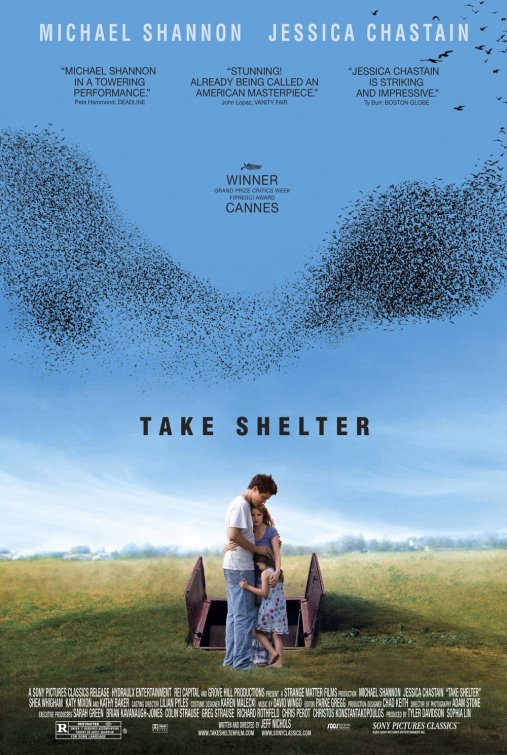 It’s rare that I get to take some local pride and puff my chest about a movie being shot in Ohio. Take Shelter, a small, suspenseful character-piece, was filmed in Loraine County, near Cleveland. Several of the actors in the production are local actors, including Tova Stewart, the adorable seven-year-old who plays the onscreen deaf daughter. The young gal, who is also deaf in real-life, is from Columbus and was in attendance at the theater I saw Take Shelter at. And I can beam with even more local pride at the fact that Take Shelter is unwaveringly magnificent. It’s a remarkably tense movie, deeply realized, expertly crafted, and one of the best films of the year.
Curtis (Michael Shannon) is a working-class family man in rural Ohio. He works as a manager of a two-man drill team, scouring the earth for valuable deposits. His wife, Samantha (Jessica Chastain), cares for their recently deaf daughter, Hannah (Stewart), and sews pillows and embroidery on the side. They are making ends meet to save up for Hannah’s cochlear implant surgery. This family tranquility is interrupted when Curtis begins having strange visions. He sees dark, ominous storms that no one else seems to see. He hears loud cracks of thunder during clear skies. He feels the dark rain fall on his person. He wakes from frightful dreams detailing friends and family turning on him. What does it all mean? Curtis feels compelled to remodel the storm shelter in the backyard. He even purchases a cargo container and buries it in the yard, collecting some end-of-the-world provisions. Could Curtis just be crazy? His mother has been in a psychiatric home since she abandoned Curtis as a child. She began having schizophrenic episodes in her mid 30s, and Curtis is now 35. Is he being warned of what lies ahead or is he succumbing to the pull of a hereditary mental illness?
 This is very likely the most nerve-racking, tense, dread-filled film I’ve watched since 2009’s Oscar-winner, The Hurt Locker. Writer/director Jeff Nichols (Shotgun Stories) masterfully lays out the particulars of his tale. Even the family drama has some nicely constructed tension. Curtis’ family is living paycheck to paycheck, so his backyard project is a real financial setback. By borrowing equipment from his work, Curtis is even risking losing his job, the only way he can afford his child’s cochlear implant. Not only do we dread stormy weather and strange flocking patterns for birds, we dread the everyday struggles of keeping afloat. Curtis following his visions can very likely put his family into financial ruin, but is that a risk worth taking? Nichols nicely creates an authentic small-town setting. There are small, acute character touches that enrich the story, like when Dewart (Shea Wigham) concludes that the best compliment a man can give is that “he’s lived a good life.” When Curtis and Samantha watch their daughter sleep, they share behavior they are still trying to kick in adjusting to having a deaf child (“I still take my boots off not to wake her,” he confides. “I still whisper,” she returns). These people and their troubles feel believable, and their reactions to Curtis’ strange behavior feel extremely believable. Whispers begin to spread and people start to treat madness like it’s a communicable illness. Religion seems like a natural landing zone when discussing anything apocalyptic and/or prophetic, but Nichols sidesteps this discussion. There could have been some interesting theological room to explore here, considering a Biblical prophet would likely be derided as mentally ill in our modern age. Nichols keeps things secular. Curtis is admonished for missing church again, but that’s about the extent of religion in the man’s life. He does not seek out spiritual advice. He seeks out psychiatry, at least if he could afford it he would.
There are some terrific standard thriller moments, like some well-calculated jump scares and many nightmare fake-outs, but the film’s real skill is drawing out tension to the point where you want to shout at the screen. This is a deliberately paced thriller knotted with unbearable tension. We become conditioned to start doubting the onscreen imagery after Curtis’ series of nightmares. Every time there’s a storm now the audience, too, fears the validity of what we witness. What is the significance of these portent signs? There’s a moment toward the climax, where a storm door needs to be opened, and I simultaneously was dreading every second leading up to that door opening and silently screaming in anticipation. Every part of me wanted to see what was going to happen next and I could not guess where Nichols would take us. I was a nervous wreck. The dread was so heavy, so all consuming, and not just from an apocalyptic standpoint. Curtis understandingly thinks he may be nuts, especially since his own mother is a paranoid schizophrenic. The threat isn’t just the strange apocalyptic signs but also Curtis himself unraveling and lashing out. He worries that he’ll become a danger to his own family, and if he cannot discern the difference between reality and fantasy it’s only a matter of time before he jeopardizes his loved ones. He fears he’ll be ripped away from his family. He wants to be better, he wants to be “normal,” but he can’t trust his own senses.
 Take Shelter is also so effective thanks to Shannon, a talented actor who always seems to be on the brink of freaking out. The bug-eyed, crazed, monotone actor has played plenty of nutcases in the movies. He was nominated for an Oscar in 2009 for Revolutionary Road for playing such a nutter. He’s a live wire of an actor, simmering, waiting for the final cue to explode. Shannon uses this intensity to his great advantage, wonderfully mirroring the movie’s compounding dread. Shannon’s character is troubled, that’s for sure, and worries about slipping into insanity. His performance is simply riveting, searching for answers amidst the desire to keep his family safe at all costs, even if that eventually means his removal. When he has to confront his central dilemma, the legitimacy of his visions, Shannon is racked with fear, eyes glistening with tears, terrified to go on faith, and your eyes are glued to the screen, completely taken in by the depth of the performance. I hope Shannon gets some due recognition come awards season because I doubt I’ll see few performances more compelling.
Chastain has had quite a breakout year for herself with lead roles in Tree of Life, The Help, and The Debt. She has a remarkable vulnerability to her, radiating an ethereal vibe (no doubt why Terrence Mallick chose her), and both aspects are put to fine use in Take Shelter. She’s much more than the oft underwritten put-upon wife, silently enduring her husband’s foibles. She’s desperate for an answer to explain her husband’s actions and motivations. She’s alert, angry, compassionate, and deeply concerned. Chastain holds her own with Shannon, and the two elevate each other’s performance subtlety, making their supportive relationship even more believable.
Take heed movie lovers, and make sure to find Take Shelter, an intelligent, expertly constructed, suspenseful drama with powerful performances and a powerful sense of dread. Shannon’s coiled intensity nicely fits the mounting tension. Nichols has created a taut thriller, a fiercely felt human drama, and an involving character-piece attuned to the talents of its cast. Take Shelter is a commanding, unsettling film that puts the audience in the unreliable position of the main character’s point of view. You may almost hope for some actual apocalypse just to validate the guy’s struggle. When was the last time you secretly hoped for the end of the world just to give one person a sense of relief? Take shelter from inferior movies and find a theater playing this tremendous movie.
Nate’s Grade: A
Share this:

The Runaways (2010)
 This fizzy 1970s glam rock biopic on the teen girl rock group The Runaways is a fairly shallow tale elevated by a handful of strong performances. All but completely ignoring the other members of the famous girl group, the movie focuses on lead singer Cherie Currie (Dakota Fanning) and guitarist Joan Jett (Kristen Stewart). Both actresses slip under the skin of their real-life figures, imbuing the anger, desperation, and sheer nerve of pubescent rock stars being exploited. Watching Stewart’s attitude-filled strut, or how Fanning transforms from any other California girl into a slinking rock goddess igniting a Tokyo stage, is downright exciting to behold. But the chief reason to watch this film is Michael Shannon (Revolutionary Road) as the group’s flamboyant, lewd manager who put the girls together. Shannon is his typical bug-eyed sensational self, but the profane tirades he unleashes are downright poetic. He gives the movie a desperately needed pulse, and thus when he leaves the screen he also takes most of our interest. The biggest issue The Runaways has is that writer/director Floria Sigismondi doesn’t convince us why any of this matters. We watch the girls get together, play their first gigs, improve musically, and then all of a sudden they’re famous thanks to a magazine headline montage. Then they’re broken up. You neither feel the rise nor the fall, nor do you ever truly get a good feel for any of the characters. The Runaways spends too much time posing and trying to look fierce when it should have spent more attention on a decent script.
Nate’s Grade: C
Share this:

Bad Lieutenant: Port of Call New Orleans (2009)
 This is a crazy movie. It is not weird, it is not bizarre; it is not silly. Werner Herzog’s whacked-out movie is a remake of a 1992 movie that wasn’t that good to begin with. This certifiably crazy movie mostly involves Nicolas Cage as a corrupt cop playing all sides and snorting everything that isn’t bolted down in the Big Easy up his nose. For a stretch during the middle, he starts to sound like Jimmy Stewart with lockjaw. The central murder investigation plot is pretty much an afterthought in an environment like this. You want the crazy, and with Cage and Herzog, it is in no short supply. There’s Cage threatening an elderly woman at gunpoint, crawling reptile POV shots, a man’s “soul” break-dancing after the man lies dead, and neon iguanas that may exist only in Cage’s drugged-out mind. The film has been described as a trippy parody of standard cops-and-robbers fare, or as a seriously demented anti-drug message, but I think the best description is just “crazy-ass movie.” It has moments that make you do nothing but shake your head and laugh, like when Cage is about to hit rock bottom and EVERY case/storyline gets solved in a matter of seconds to his bemused disbelief. The comedy is straight-faced but it is definitely there. Cage harnesses his eccentricities and delivers an insanely entertaining performance that reconfirms that there is indeed an actor underneath his Hollywood veneer. He is compulsively enjoyable and the movie is compulsively watchable, every crazy freaking second of it. Iguanas!
Nate’s Grade: B
Share this:

Reservation Road (2008)
 This movie beguiles me. I watched it over a month ago and I am still turning it over in my brain, and not just for the fact that I get it confused with the similar sounding yet also disappointing Reservation Road. It’s another movie that presents the suburbs as a prison of bourgeoisie social moirés about how men and women are expected to live to be happy. The movie looks magnificent thanks to skilled cinematography by Roger Deakens, even if it falls back on redundant visual metaphors (look, the windows are shaped like prison bars!). The acting by Leonardo DiCaprio and Kate Winslet, the unhappily 1950s married couple Frank and April Wheeler, is mostly impressive. Michael Shannon deservedly was nominated for an Oscar as an unhinged realtor’s son who cuts through all the troublesome and fake niceties. It is a terrific performance and jolts the movie with much-needed energy, somewhat like Renee Zellweger’s role in Cold Mountain. I think that’s where my biggest area of concern is: the movie is just kind of placidly dull. Watching people be miserable for most of a two-hour running time isn’t a deal-breaker, but the movie needs to have some life to it. Revolutionary Road feels just as morose and restrained as its assortment of doomed married couples eeking out an existence. Perhaps that is an achievement to be heralded for director Sam Mendes. Then again, perhaps it just means I felt purposely remote and directionless and just waited for the movie to expire.
Nate’s Grade: B-
Share this:

The Assassination of Jesse James by the Coward Robert Ford (2007)
 This is a harrowing, haunting, beautiful, mesmerizing movie that is easily one of the best films of 2007. Casey Affleck is an acting revelation as Robert Ford, the man who worshipped Jesse James and obsessed over him before eventually turning sour and killing his hero. This languid Western, paced at 2 hours and 40 minutes, establishes a mood of gnawing paranoia as the law closes in and Jesse suspects his gang members will betray him. The day-to-day worry and dread of a life of crime really translates, and Jesse James proves an intelligent, unstable leader to mix the pot. The movie builds slowly but the tension grows unbearable and puts knots in your stomach. The acting is outstanding all around, and Brad Pitt proves a great choice for a 19th century American icon weary of his legendary status. The movie presents a fascinating peek into Jesse James’s gang and presents a wealth of historical information, none more intriguing than when the public turned on Robert Ford for terminating one of American’s folk legends. The narration provides sharp, illuminating details in brief expository scenes, and thanks to Roger Deakins’ stunning cinematography, Jesse James is an authentic period picture that is a marvel to view. I was awed by this artistic achievement that still resonates with me long after I finished watching. This film simply envelops you.
Nate’s Grade: A


 nathanzoebl
You must be logged in to post a comment.