Blog Archives
The Idea of You/ Turtles All the Way Down (2024)

The Idea of You is the kind of movie that Hollywood used to crank out, a romantic drama star vehicle based upon a popular novel and with a skilled director, and now it forgoes any theatrical run and ends up as another option on a streaming channel. The Idea of You follows a 40-year-old divorced single mom played by Anne Hathaway who also happens to run an L.A. art gallery and has a meet-cute with a handsome boy band member (Nicholas Galitzine, Purple Hearts) at the Coachella music festival (oh the magic lives of people never having to worry about bills in rom-coms). they hit it off, and the rest of the movie is whether or not they can make a romance work. There’s a 15-year age gap that she feels very self-conscious about as an older woman (“older” by Hollywood standards). She’s this formerly normal woman who wants to date one of the most famous music stars in the world who isn’t always available, but most of the problems and conflicts stem from the perceived issues of the age gap. It’s a charming romance that’s more dramatic than it is comedic, and Hathaway is quite good as our lead plucked from obscurity. Though the many scenes of our smitten boy band member making googly eyes at Hathaway as he reminds her how attractive she is, and as she bashfully demurs, are a little much (it’s Anne Hathaway, notorious horrible-looking human specimen, right?). As a core romance, the movie works well under the guidance of director and co-writer Michael Showalter (The Big Sick), and it’s more adult than I was expecting. It’s rated R for language and it’s also more sensual, but it’s also more adult as in looking at the ramifications of this relationship in a mature perspective, from the terrors of paparazzi imposition to her daughter being harassed at school. The portrayal is thus more engaging and engrossing and feels above the more flippant and flimsy romances that would settle for far less. Though be warned: there are several sequences of singing and serenading which might cause you to shrink awkwardly inward on your couch. Surprisingly thoughtful, and relatively romantic, The Idea of You is a charming reminder of the appeal of comforting tales of love blossoming in unexpected places and pretty people allowing themselves the choice to be happy.
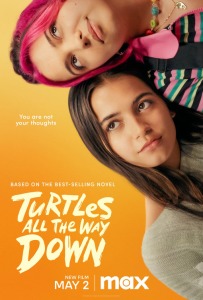
Based on best-selling YA author John Green’s 2017 novel, Turtles All the Way Down is a very accessible and very affecting glimpse at living with mental illness, obsessive compulsive disorder, and intrusive thoughts. Aza (Isabela Merced) has an overwhelming inner monologue that sabotages her daily life in high school and carries her along anxious thought diversions, constantly relating to some illness growing inside her that she needs to cleanse. This is the crux of the story, along with her relationship with her super eager best friend. There’s a romantic side plot where she helps out a rich classmate whose billionaire dad has gone missing, which feels like a plot device to necessitate the two characters spending time together. The standout aspect of this adaptation by writer/director Hannah Marks (Don’t Make Me Go) is its unsparing and honest yet hopeful depiction of mental health and intrusive thoughts. Merced (Dora and the Lost City of Gold, Madame Web) is excellent and deeply empathetic as this woman held hostage by her wayward thoughts and impulses. It’s a performance that goes beyond easy depictions of aloof detachment or exaggerated histrionics, shedding any acting techniques that are too mannered or attention-seeking. Marks’ direction helps reflect Aza’s troubled mind with rapid insert edits and voice over to communicate the intrusive thoughts and maelstrom of spiraling negative emotions. If you’re a fan of Green’s popular novels, or YA-themed literature, or even just honest attempts to empathize with teens in turmoil, then Turtles All the Way Down is worth battling through any negative thoughts to finish and relish the journey.
Nate’s Grades:
The Idea of You: B
Turtles All the Way Down: B+
Share this:

The Butterfly Effect (2004) [Review Re-View]
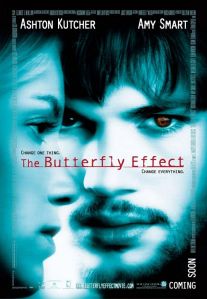 Originally released January 23, 2004:
Notice: I found Ashton Kutcher, star of The Butterfly Effect, on a trip to buy dog food, and cordially asked him to write a review. This is what he sent me. It’’s totally him. I wouldn’’t make this stuff up. That would be dumb.
“So, like, this Nate guy asked me to do a review of my new awesomest movie, The Butterfly Effect. Dude, like anyone needs a review for the most awesomest movie ever. I mean, like, the term ‘awesomest movie ever’ should say, like, everything. The only thing possibly more awesome than The Butterfly Effect would be trucker hats …… or two chicks totally making out. And I only said ‘possibly more awesome,’ which doesn’’t mean it is more awesome, because, dude, like I said before, The Butterfly Effect is the most awesomest thing ever. You can’t dispute that. Don’t even try. I’m awesome!
Like, the story goes like this, man. I play this guy, like I know big stretch there, but he’s not the most awesome guy ever, which is what you’d be thinking since it’s the most awesomest movie ever. But no, he’s like this kid who blacks out and has this wickedly twisted childhood where he stars in his neighbor’s kiddie porn, has his dog set on fire, and, like, his dad is all crazy, or, like I like to say, insane in the ole’ membrane. Ha, I totally made that up right now. I’m awesome!
So, you’re like saying, ‘Dude, that movie sounds less than awesome. Yes, sir, I am having definite doubts about the awesomeness of this movie. Like, do I need to go to the movies to, like, feel bad? I got my parents to do that for me. That and school.’ Hey man, I’m there, I know what you feel. ‘Cause right when you are like, ‘Dude, when is Demi gonna’ show up playing his mom?’ I find these old journals of mine and, dude, use them to travel back in time. I know, the awesomeness has returned. And I use the journals to go back and try and punk time, man. I try and make things better and change the future but I like totally just make it worse. I know, double punk’d, man! I try and fix the life of this hot girl in the movie (she showed her boobs in that Road Trip movie, did you see that? That part where she shows her boobs, oh man … It is awesome) but things don’’t work out. Like she becomes a crack ho at one point. Dude, total punk’d. I’m awesome!
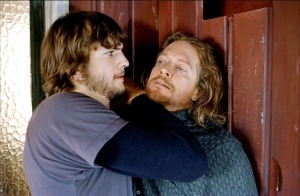 I should be taken as a serious actor. I didn’t hit my head on something and I grew a beard, what more do people need to know I got the goods? I mean, I don’t want to keep saying it but …… beard. C’mon! When actors want to be taken seriously they, like, grow beards. That’s why all those people in movies before 1970 (I know, it surprised me too that there were older movies) got awards and stuff. Beards, dude. Beards. When Billy Dee Shakespeare, like, invented acting, he totally imagined dudes, and chicks too, with beards. That’s why girls can’t be taken as serious actors, ‘cause they can’t grow beards. Ha. I’m awesome!
So, like, if you ever wondered what it would be like to see me, Ashton Kutcher, the most awesome man alive …who ever lived, no… the most awesome human being …-the most awesome thing …- ever, as a frat boy, or like, some poor dude with no arms, then you should see my new movie, The Butterfly Effect. After all, it is the most awesomest thing ever. That’s awesome. So, like, you people reading (is that what school is for?) should go see my movie. I’ll tell you why in two words: beard.”
Nate’s Grade: C+
——————————————————
WRITER REFLECTIONS 20 YEARS LATER
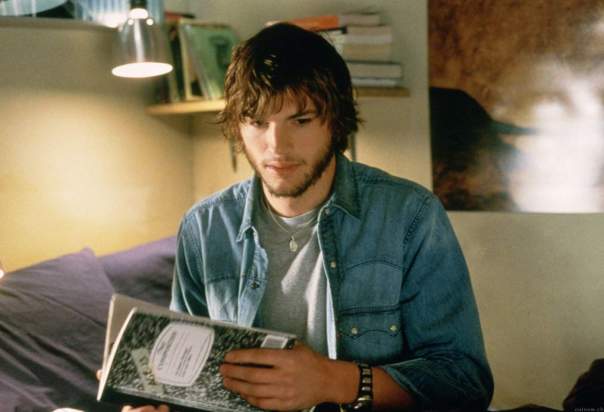
It’s hard to remember but there was a time where Ashton Kutcher was the king of the early 2000s universe. He had parlayed his excitable supporting character on a late 90s network sitcom into a successful movie career top-lining wild comedies, and he had also found success as a producer, bringing new life to the hidden camera prank TV show with his eponymous Punk’d where many of his celebrity friends would be victimized for the lols. The man even single handedly made goofy trucker hats a fashion mainstay. I know we haven’t seen much of the Kutch in a while, as he’s settled into his non-profit charities and being a family man, ceding the spotlight to his wife and former sitcom girlfriend, Mila Kunis. The Kutcher brand was stronger than ever at the time of The Butterfly Effect, enough so that Kutcher signing on as an executive producer was what finally got this widely read industry script to finally get made. You must view The Butterfly Effect as a point not just in Kutcher’s career but also in millennial edge-lord culture, the concept that anything dark is therefore compelling, and the more twisted the better. Re-watching the movie twenty years later, I wanted to laugh out loud at so many points because The Butterfly Effect is so serious while being so silly as it plumbs every depth of misery, both for its characters as well as any potential audience members still keeping track of the messy metaphysics.
Kutcher plays the adult version of Evan, a kid who has had quite a challenging upbringing to put it mildly. Mom (Melora Walters) is doing her best while Evan’s father is locked away in a mental asylum, and she’s worried her child might have inherited dad’s instability. He blacks out for extended periods and is found holding a knife or having drawn a horrible massacre at school, and even worse neighborhood tragedies (oh, I’ll get to all of them). A psychiatrist advises him to start journaling as a therapeutic means, and so he does, and when adult Evan reads his childhood journals, the words become blurry and he’s able to travel back in time to those exact moments. With this great power, adult Evan tries to right the wrongs of his life and those around him, but as all time travel stories are destined to discover, there are cruel unintended consequences to endure.
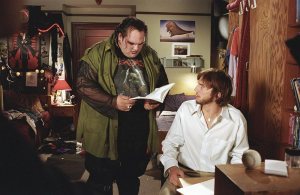 Watching this movie is like watching a checklist of events that producers thought would be dark and grisly and So Messed Up, but this movie is so self-serious that it could be a parody of what a moody teenager would think of as a “mature movie.” Let me just list some of the content the movie covers: the drunken dad next door (Eric Stoltz) is a pedophile who records his daughter and son and Evan in child porn, the kids put a firecracker in a mailbox that blows up killing a mother and her baby, an angry kid kidnaps Evan’s dog and ties him in a bag and literally sets the bag on fire killing the animal, lots of violence against young children including murder, attempted suicide, disturbing behavior in children including traumatic self-harm at school, prison rape, multiple mental asylums, disfigurement and disability, prostitution and addiction, and in the original ending, the one I re-watched, a fetus literally strangling itself with its own umbilical cord rather than being born. Wow. Just… wow. This movie is only two hours and it crams enough sundry melodrama and grimdark grist to fill out a month of the grimiest soap opera ever. Because of the sheer amount of disturbing content, every new provocative addition makes the movie’s tone teeter further and further into unintended self-parody. Once you’re starting to process the homegrown child pornographer, the movie throws animal cruelty at you, and so on. It’s not enough that Evan had a bad childhood of trauma, but does he have to experience all the traumas?
Much of the movie follows Evan’s morose quest to improve the life of his unrequited love, Kayleigh (Amy Smart as the adult version). He runs into her after several years apart and merely bringing up the past with her pedophile father filming the two of them propels her to kill herself off-screen. She’s literally introduced in one scene and then in the next she’s dead, and it’s all Evan’s fault, so says her angry brother via the answering machine clunkily informing us. Evan goes back and stops her dad from molesting her, so now dad only molests her brother Tommy instead, who Evan kills as an adult defending himself. He travels back in time and now her brother is dead and she’s become a heroin-addicted hooker and that won’t do. He travels back again and manages to improve the lives of Kayleigh, Tommy, and their friend Lenny, except in this timeline Lenny and Kayeligh are the romantic couple and Evan has no arms, having lost them in the childhood mailbox explosion. He travels back again and this time Kayleigh gets blown up as a child. Ultimately Evan concludes he cannot save her and have everything he wants, so he makes some form of sacrifice by the end; in the theatrical cut, young Evan upsets her so she chooses to live with her mother rather than her pedophile father, and in the director’s cut, he ensures Kayleigh will never meet him by killing himself in the womb (his mother reveals she’s had multiple miscarriages, leaving the impression other future siblings have done the same). I appreciate how the filmmakers have streamlined their convoluted time travel tale into a simple task of trying to get the girl, but it also becomes so overwrought that I wanted to shake my head and sigh.
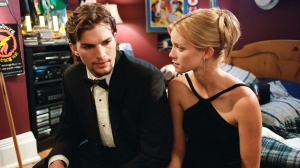 These characters are put through an emotional and often physical grinder, so it’s hard not to feel sorry for them. I long felt the film’s contempt for Kayleigh ever since young Evan (a young Logan Lerman) tells her, “You don’t even know how beautiful you are,” like she’s so stupid to see the obviousness of his compliment. I think dark comedy is the best way to read the movie, laughing along the way as Evan fails time and again to improve the lives of everyone through his space-time interventions. He can save this kid but doom his mother to lung cancer. He can save this person but is locked away in prison. It’s a no-win scenario for Evan, so he decides it’s better if he was never born, negating all the possible good he’s done in his life, including maybe being a force that could keep Kayleight from living with her dad. Maybe not having that friend and an advocate push her into that decision doomed her to a life of molestation, so way to go Evan.
I kind of loathe the time travel method in this movie but at least it provides a limitation that works within the universe of The Butterfly Effect. He can only travel reading his journals, which means he’s stuck in whatever nightmare timeline he’s responsible for unless he can recapture some part of his childhood scribblings. Reading them aloud is also an unexpected source of dark comedy because it makes me question how forthcoming a child of trauma would be about writing down his experiences in simplistic shorthand (“So today Kaleigh wasn’t feeling so good. Her face blew up. I was sad”). I did like that this inherited disorder provides more mystery to his family line, a source of material not covered in either of the Butterfly Effect direct-to-DVD sequels unrelated to Evan’s troubled story. This is perhaps the second worst method of time travel I’ve found in the movies after 1980’s Somewhere in Time where Christopher Reeve uses the power of positive thinking to convince himself he’s in 1912, and lo and behold he shall be.
 Watching this movie is like revisiting a Goth phase you had as a brooding teenager but have since considered a point of embarrassment (not that being Gothic is something to be ashamed of, simply that it was an overzealous step in asserting a misguided sense of what being a mature adult meant, generally disaffected and cynical and edgy for its own attention). The Butterfly Effect is an endless improv game of “yes and” where the proceedings only get worse. My original review in 2004 was one of my more unconventional reviews, and I just wanted to adopt my perception of the “Kutcher brand” persona of the era and make a bunch of dumb jokes, several of which I’m not too ashamed to admit still made me chuckle (“two words: beard.”). I’d lower my grade a tad but there is still a car-crash fascination of watching a movie try so transparently hard to be so twisted.
Re-View Grade: C
Share this:

Empire of Light (2022)
 I was recovering from the flu while watching Empire of Light, which probably hindered my entertainment experience somewhat, but I was astounded at how a movie with this pedigree could be this boring and adrift. It’s directed by Sam Mendes, photographed by Roger Deakins, starring Olivia Colman and Colin Firth, and it’s all about running a movie theater in England in the early 1980s, so you would expect it to be nostalgic catnip for any cinephile. Not so. For the first hour, it feels more like a series of moments that feel pressed under glass, all the air and life removed in the presentation. It doesn’t work as a celebration of art and the power of movies, though it tries at points. It doesn’t work as a character examination because so many of the characters are kept surface-level, shallow, or boring. Colman is our main character and having an unfulfilling affair with her boss (Firth) and then she starts a friendship with a new, younger co-worker that transforms into its own romance. Given that setup, you would think you would care about their burgeoning relationship, but I didn’t (I was more amused at all the places beside an actual bed that people are seen having sex). That’s because this movie feels so poorly paced and passionless. Colman gets her showdown with her bad boss and I thought, “Well, we’re wrapping things up,” and then I discovered that, amazingly, there was still 50 minutes left. “How?!” I shouted at my TV screen. Ah, you see that’s when the movie throws out a mental illness subplot that feels entirely too late and awkwardly handled to count for much else than a delay tactic. I wish Empire of Light had just been one of those adorable British small-town comedies with oddballs running a movie theater in the past, either leaning into it as a workplace comedy or a romantic ode to cinema. It’s a lot of missed potential and middling artistic elements without a clear vision to steer them. There are moments that stand out, especially the racist ones, but it’s a too-long movie missing interesting characters and an accessible and engaging story that exists beyond the (assumed) ephemeral memory of Mendes.
Nate’s Grade: C
Share this:

Blonde (2022)
 After receiving such blistering and excoriating responses, I went into writer/director Andrew Dominik’s Blonde with great trepidation. The near-three-hour biopic on the iconic Marilyn Monroe, played by Ana de Armas, is the first movie to earn an NC-17 rating since 2011’s Killer Joe, and as such, there’s a natural curiosity factor to any movie receiving such hostile reactions. Fans and critics have called the movie exploitative, navel-gazing, misogynistic, and redundant misery porn. One critic even said Blonde was “the worst movie Netflix has ever made.” I was a major fan of Dominik’s verbosely titled 2007 film, The Assassination of Jesse James by the Coward Robert Ford, and less so 2012’s Killing Them Softly, though I recognized sparing artistic merit. It’s been ten years since Dominik has directed a movie, so surely Blonde, based upon the novel by Joyce Carol Oates, had to have some merit beyond all its hype and criticism, right? Well, no. I processed my general disgust for Dominik’s three-hour slow-mo car crash. This movie is so stupendously misguided and cruel and filled with bizarre, outlandish, and maddening artistic decisions. For my movie review, I felt I needed to break my standard formula, so I decided to give voice to my analysis and criticisms by writing a pretend conversation between Dominik and a stand-in for the Netflix production. Enjoy, dear reader, and beware.
Andrew Dominick sits in front of the desk of a very concerned Netflix Producer, who fidgets uncomfortably in his seat and shuffles papers in his hands.
Netflix Producer: So, thanks, Andrew for making time for this meeting. We’ve seen your full movie and we have some… well, concerns.
Andrew Dominik: That’s life, man. You can’t tell stories without risk. Break a few eggs.
Netflix Producer: Yes, sure, but, well, I guess one of our biggest questions is why did you need almost three hours to devote entirely to the lengthy suffering of Marilyn Monroe? This is supposed to be a biopic, but all we get, scene after scene, to a fault, is a moment of Marilyn being abused, or crying, or being generally exploited. It’s… a lot to take in, Andrew.
 Andrew Dominik: Hey man, that was her life. She was this glamorous star, but behind the glamor is a lot more dirt and grime. Everyone wanted to be her, and I wanted to show the world how wrong that would be. This is a woman who was desired by the world and she was still a victim in the Old Hollywood system, which was a rape factory. I was just being honest, man.
Netflix Producer: I get that principle, but it really feels like the only version of Marilyn we get in this movie is the role of a long-suffering victim. It’s practically a passion play: The Passion of Marilyn Monroe. You’re cheapening her real-life suffering by making it so redundant to the point of self-parody, and also, if you were so concerned about creating an honest portrayal of what this woman went through, then why are you also making things up to add to her legitimate suffering?
Andrew Dominik: What d’ya mean? I adapted the book.
Netflix Producer: Yes, but you do know that Oates’ book is explicitly fictitious, right? It’s made up. Marilyn never had a throuple relationship with Charlie Chaplain Jr. and Edward G Robinson Jr. Marilyn had a positive relationship with her mother. Even worse, you’re adding fictitious suffering, like her relationship with her mother, or Marilyn being raped during an audition.
Andrew Dominik: Yeah, that might never have happened, but the rape represents the-
Netflix Producer: I’m gonna stop you there. You should refrain from sentences that include the phrase, “The rape represents [blank].” We don’t need literal sexual violence, of which we return to time and again, to stand in for a larger thematic message. Also, it’s quite disingenuous to add extra traumatic experiences when you’re purporting to tell this woman’s real trauma and conflict.
Andrew Dominik: Agree to disagree, then.
Netflix Producer: No, not really, but, okay, Andrew, can you tell me any personable impression you get of Marilyn from this movie? And-and you cannot say “victim.”
 Andrew Dominik: She was…….
Netflix Producer: …Yes?
Andrew Dominik: Sexy?
Netflix Producer: Okay, sex symbol for nearly 60 years after her death, sure. What else?
Andrew Dominik: She was…. Um…. Uh… Can I look this up on my phone?
Netflix Producer: See, Andrew, this is our problem-
Andrew Dominik: Oh, she has daddy issues! There. That.
Netflix Producer: And for an hour you have her referring to all the men in her life as “daddy,” which is very uncomfortable especially when those men are literally abusing her.
Andrew Dominik: But, y’see, she calls ‘em all “daddy” because she has-
Netflix Producer: Oh, we get it. Thank you. You have 160 minutes and you keep hitting the same point over and over, bludgeoning the viewer into submission. It’s more than a bit gratuitous, especially when you factor that you’re adding even more trauma.
Andrew Dominik: What d’ya mean by “gratuitous?”
Netflix Producer: I have prepared several examples. For starters, it might be a bit much within the first twenty minutes of your movie to subject your audience to a mother trying to drown her child in the bathtub and Marilyn being sexually assaulted at one of her first auditions.
Andrew Dominik: Okay. Okay. I get that.
Netflix Producer: Then there’s the ghastly POV shot from inside Marilyn’s vagina, which by God happens twice, and both times it’s during forced abortions. Did we really need that queasy angle that is literally invading her body against her will to accomplish what exactly?
Andrew Dominik: The purpose of any true artist is to go deeper-
 Netflix Producer: I’m gonna stop you there again. It’s just bad taste, Andrew. Also, speaking of bad taste, maybe we don’t need the entire sequence where JFK rapes her and then hires government goons to abduct her and force Marilyn into an abortion. And then, on top of all that, she hears the pleas of her first aborted fetus calling back to her. Yikes. Can you at any point step outside of your position, Andrew, and realize how shockingly gratuitous all of that can be?
Andrew Dominik: It’s all designed to separate the person from the icon. Marilyn Monroe never really existed beyond the fantasies of the public, man. It’s about bringing back her humanity.
Netflix Producer: Separating the legend from the person would be a natural artistic angle, but that means spending time establishing the person, building her up through multiple dimensions, multiple opportunities to flesh her out. You only spend time seeing her as a victim, that is when we’re not meant to partake in the same sexualization of her that you seem to be criticizing. I mean the 1996 HBO TV movie managed by having two different actresses portray her, with Naomi Judd as Norma Jean and Mira Sorvino as Marilyn. That literalized the differences and even had Marilyn converse with her former persona as a plot device. You have none of that.
Andrew Dominik: I might not have that, but my movie has a cross dissolve that goes from Marilyn getting banged to the literal crest line of Niagara Falls.
Netflix Producer: I don’t think that really makes up for a lack of character substance.
Andrew Dominik: Agree to disagree, man.
Netflix Producer: You really can’t keep using that as a defense.
Andrew Dominik: Agree to disagree, man.
Netflix Producer: Your horror show of relentless trauma and bad taste might undercut your stated goal of humanizing this woman. She’s not a character but a symbol of abject suffering, a martyr, and you increase her suffering, and sometimes in grating, absurdly grotesque ways. Do you even care about this woman? You’ve devoted three hours to reanimating her as a powerless punching bag.
Andrew Dominik: Well, I did say Gentlemen Prefer Blondes is about “well-dressed whores” and that Blonde is “just another movie about Marilyn Monroe. And there will be others.” I also said that the most important part of her life was that she killed herself.
 Netflix Producer: Exactly. That makes us question whether you have the passion and sensitivity for this project. Why does this movie even have to be NC-17? Will your three hour torture chamber be bereft of meaning if the audience doesn’t see two inner vaginal camera angles?
Andrew Dominik: How dare you even question my artistic integrity. If you remove those shots, you might as well be removing the soul of this movie. Why even tell this story?
Netflix Producer: Yes, why indeed?
Andrew Dominik: It’s meant to be disorienting.
Netflix Producer: Congrats.
The Netflix producer leans back in his chair and releases an extended, wearying sigh.
Andrew Dominik: So… after everything…. Are you going to make me cut anything?
Netflix Producer: Please. We’re so hungry for Oscar recognition, we don’t care. Go for it.
I want to cite de Armas’ (The Gray Man) performance as one of the few attributes to the movie. It’s hard to watch this woman suffer and cry in literally every scene, but I also just felt so sad for not just her character but for de Armas as an actress herself. She shouldn’t have to endure everything that she does to play this character. She is undercut by Dominik’s artistic antics and avarice at every turn, like the story jumping around incoherently so every scene fails to build upon one another. There is no genuine character exploration to be found here. It’s a cycle of suffering, and the movie wants to rub your nose in the exploitation of Monroe while simultaneously exploiting her. De Armas deserves better. Marilyn Monroe deserves better. Every viewer deserves better. Spare yourself three awful hours of pointless suffering in the name of misapplied art.
Nate’s Grade: F
Share this:

Secretary (2002) [Review Re-View]

Originally released September 20, 2002:
Secretary is a new romantic comedy with a few kinks to it. It’s actually the most romantic S&M movie ever. It’s the first S&M romantic comedy since maybe Garry Marshall’s disastrous 1994 Exit to Eden. I’m still trying to get the image of Rosie O’Donnell in a bondage mask out of my ongoing nightmares.
Lee Halloway (Maggie Gyllenhaal) is fresh from a stop at a mental institution for her hazardous habit of cutting herself to feel relief. Her overbearing mother stashes the entire kitchen cutlery in a locked cabinet. The sheltered Lee resorts back to a kiddy make-up box stashed under her home bed. Instead of colorful brushes and arrays of lipstick, she has a selection of sharp objects. Lee goes job hunting to step back from her habit, and is hired as a secretary to E. Edward Gray (James Spader). He is a rigid taskmaster who delights in pointing out typographical errors with his red marker, his weapon of choice. Gray enjoys his dominance and Lee complies, even if it’s routing through garbage. He ticks away Lee’s flaws like a checklist of annoyance but also appears to have genuine concern for her. When he notices her wounds Gray confronts her and convinces Lee to stop cutting herself.
The turning point arrives when Gray orders Lee into his office one afternoon. He commands her to bend over his desk and then delivers a sound spanking. Lee stares at her purple rump with fascination, like something has been awakened inside her. Soon enough Lee purposely makes typos so she can re-assume her spanking position.
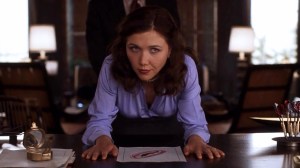 Maggie Gyllenhaal is a cinematic find with a fearless and breathtaking performance that is at once delicate, nervous, self-controlled, seductive and delightful. Gyllenhaal, with her heart-like face and pert lips, radiates star quality. She allows the audience into Lee”s head and we quickly fall in love with this peculiar yet charming heroine. If there is any justice in this world Gyllenhaal should at least get an Oscar nomination (she didn’t). Spader can do this left-of-center creepy character stuff in his sleep.
Secretary on the surface may seem like a fetish flick but it’s no different than boy (sadist) meets girl (masochist) and falls in love. Director Steven Shainberg treads carefully around serious subject matter, like Lee’s self-mutilation, to focus on these two very special characters. Secretary isn’t making any loud statements on sadomasochism or post-feminism, it’s just showing us that S&M is the route these two people take to find true love. It doesn’t judge them for their unconventional tastes and neither should we. This is one of the finest romances in recent memory and it seems to come from one of the most unlikely places.
Sadomasochism has been predominantly shown involving pain or some leather-masked madman evoking torture. Secretary may be the film that shows there can be pleasures with pain. Some people regard what Lee and Edward do as sick, perverted, or downright wrong. Secretary is a foot in the door to get people to understand what willing sadomasochism really is about. We all have fetishes and interests, and S&M is the number one fetish truth be told. This isn’t your everyday romance.
Obviously, this is a movie that will not appeal to everyone. The relationship between our leads is surprisingly complex but gentle and even sweet (if that’s the proper word for an S&M romantic comedy). Secretary shows that it truly takes different strokes and, despite an overly silly ending, is the most pleasing romance of the year. You’ll never look at red felt pens the same.
Nate’s Grade: A
——————————————————
WRITER REFLECTIONS 20 YEARS LATER

I’ll be honest with you, dear reader, because I think you deserve that. I didn’t recently re-watch Secretary. I did re-watch it a year or two ago, and the return experience was so jarring that I didn’t feel that I would greatly benefit from watching it so soon again, but I knew I would have to include it on my 2002 re-watch list when it was time. When I first watched it in 2002, I was smitten with its offbeat charms about an unconventional romance through the BDSM community and a young woman’s self-actualization through accepting her kinks. It was a star-making performance from Maggie Gyllenhaal (originally was going to be Gwyneth Paltrow) and as a sucker for quirky romances, it was one of my favorite films of the year. Nearly two decades later, I took out my DVD copy to share with my now fiancé, who is also a fan of quirky romances and who had never watched Secretary. Surely, I thought, she would be entertained. Dear reader, she was very not entertained. She was horrified. She was shaking with disgust. She was having a literal violent reaction to the movie and its onscreen display of what constituted romance, and I will say it struck me differently too. I understand that not every film will age well, as our sense of what is funny or acceptable or what is even compelling will change over time as our culture inevitably shifts. That’s art. But hoo boy has Secretary aged about as well as milk in the ensuing twenty years.
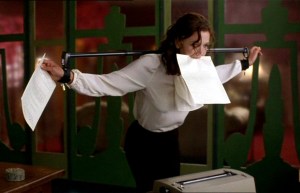 The very nature of the S&M relationship between boss and secretary was already problematic when it was released in 2002, but in a post-Me Too universe it is inexcusable and taints any charms the movie may have had. Mr. Grey (James Spader), the dominant boss and rigid stickler for rules, is the villain of the movie and not its Byronic hero, the brooding and damaged man that a pure-hearted woman just needs to find a magical way to reach and reform. He is not romantic. He is appalling, and the early critical praise, myself included, excused far too much of his behavior. While not condoning his excesses, critics may have given more leeway because the end result was framed as a happy ending, with Lee (Gyllenhaal) being cared for by Mr. Grey. However, he completely uses his position of authority in many inappropriate manners, and while they do develop a mutual relationship, eventually, the power dynamic is not equal at all. This takes away the agency of Lee and makes the romance feel like a false choice. Much of her relationship can be summarized by the awful moment he ejaculates on her back: she just has to take whatever he dishes and like it. That’s not romantic. That’s not cute. That’s toxic. It also hurts the overall movie that the way Lee proves her devotion as the film’s climax is to stay fixed at her boss’ desk for many days, to the detriment of her physical health. Yes, Mr. Grey gets Lee to kick her habit of self-harming but she replaces one need with another. He resembles a predator by most every definition, and to try and say, “Well, he’s just complicated,” is bad man excuse-making.
I tried imagining tweaks and alterations that could make this all work, but anything where he is her boss muddies the issue of consent. Maybe if he was a visiting businessman, but that would also offer a questionable dynamic. The core of Secretary is built upon the secretary/boss interplay and imagery. The tagline is, “Assume the position,” and depending upon the poster, you might only get a woman’s rear in fishnets as the sole imagery. Director Steven Shainberg (Fur) and screenwriter Erin Cressida Wilson (Chloe, The Girl on the Train) are clearly veering into the obvious office power dynamics for provocation. They are very intentional about subverting romantic clichés and looking for something different for our heroine. We have a nice guy, played with squirmy energy by Jeremy Davies, who just won’t cut it. He’s too vanilla for her and afraid to be too forceful in his spanking. It’s like the filmmakers are declaring that Lee demands more, and her specific combination of qualities just so happens to align with this gross man. The movie wants us to hold our judgment, and I could in 2002 in a “love is love” declaration, but what I see on-screen in 2022 is not indicative of love. It’s obsession. It’s codependency. It’s sad.
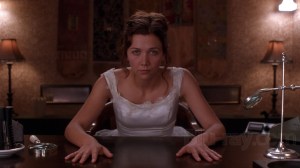 The other problem, sadly, is Maggie Gyllenhaal’s fragile performance. The choices she makes collapse Lee, greatly infantilizing her and magnifying all the icky feelings I had. She’s playing Lee less like an adult woman who is struggling to figure out her confusing life, and impulses, and more like a teenager who woke up in the body of an adult woman. Part of this is the screenplay but it’s not helped by the acting choices that Gyllenhaal engages with. I do really enjoy her as an actress, and it’s easy to see why she could captivate so many circa 2002 with this performance, but it plays so differently now. Today, she comes across as another young woman trying to remodel herself to please a man. Her little girl acting choices only make the courtship feel even more abhorrent. I wonder if they were trying to aim for the movie to be its own kinky fable, wherein the infantilization would harken back to older fairy tale tropes and Mr. Grey as the unorthodox knight in shining armor.
This is one of the biggest critical swings I’ve had since re-watching twenty-year-old movies and my initial reviews, and I’d say even one of my biggest changes on any movie I’ve watched. I do think you can make a funny and sexy S&M rom-com; for years I thought Secretary was it. Not so. I wouldn’t even recommend this movie and it used to be in my top of 2002. I suppose people who are curious could give it a chance, but I think the objections outweigh whatever positives can be gained from viewing. Oh well. That’s the nature of art. Not every movie or book or song will have the same power over time. They stay the same but we, the prism upon which art is judged and related, are constantly in flux. That’s just the way it is. This won’t be the last movie where my opinion changes dramatically. I just won’t watch Secretary again, and that’s okay.
And you’ll never be able to convince me that E.L. James didn’t take her BDSM character’s name from this film.
Re-View Grade: D
Share this:

Kimi (2022)
 Part COVID character study, part Blow Out murder conspiracy, and part corporate thriller, Kimi is a lean 90-minute thriller that doesn’t overstay its welcome even as it’s constantly morphing. Kimi is the Siri./Alexa-esque personal A.I. assistant device found in millions of consumer homes. Angela (Zoe Kravitz) is an agoraphobic Seattle tech worker who clears the Kimi user problems, and one day she overhears a recording of a woman being murdered, the same woman who accuses the Kimi CEO of assault. The first half of the movie is establishing the crippling anxiety and welcomed routines for Angela as well as the geography of her home, a point that will be more important in the final act. Kravitz is good but too much time is spent analyzing the captured audio and getting her ready to leave. From there, she ventures outside to report the crime, and that’s when powerful people try and abduct or kill her. The movie is brisk and has a constant nervous energy to it, never better than when Angela meets with her shady corporate HR rep (Rita Wilson). However, these killer corporate goons committing don’t seem as scary efficient like in Michael Clayton, so mundanely proficient at ending lives. These guys are more bumbling goons, which takes some of the threat away, though I still relished Angela getting the better of her attackers. For so much buildup about Angela’s terror of the outside world, I was expecting more obstacles relating to her personal agoraphobic fears, but these concerns are dropped too easily once she’s running away from scary bad guys. It’s a thriller that doesn’t exactly transcend its influences and inspirations, but there should still be room for well-made, derivative B-movie thrillers that still know how to entertain. Director Steven Soderbergh and writer David Koepp are genre veterans so even a lesser effort will be effortlessly better than most. Kimi is a narrow but enjoyable thriller that had some room for improvement but still satisfies.
Nate’s Grade: B
Share this:

Scream 5 (2022)
 The fun of the Scream franchise has been its meta-textual commentary, wry jabs at horror, and the guessing game of who the killer culprit(s) could be, and Scream 5 or Scr5am (what it SHOULD be called) is a good-fun B-movie that knows precisely what it wants to be and plays to the strengths of the franchise. We haven’t had a Scream sequel since 2011, and the landscape of horror has changed as well as the landscape of multi-media entertainment. There are new satirical horizons to be targeted. This is the first Scream after the death of legendary horror director Wes Craven, but it’s in good hands with the directors and writer of 2019’s bloody excellent Ready or Not. The fun, knowingly goofy elements are retained, and the filmmakers clearly have love for what they’re sending up. There’s a sequence of languishing shots of a character opening fridge doors and pantry doors and I felt everyone in my theater tense for the eventual reveal of the killer on the other side. Moments like these are the good kind of tension-release giggle that Scream can get away with. The plot is sufficient to gather the “legacy characters” back to the site of the original murders for a new stab at rewriting the movie franchise. There’s even some plot elements that are surprisingly resonant and deeper for a satirical slasher franchise, like tear-filled discussions over loss, abandonment, mental illness, and personal responsibility. There’s a sister-to-sister reconciliation that plays like a straight drama, and it plays well. There’s nothing terribly gruesome or memorable about the kills, and some of the meta-commentary can feel like talking in circles, especially as characters knowingly enact scenes from the original. It’s a copy of a copy, meant to mock Hollywood’s reboots, but it’s still a copy of a copy. Sometimes the knowing winks are obvious, like a shower sequence recreating Hitchcock’s angles, and sometimes the potential homage feels lost in translation. Still, Scream 5 is a fun, ironic, bloody hoot of a movie, and for fans of the franchise a more welcomed return to the creative heights of the original movie.
Nate’s Grade: B
Share this:

Donnie Darko (2001) [Review Re-View]
 Originally released October 26, 2001:
Donnie Darko (Jake Gyllenhaal) is your normal malcontent teenager in late 1980s Reagan America. He bickers with his older sister, worries over the right moment he’ll kiss his new girlfriend, and tries to ignore the advice of many imprudent adults. Donnie’s your typical teenager, except for his imaginary friend Frank. Frank is a sinister looking six-foot tall rabbit that encourages Donnie into mischief and gives a countdown to the impending apocalypse. And I haven’t even gotten to the time travel yet.
One night as Donnie wanders from his home at the behest of Frank, an airline engine mysteriously crashes through the Darko home and lands directly in Donnie’s room. The airlines are all at a loss for explanation, as it seems no one will take responsibility for the engine or knows where it came from. Donnie becomes a mild celebrity at school and initiates a relationship with a new girl, Gretchen Ross (Jena Malone). One of his classes consists of watching videos of self-help guru and new age enlightenment pitchman Jim Cunningham (Patrick Swayze). His school has even, under the persistence of self-righteous pain Kitty Farmer, persuaded Cunningham to speak and try to help students conquer their “fears.”
 Donnie is also seeing a therapist for his emotional problems and taking medication for borderline schizophrenia. Around this time is when Donnie starts to inquire about a strange old woman, obsess over the possibilities of time travel, as well as see weird phosphorescent pools extend from people’s chests. He also floods his school at the urging of Frank. This is no Harvey-type rabbit.
The longer Donnie Darko goes on the more tightly complex and imaginative the story gets. First time writer-director Richard Kelly has forged an excitingly original film that is incredibly engaging with charm and wit. He masterfully mixes themes of alienation, dark comedy, romance, science fiction, and a sublime satire of high school. Donnie Darko is the most unique, head-trip of a movie unleashed on the public since Being John Malkovich. Kelly has a created an astonishing breakthrough for himself and has ensured he is a talent to look out for in the future.
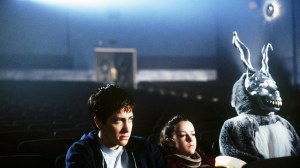 Gyllenhaal (October Sky) is superb as disenchanted Donnie, a Holden Caulfield for middle suburbia. His ghastly stare conveys the darkness of Donnie but his laid-back nature allows the audience to care about what could have merely been another angst-ridden teenager. Swayze is hysterical as the scenery-chewing Cunningham. The rest of the cast is mainly underwritten in their roles, including stars Drew Barrymore (who was executive producer) and ER‘s Noah Wyle, but all perform admirably with the amount they are given. Not every plot thread is exactly tidied up but this can easily be forgiven.
Donnie Darko is a film that demands your intelligence and requires you to stay on your toes, so you can forget any bathroom breaks. The film is one of the best of 2001 but also one of the funniest. You’ll be honestly surprised the amount of times you laugh out loud with this flick. The theater I saw this in erupted every half a minute or so with boisterous laughter.
Donnie Darko is a film of daring skill and great imagination. You don’t see too many of these around anymore.
Nate’s Grade: A
——————————————————
WRITER REFLECTIONS 20 YEARS LATER
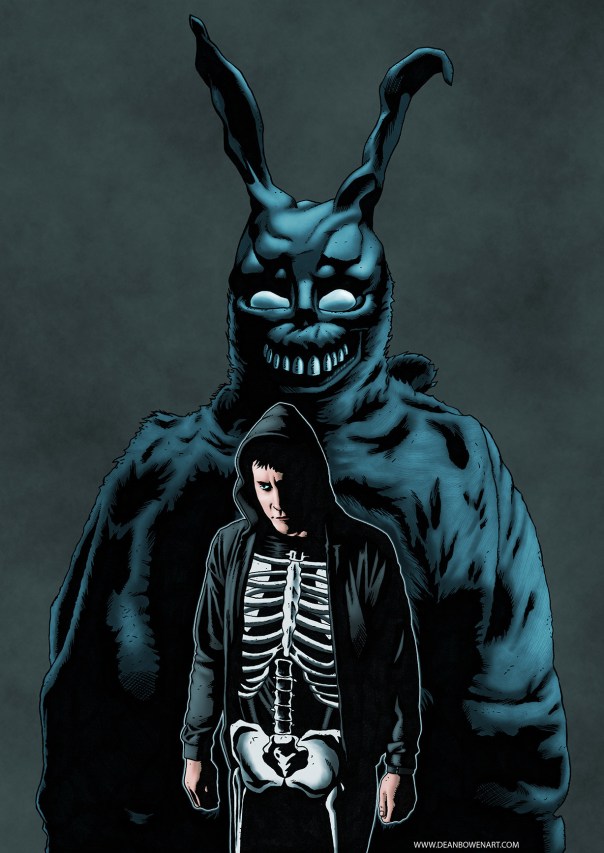
Not to sound too annoying, but I’ll cash in my hipster points here and declare that I was on the Donnie Darko bandwagon from the start. The eventual cult phenom was originally released in October 2001, mere weeks removed from 9/11, dooming its commercial appeal considering a major plot point happens to involve deadly airline debris. I was a sophomore in college across from a little indie movie theater, the Drexel, that was like a wonderful escape for a budding cinephile looking for his next fix of weird and daring movie experiences. I recall seeing the trailer for Donnie Darko and being immediately intrigued, but its release date kept bouncing back month after month until it finally opened at the Drexel in February 2002, and I was there opening day. I saw it twice, brought friends with me, and I wrote about it as one of my earliest reviews as my college newspaper’s film critic. I wanted to get the word out that this was something special. The first day it was available on DVD, I went to Best Buy looking for a copy and the store employee was deeply confused about its existence. He probably knows now, as the movie achieved cult status on DVD and became an iconic indie fixture for many a Millennial.
Revisiting the films of 2001 has been reliving many films that made such formative impacts on my life: Memento and its airtight structural sleight-of-hand, Moulin Rouge and its ambitious and messy celebration of old, new, reverent and irreverent, and now Donnie Darko (this isn’t even counting films I never wrote reviews for and thus were ineligible for this re-watch, like Hedwig and the Angry Inch and Amelie – 2001 was an excellent year at the movies). I have probably watched this movie more than any other in the 2000s, with the late exception perhaps of The Room that came on strong for me at the end. My friends and I would debate it, quote it, and work toward bringing others into the cult of Darko. Looking back now twenty years, I’m happy to report the movie’s power is still just as alluring and transcendental. What earned this movie its fawning fandom? Why did writer/director Richard Kelly, only in his early 20s, find success with his weird little indie while others went painfully ignored? I think it comes down to Kelly’s ambiguous approach, threading a delicate needle so that there are enough pieces present to put together an interpretation that can prove satisfying while personal and potentially different from your friend or neighbor with an equally valid interpretation.
 What helps is that Donnie Darko doesn’t feel like it’s weird for weird’s sake, like a formless collection of strange ideas and confounding imagery operating on an unknowable surreal dream logic. What Kelly has done is mix and match parts of an intriguing apocalyptic puzzle. There’s relatable high school drama about pushing back against the hypocrites and phonies of the adult world, there’s a mystery about who or what is behind Frank the bunny, the creepy otherworldly figure serving as Donnie’s Virgil-like guide, and the character study of a lonely, troubled kid trying to find a better sense of understanding of himself, his place in the world, and his sense of what lies beyond. I could just as readily view Donnie Darko as a spiritual refresher, and I’ve always sided more with a divine interpretation than sci-fi. Donnie and his therapist talk about the question over God’s existence and Donnie says he doesn’t feel like he can get anywhere debating it, so he has simply agreed to give up. Donnie talks about dying alone and how if everyone is resigned to do so then this must be a condemnation of God. Kelly establishes these early conditions as the beginning of an arc that leads to Donnie not just accepting a messianic status but volunteering for one, dying alone but in a manner that serves as victory. This to me is why he laughs at the end after being transported back to a fateful spot. He rolls over in his bed and closes his eyes knowing an end for him is not an end but a vindication (the honking from Frank the second time serving as a “we did it” victory celebration). Through his sacrifice, the world will continue (“I hope when the world comes to an end, I can breathe a sigh of relief, because there will be so much to look forward to.”). Through bizarre circumstances, a young man has found spiritual renewal, bringing him to a personal fulfillment as well as the larger picture of averting a looming apocalypse for a tangent world.
This has been my preferred reading of Donnie Darko, with divine forces selecting Donnie as the universe’s lone hero and mysteriously guiding him along his journey, each intervention and urging from Frank leading to the culmination of events that would convince Donnie of his duty. When Donnie is talking to Frank the bunny in an empty movie theater (playing a double feature of Evil Dead and The Last Temptation of Christ, one of my favorite jokes), he asks Frank, “Why do you wear that stupid bunny suit?” Frank turns and asks, “Why do you wear that stupid man suit?” Under my interpretation, Frank is a supernatural force, call it an angel or whatever you want, but he is not human and only using the form of a doomed man as a necessary vessel. When Donnie breaks into his school and breaks the water main, under the hypnotic control of Frank’s urging, we see that the vandal has also spray-painted “They made me do it” on the school mascot. The school and police go class-by-class and have students rewrite the phrase on a chalkboard, analyzing their handwriting. Donnie’s handwriting is clearly different. Could it be that Donnie, under the influence of Frank, also wrote as him, adopting his handwriting? With that, perhaps instead of Donnie writing a would-be confession it was actually Frank. “They made me do it,” Frank writes in apology to Donnie, not just for prodding him along but ultimately for the pain and suffering the real Frank of this world will cause for Donnie. “I’m sorry that all of this has to happen to you, Donnie. It wasn’t my choice. They made me do it for their plan.” I think that’s a more intriguing examination than Donnie just saying he was told to flood the school by his imaginary friend.
 This is one reason why I was not a big fan of Kelly’s eventual director’s cut DVD release in 2004, which added twenty minutes to the film and changed many edits, song choices, and special effects sequences. The director’s cut went too far for me, specifically spelling out Kelly’s vision of time travelers from the future trying to coach Donnie as their variable. Whole sections from Roberta Sparrow’s book, The Philosophy of Time Travel, were printed on screen, explicitly connecting the various pieces in a way that had previously been left as ambiguous. My disappointment with the director’s cut reminded me of the disappointment Star Wars fans felt when George Lucas went back and tinkered with the original trilogy. Lucas has said the re-releases were the films he had always intended them to be, that the earlier theatrical editions were the imperfect versions of his creative intentions. The problem is that millions fell in love with those versions of the movie, even if they were an imperfect vision of their creator. Richard Kelly always intended for the opening song to be INXS’ “Never Tear Us Apart,” but hearing that felt wrong to me after watching the same scene played to Echo and the Bunnyman’s “The Killing Moon” with the theatrical cut. Kelly’s imperfect version was the one I fell in love with, the one that spoke to me as a 19-year-old and as a 39-year-old, and that’s the one I vastly prefer.
Another reason for Donnie Darko’s success is more than likely the appeal and performance of young Jake Gyllenhaal. Over twenty years, Gyllenhaal has become one of the best actors of his generation and criminally overlooked by the Academy. He’s only been nominated for one Oscar for 2005’s Brokeback Mountain, not for 2017’s Stronger, or 2007’s Zodiac, or, most egregiously, for his hypnotically disturbing portrayal in 2014’s Nightcrawler. Gyllenhaal has mesmerized for so long and handles the many confusing aspects of Donnie with aplomb. It would be easy to play Donnie as a cliched rebellious teenager, but Gyllenhaal really digs into his questioning nature; he’s hungry for answers, desperate even, and tired of being disappointed in the adults of his life. That’s why it becomes emotionally satisfying for me when Donnie appears to achieve some semblance of answers by the end, his laughter is victorious and cathartic.
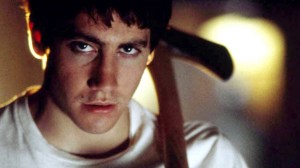 Jake Gyllenhaal is terrific but the rest of the cast is outstanding. This was the first time I saw Maggie Gyllenhaal, as Donnie’s older sister, one year before her star-making turn in 2002’s Secretary (stay tuned, 2022). Jena Malone (The Hunger Games sequels) was a remarkably downhearted presence, able to imbue teenage heartache and unease so preternaturally. Ever since her role as the snitty, judgmental gym teacher Kitty Farmer, I perk up whenever I see Beth Grant in a movie or show. To this day I still consider her wondrous line reading of, “Sometimes I doubt your commitment to Sparkle Motion” to be one of the greatest achievements in mankind’s history. Mary McDonnell (Battlestar Galactica) has two scenes that still get me as Donnie’s mother, where she fights back tears at the suggestion of Donnie’s therapist to up his medication as doing what she thinks is right for her son, and a final scene with that same son where she responds to his query that having a “weirdo for a son” is, in fact, wonderful. The parental care and empathy that she exudes is poignant. I still laugh when Holmes Osborne, as Donnie’s father, cannot contain his inappropriate titter to hearing about his son’s vulgar outburst directed at Ms. Farmer. The adult actors (Drew Barrymore, Patrick Swayze, Noah Wyle) all got the bigger headlines at the time, but it’s these actors that have stayed with me the most.
With so many people being launched into success and acclaim from this movie, it’s a sad surprise that Richard Kelly himself was never able to recreate his winning alchemy. He wrote the shooting draft for 2005’s Domino, a needlessly excessive and irritating movie. His big follow-up, 2008’s Southland Tales, was a disaster at the Cannes Film Festival and Kelly cut a half-hour before it was ultimately released stateside to head-scratching. I was eagerly anticipating Southland Tales and then I watched it and minute-by-minute the sinking realization set in that this was not going anywhere and anytime soon. It was like Kelly was trying to throw every dispirit idea he ever had into one movie for fear he’d never make another. I haven’t re-watched it since and feel no need to do so. The last movie Kelly directed was 2009’s The Box, an adaption of the William Matheson short story featured on newer incarnations of The Twilight Zone. It too failed at the box-office, suffered from a confusing and muddled narrative, and from there Kelly was radioactive to Hollywood. He hasn’t a credit to his name since. With each directorial effort, you can feel Kelly trying to recreate that formula from Darko, bringing the different weird pieces and tones together by the end to form a satisfying mosaic open to interpretation. Southland and The Box both feel over-extended, strained, and cluttered with too much salient junk. I truly wish Kelly has another shot to tell a big screen story after everything he’s been through. I’m sure he has more stories to tickle our brains. Maybe he just needs an editorial guidance.
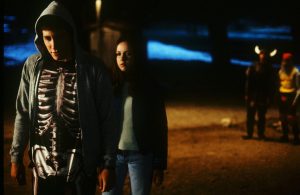 The other thing of curious note is that a sequel, S. Darko, was released in 2009 starring Donnie’s little sister Samantha, played by Daveigh Chase (The Ring). It’s not very good at all and strains to be an imitation of its predecessor, right down to Samantha having to be the sacrifice to go back in time and save her friend’s life. Kelly had nothing to do with the sequel, which was written by Nate Adkins, who would go onto create the Netflix franchise, The Christmas Prince. There is nothing of note in this cash-grab of a sequel to even reward your curiosity in watching it.
Donnie Darko was a movie I loved when I originally saw it and I’m happy so many others were able to become fans and share the good news of Darko. I’m happy this movie exists and has stuck with me all these years. It’s still transporting and invigorating and funny and soulful and tantalizing. I still love the lilt of Michael Andrews’ minimalist score. I love the scene of Donnie reaching out to Cherita Chen, the target of rampant bullying, to promise her one day everything will be better for her. I still get fascinated by the instant-iconic design of that Frank the bunny mask, an image that has lead to thousands of Halloween costume imitations. My original review was more driven by distilling its plot so that I could hook a reader into making the trip for themselves. Otherwise, my thoughts remain relative the same in twenty years of reflection. This is a gem of a movie that was never really recreated by its creator, which makes it all the more remarkable and special. If you haven’t joined the cult of Donnie Darko, there’s no time like the present, folks.
Re-View Grade: A
Share this:

Dear Evan Hansen (2021)
 If you’re unfamiliar with Dear Evan Hansen or do not consider yourself among the fandom of the Tony-wining Broadway musical, then I would highly recommend watching a 2009 movie called World’s Greatest Dad, a film I will be referring to later in this review. It’s a smaller indie starring Robin Williams and written and directed by actor-turned-director Bobcat Goldthwait. It also has a very similar premise of a character exploiting the grief of others to try and better their own personal standing by fabricating an introspective life for a high school student who recently took their own life. The exception is that World’s Greatest Dad played its heavy content for dark comedy and stinging satire and it never excused the behavior of its lead character as he manipulated the collective sympathies of others for personal gain. As I kept watching Dear Evan Hansen, I kept feeling like someone had attempted to make World’s Greatest Dad but played straight and absent the satire, and that was a very bad decision.
Evan Hansen (Ben Platt) is a high school senior and has more anxiety disorders than friends. He starts the school year with cast on his arm, the result of “falling” from a tree. Evan writes motivational letters to himself as a therapeutic exercise for his counselor, but Conner (Colton Ryan) steals the paper at school and freaks out when Evan expresses interest in Conner’s younger sister, Zoe (Kaitlyn Dever). Conner’s only two appearances on screen both involve him shoving, yelling, and threatening Evan. Days later, Conner has taken his life and the only letter his family has found was the “Dear Evan Hansen” paper he snatched away. Conner’s parents (Amy Adams, Danny Pino) are eager to know anything about their emotionally troubled and secretive son. They didn’t know he had any friends let alone one he would compose his suicide note for. Evan doesn’t come clean and instead plays along, happy to provide a false version of their son, one who was bristling with thoughts and compassion he could never properly express. Evan spends more and more time with Zoe, trying to share his own romantic feelings, and getting deeper into his lies.
 This was a deeply uncomfortable experience for me, and I don’t quite understand how fans of the theater show were so moved and uplifted and, frankly, entertained. Maybe all this drama plays better on the stage, though I think many of the same issues I would have with the story would be evidently present for the stage productions as well. The main character is presented as lonely and anxious and depressed and longing to make connections, and this is meant to serve as the emotional explanation for why he leaps at a chance to insert himself into another family and manufacture a false identity about their dead son to score with the girl he’s been crushing on from afar for an indeterminate amount of time. Evan Hansen is, quite simply, a monster of a human being. Through tortured coincidence, he is believed to be Connor’s only friend, and Evan can at any point clarify this mistake and explain the truth. But he chooses instead to supply a fictional version of Connor that he feels every member of his family needs to hear to feel better about themselves. Evan justifies his actions as kind lies, as helping those in mourning by telling them what they want to hear, what he feels like they need. It’s not his place to decide what people need to better grieve, and Evan uses his newly favored position as the rare Rosetta Stone to Conner, the keeper of his secret internal life, to manipulate everyone to like him more.
I felt increasingly uncomfortable and upset the longer Dear Evan Hansen progressed with its treacly story, especially as Evan sets his sights on Zoe. It’s not as if over the course of his mounting lies that he organically grew closer to this woman who had been a stranger; he has been crushing on her and uses fake emails written by her brother to express his unrequited feelings for her in a song that DEFINITELY does not feel like it was written from a brother to a sister unless we’re talking like Game of Thrones territory (“There’s nothing like your smile / Sort of subtle and perfect and real”). Both of those scenarios are bad, but one of them is so much worse, and that’s the route Dear Evan Hansen goes. The romance is gross, and I knew that the movie was going to let Evan off the hook by the end. Once the truth, the real truth comes out, no one should want anything to do with this person. He says he meant well but he’s also the kind of guy who literally uses the fake suicide note, which all the characters believe to be legit, as an emotional cudgel to quiet and shame his biggest doubter as she starts to pick apart his lies. When that moment happened, I wanted to strongly yell at the screen, “Dear Evan Hansen, you dearly suck.”
 There’s a worthy message buried somewhere in this movie about reaching out to people who are struggling in the shadows, that mental illness can affect anyone, and that often those who look like they live perfect lives on the surface might just be better at hiding their pain. This is best exemplified in the supporting character of Alana (Amandla Stenberg), the school president who has a raft of anxieties that she keeps to herself. Her moments of vulnerability feel the most honest in the entire movie, and she’s trying to allow Conner’s death to reach others who might also be struggling, to inspire and save lives through their fledgling organization, The Conner Project. She’s the one who is putting in the actual work, both physical and emotional labor, and she’s the one who Evan shames with the mistaken suicide note toward the end of the movie. The tone of this movie is amiss from early on, and there’s a jaunty musical number where Evan and his one friend comically write fake emails between Evan and Conner. It’s played so light and breezy that you’ll have to recall this is Evan manufacturing the evidence of his fabrications. Why is this played so flippantly and like we’re in on the goofy gag? It’s mishandled. The good intentions Evan Hansen the movie, much like the potential good intentions of Evan Hansen the character, are clouded and ultimately sabotaged by its misguided solipsistic approach to grief.
And it’s taken me this long to talk about another key hindrance and that’s the casting of Platt in the title role. Platt originated the role on Broadway in 2015, and yes he wouldn’t be the first actor in history playing a high schooler who was clearly older, but they have made a gigantic miscalculation in trying to make Platt appear as a youthful 18-year-old (for the record, he was playing a college student almost a decade ago in 2012’s Pitch Perfect). It hit me immediately that Platt does not look right for this role. Immediately. In the awkward attempts to make him more youthful, they have made him look like a shifty undercover cop at a school (“Are you a cop, dear Evan Hansen? You have to tell me if you’re a cop.”). His pasty skin is so smoothed out as to appear like a shiny mask. His hair is oily, stringy, and looks like a terrible wig, except I have read that it is unfortunately real. Evan Hansen looks like he’s wearing a bad hair piece. Platt’s performance also left me cold. His mannered, affectless delivery gave me the impression of a sterile serial killer with every fifth line. This may sound overly harsh, but the presence of Platt and his performance dooms this movie’s bid for believability. I understand wanting to reach out to the man who left his mark on the role early, but there is a reason that Lin-Manuel Miranda played an older supporting role and not the headstrong young lead for the In the Heights movie adaptation earlier this year. Let the movie be its own thing from the stage show. Then again, there’s a rubbernecking fascination with Platt in place, magnifying all the other sins. If there was going to be a bad movie for Dear Evan Hansen, and I question if a good movie was at all possible, then why not go for broke with misapplied creative decisions that make it worse?
 A lone saving grace for this movie is that the music is actually pretty solid. Justin Paul and Benj Pasek, the Oscar-winning team behind La La Land and The Greatest Showman, can craft some catchy melodies with soaring choruses. If you only listen to the music you might come away with a different opinion of this show and movie. However, the context of what these songs are meant to serve in the larger story besmirches the good feelings you may derive from them. I suggest casually listening to the soundtrack and forgetting the icky context of every tune. Julianne Moore, as Evan’s overworked, stressed-out mother, has a nice song toward the very end that feels more honest and pared down than much of the drama allows.
I was re-reading my review of World’s Greatest Dad, an underrated movie that managed to make my top ten of that year. It reads so closely to this movie but also how this story needs to be told: “The movie satirizes grief culture with sharp acuity… Suddenly their fallen peer has transformed from the kid nobody liked into the wounded soul that touched all their lives. Bullies reexamine their behavior, girls that never would have given him the time of day now immortalize Kyle, and the faculty that wanted to expel him now wishes to rename the library in his lasting memory. This warm, fuzzy gauze of grief is Goldthwait’s target. He is satirizing how people turn tragedy into hypocritical attitude shifts. He ridicules the easy revision of history under the guise of collective sympathy. Not every youth is necessarily taken before their time. Not everyone was going to grow up to contribute selflessly to society, making the world a better place to live. Not every youth is deserving of canonization. Some people are just jerks from beginning to end, and Goldthwait proposes we do a disservice when we whitewash reality in the name of kindness and good taste.” That sounds like the better version of Dear Evan Hansen to me, except that’s not exactly the kind of musical that people hug over and buy a T-shirt or hat to adorn on the drive home.
 If you’re among the fandom for Dear Evan Hansen, I’m sure you’ll find enough to enjoy with director Stephen Chbosky’s big screen adaptation. I don’t want this to sound condescending, but you’ve likely already built the excuses for the characters and the story and made peace with whatever ethical foibles persist, so whether it’s on the stage or on the screen matters little. For those unfamiliar with the popular stage show, I don’t know what your takeaway will be but I’m positive this is not the best introduction. Again, Dear Evan Hansen is not the first musical to deal with complicated ethical scenarios and with morally compromised characters trying to do their best with the hands that fate has dealt them. Empathy is a powerful tool for storytelling, and that’s what Evan Hansen weaponizes for his own personal gain. I found this movie to be uncomfortable, misguided, and emotionally exploitative just like its hero. If the movie was critical of Evan’s bad behavior, then maybe this would be a different matter. It wants you to understand that Evan is hurting and therefore complicated. Well, Evan Hansen, there’s a lot of people in this world that are struggling with mental health issues, and suicide ideation, but they don’t manipulate and exploit those they deem are most important to them. Sorry Evan, and sorry Dear Evan Hansen, but you can stay waving behind a window for all that I care.
Nate’s Grade: D+
Share this:

The Woman in the Window (2021)
 The story behind The Woman in the Window is far more fascinating than the finished movie, based upon the 2018 best-selling debut novel by Dan Mallory under the pseudonym A.J. Finn, a hasty rehash of popular thrillers, notably Rear Window, mixed with recent unreliable narrator mystery/thrillers like The Girl on the Train. It’s actually somewhat shameless how derivative it comes across, so much so that you might be able to guess one of the movie’s Big Twists in the literal opening minutes. Amy Adams plays an agoraphobic psychiatrist who believes the new neighbor (Julianne Moore) across the street has been killed by her husband (Gary Oldman), and no one believes her because of her drinking and medication and general misogyny and obvious twists. I cannot tell if screenwriter Tracy Letts (Killer Joe) and director Joe Wright (Darkest Hour) were going for camp or sincerity, as the movie veers chaotically until its final groan-worthy revelation, which is apparently taken right from the source material. There aren’t any significant moments of tension. I was more confused why and how everyone was constantly coming into this lady’s opulent New York brownstone. I was also wondering why the filmmakers made Oldman look like Jon Voight. The troubled movie was delayed twice, went through several re-shoots by Tony Gilroy (hey, it worked for Rogue One, right, Disney?) and ultimately cast off to Netflix. The most interesting aspect of this movie, by far, is the author being discovered as a fraud and fabulist of the first order, lying about everything and anything to elicit pity and use it for personal and professional manipulation, and I’m talking lies about his mother dying of cancer, his brother committing suicide, himself suffering from a recurring brain tumor, and even pretending to be his brother to write emails to colleagues while still maintaining the same distinct writing voice. Mallory’s years of pathological lies (he blames it all on being bipolar now) have actually inspired a TV series where Jake Gyllenhaal is set to play him. You should spend the time you would have used watching The Woman in the Window on Netflix and instead read the extensive New Yorker article that painstakingly paints the damning portrait of Mallory as a narcissistic con artist who would weaponize people’s sympathy.
Nate’s Grade: C-


 nathanzoebl
You must be logged in to post a comment.