Blog Archives
True Grit (2010)
 It may sound like sacrilege to some to remake True Grit. What can the Coen brothers add? Can Jeff Bridges fill in the boots of John Wayne? Those familiar with the 1969 original will recognize many of the same elements and a solid 70% of the dialogue is the same owing to the fact that both films come from the same source, Charles Portis’ novel. Where the Coens step out is placing the story’s focus on Mattie Ross (Hailee Steinfeld), the 14-year-old seeking vengeance for her dead father. Marshall Rooster Cogburn is a rascally often drunken cynic, so it’s easy to get swept up in the amusing character, initially played by the Duke and now played with great gruffness by Bridges. But the Coens know this is Mattie’s story, and apologies to Kim Darby, but Steinfeld looks like a 14-year-old. Every second onscreen reminds you how truly vulnerable she is, that is, until she opens her mouth. Steinfeld is remarkable and so self-assured. She holds her own with the stars. This is a young actress that has a bright future in Hollywood.
The Coens have put together such richly drawn characters, so it’s a tremendous pleasure just to watch the people interact, luxuriating in that old West speaking style that actors chew over like gumbo. It takes a while for the film to assemble its pieces, but once the gang is underway you just want to spend. As anyone who has ever seen a Coen brothers’ picture, the movie is technically flawless. Whether it be the sumptuous old west cinematography by the best man in the industry, Roger Deakens, the stirring score by Carter Burwell, impeccable sound design, or the overall languid yet authentic pacing of the whole film. There are moments of offbeat humor, moments of quiet tension, explosions of brutish violence, but I had to ask what it all added up to. It’s a good time spent with some nice characters, but it’s hard to shake the idea that the movie falls short of greatness. The Coens can’t be expected to make a masterpiece every time they step behind a camera. But the films that fall short of the M-word generally can be slotted in the “mostly very good” category (O Brother, Burn After Reading). You’re left with a somewhat sour resolution and it starts you thinking whether or not the film had anything substantial to say about vengeance, friendship, community, or a legion of topics. It turns out, True Grit is a solid two hours of great actors working through an entertaining story. For any other filmmaker, that would be all you could ask for. For the Coens, it means the film only can be classified as “very good.”
Nate’s Grade: B+
Share this:

Inside Job (2010)
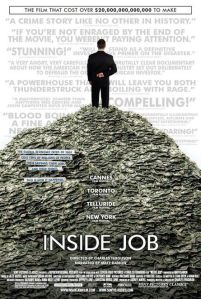
Charles Ferguson is a man I’d love to sit down and have a conversation with. The former political scientist first waded into the waters of documentary film with his brilliant Iraq War doc, 2007’s Oscar-nominated No End in Sight. He’s a filmmaker that absorbs himself in the comfort of clear logic and facts. Now he takes that same rigorous and analytical eye to the story of our generation, the worldwide financial meltdown from the fall of 2008. The global event eliminated trillions in money, millions in jobs, and still confounds thousands of us. If you don’t leave Inside Job absolutely infuriated, then you weren’t paying close enough attention.
Just like he did with No End in Sight, Ferguson lays out his case with clear-eyed precision. He doesn’t rely on ad hominem attacks, a la Michael Moore’s myopic Capitalism: A Love Story; he lets the facts do the talking, and as presented they are damning. Inside Job sounds like the title of a heist movie and that’s exactly what was propagated on the world stage. This is a wholesale plundering brought about by unchecked avarice, greed, and hubris. I’ve been waiting since the financial collapse for a filmmaker to produce an authoritative step-by-step document that could meet out deserved blame and scorn, while presenting complex mathematical calculations in layman’s terms. This is that movie. Ferguson has crafted a definitive synopsis of the 2008 global meltdown that is scarier than any horror movie Hollywood could churn out.

When you learn about the forces that led this country into economic disaster, you begin to realize that it all centers on the old Gordon Gekko pronouncement that “greed is good.” I’ve never fully understood how capitalism is somehow absolved of any sin or that free markets are the same thing as democracy. Somehow the screwy idea that business would behave if nobody were watching became an intractable ideology. The Reagan revolution of the 1980s brought with it deregulated markets and lax oversight, which has brought waves of financial scandals that have only led to bigger consequences (Savings and Loan to Enron to the 2008 collapse). With the dense derivatives market, the financial industry found new tools to manufacture money at alarming rates. Rather than betting on simple stocks, investors could now bet on anything. Derivatives helped turn the entire world into one large casino. Short-term profits became the total goal and risk became just another four-letter word. Just like the insightful 2005 doc Enron: The Smartest Guys in the Room, these events are not stories about math, they’re stories about people. You don’t have to know a CDO from a CFO. It’s the unchecked hubris of men and women, but mostly men, and the slippery slope of business when the only protectors for the consumer is getting paid by Wall Street profits.
But all those greedy bankers and CEOs were not alone. Days before the several lending firms went bust, their ratings were stuck in the AAA to AA range, the same rating as a U.S. bond, meaning non-existent risk. The ratings industry got used to big paychecks dependent upon the number of high-quality ratings they passed out. As one interview puts it, if a New York Times journalist was offered $5000 to write a positive story and zero to pen a negative one, what do you believe the outcome would be? Insurance companies, notably AIG, were gambling with all that collateralized debt, betting that it wouldn’t get paid off. This allowed companies to sell loans they knew were poor and bet against them. The systems of regulation, like the Fed and the SEC, were ridiculously negligent at best and criminally complicit at worst. Rather than investigate and prosecute, regulation officers sat on their hands, relying on an ironclad belief that the industry knew best. Congress passed a law in 2000 that prohibited government from regulating the derivatives market. Then in 2004 the regulatory bodies decided to relax requirements for capital reserves. This meant that banks could take on even more borrowed assets, leveraging greater debt (ratios of capital to borrowed capital went from 3:1 to as high as 30:1). Both of these regulatory omissions allowed Wall Street to gamble even bigger. Don’t forget that many of those high-ranking officials meant to operate as referees had been former employees of large financial firms. It all became an incestuous boys club that looked out for its own interests. Why haven’t there been any prosecutions even concerning the drugs and hookers? It seems that the only people who get prosecuted for their vices are the ones fighting for reform, like former New York governor Eliot Spitzer (he gets his own doc this fall too). The collusion among the financial sector, regulators, and legislators is staggering.

To Ferguson’s credit, he lays out a sober and exacting analysis of the mess. This cannot be dismissed as some sort of partisan hatchet job like a Michael Moore production. Like it or not, Moore has become a caricature of himself and his dubious sleight-of-hand practices hurt the merits of his message. Ferguson, on the other hand, is a reasonable fella who assembles a crack team of experts and officials, the people directly involved with the financial meltdown. Several big names like Alan Greenspan and Larry Summers declined to be interviewed, lest they have to atone for their actual culpability (Summers is getting slammed twice this fall, after his irritable appearance in The Social Network as the dean of Harvard). Ferguson serves as an intelligent inquisitor, ready and willing to challenge his subjects when they try and hide between weak rationalizations or inaccurate facts. Inside Job plays a serious subject fairly seriously. There are no easy gags or frivolous attempts at comedic relief, despite some ironic usage of pop songs. Ferguson makes use of several unsophisticated charts and graphs to help grasp the explosive rise in profits and debt. They aren’t fancy graphics, in fact most are red bar graphs you’d find in a junior high report. But Ferguson’s great asset is his collection of key participants. Inside Job isn’t much more than a talking heads piece with a smattering of visual aids and narrative elucidation. But when your subject is no less than the financial state of the world, you’ll be forgiven for keeping a professorial approach.
Ferguson is one of the first I’ve seen to shed due attention to the area of academia and its cozy relationship with the financial institutions. Many of the same names involved in the accumulated financial disaster are teaching economics at prestigious Ivy League universities. These men, the devoted disciples of deregulation, are teaching the next generation of capitalist sharks. Ferguson even examines the non-disclosure of who is paying all these business profs. A professor can have a lucrative side business when it comes to consulting, so the companies that benefit the most from deregulation are paying the men championing the ideology of free markets. Professor will write scholarly articles about the merits of various financial firms, failing to note that the firms paid them. It’s another in an endless series of maddening conflicts of interest that go unimpeded.

Inside Job ends on a somber note of resignation. As we’re informed, not one body has been brought to justice over the worldwide financial collapse or the crimes and outright fraud that got us there. In the wake of the doom and gloom, banks gobbled each other up and now Too Big to Fail has gotten even bigger. In a world where companies book potential earnings as current earnings, bet against their own stocks, and employ a phalanx of high-priced lawyers and lobbyists to resist any minute reform, whom is the American public supposed to trust? Who isn’t on the payroll? Ferguson’s lacerating documentary is the best starting point for novices to history, but even Inside Job is far from definitive. This is because the complete scope of the 2008 crises cannot be contained to a two-hour movie, even with the talents of Ferguson. As the movie comes to a close, and the audience is generally feeling numb to all this high-stakes larceny, it looks like things are depressingly settling back to the way they were. President Obama has appointed several people involved in the financial collapse to cabinet and regulatory positions. I’m sorry Mr. President, but that doesn’t count as change by the most generous definitions. The coterie of Wall Street elites feel that they are indispensable, that what they do is just too complicated for the rest of us plebeians to fathom. I don’t know about other folks, but I’m tired of the top 0.1 percent holding the rest of the nation hostage and expecting everybody else to foot the bill for their gambling losses. The narration ends with a righteous fury, declaring that some things are worth fighting no matter how hard. Inside Job is required viewing for every man, woman, child, and dog in this country. The future of the world depends upon people seeing movies like this. An informed public is the best defense against Wall Street firms and bought-and-paid-for politicians getting away with murder — again.
Nate’s Grade: A
Share this:

The Informant! (2009)
 Stephen Soderbergh’s comic farce is highly amusing from start to finish. I even watched it twice and still found myself shaking my head and chuckling in bafflement. That’s the best way to describe the tone of the film — baffled laughter. Matt Damon stars as Mark Whitaker, a corporate whistleblower whose grasp on the truth is tenuous at best. Damon’s character is a cut-up and his delusions of being a spy plus his scatter-brained narration are as fascinating as they are hilarious. This guy thinks he’s James Bond. And yet the film, while deeply comic, never comes across as snide or condescending even if most of the laughs come from Whitaker’s disconnect from reality. The film has a deliberately ironic tongue-in-cheek vibe, from the silly yet undeniably jaunty kazoo-aided score by Marvin Hamlisch to even the amber-colored cinematography (like the film was shot through the prism of a honey jar), the movie is an entertaining series of blunders and revelations. Damon is charismatic and deeply funny and Whitaker makes for such an interesting main character exactly because he is so unpredictable and unreliable. He doles out the truth in pieces like a kid caught. The Informant! is light and breezy but with some well-honed psychology of rationalization and self-deception. I don’t know how true this supposed true-life tale really is, but it’s a hell of a fun tale.
Nate’s Grade: B+
Share this:

Green Zone (2010)
 I have noticed that I’ve really been dragging my feet when it comes to writing a Green Zone review. I’ve prioritized it only to have something more necessary (catching up on VH1 reality shows) come to the forefront of my attention span. It’s not like the movie is bad. It may have been misleadingly advertised as Jason Bourne’s tour of Iraq, bringing back together Matt Damon and director Paul Greengrass (The Bourne Supremacy), but it’s not bad. It’s a perfectly fine movie, except in this instance, given the politically explosive and monumentally relevant subject matter, “perfectly fine” sounds like a missed opportunity. This movie should be incendiary, shocking, aggravating, enlightening, and if it happens to be entertaining then that ain’t bad either. The subject matter –the false rationale for war, WMDs– deserves a sober examination. Green Zone is not that movie. Green Zone is about uncovering and righting the mistakes of the Iraq War, and I believe I figured out what keeps Green Zone from being a better, more powerful, more engaging movie — it fictionalizes a story that is already wroth telling. This is a true story that could have stood well on its own merits.
Shortly after the fall of Baghdad in 2003, Chief Warrant Officer Roy Miller (Damon) is on the hunt for those weapons of mass destruction (WMD), the chief argument for invading Iraq. His team investigates suspected weapons sites but they keep coming up empty. The intelligence appears to be in sharp contrast with the reality on the ground. Miller butts heads with shady government officials (Greg Kinnear) and finds aid in a state department realist (Brendan Gleeson) and a reporter (Amy Ryan) who put her reputation at stake parroting the government intelligence as fact. The Iraqi army is disbanded and now the former generals under Saddam Hussein are conferring what the next steps should be. General Al Rawi (Yigal Naor, who played Saddam in a TV mini-series) is waiting for the Americans to extend a hand, and if not then they will become an insurrection. Miller is racing to track down Al Rawi because he knows the truth in the lead up to the war, which is why those shady government officials are also trying to kill him.
 Based upon reporter Rajiv Chandrasekaran’s book Imperial Life in the Emerald City: Life Inside the Green Zone, the filmmakers have resorted to a fictional narrative informed by the real events. My biggest gripe is this: the true story is far more interesting, complicated, and relevant than concocting a story about one military man’s search for answers. The film is laid out like a conspiracy thriller, where our hero gains a small sliver of information that leads to another piece, and another and another, until finally a picture emerges. I get it. With Damon as a soldier, the audience has an obvious rooting point, a protagonist who we can easily be labeled as good. And then when he uncovers the truth, and alerts the media, it provides a tidy, satisfying end for the movie. Except that’s not what happened. In the real world, the hunt for those phantom WMDs carried on for months, and the news trickled drip by drip. There were no smoking guns, no white knights to shine the light of truth (Joe Wilson and Valerie Plame might be the closest in consideration), and there wasn’t anything as conclusive as a military officer writing a report and sending it the mainstream media.
Green Zone attempts to craft a satisfying close to the WMD hunt and likewise the war itself. This is nothing more than revisionist wish fulfillment, wanting to insert a hero of conscience and ability during a time where we had a malaise of responsibility from those in the realms of higher command. And just to make sure they don’t make too many waves, Greengrass and screenwriter Brian Helgeland (Mystic River) wrap their crusading character in the uniform of America’s finest, making it difficult to criticize his noble hunt, striping away politics. The trouble is that the Bush Administration rarely made apolitical decisions; everything was steeped in politics, even the truth about weapons of mass destruction. So Green Zone does the audience a disservice by trying to play nice, setting up a villainous fictional straw man, and forgoing naming the names of those that led this country astray. Because of placing the film’s point of view squarely with Miller, we never get to examine the bigger picture, the manipulations and machinations that led to war. We are stuck in a very limited focus of finding the WMDs.
 Now, I must ask whether or not I’m unfairly judging the movie. Hollywood has often taken fascinating and momentous true-life stories and redirected them toward fiction. Green Zone is certainly a technically proficient film. Greengrass’ trademark shaky camera is ever vigilant, always roving and looking for the action; although in a realistic war setting, the kinetic handheld camerawork can come across as potentially hyperactive. Conversations between two people can come across like intense linguistic battles. Walks down hallways can appear to be speedy jaunts brimming with purpose and anxiety. The tension just doesn’t materialize. Without a nervy story, the Greengrass visual staple can seem over the top, antsy, nervous, and also annoying. This is one narrative for Greengrass that could have improved by the dedicated use of a tripod.
Green Zone is not Bourne at all. The Universal marketing team was trying to hoodwink the public into seeing an Iraq War movie. Damon isn’t as polished and in command as Bourne. Those who argue that Green Zone is anti-American or anti-troops are grossly missing the point. Reactionary, bellicose rhetoric, without a wit of substance, is part of the reason the U.S. is currently in Iraq. You can argue against policy, including war policy, and still be considered a patriot. Patriotism is not synonymous with warmongering. It’s too bad that the filmmakers felt that the true story wasn’t good enough to be told, instead settling for a decent if unmemorable political thriller. This adaptation takes the most significant foreign policy event in modern American history, one where the ramifications will be felt for over a generation, and clears all the hard-boiled details to attach a conventional one-man-fights-for-truth tale. It’s hard to get self-righteous when the movie keeps trying to cover its own ass.
Nate’s Grade: B-
Share this:

The Bourne Ultimatum (2007)
 I think the best aspect of the The Bourne Ultimatum, the third in the memory-troubled spy series, is how kinetically improvised it feels. Jason Bourne (Matt Damon) is a human weapon and he thinks constantly with his body, feeling the situation and his environment, and he comes up with improbable weapons, be them pens, magazines, or kicking ass with just a book (knowledge is power). Bourne doesn’t rely on fancy gadgets or a caustic wit; he just outsmarts the competition by reading his world and reacting instinctively, and that is thrilling to watch. The Bourne films have separated themselves from other spy series like James Bond and standout because of how viscerally realistic they play out. That said, Bourne still survives scrapes that would kill any mortal. At this point, we know just about all we need to know with most of the characters, so Ultimatum is one long, fantastic, and gripping series of chases between Bourne and the CIA operatives that want to rub him out. Ultimatum is Paul Greengrass’ (United 93) second film in the series and he enhances the excitement through his docu-drama style of shooting. The editing is constantly roving and perfectly channels the nervous wariness of a spy that is constantly looking over his shoulder. The action sequences are stellar and raft with suspense and top notch stunt work amongst exotic locales. Ultimatum tacks on some awkward political commentary (black hoods, secret CIA torture, breaking the law to “win” the battle against terror) and tries squeezing its story into a fight between Bourne and the dangerous and lawless elements of the American government that have flourished under President Bush’s watch. It doesn’t quite work in the context of a summer action movie, but thanks for trying. The Bourne Ultimatum is a spry and refreshing action movie that serves to cleanse the summer palate of huge special effects blockbusters.
Nate’s Grade: A-
Share this:

Ocean’s 13 (2007)
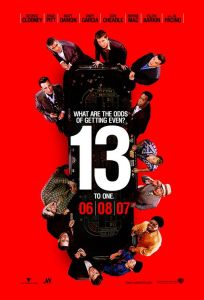 Much more like 11 than 12, this latest Ocean’s caper is just as preposterous as all the others but remembers that the audience needs to have fun too. Danny (George Clooney) and his baker’s dozen are plotting revenge on Willie Bank (Al Pacino, looking like a leather couch), a ruthless casino mogul who pushed old friend Rueben (Elliot Gould) out of a business agreement. The boys must outwit casino workers, modern technology, and a super computer able to detect pupil dilation in order to fleece Bank’s Vegas eyesore. Thankfully, all of the players are back and given tasks to do, and some of the means of their scheme are ingenious. How do you pass a lie detector tests? Place a tack in your shoe so that all your truthful answers match the intensity of your false ones. How do you get your hands on rigging dice? You send a couple guys to work in the Mexican factory and, why not, start a worker’s revolt. Ocean’s Thirteen glides along almost too smoothly, barely stopping to enjoy the crazy amount of absurd machinations before they fly by. The dialogue is packed with coded terms and the film doesn’t even stop to explain them. The movie works on the contact high of cool it luxuriates in, but unlike Ocean’s Twelve, this time the gang is given an objective, allows the audience in on their plot, and then we sit back and watch the execution. Steven Soderbergh and the gang have created a slick and amusing sequel. It lacks the freshness of the first go-round in 2001, but Ocean’s Thirteen is the most satisfying three-quel so far in a summer already weighed down by them.
Nate’s Grade: B
Share this:

The Departed (2006)
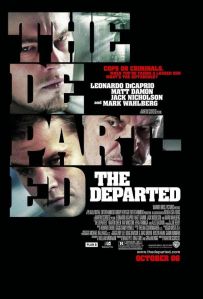 “I don’t want to be a product of my environment,” growls Frank Costello (Jack Nicholson) in the opening seconds of The Departed. “I want my environment to be a product of me.” Without question, the filmmaker that has shaped the environment of movies more than any other in the last 30 years is Martin Scorsese. No one does the cops-and-robbers territory better than Scorsese, and it’s great to have him back on familiar turf. It’s not that Gangs of New York and The Aviator were lacking in directorial skill, it’s just that they felt so labored and reeking of classy awards envy. With The Departed, it all feels so artistically effortless, like Scorsese settled in a zone of brilliant filmmaking. I just hope Marty bangs out more of these excellent gangster flicks before trying again to woo Oscar. In fact, his return to his violent stomping grounds might finally be his long-overdue ticket to the winner’s circle.
The premise is appealingly simple. The Boston State Police Department is desperate to nail local crime lord Costello. They pluck a young recruit, William Costigan (Leonardo DiCaprio), who has a shady family history of small-time crooks. He agrees to infiltrate Costello’s mob and report back to the Boston PD. To make is situation credible, Costigan is expelled from the force and sent to prison to earn a rep. Only two other people know Cosigan’s real identity, the police chief (Martin Sheen) and the head of undercover work (Mark Wahlberg). On the other side of the law, Costello has a mole all his own working inside the Boston State police force. Colin Sullivan (Matt Damon) has quickly risen through the ranks and has a prime position working with the state?s FBI crack force. He’s also an acolyte of Costello’s ever since he was a young Southie kid seeing the draw of power. Now full grown, Sullivan tips Costello and tries to redirect the ongoing investigation to bring the man to justice.
 The real sparks come when both moles try to discover the identity of the other, without compromising their own precarious identities.
The Departed is a bruising, bristling return to form for Martin Scorsese and his most entertaining film since his last Great Movie, 1990’s gangster-rific Goodfellas. This is a movie that crams multiple characters, storylines, and histories into one tight, focused setting, but then the flick glides smoothly on electric storytelling and intense performances. The movie’s twists and turns are, at times, of a knockout variety, and there’s a stretch of late surprises that each feels like a shot to the gut. I was possibly winded from gasping so hard. This is a film so fantastically alive with feeling and vigor that you cannot help but get ensnared. It sets up all the players and back-story before we even get the opening titles set to the blaring wails of the Dropkick Murphies. The thrills are real because we feel the danger, and the onslaught of brutal violence is another rhythmic piece in Scorsese’s masterful conduction. Adding to the feeling is the sure-handed, quick-fire editing of longtime Scorsese collaborator Thelma Schoonmaker and the ominous cinematography of Michael Ballhaus. Even though this film is based on a 2002 Hong Kong film, Scorsese has firmly made The Departed a movie all its own in spirit and personality. No one so easily brings us into the sordid lives of criminals better than this man, who, when in that creative zone of his, brings such palpable energy to his melding of image, song, and consequence, that the results are simply intoxicating. The Departed reminds you why Scorsese is still our greatest living director, no matter what Oscar thinks.
What elevates The Departed from the clutter of other macho men-with-guns crime capers is its studious attention to character. This is a film that works beyond a concept. The movie’s central moral theme is the price of identity. Frank opens the film asking what does it matter who’s holding the gun to your head, cop or crook. Costigan is tormented from wearing too many faces. He’s having trouble justifying his deeds and actions and is scared he may lose his own soul at the price of his lost identity. Sullivan, on the other hand, has gladly sold his own soul for a pittance. He’s a class conscience yuppie that craves power and will cut any throat if it gets him ahead. The movie steamrolls ahead with intrigue but it’s our connections to these characters that elevate the life-and-death stakes. You have a real emotional investment in this story, therefore when things get murky you really feel the danger. My heart was racing with excitement and dread. There may still be impressions from where I was squeezing the movie chair.
 Complimenting these complex characters are brilliant performances. DiCaprio may have been nominated for a Best Actor Oscar for his second Scorsese collaboration, The Aviator, but he turns in his strongest work here. DiCaprio expertly bares a gnawing moral conflict with equal parts desperation and the hunger to do good. He’s trying to finally do right and step out of his family’s criminal past, and DiCaprio brings sharp intensity to this plight. You really feel every stomach churn this guy goes through to do what he does and stay alive. I knocked the boy for being too boyish a gangster in Gangs of New York, and let me say I take back my words. On the flip side, Damon utilizes his angelic, choirboy good looks and masterfully downplays his character’s pragmatic villainy. The character has to hide so much from the outside world, be it the police, his true bosses, his girlfriend, and even himself. Damon goes about his deceitful business with slickly sick ease, tapping a killer’s instinct for self-preservation. You may shudder from how methodically cold and manipulative he comes across. He’s a mesmerizing rat bastard of a human being and yet Damon presents an almost seductive portrait of evil.
Nicholson is equally good though at times can be a distraction to the storytelling. There are a handful of moments where Nicholson seems to go too far off the page, indulging his crazier tendencies. Costello is supposed to be a scary, unpredictable, potentially unhinged man, and Scorsese has plenty of moments that bring home this point. It just feels inappropriate then for Nicholson to, in a few small moments, transform into a goofy cartoon. With that said, it’s great to see Nicholson cracking some heads for Scorsese. He has devilish fun and is insanely watchable while definitely going for broke. After some nice guy roles it’s nice to have back an unrestrained Nicholson to play the film’s abyss of evil.
 The collected supporting players all leave some mark. Baldwin and Wahlerg are perfectly profane hardass characters that you warm up to. Sheen, free from the Oval Office, displays nice touches of weariness and, in one moment, practically breaks my heart with his brave resignation. Breaking up this boy’s club is Vera Farmiga (Running Scared) as a somewhat contrived plot point to connect Costigan and Sullivan as the police shrink to one and the girlfriend to the other. There’s a perceived sadness to her willowy eyes and slender face that she plays to great effect. She?s a captivating new face and gives an extra ladling of emotion to the tale.
It’s been over a week since I’ve seen the movie and I still can’t get it out of my head. There are only a handful of flaws that separates The Departed from Scorsese’s rich pantheon of mythically Great Movies. This is a complex, gritty, amazing crime thriller stuffed to the gills with entertainment. Making the bloody body count resonate are the incredibly intense performances, particularly Damon and DiCaprio. This is a gripping gangster thriller pumping with the blood of a sterling character piece. The unexpected twists and turns will shake you, and the movie goes well beyond a snappy premise. The Departed is a moviegoing experience that will thrill you, stir you, sadden you, exhilarate you, and firmly plant itself in your memory banks. Welcome back Marty.
Nate’s Grade: A
Share this:

Syriana (2005)
 Written and directed by Stephen Gaghen, Syriana is very reminiscent of his Oscar-winning work with Traffic. It’s very dense, complex, and demanding of its audience, which is both its best and worst aspect. I needed a notepad to keep up with the multiple criss-crossing storylines. It’s similar to Traffic in scope and texture, but this film seems a whole lot angrier. Whereas Traffic felt like it was trying to hold a mirror up to society, show us the truth of the failing War on Drugs, this movie feels like a wake-up call as well as a call to arms. Syriana is desperate to shake people out of complacency and show them how the world is running. I love the fact that the “Free Iran” committee in the film that preach Iran’s desire for democracy are not backing the emir’s son that wants to educate his country, install democratic freedoms, put women on equal footing as men because … he wants to open the oil fields to China because they’re offering more money. They are backing the less-enlightened son because he’s willing to give America what it wants: oil. The movie is a mostly potent microcosm about questioning who has our best interests at hand. It’s a bit slow at parts and incredibly rushed at others, and your head will be left spinning trying to keep track of the wealth of information it throws at you. It is thought-provoking even without an emotional connection. This flick reminded me of The Constant Gardener, also a screed against the evils of big business though grounded in an evolving love story. This is a movie I admire more than I can say I enjoyed.
Nate’s Grade: B
Share this:

The Brothers Grimm (2005)
 Director Terry Gilliam is one of the true artists working today in movies. His manic, off kilter, visually grand imagination has crafted wonderfully vivid fantasias, but it also has given Gilliam a reputation for being the captain of a sinking ship. The Adventures of Baron Munchausen is regarded as one of Hollywood’s bigger failures, unfairly I might add. A fascinating 2003 documentary called Lost in La Mancha detailed the bizarre circumstances and implosions that forced Gilliam to shut down production of his pride and joy, a film about Don Quixote. We’re talking things as out of control and unlucky as acts of God conspiring to doom this project. But then, Gilliam has always been fighting someone or something his whole film career. The studio refused Gilliam’s cut of Brazil so he sneaked out a print, showed it to the Los Angeles film community, and they dubbed it the best film of that year. Gilliam is a man governed by his idiosyncrasies. He’s blessed with a unique voice but cursed with the prospects of not having anywhere to say something (would he not make simply the most divine Harry Potter film yet?). And so Gilliam strikes his hands at something a bit more commercially minded with the action/comic fable, The Brothers Grimm.
Will (Matt Damon) and Jakob (Heath Ledger) Grimm are nineteenth century ghostbusters, so to speak. They travel from town to town ridding the villagers of evil spirits, witches, and all sorts of demonic creatures. Trouble is it’s all a lie. The Grimm brothers and their pals set up the spooks and rob the town blind. Will enjoys the fame, and especially the women, but Jakob feels apprehensive. It?s the Napoleonic wars, and the French have occupied the Germanic lands. A snooty general (Jonathan Pryce) plans to behead the two Grimm brothers unless they solve a strange case in a rural town. A slapsticky, torture-loving commander (Peter Storemare) is sent to watch over the “Grimmies.” At the village, Will and Jakob discover the town has had 10 of its daughters kidnapped with little explanation. With the help of a free-spirited woman (Lena Headey), the brothers encounter giant wolves, moving trees, lickable frogs, and the giant tower of the Mirror Queen (Monica Bellucci). The Queen was given eternal life but not eternal youth. In order to gain eternal youth, the Queen needs to take the lives of 12 hearty girls, and only the bumbling Grimm brothers stand in her way.
 The acting is an example of the film’s messy feel. Ledger talks with marbles in his mouth. He’s putting more detail into the character than it deserves. Damon seems like he’s sleepwalking through the film, and his accent fluctuates wildly. He’s sort of a grinning straight man to Ledger’s tic-heavy daydream believer. Belluci is a ravishing beauty and proof positive for Hollywood that women over 40 don’t need to be put out to pasture. Too bad all she’s expected to do is look pretty and seductive in The Brothers Grimm. Pryce plays his role like a cartoon caricature. Stormare has already given one crazy performance this year (Constantine), and his frenzied, nearly indecipherable performance seems to be the closest to Gilliam’s whacked-out wavelength. Stormare is entertaining in every scene he’s in but can be found guilty of chewing scenery like it was a delicious candy house.
The Brothers Grimm is a gorgeous looking film. The sets are massive and greatly detailed. The location shoots in Prague seem like the perfect environment for Gilliam’s beyond-this-world landscapes. Gilliam experiments with advanced computer graphics for the first time and adds his oddball touches. A child has her eyes taken by a glob of mud, and then the mud reshapes itself into a lumbering gingerbread man. A horse spits out a spiderweb and ensnares a child. And it looks really freaking creepy. The Mirror Queen’s defeat is another standout effect as she breaks apart like shattered glass. The look of The Brothers Grimm is outstanding, but it’s what takes place inside those pretty pictures that dooms the film to mediocrity.
 The Brothers Grimm is an unfocused mess. It has disjointed subplots and several story elements that just don’t fit. The wacky French occupation feels like a leftover from a different movie. It just doesn’t work and grinds the movie to a screeching halt with every resurfacing. The Brothers Grimm will routinely work its way into a narrative corner and then use a “magic” cheat to escape (magic axe, magic mirror, magic kiss). Gilliam has always been a master maestro of chaos and visual oddities, but this time he’s tackled a film with a very weak script by Ehren Kruger (Ring Two). Kruger doesn’t bother laying the groundwork of his magical world or establish the rules. Therefore anything can happen and rarely feels satisfying. The characters are one-note, each given a single character trait to play with (skeptic, believer, idiot, etc.). The pacing is pretty sluggish. The first act takes an eternity to set up the film’s characters, plot, and yet it still feels sloppy. The twists and turns are easily telegraphed and unexpectedly boring. The plot is frustrating, shortsighted in scope, and far too conventional for Gilliam’s tastes. When The Brothers Grimm reaches its happy ending you’ll swear you can hear Gilliam gagging somewhere.
Gilliam adds a worthy macabre tone to the film. There will be touches that you know are pure Gilliam, like a woman skinning a rabbit as she talks, or a cat flying into the blades or a torture device. In fact, The Brothers Grimm has a lot of humor involving the comic demise of animals. This isn’t exactly a film appropriate for young children despite the appeal of a fairy tale background. The film wants to tweak fairy tale legends like the two Shreks, but Gilliam wants to make them disturbing nightmares, not something of irreverence. This puts the film’s tone at odds. One minute you’ll have a scene that?s morbid, darkly funny, and unconventional, and then the next minute you’ll have a scene that’s cliché, dull, and whimsically misplaced.
The Brothers Grimm feels like a Terry Gilliam film under glass. The script is weak and plodding, the characters barely leave a dent, and the tone is uneven. The plot is pulled in too many directions and lacks momentum. There are a handful of fun comic diversions but the movie feels like a loose collection of disjointed story elements. There are flashes of grim humor and visual elegance but more often than not the film is just stupendously boring. The Brothers Grimm feels the same way the Coen brothers’ Intolerable Cruelty felt: a unique vision compromised and downsized by studio conformity. You can see the indie spirit but the heart just isn’t beating. The Brothers Grimm is mediocre at best. How very grim indeed.
Nate’s Grade: C
Share this:

Ocean’s 12 (2004)
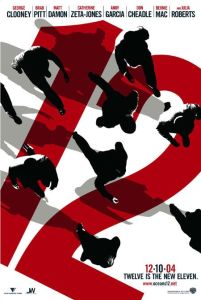 In 2001, Steven Soderbergh’s remake of Ocean’s Eleven was a giant surprise. It was a blast of fun with an impressive collection of Hollywood royalty. It had clever dialogue, fun characters, and a gala of amusing plot twists. It was one of the breeziest, most entertaining movies in years. Now, come late 2004, Ocean’s Twelve is released with the entire cast returning, including the lovely Catherine Zeta-Jones in tow. Expectations are high for another glitzy romp, but what you’re left with in Ocean’s Twelve is all glitz and no romp.
It’s been three years after the gang robbed ruthless casino owner Terry Benedict (Andy Garcia) of 160 million dollars. Benedict tracks down each member of Ocean’s Eleven and gives them the same ultimatum: either pay back what they stole, with interest, in two weeks or they’ll be killed. Danny Ocean (George Clooney) leaves his attempts at normal home life with Tess (Julia Roberts) and reassembles the team, many of whom have burned through their shares of the millions. Danny and his right-hand man Rusty (Brad Pitt) figure they’re too hot stateside so they’ll need to travel overseas if they’re to steal their fortunes. Linus (Matt Damon) also wants to have a greater role in the heist this time around.
In Europe, Ocean is challenged by a French playboy (Vincent Cassel) who moonlights as the notorious thief, the Night Fox. The challenge is to see who can steal a priceless Faberge egg, and if bested the Night Fox promises to pay all of Ocean’s debts to Benedict. Hot on the heels of both thieves is Isabel (Zeta-Jones), an expert police officer that also happens to be the former girlfriend to Rusty.
 Ocean’s Twelve does not work as a heist picture. For starters, the audience has no idea what’s going on for most of it. A general heist movie bylaw is to explain what the heist will entail, and then we watch the team hit it step by step. Forget that. In Ocean’s Twelve we’re never told how they are going to do their heist, and as they commence with their plan it’s not surprising to an audience, only confusing. I had to wait until the very end for some character to go into a monologue to explain how they accomplished their heist, and let me say, it was not worth two hours of waiting and scratching my head. The result seems to push away an audience instead of involving them in the fun of the scheme.
The story doesn’t utilize the talents of the assembled members. There’s a reason you hire a demolitions expert or a pick pocket, and that’s to let them work their skill. Well in Ocean’s Twelve we get none of that. Most of the cast’s skills are not ever put to use, which further gunks up a heist movie. The movie really errs by putting many of its eleven on ice for long stretches of the film. Around the second act almost everyone gets arrested. Pity poor Bernie Mac, who is in jail for near the whole movie. It seems that Soderbergh doesn’t know what to do with all his characters, and the new additions, so he stashes them away for long stages of time hoping an audience won’t notice.
Soderbergh is in danger of becoming a parody of himself. His usual narrative flourishes are present, including jumps in time and perspective; however, they don’t add up to much except unnecessary showmanship. The nonlinear leaps and shell game of information do not add to the film. Soderbergh keeps his audience in the dark for too long and then cheats us with the ending. Ocean’s Twelve is a good looking film (the vistas look beautiful), but it’s a good looking movie with nowhere to go. What’s even more frustrating is the ending to Ocean’s Twelve. You see, in the end we find out that the last hour plus of the movie was unnecessary. Yes, the movie actually makes a reveal that nullifies over half of the film. It’s cheap and unappreciated. Ocean’s Twelve, there’s a difference between tricking an audience and conning them. Maybe some day you’ll realize this.
 The new storylines never really develop. Zeta-Jones doesn’t add much besides another authority figure to chase after Ocean and the boys. Her subplot involving finding her master thief father is abrupt and easy. The best new addition to Ocean’s Twelve was the prospect of a rival, but again nothing really happens with our French thief. He’s more of a catalyst for the plot than anything else, and it’s a shame, because he could have opened the door for a great film pitting two competitive teams of thieves against each other.
Ocean’s Twelve is too satisfied with itself to be that entertaining. It’s now actually reminiscent of the 1960 original film (my grandmother swears it’s wonderful, take that for what you will), starring the Rat Pack. Plot and logic are secondary to a bunch of cool characters having fun. I really enjoyed Ocean’s Eleven (the 2001 film, not my grandmother’s preferred version), but this new sequel lacks any charm and verve. I can’t even say there were many good scenes, just some good ideas that they didn’t fully actualize, like stowing Yen in baggage and then losing their luggage (nothing comes of this). There’s a fun scene involving Topher Grace spoofing his own micro-celebrity, but beyond that many of the scenes and ideas don’t seem developed. The best moment of Ocean’s Twelve, for me, was when I saw Eddie Izzard, the funniest man on the face of the Earth and then some, chat with Hollywood’s A-list on screen. God bless you Eddie Izzard.
Ocean’s Twelve wilts in comparison to its witty, effervescent predecessor. Ocean’s Eleven was fun and hip but didn’t need to coast on star appeal. It had a believable heist, engaging personalities, and it was fun because we knew what was going on and it mattered! I’m sure the cast of Ocean’s Twelve had a blast making the movie together, and their friendly camaraderie shows, but when I left the theater I felt like I had been stuck with the bill for someone else?s good time.
Nate’s Grade: C


 nathanzoebl
You must be logged in to post a comment.