Blog Archives
Green Lantern (2011)
 To quote that sage Kermit the Frog and his words of wisdom concerning Green Lantern: “It ain’t easy being green.”
Hal Jordan (Ryan Reynolds) is a cocky pilot working for his ex-girlfriend, Carol Ferris (Blake Lively). Hal never takes anything too seriously and seems to freeze up in moments, recalling his own father’s crash. Then one day a purple alien crash-lands on Earth and seeks a replacement. This alien belongs to the Lantern Corps, a group of intergalactic policemen for the universe. He was mortally wounded by Parallax, a creature that grows stronger on fear but looks like a big rain cloud. The alien’s ring chooses Jordan as the replacement. Next thing you know, the guy is training on the alien world Oa and meeting lantern officers from all over the universe led by Sinestro (Mark Strong). Jordan is unsure of his heroic destiny, though we are reminded many times “the ring does not make mistakes.” In the meantime, Hector Hammond (Peter Sarsgaard) is dissecting the dead purple alien and gets infected with the fear cloud/Parallax. He lashes out at his father (Tim Robbins), at Jordan, and signals to the giant evil rain cloud that Earth is an all-you-can-eat fear buffet ready for the binging.
For starters, he power is a bit silly and hard to explain. I fall in with the majority of the public when I say, “Green Lantern who?” So the guy’s super duper power is to channel his imagination into green-tinted reality? It’s a bit vague and hard to quantify. So when a helicopter is falling to earth, instead of, say, picking it up or steadying it, Jordan creates a green Hot Wheels racetrack for it to zoom around to a stop. When the evil rain cloud fires its energy projectile, Jordan conjures a catapult to catch the projectile and fire it back. And of course at some point he materializes a green gun to use in combat. I’m sorry but for me this just seems silly. It’s one thing to say, “His strength is the power of his imagination,” and I can see where young kids would gravitate to this stuff, but when it’s realized on the big screen is seems infantile. What are the rules here exactly? It just seems dumb. I can better accept a magic ring that allows Jordan to fly or shoot sparkly lasers. If a healthy imagination is key, then the rings should be choosing some of the world’s greatest living authors and artists. Can you imagine Charlie Kaufman (Being John Malkovich) with a lantern ring, or Neil Gaiman (Sandman)? Surely those guys would come up with something more interesting than catapults and racetracks. But you see, the rings, and the lantern world itself, runs on the power of will. Will power is their energy resource (talk about going green). The enemy, the cosmic rain cloud, runs on the power of fear, which is represented by yellow energy. What are the other colors of the rainbow? Is the power of love red? Is the power of envy a darker green? Is orange the color of hunger? Is brown the color of painful bowel movements? Is the power of apathy… forget it.
The biggest misstep is all the time the screenplay squanders on boring old Earth. Just like Thor, the alien worlds are the best part of the movie. But in Green Lantern, we see the training home world (Oa) and the thousands of weird, fun-looking aliens staffed to police the universe. We get a taste of the lantern life and the heavy responsibilities. We get a sense of the powers. And… then… Hal… quits. He up and quits. He says, after about five minutes of training, “You got the wrong guy,” and we head back to Earth. What the hell? We then get to spend the majority of Act II with this guy moping over whether he should or shouldn’t be a superhero. Memo to Hollywood: no one spends this kind of money on a movie where the main character can’t be bothered to accept being a hero with amazing super powers. I can’t be bothered with a hero who can’t be bothered. The screenplay structure should have been: Act I spent on Earth, Act II spent on Oa and in space, Act III return to Earth to save the day. Instead we get about ten minutes spent on Oa. And while I’m on the subject, whenever we see this alien planet it’s like a non-stop Green Lantern convention (does Oa host other conventions? Is next week the semi-annual gathering of amateur ornithologists?), so who is left policing the universe? I understand that a majority of the universe is empty space, but if the lanterns keep getting together for pep rallies on Oa, what’s to stop a universe full of criminals from stealing everybody’s car stereos? Also, lanterns intervene in the universe when evil is afoot, but nobody seemed to give a damn about planet Earth until we got lantern representation with Hal Jordan.
So the bad guy here is a semi-formless rain cloud with a head that sucks people’s fear. It feeds on fear. That is its energy source (get a job in the media, son). Like much else in the film, the rules concerning the villain are never fully explained. At times, this rain cloud thing seems invincible. Most of the time it’s never explained what exactly this thing could do. See, if you explain things then you box in your characters. So if you don’t establish rules for your villain, your heroes, their respective powers, the history of the universe, etc., then they are limitless. It also means that everything onscreen lacks any sort of logic, internal or otherwise. So the villain is really just a fuzzy concept of fear. Hal Jordan and the lanterns have nothing to fear but fear itself. That means that the screenplay falls prey to a plethora of hackneyed messages that feel ripped out of some Saturday morning cartoon series. Everyone feels fear. Accept your fear. Courage means rising above. It’s the same patter that’s been rehashed for hundreds of episodes of people in tights teaching schoolchildren it’s okay (take a drink every time a character utters the word “afraid” or “fear”). The simplistic moralizing on fear and courage made me yearn for a ring so that I could imagine a better villain. Lastly, there’s a scene where our dastardly cosmic rain cloud descends to Earth and starts sucking away people’s fear/energy/souls. There’s a shot of a school bus screeching to a halt and children dashing away. I imagine children’s fears are more heightened since their healthy imaginations and lack of world experience would exaggerate scary things that adults would try and simply deny. Their fear has to be like a delicacy. I guess what I’m getting at is, if I were a giant space cloud that fed on people’s fears, I’d go for the children first.
Director Martin Campbell has crafted some truly spellbinding, breathless action sequences in movies like Goldeneye and Casino Royale, but you can tell that he seems to be straining against the onslaught of computer effects. Campbell is more at home with the open world of practical effects and the tangible. Being confined to the realm of green screen and CGI seems like a shackle for this guy’s own imagination. He constructs solid action sequences, admittedly, but nothing worth bearing the name of Campbell. It’s a special effects bonanza without a hint of realism, like a computer start vomiting onto the screen. It feels weightless and formless, like a giant evil rain cloud. The film reportedly cost over $200 million, which is a high figure for a movie that spends so much freaking time on Earth! Here’s an example of a costly filmmaking expenditure – the suit. Hal Jordan has a skin-tight green suit that is complete a computer effect. That means that every second Reynolds is seen onscreen in his signature outfit, it’s another effect that people labored over for months. Why? I’m pretty sure that in this day and age we have the technology for clothing. Campbell succumbs to the limitations of the material and Green Lantern ends up feeling more like a TV pilot with a runaway budget than the beginning of an epic franchise for its parent company.
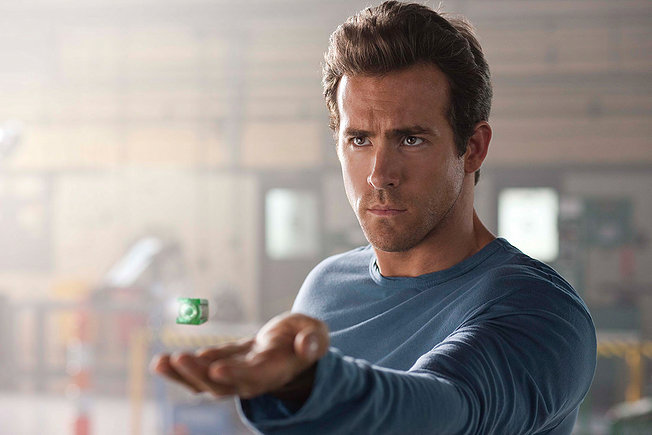 Reynolds (The Proposal) is an extremely likable actor whose biggest drawback is that he rarely seems serious, last year’s Buried a notable exception. He’s got this carefree attitude, practically bobbing his head and winking to the audience, and you like the guy even when he’s being a cad or a wimp. His character’s arc is supposed to be the guy who accepts responsibility, learns to accept and move beyond his fears, and it’s a character track that has been long journeyed and will continue to be. It makes for a simplistic hero’s journey storyline that seems to do the least work necessary to move things along. The movie did not fail on Reynolds’ shoulders; you can blame the four screenwriters and a ballooning budget for that one. Lively showed that she really could act in The Town. She shows no proof of this ability in Green Lantern. She speaks every line in a flat, monotone delivery, so much so you start to think she has like an inner-ear infection and can’t hear her own modulation. Her character is the weak love interest/damsel in distress role that regularly peoples these kinds of movies. Her monotone delivery does nothing for the lukewarm chemistry between her and Reynolds. Only Sarsgaard (An Education, Orphan) comes away mostly unscathed. His underwritten villainous character undergoes a monstrous transformation that would elicit sympathy from the Elephant Man.
Green Lantern is a movie that will thrill twelve-year-old boys and few others. It’s full of special effects, noise, and little clarity or wit. It’s not even a particularly fun movie. It repeatedly tells the audience things it should be showing, and it can’t help showing the audience character points (like Hal’s dead dad) that could have been handled with smoother nuance. The movie never feels like it can trust its audience for anything subtle. This is the kind of movie that needs to spell out everything. Green Lantern is muddled, tonally disjointed, the rules are not established, the villain is abstract, the messages are simplistic, the powers are ill-defined and also silly, the action is lackluster and overly dependent on often needless CGI, and the hero can’t even be bothered to accept his super powers. Apparently Green Lantern has about 60 years of comic history and a rich sci-fi universe, and this is the best four screenwriters could come up with? This is the best stuff they pulled from? Green Lantern is a movie that feels dimmed from start to finish.
Nate’s Grade: C
Share this:

Edge of Darkness (2010)
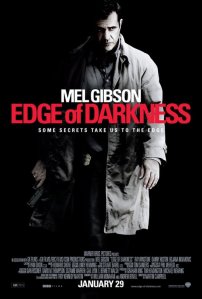 While I was watching Edge of Darkness, a conspiracy thriller that hearkens the return to acting for Mel Gibson, one thing kept sticking out to me, and no, it wasn?t the protracted ear-splitting “Bahstun” accents. One character makes comment about the current lowly state of affairs and says, “Everything’s illegal in Massachusetts.” That perked my ears, and then a second character says the exact same thing later in the movie, like it’s this flick’s summary, “It’s Chinatown.” What exactly does that mean specifically about Massachusetts? That the Bay State is somehow a nanny state, dictating behavior? Or is this a resigned admittance toward the futility of competing against the long arm of the law? I’ll tell you something that isn’t illegal in Massachusetts — gay marriage. They got a leg up on that one. This is the kind of internal conversation I had with myself while Gibson unraveled a fairly ho-hum conspiracy-of-the-week plot.
Detective Thomas Craven (Gibson) is a decorated Boston lawman. His grown daughter, Emma (Bojana Novakovic), is visiting from her job when she starts throwing up blood. She needs to tell her father some important secrets about her workplace. But as the two are about to leave for the hospital, a man cries out “Craven,” and follows it with a thunderous shotgun blast. Emma gets the full force and dies in her father?s arms. The media assumes Thomas was the target and the gunman had an old score to settle. However, the more Craven investigates the more convinced he is that his daughter was the real target. He looks into Emma’s connection to some dead environmental activists caught breaking into her place of work. The head of the company (Danny Huston) has plenty of important defense contracts and suspicious behavior. As Craven tracks down the truth he is assisted by the mystifying Mr. Jedburgh (Ray Winstone), a man normally hired to cover up any messy loose ends of governmental business. Jedburgh decides to work with Craven instead of against him, and the two men must fight for their lives.
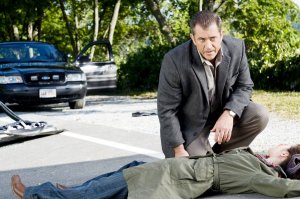 The real reason to see this fairly pedestrian police thriller is because of Gibson. It’s been a long eight years since his last onscreen role, and I must say I’ve forgotten about what a great actor the man can be. When this guy gets mad, you can practically feel the intensity. Gibson is terrific at playing a man with simmering emotions that often get the better of him. The lines and wrinkles give him a new canvas to play with, letting his age help tell the story of his character. Gibson seems to have this inner insanity to him, an admirable bent of crazy manic anarchic energy (I highly suggest checking out some of the Jimmy Kimmel Show shorts he’s been apart of). It makes him hard to ignore. He peppers in what he can with his character, a long-standing member of the law thirsting for answers and vengeance. What’s enjoyable is that he doesn’t go about knocking down every door to make people pay. Craven plays each interrogation differently depending upon his prey; sometimes he uses a soft touch and sometimes he opts for the tried-and-true punch to the nose. It’s little touches like this that bring out details in the character, and Gibson knows how to exploit them for maximum drama. Does anyone play instantly bereaved better than this man? He has a real knack for nailing scenes where a character is confronted with the sudden death of a loved one. His face is full of tics, his eyes glass over, it’s like he has lost all control and given over to the amassing and conflicting emotions. This clearly isn’t one of Gibson’s best performances, but after eight yeas of absence I’m more than willing to give the man a little latitude. An angry and bereaved Gibson is a Gibson I can enjoy watching on the big screen no matter how rudimentary the caper.
Edge of Darkness belongs to Gibson, but Winstone pretty much comes out of nowhere and hijacks the movie. Every time his character leaves the scene you’re anxiously awaiting his return. He’s an intriguing character, which makes me wonder why he’s gotten such a languished subplot. He could have been better involved in the story but the script keeps him to the narrative’s edges until the climax. Though a bit hard to understand thanks to a severe case of the mumbles, Winstone is by far the most interesting character in the movie. He’s an expert on fixing problems who tires of the long hours of shadowy, dastardly work. This is surely a character worthy of his own tale, or at least equal placement in the narrative, but instead Jedburgh functions as a sly informant when he should be running the show.
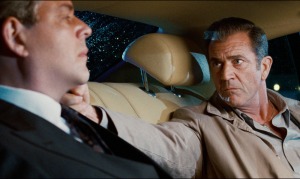 The script pretty much treads water. It’s not anything that’s particularly bad, but this story is pretty much content to stick with the basics. This isn’t a dumb movie per se, thanks to screenwriters William Monahan (The Departed) and Andrew Bovell (Lantana) adapting from the acclaimed BBC mini-series. Those guys know something about a crackling crime thriller, which this is not. The lizardly Huston couldn’t be any more obvious of a villain, but he’s not alone. The burly henchmen drive around in dark, tinted SUVs that seem to say that somebody got their nefarious goon driver’s license. This is the kind of movie that plays its hand early, telegraphing future revelations and double-crosses. When we’re introduced to a character right after Emma’s death, and the camera takes a deliberate amount of time hanging on that character’s pained expression, obviously we’ve been informed that this person is somehow connected. No prolonged reaction shot is ever meaningless in an action thriller. Every time Craven ties to gain information from a person of interest, they say, “I can’t talk. They’ll kill me,” and then that person is promptly killed as prophesied. You basically expect something “shocking” to happen every time a person leaves Craven’s presence (FYI: check both ways before crossing the street).
There’s a really engaging and politically active whistler blower story somewhere in here that could have used better attention. It seems the line between whistle-blower and activist is a thin one, and Craven must assemble enough evidence to make sure that his case cannot be dismissed as a kook. It’s an interesting dilemma, trying to assemble a compelling case that will hold up on objective scrutiny, that can’t be tossed out. That’s an interesting predicament considering the many eyes and ears of a large, legally autonomous corporate entity. Alas, that movie is not Edge of Darkness.
Gibson’s return to movie acting is definitely welcomed, even if it’s something as disposable as this. Edge of Darkness is a by-the-book conspiracy thriller that offers glimpses of something superior that could have been worked out. More attention could have been given to Winstone’s character. The whistleblower aspect could have been heightened and clarified. There could have been a bit more action and a little less blood. The bad guy could have been less obvious from the get-go. But in the end, there’s Gibson tapping into his mad Mel streak of appealing intensity. Not everybody can offer what Gibson does. It’s too bad then that Edge of Darkness fails to realize this virtue.
Nate’s Grade: B-
Share this:

Casino Royale (2006)
 This is very different James Bond and it’s about time. The Bond film franchise began all the way back in 1962, and it essentially became the blueprint for the modern action movie. Quips, alluring women, exotic locations, car chases, colorful villains, and spoiled plans for greed or world domination. But even if Bond got the ball rolling, the action movie became its own insatiable beast, thanks to the likes of studio bean counters and the ubiquitous uber-producer Jerry Bruckheimer. The 90s Bond revival followed suit. The movies became more about extravagant fireballs, throwaway characters, and preposterous scenarios. After 2002’s Die Another Day, where Pierce Brosnan’s Bond drives an invisible car through a melting ice palace caused by a solar laser from space run by a yuppie playboy who really had the DNA of a North Korean dictator… well, you don’t need to be an expert to figure out that something was rotten in that state of Bond.
The Bond films have great history to them, but let’s not get overly romantic here; a majority of the James Bond movies are outright crap, especially the ones with Roger Moore. There were jaunts into space, men with metal teeth, Timothy Dalton, a title called Octopussy, and Christopher Walken trying to have California fall into the ocean. Let’s face it, half the movies are rubbish. Someone, anyone try and tell me the redeeming qualities of Moonraker. The last good-to-great Bond movie was Brosnan’s debut, 1995’s Goldeneye. The Bond franchise has been in desperate need for a makeover. This is it.
 The producers went back to Bond basics. The long-time producers had the rights to every Ian Fleming novel, except for Casino Royale, which was turned into a cheesy comedy lampooning Bond instead of competing with the franchise. Several decades later, we’re given a serious adaptation of Royale, Fleming’s introductory book about the secret agent that rewrote movie rules. The new Bond has a splash of Jason Bourne in him and seems more tightly wound and hard-boiled. He doesn’t have time for trivial decisions like shaken or stirred. “Does it look like I give a damn?” he barks at the bartender.
Bond (Daniel Craig) is more thug with a badge than a suave secret agent. He’s just risen to double-O status and his boss, M (the incomparable Judi Dench), doesn’t feel that he’s ready or can be trusted. But then, he is the best poker player MI5 has. Le Chiffre (Mads Mikkelsen) is entering into a high stakes poker game worth millions of dollars. He’s playing with the money of African warlords and terrorists and has promised them a great return on their investment. Bond is assigned to gather information and stop Le Chiffre from financing terrorism. Vesper Lynd (Eva Green) is a representative of the bank that will be sponsoring Bond in the card game. It’s up to her to keep tabs on Bond and make sure her bank?s money is wisely invested.
Now this is what action movies should be like. Casino Royale is a terrific ride with great action sequences, great intrigue, strong acting, and some wonderfully exotic locations. The movie, like Bond to Vesper, sure feels the need to prove money was well spent. The story is smart and filled with sharp dialogue, perhaps thanks to co-writer Paul Haggis (Million Dollar Baby, Crash). This is Bond dialed back, stripped of fancy gimmicks and gadgets and left to battle with his wits and his brutality. This is a meat-and-potatoes action movie without irony or frills. It’s serious about its business and business, let me tell you, is good. Casino Royale is monstrously entertaining.
 There was a lot of grumbling when Craig was selected as the next actor to fill the 007 shoes. Some scoffed at the idea of a blonde Bond, as if hair color had shot to the top of the list of important qualifiers. I wrote this about Craig after seeing 2005’s Layer Cake: “This man is a modern day Steve McQueen with those piercing blue eyes, cheekbones that could cut glass, and the casual swagger of coolness. We may never see Craig sweat but he still expresses a remarkable slow burn of fear so effectively through those baby blues.” This man is the perfect candidate for a Bond reboot. He has a boxer’s face, those wonderful eyes, and a sculpted body that will take many a breath away. But even better, Craig is likely the best actor that has even been tapped for 007. Connery will always be the sentimental favorite, and rightfully so, but Craig imbues his Bond with startling amounts of emotion and vulnerability. In the dramatic black and white opening, his first kill isn’t clean and quick, it’s long, drawn out, messy, and leaves Bond shaken, not stirred. His relationship with Vesper gives him even more opportunities to feel and be tortured, sometimes literally (Note: a naked torture sequence is far too intense for children, especially those with their genitals on the outside). Craig gives a rich performance. When he’s chasing bad guys you see the determination of his running, the anguish on his face. When he’s flirting with women you can practically feel the smolder. This is a far more pragmatic Bond and Craig is the right actor for the job.
Green leaves her mark as one of the best Bond girls in the franchise. Usually the Bond women are either respites for fine-tuned lovemaking, or damsels wronged by the eminent domain of evil. She has a nice moment where she sits in the shower in shock after being witness to the reality of murder. She showed a lot of promise and gives a commanding performance on her biggest stage.
Director Martin Campbell has some history with the Bond franchise, restarting it with Goldeneye. He’s a pro at orchestrating action sequences, and there are some doozies in Casino Royale. The beginning sequence is a thrilling foot chase inside a construction zone. Bond’s target, a bomb maker, bounces off walls, swings along ledges, and motors around beams and ladders like he was a trained monkey. It’s an exciting French style of acrobatics called Parkour, and it was used to dizzying effect in this year?s District B13. The chase just goes from one level to another, and the stunts are brutal and of the death-defying variety. It’s a showstopper opening. An airport sequence is also quite memorable, as Bond races to stop a bomb from reaching an airplane. Campbell has taken a hint from the Jason Bourne spy movies and made Bond more reactionary to his surroundings. Many fight sequences feel tense and un-choreographed, even though we know that isn’t the case. When this Bond gets into scuffles you don’t know whether he’ll make it out unscathed. Campbell keeps the pace steady and the visuals crisp. Best of all, Campbell allows the audience to fully see what’s taking place. There’s no MTV-style edits. The film feels totally in control like the best action movies do. You’ll feel battered, bruised, but exhilarated all the same.
 However, Casino Royale is not a perfect action movie. It feels way too front-loaded; all the big action sequences seem to occur within the first hour. The film then settles in for a climactic game of… cards? I’m not one who fell into the spell over Poker on TV the last few years. It just doesn’t seem that thrilling to me to watch one guy turn over his cards and then wait for another to turn over their cards. There are only so many combinations to be had, and hoping for Bond to have a flush to beat out four of a kind is just not high drama. It’s luck. The poker scenes seem to last longer than they should, as does the film as a whole. This is on record the longest Bond movie ever, clocking in at 144 minutes. It’s a whole hell of a lot of fun, but the tacked on ending in Venice seems like an entirely different movie slapped together for closure. The villain is somewhat weak. He’s given a nifty visual item, weeping tears of blood, but it is meaningless. The plot also gets too convoluted for its own good, with double-crosses, triple-crosses, and finally a reveal as to who the Big Bad in Charge was and I could not for the life of me remember who he was. Seriously, there are so many characters and faces shoved in that the producers could throw us a bone. All I’m asking for is some clarity while I chow down on my popcorn.
Casino Royale is the Bond movie Ian Fleming would have paid to see. Craig and Campbell have given new life to a teetering franchise. This Bond is much scrappier and more cunning. The action sequences are slick and the movie is fun and engrossing, plain and simple. In the closing seconds, when the familiar notes of the James Bond musical theme come alive you will feel like the journey has been earned.
Nate’s Grade: A-
Share this:

Vertical Limit (2000)
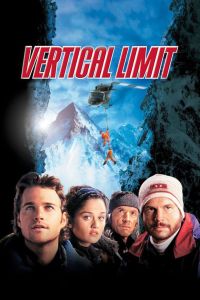 New heights are explored in the mountain climbing expedition that is Vertical Limit. A group of climbers must perform a rescue mission on the second highest mountain in the world or risk losing the lives of their friends and loved ones. With a set-up like this you would assume it would have a lot of great action. Well, yes and no.
Limit stars Bill Paxton (talented but has poor film choices) as the usual corporate villain, Chris O’Donnell (untalented with poor choices) as the tortured rock climbing hero, and Robin Tunney as the overly ambitious climbing sister to O’Donnell. This isn’t all the subplots though — oh no! We get a pair of wise cracking pot head brothers, a religious Pakistani serviceman, a military base, and a grizzled loner that everyone thinks is crazy until we finally realize he’s the best mountain man of them all. By the time it takes to establish all of these subplots, plus others I’ve failed to mention, we haven’t even gotten to the damn mountain yet. Rule #1 of a mountain climbing movie: Get on the bloody mountain within an hour of the movie starting!
The plot is overly cornball and excessively redundant. By the time you actually see the loner’s long lost wife frozen in a wall of ice and looking like a figurine from the Mattel Barbie catalog you will know the ends this film will go.
The experts of rock climbing are all young and seemingly frat house rejects. Why in every film must the experts in any field of scientific research be frat house party animals? How about some realism there and make them all middle aged balding white males. Well… I guess that would be less of a draw.
 Director Martin Campbell (GoldenEye) has a great knack for establishing tight thrills and strong suspense. Campbell is clearly the strong point of this picture. When the action is running it’s plumb with excitement and great visceral visuals of the scenery. The only problem is that the action scenes are separated by long stretches of characters coughing or wheezing and terribly cheesy dialogue. If the story is technically built around the action sequences why do we have to devote so much time to it then? It’s a waste of Campbell, a true action talent.
Limit is rigid with expendable cut-outs designed to be its people. The characters are shoe-string and so is the plot but the action, when allowed to actually happen, is first rate. However, I do exclude a series of scenes where Tunney and Paxton are trapped in an ice cave that resembles more of your grocer’s freezer than a Himalayan peek. The 12 year-old behind me kicking my seat figured it all out good enough. I think that says enough.
Nate’s Grade: C-


 nathanzoebl
You must be logged in to post a comment.