Blog Archives
Ted (2012)
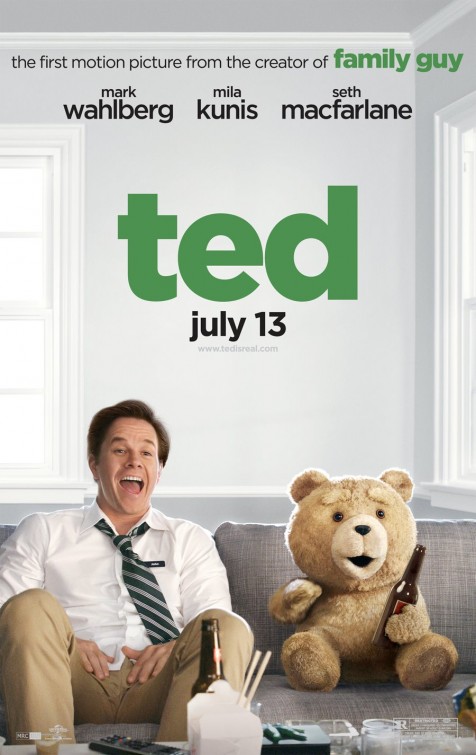 Seth MacFarlane has become an industry powerhouse. The man has three animated TV shows on air (Family Guy, American Dad, The Cleveland Show) and essentially carved an entire niche of modern comedy. His brand of irreverent, offensive, tangential humor has turned the man into a demigod among young audiences and helped him rake in millions. A journey to the movies seemed inevitable, and so comes Ted, which MacFarlane directed and co-wrote with two of his Family Guy scribes. The best assessment I can give is that if you enjoy MacFarlane’s brand of humor on TV, you’ll probably enjoy Ted. If not, then you’re in for a prolonged, obnoxious two hours.
One day when young John Bennett was a young boy, he wished his teddy bear would come alive so he’d always have a best friend. And as a narrator tells us, nothing is stronger than a young boy’s wish (curious gender is specified and then never touched upon for some kind of joke). The next morning Ted (voiced by Seth MacFarlane) comes alive. Flash forward 30 years and Jon (Mark Wahlberg) works at a rental car company, has a stunning girlfriend in Lori (Mila Kunis), and regularly gets stoned with his best pal, Ted. The two guys are inseparable, which causes friction between John and Lori. After another notorious incident of Ted behaving badly, Lori insists that he move out. John has to start acting more responsible and treating Lori like she deserves, but Ted’s influence usually leads to trouble. Both Ted and John are in desperate need of growing up.
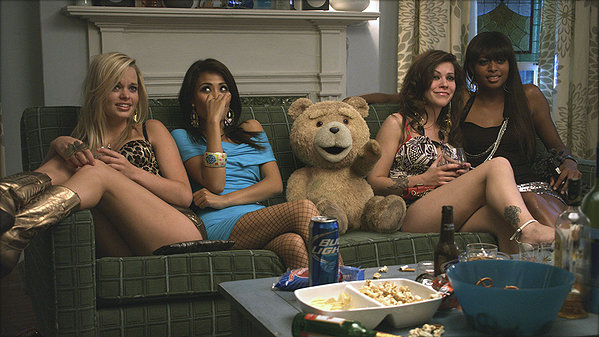 It was no surprise for me that Ted was exactly what I expected from Seth MacFarlane. It’s just a bigger, raunchier version of the style of humor he’s patented on television: tangential non-sequitors, scenes that go on far too long, obscure pop culture references, pointless shock material, and the basic premise that the jokes hinge around some creature merely doing things. Like Brian the Dog, or Roger the alien, Ted is a creature that shouldn’t necessarily exist, and thus so much humor is built around just seeing Ted exist. Is it supposed to be hilarious watching him drive? How about hit on women? Do bong hits? Far too often the only joke the movie seems to offer is that Ted is a teddy bear doing stuff. If you replaced him with, say, a normal human being, would any of those jokes work? Would it be funny watching a normal person drive, hit on women, and do bong hits? Maybe but probably not. It’s all one joke: look at something unnatural doing natural things. And that’s my issue with MacFarlane’s brand of humor. These jokes are not given proper attention, setup, and development. The film rarely subverts your expectations with how every joke will play out, and if you already know the jokes before the movie delivers them then what’s the point? The one joke I did laugh at, and a good guffaw at that, was Ted’s boss who kept responding to Ted’s screw-ups with good words and promotions. That was a surprise. But here’s the thing: once it’s established, you know what will happen the next time. So the second time it’s still funny but not as much. By the third time, his nonplussed reaction is completely expected and thus all traces of funny have been squeezed dry. In comedy, it’s all about surprise, and I find with MacFarlane that he rarely strays from his routine.
As far as jokes going on too long, let’s talk about a myriad of subplots that seemed to go on forever. There’s an entire storyline where an obsessed fan played by Giovanni Ribisi (Contraband) kidnaps Ted. This storyline makes up almost the entire third act and occurs after the reconciliation between John and Lori, so the movie already feels like it should be over. And then it keeps going. And it keeps going longer. And then there’s a car chase and a foot race through Fenway Park, which serves no purpose other than to probably fulfill a childhood wish of MacFarlane’s to film on said hallowed grounds. And it’s during this final act where the crass movie tries to become… sentimental? It just doesn’t work. You can’t have 100 minutes of rude, offensive, vulgar humor and then try and then try and go all gooey and soft and make people feel something akin to emotion. The reason that the Judd Apatow films can work with emotion is because from the get-go they make you care about the characters and their relatable conflicts. But there’s a difference between emotion and cheap sentiment, and Ted hasn’t earned genuine emotion. I didn’t like any of these characters. They all seemed like louts and jerks and dolts, none of them charming. Thus the end and its wish-upon-a-star conclusion are cheap sentiment and the kind of conclusion that you believe without a doubt that the characters in Ted would mercilessly mock.
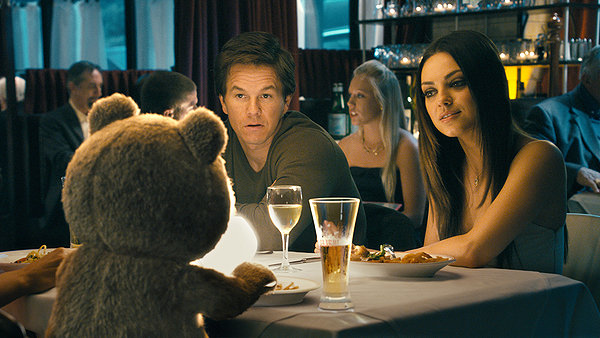 Let me specify for the moment that there is a distinct difference between gross-out gags and gags that are just gross. There is also a difference between jokes that are shocking but funny and jokes that are just desperate to offend. In my experience with MacFarlane’s brand of humor, as well as McFarlane’s fratty devotees (if I was rushing a fraternity, I have no doubt Ted would be my favorite movie, bro), that difference is not understood. Watching an over-the-top racist Asian stereotype is merely offensive without proper context to draw out humor beyond the odious and obvious. Just punching a child in the face isn’t funny. Just having someone defecate on the floor isn’t funny, though the panicked removal of said feces was humorous in flashback. I may have chuckled and giggled from time to time with Ted, but most of the time I was just saddened by how desperate McFarlane and his writers were to shock rather than to entertain.
Thank God Wahlberg (The Fighter) was in this movie. While Ted is best left in small doses, the boorish best friend archetype, Wahlberg has been sharpening his comedic muscles (the only muscle in need of work it seems) and has become a terrific straight man. Anyone who remembered 2010’s The Other Guys knows that Wahlberg can be flat-out funny when given great madness to play off of. With Ted, Wahlberg’s commitment to the innate absurdity of the movie goes a long way. His breathless rendition of an exhaustive list of white trash girl names had me laughing harder than anything else in the movie, and I admit I was also impressed by Wahlberg’s speedy delivery. The character of John is a pretty standard role at this point in American comedy, one of arrested development. However, it seems to take so long, blown chance after blown chance, for John to finally find some sense of responsibility. Just like everyone else, he is at the mercy of Ted’s corrosive influence.
I probably wasn’t the ideal specimen for MacFarlane’s first foray into movies. I’ve never been more than a mild fan of his TV work and its hit-or-miss-but-mostly-miss brand of tangential humor, though I admit American Dad has grown on me (the only MacFarlane show where the jokes seem related to the story situations). MacFarlane unleashes the vulgar material he’s been holding back from TV, which makes for some laughs. The obviously stoned guys sitting in front of me thought the movie was hilarious, even during quiet moments where nothing was going on. I’m disappointed that a MacFarlane movie is pretty much exactly as I would have suspected, essentially a MacFarlane TV show blown up to a bigger screen. The jokes here are so limited, mostly deriving from Ted the teddy bear just doing things a teddy bear normally doesn’t. I wish the comedy were more developed, more nuanced, more concerned with doing something other than shock. The most shocking aspect of Ted is how utterly forgettable the whole enterprise is even with a magical talking teddy bear.
Nate’s Grade: C
Share this:

Contraband (2012)
 January at the movies has long been a time for two kinds of releases: 1) award-worthy films expanding into wider release, and, 2) crap. That’s about it. I’ll let you figure out which category the action thriller Contraband belongs in.
Paul (Mark Wahlberg) was once the best smuggler in the business. He’s since gone legit, starting a family and his own private security business. His brother-in-law (Caleb Landry Jones) gets into trouble with some bad men. He tosses a load of smuggled drugs to elude Customs ships, but now Briggs (Giovanni Ribisi) wants the value of the drugs or else. Paul knows he has no choice but to put together one last job to save Kate’s (Kate Beckinsale) brother. Paul leaves his family in the hands of Sebastian (Ben Foster), a trusted accomplish on many missions. John puts together a team and plans to board a ship headed for Panama City. While there, the team will load large sums of confederate money. The sale of the fake currency should square things between John and Briggs. However, little goes according to plan.
 Contraband is a lousy heist picture that feels like it’s making it up as it goes. First off, the premise of John having to go back into his art of smuggling to settle a debt has been overdone, and the fact that John’s idiotic brother-in-law is as fault makes it hard to care that something might happen to the idiot. But why God do they bring this screw-up, the brother-in-law, along with them? He’s already proven to be a poor decision maker and a moron, and, surprise surprise, when in Panama the guy gets them into more danger. So irritating is this character, always foolishly making things worse for John, that you wish they had thrown this dolt overboard. This is a movie structured with a small beginning, a small end, and a great big fat middle, and it’s that middle that involves our destination to Panama. With heist movies, as well as most thrillers, we don’t want things to go according to plan. We want to see organic complications and watch our team of characters adjust. With Contraband, the complications don’t feel natural so much as like careening plot elements from other movies. John’s quick visit goes out of control, with the team losing their payment money for the confederate loot (guess who’s responsible for that? Guess?), and they have to go find a budding crime lord, Gonzalo (Milk’s Diego Luna), and then this crime lord just happens to be plotting a heist at THAT EXACT MOMENT and John and his team should come along and then the heist goes bad, as always, and the team ahs to get away, but Gonzalo demands to be taken to a hospital by gunpoint, and then the cargo ship is going to leave port, and, and, and, and, etc. There are so many breakneck plot turns thrown in that it feels like a broken blender spewing half-formed plot residue everywhere. It’s the film equivalent of the If You Give a Mouse a Cookie story (“If you give a smuggler a deadline, he’ll need a contact. If you give him a contact, he’ll need to do the contact a favor. If he does the contact a favor, he’ll have to do this one job for him. If he does this one job for him, he’ll need a crew. If he needs a crew, he’ll need… etc.).
Let’s take a moment to analyze the peculiar masks Gonzalo and his team choose to utilize. They literally wrap duct tape around their faces. That’s got to be the dumbest mask in the history of cinema, and there have been some stinkers. They couldn’t afford pantyhose? Anything? They had to use tape? First off, you can’t conceal key features, like your eyes and mouth, and lastly, isn’t it going to be something of a bitch to rip those things off? The only person who could properly wear a duct tape mask would be someone suffering from alopecia (condition that leaves a person hairless). Otherwise you’re sacrificing your eyebrows. Maybe this is just how things are done in Panama.
So much of this movie feels like it’s on autopilot, just drifting like that cargo ship. At this point, I don’t even think Wahlberg is trying to hide his indifference to the material. He’s a man with a shady past who went legit and has a family now, but in order to protect that family he is drawn back to his shady past. How many times has this plot device just been used in the last few years? The rest of the characters fill out the crime thriller cheat sheet: young screw-up who serves as plot catalyst, parent in prison to provide cautionary tale, best trusted pal that ultimately proves to be untrustworthy, and the harried, often victimized wife. Poor Beckinsale (Underworld) who gets beaten, threatened with a gun in her face, and victimized to a degree that it feels like exploitation. This woman can never catch a break. She gets few moments in the film where she is free from being terrorized with violence. I have no idea what would attract an actress like Beckinsale to this part other than the allure of a paycheck. Contraband stalls when it comes to thrills, and part of this is because the villains seem so lame. Briggs just comes across as an inept criminal, like somebody’s own screw-up brother-in-law that tagged along to play with the big boys. He’s routinely beaten and bossed around. It’s hard to take his threats seriously, so the movie cuts its losses and just has him threaten Kate some more. It becomes old quick. The only thing that keeps Contraband going is the great distance between Paula and his family, a divide that keeps Paul vulnerable. Too bad that the movie can’t think of anything thrilling to do with this scenario and settles, all too frequently, on scaring the wife. Wouldn’t the film have been more engrossing if Paul’s wife had been kidnapped this whole time? Would that not cause a better sense of urgency than the vague threat that a character we don’t care about might get offed for being stupid?
 From an action standpoint, the thrills rarely materialize, relying on a contingent of blunders and coincidences to provide the thrills. There wasn’t a moment where I worried for a character on screen. This may be because I didn’t care for a person on screen, thanks to workmanlike characterization, but it’s also got to fall on the feet of Icelandic director Baltasar Kormakur (who starred in Wahlberg’s role in the original Icleandic version of this flick) and his nascent camerawork. There will be moments where his camera does stutter-step zooms, mimicking the docu-drama camerawork that’s been en vogue with action cinema. And then he’ll never repeat it. There’s a shot of Gonzalo blowing the armored car up and it’s filmed in a high-speed, stylized shot to distill the strange beauty of the force, and then this never happens again. It’s like Kormakur is sampling all 31 flavors of action movie styles and can’t decide on a visual tone. The action is too dependent on arbitrary coincidences for it to be satisfying of thrilling; we’re just waiting for the next out-of-nowhere plot turn to move things along. The ending attempts to tie up things nicely but feels asinine and laughable in how John can take out three villains in one well-orchestrated, tidy swoop. Don’t even get me started on the impracticalities of John hearing a lone cell phone ringing to be able to trace his wife in an entire construction site. The resolution feels ludicrous and a stroke of dumb luck.
Contraband is a convoluted, knuckleheaded thriller that drags because of arbitrary maneuverings, poor characterization, a fat middle section plot-wise, and pedestrian action. The movie feels like it’s being made up on the spot. As a result of all this tiresome lateral plotting, Contraband feels like it’s going nowhere and spinning into oblivion. I found myself nodding off at various points, my brain bored by all the generic goings-on. The constant victimization of Paul’s wife is a rather ugly development for a movie that confuses salty language and furrowed brows for toughness. The movie is devoid of any sense of fun. It just becomes an empty enterprise of actors going through the motions to work of genre pap. Even by the dirt-low standards of January cinematic offerings, Contraband isn’t worth a cent of your hard-earned money.
Nate’s Grade: C-
Share this:

The Fighter (2010)
 Somewhere along the line, the boxing film became the perfect metaphor for the underdog story. Two men at battle with only their fists and iron wills. Somehow this match up has come to symbolize man’s eternal struggle against himself and society. From Body and Soul to Rocky and Raging Bull, it’s hard to imagine the filmic landscape without the tropes of boxing. It’s also a pretty staid and tired genre, where filmmakers often rely on those tropes to fill in the gaps for lazy storytelling. The Fighter is a true story that star Mark Wahlberg has been nursing for years trying to get it off the ground. It’s the knockout acting and attention to character that separates The Fighter from the competition. Rarely has such a sedate formula felt so freshly presented.
In the mid 1990s, Mickey Ward (Wahlberg) is a man trying to come to grips with his life. His welterweight boxing career has stalled thanks primarily to his trainer, his unreliable half-brother Dicky Eklund (Christian Bale). Big brother used to be the pride of Lowell, Massachusetts, once fighting Sugar Ray Leonard and boasting about knocking the giant down (this claim is in dispute as replays show that Leonard may have simply tripped). Dicky’s boxing career went away about the same time that Dicky became addicted to crack cocaine, spending long hours inside Lowell’s many crack houses. An HBO documentary crew is following around Dicky, which he mistakenly believes is a ticket to his comeback. Mickey’s mother, Alice (Melissa Leo), also serves as manager to both her boys. Dicky is clearly the apple of her eye and Alice enables his destructive behavior. Mickey is pushed into fights to feed his extended family (eight siblings), and the thrill is gone. Then one day he’s approached by a promoter who will give Mickey one more chance. The only catch is that Mickey has to cut his family loose.
 Truth be told, The Fighter isn’t really much of a boxing movie. Sure that’s the selling point and it allows for a rousing, crowd-pleasing finish, but Mickey could just as easily be striving to open a deli or striving to go back to school. The real story is the family. The boxing is only a backdrop, and if it weren’t for the true-story basis I would say it serves as little more than a metaphor for the punishment Mickey has taken in life. The Fighter is about a man working up the courage not to step into the boxing ring but to break away from his self-destructive family weighing him down in misery. This is a dysfunctional family drama disguised as a Rocky-style boxing redemption picture. The boxing aspects are small, mostly contained to the final act as Mickey’s career finally begins to gain some traction. For some, this will be disappointing news. But for me, I loved the family drama stuff. This is a fractured family with deep lines of division, nursing grudges, resentment waiting to boil over, all the marks of meaty drama. The focus is on Mickey trying to break away from the pull of his harmful older half-brother and his boorish mother. His mother enables Dicky, her favorite child, to the detriment of the rest of her brood. Her relationship with Dicky is fascinating and complicated, like a mother sacrificing the rest of her clan to help her most damaged child. You can catch some of the invisible ripples from these decisions, like the seven sisters all forming one unified hive-mind to survive. They’re like a block of cheerleaders for mother, only able to get attention and some form of affection by doing so. The extensive family unit revolves around Leo’s matriarch, fiercely protective and fiercely myopic. She refuses to remove herself from Mickey’s management team, and thus Mickey and his career suffer. It’s downright Oedipal. If only he can escape the clutches of his family, perhaps Mickey can taste success that has eluded him so long. The family drama makes up a good majority of The Fighter, and that’s just fine with me when I get characters this damaged and complicated.
And all of this is blissfully entertaining. Director David O. Russell is miles away from his other films like Three Kings and I Heart Huckabees. This is different kind of redemption story where the main guy winning a title is nice, and we can all celebrate, but it’s really his separation from a harsh family dragging him down. The film also produces an engaging romance for Mickey, which gives him a renewed sense of purpose to finally break free of his family. Amy Adams (Enchanted, Doubt) is a bartender at a local hangout with some college under her belt, a point that irritates Mickey’s family. The Eklund sisters lash out at Mickey’s squeeze in childish ways. Adams, playing Charlene, shies away from the daffy or genteel roles of her past. She gets to spit profanities with glee. Her relationship with Mickey serves as a foil to his family, showing what strength a positive, healthy relationship can achieve. But while the family is presented in an antagonistic sense, they are not blithely demonized. Russell and his team of writers and actors use humor to find surprising pockets of warmth amidst all the darkness and shattered dreams. This isn’t an addiction story that plumbs the depths of human weakness. The production feels bathed in authenticity and the city of Lowell, Massachusetts and its lived-in, blue-collar culture feels like another vital character. When the HBO documentary finally airs, you feel the cloud of hurt that covers the entire town in shame. Nobody wants to be known as a town famous for crack addiction (you can watch the 1995 doc online for free).
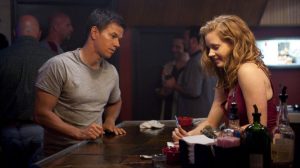 The acting is also some of the best you’ll see all year. Wahlberg is a sturdy center, used to the abuse and underplaying his character’s transformation from punching bag to assertive human being. This is Wahlberg’s home turf, and he’s been shopping the story for years in Hollywood, so it’s no surprise that everything comes so natural for the Beantown kid. But his understated work is going to get obscured with the flamboyant performances from both Bale and Leo. Bale (The Dark Knight, Rescue Dawn) has long been considered one of the finest actors of his generation, his Method devotion and versatility a godsend. In The Fighter, he’s a live wire, a bundle of energy in a haunting skeletal frame. He’s a figure of lost promise, of tragedy and bruised ego, trying to live vicariously through his younger brother. He’s deluded himself into thinking that this HBO documentary will launch a comeback at 40. Bale excels with the bombastic bits, practically bouncing off the walls, but then he nails the quieter, smaller moments of his character, where Dicky realizes that he’s wasted his gifts. Leo (Frozen River) could easily fall into an outsized monster of large hair and nicotine-stained fingers, but the Oscar-nominated actress finds exciting ways to tap into her character’s humanity. She fully knows that her beloved child is a crack addict, but watching her rationalize and justify her actions is exciting.
The Fighter is a meaty family drama, stirring tale of redemption, and a showcase of superior acting. In an awards season where it feels like many films are missing some secret ingredient, The Fighter has it all together. It’s an underdog story of a different flavor that manages to be authentic, entertaining, charitable, and engrossing even while staying within the boundaries of a predictable framework. We all know that Mickey will triumph in the ring; otherwise his tale would never have caught the notice of Hollywood producers. This is a fresh take on old material. The focus is on the fractured family dynamic and the many characters, not on a simplistic rising through the rankings of sport. It’s because of the tremendous acting and character work that the first half of the film easily outshines the second. Once the family is sidelined, and Mickey’s boxing career takes off, The Fighter turns into a more conventional genre picture, though still engaging. The movie ends on a satisfying note of uplift that feels fully earned without a twinge of naiveté. This Oscar season, expect audiences and voters alike to find something to cheer about in this return to the ring.
Nate’s Grade: A-
Share this:

The Other Guys (2010)
 Surprisingly consistent in its belly laughs, The Other Guys proves that Will Ferrell is at his best when he re-teams with his greatest collaborator, co-writer and director Adam McKay (Anchorman, Step Brothers). The duo takes on the cop genre with a loving parody that manages to send up the genre while celebrating its excesses. Ferrell and his partner (Mark Wahlberg) stumble onto a mostly convoluted financial scam with banks, traders, and the police. The movie takes scene after scene and gives it a little twist for the self-aware characters to comment, usually to great comedic effect. There were some stretches that I was near tears from laughing so hard (the tuna vs. lion argument is an instant classic). I expected to be amused by the movie since nobody does silly smarter than Ferrell with McKay, but I was not prepared for how much I genuinely liked this movie. From scene to scene, I found something different to laugh at. There’s an undercurrent of rage from McKay concerning the economic stickup Wall Street got away with in 2008. The end credits are an animated statistics presentation on how large Wall Street firms screwed over the American public and are still profiting off of pubic misery. It’s a bit odd tonally to cover at the end of the film, like McKay wanted his legions of fans to get some morsel of education by the end of a film with goofy action and juvenile sex gags. The joke is on us all.
Nate’s Grade: B+
Share this:

Date Night (2010)
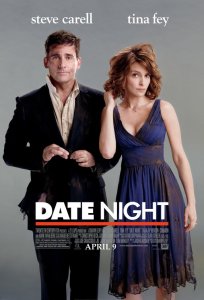 Here is a classic example of two game comedians elevating substandard material. The contrived premise revolves around an ordinary if somewhat bored married couple (Steve Carell, Tina Fey) being chased all over New York City in an extreme case of mistaken identity. Carell and Fey have a terrific comedic dynamic and watching them play and riff is when the movie feels sharp and alive. Sadly, this is another action comedy that thinks people will lap up action that’s slightly skewed. Note to filmmakers: most action sequences are not inherently funny without effort made via context and surprise (see: Cop Out, Bounty Hunter, Killers, or better yet, don’t). The more bad action comedies I see from 2010, the better The Other Guys keeps looking to me in the rear view mirror of memory. When Carell and Fey switch into action mode is when the comedy takes a back seat to lame mayhem. When the movie manages to squeeze in small moments where the actors have space to breathe and the banter is amusing. At best, Date Night is an amusing excursion when it lets the adults get to behave. When they have to go bug-eyed and yell at all the noise, then the movie just becomes exasperating. Good enough for a rainy day, with some lowered expectations, but this movie wouldn’t be nearly worth watching without the resolute comedic efforts of the two leads.
Nate’s Grade: C+
Share this:

The Lovely Bones (2009)
 The Lovely Bones, based upon Alice Sebold’s 2002 best-selling blockbuster, is about some heavy stuff. It’s told entirely from the point of view of a dead teenage girl. She was raped and murdered by a skeevy neighbor, and now she gets to watch her family get torn apart through grief. For most filmmakers, this material would not be considered a “breather,” but then most filmmakers are not Peter Jackson (to my knowledge, only one is). The man known for epic fantasy adventures and lavish special effects applies his skills to bringing Sebold?s beyond-the-grave drama to life. The Lovely Bones has enough skill and craft to its merit, but Jackson’s rep as a filmmaker cannot save this poor adaptation. Who would have thought that the lord behind those Rings pictures could be felled by a teenage girl?
“I was fourteen years old when I was murdered,” Susie Salmon (Saoirse Ronan) informs the audience. In 1973, young Susie Salmon (like the fish, we will be told many times) is walking home from school one night. Mr. Harvey (Stanley Tucci) approaches her and asks her to be the first kid in the neighborhood to see his underground clubhouse he built. She follows inside and will never make it back out alive. The police discover Susie’s knit hat and massive amounts of blood in the earth but no body. Susie’s family is a wreck. Jack Salmon (Mark Wahlberg) consumes himself with the mission of finding his daughter’s killer, alienating his wife, Abigail (Rachel Weisz). Mr. Harvey watches the stalled police investigation with growing pleasure, knowing he has gotten away with yet another child murder. As the years pass, he sets his sights on Susie’s younger sister, Lindsey (Rose McIver). But Susie is not completely absent during this period of time. She awakens in a magical, CGI-attuned spiritual realm known as the “in-between.” It is here that she spies on her family and her murderer and tries to pass time.
 Since most of this story is told after her death, and because Susie died when she was a blossoming teenager, apparently she’s doomed to live the rest of her quasi-afterlife in that awkward visage. Imagine being a 14-year-old for eternity, and the only clothes you have to wear are ugly mustard-colored corduroy pants? That sounds more like hell than heaven. So Susie gets to interact in an afterlife built upon the mind of a teenager, which means that the afterlife involves pretending to be on magazine covers and dancing to disco music (again, heaven or hell?). I know that Jackson was asking for trouble by even attempting to interpret the ethereal, but his candy-colored version of Susie’s afterlife comes across like a bright, shiny doctor’s waiting room (“God will be with you in just a few minutes. Please enjoy our magazine selection in the meantime.”). It’s like you have to find peace before going through them pearly gates. Heaven doesn’t want your negativity so you are forced to chill in a screensaver.
There’s going to be some natural disconnect in trying to showcase a realm beyond human comprehension. I accept that, but why does Susie even bother staying in this “in-between” world? She spies on her family in grief through the years but she has no power to change things; that is, until she does for some inexplicable reason. And what does she do with that inter-dimensional power? She inhabits some girl’s body so she can snag her first kiss that her murder denied her. She passed up heaven and chose not to tell people about her body being disposed of. That doesn’t sound like she really reached any sense of enlightenment. But I digress. Why would Susie stay in this “in-between” when it only makes her sad? She’s fairly powerless and, honestly, does anybody really want to delay entering into heaven? Why does Susie get to pal around with all the other Mr. Harvey murder victims like some celestial support group? None of this can be explained because we’re dealing with a topic that defies rationale explanations. However, this “in-between” spiritual land feels like a visual leftover from the 1998 film, What Dreams May Come. That was another movie where I could never explain why anything happened.
 Actually, the entire movie lacks any cause-effect continuity. The Lovely Bones feels bereft of any connective tissue. Characters will make huge decisions or be granted epiphanies because the plot demands it. I have no idea why Jack suddenly figures out that Mr. Harvey responsible for his daughter’s death. He thinks back to a memory and then all of a sudden everything makes sense, but only for his character. For me, none of it made sense. The entire investigation of Mr. Harvey doesn’t really hold up upon reflection. Jack personally looks into every shifty person in town but somehow overlooks the creepy loner across the street that builds meticulous dollhouses for fun? Mr. Harvey also likes to sketch out his murder pits, but just stop and think about Susie’s deathly hobbit hole. The man digs an entire underground lair in a cornfield. Wouldn’t it take hours if not days to refill the whole thing to cover his tracks? For a prolific serial killer, Mr. Harvey seems to be somewhat careless about leaving behind evidence (a safe filled with your victim’s remains?). I guess this is why Susie has to tell us at the onset that people were ignorant to all this unpleasantness in 1973 (I guess that means common sense was acquired in 1974). Why does Abigail all of a sudden desert her family? She can’t take the grief, so she ditches her two other younger children to live the life of a migrant worker. And why does she come back? How can two brown-eyed, brown-haired parents have three blue-eyed, blonde-haired kids? The entire movie lacks vital coherency and context.
From a tonal standpoint, The Lovely Bones never quite settles down and figures out what film it?s going to be. It veers from sentimental melodrama, to thriller, to headache-inducing camp (Sarandon’s boozy grandmother is terrible at housework — hilarious!). Jackson and crew jettison large amounts of Sebold’s text, leaving behind a New Age-y heaven and a fairly lame murder mystery where we already know the guilty party. The drama then pretty much boils down to whether or not Mr. Harvey will get caught.
You can tell that the serial killer segments grabbed Jackson’s interest the most because every sequence with Mr. Harvey feels more predicated and textured, like Jackson is applying more skill to showcase the twisted mind of a sick man. Jackson exerts far more energy into exploring the dark reaches of Mr. Harvey than he does the mourning of the Salmon family. We are denied the complexity of grief and remembrance. As presented, the Salmon family gets to weep and shout but nobody really tackles the issues or moving forward and acceptance of loss. Instead, we watch Mr. Harvey twitch and squirm and plot his next move. Tucci is appropriately scary, aided by an ominous comb-over. The segment when a ghostly Susie stumbles into Mr. Harvey’s bathroom is the best moment of dread. The bright white room is splattered in trails of dirt and streaks of hardened, dark blood, while Mr. Harvey rests in his bath with a washcloth covering his face. It seems like Jackson decided that what fans really wanted from a Lovely Bones movie was more serial killer screen time. If the family drama was going to be this boring, then I say devote the whole movie to the creep.
 The acting is another curious detraction. Ronan (Atonement) fits the part but Jackson forces her to speak in this annoying, pseudo-spiritual whisper, like once you?ve attained the knowledge of the afterlife you become very soft-spoken. She shows a decent range of emotions but even she can?t quite figure out her character. Wahlberg seems miscast in his role and pretty limited in his depiction of obsessive grief. Weisz gets to cry her eyes out the most but then her character sits out the second half of the flick. Sarandon is only playing the role she was given, so I’ll be fair in my criticism, but her brassy, alcohol-swilling grandmother is like an unwelcome party crasher. She’s broad and loud and mostly cartoonish. I understand Sarandon was serving as comic relief amidst all the heavy drama, but it doesn’t count as relief when you wince at her presence. Tucci gives the mot layered, nuanced performance. He tries to relive each kill but soon enough the memory fades, and he feels the unstoppable impulse to feed his demons. Tucci is deeply scary, though he kind of talks like the roof of his mouth is stuffed with peanut butter.
Heavenly Creatures showed the world that Jackson could do so much more than campy, splattery gore and crude humor. It beautifully dealt with the scary, bewildering world of fantasy and budding feminine sexuality. Now after four grandiose movies, The Lovely Bones was supposed to be a trip back to that smaller, character-driven territory that Jackson first charted in Heavenly Creatures. Now I wonder if Jackson has the ability to return to smaller scope pictures. He and his screenwriting brain trust, Philipa Boyens and Fran Walsh, have softened the harder elements from the novel, completely eliminating any sexual emphasis. This PG-13 take is heavy on ponderous acid trip visuals and light on coherence, and when you can?t understand why things are happening after a while you stop caring why. After a while, I just stopped caring about Susie Salmon (like the fish).
Nate’s Grade: C
Share this:

Max Payne (2008)
 I have no idea whatsoever what the point of this movie was. Adapted from the popular video game, Max Payne follows a hardened police officer played hysterically super serious by a grumpy Mark Wahlberg. He scowls, he grumbles, he chews over laugh-out-loud “tough guy” dialogue as he searches for his wife’s killer. For whatever reason, this storyline dovetails with a super drug on the streets that makes people see hallucinations of winged demons/angels. The entire storyline has no merit except to squeeze in some semi-cool effects shots. But when you know they’re all just hallucinations, what does it matter? Can that really be scary? But then these creatures seem to interact with reality and pull people to their deaths, so what are the rules here? There’s not an ounce of fun to be had amidst this drabby neo-noir landscape. The plot is a formulaic revenge tale, where every turn is easily telegraphed and every character is a one-note stock role, complete with the video game favorite of doe-eyed pixie girl who carries huge guns (Mila Kunis, why?). Even the action sequences are dour and dull. Max Payne is a movie that was built to exist in moments and not as a whole. The most troublesome aspect of this whole sodden adventure is how much the film openly fetishizes guns. The end credits are like a reel of money shots, watching glistening CGI guns rattle off. What better way to end such a thoughtless exercise in pseudo entertainment.
Nate’s Grade: D
Share this:

The Happening (2008)
 M. Night Shyamalan is still reeling from the beating he took over 2006’s Lady in the Water, a colossal misguided attempt at a modern fairy tale. The man is trying to retain his cozy relationship with audiences that adored his earlier works like The Sixth Sense and Signs. Shyamaln’s latest, The Happening, isn’t going to dissuade the detractors. This man is a talented filmmaker and I think it’s finally time that he starts thinking of focusing on one creative job and one job only, either writing or directing.
There’s a pandemic sweeping across the Northeast United States. It first starts with disoriented speech, then moves to disoriented movement, and ends with people committing suicide. Nobody knows what is officially going on. High school science teacher Eliot Moore (Mark Wahlberg) tries to flee Philadelphia with his estranged wife, Alma (Zooey Deschanel). They travel out into the suburbs when their train stops. The conductor says that they’ve lost contact with everybody. Eliot eventually theorizes that what’s causing this pandemic isn’t terrorists, or the government testing some biological agent, but plants. Yes, plants. In their defense, the plants are releasing an airborne toxin that flips a neurological switch in human brains. Instead of self-preservation the brain is pushed toward immediate self-destruction.
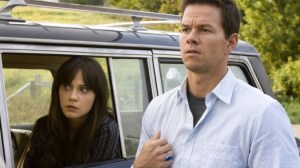 The Happening is no Lady in the Water, thankfully. The premise is pretty interesting in a feature-length Twilight Zone kind of way. Shyamalan does know how to spin an interesting idea and watch social paranoia explode. The best moments of The Happening take place during its beginning where confusion and panic reign. Shyamalan then takes a page from 2005’s War of the Worlds and follows the perspective of a handful of normal folk as the experience an apocalyptic event. We even spend the third act hiding out in the home of a crazy person (the creepy Betty Buckley). Unfortunately, we in the audience feel no involvement with the poorly written main characters. Once again Shyamalan utilizes a horrific and unique encounter as the impetus for reconciling the pains in a marriage. At a scant 99 minutes, there isn’t much time set aside for building characterization. There is not a whiff of personal connection to this tale.
Shyamalan doesn’t seem to explore the psychological ramifications of his premise. Suicide is very traumatizing and it would have swept over the East Coast in waves; millions would be dead. Yet the characters and Shyamalan never seem to focus on this point. Perhaps they’re in shock but no one seems to actually react realistically to the possible end of the world. Normal people would be freaking out. I would be freaking out. The idea that the country goes back to normal after three months is preposterous. Would anyone want to live on the East Coast again after all that death? People would be finding bodies for many months after the “happening;” just look at the slow recovery of New Orleans. Never mind the hit the economy would take from millions of people expiring.
The ecological message can also be incessantly heavy-handed. Characters run past a sign for a housing development that advertises the slogan, “You deserve this.” Oh, gee, I get it. A TV host at the very end interviews a scientist theorizing that what happened was a warning from the environment to shape up and change our ways. The TV host is so incredulous that he actually says, “Well, I’d like to believe you doc, but maybe if it just happened somewhere else again, maybe then I could believe you.” You idiot, millions of people died and there are how many witnesses? I know exactly what message Shyamalan is trying to say (wake up, we can’t ignore the signs) but having a character denying the obvious is too ludicrous given what happens in the story.
 But the story does invite further inquiries. How exactly do the plants communicate with each other? I can understand root structures but how does a bush talk to a tree unless they share root structures? Do plants speak different languages? Can a bush talk with a tree, and do French bushes speak differently than their English brethren? The plants seem to react to large numbers of people, but how do they know when there’s say enough folk running around to kill? Do they smell people? That toxin seems to not affect animals but I don’t see how that could be possible given that, as far as I know, animals inhale the air as well. Of course, if all surrounding animals and insects were to keel over then that would irrevocably harm the ecosystem and endanger the plants. This must be why the “happening” lasts a little over a day, coincidentally ending just when our protagonists are about to give up. And if Mother Nature, as a form of population control, triggers this toxin release then wouldn’t it stand to reason that some place like China or India would be hit first instead of the Northeast United States? Shouldn’t a science teacher know that still air would be filled with more toxins than when the wind blows? I’ll give Shyamalan this — he was able to make me fear a tree. There was one moment where a little girl was on a swing that was bolted into a tree limb and the constant creaking made me nervous that they would anger the tree.
Despite the flaws in storytelling, this narrative still could have worked as is if it just had a better director at the helm. Shyamalan lets everyone down on this one. Much of the marketing angle was how The Happening is Shyamalan’s first foray into R-rated material, but you can tell he doesn’t feel comfortable showing more than implying. One sequence follows a police officer’s gun as different individuals take turns shooting themselves in the head. Shyamalan shoots this sequence like the camera weighed 800 pounds, so the shot never rises above people’s feet. We see the gun fall on the ground, feet walk over to the gun, hands pick it up and lift it off screen, then a very unconvincing gunshot sound effect, then the process repeats. By not actually seeing the deadly aftermath Shyamalan risks the sequence becoming unintentionally funny and it almost happens. This directorial technique does not raise suspense, and in fact, Shyamalan botches most of the potential suspense in The Happening. Given the premise, Shyamalan doesn’t find too many sequences that make the audience squirm. A man wandering around in a lion’s cage is so fake and played in the wrong tone that it just becomes goofy even when his arms get ripped off. There’s only one protracted horror sequence that shows true gore, where a man lies down in the path of a giant lawnmower and we start to see the machine ride over him and whirl its blades. However, even this scene could have gone longer to fully draw out the shock and terror. Shyamalan just doesn’t have the temerity for R-rated material, and as a result the movie could have been a lot more terrifying had the man embraced the gruesome potential of a more mature rating.
Shyamalan’s visual storytelling is pretty rote. I kept thinking to myself how poor everything seemed to be looking. The cinematography is lackluster and the shot compositions are rather bland. Part of what makes a horror movie effective is clever visual setups that slowly leak tension like air from a balloon. Shyamalan’s idea of drawing out tension is to watch tress blow in the wind. After a while, when you realize this is the one trick Shyamalan has, it gets old and extremely boring. The Happening would have benefited from a stronger visual storyteller who could also goose the narrative with better-constructed scares. It’s disappointing because Shyamalan was able to elicit top-notch suspense in 2002’s Signs with simple sounds and the imagination. Now, when he’s given the chance to show terror he falls on his face.
 Another dent to Shyamalan’s direction is the fact that the actors all give bad performances. Wahlberg and Deschanel have given great performances in other movies so I know they are capable of more, and the blame must lie at the feet of Shyamalan. They overact with gusto and always seem to never be fully immersed in the reality of the drama. Even Wahlberg’s first line delivery raises your eyebrow because it seems too amateurish and flat. Deschanel is even worse and whatever emotion she is playing in a scene is the wrong emotion. She’s whiny and overly childlike when she should be reflective and contemplative, she’s wide-eyed and weepy when she should be tender, and she’s bad with just about every line. Alma is a weak character and seems to turn everything back to an injustice against her, even when people are killing themselves en mass. Part of the actors’ woes is complicated by Shyamalan’s wooden dialogue, which includes gems like, “We’ve just got to stay ahead of the wind” (how exactly does one do that?) and, “We’re not going to stand around like uninvolved bystanders” (who says that?). The most shocking aspect of The Happening is that Shyamalan totally betrays the trust of his very competent actors.
M. Night Shyamalan would be best served in the future by focusing on one role. He could direct someone else’s material or he could write and have someone else direct. If he had gone the latter route I’m convinced that The Happening would have worked even with a flawed script. The movie is too timid to push the horror boundaries available to a mature rating, the suspense is minute, and Shyamalan completely leaves his actors hanging out to dry. There is some laugh out loud moments of unintentional hilarity (like when Wahlberg calmly says “Oh no” upon hearing suicidal gunshots), but the movie also has moments of intrigue amidst its heavy-handed environmental message. Statistically, if there were a killer toxin there would be those who would be genetically immune to it, much like the scenario in I Am Legend. I have to say that if I was fortunate enough to survive I would whisper some threatening words to some choice flora and then I would set lots and lots of fires out of revenge. Take that, you stinking vegetation!
Nate’s Grade: C
Share this:

Shooter (2007)
 A passable albeit mediocre action thriller, this humorless tale about an elite sniper framed for a presidential assassination is more interested in the nitty gritty of sharp-shooters than building a credible plot. Mark Wahlberg grumbles through uninspired action sequences but who really draws attention is a villainous Danny Glover. The man has a lisp and carries it until the end of the film, and it is never explained. It’s so weird and distracting and it feels superfluous, like Glover was hard-pressed to make his rote villain interesting, so he thought, “Why not a lisp?” Shooter is more proof to my ongoing assertion that Antoine Fuqua (King Arthur, Tears of the Sun) is a director with little interest in storytelling; he’s studied at the Tony Scott school of Visual Indulgence. The characters are either stock roles or superhuman, and how in the world does a man get pinned for almost taking out the President and then buy mass quantities of weapons with the clever disguise of sunglasses?
Nate’s Grade: C
Share this:

The Departed (2006)
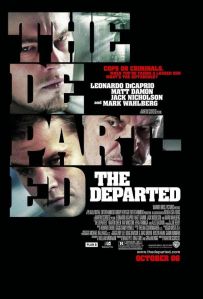 “I don’t want to be a product of my environment,” growls Frank Costello (Jack Nicholson) in the opening seconds of The Departed. “I want my environment to be a product of me.” Without question, the filmmaker that has shaped the environment of movies more than any other in the last 30 years is Martin Scorsese. No one does the cops-and-robbers territory better than Scorsese, and it’s great to have him back on familiar turf. It’s not that Gangs of New York and The Aviator were lacking in directorial skill, it’s just that they felt so labored and reeking of classy awards envy. With The Departed, it all feels so artistically effortless, like Scorsese settled in a zone of brilliant filmmaking. I just hope Marty bangs out more of these excellent gangster flicks before trying again to woo Oscar. In fact, his return to his violent stomping grounds might finally be his long-overdue ticket to the winner’s circle.
The premise is appealingly simple. The Boston State Police Department is desperate to nail local crime lord Costello. They pluck a young recruit, William Costigan (Leonardo DiCaprio), who has a shady family history of small-time crooks. He agrees to infiltrate Costello’s mob and report back to the Boston PD. To make is situation credible, Costigan is expelled from the force and sent to prison to earn a rep. Only two other people know Cosigan’s real identity, the police chief (Martin Sheen) and the head of undercover work (Mark Wahlberg). On the other side of the law, Costello has a mole all his own working inside the Boston State police force. Colin Sullivan (Matt Damon) has quickly risen through the ranks and has a prime position working with the state?s FBI crack force. He’s also an acolyte of Costello’s ever since he was a young Southie kid seeing the draw of power. Now full grown, Sullivan tips Costello and tries to redirect the ongoing investigation to bring the man to justice.
 The real sparks come when both moles try to discover the identity of the other, without compromising their own precarious identities.
The Departed is a bruising, bristling return to form for Martin Scorsese and his most entertaining film since his last Great Movie, 1990’s gangster-rific Goodfellas. This is a movie that crams multiple characters, storylines, and histories into one tight, focused setting, but then the flick glides smoothly on electric storytelling and intense performances. The movie’s twists and turns are, at times, of a knockout variety, and there’s a stretch of late surprises that each feels like a shot to the gut. I was possibly winded from gasping so hard. This is a film so fantastically alive with feeling and vigor that you cannot help but get ensnared. It sets up all the players and back-story before we even get the opening titles set to the blaring wails of the Dropkick Murphies. The thrills are real because we feel the danger, and the onslaught of brutal violence is another rhythmic piece in Scorsese’s masterful conduction. Adding to the feeling is the sure-handed, quick-fire editing of longtime Scorsese collaborator Thelma Schoonmaker and the ominous cinematography of Michael Ballhaus. Even though this film is based on a 2002 Hong Kong film, Scorsese has firmly made The Departed a movie all its own in spirit and personality. No one so easily brings us into the sordid lives of criminals better than this man, who, when in that creative zone of his, brings such palpable energy to his melding of image, song, and consequence, that the results are simply intoxicating. The Departed reminds you why Scorsese is still our greatest living director, no matter what Oscar thinks.
What elevates The Departed from the clutter of other macho men-with-guns crime capers is its studious attention to character. This is a film that works beyond a concept. The movie’s central moral theme is the price of identity. Frank opens the film asking what does it matter who’s holding the gun to your head, cop or crook. Costigan is tormented from wearing too many faces. He’s having trouble justifying his deeds and actions and is scared he may lose his own soul at the price of his lost identity. Sullivan, on the other hand, has gladly sold his own soul for a pittance. He’s a class conscience yuppie that craves power and will cut any throat if it gets him ahead. The movie steamrolls ahead with intrigue but it’s our connections to these characters that elevate the life-and-death stakes. You have a real emotional investment in this story, therefore when things get murky you really feel the danger. My heart was racing with excitement and dread. There may still be impressions from where I was squeezing the movie chair.
 Complimenting these complex characters are brilliant performances. DiCaprio may have been nominated for a Best Actor Oscar for his second Scorsese collaboration, The Aviator, but he turns in his strongest work here. DiCaprio expertly bares a gnawing moral conflict with equal parts desperation and the hunger to do good. He’s trying to finally do right and step out of his family’s criminal past, and DiCaprio brings sharp intensity to this plight. You really feel every stomach churn this guy goes through to do what he does and stay alive. I knocked the boy for being too boyish a gangster in Gangs of New York, and let me say I take back my words. On the flip side, Damon utilizes his angelic, choirboy good looks and masterfully downplays his character’s pragmatic villainy. The character has to hide so much from the outside world, be it the police, his true bosses, his girlfriend, and even himself. Damon goes about his deceitful business with slickly sick ease, tapping a killer’s instinct for self-preservation. You may shudder from how methodically cold and manipulative he comes across. He’s a mesmerizing rat bastard of a human being and yet Damon presents an almost seductive portrait of evil.
Nicholson is equally good though at times can be a distraction to the storytelling. There are a handful of moments where Nicholson seems to go too far off the page, indulging his crazier tendencies. Costello is supposed to be a scary, unpredictable, potentially unhinged man, and Scorsese has plenty of moments that bring home this point. It just feels inappropriate then for Nicholson to, in a few small moments, transform into a goofy cartoon. With that said, it’s great to see Nicholson cracking some heads for Scorsese. He has devilish fun and is insanely watchable while definitely going for broke. After some nice guy roles it’s nice to have back an unrestrained Nicholson to play the film’s abyss of evil.
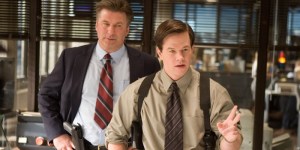
 The collected supporting players all leave some mark. Baldwin and Wahlerg are perfectly profane hardass characters that you warm up to. Sheen, free from the Oval Office, displays nice touches of weariness and, in one moment, practically breaks my heart with his brave resignation. Breaking up this boy’s club is Vera Farmiga (Running Scared) as a somewhat contrived plot point to connect Costigan and Sullivan as the police shrink to one and the girlfriend to the other. There’s a perceived sadness to her willowy eyes and slender face that she plays to great effect. She?s a captivating new face and gives an extra ladling of emotion to the tale.
It’s been over a week since I’ve seen the movie and I still can’t get it out of my head. There are only a handful of flaws that separates The Departed from Scorsese’s rich pantheon of mythically Great Movies. This is a complex, gritty, amazing crime thriller stuffed to the gills with entertainment. Making the bloody body count resonate are the incredibly intense performances, particularly Damon and DiCaprio. This is a gripping gangster thriller pumping with the blood of a sterling character piece. The unexpected twists and turns will shake you, and the movie goes well beyond a snappy premise. The Departed is a moviegoing experience that will thrill you, stir you, sadden you, exhilarate you, and firmly plant itself in your memory banks. Welcome back Marty.
Nate’s Grade: A


 nathanzoebl
You must be logged in to post a comment.