Blog Archives
Lights Out (2016)
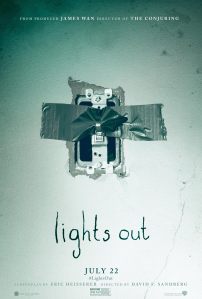 When it comes to horror, concept is king, but what’s just as important is fully developing that concept to meet its potential, and that’s where Lights Out succeeds. This is a low-budget horror movie that taps into a primal fear of the dark with a supernatural entity named Diana that can only be seen outside light sources. Thankfully, director David F. Sandberg smartly thinks of fun and interesting ways to play with this concept, like Diana disappearing in bursts of muzzle fire and a frantic, life-saving use of a car alarm. There’s a great suspense sequence where an off screen light from a flickering neon sign, switching off and on steadily, sets up audience expectations and lingers, drawing out the fear. The editing is terrific. There’s also a surprising subtext tackling the issue of mental illness and depression, as Diana, the malevolent spirit tethered to Maria Bello’s character, only seems to appear during the rougher patches of her life, and Diana fights against Bello getting “better” which weakens her existence. Theresa Palmer (Warm Bodies) settles in as a capable heroine that genuinely cares for her younger brother in danger from her mother and her “friend.” I cared about the people in this. The movie also subverts some genre clichés and treats its handful of characters with credibility. While the very end leaves some questionable final statements on mental illness, Lights Out is an elevated B-movie that takes its fun premise and executes it with aplomb. It’s worth 90 minutes in the dark.
Nate’s Grade: B
Share this:

Prisoners (2013)
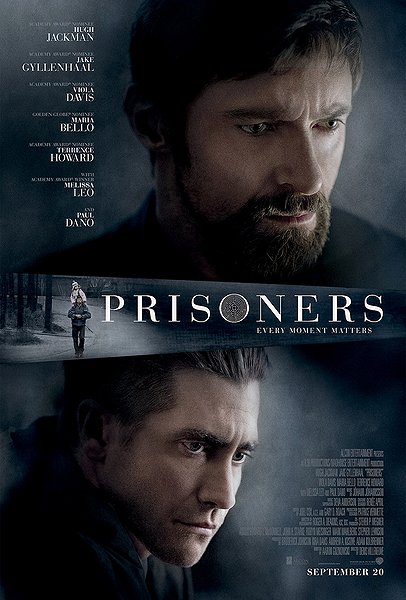 One rainy Thanksgiving day, two little girls go missing. Keller and Grace Dover (Hugh Jackman, Maria Bello) and their neighbors, Franklin and Nancy Birch (Terrence Howard, Viola Davis), discover their two young daughters have gone missing. A manhunt is underway for a suspicious RV, spearheaded by Detective Loki (Jake Gyllenhaal). The RV is found with Alex Jones (Paul Dano) inside. The problem is that there is no physical evidence of the missing girls inside the RV and Alex has the mental capacity of a ten-year-old. He’s being released and Keller is incensed. He’s certain that Alex is guilty and knows where his missing daughter is being held. One night, Keller kidnaps Alex and imprisons him in an abandoned building. He beats him bloody, demanding Alex to tell him the truth, but he only remains silent. Loki has to deal with finding the girls, finding a missing Alex, and trailing Keller, suspicious of foul play.
This is a movie that grabs you early and knows how to keep you squirming in the best ways. The anxiety of a missing child is presented in a steady wave of escalating panic. The moment when you watch the Dover and Birch families slowly realize the reality of their plight, well it’s a moment that puts a knot in your stomach. Prisoners is filled with moments like this, that make you dread what is to come next. The crime procedural elements of the case are generally interesting and well handled to the point that they feel grounded, that these events could transpire, including police mistakes. The central mystery sucks you in right away and writer Aaron Guzikowski (Contraband) lays out clues and suspects with expert pacing, giving an audience something new to think over. At 153 minutes, there is a lot to chew over in terms of plot developments and character complications. It’s a compelling mystery yarn and shows such promise, though the last half hour cannot deliver fully. Fortunately, Prisoners is packed with terrific characters, a real foreboding sense of Fincher-esque chilly atmosphere from director Denis Villeneuve (Incendies) and greatest living cinematographer Roger Deakens (Skyfall). The film’s overall oppressive darkness is also notable for a mainstream release. The darkness doesn’t really let up. It’s hard to walk out feeling upbeat but you’ll be thankful for those punishing predicaments.
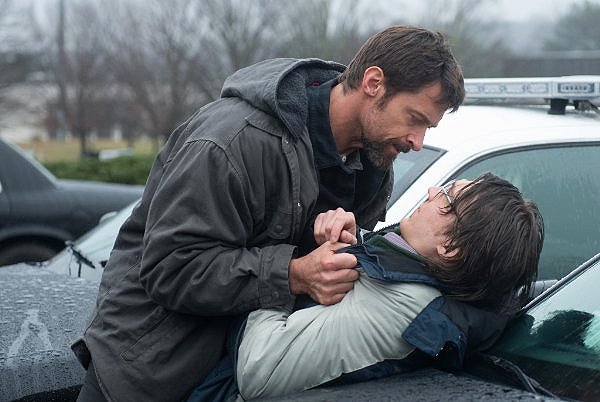 By introducing the vigilante torture angle, Prisoners is given a dual storyline of suspense and intrigue. How far will Keller go? Will he get caught? What will his friends think? Will they be supportive or will they crack? How does this change Keller? That last question is the most interesting one. Others tell us how Keller is a good man, and he’s certainly a devoted family man, but does a good man imprison and torture a mentally challenged man? Does a good man take the law into his own hands? If it meant the difference between your child being dead or alive, how far would you go? These are the questions that bubble up and the movie makes you deal with them. The torture segments are unflinching and challenge your viewer loyalty. You will be placed in an uncomfortable moral position. Then there’s just the what-would-you-do aspect of the proceedings. Could you torture someone, possibly to death? Fortunately most of us will never have to find out. I do wish, however, that the movie had gone further, complicating matters even more severely. It becomes fairly evident halfway through that Alex is innocent. It would have been even more interesting to intensify Keller’s legal troubles. If the police have their man, what does Keller do with Alex? Does he let him live after everything Keller has done? I think it would have worked as a logical escalation and put the audience in an even more uncomfortable position, forcing us to question whether Keller deserves to get away with what he did or pay a price.
What separates Prisoners from other common thrillers, and what must have appealed to such an all-star cast, is the raised level of characterization on display. Jackman’s (Les Miserables) intensity is searing, as is his character’s sense of pain and futility. By all accounts, this is the best acting work Jackman has done in his career. Keller’s determination is all consuming, pushing away his doubts with his reliable pool of anger. Everyone is failing him so he feels he must take matters into his own hands, and the film does a fine job of relating his frustrations and urgency. But Keller is also in danger of derailing the ongoing investigation, becoming a liability to finding his daughter. This predicament pushes Loki into the tricky role of having to defuse parental intrusion, pushing him into a role he loathes, having to tell a harrowed father to back off. Loki is also consumed with the case, causing plenty of internal tumult and chaffing with the inefficiency and miscommunication of the police force. Gyllenhaal (End of Watch) doesn’t play his character big; he keeps it at a simmer, with hints of rage below the surface. His character is certainly richer than the Driven Cop we’ve often seen. His character is given less moral ambiguity but you feel his frustration working within the system and hitting dead ends. These two performers are both ticking time bombs.
The rest of the supporting cast has a moment or two to shine, though the characters are given less to work with. Bello (Grown Ups 2) is hastily disposed of from a plot standpoint by making her practically comatose with grief. Davis (The Help) knows how to make the most of limited screen time (see her Oscar nominated performance in 2008’s Doubt as evidence), and she’s heartbreaking in her moments of desperate pleading. Howard (Lee Daniels’ The Butler) is meant as the foil to Keller, a voice of moral opposition, but Howard lets the gravity of his involvement in horrible acts hit you hard. Dano (Ruby Sparks) has the toughest part in many ways because of his character’s brokenness and the fact that he’s being tortured so frequently. It’s hard not to sympathize with him even if part of you suspects his guilt. Naturally, Dano is adept at playing weirdos. Melissa Leo (Olympus Has Fallen) is nearly unrecognizable as Alex’s older aunt caring for him. She’s prepared for the worst from the public but has some nice one-on-ones where she opens up about the difficulty of losing a child herself.
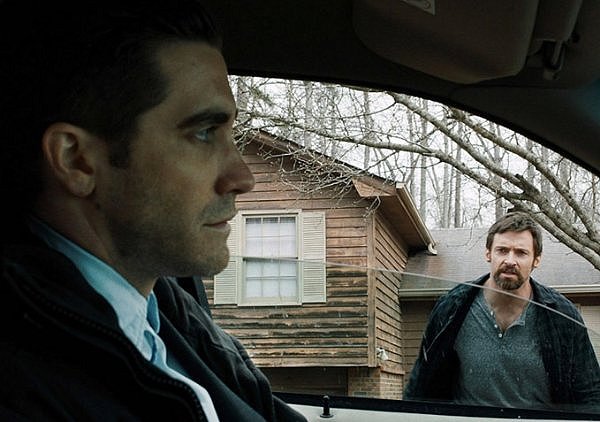 Prisoners is such a good mystery that it works itself into a corner to maintain it, ensuring that no real answer or final reveal will be satisfying, and it isn’t. I’m going to tiptoe around major spoilers but I will be delving into some specifics, so if you wish to remain pure, skip ahead. The culprit behind the child abductions, to put it mildly, is underwhelming and rather obtuse in their wicked motivation. The specified reason is to test people’s faith and turn them into monsters by abducting their children. This comes across as an awfully nebulous philosophical impetus, and it’s a motivating force that I find hard to believe even in the grimy, dark reality the movie presents. It just doesn’t feel grounded, more like a last-ditch conclusion to a TV procedural. However, what makes this ending worse is the false turns and red herrings that Prisoners utilizes. Every mystery requires some red herrings but they need to seem credible, and if executed properly, the characters will learn something useful through the false detour. The issue with Prisoners is that it establishes a secondary suspect that is so OBVIOUSLY the guilty guy, compounded with plenty of incriminating evidence including the missing children’s clothing covered in blood. When this suspect comes undone, his sketchy behavior starts to become a series of contrivances. They introduce a character that is too readily the guilty party, and then they just as easily undo him. And here’s another character of questionable motivation. Plus, there’s the central contrivance of having two characters that remain mute under all torturous circumstances unless the plot requires them to say something that can only be interpreted in an incriminating manner. These mounting plot contrivances, and an ending that wants to be ambiguous but in no way is, rob Prisoners of being the expertly crafted thriller it wants to be. It still hits you in the gut, but you’ll be picking it apart on the car ride home.
Grisly, morally uncomfortable, and genuinely gripping, Prisoners is a grownup thriller that isn’t afraid to go to dark places, with its characters and its plot. It hooks you early and keeps you on the hook, pushing its characters to make desperate decisions and asking you to think how you would perform under similar pressure. It’s a fascinating meta game and one that also adds extra intrigue to a rather intriguing mystery. It may not be revolutionary, but Prisoners is an above-average thriller with strong suspense and characterization. Where Prisoners stumbles is how it brings all this darkness to a close. The ending is rather perfunctory and not terribly satisfying; perhaps no ending would have been truly satisfying given the setup, but I’d at least prefer an alternative to the one I got, especially since it feels less grounded than the 140 minutes or so beforehand. It’s an ending that doesn’t derail the movie, but it certainly blunts the film’s power and fulfillment. Then again perhaps a word like “fulfillment” is the wrong term to use on a movie that trades in vigilante torture and the cyclical nature of abuse. In pursuit of perceived justice, what are we all capable of doing? The answer is likely surprising and disheartening for many, and Prisoners deserves credit for pushing its audience into uncomfortable positions and reflections.
Nate’s Grade: B
Share this:

Grown Ups (2010)
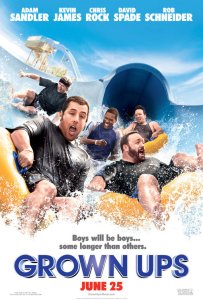 Adam Sandler keeps his friends from the unemployment line with this lowbrow, middle-aged themed, yet still entirely juvenile, comedy, Grown Ups. The movie is really a giant fetid waste of potential. It’s Sandler and his old Saturday Night Live buddies (David Spade, Rob Schneider, Chris Rock, and Kevin James obviously filling the Chris Farley spot) chumming it up and decrying the foibles of being 40. They don’t get the kids today, nostalgically reflect on their summer camp days, and try to recreate some of that old magic with a combined family get-together. Each man falls into a rigid type and will learn some half-hearted, disingenuous form of a life lesson by film’s end. The entire dimwitted plot is as stunted as the male characters. These guys just pal around and it’s termed a movie. The female characters are all one-note: figures of lust, saintly significant others who never get to be in on the joke, shrews, or Schneider’s older wife who is a constant butt of some mean-spirited jokes. The actors do have an amiable chemistry that allows the film to coast for some time before the whole affair just becomes wearisome. These guys have played these types for many many movies, and so everyone just operates on autopilot. The heavy slapstick momentarily distracts from the truth that Grown Ups is an unfunny, crass attempt by Sandler to get audiences to pay for his class reunion. The fact that this junk won the Best Comedy Award from the People’s Choice Awards illustrates the limitations of democracy.
Nate’s Grade: D+
Share this:

The Mummy: Tomb of the Dragon Warrior (2008)
 The Mummy: Tomb of the Dragon Emperor, the third film in the once popular Mummy franchise, is facing an uphill battle. It’s been a long seven years in between films and some, like myself, would argue that the franchise is already creatively exhausted. This stuff is the brainchild of writer/director Stephen Sommers (Van Helsing), who decided he would rather make a movie based upon an action hero than rehash mummies (see you this summer, G.I. Joe: The Movie). In comes director Rob Cohen who has given the world such cinematic abominations like XXX, Stealth, and The Fast and the Furious. Surely this was the proper artist to re-energize a semi-dormant franchise. The results are about as unexceptional as you’d expect.
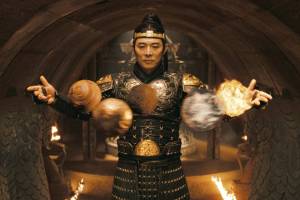
In 1947, Rich O’Connell (Brendan Fraser) and his wife Evie (Maria Bello, replacing Rachel Weisz) are in retirement from adventure seeking. They live at a palatial estate. Their son Alex (Luke Ford) is in college except they do not know that Alex is really surveying ancient tombs in China. The lad has stumbled across the massive tomb of Han (Jet Li), China’s first united emperor. Han was a ruthless warlord that conquered all. He punished Zi Juan (Michelle Yeoh) for falling in love with one of his generals and not the mighty emperor. Zi Juan managed to cast a spell on the evil emperor that trapped him in metal. And he sat undisturbed in his tomb for 2,000 years until Alex came along. Eventually the spirit of Han is released and some Chinese military officials wish to serve their departed emperor. Han is seeking the location to Shangri-La to bathe in the pool of immortality, and then he will awaken his army and continue his quest for world domination. The Far Eastern exploits bring the O’Connell family unit together to save the world yet again.
 The first film was a cheesy, campy tongue-in-cheek adventure that managed to be consistently entertaining. The second film retained the same fun and humorous atmosphere, though it subscribed to the “bigger is better” theory of sequels and ramped up all the action to a cartoonish degree. Seven years later, the third Mummy movie is a complete bore. Tomb of the Dragon Emperor feels like two movies sewn together; ancient Chinese warlords and treasure-hunting archeologists do not come across as a good fit. The terracotta warriors are a great source for an imaginative tale, but this is not it. So Emperor Han has mastered the elements of fire, water, earth, metal and wood (when did wood become an element? I don’t see that one on the periodic table) and the guy can also turn into giant monsters like a three-headed dragon. The writers of this Mummy entry have goofed by making the villain too powerful. Yeah he can be slain by a magic sword (there’s always something magic-y) but this is a foe that can control oceans, water vapor, clouds, rain and snowstorms, ice shards, and that’s just with one element. I must confess that I cannot fathom Han getting too much use from the wood element. On top of that, he can transform at will into ferocious creatures, so what is the point of turning back into a tiny human? Why would anyone fight hand-to-hand when you could fight as a 30-foot monster of your own design? The problem with making the villain too powerful is that when they do not take advantage of their clear advantage, then the villains just look stupid. “The Dragon Emperor” looks stupid for fighting as a 5′ 6″-sized man instead of a killer dragon. Which would you fight as? At least the Mummy from the other films had limitations.
Even worse than being incomprehensible and dumb, none of the action sequences are thrilling or exciting. The action sequences are fairly sub par, resorting to shootouts and the occasional car chase. At least a car chase through the streets of Shanghai during Chinese New Year takes advantage of the location, allowing Rick and Evie to use firecrackers like missiles. The martial arts work is poorly choreographed and poorly presented thanks to some butchered editing. This is one of the worst edited big-budget films of recent memory. Tomb of the Dragon Emperor seems to be making it up as it goes. There are moments where characters will state where they need to travel to and then in the next second they’re preposterously there. Someone talks about the path to the hidden land of Shangri-La and then the next moment, hey, there they are. How did these places remain hidden for centuries? Very little makes sense in this movie. I’m not asking for complete believability in a film involving immortal bad guys and ancient spells, but at least let me able to follow along. I felt like I could tag along with the first two Mummy films and I had fun to a certain degree, but this time I felt like I was being dragged. I won’t even go into great depth about the appearance of yetis except to reveal that there is a moment where one yeti dropkicks a Chinese soldier over a gated wall and another yeti raises his arms straight in the air, signaling in football terms that it is indeed “good.”

Rachel Weisv not pictured.
Once again it all comes down to an all-out CGI battle between Han’s CGI army and the CGI zombie opponents buried under the Great Wall of China. The second Mummy movie ended in a similar fashion, and frankly I’ve become bored with the CGI armies clashing en masse unless I’m emotionally invested in the story. The effects work isn’t too fancy either. Most of the CGI creatures look flimsy and there’s nary a sense of wonder for a movie dealing with awesome supernatural forces.
The cleverest moment in the entire film involves the departure of Rachel Weisz. The Oscar-winning actress decided that she had had enough rumbles with the undead and bowed out of reprising her character of Evie. Smart move, lady. The film opens with Evie reading to an audience from her adventure novel based upon her encounters with a certain mummy. A woman asks her if the book’s female heroine is based upon the real-life Evie. She closes the book, smiles, and says in Bello’s first close-up that, “No. I can honestly say that she is a completely different person.” It’s all downhill from there for Bello, whose terrible British accent veers wildly to the point that she sounds like eight different kinds of Brits inhabiting one mouth.
The Mummy franchise is not where I go looking for parental drama. I understand that the 2001 Mummy sequel introduced Rick’s son, but why did this movie need to be set so far ahead in the future? The only reason this movie is set in 1947 is so that Alex can be like a twenty-something adventurer. The Mummy Returns was set in 1933 and Alex was eight years old, so by use of basic math he is now 22. There is no other prominent plot point, character revelation, or action set piece that relies on the date being 1947. Okay, so we’ve arbitrarily aged the kid, so surely the film will present some parental dilemma. Nope. The closest the movie gets to capitalize on Alex’s advanced age is pushing Rick to acknowledge his son’s accomplishments. The film’s idea of exploring family dynamics is a passing statement about making sure to express your love. Nothing is really gained by inserting the familial connection between Rick and Alex, who just as easily could have been a non-blood related character.
 The inherent issue with an older Alex is that Fraser and his son look about the same age. Fraser has remarkably aged very little over the course of nine years since the first Mummy movie; sure there’s a few facial lines and a hardness that wasn’t there, but this man clearly looks like he is in his late 30s. Alex looks like he’s in his mid-twenties and the actor, Ford, is actually only 13 years younger than Fraser. It just doesn’t work at all. It looks like Rick and his younger kid brother, not his son. But lo, I think I have figured out the true reason behind position Alex as a younger, dashing version of Rick O’Connell, dispatcher of mummies. Fraser’s three-picture deal was fulfilled by this mediocre movie. If the producers want to have further mummy and non-mummy escapades, they have targeted Alex as their leading man of derring-do.
I like Fraser, I like him in these kinds of movies, but even he feels like he’s running out of gas with Tomb of the Dragon Emperor. The location switch from Egypt to China fails to give the franchise a new kick. The Chinese martial arts material bookends the movie and seems out of place, let alone poorly designed. Jet Li must have had a great time cashing his check because the kung-fu master appears for like 15 total minutes as himself. The lackluster action, questionable plotting, cardboard characters, and dearth of enjoyment make this a sequel a potential franchise killer. The tongue-in-cheek energy and cheesy fun of the other movies is completely absent. You can forgive stupid when it’s fun, but stupid and boring is a deadly combination for a huge effects-laden action movie. Hopefully The Mummy: Tomb of the Dragon Emperor will serve as proof that bad jokes, bad visuals, bad editing, bad plotting, and bad accents do not somehow go vanish because of lingering goodwill from previous films. This is one movie that should have stayed buried.
Nate’s Grade: C-
Share this:

Assault on Precinct 13 (2005)
 It seems that in American cinema, we have a long history of people being holed up in one location and fighting off outside forces. There’s instant drama in fending off forces that outnumber you, and Hollywood knows this. There are historical dramas (The Alamo), fantasy flicks (Lords of the Rings), and nearly every other horror movie (Night of the Living Dead) that have a central conceit of the good guys being outnumbered and with no place to go. Assault on Precinct 13 (a remake of the 1976 John Carpenter cult film) is the latest in this mini-genre. The film has big stars like Ethan Hawke, Laurence Fishburne, Gabriel Bryne and a mustachioed Brian Dennehy (there really should be no other kind) but even star power with facial hair can’t stop Assault on Precinct 13 from feeling run-of-the-mill.
On New Year’s Rockin’ Eve, Sergeant Jake Roenick (Hawke) is left to tidy up precinct 13, which will be shut down in days. The precinct secretary (Drea De Matteo) and seen-it-all veteran Jasper (Dennehy) will keep Roenick company. But alas, they have more company than they expected. A bus transporting prisoners makes an emergency stop at the precinct because of a blizzard. The bus has three small time criminals (John Leguizamo, Ja Rule, Aisha Hinds) and one very big fish, crime kingpin and cop killer Marion Bishop (Fishburne). Late in the night the precinct is besieged by a team of dirty cops led by Marcus Duvall (Byrne). It seems Duvall and his squad of corrupt cops have had many deals with Bishop, enough that they can’t let him live. Jake takes command of the precinct’s motley crew, prisoners included, and attempts to have everyone work together to fight off the invading forces.
 Hollywood upped the budget for this remake but they also upped the plot holes to match the firepower. How are the bad cops going to explain all those dead police officers in commando outfits? There’s likely enough forensic evidence everywhere to point a finger at the long arm of the law’s involvement. I suppose they could have burned the whole place down when they were done, but to paraphrase that great philosopher Ricky Ricardo, “Luuuuuucy, you got some ‘splainin’ to do.”
The acting is a non-issue. Hawke and Fishburne get to trade cool glances, Matteo gets to shake her Sopranos Joisey accent, and Dennehy gets to eat any scenery that isn’t bolted to the ground. I have no idea what Leguizamo was going for. His disturbed junkie performance reminded me of Mr. Ed, because whenever he spoke it looked like Leguizamo’s lip was being pulled up by an invisible string. Some may call this acting; I call it fun to watch.
Assault on Precinct 13 is constructed from so many familiar action elements you may think you’ve seen this movie before. Hawke plays a cop haunted by a bust gone wrong that, surprise, killed his partners. When the siege does go down, of course everyone can pick up a weapon (even a 1920s Tommy gun) and instantly become a trained marksman. There’s the whole “who can we trust” plot element that spurs Mexican standoffs between the cops and the crooks. All the characters are stock types, from Hawke’s reluctant hero, to Matteo’s saucy secretary, to Dennehy’s single-minded hothead to Fishburne’s calm and collected criminal mastermind badass. When a character opines a theory that someone on the inside is really working for the dirty cops, you should be able to immediately follow the falling anvils.
 Even when it comes to the action, Assault on Precinct 13 is too familiar. Because nothing interesting is going on inside the precinct, the audience relies on the spurts of action for their money’s worth. It all gets a little bland after awhile. Cops try breaking in. They get shot. They try breaking in with more cops. They get shot. Granted, replace “cops” with “monsters” and you have 30% of horror movies. There needs to be escalating action and some overall cause and effect with the plot, especially with action movies set in one isolated locale. In Assault in Precinct 13, rarely does the previous moment matter because both sides seem to shrug and move on. The only notoriety director Jean-Francois Richet brings to the action is a peculiar fetish for long takes of fresh head shots. He does enjoy the slow trickle of blood out of a bullet to the cranium (I counted 5 times; turn it into a drinking game at your own danger).
Assault on Precinct 13 is indistinguishable from what Hollywood pumps out every day. The characters are stock, the dialogue is short but stale, the plot holes seem to swallow the film whole, and, most tragically, the action seems meaningless except when paring down the cast (there’s a ten-minute whirlwind that cuts the good guys in half). People hungry for action might find something worthwhile but most will probably walk out of the theater with the same shrug the actors seem to exhibit. Assault on Precinct 13 is a routine action flick that replaces escalation with excess.
Nate’s Grade: C


 nathanzoebl
You must be logged in to post a comment.